




Abstract
Scholars have long recognized that national identity-related factors are among the strongest predictors of citizens’ attitudes toward the European Union. But while some find that they reinforce support for the European Union, other scholars show that national identity undermines its support. In this article, we aim to disentangle this puzzle by studying how the national identity profiles of European citizens relate to support for the European Union across individuals and member states. To this end, we employ data from the International Social Survey Program 2013, by far the most extensive collection of survey questions on national identity, and the technique of latent class analysis. Our results show which specific configurations of national identity entail support, ambivalence or rejection of the European Union, their antecedents, and their variation across countries.
Introduction
Repeated shocks such as the deep and long-lasting economic crisis and the ‘refugee crisis’ have brought issues of identity, tolerance, solidarity and cooperation to the forefront of political, popular and academic debates virtually in all European countries. One of the consequences of these developments is the surge in what has been called ‘the politics of nostalgia’ and the growing success of populist parties across the ideological spectrum that especially target the European Union (EU) for the malaises of their countries. There are clearly tensions between, on the one hand, nativist populism whose main goal is to defend the national identity and, on the other hand, the pluralist essence of Europe where nationalities with different histories and socio-cultural backgrounds are asked to cooperate and help each other. In this conflictual climate, citizens’ recalling of the nation and of national identification challenges the EU as a political project and puts EU support under pressure (e.g., De Vries, 2018; Lefkofridi and Schmitter, 2015).
Public support for the EU has many sources (see Hobolt and De Vries, 2016), but one of these sources has received growing attention in recent years: individuals’ attachment to their nation or – more generally – their national identity (e.g., Carey, 2002; Hooghe and Marks, 2009; McLaren, 2002, 2006). National identity has been interpreted in different ways, yet, strong support has been found for the proposition that the intensity of feelings toward one’s country (Blank et al., 2001), the level of attachment to the nation in relation to other territorial entities (Carey, 2002; Christin and Trechsel, 2002), and the fear of other identities and cultures threatening the dominant culture of the nation (Azrout et al., 2011; Kentmen-Cin and Erisen, 2017; McLaren, 2002), all relate negatively to support for the EU and potentially undermine the legitimacy of the EU project (e.g., Easton, 1975; Lipset, 1960). Over time, however, the literature has come to realize that national identity and EU support do not necessarily exclude each other (Cram, 2009). This has meant the recognition that national identity is double-edged (Diez Medrano, 2003) and can both strengthen (Citrin and Sides, 2004) and undermine (Luedtke, 2005) EU support. Thus, national identity seems not to be an obstacle per se for the support of the European integration process (Hooghe and Marks, 2005, 2009). But how can national identity both reinforce and undermine support for the EU?
In this article, we aim to disentangle this puzzle and examine the relationship between national identity and EU support in detail. While national identity is increasingly debated in the public sphere, its conceptualization and its relation to EU support remain understudied. This examination goes beyond the one-dimensional conceptualization of national identity, often employed in the existing literature. Specifically, in a first step we examine how different dimensions of national identity – patriotism, chauvinism, ethnic and civic conceptions of nationhood – relate to EU support by developing an empirically-based typology of varying national identity profiles of European citizens. Using these profiles, in a next step, we investigate variations across countries and study their antecedents. In keeping with the topic of this special issue (see Clark and Rohrschneider, 2021), and especially the articles by Curtis and Miller (2021) and Rooduijn et al. (2021), the overall aim of our query is to unveil how support for the EU coexists with European citizens’ national identity dimensions, which identity profiles can be deduced from there and what their antecedents are.
We use individual-level data from the International Social Survey Progamme (ISSP) National Identity III (2013), to the best of our knowledge the only cross-national survey that includes simultaneously questions on public support for the EU as well as national identity and its different conceptions. For the analysis, we rely on a latent class analysis, a classification technique that, broadly speaking, clusters groups of individuals together. These groups share a common pattern of identity attachments toward their nation in combination with EU support. This allows us to identify clusters of Europeans along various national identity profiles. 1 It thus serves as a valuable tool to detect and describe attitudinal – in our case national identity – compositions and inconsistencies among survey respondents, and as such will allow us linking the different components of national identity to EU support.
Our results show that EU citizens hold different identity profiles. The varying combinations of national identity dimensions explain why overall national identity is not an obstacle per se for the support of the European integration. In particular, we find that, while for certain groups of European citizens identity-related factors will not necessarily undermine the support for the EU, facets of their national identity put a brake on EU support for the majority of European citizens. We can also observe that identity profiles differ substantially between Eastern and Western Europe with certain profiles occurring more or less often along this geographic division. With regards to the antecedents, the variables more strongly associated with variation in identity profiles are age, education, and migration background, while we find smaller differences between occupational classes, migration background and the urban/rural divide.
Overall, the arguments and findings presented in this study have important implications for our understanding of the relationship between EU support and national identity. First, our findings are theoretically important as they improve our understanding of how differently citizens conceive national identity. Second, they show which national identity dimensions correlate positively and which ones relate negatively with EU support, resulting in different identity profiles of citizens. Third, they show differences both between countries and across individuals. Hence, our results speak to current debates on solidarity, tolerance, demarcation, and nationalization within and across EU member states, and help us identify when, where and for whom certain patterns are to be expected. In sum, we contribute to a better understanding of identity politics and its relationship to the (future) European integration processes.
Foundations of EU support and the puzzle of national identity
Scholars and pundits largely agree that the future of the EU and the possibility to deepen and widen the European integration process largely depend on the approval of its citizens (Treib, 2014). Given that public opinion about Europe is central to the development and existence of the EU (Carrubba, 2001), it is essential to study the factors that affect citizens’ support for the European project.
For a long time, cost-benefit considerations have been regarded among the most important sources of support for the EU: the existing literature has shown that those citizens benefitting the most from the European integration process are also more likely to support it (e.g., Anderson and Reichert, 1995; Gabel, 1998; Gabel and Palmer, 1995; Tucker et al., 2002). In recent years, though, growing attention has been dedicated to identity-related factors (Carey, 2002; Hooghe and Marks, 2009; Kritzinger, 2005; McLaren, 2002, 2006).
The focus within this strand of the literature is on the individual’s attachment to her nation. As the EU has continuously evolved from an international organization aimed essentially at trade liberalization to one concerned with both economic and political wide-ranging competences, the identity-related approach has become increasingly important (Hobolt and De Vries, 2016). In this regard, European integration may be seen as a force eroding national self-determination and blurring the boundaries between national communities (Kriesi and Lachat, 2004) so that a strong attachment to one’s nation was expected to relate negatively to EU support. National identification was hence often considered an obstacle to the development of a fully-fledged EU support, necessary to obtain legitimacy by its citizens. McLaren (2002, 2006) shows that those people concerned with their language disappearing, or their national identity and culture becoming less distinct, hold a more negative view of the EU. Furthermore, existing studies find a strong negative link between negative attitudes toward out-group members (e.g., anti-immigration attitudes), and support of the EU (e.g., De Vreese and Boomgaarden, 2005; Hobolt et al., 2011; Kentmen-Cin and Erisen, 2017; Kuhn, 2011;). These findings point toward the theoretical argument that, when the relevance of national identity is sustained by in-group favoritism (toward the own nation) and out-group derogation, it will negatively relate to EU support (see also Clark and Rohrschneider, 2019).
Another strand of research has, however, shown that EU support and national identification are not necessarily mutually exclusive (Cram, 2009). Citizens can, in different moments of their lives, hold multiple identities. Various identities can exist side by side, such as different norms and values (Duchesne and Frognier, 1995) or different memberships and social positions (Kohli, 2000). They can also overlap capturing different types of identities, like national and regional ones also including a European identity (Kuhn and Nicoli, 2020). The phenomenon of holding more than one identity is known in the existing literature by different names, such as ‘multi-level identities’ (Nicoli et al., 2020), ‘nested identities’ (Diez Medrano and Gutiérrez, 2001), ‘layered identities’ (Laitin, 2001), ‘hybrid’ identities (Citrin and Sides, 2004) or ‘entangled identities’ (Ichijo and Spohn, 2005). Being either complementary to or reinforcing each other, multiple identities allow citizens to simultaneously feel attached to their nation state and to support the EU.
Hence, while part of the literature sustains that national identity is the gravedigger of the European integration process, another strand claims that national identity may not necessarily undermine EU support, but may even sustain it (see also Hooghe and Marks, 2005, 2009). To address this ambivalent finding on the relationship between EU support and national identity, we propose to go beyond the one-dimensional, arguably simplistic conceptualization of national identity offered in the existing literature as discussed next.
The multidimensionality of national identity and EU support
Tajfel (1978: 63) defines social identity as ‘that part of an individual’s self-concept which derives from his knowledge of his membership of a social group (or groups) together with the value and emotional significance attached to that membership’. When applied to international relations, the nation represents the core of individual social identities (Hjerm, 2001; Mansfield and Mutz, 2009). As with all social identities, national identity is a generic concept that reflects different aspects of an individual’s relationship with or attachment to her nation (Blank et al., 2001).
In general terms, national identity describes the intensity of feelings and closeness toward one’s own nation (Blank et al., 2001). Although regional and global identities, such as the EU, are becoming increasingly relevant today, nations are still the core of individual social identities (Hjerm, 2001; Mansfield and Mutz, 2009). However, how the relation between the individual and the nation is structured can vary substantially, as significant differences in the way individuals understand their national identities have been detected (e.g., Baycroft and Hewitson, 2006; Davidov, 2009; Kunovich, 2009).
Specifically, in social psychology, national identity has generally been conceptualized as a two-dimensional construct with an ‘exclusive’ and an ’inclusive’ aspect to it (e.g., Davidov, 2009; Schatz et al., 1999). The exclusive aspect of national identity has been labeled ‘chauvinism’ or ‘blind patriotism’, referring to feelings of superiority or hostility toward other nations or cultures (Blank and Schmidt, 2003; Kosterman and Feshbach, 1989). From this point of view, national identity is characterized by an idealization of the nation coupled with a feeling of national superiority and an uncritical acceptance of and loyalty towards national, state, and political authorities (Blank and Schmidt, 2003). The inclusive aspect of national identity has been labeled ‘constructive patriotism’, ‘positive patriotism’ (Schatz et al., 1999) or ‘constitutional patriotism’ (Habermas, 1996). It refers to positive feelings toward the own country that are associated with civic national pride based on being proud of the country’s political institutions, culture, economy, and social welfare system (Hjerm, 1998). Hence, it is defined as inclusive aspect of national identity since it represents a positive identification with a nation’s social, economic, and political achievements without implying a critical stance toward the out-groups (Blank and Schmidt, 2003; Brown, 2000).
Quite differently, the literature in political science has usually put attention to the citizenship dimension of national identity distinguishing between a ‘civic’ and an ‘ethnic’ conceptualization of nationhood (Kohn, 1944). 2 Such distinction is rooted in Meinecke’s (1970) study of the divergence between those nations brought together by some shared cultural heritage, and those nations that are based primarily on the unifying force of a common political history and constitution. Civic citizenship is based on a form of social contract that in principle is open to all who wish to adhere to it, while ethnic citizenship is described as an ethnic community in which inclusion is based on descent. In other words, while ethnic citizenship refers mostly to having national ancestry, for civic citizenship the most important criterion is to obey national (constitutional) laws. Other authors define this ethnic conception of citizenship as culturalism, which is the belief that the boundaries of the nation are defined by ‘cultural markers’ (Herrmann et al., 2009). In sum, ethnic citizenship conceptions stress the importance of national identity as being defined by cultural similarity and ethnic communities, while civic citizenship can be much more easily ‘earned’ by those respecting the country’s constitutional rules. Although conceptually different, it should be noted that, empirically, people’s attitudes underlying the inclusive and exclusive elements of national identity are usually positively and moderately correlated (Davidov, 2009; Reeskens and Hooghe, 2010; see also the Online appendix).
From both the social psychology and political science literature it is, however, clear that national identity should be conceived as a multi-dimensional concept including the components of chauvinism, patriotism, ethic and civic citizenship and with individuals possibly holding different identity profiles resulting from the combinations of these identity-related components (Davidov, 2009). But how can these different national identity profiles be related to EU support?
The EU project challenges the idea of nation states and the very definition of who we are and where we come from (Habermas, 1999), it undermines the nation state by forcing nations into a homogenizing process (Kriesi et al., 2008), and it increases immigration of people who are heterogeneous from a cultural point of view (De Vreese and Boomgaarden, 2005; Hobolt et al., 2011). This means that the EU project touches upon different components of national identity simultaneously (see also Diez Medrano, 2003). In the specific, we expect individuals whose national identity profile is largely determined by inclusive aspects, i.e., patriotism, to be positively oriented towards the EU, whereas citizens with identity profiles sustained by exclusive aspects, i.e., chauvinism, to consider the European integration project more skeptically and hence, to show on average lower levels of EU support. This is due to the fact that, as discussed previously, patriotism represents an inclusive national identity component that does not necessarily refuse integration to or collaboration with other nations. Furthermore, pride on national achievements can easily be extended to the economic and cultural achievements the EU has obtained and stands for (e.g., democratic values like freedom and equality, the rule of law, respect for human rights, etc.). National patriotism should thus be positively related to EU support. On the other hand, chauvinism should be negatively associated with EU support due to its nature of demarcation and feelings of superiority. Chauvinism may create fears that blurring boundaries between EU member states allow ‘out-groups’ to become part of one’s nation and the ‘ideal’ national political sovereignty is undermined as EU institutions take over.
With regard to citizenship, we expect endorsement of ethnic citizenship to be negatively related to EU support. In turn, an identity profile that reflects support for civic citizenship might correlate positively with individuals’ support for the EU. In fact, the EU as a project provides a new possibility to define who is part of the in-group (e.g., nationals), and who is part of the out-group (e.g., other EU nationals or non-EU nationals). Hence, the more in-group-out-group-oriented national identity is conceived (i.e., endorsement of ethnic citizenship), the more negatively it should be associated with EU support. In this view, other EU citizens cannot be part of one’s nation state as inclusion is based on descent. The introduction and enforcement of EU rules (e.g., freedom of movement) however, could undermine this. Vice versa, we expect that the more inclusive-oriented national identity is conceived (i.e., endorsement of civic citizenship), the higher the EU support. The EU adds a new lawyer of a social contract that is open to everyone.
Looking jointly at these national identity dimensions, we come up with several expectations. We assume that citizens who place importance on all these national identity dimensions – patriotism, chauvinism, ethnic and civic citizenship –, and thus show an encompassing national identity, will tend to have mixed feelings towards the EU. While certain parts of this encompassing national identity would certainly be open towards the EU, others thwart this, most likely resulting in an average to lower EU support. Meanwhile, those citizens placing higher importance on exclusive identity dimensions and downplaying inclusive aspects will be the strongest opponents of EU integration. The opposite should be the case for those citizens who prioritize inclusive over exclusive aspects: there, dimensions of national identity should go hand in hand with higher support of the EU. Lastly, those citizens who lack any profound attachment to their nation could unfold in two groups. On the one hand, not possessing any positive feeling toward one’s nation might hinder these citizens to develop support for a supranational political institution such as the EU. On the other hand, however, negative feelings toward one’s nation state might result in higher support of the EU as hopes and more positive notions are transferred to the supranational institution (e.g., Kritzinger, 2003).
The existing literature also indicates clear differences across countries in terms of national identity profiles. Diez Medrano (2003) argues that national histories are crucial in resolving conflicting expectations between national identity and EU support. In his seminal study, Diez Medrano found that British Euroscepticism is rooted in Britain’s history of empire, whereas West German and Spanish pro-Europeanism reflects very different roots, i.e., World War II guilt and need for modernization and democratization, respectively. The components of national identity capturing different latent structures might be also relevant in the distinction between Western and Eastern Europe, i.e., older and new member states, respectively. In fact, Kohn’s (1944) basic argument was that in Western Europe members of the nation were already ‘unified by their equal political status’ (see Shulman, 2002: 555), which created a strong focus on the civic motive of nationhood. In contrast, the borders in Eastern Europe were settled after the rise of nationalism or ‘the nation preceded the state’, which created a strong focus on the ethnic/cultural motive of nationhood. Despite critiques of the conceptual demarcation between Western-civic and Eastern-ethnic (e.g., Ceobanu and Escandell, 2008; Shulman, 2002), the civic-ethnic framework reflects an important distinction between Western and Eastern Europe, which becomes apparent by a stronger relation between national identification and the ethnic component in Eastern Europe (Ariely, 2013). Yet, also Western European nation states differ in the extent to which citizenship regimes are shaped by criteria of descent (e.g., forms of jus sanguinis or jus soli; see Curtis and Miller, 2021), which can affect citizens’ in- or exclusiveness of their citizenship conceptions (Weldon, 2006).
Yet, how the national identity dimensions relate to EU support, what types of identity profiles exist in Europe, and how they vary across European countries are questions still to be settled. Below, we first use an inductive approach to examine how support for the EU coexists with these varying national identity dimensions and then study which identity profiles exist within and across countries. Finally, we investigate the variation of these national identity profiles across individuals and countries, including associations with socio-demographic covariates.
Data and variables
Individual-level data for this study are drawn from the ISSP National Identity III (2013). 3 We use this dataset because it includes survey items that measure all the different conceptions of national identity that we aim to investigate. The ISSP is to the best of our knowledge the cross-national survey that provides the widest range of attitudinal variables related to national identity as well as attitudes to European integration. 4 The ISSP is a continuing cross-national collaboration that explores different social and political issues annually (Haller et al., 2009). The Module 2013 includes data from 18 European countries: Belgium, Croatia, Czech Republic, Denmark, Estonia, Finland, France, Germany, Hungary, Ireland, Latvia, Lithuania, Portugal, Slovakia, Slovenia, Spain, Sweden and the United Kingdom (UK). Unfortunately, questions on EU support have not been asked in Germany and Slovakia, so we must exclude these two countries from subsequent analyses. The overall sample consists of just a little more than 20,000 respondents from 16 countries.
In the existing literature, EU support has been operationalized in a number of different ways (e.g., Carey, 2002; Eichenberg and Dalton, 1993) and, both conceptually and empirically, scholars have had difficulty fully accounting for the multidimensionality of EU support (Boomgaarden et al., 2011). The approach we take to measure our main variable of interest, EU support, is to use the three available items in the ISSP survey meant to measure both specific and diffuse elements of EU support, allowing us to capture the multidimensionality of EU support. Specific support is measured using the question ‘Generally speaking, would you say that [COUNTRY] benefits or does not benefit from being a member of the European Union?’, with response options ranging on a five-point scale from ‘not at all’ to ‘greatly benefits’. Diffuse support is captured using two questions ‘How strongly do you agree or disagree with the following statement? [COUNTRY] should follow [European Union] decisions, even if it does not agree with them’, measured using a five-point scale from ‘disagree strongly’ to ‘agree strongly’, and ‘Generally, do you think that [the European Union] should have much more, more, as much, less, or much less power than the national governments of its member states?’. 5 Our measure of EU support is an additive index of these three questions, with higher values indicating higher support (Cronbach’s Alpha values by country are displayed in the Online appendix; values of Cronbach’s Alpha are generally above 0.6).
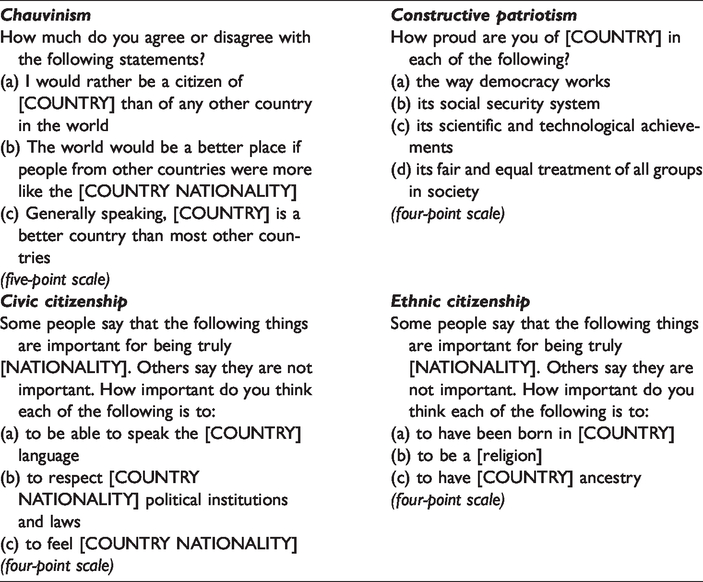
Table 1 displays the survey questions used to measure the components of national identity. To select the items to measure chauvinism and constructive patriotism we followed Davidov’s work (2009), while we capture ethnic and civic citizenship conceptions using Reeskens and Hooghe’s (2010) work. Notwithstanding, since our goal is to reduce single survey items to summated scale scores, we have also tested the factor structure of the multi-item measurements of these theoretical key constructs, using principal component analysis (PCA). The results presented in the Online appendix suggest that the selected items clearly measure related, but distinct constructs, i.e., we find sufficient discriminant validity to distinguish the four different components and use their underlying motives in the subsequent analysis (see the Online appendix for all pairwise correlations of the constructed scale scores). Moreover, each scale score composed of the chosen indicators exhibited sufficient reliability; these results are summarized in the Online appendix. Given that, as shown in Table 1, different response scales are used in the ISSP to measure these constructs, we standardized all the variables (or scale scores) in the analysis below.
Measurement of the main identity dimensions.
Method
In what follows, we apply a variant of cluster analysis that aims at grouping cases (= respondents) based on their profile in the four national identity dimensions. Our analysis is based on a latent profile analysis (LPA, categorical latent clusters with continuous indicators), using Stata’s gsem command. The idea of LPA is that a latent structure exists behind the data – in this case, unobserved groups of identity profiles in European citizens – that determines the observed profiles or combinations of the national identity markers. Although exploratory in nature, this statistical model enables researchers to assess the likelihood that a respondent is a member of a certain latent class. In addition, LPA assumes ‘local independence’, i.e., the indicators may be uncorrelated within classes so that varying combinations – in this case of national identity dimensions – are possible. The aim of LPA is to find distinct classes, i.e., showing both high variation in the variables used and theoretically interpretable classes. Eventually, unlike similarity-based methods such as cluster analysis, LPA is also less dependent on the choice of a similarity measure such as Euclidean distances (see e.g., Vermunt and Magidson, 2002). To sum up, we infer the national identity profiles (latent classes) by looking jointly at the national identity dimensions and EU support and how they are related to each other. Figure 1 shows the according analytical model.
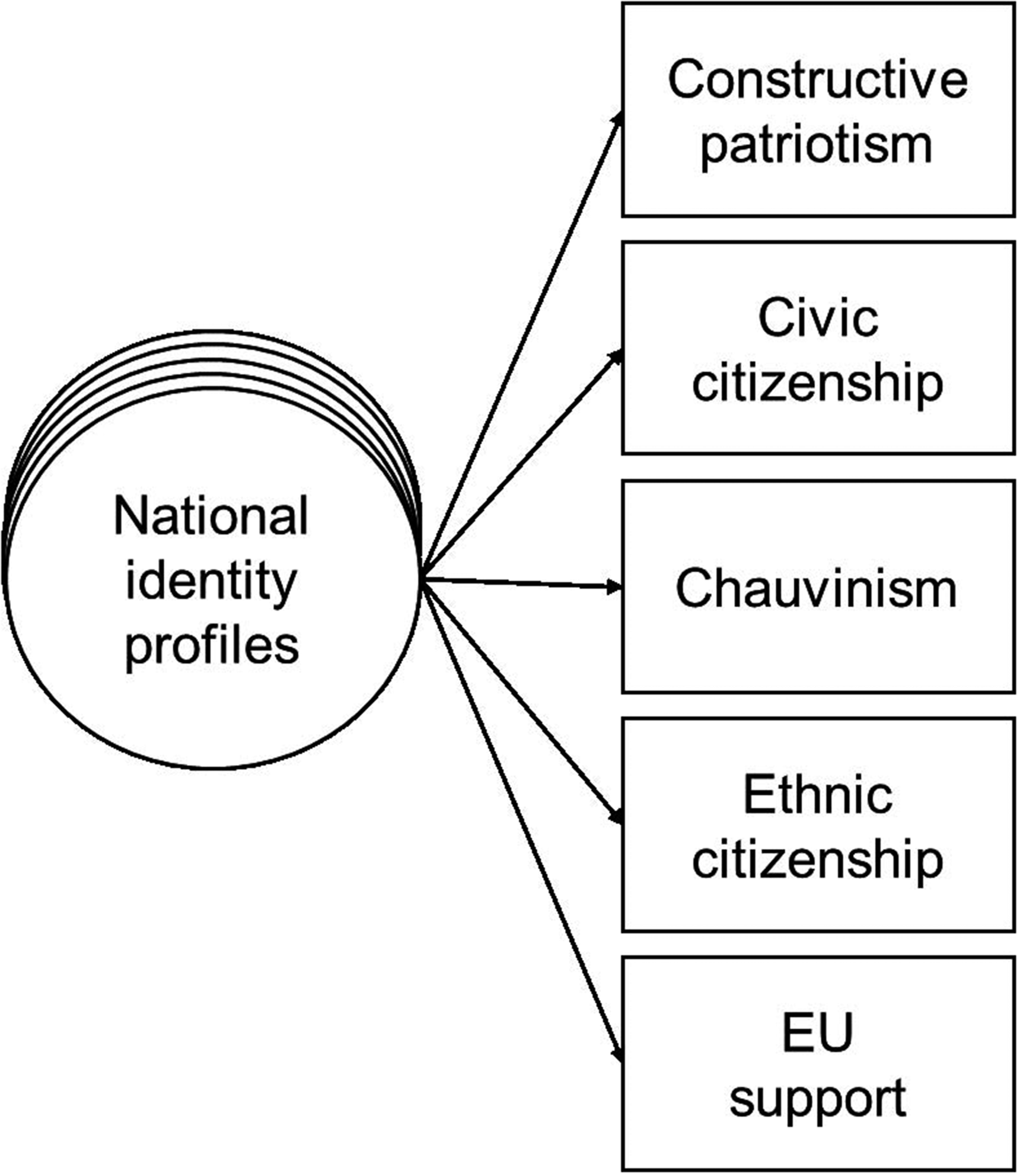
Analytical model of the latent profile analysis (LPA).
To identify the class structure that balances model fit and parsimony, we estimated and compared models with three to six classes. 6 We used a number of indices to make these model comparisons (see the Online appendix): the Akaike Information Criteria (AIC) and Bayesian Information Criteria (BIC) as relative fit indices, where smaller values indicate better model fit, and entropy as a marker of the clarity of class delineation, with values closer to 1 indicating greater classification accuracy and more precise assignment of individuals to latent profiles (e.g., Celeux and Soromenho, 1996). A six-classes solution showed a reasonable fit to the data in terms of entropy and interpretability of the classes (for more information on the various cluster solutions see the Online appendix). Nevertheless, to prevent classes from becoming too small and indistinguishable (for instance, < 5% of the cases), we settle on a five-classes solution, combing two classes that had a very similar profile, with one of them covering only 2% of the total cases. For the following analyses, we then used respondents’ most likely class membership derived from the LPA model.
The relationship between national identity dimensions and EU support
Figure 2 shows mean values (z-scores) for all variables in the five-classes solution. Negative values mean that respondents of a certain cluster on average scored below the mean value of this variable, while higher values indicate that respondents in a cluster generally scored above the mean value of this variable. Since we used z-scores, these differences in the mean values can be interpreted in terms of the variables’ standard deviations (in the total sample).
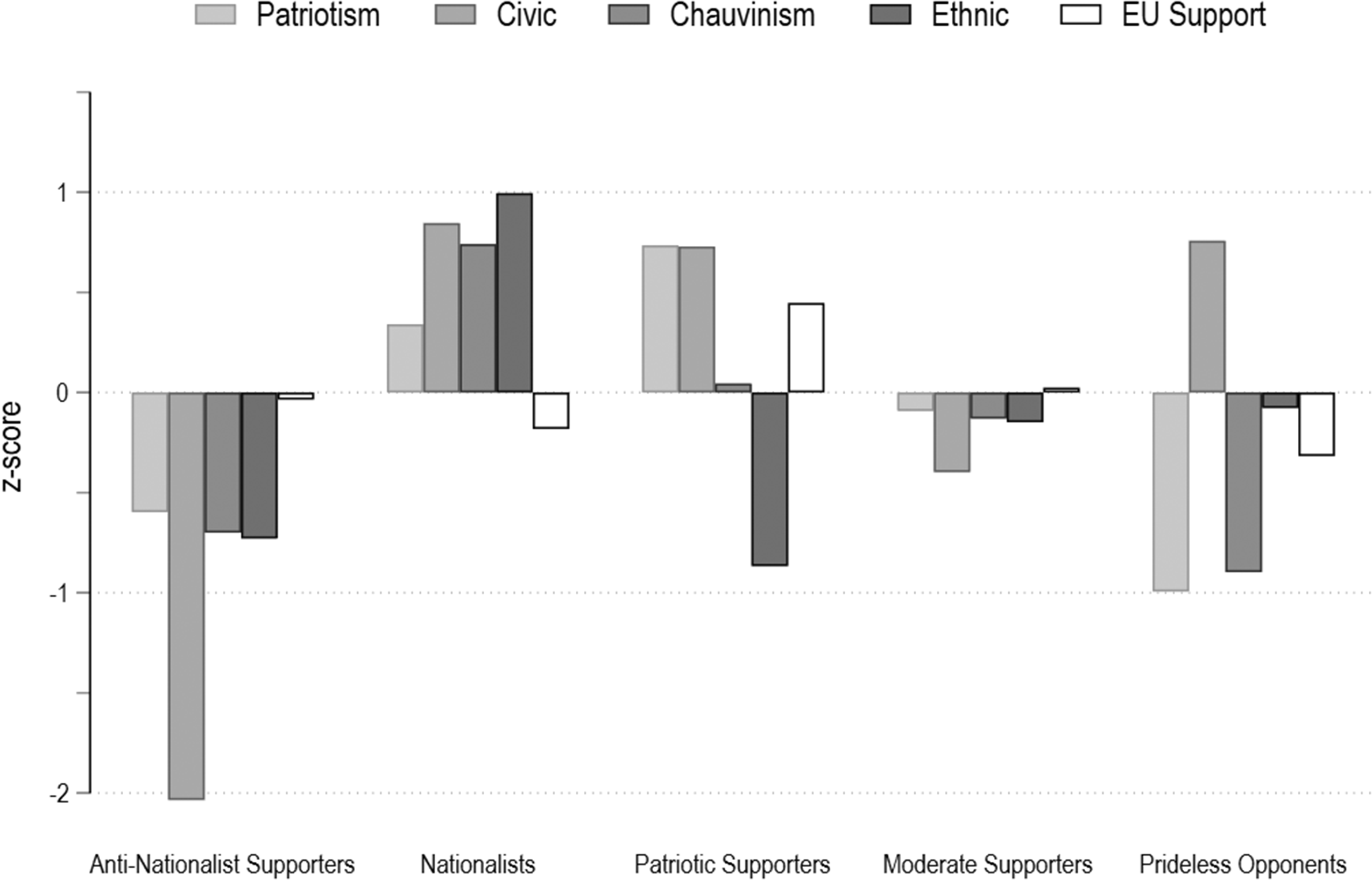
National identity dimensions of European citizens and EU support (n = 19,336).
The first class profile (Cluster #1, about 10.5% of the sample) is characterized by negative levels of all national identity dimensions, and especially low levels of civic citizenship. Interestingly, this is coupled with neither warm nor hostile EU attitudes (in other words, EU attitudes are not significantly different from 0, where 0 represents the average of EU attitudes). We label this profile ‘Anti-Nationalist Supporters’ as respondents in this cluster reject all components related to national identity and this rejection coexists with average EU support. In other words, their rejection of stressing any type of national identity goes hand in hand with average support for the EU.
The second class profile (Cluster #2, about 25.9% of the sample) exhibits a relatively low level of EU support with positive values of all national identity components, especially ethnic citizenship and chauvinism, thus indicating high importance of all national identity dimensions. We label this profile ‘Nationalists’ as respondents in this cluster see their own nation in all domains ‘above’ others, which is clearly associated with below-average EU support (see also the Nationalist ideal-type described by Kuhn and Nicoli, 2020).
The third class profile (Cluster #3, about 15.4% of the sample) shows the highest level of EU support, which is coupled with high levels of constructive patriotism, high endorsement of civic citizenship, but low levels of ethnic citizenship. We label this profile ‘Patriotic Supporters’ as respondents in this cluster seem to be proud of their nation however without an exclusionary component on ethnic grounds. This composition of national identity – with low scores in the out-group-oriented identity component – correlates with the highest degree of EU support.
The fourth class profile (Cluster #4, about 39.6% of the sample) is characterized by below-average values of all components. EU support is in this class positive, yet just above the mean. We label this profile ‘Moderate Supporters’, since respondents in this cluster do not particularly emphasize national identity and exhibit average EU support.
The final, fifth class profile (Cluster #5, about 8.6% of the sample) is the cluster with the lowest level of EU support which seems to be related to civic-oriented national identity, but very low levels of national pride in their country—i.e., neither embracing patriotism, nor chauvinism. We label this profile ‘Prideless Opponents’, because these respondents’ identity is not particularly based on notions of pride. Rather, these respondents seem to lack an essential attachment to the nation, which could provide the foundation to develop any support for the European project. This class resembles the Apolides ideal-type (i.e., those with low attachment to any level of political community) as described by Kuhn and Nicoli (2020).
Generally speaking, we do not see a neat separation between the four components of national identity as anticipated in the theory section (see Clusters #1 and #4). The two conceptions of citizenship and the two conceptions of patriotism coexist but when they point to the same direction, EU support is usually below the mean. Ethnic citizenship appears to play an important role in this regard; in fact, when this identity component points to a different direction than the other national identity components, it is always related in an opposite manner to EU support – high EU support in Cluster #3, and low EU support in Cluster #2. In other words, positive ethnic aspects in a person’s identity profile are negatively related with EU support. Finally, high and, interestingly, also low attachments to the nation in terms of pride coexist with negative EU attitudes (see Clusters #2 and #5). Overall, we find quite distinct identity profiles across individuals that provide evidence of different relationships between national identity compositions and EU support.
Distribution of identity profiles across countries
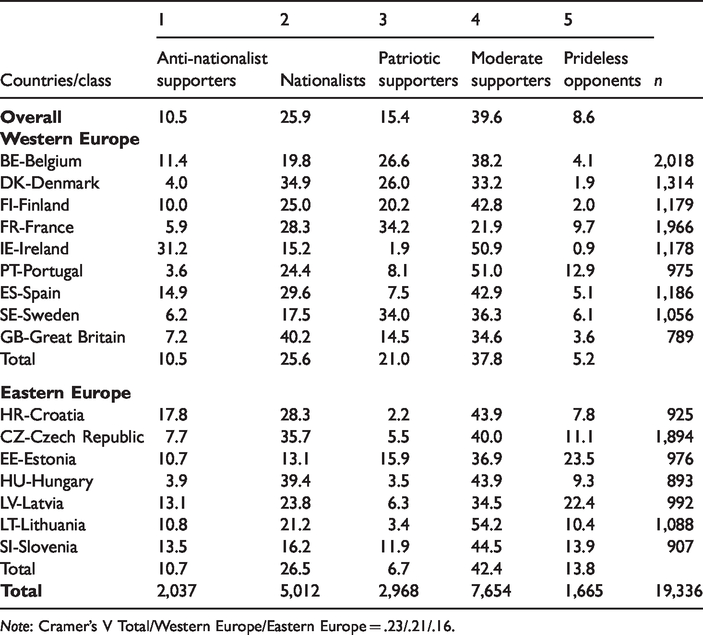
Table 2 shows the overall frequency of individual-level observations assigned to each of the different clusters as well as distributions across countries. First, Table 2 shows that overall the most common subtype is Cluster #4 (39.6%), followed by Cluster #2 (25.9%) and Cluster #3 (15.4%). This means that Moderate Supporters are the most common type amongst European citizens followed by Nationalists and Patriotic Supporters. Overall, we can observe that some form of nation-oriented identity aspect prevails amongst a majority of Europeans (this in line with the recent findings by Clark and Rohrschneider, 2019) – only the composition thereof and their association with EU support vary.
Distribution of clusters across countries (row %).
Note: Cramer’s V Total/Western Europe/Eastern Europe = .23/.21/.16.
Table 2, however, also reveals several important differences across countries in general and between Eastern and Western Europe in particular. Starting with the latter differentiation, Table 2 shows that while Patriotic Supporters (i.e., Cluster #3) are much more common in Western Europe, Prideless Opponents (i.e., Cluster #5) are more typical of Eastern Europe. The former findings suggest that the compositions of national identity profiles in Western Europe hamper EU support to a lesser extent than in Eastern Europe.
Table 2 also shows conspicuous differences within the two broad regions of Western and Eastern Europe, namely between the single countries, that help us to understand recent events. For instance, Cluster #2 – Nationalists – is the most frequent group in the UK, with marked differences with the other countries in Western Europe. Followed by Denmark, these results fit well with the Brexit vote in June 2016 and the rejection of the referendum held in Denmark in December 2015 for further European integration. Instead, we see that the group of Nationalists is relatively thin in Belgium – as opposed to Ireland and Sweden –, a result that is in line with the findings on European identity in Diez Medrano (2003), claiming the presence of constructed multiple identities in Belgium.
Moving to Eastern Europe, Table 2 shows that the Nationalists group (Cluster #2) is particularly common in Hungary and the Czech Republic, while being particularly low in Estonia. Given the positions on asylum seekers in and after the recent refugee crisis in Hungary and the Czech Republic these results meet face validity and provide an indication on the policy positions of these countries.
From Table 2, we can also see that identity profiles are more polarized in some countries compared to others: for instance, the UK and Hungary display an almost equal size of Nationalists and Moderate Supporters (Cluster #2 and Cluster #4), unlike other countries, for instance Finland, where citizens are less sharply divided on their identity profiles in relation to EU support. Throughout the various countries the group of Anti-Nationalist Supporters is rather small with more respondents in countries such as Ireland and Spain clustering in this group.
Predicting class membership
After having identified that profiles of national identity dimensions align differently with EU support, in a next step, we examine the antecedents of identity profiles. In other words, who is more likely to fall into which identity profile? To answer this question, we investigated potential socio-demographic antecedents of class membership. These are age (in years) and age squared, gender (1 = male, 0 = female), years of schooling, 7 occupational class using International Standard Classification of Occupations (ISCO) codes (Manual Worker, Professional Managers and other groups), 8 urban-rural place of living, and migration background (defined as both parents born abroad). Given the variations in identity profiles across countries, we control for the baseline cross-country differences by using fixed effects (i.e., country dummies) in a multinomial logit model (see the Online appendix).
Figures 3 and 4 show the predicted probabilities for the different socio-demographic antecedents. Figure 3 featuring the variables age and education shows that with increasing age citizens – and here in particular citizens at a very high age (Figure 3(a)) – are much more likely to exhibit the profile of Nationalists, rather than any other identity profile. In turn, younger age cohorts are more likely to be Moderate Supporters. With increasing formal education (Figure 3(b)) it is more likely that citizens identify themselves with what we labeled Patriotic or Moderate Supporters. In turn, people who are less well educated more often find themselves in the Nationalists class, while education does not seem to make much of a difference for the remaining classes.
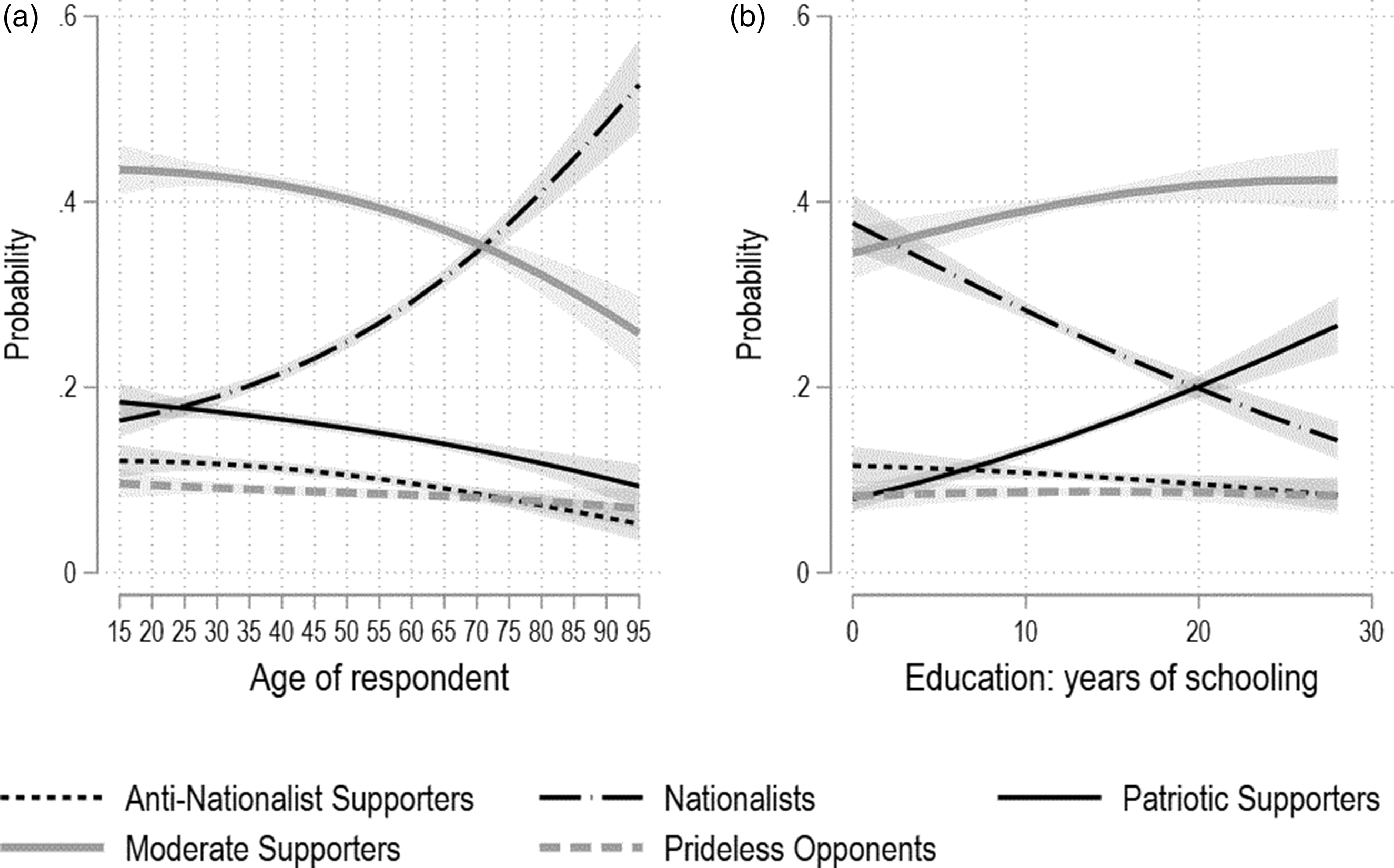
Regression of identity profiles on (a) respondents’ age and (b) years of schooling.
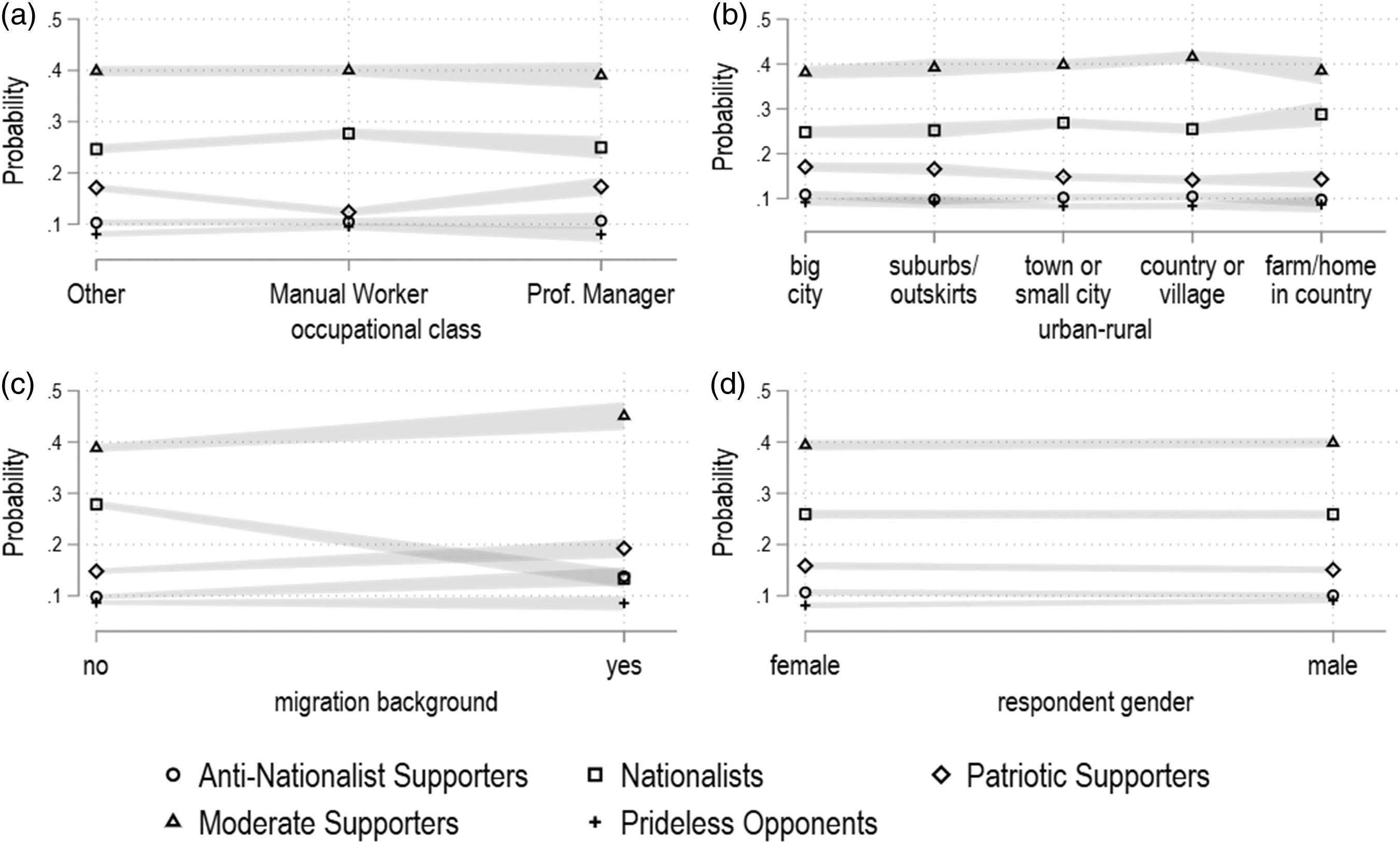
Regression of class membership on respondents’ (a) occupational class, (b) place of living, (c) migration background, and (d) gender.
Turning to Figure 4 and considering occupation first (panel (a)), we see that compared to other occupational classes, working class respondents are much more likely to exhibit the profiles of Nationalists, Prideless Opponents, and are less likely to be Patriotic Supporters (see the Online appendix for full results). People who live in middle-sized or country villages (Figure 4(b)) are, when compared to people living in large cities or suburbs, somewhat less likely to be in the class of Patriotic Supporters. People who have a migration background (Figure 4(c)) are, however, significantly more likely to feature the profile of Moderate, Anti-Nationalists and Patriotic Supporters, rather than being Nationalists. Overall, we find no significant gender differences (Figure 4(d)).
Discussion and conclusion
In his speech on the occasion of the Austrian National Day on October 26, 2016, then Austrian Chancellor Christian Kern said that Austrians are self-confident and patriotic but not fearful and chauvinistic. Such differentiation in citizens’ national identity profiles have been largely overlooked by the existing literature on support for the EU, which has focused on national identity as a one-dimensional concept. In fact, while national identity per se has been found to be a powerful explanation for individual-level attitudes over Europe (Carey, 2002; Diez Medrano and Gutiérrez, 2001; McLaren, 2002) as well as for the development of a supranational EU identity (Hooghe and Marks, 2005), there is still confusion in the literature on whether national identity reinforces or diminishes support for the EU.
The main aim of this article was to unveil the diverging identity profiles of European citizens by examining the relationship between national identity dimensions and EU support. Specifically, relying on a database from the ISSP 2013 and using latent profile analysis, this article aimed to provide a typology of national identity profiles of Western and Eastern European citizens. We explored the face validity and potential covariates of our typology looking at cross-country variation and various socio-demographic groups. Although our data source dates back to 2013, we think that we can make a strong argument in favor of the generalizability of the correlational or interactive patterns of national identity dimensions and EU support, which are likely to be more stable than the overall level of each of the attitudinal variables normally under investigation. This is because historically built identities require long-term cohort replacement to change and again manifest in a country’s collective identity (see Clark and Rohrschneider, 2021; Lutz et al., 2006). 9
Our findings point towards three important conclusions. First, national identity represents a multi-dimensional concept composed of four main different components; the level of these components in relation to each other is fundamentally linked to support for the EU. We thus acknowledge that affective components of one’s national identity shape assessments of the performance and functioning of the EU as a political institution. We can observe different types of European citizens who differ in their conceptions of national identity and these differences are consequential in terms of EU support. Specifically, we see the Prideless Opponents’ identity profile featuring the lowest support for European integration followed by the Nationalists one; on the opposite, Patriotic Supporters are those more likely to have warm feelings toward the EU, whereas Moderate and Anti-Nationalist Supporters represent a middle ground of neither feeling particularly warm, nor hostile towards the EU, with the latter class also clearly rejecting any type of affective national attachment.
Second, while these results reveal the complex and heterogeneous nature of the national identity dimensions of European citizens in their relation to the EU, we found that the Moderate Supporters group is the most common type of Europeans followed by the Nationalists – a group of citizens that can hardly reconcile their national identity conceptions with EU support. In summarizing, while for certain groups of European citizens identity-related factors will not necessarily undermine the support for the EU, and hence its legitimacy, for large parts of European citizens their national identity is, however, putting the brakes on EU support.
These findings thus speak to a partly contradicting literature, which has shown that national identity can both strengthen and undermine EU support. This contradiction is mainly rooted in the lack of differentiation between different conceptualizations of national identity. We therefore stressed the necessity to, one the one hand, distinguish between potentially inclusive and exclusive aspects and, on the other hand, to consider unique combinations of the different national identity components that give rise to support of or opposition to the EU.
Third, the results point towards conspicuous variation across countries. In terms of cross-country variation, the differentiation between Eastern and Western Europe is very telling, especially with regard to ethnic differentiation, and help explain recent events in the EU, such as the refusal of the Visegrád countries to receive refugees or the Brexit vote.
Fourth, we found that certain demographic groups are more likely to be alienated from the EU project with sometimes strong, exclusive attachments (Nationalists), namely older, less well educated respondents, and working class citizens. Younger, highly educated people, and people having migration background are, in turn, more likely to exhibit a Patriotic Supporter or at least a Moderate Supporter profile.
Overall, these results show that when looking at national identity as a multidimensional concept we capture distinct identity profiles that vary in their relationship to EU support. The conclusion that there is only one dimension underlying national identity, and that this dimension is negatively related to EU support, is thus too shortsighted. Rather, we observe different types of European citizens, which also unveil groups of citizens for whom national identity is positively related to EU support – an important finding for the future integration process and the legitimacy of the EU.
Given that national identity is increasingly debated today in the public sphere, we need a firm grasp on what it is and how it relates to EU support. So, we encourage future research to expand on our analysis especially examining additional antecedents as well as consequences of specific identity profiles and perhaps also considering variation over time in the patterns of support for the EU.
Supplemental Material
sj-pdf-1-eup-10.1177_1465116520980068 - Supplemental material for National identity profiles and support for the European Union
Supplemental material, sj-pdf-1-eup-10.1177_1465116520980068 for National identity profiles and support for the European Union by Julian Aichholzer, Sylvia Kritzinger and Carolina Plescia: for the Keio Donner Project Team in European Union Politics
Footnotes
Acknowledgements
A previous version of this article was presented at the European University Institute Conference ‘Rejected Europe. Beloved Europe. Cleavage Europe’ in 2017, at the Internal seminar series at the Department of Government, University of Vienna and at the Webster University Vienna. We greatly benefitted from comments by participants. The authors are also grateful to Theresa Kuhn, Robert Rohrschneider and Nick Clark for their precious feedback. We also would like to thank Anna-Lia Brunetti for her support with the data analysis.
Funding
The author(s) received no financial support for the research, authorship, and/or publication of this article.

Notes
References
Supplementary Material
Please find the following supplemental material available below.
For Open Access articles published under a Creative Commons License, all supplemental material carries the same license as the article it is associated with.
For non-Open Access articles published, all supplemental material carries a non-exclusive license, and permission requests for re-use of supplemental material or any part of supplemental material shall be sent directly to the copyright owner as specified in the copyright notice associated with the article.
