



Abstract
Does the Early Warning System alert the European Commission about the prospects of passing new policy? We present a model of European Union policymaking in which the Early Warning System plays an important signalling role. In our model, the Commission uses signals from the Early Warning System to update its belief about governments’ voting strategies in the Council. The Commission may then anticipate difficult negotiations by withdrawing its proposal early. We find empirical evidence for our theory: (1) reasoned opinions submitted by national parliaments strongly predict opposition from their governments and (2) the Commission is more likely to withdraw proposals that receive reasoned opinions, even in the absence of a yellow card. Our results run counter to the dominant view in the literature that the Early Warning System is not a very relevant aspect of EU decision-making. Instead, reasoned opinions constitute a clear signal that negotiations are more likely to fail.
Introduction
Does the Early Warning System (EWS) alert the European Commission about the prospects of passing policy in the European Union (EU)? The answer to this question touches upon the core of political economists’ research agendas: How do political institutions work? The EWS is a political institution of which the performance is arguably not clear cut. Yet, it appears prominently in current debates in the EU.
Proposals to reform the EWS circulate regularly, with recent suggestions for green and red cards, next to the already existing yellow and orange card system. The EWS is also likely to feature on the agenda of the upcoming Conference on the Future of Europe, that is to be held within the next two years. Understanding how the EWS works, and any impact it may have on policymaking is thus fundamental to judge whether institutional reform is warranted.
The EWS, introduced with the Lisbon Treaty in December 2009, had the objective to increase the EU’s legitimacy by strengthening the role of national parliaments (NPs) and allowing them to directly intervene in EU policymaking. It allows NPs to raise objections to legislative proposals submitted by the European Commission if they believe the draft proposal violates the principle of subsidiarity. They can do this up to eight weeks after receipt of the Commission’s proposal. If enough NPs raise such objections in the form of reasoned opinions (ROs), a ‘yellow card’ is triggered, and the Commission is formally obliged to reconsider its proposal. 1
At first glance, both logic and anecdotal evidence seem to suggest that the EWS fell short of increasing parliaments’ power. Nor does it appear to have a considerable impact on EU policymaking more broadly, perhaps aside from increasing parliaments’ awareness of EU affairs (Miklin, 2017). For instance, parliaments only submit ROs sporadically, resulting in isolated occurrences of objections, which are likely not to matter much. Moreover, even if parliaments succeed in collectively submitting ROs, the impact is questionable, as the yellow card against the Posted Workers Directive demonstrated. Apart from the fact that this yellow card was only the third such instance since the EWS’s introduction, the Commission – undeterred by the yellow card – simply decided to proceed with the legislative process. So not only do individual ROs seem to have little impact, neither does a collective yellow card.
The picture sketched above of the EWS as irrelevant is misleading. Not merely because systematic empirical analysis is lacking, but primarily because the EWS has a role that has not been considered thus far: it provides information. In this regard, it may provide an important signal to a variety of actors about bargaining difficulties that will arise later during negotiations in the Council, the EU’s most important legislative institution, but also infamous for its lack of transparency.
In this article, we present a simple model of EU policymaking in which the EWS may serve as a signal to the European Commission. The Commission, uncertain about how governments will vote in the Council, can resolve part of this uncertainty through the EWS. Anticipating difficult negotiations, the Commission may decide to withdraw its proposal, because it believes that the proposal will fail anyway or because it is likely to be amended far away from its ideal preferences.
Our model results in two key questions that we put to an empirical test. First, are ROs by parliaments a good predictor of their governments’ voting behaviour? In other words, do they signal that negotiations in the Council will be challenging? After all, governments in the Council are accountable to those same parliaments that may record ROs in the first place. Second, if they do indeed allow the Commission to update its belief, does it respond to these signals by withdrawing proposals altogether?
To test these questions empirically, we constructed a unique dataset in which we match all ROs submitted by NPs at the start of the legislative process with the votes and formal policy statements from their cabinet governments in the EU Council at the end of the process. Based on more than 400 matched proposals initiated by the European Commission between January 2010 and December 2013, we find evidence for a significant and positive relation between ROs and negative votes. 2 More specifically, when an NP has issued an RO on a legislative proposal, its cabinet government is, on average, five times more likely to oppose that same proposal during Council negotiations. Importantly, the magnitude of this relation merely constitutes a lower bound, because controversial proposals may never be voted on in the Council. ROs early in the decision-making process are thus a strong predictor of bargaining difficulties at later stages.
In addition, we find that the Commission is not unaware of this signal nor ignorant of its meaning. Proposals that receive ROs have a higher probability of being withdrawn, even in the absence of a yellow card. Furthermore, we show that the Commission makes a rational cost-benefit calculation: given its belief, the Commission is more likely to withdraw if the proposal is not very salient (low benefits) and the costs of policy adoption are high.
Our results have a number of important implications for EU policymaking. First, the EWS has more general value than has been considered so far. In particular, it has an important informational value. From this perspective, we could consider the EWS as a tool similar to the United States (US) Senate’s ‘Hold’ and the US House of Representatives’ ‘Motion to recommit with instructions’. 3 All three procedures give a decentralized entity – an NP in case of the EWS – a way to signal-specific concerns that are important to its members. Such a signal may also have value to the receiver if leaving the signalled concerns unaddressed would eventually cause the receiver harm. In our model, policymaking is costly for the Commission. As such, it benefits from extra information if this may lead to the conservation of scarce resources and precious negotiating time. This, in turn, may lead to an increase in decision-making efficiency and can partly explain why the Commission has been willing to grant more powers to NPs. 4
Second, while this article focusses on the informational value for the Commission, it has implications for a variety of other actors that have an interest in EU policy. Whether it be other EU institutions such as the European Parliament (EP) or policymakers, interest groups and voters more broadly. For instance, like the Commission, interest groups can assess how likely it is that a proposal will pass and organize their lobbying activities accordingly. Similarly, ROs may arguably allow voters to infer the position of their governments in Council negotiations.
Third, our results are important for research on decision-making in the Council of the EU. The Council is still an opaque institution. Member state governments are well-known to hide their policy preferences for a variety of reasons. ROs from NPs can then provide an alternative source of information for scholars who have made it their primary objective to unravel parts of this black box.
Related literature
The Treaty of Lisbon introduced several novelties into the legislative process of the EU. Arguably, the most significant reform has been the introduction of the EWS. It allows NPs to intervene directly in EU policymaking in the form of ROs against draft legislative proposals initiated by the European Commission. Parliaments send these opinions, at least in theory, to defend the principle of subsidiarity and to actively engage in the EU’s policymaking process. In practice, however, objections go beyond the subsidiarity principle and may as well express a divergence of policy preferences (see for example, Jancic, 2015). Objections of the latter kind are then simply ‘disguised’ as subsidiarity complaints. Either way, if enough parliaments submit ROs, a yellow card is triggered, and the Commission is formally obliged to reconsider its proposal.
To date, most scholarly attention has focused on explaining the variation between parliaments’ decisions to submit ROs. For an excellent overview of this literature, we refer to Gattermann and Hefftler (2015), Williams (2016), Malang et al. (2017) and Huysmans (2018). Contrary to explaining the variation between parliaments’ use of ROs, we are primarily interested in their impact for EU policymaking more broadly.
One way ROs may have an impact is by acting as a signal for opposition in the Council. In a case study on the Monti II regulation, Cooper (2015) found that parliaments that submitted an RO also appeared to instruct their governments to vote against the Monti II proposal in the Council. A similar argument has recently been made by Rasmussen and Dionigi (2018). They studied the actual content of parliamentary opinions to the Commission and found anecdotal evidence that some parliaments explicitly include in their submitted opinion a message to their government, such as ‘we call upon the government to register its disagreement with the proposals’ (Rasmussen and Dionigi, 2018).
These findings are also in line with the conclusions drawn from a slightly different research domain. In the field of Council decision-making, van Gruisen and Crombez (2019) and Hagemann et al. (2019) have shown that governments are more likely to oppose legislation if their parliament strictly controls them. Van Gruisen and Crombez (2019) find that this is all the more the case when parliaments are Eurosceptic and have the power to provide parliamentary mandates to their ministers on how to vote on Commission proposals.
Thus, if parliaments submit ROs to oppose EU legislation and subsequently instruct their governments to do the same in Council negotiations, this could be an important argument that ROs carry valuable information as well as have a causal effect on government votes. Moreover, even if parliaments lack the power to instruct their governments how to vote, as is arguably the case for ‘weak’ parliaments, the fact that they are likely to hold similar policy preferences is another argument that ROs convey valuable information. This is especially true for parliaments of majority governments. As a result, ROs may provide a lot of information about how governments are likely to vote, whether it be because parliaments instruct their governments or simply because parliaments and governments may have similar preferences.
Other actors that have an interest in EU policy may then benefit from this information. One such actor is the European Commission. Upon observing these opinions, the Commission may anticipate difficult negotiations in the Council and decide to withdraw its proposal. Studying a limited selection of proposals that received most ROs, Cooper (2018) finds that NPs had at least some influence on the final outcome in these instances. What the underlying reason is for influence remains unclear, however.
In contrast, in this article, we present a formal theory that explains why the Commission is more likely to withdraw proposals as a function of the number of ROs. Our findings stress the importance of the EWS in updating the Commission’s information.
The informational value of ROs
Model set-up
In this section, we introduce a simple model of EU policymaking. The objective is to study the Commission’s decision to proceed or end the legislative process as a function of submitted ROs by NPs. The intuition is that the more ROs, the less likely the proposal is to pass in the Council. The model focuses on the informational value of ROs for the Commission. The complicated two-way interaction between NPs and governments is not modelled in detail; reduced form parameters are used instead. Note that we use ‘RO’ and ‘opinion’ in this section interchangeably to avoid repetition.
We study EU policymaking as a process between the Commission on the one hand and 28 NPs and their governments on the other. For simplicity and given the focus of this examination, we disregard the role of the EP. Taking the EP into account would complicate matters without affecting our main conclusions. 5
The Commission is the EU’s formal agenda-setter. Implicitly, we assume a spatial model where the Commission has Euclidean preferences, that is, it considers proposing a new policy whenever it anticipates the new policy to be closer to its ideal policy than the status quo. Because not all policies are equally important, we assume the Commission’s utility from new policy relative to the status quo depends on the salience
Relative to the status quo, the new policy entails a higher utility, but also a policy-adoption cost
In line with Boranbay-Akan et al. (2017), we assume that the Commission is an imperfect agenda-setter. While the Commission holds consultations during the drafting stage, these are unlikely to give it perfect information. Similarly, Crombez and Vangerven (2014) and Høyland and Hansen (2014) argue that the Commission does not have perfect information regarding the distribution of preferences in the Council. König and Proksch (2006) refer to the Commission as an agenda-setter that has ‘imperfect drafting information’. In our analysis, we assume that the Commission has some prior belief about the preferences of the governments but is not entirely certain. As such, the EWS may help the Commission partially resolve the remaining uncertainty.
Although the Commission is uncertain whether its proposal will be adopted, it does know the probability distribution of governments’ votes and thus has a prior belief

The national governments also care about policy. If brought to vote, the governments
In the absence of the EWS, the policymaking process is straightforward: (1) the Commission proposes policy; (2) the governments vote either in favour (
Under the assumptions made, calculating the prior probability of adoption

Under Qualified Majority Voting (QMV), the probability of obtaining a QM

The process is slightly more complex with the introduction of the EWS. In particular, the EWS adds two more stages to the process: (1) the Commission proposes policy; (2) the Commission observes any ROs sent by NPs; (3) the Commission can withdraw the policy or proceed with the process, but if the Commission withdraws the policy, it avoids the policy-adoption costs
Like governments, parliaments may be either in favour of or opposed to the new policy. We assume that if they are opposed, they issue an opinion (
The real-world interaction between governments and parliaments is complicated. The baseline expectation is that governments and parliaments have relatively similar preferences, since government coalitions typically require a majority in the parliament. This observation leads to the expectation of a (mere) correlation between government votes and parliament ROs. Yet, there may be two-way strategic interactions, making part of the correlation causal. On the one hand, parliaments may use ROs to try to commit their governments to voting a certain way in the Council; some parliaments even have formal mandating rights to guarantee this (Winzen, 2012). On the other hand, governments may encourage their parliaments to submit opinions to have a scapegoat to point at when they voice opposition in the Council. This is similar to Putnam’s (1988) domestic constraint argument in two-level games and may especially be the case for majority governments (Auel and Neuhold, 2017).
Regardless of how this game between parliaments and their governments is played, what matters is the final correlation between opinions and votes. Hence, we leave more sophisticated models for future research and take a reduced form approach to this interaction instead.
Furthermore, we assume that governments and parliaments are truthful rather than strategic vis-à-vis the Commission; they simply issue an opinion or vote ‘no’ if they dislike the policy. 7 There may be reasons for parliaments and governments to strategically fake opposition occasionally, but the low numbers of opinions by parliaments and opposition in the Council clearly show that incentives for such strategic behaviour are limited.
Now, a reduced-form model of the interaction between governments and parliaments requires only two parameters. On the one hand, define
The complements of these parameters give the remaining two possibilities:
For information to be contained in opinions, it has to be the case that H1: The probability that the government opposes a proposal is higher conditional on an RO by its parliament.
ROs and the Commission’s equilibrium strategy
We solve the decision-theoretic model by choosing the Commission’s strategy
The Commission, when proposing policy in stage 1, looks ahead. In the final stage (stage 4), the governments vote on the proposal. In the preceding stage (stage 3), the Commission has to decide whether to withdraw its proposal or to move it to a vote in stage 4. While withdrawing leads to a certain payoff of zero, putting the proposal to a vote comes with uncertain payoffs, depending on governments’ votes.
Note that, at this point, the Commission has more information about the expected government votes compared to when it proposed its policy in stage 1. Having observed in stage 2 which parliaments (if any) submitted ROs, and using the historically inferred parameters
By applying Bayes’ theorem, having observed


The conditional probabilities

More details on the derivation are provided in the Online appendix. By taking the observed parameters
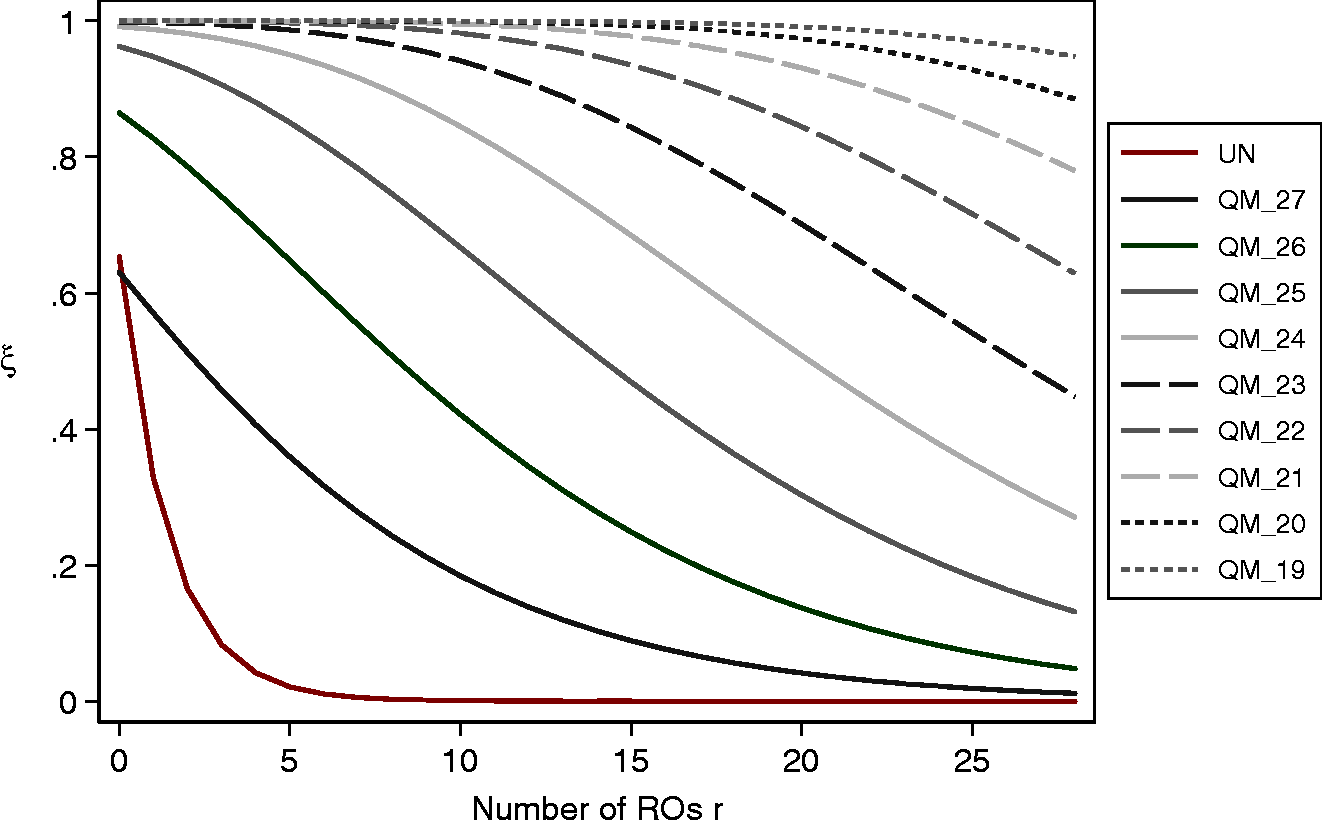
Posterior probability of policy passing
Based on its updated belief

The logic of the above inequality is intuitive. Upon receiving an RO, the Commission is more likely to withdraw the proposal H2a: The probability that the Commission withdraws its proposal decreases with the posterior probability of passing, and hence increases with the number of ROs. H2b: The Commission is less likely to withdraw proposals of high salience, even if the posterior probability of passing is low. H2c: The Commission is more likely to withdraw proposals with high policy-adoption costs.
Empirics: ROs and information
Data and methodology
Do ROs indeed predict opposition in the Council? While our theoretical simulation, based on the parameters
It may very well be that the submission of an RO is correlated with a number of other factors that affect governments’ voting behaviour and thus would confound this relationship. For example, parliaments may send ROs more often on issues that require QMV, as these legislative proposals often involve competencies that are transferred from the national to the EU-level. Studies on Council decision-making in turn have shown that governments are more likely to oppose proposals under QMV (for example, Bailer et al., 2015). Hence, to isolate the relation between voting behaviour and ROs, we must account for such confounding factors with more rigorous analyses.
To that effect, we run a series of regressions. The dependent variable government opposition takes a value of 1 if a government has opposed a proposal in the Council by either a ‘no’-vote, an abstention or a negative statement and a value of 0 if the government voted in favour. 8
Our key independent variable captures whether an NP has submitted an RO. To collect these data, we matched every RO on legislative acts introduced under the EWS between January 2010 and December 2013 with the formal votes and policy statements of the governments in the Council. 9 The variable RO takes a value of 1 if a parliament submitted an RO on a particular proposal and zero otherwise. In the case of bicameral parliaments, we considered an RO only if issued by the parliament’s lower chamber as the government is ultimately accountable to the lower house. In the Online appendix, we redo this exercise with a measure that also takes into account ROs issued by upper chambers, with similar results.
Our dataset includes 372 matched proposals. This gives us 10,044 observations of proposal-country dyads representing 27 member states (Croatia only joined in 2013). Note that votes on withdrawn proposals are not available and could not be matched with the ROs from parliaments. As a result, the estimates we obtain regarding the relation between ROs and government opposition are merely lower bounds on their true relation.
As mentioned previously, we want to isolate the effect of ROs. As such, we control for a number of proposal characteristics, parliament characteristics and government characteristics. The description and coding of the control variables can be found in the Online appendix. One variable to highlight concerns parliaments’ political dialogue contributions (PDCs). In addition to submitting an RO, parliaments may also submit a PDC to the European Commission. These opinions do not deal with the subsidiarity principle nor do they require a formal reaction from the Commission, as the yellow card does. These opinions are broader and are primarily used to engage in dialogue. Nonetheless, parliaments may also communicate any complaints by submitting such a contribution.
Apart from the control variables introduced above, two other issues are present. Votes on proposals are not entirely independent, and some countries may simply issue more ROs and more opposing votes. We account for this by clustering the standard errors at the proposal level and introduce fixed effects for member states and years. In the most robust model, we include country and year fixed effects as well as their interaction. Such interaction may capture, for instance, a change of the government in office. Our main probit model is as follows

Results
Do ROs by parliaments signal opposition by their respective governments in Council negotiations? Table 1 presents the results of the regression analyses. We gradually build our model to more robust specifications. We find that the likelihood that a government opposes Commission proposals is indeed significantly higher with the issuance of an RO from the parliament. This result is robust to various model specifications (Models 1–4). ROs are thus a credible signal of government opposition, consistent with hypothesis 1. Full regression tables can be found in the Online appendix.
Reasoned opinions by parliaments and opposing votes by their governments.
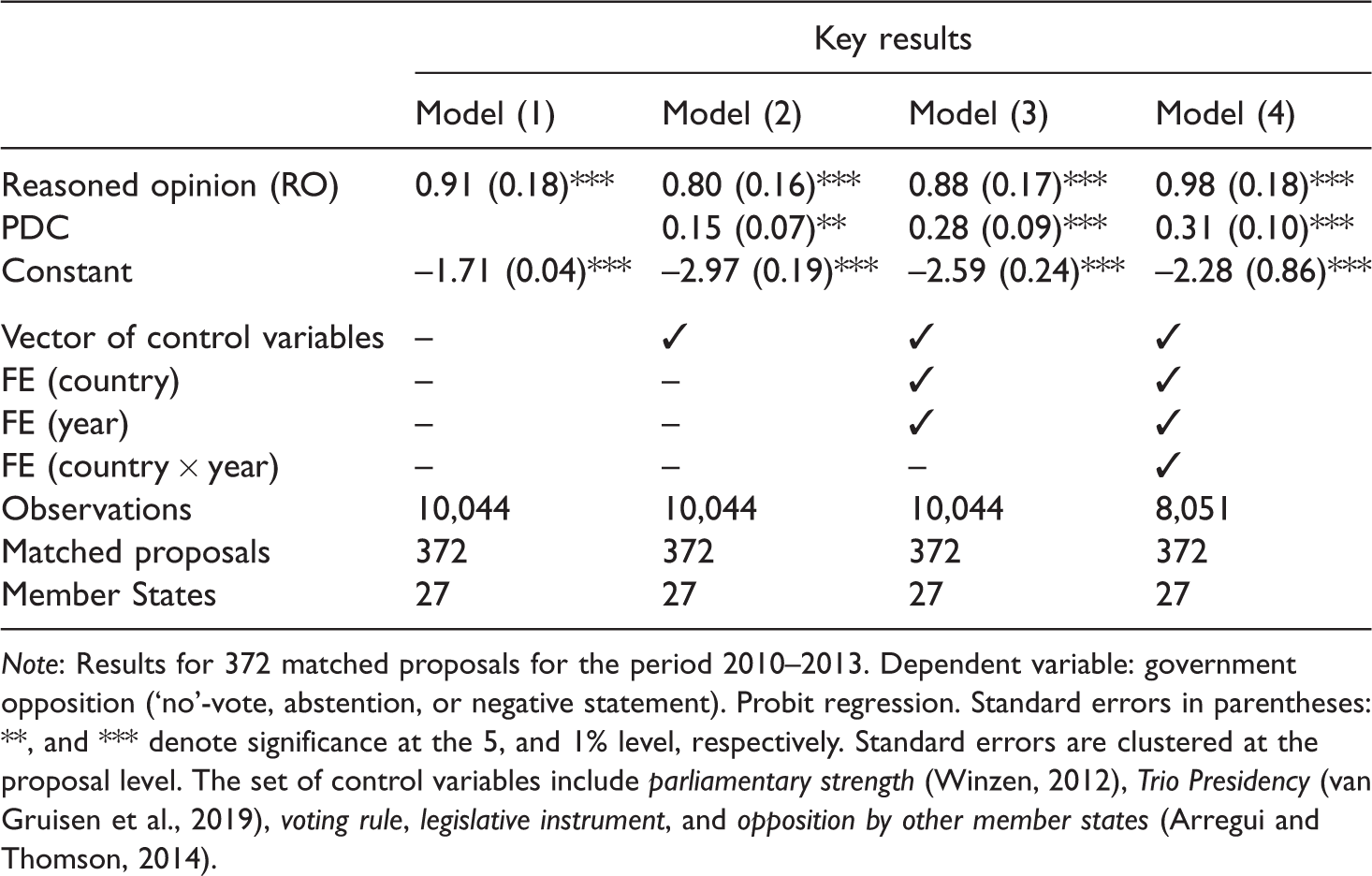
Note: Results for 372 matched proposals for the period 2010–2013. Dependent variable: government opposition (‘no’-vote, abstention, or negative statement). Probit regression. Standard errors in parentheses: **, and *** denote significance at the 5, and 1% level, respectively. Standard errors are clustered at the proposal level. The set of control variables include parliamentary strength (Winzen, 2012), Trio Presidency (van Gruisen et al., 2019), voting rule, legislative instrument, and opposition by other member states (Arregui and Thomson, 2014).
To give a more substantial interpretation of our estimates, we plot the predicted probability of opposing legislation in the Council conditional on an RO in Figure 2. In addition, we contrast the effect of ROs with the effect of contributions under the political dialogue system. Our results show that the latter are also positively related to opposing votes, albeit with a less significant effect in both statistical and substantive terms. Figure 2 clearly illustrates that an RO is a far better predictor of opposing votes than are PDCs. With an RO, the probability of opposition in the Council goes up more than fivefold from 3 to 16%. This estimate is based on the most robust model, Model 4. As previously stated, this is merely a lower bound of the true relation.
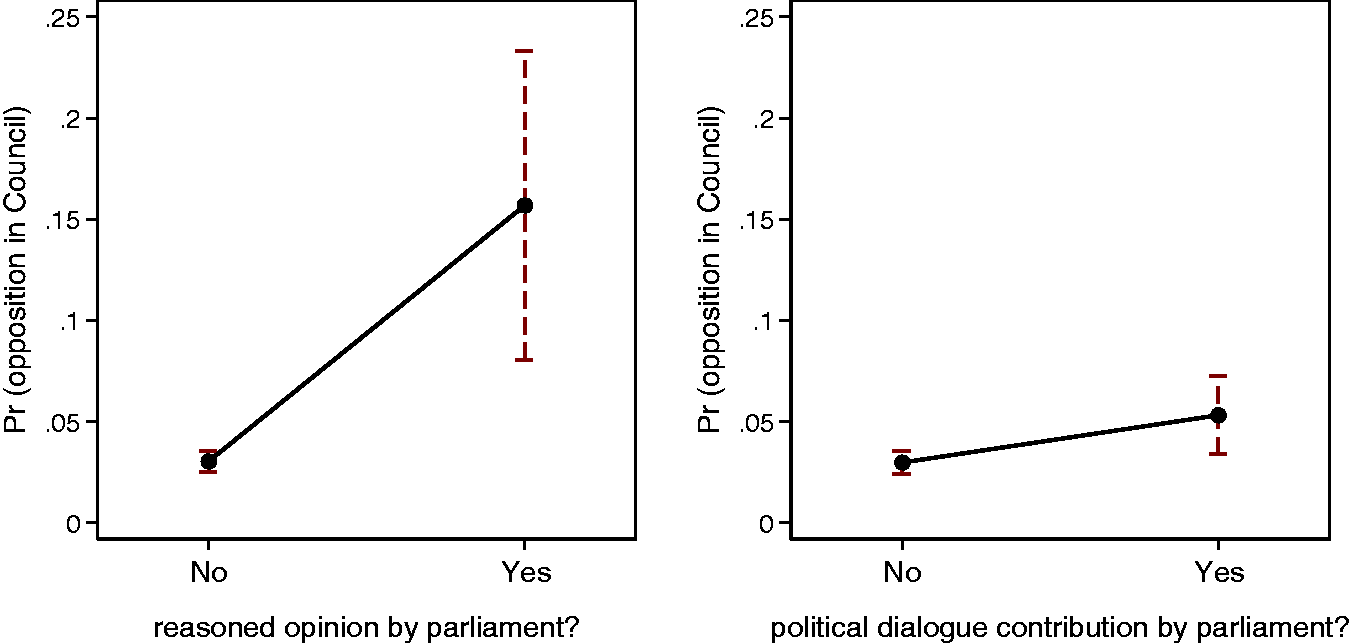
Predicted probability of opposition in the Council.
Now that we are more confident that ROs provide information, we can proceed to study whether this has any implications for the Commission’s decision to withdraw its proposals.
Empirics: Updated information and withdrawal
Data and methodology
The previous section showed that ROs provide credible information on the likelihood of opposition in the Council. Then, according to our expected utility model
While the Commission’s utility from withdrawing is unobserved, it can be seen as the latent variable driving the decision to withdraw. According to our formal model, the Commission’s equilibrium strategy is

Now, assuming an unobserved error 

The dependent variable withdraw is coded as 1 if the proposal is withdrawn and 0 otherwise. We obtained the Commission’s decisions to withdraw from EUR-Lex. 10 Our data include 424 legislative proposals that were introduced between January 2010 and December 2013.
For the Commission’s posterior
We proxy salience
For the policy adoption costs, we use the distinction between UN and QMV in the Council. It seems natural to assume that getting all governments on board is more difficult (costly) than a QM. Hence our variable policy adoption costs = 1 if the voting rule is UN and zero otherwise. In the Online appendix, we redo the exercise with the size of the gridlock interval as a measure of policy adoption costs, with similar findings.
Results
The results are reported in Table 2. We first use our preferred measure for posterior belief
The determinants of policy withdrawal.
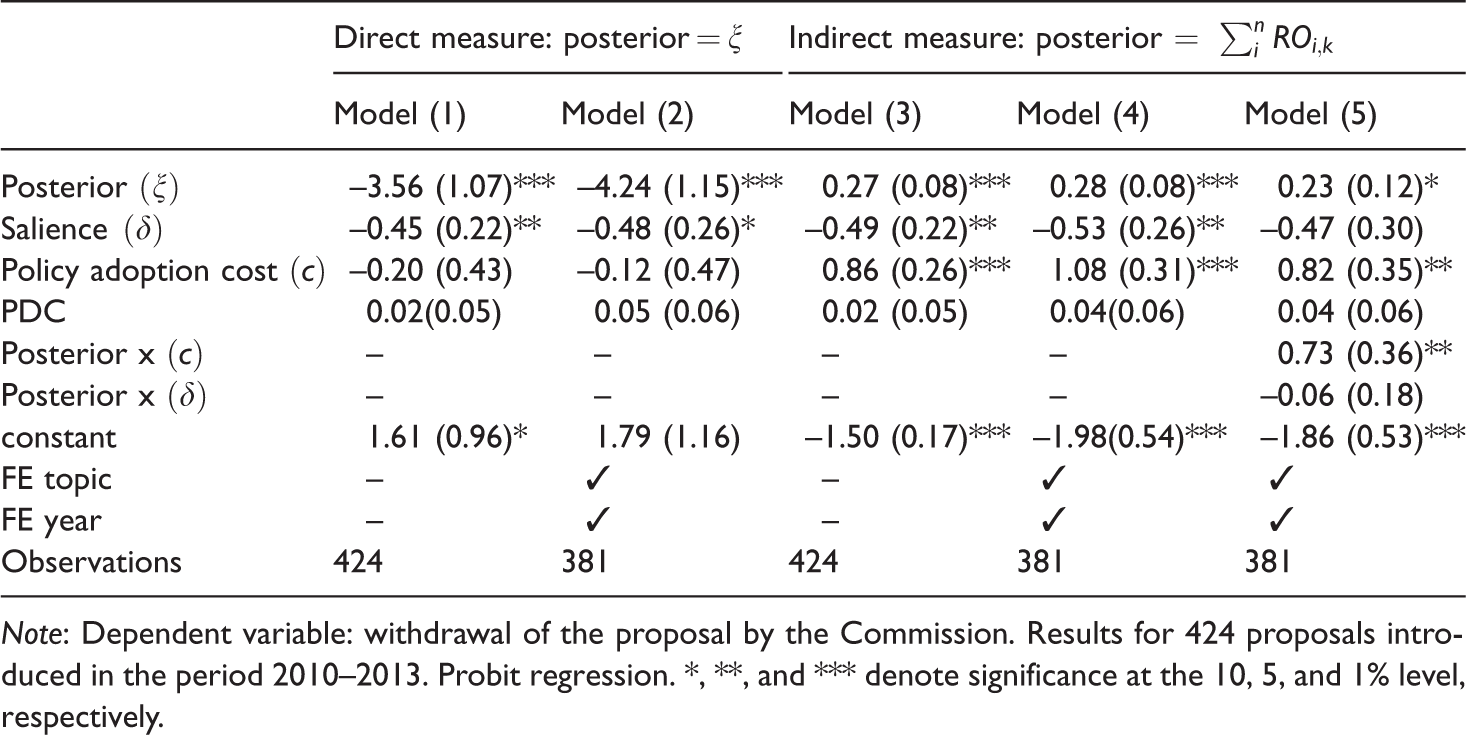
Note: Dependent variable: withdrawal of the proposal by the Commission. Results for 424 proposals introduced in the period 2010–2013. Probit regression. *, **, and *** denote significance at the 10, 5, and 1% level, respectively.
In Model 3 and 4, we use the aggregate number of ROs directly in the model. We find that the more ROs, the more likely the Commission is to withdraw. Now, the variable policy adoption cost is significant and positive. In other words, the higher the cost of proceeding with the proposal, the lower the Commission’s expected utility, and thus the higher the likelihood, it will withdraw instead. This is in line with hypothesis 2c. Finally, in Model 5, we find an interaction effect between the number of ROs and voting rule in the Council, as referred to in the table as policy adoption costs. We do not find a significant interaction effect with salience, although the direction is in line with what one would expect.
Interestingly, in all models, we do not find any evidence that more PDCs lead to a higher probability that the Commission will withdraw a proposal. ROs thus seem to capture specific information that are not captured by PDCs.
The predicted probabilities for all variables are plotted in Figure 3(a); the higher the Commission’s posterior belief that the proposal will pass, the lower the probability that it withdraws. Moreover, for any given belief, the Commission is more likely to withdraw if the proposal is not very salient (b) and if the cost of getting the proposal through the policy process is high (c).
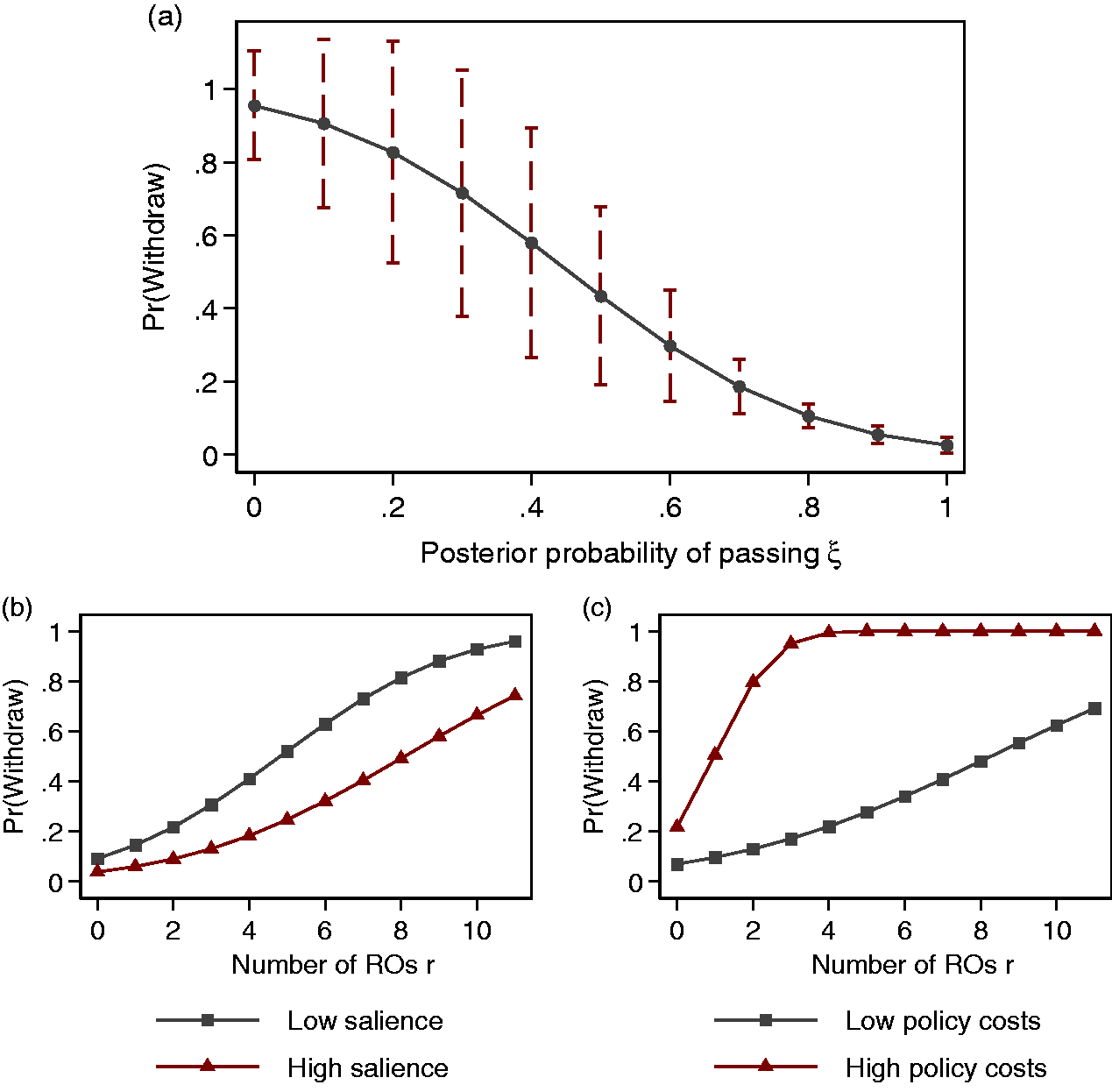
Predicted probability of withdrawal.
Although we have shown that the Commission does indeed have a higher likelihood of withdrawing in cases where the prospects of success are low, we cannot explicitly distinguish between early and late withdrawal. In other words, we cannot assess whether the Commission withdraws a proposal early because of ROs or because of a lack of support in the Council. The data on withdrawals are released in batches and are not informative as to when the Commission actually withdraws a proposal. Below, we present a number of arguments in favour of our theory, and we consider the broader relevance for our theory beyond the European Commission.
First, the yellow card on the Monti II regulations provides some empirical evidence for our argument that the Commission may withdraw a proposal early in response to ROs. In particular, when the EU Commission received the yellow card against the Monti II Regulation, a regulation concerning the right to strike, it subsequently withdrew the proposal. The Commission explicitly stated that a breach of the subsidiarity principle was not evident in the parliamentary opinions. Rather, the proposal was withdrawn because it was ‘unlikely to gather the necessary political support within the EP and the Council to enable adoption’ (European Commission, 2013).
Second, the Commission is only allowed to formally withdraw its proposal as long as the Council has not acted (Article 293(2) Treaty on the Functioning of the European Union). Thus, in order to avoid that the Council and EP adopt a proposal that differs significantly from the original proposal, the Commission has a strong incentive to strategically anticipate such events and timely withdraw its proposal.
Third, regardless how responsive to ROs the Commission is in reality, we have shown that the Commission is much more likely to ultimately withdraw proposals that receive ROs. So, either the Commission already makes use of the signal, as the Monti II proposal arguably indicates, or it should consider making more use of it to avoid wasting time on proposals that it does not find sufficiently important.
Finally, the Commission is clearly not the only actor that benefits from the signalling value of ROs. Given that the Council is by far the most non-transparent institution, the EP, but also policy-makers and other interest groups, may use ROs from parliaments to improve their information on the likelihood of policy success.
Conclusion
Intuitively, the EWS may not have been very successful. This intuition has largely been fueled by the low number of yellow cards, only three to date. These have often taken a central position in recent research about the merits and demerits of the EWS. This article challenges this intuition. We provide an alternative theory that shows how the EWS could be considered a useful institutional innovation. Contrary to the approach that treats the EWS as a failed mechanism to veto EU legislation, we consider it as a signalling device to the European Commission and other actors that, in a broader context, is similar to other institutional signalling mechanisms in the US.
We present a simple model of EU policymaking. In the model, the EWS can be a credible predictor of how governments will vote in the Council. The EU Commission, as a rational actor, takes these signals into account when deciding to proceed with the legislative process or to withdraw the proposal altogether. We show that if the signal is sufficiently accurate, the salience of the proposal is low and the costs of policymaking are high, then the Commission optimally withdraws the proposal when it receives ROs. Our model can provide an explanation for the Posted Workers Directive which triggered the third yellow card but was ultimately not withdrawn by the Commission: on the one hand, the yellow card provided a strong signal that negotiations in the Council would be difficult (many ROs). On the other hand, the proposal was of high salience (directive) and the costs of policy adoption were relatively low (QMV), making the expected utility from not withdrawing the proposal arguably positive.
Our empirical analysis of all legislative proposals submitted under the EWS between 2010 and 2013 supports this theory. We estimate a lower bound of the true relation between parliaments’ ROs and their government’s opposition in Council negotiations. We find that, on average, governments for which the parliament has submitted an RO are five times more likely to oppose that same piece of legislation in the Council. Hence, ROs are a credible signal of government opposition in the Council. This may either be a consequence of the fact that governments tend to have similar preferences as their parliaments or because ROs have a causal effect on government opposition. While both mechanisms imply that ROs are informative signals for the Commission, future qualitative research could shed further light on these dynamics.
We find that the Commission takes this signal seriously. Our results provide compelling evidence that the Commission is more likely to withdraw its proposals the more ROs are issued, whether or not they constitute a yellow card. A yellow card is thus not a sufficient or necessary condition for the Commission to withdraw a proposal. In addition, the Commission is more likely to withdraw when the costs of policy adoption are high (UN voting), and the proposal is not very salient.
Moreover, our results have important implications that are less intuitive. A more binding EWS, such as under the proposal for a red card, could upgrade parliaments to a collective veto player in EU policymaking. However, adding veto players may result in more legislative gridlock (Tsebelis, 2002) and hence decrease the EU’s ability to legislate efficiently. Contrary to this logic, our results suggest that the EWS in its current form may actually increase the efficiency of the legislative process. While the Commission already holds pre-negotiations with governments and, as such, selectively proposes policy that is supported widely, NPs may in the end instruct their governments to oppose, even though the government has shown support in pre-consultations. As such, ROs can be considered as an expanded form of pre-consultations. The Commission can then anticipate bargaining difficulties in the Council and therefore save precious time and resources.
Supplemental Material
sj-pdf-1-eup-10.1177_1465116520923752 - Supplemental material for The Early Warning System and policymaking in the European Union
Supplemental material, sj-pdf-1-eup-10.1177_1465116520923752 for The Early Warning System and policymaking in the European Union by Philippe van Gruisen and Martijn Huysmans in European Union Politics
Supplemental Material
sj-zip-2-eup-10.1177_1465116520923752 - Supplemental material for The Early Warning System and policymaking in the European Union
Supplemental material, sj-zip-2-eup-10.1177_1465116520923752 for The Early Warning System and policymaking in the European Union by Philippe van Gruisen and Martijn Huysmans in European Union Politics
Footnotes
Acknowledgements
We would like to thank Bruno Castanho Silva and Katjana Gatterman as well as the participants at the Interaction Between Legal Systems Seminar at Leiden University (2018), the conference on Analyzing Strategic Interactions in Political Decision-Making, CIES-IUL, Lisbon (2019), the 2019 European Political Science Association (EPSA) conference in Belfast and the 2019 American Political Science Association (APSA) conference in Washington DC for helpful comments and suggestions. We thank Thomas Gomez for excellent research assistance and we thank four referees for helpful comments and suggestions.
Funding
The author(s) received no financial support for the research, authorship, and/or publication of this article.

Notes
Supplemental material
Supplemental material for this article is available online.
References
Supplementary Material
Please find the following supplemental material available below.
For Open Access articles published under a Creative Commons License, all supplemental material carries the same license as the article it is associated with.
For non-Open Access articles published, all supplemental material carries a non-exclusive license, and permission requests for re-use of supplemental material or any part of supplemental material shall be sent directly to the copyright owner as specified in the copyright notice associated with the article.
