




Abstract
The bureaucratic reputation literature stipulates that bureaucracies strategically aim to maximize reputational benefits and minimize reputational damages through targeted communication strategies. Departing from this assumption and using an extensive dataset on the media coverage of 54 legislative acts, we examine the conditions under which commissioners appear in the news and which communication strategies they pursue. Our analyses show that commissioners are more likely to appear in news coverage in the context of technically complex issues. We find that if a regulation is less politically conflictual, they are more likely to promote the commission's policy preferences, whereas they adopt a more passive style of communication in the face of political conflict. The findings further our understanding of regulatory policymaking by explaining bureaucratic behaviour through a communicational lens.
Keywords
Introduction
A recently emerging line of research within the bureaucratic reputation literature investigates the role of strategic communication as an important tool in regulatory governance (Maor, 2020). Regulatory organizations strategically identify, process, and prioritize multiple and often conflicting expectations among their various audiences and attempt to respond to these expectations through strategic and consistent public communication efforts (Gilad et al., 2015). Many of the valuable studies on the matter specifically focus on regulatory organizations’ efforts to protect their reputation regarding their core responsibilities vis-à-vis reputational threats or examine which reputational dimensions they emphasize in their outputs (Boon et al., 2019; Busuioc and Rimkutė, 2019; Maor, 2020; Maor et al., 2013; Moschella et al., 2020; Van der Veer, 2020). However, strategic communication can serve more goals than protecting an organization from reputational threats: it can serve as a reputation management tool for regulatory organizations directly involved in regulatory policymaking processes. While early reputation research has stated that regulatory organizations act strategically to protect and forge their reputations in policymaking processes (Carpenter, 2001), we know very little about the nature of their communication in the context of specific (regulatory) policy processes. Depending on the specific mandate, regulatory organizations provide scientific expertise for formulating policy options, organize stakeholder consultations, or – in the case of the European Union (EU) Commission – even formulate initial policy proposals that will enter the legislative stages of policymaking. Due to their close involvement, the course and outcomes of regulatory policymaking processes have direct impacts on these organizations, as they can affect both their reputation and the specific policy content.
During regulatory policymaking processes, public communication plays a central role as part of an organization's reputation-management strategy: depending on how organizations publicly portray themselves, they can either show that they can deliver unique services to the polity or avoid visible failures (Carpenter, 2001, 2004; Carpenter and Krause, 2012; Wæraas and Maor, 2014). While we are starting to understand the intricacies of strategic regulatory communication in response to reputational threats, we do not know whether these findings also extend to regulatory policymaking processes. Given that the regulatory state is becoming increasingly responsive to the public (Koop and Lodge, 2020) and regulatory processes are becoming more politicized (Busuioc and Jevnaker, 2020), we need to better understand the role of regulatory communication in the context of regulatory policymaking and the nature and implications of the communicational strategies of regulators. This research, therefore, investigates the following critical question: how do regulatory actors use communication as a strategic tool during regulatory policymaking processes?
In this article, we focus on the strategic communication during policy processes of the EU Commission - a strong supranational executive organization with many political ties and confronted with ever-increasing audience contestation (Blom-Hansen and Finke, 2020; Van der Veer, 2020). The strong emphasis on regulatory governance in the EU and the complex political and institutional structure render it a highly relevant case to study how regulatory actors use communication as a strategic tool during policymaking processes. As the EU Commission is almost exclusively publicly represented by its political principals, henceforth the commissioners, this study will specifically examine how these elites communicate during regulatory decision-making processes. Using a dataset of 1139 newspaper articles covering 54 regulations that passed the EU's ordinary legislative procedure in 2015 and 2016, the article empirically assesses when and how commissioners strategically communicate for reputational purposes via the news media.
Drawing on communication and reputation perspectives, we argue that commissioners choose communication strategies that maximize the reputational benefit for the EU Commission and minimize potential reputational damages. The choice for a specific strategy is based on issue-specific characteristics, such as policy complexity, policy salience, and political conflict. In line with earlier research on the matter (for instance: Koop and Lodge, 2020), our findings show that the policy process appears to be (in part) politicized. Using media coding and multilevel analyses, we find that Commissioners are more likely to speak up in the news in the context of more technically complex regulations, as it allows them to demonstrate the EU Commission's expertise by explaining and disclosing regulatory details. Furthermore, they are more likely to promote the policy preferences of the EU Commission if these preferences are politically supported by the European co-legislators, and use a more passive voice for policies characterized by political conflict.
We contribute to research on regulatory governance and regulatory communication in four important ways. Firstly, in line with other recent work (Blom-Hansen and Finke, 2020; Busuioc and Rimkutė, 2020; Van der Veer, 2020), we extend the empirical focus of the regulatory communication literature to the use of communication in EU policy-making, studying a ‘high-profile supra-national organization[s] beyond strictly regulatory one[s]’ (Van der Veer 2020: 3). The EU Commission holds a quasi-monopoly to propose legislation for the EU and is a bureaucratic organization that is led by politically elected commissioners. Compared to strictly regulatory agencies (both in national and EU contexts), the EU Commission is deeply involved in the policy-making process and heavily depends on a strong reputation for the creation of good legislation. 1 The EU Commission provides a suitable example to study reputational mechanisms across various policy areas within one single organization. By focusing on a single organization, albeit it is a complex one, we leverage intra-institutional insights and avoid Carpenter's critique regarding comparability in public administration research: comparing very different organizations directly with each other might not always be scientifically appropriate, as public servants within these organizations might follow very different routines and logics based on the policy field and nature of their work (Carpenter, 2020). Carefully selecting units and organizations of comparison or following ‘Wilsonian’ principles of analysis of bureaucratic organizations can help to avoid these unmatching comparisons and provide more appropriate and valid insights (Carpenter, 2020). Secondly, we extend the focus of existing regulatory communication literature on formal communication (e.g. reports), or crisis communication, to regulatory actors’ communication via the news media during regulatory policymaking processes-from publishing the regulatory proposal to the final vote of the legislators. Furthermore, the existing literature that covers media statements of regulatory organization representatives typically focuses on times of crises, which are exceptional events, while we cover a regulator's everyday communication via the news media. Lastly, the findings demonstrate, to our knowledge for the first time, how regulatory actors make sense of the political climate around a regulatory decision-making process and strategically adapt their public communication accordingly. While it has been shown that the EU Commission anticipates levels of political opposition in the policy drafting stage (Rauh, 2021), this article asks whether this sense of anticipation also shapes communication strategies to manage the organization's reputation during the regulatory policymaking process.
Reputational explanations of regulatory communication
In the past few years, bureaucratic reputation scholars have highlighted the importance of regulatory communication as a strategic tool for regulatory organizations to forge a strong reputation for various organizational competencies (Busuioc and Rimkutė, 2019; Gilad et al., 2015; Maor and Sulitzeanu-Kenan, 2013; Moschella et al., 2020). It has been demonstrated repeatedly and in varying contexts that regulatory organizations endogenously construct their audiences and tend to act in a way that aims at minimizing negative perceptions and maximizing external support of the organization (Carpenter, 2004; Carpenter and Krause, 2012; Gilad, 2008; Gilad et al., 2015; Maor et al., 2013; Maor and Sulitzeanu-Kenan, 2013).
During regulatory decision-making processes, representatives of the EU Commission see themselves confronted with an environment of multi-faceted audiences and contrasting policy preferences. As this environment of competing interests and multi-faceted audiences is directly comparable to that of other regulatory organizations that are typically studied by reputational scholars, we rely on a key underlying assumption of the bureaucratic reputation literature for theorizing how executive regulatory organizations use communication for reputational purposes: regulatory actors aim for communicational strategies that will maximize reputational benefits and minimize reputational damages, and use the news media as an important venue for doing so (Maor, 2020).
Strategic communication as a reputation management strategy
Through the shift toward more responsive and participatory modes of regulatory governance, regulatory organizations increasingly use tools to engage their various audiences. Given the central role of the news media in a regulator's public profile, regulatory communication via these media has become a key component of a regulator's reputation management strategy.
Prior research has shown that a regulator's strategic media response is guided by two general principles: (a) maximizing reputational benefits and (b) limiting the reputational damage to their organizations. The key implication of this principle is that regulators chose differential responses, based on a trade-off between responding or staying silent, to enhance reputational benefits and limit reputational damages (Gilad et al., 2015; Maor et al., 2013). Prior research has shown that regulators do not only consider the current situation for their strategic choice but also take into account potential future developments. For instance, Moschella and Pinto (2019) show that the most salient issues in the US Federal Reserve's communication are shaped by reputational concerns about future policy reversals. If central bankers anticipate policy reversals with potential impacts on their organization's reputation, they emphasize more topics for which the Federal Reserve enjoys a weaker standing. In the case of regulatory decision-making, we assume that executive regulatory organizations are typically faced with two decisions when using strategic communication for reputational purposes. Firstly, should they participate in the discussion (regulatory talk) or should they remain silent (strategic silence)? Secondly, how shall they communicate to advance their reputation?
Strategic silence versus regulatory talk
Similar to regulatory talk, strategic silence can serve many purposes for an executive regulatory organization (Maor et al., 2013). Firstly, if an executive regulatory organization stays silent in the news, it can potentially prevent public discussions on issues that it would rather avoid publicly discussing. This may be due to various reasons, for instance, to prevent uncovering potential existing problems or conflicts that would worry external stakeholders or stir up criticism of their organization (for an example of central banking, see Cukierman, 2009; for another example involving private organizations, see Carlos and Lewis, 2018). In some cases, deciding to talk publicly might also backfire at the organization, depending on the topic of the discussion – particularly moral or ethical issues (Bloom and Levitan, 2011). Secondly, executive regulatory organizations need to ensure that their policy preferences receive support from other key actors and institutions who (co-)decide whether the executive regulatory organization's policy preferences are transposed into policies. Maor et al. (2013: 586) state that the ‘regulators’ choice between silence and talk is directly related to the likely impact of external judgments on their distinct reputation’. Therefore, an executive regulatory organization's distinct reputation during policymaking processes directly depends on whether its policy proposals are politically supported.
H1: An executive regulatory organization is more likely to engage in a regulatory talk during regulatory decision-making processes if there is little political conflict surrounding a policy issue.
In line with Maor et al. (2013), it can be expected that the regulator's willingness to respond is shaped by the intensity of the opinions that it faces. For instance, if there is high media coverage, the chance that stakeholders or politicians directly address the regulatory organization increases. Large media attention provides a greater reputational threat for an organization, because it could, for instance, highlight weaknesses of the organization publicly. These negative depictions might stick in the public memory of the competencies of the organization if the concerned organization does not directly intervene. The organization might also be asked questions about issues more frequently, ‘and the absence of a response becomes an issue on its own with each additional choice to remain silent’ (Maor et al., 2013: 587).
H2: An executive regulatory organization's propensity to engage in regulatory talk regarding a policy issue is positively associated with the media salience of the issue.
Lastly, executive regulatory organizations might act differently depending on how technically complex each policy is. As Gormley (1986) first showed, politicians tend to be more active on highly salient and low complexity issues, while bureaucratic actors are more crucial in policy processes that involve significantly complex issues. Highly complex issues pose barriers to politicians’ participation, as it is difficult for them to claim policy success before their constituents. Gormley suggests that the opposite is true for bureaucratic actors: if issues are complex, regulatory organizations can show off their expertise and prove themselves to other actors in the policy process. Therefore, we expect that an executive regulatory organization appears more often in the media for technically complex issues because it gives these organizations a possibility to prove their expertise.
H3: An executive regulatory organization's propensity to engage in regulatory talk regarding a policy issue is positively associated with the technical complexity of that issue.
Policy promotion and passive talk
How does an executive regulatory organization use different modes of regulatory communication? In line with similar arguments from the bureaucratic reputation literature, we argue that an executive regulatory organization will choose public statements that will maximize reputational gains and minimize reputational damages during regulatory decision-making processes. If an executive regulatory organization senses that its policy preferences are likely to be transposed into law, it will adopt an active and bold communication style that signals its preferences (henceforth, policy promotion). Whereas it is more likely to adopt a passive and careful communication style if its policy preferences are under threat, that is, when the outcome of a legislative procedure is politically uncertain (henceforth, passive talk).
Signalling theory provides a good foundation for understanding an executive regulatory organization's use of policy promotion. The theory has been used to explain how political actors convey difficult to observe qualities to other audiences (Bailey et al., 2005; Hennessy, 2017; Van der Veer, 2020). Effective signals combine two qualities, namely, they are observable and costly to the signalling actor (Connelly et al., 2011). Firstly, the target audience of a signal needs to be able to differentiate the signal from other, usual communication (often referred to as ‘noise’). Secondly, signals are costly for the signalling actor if they tie the signalling actor to a specific kind of action. In regulatory communication, promoting one's policy preferences can be considered a costly signal. If the signalling actor's policy preferences are not attained, the actor might lose credibility in future policy negotiations. Simultaneously, issuing such a signal might be beneficial for the signalling actor if the stated policy preferences are indeed transformed into policy outcomes, as the signalling actor can claim such outcomes as their will. It is likely that executive regulatory organizations will use policy promotion if they do not expect stakeholder’s or political opposition, and expect their policy proposals to successfully pass the legislative process.
H4: An executive regulatory organization is more likely to use policy promotion during a policymaking process if a policy issue is characterized by low levels of political conflict.
As the external environment in which an executive regulatory organization operates becomes more hostile, and policy preference attainment is less likely, an executive regulatory organization may adopt a more careful and passive communication strategy, that is, passive talk. After all, according to the signalling theory, sending strong signals in the shape of clearly stated policy preferences is costly to the sender. If an executive regulatory organization publicly commits to a particular policy solution and this proposed solution does not pass the political policymaking process, the issuing executive regulatory organization will lose credibility in public's perception. We can assume that in the face of a lower likelihood of an executive regulatory organization's preferred policy solution being turned into binding law, the executive regulatory organization will be much more careful in its public commitments.
What could passive talk look like in practice? Firstly, it will most likely not contain any strong communicative signals. As stated above, issuing these signals is costly and only pays off for the executive regulatory organization in the case of a successful policymaking process. If the executive regulatory organization does not anticipate its policy preferences to be successful, it will most likely refrain from strongly and publicly promoting these policy ideas. Secondly, passive regulatory communication would most likely focus on the administrative aspects of policymaking. If the regulatory policy does not pass the political process or gets heavily amended, the executive regulatory organization can therefore show that it has done its due diligence in finding a good policy solution. If a regulatory proposal is less likely to pass the legislative process, such passive talk will ensure that the executive regulatory organization does not lose its reputation when a policymaking process fails.
H5: An executive regulatory organization is more likely to use passive talk in regulatory communication during a policymaking process if a policy issue is characterized by high levels of political conflict.
The case: Regulatory decision-making in the EU
The EU's nature as a regulatory state (Majone, 1997) renders it a relevant case for assessing strategic communication in regulatory policymaking, considering that much of national-level regulation in EU member states can be traced back to regulatory policies that were agreed on at the EU level. It has been shown that the EU's policymaking bodies are faced with a complex environment of ‘multiple, heterogeneous audiences posing a dynamic balance of conflicting threats’ (Van der Veer, 2020: 2). Faced with such a difficult environment, EU institutions provide both an informative as well as a most likely case for the use of policy preference signalling to increase the chance that their preferences will prevail. Specifically, we focus on the EU Commission because of its exclusive right to initiate EU regulations. As the EU's central executive bureaucracy, the organization and its political heads (i.e. Commissioners) find themselves particularly dependent on regulatory communication and open to challenges by their audiences (Blom-Hansen and Finke, 2020; Van der Veer, 2020). After the EU Commission publishes a legislative proposal, the formal decision power over a particular policy lies with the EU's two co-legislators (Council and Parliament). Next to so-called trialogue meetings and other formal mechanisms, the use of communication via news channels is an important way the EU Commission can still participate in the policy process. 2 The news media provide a venue for the EU Commission to publicly promote and signal its policy preferences as well as defend and explain its reasoning. In these media appearances, the EU Commission is almost exclusively represented by its commissioners (one for each EU member state).
Data and methods
Commissioner communication is measured via an appearance in newspaper articles. The media provide an additional filter to real-life events, as newspaper outlets decide what they wish to report on and what remains unreported. However, previous research on the involvement of the news media in the policy process has suggested that the media can be understood as an amplifying factor rather than a causal factor in setting the agenda (Wolfe et al., 2013). The news media are, therefore, a good venue to study the communication of the EU Commission, as they are likely to highlight the most salient issues within the organization's communication. Secondly, due to a broad selection of newspapers with different political leanings, it is likely that we also capture a broad representation of policy issues at the EU level. Third, newspaper reporting, although not perfect, is the best available medium to observe public communication in policymaking processes. Alternative sources, such as EU Commission's press releases, are highly standardized and therefore show relatively little variance across policies. Venues such as social media in contrast are not consistently used to communicate updates about policy processes and are therefore also not suitable as a medium to study in this context. By selecting the EU Commission as the sole target organization, our research design ensures that potential noise arising through media filtering is held constant across the regulations. For the above reasons, our design is in line with previous research on public communication in regulatory affairs (Gilad et al., 2015; Maor et al., 2013).
To test the above hypotheses, the authors constructed a database consisting of 2619 newspaper articles covering 76 regulatory legislative acts that have passed the ordinary legislative procedure of the EU between 2015 and 2016 (for the strategy on how the legislative acts were selected, see Braun et al., 2020 and the Online appendix). Our sample only contains passed legislative acts and one might argue that the selection of samples might bias the results. However, selection bias is kept to a minimum: firstly, during the time of observation (2015 and 2016), no legislative acts in the ordinary legislative procedure were rejected by the Parliament or by the Council. Secondly, while the EU Commission withdrew 42 legislative proposals at different stages of the ordinary legislative procedure in one coordinated effort in 2015, this was done to align the legislative agenda with the new political priorities arising from the 2014 European elections. A large majority of the withdrawn legislative proposals were largely older legacy proposals that did not align with the new legislative vision of the EU. Lastly, our sample contains legislative acts that proved to be very difficult to pass and almost were unsuccessful. About one-fifth of legislative acts in our sample took six years or longer from first consultations to the final passing.
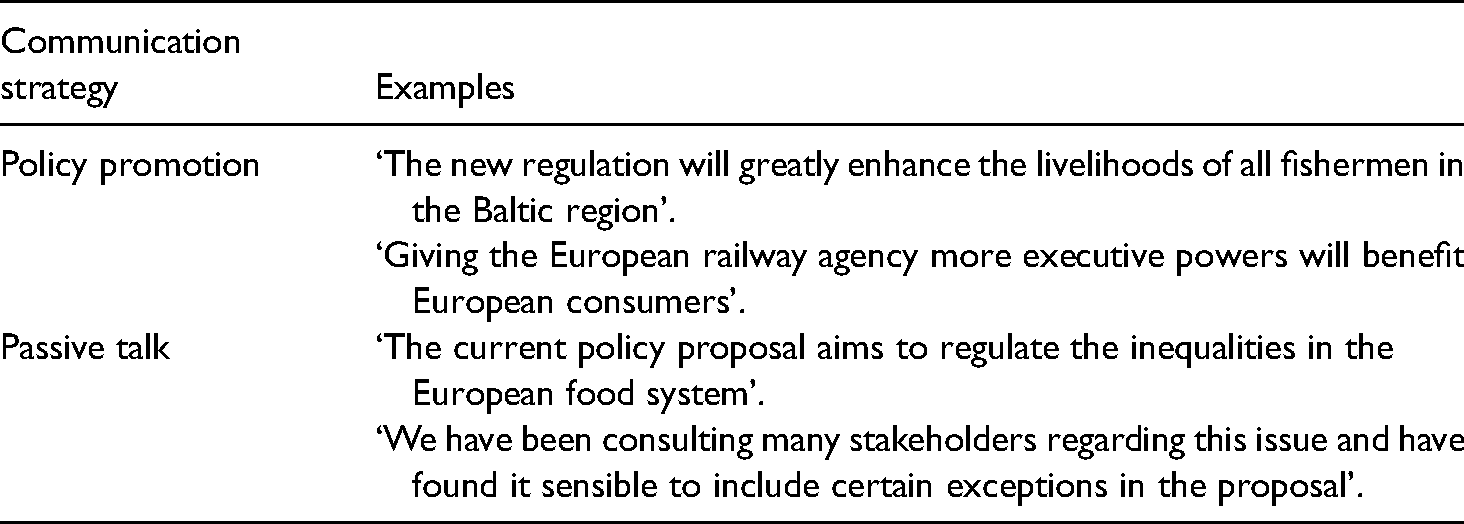
The newspaper database construction has been part of a larger research project on stakeholder engagement in supranational regulatory governance (Braun et al., 2020). To retrieve the articles, standardized search strings were constructed to capture articles covering each regulation (details in the Online appendix). The newspaper articles were retrieved from five of the most widely circulated newspapers covering European Affairs and a range of political perspectives from centre-right to centre-left. 3 While the newspapers are balanced in terms of political leaning, their audiences are likely located in the professional sphere. Given that we observe communication regarding ongoing policymaking processes, professionals can be considered the primary audience for Commissioners. The newspaper selection, therefore, aids in measuring communication between Commissioners and some of their most important stakeholders. However, while the audiences of the selected newspapers are not representative of the full public, these newspapers constitute a key source for the EU Commission to contribute to and shape the public debate on EU matters (many major newspapers pick up stories from these specialized outlets). Three trained human coders assessed for each sampled article whether it substantively covers each respective legislative act. A total of 1139 relevant articles remained in the database covering 54 of the 76 originally sampled legislative acts that passed the ordinary legislative procedure (22 legislative acts did not receive any media coverage). The authors coded each article as to whether it contained a statement by a commissioner regarding each respective regulation. For each commissioner statement, the authors further determined whether the statement contained elements of policy promotion or passive talk (for details on how it was coded, see Table 1). After completion, every article was linked to an extensive dataset containing detailed information on each article's respective policies (containing details on stakeholder mobilization, consultations, and voting results in the Parliament and Council, see Braun et al., 2020).
Coding examples.
Dependent variables
The hypotheses outline three dependent variables. The first one involves whether the commissioners speak up (or not) in any of the news articles covering one of the sampled policies (strategic silence vs. regulatory talk). The second and third dependent variables test how the commissioners communicate in each article they appear in (i.e. whether they use policy promotion or passive talk). Examples for all categories are shown in Table 1. The level of observation is each newspaper article in the database.
The outcome for the first dependent variable is a binary variable indicating the presence of a (or multiple) commissioner(s) in an article and is subsequentially coded as silence (0) versus talk (1). The authors did not code any mere mention of a commissioner as talk, but only coded it as such if there is a direct or indirect quote of a commissioner. A statement was recorded both when it was a direct response to a journalist's question or a secondary reporting – for example, if an article's author quotes a press conference statement by a commissioner. For instance, an article that stated ‘Commissioner Barnier attended the meeting of ministers on 3 October’ would be classified as silence, while another article that mentions ‘Commissioner Barnier voiced his opposition to the current developments in the Parliament and stated that “any alternative to the proposes scheme is unfeasible to implement”’ would be labelled as talk. Commissioners appeared in 185 articles across 32 out of the 55 sampled regulations that had received media coverage – they did not appear at all in the news coverage of the other 23 regulations.
The second and third dependent variables capture, respectively, whether a commissioner uses policy promotion or passive talk in each of the recorded statements. Therefore, each of the 185 news articles in which a commissioner statement was recorded was then coded to whether the commissioner statement contained elements of policy promotion or passive talk. The authors chose to do this via two separate binary variables for the presence (1) or absence (0) of each strategy, as one statement could contain elements of both strategies. A statement was coded as policy promotion if the commissioner highlighted specific dimensions of the regulation and emphasized the benefits of the regulatory solution the EU Commission proposes or promoted the EU Commission's policy proposal in other ways. It was coded as passive talk if the commissioner did refrain from disclosing the EU Commission's preferences regarding an ongoing policy negotiation process and described the purposes of the regulatory proposal without explicitly promoting it or highlighting how the EU Commission agreed on a solution. While the communication strategies were coded by one coder, a random sample of 30 articles containing commissioner statements was coded by a trained second coder to test the robustness of the two categories. Inter-rater reliability was high with a Krippendorff alpha of 0.863 for policy promotion and 0.931 for passive talk.
Independent variables
The analysis highlights three independent variables: political conflict, policy complexity, and media salience. All three variables are measured at the policy issue level. Furthermore, we controlled for potential stakeholder conflict and staff size (also measured at the policy issue level).
The EU Commission is an institution that is influenced by political dynamics, both internally and externally (Hartlapp et al., 2014). If there is political contestation within the two EU co-legislators, we can assume this to influence the voting outcome in both chambers. Political conflict is therefore operationalized by quantifying and combining the voting results in the Council and the Parliament regarding the regulations. 4 Political conflict is a bounded continuous variable ranging from 0 to 1, where 0 is the lowest level of political conflict, that is, 100% agreement to the policy proposal in both the Parliament and the Council and 1 is the highest level of political conflict. The value of 1 can only be reached theoretically, as it would imply that both the Parliament and the Council outright reject the proposal and it would therefore not have passed the ordinary legislative procedure. Conceptually, this measure is supposed to locate political conflict during the policymaking process. While this operationalization measures political conflict towards the end of the policymaking process, it provides an accurate proxy for political conflict during the process. We have verified this measure with interviews with public officials of the EU Commission working on each legislative proposal and found that it strongly correlates with our qualitative assessment (for more information, see the Online appendix).
Media salience is measured as the total amount of newspaper articles that cover a specific policy issue. Policy complexity is conceptualized as the amount of information that is contained in a legislative proposal. In line with earlier research on text complexity, we assume that the more unique words a legislative proposal contains, the more technical the text can be assumed to be: each word contains information and if there are many unique words, there is much information (Aizenberg and Müller, 2020). In contrast, a text that uses the same words repetitively can be assumed to use less information. Different measures of text complexity are often highly correlated, yet, they use various ways of measuring complexity in the text – for instance, the average number of syllables, ‘familiar words’, or vocabulary diversity (Benoit et al., 2019). While there are many measures of text complexity, this research has to account for varying lengths in the different legislative proposals. Carroll (1964) introduced one of the most frequently used measures that calculates the ratio between unique words and overall words and included a correction term for the length of a text – that is, Carroll's corrected type-token ratio. 5 We choose this measure for our analysis because it corrects for varying text lengths and has been successfully applied in other research contexts. 6 The CCTR of each legislative proposal was calculated to investigate the impact of policy complexity on the likelihood of the EU Commission engaging in the news.
Commissioner communication might indirectly be influenced by underlying stakeholder conflict. To control for this possibility, we chose to measure potential stakeholder conflict as the number of interest groups who have mobilized on a specific policy issue divided by the total number of total interest groups in the respective policy area. The number of mobilized interest groups has been determined through the study of EU documentation on public consultations and the impact assessment of the EU Commission regarding each of the sampled policies. The number of overall groups active in a policy area was determined through a count of organizations registered in the EU transparency register in the policy area that most closely fits each respective policy. The underlying assumption behind this measure is that if many organizations active in a general policy area mobilize on a specific policy (e.g. health policy), there will be multiple policy preferences. If only a few organizations mobilize, the universe of preferences amongst stakeholders is likely to be smaller and might decrease the likelihood that stakeholders will challenge the EU Commission's policy proposal.
Various Directorates-General (the subunits of the EU Commission, henceforth DGs) might have different administrative capacities to gauge and process the current public and political climate surrounding a certain policy. To control for the possibility that larger DGs are more likely to assess public and political opinions regarding a legislative act and subsequently might prime Commissioners to become publicly active on an issue, the analysis also controls for staff size. This is measured by the number of employees that worked for each of the DGs (in full-time equivalents, data from 2016). Models 2 and 3 exclude DG staff size since the number of policy issues (32) is relatively low and it is advisable to limit the number of explanatory variables per model.
Results
The results of the research are presented in three parts. Firstly, we describe general communication tendencies; secondly, the model examining talk versus silence will be shown and discussed; thirdly, we present the results of the models that investigate commissioners’ communication strategies.
Descriptive statistics
Of the total 1139 articles covering the sampled regulations, the EU Commission commented in 16% of these articles (n = 185). The EU Commission's comments do not appear evenly distributed across regulations but focus on specific ones (ranging from an appearance in 0% to 54% of all articles featuring each respective regulation). This strongly suggests that EU Commission appearances in the media are not randomly dispersed but vary across different legislative acts. Furthermore, if commissioners appear in news coverage, they are likely to promote the policy proposal of the EU Commission (52.4% of all articles with commissioner appearances) and less likely to engage in passive talk (28.1%). Descriptive statistics regarding the independent variables can be found in the Online appendix.
Talk versus silence
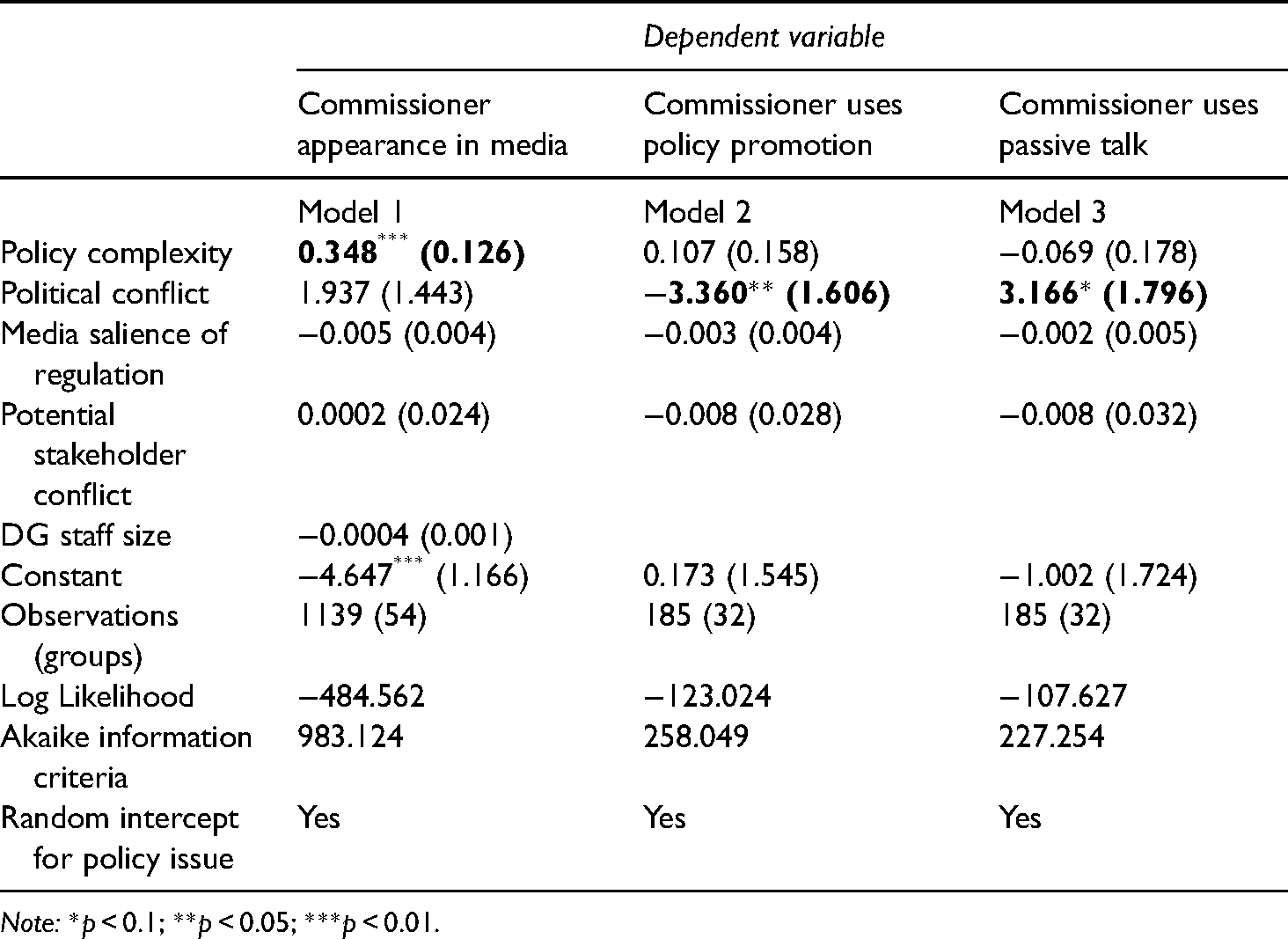
The analysis fits multilevel binomial logistic models with random intercepts for policy issues to account for the heterogeneity of varying issues and unequal distribution of EU Commission appearances across issues. This means that newspaper articles are nested in policy issues. From a model selection perspective, this random intercept is particularly recommended as it provides the lowest Akaike Information Criterion in an empty model compared to a model without random intercept or other conceivable random intercepts such as accounting for the DG that is responsible for each respective policy area. The number of observations varies, as model 1 tests all articles covering policy issues, while models 2 and 3 only test those articles that contain commissioner statements. Model 1 tests whether a commissioner appears in a news article covering any of the regulations. Model 2 tests, for all of the articles where a commissioner’s statement on policy promotion is reported. Model 3 controls for Commissioners’ use of passive talk in their statements.
Model 1 in Table 2 shows that only policy complexity can explain whether a commissioner is likely to appear in the news (H3 confirmed). Neither media salience, nor political conflict can explain whether a commissioner is likely to appear in the news media in the context of the sampled policies (H1 and H2 rejected). The marginal effects plot in Figure 1 shows that the effect of policy complexity on the likelihood of a commissioner appearing in the news is quite strong: commissioners are almost four times as likely to appear in articles covering very complex regulations compared to regulations that are not very complex.

Marginal effect plots: (a) model 1; (b) model 2; (c) model 3.
Results.
Note: *p < 0.1; **p < 0.05; ***p < 0.01.
Policy promotion and passive talk
Focusing on the models investigating communication strategies of commissioners, we broadly find support for signalling theory: if a regulation is politically contested, commissioners are much less likely to use policy promotion (see Table 2). Instead, they tend to use passive talk when discussing the regulations in question (H5 confirmed by model 3). A different picture emerges if the regulation is less political conflictual: model 2 shows that the coefficient of political conflict is negative, meaning that commissioners are more likely to use policy promotion if the political conflict is low (H4 confirmed).
We also included the models that contain all variables, which show that it does not significantly change results (besides raising the p-value of political conflict in model 3 slightly above the .1 level, see the Online appendix). Our findings provide a good indication of the presence of an effect of political conflict on the choice of rhetorical tools. However, in light of the confidence intervals that are quite large at the extreme ends of our distributions (due to the fewer observations in these ranges) and the relatively high p-value in model 3, the specific degree of the effects should be regarded with a sense of caution. We will further discuss the robustness of our findings in the conclusion.
Some case study illustrations might aid to contextualize the marginal effects plots reported in Figure 1. One of the least politically conflictual cases in the data, Directive 2016/2102 ‘on the accessibility of the websites and mobile applications of public sector bodies’, has been a part of the EU Commission's Accessibility Act – a range of policies to better accommodate public infrastructure to the needs to individuals with various types of disabilities. This directive specifically sets guidelines to improve the accessibility of websites and interfaces of public organizations and has received political support from the beginning to the end of the policymaking process. The news coverage shows that the responsible commissioner for the legislation, Marianne Thyssen, frequently endorses the legislation publicly. She wrote an opinion piece on the act in EURACTIV, titled ‘Better accessibility is good for consumers and businesses’, in which she promotes the EU Commission's effort to improve accessibility for all and lays out how the Accessibility Act will accomplish this goal. Other newspaper articles quote her with similarly promoting statements. Similar legislative acts in the dataset with little political conflict show identical patterns, as policy promotion is the dominant communication style of commissioners in news coverage, complemented with occasional use of passive talk. Legislative acts that were politically conflictual are covered very differently in the news media. Consider one of the most conflictual legislative acts in the sample, Directive 2016/2284. It aims to regulate certain pollutants in the environment and was met with significant political opposition. Next to disagreements with the EU Commission's initial proposal, the Parliament and the Council disagreed on a number of key points in the proposal. Karmenu Vella, the Commissioner for the Environment, Maritime Affairs and Fisheries at the time, gives frequent but careful statements in the news coverage that mainly describe the problem of too much air pollution. In contrast to the communication on Directive 2016/2102, the commissioner never mentions the possible benefits of the EU Commission's proposal, but rather focuses on the problem at hand, or more procedural elements such as how the EU Commission aims to facilitate an agreement between Council and Parliament. We found four instances of this type of passive talk, while the commissioner only made one statement promoting the particular policy, and this happened after an agreement was reached on the directive and it successfully passed the vote. Both examples illustrate the varying nature of EU Commission communication related to the politically contested nature of its policy proposal.
Discussion
The results show that commissioners often seem to be guided by reputational concerns when using the media during regulatory decision-making. Firstly, in line with a general argument by Gormley (1986), they are more likely to speak up in news articles covering a regulation if the regulation in question is more complex. A possible explanation would be that more complex regulations provide the EU Commission's representatives with an opportunity to show their expertise to the public and underline the organization's competence to deliver innovative solutions to solve regulatory problems. Simultaneously, journalists might have a bigger need for explanations of certain parts of the regulation – to make the contents understood for the wider public – and might therefore rely on commissioners, who know the details and intentions of the EU Commission's regulatory proposals.
Secondly, commissioners promote the EU Commission's legislative proposals and regulatory preferences if they have little political opposition. Again, this can be ascribed to reputational concerns: if it is likely that the EU Commission's policy preferences will be transformed into law, commissioners aim to claim policy success for themselves and the EU Commission. Promoting policy success is crucial for an executive regulatory organization such as the EU Commission, as it underlines that the organization can draft sound and agreeable policies.
Thirdly, the results show that commissioners refrain from promoting the EU Commission's policy preferences if the political conflict is high. Instead, they engage in a more passive style of communication that outlines the EU Commission's efforts to draft a legislative act and the overall act's purpose. A possible explanation of this behaviour could be the following. In this particular context, it seems most likely that commissioners sense political opposition against the EU Commission's proposal and aim to limit the damage to the EU Commission's reputation in case the regulation is politically contested.
Lastly, this article finds that other policy issue factors such as media salience or potential stakeholder conflict do not significantly influence whether and how commissioners speak up in the news. Further research will need to prove the robustness and external validity of our results. Due to the number of observations (which is naturally limited by the size of the overall population of passed EU legislation), confidence intervals, especially at the extreme ends of the distribution, become quite large.
Conclusion
This article investigated how the EU commissioners use strategic communication in the context of regulatory decision-making. The results of our analyses lend support to the idea that reputational concerns are a key factor for the communication strategies of commissioners. Three key findings arise: firstly, the data show that commissioners do communicate strategically via the news and that their strategies are dependent on policy-specific characteristics. They suggest that commissioners sense the political mood surrounding each regulation and then pick communication strategies that maximize the reputational benefits for themselves and their organization. Secondly, commissioners aim to maximize the reputational benefits through their communication. They are more likely to publicly engage regarding complex issues that allow the EU Commission to provide expertise to the public. Furthermore, if the legislative proposal of the EU Commission is likely to pass the co-legislation phase, commissioners are more likely to promote it. This in turn might make it easier for them to claim policy success once the regulation is passed. Thirdly, commissioners aim to minimize reputational damages through their communication. If it is uncertain whether a legislative proposal by the EU Commission is likely to pass the political decision-making process, they choose a much more passive communication strategy that avoids publicly linking a policy to the intentions of the EU Commission.
These findings warrant further research that could uncover certain blind spots in our understanding of regulatory communication. On the one hand, the data does not show whether commissioners choose to be involved in the news media or if journalists simply require the voices of commissioners in their articles in specified cases. While the media agenda and the political agenda typically overlap and reinforce each other (Wolfe et al., 2013), future research should address whether and how media filtering influences interactions between public organizations and their audiences. Another approach to control for potential media filtering could be to compare news media reporting and direct outputs of the public organizations (e.g. press releases or social media communication). In addition, it is unclear whether a policy is more likely to pass because commissioners promote it, or whether commissioners only promote policies that are likely to pass anyway. Both of these questions could be addressed with a survey experiment or in-depth case studies with a time-series component that investigates the motivations and behavioural sequences behind the EU Commission's communication efforts.
Our empirical findings and theoretical propositions offer a range of contributions to the existing research on regulatory communication. They show that current regulatory communication research might be biased towards negative externalities of communication – that is, how regulators attempt to limit reputational damages. Our research underlines that regulatory communication is more than ‘damage control’, and can also be used to maximize reputational benefits for an organization. While this assumption has been implicit in prior research (e.g. Busuioc, 2016; Maor et al., 2013), scholars recently have started to more closely investigate the positive externalities of regulatory communication (Salomonsen et al., 2021). Our analyses show that reputation maximizing behaviour can explain certain communicational patterns for a broader set of regulatory organizations. Furthermore, we found that exploring regulatory communication from the perspective of an executive regulatory organization, the EU Commission, provided valuable insights into how regulators perceive the environment. Due to the exposed and executive nature of the EU Commission, commissioners are persons of public interest and therefore have great signalling power to politicians and the wider public. Therefore, this context enabled us to both identify signals that these individuals were sending via the media, as well as identify developments in their direct environment that could have motivated them to send (or not send) these signals in a particular way.
Supplemental Material
sj-docx-1-eup-10.1177_14651165221090743 - Supplemental material for Cautious communicators: Strategic communication of European Union commissioners in regulatory decision-making
Supplemental material, sj-docx-1-eup-10.1177_14651165221090743 for Cautious communicators: Strategic communication of European Union commissioners in regulatory decision-making by Moritz Müller, Caelesta Braun and Bert Fraussen in European Union Politics
Supplemental Material
sj-R-2-eup-10.1177_14651165221090743 - Supplemental material for Cautious communicators: Strategic communication of European Union commissioners in regulatory decision-making
Supplemental material, sj-R-2-eup-10.1177_14651165221090743 for Cautious communicators: Strategic communication of European Union commissioners in regulatory decision-making by Moritz Müller, Caelesta Braun and Bert Fraussen in European Union Politics
Supplemental Material
sj-csv-3-eup-10.1177_14651165221090743 - Supplemental material for Cautious communicators: Strategic communication of European Union commissioners in regulatory decision-making
Supplemental material, sj-csv-3-eup-10.1177_14651165221090743 for Cautious communicators: Strategic communication of European Union commissioners in regulatory decision-making by Moritz Müller, Caelesta Braun and Bert Fraussen in European Union Politics
Supplemental Material
sj-csv-4-eup-10.1177_14651165221090743 - Supplemental material for Cautious communicators: Strategic communication of European Union commissioners in regulatory decision-making
Supplemental material, sj-csv-4-eup-10.1177_14651165221090743 for Cautious communicators: Strategic communication of European Union commissioners in regulatory decision-making by Moritz Müller, Caelesta Braun and Bert Fraussen in European Union Politics
Supplemental Material
sj-Rproj-5-eup-10.1177_14651165221090743 - Supplemental material for Cautious communicators: Strategic communication of European Union commissioners in regulatory decision-making
Supplemental material, sj-Rproj-5-eup-10.1177_14651165221090743 for Cautious communicators: Strategic communication of European Union commissioners in regulatory decision-making by Moritz Müller, Caelesta Braun and Bert Fraussen in European Union Politics
Footnotes
Acknowledgements
We would like to thank the journal editors and four anonymous reviewers for their detailed, swift, and helpful reviews. Furthermore, we would like to thank Adrià Albareda, Erin Sullivan, and Saar Alon Barkat for their valuable feedback.

Declaration of conflicting interests
The authors declared no potential conflicts of interest with respect to the research, authorship, and/or publication of this article.
Funding
The authors disclosed receipt of the following financial support for the research, authorship, and/or publication of this article: This work was supported by the Dutch Research Council (Nederlandse Organisatie voor Wetenschappelijk Onderzoek (NWO)), grant 452-14-012 (Vidi scheme).
Supplemental material
Supplemental material for this article is available online.
Notes
References
Supplementary Material
Please find the following supplemental material available below.
For Open Access articles published under a Creative Commons License, all supplemental material carries the same license as the article it is associated with.
For non-Open Access articles published, all supplemental material carries a non-exclusive license, and permission requests for re-use of supplemental material or any part of supplemental material shall be sent directly to the copyright owner as specified in the copyright notice associated with the article.
