




Abstract
Political actors cooperate with each other to share resources and to organize political support. In this article, we describe and explain such cooperative behavior in European Union policy-making by analyzing the information networks that parliamentarians of the Bundestag entertain with other party politicians and with interest groups. First, we describe whom parliamentarians cooperate with to receive policy information. Subsequently, we identify different types of cooperation networks. Differences in the structure of these networks point to a political division of labor inside political parties which is driven by the need to organize political support in policy-making. Finally, we test the explanatory power of individual attributes, institutional positions and (shared) political interests to account for the structure of parliamentarians’ cooperation networks. While formal positions and party ideology generally shape parliamentarians’ cooperation, their relative importance varies across different types of networks. The article contributes theoretically to informational theories of interest group politics and to the literature on national legislators’ behavior in EU policy-making.
Introduction
Politics is a collaborative enterprise. Politicians cooperate with each other and with interest groups to develop policy initiatives and to organize support for the adoption of these policies. This cooperation takes place within single political institutions and across institutions. While our knowledge on parliamentary decision-making and on interest-group politics is extensive, surprisingly little is known about party politicians’ cooperative information-seeking efforts. This might result from the fact that studies on political parties focus on voting patterns when analyzing party politicians’ policy relevant behavior (Sieberer, 2006), whereas studies of cooperation inside and across parties are rare and mostly found in policy research (Grossmann, 2014). In addition, research very often focusses on single institutions, thus excluding cooperative behavior which reaches beyond these institutions. The interest group literature, on the other hand, sees politicians usually only at the receiving end of interest groups’ lobbying strategies and not as active and selective agents who, based on their own ambitions and ideas, seek information from specific actors (Hall and Deardorff, 2006).
Our analysis of German parliamentarians’ information seeking activities regarding European Union (EU) policies and the cooperation networks resulting from these takes a broader political and institutional perspective. We account for parliamentarians’ interactions with other members of the Bundestag, both of their own and other parties, and with their (parliamentary) party’s leadership. In addition, we will consider parliamentarians’ cross-institutional interactions with members of the government. Accounting for the multilevel character of the EU polity, we also consider parliamentarians’ supranational contacts to parliamentarians of the European Parliament (EP) and their transnational cooperative efforts with parliamentarians in other EU member states. Since interest groups are important for parliamentarians’ work (Dür and Matteo, 2013; Rasmussen, 2012; Rasmussen and Lindeboom, 2013), we also investigate parliamentarians’ interactions with different types of interest groups (business groups, labor unions and nongovernment organizations (NGOs)) in Germany and other countries as well as at the EU level.
The substance of the cooperation efforts investigated here are interactions initiated by German parliamentarians to obtain information on EU policies. We use a broad concept of information which encompasses technical as well as political information. The patterns identified below represent stable relationships of information exchange. To identify the networks representative of parliamentarians’ information-seeking activities, we asked parliamentarians to mark those from a given list of a diverse set of actors whom they often approach to receive information on EU policies. With our approach we aim at uncovering the informal cooperation efforts that members of the Bundestag entertain with party politicians as well as interest groups and we assess the relative weight they attach to these, respectively (Allern and Bale, 2012; Grossmann and Dominguez, 2009; Koger et al., 2009; Otjes and Rasmussen, 2017; Wonka, 2017).
The goal of this article is threefold: First, by investigating the relative strength of information ties to different actors, we want to reveal the relative political importance of different actors in parliamentarians’ cooperation networks. Second, while we expect some general factors to drive the behavior of parliamentarians, we do not expect that all parliamentarians show the same cooperation behavior. Instead, we expect a political division of labor in which groups of parliamentarians focus their informational activities on different institutions and actors to facilitate compromise and political assertiveness within their party and in policy-making more generally. We will therefore identify different clusters of parliamentarians who entertain similarly structured cooperation networks. Third, we will test the explanatory power of different individual- and institutional-level variables in accounting for variation in the structure of EU-related information networks of members of the Bundestag.
In our analysis, we find five types of cooperation networks which vary regarding the role played by interest groups, by politicians in different national and EU institutions and by party leaderships. We find that formal positions and partisan ideology generally have effects on parliamentarians’ cooperation networks. Their relative importance, however, varies across different types of networks. Differences in cooperation networks point to a political division of labor inside (parliamentary) parties, which these rely upon to organize political support in (EU) policy-making among politicians in different institutions and positions.
Our article contributes theoretically to informational theories of interest group politics. We show that information provided by interest groups is an important resource for some, but not for all parliamentarians. Interest groups thus have no monopoly on policy-relevant information (Burstein, 2014; Grossmann, 2014; Hall and Deardorff, 2006). Theories that base their assessments of interest group access and power on politicians’ strong and asymmetric informational dependency should therefore reconsider interest groups’ role and influence. Our analyses of parliamentarians’ informal cooperation efforts also contributes to the literature on national legislators’ behavior in (EU) policy-making, by complementing institutional accounts focusing on parliamentarians’ reliance on parliamentary questions and plenary speeches (Proksch and Slapin, 2010; Rauh, 2015; Rauh and De Wilde, 2018; Vliegenthart et al., 2013; Zittel et al., 2019).
Parliamentarians’ cooperation networks in (EU) policy-making
Our analysis of parliamentarians’ political cooperation networks centers on parliamentarians of all political parties represented in the German Bundestag in 2009. Standard accounts of political parties argue that parties contribute to overcoming politicians’ collective action problems through selective incentives provided by party leaderships (cf. Müller, 2000). While we take party leaderships into account, our perspective is not a priori centered on party leaderships. Moreover, most party politics research restricts itself analytically to the voting behavior of parliamentarians (e.g. Sieberer, 2006) or the political positioning of party organizations (e.g. Budge et al., 2001; Kriesi et al., 2006). We complement this work by investigating cooperation between parliamentarians within and across political parties and between parliamentarians and different types of interest groups. We consider such a broader perspective on parliamentarians’ and parties’ behavior in (EU) policy-making analytically important, since politicians need to cooperate with other political actors to win formal and informal support for the successful formulation and adoption of policies (Fischer et al., 2019; Grossmann, 2014; Grossmann and Dominguez, 2009; Koger et al., 2009; Varone et al., 2018).
The perspective taken in this study rests on the assumption that information is a crucial political resource. This assumption is widely shared by party and interest group scholars (Berkhout, 2013; Hall and Deardorff, 2006; Krehbiel, 1991; Vliegenthart et al., 2013). Analyzing the (self-reported) ties which individual parliamentarians entertain with other political actors to acquire information on EU policies allows us to assess the relative political importance which they accord to these actors. We expect the strength of information ties to be systematically related to the political coalitions which parliamentarians form with others to agree on common positions and to pursue collective political actions to advance their legislative goals. The fact that parliamentarians’ reported information ties and their reported coalition ties correlate quite strongly and positively – between 0.4 for members of the same parliamentary group, 0.7 for the parliamentary group leadership and between 0.7 and 0.9 for all interest groups – confirms this. Parliamentarians tend to enter coalitions with those actors with whom they also share information. The informational ties that we study in this article are thus not only relevant because information is an important legislative resource. They also reflect political ties that take effect in a broader set of legislative activities preceding the actual voting in parliament.
The second assumption on which this study rests is that parliamentarians, just like all political actors, need to cooperate with other actors to organize support for the political initiatives they pursue. To organize this support, parliamentarians enter political relationships with other political actors. These relationships are not ad hoc but rather stable. In building these relationships parliamentarians’ behavior is driven by their policy-seeking and their office-seeking motives (Strøm and Müller, 1999). Moreover, we argue that the political seniority of parliamentarians and the political reputation resulting from it, affects parliamentarians’ ability to establish cooperative relationships. Because the relative weight of policy- and office-seeking motives as well as seniority varies between parliamentarians, we expect systematic variation in the structure of parliamentarians’ cooperation networks.
At the same time, this variation serves (parliamentary) parties’ need for a political division of labor in (EU) policy-making. The cooperative relationships entertained by parliamentarians allow parties to tie together possibly diverging interests inside a party and to integrate interests and information from important constituencies of political parties. In the development of our hypotheses we argue that, depending on their core motivation and their respective institutional position, some parliamentarians should concentrate their activities on cooperation inside parties. These activities can be expected to reach across hierarchical levels in (parliamentary) parties and across institutions. Other parliamentarians should focus their activities more on interest groups that represent constituencies which are important for the respective party. In a first step, we rely on exploratory cluster analysis to identify the cooperation networks of members of the German Bundestag in EU policy-making. In a second step, we will then account for these differences by relying on the parliamentarians’ policy and office goals and their seniority.
Explaining the structure and content of parliamentarians’ cooperation networks
Members of political parties hold similar political preferences and pursue similar political objectives. Their shared policy goals should induce parliamentarians to, in general, rely strongly on intra-party contacts to other parliamentarians to inform themselves about EU policies. We expect, however, that a parliamentarian’s seniority has effects on the cooperation efforts that go beyond fellow parliamentarians in their parliamentary party. The acquisition of policy expertise and getting to know the political game takes time (Ceyhan, 2017; Mickler, 2013). This is also true for the development of a reputation as a trustful cooperation partner who is attractive for other political actors. We therefore expect that the structure of parliamentarians’ cooperation networks varies systematically with their seniority. Based on their reputation, more senior parliamentarians should be able to extend their cooperation networks beyond their parliamentary party. Parliamentarians with less seniority, on the other hand, are more strongly restricted in their cooperative efforts on other members of their parliamentary group and to parliamentarians from their own party in the EP (Wessels, 2005: 460; Wonka and Rittberger, 2014). H1: The cooperation networks of parliamentarians with a low level of seniority (one legislative term) is restricted to members of their parliamentary party and to their co-partisans in the EP. H2: The cooperation networks of parliamentarians who act as committee (vice-) chairs or as speaker of their party in a specific policy area will have a higher likelihood to be part of cooperation networks that span across institutions and to their party’s leadership than those without such a formal position. H3: Parliamentarians from left parties are expected to entertain more ties to trade unions and NGOs while parliamentarians from right parties should rely more on contacts to business associations.
Research design and data
This article empirically investigates parliamentarians’ information networks in a specific institutional and political context. National parliaments play a subordinate role in EU multilevel policy-making. While not having a binding say in the making and taking of EU legislation at the EU level, they have several formal information and control rights vis-à-vis governments (Winzen, 2012). They complement these by relying on partisan contacts and channels to involve themselves in EU politics (Finke and Dannwolf, 2013; Proksch and Slapin, 2010; Wonka and Rittberger, 2014). The German Bundestag has, compared to parliaments in other member states, strong powers in EU politics (Winzen, 2012). These should provide German parliamentarians with comparatively strong incentives to engage in EU multilevel policy-making. From a comparative perspective, we might therefore find less intense informal cooperation behavior in EU policy-making by parliamentarians in other countries. Yet, we would expect to find similar patterns of functional and political division of labor in parliamentarians’ cooperation efforts in other countries with parliamentary political systems. Inside the Bundestag, work on EU policies is divided between different parliamentary committees. The EU Affairs committee deals with institutional questions of EU integration and EU enlargement, while EU policies are dealt with by the parliamentary committee responsible for the respective policy area. In addition, national issues still seem to be more salient than EU issues (Green-Pedersen, 2012; Hoeglinger, 2016). Parliamentarians might consequently select more carefully their cooperation partners in national politics. Shared political ideology and goals might be even more important in domestic than in EU politics.
The data used in this article were collected through an online survey with members of the Bundestag between January and October 2009 (Wonka and Rittberger, 2014). To make sure that all members of parliament (MPs) had sufficient experiences in their parliamentary work the survey was carried out at the end of the legislative period. Ninety-eight of the 614 members of the 16th German Bundestag responded to the survey. This amounts to a response rate of 16%. Parliamentarians were provided with a list of (generic) political and bureaucratic actors in executive and legislative institutions as well as different types of interest groups in Germany, at the EU level and in other member states of the EU. This list also contained positions at different hierarchical levels in their own and other political parties. In addition, parliamentarians had the opportunity to name additional actors they exchange information with in EU policy-making. The originally designed list of actors was tested in a pre-test with personal assistants of parliamentarians and amended thereafter. Since additional actors were of no significance, we rely on parliamentarians’ information contacts from the pre-set list they were provided with in the survey. Moreover, as we are interested in parliamentarians’ stable information-seeking relations, we only keep contacts that parliamentarians rated as ‘very frequent’ or ‘always’ (values 4 and 5). 1 This reduced the number and type of actors from the original list that are considered to the 19 actors represented on the y-axis in Figure 1. It also reduces the observations in the data set on which the empirical analysis is based to 77.
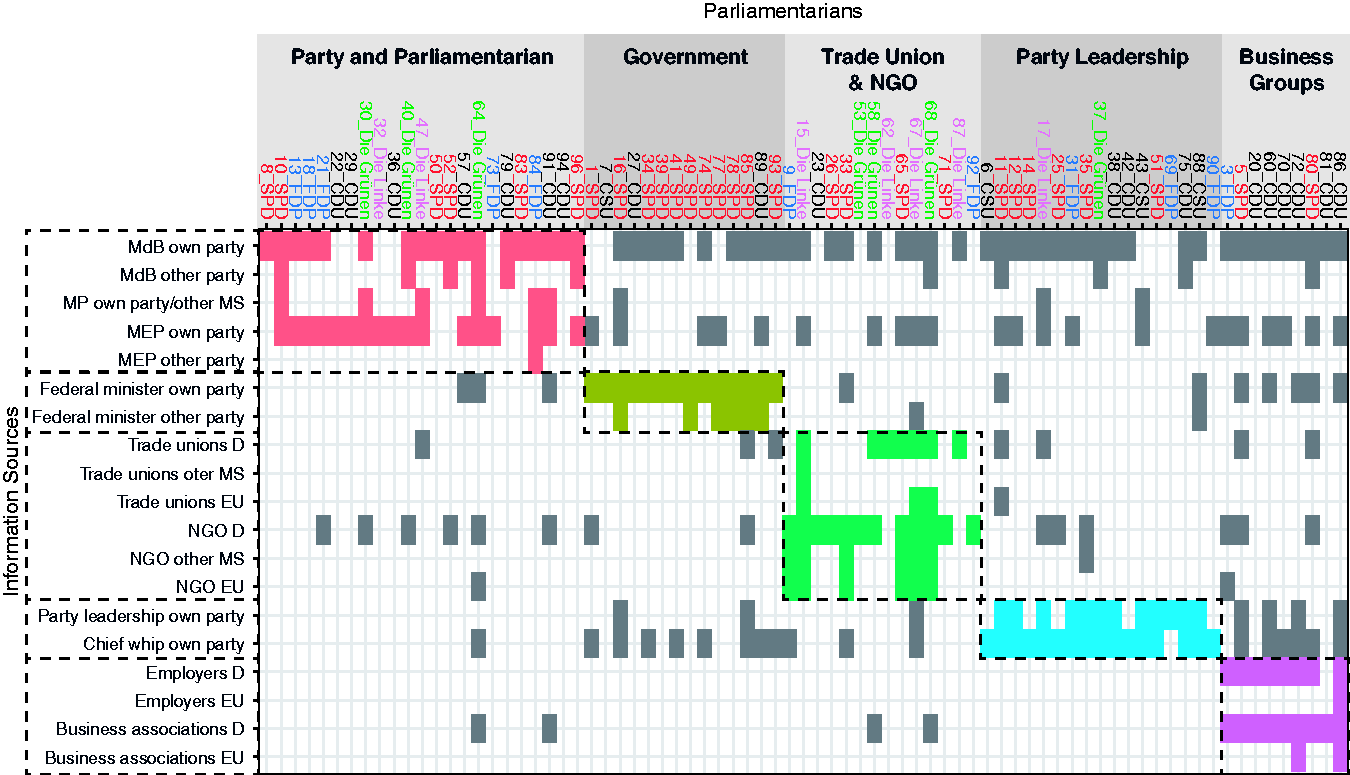
Five clusters of parliamentarian cooperation networks. The following item was used in a survey with members of the German Bundestag to measure information ties: ‘Please indicate how often you contact the below listed [actor] to obtain information on planned or current policies at the EU level’. Members of different clusters are marked with different colors and were empirically identified with the DIRTLPAwb+ cluster analysis algorithm (Beckett, 2016).
The sample of parliamentarians is broadly representative of the partisan composition of the Bundestag: Parliamentarians of the Christlich Demokratische Union (CDU)/Christlich Soziale Union (CSU) (sample: 31.6%; Bundestag: 36.8%) and the left party Die Linke (sample: 7.1%; Bundestag: 8.8%) are slightly underrepresented while members of the liberal Freie Demokratische Partei (FDP) (sample: 16.3%; Bundestag: 9.9%) are slightly overrepresented. The sample is not biased as regards respondents’ legislative specialization: Parliamentarians in the sample were active in 21 Bundestag committees. The information presented below is therefore not biased towards activities and perspectives from members of specific committees. As a consequence, the cooperation patterns we identify do not reflect possible idiosyncrasies of particular – and/or particularly Europeanized – policy areas but should convey a more general picture of parliamentarians’ cooperation networks in (EU) policy-making. 2 Moreover, the respondents vary considerably in their reported behavior and attitudes. The data and findings presented in this article should therefore not be biased towards legislators of a particular (behavioral or attitudinal) type.
The information-seeking contacts of members of the Bundestag were originally measured on a five-point scale and with the following item: ‘Please indicate how often you contact the below listed [actors] to obtain information on planned or current policies at the EU level.’ To measure parliamentarians’ ideological orientation (party position, (right)), we relied on a dummy variable which pits left parties – die Linke, Bündnis 90/Die Grünen, Sozialdemokratische Partei Deutschlands (SPD) – against rightist parties. The information on political parties’ left – right placement was taken from Döring and Manow’s (2012) ParlGov database. The dichotomous opposition variable separates members of the opposition (Liberal FDP, Die Linke, Bündnis 90/Die Grünen) from parliamentarians who belonged to the governing majority (CDU/CSU, SPD) at the time of the survey. Finally, the variable membership length captures MPs’ seniority and is measured dichotomously. It distinguishes those parliamentarians who served in the Bundestag for one term versus those having served two or more legislative terms. 3
We conceptualize the observed information-seeking strategies as networks that connect parliamentarians with a diverse set of information sources. As a result of the data collection strategy we do not have information on the information-seeking contacts between individual parliamentarians nor between, for example, NGOs and ministries or business associations and EU institutions. The observed network thus belongs to the general class of affiliation or bipartite networks (Borgatti and Everett, 1997). In these networks, edges can only exist between two disjoint sets of nodes. Our data also contain information on the frequency with which parliamentarians rely on different actors as information sources. In the network, this frequency can be operationalized as the weight of the respective edge. The information-seeking network is thus a weighted bipartite network.
We rely on cluster analysis to identify groups of parliamentarians with shared information seeking patterns in a first exploratory analysis. The algorithm that we use (DIRTLPAwb+, c.f. Beckett, 2016) takes the specific features of the observed information network into account: The information network is bipartite (links were observed between an individual MP and the potential information sources listed in the questionnaire) and weighted (the reduced contact frequency scale: always contacting = 2, very frequent = 1, seldom or never = 0). The empirically observable clusters of information-seeking strategies are thus the first result of our analysis.
To assess the effect of the hypothesized explanatory factors on the structure of the network in a multivariate framework, we rely on exponential random graph models (ERGMs) (Robins, 2009). ERGMs allow to determine whether specific factors included in the models appear more/less often in the observed networks than in a set of random networks with similar features. For the ERGMs, we dichotomized the actor attributes because our goal was not to test whether, for example, more seniority leads to more contacts with federal ministers, but to test whether actors with similar attributes show similar information behavior.
The bipartite structure of the network greatly reduces a well-known problem with sampled network data: In a 1-mode network, in which respondents are free to choose actors whom they entertain ties with, a 16% response rate would be highly problematic. Bipartite networks, however, are significantly more robust with small sample sizes, especially if, as in our case, information is only missing for one of the two modes. If the list of possible information sources is complete (fixed choice design) and does not vary with the response rate, as in our case, small sample sizes can increase the modularity score of the network (Kossinets, 2006; Rivera-Hutinel et al., 2012). With a greater size of our sample the clustering algorithm used here might detect a slightly different number of clusters which would most likely be a sub- or super-cluster of the clusters identified by our analysis.
Cooperation networks of parliamentarians
In a first empirical step, we will explore differences in the strength of parliamentarians’ ties to other politicians from their own and other political parties in the Bundestag and in other institutions at the national and the EU level to inform themselves about EU policies. In addition, we will consider parliamentarians’ ties to different types of interest groups. In the following analyses, we consider as ties in parliamentarians’ cooperation networks all those relationships to actors with whom parliamentarians reported to consult ‘very frequently’ or ‘always’ on EU policies that are in preparation or already negotiated at the EU level.
We find five clusters of parliamentarians whose cooperation networks in EU politics differ both in their structure and in the intensity of contacts they entertain with different actors (Figure 1). The first cluster that we identify represents the standard repertoire on which all parliamentarians rely: Almost all are in close contact with members of their own parliamentary party. A considerable number of parliamentarians extend these interactions to co-partisans in the EP (Figure 1). Transnational contacts to parliamentarians in other member states (MP own party/other MS) as well as contacts to members of the Bundestag and the EP from other parties play a much more limited role. The first cluster thus identifies the group of parliamentarians (upper left corner) which restricts its cooperation largely to this standard repertoire and is thus part of the party and parliamentarian network. The party and parliamentarian network is considered important by the vast majority of parliamentarians and by parliamentarians from all parties as the composition of the cluster shows. Yet, many parliamentarians extend their cooperation beyond that standard repertoire.
The second cluster consists of parliamentarians who, in addition to the standard repertoire, interact relatively closely with government ministers mostly from their own party. We call this the government network (Figure 1, second from left). Parliamentarians belonging to this cluster come mostly from the SPD, which was, together with the CDU/CSU in government at that time. Note that a considerable share of parliamentarians in this cluster also entertains contacts to ministers from a different (governing) party. Parliamentarians in the government network also have relatively strong ties to their parliamentary party’s leadership (Figure 1, row 15). Their ties thus not only span institutions but also travel across hierarchical levels. Parliamentarians in this cluster might be important brokers and negotiators in (EU) policy-making. In addition, while social democrats are overrepresented in the government network a considerable share of the members of the CDU also entertain strong contacts to federal ministers (Figure 1, row 6). These CDU parliamentarians, however, also have strong ties to business interest groups and are thus part of a different cluster.
The third cluster, the trade union and NGO network, includes parliamentarians who, in addition to contacts within their parliamentary party in the Bundestag, entertain strong ties to NGOs and trade unions. Parliamentarians of left parties (die Linke, SPD, Bündnis 90/Die Grünen) are primarily found in this cluster. Upon closer inspection, one can see that the three CDU and FDP parliamentarians in this cluster actually only cooperate with NGOs and not with trade unions, which are regular information sources only for the more left-leaning MPs from the SPD, the left party and the greens. Again, there are also parliamentarians outside this cluster who regularly interact with trade unions and NGOs. If we compare the information contacts of parliamentarians in the trade union and NGO network to those outside this cluster but with regular contact to NGOs and trade unions, it seems to be the case that members of the network have a stronger inclination to not only interact with German NGOs and trade unions but also to those at the EU level. NGOs and trade unions are politically important constituencies for left parties. Parliamentarians who are part of the trade union and NGO network thus focus their cooperation efforts on fostering the political relationship with these constituencies that are of particular political importance to leftist parties.
In the fourth cluster, the party leadership network, parliamentarians add regular contacts with the leadership of their parliamentary group and to their party’s leadership to the standard information-seeking repertoire (Figure 1, second from right). There are also other parliamentarians who entertain ties to their parliamentary party leadership. Members in this cluster, however, are characterized by the disproportionally high share of individuals who have ties to both, the party and the parliamentary party leadership. The cluster includes parliamentarians from all parties represented in the Bundestag at this time. This comes as no surprise, since group leaderships play a crucial role in all parliamentary parties and so does the need to find compromises and agreements between the parliamentarians of the same party who differ as regards legislative specialization, regional origin and (formal) political importance. Parliamentarians who are part of this cluster also have strong ties to other parliamentarians from their party. Given their position as brokers between the leadership and the rank and file, members of the party leadership network should play an important role in finding compromises and agreements regarding (EU) legislative policy-making in their party groups. Since many of these parliamentarians also have close ties to their party organization’s leadership, they might more generally – across institutions and factions – contribute to balancing potentially diverse interests in their party.
The fifth cluster is, like the third, one in which parliamentarians cooperate strongly with interest groups. Parliamentarians in this business group network are primarily coming from rightist parties, in particular from the economically more liberal CDU. Just like those parliamentarians from leftist parties who entertain strong ties to NGOs and trade unions, those with strong ties to business groups ensure that the interests of this constituency are considered in the CDU’s legislative work. Comparing the cooperation patterns of parliamentarians in the two interest group networks one can see that these clusters are not fully segregated. Some parliamentarians in the business network also interact with trade unions or, more frequently, with NGOs – and vice versa. While these ‘cross-cutting’ interactions might facilitate compromises in policy-making, they occur only seldomly. Instead, parliamentarians’ interactions with different types of interest groups are strongly shaped by shared political interests and parties’ wish to foster their relationships with organized constituencies which are most important to them (Hall and Deardorff, 2006).
The discussion above shows that the clusters identified capture substantially different strategies of groups of parliamentarians (Figure 1). These strategies are not mutually exclusive. Parliamentarians entertain contacts to actors in other networks as well. But the clusters describe the focal points of information-seeking activities of parliamentarians in the German Bundestag in EU policy-making. The structure and partisan composition of these cooperation networks shows that parliamentarians’ cooperation behavior varies both within party groups and between them. For all parliamentarians, we find that cooperation mostly happens within each party. Interactions across party lines take place but play a much less important role. The ideological cohesiveness, the organizational means and the shared political goals, which characterize political parties, thus form the backbone of the cooperation networks, which parliamentarians create inside the Bundestag and to other institutions at the national and at the EU level. Our exploration of these interactions at the same time shows that interest groups are important cooperation partners for parliamentarians. The results of our cluster analysis point to a political and functional division of labor within parliamentary parties. This division of labor is necessary to organize the cooperation among parliamentarians and politicians in other institutions that is needed to successfully adopt policies (Grossmann, 2014).
Figure 2 depicts the complete information-seeking network. The size of the nodes corresponds to their eigenvector centrality which measures the degree to which an information source is used by many parliamentarians who also use other information sources which are prominent among other parliamentarians. The size of the node can thus be interpreted as measuring the popularity of information sources used by well-connected parliamentarians. Nodes are grouped according to the cluster to which they belong. The centrality of the placement of a node in the circle also corresponds to its eigenvector centrality value. The centrality of the ‘own party’ information sources shows that ties within a party – across institutions (federal minister), across territorial levels and institutions (members of the EP) and across the hierarchies of parties (party leadership) and party groups (chief whip) – play the most important role for parliamentarians. At the same time, ties to different types of interest groups are also of considerable importance for members of the Bundestag and their (EU) legislative activities. Apart from party and executive sources, NGOs are the next most central interlocutors chosen by parliamentarians. Trade unions and business groups are less central because interactions with them are clearly split along party lines. Transnational interactions with parliamentarians or interest groups in other member states are only weakly developed. Parliamentarians’ cooperation in EU policy-making is thus firmly rooted in their national context.
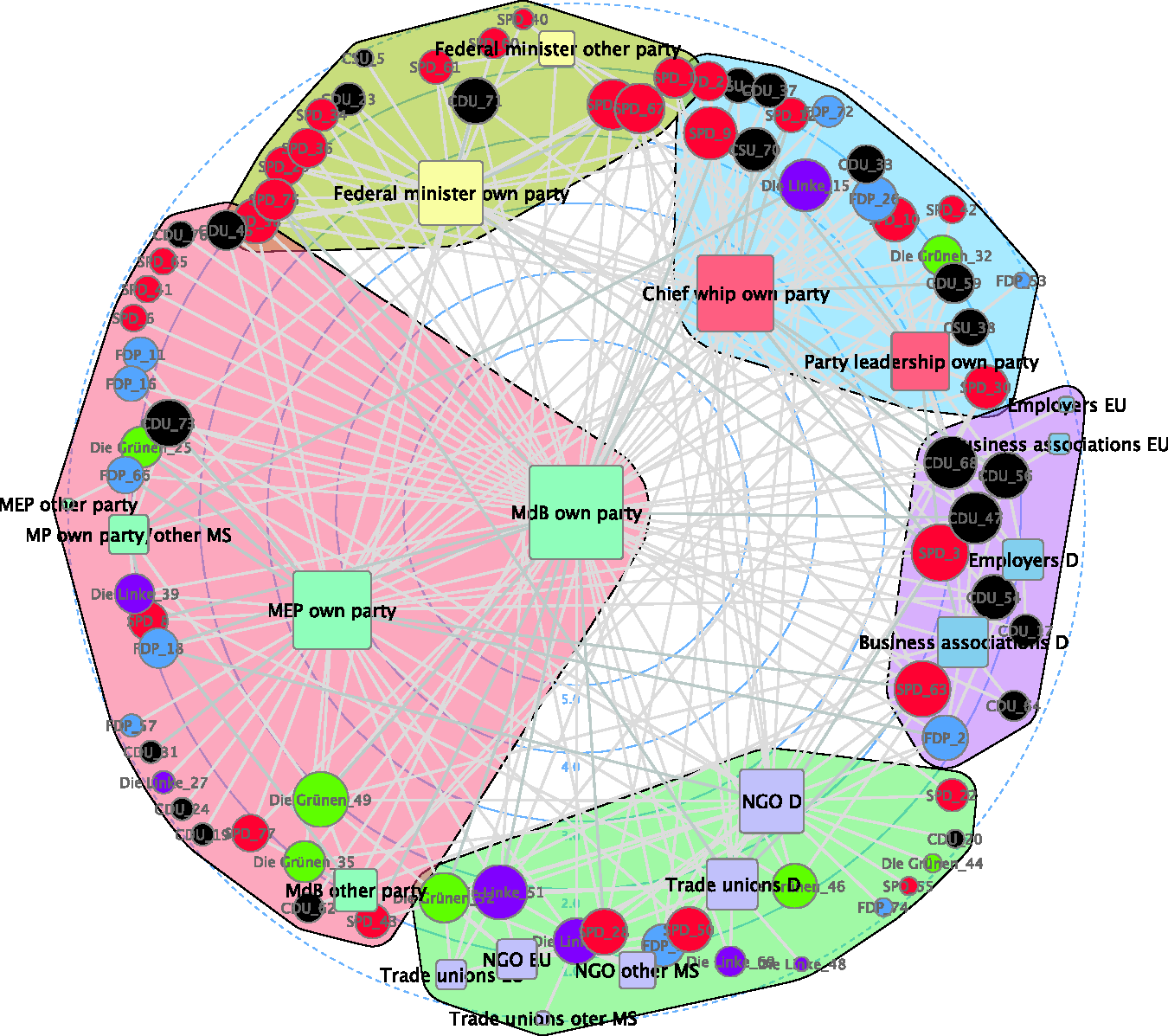
German parliamentarians’ EU politics cooperation networks.
In the next section, we will use exponential random graph models to assess the extent to which the factors captured by our hypotheses account for the empirically observed information-seeking networks of the members of the German Bundestag.
Parliamentarians’ informational networks: Structures and determinants
In the following, we will focus on the effects of parliamentarians’ seniority as well as their office and policy goals on their cooperation networks. In our hypotheses, we argue that less senior parliamentarians restrict their activities to their parliamentary party (hypothesis 1), that party speakers and committee (vice-) chairs 4 pursue their office goals by extending their interactions across institutions and the hierarchical levels of their party (hypothesis 2) and that parliamentarians pursue their policy goals with interest groups by focusing interactions on those types of groups that have similar policy preferences (hypothesis 3).
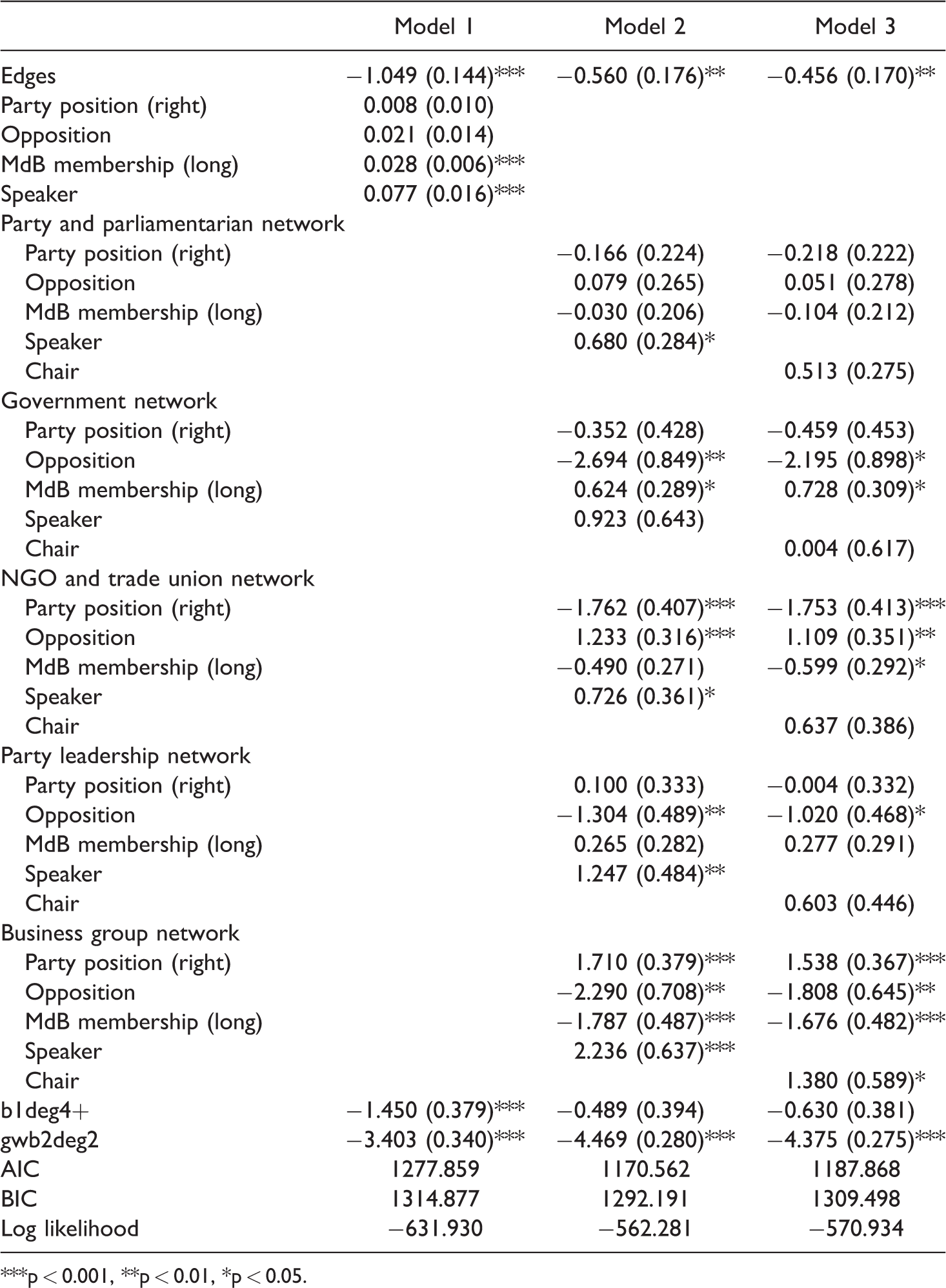
To test our hypotheses, we estimate three models. The first model does not account for the five clusters but tests if parliamentarians with similar attributes (left/right, government/opposition, seniority and office) entertain similarly structured cooperation networks. Models 2 and 3 then go on to test the extent to which these attributes influence the structure of each cluster. 5 All three models contain three network parameters (edges, gwb2deg2, b1deg4+). The edge parameter captures the propensity of the network to form ties. A significantly negative edge term means that the observed networks shows a strong tendency to form non-random ties. An edge term is the ERGM equivalent to an intercept in regression analysis. The three remaining network parameters are highly significant in all three models. The geometrically weighted degree distribution for the second partition (the information sources in our data) captures the networks propensity for preferential attachment centered on this partition. A negative value of gwb2deg2 reflects the propensity of parliamentarians to use already popular information sources, accounting for the fact that the marginal effect of additional popularity decreases, so that for example the third or fourth additional tie to an information source is more important than the tenth or fifteenth. The parameter b1deg4+ captures the propensity of high degree nodes in the first partition (the parliamentarians) to form additional ties. A negative value indicates that the observed network has, in the first partition, fewer nodes with a degree of four or higher than a random network with the same density and the same number of nodes. This reflects a certain upper limit of information sources one parliamentarian can meaningfully use.
In the first model, the speaker and the membership variables are significant, showing that speakers and longer serving parliamentarians respectively tend, compared to parliamentarians without such a position or less seniority, to have similar information-seeking strategies. The odds of two parliamentarians with institutional position using the same information source are by a factor of exp{0.077} = 1.08 higher than for parliamentarians not sharing this attribute. The chance of two longer-serving parliamentarians to show similar information-seeking strategies is about 2% higher than if they do not share this attribute. The estimates of Model 1 (Table 1) thus indicate that there are some general network effects which structure information-seeking strategies in the German Bundestag. The actor attributes whose effects we test with regards to their structuring effects on different types of cooperation networks have no or rather weak impact on the overall structure of the network.
Determinants of the structure of parliamentarians’ cooperation networks.
***p < 0.001, **p < 0.01, *p < 0.05.
In Models 2 and 3 (Table 1), we therefore estimate the effects of our variables of interest on the choice of information source belonging to the same cluster (government network, trade union and NGO network, party leadership network, business group network, party and parliamentarian network). We estimate whether actors, who are members of a right-wing or opposition party, have longer parliamentary experience, are speakers of their parliamentary party or who are committee chairs, differ systematically regarding the ties they entertain with actors in the different types of cooperation networks we identified to seek information on EU policies. In Models 2 and 3, we tested the speaker and the committee chair variable separately, because of the relatively strong correlation between the two variables. If our hypotheses are correct, we should find that seniority has negative effects on the parliamentarians’ reliance on the party and parliamentarian network whereas the chair and speaker variables should have positive effects on the government network and the party leadership network. Finally, the partisan variable (right) should have a negative effect on parliamentarians’ reliance on the NGO and trade union network and a positive effect on the business group network.
We find no support for hypothesis 1: Parliamentarians who restrict their activities to the party and parliamentarian network, which represents the standard repertoire of all parliamentarians, are not primarily found among those with less parliamentary experience. Yet, in our sample of parliamentarians, the more experienced have closer cross-institutional ties to the government (government network) while ties to business interest groups (business group network) are disproportionally found among those who have served one legislative term (Table 1). The positive effect on cooperation in the government network fits with our reasoning that more experienced parliamentarians have a higher propensity to having built a reputation as trustful political partners which might allow them to form ties across institutions and with decision-makers in government. We need additional empirical data and further theoretical considerations to assess the differential (non-) effects of parliamentarians’ length of membership in the legislature on their cooperation with different kinds of actors.
We find general support for hypothesis 2 according to which we expected parliamentarians with formal positions, i.e. those who serve as committee chairs, vice-chairs or policy area speakers of their party, to occupy more central positions, especially in those cooperation networks which connect political actors (of the same party) across institutions and with their party’s leadership. Speakers of specific policy areas in particular have a strong effect on the structure of the government and the party hierarchy cooperation networks (Table 1). While the direction of the effect is also positive, three chair coefficients do not meet the level of statistical significance. This suggests that similarities among speakers are stronger than similarities among all parliamentarians with formal positions – a result that does not contradict our argument about the importance of having a formal position but, obviously, asks for the qualification of its empirical relevance. In general, our findings on the effects of formal positions lend support to our reasoning that these positions put parliamentarians in a privileged position in parliamentary cooperation networks and should give them particular authority in forging compromises in their party groups and possibly also between these.
Finally, we find strong support for hypothesis 3. The policy goals which parliamentarians pursue in their interactions with interest groups reflect in the partisan effects on the trade union and NGO network and on the business group network: Parliamentarians from (economic) rightist parties – CDU/CSU and FDP – dominate the business group network while leftist parliamentarians – SPD, Greens and Die Linke – have comparatively strong ties to trade unions and NGOs and thus decisively shape the trade union and NGO network. This finding is in line with previous research, which has shown that partisan ideology and interests shape the interactions between parliamentarians and interest groups in national and EU legislative politics (Koger et al., 2009; Otjes and Rasmussen, 2017; Wonka, 2017). Parliamentarians do not seem to rely on interest groups to broadly screen the different positions that might exist among groups representing different types of interests. Instead, they rely on those groups that help them advance their own and their party’s policy goals. These ties allow parliamentarians and parties to draw on interest groups’ and their members’ technical knowledge and political assessments to strengthen their own position (Fischer et al., 2019; Hall and Deardorff, 2006; Varone et al., 2018; Wonka, 2017).
In addition to party ideology, we also see that belonging to a government or opposition party has a strong influence on information-seeking strategies. Apart from the standard repertoire, where we find no significant effect, in three of the four remaining clusters parliamentarians from government parties are more active. Only NGOs and trade unions are more likely chosen by opposition actors.
Discussion and conclusion
In this article, we, first, showed that parliamentarians in the German Bundestag rely on a large and diverse set of cooperation partners in their EU-related political activities. The cooperation networks resulting from parliamentarians’ ties to both party politicians in the parliament and in other domestic and EU institutions as well as to different types of interest groups, however, vary considerably across parliamentarians. In our explorative cluster analysis, we identified five distinct cooperation networks that reflect structural similarities and differences in the ties that parliamentarians draw upon to obtain information on EU policies. In a second step, we assessed the effects of parliamentarians’ partisan ideology and interests, their experience in the Bundestag as well as their formal positions on the structure and the actor composition of the cooperation networks in which they are active.
Our study adds to the existing literature in different ways: While the literature on parliaments focusses on the role of political parties in shaping parliamentary politics, it hardly considers the role which interest groups play for parliamentarians’ work. Interest group scholars, on the other hand, usually assume that parliamentarians are in need for information and will thus turn to groups which can provide them with – functionally and/or politically – useful information, irrespective of a parliamentarian’s partisan ideology and interest. We, first, account for the role which both, political parties and interest groups, play in parliamentarians’ cooperative efforts and we analyze how the structure and content of these cooperation networks varies across parliamentarians – and why. In addition to partisan effects, we empirically assess the effects of institutional (speaker and committee chair) and personal factors (length of parliamentary membership) on these cooperative relationships. Also, our relational approach allows us to analyze the relative importance that parliamentarians attribute to different types of actors as information sources and to account for cooperation efforts within but also across institutions and territorial levels. Moreover, instead of assessing only average effects across parliamentarians, our exploratory cluster analysis allowed us to identify distinct patterns of cooperation which reflect a division of labor between parliamentarians and their structurally different cooperation efforts.
Second, while we expected and showed that formal offices have a systematic impact on actors’ incentives and political behavior, we suggest that political dynamics should not be reduced to institutional structures and actor preferences. Formal institutions provide actors with resources and structuring devices. We argue and show that political dynamics are also shaped by stable and informal political relationships to others on which parliamentarians draw during policy-making. We therefore agree with Grossmann (2014) that studies which aim at identifying the dynamics and outcomes of policy-making should consider both formal institutional structures and the informal cooperative relationships inside and across political parties, within and across different institutions and between different types of actors.
Finally, we regard our analysis of parliamentarians’ cooperation networks as an analytically useful complement to studies which treat parties as unitary actors or focus on their voting cohesiveness. We thus complement dominant analytical perspectives which attribute party political dynamics, including parties’ behavior in policy-making, exclusively to the relationship and competition between political parties and/or to electoral incentives resulting from voters’ preferences (or public opinion more generally) (Grossmann, 2014; Hacker and Pierson, 2014).
To further develop the analysis of parliamentarians’ (and other politicians’) cooperation networks, different research avenues appear promising to us: We relied on the ego-networks which members of the Bundestag reported to entertain in EU policy-making. To start identifying more general patterns of cooperation in policy-making, it would be interesting to obtain comparable information from parliamentarians in other countries. Extending the empirical analysis to other countries would allow investigating if and how the structures of party systems, political systems and institutions as well as interest group systems affect networks of cooperation between diverse actors. In addition, extending the analysis to other policy areas enables assessing the effects policy issues have on patterns of cooperation between political actors. Moreover, with our data, we cannot analyze the effects patterns of cooperation have on the contestation between actors that hold different political ideas and positions – and their effects on policy-making outputs. To do so, we would need data on actual policy-making processes.
Supplemental Material
Supplemental material for Cooperation in networks: Political parties and interest groups in EU policy-making in Germany
Supplemental Material for Cooperation in networks: Political parties and interest groups in EU policy-making in Germany by Arndt Wonka Sebastian Haunss in European Union Politics
Footnotes
Acknowledgements
We would like to thank the participants of the panel ‘Interest Groups and Political Parties: Towards More Complex and Flexible Relationships’ at the ECPR General Conference 2018 and particularly Elin Haugsgjerd Allern for their comments. We also profited greatly from the discussion of Fabio Franchino, Francesco Zucchini and the other participants at the NASP POLS colloquium at the University of Milan and the Third European Conference on Social Networks in Mainz. Finally, we would like to thank the reviewers for their excellent and productive criticism.
Funding
The author(s) disclosed receipt of the following financial support for the research, authorship and/or publication of this article: The data were collected in a project co-led by Berthold Rittberger and Arndt Wonka. Arndt Wonka gratefully acknowledges the financial support from the German Science Foundation (DFG, RI 1972/1-1).
Supplemental Material
Supplemental Material for this article is available online.
Notes
References
Supplementary Material
Please find the following supplemental material available below.
For Open Access articles published under a Creative Commons License, all supplemental material carries the same license as the article it is associated with.
For non-Open Access articles published, all supplemental material carries a non-exclusive license, and permission requests for re-use of supplemental material or any part of supplemental material shall be sent directly to the copyright owner as specified in the copyright notice associated with the article.
