




Abstract
Many international organizations and the vast majority of federations lack exit clauses. Existing theoretical explanations of this stylized fact focus on issues of credible commitment, signaling, and the risk of strategic exploitation. However, such accounts are unable to explain the adoption of Article 50 by the European Union, which allows unilateral withdrawal. I theorize and demonstrate empirically that in the case of the European Union, an exit-voice logic lies at its origin during the 2002–2003 European Convention. As a protection to undesired policy changes post entry, countries of the 2004 Eastern accession demanded an exit right. Underlying the fear for policy changes was their much lower level of economic development and corresponding differences in policy preferences. As a mirror image, rich outliers like the United Kingdom and Denmark also supported Article 50, which likely contributed to its final adoption through the Treaty of Lisbon.
Introduction
The European Union (EU) first adopted an exit right during the 2002–2003 Convention on the Future of Europe. The clause came into force with the Treaty of Lisbon as Article 50 of the Treaty on EU (Athanassiou, 2009). On 29 March 2017, the United Kingdom (UK) triggered Article 50 and set in motion the process of its withdrawal from the EU, known as Brexit. Clearly, Article 50 matters. This article provides a theoretical and empirical account of its origins.
Temporary escape and withdrawal clauses are present in many but certainly not all international treaties (Helfer, 2005; Koremenos, 2016; Rosendorff and Milner, 2001). In contrast, the vast majority of federations lack exit clauses. 1 Existing theoretical explanations focus on issues of credible commitment, signaling, and the risk of strategic exploitation. However, such accounts are unable to explain the adoption of Article 50 by the EU, and even less its timing.
Regarding international agreements, Koremenos (2016) demonstrates that when exit clauses are present, they have longer notice and wait periods in the presence of enforcement and commitment problems. Extending this logic, given the importance of stability and credible commitment for the EU’s success, it should lack an exit clause. From this perspective, the timing of its adoption is even more striking. As the EU became further integrated and adopted a common currency, commitment should have become more important – and hence the adoption of an exit clause less likely rather than more.
A similar argument regarding federations is developed into a formal model by Bordignon and Brusco (2001). They find that even in the presence of exogenous shocks, constitutions may optimally avoid exit clauses. The reason is that the benefits of a union may depend on its perceived stability: ‘By not introducing these rules, the federation raises the exit cost for its members, thus reducing the probability of a break-up in the future’ (Bordignon and Brusco, 2001: 1812). Again, following this argument, one would expect the EU not to have an exit clause and expect the probability of adoption to decrease with further integration.
As pointed out by Spier (1992) and Rainer (2007), contracts may lack exit clauses because of signaling. Parties committed to the success of cooperation may want to signal this by foregoing exit provisions. Finally, exit clauses may be avoided because they may be exploited strategically for blackmailing the rest of the union into concessions, especially in the presence of incomplete information (Chen and Ordeshook, 1994; Sunstein, 1991). In order to explain the adoption of Article 50 based on these arguments, one would have to take the tenuous position that concerns of signaling or strategic exploitation in the EU have gone down rather than up.
To conclude, none of these theoretical arguments can explain why the EU has an exit clause, and even less why it was only adopted later in its institutional development. This is the contribution of this article. It is, to the best of my knowledge, the first to address theoretically and empirically why and when the EU adopted an exit clause. 2
The empirical focus of this article is on the EU’s 2002–2003 Convention on the Future of Europe. At the time of the Convention, 10 Candidate States were expected to join in 2004. The heterogeneity-veto argument developed later is shown to be able to account for the timing of the EU’s adoption of an exit clause, since these Candidate States were the first new Member States to both differ significantly from the existing Member States and to enter when the EU had moved from unanimity decision-making to qualified majority voting (QMV).
The empirical argument about the timing of the adoption is further supported by a series of probit regressions on the positions of Convention delegates. The regression results show that the heterogeneity-veto argument predicts well which Member States would support an exit right, namely those with outlying preferences.
Exit, voice, veto rights, and heterogeneity
The exit-voice argument of this article fits in a tradition of exit-voice-loyalty models building on Hirschman (1970). It also relates to the work by Buchanan and Tullock (1962) and Buchanan (1991) regarding the need for minority protection. In this literature, exit rights are seen as enabling credible threats in order to prevent exploitative policy changes and overreaching by the central government (Apolte, 1997; Buchanan, 1995; Buchanan and Faith, 1987; De Figueiredo and Weingast, 2005; Hirschman, 1970; Slapin, 2009; Weinstock, 2001).
My specific theoretical argument is as follows: when thinking about joining the EU (or another type of political union), prospective members reflect on the benefit this will yield. A first proxy is the estimated benefit under the existing policies. However, depending on the policy-making rules, prospective members realize that these policies may be changed later on.
Without a veto, they cannot block changes, and policies may be changed to such an extent that a member stops benefitting from the union. Given the reputational costs of unilateral exit (Helfer, 2005), members may be forced to stay even in such cases. However, if they are given an ex-ante exit right, they know that they will be able to leave at a more limited cost.
The problem of unwanted policy changes is most urgent for prospective members that are outliers in terms of characteristics and preferences. The more heterogeneity across members, the higher the possibility that some members will be consistently outvoted. This is especially true in a setup with a relatively homogeneous core of members that has a sufficient legislative majority to push through policy changes at the expense of a periphery with different preferences. 3
This implies that a core could only successfully attract a periphery with (a) a set of initial policies such that the periphery would benefit from the union and (b) a legislative veto or a constitutional exit right. With a legislative veto, any member of the periphery could block any unwanted policy change. With an exit right, a member of the periphery would leave only if so many policy changes had occurred that it was no longer benefiting from the union at all. Hence from the point of view of the core, offering a constitutional exit right is the better option.
In conclusion, in unions that are strongly heterogeneous across members, the expectation is that the core will offer the periphery an exit right in order to give it some protection against unwanted policy changes. Consistent with the literature on the size of jurisdictions (Alesina and Spolaore, 2003; Tullock, 1969), the core will be willing to do this if the additional economies of scale from attracting the periphery are worth it.
Another way to phrase the heterogeneity-veto explanation of exit clauses is the following: veto rights and exit rights can act as substitutes in offering constitutional protection to peripheral members in heterogeneous unions. However, given that veto rights are costlier in terms of inhibiting policy changes, the expectation is that an exit right will be offered.
The EU’s adoption of an exit right at the European Convention
The Convention on the Future of Europe (2002–2003)
At the Convention on the Future of Europe, the 15 Member States and 13 Candidate States 4 had one representative of their government, and two representatives of their national parliaments. The European Parliament (EP) had 16 representatives and the Commission two. In this setup, as formulated by van Hecke (2012: 846), ‘each Convention member was subject to three loyalties: nationality, institution and ideology’.
Prior to the Convention, the legality of unilateral exit from the EU had been contentious (Athanassiou, 2009; Berglund, 2006; Harbo, 2008; Herbst, 2006; Hofmeister, 2010; Weiler, 1985; Wyrozumska, 2012). Most of the cited authors do not take a strong position themselves. Those that do take a position tend to conclude that unilateral withdrawal was not possible. 5
Arguments that unilateral exit was possible are usually based on the Vienna Convention on the Law of Treaties (VCLT), the acceptance of the 1975 British referendum on European Community membership, or the withdrawal of Greenland (a part of the Kingdom of Denmark) in 1985. Since the withdrawal of Greenland was not unilateral but based upon unanimous agreement, most authors consider the last argument void in relation to unilateral exit. Based on the first two arguments, the House of Lords (2016) concludes that exit was possible prior to Article 50. However, now that Article 50 exists, they acknowledge that it overrides any general exit right conferred by the VCLT to treaties that are silent on the matter.
Arguments that unilateral exit was not possible are usually based on the unlimited duration of the treaties (Art. 312 EC, later Art. 53 TEU), the principle of ‘ever-closer union’ and the autonomous and superseding character of the European legal sphere. While the first two arguments undermine the claim that the treaties are silent on exit (so that VCLT Art. 56 does not apply), the third argument on the ‘primacy of EC law’ implies that Member States could not withdraw unilaterally, because they are not allowed to overturn the application of EU law to their citizens (Wyrozumska, 2012: 1394). To conclude, while unilateral exit was possible according to some, it clearly would have been more difficult and costlier prior to Article 50.
The first substantive draft of a withdrawal right was proposed by the Presidium on 2 April 2003 (document CONV 648/03). The draft Article 46 (reproduced in the Online appendix) allowed unilateral withdrawal, i.e. exit. If a withdrawal agreement could not be reached within two years, the withdrawing state would no longer be bound by the EU’s constitution.
The draft of Article 46 proved controversial (Spinant, 2003), and many amendments were proposed (European Convention, 2003). The Convention plenary of 25 April 2003 saw a strong discussion: ‘the 105-member body was split as to whether such a clause would appease Eurosceptics or give ammunition to them’ (Mahony, 2003).
Representing the Dutch parliament, Frans Timmermans (intervention 5-066) formulated the following position, which showed understanding for the Baltic countries but still demanded stringent conditions for exit: ‘[…] think of our Baltic friends: they have indeed lived in a prison and it is important for them to be able to say to their citizens, “we can leave”. […] If we maintain Article 46, I would support […] three conditions, namely that you can leave at the next stage of European integration, […] by the same procedure as that by which you joined; and, thirdly, a mutually acceptable agreement is compulsory’.
The 2004 and 2007 Intergovernmental Conferences
Following the Convention, an Intergovernmental Conference (IGC) was started on 4 October 2003. The IGC adopted the Treaty Establishing a Constitution for Europe (TCE) on 18 June 2004. The withdrawal clause was now numbered Article I-60 (reproduced in the Online appendix). However, referendums in France and the Netherlands failed to approve ratification and the TCE never came into force. This setback led to a period of reflection.
When Germany assumed the presidency of the Council in 2007, it decided to strive for a new Treaty that would contain the most important reforms of the failed TCE (König et al., 2008). Lord Kerr, who had been Secretary General of the Convention, pushed for the inclusion of the withdrawal clause he had drafted (Kerr, 2007). This attempt was successful, and the withdrawal clause was reproduced in the Treaty of Lisbon. Since the ratification of this Treaty, the exit clause has been numbered Article 50 of the Treaty on European Union (TEU), reproduced in the Online appendix.
The EU’s institutional history and the timing of its adoption of an exit right
An overview of the EU’s recent history is provided in the Online appendix. More details can be found in Crombez and Hix (2011) and Kelemen et al. (2014). Broadly speaking, the EU has moved from unanimity decision-making to supermajority QMV. In addition to the move toward QMV on existing policy areas, there was also an expansion of policy areas on which the EU produced legislation (Pollack, 2000). This expansion of competences may also have contributed to the desire for an exit clause. Its more direct effect was to increase support for the subsidiarity principle and for an Early Warning System to police it (Huysmans, 2018).
The historical use of unanimity extended to the nomination of the European Commission (EC). This is important because the EC holds the legislative initiative right, implying that Member States could indirectly enforce the legislative status quo by refusing to nominate Commissions that would move away from it (Crombez and Hix, 2011). However, since the Nice Treaty, the EC has also been nominated by QMV, thus opening the possibility of majority-approved legislative programs that move away from the status quo.
The decision to abandon unanimity voting allowed the EU, which was relatively homogeneous up to that point (Maggi and Morelli, 2006), to escape a joint-decision trap in which one dissenting country could block efficient collective action (Scharpf, 1988). It is important to point out that even the UK and Denmark, two later supporters of a free exit right, accepted to give away their individual veto power. In accordance with my theoretical argument, this suggests that they were not too heterogeneous from the rest of the EU at that time and willing to accept being outvoted occasionally. As it turned out, while the UK and Denmark were sometimes outvoted in the Council, both Sweden and Germany voted ‘no’ or abstained more often (Mattila and Lane, 2001).
The theoretical argument presented earlier leads to the conclusion that prospective members of a union will require an exit right if (a) they are strongly heterogeneous from the core majority and (b) they will lack a legislative veto after joining. Applying this to the EU, both conditions apply clearly to the countries that acceded in 2004 and much less to those that acceded before.
Concretely, the new members of 1995 (Austria, Finland, and Sweden) were arguably much more similar to the EU-12 than the 10 new members of 2004 (the ‘A-10’) were to the EU-15. 6 The A-10 accession states were mostly Eastern European and former communist countries. Average Gross Domestic Product (GDP) in 2003 was 29,124 Euros per capita for the EU-15 and only 8571 Euros per capita for the A-10 (Eurostat, 2016).
Because the A-10 countries were so different from the EU-15, in particular with respect to economic development, they expected to benefit from EU policies such as cohesion spending and the Common Agricultural Policy (König and Bräuninger, 2004; Swinnen, 2001). However, in line with my theoretical argument, they knew that once they entered, the EU-15 might attempt to reduce these policies. 7
In terms of lacking a legislative veto to block such policy changes, the prospective Member States in 2003 would clearly have less veto power than those of 1994 due to the expansion of QMV to more policy areas and to the nomination of the European Commission. 8
The timing of the EU’s introduction of an exit right is therefore consistent with the heterogeneity-veto argument presented in this article: it came at a time when a set of new and heterogeneous states were about to become members, knowing that they would lack a legislative veto. This conclusion is supported by statements such as that of Liene Liepina (plenary of 25 April 2003, intervention 5-076, in German). Speaking on behalf of the Latvian Parliament, she said that the article was necessary in order to underscore any country’s freedom of leaving just like joining. She added ‘here in Latvia, people say: do we really want to go from one union to the next?’. Clearly, Liepina saw the exit right as important for the Latvian accession referendum to be held on 20 September 2003.
In an article on the earlier Hungarian accession referendum held on 12 April, The Economist (2003) wrote the following: ‘Viktor Orban […] said that today’s Eurocrats view Hungary much as its former Soviet masters used to’. The introduction of an explicit exit right, while perhaps not salient to the average voter, made it at least more difficult to make such statements undermining support in subsequent accession referendums.
In addition to the wish of positively affecting the accession referendums, the exit clause also served the purpose of shoring up support for the Constitutional Treaty in the accession countries and in Eurosceptic Member States such as the UK and Denmark. As said by Henrik Hololei, representing the Estonian government: ‘I extend my sincere support for Article 46 […] Not having this article makes it very difficult for me to defend the new Constitutional Treaty in my own country’ (plenary of 25 April 2003; intervention 5-053).
Heterogeneity and the desire for an exit right: Empirical evidence
A consistent picture emerges from the Convention documents, amendments, and newspaper articles discussed above. The Presidium felt that an exit clause was necessary to convince Eurosceptics in the Candidate States and elsewhere (mostly the UK and Denmark) that the EU was not a prison. 9 The Candidate States desired an exit right in light of their accession referendums, and the others accepted this in order to benefit from increased economies of scale and buy-in from the UK and Denmark on the Constitutional Treaty.
In order to directly assess the claim that heterogeneity creates a desire for an exit right, this section systematically analyzes all amendments and plenary interventions made at the Convention plenary on 25 April 2003 regarding the proposed Article 46. The analysis is conducted at the level of Convention delegates. On the basis of their amendments and plenary statements, delegates were coded as being either in favor or against a free exit right. Using a probit regression, the positions regarding a free exit right are regressed on a measure of heterogeneity and a set of control variables.
Dependent variable: Positions in favor or against a free exit right
The European Convention published summaries of the amendments to Article 46 (CONV 672/03) and the plenary debate of 25 April (CONV 696/03) on its website. The full text of all amendments was collected from the Convention’s website (European Convention, 2003), while the verbatim text of the plenary interventions was obtained from the EP after a request under the right of access to documents.
A total of 43 amendments were submitted to Article 46, and 60 plenary interventions were made on title ‘Union Membership’ which contained Article 46. Of these, 36 amendments and 39 plenary interventions from EU-25 delegates substantively addressed the withdrawal right. All of these were classified as being either in favor of a free exit right or against. Observations proposing to delete the clause, or arguing exit was only possible at certain moments (e.g. Treaty change) or on certain conditions (e.g. a negotiated exit agreement), were counted as being against. Indeed, taking a game-theoretical perspective, an exit clause that requires a negotiated exit agreement does not provide effective insurance against unwanted policy changes.
To ensure the reliability of the coding, a second coder independently coded each of the 75 amendments and plenary interventions from EU-25 delegates that addressed the withdrawal right. The coding was different for six of these 75, yielding an intercoder reliability of 92%. The corresponding results are reported as a robustness check.
Next, these positions in favor or against were traced to the delegates who signed the amendments or made the plenary interventions. While plenary statements are always made by one person, amendments can be signed by multiple delegates. This yielded a list of 94 delegates, 23 of which had more than one amendment or plenary intervention. Of these 23, only one had items against and in favor. Having two items against and one in favor, this delegate was coded as being against.
The result of this coding process is a dummy ‘Exitfree’ with a value of 1 for delegates in favor of a free exit right, and a value of 0 for delegates against. As an example, consider the plenary statement made by Frans Timmermans quoted above (intervention 5-066 of 25 April 2003). Given the conditions mentioned, this statement is clearly against a free unconditional exit right and was coded as a 0 by the author and by the second coder. Hence Frans Timmermans was coded as a 0, i.e. being against a free exit right.
The Convention had 105 delegates and 102 alternates, of which 189 came from EU-25 countries. Of these 189, only 94 delegates were observed through an amendment or a plenary statement. The remaining 95 delegates from EU-25 countries were not observed. This limitation will be the focus of two robustness checks reported later.
Because some of the control variables introduced later are at the party level, each delegate was linked to her national party at the time of the Convention, using a list of delegates and their parties (Coffey, 2003: 133–137) complemented with Convention documents, the repository of the EP, and national parliament and party websites. Five delegates without affiliation (four diplomats and one academic) were attributed to the party of the Minister who appointed them. Parties were coded based on their Party ID as reported in the Parliaments and Governments (ParlGov) database (Döring and Manow, 2016).
The 94 observed delegates belong to 65 different national parties. 10 As a robustness check, the regressions will also be run at the level of the parties with errors clustered at the country level. Of the 65 parties, 31 have multiple observations, of which three parties have conflicting observations. One party had four against and one in favor and was therefore coded as being against. The other two parties had an equal number of observations in favor and against, requiring an overall judgment to be made.
To illustrate the process of linking delegates to parties and deriving parties’ positions, I return to Timmermans. Since he belonged to the Dutch Labor Party ‘Partij van de Arbeid’ (PvdA) his party was coded as 742, the ParlGov code for this party. There were no other delegates belonging to PvdA, so the party was also coded as 0, i.e. against a free exit right.
Independent variables: Measuring heterogeneity and identifying the periphery
In the theoretical section, the periphery was defined as the members of the union that stand to lose from majority-approved legislative programs. In the context of the EU, one key hurdle that legislation needs to pass is obtaining a qualified majority in the Council (Crombez and Hix, 2015). This section describes how the rules for QMV can be used to identify the EU’s periphery.
After the accession of the A-10 countries, a qualified majority in the Council would require 88 out of 124 votes. In the context of a spatial model, this threshold can be used to compute a Council gridlock interval between its left and right pivot (Crombez and Hix, 2015). After having sorted the Member States according to their ideal policies along a dimension and adding up their votes, the right (left) pivot is the country with the 88th vote starting from the left (right). The interval between these two is a gridlock interval: policies can be moved into it, but there will never be a qualified majority to move policies out of it. Hence a natural way to identify the periphery is to look at countries outside of the gridlock interval.
As noted before, the A-10 accession countries were on average much poorer than the existing EU-15. To investigate the importance of heterogeneity along this dimension, each delegate was associated with the 2003 per capita GDP of its country, calculated based on Eurostat (2016). This yields a left pivot of 13,994 Euros per capita (Portugal) and a right pivot of 27,293 Euros per capita (Belgium).
As reported in the Online appendix, all of the A-10 countries except for Cyprus had a level of GDP per capita below the gridlock interval, while none of the EU-15 did. This means that the EU-15 together with Cyprus had a qualified majority to adopt policies that would be more favorable to richer Member States. Conversely, the nine countries below the gridlock interval can indeed be said to constitute the poor periphery of the EU-25.
The dummy variable ‘GDP_Peripheral_poorer’ captures this as follows: it is equal to 1 for delegates from countries with levels of GDP per capita below the left pivot of 13,994 Euros. In terms of theory presented above, the expectation is that delegates for whom GDP_Peripheral_poorer is equal to 1 are more likely to be in favor of a free exit right. In the case of Frans Timmermans, being from the Netherlands with a GDP per capita of 31,290 Euros, i.e. not below the gridlock interval, GDP_Peripheral_poorer takes a value of 0.
Countries with levels of economic development above the gridlock interval constitute a different kind of periphery. Indeed, they may fear increases in regulation or immigration. The dummy variable ‘GDP_Peripheral_richer’ is equal to 1 for delegates from countries with levels of GDP per capita above the right pivot of 27,293 Euros. In the case of Frans Timmermans, being from the Netherlands with a GDP per capita of 31,290 Euros, i.e. above the gridlock interval, GDP_Peripheral_richer takes a value of 1.
Control variables
Since the economies of scale from the EU may be less relevant for larger countries, controlling for country population is in order. The variable ‘Population’ captures the 2003 population in millions (Eurostat, 2016). In the example, the Netherlands in 2003 had a population of 16,192,572, yielding a value of 16.2 for the variable Population.
Because of the history of their countries, delegates from ex-Soviet countries may have a particular desire for a free exit right. The dummy ‘Ex_SovietUnion’ is equal to 1 for countries that were part of the Soviet Union, i.e. the Baltics (Estonia, Latvia, and Lithuania).
Individuals and parties may have ideological objections to European integration and hence desire a free exit right irrespective of whether their country is peripheral. To control for this, a variable variable ‘Anti_EU’ is constructed based on the variable ‘eu_anti_pro’ in the ParlGov database (Döring and Manow, 2016). This latter variable presents expert judgments on a 10-point scale, where 0 is completely against the EU and 10 is completely in favor. The transformed variable Anti_EU is calculated as follows: Anti_EU = (10 – eu_anti_pro)/10. Returning to the example of Timmermans, his party PvdA has an eu_anti_pro score of 8, resulting in a value of 0.2 for Anti_EU.
Parties with peripheral positions on the left–right dimension may also be more in favor of a free exit right. The variable ‘left–right’ of the ParlGov database was used to score parties on this dimension (Döring and Manow, 2016). These are expert judgments on a 10-point scale, where 0 is extreme left and 10 is extreme right. Member States’ positions on this dimension were computed as the seat-weighted position of parties in government on 25 April 2003. This yields a Council left pivot of 4.0 (Slovenia) and a right pivot of 7.1 (Slovakia). Using these pivots, a dummy ‘LR_Peripheral’ was constructed. Parties with a left–right score outside of the Council gridlock interval
Finally, compared to delegates from national governments and parliaments, delegates representing supranational institutions (the EC and the EP) could be expected to have more integrationist preferences, i.e. to be against an exit right (Vaubel, 2002). To control for this, the dummy ‘Supranational’ is 1 for delegates from supranational institutions. In the example, Timmermans represents his national parliament and is hence coded as a 0 for Supranational.
Descriptive statistics
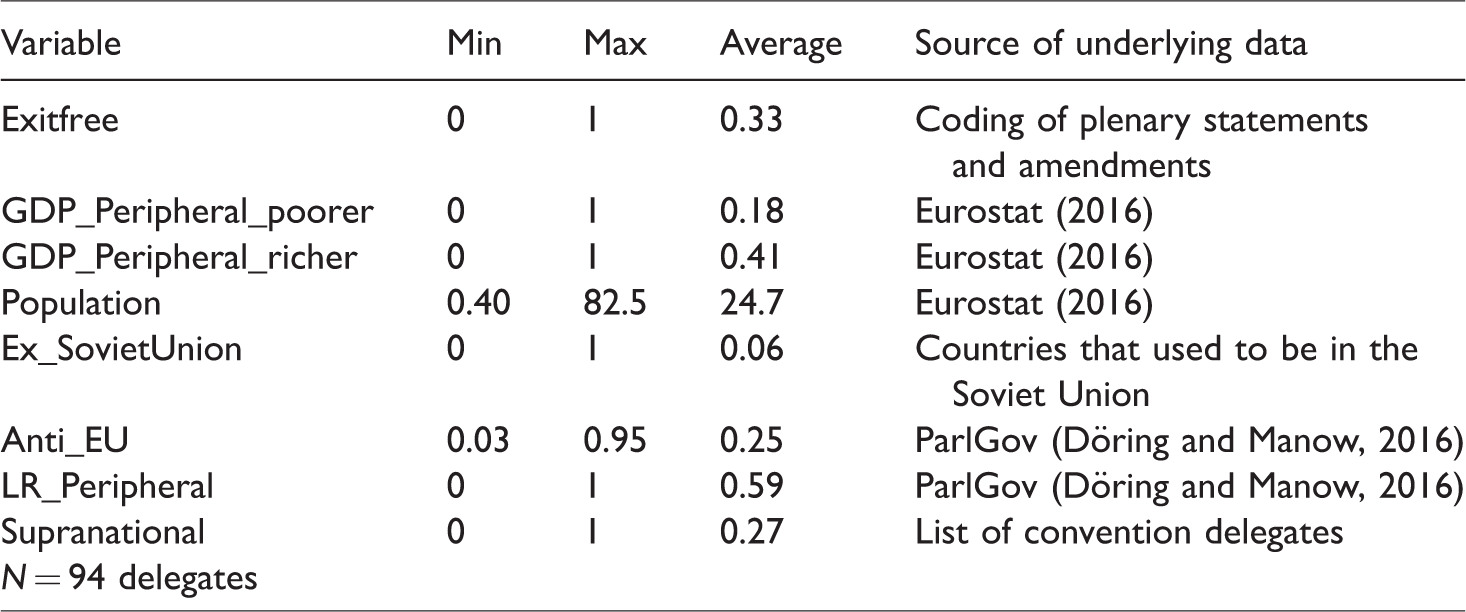
Table 1 provides a summary of the data. More detailed information is presented in the Online appendix.
Regression variables: descriptive statistics and sources.
Empirical strategy and results
This article contends that, in the absence of a veto, peripheral member state will require an exit right in order to join. This can be tested by investigating whether delegates from the EU’s poorer periphery (roughly corresponding to the A-10 accession states) were indeed more likely to be in favor of a free exit right. While members of the EU’s richer periphery could no longer threaten not to join, they might also fear policies moving into the gridlock interval.
Considering delegate 
Delegates’ utilities from a free exit right are unobserved. However, the unobserved utilities can be seen as the latent variable driving their position on the free exit right. It is natural to assume that a delegate would be in favor of a free exit right in case her utility from it would be positive. Assuming that the error term in (1) follows a standard normal distribution with cumulative density function 
In order to assess the role of heterogeneity in driving the preferences for a free exit right, the probit model was estimated for the 94 observed delegates. Standard errors were clustered at the party level. The results of this regression are reported in Table 2.
Probit regression of Exitfree at the delegate level (1 = in favor of a free exit right).
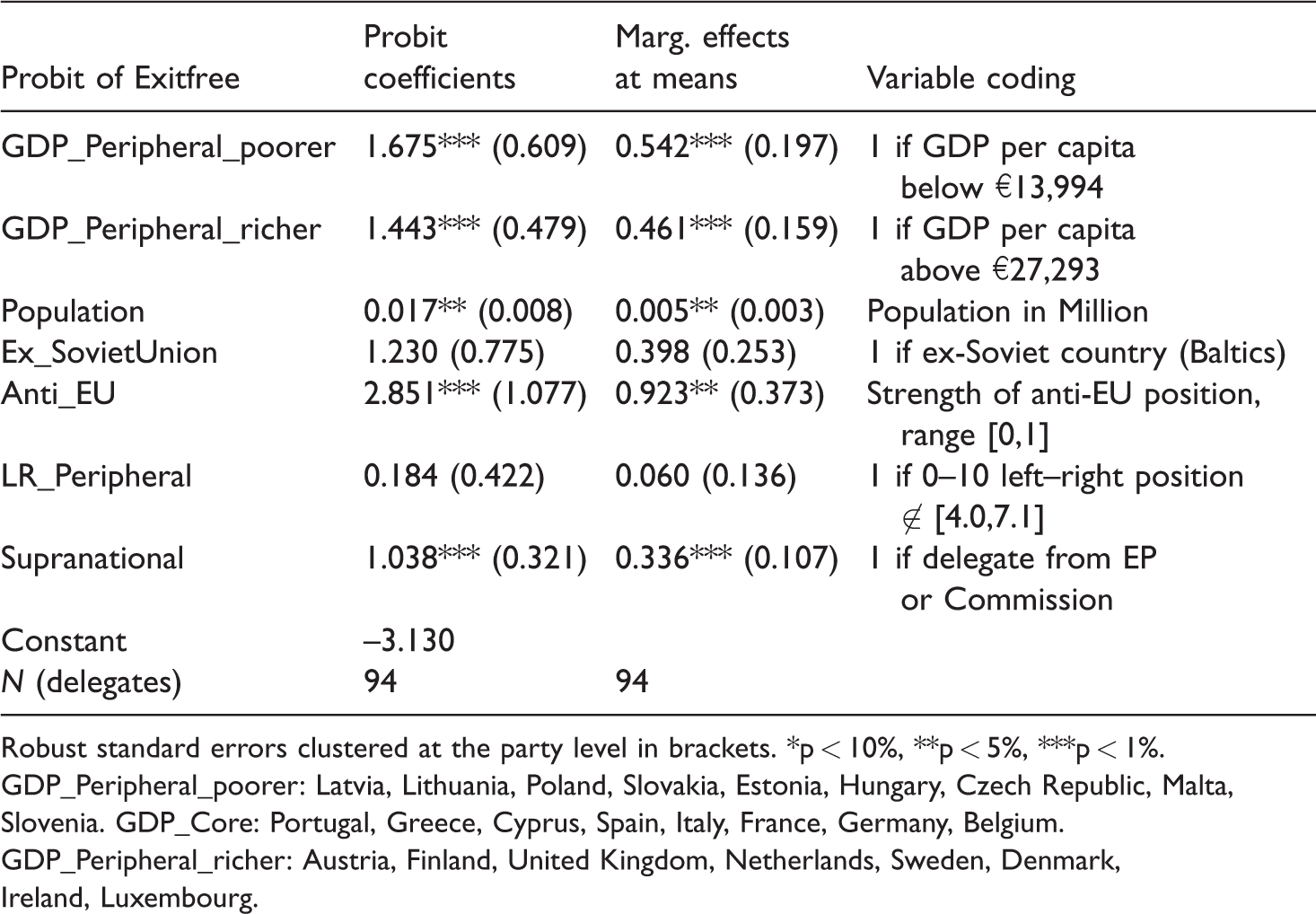
Robust standard errors clustered at the party level in brackets. *p < 10%, **p < 5%, ***p < 1%.
GDP_Peripheral_poorer: Latvia, Lithuania, Poland, Slovakia, Estonia, Hungary, Czech Republic, Malta, Slovenia. GDP_Core: Portugal, Greece, Cyprus, Spain, Italy, France, Germany, Belgium. GDP_Peripheral_richer: Austria, Finland, United Kingdom, Netherlands, Sweden, Denmark, Ireland, Luxembourg.
The results are consistent with the heterogeneity-veto theory. The probit coefficients for both GDP_Peripheral_poorer and GDP_Peripheral_richer are significant at the 1% level. Hence, delegates from both the richer and poorer peripheries are significantly more likely to be in favor of a free exit right. The marginal effects (computed at the means of all variables) are substantial: delegates from countries with a level of GDP per capita below the Council gridlock interval are 54% percentage points more likely to support a free exit right. For delegates from the rich periphery, the effect is 46% points.
The results for all but one control variables are intuitive. For each additional million inhabitants in their country, delegates are 0.5% points more likely to want a free exit right. An increase in a delegate’s party anti-EU score has a marginal effect of 92% points. The coefficients for delegates from ex-Soviet countries or from parties with a peripheral left–right position are positive but not significant.
Finally, delegates from supranational institutions are 34% points more likely to be in favor of a free exit right. This finding goes against the expectations. Although this merits further research, one speculative explanation is that directly elected Members of EP were responding to electoral fears of a European superstate at least as much as delegates from national institutions. Alternatively, some supranational delegates may have preferred deeper integration over wide integration and hence wanted to give doubters an elegant way out.
To conclude, the estimated effects of GDP_Peripheral_poorer and GDP_Peripheral_richer are strongly statistically significant, and of substantial magnitude. Hence, I argue that the results of this regression support the theory developed in this article: heterogeneity from the rest of a prospective union drives preferences for a free exit right.
Figure 1 illustrates the predicted probabilities of being in favor of a free exit right. The x-axis corresponds to the anti-EU position of a delegate’s party, while the three different graphs show the predicted probabilities for the different categories of economic development. Those in the core, i.e. with a level of GDP per capita in the Council gridlock interval of [€13,994; €27,293], are much less likely to support a free exit right. Those in the rich periphery are more likely to support a free exit right, and those in the less developed periphery more likely still.
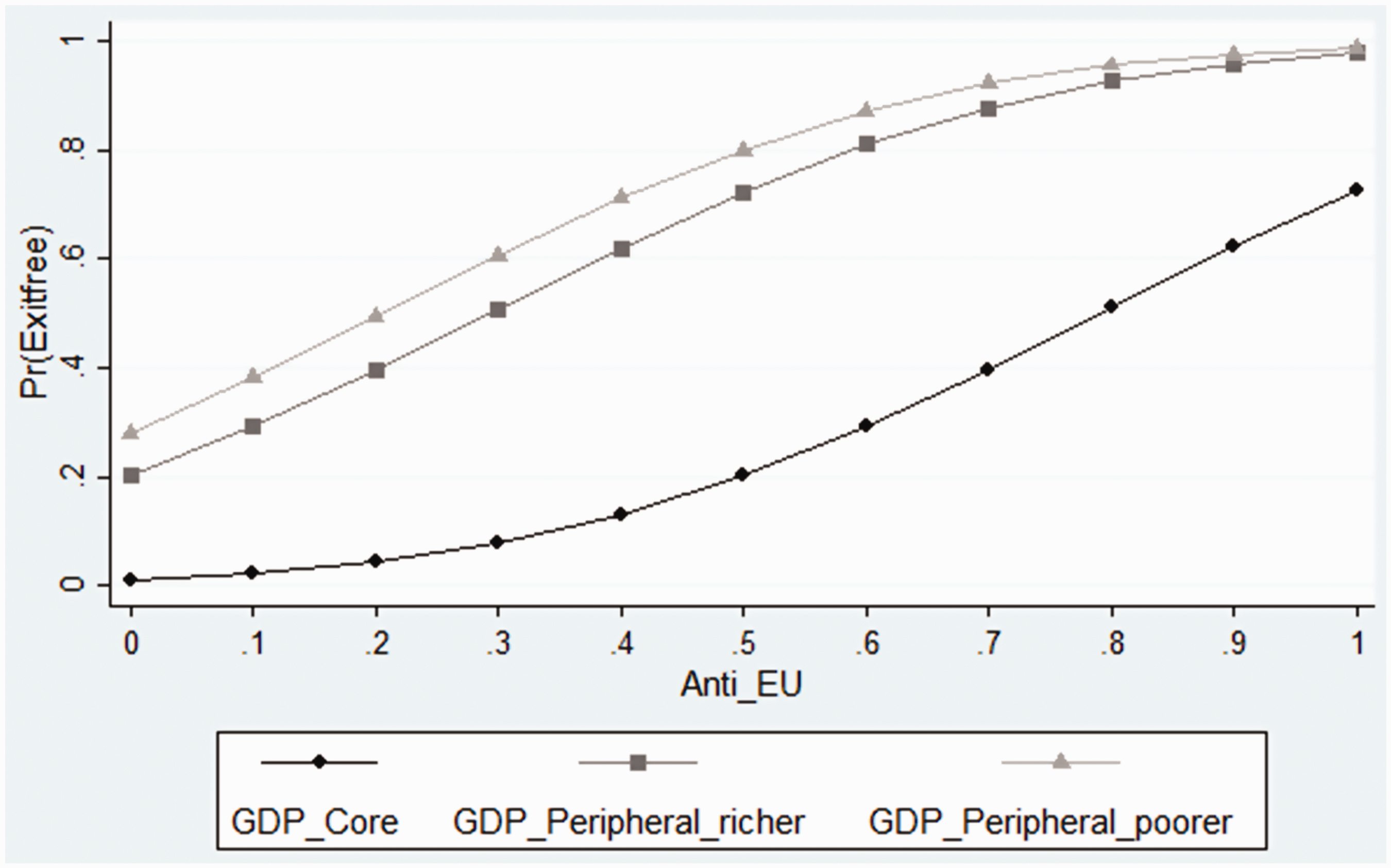
Predicted probabilities of being in favor of a free exit right.
Robustness
The results of five robustness checks are reported in the Online appendix. Only 94 of the 189 EU-25 delegates have an observation for Exitfree. The first robustness check reports the results of an ordered probit regression assuming that the remaining 95 delegates had no strong opinion. The coefficient for GDP_Peripheral_poorer is again positive and significant at the 1% level. The coefficient for Supranational is no longer significant, so the finding for national versus supranational delegates is not robust.
An alternative assumption is that the remaining 95 delegates did not voice their opinion because they were actually in favor of the Presidium’s proposal to introduce a free exit right. In this second robustness check, most of the marginal effects are smaller than in the main regression. The marginal effect of GDP_Peripheral_poorer drops to 32% points. However, the effect remains of substantial magnitude and is still significant at the 1% level.
For the third robustness check, the regression was conducted at the party level, with standard errors clustered at the country level. The estimated coefficients are similar to the main regression. In particular, the marginal effect of GDP_Peripheral_poorer is 51% points and significant at a p-value of 1.3%.
The results are robust to using the second coder’s coding of the dependent variable: under the fourth robustness check, the marginal effect of GDP_Peripheral_poorer is 50% points and significant at a p-value of 1.2%.
Finally, after adding GDP per capita as an additional control variable, the marginal effect of GDP_Peripheral_poorer is 42% points and significant at a p-value of 5.5%. The estimated effect of GDP_Peripheral_richer is 54% points, significant at the 1% level. This confirms that the result for GDP is really due to countries being peripheral and not to an indirect effect of omitting GDP per capita.
Discussion: The role of the UK
This section provides a discussion of the UK’s role in the adoption of Article 50 and of Brexit.
The UK’s role in the adoption of Article 50
Because the documents relating the Convention are public, the empirical part of this study focused on the Convention, rather than on the IGCs. In other words, it focused on the origins, rather than the final adoption of Article 50.
As can be seen from the data in the Online appendix, the UK was peripheral on the dimension of economic development: it was richer than the core of the EU-25 (rather than poorer, like the A-10 countries). It might, hence, have feared more regulation or more immigration as EU policies are brought into the gridlock interval. Consistent with the hypothesis that heterogeneity drives the desire for an exit right, the UK was a strong supporter of introducing Article 50.
However, contrary to the accession states, the UK could not bargain at the Convention on the basis of not becoming a member if it did not get an exit right. That is why I argue that the A-10 countries were crucial in getting the exit right into the draft Constitution. Indeed, according to Le Monde (2003), the exit clause was ‘chiefly aimed at reassuring the future members’.
On the other hand, I am far from claiming that the support of the UK and Denmark was not important in the final adoption of an exit right at the IGCs. While they could not threaten not to join, they could threaten not to accept treaty change. Consistent with this observation, the drafter of Article 50, Lord Kerr, has said that it was included ‘partly to undermine an argument made by British opponents of EU membership’ about being trapped in an ever-closer union (Gray, 2017).
A final observation on why the A-10 countries were crucial at the origins of Article 50 is the following: if the UK and Denmark had the will and necessary bargaining power, then why did they not obtain an explicit exit right prior to the Convention, for instance in the 2001 Nice Treaty?
The Brexit referendum
The Brexit referendum of 23 June 2016 has shown that when an exit right is in place, governments may be willing to take recourse to uncertain referendums. This may be attributed to intra-party or domestic politics. Alternatively, consistent with the logic of two-level games (Hug and König, 2002; König et al., 2008; Putnam, 1988; Schneider and Cederman, 1994) and brinkmanship (Schelling, 1960), the decision to call a referendum may have been a deliberate attempt to generate uncertainty and use this to extract surplus from the rest of the union.
This argument is consistent with the observation that in anticipation of the referendum, David Cameron obtained an emergency brake on welfare payments to immigrants, should the UK have decided to remain. However, the outcome of the referendum confirmed that the strategy of brinkmanship is dangerous: although it allowed the UK to extract some concessions, the end result was the decision to leave and trigger Article 50 on 29 March 2017.
Conclusion
This article presents a theoretical argument and empirical evidence regarding heterogeneity, vetoes, and exit clauses in the EU and political unions more generally. By including an exit right at the constitutional stage, political unions can ex-ante insure prospective members against undesired policy changes. Members of a periphery that is highly distinct from the core will require an exit right if they will lack a legislative veto. This conclusion is supported by detailed evidence from the EU.
The EU adopted a free exit right during the 2002–2003 Convention on the Future of Europe, which developed a draft Constitution for the EU. The draft Constitution was not ratified, but, through the 2007 Treaty of Lisbon, the withdrawal clause containing the exit right was adopted as Article 50 of the TEU.
The case of the EU presents a twofold puzzle from the point of view of the most common theories about exit clauses in international treaties and federations. These theories explain the absence of exit clauses by referring to stability and commitment problems, signaling, or the risk of strategic exploitation. The first puzzle is that they cannot explain why the EU would have an exit clause. The second puzzle is that they cannot account for the timing of its adoption. The heterogeneity-veto argument can solve both puzzles. In addition, it correctly predicts that preference outliers will support an exit right.
The Candidate States that joined in 2004 were the first new Member States to both differ significantly from the existing members and to enter when the EU had largely moved from unanimity decision-making to QMV, eroding Member States’ veto power.
The hypothesis that heterogeneity leads to a desire for an exit right is further supported by probit regressions at the level of 94 Convention delegates and their 65 national parties. In these regressions, delegates were coded as being peripheral if their country fell outside the Council gridlock interval in terms of GDP per capita. Nine of the 10 Candidate States from the Eastern enlargement had a level of GDP per capita below the gridlock interval. For the dependent variable, two independent coders classified all amendments and plenary statements made at the Convention on 25 April 2003 as either in favor or against a free exit right.
In the main regression, the expected effect of being from a country with a level of GDP per capita below the gridlock interval is a 54% point increase in the probability of being in favor of a free exit right. For delegates from the rich periphery, which includes the UK and Denmark, the corresponding increase is 46% points.
Unsurprisingly, the regressions also show that the stronger the anti-EU ideology of a delegate’s party, the stronger the desire for a free exit right. Delegates from larger countries were also found to be somewhat more likely to support a free exit right. In the main regression, delegates from supranational institutions (the EP and the EC) were found to be more likely to support a free exit. However, this counterintuitive result was not robust.
Finally, while this article advances a heterogeneity-veto argument rather than an argument about commitment, signaling, and strategic exploitation, it does not deny that such phenomena can and do occur. The Brexit referendum is a case in point. However, such arguments cannot account for the adoption of Article 50, while the heterogeneity-veto argument can.
Footnotes
Acknowledgements
I would like to thank Claudia Avellanada, Massimo Bordignon, Renee Bowen, Mark Copelovitch, Christophe Crombez, Axel Dreher, Bruno Frey, Clemens Fuest, Benjamin Geys, Daniel Gros, Bjørn Høyland, Simon Hug, Geert Jennes, Thomas König, Keith Krehbiel, Costas Lapavitsas, Maurits Meijers, Sean Mueller, Nina Obermeier, Jon Pevehouse, Leo Sleuwaegen, Jason Sorens, Enrico Spolaore, Jo Swinnen, Steven Van Hecke, Jakob Vanschoonbeek as well as anonymous reviewers and seminar participants at KU Leuven, ECORES, INET-YSI, EPSA 2017, APSA 2017, PEIO 2018, ECPR 2018, and the 2018 CESifo Venice Summer Institute on Country Clubs for their comments. I also want to thank Dorien Emmers for research assistance, Lucia Rossel Flores for copy-editing suggestions, and Stephanie Rosenkranz for translation advice. All shortcomings remain my own.
Funding
The author(s) disclosed receipt of the following financial support for the research, authorship and/or publication of this article: Research on this project was financially supported by the KU Leuven (Methusalem Program) while the author was a PhD candidate at the LICOS center for institutions and economic performance.
Supplemental Material
Supplemental Material for this article is available online.