



Abstract
The left–right line of conflict has been the dominant dimension of decision-making in the European Parliament since 1979. A pro-/anti-European Union integration dimension is of secondary importance. Limited evidence exists on the conditions under which these different dimensions matter. This study examines parliamentary decision-making about the so-called Two-Pack, which moved responsibilities about budgetary decision-making to the European Commission. The article uses in-depth interviews, textual analysis of committee debates and roll call voting analysis in order to determine which lines of conflict matter at which stage of decision-making. The evidence indicates that left–right division is dominant in the informal stage preceding committee debates, while both the pro-/anti-European Union and the left/right dimensions matter during the committee stage, whereas for plenary votes, the pro-/anti-European Union dimension is crucial.
Keywords
Introduction
For a long time, the European Parliament (EP) has suffered from a lack of substantive political competition (Mair, 2007). The two big groups in a so-called ‘Grand Coalition’ took most decisions consensually (Kreppel and Tsebelis, 1999). In the last decades, scholars have pointed a shift towards contested decision-making in the EP, fuelling hopes for ‘limited democratic politics’ (Hix, 2008, 2013). Recent studies on party competition in the EP have challenged this hope. The original shift towards a ‘left–right confrontation’ (Kreppel and Hix, 2003) seems to have been reversed after the on-set of the eurozone sovereign debt crisis. One may have expected that the conflict between the economic left and the economic right structures voting in the EP, as the question of austerity-versus-spending was at the core of the debate after the onset of the eurocrisis. Otjes and van der Veer (2016), however, found that for voting on economic issues in the seventh EP, the importance of left–right dimension has decreased while the significance of the pro–anti-European Union (EU) dimension has greatly increased.
Studies on the internal decision-making in the EP have pointed to the fact that it builds broad legislative coalitions of the pro-European centrist groups during inter-institutional conflicts (Bressanelli et al., 2016; Hagemann and Høyland, 2010). Rapporteurs, shadow rapporteurs and, on controversial issues, the political groups build these coalitions during the legislative process (Finke, 2012; Jensen and Winzen, 2012; Roger and Winzen, 2015). Our central argument is that left–right conflict (despite the evidence of Otjes and van der Veer, 2016) is still present in the Parliament but that it is present outside the meetings of the plenary, namely in earlier stages of the decision-making process. Left–right conflict structures the informal pre-committee stage and the committee stage, yet during plenary voting, a pro-/anti-integration dimension dominates. To substantiate our argument, we examine the entire decision-making process of a crucial legislative proposal in the Parliament during the eurocrisis, the ‘Two-Pack’, in detail.
The Two-Pack legislation strengthened the economic coordination at the European level. In order to contain the European sovereign debt crisis, the European Union (EU) expanded its control over economic governance at the expense of national economic governments (Armingeon and Baccaro, 2012). It gave the Commission considerable oversight powers over the national budgetary decision-making of eurozone member states. This legislation, in which the EP was closely involved, represented an unprecedented move of competences within the EU (Chalmers, 2012; Majone, 2014; Tosun et al., 2014). Here, we analyse how the decision-making in the EP took place. Our central research question is which lines of conflict within the EP were dominant at which stage of the legislative process during the decision-making on the Two-Pack, and why these?
In line with Otjes and van der Veer (2016), we argue that the eurocrisis and the political reactions to this crisis have strengthened the pro-/anti-integration dimension. The European Commission pursued the solution of prioritising European-level economic governance over national budgetary autonomy (Bauer and Becker, 2014; Chalmers, 2012; Majone, 2014). Moreover, the EU dealt with the crisis in an intergovernmental mode, empowering the member states at the expense of the EP (Schwarzer, 2012). Members of the EP (MEPs) fought to be active in the legislative decision-making. Consequently, the pro-European groups agreed on a united position, blurring their ideological divisions (Roger, 2016; Rose and Borz, 2013). Previous research suggests that compromises are built during and before the committee stage (Bressanelli et al., 2016; Settembri and Neuhold, 2009) A sole focus on the plenary votes will not suffice to capture all conflict in the EP (Bowler and McElroy, 2015; Ringe, 2010). We therefore analyse the dynamics of decision-making beyond the voting stage. We show that left–right confrontation occurs at the committee level but is resolved in the informal negotiation process before the vote takes place. The pro-European centrist groups sought to achieve a compromise on the Two-Pack that ensured the stability of the European project. Nevertheless, these groups were divided on central aspects of the legislation and accordingly had to solve their disagreements before the voting stage.
This study contributes to the existing literature on European politics in four ways. First, we examine the nature of political conflict in both the committee and plenary phases of the legislating. Analyses of politicization focused on the plenary phase (Hix et al., 2007; Slapin and Proksch, 2010). However, the committees are important as most of the legislative work is carried out there (Yordanova, 2013). Studies have investigated how conflicts at the committee level are translated into a united position for the EP (Ringe, 2010; Roger, 2016). We add to this literature by analysing the evolving nature of conflicts over the different phases. Second, interviews with the decision-makers allow us to explain the coalition-building process. Negotiations with the Council impact the strategic coalition-building before the voting stage by centrist, pro-European groups (Bressanelli et al., 2016; Finke, 2012). Our interviews add to our understanding on how and why these coalitions are built. Third, we study the final votes on two key plenary votes to understand how the committee and coalition-building processes cumulated. Finally, we add understanding about legislating during EU crises. The crisis has been crucial for the furthering of European integration, such as the Two-Pack investigated here is clearly a case (Bauer and Becker, 2014). The effects of the eurocrisis on EP decision-making have not been examined in-depth (Braghiroli, 2014; Otjes and van der Veer, 2016).
We find that the anti-/pro-EU integration dimension is the most important line of conflict during the two plenary votes investigated. Nonetheless, given that the issue revolves around an economic issue, we do find left–right conflict, but this conflict primarily occurs in the committee and negotiation phases.
Theorising the lines of conflict in the EP
The extent to which decision-making in the Parliament is and ought to be polarized is a matter of academic debate. The earlier work of Kreppel (2000) has pointed at the importance of parliamentary unity for enabling the EP to amend legislation. Bartolini and Hix (2007) have argued that in order to provide legitimacy, EP decision-making has to be politicized. Empirical studies found politics in the EP to be more politicized (Hix, 2013; Kreppel and Hix, 2003), further fuelling hope of competitive EP politics. The Lisbon Treaty further enhanced the tendency towards politicization. It extended the EP’s legislative rights (Hix and Høyland, 2013). Nevertheless, even though patterns of party politics occur, the EP still remains a consensual assembly (Bendjaballah, 2011; Bowler and McElroy, 2015; Roger, 2016). In order to behave as ‘responsible legislator’ (Ripoll Servent, 2013), the Parliament prioritizes agreements with the Council over politicization (Burns, 2013; Huber and Shackleton, 2013). This focus on compromise has implications for the democratic representation of citizens. Rose and Borz (2013: 490) argued that the aggregation of interests into a united position for the pro-European centrist groups leads to ‘misrepresentation’. Similarly, Lord (2013: 1069) pointed the risks of ‘consensus decision-rules [that] constrain how far the EU can develop forms of political competition that offer public choice and control over the Union’s legislative agenda’ in the ordinary legislative procedure. Likewise, Ripoll Servent (2013: 983) maintained that institutional constraints lead to ‘depoliticization’: actors ‘may prefer to sacrifice substantive issues rather than be accused of be “irresponsible”’, whereby the ‘weight of compromise and “responsibility” translates into equating “legislative” practices with “technical” negotiations’.
The key argument of our article is that the question of politicization or consensus in the EP is not a black-and-white issue. At different phases of decision-making compromise and consensus may matter more, while at other phases of decision-making ideological polarization may be more pronounced. Ideological polarization and conciliatory compromise between the two groups are different modes of decision-making and the EP can ‘shift gears’ between them (Andeweg, 1992). We build on the idea of Kreppel (2000) that the Grand Coalition waxed and waned during different phases of decision-making. First, we will introduce the different lines of conflict that according to previous authors have characterized decision-making in the EP and then will discuss in greater detail under which conditions what dimensions may matter more or less.
Tsebelis and Garrett (2000) proposed that the dominant line of conflict in the EP may be the economic left/right-dimension. The key question in the Parliament is what kind of Europe MEPs want. They can choose for government intervention in the economy (a left-wing Europe) or market-based solutions (a right-wing Europe). Studies have found that the left–right dimension is the dominant dimension in the roll-call voting behaviour of MEPs, particularly for economic issues (Hix et al., 2003; Kreppel and Tsebelis, 1999). H1 (Economic Expectation): Decision-making in the EP follows the economic left-right line of conflict. H2 (European Expectation): Decision-making in the EP follows the line of conflict between pro- and anti-EU integration groups. H3 (Grand Coalition Expectation): Decision-making in the EP follows the line of conflict between the political groups inside of and outside of the Grand Coalition.
We argue that the basic logic of Kreppel has been reinforced under the new modus operandi of the EP, but that the different phases of decision-making are now already displayed during first reading. The institutional context reaffirms the central place of parliamentary committees in the decision-making process, where ideological differences are displayed and compromises built (Bendjaballah, 2011; Longley and Davidson, 1998; Ringe, 2010; Settembri and Neuhold, 2009). Ripoll Servent (2012) showed how difficult it is for a committee to reconcile competition and consensus: even though the confrontation over policy values still hold, a committee displayed consensual behaviour both internally and in negotiations with the Council, leading to the formation of a Grand Coalition. Under co-decision, Ripoll Servent (2012: 68) argued, ‘the EP had less room for radicalism and ended up with more centripetal outcomes’. These constraints are even more pronounced in times of crisis, where it is ideologically divided, but at the same time needs to reaffirm its role as co-legislator.
Nevertheless, even though the EP has to adapt to a new institutional context, conflicts over policy issues cannot be expected to disappear. We argue that policy conflicts still play a major role in EP decision-making, but are settled earlier in the process. Transposing Kreppel’s logic to a shorter time frame, we expect that the debates in the informal decision-making before the committee stage and during the committee stage are more politicized (along the left–right dimension). However, we expect the importance of left–right polarization to decrease sharply when moving to the plenary stage. We expect ideological conflicts to dominate earlier states of the legislative process but MEPs to overcome their ideological differences in order to reach an agreement with the Council. Hence, the Grand Coalition should be stronger at the plenary stage compared to the committee stage. Therefore, we expect that the patterns introduced above matter more (and less) at different points in time: H4 (Left-Right Timing Expectation): Decision-making in the EP follows the left-right dimension more during the informal pre-committee and committee phase than during the plenary vote. H5 (Grand Coalition Timing Expectation): Decision-making in the EP follows the Grand Coalition logic more during the plenary vote than during the informal pre-committee and committee phase.
Lines of conflict for the Two-Pack
We examine these theoretical expectations for the case of the Two-Pack. It consists out of two legislative regulations on European economic governance: a regulation on enhanced surveillance of member states whose financial stability is at risk, and a regulation concerning oversight on member states’ economic and budgetary policies. 1 The Commission presented both proposals in November 2011 and the responsible committee brought it to the plenary in June 2012. The negotiations took another 11 months. The Council adopted the Two-Pack in May 2013. The two proposals contributed to the Europeanization of economic governance by strengthening the monitoring processes of national economies at the European level through the Commission and the Council. The Two-Pack regulations were the last two parts of a general reform of the European Economic governance of the eurozone, following the reinforced Stability and Growth Pact of 2011 (the Six-Pack). Moreover, the Two-Pack dealt with similar issues as the Treaty on Stability, Coordination and Governance (TSCG). Both the treaty and the Two-Pack set limits to the structural deficit a member state could have, and deal with the surveillance by the Commission of national economic policies.
We select the Two-Pack as a ‘crucial case’ to test our expectations (Gerring, 2004). In the case of the Two-Pack there are sufficient reasons to expect each of the three dynamics, left–right, pro-/anti-integration and Grand Coalition, to be dominant. First, it was a major piece of economic legislation during the eurocrisis. Decision-making on key economic issues is generally expected to lead to a strong left–right polarization (Hix et al., 2007). The question MEPs faced when debating the Two-Pack can be understood in left–right terms: they could choose between a fiscally disciplined EU which would implement austerity programmes in order to re-gain the trust of the international financial markets, or they could opt to expand public expenditure on the national level in order to reignite economic growth. Therefore, one may expect the left–right dynamic to dominate in the decision-making.
Second, there may also be reasons to expect a strong division between the pro- and anti-European groups on this economic issue. The package also proposed a major shift in responsibility between national governments and the European Commission. The legislation had important implications for the national economies as it introduced the ‘European semester’, coordinating Member States budgetary plans at the European level (Chalmers, 2012; Bauer and Becker, 2014). Therefore, the pro-/anti-integration dimension may structure decision-making: do MEPs want more European control over budgetary decision-making or do they want to leave these competences to the member states? All in all, there are strong reasons to expect ideological polarization, either left–right or pro-/anti-integration, on this major policy package.
Third, the Grand Coalition may also structure decision-making (Kreppel and Tsebelis, 1999). When bargaining on this highly salient policy package the EP faced another veto player, in the form of the Council. In this specific case, there may have been more reasons for the EP to present a united front. The intergovernmental mode of decision-making has become more important in response to the eurocrisis (Fabbrini, 2013, 2015; Majone, 2014). For instance, the TSCG was decided on outside the legal EU framework, leaving the Parliament aside (Auel and Höing, 2014; Schwarzer, 2012). The EP had declared its opposition against the TSCG, in part, because it put decision-making outside of its own control. The Two-Pack was introduced using the ordinary legislative procedure. The legislation was contentious as it integrated provisions of the TSCG in the Two-Pack. MEPs feared a Council veto if the text of the Two-Pack deviated from the TSCG (Roger, 2016). Therefore, the case reflects the dilemma that MEPs oppose each other on controversial content, but need to act in order to prevent the Council from overruling them.
Our choice to study the Two-Pack has limits for the generalizability of the results. This is an extreme case: the pressure to see a left–right, pro-/anti-integration or Grand Coalition decision-making pattern may be more limited in other cases; however, it is an ideal opportunity to explore what structures decision-making in the Parliament under extreme circumstances and how different lines of conflicts evolve throughout the entire legislative process.
This article employs multiple sources of data and both qualitative and quantitative methods to determine which lines of conflict structured the decision-making process. We will trace the dominant line of conflict in the decision-making on the Two-Pack in three steps, moving backwards in time: first, we will use regression analysis to determine which lines of conflict mattered during the final votes concerning the Two-Pack. Second, we will examine the committee debate that preceded the vote using manual text analysis to find out what structured these debates. Finally, we will study the coalition formation process that preceded the actual committee debate using interviews with key players. It is important to note that the analyses employ different methodologies, choosing the appropriate method for the kind of data that is available and that the results are not directly comparable.
Voting patterns in the EP
On 12 March 2013, the Parliament voted on the Two-Pack in two votes. The MEPs had dealt with the amendments in the committee stage. This only left the votes on the entire bill for the plenary. We will consider here what determined the voting behaviour of individual MEPs in these two votes. We expected that MEPs follow the left–right dimension, the pro-/anti-integration dimension, or the Grand Coalition-opposition line. We include three control variables: whether or not the national party of the MEP was in the national government (and therefore in the Council) at the time of the vote, as they might be more inclined to vote in favour. We also include the size of the national debt of the MEP’s member state, as MEPs from these countries may be less inclined to accept European budgetary controls. Finally, we added a control variable measuring whether the MEP is from a country that the measure affects (i.e. in the eurozone).
We draw on VoteWatch (2014) for the data on the individual MEPs’ voting decisions, while the EP website provides the party membership information. The Chapel Hill Expert Survey (CHES) is used for the national parties’ ideological left–right and anti-/pro-integration positions (Bakker et al., 2012). 2 The ParlGov database (Döring and Manow, 2012) is used to assess whether the MEP’s national party was in government at the time of the vote. The information on the national debt is extracted from EuroStat (2015). We recoded all variables to score between 0 and 1 for reasons of comparability. 3
Logistic regression analysis of roll-call voting.
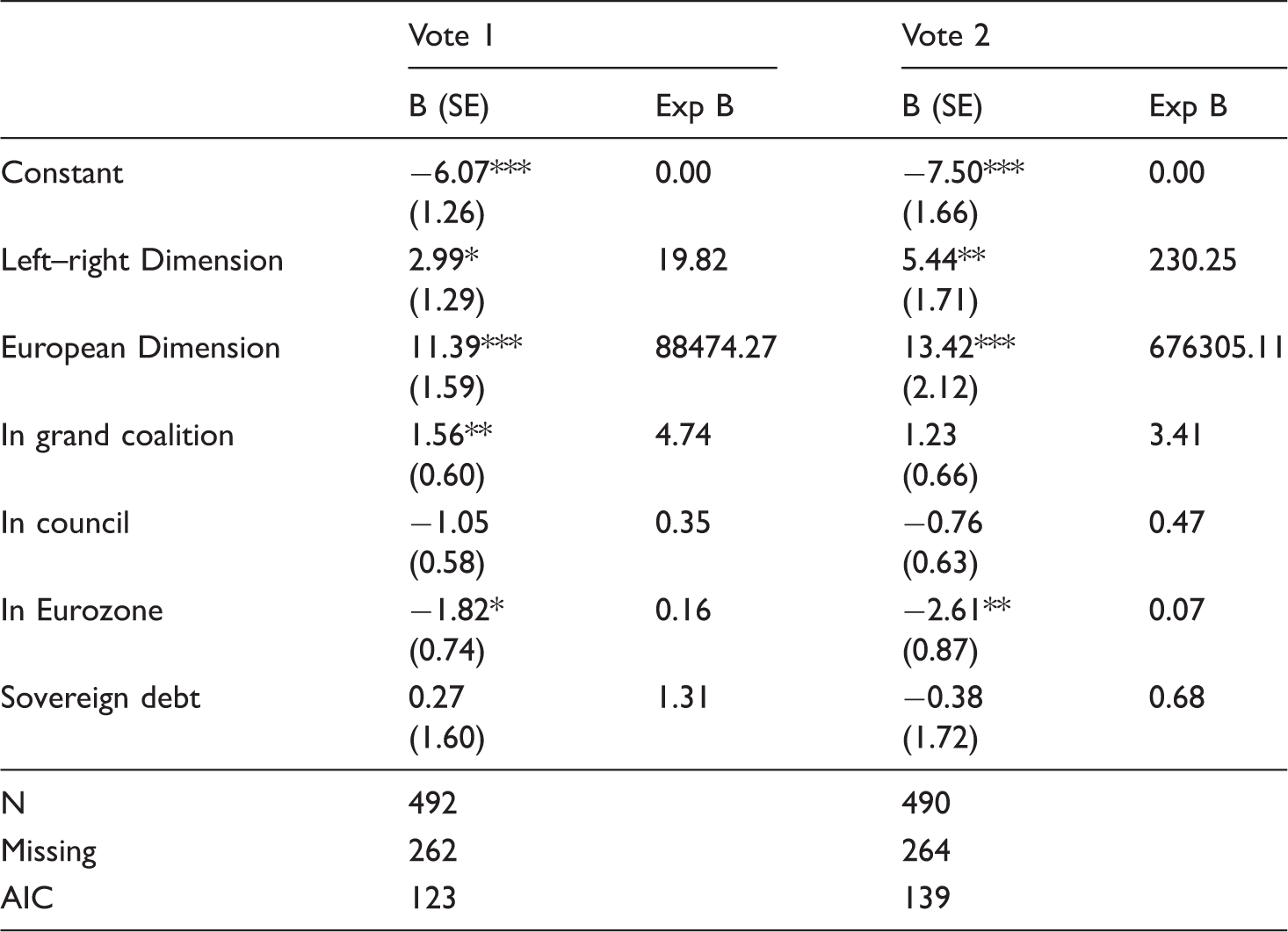
p < 0.001; **p < 0.01; *p < 0.05.
The Grand Coalition expectation stated that the decision-making in the EP would divide Grand Coalition from the other parties in general, and the Grand Coalition Timing Expectation stated that the Grand Coalition would be particularly strong during plenary voting. We find mixed support for these expectations. In the first vote, the Grand Coalition does explain variation in voting, however, the effect is much smaller than both the European integration and the left–right dimension and no longer significant for the second vote. Grand Coalition membership did not matter in this final phase of decision-making. Still, 98% of all Grand Coalition MEPs (who therefore belong to either the S&D or the EPP) voted in favour of the Two-Pack legislation. Conversely, on average 38% of non-Grand Coalition MEPs voted against. The reason that we find little support for the Grand Coalition Expectation is because there is a ‘grander’ coalition, which united all pro-European integration MEPs in favour 4 and all anti-European integration MEPs against the legislation. Whether or not the MEP is from a eurozone member state had a negative and significant effect in both models. It is easier to vote fiscal discipline when it does not apply to your country. The other two variables were not significant.
What do these findings mean? Both votes dealt with policy that boiled down to extending the powers of the Commission. Although the votes deal with an economic issue, the key issue in the proposal appears to be the question of the competences of the EU, in the form of the enhanced enforcement mechanism, as the vote followed the European integration dimension rather than the left–right dimension.
The two votes we analyse in this article clearly deviate from the existing literature. Overall, the dominant dimension of the EP is the left–right dimension (Hix et al., 2007), especially on economic issues (Kreppel and Tsebelis, 1999). Our findings are in line with more recent research on the EP (Otjes and van der Veer, 2016), that show that the European integration dimension became much more important for votes on all economic issues in the wake of the 2008 financial crisis. The results indicate that the Parliament adapted to the crisis context, and behave as ‘responsible legislator’: to reach a compromise with the Council, it managed it to overcome the left–right conflict. A ‘Grander Coalition’ pattern dominated the vote, with all the pro-European political groups voting in favour. 5
Patterns in parliamentary debates
The reports voted at the plenary stage already reflect compromises found at the committee level (Ringe, 2010). Here, we may find different patterns than in the final vote. We analyse the committee debates on the Two-Pack that took place in the Committee on Economic and Monetary Affairs (ECON) in the period of January–March 2012. These debates include an initial exchange of views on the two legislative proposals and debates on the amended draft reports. Gauzès (EPP) and Ferreira (S&D) were rapporteurs and spokespersons from all main party groups were present and participated (ALDE, ECR, EPP, Greens/EFA, GUE/NGL, S&D).
We transcribed the English interpretation available in video format from the Parliament website. We coded each sentence in the debate manually. A sentence is a string of words ending with a full stop, question mark, exclamation mark, semi-colon or colon. We employed four codes. The first code captured whether the sentence included left-wing content advocating of an active role of the government in the economy, in the form of nationalization of economic sectors, higher taxes, more market regulation, increased government spending and a maintaining the welfare state. The second code discerned whether the sentences included right-wing content, by which we mean a limited role for government in the economy, privatization of government enterprises, lower taxes, less market regulation, spending cuts, deficit reduction, fiscal discipline, austerity and welfare state reform. Third, we coded whether a statement was pro-European, that is advocating the transfer of sovereignty or competences to supranational European institutions and preferring Community law over intergovernmental treaties. Finally, we coded whether a statement was anti-European, i.e. advocating maintaining or returning sovereignty or competences at/to the national level. We only coded sentences that express a policy position those that express (dis)agreement with the legislation, a desire to change or maintain the status-quo or describe a situation using normative (positive or negative) wording. We exclude sentences that make factual statements. Two experienced coders coded all 1125 sentences. Disagreements about the interpretation of the text between the coders were resolved through discussions. One hundred and ninety sentences were given a left or right position, and 156 sentences were given a pro- or anti-EU position. 6 We make scales that subtract left from right-wing statements and pro- from anti-EU statements, respectively. 7
Figure 1 shows the positions of the speakers in a two-dimensional model with a left/right and a pro-/anti-integration dimension. There is a cluster of two speakers from GUE/NGL in the left-wing Eurosceptic quadrant. One S&D MEP who is on the border between pro- and anti-EU joins them. These three were critical of the Two-Pack. In the centre, there is a cluster of MEPs from the S&D, ALDE and Greens/EFA, including the two rapporteurs. These MEPs generally supported the proposal but proposed changes in a left-wing, pro-European direction, such as pooling state debt, a bigger role for Parliament or a balance between austerity and growth. Two MEPs from the EPP (on the border between pro- and anti-EU) and one MEP from the ECR form the final cluster. These speakers mainly opposed the changes the second group proposed and they endorsed fiscal discipline.
8
Positions of speakers in the committee debates.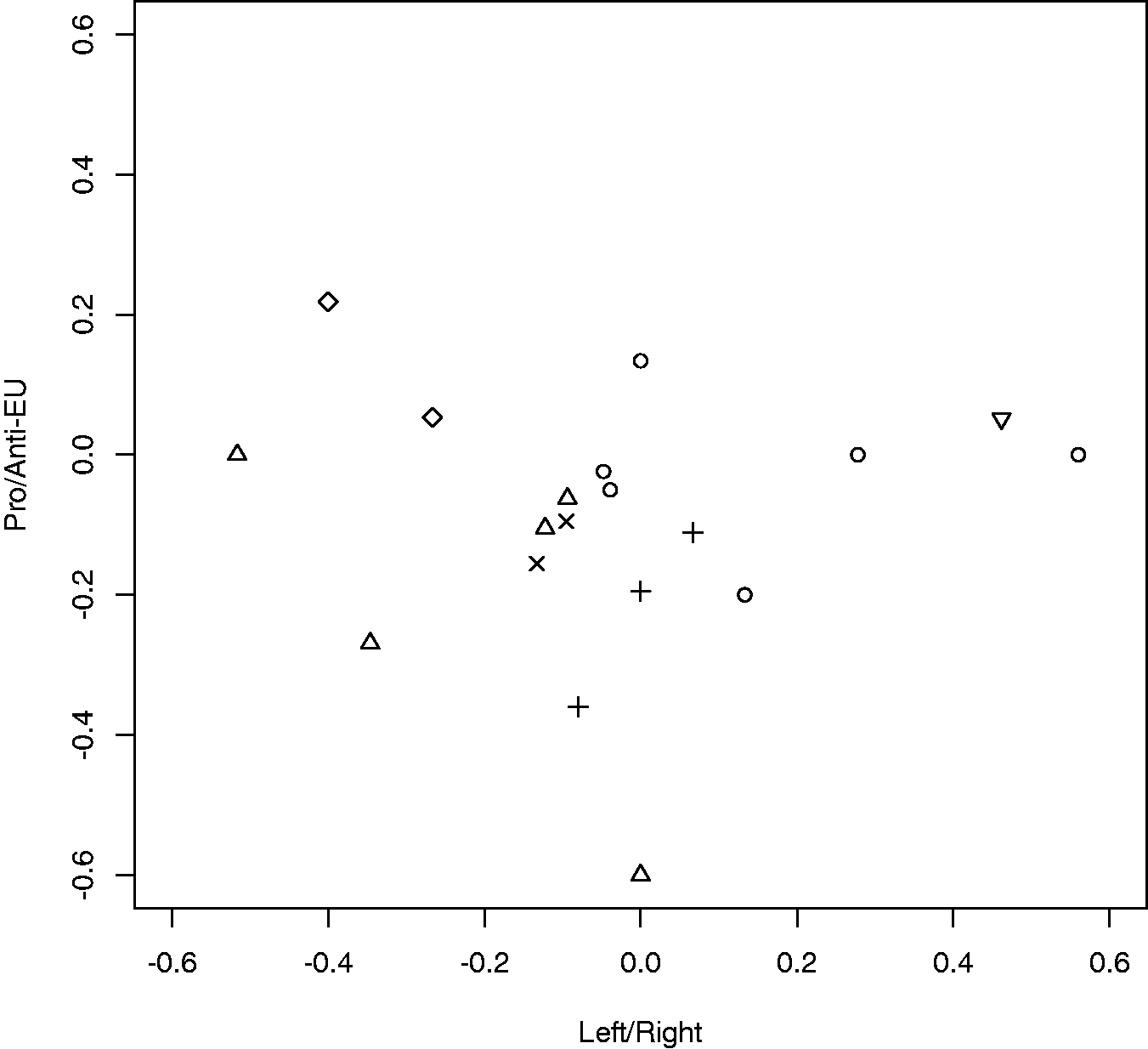
What is crucial about this analysis is that in the committee the Two-Pack was discussed along both dimensions: on the one hand, there is a discussion about fiscal discipline versus growth. Here the S&D, Greens and GUE/NGL stand on one side, and the ECR and EPP on the on the other side with the ALDE in the centre. On the other hand, there is a debate over sovereignty. Here we find the Greens, ALDE and most S&D members, endorsing further transfer of sovereignty. The GUE/NGL, the ECR and the EPP were sceptical about this. The scepticism of the EPP was limited to transfer of sovereignty further than the original proposal.
Overall, both dimensions matter equally. The data thus provides considerable evidence for the Economic and the European Expectation. The EPP and S&D are not united in the committee debates, in contrast to the Grand Coalition Expectation. Both the left–right and pro-/anti-integration lines of conflict were present in the committee debates, but did not determine voting behaviour: the MEPs prioritized compromising in voting over policy conflicts that they showed in the committee. As we will see below, the compromises were negotiated in informal negotiations that accompanied the committee meetings.
Interviews with key participants
In the debate stage the European and economic dimensions played a role: the Eurosceptic left attacked the Commission proposal; the pro-European left proposed to alter the legislation. The government parties of the right opposed that. Various informal meetings accompanied the committee meetings: committee members of the same political group meet in working groups where amendments proposed by shadow rapporteurs are discussed; in meetings between the shadow rapporteurs the legislative proposal is discussed and compromises are negotiated between the political groups. We focus on the informal discussions beyond the committee and the plenary. There, the dominant lines of conflict related to the content of the legislative proposals and the negotiation strategy vis-à-vis the Council are most likely to appear. Our analysis draws on twenty in-depth interviews conducted with the negotiators of the Two-Pack and parliamentary officials involved in the legislative process. 9 As the interviews were held during the entire decision-making process, they allow us to understand the dimensions we found at the plenary and the committee. The following section outlines the key conflicts between the political groups and analyses the negotiation process, which leads to a broad agreement within the Parliament.
The left–right dimension dominated the debate on the Two-Pack at the beginning of the negotiation process. The groups of the left opposed the groups of the right on the deficit rules, specifically on the question whether investments should be integrated in the calculation of the public deficit (Interview n°28, n°62, n°67). The right-wing groups advocated balancing the budget as a precondition for growth, where the left groups argued that public investments stimulate growth (Interview n°20, n°28, n°39, n°50, n°67): This is a fundamental difference between the political groups, especially with the S&D and Greens, in their opinion, a proposal cannot be focussed on fiscal discipline solely. It must focus on fiscal discipline and growth. Whereby the Commission tends to say, we focus on fiscal discipline, and there are other instruments for growth (Interview n°65, own translation).
The left-wing groups and ALDE had the feeling that European governance solely concentrated on austerity measures, and consequently made investments and mutualising the debt a condition for their support (Interview n°39, n°65, n°70): We will be very, very strict with austerity but you are not giving anything on the other hand. You are not reinforcing the fiscal union, you’re not further coordinating economic policies, you’re not giving us Eurobonds for example, you know. So, the feeling is that it is very imbalanced […] (Interview n°67).
The pro-/anti-integration dimension also played an important role. From the perspective of the Eurosceptic MEPs, the European management of the crisis lacks legitimacy and cannot be imposed on member states (Interview n°53, n°25): This is the fundamental position of the […] party, which is very eurodistant. The party will rather say, we are against, not so much because of specific arguments but because of their general attitude … they will say, we are against because it stabilizes a system we don’t find very attractive. (Interview n°53) […] the Euro has been one of the causes of the crisis, particularly the generation of the cheap money that created bubbles and debts and all the rest of it. But there is something that they will intellectually never want to accept because accepting this is accepting for the pope that God doesn’t exist or for Mister Brejnev that Marxism doesn’t work. So it becomes something of a religion, it becomes a religious emotion and that is also feeling with the European Parliament, lots of people dealing with this issue: socialists, Christian democrats and liberals - at least most of them, the Greens. (Interview n°51) If you want to pass something and you know that you will need to have a partner, because you don’t have within your own political group the majority to pass that thing, then you need to approach the partner as soon as possible to make sure if I go this way, you go this way; you are not going to diverge, but somehow at least going in parallel and possibly converge at some time (Interview n°32). Let’s assume that ESM treaty is ratified, the Fiscal compact [TSCG] is ratified, they have tools they can work on and build up. So for them, Two-Pack was maybe not, you know, the crucial instrument. And then you could say “oh, we don’t talk with you until you give us […]”. (Interview n°13)
The interviews explain the differences between the committee and plenary. At the beginning of the process, the left–right dimension was polarized. However, to strengthen Parliament’s stand in the negotiation with the Council, the two big groups made crucial compromises during the legislative process and finally agreed on the reports. These compromise amendments were presented and discussed in the committee, where pro-European groups embraced them. The interviews support our findings at the voting stage: the ‘Grand Coalition’ collapsed into the ‘Grander coalition’, as the other pro-European groups embraced the compromise that was struck by the two big groups. As they were in favour of common European economic governance, they preferred the Two-Pack to the status-quo. Even though they disagreed on some aspects of the legislation, their commitment to keep the European project afloat drove their positioning in the committee debates and in the plenary vote.
The analysis of the three decision-making phases provides support for our central argument: policy conflicts still occur, but the political groups – driven by the ‘Grand Coalition’ – prioritize consensus-seeking in order to reach an agreement with the Council. The ideological conflicts do not disappear but are displayed in the committee meetings. At the same time, compromises are negotiated behind the scene. In the plenary, the pro-European parties vote united despite their internal divisions, and to preserve the Parliament’s role as responsible co-legislator.
Conclusion
This article provided in an in-depth analysis of decision-making on the Two-Pack. The Two-Pack moved responsibility concerning economic issues to the European level and strengthened the ability of the European institutions to enforce budgetary discipline in their member states. Our study provides insight into how the Parliament decides in extreme circumstances. Did political conflict during this crucial stage in the eurocrisis follow the division between the left and right (as one may expect on economic issues)? Did it follow the division between pro-/anti-integration parties (as the Two-Pack formed an unprecedented shift in competences in the EU)? Or did it follow the line of conflict between the unofficial coalition of S&D and EPP and the other groups (as one may expect during contentious politics)?
The three analyses showed the complexity of decision-making in the Parliament, as in different stages of the legislative process different lines of conflict were salient. The analysis of the two final votes showed that the single most important deciding factor separating ‘yea’ from ‘nay’-votes was the European dimension. This goes in against the logic that the left–right dimension structures decision-making on economic issues: the opposition to the Two-Pack came only from Eurosceptic parties. We also did not find evidence for a division between the Grand Coalition and the other groups. Rather all pro-European groups formed a ‘Grander Coalition’.
We found that both a left–right and a pro-/anti-integration dynamic was present in the committee. The Eurosceptic left criticized the proposal as such. MEPs from pro-European left tried to move the proposal further in their own direction. The EPP with support of the ECR opposed this. The Grand Coalition of S&D and EPP was divided between the most left and most right-wing and the most pro-EU and most anti-EU sides of the debates.
The interviews provided a basis to explain this pattern. The disagreement between the left and right on the economic issues at the core of the Two-Pack were solved in a grand compromise between the grand coalition of social-democrats and Christian-democrats. They needed to cooperate in order to offer a unified front vis-à-vis the Council. The pro-European parties of the left and right, inside and outside of the Grand Coalition accepted the compromise in order to ensure the stability of the eurozone, a political project that is on the long-term more important to them than the short-term policy goals they were divided over. In the final vote, all pro-European parties backed the comprise, leaving opposition to the Eurosceptic left and right. These parties opposed a shift in a further sovereignty to save a political system that they were not particularly positive about.
What does our case study teach us beyond the borders of this single case? We add to the existing literature in two ways. First, it shows us that economic issues should not be equated with the left–right dimension. When the question of transferring sovereignty to the European level is added to the decision-making, economic issues can gain a European dimension. This article stands in line with a number of studies (Katsanidou and Otjes, 2015; Otjes and van der Veer, 2016) that show that the decision-making during the European sovereign debt crisis did not just follow a left–right pattern but that it divided pro- and anti-EU integration parties as well.
Our research helps to explain the motivations that pro-European parties had to back the solutions the Commission pursued and the Eurosceptic parties had to oppose them. In the end, our interviews show that the core question is not whether parties endorse a shift in sovereignty in principle but rather to what extent parties are willing to put away their policy differences on the question of investment or austerity in order to stabilize the eurozone. The Eurosceptic parties that were not committed to the European project were unwilling to do this, but the pro-European parties prioritized stability over policy and therefore accepted a transfer of sovereignty.
The second contribution of this article is that it shows the value of the early work of Kreppel and Tsebelis (1999) on the Parliament. Different dimensions are important in particular phases of European decision-making. In the period that they studied these were other phases in the formal decision-making by the plenary with legislative proposals going through multiple rounds between Council and the Parliament. In early votes the S&D and the EPP would emphasize their ideological differences, but in later votes the Grand Coalition would compromise. Here, we uncovered the same pattern of polarization and compromise that Kreppel and Tsebelis (1999) found in the informal decision-making and the committee stage before the final vote. In line with Ripoll Servent’s (2012) argument, we identified that the patterns were reinforced with the extension of co-decision: even though policy conflicts hold, the Parliament choses to behave as ‘responsible legislator’.
Finally, our analysis shows that any hopes for ‘democratic politics’ should still be treated with caution as the constraints in the inter-institutional bargaining process always push for EPs unity, with the risk to sacrifice policy issues (Ripoll Servent, 2013). This is especially true in the eurocrisis as the resurgence of intergovernmental decision-making came at the expense of parliamentary participation. The results suggest that crisis moments do not lead to politicization, but rather further strengthen necessity of compromise. The article points a dilemma: in times of (politicized) crisis, the institutional setting constrains the Parliament even more. The dominance of intergovernmental decision-making modus makes the EP a vulnerable actor. To face this ‘full affirmation of the intergovernmental approach of European governance’ (Fabbrini, 2014: 1) in the eurocrisis, MEPs are constrained to compromise and hence may be tempted to neglect substantive demands. The study, however, provides evidence that the party competition nevertheless matters in the legislative process; from this view, the EPs vote is not a sign of ‘misrepresentation’ (Rose and Borz, 2013), but may be interpreted as the outcome of a party battle at the committee stage which lead into a compromise position, guaranteeing the representation of EU voters in the inter-institutional bargaining process.
Footnotes
Funding
The author(s) received no financial support for the research, authorship, and/or publication of this article.
Notes
References
Supplementary Material
Please find the following supplemental material available below.
For Open Access articles published under a Creative Commons License, all supplemental material carries the same license as the article it is associated with.
For non-Open Access articles published, all supplemental material carries a non-exclusive license, and permission requests for re-use of supplemental material or any part of supplemental material shall be sent directly to the copyright owner as specified in the copyright notice associated with the article.
