




Abstract
A thematic gap in decentralization research is how rural councillors with limited political scope assert agency in rural transformation processes. Analysis of councillors’ strategic interfaces with local organisations and international agencies outside the elected councils explores how they construct access to resources for rural development. Drawing on fieldwork in rural Ghana, the article demonstrates how creative boundary-spanning links councillors to different structures of rural governance and development intervention outside the remit of the district council. Clearly emergent from this study is that the cross-boundary collaborations create privileged access to outside resources and support for local political action but with significant political and economic consequences for councillors. These collaborative engagements offer a wider framework to understand councillors’ individual agency for rural transformation beyond conventional analyses of state-led or bottom-up development planning and the dominant critique of external intervention.
I. Introduction: Pitfalls of ‘Governance Gone Local’
Decentralization, particularly in the rural periphery, is a long-established theme in Africa’s development cooperation and policy, with numerous projects launched to revitalize the local administration and bring governance closer to rural dwellers (Rondinelli et al., 1989; Wunsch and Olowu, 1992). The renewed interest follows its recent efforts to facilitate and deepen local political participation and accountability (Andrews and Shah 2005; Crawford, 2009; Dickovick, 2014; Fedelino and Smoke, 2013; Krawczyk and Muhula, 2018; Smoke, 2015). Decentralization is also linked with ‘neo-endogenous’ development goals, that is, development interventions that envisage the strengthening of self-organized groups to fight rural poverty (Bosworth and Atterton, 2012; Francesconi and Wouterse, 2015; Kotir and Obeng-Odoom, 2009; Ray, 2006; Vengroff and Johnston, 1987). Despite doubts about whether decentralisation can deliver on its promise of rural transformation or political participation (Awortwi and Helmsing, 2014; Hasselskog, 2015), several early adopters, including Uganda, Ghana and Senegal, invest a curious hope in elected councillors and provincial elites as providing the essential link needed between the governors and the governed (Crook, 1999; Green, 2015; Juul, 2006). Bafflingly, national governments and international sponsors tend to conveniently gloss over the working conditions of elected councillors. Given their restricted influence over decisions and the resources needed to fulfil their duties, the position of councillors, who pass for ‘elites’ in the rural periphery (see Higley and Burton, 2006: 7), appears contradictory. In emerging and established democracies, councillors lacking influence or those dissatisfied with their performance would generally quit their seat or refuse to seek another term (Aars and Offerdal, 1998; Chiweza et al., 2021; Crook and Manor, 1998; Hjelmar and Pedersen, 2010). 1 Pragmatically, those who continue in their role would need a delicate balance between attempting to fulfil their mandate on the local council and actively pressuring for more effective government action to avoid incurring the wrath of voters. Consequently, some may side with voters’ disappointment regarding unmet expectations.
Tellingly, we know very little about how councillors in rural Africa overcome these challenges as they perform their functions on a daily basis. Extant studies prioritize competing hierarchies and tensions over local resources (Crawford, 2009; Crook, 1999; Devas and Grant, 2003; Francis and James, 2003). Others highlight districts’ liaison with group-based projects to compensate for the former’s failings in delivering public services (Lyon, 2003; Porter and Lyon, 2006). However, these studies neither discuss the actors who provide the requisite collaborations, nor the challenges and everyday strategies deployed for those collaborations to function. This article contributes to filling this gap by embedding the agency of elected councillors in the context of official neglect. Organized around the persuasive phrase, ‘we did many things together’, 2 used by a Ghanaian councillor to describe their interaction with external experts, this article’s objective is two-fold. First, it offers a nuanced analysis of the motivation underpinning rural councillors’ commitment to stay in office regardless of the serious limitations on their ability to influence the decisions of, and secure the appropriate use of resources by, the local administration. Second, it discusses councillors’ strategic cross-boundary interfaces as an instance of agency for crafting incentives for public action; successful councillors—to wit those who can muster support and resources to honour their obligations—draw on their mandate to connect different information and resource domains that augment their limited influence and rewards for public action.
The focus on Ghana is remarkable for decentralization debates and development policy, broadly. The country enjoys international credibility for progress in decentralized governance in Africa (Crawford, 2009; Resnick, 2017; Sabbi, 2020) but, notably, this occurs with an active role of communally-organized groups and a nudging from external donors (Abdul-Rahaman and Abdulai, 2018; Frontani and Taylor, 2009; Porter, 2003). By exploring the daily strategies used by poorly-resourced officials, this analysis foregrounds councillors’ agency as they refer to the ideas of ‘community’ and ‘development’ to articulate their mandate regardless of their limited political influence. Councillors tactically straddle their internal networks and external entities to access information and negotiate resources and support. These cross-boundary interfaces offer a wider perspective for understanding rural transformation beyond the conventional analyses of centre-led or bottom-up development planning. The argument in this article unfolds as follows: It begins with a brief review of the main elements of the debate on decentralization including the hope and frontiers of neo-endogenous intervention, particularly through the local administration and self-organized groups. The remaining sections analyse the everyday creative collaborations by rural councillors in performing their roles. The discussion particularly highlights the ensuing consequences of these interfaces, to wit councillors’ political and economic gains, and demonstrates that these interfaces simultaneously support transformation in the rural periphery.
II. Devolution and Neo-Endogenous Transformation in Rural Ghana
Parroting Devolution: Restricted Autonomy of Rural Local Governments
The alienation of Ghana’s rural councillors is inherently linked to the paradoxical conception of the decentralization programme. The District Assembly is comprised of councillors elected to represent a geographically-defined area and is the political and administrative unit of local government. While the current District Assembly system is, in many respects, a genuine devolution, there remain a few contradictions. 3 After almost three decades of recurring reforms, a 2016 local governance law (Act 936: Art. 16 [Republic of Ghana, 2016]) empowered decentralized government bodies particularly elected officials to make and approve local laws and policies autonomously. Seventy percent of district councillors are elected on a non-partisan basis, but they continue to serve under a government-appointed mayor (locally known as the District Chief Executive, DCE) who, as the political head of the district, wields enormous authority over local decisions thereby guaranteeing the central government’s control of the local arena (Ayee and Dickovick, 2014; Boone, 2003; Crawford, 2008; Crook, 1999; Gilbert et al., 2013). Again, by extending decentralization to all public agencies in a district the programme creates paradoxes and multiple outcomes (Crook, 1994; Gilbert et al., 2013).
Consequentially, although rural local governments officially constitute the main target of decentralization, the discrepancy between the councillors’ role in local development policy to fight rural poverty and their daily reality is stark in rural districts. By rural districts, I refer to local government areas with predominantly agrarian economies and classified as ‘deprived’ by Ghana’s local government ministry (see Debrah, 2016: 142; Diao, et al., 2019: 146). These rural districts account for more than half (i.e., 56%) of the current 261 local governments. In support of rural transformation, their elected councillors organize rural dwellers to implement communal labour and self-help projects while negotiating with district officials for the daily delivery of public services. This support fits closely with the neo-endogenous framework in current development thinking. 4 The approach aptly criticizes the hidden pretentions of existing ‘endogenous’ development perspectives that merely front local people with predetermined priorities. Instead, locally- led initiatives with outside support from national and external agents take centre-stage in a ‘neo-endogenous’ framework (Bosworth and Atterton, 2012; Margarian, 2013; Ray, 2006). Ghana’s decentralization framework expects elected councillors to take the lead in setting their local initiatives. However, neither elected councillors’ oversight of the executive nor their decision-making roles can be realised because the powerful appointed mayors prioritize their personal preferences; they generally bypass the council regarding local decisions and task fulfilment. The mayors’ neglect of their councillors also prolongs their residents’ unsuccessful search for access to basic public services, particularly water and healthcare.
There have been critical views on the authority of appointed mayors in Ghana’s decentralization programme since they came into existence in 1988 (Agomor et al., 2019; Crawford, 2008; Crook, 1994, 1999; Debrah, 2016; Sabbi, 2020). Of course, it is not accidental that district mayors wield so much political influence. Ghanaian authorities grapple with finding a balance between local autonomy and central control. Since the appointed mayor’s role precisely fulfils this goal, the state commits to preserving the status quo side by side with patchy reform of the local executive functions (Acheampong, 1995; Gilbert et al., 2013; Riedl and Dickovick, 2014; Sabbi, 2022). The motives underpinning the government’s instrumentalization of decentralization goals are numerous. Among others, the administration strategically exacts legitimacy by appealing to international sponsors for capacity support to augment local government reform as well as assistance for rural agriculture (Mogues and Owusu-Baah, 2020; Sabbi, 2017; Sabbi and Stroh, 2020) in support of neo-endogenous development goals. Thus, the rural district is the ideal site for the ruling elites’ rhetorical commitment to internationally-funded decentralization frameworks aimed at responsive local institutions and poverty reduction: but it is also an arena where the inherent contradictions are conspicuously revealed.
Beyond the elected local governments, the arena for local transformation in rural Ghana also includes communally-organized groups, and external assistance and experts. With the advantage of appointed district mayors and other appointed officials, the central government successfully truncates societal pressure and criticism of the unfulfilled promises by those in direct interface with the local population (e.g., local government agents). These appointed officials sustain the official narrative of decentralization through unreasonable excuses and are hardly held to account while blaming the local citizenry and some resistant local factors for the failings in local government’s task fulfilment (see Crook, 1994). Councillors’ alienation is further heightened by the same local governance law (Act 936, Art. 11) which officially charges district mayors’ emoluments to the national revenue account while the remuneration for councillors is charged to local revenue accounts. Consequently, the actual delivery of payments for mayors is reliable while payment for local councillors rarely materialises and is often simply lacking. Against the backdrop of the challenging roles, the lack of influence to affect local decisions and with no remuneration forthcoming, a burning question is: what motivates some councillors to stay in their roles under these conditions?
The Research Design
To address this question, I collected the views of elected councillors who represent a predominantly rural population. The unit of analysis is the District Assembly with elected councillors as respondents (formally, Assembly Members) whose remit extends to the district council and all other scales of local government. 5 I concluded 6 months of fieldwork organized in two phases: between 5 July and 10 November 2017, and between 5 August and 3 October 2018. I collected data from 78 councillors in seven districts: three of the districts are predominantly rural districts, namely Wa East (12 councillors), Jaman South (21 councillors) and Nkwanta South (22 councillors). 6 The rest, namely Tamale (six councillors), Wa (nine councillors), Cape Coast (three councillors) and New Juaben (five councillors) are largely urban districts and only their councillors representing primarily rural wards were included. The scope of the empirical data, thus, spreads across northern, middle-belt and southern Ghana.
The councillors were selected systematically. Following Neuman’s (2000: 217) sampling rule of thumb, I aimed for a minimum quota of 30% in the predominantly rural study districts but in practice interviewed between 47% and 69% of elected councillors. To ensure a measure of representativeness, the 30% threshold was implemented at the sub-council (i.e., Zonal Council) in the districts. In the ‘special’ case of urban districts, I interviewed between 3 and 9 councillors per district (representing a range of 6%–28%). 7 A list of councillors and their contacts was provided by each district administration. I contacted councillors by phone to discuss availability and willingness to participate in the study. I also chanced on a few councillors who had already come to the district premises for meetings and other administrative tasks. Apart from a handful of councillors who were either outside the district or indisposed through sickness or bereavement at the time of research, the majority of councillors freely accepted to participate in the study. I began by administering a semi-structured questionnaire to the 78 councillors to understand their motivation, everyday and official challenges, and their success. After an initial assessment of the responses to the questionnaire, I used in-depth interviews for a select group of 21 councillors who had raised intriguing points (such as leading self-organized groups, liaising with outside actors for support and so on) to better understand the emergent issues.
I administered the questionnaire at the District and Zonal Council offices as well as at councillors’ homes and workplaces. Perhaps due to their formal neglect, the councillors showed a willingness to talk about their conditions of work and were generally frank with their responses. I also shadowed ten councillors and their activities over time which helped to elaborate on their intentions and in making logical inferences from the interview data (Small, 2009). I attended selected district meetings and public events. I also reviewed relevant official reports and grey literature by the Ghanaian government and non-state actors on the subject. These activities yielded insights into power hierarchies and the logic of the different actors and the alignment of rural development expectations and realities on the ground. I processed the questionnaire data with the IBM/SPSS 26 software. I transcribed the recorded interviews electronically via the F4 software and processed the data together with the reports in the MAXQDA software for qualitative analysis. Subsequently, I performed content and thematic analysis on both strands of data iteratively. In line with Braun and Clarke (2006), I identified patterns and categorized them according to emergent themes and subthemes, which allowed me to inductively ascribe meanings.
Uncovering Councillors’ Agency
My analysis of the views of councillors begins by describing councillors’ experiences as representatives in the local administration and their future intentions regarding this role. I go on to reveal councillors’ boundary-spanning practices which are facilitated by their ties to organized farmer groups, and their creative linkages to the local council and external actors. I end with a reflection on councillors’ ties to farmer groups as a useful mechanism for understanding some pressing local priorities and preferences. Besides poor incentives and high local expectations, rural councillors faced daunting difficulties in performing their roles. These include unavailable transport, inaccessible roads and weak communication networks. 8 Some councillors endured grave difficulty ‘travel[ing] for over 100 km in total’ over several days to the district capital to attend meetings (Councillor, Wa East, 20.09.2018). Still, councillors receive no fixed remuneration, not least because the districts generate remarkably little revenue from the officially-specified sources (Act 936: Art. 124), making them dependent on central government remittances for their recurrent expenditure.
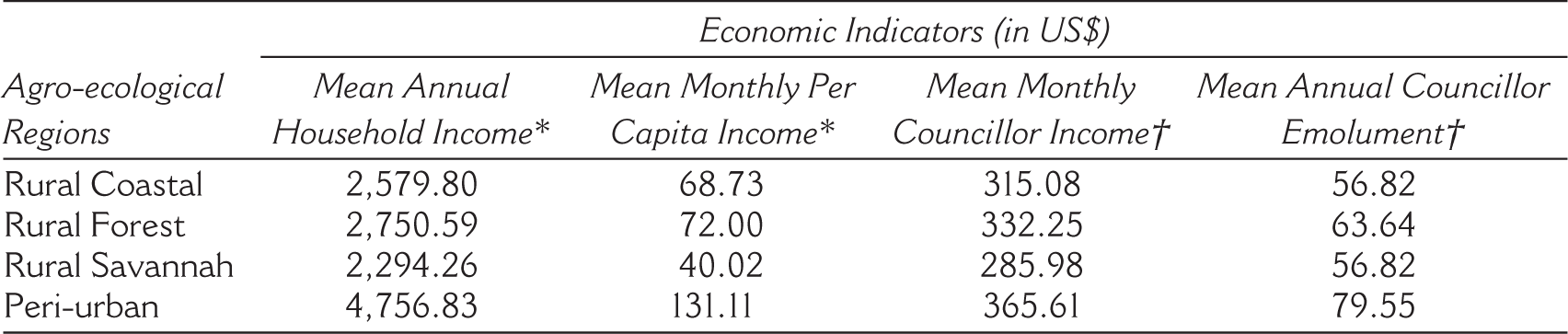
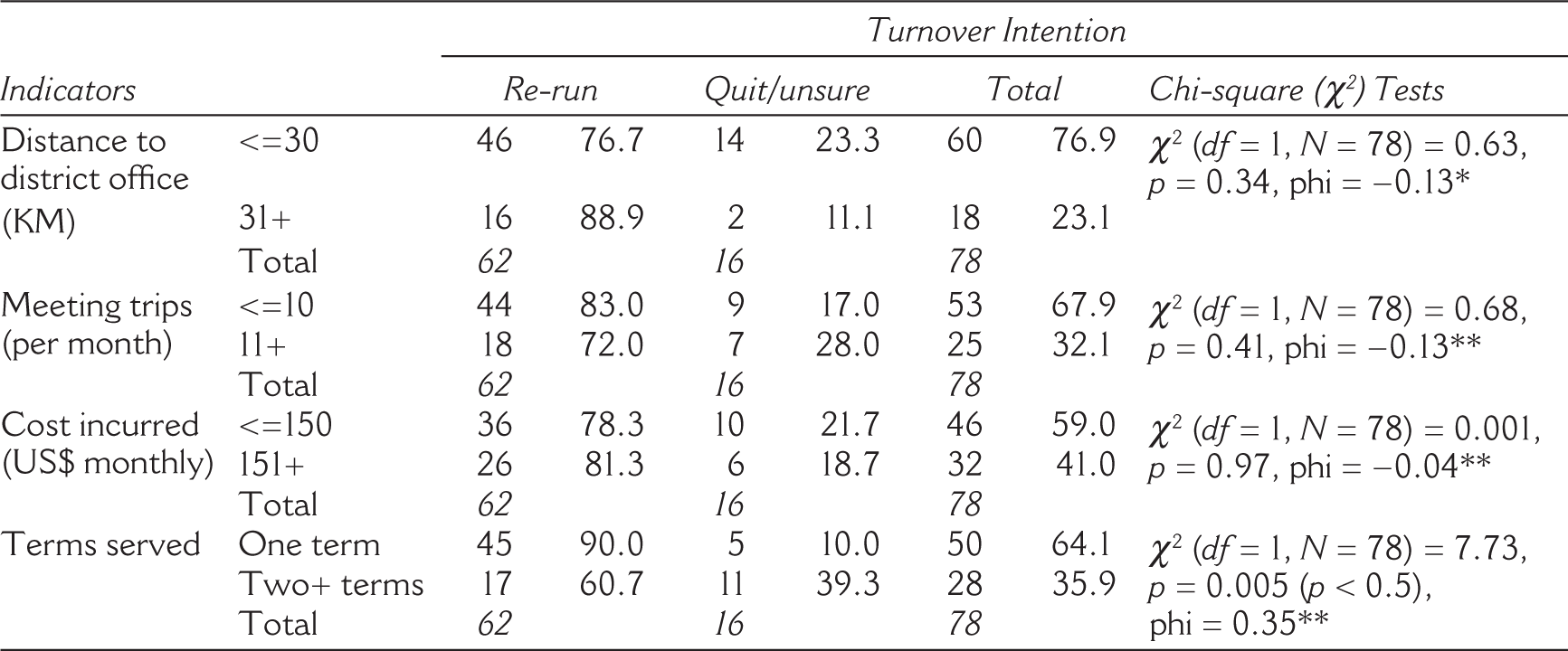
The meagre payments to councillors (Table 1) could hardly incentivize them to remain in office. Alternative sources are non-existent, unlike in urban districts where councillors resort to hidden official avenues to support themselves such as refurbishing and managing the proceeds of public toilets or refuse collection sites (Sabbi, 2020). Unsurprisingly, most councillors generally earn above the average local income. Without that, district council allowances would hardly contribute to realizing their many obligations to the citizenry. Puzzlingly, most councillors seem undeterred by the difficulties with travel to attend meetings, the number of meetings they attend, or the cost incurred for those efforts vis-à-vis their willingness to quit their official roles (Table 2). Several possible explanations may explain their commitment to their political role despite the absence of reimbursement or support for expenses. The current argument focuses on the role of outside agencies that offers the requisite support and rewards for councillors to do their work in rural areas.
Selected Economic Indicators for Rural Councillors.
Councillors’ Daily Challenges Versus Turnover Intentions.
Councillors are involved in several community-based and councillor-led initiatives like mental health and women’s empowerment projects. However, of all of these, it is their engagement with farmer groups that is the most vibrant. There are numerous farmer-based organizations (FBOs) in rural Ghana (Francesconi and Wouterse, 2015) which typically aim to produce and market their crops but also establish social support mechanisms (mostly) through revolving savings funds (known as susu) to support members who are in difficulty. 9 Their additional goal of pleading collectively for outside support drives several societal groups into a frantic search for legitimacy, leading in some cases to FBOs that are all window-dressing and are without substance (Lyon, 2003; Neubert, 1996; Porter and Lyon, 2006). Rural farmers who are members of FBOs mostly expect councillors to support their farming needs. Rural councillors must negotiate with district agricultural boards for farm implements, seedlings and extension services, on farmers’ behalf. These negotiations often involve councillors expending own resources in order to ‘get the ears’ of powerful district officials.
On the margins of the district administration and FBOs are external actors that pursue neo-endogenous goals. This neo-endogenous development with its bottom-up participatory thinking promises to place local agents at the forefront to set and lead development initiatives while external actors (i.e., state officials and international development agencies) mainly provide support (Bosworth and Atterton, 2012; Margarian, 2013; Ray, 2006). The deference of neo-endogenous development to local agents allows them to retain control over their pressing needs with material support from external actors and squares with the bottom-up rural development trajectory promoted by both the Ghanaian government and external supporters (MLGRD, 2010; Mogues and Owusu-Baah, 2020). Among the most important external actors in the study districts is the USAID’s Resilience in Northern Ghana (RING) projects and volunteer scheme. To be sure, the Peace Corps programme faces criticism for its seemingly imperialistic overtones. 10 Embedded in those agricultural initiatives is a broader US interest to be present in developing countries while the volunteers accrue material and professional benefits (Brown and Green, 2015; Frontani and Taylor, 2009). But there are also broad and mutually beneficial public goals in the encounters, such as when a ‘pro-bono agricultural expert works in a community on agricultural development’ (Lough and Tiessen, 2018: 106). 11 In rural Africa broadly, these encounters create opportunities to negotiate public authority (Dodworth, 2019), as demonstrated in this study of councillors’ creative interfaces. As I show below, these creative interfaces are integral to the way the councillors I interviewed negotiated their public authority.
III. Boundary Spanning: Mandate, Ties and Binds
A crafty combination of formal roles and personal relations is important for councillors’ mandate. District councillors are ordinarily positioned between farmers and the local administration. But their everyday lobbying to access officially-unavailable resources (Kerkvliet, 2009; Olivier de Sardan, 2005) links them with different organizational domains. The concepts of boundary spanning and networks of ties from organizational studies and sociology are helpful to understand the ongoing interfaces and social commitments of councillors. Despite their conceptual proximity, I distinguish boundary spanning from networks of ties. Boundary spanning denotes the actions of organizational actors who facilitate cross-boundary collaborations (Orton and Weick, 1990; Sørensen et al., 2020). Networks of ties denote a mix of close and loose contacts and structures bound by the pursuit of a common overlapping interest (see Granovetter 1973, 1983). From the perspective of individual agencies and networks, boundary spanners connect different fields of action by creating institutional and relational linkages and ties. They mediate information flow and remove red-tape hurdles across organizational boundaries (Schotter et al., 2017; van Meerkerk and Edelenbos, 2018). 12 Here, the impulse for intermediaries arises from two intersecting interests: the FBOs’ need for locally unavailable material support overlaps with the district administration and outside agents’ search for credible community associations as partners. Hence, boundary spanners enter the fray to fill that void by permeating those boundaries and strategically communicating their mutual crosscutting goals and activities.
Aside from (educated) chiefs who are highly legitimized in the rural periphery (Grischow, 2008), other potential boundary spanners who command requisite trust include elected public officials and local entrepreneurs. But effective boundary spanners need internal and external knowledge and connections to help negotiate strategic compromises, a quality that works in councillors’ favour. Irrespective of their influence in the council, educated councillors easily span these opaque boundaries through their formal position and popularity in their wards. They skillfully straddle the district administration and the local population for privileged access to information and legitimize their networks in cross-boundary interfaces with outside agencies (Levina and Vaast, 2005; Nederhand et al., 2016; Williams, 2002). Beyond facilitating FBOs’ access to services from the administration, councillors’ multiple relations simplify the needs of outside actors. Councillors’ credible ties link external actors to pressing local needs and provide legitimacy to the often negative image of development mediators (see Neubert, 1996; Olivier de Sardan, 2005). Thus, Granovetter’s concept of ‘strong-and-weak ties’ accurately captures the concurrent interaction between farmer associations, local administrators and external entities mediated by councillors. By forging relations to outside information and support, councillors create a necessary balance between strong and weak ties.
In the sense of Granovetter (1973, 1983), the negotiated balance becomes both a means and an end; it creates access to trusted information and loyalty within councillors’ local networks while offering opportunities for tangible external support from state agents and outside actors. Figure 1 demonstrates the flow of councillors’ boundary-spanning collaborations as they bring together their strong ties with FBOs, ties that are integral to their formal mandate as elected councillors, with their weak ties to the local administration and external actors. For their boundary-spanning role, strong and skilful councillors tap into the organizational and communication void in farmer groups. The councillors strengthen their strong ties with FBOs by brokering external support for the FBOs. In this way, boundary-spanning works because councillors, FBOs and external supporters have overlapping interests. A discussion of the setting in which successful boundary-spanning interfaces occur helps unearth the reciprocal obligation of the local populations to councillors. It makes clear that (effectively) unpaid councillors invest their own resources in the boundary-spanning needed to deliver on their mandate to the local community and in return they gain political legitimacy, authority and voter loyalty. 13
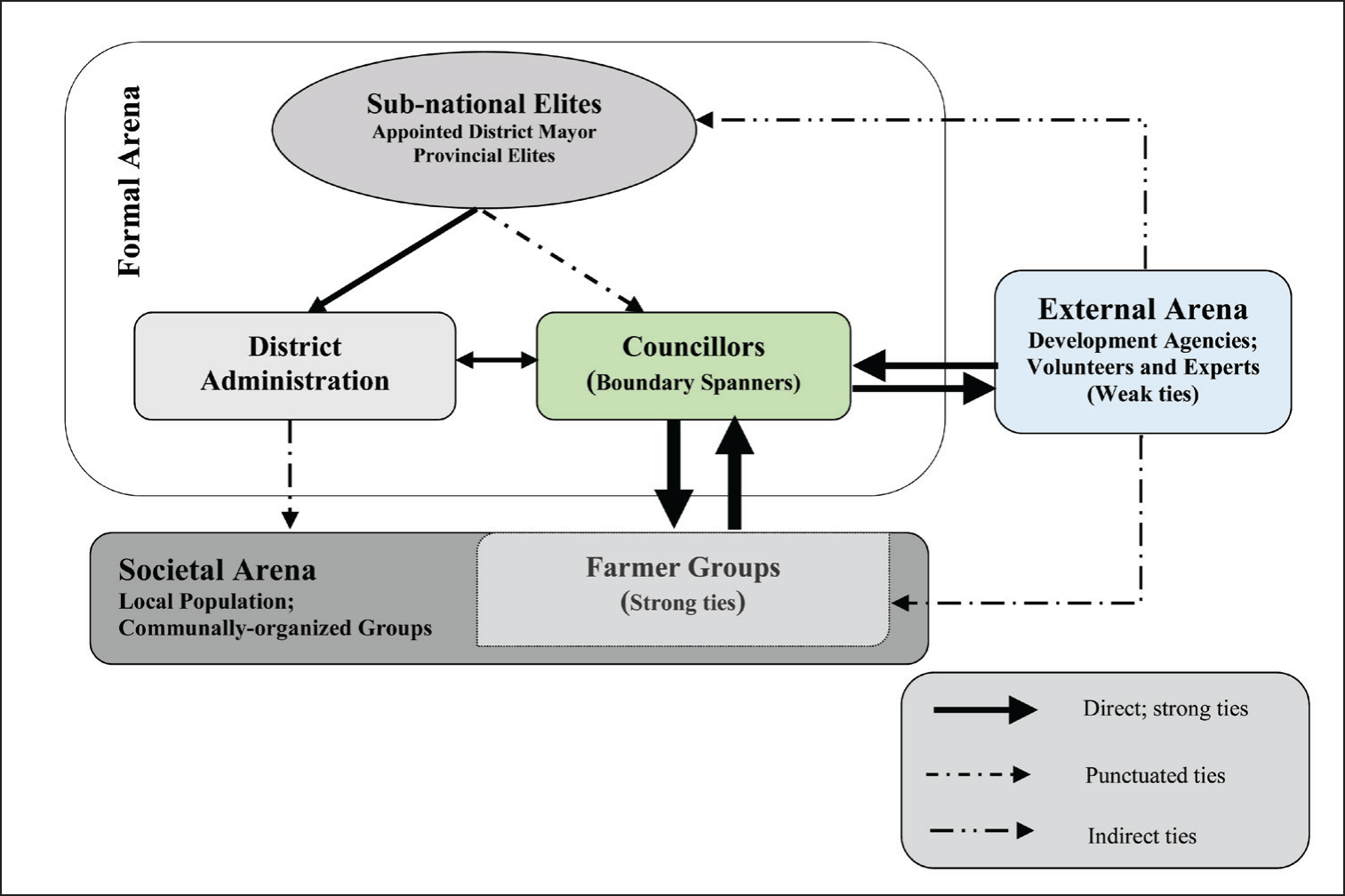
Prepping Local Networks: Straddling the Administration and the Community
Regardless of affluence, all councillors face political and financial demands. Councillors residing in the wards face demands on a daily basis; those who live outside of their wards compensate for their irregular presence through patronage, such as supporting those ‘who become stranded in urban centres’ (Councillor, Wa, 19.09.2018). This gesture endears them to the local population and helps ward off pressures on councillors to visit frequently. To realize their political goals, however, councillors must draw on lobbying strategies targeting public goals like capacity-building and support for communally-organized groups (e.g., farmers), at the expense of their time and earnings (Table 1). However, by dint of their cultivation of these interfaces, councillors’ status improves. Notably, they are required to service these social commitments in order to maintain this gain. Councillors who succeed typically connect their constituency, especially farmers, to district resources and outside support and in so doing gain social standing as trustworthy partners of farmers and state agents (see Figure 1). By working with councillors to secure access to district agricultural resources, farmers are able to reduce their own transaction costs while also remaining loyal to councillors. For farmers, this access accrues only through the councillor’s intervention. As I will show, successful councillors help overcome local officials’ tepid attitude when negotiating extension services with rural farmers.
Part of councillors’ boundary-spanning tactics with state agricultural agents is their use of own farm produce to solicit an audience with the respective officials:
I spend money to go to the [administration] to follow up on projects. Because this is Ghana [everything] depends on follow-ups … I arrange with Nananom [traditional chiefs] to organize some bush-meat and if it is [the mayor, or another official] we go to see him. (Councillor, Jaman South, 27.08.2017)
The idea of ‘following up’ on a pressing need is not unique to the rural Ghana context. Elwert (2001) discusses the role and apparent stability of this practice between politicians and administrators elsewhere in Africa and beyond. It is a tolerable, flexible and efficient practice in the central state structures. Seen from the local arena, these blurred gifts are generally understood in local parlance as facilitating an audience with municipal executive power.
The strategy seems compelling to most councillors. Like many others, one councillor used this chance to bring ‘elders of my community to see the mayor’ and urge the mayor to ‘understand the challenges we face in [our] electoral area’ (Councillor, Nkwanta South, 12.10.2017). Additionally, councillors use the audience with the state agent to plead directly for a share of scarce district resources. Thus, it does not matter whether the councillor is spending money on bringing the elders to the mayor or on feeding the official when he visits the chief, what matters is that the expenditure creates access to vital information and contacts. Still, councillors’ attempts to entice district officials seem paradoxical if we consider, intuitively, that elected councillors can ordinarily use their no-confidence vote as a lever over, or even to threaten, government-appointed mayors. Conversely, district mayors have almost total control over district resources and are directly answerable to the central government and so have a little incentive to respond to pressure from elected councillors (Crawford, 2009; Debrah, 2016; Sabbi, 2017). The government’s tight control over external funds for rural agriculture, which are a core target of local FBOs (Mogues and Owusu-Baah, 2020), compels rural councillors into a frantic chase for this support. In this context, these gifts and attention from councillors, elders and FBOs implicitly pressure district officials to return a favour. Thus, establishing these relationships enlarges the possibility of influencing decisions and securing support for FBOs.
District committees are a crucial interface for councillors to ensure a measure of influence. They can use the privileged information from sitting on or chairing a committee to leverage support from farmers and they can use their status on committees to chase up officials to implement things already decided upon. Councillors who possess valuable information for FBOs shore up their political standing with farmers. One of them recounted the material benefits to his FBO, given his influence on the district agricultural committee. Serving as the committee’s chair, his FBO gains privileged access to ‘any information from the council [on farming] during our monthly meetings’ (Councillor, New Juaben, 10.08.2018). Once their FBOs know about those privileged district council decisions, councillors enhance their legitimacy even further as members of the FBOs become more receptive to councillors’ ideas.
Councillors’ leverage over ordinary farmers is not limited to lobbying deals for their farmers. Some influential councillors emphasised that they played a crucial part in implementing decisions agreed by their district council. Such strong councillors could even call to task district officials for missing deadlines. One councillor concurred that district officials ‘know I am aware of the spraying season [so] if the pesticides are not released on time, I go directly to tell them to start distribution asap’ (Councillor, New Juaben, 10.08.2018). Interestingly, this is one rare chance for councillors to exercise political control over the local administration.
My data showed that the boundary- spanning interventions lead FBOs to assume extra roles besides their primary search for market access for their produce, and their mutual support system. Importantly, FBOs have become a significant voting constituency offering a buffer for councillors against future re-election pressures. To consolidate the votes and their socio-political prestige, councillors use their boundary spanning to strategically cultivate their role as legitimate and trusted leaders. Educated councillors efficiently mediate with district and provincial elites on behalf of rural farmers. They project their FBOs’ interests to leading officials like MPs and influential bureaucrats. The revival of interest in communally-organized groups as a channel for rural transformation creates peculiar functions and opportunities for councillors. It creates a lever for them to negotiate rarely available support from the state. The Ghanaian government’s factory-building initiative since 2017, to create more jobs through rural industries, is illustrative. State officials generally prefer well-organized FBOs as beneficiaries (Abdul-Rahaman and Abdulai, 2018; Francesconi and Wouterse, 2015). Aware of this demand, some councillors bolster efforts to initiate or revive dormant FBOs, including developing a membership register and financial plans to seem more credible and qualify for support. Additionally, strong councillors try to influence the cash crops selected for official sponsorship, expressly advocating their groups’ preferences. One strong councillor explicitly stated he promoted his FBO’s preferred cash crop by raising it at a meeting:
‘that if we look at this district, cashew is the most cultivated [cash] crop so we should put up a cashew-processing factory in the district, and this has been adopted. (Councillor, Jaman South, 23.08.2017)’
When influential councillors get this rare possibility to have meaningful input on district preferences, they eventually become brokers in marketing farmers’ produce. Financial institutions (e.g., banks, micro-credits) are happier to lend to farmers in councillors’ groups because of the councillors’ perceived trustworthiness and knowledge of financial institutions. According to one councillor, this easy access to credit arises because creditors ‘know me that I won’t run away [because] they know that I am a public figure’ (Councillor, Cape Coast, 30.08.2018). Councillors’ legitimized social status, relatively better education and negotiation skills make them credible partners to outside stakeholders, including financial institutions.
Deploying Strong Ties: Cushioning Farmer Groups via External Support
Favourably placed to boundary span via their mandate from the local electorate and their links to the local administration, councillors legitimately procure external funding and technical support (see Figure 1). Those serving on important district committees instrumentalize their privileged access to information about external support and make use of their internal networks and contacts to devise actionable strategies to procure such external assistance. This effort transcends just facilitating the interface between farmers and the administration. Councillors’ role as elected representatives helps them broker collaborations outside of the administration. One councillor noted, he could only recruit an expert volunteer in the community through an acquaintance who ‘brought me the [request] forms, which I filled’ and with the local chiefs’ support ‘furnish[ing] a chamber and hall with private WC’ as a fitting accommodation for the expert (Councillor, Jaman South, 28.08.2017). Councillors quickly take advantage of any new opportunity that connects them with external support, particularly hands-on technical support for farmers from external experts. A councillor narrated the benefits when an international volunteer brought both a woodcutting machine and a digital positioning system (GPS) to:
‘map our farms, issued certificates so farmers know their acreage and introduced us to proper book-keeping. We [now] know how much we have spent this year on our farms. (Councillor, Jaman South, 28.08.2017)’
Despite the high costs of procuring and keeping international experts, councillors take these costs personally rather than overburden a local population already strained by self-help contributions. One councillor’s remarks reflect their typical dilemmas regarding costs: ‘a US citizen and living in this community, where he’ll sleep is up to me’ and vis-à-vis the expert’s efforts to ‘mechanize [our] borehole for which the community needs to commit 25% of the cost. I have to pay that’ (Councillor, Jaman South, 27.08.2017). A daily concern for councillors is carefully balancing the cost of procuring external experts with the local development outcome of their stay. The experts’ presence enables councillors to revive dormant self-help schemes and being responsible for the experts’ stay, some councillors ‘took that opportunity to introduce the farmer association’ to those experts to extend the cooperation (Councillor, Jaman South, 28.08.2017). These highly intensive exchanges reflect the promise in the neo-endogenous rural transformation of putting local actors in the driving seat (Bosworth and Atterton, 2012; Ray, 2006), which is a clear counterpoint to the dominant role of external actors in most rural interventions (Ika et al., 2020; Julian, 2016).
A more concrete source of external support amenable to councillors’ boundary-spanning practices is the USAID-funded resilience in northern Ghana (RING) project. Besides helping build local governments’ financial and planning capacities, the project provides direct grants towards development priorities agreed jointly by the districts, elected officials, and the local communities. Importantly, the demand for credible intermediaries to identify the genuinely ‘vulnerable population’ targeted by the planned intervention (Spanner, 2016) favours councillors. As echoed by several others, one councillor remarked that since ‘the Assembly has been clear that it won’t support Assembly Members’, the RING intervention fills an agricultural services delivery (Councillor, Tamale, 15.09.2018). The cascading effects of RING in adjoining regions were also palpable. RING volunteers promise to teach beneficiaries ‘technical skills for improved beekeeping practices, assisting with harvesting, and providing guidance on marketing’ (Global Communities RING, 2018: 105–6). A councillor in the Nkwanta South district, aware of this support, had revived their beekeeping FBO and relentlessly pressured the author’s research team for possible leads to the RING project.
It is unsurprising that rural councillors are preoccupied with external expertise and assistance. Beyond promoting a collective effort, some councillors utilize their international ties to enhance their own economic options too. One councillor revealed as much when he told me that he had made links with an ‘American NGO […] that can link me to other markets’ (Councillor, Wa East, 18.09.2018). This occurs against the backdrop of scarcely available support from the state or local government. Inevitably, perhaps, the line between boundary-spanning—that potentially fits well within a neo-endogenous understanding of development—and that of acting as a profit-seeking middleman—that clearly falls outside such a paradigm—became blurred. In these instances, councillors filled a gap in the market and used their privileged position as a middleman between external interventions and farmers for profit. Thus, the councillor’s support for local people in accessing this external expertise and assistance had attendant consequences. Farmers and local people supported by councillors commit to an apparent political bind: the enormous time and resources councillors expend in addressing those demands bind residents and smallholders to councillors’ benevolence. As local farmers receive tangible support—farm implements or cash loans—directly from councillors or through councillors’ brokerage, they willingly or inadvertently grant outright purchasing rights of their produce, in addition to promising their votes in future elections. If councillors continue to deliver support, they can keep farmers in this web of dependency, thereby deriving significant political and economic opportunities. Indeed, one councillor hinted:
I can sell [the produce] to government schools. I also have the American NGO […] that can link me to other markets. And our [FBO] by-laws state that if the farmers under me, once I give them inputs, I should be able to buy their produce that are not sold and [whatever] is left over. (Councillor, Wa East, 18.09.2018)
The multiple contradictions of inequality are manifest. Farmers’ dependence on councillors’ benevolence is based on inequality, but the intervention also reproduces inequality, even when the farmers have good reasons to accept the councillors’ support. Councillors ultimately recoup their investment in addition to political and economic gains. Even as they lessen farmers’ manipulation by commercial firms, councillors accumulate economic benefits and guarantee the farmers’ votes for future elections. This advantage obtains because most rural farmers are unable to procure loans that attract collateral security or high-interest rates (Kotir and Obeng-Odoom, 2009). Furthermore, farmers’ unsuccessful clamour for state authorities to rein in extortions by private purchasing firms (Joy Online, 2013; Daah, 2014) leaves them just as vulnerable:
‘Indian buyers have dominated the market … the government [should] come and buy directly. At GH¢ 2.00 [0.45 US$] per kilo, virtually they are taking everything for free. (Councillor, Jaman South, 28.08.2017)’
Some farmers facing this dilemma resort to myriad unconventional tactics to mitigate commercial exploitation, including cross-border trade to Togo and Côte d’Ivoire. But the high risks of arrests and the confiscation of their produce requires councillors’ intervention ‘to help resolve’ (Councillor, Jaman South, 28.08.2017) matters and pushes other farmers into regular borrowing from better-off councillors who are generally flexible with repayment terms and who are willing to wait for reimbursement until after the harvesting season. Farmers are unable to repay loans and settle their debts with their produce while procuring new loans. This situation, however, binds many rural farmers into ongoing indebtedness since their yields are not substantial to offset current debts. Thus, farmers depend on councillors because they lack the cultural capital to access credit on their own but doing so reinforces these enduring strong ties of inequality and dependency on councillors’ patronage.
Councillors enhanced their strong position even further with organizational skills developed through collaborations with international experts. Again, the crucial assistance from USAID’s RING project gives training in very basic management skills (Global Communities RING, 2018: 105–8) which revives the unenthused local leadership. Councillors also use the training sessions to motivate their FBOs to develop local livelihood schemes. They typically found, or reinvigorate, a savings scheme to buffer farmers against economic insecurity. One councillor noted, his FBO members ‘were [always] looking for loans from banks to expand our farms’ until an expert volunteer broached the idea of a savings group and ‘encouraged me to form the executive committee and each farmer buys shares […] From our association, we support [needy] members’ (Councillor, Jaman South, 28.08.2017). The savings scheme established at experts’ urging, creates ready access to micro-credit to augment farming and personal financial needs. Further, councillors encourage FBOs’ to commit to schedules such as fixed ‘monthly meetings where members pay monthly dues’ (Councillor, Wa, 19.09.2018) in order to energize less committed members and improve the groups’ financial base; a prerequisite for the associations’ survival (Francesconi and Wouterse, 2015). Cumulatively, the outside support, strengthened membership and development of their own financial base give FBOs a stronger bargaining power over produce prices and farm implements.
Quid Pro Quo? Hidden Incentives in Councillors’ Social Commitments
Because councillors combine the fulfilment of legitimate social commitments with the exchange of mutual benefits, an explicit quid pro quo logic is often lacking (cf. Roniger, 2004; McCauley, 2021). Whether gauged from their weak incentives, their lost earnings from the time spent addressing pressing local needs, or the many commuting difficulties (see Tables 1 and 2), the councillors’ tasks and challenges are enormous. Any of these challenges could be disincentive enough for the role of a local politician. That most of the councillors do not abandon their role suggests a genuine commitment to community goals. In their relations with farmers, we also observe that strong and successful councillors genuinely boundary-span the different actors and institutions searching for legitimacy, support and success for their FBOs. But councillors’ genuine boundary-spanning interventions blur several important consequences beyond advancing the goals of their FBOs. The outcomes of the interfaces with external actors and contacts in the local administration shore up councillors’ political standing and legitimizes their leadership in the local arena. Successful councillors are careful not to express their efforts and resources in economic terms; they instead classify those actions under social prestige and honour. Following Bourdieu’s (2005) standpoint, however, it is apparent that councillors’ investments in farmers create social capital, political legitimacy and financial gain.
Among other things, some councillors use their time and resources to bind farmers through the latter’s implicit pledge to sell their produce to councillors and to vote for councillors at election time. This exchange yields political prestige and economic benefits for councillors. Councillors implied in their interviews that farmers knowingly agree to this exchange for fear of losing councillors’ support and because of a—real or imagined—threat of retribution. The existing influence of local strongmen in the agricultural value chain (Abdul-Rahaman and Abdulai, 2018), privileges councillors’ access to farmers’ produce for onward retail to well-paying outlets. These boundary-spanning efforts create access to more benefits as councillors connect external supporters to their farmers and articulate pressing local needs. Remarkably, the interaction between strong ties and cultural capital—proven local connection to the context, education and experience—is fundamental to successful cross-boundary collaborations. Through their immediate networks and social commitments, councillors accumulate social capital, which cascades into other benefits (Birner and Wittmer, 2003; Bourdieu, 2005; Granovetter, 1983). Their flexible terms of lending and brokerage to farmers allow for a strategic conversion of their social capital into political and economic gains.
Beneficiary farmers become indebted to councillors, but hardly question the benefits accruing to councillors because the councillors have offered them support and protection against (worse) exploitation by private companies. Keeping farmers in such a bind is indicative of rural accumulation as already adduced by Boone (1994) and Keegan (1986); councillors procure and distribute tangible support to farmers, receiving in return, loyalty and economic dependence of farmers. But this observation must be nuanced in light of councillors’ commitment to bear the brunt of many ongoing and emerging local challenges. As Jane Guyer (1995: 24) observes of local strongmen elsewhere in Africa, the councillors’ actions may at first appear to insure them against the ever-changing political and financial circumstances so that they can maintain the status quo. What we find here, however, is that their interventions create access to district resources and external support while also offering protection for FBOs against exploitation by private companies.
Interestingly, councillors are highly reticent and only grudgingly admit to receiving personal benefits from the intervention, even when such rewards become obvious. Councillors frame their actions as a response to the many economic pressures on impoverished farmers. One such councillor with a network of some ‘250 farmers to whom I supply farm implements’ boasted of his social commitment in allowing them to:
‘pay me back at the end when they harvest their produce … my aim is not to make [a] super profit. Even if I break even, I am fine because I know that I’ve helped!. (Councillor, Wa East, 21.09.2017)’
Similarly, a councillor—and sole nursery farmer—touted his support for poor farmers who ‘cannot afford the seedlings’, allowing them to ‘pay back sometime later [or] they do not pay at all’ (Councillor, Jaman South, 27.08.2017). Ostensibly self-aware, the councillors downplay returns on their investments. As one councillor who had received external financial support for capacity training in rural income generation confirmed, he could ‘procure loans or use [his] own money to pre-finance them and recoup funds with or without interest’ (Councillor, Wa East, 20.09.2017). Effective boundary spanning, à la Bourdieu (2005), depends on the sum of councillors’ social embeddedness, personality and individual affluence. Affluent councillors use economic capital to reinforce their political prestige and they use their political prestige to open up economic opportunities, in an alternating manner. However, the very real social commitments that councillors make to ‘their farmers’ qualify any simplified assertion that their boundary-spanning generates unjust economic gains.
Devolution has widened the context of councillors’ roles and actions, enabling them to develop creative interfaces with external actors, in ways that address broader development goals by changing the nature of transformation in the rural periphery. Their mundane, creative interfaces with external actors and volunteer experts occur outside of the official functions assigned to councillors in decentralization programmes. This is clearly evident in the role that councillors play in bringing relevant education to the rural periphery (Frontani and Taylor, 2009). Despite some legitimate criticism, external experts who volunteer for rural transformation have been noted elsewhere in Africa, particularly in Kenya and Tanzania to play a beneficial role (Brown and Green, 2015; Olsen et al., 2021) with reciprocal benefits to both the host communities and experts (Ika et al., 2020; Lough and Oppenheim, 2017). What appears to be unique here is how Ghanaian rural councillors creatively deploy their formal political position to create, facilitate and guide these transformative interfaces.
The existing empirical literature largely prioritizes cross-boundary interfaces in formal organizational settings. This study presents the interplay between communally-organizing groups and formal local governments facilitated by councillors to deliver public services. While a few empirical studies in advanced democracies demonstrate this interface (e.g., Nederhand et al. 2016; Van Meerkerk and Edelenbos, 2018), there are none in emerging democracies where local governments face limitations in delivering public services. Most studies on Ghana’s decentralization aptly show the instrumental manipulation of local governments and elected local officials by central government agents (e.g., Ayee and Dickovick, 2014; Crawford, 2008; Debrah, 2016; Resnick, 2017). Observations of councillors’ alienation and low morale (see Crook, 1994; Acheampong, 1995) might be interpreted as indicating their lack of initiative. However, the current study demonstrates how these neglected local politicians use their formal mandate to engage in informal interfaces with external actors within the broader framework of local development policy. In most cases, the cross-boundary interfaces offer a way in which the citizenry can procure much-needed public goods. Far from suggesting that these interfaces are easy to create and sustain, the analysis shows that the success of councillors is in no way guaranteed. As McCauley (2021) observes among patrons and their dependents, successful councillors must have the ability to create these connections and invest in social capital to offset emergent doubts from their followers.
Conclusion: Social Commitments with Benefits?
This article highlights the agentic efforts of councillors who formally lack political influence but strategically commit to transforming the rural periphery while bolstering their own political and economic standing. The actions of the councillors reveal that formal political roles and informal boundary-spanning activities are not contradictory. Councillors adopt international development narratives and tactically communicate their mutually overlapping interests in rural transformation. These efforts translate into access to support for rural farmers, but they also yield latent political and economic benefits. A conventional view may assume that councillors are essentially motivated by economic gains. As demonstrated, this is not always the case. Prestige may be important but political power and financial benefits for farmers emerge from councillors’ successful interfaces and supportive roles. Without councillors’ boundary-spanning collaborations, most rural farmers would rarely access state resources or outside support. Councillors enhance their prestige through these multiple interfaces but only to the extent they succeed in delivering resources to the local population that lacks access to official channels. Certainly, councillors also improve their own economic capacities via strategic support for the farmers helping to eke out their meagre official incentives.
The study reveals nuanced organizational dynamics and agency in both state-sanctioned and group-based interventions and practices. Councillors’ actions underscore the possibility of the existing local political arrangements supporting neo-endogenous rural transformation even as the official goals of decentralization are side-stepped by government-appointed mayors and are curtailed by the real limitations of public resources. The consequences of councillors’ efforts can be understood as politicized accumulation, given that councillors generate surplus value, namely political and economic benefits. Viewed broadly, councillors’ actions are ambiguous. They help reproduce modes of socio-political and economic domination but it is difficult to delineate a quid pro quo logic from the emergent benefits in councillors’ boundary-spanning efforts. Clearly manifest is that councillors’ boundary-spanning precepts entail a political equilibrium that benefits all the parties involved. The formal political neglect of councillors compels them to boundary-span for outside support to address crucial local needs. At the same time, external expertise and outside support have proved helpful for local farmers, even when the benefits are skewed in favour of the councillors and the international experts. Given their effectiveness, one may curiously ask why the state authorities have yet to offer a supportive environment and discretionary space for councillors to do even more.
Footnotes
Acknowledgements
Earlier versions of this article were discussed at the ECAS conference in Edinburgh, 11–14 June 2019, and at the ISA Forum for Sociology, February 2021. I am grateful for a travel grant from the University of Bayreuth’s Universitätsverein e. V. in 2019. The final version also benefited from a fellowship from the Bayreuth Academy of Advanced African Studies from January to June 2020. I particularly appreciate the helpful feedback from the Editor-in-Chief Catherine Locke and two anonymous reviewers. The author is solely responsible for any errors.
Declaration of Conflicting Interests
The author declared no potential conflicts of interest with respect to the research, authorship and/or publication of this article.
Funding
The research for this article was generously funded by the Fritz Thyssen Stiftung (Grant number: Az. 40.17.0.002EL) and the German Research Foundation (DFG) (Grant number: NE640/9-1).