




Abstract
Urban China reached 50% of the nation’s population by 2010, mainly as a result of massive rural–urban migration. There is substantial evidence of their social marginality in terms of occupational and housing opportunities. Here we ask about their incorporation into the neighbourhoods where they live. Rural migrants are called the ‘floating population’ in China, suggesting that their residence in the city is only temporary and that they are unlikely to develop strong local ties. This study contrasts the neighbourhood socialising of migrant tenants with that of urban homeowners who were born in the city. It draws on original survey research in Beijing that included questions on relations with neighbours and neighbourhood sentiment. It is found that migrants are more likely to engage in socialising and exchange of help with neighbours, and consequently their neighbouring helps strengthen their sentiment towards the neighbourhoods where they live. It is argued that contemporary social changes – including rising education and homeownership – may actually reduce neighbouring, while rural migrants’ marginality makes them more dependent on their local social network.
Introduction
China has been experiencing rapid urbanisation, transitioning from less than 30% urban in 1990 to about 50% in 2010. The influx of rural migrants into Chinese cities reached 230 million persons by 2012 (Wang and Fan, 2012), dramatically transforming the urban environment. The common perception of rural migrants is that they are a ‘floating population’ with high residential mobility and only a temporary, weak connection with the city (Fan, 2008). Certainly they are a socioeconomically marginal category, with limited occupational prospects and entitlement to public services. They are also concentrated at the periphery of the urban area, especially in low quality, high density housing constructed specifically for migrants. The city seems to offer poor prospects for their incorporation into local neighbourhood life, except to the extent that they form separate enclaves (Ma and Xiang, 1998; Zhang, 2001) or gather in urban villages (Zhang et al., 2003) as an adaptive response to discrimination. Indeed informal and reciprocal help, possibly neighbourhood-based, may be an important support for vulnerable social groups as shown in Western market economies (Hays and Kogl, 2007).
The incorporation of rural migrants in Chinese cities is a significant policy issue. Currently rural migrants are subject to discrimination and excluded from public service provision, but policymakers at the national level now stress the prospect of ‘assimilation’ (shiminghua). A key to successful incorporation could be their social relationships within local urban society, and little is known about this aspect of their lives. The common perception is that they are highly mobile and thus less committed to local neighbourhood life. The very notion of ‘floating population’ – which is how migrants have long been referred to – suggests a low level of sociability and social participation.
This study focuses on the residential neighbourhood as a locus of social interaction among residents (visiting and exchange of help with neighbours), and it compares rural migrants with permanent urban residents. We also measure people’s attachment or more precisely their sentiment toward the neighbourhood, and ask how it is associated with neighbourhood social interaction for both urban residents and rural migrants.
There are also questions about the social relations among long-time residents in a setting where the nature of the city is being substantially transformed (Logan, 2008). Whyte and Parish (1984) examined social relations in the socialist era, when many urbanites spent their whole careers in a single work unit and living in a work-unit compound. That system, and specifically work-unit based housing provision, is being dismantled (Li and Yi, 2007; Zhou and Logan, 1996), with implications for the neighbourhood and urban life. Recently observers have noted a decline in neighbourliness (Forrest and Yip, 2007; Hazelzet and Wissink, 2012; Wu and He, 2005; Zhu et al., 2012). Recent studies of neighbouring and neighbourhood attachment have focused on urban residents in both middle-class housing estates (Li et al., 2012; Zhu et al., 2012), or (more rarely) in low-income communities (Wu, 2012). One explanation for the observed decline of neighbouring in the middle-class estates is their preference for more exclusive and private residential environments such as gated communities (Pow, 2009). In response, the government has tried to promote ‘community construction’ as a new form of service provision (Xu, 2008) and local-level governance (Bray, 2005; Friedmann, 2005; Read, 2003; Shieh and Friedmann, 2008).
This study focuses on what may be considered social bonding in the sense of Putnam’s (2000) social capital. Another dimension of local connections that deserves attention is social bridging (Granovetter, 1973), especially the development of weak ties and social networks beyond the local territory. It would be particularly interesting to enquire into the relationships between migrants, mostly segregated into separate residential enclaves, and local residents (e.g. Guest et al., 1999). Such research could shed light on the reasons for migrant concentration, which to some extent may reflect self-selection and preferences for a co-ethnic living environment. Such self-selection, while reinforcing residential segregation (e.g. Du and Li, 2011; Fan, 2008), might at the same time be a source of greater social integration within the neighbourhood.
Models of neighbourhood interaction
There is an extensive literature on neighbouring in Western countries, much of which reflects the classical Chicago school view of urbanism. Neighbourhood social attachment was expected to be low and diminishing as a consequence of increasing urban size and density (Wirth, 1938). As formulated by Kasarda and Janowitz (1974), neighbour relations reflect both investments and constraints. Attachment would increase with length of residence in the community. The time spent in neighbourhood thus can be seen as a form of investment. Home ownership (Manturuk et al., 2010) and raising children in the neighbourhood or having other local family ties (Logan and Spitze, 1994) would similarly increase local investment. But local connections also arise from constraints, such as the lack of wider social networks by older persons and minorities or lower income residents. Wellman’s notion of ‘community liberated’ (Wellman and Leighton, 1979), in which people freely develop social networks not limited by proximity, is a good example of an alternative that depends on one’s personal resources and mobility within the city.
Homeownership is seen by some as the strongest predictor of place attachment. It is viewed as providing membership to the community of owners and a feeling of commitment that can stimulate affinity to neighbours. Homeownership further means greater residential stability, both for the homeowner and for the neighbourhood collectively. A more stable history of residence would generate stronger neighbourhood attachment and local solidarity (Brown et al., 2003; Manturuk et al., 2010; Woldoff, 2002).
Seen from this constraint and investment perspective, rural migrants should have reduced local interaction because of their newcomer status and the prospect that their position in the city might only be temporary. They are less likely than locals to have extensive family ties in the new location. On the other hand, rural migrants are increasingly able to stay longer in cities (Fan, 2008), and many express an intention to stay (Wang and Fan, 2012; Wu, 2012; Zhu and Chen, 2010). In addition, they are often spatially clustered through their place of origin. Their entry to the city may have been through a pre-existing social network of people with the same place of origin (Ma and Xiang, 1998; Wang and Fan, 2012). Laoxiang – an extended kinship and village linkage – may serve the same function as ‘family neighbours’ to increase their neighbouring and neighbourhood attachment. Rural migrants are also constrained in their choice in residential location and contacts in the city. Their employment could connect them with networks outside the neighbourhood. But informal employment can restrict their access to outside world, because many rely on a labour market that is quite local and specific to ties based on their place of origin. Their access to the wider city can also be restricted by living in factory dormitories, a common practice for migrants. For example, Foxconn in Shenzhen employs as many as 300,000 employees, mostly living in the dormitory (Yang, 2013). The ‘neighbourhood’ for them is likely to be the factory.
Few Chinese studies of neighbouring cover migrant neighbourhoods. An exception, Li and Wu (2013), surveyed informal settlements in three cities and found that migrants have the same level of neighbourhood satisfaction as non-migrants. However their neighbourhood attachment (responses to questions such as ‘my family participates in neighbourhood social events’, ‘most neighbours know me’ and ‘I belong to this neighbourhood’) is much lower, suggesting that the ‘floating’ designation may be accurate.
With respect to locals, as noted above some have observed that traditional Chinese neighbourhoods are being replaced by new forms, such as commodity housing estates on the edge of the core city (Forrest and Yip, 2007). Changes in the system of housing provision have transformed the older work-unit communities (Lu, 2006) and created new spaces that are more privatised and where homeowners’ associations play a major role in organising local social networks (Tomba, 2005). Patterns of neighbouring appear to vary across different types of neighbourhoods (Li et al., 2012; Wu, 2012). For example, in new housing estates the solidarity of homeowners is based on their property interests. To protect their living environment, Boland and Zhu (2012) observed an emergence of green activism. Huang (2006) argues that there is a continuation of collectivism in these gated communities. In contrast Li et al. (2012) found that local networks are generally weaker in these commodity housing enclaves, although these have higher community attachment and neighbourhood satisfaction. Zhu et al. (2012) have similar findings, and they attribute the higher neighbourhood satisfaction to the solidarity arising from homeownership.
These studies lead us to conflicting predictions. Neighbour relations among migrants are expected to be reduced by some conditions but enhanced by others. Findings for urban locals are expected to reflect the overall decline of solidarity that was once found in work-unit housing compounds but may be replaced by a different sort of solidarity rooted in property interests. And for all residents we need to take into account factors such as length of residence and socioeconomic status that are regularly associated with neighbouring.
Research design
The data for this research came from the survey of residential mobility and urban restructuring under marketisation carried out by the Chinese Academy of Social Sciences in Beijing in 2006. There are two samples, persons with local registration and migrants. Questions about neighbouring were included in interviews with local homeowners, not tenants (who are a minority of urban locals) and in interviews with migrants (most of whom are tenants).
The local sample included a total of 1200 heads of households, of whom 63% (756) were homeowners who were asked the items on neighbouring. The sample was drawn through a two-stage stratified, clustered sample design. In the first stage 48 neighbourhood committee areas (jumin weiyuanhui) were selected randomly from Beijing’s eight urban and inner suburban districts with the probability of selection proportionate to the number of permanent urban residents. The eight districts include Dongcheng, Xicheng, Chongwen, Xuanwu, Chaoyang, Fengtai, Haidian and Shijingshan (Figure 1). Within each selected neighbourhood committee the target was a sample of 25 adult householders who were randomly selected with replacement. The refusal rate was approximately 10%.
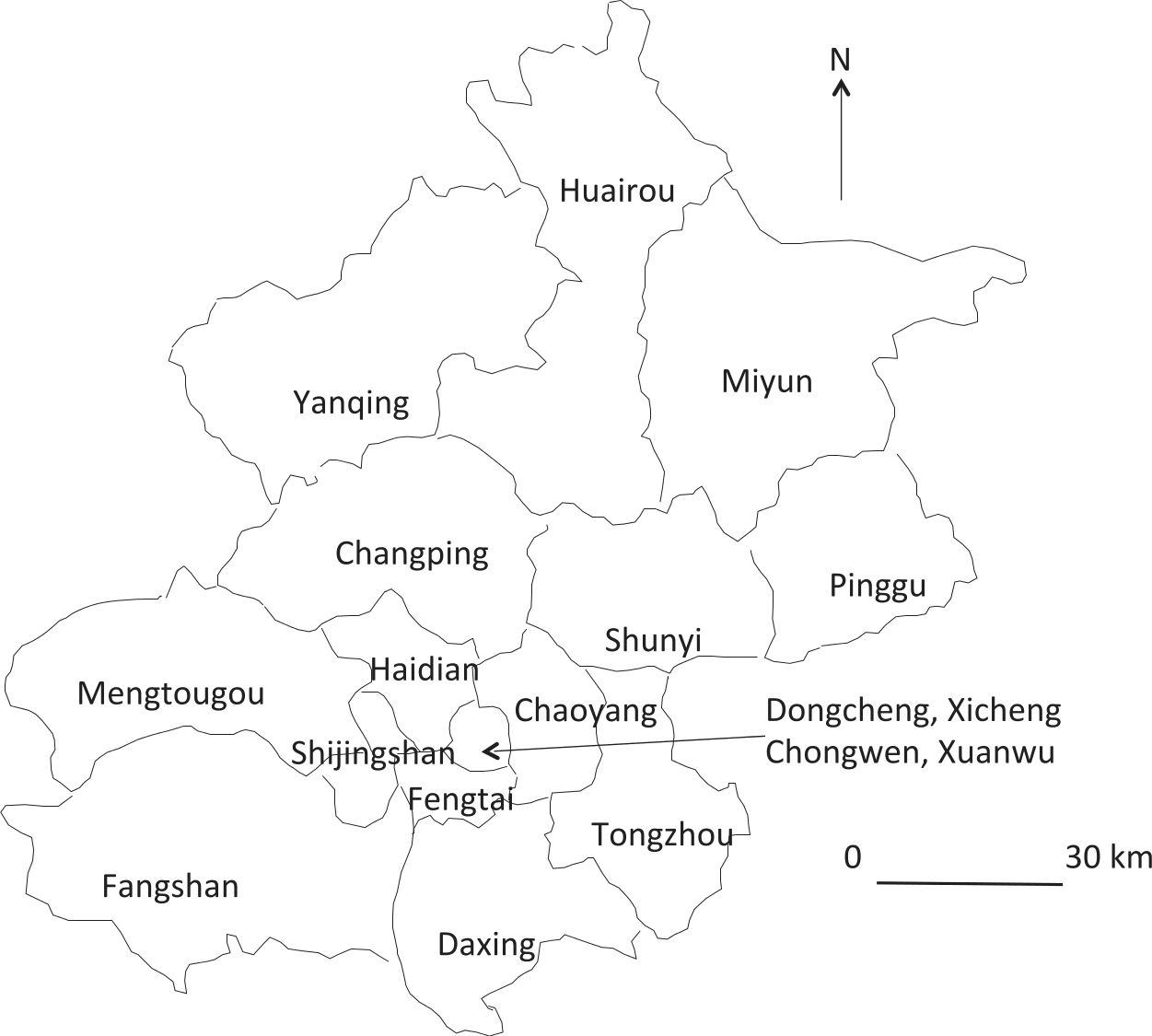
The administration structure of Beijing.
The second sample included a total of 300 rural migrant households. Sampling was done in four suburban districts where migrants are concentrated (Chaoyang, Fengtai, Haidian and Shijingshan), within which 15 neighbourhood committee or village committee areas (cunmin weiyuanhui) were selected randomly (where the chance of being selected depended on the number of migrant residents). Within each sampling unit 20 respondents were randomly selected with replacement from adults above 18 years old who did not hold a Beijing hukou at the time of interview. Again the refusal rate was approximately 10%.
Measures of neighbouring and neighbourhood sentiment
The term neighbouring here is defined as various forms of social interaction within a small geographical area, in the sense of neighbourhood. In the Chinese context, the neighbourhood mainly refers to a small street block or residential compound, or one or two lanes in urban villages. It goes beyond the immediately adjacent neighbours but not as large as the administrative unit of residents’ committee areas (which could be thousands of residents). We investigate four measures of different aspects of neighbouring. Two questions refer to the respondents’ own interactions with neighbours: visiting and exchange of help. ‘Visiting’ refers to casual interactions, expressed by the Chinese term chuanmen (literally dropping off at neighbour’s house – a phenomenon often seen in traditional neighbourhoods where neighbours visit without making a formal appointment). `Help' refers to actions with a modest level of commitment and without financial responsibility. The example given in the questionnaire is ‘looking after each other’s children’. The response categories are often, sometimes, seldom and never.
Another dimension is neighbourhood attachment. The Chinese term used in the questionnaire is qingqiegan, which gives a slight emphasis on affectionate feeling, or feeling at home, similar to what is often translated as ‘neighbourhood sentiment’ (Du and Li, 2011). This is slightly different from the term guishugan (Wu, 2012), which is more towards the sense of belonging and association. The indicator used here is commonly understood as an attachment in the sense of neighbourhood social relations rather than a sense of citizenship. Considering the exact term used in the questionnaire in Chinese, it is more accurate to describe the term as neighbourhood sentiment (Du and Li, 2011).
Conceptually the sentiment is arguably attributed to the neighbouring activities, as the theory of investment predicts (Logan and Spitze, 1994). This is because the affectionate feeling towards a larger group is built upon everyday interaction at individual levels. It would be harder to recognise that general feeling (attitude) could determine individual interactions, because the former is an accumulative effect from individual practices (behaviour). In this way, we include neighbouring activities as a predictor for neighbourhood sentiment. Because of the subtle difference between sentiment and attachment, here we may find a strong causal relation between neighbouring and affectionate attribute, but the relation may not lead to the final sense of bonding.
In addition to the single measure, the survey also includes four questions about social relations within the community, each of which was answered on a 7-point scale for the following four aspects: ‘1. Neighbours are friendly with each other; 2. Neighbours are looking after each other; 3. Neighbours trust each other; 4. Neighbours are familiar with each other’. A composite index score of neighbourhood socialising (ranging from 7 to 28) is used to describe the neighbourhood as perceived by respondents. This measure is somewhat similar to the sense of community index (SCI) – including elements of membership, influence, meeting needs and a shared emotional connection – that has been used in the USA (McMillian and Chavis, 1986). The composite index is useful in the sense it summarises various aspects of interaction into an overall score, in comparison with visit, exchange of help and sentiment. On the other hand, these different measures are more straightforward. The composite measure may use one aspect to compensate another and thus does not show the characteristics of these aspects. This also may lead to difficulty in determining causal relations between the final composite score and contributing factors. Alternatively, a factor analysis could be used to identify the principal components as how these aspects are different in the key dimensions. In general, a composite score approach is used in the literature, following the SCI score.
Predictors
As discussed above, the status of rural migrants could affect local social ties in contradictory ways, both constraining local participation because of outsider and temporary status and increasing it because of the need for mutual or reciprocal support. Following the perspective of investment and constraint, the independent variables include age of the respondents, gender and marriage status (expecting greater local involvement of older persons, women and married people). Length of residence is another major indicator of investment in the neighbourhood. Homeownership is also usually treated as an indicator of local investment. However, in this specific study, homeownership is indistinguishable from migrant status because all locals are homeowners and almost all migrants are tenants. Thus, we will not explicitly test the effect of homeownership. However, there is an expectation that local residents should have a stronger neighbourhood sentiment than rural migrants. If we find that this is not the case, one might infer that the ‘ownership advantage’ of locals is not decisive.
We include other measures of class position that may operate in different ways. Income and education are both often understood as measures to explain social capital, and the usual expectation is that higher income and better educated persons are more socially active. Yet they may also be more spatially mobile and less bounded to the local neighbourhood. We include both indicators. They are positively correlated but we tested for and did not find evidence of multicollinearity in the multivariate model. Employment status (whether the respondent is working or retired/unemployed) would have an impact on their neighbourhood activities, partially because of more time available in the place of residence. For the unemployed, the neighbourhood might be also an important source of support.
It would be useful also to compare different kinds of neighbourhoods for both local and migrant populations. In theory rural migrants might be living in commodity housing estates (though most do not), and their behaviour might be different from those who live in ‘urban villages’. However, as pointed out earlier, these specific two samples are collected from two types of neighbourhoods. For urban locals it is a random sample from various neighbourhoods, but the migrant sample was drawn from migrant concentrated neighbourhoods. For the latter, there is limited variation in terms of migrant composition. Further, the available data on local areas are for quite large areas (subdistricts) that cannot reflect the situation of smaller neighbourhoods within them. The variation among neighbourhoods should be the topic for future studies, if possible with more detailed census information.
Findings
The descriptive statistics of variables are reported in Table 1. The table shows that migrants are generally younger than locals. For the head of households, a much larger percentage (78.8%) is male, while females only accounted for 21.2%. The local households show a more balanced gender structure; still nearly 60% are male-headed households. Now rural migrants have a larger proportion of family households. However, their duration of residence is much shorter than the length of residence for locals. The average length of residence for the locals is as long as 19 years but only 9.6 years for migrants. Still, this is not a short period, showing that migrants in our sample spent a substantial period in the city. Compared with local residents, migrants have lower annual income. In terms of educational attainment, locals show a much higher level. About one-third have college or above college level education, while nearly half of migrants are in junior secondary education. But in terms of employment status, about 87.8% of migrants are employed or economically active. This is not a surprise given that migrants came to the city mainly for work. They could not survive without a job, even though the job could be an informal one. In terms of dependent variables, migrants show a more active neighbouring interaction by visiting neighbours and helping neighbours. Both locals and migrants agreed that there is some sentiment to their place of living. Less than one-third hold a neutral view, and only 3.6% for the locals and 1.8% for migrants said they disagreed or strongly disagreed with the statement that residents had a sense of neighbourhood sentiment.
Descriptive statistics of variables.
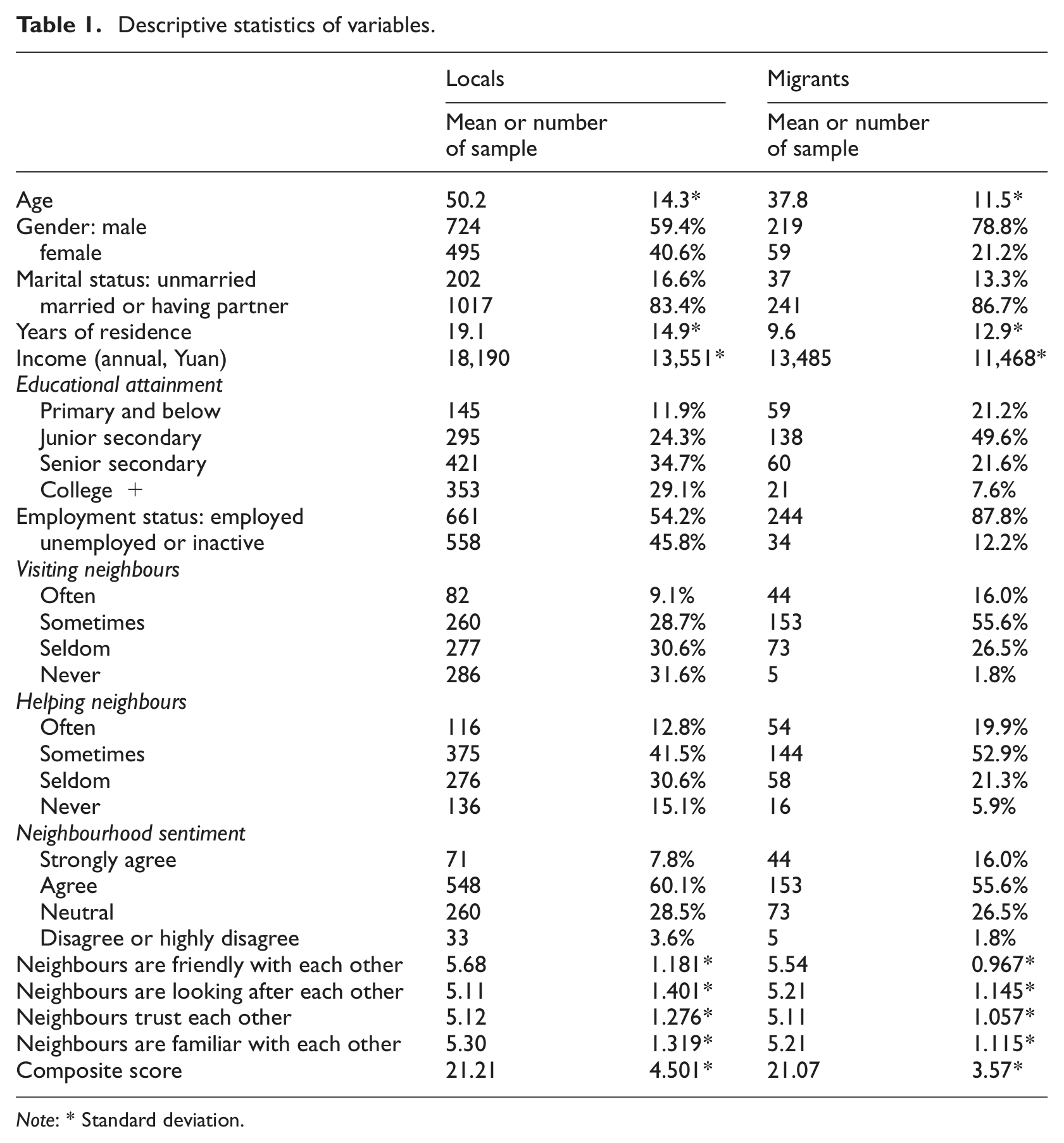
Note: * Standard deviation.
To compare the survey sample with earlier social surveys, we use the 2010 Beijing population census (Table 2). The distribution of educational attainment is generally consistent with that of the survey sample. Because the age distribution in the sample refers to that of household head, it is difficult to match directly with the population census. However, the same pattern exists. That is, the migrants are younger than the local residents. The median age of migrants is 29.6 years and that of the local households is 41.5 years.
Information from 6th population census (2010) in Beijing.
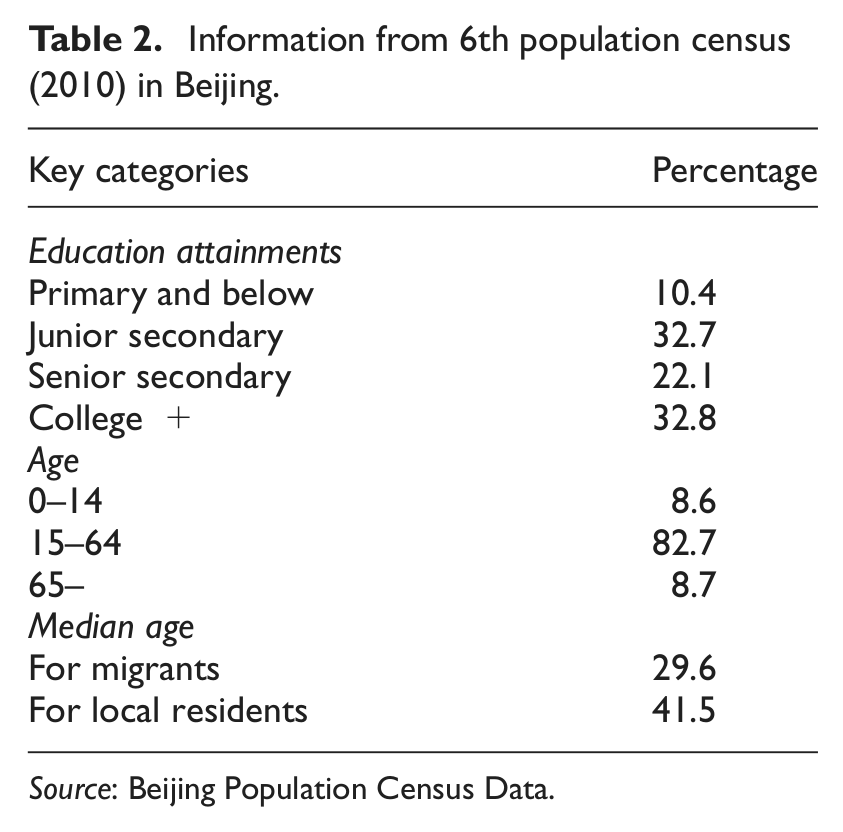
Source: Beijing Population Census Data.
The analysis is conducted as a multivariate regression. For the categorical dependent variables (visiting, helping and sentiment) the model is a mutinomial regression. For the socialising index, which is an interval scale, we use ordinary least-squares regression. All of the models include age, gender, marital status, years of residence, income, education and employment status, plus the key dichotomy between migrant tenant and local homeowner. In the model predicting sentiment we introduce the measure of visiting (as one indicator of neighbour interaction), on the assumption that neighbouring itself is a potential cause of increasing sentiment.
Visiting neighbours
Being a rural migrant increases the chance of frequently visiting neighbours (Table 3). Compared with urban homeowners, migrants odds of frequently visiting (versus never) are 3.7 times greater. This effect is after controlling for educational attainment, income and other demographic factors. In other words, rural migrants tend to interact with neighbours more frequently than the urban locals, not just because they are younger, have a lower income and are less educated (which would lead them to act in a more traditional and social way to each other), and despite the fact that they are mostly renters.
Visiting neighbours (the reference group is those who said that they never visit their neighbours).
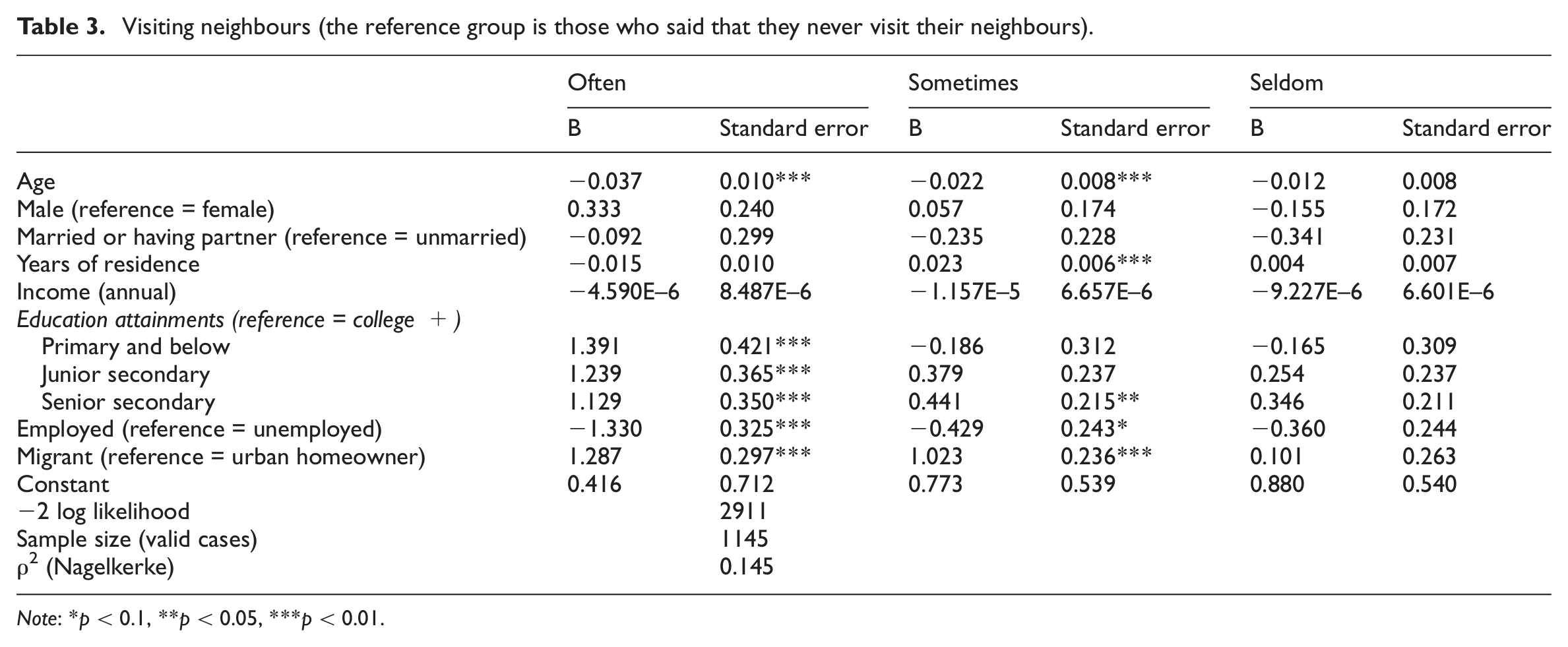
Note: *p < 0.1, **p < 0.05, ***p < 0.01.
Surprisingly the frequency of visiting is unrelated to duration of residence. Only for the category of occasional visit, compared with never visiting their neighbours, duration of residence enhance occasional visit but not the category of frequent visit. It is greater for younger persons, suggesting that the relevant aspect of age is not constraint on mobility (assuming that older persons are less likely to leave the neighbourhood) but rather a matter of styles of socialising (with younger people more involved in casual interactions). Visiting is more frequent for persons with lower education: the difference is between those who receive higher education and those who have not. Income is unrelated to visiting. Finally, being employed reduces the odds of frequently visiting neighbours (versus never visiting) to only 28.9% as supposed to never visiting neighbours.
Helping neighbours
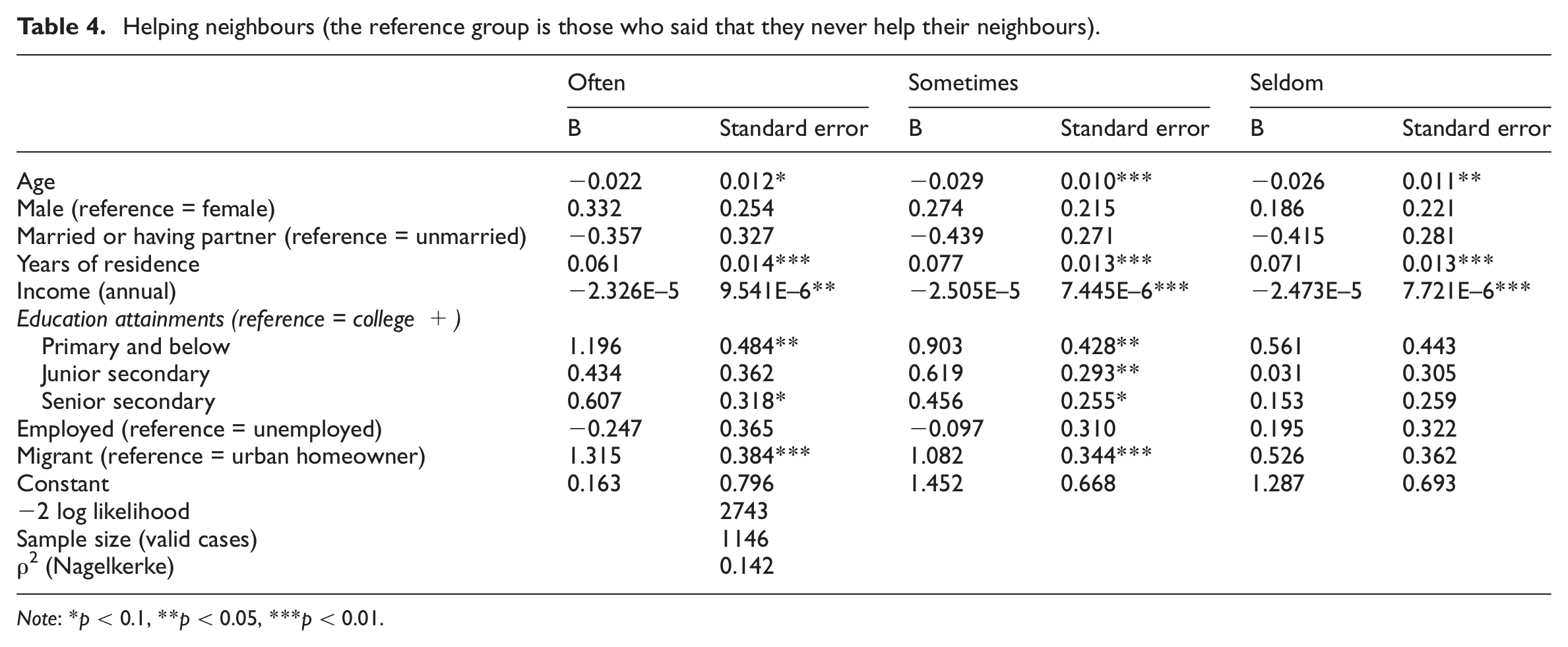
Compared with more casual visiting, helping neighbours through looking after children is a stronger tie. Again, being a rural migrant in these urban neighbourhoods actually increases the odds of helping neighbours (Table 4). It increases the odds of frequent helping by 3.72 times as opposed to never helping neighbours and the odds of infrequent helping by 2.9 times. This pattern is consistent with the one of visiting neighbours; rural migrants are not socially disengaged in their immediate life circles. Income is another significant factor.
Helping neighbours (the reference group is those who said that they never help their neighbours).
Note: *p < 0.1, **p < 0.05, ***p < 0.01.
For helping the duration of residence is significant (Table 4). The longer one has lived in the neighbourhood, the more likely is helping neighbours. Each additional year of residence enhances the odds of frequently helping neighbours (as opposed to never) by 106%, and the odds of infrequent visit by 108%. Higher education reduces the odds of frequently helping neighbours, and higher income residents are also less frequently engaged in the exchange of help. But employment status does not have a significant effect. This means employment does seem to be an obstacle for a more casual visit, but not for mutual assistance.
Neighbourhood sentiment: From neighbouring to homely feeling
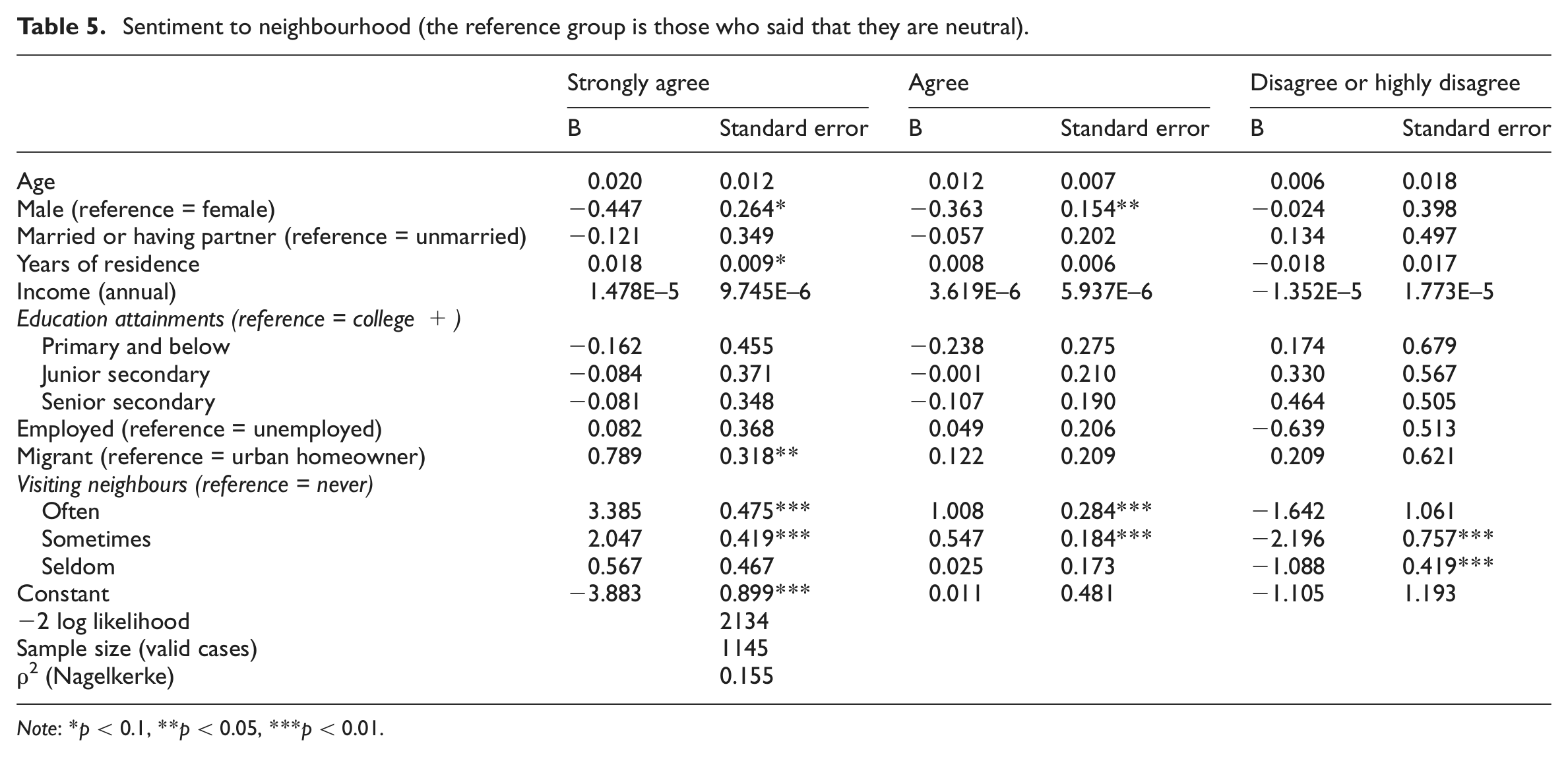
If rural migrants are more likely to visit and help their neighbours, does this translate into stronger neighbourhood sentiment? Table 5 shows neighbourhood sentiment as an outcome with neighbouring included as a predictor (though we recognise the possibility of a reciprocal effect). There is strong evidence that neighbouring can be seen as investment and enhance neighbourhood sentiment, because more frequent visiting is associated with stronger sentiment. Compared with those who never visit their neighbours, those who often visit their neighbours are 29.5 times more likely to strongly express a positive feeling (versus holding a neutral view), and occasional visits to neighbours would raise the equivalent propensity by 7.7 times. Rural migrants have more frequent neighbouring activities and in this sense demonstrate more connection to the neighbourhood. Table 5 shows that they are also more likely to have the highest level of neighbourhood sentiment.
Sentiment to neighbourhood (the reference group is those who said that they are neutral).
Note: *p < 0.1, **p < 0.05, ***p < 0.01.
Other factors are also significant. Longer length of residence helps to strengthen the neighbourhood sentiment, and older persons and women also have stronger sentiment. However, it is interesting to note that neither education, nor income, nor employment status has a significant effect. We suspect that there may be countervailing effects. Higher educated, higher income and working people likely have more connections outside of the neighbourhood. Yet persons of higher social class also have more options about where to live, and they might therefore be expected to be more satisfied with the residential area that they have chosen. And employed persons, especially among migrants, may have been more dependent on local ties to find work, which could increase their sense of local attachment. For whatever reason, we find no tie between these indicators of class position and local sentiment.
Neighbourhood socialising as a composite index
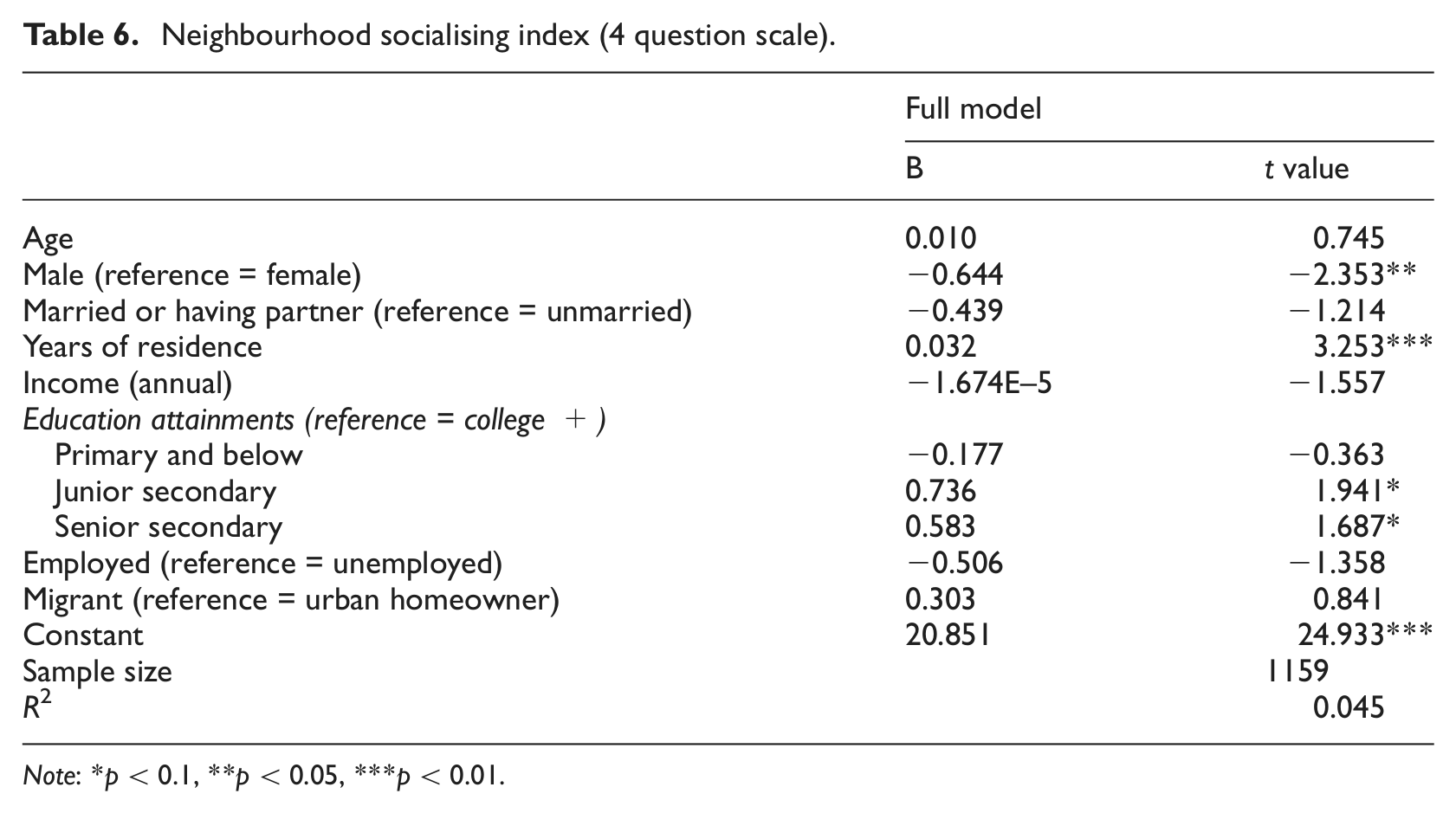
The composite score of neighbourhood social relations is aggregated from items about friendliness, trustworthiness, acquaintance and social support. The findings demonstrate that these dimensions do not all have the same sources (Table 6). Most relevant, we find no significant difference between migrants and locals. The strongest predictor is the length of residence: consistent with all prior research, longer duration of residence is associated with higher perceived neighbourhood socialising. Women report stronger neighbourhood socialising, perhaps because they are more involved in networking activities. The effect of education is surprisingly curvilinear in this model (those with junior and senior secondary education have higher index scores). However, neither income nor employment status is significant.
Neighbourhood socialising index (4 question scale).
Note: *p < 0.1, **p < 0.05, ***p < 0.01.
Discussion
Regarding the two main hypotheses, the first hypothesis is rejected: the neighbouring of rural migrants is not lower than the locals; and rural migrants tend to help neighbours more than the locals. The second hypothesis is confirmed, that neighbouring has positive effects on neighbourhood sentiment for both urban locals and rural migrants.
Living in the neighbourhood for a longer time, as a form of ‘investment’, the residents are more likely to engage in neighbouring activities, including helping their neighbours. With higher education, the intensity of neighbouring is reduced. Being employed and older both reduce the odds of frequent neighbourhood interaction as opposed to never interacted with neighbours. Similarly, the higher one’s income, the less chance of helping or receiving help from their neighbours. These factors could be understood as empowerment: the attainment of higher education, income, the formal employment and the seniority (age) allow the residents to gain social capital outside the immediate neighbours. Investment in neighbourhood as the longer length of residence helps to further move the stage of visit to helping neighbours.
In terms of neighbouring, there seems to be a polarised pattern of ‘urban elites’ as represented as those with higher education and rural migrants. This polarisation is not alleviated by ‘investments’ in residence (Logan and Spitze, 1994): urban elites being homeowners, and rural migrants being renters. Staying longer in the neighbourhood tends to contribute to helping neighbours but compared with the same length of stay rural migrants do not reject visiting and helping neighbours. In other words, even for a shorter period of time in the host society, rural migrant status still allows them to engage more positively in neighbouring and mutual help. It has been widely noted that rural migrants do possess social network across the cities (Hazelzet and Wissink, 2012), and mostly these networks are based on the origin of the place. Against the argument that the neighbourhood is losing its role as an organiser of social network (Wissink et al., 2013), the continuation of rural migrant in their locally territorial relation is significant. The existence of local neighbourhood interaction is the key finding of this study, although the finding is placed in the context of self-help rather than perhaps inter-group interactions. When the education attainment factor and income are controlled, modernisation is not an explanation for rural migrants’ engagement (that is, rural migrants represent the less educated and traditional part). The explanation is more likely directed towards the different level of concentration of migrants, but this sample design cannot fully confirm this factor. The variation of neighbourhood characteristics in terms of social diversity should be explored in the future studies. With the income factor controlled, the rural migrants have both higher chance of frequent visit with their neighbours and exchange of help, leading to higher neighbourhood sentiment. However, at a neighbourhood level, this finding needs to be further verified. Others have found that in low-income communities, the sense of belonging in migrant villages is lower attachment than that of workers’ villages – a unique phenomenon of a socialist housing system based on occupation (Wu, 2012).
Here at the individual level it was found that rural migrants do not have a lower chance of associating with neighbourhood sentiment. In terms of neighbourhood effect, Putnam (2007) argues that diversity can erode social cohesion. The diversity could be class or nativity based. Here in urban China, there is a relatively homogenous ethnic composition. Therefore, the class diversity might be more relevant. That is, a higher income resident may not feel the need to be part of a lower income neighbourhood or a migrant resident might not be able to socialise with a predominantly native neighbourhood. However, in Britain, Sturgis et al. (2010) specifically analysed the effect of ethnic diversity on trust and found the casual relation did not exist. There is limited research on the diversity in terms of migrant composition and its effect on social trust and neighbouring in Chinese cities. This could be a topic for future research.
It is important to clarify the exact findings of this survey: focusing on neighbouring and neighbourhood sentiment does not mean that rural migrants are integrated with the host society better than the local urban residents. The feature of the neighbourhoods where the sample of rural migrants was drawn is clear: they are concentrated migrant enclaves. The sheer concentration of migrants may indicate residential segregation; and frequent neighbouring may further suggest that self-selection processes may hinder social integration. Focusing on migrant renters did not allow us to identify exact effect of housing tenure. Nevertheless, the findings do highlight the condition of social interactions at the neighbourhood level, and the positive contribution of local interaction to an affectionate feeling. The problem is that these neighbouring activities may not transcend various barriers and exclusionary practices.
The understanding that rural migrants in urban China are not ‘floaters’ in a social relation sense does not deny their status of rights deprivation. What the implication of this study for urban policies is a cautious rethinking of the mainstream discourse of migrant ‘assimilation’ (shiminghua, literally becoming citizens) (Wen and Wang, 2009). The study of low-income communities, especially ‘urban villages’ (Wu et al., 2013) suggests rural migrants have strong preference to stay in the city and they are ‘sojourners’ not by their own preference but for structural reasons (Solinger, 1999; Wu, 2012). This study interrogates the social aspect of rural migrants in comparison with urban locals. The finding is that despite high residential mobility during the process of urbanisation, rural migrants left a dense social network in the countryside and brought in with them a social network across scales, and became embedded again into the host society. A circular nature of work and living (Zhu and Chen, 2010) in addition to the form of ‘split households’ (Fan, 2008) might be the legacy of social exclusion and the adopted coping strategy of migrants.
The homeownership as a form of investment in neighbourhood (Logan and Spitze, 1994) is not a predictor for their socialisation in this case. Or at least, renters can have a stronger neighbourhood interaction and sentiment. Rural migrants are able to develop new neighbouring and reciprocal relation in their place of living. They do not need to become homeowners in order to develop their sentiment. Based on neighbouring, the affectionate attachment towards the neighbourhood is under formation. Having identified that the factor of homeownership alone might not deter social interaction and the formation of sentiment to the place of living, the exact role of homeownership should be examined in future studies.
Conclusion
This study draws a sample from two parallel surveys administrated in the same period of time, one in urban neighbourhoods for the urban locals, and the other in the peri-urban areas for rural migrants. These are two dominant groups in urban China: the urban group is mainly homeowners, and the rural migrants are mainly renters. Although in theory there are urban renters, the surveys did not record urban renters’ neighbourhood relation; therefore our main comparison is between migrant renters and local owners.
The most important and surprising finding of this study is that rural migrants in Beijing did not necessarily have a lower neighbouring intensity. They are a factor countering the process of ‘modernisation’. They bring in a traditional element of society into the city, especially into their enclaves. Being constrained by the access to public resources, they interact with neighbours, who are probably in the same category of ‘floating population’. Rural migrants are developing a social space of their own. Greater neighbouring is accompanied by a higher propensity of helping neighbours, and based on neighbouring they do not have a significant lower evaluation of the social relation in the neighbourhood. In a sense, the neighbourhood is still relevant to rural migrants, even against a background of declining neighbouring and increasing privacy as in middle-class commodity housing (Forrest and Yip, 2007). Rural migrants are not a socially isolated group: their involvement in neighbourhood is both self-selected and externally enforced, as ‘better living environment, freedoms from obligation and privacy are not available equally to everyone, because they come with a price tag’ (Zhu et al., 2012: 2454). This means while we recognise that migrants are excluded from public services, they do interact with neighbours, perhaps as self-help.
The second important finding is that homeownership does not hinder rural migrants’ social interaction within their neighbourhoods. The study reconfirms the importance of neighbourhood as everyday life (Forrest and Kearns, 2001; Hays and Kogl, 2007; Kearns and Parkinson, 2001) to rural migrants in China. Kasarda and Janowitz (1974) in their classic study argue that the length of residence is the strongest predictor of number of friends in the local society. This ‘natural assimilation’ is widely recognised. This study highlights that neighbouring activities help rural migrants develop a stronger sentiment to their place of living. Similarly, the acquiring of homeownership is seen as a concrete material interest in neighbouring and neighbourhood attachment (Manturuk et al., 2010). Here we do not test the effect of homeownership directly because we essentially compare local homeowners and migrant renters. Homeownership may present a similar positive effect towards neighbouring and sentiment. However, the contrast between local homeowners and migrant renters is quite meaningful to suggest that investment such as homeownership alone may not be the predictor of neighbouring activities, because rural migrants renters do have stronger neighbouring activities than the local homeowners, and neighbouring helps strengthen the sentiment towards their places. Here, homeownership may not be a strong predictor of neighbouring activities. From this viewpoint, allowing existing neighbouring activities to continue to generate neighbourhood attachment and recognising de facto migrant communities might be useful towards migrant integration. Demolishing the settlements of rural migrants, forcing rural migrants to live in modern apartments and converting their neighbourhoods into a formal residential district (Wu et al., 2013) may be harmful towards rural migrants’ integration. Moreover, demolition programmes aim to create more urban homeowners, while rural migrants are forced to live in other remaining villages as renters. In the long run, if rural migrants are able to afford to live as homeowners in the city, this may help their integration at both neighbourhood and city scales. Currently research is inadequate because there are few migrant homeowners. Future research should study the role of homeownership in the integration of rural migrants.
Footnotes
Funding
This research is supported by the UK Economic and Social Research Council (ESRC)/ Department for International Development (DFID) project (RES-167-25-0448) and Brown University