



Abstract
The COVID-19 pandemic has disrupted social and economic activities across the world, resulting in the contraction of national economies and the global economy, causing an unprecedented loss of employment. The pandemic’s detrimental impact has meant that governments have to play an interventionist role to mitigate the staggering social and economic effects of the COVID-19 lockdown on sustainable development. In light of the damaging impact of the pandemic on the economy, employment and poverty, this article assesses the socio-economic contribution and effectiveness of the counter-cyclical policies in mitigating the socio-economic impact of COVID-19 in South Africa. Methodologically, the article used secondary qualitative and quantitative data to assess the government’s fiscal and monetary measures. The findings suggest that South Africa adopted extensive counter-cyclical fiscal and monetary policies, such as increased government spending on social and economic public goods, tax relief, interest rate cuts and job protection measures. While these counter-cyclical measures had some degree of effectiveness, they were undermined by the lack of comprehensively targeted measures for low-income households. This article argues that the country needs to find proactive ways of managing its counter-cyclical fiscal measures to ensure a higher degree of effectiveness and economic stabilization to reach those in greatest need.
Introduction
The emergence of the novel coronavirus (COVID-19) has reintroduced the role of the state in regulating social and economic development, following decades of free-market policies advocating for minimal state intervention. The re-emergence of the strong state interventionism has been driven by the need for governments to play a counter-cyclical role in mitigating the health, social and economic impact of COVID-19 on businesses and the general welfare of citizens. In times of economic volatility, the state assumes social and fiscal responsibilities by implementing expenditure policies directed at mitigating the adverse effects of negative economic cycles on the general welfare of citizens (International Monetary Fund, 2009, 2020a; Thatcher, 2017; World Bank, 1997). The Great Depression and the European reconstruction are two examples of periods when states drove social, political and economic recovery after contractionary phases brought by economic crises and political power dynamics. Over a decade ago, the counter-cyclical role of the state was evident during the 2009 global financial crisis through the adoption of stimulus packages to cushion the economy against financial shocks.
In 2015, the African continent experienced 26% of the global disease burden and 16% of the world’s population, yet accounted for only 2% (US$97 trillion) of global health spending (Economic Commission for Africa, 2020). This has led to growing concerns that COVID-19 will have a catastrophic impact on developing nations, particularly sub-Saharan countries that lack the requisite fiscal capacity, infrastructure and state capacity to deal with the pandemic. In South Africa, the government aspires to become a capable developmental state that uses its institutions to accelerate social and economic development to meet the needs of millions mired in unemployment and poverty (Khambule, 2018; National Planning Commission, 2012). COVID-19 created a perfect opportunity for the South African government to test the limits of its state institutions by responding to the unprecedented socio-economic impact caused by the pandemic. COVID-19 has the potential to amplify the country’s triple challenges of unemployment, poverty and inequality, if the state’s institutions are incapable of effectively implementing counter-cyclical policies by directing capacity and resources towards minimizing the impact of COVID-19 and resuscitating the economy for inclusive economic growth. The World Bank (2020) noted a 5% contraction in the global economy due to the strain placed on the supply and demand sides of the economy, causing limited economic activity at the domestic and international levels. Estimates suggest that COVID-19 could potentially increase unemployment by 25 million people globally, and those working in poverty are expected to increase by 20–35 million (International Labour Organization [ILO], 2020a; McKibbin and Fernando, 2020). This has led countries across the globe, developed and underdeveloped, to adopt counter-cyclical measures to minimize the socio-economic impact of COVID-19 (IMF, 2020a). Against the increased state activism to counter the impact of COVID-19, this article assesses the contribution and effectiveness of the counter-cyclical measures adopted by the South African government to combat the spread of COVID-19 and avert the adverse socio-economic impact unleashed by the virus. This is important because without effective interventionist policies, the effects of COVID-19 could amplify South Africa’s high unemployment and poverty rates. The article is grounded on the widely held assumption that counter-cyclical measures are needed in a crisis. This is evident in emergencies such as the Great Depression, the European Reconstruction Period and the 2009 global financial crisis. Essentially, the article interrogates the impacts of these counter-cyclical measures on poverty and on those most vulnerable and lays the groundwork for wider economic recovery.
Methodologically, this study used qualitative and quantitative secondary data on the fiscal and monetary measures taken by the South African government to combat the socio-economic impact of COVID-19. The effectiveness of these measures was evaluated mainly on the government’s mission to stabilize the economy, address the extreme decline in both the supply and demand sides of economic activities and protect against job losses and the loss of life. It uses data from the National Income Dynamics Coronavirus Rapid Mobile survey, Statistics South Africa (Stats SA) and data on COVID-19 corruption from anti-corruption agencies such as the Auditor General of South Africa (AGSA) and the Special Investigating Unit (SIU) (Auditor General of South Africa, 2020a; 2020b; Special Investigating Unit [SIU], 2021; Statistics South Africa, 2020a). The data are based on an evolving situation and offer estimates based on parameters that are subject to daily changes but suffice to present some evidence and provoking debates about the targeting of South Africa’s counter-cyclical measures. While the secondary analysis is tentative, it provides valuable insights pointing towards the unfolding impacts of the counter-cyclical policies.
The Counter-cyclical Role of the State
The counter-cyclical role of the state is driven by the government’s fiscal power to put counter-cyclical measures in place. In accordance with the counter-cyclical role of the state, ‘government spending should be increased during contractionary periods and decreased during expansionary periods’ (Sharp, 1958: 139). An increase in government spending refers to an expansionary fiscal policy, which is influenced by domestic and global economic conditions. This translates to the state increasing its spending during contractionary periods because of the income and employment fluctuations that affect private spending, while spending can be decreased during the expansionary period where there is growth in employment and income, thereby requiring the state to spend less due to the general spending ability of the citizens. The counter-cyclical fiscal policy role of the state was evident in the increased state expenditure seen during the Great Depression of 1929 and the early 1930s where the aim was to stimulate economic recovery while also protecting the citizens from stagnating into deplorable poverty (Snell, 2009). Spending in America was at its highest when the economic activity was at its lowest, based on the 1929 constant prices (Sharp, 1958). This is evidence of the counter-cyclical role of the state in keeping the supply and demand sides of the economy afloat when periodic economic volatilities undermine the financial position of the general population.
For the USA, the revenue transfers to local governments played an instrumental role in the state’s spending structure and supplemented the revenues of local governments. The payments played a counter-cyclical role by offsetting the local government-burdened revenue structure (Gordon, 2012). This was important as local governments have limited tax bases and often rely on revenue streams challenged during times of economic volatility, rendering them unable to finance their services. Importantly, contractionary periods increase the demand by citizens for local state services, thereby signalling a need to improve the financial capacity of local governments to deliver beyond their traditional functions. Without an improved financial base, local governments will have to lower their spending in relation to a decline in their revenues; yet, the central government has the power to increase its spending even in the face of an economic downturn due to its diverse revenue structures (Snell, 2009). Sharp (1958) noted that the capacity of local governments to withstand the Great Depression depended on the counter-cyclical role of the federal government.
The social and economic conditions of the European reconstruction period resulted in states adopting new and increased fiscal responsibilities to the extent that it is regarded as the height of state’s involvement in social and economic development. Post World War II, nations acted counter-cyclically to reverse the economic fluctuations impacting people’s socio-economic conditions in the face of financial risks and other vulnerabilities. The World Bank (1997: 22) revealed that the ‘geopolitical change - as well as the clamor for social insurance in the industrial economies ushered in fifty years of policy debate focused around a more activist role for government’. This post-war period relied on three tenets: the provision of welfare benefits to counter loss of income, the shift to a mixed economy and the coordination of macroeconomic policies (Thatcher, 2017). The increased state expenditure was largely due to the state buying more goods and services to keep the economy afloat, while also ensuring the ability of the government to deliver on its increased mandate, which included infrastructure delivery, health and education. These counter-cyclical policies were implemented to mitigate adverse outcomes related to the contractionary period. Counter-cyclical policies also took the form of nationalizing key industries and used state-owned enterprises to pursue national developmental goals.
The sources of revenue for a state’s counter-cyclical measures can be attained through national development banks and state-owned entities. In their investigation of the cyclical lending of national banks in Latin America and the Caribbean, Breia and Schclarekb (2017) found that national banks and public retail-oriented banks proactively counteract slowdowns in lending by private banks during contractionary and crisis periods by increasing loans. Such a counter-cyclical role is essential in relieving the pressure on firms and, thus, plays a significant role in attenuating adverse outcomes through state-owned banks and development institutions in developing countries where state-owned enterprises continue to play a dominant role in economic development. In this context, the private banks could aggravate economic fluctuations by not compensating for the changes and fluctuations in corporate, private and state spending to stabilize employment and income trends. These measures are somewhat influenced by the counter-cyclical measures taken by central banks. National development banks traditionally play an essential role in reducing finance-related costs and financing socially optimal investments that promote public goals (Eslava and Freixas, 2016). Such a move is necessary to foster the productivity and expansion of businesses and plays a critical role in protecting jobs while also creating further job opportunities.
Kasekende et al. (2010: 1) observed that while African countries adopted stimulus packages to cushion against the 2007–08 financial crisis, ‘many, especially low-income and fragile countries with limited fiscal space and international reserves, have lacked resources to implement counter-cyclical measures. In some cases, capacity constraints have presented an additional challenge to effective policy responses’. Further to this, Thornton (2008) noted that Africa’s fiscal policies are contradictory as they tend to be expansionary during economic fortune and adopt austerity measures during downturns. Sub-Saharan African countries with low institutional quality, like Ethiopia and Uganda, produced inefficient counter-cyclical policies when responding to the financial crisis (Calderón et al., 2012). Meanwhile, a country like South Africa was praised for the effective counter-cyclical policies it deployed during the 2007–08 financial crisis with a notable role for state institutions like the Industrial Development Corporation which injected R6 billion to South Africa’s Framework Response to the Global Economic Crisis (Trade Industrial Policy Strategies, 2016). This funding mostly targeted sectors that were heavily impacted by the 2007–08 economic crisis, focusing on key business and industries linked to the country’s industrialization policies and the need to expedite job creation and create an inclusive economy.
Contemporary economic development has recognized the importance of institutions in economic development. Numerous studies have shown that inclusive institutions produce better economic development outcomes than exclusive economic development institutions (Acemoglu and Robinson, 2013). A study of 115 industrial and developing countries conducted between 1984 and 2008 revealed that institutional quality is a significant determinant of the effectiveness of counter-cyclical fiscal and monetary macroeconomic policies adopted by states (Calderón et al., 2012). As expected, countries with weak institutions struggled to adopt effective counter-cyclical fiscal policies and produced procyclical fiscal policies, while those with stronger institutions adopted more proactive counter-cyclical policies. These differences are also affected by unfavourable financial, political and economic conditions, such as high illicit financial flows, a small tax base, imperfect markets and fragile economic structures across developing countries, particularly in sub-Saharan Africa (Calderón et al., 2012). These realities affect the ability of developing nations to adopt effective counter-cyclical fiscal policies that are capable of stabilizing economic fluctuations compared to developed countries.
The Global Socio-economic Impact of COVID-19
The outbreak of COVID-19 has caused unprecedented social, political and economic mayhem around the world. With the first case reported in Wuhan, China, the country with the world’s largest population, the novel coronavirus caused profound disturbances to the extent that the country had to lockdown social and economic activities to reduce the impact of the deadly virus (World Health Organisation, 2021). The rapid spread of the virus to other parts of the world, particularly to the USA and European countries such as Italy and Spain, demonstrated the terrible impact of COVID-19, as these nations began to experience high transmission and death rates. The health impact of COVID-19 in these countries forced states across the globe to lockdown their borders, implement measures that promote social distancing and halt most social and economic activities. The lockdown measures in China are considered to have been the most effective, as it resumed its economic activities 2 months after implementing a lockdown, while many countries are still on lockdown after more than a year of battling with COVID-19. Countries such as the USA, Brazil, Britain and India have recorded approximately 1 million deaths out of the 2.3 million global deaths that have been recorded by 9 February 2021 (WHO, 2021).
The magnitude of the lockdown had severe consequences for various industries due to the labour market shocks caused by the global decline in supply and demand, and the resultant global economic contraction. The ILO (2020a) noted that people-based industries such as the tourism, aviation and hospitality sectors are profoundly affected because of the imposed restrictions and travel bans. As the tourism industry is estimated to contribute 10% of the world’s gross domestic product (GDP), these restrictions threatened 50 million jobs globally in the first quarter of 2020 (World Economic Forum, 2020). Small Island and Developing States (SIDS) will be the most hit as their tourism sector accounts for 30% of GDP, with Seychelles expected to be the most impacted, as tourism contributes over 50% of GDP (United Nations Conference on Trade and Investment, 2020). Declines in the tourism industry had ripple effects on industries such as transportation and almost led to the global oil crisis in 2020 due to the lack of demand for oil because of the travel restrictions (World Tourism Organisation, 2020).
While there are many consequences associated with the global economic decline brought about by the COVID-19 pandemic, workers remain the most severely affected due to limits on their movement and inability to carry out work, leading to a loss of income. This loss of income is expected to have the most severe impact on those in the informal economy, the marginalized, wage labourers, the elderly and the disabled, particularly those who lack social security to cope with the economic shocks (ILO, 2020a). Therefore, these consequences will be most felt in developing nations where the informal economy accounts for approximately 90% of total employment, compared to only 18% in developed countries (Khambule, 2020). One study predicts that a 1% contraction in global GDP could increase poverty in sub-Saharan Africa and South Asia by 14–22 million people (Vos et al., 2020). These estimates offer an important account of the likely impact of COVID-19 on the global landscape but remain open to change as the pandemic continues.
Several studies have begun to measure the expected economic impact of COVID-19 and the bleak future that the global economy faces. ILO (2020a) expects the losses in labour income in the region to be US$860–US$3,440 billion with a devastating impact on workers and businesses, as this loss of income translates to the lower consumption of goods and services. Sumner et al. (2020) estimate that between 400 million and 600 million people will fall into poverty around the world, based on a scenario where per capita consumption contracts by 20%. Workers without any form of social security are likely to be the most impacted by the lockdown as opposed to those who have access to government-protected types of social security (ILO, 2020a; 2020b). Studying the incidence of poverty caused by the pandemic through the PovcalNet computational tool for poverty monitoring, Diop and Asongu (2020) project that extreme poverty is projected to increase on all poverty thresholds with a significant increase in those falling under the higher poverty line of US$5.50 per day. This suggests that while governments need to adopt counter-cyclical policies that protect all citizens, those without adequate forms of social security need to be prioritized to prevent them from falling into poverty.
The economic impact of COVID-19 will not only be felt in emerging and developing nations, but in developed countries as well. Based on three scenarios, the estimates suggest that high-income countries are likely to experience a loss of employment of between 2.9 million and 14.6 million jobs, while upper-middle-income countries are likely to lose between 1.7 million and 7.4 million jobs. Lower-middle-income countries are likely to lose between 0.7 million and 2.8 million jobs (ILO, 2020 2020a; McKibbin and Fernando, 2020). However, the figures for high-income countries might increase as more than 36 million people filed for unemployment in the USA alone in the first few months of the pandemic. For middle-income and lower-income countries, ILO (2020a) suggests that an additional 8.8 million people will be living in poverty because of COVID-19, with estimates for higher scenarios revealing that the number of people living in poverty could increase by 20.1–35 million. The youth in developing nations could be disproportionally affected by the pandemic because they accounted for a significant share (156 million) of those who worked and lived in extreme poverty in 2016 (ILO, 2016). Working youth have such poorly paid jobs that they are unable to escape moderate poverty (between US$1.90 and US$3.10 per day) (ILO, 2016).
The Socio-economic Impact of COVID-19 on South Africa
The social and economic impact of COVID-19 on South Africa cannot be understood in isolation of the prevailing environment before the pandemic. In 2019, South Africa faced 30% unemployment rate, 55.5% poverty rate and growing social and economic inequality (Stats SA, 2020b). These adverse socio-economic conditions were primarily attributed to the country’s macroeconomic environment, which was marked by policy uncertainty, slow economic growth and fiscal pressure due to an unsustainable wage bill and the ongoing bailouts of the country’s state-owned enterprises (IMF, 2020b; National Treasury, 2020). The effects of the country’s inability to grow the economy are also evident in the growing discontent, which manifests in service delivery protests around the country. These protests are largely due to the challenged institutional capacity of the local government to deliver basic services such as water, electricity and housing to the millions languishing in poverty (National Treasury, 2020). In addition, rampant corruption and a lack of consequences, as evident in the state capture 1 debacle that has produced little to no accountability, caused deep anger among citizens, as evidenced by the violent service delivery protests (Lancaster, 2018).
South Africa recorded its first COVID-19 case on 5 March and imposed lockdown on 26 March under the National State of Disaster as per Disaster Management Act, 2002 (Cooperative Governance and Traditional Affairs, 2020). The emergence of COVID-19 in South Africa presented the government with an opportunity to test the limits of the country’s state institutions by responding to the immediate developmental challenges it had long struggled to address. The government initiated a series of regulations that included tracing positive cases, quarantining the infected, closing the borders and limiting social and economic activities (The Presidency, 2020a). While the initial level-five lockdown was successful in limiting the transmission of the virus, the subsequent easing of the lockdown regulations to levels four and three in May led to a significant increase in the number of COVID-19 cases and deaths. Under level five, the country had only 7,572 recorded cases, but recorded more than 500,000 cases between May and August 2020. By August 2020, South Africa was among the five countries most severely affected by the pandemic, after the USA, Brazil, India and Russia. The cases increased up to 1.48 million and 46,290 thousand deaths by 8 February 2021 as the second wave that started in December 2020 significantly impacted the country’s COVID numbers (National Institute for Communicable Disease, 2021; WHO, 2021). This means that South Africa had the highest number of COVID-19 cases in sub-Saharan Africa as of February 2021.
Early estimates suggest that approximately 9.1% of the population in sub-Saharan Africa has stagnated into extreme poverty, mainly because of the lockdown (Teachout and Zipfel, 2020). Official statistics from Statistics South Africa (2020a) revealed that employment shrank by 2.2 million people in the second quarter of 2020, meaning that of the 16.4 million people who were employed in quarter one, only 14.1 million were still employed in the second quarter. In the same period, the number of economically inactive people increased from 12.5 million people to 18.1 million. Confusingly, the number of unemployed people decreased from 7.1 million to 4.3 million, representing a drop in unemployment from 30.1% in quarter 1 to 23.3% in quarter two (Stats SA, 2020a; 2020b). However, this sharp fall ‘in the unemployment rate in quarter two is not a reflection of an improvement in the labour market but rather an effect of the national lockdown, since the official definition of unemployment requires that people look for work and are available for work’ (Stats SA, 2020b: 1). This can be further explained by the lockdown regulations that hindered people’s search for employment opportunities, thereby causing a decline in the number of people looking for employment. However, statistics from the first quarter of 2021 revealed that unemployment rose to 32.6% (Stats SA, 2021). Black African women were observed to be the most affected by COVID-19-related unemployment than any other gender and group (Jain et al., 2020; Stats SA, 2020c).
While the early success of these lockdown measures in combating the spread of COVID-19 led to the country being lauded by the WHO, the resulting economic impact cannot be ignored. The lockdown of social and economic activities left those in the informal economy with no form of income or social security and threatened their livelihoods (Khambule, 2020). The closure of other economic sectors such as the tourism and hospitality industry meant that over 800,000 jobs were in jeopardy, potentially increasing the country’s already high unemployment rate. The subsequent second wave undermined tourism as the country implemented stricter restrictions during the festive season. Notably, the months of April and May were socio-economically the hardest for South Africans due to the strict lockdown regulations that affected income and employment since level five regulations prohibited many economic activities (Posel and Casale, 2020).
The recession, the slowdown in economic activities and the ongoing power cuts make it extremely difficult for the country to respond to the pandemic effectively. These issues are exacerbated by the devastating 55% poverty rate caused in part by the country’s structural challenges. In addition, it is estimated that food prices have risen by 30% (Pietermaritzburg Economic Justice and Dignity Group, 2020), making it impossible to move people, particularly those who depend on government grants to sustain themselves, out of poverty. These figures need to be understood in relation to the country’s pre-existing poverty rate. This is supported by evidence that roughly 30% of those who lost their jobs because of the COVID-19 lockdown had no household-level grant protection (Jain et al., 2020).
The Counter-cyclical Role of the State in South Africa
A pandemic-induced crisis such as that caused by COVID-19 requires wide-scale counter-cyclical measures that include the need to prioritize the health sector’s capacity while also providing other traditional fiscal and monetary measures to keep the economy afloat. This is different from counter-cyclical measures for an economic-induced crisis that traditionally cater to fiscal and monetary measures, but which are not burdened by a pandemic that requires the diversion of resources to the health sector. To mitigate the social and economic impacts of COVID-19, the South African government adopted a set of measures that included wage support through the Unemployment Insurance Fund (UIF), funding support for small businesses affected by COVID-19, the release of disaster relief funds and tax relief for businesses after declaring the pandemic a national disaster (The Presidency, 2020a). The most proactive fiscal policy was the second phase of the country’s economic response, which mainly focused on stabilizing the economy by addressing the extreme decline in the supply and demand sides of economic activities to protect against further job losses. This was undertaken through a R500 billion social and economic relief package, which aimed to alleviate poverty, increase economic activities and boost the state’s capacity to mitigate COVID-19 outcomes (The Presidency, 2020a).
Table 1 depicts the distribution of this stimulus package, which was utilized as a counter-cyclical fiscal policy.
Distribution of the R500 Billion Social and Economic Stimulus Package
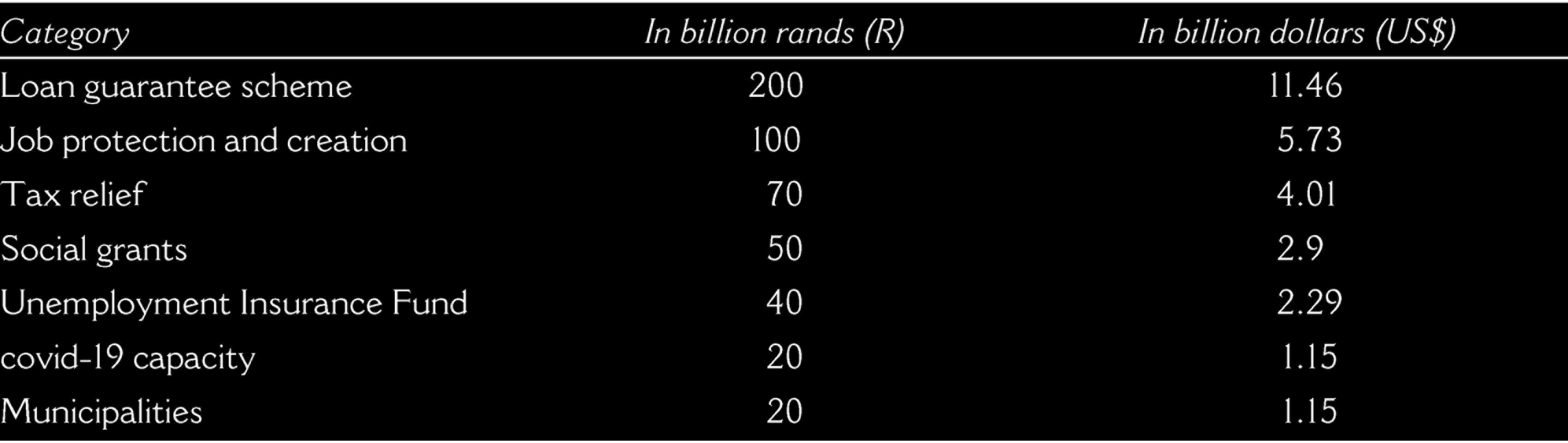
Distribution of the R500 Billion Social and Economic Stimulus Package
The R500 billion stimulus package, which accounts for approximately 10% of the country’s GDP, was intended to stabilize the economy by addressing its supply and demand components and ensuring the protection of jobs in various sectors of the economy (The Presidency, 2020a). This is appropriate state activism in a country where most citizens are mired in unemployment and poverty and a growing number are dependent on government grants. An important observation is that the pandemic revived the government’s commitment to delivering services; a state that was once considered incapable is finally demonstrating the highest level of capacity to deliver essential services (Public Service Commission, 2020). This can be seen in the various programmes the state has created to support communities, including the provision of water tanks and housing for the homeless. This unprecedented level of spending is evident in South Africa and across the entire globe as is evidenced by data on the stimulus packages as a share of GDP in many nations (African Development Institute, 2020).
While sub-Saharan African countries have made some progress in adopting counter-cyclical fiscal and monitory policies, their fiscal capacity to effectively respond to the pandemic has been undermined by insufficient domestic finance. South Africa is the only sub-Saharan country that implemented a stimulus package with double figures (10%) of its GDP, with Niger and Senegal adopting stimulus packages amounting to 7%, respectively. The rest of the other sub-Saharan African countries adopted stimulus packages below 5% (African Development Institute, 2020). In comparison, advanced economies adopted fiscal stimulus packages that averaged 17.40% of their GDP. Emerging markets adopted stimulus packages averaging approximately 6% of GDP, while African countries only averaged approximately 4% of GDP (African Development Institute, 2020). In responding to the lack of sufficient domestic finance, many African countries borrowed from IMF’s Rapid Financing Instrument (RIF) to put an impetus on their ability to mitigate the pandemic’s health and economic impact (IMF, 2020c). The size of South Africa’s stimulus package is an outlier for the continent and exceeds those in emerging economies. However, the size of the stimulus package does not automatically mean that it will prosduce effective responses.
In the first stage of the stimulus package, the government dedicated R20 billion to mitigating the rapid spread of the virus by equipping the health sector with personal protective equipment (PPE) items, increasing the country’s screening and testing capacity and providing hospitals with additional ventilators, staffing, medicine and beds (The Presidency, 2020a). This intervention was important in extending the role and capacity of the state to deliver some of the developmental outcomes it has been struggling with over the past two decades, including an unreliable and deteriorating public health system. Additional funds to support the public health expenditure were administered through the Solidarity Fund, which is mainly underwritten by private contributions from citizens and businesses (IMF, 2020c). As such, the financial contribution to the public health system assisted the government in improving its testing capacity and its overall management of the pandemic. This is evident in that by June, the public sector accounted for 54.1% of the COVID-19 tests, while the private sector accounted for the remainder (NICD, 2021). However, by August 2020, there were some fluctuations with the private sector carrying out 56% of tests, largely due to a testing backlog in the public sector (NICD, 2021).
An essential component of the country’s fiscal response was its job protection and creation measures, as the decline in economic activities threatened millions of jobs. The government also used UIF to support businesses and workers affected by the lockdown, particularly those businesses that struggled to pay salaries because of a loss of income. UIF’s special COVID-19 benefit has paid out R34 billion thus far, assisting over 7.5 million workers by preventing further retrenchments (The Presidency, 2020b). In addition to these measures, IDC has played its development finance role by using the R300 million Small Industrial Finance Distress Fund to support distressed small industrial businesses (Industrial Development Corporation (IDC), 2020). IDC has also played a development finance role by supporting local companies to manufacture PPE to the value of R156 million to boost the country’s manufacturing sector during the lockdown, thereby increasing economic activity in the country. To ensure that the support for businesses reaches vulnerable communities, the government has dedicated an additional R2 billion to support spaza shops (informal convenience shops run from home) and other small community-based shops (The Presidency, 2020). This support is instrumental in ensuring that community-based businesses are not left out of the state’s interventionist policies geared towards improving the country’s economic outcomes. Overall, these fiscal measures, together with R70 billion in tax relief, demonstrate how the South African government used increased government spending and tax reductions to stimulate the economy.
ILO (2020a) has emphasized that older people, marginalized groups and the unemployed will be most affected by the COVID-19 pandemic. Given that South Africa has more people on social grants than in the working population, the government has adopted a series of responses to support its most vulnerable citizens. Measures to protect the poor from economic shocks included increasing the child grant by an additional R300 for May 2020, and an additional R500 every month from June to October 2020, denoting 6 months of increased state assistance (The Presidency, 2020a). Other grant beneficiaries, like the elderly and the disabled, will receive an additional R250 every month for 6 months for the same period as the child grant. Further to this, the government has established a special Covid-19 Social Relief of Distress grant of R350 a month for the unemployed for 6 months. This grant is for those who are unemployed and do not receive any other form of government assistance. Additional measures to protect the poor and vulnerable include a partnership between the Department of Small Development (DSD), the Solidarity Fund, non-governmental organizations (NGOs) and community-based organizations to distribute an additional 250,000 food parcels to the poor and vulnerable (The Presidency, 2020a). There have also been calls for the government to extend these social programmes to include an unemployment universal wage post-COVID-19 (Institute for Economic Justice, 2021).
Given that the local government sphere is at the forefront of service delivery, its institutional capacity has required additional financial support during the pandemic. As was seen during the Great Depression, while the aggregate demand for economic activities tends to be low during an economic contraction, the aggregate demand for services provided by the local government increases (Sharp, 1958). Similarly, the adverse socio-economic impacts of the pandemic led to a rise in the demand for local government services and necessitated increased institutional and fiscal capacity of municipalities. As such, through the government’s fiscal transfer powers, R20 billion was availed to municipalities to strengthen their responses to mitigate the adverse outcomes of COVID-19 for citizens (The Presidency, 2020a). The R20 billion allocated to municipalities was, thus, targeted at improving water and sanitation facilities, particularly in informal settlements, and providing shelter for the homeless. Notably, areas with high population densities such as Johannesburg, Cape Town and Durban have become epicentres for COVID-19 during the first and second waves. This initiative demonstrates the South African government’s developmental ambitions to create a fair and stable society, as outlined by the country’s National Development Plan (NPC, 2012).
Given the severe impact of the COVID-19 pandemic, the South African government applied for, and received, IMF assistance under the RIF. The US$4.3 billion emergency financial assistance loan forms part of the country’s fiscal relief package. The loan was meant to assist the mission of strengthening the capacity of the health sector, reducing the adverse socio-economic conditions and limiting the fiscal pressure presented by the pandemic (IMF, 2020b). While IMF regards the loan as an important milestone in assisting the country in dealing with the social and economic impact of COVID-19, the government received widespread criticism from various sectors of society and opposition parties due to the conditionalities that are often attached to IMF loans. Further to the IMF loan, the government also received a loan of US$1 billion from the New Development Bank to further strengthen the country’s response to COVID-19 and alleviate the impact of the pandemic on the poorest and most vulnerable citizens (New Development Bank, 2020). These loans demonstrate the political consensus over the necessity of counter-cyclical fiscal policies in the South African government’s bid to respond to the socio-economic impact of the pandemic. They also reflect a degree of consensus from IMF and NDB on the importance of supporting individual countries and global economic development.
Counter-cyclical fiscal policies are only effective if they are complemented by monetary measures that minimize the financial burden on the greater population and businesses. This can be done by offering favourable interest rates that promote lending and encourage spending to increase economic activities. For this reason, the South African Reserve Bank (SARB) cut the country’s repo rate 2 by 300 basis points in 2020, lowering it to 3.5%—the lowest since 1998. Table 2 highlights the monetary decisions taken by SARB to mitigate the impact of the pandemic on the country’s economy.
South Africa: Monetary Policy and Bank Regulatory Measures
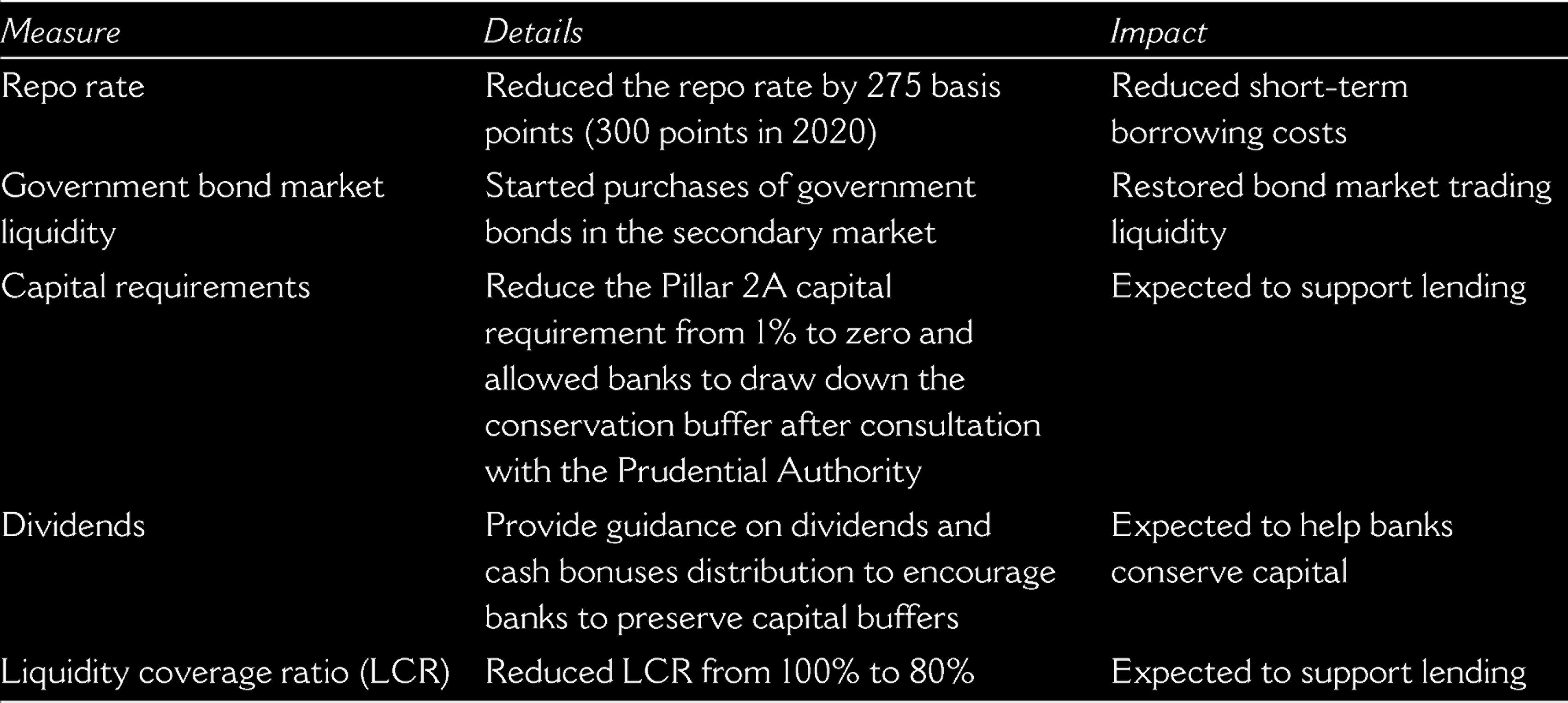
SARB (2020) projected that the economy was likely to contract by 7.3% in 2020 and will only grow by 3.7% in 2021 and 2.8% in 2022. The uniformity of SARB’s measures is important as they complement the country’s expansionary fiscal policy by encouraging government and consumer spending to limit the contractionary impact on the economy. In addition, SARB’s measures are instrumental in promoting lending at the lowest rates while keeping the inflation rate below the traditional 6% target. When the repo rate dropped by 200 basis points in 1 month, more than R80 billion was unlocked in the economy, giving citizens more power to purchase and save (SARB, 2020; The Presidency, 2020a).
Additional measures were also implemented by the National Treasury, working with SARB and major banks, through establishing a R200 billion loan guarantee scheme to assist businesses to pay rent and salaries, with an estimated 700,000 firms and more than 3 million employees expected to benefit from the programme (The Presidency, 2020a). The scheme has already used R12 billion to assist more than 8,600 small and medium-sized businesses (The Presidency, 2020b). The state’s activism and interventions in this context are important because they aim to promote the welfare of the economy and the population socially and economically through a compatible macroeconomic framework.
A compelling case for the South African lockdown was that the government needed to buy time to consolidate and improve its health capacity to manage the pandemic. Two critical areas that needed improvement were the public healthcare system and the local government sphere, each of which received R20 billion. The effectiveness of the public healthcare response has been evident in improved testing, quarantining, staffing, bedding and ventilator capacity. Further evidence of the efficacy of the counter-cyclical measures can be observed in the country’s COVID-19 recovery rate, which is at 93.7% compared to the global recovery rate of below 70% (2021; NICD, 2021). The local government sphere also recorded a degree of effectiveness in delivering essential services such as water, sanitation and temporary shelters for the homeless. This denotes a level of effective coordination between the national, provincial and local spheres of government in mitigating the spread of the virus and responding to the plight of those who cannot afford to protect themselves.
South Africa is estimated to have lost 2.2 million jobs in the second quarter of 2020 because of the COVID-19 lockdown and failed to recover these jobs in the third and fourth quarters of 2020 (Stats SA, 2020a). From a fiscal perspective, the job security and job creation measures through the UIF COVID-19 relief fund, the tax relief measures and increased government spending have shown some degree of effectiveness through assisting thousands of struggling companies to pay salaries during the strictest lockdown period. More than 7.5 million workers benefitted from UIF’s special COVID-19 grant by the end of the second quarter of 2020 (The Presidency, 2020b). This means that of the 16.4 million workers recorded in the Quarterly Labour Force Survey (QLFS) for the first quarter of 2020, 46% received the UIF benefit (Stats SA, 2020c). Based on this evidence, it can be argued that UIF’s special COVID-19 benefit was an effective counter-cyclical measure that protected jobs in the formal economy, as it saved millions of workers from income loss and retrenchment.
The effectiveness of the job protection measure is notable in that the formal sector recorded 1.2 million (10.8%) job losses as a share of employment compared to the informal sector’s 640,000 (21.9%) (Stats SA, 2020a). The high rate of employment loss in the informal economy is underpinned by the lack of social security measures and informal workers not qualifying for UIF because they do not contribute to the scheme. The unintended consequence of the government’s job protection measures is the unprecedented loss of employment within the precarious informal sector that left millions without recourse. In contrast, other countries with smaller stimulus packages prioritized the informal economy. Schwettmannm (2020) observed that Togo introduced cash transfers to support informal workers for the first 3 months of the lockdown period, while Côte d’Ivoire used approximately 0.3% (US$171 million) to support the informal sector, and Lesotho increased cash transfers to the vulnerable and marginalized, including the informal economy, for a further 3 months in 2020. The lack of emphasis on the informal economy households means that the counter-cyclical responses are unlikely to protect those with the most precarious jobs in society.
Although it has been a year since the R200 billion guarantee scheme was adopted by the National Treasury and SARB, only 10% of the funding had been utilized by the first quarter of 2021. This low rate is primarily linked to the rigorous requirements and regulatory burden that often side-line the country’s small businesses. A lower application rate was noted for the spaza shop funding (AGSA, 2020b). This is caused by the centralized and cumbersome application process that fails to promote the township economy. Further to this, 66% of South Africa’s COVID-19 assistance went to big businesses. Findings from the Financial Transparency Coalition (2021) revealed that data from eight countries in Africa show that 63% of the aid went to big businesses, 26% was dedicated to social protection measures, 10% went to small and medium-sized businesses and 1% went to the informal sector. Despite the informal economy playing a significant role as a share of total employment, these measures demonstrate the lack of attention to the plights of low-income households.
The provision of increased social grants to the elderly and children and introducing the R350 special COVID-19 Social Relief of Distress grant for the unemployed were important fiscal social policy measures for the poor and vulnerable. However, Khambule (2020) criticized the government’s measures for falling below the international standard of US$1.90, US$3.20 and US$5.50 per day. In a study on food security in South Africa during the lockdown period, Wills et al. (2020) find that 47% of respondents reported having run out of food during April, the month of the strictest COVID-19 lockdown in South Africa. Stats SA (2020c) showed that the previously marginalized, Africans in particular, were more severely affected, with 26.3% reporting that they ran out of food in April. The increased poverty and hunger rates caused by the pandemic undermine NDP’s (NPC, 2012) target of reducing the number of people living below the lower bound poverty line to zero by 2030. This also undermines the country’s ability to meet sustainable development goals, a predicament that is echoed throughout sub-Saharan Africa due to the poverty increase observed by Mattes (2020) even well before COVID-19 hit the African continent.
The monetary measures taken by the SARB played an important role in maintaining the country’s inflation rate below 3%, while the decrease in the repo rate by 300 basis points improved the lending, spending and saving power of consumers and enterprises alike. Similar patterns were also observed in the reserve banks of countries such as Nigeria, Botswana Canada, China, the UK, Australia and the USA in cutting interest rates to unlock billions in the economy, thereby giving workers more power to save and purchase during the pandemic (IMF, 2020a). However, the concern for South Africa (and other developing nations) is that the monetary measures taken by the reserve bank do not have much effect on those at the lowest income levels who have limited access to credit and are less likely to benefit from interest cuts. This is evident in that most workers who lost their jobs were from low-income households, were less educated and had jobs with no social security (ILO, 2020a; Ranchhod and Daniels, 2020; Stats SA, 2020a).
The IDC grant for companies to manufacture PPE played a dual role, that is, saving jobs and reprioritizing production to meet national goals, both of which bolstered economic activity during a contractionary period. The country’s economic recovery strategy has also incorporated a substantial infrastructure building programme, which is vital because infrastructure plays a significant role in unlocking investment, as evident in China and India’s recovery plans during the 2009 global financial crisis (Jiang, 2015). The adopted infrastructure spending follows years of massive infrastructure underspending by all spheres of government and state-owned enterprises, estimated to be R38.29 billion and R109.06 billion on average in real terms between 2014 and 2019 (Department of Public Works and Infrastructure, 2020). The government identified 177 infrastructure projects to the value of R1.65 trillion, which will act as a measure of economic recovery (DPWI, 2020). This programme is vital as the increase in unemployment indicates that the country needs compelling programmes to encourage job creation and equitable economic growth.
AGSA’s (2020b: 1) first COVID-19 report covering R68.9 billion (47%) of the 147.4 billion and 16 of the main COVID-19 flagship initiatives from April to July 2020 spending noted that South Africa’s R500 billion relief package ‘landed in a weak control environment’. The lack of effective oversight led to more than 6,000 government employees corruptly receiving the temporary employee/employer relief (TERS) scheme and corruption amplifying because of the emergency procurement process that enabled the bypassing of some financial regulations (AGSA, 2020b; Special Investigating Unit, 2021). These pitfalls are blamed on the lack of integration between the Home Affairs, the South African Revenue Services and the South African Social Security Agency (Sassa) and UIF’s inability to seek this information to minimize corruption (AGSA, 2020b). This undermined the effective distribution of COVID-19 responses to the vulnerable as most collection points (South Africa Postal Services) experienced a delay in receiving and distributing grants.
SIU (2021) investigated R13 billion of the R30.7 billion spent on PPEs from April to November 2020, as PPE items were not procured at market-related prices. In further attempts to deal with this corruption and price gouging, the Competition Commission investigated more than 800 businesses and reached settlements, with 28 companies levying over R16 million in penalties (The Presidency, 2020). Some encouragement may be noted in the recovery of R3.4 billion disbursed incorrectly through the TERS scheme (AGSA, 2020b). SIU (2021) indicated that the political and administrative interface was at the heart of the corruption because high authorities within provincial governments used the emergency procurement to bypass compliance, while officials merely rubber-stamped the unlawful instructions. In addition, inadequate accountability mechanisms in various COVID-19 tender processes have enabled private companies and the politically connected to undermine the full capacity of the government’s responses to the pandemic by redirecting COVID-19 responses for private gains.
The wider economy faces a slower recovery if lockdown measures are prolonged for longer than necessary because they prevent the economy from operating in full capacity. However, the timing of South Africa’s counter-cyclical measures that mainly focused on the 2020 period and were not prolonged to cover the second wave threaten the recovery process of the entire economy. Getting the timing right for the withdrawal of counter-cyclical measures is critical to the impact on poverty: premature withdrawal leads to recovery challenges for the vulnerable who remain unable to secure their food, housing and inability to recover pre-COVID income in the informal economy. This segment of the economic sector is likely to fall further into poverty without targeted interventions. An important lesson from the government’s response is that the impact of responses is not determined by how much money is spent on counter-cyclical measures, but rather by how responses are structured to impact on existing poverty, unemployment and inequalities. Responding effectively means deploying effective social security measures to ensure that unemployed and low-income households are provided with the means not only to resist falling into, or further into, poverty but also to make gains in escaping from it. If these adverse developmental challenges persist, the country is unlikely to meet sustainable development goals that the pandemic has side-tracked.
Conclusion
The impact of COVID-19 has put a strain on the global economy and forced states to adopt stimulus packages to protect the economy and the general well-being of the citizens. South Africa’s R500 stimulus package demonstrates political willingness through counter-cyclical fiscal and monetary measures to stabilize the economy, protect jobs, address the extreme decline in supply and demand and provide social and economic assistance to the poor. Based on the evolving COVID-19 situation, it is essential to learn from the ongoing impact of counter-cyclical policies implemented by the South African government. While the data used in this article are tentative, they are helpful in painting a picture of the valuable lessons and challenges emerging from the South African case.
The UIF grant, job protection measures and tax relief played an essential role in supporting the supply and demand sides of the economy by assisting businesses to pay for salaries and ensuring increased economic activity. These lessons point to the importance of fiscal policies capable of keeping the economy afloat, particularly in sub-Saharan Africa, where African countries are often criticized for implementing procyclical policies during economic emergencies. Some positive effects of South Africa’s responses are also evident in the increased capacity of public healthcare to test, admit and treat patients. This signals the importance of investing in public healthcare infrastructure in Africa to improve the capacity to manage pandemics and other health-related diseases in Africa. These lessons also emerged from the Ebola outbreak that faced Western African nations in 2014–16 and sent shockwaves through the health infrastructure in many African countries.
Despite the large expenditures made in South Africa compared to other similarly placed countries, the resources that it has dedicated to support the poorest and those in the informal sector are too low. These measures also fall below the national and international poverty lines, and the country’s minimum wage, and only cover the first wave of the pandemic. This failure is compounded by the lack of tailored funding for workers in the informal sector. This contrasts with the strategies of other sub-Saharan African countries that adopted smaller stimulus packages compared to South Africa, yet spent a significant share on social security schemes and the informal sector. The lesson to be learnt is that the size of the stimulus package will not yield the necessary results if it fails to target the poor, vulnerable and those who work precarious jobs in the informal economy. This lesson from the South African case is particularly important for developing countries with smaller fiscal capacities and higher rates of informal economy. Further research is urgently needed to identify policies that can protect the informal sector, low-income households and other vulnerable groups in the post-COVID period.
Footnotes
Acknowledgements
The support of the DST-NRF Centre of Excellence in Human Development towards this research/activity is hereby acknowledged. Opinions expressed and conclusions arrived at, are those of the author and are not necessarily to be attributed to the CoE in Human Development.
Declaration of Conflicting Interests
The author declared no potential conflicts of interest with respect to the research, authorship and/or publication of this article.
Funding
The author(s) disclosed receipt of the following financial support for the research, authorship, and/or publication of this article: This work was supported by the DST-NRF Centre of Excellence in Human Development (grant number ACC2020-COVIDHD-2).