



Abstract
The safety of journalists covering conflict goes beyond their physical protection. It includes the psychological impact of repeated exposure to traumatic events. This study employs a mixed methodology across two complementary studies to analyse how revictimization, coping strategies, and working conditions affect the development of post-traumatic stress disorder (PTSD) in journalists. In Study 1 (qualitative) we conducted 24 in-depth interviews to experienced conflict journalists that revealed a culture of silence around trauma, a consistent absence of support protocols in the media, and the widespread use of emotional suppression as a coping strategy. In Study 2 (quantitative, n = 85) we applied a moderate mediation model (PROCESS Macro, Model 10) to verify these findings. Results showed clinically relevant levels of PTSD (M = 36.98), with 54.12% of the sample exceeding the cut-off point. We identified a direct effect of revictimization on PTSD in journalists conditioned by working conditions. We also found that the indirect effect (revictimization → emotional suppression → PTSD) was significant for journalists with precarious contracts, regardless of the break after coverage. These results underline that job insecurity enhances the harmful role of emotional suppression, situating trauma not as an inevitable collateral damage, but as a result of the interaction between risk exposure, individual coping strategies, and the labour structures of the media.
Keywords
Introduction
Conflict journalism has long attracted scholarly attention, yet the first study on the health impact of war reporting was not published until 2002 (Feinstein et al., 2002). A decade later, the United Nations Plan of Action (UNESCO, 2012) marked a turning point in placing journalists’ wellbeing on institutional and academic agendas (CFOM, 2025; Westlund et al., 2024). Still, the profession remains shaped by “sexism, machoism, and a fierce competition breeding a newsroom culture that makes it difficult for journalists to openly speak about the emotional fallout from trauma exposure” (Obermaier et al., 2023:1414). This environment fosters silence around psychological impact, with many fearing professional repercussions if they disclose trauma-related struggles (Aoki et al., 2012). While progress has been made in some countries, the issue remains largely absent from the Spanish debate.
Situated within journalism and trauma literature, particularly research on covering potentially traumatic events (PTEs) (MacDonald et al., 2017; Osmann et al., 2021), this study addresses a critical gap. Conflict reporters show some of the highest post-traumatic stress disorder (PTSD) prevalence rates, comparable to war veterans (Aoki et al., 2012; Feinstein et al., 2002). Yet previous scholarship has focused on physical, digital, or general psychological safety, rarely addressing trauma explicitly or linking it to working conditions and newsroom culture. While avoidance strategies have been documented, their impact on conflict reporters remains underexplored (Thomson, 2021). Leading institutions like the Dart Center emphasize examining multiple risk factors simultaneously, noting the scarcity of integrated studies (Smith et al., 2015).
Research remains notably limited. The only quantitative study to date touching on journalist safety—though not trauma—is a Reporters Without Borders Spain (RSF) and University of Valladolid report on Spanish journalists covering the Ukraine war (Etura and Martín Sánchez, 2022). Its findings underscore the precariousness of conflict reporting under a Mediterranean or polarized pluralist media model (Hallin and Mancini, 2004), characterized by temporary contracts (Tejedor et al., 2020), lack of institutional support, and minimal training or safety protocols (Unda-Endemaño et al., 2022). This gap highlights the urgency of integrating trauma into the broader discussion of journalistic safety, not only in Spain. This article provides the first empirical evidence showing how specific conditions interact, amplifying their impact on journalists’ mental health.
This article incorporates coverage-related trauma as a key dimension of safety by measuring relationships between three critical factors: repeated exposure to potentially traumatic events (PTEs) (revictimization), coping strategies, and PTSD symptomatology. These are examined alongside structural conditions, including contractual precariousness, the implementation of post-assignment rest periods—internationally recommended but inconsistently applied. To our knowledge, no previous study has directly examined revictimization among conflict journalists or provided empirical evidence on the mediating and moderating roles of coping strategies and workplace conditions in PTSD development. The contribution lies in showing not only prevalence (how common the issue is), but also mechanism (how and why it occurs) and enabling conditions, thereby advancing journalist safety debates in Spain and internationally.
Following the literature on journalism in conflict zones (2.1), revictimization (2.2), and structural precarity (2.3), this article asks how the interaction between exposure, working conditions, and coping strategies shapes PTSD in conflict reporters (3). The answer derives from two complementary studies: an exploratory qualitative study (4.1) and a quantitative study (4.2) measuring the interaction. These studies are described consecutively—first Study 1’s design and results, then Study 2’s—to underline how Study 1’s results informed Study 2’s variables. After the quantitative results, the article closes with discussion and conclusion (5).
Literature review and conceptual framework
Journalism in conflict zones: Safety and trauma
Research on the safety of journalists covering conflicts has traditionally focused on physical safety, with recent data being particularly alarming. Yet journalists’ safety extends beyond the physical threatening their psychological, digital and financial integrity and well-being: threats to journalists’ safety — “the actions and conditions that increase the risk of physical, psychological, digital and financial harm to journalists as human beings and institutional actors” (Slavtcheva-Petkova et al., 2023:5)— must be tracked, as “monitoring threats and attacks is essential for advancing research on journalists’ safety” (Harrison et al., 2020). This study contributes to that regard by identifying war coverage as the major type of stressor among threats and attacks (Osmann et al., 2021).
Most research has examined journalists’ conditions for physical safety (Etura and Martín Sánchez, 2022; UNESCO, 2012, 2022), addressing issues such as training (Iturregui Mardaras et al., 2017; Shapiro et al., 2017) and the importance of legal and institutional support regarding equipment or insurance coverage (Lisosky and Henrichsen, 2009; Tenore, 2012). However, the psychological dimension has been studied later and less extensively, perhaps because “if professionalising physical safety was difficult, establishing the importance of emotional health was more controversial” (Cottle et al., 2016:179). Studies from psychiatry and psychology (MacDonald et al., 2017; Pyevich et al., 2003) have contributed interdisciplinary knowledge, though often referring to journalists’ safety only tangentially.
This research instead advances decidedly on the psychological dimension of journalists’ safety, framed within the journalism studies tradition but implemented through a multidisciplinary team with a psychological conceptual framework.
Revictimization: Repeated exposure to PTEs, coping, and PTSD
Covering armed conflicts, humanitarian crises, and situations of extreme violence exposes journalists to PTEs on a recurring basis, triggering severe psychological consequences—with PTSD being one of the most disabling (MacDonald et al., 2022). Since the first study on PTSD among conflict reporters (Feinstein et al., 2002), academic literature has consistently documented high prevalence of post-traumatic symptomatology in this professional group (Feinstein et al., 2018; Feinstein and Osmann, 2023). Intimidations, direct exposure to death, and even mock executions form part of conflict journalists’ common experience.
Research has often focused on acute exposure to single traumatic events, leaving relatively unexplored the cumulative impact of revictimization—defined as repeated exposure to highly distressing situations (Cividanes et al., 2019; Weiss, 2025). Over more than two decades, revictimization has emerged as a critical risk factor in the development and chronicity of PTSD (Dworznik, 2006, 2011; Newman et al., 2003). In cases related to direct and indirect violence, repeated traumatic exposure lowers the stress-response threshold, exacerbating psychological and physiological reactivity to subsequent events—even less intense ones (Flores Morales et al., 2016). Each new assignment adds to the cumulative psychological burden, and accumulating years covering conflicts is a known risk factor (Aoki et al., 2012). Studies with journalists confirm this, showing that frequency and intensity of exposure correlate directly with PTSD symptom severity (Pyevich et al., 2003; Smith et al., 2017).
Journalists develop coping mechanisms to manage the emotional toll of repeated exposure. Among these, emotional suppression—inhibiting emotional expression—stands out for its frequent use in professional environments that emphasize objectivity and impartiality, where showing vulnerability may be perceived as unprofessional (Hughes et al., 2021; Ivask et al., 2024). Ethnographic research shows how journalists ‘lock away’ emotions, a process central to professional culture (Buchanan and Keats, 2011). Yet research on emotion regulation indicates that avoidant strategies, while functional in the short term for task performance, are associated with long-term negative affectivity, physiological reactivity, and psychopathology, including PTSD (Monteiro et al., 2015).
This study proposes that emotional suppression functions as a key mediating mechanism: revictimization fosters this maladaptive coping strategy, which in turn heightens vulnerability to PTSD. This hypothesis (see Study (2) aligns with prior findings linking avoidant coping with poorer psychological outcomes among journalists (MacDonald et al., 2022).
The precarity of journalism: The threat at home
It is also crucial to consider the role of workplace and organizational contexts in this process. Factors such as contractual precarity—a pressing concern in Spain (Palau-Sampio and López-García, 2025)—or the absence of post-assignment protocols (Unda-Endemaño et al., 2022), including lack of rest days, are not mere background conditions but constitutive elements of the trauma experience. Job insecurity and pressure to produce content without decompression periods intensify feelings of helplessness and restrict access to support networks, making emotional suppression the only available coping resource (Hughes et al., 2021).
Systematic studies show that organizational stressors, such as lack of institutional support, are significant predictors of psychological distress among journalists—sometimes even more so than trauma exposure itself (Monteiro et al., 2015; Osmann et al., 2021). This study therefore incorporates these variables as moderators, hypothesizing that the relationship between revictimization, emotional suppression, and PTSD will be stronger among journalists working under precarious conditions and without paid rest periods—an interaction not yet empirically tested.
Media organizations remain central to journalists’ well-being. Following early studies documenting the impact of coverage (Feinstein et al., 2002), outlets such as the BBC began implementing measures to improve safety (Cottle et al., 2016) and reshaping corporate culture, offering confidential counselling to those in need (Cramer, 2002; Feinstein et al., 2014). Nonetheless, attention to mental health remains one of the newsroom’s main challenges, and recent work calls for stronger managerial involvement and intervention (Miller, 2025; Obermaier et al., 2023).
Scholars have emphasized the need to discuss interventions that prevent PTSD. Recommendations include trauma-informed training for professionals (Ogunyemi and Price, 2023:2), raising editor awareness, and preparing them to identify and support employees with PTSD symptoms (Aoki et al., 2012:387; Cottle et al., 2016:179). Such interventions can help create healthier workplaces and address needs that yield both organizational and individual benefits (Idås et al., 2019).
This article addresses the need to move beyond fragmented approaches that isolate trauma exposure, coping, and workplace context. Instead, it builds on prior findings to propose an integrated moderated mediation model that contributes to a more nuanced understanding of trauma in journalism, framing it not as a mere occupational hazard but as a phenomenon deeply embedded in the economic and organizational structures of media institutions.
Research question and hypotheses
To explore conflict journalists’ repeated exposure to stressful events and its relationship with occupational and psychosocial variables, the article starts from a central overarching question:
How do repeated exposure to traumatic events and precarious working conditions interact to influence PTSD development in conflict journalists, and what mediating role do coping strategies play in this relationship?
To address this question, the article adopts a sequential exploratory mixed-methods design integrating a qualitative study (Study (1) and a quantitative study (Study (2) to provide comprehensive understanding of trauma in conflict journalism. In Study 1, an in-depth qualitative approach identified emerging factors, narratives, and contextual elements related to trauma. Building on these findings, Study 2 operationalizes and empirically tests a theoretical statistical model examining relationships among revictimization, emotional suppression, and job insecurity in relation to PTSD development. This methodological strategy enables both in-depth exploration of subjective experiences and statistical validation of relationships between key variables, thereby overcoming limitations of prior research that has predominantly examined trauma through fragmented and isolated factors. By elucidating interplay among multiple risk dimensions, this integrated approach responds to recent calls to move beyond reductionist frameworks and simultaneously examine complex mechanisms and moderating conditions underlying trauma in conflict journalism.
Studies
Study 1
Methods
Our qualitative Study 1 examined journalists’ experiences covering international conflicts. We conducted 24 in-depth interviews—a technique effective for capturing interviewees’ perspectives and attributed meanings (Taylor et al., 2016). This approach, used in research on journalism in contexts of violence (Tejedor et al., 2020), reflects a growing trend of applying qualitative methods to explore journalists’ experiences and complement traditional research (MacDonald et al., 2017).
Sample
Interviewed journalists.

Ethical standards and procedure
Participants were contacted by email with the study’s objectives. Those who agreed scheduled a virtual appointment via Skype. Before each interview, participants consented to full recording for later analysis under confidentiality protocols. Semi-structured interviews focused on four areas: trauma experience and post-trauma after covering critical events, PTSD symptoms and possible diagnosis, emotional regulation strategies, and working conditions. Interviews lasted approximately 45–75 minutes. All interviews were conducted in Spanish, the native language of both the participants and the researchers, between 2021 and 2022, facilitating depth of expression and nuanced discussion of sensitive experiences.
Content analysis was carried out manually, systematizing and coding data to identify patterns, themes, and categories related to trauma exposure and its psychological impact on journalists. The research was approved by the Research Ethics Committee of the University of the Basque Country EHU.
Results study 1
The interviews generated substantial data, detailed elsewhere. Here, we focus on findings most directly informing Study 2. This section is structured around three strands: first, coverage impact, including PTSD symptomatology and the perceived social value of the condition; second, precarious labour conditions and absence of safety protocols in the media industry; and third, coping strategies journalists use to manage the emotional toll of their work.
Impact of coverage: Symptomatology, PTSD, and taboo
Interviews revealed the psychological impact of reporting in conflict zones, characterized by intense emotional activation linked to event memories and challenges readjusting to everyday life post-assignment. Some journalists reported PTSD-consistent symptoms, while others downplayed or denied long-term effects, though moments of vulnerability were widely acknowledged. “I have been diagnosed with post-traumatic stress disorder for 5–6 years, and I have paid for the treatment myself. […] There came a point when, if I didn’t pay for that treatment, I couldn’t continue developing my profession” (J21). Participants also described symptoms of lesser severity but persistent: “Nightmares, excessive sensitivity to noises, mood swings… but I have been fortunate because I don’t believe I have suffered serious psychological damage” (J16). A sense of disorientation upon returning to everyday life: “When I came back, I felt like some kind of alien. What interested other people seemed trivial to me, and what was worrying for me nobody valued” (J15). Numerous testimonies highlighted a persistent taboo around psychological effects, especially among men: “We are superheroes and cannot have a weakness that makes us human. And we cannot be human; we must be better than the rest. And that is a problem” (J19). Others criticized the traditional image of the war correspondent, which denies any emotional impact: “We need to dismantle that image of the correspondent who cures depression with gin and tonics. Many are traumatized but recognizing it still carries stigma” (J21). Even when some journalists reported not having developed PTSD, many acknowledged that certain images or experiences remain indelibly engraved: “What affects me most is always seeing children destroyed and broken, or with bloated stomachs from hunger. […] You cannot easily get it out of your head” (J20).
Precarity in the media: Lack of protocols and rest measures
The absence of institutional protocols to support journalists’ mental health—whether freelance or staff—was a recurrent topic. Most interviewees had never received post-assignment psychological support. “No one has ever asked me, ‘Are you okay?’, ‘Do you have nightmares?’, ‘Do you think you need psychological help?’ Forget about treatment, therapy, or anything like that” (J15). Journalists also criticized the absence of an organizational environment that allows the expression of suffering without fear of stigma or professional delegitimization: “In the media, we are still thought of as robots with no feelings. Nobody asks how you are or whether you have been able to sleep after seeing what you have seen” (J19). “Not even public media have reintegration protocols. NGOs do: they offer psychological treatment even if you don’t have a pathology. Just to help you reintegrate” (J21).
Coping strategies: How journalists manage emotional impact
In the absence of institutional support, journalists develop individual coping strategies to manage emotional impact, including preventive mechanisms during coverage and readjustment processes upon returning. Some rely on informal support from close personal networks (J7) or formal support through international networks (J17); others use rationalization and self-control (J24), emotional release (J15), or writing (J8). However, the most frequently employed strategies are avoidant. Some professionals adopt rigorous emotional control, suppressing affective expression to protect themselves or others: “I have cried, of course, but I try not to dwell on it […] or I allow myself to break down only when what is needed is to stay strong” (J24). They often avoid narrating their experiences outside the professional context, opting for silence: “In the end, you learn that they [referring to the media or people around you] don’t really want to know what happened; it’s something you have to manage on your own” (J10).
Or try not to externalize emotions or to maintain an image of strength: “The figure of the superman who overcomes everything, when in reality we are normal people” (J7) “No colleague will admit that they went to a psychologist” (J19).
These qualitative findings not only illustrate the reality of trauma in journalists but also served as the basis for the operationalization of variables in Study 2. Revictimization, emotional suppression, and job insecurity emerged as the key constructs measured and tested in the subsequent quantitative model.
Study 2
For Study 2, we analysed a moderate mediation model with a sample of Spanish journalists to examine how contractual precariousness and lack of rest moderate the relationship between revictimization and PTSD through emotional suppression. Based on previous literature, the following hypotheses were proposed:
Revictimization (repeated exposure to highly stressful events) will have a direct positive effect on greater PTSD symptomatology.
Emotional suppression will mediate the relationship between revictimization and PTSD, such that greater revictimization will predict greater use of emotional suppression, which in turn will be associated with more severe levels of PTSD.
The relationship between revictimization and PTSD (both direct and indirect through emotional suppression) will be moderated by working conditions. Specifically, the effect will be strongest in journalists with precarious contracts (H3a) and in journalists who do not receive paid days off after their coverage (H3b).
Methods
Sample
Demographic characteristics of the sample for study 2. Reporting valid percentages (%). The Education category allowed a multiple-choice option.
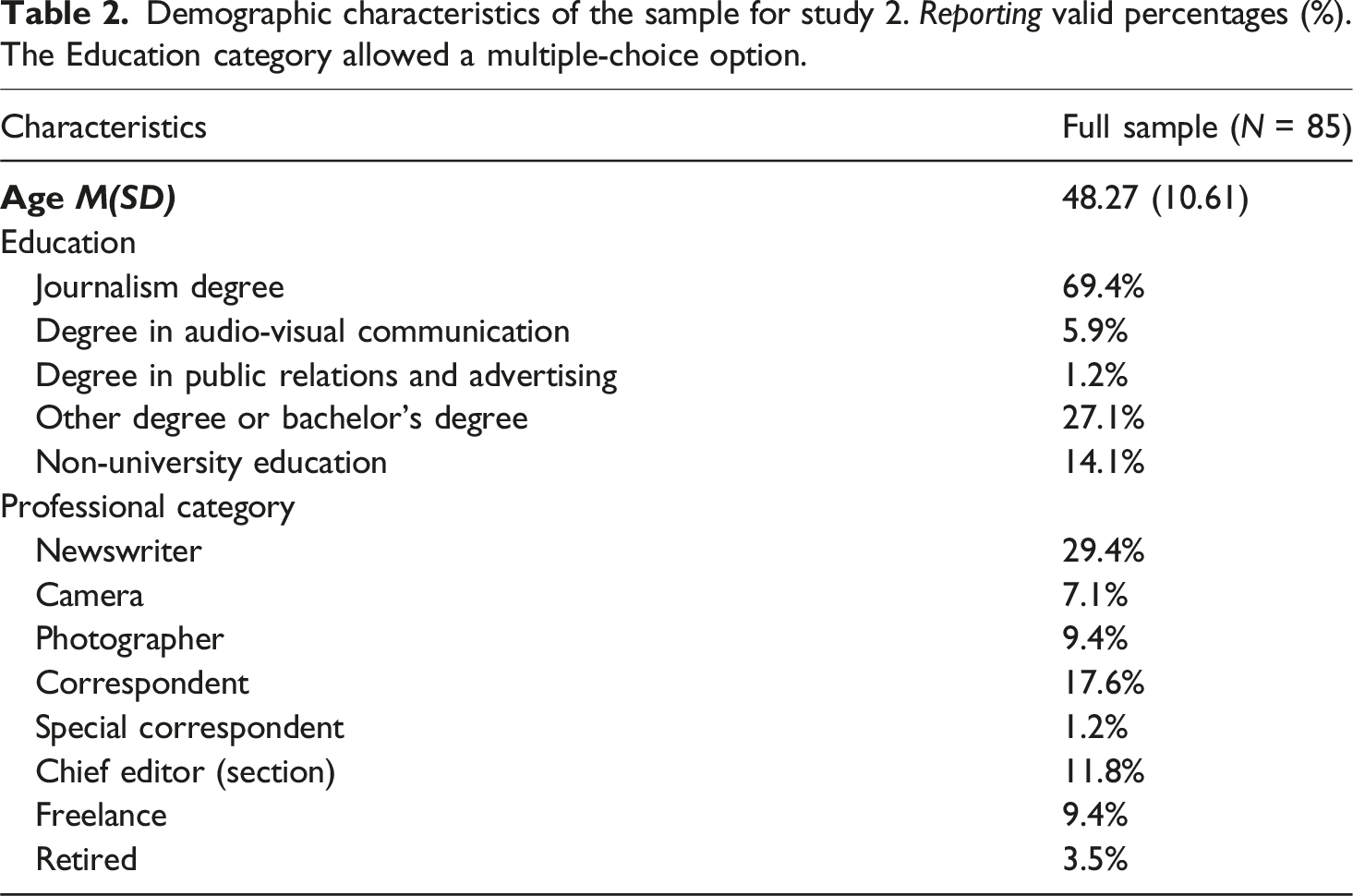
Participants averaged 14.07 years of coverage (SD = 10.84), ranging from one to 40 years. Journalists reported covering conflicts from the 1991 Gulf War to current wars in Ukraine and Palestine-Israel. Regarding media funding, although the mean score exceeded the theoretical midpoint (M = 2, range 0-4), insurance and equipment were not always funded (M = 3.11; SD = 1.61). No significant gender differences were found in years of coverage or media funding.
Ethical standards and procedure
Based on Study 1 results, we created a questionnaire with the theoretically most relevant variables. To recruit participants for the quantitative phase, we compiled a database of Spanish conflict journalists by reviewing bylines in major national media outlets and collecting publicly available professional email addresses. This convenience sample was contacted via email with an invitation letter detailing the study’s purpose and ethical considerations. We also used a snowball strategy, asking journalists to forward the questionnaire to colleagues. Upon accessing the survey link (hosted on EncuestaFacil), participants completed a digital informed consent form before proceeding to the approximately 20-min questionnaire. We sent 356 invitations, achieving a 24% response rate (n = 85), consistent with survey research in this field (Shih and Fan, 2009). The protocol was approved by the Research Ethics Committee of [Redacted] University.
Measures
Personal information: We collected data on sex, age, and education (university degree or non-university studies).
Working conditions: We asked about current professional relationship in terms of employment contract with the media. Responses were categorized into precarious contracts (those without contractual security, indefinite terms, etc.) and non-precarious contracts (full-time, permanent staff, etc.). Participants indicated whether, after coverage, they were offered paid days off by the media outlets they work for (yes/no). Finally, we inquired about media funding via two items on insurance and equipment: “Do you have insurance provided and paid for by the media outlet you work for?” and “Has the media outlet provided you with security equipment?” Response range: 0 = Never to 4 = Always.
Conflict coverage: Journalists reported the conflicts covered throughout their careers (as the First Gulf War, the Balcan Wars, the War in Afganistán, in Siria, Iraq, etc.) and total years spent covering international conflicts.
Emotional suppression: We used the Measure of Affect Regulation Styles (MARS) (adapted to Spanish by Puente-Martínez et al., 2018) to assess emotional intensity during conflict coverage and coping responses. Specifically, we used two emotional suppression items describing emotional response regulation: “Trying not to show my feelings, suppressing all expression of them” and “Faking or expressing emotions opposite to those felt.” Response range: 0 = Never to 6 = Always. Analyses used the mean of both variables; higher scores indicate greater use of this coping strategy (α = .805).
Revictimization: To assess revictimization, journalists were asked whether they had been repeatedly exposed to situations causing high distress while covering international conflicts (Yes/No).
Post-Traumatic Stress Disorder (PTSD): To assess PTSD symptom severity, we used the PTSD Checklist for DSM-5 (PCL-5) (adapted to Spanish by Echeburúa et al., 2016), a 20-item self-report measure corresponding to DSM-5 PTSD symptoms. Response scale: 0 = Not at all to 4 = Extremely, with the statement: “Could you tell us how much you have suffered from each of the symptoms listed below during the last month as a result of any coverage provided during your professional career?” Items are summed for a total score (0–80), with higher scores indicating greater symptom severity (α = .943).
Statistical analysis
First, the sample was described using means, standard deviations, and ranges (continuous variables) and frequencies and percentages (categorical variables). Second, preliminary analyses assessed relationships between sociodemographic and work-related variables and the dependent (PTSD) and independent (revictimization) variables to determine covariate inclusion. We applied independent samples t-tests (education, conflict covered), one-way ANOVAs (professional category), and correlations (age, media funding, years of coverage). Only age (r = −.270; p = .012) and media funding (r = −.302; p = .005) correlated significantly with PTSD; years of coverage (r = .245; p = .024) and media funding (r = −.247; p = .023) correlated significantly with revictimization. Thus, age, years of coverage, and media funding were included as covariates. Gender showed no significant differences with any examined variable—including independent (revictimization), mediating (emotional suppression), moderating (job insecurity and rest period), or dependent (PTSD) variables.
Finally, to examine hypotheses, we conducted partial correlations (H1) and moderated mediation analyses (H1, H2, and H3) using SPSS V27. The moderated mediation analysis tested: (1) the direct effect of revictimization on PTSD (H1), (2) the indirect effect of revictimization on PTSD through emotional suppression (H2), and (3) the indirect effect conditioned by job insecurity (H3a) and the possibility of taking breaks (H3b) (Model 10). These analyses used the PROCESS MEDIATE v4.2 macro for SPSS v27 (Hayes, 2018), which estimated direct, indirect, and conditional indirect effects with standard errors (SE) and 95% confidence intervals (CI) based on the percentile Bootstrap method. This method uses resampling with replacement, generating 10,000 simulated samples to calculate standard errors. Indirect and conditional indirect effects are considered significant if the confidence interval does not include zero. Significance level was set at p ≤ .050.
Results
Correlational analysis
Descriptive analysis and partial correlations among target variables.
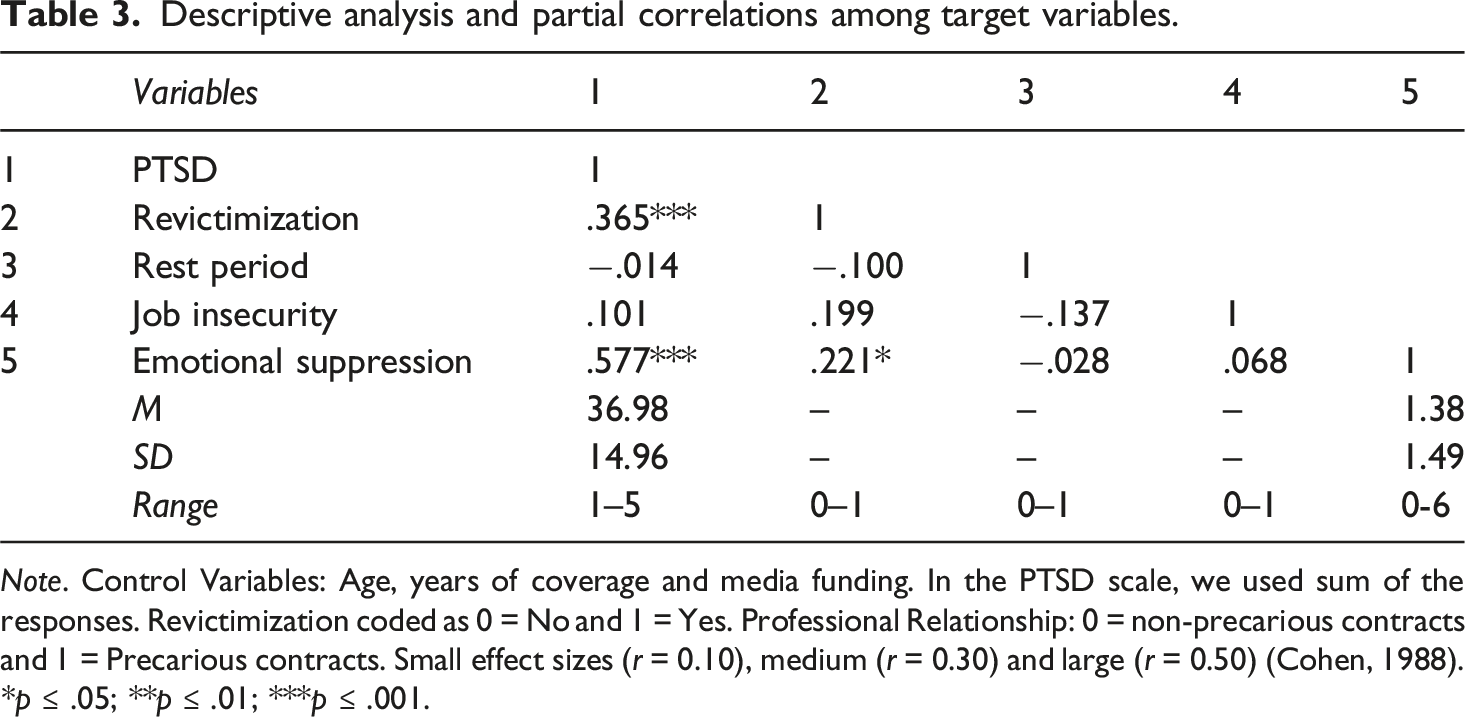
Note. Control Variables: Age, years of coverage and media funding. In the PTSD scale, we used sum of the responses. Revictimization coded as 0 = No and 1 = Yes. Professional Relationship: 0 = non-precarious contracts and 1 = Precarious contracts. Small effect sizes (r = 0.10), medium (r = 0.30) and large (r = 0.50) (Cohen, 1988).
*p ≤ .05; **p ≤ .01; ***p ≤ .001.
Significant associations emerged among all variables of interest, indicating complex interrelationships. Correlation coefficients ranged from small to strong. Notably, PTSD correlated with greater revictimization and greater use of emotional suppression. Revictimization was also associated with greater use of emotional suppression.
Moderated mediation analysis
In order to verify whether revictimization has a direct effect on PTSD (H1), and whether the coping strategy of emotional suppression mediates the relationship between the two variables (H2), we performed a moderated mediation analysis, using the variables of rest after returning from coverage (H3a), and job insecurity within the media industry (i.e., the type of contract coded as precarious or non-precarious) (H3b) as moderating variables (see Figure 1). In this analysis, the direct effect is defined as the effect of revictimization on post-traumatic stress when the mediating variable (emotional suppression) is controlled. The analysis incorporated the variables of age, years of coverage and media funding as covariates. Model 10: Moderated mediation model. Direct effect of revictimization on PTSD and indirect effect through emotional suppression, conditioned by the rest period and job insecurity.
As illustrated in Figure 1, revictimization has a significant direct effect on PTSD, i.e., repeatedly experiencing situations of great distress (revictimization) during coverage is associated with greater symptoms of post-traumatic stress. Despite the absence of significant effects of revictimization on emotional suppression, this coping strategy demonstrated a significant and positive effect on post-traumatic stress. In essence, the more frequently participants employ the emotional suppression strategy, the higher their level of PTSD.
Results of the moderated mediation analysis (PROCESS, model 10).

Note. The table includes B coefficients, which are non-standardized regression coefficients. Bold values indicate statistical significance (p ≤0.05) based on upper and lower limit that do not include 0.
RV: revictimization, SUPPR: emotional suppression, PTSD: post-traumatic stress disorder.
Discussion & conclusions
This article contributes to debates on journalists’ safety by moving beyond traditional approaches, which examine individual (trauma exposure, coping strategies) and organizational (working conditions) factors in isolation. Using a mixed-method design, it shows that trauma among conflict journalists is the result of complex interactions between risk exposure, coping strategies, and structural conditions of media work. Previous evidence highlights high PTSD prevalence (Feinstein et al., 2002; MacDonald et al., 2022), the role of revictimization (Cividanes et al., 2019), and avoidant coping strategies (Buchanan and Keats, 2011; Ivask et al., 2024).
Our findings confirm a latent reality about the impact of trauma on journalists covering international conflicts, which underscores the centrality of working conditions on their psychological well-being. Evidence from both methodological approaches hold trauma at the centre enriching the value of the findings and highlighting robust, strong and multifaceted arguments for action.
Firstly, as posited in H1, findings confirmed the high psychological burden associated with the conflict journalism. Study 2 quantified clinically relevant PTSD levels (M = 36.98), with over half of participants (54.12%) exceeding the established cut-off, an alarming result consistent with previous studies. This complements Study 1 testimonies, where journalists openly describe PTSD-compatible symptoms (e.g., nightmares, hypervigilance, emotional maladjustment) and the “impact they have suffered”, thus corroborating that the consequences of trauma are a constant reality often hidden due to stigma (Olajide Talabi et al., 2024), to a newsroom culture of silence (Feinstein et al., 2002) and to lack of support protocols (Unda, 2023).
It is important to note that, while sexism and gender-based disparities are persistent and critical issues in journalism, affecting women journalists disproportionately in many contexts (García-Mingo, 2019; Hanitzsch and Hanusch, 2025), gender did not emerge as a significant predictor of PTSD severity or as a moderating variable in our specific model and sample. This finding does not diminish the fundamental importance of gender as a social determinant of journalists’ safety and well-being, as it is pointed out by Bashri et al. (2025). Rather, in our study it may reflect the characteristics of our sample—veteran journalists operating in high-risk conflict zones—where the extreme and shared nature of occupational stressors (revictimization, precarious contracts) could have a homogenizing effect on psychological outcomes, overriding other demographic differences (Backholm, 2012; Monteiro et al., 2015). Future research should continue to investigate the intersection of gender, specific forms of victimization, and organizational culture to fully understand its role in the mental health of conflict journalists.
The Study 2 moderate mediation model identified that revictimization operates as a central factor in PTSD, consistent with findings on accumulated experience (Feinstein et al., 2014). This effect manifests in two ways, albeit with nuances: direct and indirect effects mediated by emotional suppression. Study 1 vividly illustrates journalists maladaptive strategies described as ‘locking up’ their emotions, ‘not wanting to worry the family’ or feigning normality (“I’m coming back with complete normality, if not, I wouldn’t go”). Suppression, quantified in Study 2, is an active and exhausting effort to comply with a professional culture that penalizes vulnerability.
Our findings, supporting Hypotheses 2 and 3, highlight emotional suppression as a potential mechanism linking revictimization and PTSD, particularly under conditions of employment precarity. This aligns with previous research suggesting that journalists working in contexts that discourage vulnerability often rely on emotional inhibition strategies to maintain professional performance (Hughes et al., 2021). In the present study, the relationship between revictimization and PTSD appears to be influenced by organizational structures that normalize emotional suppression and offer limited institutional support, which may exacerbate psychological distress. Although such avoidant strategies can be functional in the short term, they are associated with higher negative affect and elevated PTSD symptomatology.
Our main contribution lies in demonstrating how working conditions intensify (critically moderate) these relationships; and how precariousness enhances the harmful role of emotional suppression. Study 2 found the indirect effect (revictimization → emotional suppression → PTSD) significant specifically in contexts of job insecurity. Study 1 journalists point at the lack of institutional support (“No one has asked me ‘Do you feel good?'”), contractual insecurity, and the absence of protocols as breeding grounds where suppression is the only coping tool available for professional life. Previous research had signalled the negative relationship between work factors such as job dissatisfaction, demands at work, or organizational stressors, and psychological well-being (Monteiro et al., 2015), or even an increased risk of post-traumatic stress (MacDonald et al., 2022).
A counterintuitive finding is the direct effect of revictimization on journalists with stable contracts but no days off. This suggests that contractual stability alone is insufficient to mitigate the impact of trauma, unless it is accompanied by active care policies. Qualitative accounts show that, although stable at work, journalists may face greater workload and continuous performance expectations: “they cannot stop”; which exacerbates the cumulative revictimization effect.
These findings point to a structural responsibility: while a personal ethic of care, solidarity and individual strategies for self-regulation can be empowering, they exist within, and are often overwhelmed by, the structural constraints identified in our model. Relying solely on individual resilience or self-care practices risks pathologizing the response to systemic failures and shifting the burden of well-being onto journalists themselves (Koster et al., 2022). Therefore, the primary implication remains for employers and institutions; to create environments where such personal ethics can flourish through structural support, normalized psychological resources, and a culture that actively values care over relentless performance (Williams and Cartwright, 2021).
While limitations remain—particularly sample size and generalizability—our model explains nearly half the variance in PTSD, underscoring its explanatory power in a highly variable field. The universe of journalists covering the conflict in Spain is very small, which limits the generalizability of results. Likewise, the cross-sectional and correlational nature of study 2 prevents the establishment of definitive causal relationships. Although the moderate mediation model explains a high percentage of the variance, being considered very relevant in a field that presents high variability and requires multifactorial models (Rucker et al., 2011), the route between revictimization and emotional suppression was not significant. There may be other mediating mechanisms that better explain how revictimization leads to PTSD. Future research will expand the model to include additional mediators, but the present findings already offer actionable insights: the need to destigmatize trauma, normalizing open dialogue about journalists’ mental health, as well as the urgency of implementing return protocols that include rest days and access to psychological evaluations; develop a culture of occupational safety where the latent risks of exposure to trauma are not enhanced by the precarious conditions of journalists and by the organizational abandonment of the media that hire them.
The synthesis of these two studies facilitates a multifaceted comprehension of trauma in the context of conflict journalism. Study 1 revealed narratives of institutional vulnerability, emotional stigma, and avoidant coping, which Study 2 quantified and modelled statistically. Collectively, these findings underscore the notion that trauma is not merely a consequence of exposure to violent events; rather, it is compounded by precarious working conditions and a paucity of post-mission support. This methodological integration is a response to previous calls (e.g., Smith et al., 2015) to address multiple risk factors simultaneously and in context.
Trauma is not an inevitable collateral damage of conflict journalism. It is a structural problem result of a complex interaction between exposure to risk, individual coping strategies and, crucially, precarious or unsupported work structures. Overcoming the previous fragmented research approaches, this mixed methodology offers a nuanced and powerful understanding of the problem, and provides evidence and impetus for media organizations, policymakers, and educators to integrate trauma literacy, rest measures, and sustained psychological support into their practices. The contribution of this article lies in offering not only prevalence data, but also a clear mechanism for how structural precarity exacerbates trauma—an advance with implications for journalism, in Spain, and beyond.
Footnotes
Acknowledgments
The authors wish to acknowledge the valuable contribution of the journalists who participated in this study. We are particularly grateful to those who took part in the in-depth interviews and those who completed the questionnaire. Their engagement and insights were indispensable to the development of this research.

Ethical considerations
This research received ethical approval from the Ethics Committee of the University of the Basque Country (UPV/EHU) for both studies: Report M10_2022_78 for the project Profile, working conditions and safety of Spanish conflict journalists (involving in-depth interviews), and Certificate CE_2024_005 for the project Safety conditions of Spanish journalists covering conflicts: defining elements and analysis of their safety before, during and after coverage (JOSAFCON, PID2021-122,680NB-I00), which complied with all ethical and legal requirements regarding voluntariness, privacy, and anonymity in research using an anonymous questionnaire.
Funding
The authors disclosed receipt of the following financial support for the research, authorship, and/or publication of this article: This work was supported by the Spanish Ministry of Science, Innovation and Universities [PID2021-122680NB-I00, MCIN/AEI/10.13039/501100011033 and FEDER, EU], the University of the Basque Country [POSTUPV24/26], the Basque Government [Predoctoral Research Training Program, 2019/2020 call], the Type A Research Group Bitartez [IT1771-22, UPV/EHU] and the Regional Ministry of Education of the Government of Castile and León to the SIQoL research group (BU039G24).
Declaration of conflicting interests
The authors declared no potential conflicts of interest with respect to the research, authorship, and/or publication of this article.