




Abstract
This article examines the emotional dynamics underpinning journalists’ professional transitions, positioning affect as central to the modality of governance in the media. We address a gap in understanding how journalists experience and manage work-related emotional dynamics throughout their professional trajectories. Drawing on the concepts of affective governmentality and manufacturing consent, we conceptualize affect as socially and institutionally regulated, embedded in governance structures that organize the media field and its work processes. Based on fifteen narrative-biographical interviews with journalists in Slovenia we show that professional trajectories are shaped not only by structural and economic pressures but also by affective attachments that regulate journalism. Emotional investments such as passion, resilience, and civic responsibility enable journalists to endure precarity and restructuring, yet they also normalize exploitation by converting enthusiasm into obligation and reframing burnout as professional commitment. At the same time, moments of resistance, refusal, and exit reveal the limits of affective governmentality, showing how emotional investments can both sustain and destabilize journalistic careers. This study contributes to media research by foregrounding how journalistic work is governed through affect.
Keywords
Introduction
This article investigates the emotional dynamics that underlie the professional transitions of journalists, emphasizing how affect functions as a modality of governance in the media. 1 We focus on the journalists’ emotional strategies as they unfold in their career trajectories to understand how they navigate shifting newsroom cultures, evolving labor conditions, and broader processes of media restructuring.
The analytical lens is informed by the concept of affective governmentality (Penz and Sauer, 2019; Sauer and Penz, 2017), through which we conceptualize affect and emotions not merely as personal responses, but as socially organized and regulated processes embedded in institutional arrangements, professional norms, and power relations. In journalism, the emotional dimension, as we argue, should be seen as intertwined with a system of governance that increasingly operates “from a distance,” without direct force or coercion (Sauer and Penz, 2017: p. 11). It regulates professional behavior while simultaneously shaping journalist’s self-understanding. Our argument aligns with the ongoing “affective turn” in media (Kotišová, 2025a; Richards, 2007; Richards and Rees, 2011; Wahl-Jorgensen, 2019a, 2020) to develop the understanding of affect as both a modality of capitalist governance and power relations, and as lived and felt experience. Journalists’ experiences have often been overshadowed by top-down historiographies that privilege institutional power and media ownership, while neglecting the perspectives and practices of rank-and-file journalists (Hardt and Brennen, 1995). Comparative surveys have provided insights into journalistic norms and values (Hanitzsch et al., 2011), but offer limited understanding of how these develop throughout journalists’ professional lifespans and how they are emotionally processed (Wahl-Jorgensen, 2019b: p. 671).
When journalists’ experiences of work-related emotions are discussed, the focus is often on emotional coping strategies, such as examinations of affective responses to burnout in war reporting (Kotišová and van der Velden, 2025; Stupart, 2021), journalist beats like lifestyle journalism (Kotišová, 2025b), or practice-oriented guides to managing emotions in everyday journalistic work (Šimunjak, 2023). While these studies significantly advance understanding of journalists’ affective responses to working realities, the biographical dimension of emotional governance has received less attention. Our contribution addresses this gap by drawing on affective governmentality (Penz and Sauer, 2019) and manufacturing consent (Burawoy, 1979) as a complementary theoretical perspective to explore how emotion is woven into the everyday journalistic work as a form of governance, particularly in relation to professionalism, entry into the field, adaptation, endurance and exit. The argument is grounded in fifteen narrative-biographical interviews with journalists in Slovenia. Our methodological approach involves the inductive reconstruction of professional paths, to examine how individuals enter the field, and how working conditions are emotionally processed and internally negotiated across their careers. This enables us to make visible the micro-level adjustments, internal negotiations and coping mechanisms through which they manage their work. Specifically, our research question asks how emotions are governed in everyday journalistic work, how they are felt and internally negotiated across professional trajectories, and how such affective processes contribute to the production of consent to unstable working conditions.
While scholarly attention to journalistic trajectories has grown, particularly regarding precarious labor and exit pathways (Davidson and Meyers, 2016; Mathews et al., 2023), their emotional dimension has received less engagement. Drawing on emotional life histories of journalists, we focus on three critical milestones that mark decisive junctures in professional life: (i) entry into journalism, when initial hopes and ideals are forged; (ii) transitions; and (iii) persistence under increasingly unstable working conditions, where affective stamina and coping practices determine endurance, and possible exits from the field, when disillusionment reshapes identities beyond journalism. These milestones are not understood as a linear or universal career path, but as an analytical tool for tracing shifts in narrative biographical interviews. Individual journalistic trajectories may therefore be characterized by different constellations and absences of these transitions. Thus, these milestones are not merely chronological moments, but serve as affectively charged turning points that shape how journalists negotiate structural pressures and reconfigure their relationship to journalism over time.
Our central thesis is that affective attachments are sustained through affective governmentality (Penz and Sauer, 2019), a mode of governance that operates “from a distance” by modulating emotions, dispositions, and self-relations, rather than through direct coercion. Within this configuration of power, journalists assume personal responsibility not only for professional performance but also for emotional resilience, adaptability, and endurance. Drawing on Burawoy's (1979) concept of manufacturing consent, we frame these dynamics as forms of self-governance that rely on implicit expectations, unspoken norms, and individual coping strategies. Journalists often embrace these affective modes of regulation voluntarily, reaffirming their professionalism even when doing so becomes personally and emotionally harmful.
Emotional manufacturing of consent: Affective governmentality across journalistic transitions
Historically, journalism has upheld an ideal of the emotionally detached, objective reporter, rendering emotional dimension largely invisible within dominant research paradigms (Peters, 2011; Wahl-Jorgensen, 2019b, 2020). Recent scholarship has begun to unfold this view, recognizing that emotions are neither private nor spontaneous but shaped by contextual expectations, professional norms, and institutional demands (Hayward and Tuckey, 2011; Kotišová, 2025a). As such, they are always a process of becoming, rather than a fixed state of being, that emerge through social interactions and are constitutive of power relations (Sauer and Penz, 2017: p. 34).
To connect individual journalists’ biographical timelines to broader media governance, we use the concept of affective governmentality (Papacharissi, 2015; Penz and Sauer, 2019; Richards, 2007). This provides a lens for analyzing how journalists are governed by affective regimes − particularly at key points in their professional lives, such as entering, transitioning within, remaining in, or leaving the profession. Affective governmentality refers to a “contextually oriented constellation of power” that shapes the inner logic of practices and norms, placing individual conduct and motivations under institutional control (Penz and Sauer, 2019: p. 46). Importantly, it allows us to move beyond analyzing journalistic norms as abstract ideals, and instead to examine how they are lived and felt, and how they affect journalists’ bodies, emotions, and lives throughout their careers.
We argue that journalistic work is shaped by a dual and complementary configuration of power: affective governmentality (Penz and Sauer, 2019), which structures and modulates emotional attachments to journalistic identity and professional norms; and manufacturing consent (Burawoy, 1979), which explains how these affective investments reproduce acceptance of increasingly intensified working conditions. Together, these concepts enable us to link micro-level narratives of journalistic careers to macro-level media governance.
Affective governmentality foregrounds a new governmentality revolving around affectivity. Whereas in the past emotions were confined to the private sphere and deemed inappropriate for public life, contemporary governance increasingly targets “the modulation of the affects of the individual” and the “inner tuning” of subjects (Sauer and Penz, 2017: p. 12). Affective governmentality is understood as a technology of power that operates at a distance (Papacharissi, 2015; Penz and Sauer, 2019; Richards, 2007), relying not on direct coercion but on capitalizing on journalists’ emotions, such as the moral obligation to inform or the duty to uphold the watchdog role. Journalists are governed through professional norms, editorial expectations, metrics of performance, and newsroom cultures, which define not only what journalists should do, but how they should feel about their work, while simultaneously inducing emotional self-regulation in service of media profitability. In the interviews, this appears in narratives of “pushing through,” “enduring,” or “accepting” insecurity, as well as in accounts of managing frustration, anxiety, or exhaustion in order to remain professionally viable.
As journalism becomes increasingly embedded in digital platforms and networked communication, the formation of professional identity − traditionally shaped by the normative expectations of the journalistic field (Goffman, 1956) − is now negotiated not only within the newsroom but also across dispersed, technologically mediated environments (Wahl-Jorgensen, 2019a; 2019b). These transformations reshape career paths, producing fragmented and non-linear trajectories that require ongoing self-governance. Consequently, in neoliberal capitalist economies such as Slovenia, journalism is no longer structured by stable, linear progressions but increasingly marked by discontinuity, freelance arrangements, and frequent shifts across roles and sectors (Lukan and Čehovin Zajc, 2023; Pajnik and Hrženjak, 2022; Čehovin Zajc and Poler Kovačič, 2021). Within this context, journalists are interpellated as self-entrepreneurs who must manage not only their skills and careers but also their affects, creativity, and emotional resilience. Discourses of self-promotion, networking, and personal branding become central for occupational survival (Davidson and Meyers, 2016), illustrating a neoliberal subjectivation in which external control is transformed into self-government (Sauer and Penz, 2017: p. 11).
The linkage between affective governmentality and the manufacturing of consent becomes especially visible at the point of entry into journalism. Early-career trajectories are marked by extended periods of unemployment and underemployment (Davidson and Meyers, 2016; Pereira and Cardoso, 2021). Despite these challenges, journalists often describe their entry into the profession through expressions of passion and interest − “I loved it,” “I liked it a lot,” − suggesting that emotional attachment to the work plays a critical role in sustaining engagement (Morini et al., 2014; Pereira, 2022: p. 769). Affective governmentality aligns passion with institutional needs, transforming it into a social technology that emotionally anchors journalists to the profession. Emotional attachment to news work is often expected, even valorized, within precarious contexts, legitimizing exploitation (Deuze and Witschge, 2018: p. 196). Journalistic norms − such as autonomy, objectivity, and public service − reinforce these dynamics by framing emotional investment as evidence of moral commitment. This is where Burawoy's (1979) concept of manufacturing consent becomes complementary. It highlights how a degree of autonomy granted to workers can serve as a mechanism of exploitation, encouraging consent to working conditions that might otherwise provoke resistance. In journalism, working conditions are often presented as the result of individual professional choice, obscuring the structural constraints at play. Burawoy reveals the interplay between coercion and consent. Legal domination of capital over labor, where capital controls the means of production, is not sufficient to organize work and manage conflict. Labor processes must be structured to ensure at least the appearance of freedom of choice, voluntary cooperation, and, ultimately, self-exploitation. Burawoy’s insights that “It is participation in choosing that generates consent” (1979, p. 27) helps explain how journalists come to experience their affective self-governance as autonomy. However, unlike factory workers, whose consent is obtained through games, competitions, and bonuses, journalists are governed by norms, such as professional ideals and internalized civic responsibility. Control is less visible, less direct, and more deeply embedded in subjectivity (Pajnik and Hrženjak, 2022.). This is where conceptual complementarity with affective governmentality becomes imperative: it captures forms of power that operate through emotion and self-governance, rather than through direct supervision or material incentives alone.
In such constellations, civic responsibility in journalism is reconfigured from a normative professional value into an emotional investment. Journalists are expected not simply to adhere to ethical standards, but to feel responsibility, passion, and commitment. Such emotionalization of civic duty transforms public service into an affective obligation, rendering professionalism a form of affective discipline that aligns journalists’ inner motivations with institutional and market demands.
The presented strategies become especially visible at the threshold of exit from the profession. When emotional commitment no longer aligns with material realities, and the work ceases to offer fulfilment, journalists may be drawn toward digital platforms or choose to pursue alternative careers. From a biographical perspective, exit reveals the limits of affective governmentality and the fragility of consent, as emotional investments can no longer compensate for insecurity. At this point, the idea of journalism as a “calling” reveals itself to be a systemic devaluation of journalistic work and an intensification of emotional strain (Aldridge and Evetts, 2003).
Method, sample and data analysis
This study employs a qualitative research design based on narrative-biographical interviews (Rosenthal, 1993) with 15 journalists in Slovenia. As a post-socialist democracy with a small yet developed media market, Slovenia combines features of both peripheral and consolidated media systems, making it sensitive to broader structural shifts in journalism. Slovenia has been facing a medium-high risk to media pluralism, with particularly high risks in market plurality and persistent concerns regarding political independence and social inclusiveness. Despite legislative reforms, enduring structural problems persist, including high ownership concentration, structural risks to political interference and deteriorating working conditions for journalists (Centre for Media Pluralism and Media Freedom, 2025; Ribać et al., 2026), which are also reflected in our interviews.
The narrative-biographical study approach was chosen to explore journalists’ lived experience, an area still underrepresented in scholarship on emotions and media (Wahl-Jorgensen, 2019b). By focusing on personal histories, the method reveals how individual trajectories intersect with emotional responses. It also provides a long-term perspective on the emotional climate of change. Seen as a form of “history from below” (Wahl-Jorgensen, 2019b), it grounds analysis in everyday experience − often overlooked in institutional accounts − while revealing its entanglement with wider political, economic, and technological shifts.
The sampling was purposive and aligned with the aims of qualitative inquiry. Interviewees were selected to include journalists working for leading news outlets in Slovenia such as 24ur.com, N1, MMC RTV Slovenija and Siol.net. While covering television, radio, and the press, particular attention was given to digital media, where the structural and affective transformations are especially pronounced. Across all media environments, journalists face accelerated production rhythms, audience metrics, and precarious labor, which together intensify the instability of professional life and its emotional demands (Lukan and Čehovin Zajc, 2023; Pajnik and Hrženjak 2022; Čehovin Zajc and Poler Kovačič, 2021). In digital newsrooms in particular, these dynamics are further shaped by new media formats, performance indicators as instruments of managerial control, and heightened expectations of emotional availability, adaptability, and self-branding (Cohen, 2019; Deuze, 2007).
The sample was diverse in terms of age and gender, enabling the exploration of generational and gendered differences in emotional management. The youngest interviewee was 28 and the oldest was 57, with work experience ranging from 4 to 34 years. Four interviewees were men and 11 were women. The interviews were conducted in person from November 2024 to January 2025, lasting on average 1 hour and 17 minutes. All interviewees signed an informed consent form prior to participation, ensuring their rights to anonymity and the protection of personal data. Participants chose pseudonyms used throughout this article. Given the interconnected nature of the Slovenian media sphere, where many actors know each other, care was taken to conceal information that could identify interviewees. The interviews were audio-recorded, transcribed, and securely stored.
Data analysis involved thematic coding of transcripts using the MAXQDA software. Each interview was first analyzed individually to ensure that respondents’ personal interpretations of their biographies were preserved. Through inductive reading, we identified recurring themes and developed codes focusing on professional transitions and career trajectories, including entry into journalism, changes of employment, persistence, and possible exits from journalism. To visualize these trajectories, we developed an analytical induction table (Becker, 2008 in Pereira, 2022) in the form of timelines for each participant (Figure 1 below). These timelines mapped different modes of transition and helped to situate emotional responses in relation to professional decisions and shifting occupational expectations. Combining narrative inquiry with thematic analysis enabled a bottom-up reconstruction of how journalists emotionally navigate their careers, showing that affective dimensions of work are shaped by structural conditions and personal adaptations. Journalists’ biographical timelines.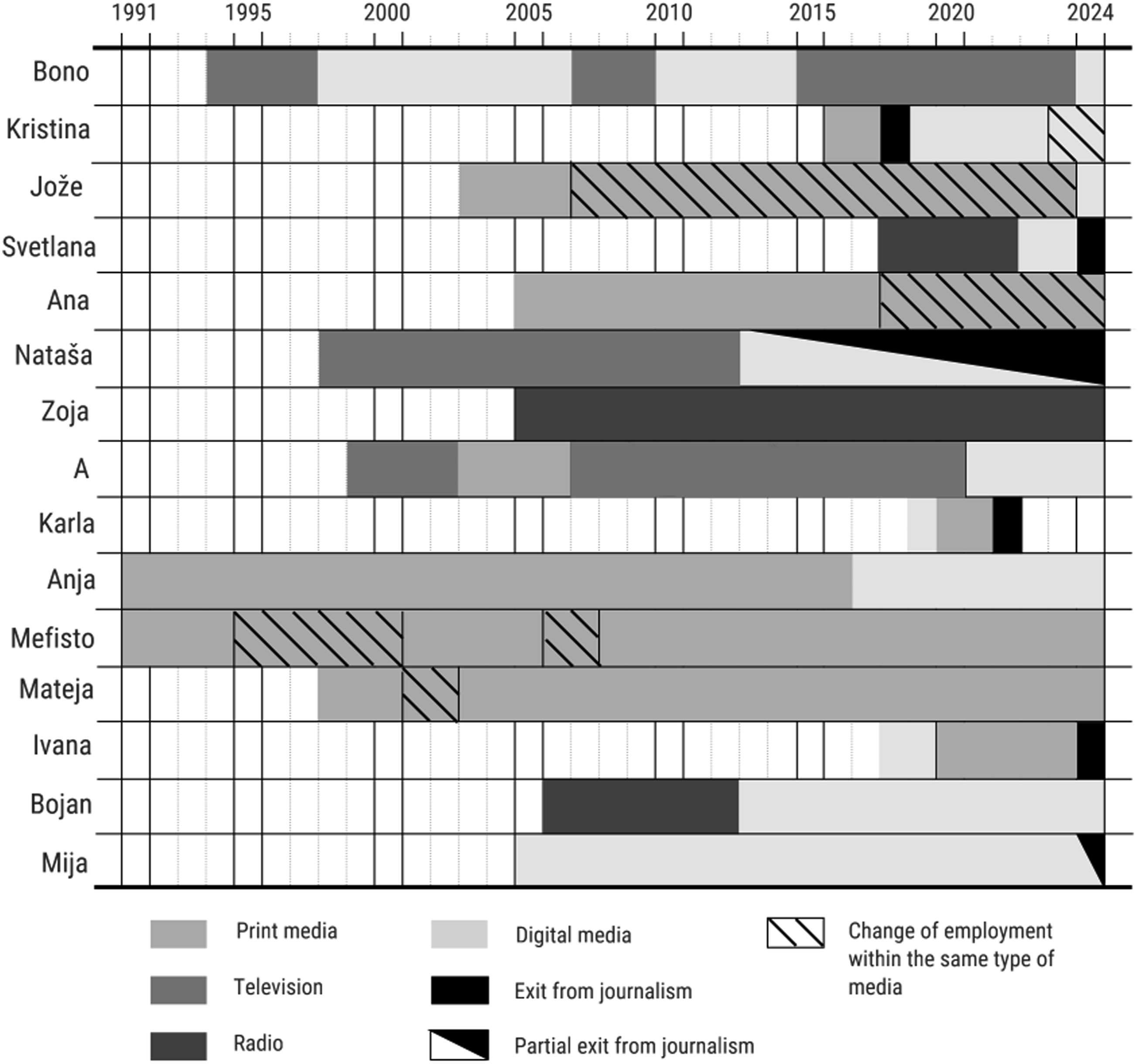
Results of the analysis
Biographical timelines and key transitions in journalistic careers
We established an analytical framework by preparing a biographical timeline for all 15 journalists, marking employment shifts, transitions between different types of media (print, television, radio, digital) or within the same type, as well as instances of exit or partial exit from journalism (see Figure 1). The overview captures key moments in each biography, reveals broader patterns in journalistic careers, and serves as a foundation for analyzing the emotional navigation of the profession.
Figure 1 shows that two-thirds of the sample experienced one or two professional transitions over the course of their careers. Among the five interviewees who diverge from this pattern, one journalist (Zoja) experienced no career changes. In contrast, A and Kristina each underwent three transitions, while Bono and Mefisto had more than three job changes.
Excluding their first jobs, we recorded 30 job changes or exits from journalism among the 15 interviewees. As seen in Figure 1, respondents moved across different media sectors, shifting between print, digital, radio, and television journalism. Transitions seem to occur without predictable patterns between media. Although some remained active in the same type of media throughout their careers, over more than 30 years, we observe a prevalence of transitions from traditional media (print, television, radio) to digital media. While three interviewees exited journalism entirely (Svetlana, Karla, Ivana) and two others (Nataša and Mija) partially, eight journalists ended up in the digital media. Only a few journalists have maintained long, nearly uninterrupted careers in the traditional media (Zoja, Mateja, Ana, Mefisto). Digital media thus played a crucial role in providing an escape from affective governmentality in traditional media, only to succumb to other types of strain (e.g. project-based work). In the following, we present the career trajectories of journalists to illustrate the underlying emotional dynamics and navigation within journalism. Based on the interviews, we divide career trajectories into three milestones: (i.) entry into journalism, (ii.) changes of employment, and (iii.) persistence in or exit from journalism.
Entry into the field: Passion and the early formation of professional commitment
Passion for journalism often underpinned the early decision to pursue a journalistic career. Most interviewees mentioned a desire to write, a sense of creativity and freedom, ongoing learning, and the societal relevance of the profession. Nataša emphasized the importance of continuous intellectual development and personal growth enabled by journalistic work: I’m doing something that truly interests me, allows me to grow as a person, brings me into contact with remarkable people, and opens up new knowledge (Nataša).
Interviewee A highlighted a sense of freedom and intellectual autonomy: There’s […] a certain sense of freedom here, a feeling that you’re creating, that you can decide for yourself what to think about and what society will think. (A)
For Ana, the key motivation was the desire to expose social injustices and a strong sense of public responsibility: [..T]here are so many anomalies in our society that we need to call attention to them – and that’s where I see my role. (Ana)
For some, like Bono, the decision to become a journalist remains infused with personal enthusiasm and loyalty to a profession: For me, this profession is so attractive, interesting, diverse, never boring, that I still more or less feel the same passion I’ve had throughout my career. (Bono)
Some interviewees stated social engagement as the primary reason for choosing journalism. Svetlana, for example, saw journalism as a way to expose problems within the academic environment, while Karla regarded it as an opportunity to bring critical social analysis into the public sphere. Like Bojan, they were “driven by a desire” to understand society and, in doing so, to help others better understand it as well. At the same time, they were aware that they could not “change the world,” but nonetheless recognized their significant influence on public debate.
With youthful enthusiasm, most journalists began their careers in precarious, poorly paid positions. Even as they later moved between employment and self-employment, their professional trajectories typically involved slow advancement from insecure forms of labor – such as student work, freelance contracts, or self-employment – toward regular employment. Kristina, who lacked family support, experienced her early journalistic work as almost traumatic. As a student-worker, she was not only very poorly paid, but also had to endure poor working conditions compounded by ownership pressures and the absence of support from editors: I came in with really high expectations of what this profession should be. I don’t know – investigative work, long conversations with informants, fact-checking ... long discussions with editors about different stories, a decent salary. And then, when I arrived at that first newsroom as a student, it all basically crumbled to dust. (Kristina)
Kristina’s lofty expectations about journalistic work were also shattered by the fact that editors at a well-known newspaper routinely published contributions from beginners without reviewing or checking them. At the same time, they pressured young journalists to write more favorably about certain individuals.
For interviewees in more precarious economic positions, instability and low pay were a significant burden. When journalistic work failed to align with their youthful ideals – due to poor mentorship, superficial reporting, propagandistic content, or ownership interference – it often became a source of deep disappointment and led to disillusionment or rejection of the profession altogether: I was short on money, and what really irritated me was the unpaid training period – I brought it up with the editor several times. (Svetlana)
In terms of content, many began professional work with “light” pieces and feature reporting (Mija, Ivana), or with “copy-paste” news, where, as Zoja put it, “you had to present the same thing in a hundred different ways.” From these tasks, they gradually moved on to more demanding topics, and some eventually developed into journalists capable of facing the deeper upheavals within the profession. A few were fortunate enough to enter supportive environments where they enjoyed the trust of editors and had material backing to pursue their “big ambitions” (Jože, Mateja).
The non-mainstream television show Studio City and Radio Student played a significant role in shaping young journalists. Studio City, a public television program, operated under a single creative rule: the content had to be unconventional. Radio Student, similarly based on transgressing mainstream media formats and conventions, also served as an important formative space. Despite its eccentricities and occasional slip-ups, two former radio journalists, Bojan and Svetlana, described it as more rigorous in its editorial approach than many mainstream outlets. Editorial discussions were often lively and argumentative, and every position had to be well justified. Humor and mistakes were accepted as part of freedom that distinguished Radio Student from mainstream media, where editorial policies are not “seriously considered” (Svetlana) and articles are rejected without explanation. However, as neither of these media outlets could provide long-term material stability, both interviewees worked there only at the start of their professional careers.
Transitions in turbulence: Navigating crisis and precarity
Frequent transitions between different types of media were often driven by professional growth, as previous workplaces no longer provided opportunities for learning or economic security. Interviewees described these transitions as opportunities to acquire new skills, work on less routine topics, advance into editorial roles, or become involved in international collaborations.
In other transitions, moments of acute crisis emerged, culminating in either the employee’s resignation or termination by the employer. These crises exposed systemic problems, including increased exploitation, ownership and political pressures, negligent editors, the monotonous copy-and-paste work and downsizing within newsrooms. Questioning the affective governmentality, the interviewees were forced to confront their position within the media industry, re-evaluate their professional purpose, develop new strategies for adaptation or resistance, and consider alternative paths – including, in some cases, leaving journalism. While slightly more than half of the job transitions (17) were initiated by the interviewees themselves, nearly as many (13) resulted from various crises. Among these, an equal number of cases were related to political and/or ownership pressures (3), a perceived “loss of meaning” in journalistic work (3), redundancies for business-related reasons (3), and experiences of (self-)exhaustion or burnout (3). In one case, all of these crises converged – exploitation, ownership pressure, and poor editorial leadership were simultaneously at play.
We now examine the underlying factors of these crises, starting with political and ownership pressures, which – according to Bono – undermine journalistic “credibility” and “professional standards.” Journalists may yield to political or commercial interests in exchange for higher salaries or other benefits. However, an even greater trap lies in the journalist’s social power – what Bono referred to as “egoistic satisfaction,” what interviewee A called “self-branding,” and what Mateja described as the emergence of a “cult of personality.” These dynamics can lure journalists away from professional standards and ethical commitments, leading them to voluntarily consent to political and financial pressures.
In some cases, interviewees were confronted with explicit forms of pressure following a media takeover by political interest groups that repurposed the outlet for propaganda. After the takeover, new management intervened by retracting articles, rewriting and deleting content, monitoring journalists’ work behind their backs, imposing editorial lines, and ultimately threatening lawsuits for causing “economic damage.”
Interviewees responded in various ways: some clung to professional standards, others evaded, resisted, sought compromise, were dismissed, or chose to resign. Jože, for example, found himself caught in such a vortex of pressure. To this day, he remains troubled by discomfort, guilt, and a series of lingering questions – did he do the right thing, or did he perhaps betray the journalistic profession: I think it affects you, it destabilizes you. Journalism is clearly a personal profession to such an extent – I’m not going to call it a calling – that you can’t fully separate yourself from it. … When you ask a question, it comes from within you, not just from professional standards – or those standards are internalized. And when someone disrupts that, it becomes a personal crisis. (Jože)
The most common reason for changing jobs or withdrawing from journalism was a loss of meaning. These crises stem from internal media practices rather than external pressures. They involve routine copying and pasting, poor editorial policies, and opportunism.
This situation deeply undermined the expectations of a young journalist, Ivana, who began to question the meaning of journalism. The primary reason was that the work environment hindered her professional development. She realized that her work received no feedback from editors and colleagues. She was also expected to take on the roles of editor and proofreader, as well as to absorb the workloads of colleagues who had either resigned or been dismissed.
Mija’s trust in journalism was shaken after more than a decade of working as a journalist. The turning point came during the Covid-19 pandemic, when media coverage contributed to public hysteria. In the name of protecting public health, editors did not allow Mija to cover many topics. This continued during the war in Ukraine, when only content from Western agencies and media outlets was permitted, with all other sources dismissed as propaganda. In her view, editors turned journalism into a “safe zone of copy-pasting.”
Such safe zone is maintained not only through editorial control but also through administrative norms – journalists are officially allotted 8 hours for a standard article and 16 hours for an in-depth piece, which discourages many from even attempting more ambitious reporting. When articles provoke public backlash, editors do not defend journalists, even if they initially supported the content. This left Mija in a state of constant weighing up, wondering whether to leave or stay in journalism.
Three crisis cases ended with job resignations due to exhaustion. In two of these, Svetlana and Kristina hoped to escape poor working conditions and/or political pressures but ultimately encountered the stresses of project work in digital media. After negative experiences in a traditional media outlet and a brief withdrawal from journalism, Kristina decided to start working for an online platform. While this move freed her from political pressures, it exposed her to the pitfalls of project-based work. Applying for grants and fulfilling project obligations pushed her into a state of constant overwork. She faced intense physical and psychological strain: uncertainty about whether they would secure funding, whether a small team could deliver all required activities, and whether the final products met a standard she could stand behind without feeling ashamed. The spiral of responsibility and pressure ultimately led to such severe exhaustion that she had to seek medical treatment. However, the burnout involved more than just workload. It’s also about how you’re seen within the organization, whether you’re valued or not, how your work is perceived, whether you’re respected. It also matters whether your work has any meaning – whether you see that it has value or that it’s making things better. (Kristina)
Eventually, Kristina was forced to leave the team and find another job. She was fortunate to ultimately secure economic stability and a supportive work environment in a financially more stable media outlet.
Ana also had to change employment due to exhaustion. Initially, she was satisfied with the workplace, as the newspaper encouraged journalists to acquire new skills, which supported her development in investigative journalism. However, it also fostered a workaholic environment in which she spent nearly all her time. Reflecting on this period, Ana described her experience as follows: I was literally physically exhausted – probably also because of my personality, since I really immerse myself in topics, take them quite personally, and insist on seeing things through to the end. … I did try for a while to be outside of journalism, but it turned out I really have a strong need to be a journalist. (Ana)
Since then, Ana has been working as a freelance journalist for various media outlets and remains hesitant to take on full-time employment for fear of falling back into the cycle of exhaustion.
Staying or leaving: Holding on, burning out, and questioning the profession
Despite all the crises described – staff reductions, exhaustion, political pressures, and loss of meaning – the interviewees did not lose their passion for journalistic work. Bono articulated his sense of persistence: That passion still keeps me going, despite everything that’s happened along the way. (Bono)
Three interviewees (Svetlana, Ivana, Karla) have stopped working in journalism, and two others (Mija, Nataša) continue on a reduced scale. However, none have fully detached from journalistic work. For most, the decision to step back was accompanied by profound emotional pain. Svetlana’s departure, for instance, was not a planned decision, but rather the result of accumulated frustration and poor working conditions. She recounted how, on the day she decided to leave, “I just started crying in front of the screen and couldn’t stop.”
Even after such difficult exits, the interviewees expressed a lingering hope that they might 1 day return to journalism.
Another response to pressure is the shift from traditional to digital media. Some journalists have left mainstream outlets and, as we have seen, experience a different form of stress from project-based work. They raise funds for digital media outlets through European and national media support schemes, media campaigns, and donations from large corporations such as Google. The structure of these financial sources indicates that funders are not neutral; they expect certain societal impacts in return. However, their approaches to digital media differ greatly. As a newcomer to digital media, Jože still hopes it will allow him to engage more deeply with urgent social issues that interest him. Together with friends, Nataša founded a digital platform in order to preserve what they call freedom. Nataša left her job as a journalist. Now self-employed in a different field, she does journalism as a side job, which is the only way for her to maintain journalistic independence. Anja launched her own online magazine as a backup plan when layoffs were frequent at her newspaper and she feared she might be next. After she was dismissed, she developed the online magazine into a small, successful project-funded company.
While many journalists are withdrawing from the profession or seeking alternatives in non-mainstream media, others continue to work in traditional journalism, often at the cost of internalizing the goals of media owners or sponsors. Journalists who have moved into editorial positions are particularly aware that articles must sell. Editors are not only senior journalists; they are also tasked with monitoring which articles, headlines, and images attract readers, ensuring that the media outlet draws in as many advertisers as possible. Bono referred to this internalization as a “game of compromise,” in which the editor is drawn into constantly balancing popularity (measured by traffic and clicks) with the expectations of “readers who value quality.”
Most journalists noted that audience traffic data was occasionally discussed in meetings and sometimes used to encourage click-oriented content, while many insisted that it did not influence their own work. Yet journalist Mateja, who each December wonders whether she has performed well enough to have her contract extended for another year, offered a different perspective. She observed how, with the rise of social media, some of her colleagues developed “incredible marketing skills,” using social media platforms to promote their articles, boost traffic, and enhance their market value in the eyes of employers. Out of fear that her contract might not be renewed, Mateja also began using social media, and started adding personal photos alongside links to her articles, having noticed that such content generated more attention than the articles themselves: So yes, you fall into it, and you only really snap out of it when you realize that a photo of a beer in your hand gets more attention than an article you’ve worked hard on… But you get caught in this trap of seeking attention, because you see your colleagues doing it. (Mateja)
In state-owned media, by contrast, editors are more guardians of the public interest than of advertising revenue. Journalists reported that editors consider certain topics “sensitive” and tend to avoid them as part of the “activist pole” of society (Zoja). As a result, journalists who engage with controversial topics feel that editors do not trust “their judgment” (Mateja) and that they are ostracized among colleagues. This creates a covert list of undesirable topics and fosters self-censorship, which many see as more dangerous than censorship itself.
Yet within this “game of concessions,” there is also space for resistance that gives meaning to journalism’s social role as a watchdog. One strategy involves resisting the impulse to cater to audience expectations or to pursue attention at all costs. For example, one editor encourages journalists not to think about whether something will be watched or read, but to first thoroughly investigate the topic and only then consider how to present it. Senior journalists, meanwhile, have developed the confidence to resist pressures, particularly their own fears, by relying on “professional standards” as a form of defense against self-censorship: [T]he main problem in journalism isn’t censorship, but self-censorship, in my opinion, that’s really the issue. [...] I persist because I’ve developed a kind of system for myself that I believe protects me from certain harmful things, so to speak. (Bono)
This confidence comes from the knowledge and skills they have gained through years of experience. They are aware of structural problems and the limited support available from managers. Nevertheless, even though their children constantly see them glued to their phones and they repeatedly excuse themselves by saying it is because of work, they still say they love being journalists.
Career transitions as affective turning points
Biographical interviews reveal emotional engagement and self-reflection among journalists at various career stages. All began their journalism careers with significant emotional investment in the profession – knowledge, freedom, passion, and social engagement – which persisted throughout their careers. The media changed, disappointed them, or presented new challenges, but their perception of the profession remained constant. The initial relationship with the profession established an affective governmentality that helped retain journalists in situations of precariousness, commodification, and political or ownership usurpation of the media.
Transitions are not merely “job changes” but affective ruptures that reorganize journalists’ relationship to professional norms. This is precisely where affective governmentality becomes empirically traceable: journalists are compelled to regulate frustration, anxiety, and anger. During transitions, journalists experienced delayed self-reflection on crises that they described as survival crises, threats to journalistic credibility and professional standards, the rise of narcissistic journalists, and a loss of meaning. Ownership interference and political pressure trigger moral injury and guilt, while routinized “safe zone” copying generates loss of meaning and cynicism. In both cases, the governing mechanism is not only external constraint; it is also the demand that journalists remain professionally composed, productive, and loyal to ideals that the institution itself undermines. Many journalists embraced digital media as an opportunity to address the crisis in journalism but ultimately encountered new problems, particularly the precariousness of project-based work.
Another pattern concerns persistence and exit. As emotional investment could no longer compensate for existential insecurity and professional devaluation, some journalists broke with media affective governmentality and chose to withdraw completely or partially from journalism. Staying, however, is rarely a neutral continuation; it is an active accomplishment that depends on affective stamina and coping practices. Persistence in journalism required direct confrontation with affective governmentality. The data show that journalists “hold on” by mobilizing civic responsibility and professional standards as protective repertoires. But these repertoires also function as governing devices: they convert structural instability into individualized resilience and thus sustain attachment to work. Interviewees justified their persistence by creating islands of autonomy, which they secured through experience and professionalism. They described their confrontations as a Burawoy game, which Bono called the “game of compromise.” They accepted the challenge, aware that mechanisms of labor control require voluntary submission, but believed they could cope with, challenge, and undermine its power.
Discussion and conclusion
This study has asked how emotions are governed in everyday journalistic work, how they are felt and internally negotiated across professional trajectories, and how such affective processes contribute to the production of consent to unstable working conditions. We argue that emotions are governed in everyday journalistic work through professional norms and institutional expectations; they are felt and negotiated across biographical turning points; and these affective processes contribute to the production of consent to unstable working conditions, while also generating points of tension and withdrawal. In this respect, our findings build on existing research that foregrounds journalists’ emotional experiences and coping strategies (e.g., Davidson and Meyers, 2016; Kotišová, 2025b; Kotišová and van der Velden, 2025; Mathews et al., 2023; Stupart, 2021; Wahl-Jorgensen, 2019b, 2020; Šimunjak, 2023), while extending this work by examining governmentality across biographical trajectories.
Biographical narratives show that governmentality is enacted through professional norms, which function as affective rules. Journalists’ biographical trajectories become sites where expectations are internalized, contested, and sometimes refused. Across timelines, a recurring pattern emerges: entry is sustained by institutionalized ideals that organize passion and civic duty as moral obligations, transitions are experienced as affectively charged tests of adaptability; and exit becomes the point at which affective governmentality reaches its limits and consent becomes fragile. While prior research has primarily examined how journalists cope with emotional strain within specific beats or work environments (Kotišová, 2025b; Stupart, 2021), our findings show that affective demands accumulate and transform across the life course of journalistic careers. In this sense, affective governmentality is revealed as a process made visible through the turning points in journalists’ biographies.
As analysis demonstrates, most journalists enter the profession with a strong sense of passion, civic responsibility, and curiosity that function not merely as individual motivations but as socially organized attachments that align journalistic subjectivities with institutional expectations of self-sacrifice and availability. This is where affective governmentality resonates with the “calling” (Aldridge and Evetts, 2003) and more: it explains how the moral language of public service functions as a technology of power that governs from a distance, channeling commitment into compliance even when employment is insecure (Deuze and Witschge, 2018). The early-career period is therefore not only a time of professional socialization but also one of affective calibration, in which disappointment, low pay, and weak editorial support are reframed as “normal” and even formative. Such reframing echoes what Deuze (2007) describes as the normalization of insecurity within journalistic culture, clarifying the link between early underemployment and emotional governance: insecure entry conditions are stabilized through affective narratives that render endurance meaningful.
Our analysis shows that emotions shape every stage of journalistic life – from the passion that motivates entry, to the emotional adjustments required to endure transitions, to the exhaustion and disillusionment that often precede exit. By mapping journalists’ biographical timelines, we make visible that affective governmentality is enacted across career milestones rather than operating as a static background condition. We show that journalists’ trajectories are non-linear and not solely structured by external coercion. As Burawoy (1979) theorized, consent is manufactured not only through material incentives but also through the meaning individuals find in their work. Consent is produced not only through material insecurity (the latent threat of unemployment) but through affectively saturated rewards: pride, recognition, the sense of relevance, and the moral satisfaction of doing “important work.” While the fear of unemployment remains a latent form of discipline, voluntary participation proves far more effective in securing active cooperation and consent. Its core strength lies in aligning the interests of labor and capital through incentives, whether financial, reputational, or emotional. As employees pursue “prestige, a sense of accomplishment, and pride” (Burawoy, 1979: p. 89), their emotional investment in their work becomes central to affective governmentality. Yet when journalists resist assignments, voice criticism, or ultimately leave the profession, legitimacy is destabilized, exposing the contradictions of affective governmentality.
Our main contribution was to show that the manufacturing of consent is affectively organized across careers, and that affective governmentality (Penz and Sauer, 2019) sustains attachment to professional norms even as work intensifies, security erodes, and professional norms destabilize. However, the limitations of this contribution should also be mentioned. Our findings are based on 15 narrative interviews in Slovenia, which supports depth but limits broader generalization. Future research could build on this approach through comparative designs and longitudinal follow-ups, and by combining narrative-biographical interviewing with newsroom observation to better trace how affective governmentality is reproduced, contested, or transformed under increasingly platformized media. Such research can help inform discussions about more sustainable and equitable conditions for those working in media and beyond.
Footnotes
Declaration of conflicting interests
The authors declared no potential conflicts of interest with respect to the research, authorship, and/or publication of this article.
Funding
The authors disclosed receipt of the following financial support for the research, authorship, and/or publication of this article: The research for this article was conducted as part of the research project “Affective Media: Transformations of Public Communication” [J5-50172, 2023–2026] as well as research programmes “Equality and Human Rights in Times of Global Governance” [P5-0413, 2020–2027] and “Problems of Autonomy and Identities at the Time of Globalization” [P6-0194, 2019–2027], all funded by the Slovenian Research and Innovation Agency.
Ethical considerations
The fieldwork protocols were approved by the Ethics Committee of the Peace Institute (approval KEMI-2024-001 on 23 May 2024), and all interviewees signed an informed consent form.
