




Abstract
Defining and understanding the contexts in which local news is both sustainable and meeting audiences’ needs and expectations has become a complex issue to ‘pin down’ in Australia, as it has in other parts of the world. This paper introduces and outlines the value of a new measurement tool that comprehensively assesses the availability of local news provisions in specific geographic locations. Referred to as the Local News Proximity Index (LNPI), it gauges local news accessibility for a given town or city. It overlays this with an assessment of the extent to which a news provider demonstrates a local connection to and investment in a given place, by examining the interplay of physical, cultural and social proximity. The index is platform agnostic, in that it does not preference one medium of news over another, instead focusing on an outlet’s commitment to a place through its physical presence and the focus of its news content. We argue the index has immense value in being able to (a) more accurately identify vulnerable areas of a local news ecology, (b) identify areas where collaboration within the ecology may be most beneficial and (c) help policymakers determine where and how to best direct support for local news futures, especially in regard to grants, subsidies and distribution of government public messaging and advertising spend.
Introduction
News media serving small towns and cities can create rich social and cultural value for the ‘communities’ they serve and keep people informed about government policies and activities affecting their patch (Hess and Waller, 2017). Many local news outlets, however, have struggled to cope with the structural transformation of the news business, from shifting advertising revenue to centralisation of news services and adjustment to the digitized news environment (e.g. Waschková Císařová, 2023). ‘News deserts’ and news gaps have become part of the lexicon, as have terms such as ‘zombie’ or ‘ghost’ publications to describe outlets that are local in name only (e.g., Assmann, 2023). Governments in the United Kingdom, Canada, Denmark, Australia and Norway have offered subsidies to address the decline or intervened by attempting to force Meta and Google to pay for news circulated on their platforms (Meese and Hurcombe, 2021). During the past 7 years, the Australian Government, for example, has invested more than $170 million in subsidies and initiatives to enhance the sustainability of media serving small towns and cities. Most funds have been directed to support established ‘legacy’ media such as local newspapers, radio and television – many of which are owned by major media corporations.
Determining where and how best to target support for struggling parts of the sector remains a challenge, especially because the term ‘local news’ is a slippery concept that creates challenges when formulating policies and solutions. The term ‘local’ has been used to describe media serving entire continents, as well as regions, towns, provinces and districts (Gulyas and Baines, 2020; Gulyas and Hess, 2023). Australian journalism think tank, the Public Interest Journalism Initiative (PIJI) attempted to identify where local news thrives and struggles to survive by collating a comprehensive news directory of local news services by Local Government Area (see PIJI, 2023) – and base-level mapping of where news outlets claim to serve as well as ownership has become a popular practice in other countries from the UK to Canada and the US (see eg: PINF, 2024). Despite good intentions, however, this paper argues that identifying the places local news providers purport to serve can cloud the reality, as a news outlet’s stated coverage and reach is often mismatched with actual news presence and focus. We introduce the Local News Proximity Index (LNPI) as a new approach for assessing and predicting a local news outlet’s commitment and ability to provide critical or essential information needs (Napoli et al., 2016) in the geographic places they purport to serve. We outline the architecture of the LNPI and demonstrate its value in identifying and classifying news outlets that claim to provide a geographic place with reliable, locally relevant news and information. The paper draws on the example of Tenterfield, a small town in New South Wales, to highlight the LNPI’s application and relevance to policymaking, industry and academia. The index is designed for an Australian context, but we argue its broader value for countries battling similar issues around understanding and defining local news access.
In the sections that follow we provide an overview of current policy interventions, definitions and regulatory frameworks shaping understandings of local news in Australia and other parts of the globe before ascertaining the importance of geographic, cultural and social proximity as key indicators of a news outlet’s ‘localness’. Ultimately, we argue an outlet’s relationship to physical geography continues to be a reliable measure of news ‘localness’ in a digital world and local news outlets must be able to demonstrate their proximity (and be held accountable) to the towns and cities they claim to serve, especially if they benefit from any government intervention to support their sustainability.
Targeting subsidies and support for local news
It has been established that local news businesses operating in many parts of the world have been heavily impacted by digital disruption (Gulyas et al. 2023), especially in rural and regional areas. For example, in the decade leading up to 2018, 106 local newspaper titles closed across Australia, reportedly leaving almost 30 Local Government Areas in regional Australia without coverage from a single local newspaper (PIJI, 2023). The decline of local news is worrying for many liberal democracies because of the important role it plays providing critical or essential information needs, holding power and civic organisations to account, encouraging civic debate, promoting social connection and cohesion and providing and information that promotes social order and safety, such as during times of natural disaster (Hess et al., 2024). When governments offer direct subsidies and support for the sector, the dominant approach has been to provide established news enterprises with financial lifelines, funds to support journalistic salaries and promote digital innovation, rather than prioritise geographic areas that have been classed as ‘news deserts’ or considered vulnerable to losing access to local news. For example, while the introduction of the News Media and Digital Platforms Bargaining Code (which is now in limbo) in Australia led to Google and Meta paying Australian news companies millions of dollars for content that appeared on their platforms, many small, independently owned operations and start-up news outlets were not deemed suitable, even in areas where they may be the only news provider (Hess and Waller, 2022). There too has been criticism around the level of accountability demanded of news providers and interest groups, regarding the return on investment for government funds. The lack of targeted support to geographic areas without (or with limited) recognised news services is, in part, due to a paucity of nuanced data identifying the most critical and vulnerable parts of the local news ecosystem.
Defining ‘local’ news: geographies, boundaries and regulation
Despite its ambiguity, ‘local’ remains a persistent term when describing news provisions, especially in small-towns, cities and rural areas (Abernathy, 2023). There is little argument in academic literature that ‘local news’ (unlike the more malleable concept of ‘community’) is inherently tied to the geographic places where we live, work, play or share or have a sense of connection (Bowd, 2021; Gulyas and Baines, 2020). Local is a cultural construct connected to a physical locale or setting – to identify as local is to have a grounded connection with, and understanding of, a physical place and its social and cultural dimensions that is practical and embodied (Hess and Waller, 2017). Contemporary definitions of local journalism also share a common thread – news is not simply local due to its geographic focus but its ability to reflect shared meaning and value through an instinctive understanding of a place’s social and cultural identity (Ali, 2017; Gulyas and Baines, 2020).
Hess (2013) argues local news outlets are geo-social in that there is a geographic anchor point but that they operate in wider social and digital flows, movements and nodes of power. In return, audiences with a connection to these towns, cities or suburbs expect journalists to have a strong local knowledge of and connections to their local patch – scholars assert that, in the digital era, news presence or embeddedness is considered vital to news sustainability (McAdam and Hess, 2024; Usher, 2021; Wahl Jorgensen, 2024). Studies show, audiences want local news outlets to hold power to account, to report on achievements, successes, events and connect people in conversation (Park et al., 2021; Hess, Waller and Lai,) Similarly, local journalist also view their role as community servant with attachments to the communities they call home (Boyles and Adonu, 2025).
The sustainability of a local news outlet can depend, in part, on (a) realistic expectations as to how far resources can be stretched and (b) what might be considered ‘reasonable audience reach’ (McAdam and Hess, 2024). For example, there are geographic, social and cultural factors which impact where and how news outlets regularly source information from and produce relevant ‘local’ news for, such as topographical boundaries defined by mountain ranges or waterways, or local government areas or cultural perceptions of where an ‘imagined local community’ begins and ends. The Public Interest Journalism Initiative in Australia used local government boundaries to measure ‘local’ news availability, but in Australia some local government municipalities cover areas up to 380,000 square kilometres (https://alga.com) and residents of towns and cities in these boundaries may not see themselves as part of the same geographic ‘community’ and receive limited attention. Elsewhere we have coined the term ‘goldilocks zone’ to explore the ideal conditions for place-based reporting to flourish and suggested a 50-100 km zone or a 1 hour’s drive is the broadly accepted resourcing limit for small-town journalists to gather news, develop understanding of place and make connections on a daily-to-weekly basis (Hess et al., 2024). While this is Australia-context specific, democratic countries with similar issues around geographic distance may also benefit such as Canada and the United States.
The extent of a local news outlet’s reach meanwhile may be increasingly limitless in a digital world, but can also be restricted by digital blackspots, the location of and regulation around transmission licences and viability of print distribution costs. Commercial broadcast mediums in Australia have some of the broadest definitions of ‘local’ in meeting local content requirements set by the governing media authority to retain their licences. The Australian Communications and Media Authority (ACMA) sets television and radio licence area content guidelines to ensure regional populations receive access to local news content (ACMA, 2023), such as how many minutes of local news must relate to a specific broadcast licence area. The notion of ‘local’ in this context can vary significantly. For television, a commercial broadcast licence area can be the size of an entire state such as Tasmania. Regional commercial broadcasting licences usually require the station to provide “at least a minimum level of material of local significance” as well as five ‘local news’ bulletins a week that consist “solely of local news and/or weather” (Broadcasting Services Act, 1992). The problem of serving large geographic areas is exacerbated in Australia, being one of the most sparsely populated nations in the world. Australia’s main public broadcaster, the ABC, has about 60 newsrooms across the country and uses the term ‘local’ to refer to the broadcast or digital content produced by one of these newsrooms for the metropolitan or regional area they serve (ABC, 2024). Most of these newsrooms are based in regional Australia, yet due to the nature of Australian geography, these ‘local’ regions may include towns separated by hundreds of kilometres. One example is the Pilbara in Western Australia - it includes the towns of Port Hedland and Carnarvon which are 868 km apart, the equivalent of a nine-hour drive.
Centralisation, dispersion and syndication
The assumption that local news outlets have some physical presence or local knowledge of the postcodes they serve has been countered by licencing requirements outlined above and trends towards cost-cutting strategy that prioritises centralising resources (McAdam and Hess, 2024). Central production nodes have been created, where news is gathered from one local area and sent to a central location outside the geographic space to be edited, produced and packaged for audiences. In the print sector, the layout and printing of local newspapers are increasingly undertaken in a distant city, subediting duties are performed by a parent company (Martin and Martins, 2018), the selling of advertisements is conducted by an external contractor, and call centres based in international locations are used to field enquiries. Another common feature of this structure is syndication of content, where news content produced in a central hub is shared, duplicated or re-purposed and used by multiple news outlets within the same company. Brüggemann et al., (2012) suggest that cost-cutting, centralisation and syndication of content are short-sighted actions that diminish the very thing distinguishing local news as a valuable commodity – its localness. They argue slashing resources ‘reduces regional content diversity despite localism being the main asset of the brand’ (Brüggemann et al., 2012, p.750). The Digital News Report notes the rise in syndicated content in regional media and suggests increased syndication of content and a reduction of original reporting by local journalists may be contributing to a decline in trust among regional consumers (Park et al., 2025). Chyi and Tenenboim (2019) describe syndication as ‘kill [ing] their core product through cutbacks’ (p..2114). This scholarship suggests cost cutting is a short-term strategy for sustainability and potentially risks damaging news businesses.
Proximity as a powerful ‘local’ indicator
We have established that local news outlets matter and that they make their presence felt when they don’t pay lip service to the local and are instead visible in the communities they serve. This physical presence enables them to develop and leverage a sensibility of place, or on other words ‘local’ knowledge and knowing how far they can stretch resources and reach without impacting their sense of localness. This paper, then, puts geographically identifiable ‘places’ at the centre of understanding the reliability and commitment of local news provisions. This does not mean other types of news providers are not significant and important to a media ecology (ie: ethnic media, lifestyle, art publications), but given so much policy and academic attention is directed to supporting local news provisions in the interests of democracy and social connection it warrants specific attention. Local government boundaries, for example, are often geographically defined, while court houses, civic institutions to events and activities and so are often place-oriented and serve geographic areas (Blakston et al., 2025). We argue for a three-dimensional proximity lens, contending it is the interplay between geographic, cultural and social proximity that can reliably determine the ‘localness’ of a publication or broadcast service’s news coverage in a first step to direct support and enhance quality.
Geographic proximity
Anderson (2020, p.143) maintains that geography matters “more than” any other competing dimension, while Reader and Hatcher (2020) contend truly local news involves a range of content that all has physical ‘proximity’ as the principal news value. The geographic proximity of news can manifest as visible infrastructure and embeddedness, such as a bricks-and-mortar newsroom in the main town, journalists who live in the area and (in the case of private/commercial media) owners who participate in community activities (McAdam and Hess, 2024). Notions of space and place also hold particular meanings for both journalists and audiences. First, the journalistic claim to “being there” when a story breaks, “and therefore to knowing more than people who are not there” is a primary means through which journalists legitimise their cultural authority as storytellers (Usher, 2021: p.8). A continuing physical presence in the location they serve is an essential component of building and developing cultural capital and legitimacy of news producers among ‘local’ audiences.
Cultural proximity
Cultural proximity is defined as the role local media play in generating shared meaning and values for audiences connected to a given locale (Usher, 2021), generating notions of ‘community’. Cultural proximity draws on Carey’s (1989) ritual view of communication as ‘sharing participation, fellowship’. For a news outlet to be considered ‘local’ and have cultural proximity to audiences requires developing a deep understanding and knowledge of a place, or the local habitus or second sense of knowing what ‘makes a place tick’ (Hess and Waller, 2016). Usher (2019, p. 23) suggests journalists who can invoke similar shared values and life experiences to their audiences are considered legitimate “emplaced agents”, giving them the trustworthiness and qualifications to culturally construct the meaning of a place. Coverage of cultural events and milestones such as festivals, annual events, births, deaths and marriages are all considered to contribute to the ritualistic dimension of news in this way. Cultural proximity also incorporates the notion of scope – how global news events are contextualised “or localised for news audiences” (Shoemaker et al., 2007: p.232-34). In assessing cultural proximity, we are acutely aware of inequalities that arise when adopting terms such as ‘community’. Ascribing notions of ‘community’ to geographic locales can mislead us into thinking inhabitants of local places exist together harmoniously and overlooks issues of equality, social class, race and power (Usher, 2021). For this reason, cultural proximity demands an inclusive view, to ensure that all who are connected to a geographic location are considered part of a ‘local’ news outlet’s ‘imagined community’ (Anderson, 2006).
Social proximity
While cultural proximity focuses on the meaning-making function of local news, social proximity encapsulates a local news outlet’s interactions with social spaces and structures and its ability to build, foster and broker social connections that relate to a geographic place (Bowd, 2021). Cohen et al. (1990) suggest proximity has a psychological component, with people perceiving patterns through social systems, structure, order and networks. Literature about local journalism highlights the importance of news outlets being visible in geographic settings to develop committed and reliable connections and relationships with people in local spaces (Hess, 2015; Wahl Jorgensen, 2024). Coverage and the understanding of societal systems of government, law and order, healthcare, sport, education, social services, business, religions, interest groups and infrastructure are identified in community settings (and by audiences) as being especially important to maintaining (and challenging) social order and keeping individuals informed about affairs. Finally, social proximity relates to the way in which local news can adequately provide critical information needs and shape social order from weather forecasting through to emergency information that helps people navigate their daily lives.
Measuring proximity for local news
‘Measuring’ local news has proved to be a challenge for scholars, think tanks and institutions across the globe. Determining which ‘local’ news providers to study and the scale of the research are common problems, as is grappling with methods that can be time consuming and resource intensive. Cartographic mapping was a common initial approach to quantitatively measure the decline of local news (see, for example: Abernathy, 2018; Cardiff University, 2019; PIJI, 2023). This method typically used markers to show where local news providers were located and tracked changing local news ecologies at a municipality, county, state or national level. These worked to highlight the problem of ‘news deserts’, however, due to the multifaceted nature of local news and the complex production realities, we argue a method that simply involves listing locations of news outlets on a GIS map is insufficient in measuring it for theoretical and practical use. More nuanced approaches have begun to emerge, such as comparative research that measures the ‘robustness’ of local news ecosystems (see: Stonbely, 2023) and case study research that uses content analysis to explore the provision of ‘original’ and ‘local’ news to certain communities, and if it addresses critical information needs (see: Napoli et al., 2018). New and diverse tools have also started to be developed. For example, in the US, the Local Journalist Index (LJI, 2025) measures how many journalists are working in each county, while the Civic Information Index (CII, 2025) measures the impact of local news by comparing a community’s health and engagement data with its access to local news and information. However, our review of scholarly and grey literature suggests there remains a gap in the toolbox. A novel method is required that captures a news outlet’s proximity to place, including both its physical proximity and its social and cultural proximity, as reflected through the content it produces. Such a method is currently lacking.
In 2023, Deakin University received an Australian Research Council Linkage Grant (LP220100053), in partnership with the Australian Broadcasting Corporation and Griffith University, to better understand the nature of local news gaps across regional and rural Australia and consider how the public broadcaster might collaborate with other news outlets to best support vulnerable areas of the local news ecology. To address the identified need for a new measurement tool to be developed to achieve the project goals, the project team developed the Local News Proximity Index. It draws on a composite index (e.g., Nardo et al., 2008) as a method of assessing and predicting a local news outlet’s commitment and ability to provide critical information needs in the places they purport to serve. The Index quantitatively measures the geographic, social and cultural proximity of each news outlet’s news coverage relating to a specific town, city or locality. By doing so, it can be used to produce evidence about specific gaps in local news coverage and help develop an understanding of how they might be overcome.
A composite index was identified as a suitable measurement tool for the purpose of categorising types of news coverage to identify news gaps, as it is an established method used in wide-ranging fields to produce simple comparisons to illustrate and explain complex issues and slippery or multi-dimensional concepts (Nardo et al., 2008; Wilson et al., 2019). Developing a composite index involves using an underlying theoretical framework to simplify multiple key aspects of a subject or phenomenon into individual indicators. These indicators can be examined separately but are also weighted and combined into a single index that provides a simple illustration encompassing the different dimensions of a complex problem (Muñoz et al., 2022; Nardo et al., 2008). Such indicators have proven useful in demonstrating trends on complex social issues, from social cohesion and wellbeing to digital inclusion (Markus, 2021; Nardo et al., 2008; Wilson et al., 2019). While simplicity is the key appeal of composite indexes, critics argue indexes can encourage users to draw simplistic policy or analytical conclusions, which is why they must be viewed as a starting point for discussion and further research (Nardo et al., 2008: p.8).
The Local News Proximity Index (LNPI) follows a similar hierarchical structure to the Australian Digital Inclusion Index (ADII) (Wilson et al., 2019). The overall LNPI score out of 100 (percentage) is based on the equally weighted aggregation of two sub-indexes or dimensions of geographic proximity and social and cultural proximity, which are also scores out of 100 (percentage).
Both sub-indexes are equally weighted to create the overall LNPI score because a news outlet’s physical presence (geographic proximity) and its news focus (social and cultural proximity) are equally important in determining a town, city or locality’s access to news. Although the overall score is the most significant in determining local news proximity, the scores of geographic proximity and social and cultural proximity are also important to consider because they help identify the strengths and weaknesses of an outlet’s ability to provide local news for a particular place. The sub-index scores are also useful for practical use (by researchers, industry or policy makers) because they provide an indication of which elements of an outlet’s approach to local news coverage are reducing their overall proximity to place. One example might be a community radio station, which is based in or within 50 km of a town, yet only broadcasts syndicated radio news bulletins from a centralised location 200 km away, including generic news and information. Data gathered using the index would demonstrate that this community radio station’s overall local news proximity score was limited because its news coverage did not demonstrate maximum or moderate social and cultural proximity to place.
The sub-indexes of proximity are determined by aggregating variables within components. Figure 1 shows the hierarchical structure applied to determine a sub-index score. In the example used, ‘Journalism Investment’ is one of three components used to calculate an outlet’s geographic proximity score for a place (see Table 1 for entire structure). Each underlying variable represents one question in the LNPI survey and the geographic proximity score is calculated with a simple average of all scores from the survey questions. All components and variables within the composite index are created using the theoretical framework that has been outlined above, meaning local news proximity is determined by considering two key dimensions (or sub-indexes): geographic proximity and social and cultural proximity. Each of the five components - journalism investment, infrastructure investment, place-based orientation, contextualisation and reach - were selected to represent a benchmark of the ‘ideal’ type of local news provider serving a place; that is, news with maximum geographic, social and cultural proximity, understanding and relevance to place. The entire sub-index structure and point scoring for each underlying variable is laid out in the table in Table 1, with each of the five components identified as relating directly to either geographic proximity, or social and cultural proximity. The LNPI’s hierarchical structure applied to determine a sub-index score. LNPI sub-index structure (components, headline variables and underlying variables).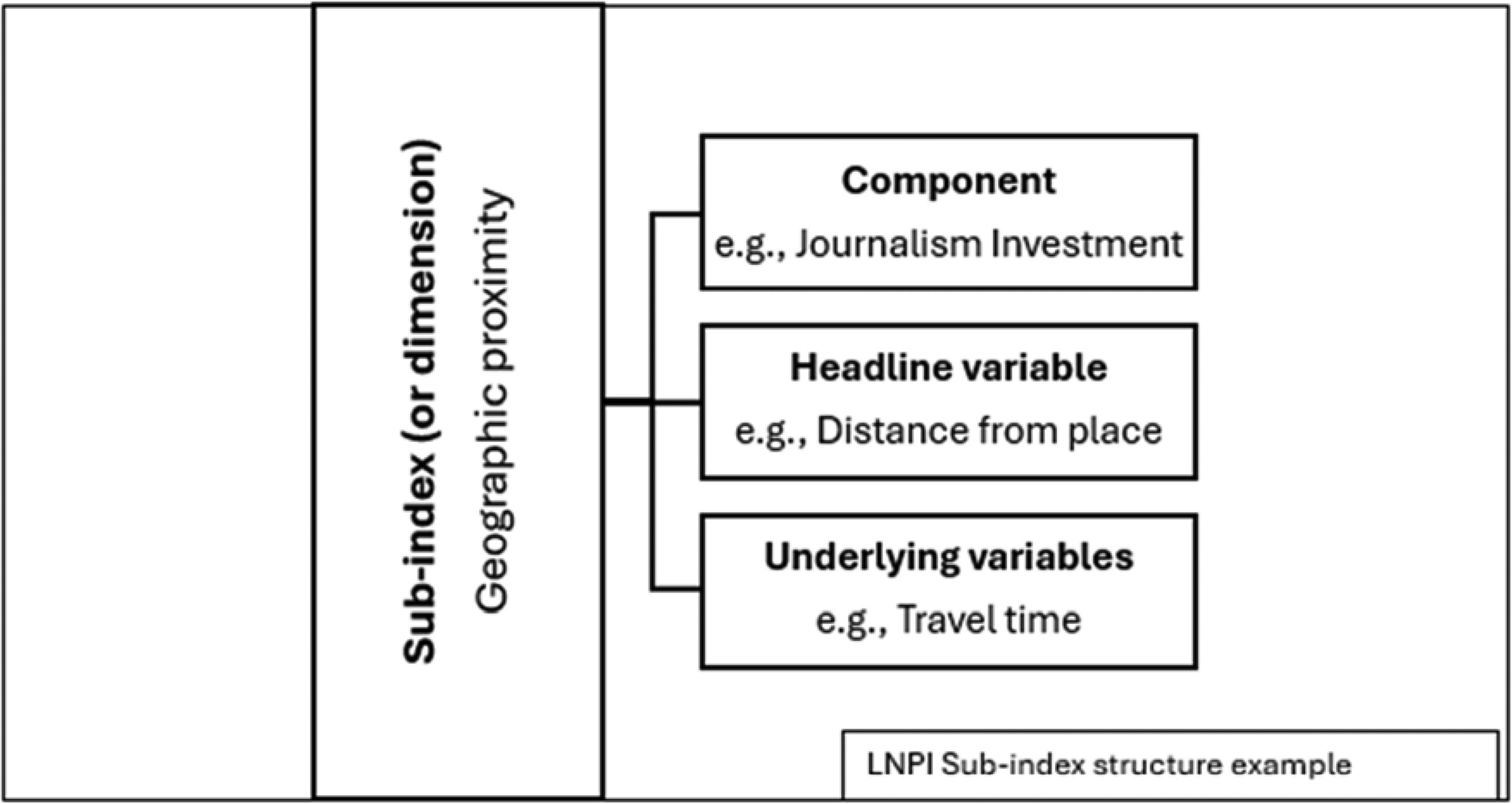
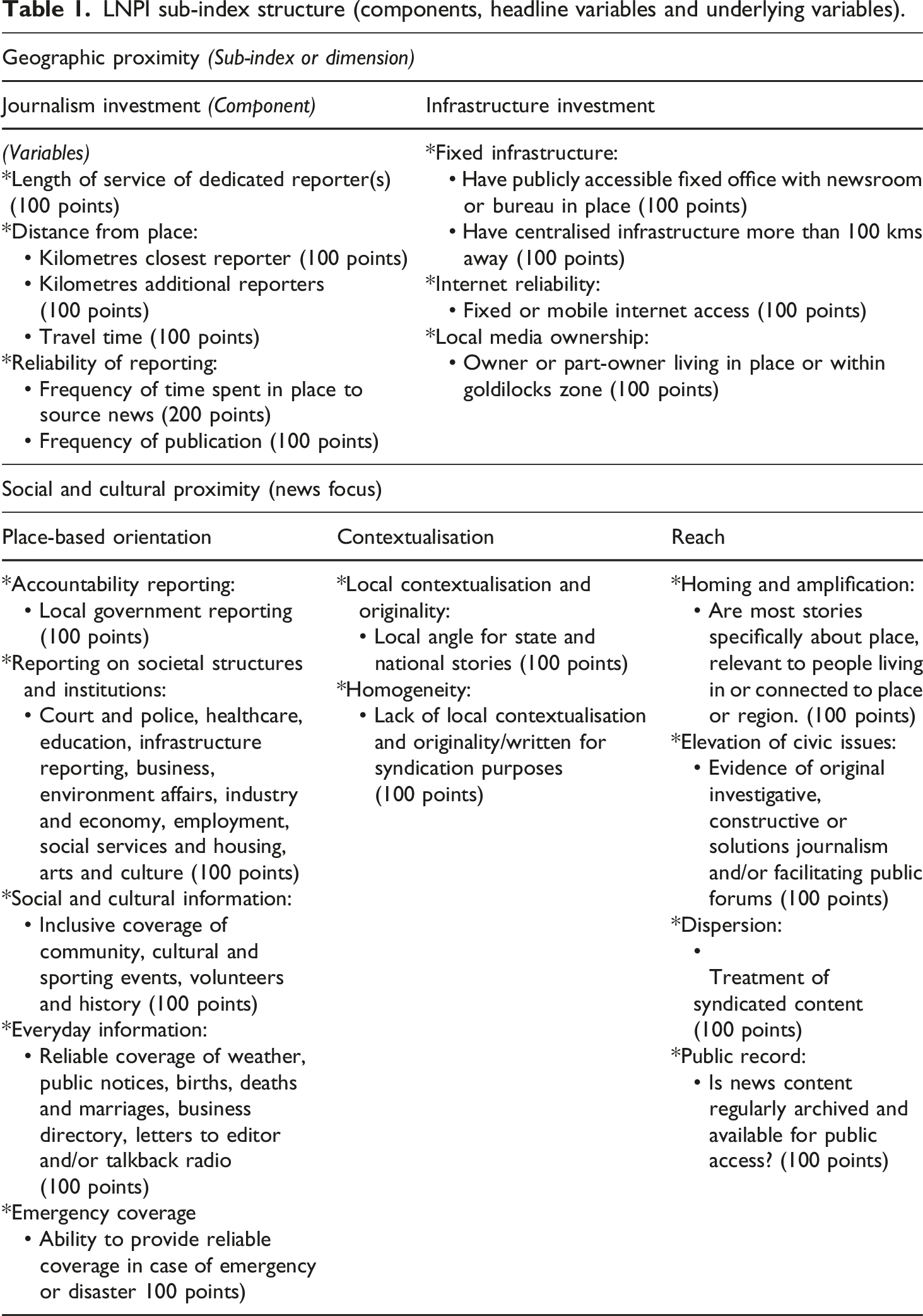
To populate the index, a 25-question online survey was developed using Qualtrics to provide an overall score demonstrating a local news service’s proximity to place. The survey is designed to be completed by news producers, researchers or auditors. Survey participants are invited to base their responses on a 4-week sample period of news coverage after identifying the primary town or city the news outlet serves. Questions are designed to align with the indicators above, such as “Where is the primary workplace of the news outlet’s closest paid reporter?”, “How often does at least one paid reporter visit the place to cover news and information?”, and “During the sample period, was at least half of the news outlet’s content syndicated or supplied and/or come from a wire service?”.
After completing the Qualtrics survey, a news outlet is given an overall score out of 2200 points and this score is converted into a percentage to represent their LNPI score. To consider the influence of both geographic and social and cultural proximity in the overall score, a percentage is also calculated from the two sub-index scores of 1100 (see Figure 2). There is one less question relating to the geographic proximity dimension, yet the overall score is 1100 because one question relating to commitment to news presence (fixed infrastructure) is given double points. This question is prioritised for double points because of its importance in determining overall local news proximity. For example, it is widely established that despite rising work-from-home practices, it is considered important for local news producers to have a public office to reinforce news presence and legitimacy (Maares et al., 2023). Each question has multiple choice answers that are assigned an automatic score from 0 to 100, to provide a score for each underlying variable. Each of the multiple choice question scores are based on the four types of local news proximity (see Table 2). The ALNPI index and sub-index scoring structure. Local news proximity index rankings.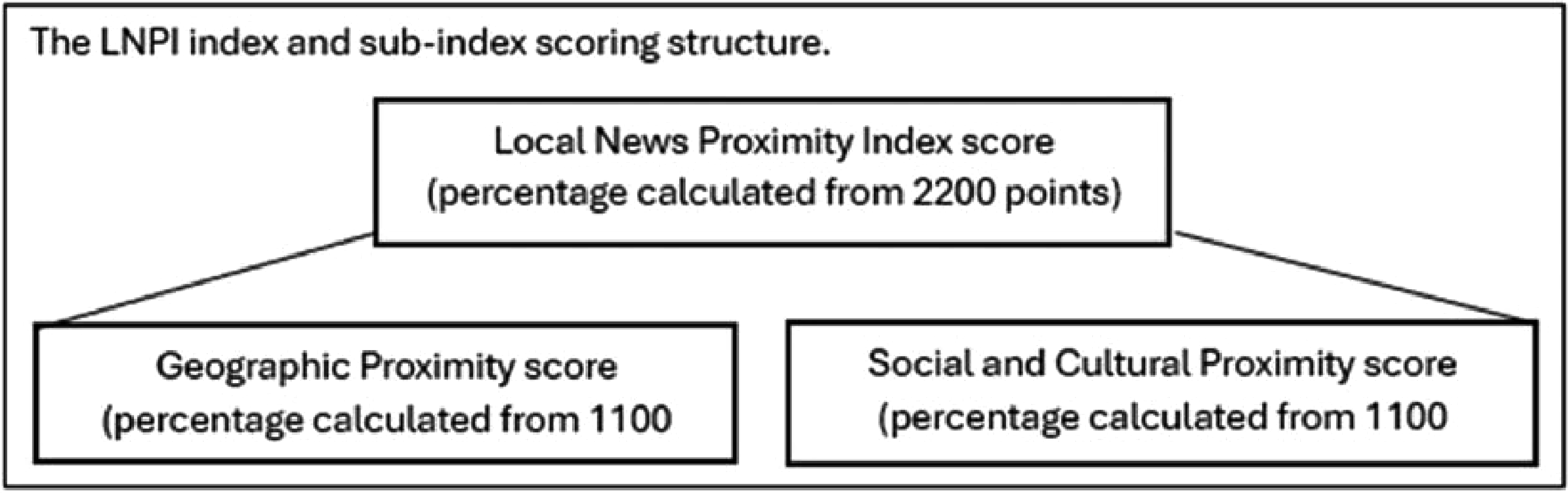
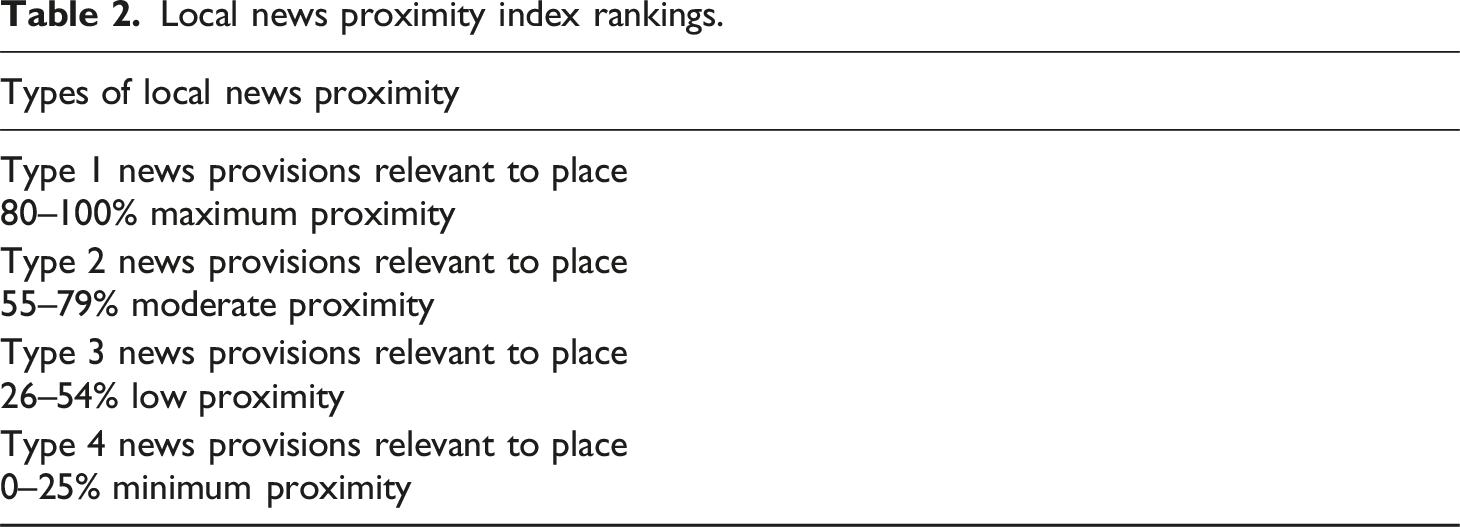
News outlets receive scores that place them in one of four types of proximal relevance from Type 1 to Type 4 for a specific place (see Table 2). In this way, a news outlet’s score is not uniform across a region; an outlet might produce news content demonstrating maximum local news proximity to one regional city yet demonstrate low local news proximity to a small town 50 km from its base that it also purports to serve. The purpose is to put each place at the centre of analysis, rather than the outlet. Type 1 news outlets tend to have a physical presence in a place and can demonstrate all or most of their news content focuses on providing relevant news and information specific to that regional city, town or locality. Type 4 news outlets, meanwhile, tend to have no regular physical presence in the place being surveyed and do not provide regular news coverage for or about a place. The characteristics of Type 2 and 3 news provisions can differ significantly, as they may be based physically close to a town or locality, yet their focus is not on providing local news for that place or they may be based outside of a town and attempt to cover a broad region. For the survey, the definition of news is quite specific to allow no room for confusion and for auditing purposes.
Although the survey has been designed for self-completion by local news producers, in the pilot stage, researchers completed surveys separately and compared results for reliability testing. Reliability is essential in quantitative surveys because of the need for consistency. Researchers used the established method of test-retest of reliability, with members of the research team comparing results on the same variables (locations and local news providers). Local mayors and librarians were also contacted to complete the survey with consistent results, the value of librarians to verify local news ecologies followed a pilot study in Canada (Lindgren, 2023). The survey was amended after each round of testing until consistency was achieved. In this testing phase, the surveys were first completed by members of the research team and once consistency was achieved, surveys were given to selected local news producers and their feedback incorporated into the survey design. This testing-retesting was completed for a dozen regional towns in different parts of Australia including Tenterfield in the state of New South Wales which is presented below. To strengthen the reliability of the tool, an additional step was added to the process to audit any overall proximity scores within two percentage points of the top or the bottom of a given type (for e.g., 78-82%). The auditing process involved a researcher conducting the survey using publicly available information online (for e.g., professional profiles on LinkedIn, news websites) and correlating the information with data generated from interviews with the local mayor and local librarian. Although auditing is a time-consuming process, the testing phase revealed very few results needed to be audited, due to receiving scores placing them closer to the middle types of news provisions relevant to a place. In what follows, we use the case study of Tenterfield to demonstrate real-world use of the LNPI and to conduct an analysis as an example of its practical and theoretical uses for academics, policy makers and industry.
Applying the index
In this paper we demonstrate the application of the index as it relates to the northern New South Wales town of Tenterfield. It has a population of about 4200 people. During the past 5 years it has been affected by a series of natural disasters and emergencies, from bushfires to major water contamination. It has been the subject of much academic interest, especially in regard to emergency management communication and recovery. As we will demonstrate, Tenterfield is also an example of how the Local News Proximity Index can reveal the extent to which a news outlet brandishing the name of a town in is masthead can be “local” in name only (Franklin, 2006).
Adopting the LNPI methodology above, the following table includes news providers that cover the town of Tenterfield. PIJI mapping data for Tenterfield Shire indicated the area was served by four local news providers including the Tenterfield Star (print and digital), the Northern Rivers Times (print and digital), 89.7 Tenterfield and Country Areas (community radio, known as ‘Ten FM’) and ABC New England North West (broadcast and digital). Other PIJI data indicated four other news organisations covered Tenterfield, including 10 Northern NSW (television), Brisbane Times (digital), Nine Northern NSW (television) and Prime7 Northern NSW (television). Importantly, PIJI’s baseline data only displayed the news outlets which purport to serve the Tenterfield shire; no independent analysis or auditing was conducted to consider the accuracy of outlet’s coverage claims.
The LNPI scores for the town of Tenterfield.
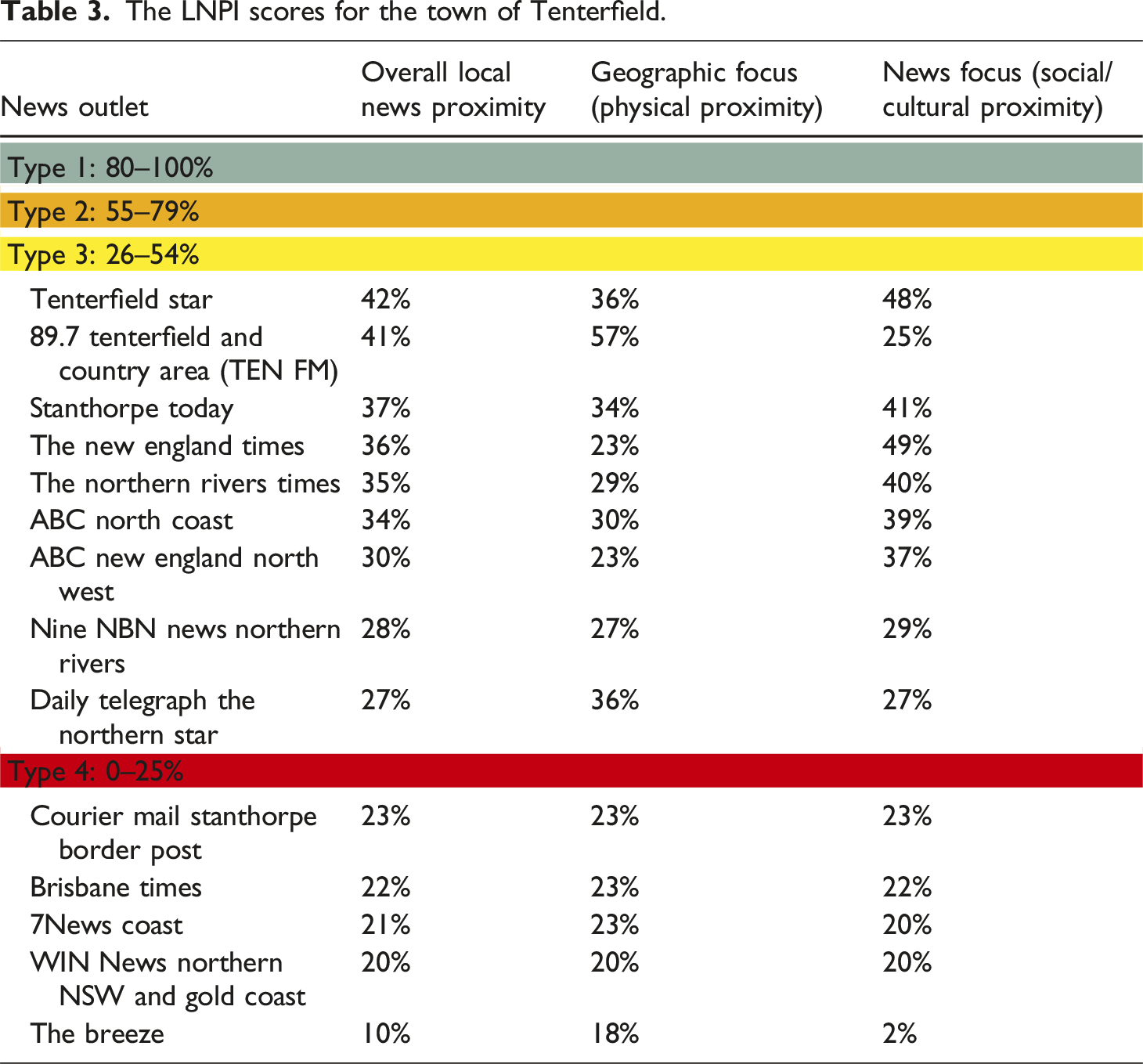
The index data highlights that Tenterfield has no Type 1 or Type 2 producers, meaning it is not served by any news outlets demonstrating combined high levels of geographic proximity, social and cultural news proximity (Table 3). Answers to specific LNPI survey questions relating to geographic proximity indicate that the only newsroom infrastructure physically located in Tenterfield is a local community radio station (89.7 Tenterfield and Country Areas), staffed by volunteer programmers. Community radio volunteers there highlighted their critical role especially in times of natural disaster by helping people stay connected with vital information but they did not have the resources, time or training to provide a full, reliable variety of critical information needs, undertake in-depth reporting or hold power to account (interview with author during audit of index survey, 15/3/2024). The data also illuminates the extent to which local mastheads, especially, can give the impression of being present in place when they are not. For example, our research indicates that the Tenterfield Star, which has a proud history of serving the township, now has only limited news presence and coverage in the area. The index survey indicated that the closest Star journalist was based more than 2 hours away (or almost 200 km) in Armidale, rarely visited the area and most stories did not relate specifically to Tenterfield, instead they had a broader regional focus or were syndicated content. The Tenterfield Star is owned by Australian Community Media, which has more than 100 regional newspapers across Australia. The Tenterfield Star has previously featured in academic literature on the history and significance of smalltown news outlets. Historian Rod Kirkpatrick highlights the newspaper was a political voice for and from the country since its establishment in 1870 and argued the case for Australian Federation and was the first small newspaper to lobby for the Australian Country Party.
To further demonstrate the issue of distance from Tenterfield, the editor of the paper, in an editorial in the Tenterfield Star in 2024, said: We are a small news team and often stories are sourced remotely, which is not ideal, but cannot be helped in many situations. We appreciate everyone who has been understanding and assists with information and the provision of photos (McMaster, 2024).
This example of the index’s application highlights how the LNPI can provide a more nuanced understanding of a location’s news ecology and reveal areas that may be vulnerable to lack of news access and the presence of public interest journalism. In this instance, it highlights that there are regionally focused and alternative news providers (Type 3 and (4) that include the town of Tenterfield in their area of coverage but there is a clear lack of geographically proximate news providers (Type 1 and (2) that have Tenterfield at the centre of their coverage. It is important to acknowledge in the example above that news providers may differ in their overall proximity score depending on the given ‘place’ in which they are assessed for providing news coverage. For example, a newspaper that has a low proximity score for one place may have high overall proximity in another, especially if the latter is where the majority of resources are consolidated. We also note that in the months following our assessment of the Tenterfield Star, its owner Australian Community Media (ACM) announced plans to stop printing the newspaper.
Conclusion
This positioning paper outlines the value of the Local News Proximity Index as a tool to help assess a locality’s access to essential or critical information needs in a given geographic place. While the Index and types of local news proximity were created to help produce evidence needed to develop a potential model for Australia’s main public broadcaster, the ABC, to support local news sustainability, there are several potential uses for this innovative tool and its value internationally. Placing news outlets into types of news proximity provides the granular data needed to help inform governments and industry about variances in local news gaps that exist across the country, whilst also providing a rich and nuanced data set for research on local news presence across regional Australia. We acknowledge there are times when social and geographic ‘distance’ may be appropriate for news reporting on local matters, especially given small-town reporters are at times criticised for being ‘lapdogs’ rather than watchdogs of authority because of their close ties (Nord, 2006). However, the literature on local news futures overwhelmingly highlights the importance of continuing presence, connection and need for investment to enhance the legitimacy and quality of local journalism (McAdam and Hess, 2024). The tool can also provide data to inform collaborative programs that might support type 1 news producers to expand indepth reporting, training and data journalism, especially when funding is limited and needs to be directed to areas that need it most. It should also be noted that the index is designed to be completed by individual news proprietors and managers who are intimately aware of their newsroom operations and may be applying to governments, foundations or organisations for subsidies or resource support. Our research indicates they are incentivised to complete the survey that informs the index in order to be considered for future funding or collaborative initiatives.
Some of the potential applications of the index include helping to provide a more nuanced understanding of ‘vulnerable areas’ at risk of losing or with limited news access and helping policy makers make more informed and targeted decisions about the type of news outlets that warrant support. The data may also provide essential information to encourage effective collaboration between news producers based on their capabilities and understanding of ‘places’, help start-ups identify local news gaps in the marketplace and provide more evidence to support efforts by policymakers, industry and academics to measure other important aspects of local news coverage, such as content quality and the quality of news service to increasingly diverse communities in regional Australia. We argue the LNPI is needed now, when there is increased concern for the equity of local news provision across the globe.
Footnotes
Declaration of conflicting interests
The authors declared no potential conflicts of interest with respect to the research, authorship, and/or publication of this article.
Funding
The authors disclosed receipt of the following financial support for the research, authorship, and/or publication of this article: This work was supported by an Australian research Council Linkage Grant No. LP220100053.
