




Abstract
The rise of disinformation has thrown news journalists into an epistemic dilemma. Traditional ideals and practices are challenged by societal changes, prompting journalists to search for solutions to maintain relevance in the information disorder. Building on 22 interviews with journalists in 12 Norwegian newsrooms this article investigates journalists’ understanding of disinformation, whether they consider it a societal problem, and how the spread of disinformation challenges their epistemic ideals and practices. The study is framed by theories of professional ideology, with a particular focus on objectivity. The findings support concerns about journalism’s relevance in the context of disinformation, revealing that journalists are actively engaging in professional reorientation while also exposing a division in how these challenges are perceived and addressed. While some emphasise traditional objectivity as a response to information disorder, others advocate a more pragmatic adaptation, warning that strict adherence to traditional ideals may limit journalistic practice and reduce relevance. Key findings include: (1) Journalists are reorienting ideals and practices in response to disinformation, even in Norway’s strong media sector. (2) A clear divide exists between traditional and pragmatic views of objectivity in addressing disinformation. (3) Journalists focus more on domestic than foreign disinformation, especially where alternative media are present.
Introduction
Journalistic ideals are constantly shaped by social changes and public discourse. Since the turn of the millennium, central ideals and values have become more ambivalent and fluid than before (Carlson, 2023; Hanitzsch and Örnebring, 2019; Koljonen 2013) leaving news journalists in a constant state of flux. Stable ideals such as truthfulness, objectivity and impartiality, shared by newsrooms worldwide (Hanitzsch et al., 2019; Hornmoen and Steensen, 2021), are scrutinised for resilience in the face of information disorder.
Significant shifts in the media industry, due to technological breakthroughs and increasing competition in the digital mediascape, has led to a reassessment of journalistic ideals (Olsen et al., 2021; Trattner et al., 2022; Westlund and Ekström, 2020).
Correspondingly, the online circulation of mis- and disinformation has emerged as a global challenge driven by major political and societal events and amplified by technological innovations that enable large-scale digital dissemination. As false or misleading content circulates alongside legitimate news, distinctions between fact and fiction blur, diminishing public trust in journalism and making it increasingly difficult for journalists to uphold the boundary between accurate and false information (Bradshaw and Howard, 2019; Kapantai et al., 2021; Marwick and Lewis, 2017).
Journalistic ideals function not only as a moral compass but also as practical guidelines embedded within the systematic routines of news production, including epistemic processes of knowledge assessment (Mellado, 2015; Weaver et al., 2007). In this era of widespread information disorder, the epistemic ability to distinguish fact from falsehood has become increasingly important (McNair, 2017; Steensen et al., 2022). Questions are being raised whether journalists have the skills and know-how to search and assess sources and information to not only produce credible truth-claims, “but to do so in a way that breaks through the information disorder and gains the publics’ trust” (Steensen et al., 2022: p. 2120). The reconfiguration of public discourse brought about by disinformation, which normalises perspectives once confined to the margins, further complicates journalists’ ability to uphold epistemic standards and maintain their role as trusted knowledge guardians (Hopp and Ferrucci, 2020; Nygaard, 2021). These rising challenges have created a sense of professional panic within the journalistic community (Wahl-Jorgensen and Carlson, 2021).
The ongoing reassessment of professional ideals builds on the normative principle that journalism sustains democracy by ensuring citizens’ access to reliable information on societal issues - knowledge that is essential for competent participation in democratic processes (Berelson et al., 1954; Moe et al., 2020; Siebert et al., 1963). Central to upholding this democratic function is journalism’s ability to establish a credible connection between news and truth (Kovach and Rosenstiel, 2007; Pavlik et al., 2020; Westlund and Ekström, 2020).
In light of these challenges, the article examines how information disorder forces journalism into a process of reorientation. Drawing on a Norwegian study based on 22 in-depth interviews with journalists from 12 different newsrooms, conducted shortly after the 2021 Norwegian election, it investigates how journalists assess traditional values and ideals embedded in the epistemic news process, and how these ideals hold up in the face of disinformation. The study also explores how journalists interpret the ambiguous terminology surrounding information disorder and whether they regard disinformation as a broader societal threat.
The research is set in Norway, a stable welfare democracy with a technologically advanced and hybrid media landscape supported by media policies seeking to promote media diversity and digitalisation. A strong legal framework, editorial independence, and a vibrant media market have consistently placed Norway at the top of international media freedom rankings (Ihlebæk et al., 2024; Reporters Without Borders, 2025). The Norwegian media industry has undergone a relatively smooth shift from print to digital despite broader industry disruption (Olsen et al., 2021), and journalism has maintained high levels of public trust and relevance. In recent years, editor-driven news organizations have become increasingly attentive to the strategic use of information and its potential implications for journalism (Samuelsen, 2025).
Given this context, Norwegian journalists are in many ways well positioned to address professional challenges due to disinformation, making Norwegian newsrooms’ handling of the professional reorientation a particularly interesting case to study.
The study is grounded in theories of professional ideology, with a particular emphasis on objectivity throughout the literature section. Following a brief introduction to the research method, the next sections present and analyse the interview data, leading to concluding remarks.
Literature and theory
Key terms
In discussions of journalism within a post-truth context, key terms such as misinformation, disinformation, and fake news play a central role. The multiple understandings of these terms serve different political and ideological interests, and they are as much discursive tools as actual realities (Farkas and Schou, 2019). Clarifying how informants understand these terms provides a common basis for analysing how journalists perceive the false information that constitutes the information disorder.
The main concept of this article, disinformation, can be defined as “… Verifiably false or misleading information that is created, presented and disseminated for economic gain or to intentionally deceive the public (European Commission, 2018). Wardle and Derakhshan (2017) distinguish disinformation from misinformation by intent: disinformation is deliberately false and harmful, while misinformation is false but not intended to cause harm. Despite this difference, both can have similar impacts, and the distinction is often unclear (Bay and Šnore, 2019; De Blasio and Selva, 2021). Journalists who fail to verify facts may unintentionally spread misinformation.
The term fake news which can be defined as “articles based on false information packaged to look like real news to deceive readers either for financial or ideological gain” (Tandoc et al., 2018: p. 674). Lately the concept has been used by politicians around the world to describe news organisations whose coverage they find disagreeable (Kalsnes, B., Falasca, K., & Kammer, A., 2021). This has led to the term being perceived as problematic by editor-controlled media.
Dissemination of disinformation is not illegal in Norway unless a foreign state is responsible, either directly or by influencing domestic actors. Political parties, communications agencies and commercial companies may exert influence on public opinion through selected information. This is part of democracy and freedom of expression, regardless of whether the information disseminated is correct, strongly angled or false.
The impact of disinformation
Deliberate dissemination of false or highly angled information has been used as a weapon in politics and war throughout the ages, described with terms such as propaganda or hybrid warfare. What distinguishes the current landscape is the complexity and extent of the information pollution (Bradshaw and Howard, 2019; Marwick and Lewis, 2017; Wardle and Derakhshan, 2017), complicating journalism’s normative functions.
Disinformation has blurred the line between facts and falsehoods, making access to diverse information a societal challenge. The digitization of society has amplified this issue by enabling new players to produce and distribute content outside traditional media - content that can go viral and infiltrate mainstream news channels through direct citation or unverified repetition by journalists in fast-paced news cycles. This undermines trust in journalism and its democratic role (Ireton and Poseti, 2018; Marwick and Lewis, 2017). Even well-intentioned efforts to debunk mis- and disinformation, may cause further spread of the false narratives (Wardle, 2022). Disinformation challenges not only journalism but also the media’s traditional role in sustaining a healthy public sphere (Christians et al., 2010; Siebert et al., 1963). It shifts the boundaries of public discourse, as views previously seen as extreme are increasingly treated as part of legitimate debate (Hopp and Ferrucci, 2020; Nygaard, 2021), moving from Hallin’s Sphere of Deviance into the Sphere of Legitimate Controversy.
These challenges, driven by the dynamics of information disorder, are driving journalists to seek ways to remain relevant and uphold their professional ideals. To understand how this reorientation is experienced within the profession, the first research question asks: How do Norwegian journalists understand disinformation, and to what extent do they perceive it as a societal problem?
Professional ideology
The societal changes in the information field, affect journalism. At the same time, many work patterns remain stable. Systematic routines of news work, associated with providing relevant, accurate, and verified public knowledge, help distinguish journalism from other forms of information production (Ekström, 2019; Kovach and Rosenstiel, 2001; Westlund et al., 2021). The news routines are based on professional ideals valid across cultures and national borders. In The Worlds of Journalism Study conducted across 67 countries, a consistent agreement/consensus was found regarding journalists’ professional orientations: that they should report things as they are, be independent, provide analyses of important events and let people express their opinions. Ideals such as truthfulness, objectivity and impartiality are shared by newsrooms all over the world (Hanitzsch et al., 2019; Hornmoen and Steensen, 2021).
Correspondingly, there are indications that journalistic ideals are evolving, as mainstream media adopt more transparent practices to rebuild trust and distinguish themselves from less regulated digital platforms (Van Dalen, 2019). While citing sources is nothing new, the push for greater transparency around journalistic methods has become increasingly emphasized in recent years (McNair, 2013; Kovach & Rosenstiel). Transparency is more often promoted as a professional norm, in response to the challenges to journalistic authority in the digital age (Deuze, 2005; Koliska, 2015). As Weinberger (2009) puts it, transparency is the new objectivity, replacing assumed neutrality with a “show, don’t tell” approach – where journalists are earning trust by showing evidence instead of just saying it.
Objectivity
One of the main features of journalism’s self-image is objectivity. The ideal of objectivity implies reporting without traces of commentary, interpretation and speculation. It can be understood as both a moral guideline, a toolkit of reporting and editing practices, and an observable pattern of news writing (Deuze, 2005; Schudson, 2001; Ward, 2004, 2010). In this article, I will discuss two forms of journalistic objectivity, traditional and pragmatic objectivity.
The belief in objectivity as a method is echoed in many journalism textbooks. It adheres to a binary epistemology that distinguishes between true and false, stating that journalists should only report accurate and unbiased information. News articles should be based on understandable and verifiable facts, presented without interpretation and preconceived opinions (Steensen et al., 2022; Ward, 2004). The Norwegian media industry frames objectivity foremost as a cornerstone of politically neutral journalism (Hornmoen and Steensen, 2021).
Questions have been raised as to whether it is realistic to obtain traditional objectivity. When discussing the possibility of neutral, value-free, reporting, Ward (2015) refers to the critique by leading sociologists such as Durkheim and Weber who argued that facts and realities are socially constructed and politically negotiated, and therefore subjective rather than objective. The notion of objectivity is only valid in specific contexts, disciplines, or eras, and journalists make a series of value judgements (Ward, 2015). Subjective assessments will always come into play when journalists select and weigh information and pass on news. In that sense traditional objectivity could become a strategic ritual more than an ideal, a journalistic routine meant to disarm critics and minimise the risk of libel suits (Tuchman, 1972). Despite the reservations, objectivity remains a valuable ideal. The pursuit of objectivity gives the audience some level of assurance that a journalistic text is founded on the aspiration to search for truth, making it central to public trust (McNair, 2013). The method is objective, not the journalist (Kovach and Rosenstiel, 2021).
Pragmatic objectivity emphasises a more context-dependent understanding of objectivity, where what appears objective to some may not be objective to others. This modified ideal allows for the existence of shades of both right and wrong without drawing a hard line between facts and values, eliminating all judgement and evaluation in reports (Ward, 2004). Pragmatic objectivity is based on an attitude that we do not have direct and immediate access to reality “as it is” but rather evolving our knowledge of the world through various codes. In that sense ‘pragmatic objectivity’ shares similarities with hermeneutic views that emphasise understanding through interpretation and re-interpretations of the sources of information we have available (Gadamer et al., 2013). This is particularly applicable to journalism that deals with human and social life where understanding of phenomenon will always be coloured by the interpreter (Steensen et al., 2022).
To move the discussion of objectivity into the societal structures that shape journalism, Hallin’s (1986) theory of news framing provides a useful analytical tool. The sphere model demonstrates how news media divide information into three overlapping spheres: the Sphere of consensus, the Sphere of legitimate controversy, and the Sphere of deviance. Views and topics are treated differently depending on their assigned sphere.
The ideal of objectivity is particularly relevant within the Sphere of legitimate controversy, where journalists are expected to fairly represent competing viewpoints. However, the model also reveals how judgments about what counts as a “legitimate” view are shaped by broader social and institutional influences (Hopp and Ferrucci, 2020). This support that objectivity is not merely a reporting technique, but more of a context-dependent practice, closer to pragmatic objectivity than the traditional ideal.
News production
The ideals of journalism are manifested in the daily practice that encompasses the process of creating news that is timely, objective and accurate. Descriptions of the various production stages show how news production is more linked to practical knowledge that is embedded in the workplace culture and handed down from experienced to newer journalists, than formal knowledge (Domingo et al., 2008; Shoemaker and Reese, 1996; Tandoc et al., 2019). The routines may build on “unstated rules and ritualised enactments that are not always made explicit” (Reese and Shoemaker, 2016: p. 399). Routines may both enable and restrict the individual journalist’s autonomy, creating predictable, legitimate, and appealing coverage in a work environment with ever-pressing deadlines, limited resources, and an inconsistent supply of sensational news stories (Hanitzsch and Örnebring, 2019; Lindner, 2017).
Research into media organisations has been fairly consistent. Despite the creative nature of the media industry, content is systematically more influenced by organisational routines, practices, and goals than by personal or ideological factors (McQuail and Deuze, 2020). Embedded in these routines of news production, is the epistemic process. The exercise of assessing knowledge claims of others, before making knowledge claims of their own, may be understood as both an ideal of journalism as well as a practical dimension of the professional role (Carlson, 2023; Mellado, 2015; Weaver et al., 2007). Most journalists do not hold any strong convictions about epistemology in the philosophical sense, but they may care a great deal about following procedures that they view as the best guarantee of doing a good job, such as verification, fact-checking and critical questioning (Örnebring, 2016).
The norms of contemporary journalism are undergoing shifts concerning aspects of epistemology, including neutrality, objectivity, fact-checking, and transparency (Ekström, 2019). Which leads us to research question 2: To what degree do Norwegian journalists find that problems of disinformation challenge their epistemic ideals and practices?
Methods
The study is based on 22 semi-structured interviews with Norwegian journalists, managers, and editors conducted during November and December 2021, following elections the same year. Election periods are particularly vulnerable to influence campaigns and disinformation was already a government priority, which likely increased journalists’ attentiveness to the issue.
Overview of the 12 media houses part of the study. Source: MBL (Medietall.no, 2023-figures, 3rd quarter).
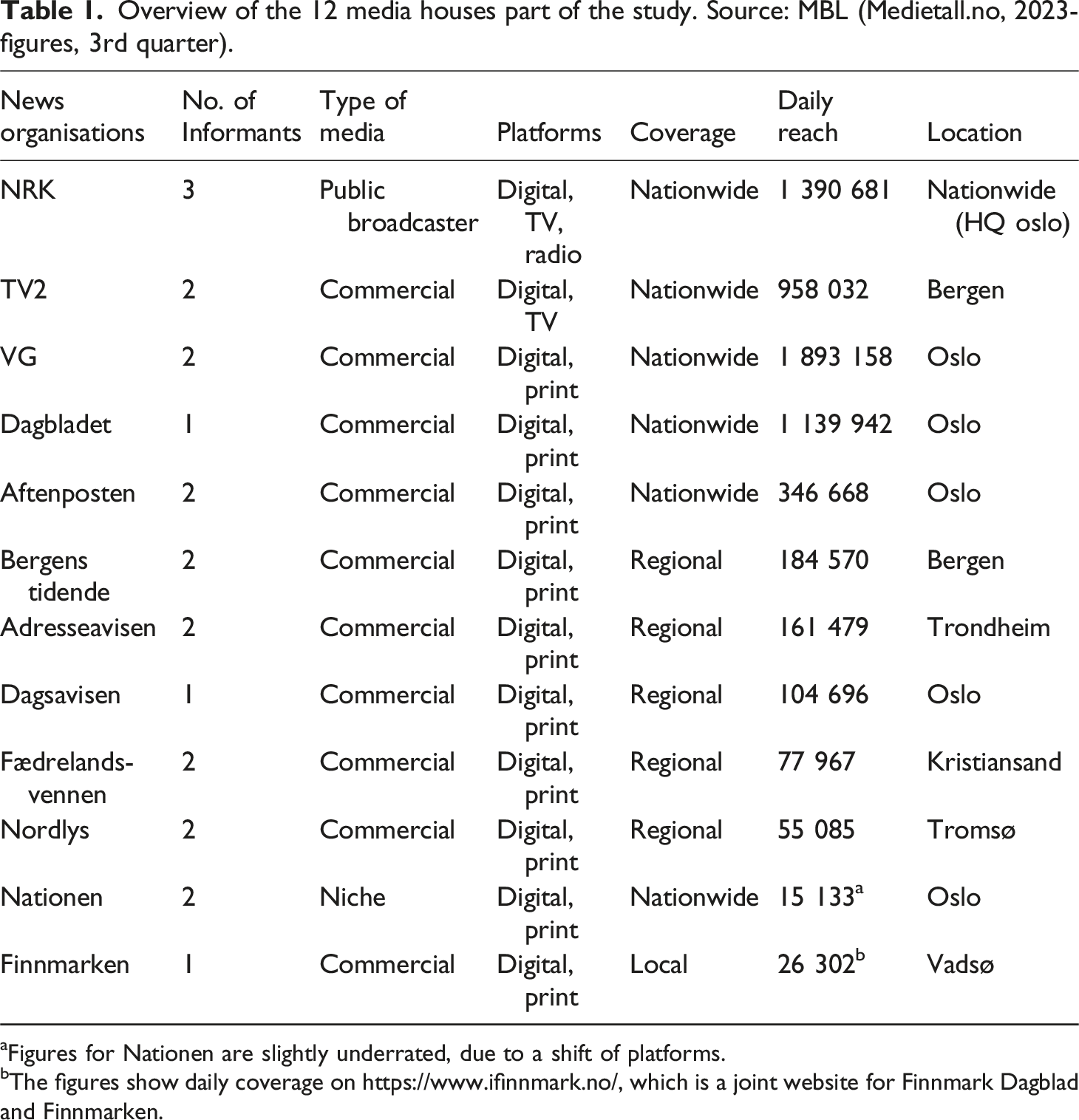
aFigures for Nationen are slightly underrated, due to a shift of platforms.
bThe figures show daily coverage on https://www.ifinnmark.no/, which is a joint website for Finnmark Dagblad and Finnmarken.
The 12 media houses are among the most influential in Norway, varying from national outlets, such as the public broadcaster NRK, to leading regional papers, and a small, local newspaper in Finnmark, North in Norway. They are chosen for their influence, reach and geographic diversity. The paper Finnmarken was included due to its proximity to the Russian border. Northern Norway has closer connections with Russia than the South, making it more vulnerable to Russian disinformation. Russia is the main source of disinformation targeting Norway (Sivertsen et al., 2025). The informants were selected based on their type of work and beat, targeting permanent staff who covered political and societal matters. Another selection criterion was that I had no prior connection with the journalists, considering my background in journalism.
My research is not independent of my own cultural and historical affiliation, as outlined in the concept of reflexivity (Hammersley and Atkinson, 2019). After more than 20 years in the media industry, I share many of the same social structures as my informants, and there can be a risk of cultural blindness (Wadel, 1991). At the same time, my knowledge and network in the media industry have made it easier to select media houses and informants and - most importantly - to gain access. Only two of the targeted journalists declined due to practicalities.
Among the 22 informants, 15 are men and 7 are women, aged 26 to 63, with an average age of 42. When asked about their journalistic experience, responses vary: most specify the time spent on the relevant beat (averaging 4 years), while others refer to their total journalistic experience (an average of 5 years). Most hold higher education degrees (bachelor’s or above). Five informants lack a degree, but all began higher education before journalism “got hold of them”.
I used a semi-structured interview guide allowing for follow-up questions and a sequence of Grand Tour questions (Spradley, 1979), in which informants described a specific work process. The interviews lasted between 45 minutes and 1.5 hours and were conducted either at the journalists’ workplaces (13), in a quiet office at my university (1), or via Zoom (8). Only the interviewer and informant were present. Interviews were recorded, transcribed, and imported into NVivo, a software program designed for coding and analysing unstructured text. The research was approved by the research ethics board at Oslo Metropolitan University. All informants gave their consent to participate in the study.
Findings and discussion
The findings will be presented and discussed according to the research questions, starting with journalists understanding of key concepts and the societal implications of disinformation, before turning to how traditional ideals and practices align with the challenges disinformation poses to journalism’s epistemic process.
The understanding of key terms
Throughout the interviews, journalists define some of the key terms used to describe the information disorder, such as misinformation, disinformation and fake news. Most of them know the difference between misinformation and disinformation, how the intention divides the two, while a few call them synonyms. They show greater engagement when describing the concept of Fake News, which they connect with social media and President Trump. A narrow majority raises concerns about how the term can be used to weaken journalism that challenges the establishment. As one puts it: “… It’s abused by powerful people who think journalists are asking difficult questions” (informant 18). Some of the informants have themselves experienced being accused of spreading fake news, this particularly applies to informants who have alternative media nearby.
The informants recognise social media as the main channel for the dissemination of disinformation. A few also mention the possibility of disinformation spreading through traditional media by unsuspecting journalists who forward false information. Most express a need for greater knowledge on how to effectively address disinformation; only two of the 22 informants feel confident in their ability to identify and expose falsehoods.
It may not be important for journalists to be familiar with these terms, as they tend to use more mundane language. However, their level of familiarity can still provide insight into their understanding of the field of and views on whether disinformation poses a societal threat. When asked about any societal consequences of disinformation, they highlight growing polarisation, mistrust and uncertainty regarding truth. In general, they regard disinformation as a possible threat to democracy but do not believe Norwegian society is particularly at risk today. At the same time, several advocate being more vigilant. Linking societal changes to the conditions of journalism, they expressed concern about the weakening reach and impact and failing trust in traditional media due to the spread of disinformation.
The societal dilemmas of disinformation
The journalists highlight the necessity of being a counterweight to false information - maintaining a difference between editor-controlled media and different forms of social media – and they speak unprompted about journalism’s social responsibility They have a normative point of view emphasising journalism’s ability to distinguish between fact and fiction and sort out what is important information for the public. Principles that may be challenged by social media and other information providers. As one puts it: “If the algorithms only present what most are interested in and click on, then we lose quickly” (informant 17).
Some informants mentioned feeling pressured to produce journalism that aligns with what goes “viral” on social media. The new competition is shifting the boundaries of what is considered news. Journalists are influenced not only by commercial interests and the pursuit of online engagement but also by the need to remain relevant across diverse social groups. It’s a problem if people feel that there are truths out there that are not covered in the newspaper. And sometimes it is not mentioned in the newspaper, because it is not true, or it is a twisted truth, or, because we have to make sure to cover it in a proper way according to ethical guidelines, which others do not have to bother with. Informant 11
Several state that today’s journalists bear a great responsibility which “maybe bigger than we can handle … fighting extreme economies, like Facebook and others“ (informant 13). In large, I find a dichotomy among the informants; some lean towards the view that traditional journalism serves as a robust enough defence against disinformation and other false narratives, while others express frustration with the development, fearing potential losses for journalism.
The informants emphasise that information disorder necessitates a shift in the epistemology of news production. Several mention the need for greater transparency in source selection and fact-checking practices to help the public distinguish traditional journalism from other information providers. They also address the representativeness of journalistic objectivity, expressing concern that if journalism fails to reflect both majority and minority perspectives, it may contribute to the emergence of parallel realities within society.
Disinformation challenges ideals and practices
The findings indicate that journalists are concerned about disinformation and seek strategies to address it. Their reflections on the profession’s future are grounded in traditional ideals such as objectivity, truthfulness, and journalism’s social responsibility. Through the interviews, they describe their day-to-day news work, emphasising how these core ideals shape their routines and practices. One of the journalists gives details of the epistemic process he undergoes when producing content, without using the term directly, describing routines of source criticism, fact-checking and transparent reporting, that aligns with the traditional ideals. I believe that editorial media have a more important job and role than ever when it comes to doing the job of fact-checking, being critical of the sources, selecting the information we pass on, to ensure that people have confidence in the information that we pass on. Informant 9
Overall, the findings show two trends that are not mutually exclusive. On the one hand, the traditional ideals of news work such as truthfulness and objectivity have gained increased importance in the face of disinformation. Many informants see these ideals as guidelines when describing the professional role, enabling them to take a counterbalancing role to information disorder. Others doubt whether traditional ideals are relevant in the face of disinformation. They worry that the ideals will limit their ability to stay visible in the chaotic information sphere.
The findings align with the dichotomy previously mentioned, between advocates for the traditional ideals, and the informants ambivalent to the relevance of these ideals in the face of disinformation. It’s the ideal of objectivity that is most debated, and parts of the findings will be structured and analysed within the two forms of objectivity – traditional objectivity and pragmatic objectivity. While the first group of informants adheres to what we may call a binary epistemology - i.e., a form of logical positivism that clearly distinguishes between true and false, fake and real - the second group adopts a more pragmatic, context-dependent understanding of traditional ideals, where what appears objective to some may not be to others.
The traditionalists
The biggest change I've seen as a journalist is that we talk so much about the truth. It’s very different from when I started working or when I studied, when there was much more talk on how objectivity does not exist ... and that the objective truth was just a construction. Informant 22
Several informants comment on the necessity of truth in journalism. One explains how truth is now on the agenda whenever journalists meet. Another mentions that it is a word you hear everywhere, whereas before it was only mentioned in church. They describe a new awareness among journalists of the profession’s fundamental ideals.
Most of the informants uphold objectivity as a guiding principle, describing it as a return to traditional journalism, the sober observer who conveys the facts of the matter. They use terms such as impartial, objective, truthful, and transparent, and some explicitly refer to the ideal of objectivity when describing the journalistic role. None of the informants advocate abandoning the principles of objectivity and truthfulness in the face of mis- and disinformation. Instead, they adhere just as strongly to these ideals as they do to their sense of social responsibility. They argue that professionalism is what sets them apart from other content producers, and that holding on to traditional ideals will enable them to serve as a counterweight. Maintaining journalistic quality, they claim, will be essential to competing with more sensational content.
At the same time, there are tensions among the informants regarding the ideal of objectivity, and some of the journalists refer to difficulties in having an agenda but putting it aside. A few of the informants also mention the possibility of taking a more visible, activist position to compete with the more sensational content in the flood of information.
The pragmatists
A minority of the informants have a more pragmatic and context-dependent understanding of the ideal of objectivity. They question the value of traditional objectivity in face of disinformation, arguing it may limit the reach of journalism in an information sphere where the personal and activist content often wins over fact-oriented news. They allow for greater variations in how to be faithful to the ideal, with the aim of maintaining a role as relevant information providers.
The pragmatic informants introduce the notion that what appears objective to some may not be perceived as objective by others. During the interviews, the journalists discuss whether a rigid application of the ideal of objectivity might exclude social groups that fall outside mainstream society. A few links objectivity to the tendency to rely on reliable, official sources as a safeguard against publishing content that contradicts established facts and views. A limited source base may prevent more marginal attitudes from reaching the public debate and lead to these groups looking elsewhere for information. Such a scenario could create mistrust between journalists and part of the audience, they fear.
Some of the informants unsolicited brought up representativeness in the newsrooms, showing concern about the consequences for society if journalism fails to embrace the minorities. At the same time, the inclusion of different voices created a lot of frustration. You kind of have to explain that there are different opinions here in order to promote inclusion. At the same time, you can't keep passing on opinions about how man-made climate change doesn't exist. Finally, you just have to say that this is nonsense, this is not what we're talking about... you just need to clear something out of the way. Informant 12
A key factor influencing the informants’ pragmatic understanding of objectivity is their experience with, and relationships to, alternative media outlets. Notably, informants express greater concern about disinformation from domestic actors than from foreign state sources. The final part of the findings examines how competition from these alternative outlets, operating within the same media environment, frustrates journalists and, in some cases, influences their epistemic practices.
Constant competition from social and alternative media is also reflected in self-imposed limitations on what to cover and which sources to use. Some journalists say they avoid topics that have been “taken over” by alternative media to avoid being drawn into a position where they must debunk alternative narratives. It may align them too closely with government perspectives and create the impression that they are collaborating, warns one of the journalists: “We will be the ones who represent common sense, and they will be the ones who represent the madness” (informant 14). The positioning involves some dilemmas. Although journalists often trust official sources, they are reluctant to side with the government, as this could compromise their watchdog role.
Four of the 22 journalists interviewed work for regional media houses that have faced close competition for public discourse from two local, right-wing alternative media sites in recent years. These four informants say they often discuss professional responsibility and how to practice journalism in such an environment. One of them mentions that he has stopped himself several times from creating a story about the alternative competition for fear of being too biased I’ve had to tell myself that if they campaign in the public space and people react to it, then it’s a story. But the fact that they sit every Wednesday and every Sunday and spread disinformation, which maybe should have been covered, I just haven’t been man enough to do it. (code removed to prevent identification between code and media house)
The same informant decided to ask the alternative media actors for an interview after they had spread disinformation targeting school children. They greeted him with a mobile phone on a selfie stick, filming the entire session. He refers to it as a “huge dilemma”; if he tries to counter the false information, he will be part of their mainstream media narrative. He will be the story and thus contribute to their viewings. If he doesn’t act, he questions whether he fulfils the obligations of being a journalist.
The sentiment aligns with the ambivalence described by many of the informants regarding debunking. They are reluctant to be seen as arbiters of truth, judging content published by others. It can challenge the objective ideal and take time away from their own journalism.
How to handle the alternative competition has led to disagreements among staff in a regional media house in Southern Norway, where alternative media was active in the run-up to the 2019-election. For my own part, I've moved on from (regarding them as) something we didn't take seriously, we didn't write about them at all. It was just some people on social media saying a lot of weird things … It was probably the biggest misjudgement that has been made here in recent years. (code removed to prevent identification between code and media house)
The journalists’ reflections highlight how newsrooms have often disregarded more extreme voices, placing them within the Sphere of deviance (Hallin 1986) and excluding them under traditional, objective journalistic norms. In the current media landscape, such a practice risks confining journalism itself to the Sphere of consensus (Hallin, 1986), thereby diminishing its relevance and ability to compete within the context of digital information disorder.
A more pragmatic form of journalism - placing greater emphasis on diverse perspectives and allowing for increased journalist visibility - may increase engagement, reach marginalised groups, and better fulfil journalism’s normative role of informing all the public. However, this approach involves certain risks. When The New York Times expanded its critical coverage of the QAnon movement from 2017, it brought increased attention to the conspiracy theories, inadvertently contributing to legitimisation of fringe views and the spread of misinformation and disinformation (Hopp and Ferrucci, 2020).
Conclusion
In a time of growing uncertainty for the field of journalism, this study aims to deepen our understanding of how disinformation affects journalistic ideals and professional practices. This is explored through two key research questions: (RQ1) How Norwegian journalists understand disinformation, and to what extent do they perceive it as a societal problem? And (RQ2) To what degree do Norwegian journalists find that problems of disinformation challenge their epistemic ideals and practices?
In response to RQ1, the findings reveal widespread concern about journalism’s continued relevance in the face of disinformation, prompting professional reorientation rather than professional panic. The journalists demonstrate an awareness of the challenges they face and engage in self-reflection, critically assessing both individual roles and the profession as a whole. They are actively exploring strategies for navigating information disorder. The results from the well-positioned Norwegian media industry align with broader research that highlights a growing sense of discomfort among journalists. Scholars such as Tandoc et al. (2019) refer to this period as a critical incident for journalism, compelling journalists to “reflect on their values and norms'' (p. 677). Similarly, Waisbord (2018) emphasises the need to situate journalistic norms, routines, and ethics within the shifting conditions of public communication and truth-telling (p. 1874).
In response to RQ2, the findings reveal a division among Norwegian journalists regarding how disinformation challenges their epistemic ideals and practices. One group upholds traditional objectivity as a key defense against information disorder, emphasising its role in maintaining journalistic credibility. The other calls for a more pragmatic interpretation, arguing that rigid objectivity may limit journalism’s impact in a media environment where personal and activist content often overshadows fact-based reporting. This tension reflects ongoing debates in the field (Ward, 2004) and is echoed in similar studies from neighbouring countries (Farkas, 2023). The conceptual elasticity of objectivity raises questions about its continued usefulness in both journalistic practice and academic discourse. Yet the findings indicate that neither traditionalists nor pragmatists are ready to abandon the ideal. Instead, they are exploring new ways to uphold it in an evolving information environment, keeping the concept both relevant and adaptable.
The blend of falsehoods and truths causes significant frustration, especially among pragmatists. If they choose to play a more active role in clarifying what they consider real to the public, they risk alienating minority groups and creating democratic challenges. It can also bring them in line with established authorities and position them as “mainstream” media. At the same time, there is uncertainty about whether they are truly fulfilling their social responsibility if they abstain from engaging in this struggle. These dilemmas are particularly pronounced among journalists who find themselves in close proximity to disseminators of disinformation and have been forced to critically reassess their roles. Notably, domestic alternative media, rather than foreign sources like Russia, pose their greatest challenge.
Future research may further examine how epistemic ideals like objectivity are being redefined in response to disinformation and delve deeper into the gap between traditional and pragmatic approaches to journalistic ideals and practices. In an evolving media landscape, such studies could help determine whether these internal divisions reflect a broader shift in the profession. Comparative research across media systems and contexts could also show how widely these tensions are experienced.
Norwegian journalism has not witnessed a comparable decline in relevance seen in other countries and its journalists are in many ways well positioned to address the challenges from disinformation. However, the findings show that this relatively privileged group of journalists expresses frustration and uncertainty regarding the contemporary relevance of journalistic ideals, suggesting that journalists elsewhere might face even greater challenges. Given that journalistic ideals are generally consistent across countries, the findings from Norway may hold significance beyond their specific context.
Finally, I would like to point out some limitations of the study. The findings are based on a specific group of individuals who were interviewed at a specific moment in time. Given that the subject is dynamic and the surrounding society is in constant flux, it’s important to note that the attention and understanding of Norwegian journalists regarding disinformation presumably have evolved.
Footnotes
Declaration of conflicting interests
The author declared no potential conflicts of interest with respect to the research, authorship, and/or publication of this article.
Funding
The author received no financial support for the research, authorship, and/or publication of this article.
