




Abstract
Based on 12 semi-structured interviews with professional Czech male and female athletes with international experience, this study explores how athletes perceive the work and presence of female journalists in the male-dominated field of sports journalism. The analysis shows that both female and male athletes believe that having a higher number of women could bring more diversity and a more empathetic approach to sports journalism. While respondents from sports traditionally perceived as masculine did express having less trust regarding female sports journalists’ knowledge, and shared the perspective that sports are considered a man’s rather than a woman’s world, in general, the athletes emphasized that the gender of journalists is not relevant as they considered the individual abilities and experiences of particular journalists more important. However, some athletes were aware of the obstacles female journalists face and found them problematic. These results may indicate a gradual (generational) shift, already trackable in some previous studies.
Keywords
Introduction
The topic of sports journalism as a sphere in which one of the longest-running gender discrimination conflicts has taken place has been quite extensively discussed in the international literature (Boczek et al., 2023; Franks and O’Neill, 2016; Hardin and Shain, 2006; Luisi et al., 2020; Schmidt, 2018; Schoch, 2022; Sherwood et al., 2018). Women in sports media, compared to other sections of the news departments, stand out as the most under-represented population. This gap manifests mainly in the positions of editors-in-chief and play-by-play commentators but is also evident in reporters covering sports traditionally perceived as masculine such as soccer or ice hockey (Mudrick et al., 2017; Schoch, 2022). In order to succeed on an often purely male team, female journalists have to cope with certain pressures which are imposed on them by their colleagues, sources of information, audiences, and also themselves.
Previous research focused mainly on the self-perception of female journalists and their representation within the sports journalism community while revealing specific obstacles that affected their work, such as gender stereotypes, discrimination, or sexual harassment (Antunovic, 2018; Hyre et al., 2017; Johnson et al., 2024; Organista and Mazur, 2020; Schoch, 2022). However, this study moves from the personal experiences of female sports journalists to the perspectives of athletes who are in close contact with them and can assess their working practices, experience, and interest in the profession.
Through a series of 12 semi-structured interviews with elite Czech male and female athletes, this paper examines their perception of sports journalists’ work, focusing on the possible differences in male and female journalists’ practices and interviewing styles, as well as discussing potential obstacles that female journalists must face. Our study analyses the view of athletes on sports journalists in the context of current trends in the profession when athletes are interacting not only with traditional media, but also with PR specialists, known as in-house or team media (English, 2022; Nölleke and Perreault, 2023). As being interviewed by media and PR professionals often at the same time, some athletes do not distinguish between PR and journalism, expecting a more positive and empathetic approach from journalists.
Considering the general expectation that female journalists are interested in covering minor sports (Organista et al., 2021; Schoch, 2022), this study provides athletes’ experiences from various disciplines to compare how are female sports journalists perceived both in the prestigious and male-dominated world of soccer and ice hockey (Kaelberer, 2019) and in sports not considered as dominantly male and not primarily covered by male journalists (Schoch, 2022), such as athletics or canoe slalom. Individual differences connected to various athletes’ values, as well as the perpetuation of widely shared beliefs, were found in the athletes’ evaluation of journalists’ work.
Theoretical framework: Sports and hegemonic masculinity
The theoretical framework of this study is grounded in the concept of hegemonic masculinity (Connell, 1987; Connell and Messerschmidt, 2005), out of which gender issues and stereotypes in sports journalism sphere are derived (Boczek et al., 2023; Hyre et al., 2017; Luisi et al., 2020; Organista et al., 2021; Schmidt, 2018; Schoch and Ohl, 2021).
According to Connell (1987), hegemonic masculinity is based on the premise of male dominance in society and subordination of all other, less dominant and marginalized masculinities and femininities through men’s authoritativeness, strength, and competitiveness. This position is maintained by tools and practices that legitimize and allow men’s dominance to continue and to strengthen the patriarchal ideology. The concept of emphasized femininity, which was formulated “to acknowledge the asymmetrical position of masculinities and femininities in a patriarchal gender order” (Connell and Messerschmidt, 2005: 848), attributed different qualities to women, such as empathy, compliance, and caring for others, and also pointed out their subordinated position.
The concept of hegemonic masculinity as a framework, where masculine characteristics are emphasized, while the others (especially feminine) are subordinated, has played an important role in sports (English, 2017; Schoch, 2022). Since the first half of the 1990s, scholars (e.g., Fink, 1998; Sabo and Jansen, 1992) have focused their research on the sports sphere and described various issues concerning both aspects of masculinity and femininity. One of the first extensive bodies of research that referred to the presence of hegemonic masculinity in professional sports was done by Messner (1992), who – based on thirty interviews with a group of male athletes of different classes, races and sexual orientations – revealed that sports had a very hierarchical structure and a significant role in shaping society’s definition of masculinity, emphasizing the importance of “being a winner” (Messner, 1992: 34).
This approach is further deepened by the media’s traditional focus on men’s sports, celebrating “male values of competition, toughness, endurance and physical prowess” (Dyer, 1987: 8). This also reflects in general beliefs widely shared by the audiences, commentators but also the female athletes themselves that in women sports one can see much more mental instability and due to it more matches with surprising results than in men sports. Even though, the data analysis of hundreds of thousand tennis matches’ results (Tejkalova and Kristoufek, 2019) shows that it is not fact-based.
The longitudinal study of women’s televised sports (Cooky et al., 2021) observed trivialization and sexualization of female performances, and also highlighted the consistently low quantity of coverage of women’s sports and stories about female athletes in comparison to men’s games. According to some scholars (Elueze and Jones, 1998; Fink, 2014 or Hardin and Shain, 2005), the disproportionate broadcasting of men’s and women’s sports and evaluation of women sports as less prestigious may have led to the prevailingly low numbers of female journalists in sports newsrooms, where men’s power and women’s subordination has been apparent over years (Organista and Mazur, 2020) and where gender plays a crucial role in the work culture (Schoch, 2022).
Stereotyping of female sports journalists
Although the number of women covering sports has risen over the last two decades (cf. Brisbane et al., 2023; Hardin and Shain, 2005), most of the sports news departments are still nearly masculine, with female journalists being “tokens” there (Hardin and Whiteside, 2009; Kanter, 1993; Schmidt, 2018). In the USA, women represent 12% of the reporters in sports departments (Lapchick, 2013), compared to 13% in the francophone Swiss press (Schoch, 2022), 8% in Australia (North 2012), only 3% in the United Kingdom (Greenslade, 2011) and 6% in the Czech Republic (Hrbáčková, 2022).
Most female journalists work as side-by-side reporters in the audio-visual media where societal pressures have led to the higher inclusion and visibility of women, while sport staffs in print media which do not face such pressure – since their journalists are not as visible – remain a men’s club. In connection with female sports journalists’ practice, severe issues related to the power relationships remain. Numerous studies (Bell et al., 2022; Brisbane et al., 2023; Kaelberer, 2019; Luisi et al., 2020; Schoch and Ohl, 2021) have demonstrated that women who enter the world of sports media are confronted with obstacles and often encounter negative reactions, notably in connection with their credibility and knowledge, and they have to fight underestimation, stereotyping or sexual harassment. However, some women, who are aware of their position within this male-dominated sphere, have gradually learned to work with, and even take advantage of, specific stereotypes, mainly connected to their feminine side.
This was the case for some of the 32 Israeli journalists interviewed by Lachover (2005) when asked how they could cope with stereotyped attitudes imposed on them by male sources of information. Some of the journalists directly and consciously took advantage of the stereotypical attitudes of their sources – such as being considered weak, motherly and emphatic (Lachover, 2005) – by adopting tactics that could help them achieve their professional goals. Lachover’s findings (2005), though not obtained specifically from the sports staffs, resonated in the research of Swiss sports news departments conducted by Schoch (2013), where female sports journalists admitted occasional seductive interactions with male sources to get required information, however, remaining still reflective about their behaviour in order to maintain their professional reputation (Schoch, 2013).
The representation of women as fragile, incompetent and weak is one of the most common stereotypes in the sphere of sports journalism (Schoch, 2013). Being perceived by male athletes’ as less critical, inoffensive and harmless, they are treated more generously and gentlemanly (Schoch, 2013). In practice, a lot of female journalists cover minor, rather women’s sports because they are stereotypically treated by editors-in-chief to be automatically interested in it (Schoch, 2022; cf. Organista et al., 2021), unlike their male colleagues whose main focus (and perceived interest) is on major, rather masculine sports, such as soccer, or ice hockey. In cases of not knowing the exact rules or terminology related to niche sports, women may adapt the “help me” strategy (Lachover, 2005: 302) and admit to athletes that they do not have enough information about that particular topic, or struggle with particular terminology (Schoch, 2013; Schoch and Ohl, 2021).
Another stereotypical labelling of women is based on their abilities and experience, as they are treated by their colleagues, sources and audiences to be generally not knowledgeable enough about sports (Organista and Mazur, 2020). Even though there has been no evidence suggesting that female sports journalists would perform worse than male sports journalists (Brisbane et al., 2023), previous studies have shown that women have had much more pressure placed on them in relation to their expertise in sports. The studies both from the beginning of the new millennium and recent years (cf. Boczek et al., 2023; Etling and Young, 2007; Hyre et al., 2017; Luisi et al., 2020) confirmed that sports media audiences are heavily influenced by gender stereotypes and perceived female sports reporters or commentators to be less credible and knowledgeable than their male counterparts.
Sport journalists in athletes’ perspective
The athletes’ view of media in general is one of the topics that rarely appears in sports journalism studies as top sports stars are rarely available for academic research (Trunečka, 2021). The supporting literature for the analytical part of the study proceeds mainly from the work by Kristiansen et al. (2011), who examined how Olympic athletes cope with media, Trunečka (2021), whose focus was on professional athletes’ perceptions of media in general, and Kovacs and Doczi (2020), examining Olympians’ publicity and motivation for media appearances.
As Kristiansen et al. (2011) realized while interviewing 10 elite Norwegian athletes shortly after the 2010 Vancouver Olympic Winter Games on the topic of coping with media pressures during top sporting events, the athletes perceived various situations they were exposed to, as stressful. According to the athletes, the majority of journalists “seemed to lack knowledge about their sport, were obsessed with injuries, and considered everything else other than a gold medal a failure” (Kristiansen et al., 2011: 455). The respondents also highlighted the intrusive media questioning as something that may “negatively affect and influence the athlete’s preparation for events” (Kristiansen et al., 2011: 443), increasing stress which is already intensified due to the competition itself.
The relationship between professional athletes and sports journalists was further explored in Trunečka’s study (2021), which conducted 12 semi-structured interviews with elite Czech athletes across various sports (e.g., soccer, ice hockey, tennis, biathlon, athletics and more), and aimed to answer how the athletes perceive the role of media in sport, how they evaluate the work of sports journalists and what are the necessary qualities of a so-called “good sports journalist” (Trunečka, 2021: 6). When seeking the characteristics of a good sports journalist in general, athletes perceived the publishing of accurate and verified information, demonstrating proven knowledge of the particular sport, conscientious preparation and interest in the profession to be the essential qualities and prerequisites for performing well as journalists.
Results of both of these studies (Kristiansen et al., 2011; Trunečka, 2021) resonate with the work of Kovacs and Doczi (2020), who examined the perception towards media and publicity among Hungarian Olympians. While some of the athletes were very open with the media, perceiving publicity as an opportunity to share their values while serving as role models to society, others viewed media as a “necessary bad” (Kovacs and Doczi, 2020: 1143). In both cases, however, athletes prefer to read quality information about themselves, making an effort to keep the public eye out of their private life.
To better understand the possible transformation of the relationship between athletes and sports journalists, we also need to take briefly into account the rise of in-house (English, 2022) or team media (Nölleke and Perreault, 2023) in recent years. By calling PR outputs media outputs and their creators in-house or team media, not PR specialists (English, 2022; Nölleke and Perreault, 2023), some athletes are unable or unwilling to distinguish between PR and journalism practices. Thus, their ideas about journalism are often distorted by their PR experiences as they expect more empathetic and friendlier manners from journalists.
Based on the literature review of previous work within the sports journalism field, we developed the following main research question with three sub-questions:
How do the athletes perceive the work of female sports journalists?
What is the difference between athletes’ perspective of sports journalists in general, and female sports journalists in particular?
What opinions do the athletes have regarding the knowledge and credibility of the female sports journalists?
Which obstacles do female sports journalists have to overcome according to the athletes?
Method and participants
Our qualitative research consisted of 12 semi-structured interviews with one female and one male Czech athlete from 6 different sports – we included both team sports (ice hockey, soccer, floorball) and individual ones (tennis, athletics and canoe slalom). The total number of 12 athletes was based on Trunečka’s research (2021) and, even though our research set was made up of different disciplines and athletes than the original, the ideas and answers started to repeat by the eighth interview.
Both ice hockey and soccer are, in terms of fandom, among the most popular sports in the Czech Republic (Tejkalová, 2019). According to the all-time Summer Olympic medal tables, canoeing (consisting of canoe slalom and canoe sprint) is the second most successful Czech Olympic sport (Olympijský tým, 2024). Both male and female Czech floorball national teams regularly occupied a TOP 4 position at the World Championships, while athletics has a great tradition in the Czech Republic and many memorable successes of both female and male athletes. The Czech tennis players are multiple winners of the Davis Cup and the Fed Cup (currently Billie Jean King Cup) or Grand Slams.
List of participants (sports in alphabetical order).
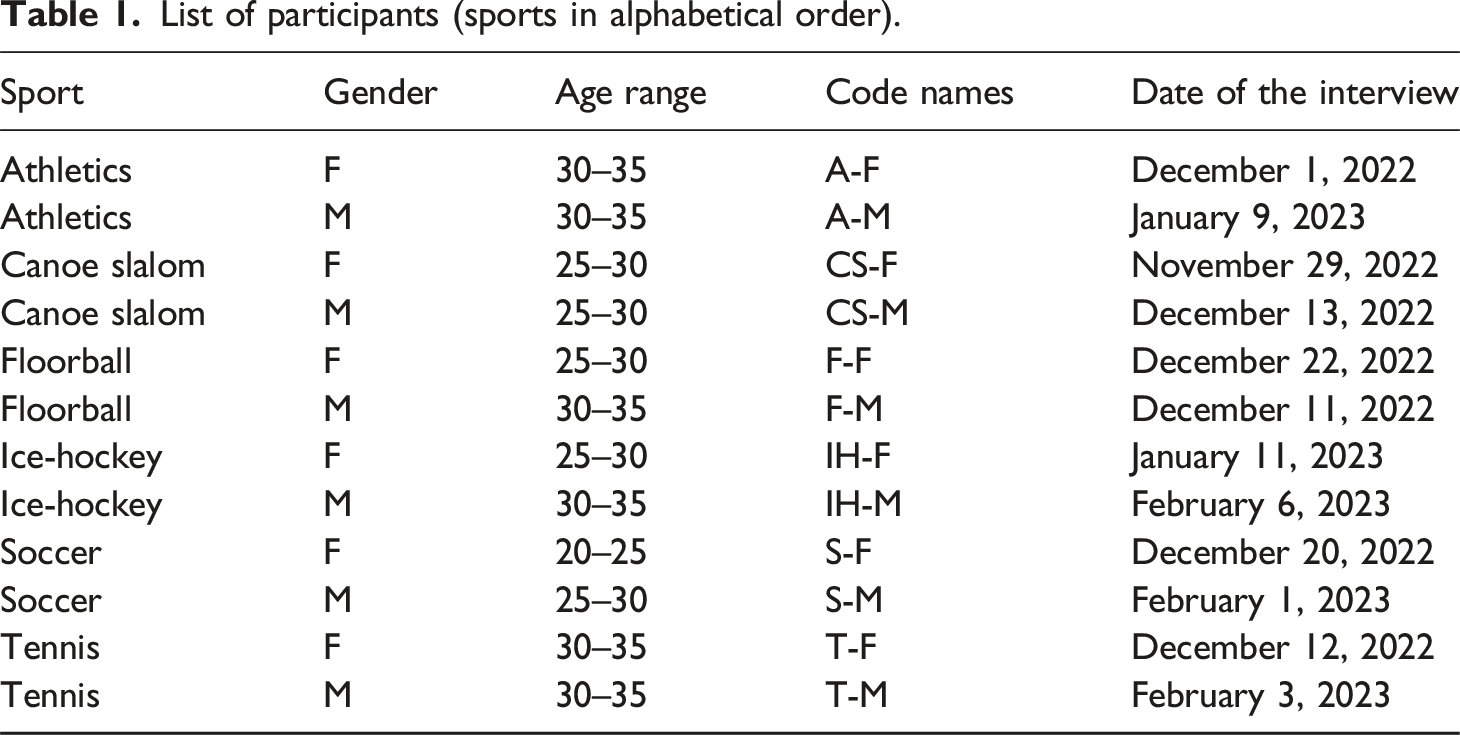
The interviews lasted from 18 to 47 min, depending on the interest of the athletes in the topics and their eagerness to talk about them. The first part of the interview included questions about the athlete-journalist relationship in general: (a) athletes’ attitude towards the media; (b) characteristics of a good sports journalist; (c) positive/negative experiences with the media and the (un)professional behaviour of journalists. The second part focused on the athletes’ experiences with female sports journalists in particular: (a) athletes’ views of female sports journalists’ knowledge, preparation and interest in sports; (b) possible differences between the styles of female/male journalists’ work; (c) athletes’ awareness of possible obstacles that female sports journalists have to face. All in-person interviews were conducted in Prague, Czech Republic, between December 2022 and February 2023, two took place via Zoom and two via phone calls. At the time the interviews were conducted, all respondents were active athletes, not retired. The interviews were recorded and then transcribed verbatim which resulted in 115 pages of single-spaced text.
The subsequent analysis was carried out via MAXQDA software, using partial coding according to grounded theory by Corbin and Strauss (2008) enriched by the constructivist approach of Charmaz (2006) who perceives coding as “the pivotal link between collecting data and developing an emergent theory to explain these data” and as the first analytical step in the process of defining what the data are about (Charmaz, 2006: 43–46). Our coding procedure consisted of two main phases – initial coding which involves naming each segment of data while staying close to the data, keeping the codes simple, active and analytic, and focused coding that helps the researcher to sort, organize and explain larger amounts of data (Charmaz, 2006).
Ethical standards and procedure
Informed consent was obtained from all participants before conducting the interviews. All the participants were informed of the purpose of the study, its possible publication in a journal or presentation in a conference. They were assured that the data obtained from the interviews and its subsequent processing would not be communicated to anyone except the research team, nor would it be treated inappropriately, and that they could withdraw their consent at any time, either during the interview, or at any time in the future. Though some of the athletes did not see a problem in publishing their opinions openly (together with their names), we decided to anonymise all of the answers and the identities of all 12 athletes have been secured. For our purposes, the use of code names was instituted (see Table 1). The research was approved by the Commission for Ethics in Research at the Faculty of Social Sciences, Charles University.
Findings
Female sports journalists as more empathetic and engaging in a broader scope of topics
According to the Czech Club of Sports Journalists (KSN, 2023), only 6% of all registered members are women. Despite this low number, male and female athletes from all disciplines included in the study had experiences with the work of female journalists (as a result of their international performance), which was essential for our research. All but one (A-F) athlete stated they have had more experience with male journalists than female journalists during their professional career. We noticed the difference between major and niche sports, where the presence of female sports journalists was perceived as rare (soccer), or more common (canoe slalom, floorball).
When discussing the athletes’ perceptions of sports journalists’ practises, respondents mentioned empathy which they perceived to be one of the most important qualities of a good sports journalist in general and admitted that it is something that seems to be less and less common (CS-M). From the athletes’ point of view, a journalist has to understand that the athletes always do their best (CS-F) and have sacrificed greatly to take part in these sports (A-M). Subsequently, criticism and negative comments were a big topic for the athletes. According to the players from primarily team sports, negative evaluation of particular players and their grading is something journalists should avoid, “because more or less, anyone can point the finger and say ‘hey, it was you who screwed it up’” (S-M). Respondents also highlighted situations when journalists put athletes under pressure and stressed them out with questions that might affect the athletes’ performance negatively (A-M). Notably, the female canoe slalom athlete declared it “the absolute worst, the ugliest journalist’s evil to lay into the athlete” after a performance does not go as expected (CS-F). From the athletes’ perspective, the role of a sports journalist should not only be to comment on athletes’ performance, but also to try to get the athletes’ feelings out of them in a respectable way (T-M)
However, this expectation sometimes overlaps with what work of in-house or team media should be about – because “they are on our side” (CS-F) –, rather that of external media representatives. When asking the athletes specifically about their experience with sports journalists, F-M stated, “in our club, it has been more than nine years, we have the same guy who does media (…) and for the Czech Floorball, there is a lot of people doing interviews”. This demonstrates that due to interacting with both journalists and PR professionals within clubs or national teams – who often transition between these roles during their career –, some athletes do not see a clear distinction and simply identify them all as “the media”. Such fluidity contributes to the blurred boundaries and reinforces athletes’ perception of journalists and in-house media as the same group. Nonetheless, an empathetic approach is expected from both sides (A-M, CS-F, CS-M, IH-M, T-M).
The perception of empathy varies based on journalists’ gender. The male tennis player perceived the women’s ability to be empathic as something that is generally missing among men: Men are sharper and can ask even more insidious questions [...] and many times they are far more critical than women (....) I think that the female journalists would have written it perhaps far more empathetically and presented it to the public in a better way, so I think that it would be to the sport’s advantage if the ratio in journalists’ gender really balanced out a bit. (T-M)
On the other hand, the female floorball player did not perceive female journalists to be automatically empathetic: “I think that a woman = empathetic and a man = non-empathetic, that just doesn’t apply. I think it’s more about personality and just some openness of the environment in which we work” (F-F).
Some athletes (A-F, A-M, T-M) thought that a good sports journalist should be interested in more than just performance and they perceived female journalists as able to ask questions outside of the sports world, which is something that revives the conversation. Moreover, having more women in the sports journalism field could help some of the athletes to open up more (A-M). Because we don’t have many women there, it sticks in one’s memory that women ask more about life outside. And men are more direct, they have the questions mainly aimed at how you performed and how much time you spend in the gym, how much training you have left until the next competition and such. So, I guess women are probably also interested in the things outside of it. (A-M)
Knowledge, credibility and experience as qualities of a good sports journalist, regardless of gender
In addition to empathy, a journalists’ level of knowledge about a particular sport and interest in it was crucial for athletes. Except for the two soccer players, no one from our participants doubted the female journalists’ knowledge or expertise and perceived them to be well-prepared and credible at the same level as male journalists. Moreover, the female floorball player and female track and field athlete considered women to be even better prepared for the interviews than their male counterparts. They believe this may be attributed to fewer female journalists in the sports media departments, so these pay more attention to good preparation and “actually have to work a little harder on themselves to get where they need to be” (A-F). The female floorball player remembered instances of female journalists that proved to be more knowledgeable than men and – conversely – experienced many cases of being interviewed by unprepared male journalists (F-F).
However, this perspective was not shared in the world of soccer. The male player stated that it is automatically harder for him to believe in female journalists’ knowledge, although they could be objectively well-prepared: “It’s just that you’ve been surrounded by men and only men since you were a child, and suddenly you have a woman there, so it’s harder for you to believe that she really knows something about soccer” (S-M). The female player was convinced that male sports journalists are generally better prepared as they are generally more “into” sports, particularly into soccer. Sharing her displeasing experiences with an actual female sports journalist that kept attacking her with uncomfortable questions, she generally perceived men to be gentler, more pleasant and careful (S-F). She also expressed that if women do not play soccer, they do not understand it and because of that they do not want to cover it as journalists (S-F). A male soccer player thought that regardless of gender: [A journalist] should have experience with the sport that they simply comment on, because then some of the opinions they say are simply believed far more than when there is some fatty dude who has never been on the pitch in his life and he tries to criticize some players there. (S-M)
A male ice hockey player expressed a similar opinion: “They go see the games but they’ve never actually played it, they don’t understand ice hockey the way they should [...] and still they talk about it like they’ve played it for 20 years at a professional level” (IH-M). However, athletes from individual disciplines did not consider it decisive if the journalists themselves have had practical experience with the particular sports (CS-M).
According to the athletes, having a good knowledge of sports allows the journalists to ask appropriate questions, or even to “try to come up with some original ones, which [...] will simply evoke some unique answers” (CS-F). Athletes admitted that they are sometimes a bit tired of answering the same things all the time: “A question like ‘what do you do outside of floorball?’ It’s like I’ve answered that fifty times already” (F-F), “the questions should be a bit different but at the same time should still make sense” (F-M). Some athletes even mentioned inappropriate questions they had been asked, such as “when are you going to quit … it’s like asking someone who has his own business when he’s going to go bankrupt” (A-M). The female tennis player added: [The journalists] could at least know a little something about the sport, because – it actually happened to me a few times – I got a question and I said to myself, yeah, like why are you even sitting here? So, this sometimes surprises me a lot that the person really doesn’t know anything. (T-F)
Nevertheless, the participants did not perceive any significant differences between these aspects of journalistic work based on the journalists’ gender, here.
Perceived obstacles and pressures on female sports journalists in the male-dominated field
In general, our respondents had more experience with male journalists than female journalists during their professional careers. When asked why there are only a few women in the sports journalism sphere, several explanations were offered by the athletes.
Speaking about their interest in sports, some of the female respondents doubted whether women enjoy sports and if they want to deal with it at all (S-F, A-F, T-F). Nonetheless, the athletes prevailingly pointed out the fact that, especially in the Czech environment, the idea that sports belong to men has been deeply rooted in society (IH-F). Interest in sports, cheering for sports and also covering sports has always been more of “a man’s thing” (F-F, T-F), because “everybody thinks that sports are for men and not for women” (F-M). The male floorball player further explained this idea: Everyone who ever played sports usually talked about it with dad when mom wasn’t doing sports. So maybe that’s why it’s such an experience that everyone has learned. It’s such an automatism that everyone takes it for granted. And I think that everyone, when talking about sport, discusses it with men. (F-M)
This idea corresponded with the views of the male soccer player who shared his distrust towards female sports journalists’ knowledge: “[Female sports journalists] have to fight against the opinion that they shouldn’t comment on soccer [...] and also with the social prejudice, which I think is probably the biggest threat for them” (S-M). However, even though he realized that it was also a challenge for him to get used to more female reporters entering the field, he tried to encourage them: When a woman started whistling, everyone looked at her as if she was crazy, and now it’s becoming more and more common, so I think it’s just a matter of habit [...] Women need to have the courage and go for it, even if the guys don’t want them there, gossiping or something. But there just have to be some pioneers who will take it into their own hands, so it will become normal. Maybe society will get used to it in a few years, but there must be some women who will be strong, could work with it and won’t be afraid to be in that environment. (S-M)
Significantly, female respondents also drew attention to the fact that few women are likely to be accepted by men in the sports departments (A-F), and that they are disrespected by the male collective when it comes to their sports’ opinions, “even though it’s complete nonsense but, somehow, we have fixed in our society that women can’t understand sports” (IH-F). According to female athletes, most media space in Czech sports news is dedicated to soccer or ice hockey (CS-F, A-F, S-F), which are sports that women are not generally perceived to be interested in (CS-F, A-F), and do not want to cover (A-F, S-F). The male canoeist even thought that it is challenging for female sports journalists to report on these “male” sports because the audience might be more critical towards them and the women themselves may find it hard to cope with it (CS-M).
Some of the sportsmen, though, did not realize exactly why the number of female sports journalists is so low and what challenges women have to face. “I don’t know why that is [...] I don’t think that anybody has a problem with them [...] I don’t mind, on the contrary, it diversifies the industry and it’s nice to talk to a lady,” said the male ice hockey player. The male floorball player even thought that women are better at conducting interviews and also considered it more pleasant to be interviewed by a woman than a man (F-M).
Nevertheless, respondents concluded that it is generally difficult for women to break through in this male dominated field, perceiving the social prejudice and underestimation to be the biggest threats for them, like a female floorball player: I would very much like someone to tell me that the [sports] environment is open, it doesn’t look at whether you’re a man or a woman and it’s simply evaluated by the quality, performance, coverage and so on. (F-F)
The male soccer player thought that men fit better into the media environment in general as they are “bigger jerks” (S-M), which corresponded with the idea that some of the female journalists might not want to deal with such a highly competitive environment (F-F, A-F). Even though the numbers of female sports journalists have been rising during the last decades, athletes (T-M, IH-M) also pointed out that a good question for the sports departments might be what can they do to make the numbers of sports journalists regarding gender more balanced, “because it really is disproportionate” (T-M).
Discussion and conclusion
Our paper aimed to examine how the top Czech athletes perceive the work of female sports journalists. Previous studies repeatedly highlighted the low numbers of women covering sports and the difficulties of female sports journalists within this male-dominated field (Antunovic, 2018; Hyre et al., 2017; Luisi et al., 2020; Mudrick et al., 2017). However, this study aimed to examine the perception of female sports journalists from the opposite side. In semi-structured interviews, 12 male and female athletes to some extent perpetuated but also identified and challenged hegemonic masculinity (found in the female sports journalists’ perception by Organista and Mazur (2020) or Schoch (2022)) and stereotypes (Boczek et al., 2023; Etling and Young, 2007) linked to female sports journalists.
To answer the first research sub-question “What is the difference between athletes’ perspective of sports journalists in general, and female sports journalists in particular?”, we needed to first examine the general athletes’ perception of current sports journalism. When characterising “a good sports journalist” (Trunečka, 2021), the quality of being empathetic, knowledgeable about sports (Kovacs and Doczi 2020), well-prepared and positive were traits that the athletes mentioned most often. In general, sports journalists were viewed by our respondents as mostly professional and well-prepared, with only a few examples of particular reporters who were not ready for the interview, asked inappropriate questions or behaved unprofessionally, which reflected the results of Kristiansen et al. (2011).
The relationship of athletes and journalists was perceived as rather symbiotic, similar to Trunečka’s (2021) findings, even though several male athletes pointed out that the Czech media, and male journalists in particular, are sometimes too negative when evaluating athletes’ performances. Representatives of male-dominated team sports such as ice hockey and soccer found it especially problematic when journalists evaluated a sport they had never experienced as professional players. However, the often-mentioned and seemingly desirable factor of “being positive” and the emphasis of an empathetic approach are characteristics that previous researches have defined as some of the elements of in-house or team media (English, 2022; Nölleke and Perreault, 2023). Some of the athletes may be influenced by the development of these media, and may not have distinguished between the world of PR and journalism. Thus, they have similar expectations for both of these sides – even though the roles of journalists and PR specialists (should) differ significantly.
Either way, the empathetic approach was considered in line with hegemonic masculinity (Connell, 1987) as something related to more of the “feminine” style of journalism (Schoch and Ohl, 2021), as well as the ability to ask questions outside of the performance. When comparing both “male-dominated” (soccer, ice hockey) and rather “gender-balanced” (athletics, tennis, canoe slalom, floorball) sports, male respondents from both categories expressed that they did not have a problem with being interviewed by women – contrarily, some of them admitted their preference of speaking with female journalists, because they are generally more positive towards their performance. This reinforces and complements Schoch’s (2013) findings, as all the participants (with the only exception of a female floorball player), not only male ones, automatically tended to consider female sports journalists as more empathetic. On the other hand, the athletes who expressed their equal opportunity or even feminist perception of sports and the role of women in society in the answers to some questions (F-F and IH-F) challenged the concept of a distinction between something perceived as feminine and something as typically masculine.
Regarding the second research sub-question “What opinions do the athletes have regarding the knowledge and credibility of the female sports journalists?”, the analysis of perceived knowledge and credibility of female sports journalists brought differences between the primarily male-dominated sphere of soccer and other sports. Only the female and male soccer players expressed distrust towards the level of knowledge of female sports journalists. In this particular sector, elements of hegemonic masculinity have been identified (Connell and Messerschmidt, 2005), along with negative stereotypes portraying women in sports journalism as weaker and less knowledgeable, as previously noted by Schoch (2013) and Organista and Mazur (2020). Especially in Czech soccer, there is a minimal presence of female sports journalists, and once women enter this masculine field, they are often dismissed because of their perceived insufficient toughness, resilience and competitiveness. Considered little more than tokens (Kanter, 1993), it is harder for female sports journalists to maintain their position and to demonstrate their knowledge, both to the audience and sources of information. The emphasis on “being a winner” (Messner, 1992) is not only applied in sport, but also in the case of media, as some of the athletes in our research doubt women’s toughness and strength of purpose (cf. Schoch and Ohl, 2021).
Brisbane et al. (2023) drew attention to the fact that female sports journalists are perceived, based on their credibility and knowledge, by sports audiences in a more positive light than ever before. Except for soccer players, respondents from our research stated they perceived the knowledge and credibility of women and men to be at the same level and pointed out that some female journalists are even more prepared for the interviews than their male colleagues (some of them who were aware of the obstacles women in sports journalism face, mentioning it may be a necessity, once these journalists want to succeed, they must be better than men). Focusing on rather niche sports (canoe slalom, floorball), athletes did not recognize any notable differences between female and male work, and did not want to generalize the qualities of journalists only according to their gender. Thus, they perceived individual abilities and depth of the journalists’ knowledge to be the most important criterion when evaluating their work.
Previous studies have also addressed challenging conditions that female sports journalists have to cope with in a masculine environment (Antunovic, 2018; Organista and Mazur, 2020; Schoch and Ohl, 2021). Therefore, we tried to find the answer for the third research sub-question “Which obstacles do female sports journalists have to overcome according to athletes?” Our respondents viewed barriers for female journalists in the sports environment mainly in relation to social prejudice connected to the concepts of hegemonic masculinity and negative stereotyping that women simply do not understand sports and that sports is generally a male domain, whether from the perspective of male athletes, male fans or male sports journalists. Nevertheless, the perception of women as being less interested in sports in general was also shared among female athletes in our research, showing how influential can long time reproduction of widely shared beliefs in society be (confirming results of Tejkalova and Kristoufek (2019) study about female athletes repeating the negative stereotype about their performance without having a basis in data).
The integration of female professionals into the male-dominated collective has been perceived as difficult as well as the possibility of breaking into popular “male sports” such as soccer or ice hockey (Schoch and Ohl, 2021). Some athletes expressed the sentiment that the significant disproportion of men and women in newsrooms should also be a matter of concern for the heads of media departments and editors-in-chief (cf. Laucella et al., 2017). Due to their being relegated to cover minor sports (cf. Organista et al., 2021 or Schoch, 2022), athletes out of these disciplines are more used to female reporters and do not find it problematic to be interviewed by women, whereas in the masculine environment of soccer, female sports journalists’ presence is still considered rare, even inappropriate (cf. Kaelberer, 2019).
Conclusion and limitations
To provide the answer for our main research question “How do athletes perceive the work of female sports journalists?”, we can conclude that they perceive it as different (especially in relation to female journalists’ higher empathy and interest in more topics than only sports performance) but not insufficient, less knowledgeable or not credible. Still, as some male athletes explicitly mentioned, the situation of being interviewed by a woman or discussing a sports result with her is an uncommon experience and in contradiction with previous socialization into sports. Therefore, it can be connected (whether consciously or not) to bias, stereotypes or even prejudices. Nevertheless, the reflection of female sports journalists’ work was not generally negative. In fact, it was rather positive which is an encouraging result, especially when considering the continuous research-based evidence of obstacles female sports journalists have to face. This different perception may be connected to the young age of our participants (there is a potential for further larger-scale studies with a broader set of participants or even a cross-country comparison). Alternatively, with all respect to our limited number of athletes and the qualitative character of our study that makes any generalization complicated, it may indicate a generational shift, supporting previous results of Brisbane et al. (2023), even though we also partially registered a persistent, internalized misogyny in the case of the female soccer player. However, while these tendencies were rarely questioned in the past, some internationally successful and recognized athletes find them problematic and navigate their way through this topic. Therefore, the question of whether women are or are not good sports journalists could be a matter for greater discussion by their male colleagues in staffs with traditional mindsets and athletes from sports traditionally perceived as masculine, than for the current generations of athletes in general.
Footnotes
Declaration of conflicting interests
The authors declared no potential conflicts of interest with respect to the research, authorship, and/or publication of this article.
Funding
The authors disclosed receipt of the following financial support for the research, authorship, and/or publication of this article: This article has been supported by Charles University, project GA UK (number 173823), and Charles University’s funding scheme Cooperatio Sport Sciences – Social.
