



Abstract
Recent debates around “transformative journalisms” in climate journalism present emerging ways to renegotiate the traditional norm of journalistic objectivity by blurring the boundaries between science, advocacy, and journalism. This paper draws similarity between the seductive powers of journalistic objectivity and of naturalism in news photography, exploring the ways these collide and interact when brought together in the context of image selection and engagement at one niche climate journalism organisation. Using a hybrid ethnographic approach between 2021 and 2023, this research addresses the question of what the engagement with imagery at one specialist climate organisation, Carbon Brief, can tell us about the shifting norms of objectivity and advocacy in climate journalism. Findings explore first the specific understanding of journalistic objectivity being performed by Carbon Brief through their policy-neutral tone, and the multiple ways this is manifest in image use. Second, this paper demonstrates how through their discussions around and engagement with photographic imagery, Carbon Brief are blurring, stretching, and transgressing the boundaries between neutrality and advocacy in climate journalism, as well as the line between naturalism and symbolism in photography. Fundamentally, this paper highlights the contradictory and complex assumptions within both climate journalism’s and news photography’s commitment to versions of objectivity, and argues that transformative journalisms provides a useful concept to understand the plurality, fluidity, and transgression which is often already present at climate-specific journalistic organisations.
Introduction
The impacts of climate change are increasingly urgent and severe (IPCC, 2023). As a result, many climate journalists becoming increasingly uncomfortable with the ‘detached observer’ role of traditional journalistic objectivity (Brüggemann, 2017; Fahy and Nisbet, 2011; Hiles and Hinnant, 2014), and are turning to more radical forms of journalism which stretch, blur, and transcend the traditional boundaries between journalism, advocacy, and science. Climate reporting provides a specific context for this, with journalists found to juggle being environmental journalists and science journalists, thus ‘allow themselves to adopt more of an activist frame’ (Kunelius et al., 2017: p. 257).
Similarly, the tension at the heart of news photography as a profession is between naturalism and symbolism, as images are expected to bear witness to a fixed reality, whilst also representing artistry and skill (Schwartz, 1992). These tensions demonstrate the seductive nature of objectivity, across both journalism and photography, and how the assumptions underpinning both professions are contradictory to the lived experience and practices in the contemporary networked media environment. This research explores the interactions between these concepts, using transformative journalisms to understand the inherent plurality, fluidity and transgression at play within one climate niche media organisation.
The introduction first explores the history of climate journalism, with a focus on niche climate organisations as harbingers of alternative climate journalism. The introduction then considers both objectivity in journalism and naturalism in news photography, emphasising that both have histories fraught with contradictions and tensions between a constructed ideal and a ‘slippery’ reality which practitioners continue to wrestle with. This paper then sets out to explore how niche climate journalism organisations (focussing here on climate media organisation Carbon Brief) negotiate these concepts. Results of a hybrid ethnography - encompassing interviews, participant observation and document analysis – demonstrate how practitioners at Carbon Brief have shifted, blurred the boundaries between journalism, science, and advocacy. The paper concludes with a call for researchers to consider more critically the role of visuals in mediating the boundaries of objectivity.
An incomplete history of journalistic objectivity: A ‘slippery’ concept
The concept of objectivity is a ‘cornerstone’ of journalism (Skovsgaard et al., 2013), and has been described as a goal (Durham, 1998), a performance (Boudana, 2011), a set of procedures to follow (Schudson, 2001), and a ritual (Tuchman, 1972). Objectivity in this context refers to the epistemological position of realism which characterises (Anglophone) journalism; the belief that there is an independent and verifiable truth exists which can be separated from subjective values (Franklin et al., 2005; Zamith, 2022). For a full description, see Schudson (1989, 2001, 2011).
The epistemological position of objectivity in journalism has been critiqued substantially, even as early as the 1980s, when social constructivist perspectives on news became popular. The movement presented an existential challenge to the epistemological underpinnings of objective journalism (Durham, 1998), and there was a move towards critical approaches to journalism which discussed subjectivity of media actors, and the impossibility of producing knowledge in a value-free way (Muñoz-Torres, 2012), recognising the culturally-contingent nature of objectivity (Tong, 2015, 2017).
Objectivity remains central to modern journalism, however, with 45% of respondents in a survey of Danish journalists answering that it is “very important” (Skovsgaard et al., 2013). What they mean by this exactly, however, has been the subject of debate within journalism scholarship. Particularly for climate change and environmental reporting, there has been a shift away from the neutral observer model of journalism (Brüggemann et al., 2022; Fahy and Nisbet, 2011; Hiles and Hinnant, 2014). In scholarship this has been conceptualised under terms such as transformative journalisms. The concept of transformative journalisms was introduced by Brüggemann et al. (2022) as a way to capture the new and emerging role perceptions and practices which do not fall within the traditional binary of “mainstream” or “advocacy” journalism. Transformative journalisms is thus a ‘particular kind of progressive advocacy’, promoting societal sustainable change but also itself acting as an agent to transform the practice of journalism (Brüggemann et al., 2022: p. 225). A range of other concepts of journalism, from quiet advocacy to constructive and civic advocacy demonstrate the continuum of experiences and practices from objective to advocacy in journalistic work (Haagerup, 2014; Waisbord, 2009).
The seductive power of imagery
The story of news photography is, similarly, a story of contradiction and tension. Photojournalism specifically is ‘distinctive for its dual rhetoric’, assuming both objectivity of news photographs whilst also lauding the artistic skill involved in the practice (Schwartz, 1992: p. 160). News photographs are purposed to carry a hidden ‘meta-message’ of witnessing, with the image acting as proof of an event happening (Hall, 1973: p. 188). In what Barthes (1977) refers to as the “having-been-there” of news photography, photographs are assumed to provide a neutral and objective depiction of reality. Herein lies the ‘seductive’ contradiction and power of imagery: conflating “seeing” with “knowing” presents the illusion of a neutral representations of reality, when decades of cultural studies and sociology work has emphasised the socially constructed nature of photographic (and other) imagery (Berger, 1972; Bock, 2008: p. 170; Sontag, 1977, 2004). This inherent contradiction between ‘the natural and the symbolic’ (Schwartz, 1992, p. np) in news photography is managed by photojournalists through strategies which act to minimise the effect of the human photographer (Liu, 2013) through a ‘communicational code of naturalism’ (Schwartz, 1992, np).
The process by which images travel from the camera of a photographer to appearing on the (digital) page has been explored elsewhere, and is the result of a complex and multi-sited network of actors, technologies, norms, and processes (Caple, 2013; Hayes and O’Neill, 2025; Rose, 2016). The selection process of imagery in a newsroom can have substantive influences on the style, discourses, and messages communicated by the published content (see e.g. Greenwood et al., 2025; Lester, 2018). Though this can be a collaborative and involve many actors in the newsroom (Kratzer and Kratzer, 2003), often, studies have found the work of image selection being the responsibility of a “visual elite”, a small group of actors responsible for decisions over which images are published (Seelig, 2005: p. 165). This group are bounded in their commitment to a ‘photographic principle’, ensuring the professional integrity of photojournalists is upheld through a protection of the perceived accuracy of images (Seelig, 2006: p. 22), creating a distinction between “word people” and “picture people” treated as separate parts of the process in newsrooms (Fahmy et al., 2014; Lowrey, 2002; Singer, 2004).
This is a problematic distinction, considering the power that imagery has in the communication process. Images have affective properties, producing emotional responses (Joffe, 2008), can overcome language differences (Popp and Mendelson, 2010), and help viewers recall media information more effectively than text (Graber, 1990).
Though the intellectual tensions of photojournalism mirror those of journalism more widely, the same academic attention has not yet been given to the visual imagery used in climate change journalism as has been afforded to text. It is in this context that the present study makes a novel contribution, by using the visual images used by one niche climate organisation as a way to understand the shifting, fluid, and inherently mutable boundaries around what constitutes journalistic objectivity in the contemporary climate change media context.
State of play for climate journalism in 2024: Niche sites
Climate journalism has always represented a somewhat controversial topic for journalism to cover, for example political journalism norms of “balanced” reporting led to “biased” reporting which mis-represented the consensus of scientific opinion (Boykoff and Boykoff, 2004). This balanced and misleading approach for climate change reporting continued into the early 2000s in the UK, before being replaced by a widespread acceptance of anthropogenic warming in news media, before being disrupted again by the Climategate moment of 2009 (Boykoff et al., 2021).
In addition to this complex context of ideology and politics, the climate journalism sector has weathered multiple shifts, notably economic pressures in mainstream journalism forcing out specialist environmental or science reporters (Newman et al., 2019). In the period 2006–2014 many “niche” climate organisations were founded (Nicholls et al., 2018). “Niche” here refers to the specialism of content (Russell et al., 2023). These sites, including Climate Home News, DeSmog UK, and Carbon Brief in the UK, and Climate Wire, Climate Central, and Inside Climate News in the US, have been found to represent a fundamental shifting of the norms and possibilities of what constitutes “journalism” by redefining business models and notions of objectivity (Atton, 2004; Pérez-Seijo et al., 2020; Wiesslitz and Ashuri, 2011). The research presented here contributes to this debate with a novel analytical focus on the relationship between the use of news photographs and journalistic objectivity at climate niche organisations.
Methods
This study aimed to investigate the use of visual imagery as a form of transformative journalisms at one niche climate website, addressing the following research question: What does the use of visuals at a specialist niche climate organisation tell us about the notions of objectivity and advocacy in climate journalism?
To investigate this question, this study drew on a hybrid ethnography, based at the niche climate journalism organisation Carbon Brief between 2021 and 2023. This approach encompassed interviews, participant observation, and document and image analysis. The work presented in this paper was part of a wider project (see also Hayes, 2024). Carbon Brief is an award-winning UK-based journalism organisation which specialises in science and policy reporting around climate and energy issues. Given the specific focus on niche, digital climate content, options for case sites were limited. Carbon Brief represented the most appropriate case due to its strong agenda-setting power in the UK policymaking scene, as well as in the journalistic field, being the subject of other studies focussing on transformative journalisms (Neff, 2022; Painter et al., 2022; Russell et al., 2023).
List of methods of data collection methods used with details, date, and associated data type.
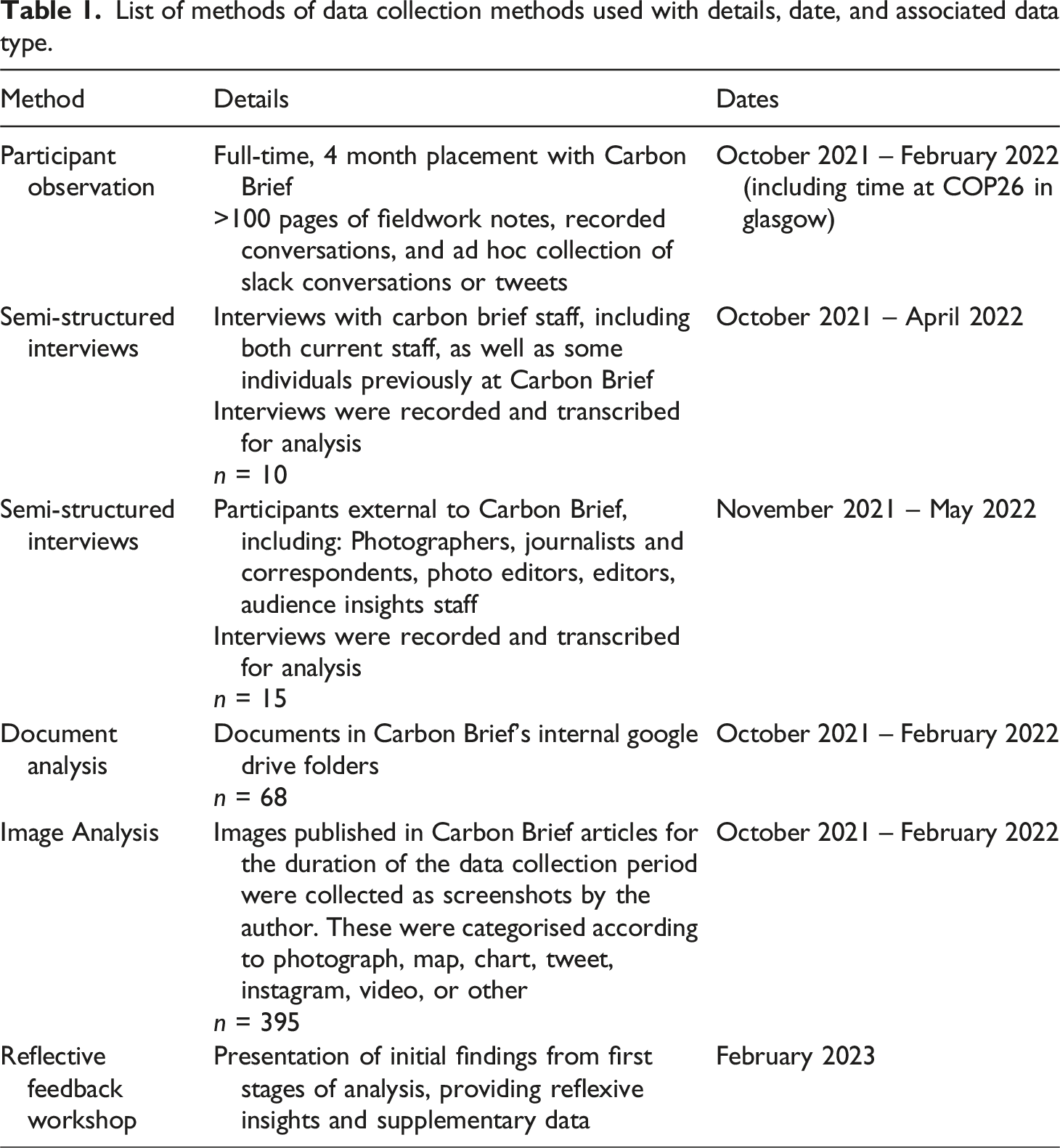
The methodology was necessarily hybrid due to practicalities of the COVID-19 pandemic in the UK, with the “newsroom” becoming a hybrid space which fluctuated between being online and offline. Much data collection took place via technologies such as Slack, Zoom, and Whatsapp, which reflected the daily routines and work practices of the participants. This hybrid element was unplanned, but provided a rich immersion into the post-pandemic and working environment of journalism (Hendrickx and Picone, 2022). Ethnographic (hybrid or in-person) research presents specific methodological and ethical challenges for researchers, and the researcher was cognisant of the ‘hidden politics’ of collaborative work (Flinders et al., 2016: p. 261) and the challenges of negotiating an ‘ethnographic self’ (Coffey, 1999: p. 36). Issues of confidentiality, anonymity, and ‘researcher-as-friend’ dynamics have been discussed elsewhere, by the author and others (see e.g. Hayes and Manktelow, 2023; Lait et al., 2024, also Mason, 2002; Coffey, 1999).
This approach resulted in a rich corpus of data. Analysis was therefore treated not as a discrete stage of research but continually practiced across the entire research process, relying on ideas developed in the field and following unexpected avenues or areas as they emerged (Hammersley and Atkinson, 2019; Mabweazara, 2013). During analysis, extensive analytical memo notes were made as part of the processing and analysis stage, clarifying areas of interest to follow up in the ethnographic journey. After data collection, the corpus of data was processed using Nvivo and qualitative methods of iterative thematic analysis and coding (Braun and Clarke, 2013; Saldana, 2021) to identify themes and relationships cutting across the entire data corpus (Hammersley and Atkinson, 2019). For the purposes of this article, conclusions pertain to quotations and data from the internal semi-structured interviews, participant observation, document analysis, image analysis, and reflective feedback workshop, and data presented below are drawn from these specific aspects of the methodology.
Background map of image use at Carbon Brief
“We have endless debates about whether an image is not quite right for the headline or the piece” (CB01)
Over the data collection period, Carbon Brief published a total of 55 articles, which in total included 395 visual items collected for analysis. These items were categorised according to type of visual image (e.g. photograph, chart, video, Tweet etc). With no dedicated photo editors or team, images were selected somewhat collaboratively, with (usually) authors of pieces writing a description of their desired image in an open Slack channel message. One of the digital team members then sought a selection of 5-6 images fitting the description from the image bank Alamy (with which Carbon Brief had a subscription), and the author choosing from that list. Often, this was not so linear, and was a collaborative process. This process allowed for many rich and long discussions of image purpose and suitability across the period of data collection (Fieldwork notes, 2021-2022). For a more full description of the process and workflow of image selection, see Hayes (2024).
Of the 395 visual images published during the data collection, 139 of these were photographs, represented below in Figure 1 in chronological order according to how they appeared in published content. This provides a ‘background map’ (Bell, 2004) of the types of imagery used by Carbon Brief as context for the subsequent discussion, which proceeds as follows. Collage of all photographic images used in Carbon Brief content during period of data collection. Produced by author using Python.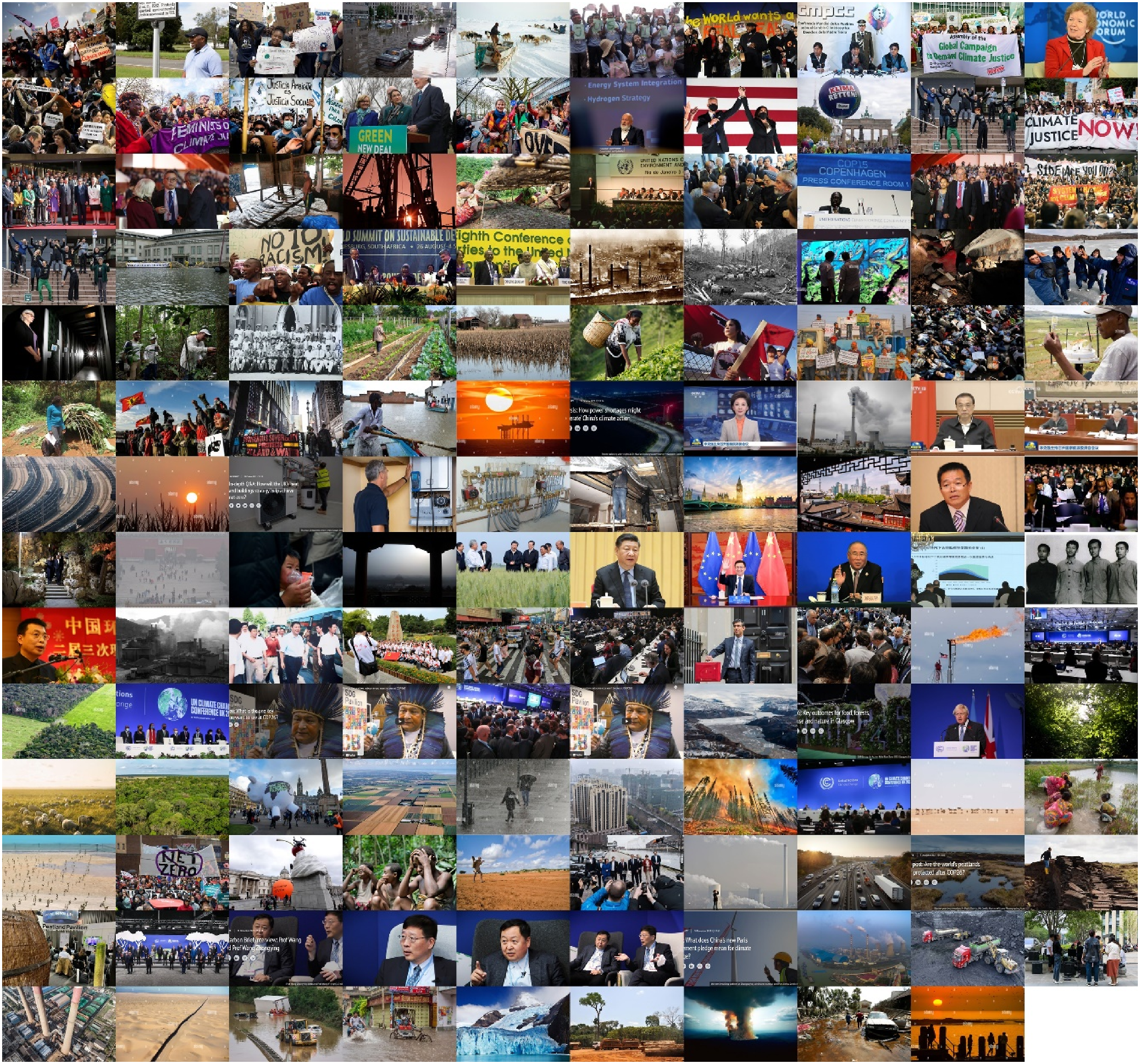
First, we present the context and manifestation of journalistic objectivity at Carbon Brief in textual content and organisational “voice”, along with the implications of this when colliding with the presumed naturalism of photography. Second, we discuss the response to this challenge at Carbon Brief, through an evolving and strategic engagement with both the naturalism and symbolism of photography. This is discussed through two vignette examples from the ethnographic data collection.
The ‘having been there’ of images: naturalism and the strategic use of an objective voice at Carbon Brief
“Not our voice, but powerful” (CB01)
Carbon Brief as an organisation maintained a strong cultural commitment to journalistic objectivity as a core part of their brand identity, with a fundamental commitment from the organisation to provide ‘policy-neutral’, authoritative reporting (Fieldwork notes, 2021). This commitment spanned back to the conception of the organisation in 2011, which was founded to “fact-check” stories in mainstream media (Fieldwork notes, 2021). The neutral reporting was understood by all Carbon Brief team members and referred to in terms of the Carbon Brief “voice” or “tone”: “with Carbon Brief, it’s got to editorially independent, and no like opinions, and just the kind of hard facts of this is what’s happening, this is how other people feel, but Carbon Brief doesn’t have a voice” (CB07, emphasis added)
This language of neutrality was particularly relevant for covering more contentious topics, such as their themed week of “climate justice” content at the beginning of the data collection period in October 2021. For example, use of so-called “talking heads” in articles, such as the piece titled “Experts: Why does ‘climate justice’ matter?”, which relied entirely on the words of scientists, campaigners and policy experts, rather than the words of Carbon Brief journalists. The introduction to this piece reads: “As part of a week-long series on climate justice, Carbon Brief has asked a range of scientists, policy experts and campaigners from around the world what the term means to them and why they think it is important. These are their responses, first as sample quotes, then, below, in full” (Carbon Brief Staff, 2021)
By reporting only “how other people feel” rather than the “voice” (CB07) of the organisation itself, for example, Carbon Brief avoids being the subject of attack, and expect to be taken more seriously by their audience: ‘when one speaks the language of experts, one gets treated like the experts’ (Steensberg, 2023: p. 1500).
This was considered successful within the team, with the themed week of Climate Justice content described as working precisely because it was “not our voice, but powerful”. Implicit in this is the idea that content can and should be powerful for some topics, and the decision to make a themed week of Climate Justice content suggests at least a recognition of the importance of the topic, if not an endorsement. Through covering climate justice, Carbon Brief were testing the boundaries of their objectivity, and renegotiated this (rather than rejected it) by maintaining a commitment to the scientific objectivity afforded to external “experts”.
The problem with naturalism of imagery
This cultural commitment to objective textual reporting on climate was manifest through image use in the desire to use imagery which document that something happened in a certain way in a certain place. Specifically in the context of depicting extreme weather events, for example this meant that: “we’d want to be careful to show an image of an impact that does clearly have a climate change fingerprint on it, and preferably from somewhere that they have done an attribution study, so Hurricane Sandy, if we can have a hero image of Hurricane Sandy and there’s been an attribution study done there then that’s absolutely a bulletproof hero image for an extreme weather piece.” (CB13)
An Extreme Event Attribution study is a statistical analysis which calculates if the extreme event was made more likely due to anthropogenic climate change (Swain et al., 2020). The conflation of the naturalism of photography (what you see is what you get) with journalistic values (the witnessing/proof power of news images), created an implicit cultural assumption that the image is directly analogous with the textual content, evidenced through Carbon Brief’s historical approach to using images of extreme weather events and the continuing desire for images to “meet the editorial needs of the article” and “match what the story is about” (CB01, CB12).
This presented a challenge for Carbon Brief to ensure they were not “pointing the finger” (CB05) at specific organisations or individuals. Multiple images were rejected on the basis of their “finger-pointy-ness”, and for one article titled “Analysis: the lack of diversity in climate science”
1
, the conversation of image choice was the most lengthy and complex of all during the data collection (Fieldwork notes, 2021-2022), for this reason; as one team member reflected at the time: “Obviously, for lack of diversity, we're not pointing the finger at people who are male or white, for example, we're pointing a finger at the system that prevents other people from accessing it. But that's not something you can put an image of.”
The naturalism of news photography therefore acted as a constraint on image use at times, with Carbon Brief wary of communicating messages which would leave them open to attack from readers through their images.
Transformative journalisms in image use: Symbolism in imagery and the shifting boundaries of objectivity
In response, Carbon Brief engaged more strategically with the naturalism and symbolism of news photography, oscillating and balancing the two in order to represent the desired points. This lent itself to a focus on the more symbolic aspects of imagery; in an early conversation where I prompted the director to describe the usual style of Carbon Brief images, they described how “in our world, in Carbon Brief world we often go for geometrically striking or visually contrasting images, that are kind of a bit abstract” (CB01). In practice, for example, this may be: “a ploughed field at an angle, so that you get lots of geometrically striking [shapes], so it’s not necessarily “saying” something other than farming, it’s not “saying” you know good bad or whatever, its just saying in a very loose way, farming, matches the headline that alludes to farming in the right context”.
Indeed, multiple hero images used throughout the data collection period fit this description; for example, the image selected to accompany an article titled “The challenge of achieving a ‘just transition’ in agriculture” depicted a produce farm in Cuba at a middle distance, with straight lines of crops framed diagonally from bottom left to top right of the image 2 . Similarly geometric and striking imagery can be seen used in hero images accompanying articles about power shortages in China 3 , or about climate migration across the US-Mexico border 4 .
The case of illustrating this latter article, titled “Global warming will make undocumented migration into US ‘increasingly dangerous’” was especially difficult, and represented one of the most interesting image discussions during the data collection period (Fieldwork notes, 2021-2022). Given the legal complexities of US border crossing in this context, Carbon Brief were reluctant to depict the faces of individual recognisable migrants in the image; see conversation over Slack messenger below (16/12/2021): CB01: I think it would be good to have an image that is quite specific to the area of Arizona the study focused on…“crossing on foot from Nogales in Mexico to Three Points in Arizona” CB08: quite difficult to find people crossing on foot but a range of images of the border [images removed for copyright reasons] CB01: I think image also really needs to “say” hot desert, ideally - but it will prob need to show a fence or wall so that it also “says” border. And not show the faces of any migrants. Quite tricky
This was a “tricky” article for the team to illustrate, not only due to the political/legal complexities of the case but also the emotional subject matter; several images suggested in the Slack channel were distressing, and described as “intense photos”. In this way, complex questions of professional journalistic ethics came into conversation with issues of human rights and national legislation, speaking to previous work on the moral decisions made by journalists around the ethical use of photojournalistic images (Miller and Dahmen, 2020) and raising questions beyond the scope of this article. The image which was selected depicts a landscape shot from above, without showing any people, but with the border line clearly shown as a divide in the middle of the landscape. CB03 wrote that it represented “quite good ‘hostile border crossing’”, speaking to the symbolic messages communicated in the image beyond the denotative content of what was literally contained in the frame. The image symbolises the hostility and danger of the US-Mexico border with a harsh, dark line cutting through an otherwise seemingly pristine desert landscape. This line contains connotations of a wound or a gash with the high visual contrast of the almost black line of shadow against the bright desert sand. Culturally, the straight line can be seen as a symbol of boundaries, borders and territory has long and complex connotations with colonialism and historical oppression (Bell, 1933; Newman, 2006), and this is being symbolically communicated through this image, as the Carbon Brief team alluded to in their description of the image as “hostile”. Meanwhile, the location accurately reflected the text of the article, and the image shot from above provided a literal representation of the detached, scientific ‘view from above, from nowhere’ means of viewing landscape which obscured the lived experience of people on the ground (Haraway, 2013: p. 589).
Here, Carbon Brief were deliberately blurring the lines between naturalism and symbolism in photography, strategically utilising the symbolic power of imagery to communicate the “hostile” nature of border crossing through the image choice, whilst retaining the defence of naturalism through using an image of a particular place and avoiding showing migrants’ faces. This deliberate choice to use an image which is visually appealing but also draws on the symbolic power of images to communicate complex emotive and affective messages (Joffe, 2008) represents an approach to image use in line with transformative journalisms, blurring the lines between symbolic and literal imagery and disrupting existing norms of objective journalistic practice. Through this, Carbon Brief were able to make use of the symbolic ability of images to, while still strategically benefitting from the defensive objectivity afforded by the presumed naturalism of imagery.
Similarly, the images used to illustrate the content of the Climate Justice week of content also represented a blurring of the lines between traditional journalistic and photojournalistic practice.
In discussions with the team about the rationale behind Climate Justice week, Carbon Brief were aware that their technical content could be “a bit dry” and “shy of human faces” (CB01), at odds with trends in towards telling more human-focused stories (De Meyer et al., 2020; Nisbet, 2019); notes from a meeting about the future of Carbon Brief revealed that the team agreed “the wider climate conversation has shifted in this direction – we need to keep up” (Fieldwork notes, 2022). There was therefore an explicit desire to focus on human stories and faces in this content: “For climate justice week, the focus was on the people, rather than on the things they were interacting with. And that was, that made things really difficult because you have to focus on their age, their ethnicity, their gender. And then it has to be saying the right message as well”. (emphasis added)
Again, there is therefore a subjective right message which is implied to be a consensus shared amongst the team, and an awareness that an image can (or not) communicate this. The images that Carbon Brief used to illustrate articles during Climate Justice week (top five rows of Figure 1) generally depicted people substantially more frequently than those articles published outside of Climate Justice week, and often depicted identifiable faces of people, in contrast to other image choices as discussed above. To illustrate, see Figure 2, a screenshot of the hero image to the piece titled “In-depth Q&A: What is ‘climate justice’?”. Screenshot taken by the author of webpage displaying Carbon Brief article from 4th October 2021.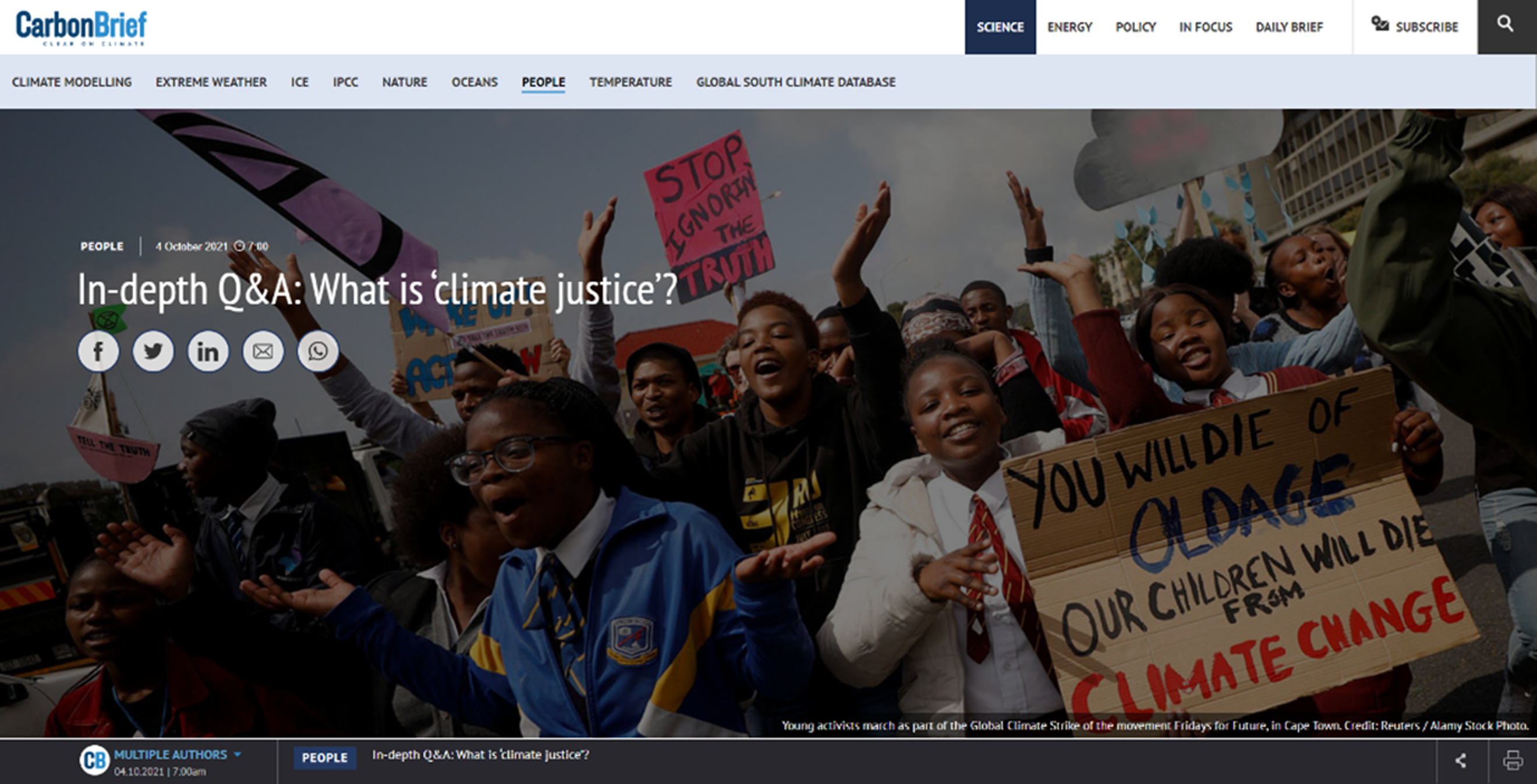
The image depicts a group of young climate activists in Cape Town, South Africa taking part in the Global Climate Strike as part of the Fridays For Future movement. This is a specific action which took place in Cape Town by the group Fridays For Future, and the group is mentioned twice in the text of the article, making the image strategically objective in the sense of acting as proof of an event mentioned in the text.
The image also, however, represents a deliberate choice of Carbon Brief to engage with the symbolic power of imagery to communicate “the right message”. The subject(s) are young, non-white climate activists, clearly lit and dominating the frame. The direct eye contact from one of the individuals humanises the image, and the image is shot from eye level with the activists, despite their apparent young age (suggesting an adult photographer had to bend down to deliberately shoot the activists in this way). Together these visual features provoke an emotive response in the viewer and represent an empowering depiction of the non-white, young, female activist. There is therefore a symbolised sympathy with the activists and a framing of climate change which is in line with intergenerational justice aims (Hayes and O’Neill, 2021). Historically, activists and protesters have often been depicted negatively in press coverage (Chan and Lee, 1984; McCarthy et al., 1996). This has been shown to have an impact on the way that protest movements or actions are understood by the public (Brown and Mourão, 2021). Symbolically, Carbon Brief’s decision to use this image with a broad-ranging article about the entire concept of “climate justice” makes an implicit link in the mind of the reader between climate justice and a social movement involving young, non-white individuals, particularly women and girls.
Concluding discussion
This research has investigated the shifting norm of objectivity across both journalistic text and image use at one specialist climate niche organisation (Carbon Brief). The research began from the understanding that within both journalism and news photography, a claim to truth serves to legitimise the profession and its outputs, and that this was a deliberate, historical, and culturally-specific construction (Schudson, 2001; Schwartz, 1992). This research demonstrated the way that news images specifically represent a space to explore the boundaries of objectivity, acting at the nexus of the dual forces of journalistic objectivity and realism of news photography, and explored the stretching and blurring of these boundaries through the case of Carbon Brief.
First, this research has demonstrated the specific version of journalistic objectivity which Carbon Brief adhere to, utilising objectivity as a strategic defence against criticism in a polarised media landscape (Tuchman, 1972). This was manifest through image use which reinforced the witnessing power of news photography.
Second, this research demonstrated how Carbon Brief negotiated this tension between the naturalism and symbolism of news photography, just as they negotiated the tension between journalistic objectivity and advocacy, for societal issues. In the same way that this represents engaging with journalistic objectivity in a deliberate and strategic way, results have demonstrated how Carbon Brief engaged in a similarly strategic way with the symbolism of imagery, by using images which connotate emotive or “powerful” messages, whilst still relying on the defence against criticism afforded by the naturalism of images which depict specific events, places, or contexts described in the text.
In sum, this research has argued that niche climate journalistic organisations are able to negotiate the dual tensions of objectivity and advocacy across both textual and visual content by embracing the plurality, fluidity and mutability of boundaries characteristic of transformative journalisms.
Future research should continue to bring the visual into studies of shifting norms and practices in climate journalism. Visual communication remains under-investigated in climate change communication research and journalism more widely (Doyle, 2011; Pearce et al., 2019, 2020), yet as this research emphasises, the role that images play in journalistic content is entirely linked to the concerns of objectivity and the stretching of the boundaries between objectivity and advocacy, science and media. Similarly, research should explore niche sites beyond the UK context, investigating the differing professional norms (Loo, 2019; Qusien and Robbins, 2023) through sites such as China Dialogue, the Third Pole, and Energi og Klima. We also call for greater connection and boundary crossing between academia and practice. It is only by engaging news photographers, journalists, editors, and media actors from across the journalistic field that meaningful collaboration and greater understanding can take place.
Implications in an age of AI
The critique of visual proof which is afforded to news photographs which has been presented in this paper has complex implications for the future use of news photographs, particularly in light of new developments in Generative Artificial Intelligence (GenAI) technologies which can produce photorealistic imagery from text prompts alone. How will newsrooms respond to AI-generated imagery which can evoke emotional responses similar to those of human-made photographs (Paik et al., 2023), but which often contain harmful stereotypes and other extant biases of the social world (Thomas and Thomson, 2023)?
The insistence on the objectivity of news photographs has previously acted as a legitimisation tactic to protect and place boundaries around the field (Newton, 2009; Schwartz, 1992), and there is every possibility that photojournalism may redraw these boundaries in light of AI technological disruptions. This paper argues, however, that the redrawing of these boundaries was long overdue, and GenAI is not the only time that the boundaries between photography, journalism, science, objectivity, and advocacy have become blurred or transgressed. The transformative journalisms practiced by niche climate organisations is already challenging this, by venturing into contentious topics and doing so in a way which redraws the lines between what is acceptable, what is journalism, what is science, and what is advocacy.
It seems that now, just as historically, there is a need to heed calls from Newton that ‘we must frame the production and use of [news] images as “mediated communication” rather than “objective truth”’ (Newton, 1998: p. 8). Perhaps the most we can ask of news images is ‘reasonably truthful communication’ (Newton, 1998: p. 8). This has, however, been the case for photojournalism since its beginning.
Footnotes
Acknowledgements
Thanks so much to Carbon Brief for their involvement in and support of this work, without which there would be no paper. Thank you also to the many colleagues in the University of Exeter Geography department for their insight, encouragement and help refining this research, and to the anonymous reviewers’ feedback on this paper, which has substantially improved the clarity and direction of the work. For the purpose of open access, the author has applied a Creative Commons Attribution (CC BY) licence to any Author Accepted Manuscript version arising from this submission.
Declaration of conflicting interests
The authors declared no potential conflicts of interest with respect to the research, authorship, and/or publication of this article.
Funding
The author(s) disclosed receipt of the following financial support for the research, authorship, and/or publication of this article: This study is supported by Sylvia Hayes was funded through an ESRC PhD studentship from the South West Doctoral Training Partnership (grant number ES/P000630/1). Saffron O’Neill was funded through a Leverhulme Research Fellowship (RF-2021-599). Writing up this article was funded through C3DS (Centre for Climate Communication and Data Science), which is part funded by the University of Exeter (UoE) and Children’s Investment Fund Foundation (CIFF) (grant number 2210-08101). The funders had no role in the conceptualization, design, data collection, analysis, decision to publish, or preparation of the manuscript and therefore the findings and conclusions are those of the authors and do not necessarily reflect the positions or policies of UoE or CIFF.
Ethical approval
This research was reviewed by the University of Exeter Geography Ethics Committee, reference number 499109, eCLESGeo000792
Data Availability Statement
Data available upon request.
Notes
Author biographies
 on this topic titled ‘The Visual Life of Climate Change’ (2021-2023) and an ESRC Future Leaders Fellowship (2012-2017).