



Abstract
This experiment test the effects of framing of climate change and finds that news stories that do not discuss the man-made cause of climate change, and do not use trigger words such as “global warming” and “climate change” are significantly better at overcoming climate skeptics’ resistance to them, leading them to agree with the story’s perspective and feel optimistic about a community’s efforts to deal with climate impacts. This process is mediated by increased perceived credibility of the story and journalists.
Introduction
According to NASA’s Global Climate Change site (2023) 97% of scientists believe that humans are creating global warming and climate change. However, a recent Yale report (Leiserowitz et al., 2024) indicated that only 70% of United States citizens believe climate is changing, while 13% deny it and 17% are unsure. When partisanship is considered in the US, Republicans are less likely to believe that climate change is happening than Democrats (51% vs 90%). The Media and Climate Change Observatory, which monitors climate news worldwide, reported that 2023 saw the second highest number of climate news stories across the 19 years of monitoring. The report emphasized that the news stories paid a great deal of attention to man-made causes of global warming, often using phrases about how “humans continue to pump out planet-warming gases” (Media and Climate Change Observatory, 2023: 13) and “how bad human-caused climate change is getting” (Media and Climate Change Observatory, 2023: 19).
It has been proposed that this steady diet of references to “human causes” and “global warming” prevents those who reject either or both ideas from processing news about efforts to ameliorate the damage (Hart and Nisbet, 2012; Nisbet and Scheufele, 2009), and that an alternate way of covering climate change stories, what NASA refers to as “adaptation,” would result in better outcomes (NASA, 2023). NASA defines adaptation as “adjusting to actual or expected future climate
Literature Review
Framing theory
Framing is the fundamental theory guiding this research. Framing is how information is packaged, emphasized, and selected (Entman, 1993; Scheufele and Tewksbury, 2007). While the term “framing” has been used in various ways, this study employs equivalence framing, which describes the way information is presented rather than its content or overall emphasis. In equivalence framing, logically equivalent words or phrases are changed to produce different effects (Cacciatore et al., 2016). Gain and loss framing is a good example, where the facts are the same, but gain frames emphasize the positive (25% lives saved), versus loss frames that emphasize the negative (75% lives lost) – it has repeatedly been shown this leads people to make different decisions even though the information they base it on is identical (Tversky and Kahneman, 1981).
One important way that framing works is by way of people’s tendency to notice information that is consistent with their pre-existing schemas (Cacciatore et al., 2016; Scheufele, 2000). This is especially true of equivalence framing. In the current study, we propose that, in line with theories of cognitive processing of framing, climate change stories that include words that trigger climate skeptics’ schemas of their dispute with scientists will make them less accepting of these stories. In this study, we manipulate the equivalence of these stories by changing only a few words to avoid activating climate skeptics’ schemas.
The adaptation frame
There is an ongoing scholarly conversation about alternate ways to frame global warming (e.g.: Gainous and Merry, 2022; Oleskog Tryggvason and Shehata, 2024; Richards et al., 2021), including as either mitigation, or adaptation (Moser, 2014). This study is focused on adaptation frames in news because they may be more effective in garnering public support; however, mitigation, such as efforts to reduce greenhouse gases, is also an important part of climate solutions. In this study, we focus on adaptation, defined in terms of what can be done to adjust to the potential damage that results from climate change. This is unlike mitigation, which involves complex ways to lessen climate change, such as reducing the discharge of heat-trapping greenhouse gases into the atmosphere (European Environmental Agency, 2023). In adaptation, the cause of climate change is not relevant; instead, the focus is what can be done to reduce the harm of more severe storms, heat waves, flooding, or other environmental disasters. Moser argues (2014) that adaptation frames are most effective because audiences can more easily understand them, and because they talk about events people have personally experienced (e.g., floods). Further, adaptive frames emphasize immediate benefits for both individuals and communities. While the threats to the ecosystem are not ignored, the responsibility for that ecological state is not the focus. Indeed, in adaptation stories (see examples in Center for Science Education, ND) what is salient is eliminating such phrases as “global warming,” “man-made,” and other terms that would trigger skeptics accessing their in-group norms about the topic, leading them to reject the news story and its sources (reporters and the news organization itself). This conceptualization leads to the proposal that when ordinary “global warming” focused stories are re-written in an adaptive frame, they will become more palatable to skeptics. That is, skeptics will agree with the stories’ perspective to a greater extent, leading to better outcomes on a variety of levels. Eschewing climate change and anthropogenic language, defined as being caused by humans, should reduce the likelihood of climate denial norm accessing.
One study (Coleman et al., 2024) tested adaptive frames against causal frames and found that the adaptive frames lead participants – including climate skeptics – to be more likely to engage with the news, take adaptive actions, and agree with the perspective of the stories. The study identified two causal mechanisms for these effects – lowering people’s awareness that they were being persuaded and increasing their perceived control over climate impacts. That study (Coleman et al., 2024) is the closest one to the present study. Here we attempt to replicate the findings that adaptive frames lead to increased levels of agreement with the perspective of the stories, including among climate skeptics, and extend the theoretical contributions. We do this in several ways – first, by testing whether adaptive frames have other benefits, specifically, by increasing people’s optimism about their community’s ability to adapt to climate change, and second, by testing a new causal mechanism of greater perceived credibility of the adaptive stories. The final contribution is in testing four different stories than the two used in the prior study (Coleman et al., 2024), thus extending the generalizability of the findings.
While only one study so far has used the concept of adaptive frames, others bear similarities to the concept. For example, Bain et al. (2012) tested a development frame, which suggested climate change action is likely to promote economic and scientific development. Participants were told that acting on climate change would either prevent its environmental and health risks or promote economic and scientific development. Climate skeptics who read the development frame showed environmental citizenship acceptance scores that were much closer to climate acceptors.
Much research has tested other ways to improve climate change skeptics’ responses to news stories about global warming. In three papers using the same dataset, Hart and Feldman (2018) framed stories on power plant emissions as either about air pollution or climate change and found more support for government regulations when framed as air pollution. They also found that the serial mediators of this effect were perceived benefits and cost (Hart and Feldman, 2021). A third paper from this study reported on an energy dependence frame as well as the air pollution and climate change frames; the climate change frame performed the worst (Feldman and Hart, 2018). A separate study (Hart and Feldman, 2018) found stories that contained messages of positive internal efficacy increased public engagement with climate change. Petrovic et al. (2014) substituted the words “air pollution” for “fossil fuel” and found a public health frame was better than a climate change frame. Other studies have examined emphasis framing, where whole stories are rewritten (Carrico et al., 2015), and adjacent research looks at survey wording, finding that using the term “climate change” was better than some terms but worse than others (Mossler et al., 2017).
While these studies tested alternate frames of climate change, none used the adaptive frame we test here.
In addition to being of interest to researchers, finding new ways to report on climate change is important to journalism practitioners, many of whom are looking at ways to alter language (Russell et al., 2023). In 2019, The Guardian eliminated the terms “climate change” and “global warming,” replacing them with “climate crisis,” “climate emergency,” and “global heating.” They also replaced “biodiversity” with “wildlife.” Thus, our proposed wording changes do not seem to be suggestions that would be dismissed by news professionals. Interviews with journalists at niche climate news outlets showed they are also concerned with the polarization of climate communication (Russell et al., 2023). The approach we test here offers promise of reducing the stark divides between climate acceptors and skeptics, at least on some attitudes, discussed next.
Adaptive framing outcomes
Perspective agreement
In considering the impact of adaptation-framed environmental stories, we are first concerned with immediate responses to news stories as were Coleman and colleagues (2024), that is, are they perceived as agreeing with the person’s own perspective? The objective of adaptive framing is not to radically transform deeply ingrained beliefs or convert climate-change skeptics into believers. Instead, the goal is to ensure that climate stories resonate with the readers’ existing viewpoints, or at least do not contradict them and lead to invoking of schemas that cause people to reject the information in them. The aim is for audiences to willingly engage with stories framed this way. This approach promotes the consideration of such actions, even if it does not lead to full acceptance of climate change as man-made among those who are skeptical.
Story perspective agreement is similar to message-attitude congruence in the third-person literature. It is defined as when the perceived viewpoint expressed in a media message aligns with a recipient’s pre-existing attitudes or beliefs (Lee, 2011). Story perspective agreement is important because it can successfully foster constructive cognitive engagement unencumbered by ideological biases. When the framing of the story aligns with a reader’s existing schemas or cognitive frameworks, it can help them process and understand information and potentially take actions in response to it. High levels of story perspective agreement indicate that the story successfully avoided triggering conflicting ideological schemas and enabled a more balanced interpretation of the facts. Adaptive frames achieve this by eliminating politically charged trigger words (man-made, climate change, global warming) and replacing them with more neutral ones (weather impacts, extreme weather), in alignment with equivalence framing. Messages that align with peoples’ perspectives will influence their interpretation of a message and therefore their subsequent thoughts and behaviors. Therefore, we predict:
Adaptive frames will lead to greater agreement with the story’s perspective than causal frames.
Community optimism
It is often observed that individual news stories are sufficient for changing specific immediate perceptions, such as agreement with one’s perspective, but are less likely to create wider generalization to application of the principals involved in the stories. Thus, we also test a longer-range outcome than immediate perceptions, in this case, the construct of optimism. An equally important outcome of adaptation theory that has been overlooked so far is whether adaptive frames lead readers to become more hopeful that such approaches will improve their communities. Optimism is characterized by responding positively to life challenges (Carver and Scheier, 1990), leading one to hold hopeful expectations for the future. Optimistic individuals use problem-focused coping strategies, and even when coping fails, they are more likely to show acceptance, humor, and positive reframing of situations. According to expectancy-value theory in psychology, optimists remain confident and engaged in efforts to overcome adversity to attain goals as long as they expect a reasonable chance of eventual success (Carver and Scheier, 1990). Marlon et al. (2019) point out that the threat of climate change means that hope and efficacy to cope are critical to audience responses and provide evidence that hope and efficacy are strongly predictive of activism in response to climate-change news.
Nordgren (2021) says news professionals can encourage optimism by highlighting efforts to reduce the damage done. But it is not often the case that news does highlight this. In a content analysis of U.S. TV news coverage of climate change, Feldman and colleagues (2012) found that broadcasters frequently referred to mitigation treatments of climate change, but much less often provided any information about efficacious coping. If journalists were to adopt adaptive framing techniques, this problem would be overcome as the core definition of adaptation is adjusting to harms and potential damage; it focuses on activities that can be engaged in to make communities less at risk from climate impacts. We posit that drawing attention to adaptive activities by including the word “adapt” and its derivations in news stories of climate change can lead people to be more optimistic. One study (Coleman et al., 2024) found that directing participant’s attention to adapting resulted in positive outcomes, but those outcomes did not include optimism. We rectify that in this study.
Optimism is strongly related to belief that constructive approaches will result from people working together. This leads to stronger policy support and political support for communities. Presumably greater optimism caused by adaptively framed stories will lead to future increased support for making adaptive changes (Reser and Swim, 2011). McAfee et al. (2019) pull these findings together to suggest that optimism can influence positive change in individuals and communities. Optimism can increase public engagement with environmental threats and encourage collaboration with experts and others in communities. We propose that news stories with equivalence frames that draw attention to adapting to climate change will increase optimism about a community’s efforts:
Adaptive frames will lead to greater optimism about a community’s efforts to combat climate change than causal frames.
Mediator
Credibility
The mechanism by which we propose adaptive framing works to create the above outcomes is via enhanced perceived credibility. Credibility is defined as how believable information in media like television and newspapers is (Metzger and Flanagin, 2015), and is indexed by trust in news stories (Henke et al., 2020).
Higher news credibility leads to greater belief change (Martins et al., 2018), and higher likelihood of choosing to read news stories (Gao et al., 2018). Stroud and Lee (2013) showed that greater news credibility leads to more learning from news stories. Given its importance in the processing of news, we posit that adaptive frames will be perceived as more credible than causal frames. Thus:
Adaptive frames will lead to higher perceived credibility than causal frames.
Climate skepticism
The phenomenon of people failing to accept scientific or other empirical information that is inconsistent with their beliefs has been a focus of social scientists for many years. Festinger and colleagues (1956) talked about the fact that people maintain beliefs even when incontrovertible evidence is provided that those beliefs are wrong. Climate skeptics do not believe global warming is happening at an increasing speed, and do not believe that it is caused by humans (McCright et al., 2016). It has been shown in several studies (Coleman et al., 2024; Feldman and Hart, 2018) that pre-existing beliefs interact with news stories. This effect is explained as people engaging in directionally motivated reasoning to protect their ingroup identity, such as political partisanship or ideology (Chan and Albarracin, 2023). This is also true on the issue of climate change (Hart and Feldman, 2021; Hart and Nisbet, 2012). News stories about climate change written with various manipulations have consistently been shown to have different effects on US citizens who are Republican (Hart and Feldman, 2018), conservative (Hart and Feldman, 2021), and those with skeptical pre-existing beliefs (Coleman et al., 2024). Although we are also conducting this study in the US, by measuring our covariate as pre-existing beliefs rather than political party or ideology, the methodology and findings are more generalizable to other countries where the political system may not be the same as in the US. However, pre-existing beliefs about climate change are worldwide. Here we propose that climate skeptics will react more negatively to causally framed stories because the mention of climate change as man-made will conflict with their pre-existing beliefs:
Pre-existing beliefs will interact with framing such that climate skeptics who read the causally framed stories will respond more negatively than skeptics who read the adaptive framed stories on (a) perspective agreement, (b) community optimism, and (c) perceptions of credibility. Then, in a mediation model, we put all this together to propose the process that:
Adaptive frames will lead to higher perceived credibility, which will mediate the effects on (a) perspective agreement and (b) community optimism, controlling for climate skepticism.
Method
This experiment uses a single-factor, between-subjects design and tests a mediation model. The manipulated factor was story frame with two levels – adaptive and causal. The mediator was perceived credibility, and climate skepticism was a planned covariate. It uses a multiple-message design with four stories on climate change issues, which increases internal validity and helps rule out unique stimulus effects (Jackson, 1992). Participants were randomly assigned to either adaptive or causal framing condition where they read all four stories in one frame.
Stimulus materials
Four stories were sampled from newspapers across the country and modified to create the causal and adaptive frame conditions. In addition, this study uses four news stories that are different from the ones used in previous studies to help us generalize to other stories and topics (Jackson and Jacobs, 1983). Each story focused on a different climate problem: drought, flooding, storms, and rising sea levels. Each causal framed story contained the phrase “climate change” or “global warming” at least three times in the story and once in the headline, and included the statement that climate change was man-made. In each adaptive framed story, the word “weather” was substituted for “climate change” or “global warming.” Instead of the man-made statement, the adaptive stories substituted the words “adapt,” “adaptive,” or “adaptation.” Both causal and adaptive versions of the stories contained the same information about what communities and individuals were doing to prepare for and adapt to weather extremes, but only the adaptive framed stories used the specific term “adapt” and its derivatives (See Appendix for stories). For example, the drought story’s causal condition headline said, “With drought and heat waves ahead, Missouri grapples with impact of man-made climate change,” while the adaptive headline read, “Adaptation on the agenda as Missouri grapples with hotter future.”
Confound check
Because only intrinsic properties of the messages were changed, a manipulation check was not necessary – in other words, no matter what participants felt about the messages, the stories did indeed differ on the words described above (O'Keefe, 2003). However, we did measure how much participants learned from the adaptive and causal stories to ensure that was not a confound (Stroud and Lee, 2013). We asked three questions for each story including what the story was about, what city was mentioned, and the name of the initiative, damage, construction, or groups of people mentioned (See Appendix for exact question wording). A summative index counted the number of questions answered correctly across the four stories.
There were no significant differences in the information participants learned across conditions (p = .278, F = 1.18, df = 1. Causal M = 4.76, sd = 0.051, Adaptive M = .471, df = 0.057), demonstrating that adaptation and climate change framing did not lead to differential learning.
Sample
A G*Power analysis showed that 518 participants were adequate to detect effects using a small effects size at a power level of 0.95. Five-hundred-twenty participants were recruited nationwide in the US from a Qualtrics panel and offered small incentives in line with the hourly wage.
Procedure and design
After IRB-approved informed consent was obtained, participants read the introduction to the study and the stories, one at a time, which were displayed on screen for a minimum of 90 seconds before subjects could continue to the next page to answer the questions. They answered the same questions immediately after each story. The stimulus order was randomized to control for order effects.
After the confound check’s knowledge questions for each story, participants were asked about the story’s credibility, their agreement with the perspective of the story, and how optimistic they felt about the community in the story. Participants then moved to the next story until they had seen all four stories, which were randomly rotated.
After all stories were presented and responses gathered, the rest of the scales were administered. All scales were 1 = strongly disagree to 5 = strongly agree unless otherwise noted. Responses to these variables were summed and averaged in indexes across all four stories.
Dependent variables
Story perspective agreement was measured with two questions, “To what extent do you agree with the perspective of this story” and “In this story, did you think the portrayal of dealing with (issue) was biased against or favored your point of view?” (Pronin et al., 2004). More agreement and favoring one’s own viewpoint was coded higher (Cronbach’s α = 0.82).
Community Optimism was measured with an index of four questions in response to, “If you lived in the community featured in the story,” followed by “I would feel hopeful about the efforts it is making,” “I would feel safer as a result of the efforts it is making,” “I would feel confident it is spending money wisely to address these issues,” and “I would be likely to consider who supports this kind of planning when voting for elected officials.” (Cronbach’s α = 0.895).
Credibility was measured with an index of four questions (Vraga et al., 2012), “To me this story was credible,” “The newspaper that ran the story is probably a credible source,” “This story was convincing,” and “This story was interesting.” Measured on a scale of “Strongly Disagree” (1) to “Strongly Agree” (5) Cronbach’s α = 0.939).
Climate skepticism, the planned covariate, was measured 1 with a nine-item index adapted from McCright et al. (2016): “The media are often too alarmist about issues like climate change,” “The evidence for climate change is unreliable,” “Floods and heat waves are not increasing, there is just more reporting of them in the media,” “Claims that human activities are changing the climate are exaggerated,” “The effects of climate change are likely to be catastrophic” (reverse coded), “Human activity on earth is leading to global warming” (reverse coded), “I believe burning fossil fuels increases atmospheric temperature to some measurable degree” (reverse coded), “There is no scientific consensus that global warming is occurring,” and “Recent temperature increases are not due to human activity” (Cronbach’s α = 93). Lower scores indicate climate skepticism. We divided the participants into high and low skepticism using a mean split (M = 2.98, sd = 0.55).
Finally, the demographics of age, gender, ethnicity, and income were collected.
Results
Demographics
Age was measured with nine categories: 18–25 (3.1%), 26–30 (5.8%), 31–40 (18.1%), 41–50 (17.7%), 51–60 (8.3%), 61–70 (19.6%), 71–80 (6%), and over 81 (1.5%). The mean age category was 41–50 years old. Gender breakdown was 30.2% men. Ethnically, 87.5% of the participants were white, 9% Black, 0.6% Native American, 1.5% Asian American, and 1.5% other. Median household income was $40,000 to $44,999.
The mean score on the skepticism index was 2.98 (sd = 0.55) out of 5. There were 289 participants in the causal frame condition and 231 in the adaptive frame condition.
Balance checks showed the adaptive and causal conditions were equivalently distributed on the skepticism index (F = 0.094, df = 1,518, p = .760), age (F = 0.707, df = 1, 518, p = .401), gender (F = 3.370, df = 1, 518, p = .067), income (F = 0.053, df = 1, 504, p = .817), race (F = 0.003, df = 1, 459, p = .957) and party ID (F = 0.007, df = 1, 367, p = .934). Education was unequally distributed (F = 72.19, df = 1, 519, p < .001). The adaptive condition had 54% with high school or GED compared to 24% in the causal condition, and 5% with a bachelor’s degree versus 25% in the causal condition. As education was not highly correlated with the DVs, it was not necessary to use as a covariate (Credibility r = −0.061, p = .167; Optimism r = −0.030, p = .492; Agreement r = −0.003, p = .953; N = 520).
To test hypotheses 1 through 4, we performed Multiple Analysis of Variance (MANOVA), which extends Analysis of Variance (ANOVA) by evaluating multiple dependent variables simultaneously, and controls for inflated Type 1 error by correcting for repeated testing. To test hypothesis 5, we used PROCESS, a tool developed by Hayes (2013) that tests mediation by estimating direct and indirect effects using unstandardized regression coefficients using bootstrapping, which provides a robust method for estimating confidence intervals. To determine significance, the bootstrapped confidence intervals are examined, and if they do not include zero, the effect is considered statistically significant (Hayes, 2013).
Hypothesis testing
The omnibus test of the hypotheses using MANOVA showed a main effect of frame on perspective agreement, community optimism, and credibility (Wilk’s Lambda = 0.963; F = 6.691, df = 3, 516, p < .001, η2p = 0.037).
Participants who saw the adaptive framed stories said they were significantly closer to their own perspective (M = 3.94, sd = 0.58) than did those who saw the causal framed stories (M = 3.71 sd = 0.67) (F = 18.03, df = 1, 519, p < .001, η2p = 0.034). Thus, H1 was supported.
Participants who read the adaptive framed stories also felt significantly more optimistic about their communities (M = 4.08, sd = 0.67) than those who read the causal framed stories (M = 3.87, sd = 0.75) (F = 11.55, df = 1, 519, p < .001, η2p = 0.022). Thus, H2 was supported.
H3 was supported. Participants who read the adaptive framed stories perceived them as significantly more credible than those who read the causal frames (F = 15.41, df = 1,519, p < .001, η2p = 0.029).
Means and standard deviations for climate skeptics on frames, perceived credibility, perspective agreement and community optimism.
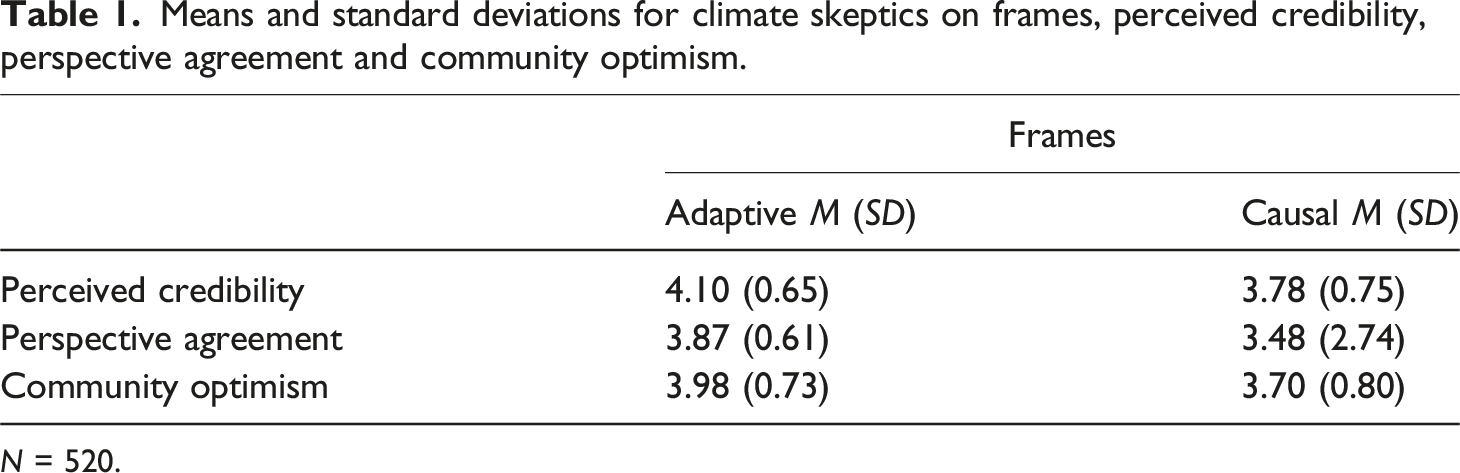
N = 520.
Finally, we tested our proposed mediation pathways, which posited that adaptive frames would lead to higher perceived credibility, which will mediate the effects on (a) perspective agreement and (b) community optimism, controlling for climate skepticism. We used PROCESS Model 4 (Hayes, 2013), to estimate mediation. H5a was supported because we found the significant indirect paths we predicted for perspective agreement through credibility with skepticism as a significant covariate. H5b was partially supported because skepticism was not a significant covariate of optimism, but the indirect path was significant.
For H5a, we found a significant direct effect of frames on story perspective agreement (Coeff. = 0.0944, SE = 0.0418, p = .025, 95% CI [0.0122 to 0.1765]), and a significant indirect effect mediated by perceived credibility (Coeff. = 0.1455, BootSE = 0.0376, 95% CI [0.0752 to 0.2235]). Climate skepticism was a significant covariate for credibility (Coeff. = 0.2392, SE = 0.0512, p = .0001, 95% CI [0.1386 to 0.3398]), and for perspective agreement (Coeff. = 0.0846, SE = 0.0380, p = .0264, 95% CI [0.0099 to 0.1592]) (See Figure 1). Mediation model predicting perceived credibility mediates the effect of frames on story perspective agreement, and community optimism. N =520. Direct effects and standard errors in parentheses. Dashed lines represent nonsignificant paths. Based on 5,000 bootstrap samples, 95% biased-corrected confidence interval. *p < .05, **p < .01, ***p <. 001.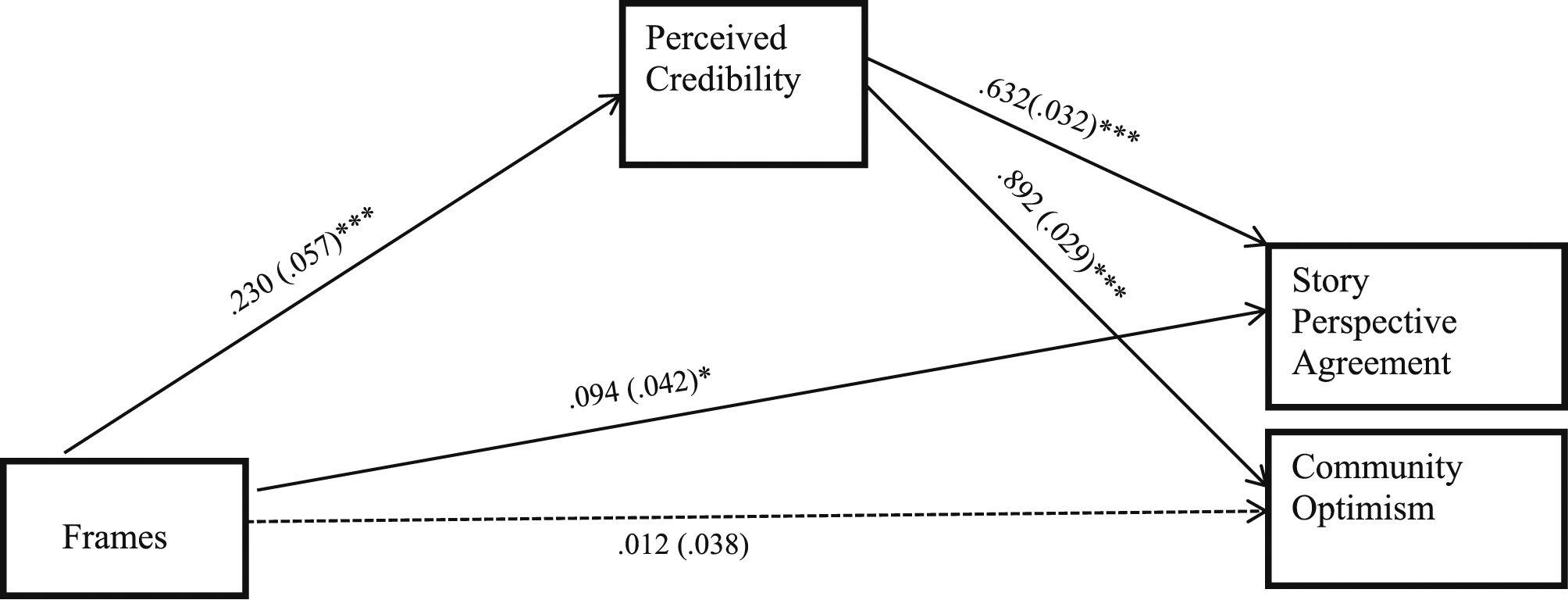
For H5b, on community optimism, we did not find a significant direct effect of frames (Coeff. = 0.0115, SE = 0.0379, p = .7613, 95% CI [−0.0629 to 0.0859]), but we did find the proposed significant indirect effect of frames through credibility (Coeff. = 0.2056, BootSE = 0.0509, 95% CI [0.1111 to 0.3071]). Climate skepticism was a significant covariate for credibility (Coeff. = 0.2392, SE = 0.0512, p = .0001, 95% CI [0.1386 to 0.3398]), but not for optimism (Coeff. = −0.0584, SE = 0.0344, p = .0903, 95% CI [−0.1260 to 0.0092]). (See Figure 1)
Discussion
This study provides support for the value of adaptive framing of climate change stories. We show across a broad sample of environmental issues that adaptation stories are found to be more in line with participants’ own perspectives – regardless of what those perspectives were. In this study, climate change skeptics and acceptors alike found the adaptive framed stories more agreeable to their own points of view. We leveraged equivalence framing to make minor wording changes to the stories, replacing trigger words such as “global warming” and “climate change” with more neutral terms such as “weather” and “weather extremes.” We also eschewed any mention of the cause of weather extremes and replaced the term “man-made” with the word “adapt” and its various derivations several times in the adaptive stories. These minor changes had important impacts, leading participants to rate the stories as more in line with their own perspectives, and to make them more optimistic about community efforts to adapt to weather extremes.
Community optimism is a new and important outcome that we measure for the first time in this study. A central tenet of adaptation (e.g., United Nations Framework on Climate Change, 2016) is that the negative impacts of climate change can be reduced when communities support changes like preparation for flood damage, planting more vegetation to cool human environments, or reducing meat consumption to adapt to dangerous change in levels of methane, nitrous oxide, and ammonia in the air. As we explicated above, optimistic response to adversity is associated with support of activities likely to lead to success (Carver and Scheier, 1990). Thus, the introduction of adaptive behaviors into communities will likely be better supported by the level of optimism in the community that people develop when they consume adaptively framed climate stories. As with perspective agreement, the adaptively framed stories raised optimism levels in both climate change skeptics and acceptors alike in this study.
Finally, we show that even though climate skeptics in this study responded more negatively than acceptors to adaptation stories, their outcomes are better on all counts than are skeptics who read stories framed the traditional way, as caused by man. This is a particularly important finding because there is extensive evidence that skeptics reject news stories about climate change (e.g., Rubin, 2016; Walter et al., 2018), likely leading to them not even reading these stories. In this study, skeptics were more accepting of the perspective, and felt more optimistic about community efforts to address the problem. They had other positive outcomes, such as finding the adaptive stories more credible, than did skeptics who read the traditional stories.
We measured perceived credibility, as do many other studies, but we conceptualize it as the causal mechanism linking adaptive framing to other beneficial outcomes. Mostly, research evaluates news credibility as the last link in the chain (e.g., Henke et al., 2020; Stroud and Lee, 2013), but fails to ask an important next motivational question – to what extent do people agree with the perspective that the reporter is taking in this story? In other words, we may think of credibility as a “grade” for the story, but perspective agreement is an indicator that the story has been persuasive, that is, it has engendered agreement. Science news stories’ task is to bring people into agreement with scientific findings (e.g., Fugl Eskjaer, 2009; Happer and Philo, 2016), thus making perspective agreement a critical indicator of news story impact. We tested credibility as a mediator and found significant indirect effects on both perspective agreement and community optimism. With this finding, we add to the list of mediators that have been identified in climate change news studies, such as perceived behavioral control and persuasion knowledge (Coleman et al., 2024), relative costs and benefits of policies (Feldman and Hart, 2018; Hart and Feldman, 2021), identification with victims (Hart and Nisbet, 2012), internal efficacy (Hart and Feldman, 2018), and belief in negative impacts (Hart and Feldman, 2018), among others.
Interestingly, pre-existing beliefs was a significant covariate only for perspective agreement and credibility, but not for community optimism in these analyses. It did not matter in this study whether one is a climate skeptic or acceptor in the process of adaptive frames increasing perceptions of credibility which then affect optimism. Apparently, even climate skeptics in this study could feel good about community efforts when they perceive climate news stories as credible.
There are some valid concerns that the approach we advocate here may imply that the cause of climate change is not important; we point out that we do not suggest this adaptive framing approach be used on all stories. We suggest that journalists write some stories using the adaptive frame. Stories that are focused on adaptation efforts are ideal for this approach. We have already begun to see this happening, including stories that address sea level rise and homes falling into the ocean without ever mentioning the words global warming, climate change, or man-made (Dennis, 2024).
One value in this approach is how scalable it is for journalists. They should continue to write stories that deliver important information about adapting to climate change, just as they always have. Then, they should go back and eliminate any use of three phrases – global warming, climate change, and man-made – replacing them with weather, weather extremes, weather impacts, and similar phrases. Last, highlight how the information they are presenting allows people to adapt to these weather impacts by incorporating the words “adapt,” “adaptation,” and “adaptive,” which seems to have important effects on increasing optimism. If there was nothing in the original story that would further any views that run counter to science, then no misinformation will be perpetuated. What these minor changes have the ability to overcome is climate skeptics’ willingness to even read such stories, or their knee-jerk reactions to dismiss these stories once they see triggers such as the words climate change, global warming, and man-made. These words trigger their schemas that say, “this story is trying to manipulate me and persuade me that my beliefs are wrong.” We demonstrated this by showing that even climate skeptics believe the adaptive stories are more aligned with their own perspective on the issue than the causal stories, and that they find the adaptive stories to be more credible than the causal stories – all by merely eliminating the phrases global warming, climate change, and man-made, and by adding the word “adapt.”
Conclusion
The finding of adaptive framing’s influence on climate skeptics is likely the most important story for practical applications as well as for media theorists. The adaptively framed stories were found to be more credible than the causally framed stories by skeptics and acceptors alike in this study. This means that those who accept climate change and those who deny it show greater trust in climate change news when it is framed as something they can adapt to. Credibility of news is crucial because, first, climate skepticism contributes to political polarization, that is, skeptics in the US tend to be Republican while acceptors tend to be Democrat, yet another point of contention between the two dominant political parties (Antonio and Brulle, 2011).
Second, climate change skeptics tend to be politically active (Engels et al., 2013), presumably influencing voters and government, and providing ongoing arguments against scientific perspectives. Thus, adaptive framing of the ongoing scientific story of climate change and its implications for the future is important because of the demonstration of its impact on credibility, trust, and believability.
The theoretical contribution of this study is the process that occurs with adaptive framing. Adaptive frames avoid invoking the schemas of people with intractable beliefs on polarizing issues. Thus, instead of rejecting the information in adaptive stories, people perceive them as more credible, which then has downstream consequences on important outcomes such as seeing them as congruent with their own pre-existing attitudes and feeling more optimistic about community efforts to address problems. We see this as having generalizable implications for a myriad of polarizing issues in society where people are skeptical of science – vaccines, the safety of genetically modified foods, and nuclear power plants for electricity generation, for example.
We add to framing theory evidence that even ideological biases can be overcome when minor word changes are made to avoid triggering schemas that cause people to reject information that does not align with those schemas. When framing does not invoke incongruent schemas, people are able to process and understand information because it is perceived as more credible. This leads people to experience positive cognitions and emotions, leading to outcomes more aligned with scientific evidence and consensus.
As with all research, this study is subject to limitations. First, we conducted this study with US citizens, who may not be generalizable to people in other parts of the world. We attempted to decontextualize this somewhat by measuring pre-existing attitudes about climate change – which are universal – rather than political party or ideology, which is specific to the US. Also, while our results were statistically significant, the effects sizes were small, as is common in this domain. One other limitation is that the mediator we identified – credibility – was measured and not manipulated. This means that we can only say that it is correlated with framing and the outcomes of perspective agreement and community optimism, not that it is causal. This is a weakness of not just this study, but nearly all studies of mediators in communication, according to Chan and colleagues (2020). This does not invalidate the current study or any of the ones that have come before, for it is necessary to first identify mediators in correlational studies before manipulating them in follow-up research.
The important conclusion here is that even climate skeptics in this study responded well to adaptation stories. This is a particularly important finding because there is extensive evidence that skeptics reject news stories about climate change (e.g., Rubin, 2016; Walter et al., 2018). Without news about the latest science findings about climate change, it is not clear what else exists to eventually change minds. This leaves a significant percent of the US population believing in what is basically misinformation (Falkenberg et al., 2022; Treen et al., 2020). The finding of the adaptive frame’s influence on climate skeptics is likely the most important story for news practitioners, as well as for media theorists. With nearly a third of US citizens being climate skeptics or at least unsure about the reality of climate change, in spite of nearly universal agreement by scientists that climate is not only warming but warming faster and threatening human life (Hamza et al., 2020; Headrick, 2019), how the news about climate change is framed becomes ever more critical.
Supplemental Material
Supplemental Material - Adapt and overcome: The impact of adaptive frames in news stories on climate change skeptics and acceptors
Supplemental Material for Adapt and overcome: The impact of adaptive frames in news stories on climate change skeptics and acceptors by Esther Thorson, Renita Coleman, Samuel M Tham, Weiyue Chen and Adam Glenn in Journalism.
Footnotes
Declaration of conflicting interests
The author(s) declared no potential conflicts of interest with respect to the research, authorship, and/or publication of this article.
Funding
The author(s) received no financial support for the research, authorship, and/or publication of this article.

Supplemental Material
Supplemental material for this article is available online.
Note
Author biographies
References
Supplementary Material
Please find the following supplemental material available below.
For Open Access articles published under a Creative Commons License, all supplemental material carries the same license as the article it is associated with.
For non-Open Access articles published, all supplemental material carries a non-exclusive license, and permission requests for re-use of supplemental material or any part of supplemental material shall be sent directly to the copyright owner as specified in the copyright notice associated with the article.
