



Abstract
Most mediation studies do not provide evidence that mediators are causal, only correlational. This is one of the first in the field to use concurrent double randomization to test causality of a mediator. Previous research showed adaptive frames that do not trigger skeptics’ anti-climate change schemas improve responses to stories and identified the activation of persuasion knowledge as the mediator. In this experiment, persuasion knowledge activation is causal for two of three outcomes, but only correlational for a third. We also report an inconsistent mediation effect, whereby persuasion knowledge activation has a positive direct effect but a negative indirect effect.
Keywords
Climate change may be the defining story of our times, and covering this complex and politicized topic is one of journalists’ toughest challenges. Academic researchers have helped by producing studies that identify strategies journalists can use to increase audiences’ uptake of climate information and improve their responses to it. One critical component is to identify the causal mechanisms—or mediators—by which these processes occur, and a wealth of information has been created. Perceived behavioral control (Thier & Lin, 2022), external political efficacy (Feldman et al., 2017), and relative costs and benefits of policies (Feldman & Hart, 2018), are some of the variables identified as mediators of climate change outcomes.
One major drawback is that none of these studies provided evidence that these mediating mechanisms are, in fact, causal. Even experiments only show an association, as these studies measured the mediators rather than manipulated them. When participants are not randomly assigned to levels of the mediating variable, there is only a correlation between the dependent variable and the mediator (Pirlott & MacKinnon, 2016). Showing statistical evidence of mediation is not the same as showing causality.
This problem is not confined to research on climate change—it is pervasive within the field of communication. Chan et al. (2020) conducted a content analysis of five top communication journals from 1996 to 2017 and found that all mediation studies had only measured and not manipulated the mediators, concluding these studies were “inadequate to make causal inferences” (p. 1). By only measuring the mediator, third variables cannot be excluded as confounds. Nor does measuring the mediator establish that it came before the dependent variable. Chan and colleagues (2020) suggest that once a study measures a mediator, a follow-up experiment that manipulates both independent variable and mediator should be undertaken, called “manipulation-of-mediator” designs. If the manipulated mediator has a significant direct effect on the dependent variable, then cause has been demonstrated (Pirlott & MacKinnon, 2016).
This study addresses that call. In a previous standard measurement-of-mediation experiment, correlational evidence was found for the activation of persuasion knowledge (PK) as the mediator for a new type of frame designed to improve acceptance of climate change news called an “adaptive frame” (Coleman et al., 2024). It tested the idea that not mentioning the terms “global warming” and “climate change” or not saying it was man-made would lead to greater agreement with the story’s perspective and increase intentions to engage with the news and take adaptive actions relative to the “causal frame” that did mention these terms. However, because that experiment did not manipulate the mediator, it only provided evidence of an association, as the authors noted. In this study, we rectify that with a concurrent double-randomization design (Pirlott & MacKinnon, 2016), where both the independent variable and mediator are simultaneously manipulated in one experiment—essentially a two-factor experimental design. This study has three goals: first, to manipulate the mediator by inducing the activation of PK through a priming prompt and manipulating the independent variable—framing—to test causality for all components. Second, it replicates previous findings that these adaptive frames that do not activate climate-skeptical schemas, mediated by PK activation, can improve outcomes of interest to journalists. Third, it extends the generalizability of these frames with four stories that have not been used before.
This study is important because it begins a practice of following up these measured mediator studies with manipulation designs to move the field forward methodologically. Mediation is a theoretical model that implies causality; yet, without testing that causality, much of what we think we know about communication processes may be based on the thinnest of foundations, if not entirely in error. Second, it is important because the communication field is also lacking in replication, especially regarding the variety of messages used. As results are often not consistent across messages, research must consider more messages to generalize to categories of media (Geiger & Newhagen, 1993).
The substance of this study is likewise important. Developing and confirming ways through which journalists can reach people, especially those who dispute science, helps reduce polarization in society, encouraging collective agreement on solutions and coming together to act on an issue that represents an existential threat.
Literature Review
Persuasion Knowledge
The process proposed in a previous study is that a new type of frame, called “adaptive,” focuses on climate change without cueing deeply held beliefs via trigger words that lead science skeptics to access their in-group norms about the topic, leading them to reject the news story and its sources. Trigger words are important aspects of climate news. Studies of survey wording show that climate skeptics react negatively to “global warming,” “climate change,” and “fossil fuels” (Benjamin et al., 2017; Petrovic et al., 2014; Schuldt et al., 2011). It was previously demonstrated in a measurement-of-mediation experiment that using non-triggering words in news stories improves outcomes by reducing perceptions that the stories are attempting to persuade (Coleman et al., 2024). PK is the idea that people learn about attempts to manipulate it throughout their lives. The Persuasion Knowledge Model (PKM; Friestad & Wright, 1994) explains the process by which people understand the tactics of manipulation and use their ability to recognize and resist persuasion. It involves three interconnected processes—acquiring knowledge about persuasion, activating that knowledge, and reacting to persuasive attempts (Rahmani, 2023). People develop PK throughout their lifetime through interactions with various persuasive events—political candidates, salespeople, and advertising, for example, learning that celebrity endorsements, fear appeals, and emotional appeals are among the persuasive techniques. Acquiring PK influences the activation process because when people recognize messages as persuasive attempts, it activates their knowledge about underlying motives of the persuasive agent. This knowledge includes the communicator’s motives that can be both good and bad. In the third step, the reaction process involves engaging in coping behavior aligned with one’s own goals such as getting accurate information or feeling positive about one’s self (Kirmani & Campbell, 2004). Literature also shows that most people react negatively and tend to resist persuasion attempts (Eisend & Tarrahi, 2022); this is the case when tactics are seen as deceptive. However, when people perceive positive motives, their reactions can be positive (Rahmani, 2023). This recognition of a persuasive attempt and reaction to it is what we focus on here rather than the acquisition of knowledge about persuasion attempts. This study uses the term “perceived PK” to mean the activation of one’s knowledge about persuasion to recognize a persuasive message and potentially employ tactics to resist it.
Although PK has primarily been studied in advertising and marketing, its authors (Friestad & Wright, 1994) intended it to apply across a broad range of contexts, including persuasive agents that are believed and trusted. Journalism is one of those contexts; sometimes people believe and trust the news media, and other times, they believe journalists are biased and stories are meant to manipulate (Mont’Alverne et al., 2023). Regardless of what people believe, some news stories may trigger audiences’ awareness that stories are trying to influence them, leading them to reject the information. The PKM also specifies that tactics seen as appropriate do not lead to negative reactions. While it still results in awareness that the messages may be persuasive, skepticism is lessened, and people find them credible. In the PKM, recipients react to persuasive messages by believing they recognize a persuasive effort—the concept of perceived PK—and the salience of motive leads to more negative evaluations of messages. In the present study, a PK prime suggesting journalists tend to be biased should increase perceived PK. The presence of words about climate in the causal frames are hypothesized to also increase perceived PK through the belief that the news story harbors an ulterior motive to persuade readers that climate change is real, dangerous, and anthropogenic. However, the use of adaptive frames should minimize the amount of perceived PK because the stories do not assert that climate change is man-made and do not use triggering terms such as “global warming” and “climate change.” While there is conflicting evidence about whether perceptions of PK result in positive or negative outcomes, we could find no research specifically on news media to guide us. Furthermore, the predominance of the evidence shows reactions are negative. Because of this, and the growing distrust of news media (Brenan, 2022), we align our predictions with evidence that shows perceptions of PK have negative outcomes.
Politicized issues such as climate change have potentially greater abilities to activate people’s PK and even trigger reactance (Ma et al., 2019). Psychological reactance is related to PK (Brehm, 1966) but differs in important ways. First, a perceived threat to freedom is an essential component in reactance, unlike in PK (Clayton, 2022). Second, the ways in which reactance is generated include warning labels, vivid images, and dogmatic, forceful language explicitly pressuring audiences, for example, “you must” and “don’t deny” (Clayton, 2022). News stories typically do not include warning labels or forceful language telling people what to do, including the stories in this study. While news stories may include vivid images, these did not. Thus, PK is more appropriate for this study than reactance.
Our study follows the common methodological paradigm in PK research, first exposing participants to a PK manipulation or control, then presenting them with a message, followed by testing whether the PK prime activated more perceived PK and prompted different reactions relative to the control. We expect the priming prompt should strengthen participants’ awareness of being persuaded while the control should not, allowing it to vary freely. If PK mediates the outcomes, then experimentally strengthening PK should cause people to become more focused on the media’s attempts to persuade them. By randomizing to levels of manipulated PK, we establish temporal precedence of manipulated PK to the DVs. Manipulated PK is then measured as both a check of the manipulation and as a mediator (Pirlott & MacKinnon, 2016). The first hypothesis is a main effect of the PK manipulation on perceived PK:
Framing Theory
The second manipulated factor is based in framing theory. In journalism, framing refers to how information is chosen, emphasized, and presented to audiences (Entman, 1993). The analogy of a picture frame is often invoked—the frame includes some elements and leaves out others, causing people to focus on certain things. The idea of elements that are left out is one approach in this study—leaving out mentions of the man-made cause of climate change is key to adaptive framing.
Framing theory includes many subsets such as generic and issue-specific frames and emphasis and equivalence frames. The latter is the subject of this study. In equivalence frames, logically equivalent words or phrases are altered (Cacciatore et al., 2016). The best-known examples of equivalence frames are the gain and loss frames in health studies. Presenting information in terms of lives lost versus lives saved results in different outcomes. The classic experiment (Tversky & Kahneman, 1981) asked people to choose a treatment for 600 people where either 200 people would be saved (gain frame) or 400 would die (loss frame). Even though, mathematically, the choices are identical, 72% of participants chose the treatment presented in the gain frame, whereas only 22% chose it in the loss frame. This has been replicated in numerous other studies and contexts. In this study, other than a few words and phrases, the adaptive and causal framed stories use identical descriptions. Numerous studies that manipulate statements or survey question wording exist, showing words such as “climate change,” “global warming,” “fossil fuel,” and others (Feldman & Hart, 2018; Petrovic et al., 2014) affect policy support, political engagement, and other outcomes. However, none of these used journalistic stories. As news stories are the main source of information about climate issues for audiences (Newman et al., 2020; Schafer & Painter, 2021), it is important to know if slight wording changes have beneficial effects.
Adaptive Framing
The basic concept of framing is extended with a new type of journalistic frame called adaptive framing. It avoids activating people’s deep-seated beliefs about climate change, such as that it is due to normal weather variation rather than being man-made. These beliefs are tied to social identity, religious beliefs, or political affiliation and are resistant to information that contradicts them (Nisbet & Scheufele, 2009). By eliminating words that trigger people’s pre-existing beliefs, we predict stories framed this way will be seen as more acceptable, increasing the effectiveness of the message.
Stories used in this study as the comparison group that did contain this information were called the “causal frame” and represent the most common way climate stories are framed, that is, with statements about the man-made cause and use of the words “global warming” and “climate change” (Climate Change Observatory, 2023). Up to 75% of stories on climate change include information on its cause (Seelig et al., 2022), and this causal frame has dominated for decades (Shehata et al., 2022).
In addition to avoiding words that trigger deep-seated beliefs, we substituted the word “adapt” and its derivatives for the words “man-made” or “human caused.” This emphasizes self-control and highlights modifying, adjusting, and revising, which are incremental changes rather than wholesale fundamental transformations. We draw from climate scientists who define adaptation as “adjustments in . . . response to actual or expected climactic stimuli or their events,” “preparations” (Ford & King, 2015, 138), and “responses to reduce potential climate change impacts” (p. 139). A previous study found that inclusion of the word “adapt” was mediated by perceived behavioral control, supporting the idea that people react positively to stories that highlight smaller, incremental changes that are easy to enact (Coleman et al., 2024). The current study does not manipulate perceived behavioral control to test it as a causal mediator to make the study manageable. This study tests only one element of the mechanisms of adaptive frames by manipulating the hypothesized trigger-words mediator of PK. We found two previous studies that tested the premise of adaptive framing. The one this study replicates and extends manipulated climate stories to either include trigger words or not and measured perceived PK as the mediator (Coleman et al., 2024). That study and the one by Chapman and Lickel (2016) made no mention of trigger phrases and avoided discussing cause. Both found non-trigger frames led to more positive outcomes. This approach is externally valid and has been adopted in other contexts. For example, the American Meteorological Society recommends weathercasters stop mentioning responsibility for climate change (Bender, 2019). 1
In this study, four news stories report adaptation efforts, differing only in that one condition contains trigger words and “adapt” while the other included trigger words and mentions man as the cause. We posit that the de-politicized nature of the adaptive frames means these stories will not activate a person’s PK the way the causal frames do. Thus, we test a main effect of frames:
In this study, we are mainly interested in outcomes of interest to journalists. Changing people’s deeply held beliefs or attitudes about climate issues is not our purpose. Nor is it the job of journalists to tell people what to believe. Instead, journalists’ democratic goals are to provide people with information necessary to make decisions about policy and leadership and to be able to debate issues with others in society to come to agreement on solutions to problems (Gajardo & Meijer, 2022). Instead, we are concerned with people’s acceptance of and responses to these types of stories as there is little chance of changing people’s attitudes if they do not respond positively to them. Thus, we use as outcomes three constructs that can help lead to agreement on solutions to climate problems.
Story Perspective Agreement
The first step toward the success of adaptive frames is that audiences hold positive attitudes toward the stories (Davis, 1999); in this case, they see the stories as congruent with their own point of view (Lee, 2011). That people see the stories as objective or balanced is not adequate as partisans see bias even when none exists (Vallone et al., 1985). Different labels have been used for this concept, including message-attitude congruence (Lee, 2011); both “perspective agreement” and “message-attitude congruence” refer to messages that contain a viewpoint consistent with the audiences. Because adaptive frames avoid the heuristics and language that people view as being against their own positions, we predict that audiences will see the adaptive framed stories as agreeing with their own perspective more than causal framed stories.
News Engagement Intentions
A second critical response of readers is becoming engaged with news. Engagement leads to continued news use, and even to finding out more (Wenzel & Nelson, 2020). News engagement has been called many names including audience engagement, user engagement, and engaged journalism (Gajardo & Meijer, 2022). We define the concept from the audience perspective, focusing on the ways engaging with the news fulfills journalism’s democratic goal of informing citizens by means such as by fostering discussion with others (Fitzgerald et al., 2020), intending to read more on the topic, and actively looking for more news (Karnowski et al., 2017).
Engagement is important because it contributes to a better-informed citizenry and higher trust in news (Zayani, 2021). Engaged citizens are more involved with the issue (Oeldorf-Hirsch, 2018), and more engagement via discussion with others can lead to more civic activities (Gil de Zúñiga et al., 2012). Engagement that promotes dialog and creates social connections can generate support for public policy (Nisbet & Scheufele, 2009).
Because adaptive frames induce low levels of perceived PK by not cueing divisive political ideas, they should arouse people’s interest in other stories similarly framed, leading them to look for more stories like them. Their emphasis on adapting and adjusting to climate change will encourage interaction with others.
Adaptive Action Intentions
Our final outcome is whether adaptive stories affect the intent to behave in ways suggested in the story, called adaptive action intentions (Coleman et al., 2024). This involves concrete steps to adjust to, reduce, or prepare for actual or expected impacts from climate change (NASA, n.d.). These can include things like conserving water, building away from floodplains, and growing crops instead of raising animals or supporting and enacting policies such as land use planning. We measured items ranging from reader’s intention to support issue-related actions to another item that has been shown to be a high barrier to positive response to climate stories—spending tax money (Hardisty et al., 2019). Our definition of adaptive actions ranges from things individuals can do to community and government-level actions that individuals can encourage (Ford & King, 2015). By not inducing high levels of awareness of persuasion, people are more accepting of the actions. Thus,
Testing Causality of the Mediator
Next, we test the claim that perceived PK is causal. We theorize manipulated PK affects the three DVs but only within one level of frames (Pirlott & MacKinnon, 2016)—the adaptive frames. This is because causal frames heighten perceived PK on their own with words that activate people’s schemas about climate change. This puts people on alert that the message may include information designed to persuade them. 2 To see the pure effects of manipulated PK, independent of perceived PK created by causal frames, we examine manipulated PK only on those who received adaptive frames to reduce the noise created by two sources of PK activation.
By manipulating and randomizing levels of PK, we can demonstrate if it is indeed causal—this is established if manipulated PK (the IV or X) has a direct effect on the DVs (Y) (X > Y; Pirlott & MacKinnon, 2016). This concurrent double-randomization design will also show indirect effects, that is, the ability for the manipulated mediator (referred to as M*) of PK to affect the mediator (perceived PK), or M, and for the mediator to then affect the dependent variables (X > M > Y1, 2, 3). It establishes temporal precedence of manipulated PK on the DVs and reduces plausible alternative explanations for the effect of the mediator on the DVs. Measuring the mediator also yields statistical evidence that it mediates the relationship between the IV and DVs. Thus,
Method
This experiment uses a 2 × 2 between-subjects, concurrent, double-randomization design to test mediation as causal. The first factor is the manipulated mediator PK (primed/not primed); the second factor is the independent variable framing (adaptive/causal). It uses four messages to increase validity and rule out unique stimulus effects (Geiger & Newhagen, 1993). Participants were randomly assigned to either have their PK primed or not and were also randomly assigned to either the adaptive or causal condition where they received two of the four stories. We indexed the two stories each person received.
Adults were recruited from the Qualtrics panel database representative of the U.S. population and received a small incentive in line with the minimum wage. A G*Power analysis using linear multiple regression as the test statistic (Perugini et al., 2018), with an effect size of .03 from a previous study (Coleman et al., 2024), showed 403 were needed for a power level of 0.80. The survey company eliminated those not passing attention checks, resulting in a total N of 457.
Stimuli
Four actual news stories about climate change that emphasized adaptation were changed for length and wording by a former journalist (See Online Supplemental Appendix). The stories included one on fruit trees that talked about how planting trees can help reduce temperatures. The storm-water story showed how collecting and storing excess rainwater is used for community gardens. The plant-based meat story talked about meat alternatives that eliminate excessive water use and greenhouse gases from animals. The wildfire story showed how controlled burns can reduce wildfires. Adaptive stories used variations of the word “adapt” at least four times in the stories and headlines. Causal versions used “man-made climate change” or “global warming” at least four times in the stories and headlines. Adaptive stories replaced “climate change” and “global warming” with “weather” and did not mention cause; these words were used in the causal versions. The Associated Press was used as the news outlet because it is perceived as center leaning (Mastrine, 2020). Stories were between 328 and 387 words.
All stories contained information about adaptive actions being taken by officials and individuals, which was held constant. If we find effects of adaptive frames, it can only be because of minor wording changes, not because these stories contained more information about adaptive actions.
Manipulation checks for story condition were unnecessary because manipulations involved intrinsic features; no matter what participants thought, the stories did differ in terms of words used (O’Keefe, 2003). Checks of the PK priming manipulation were conducted with questions after each story about participants’ PK awareness, as described in the following section.
Procedure
Potential participants were first asked about their education, age group, sex, ethnicity, and their pre-existing attitudes toward climate change with one question: “Claims that human activities are changing the climate are exaggerated.” Quota sampling on these ensured a sample representative of the U.S. population equally split between climate skeptics and accepters. We also asked distractor questions about vaccines and immigration to avoid priming participants to the study’s goals (“The risk of side effects outweighs any potential benefits of vaccines,” and “Illegal immigrants should not benefit from my tax money.”). Five-point scales (1 = strongly disagree, 5 = strongly agree) were used.
Next, participants were randomly assigned to either the PK manipulation condition or control group. Designed to activate PK, the priming prompt, adapted from the study by Isaac and Grayson (2020), said: “Before you read the following news stories, please consider the results of a recent study from the academic journal Journalism Research & Review. The study showed that most news stories tend to be biased and aim to persuade readers.” They were asked to write down what they just read. The control condition said, “Before you read the following news stories, please think about what comes to mind when you think about news in general. Please write down any thoughts that come to mind” (Isaac & Grayson, 2020).
There were 301 in the primed PK condition and 156 in the control. Variances across groups were equal (Levene’s = .161, df = 1, 455, p = .689). The PK manipulation was successful as those in the PK primed condition had significantly higher levels of perceived PK than those in the control condition using three questions described below (F = 12.28, df = 1, 456, p < .001; PK M = 3.06, SD = .049, control M = 2.77, SD = .068).
Participants were then randomly assigned to the adaptive or causal framing conditions and shown their first story. Attention checks were randomly placed asking what the story was about. Only those who answered correctly were retained by the survey company.
Immediately following the story, participants were asked questions measuring the mediator of perceived PK, followed by the DVs. This was repeated with the second of four stories in the same condition, also randomly assigned. To detect hypothesis guessing, we included an open-ended question at the end of the study that said, “Please write down your thoughts about the purpose of this study.” We categorized the comments and found no issues. 3
Measures
All items were measured with 1 = strongly disagree to 5 = strongly agree. Responses to the two stories each person read were indexed and averaged.
Perceived PK was measured with three questions: “This story seems to manipulate readers in a way I don’t like”; “I was annoyed by this story because it seems to be trying to influence the audience”; and “When I read this story, I think it’s pretty obvious it is trying to persuade me” (Vashisht & Royne, 2016; Cronbach’s alpha = .794).
Story perspective agreement was measured with two questions: “To what extent do you agree with the perspective this story takes on dealing with?,” “In this news story, did you think the portrayal of dealing with was unfavorable, neutral, or favorable to your position on the issue?” (Pronin et al., 2004; Cronbach’s alpha = .77).
News engagement intentions were measured with five questions: “How likely are you to talk with other people about?,” “How likely are you to read more stories about?,” “How likely are you to read more stories about community efforts to address?,” “If you came across this news article on your own, how likely is it that you would give it more than a glance?,” and “How likely is it that you will look for further information on?” (Fitzgerald et al., 2020; Karnowski et al., 2017; Cronbach’s alpha = .926).
Behavioral intentions to take adaptive action were measured with three questions: “How likely would you be to”: “support efforts to handle,” “vote for elected officials who support planning for,” and “endorse spending taxpayer money to address” (Cronbach’s alpha = .867).
Results
Men made up 50.5% of our 457 subjects; two listed their gender as “other.” Forty percent had an education of high school or less; 26.3% some college; 19.9% bachelor’s degree; 3.5% some graduate school, 14.4% graduate degree. Race was 57.8% White; 14.2% Black; 18.8% Hispanic; 6.3% Asian; 0.9% Native American, and 2% “other.” For age, 11.2% were 18–24 years, 16.2% were 25–34 years, 18.4% 35–44 years, 15.5% 45–54 years, 16.2% 55–64 years, 16.6% 65–74 years, 5.3% 75–84 years, and 0.7% 85 years or older. Politically, 30.8% were Democrats, 35.4% Republicans, and 33.7% Independents. Ideologically, 17.3% were liberal, 40.9% conservative, and 41.8% moderate. Our sample leaned toward conservative because those are the people most likely to be skeptical of human causes of climate change, the group we were most interested in seeing if the adaptive frames affected.
The framing conditions had 239 subjects in the adaptive condition and 218 in the causal condition. The PK conditions had 301 in the primed PK condition and 156 in the control (Table 1). 4
Means and Standard Deviations for Frames and Persuasion Knowledge Manipulation on Mediator and Dependent Variables.
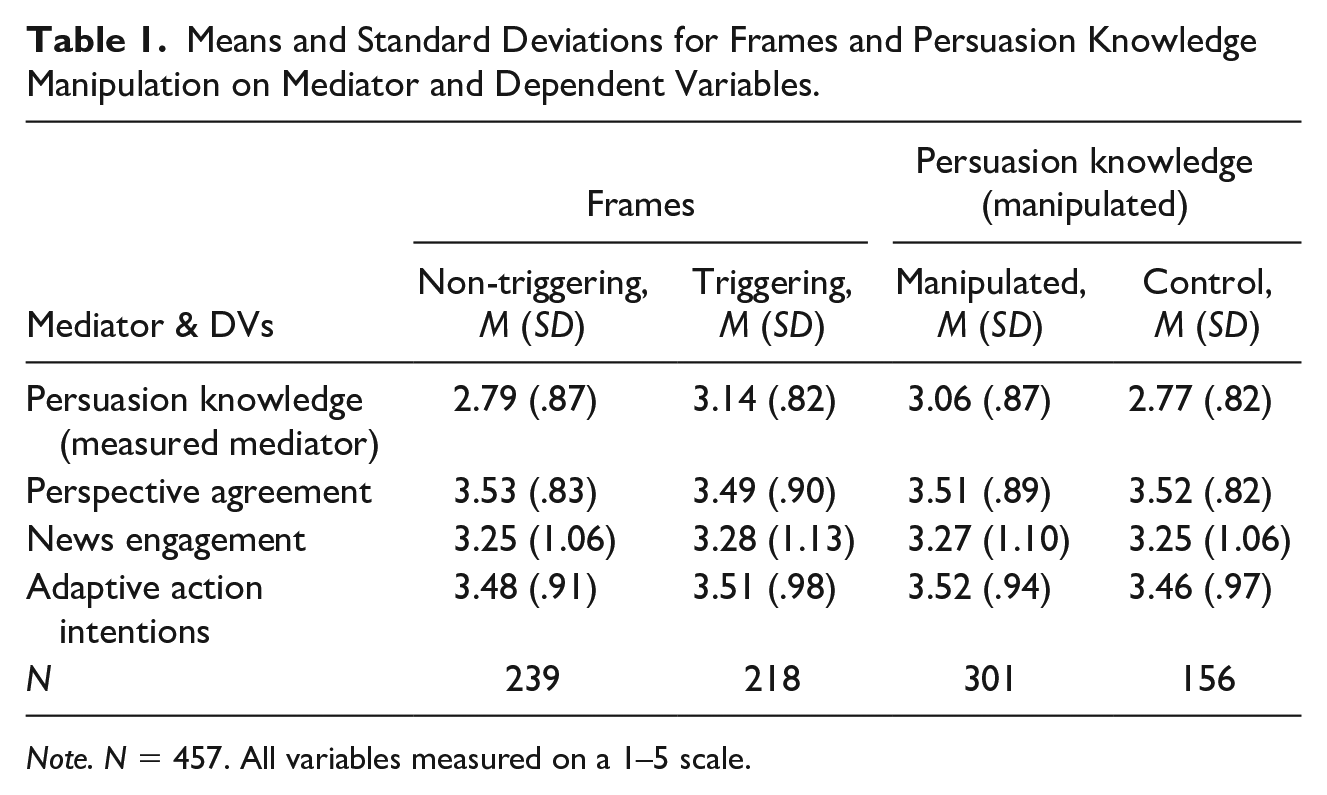
Note. N = 457. All variables measured on a 1–5 scale.
There were no interactions between story topics and framing (perspective agreement F = .666(5, 601), p = .649; news engagement F = .433(5, 601), p = .825; adaptive action intent F = .670(5, 601), p = .647).
The first hypothesis predicted a main effect of the PK manipulation. H1 was supported. Those in the manipulated PK condition had significantly higher levels of perceived PK than those in the control condition (F = 12.28, df = 1, 456, p < .001, η2p = .026; PK manipulated M = 3.06 (.05), Control M = 2.77 (.07). The manipulation increased participants’ perceived PK by nearly one-third of a point compared to those in the control group.
The second hypothesis predicted that causal frames will increase perceived PK more than adaptive frames. H2 was supported. There were significant differences in perceived PK between those in the adaptive and causal conditions (F = 19.11, df = 1,456, p < .001, η2p = .04). As predicted, those who read the adaptive stories had significantly lower levels of perceived PK than those in the causal condition (Adaptive M = 2.79 (.87); Causal M = 3.14 (.82)). The adaptive frames reduced participants’ perceived PK by more than a third of a point.
Our next set of hypotheses used PROCESS Model 4 (Hayes, 2013), to test mediation by estimating direct and indirect effects using unstandardized regression coefficients and bootstrapping. If the upper and lower confidence levels do not contain zero, the effect is significant. First, we determine if those who saw the adaptive framed stories performed better on our three DVs (perspective agreement, news engagement, and adaption action intentions), mediated by perceived PK, than those who saw the causal framed stories (See Figure 1).
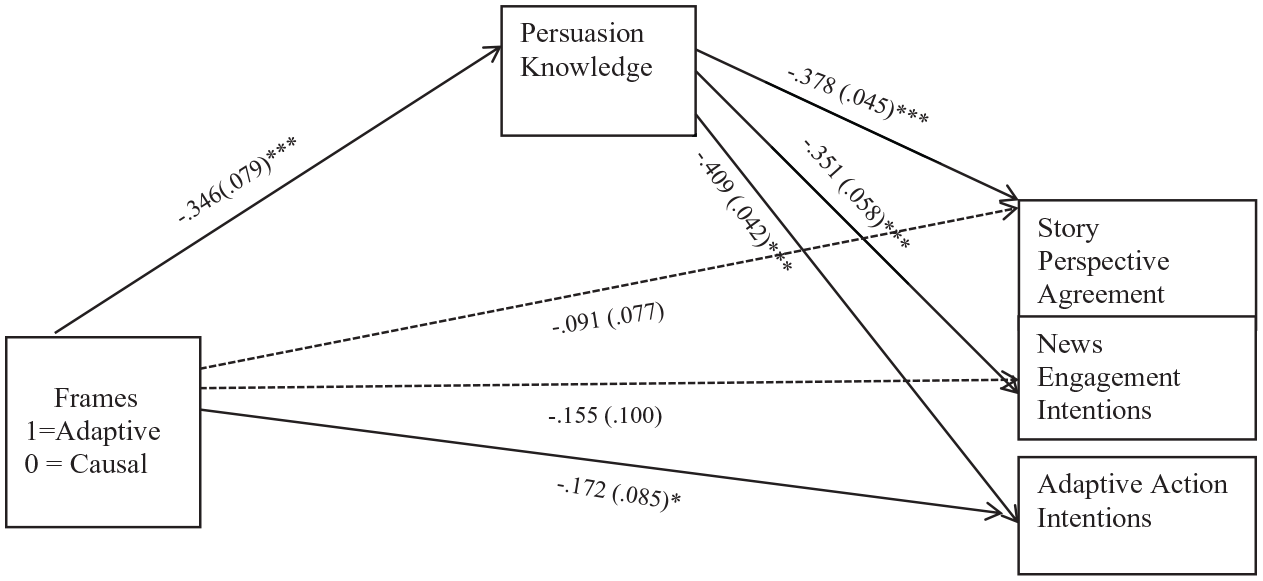
Mediation Model Predicting Persuasion Knowledge Mediates the Effect of Frames on Story Perspective Agreement, News Engagement Intentions, and Adaptive Action Intentions.
H3a–c were supported. Specifically:
For perspective agreement, there was an indirect effect of frames through perceived PK. Adaptive frames decreased awareness of PK (B = −.3464, SE = .0792, p < .001, 95% CI [−.5021, −.1907]), which in turn increased perspective agreement (B = −.3776, SE = .0445, p < .001, 95% CI [−.4650, −.2901]). There was the significant indirect effect we hypothesized (95% CI [.0639, .2077]). We did not expect a direct effect of frames, and there was none (B = −.0914, SE = .0768, p = .2348, 95% CI [−.2423, .0596]).
For news engagement, there was an indirect effect of frames through perceived PK (B = −.3464, SE = .0792, p < .001, 95% CI [−.5021, −.1907]), which in turn increased news engagement (B = −.3512, SE = .0582, p < .001, 95% CI [−.4655, −.2369]). There was an indirect effect of adaptive frames on news engagement through perceived PK (95% CI [.0574, .1977]). Again, we did not expect a direct effect of frames, and there was none (B = −.1552, SE = .1004, p = .1226, 95% CI [−.3525, .0420]).
Adaptive action intention showed the same pattern, with adaptive frames significantly lowering perceived PK (B = −.3464, SE = .0792, p < .001, 95% CI [−.5021, −.1907]), which increased intentions to take adaptive actions (B = −.4085, SE = .0491, p < .001, 95% CI [−.5049, −.3120]). There was an indirect effect of adaptive frames on intentions to take adaptive action through perceived PK (95% CI [.0714, .2248). Although we did not predict one, there was a direct effect of frames on adaptive action intent (B = −.1720, SE = .0846, p = .0427, 95% CI [−.3383, −.0056]).
Next, we turn to testing hypotheses H4a-c that posit activated PK is causal, not just correlational. We predicted this would be the case for those who saw adaptive frames but not causal frames because of the perceived PK these frames generate by activating schemas; we are examining the perceived PK created solely by the PK manipulation.
On perspective story agreement, we found that manipulated PK was not causal, as there was no direct effect for adaptive frames (B = .1846, SE = .1049, 95% CI [−.0221, .3913]). H4a was not supported.
However, we find that manipulated PK was causal for the other two DVs (news engagement, adaptive action intentions). For those seeing adaptive frames, there was a significant direct effect of manipulated PK on news engagement (B = .2984, SE = .1396, 95% CI [.0234, .5735]) and on adaptive action intentions (B = .2972, SE = .1163, 95% CI [.0681, .5263]); thus, manipulated PK was causal. Overall, this pattern suggests that manipulated PK has positive effects on news engagement and adaptive action intentions, but the increase in perceived PK by manipulated PK results in a negative indirect effect via perceived PK. Reasons for this are included in the Discussion.
We had anticipated the two direct effects would be negative; instead, they were positive, that is, manipulated PK caused more positive scores on news engagement and adaptive action intentions than the control condition. While this shows that manipulated PK is indeed causal, it worked opposite of the way we expected. H4b and H4c were partially supported in that PK was causal, as there was a significant direct effect, but it was in the opposite direction predicted (Figure 2). We discuss this finding in the following section.
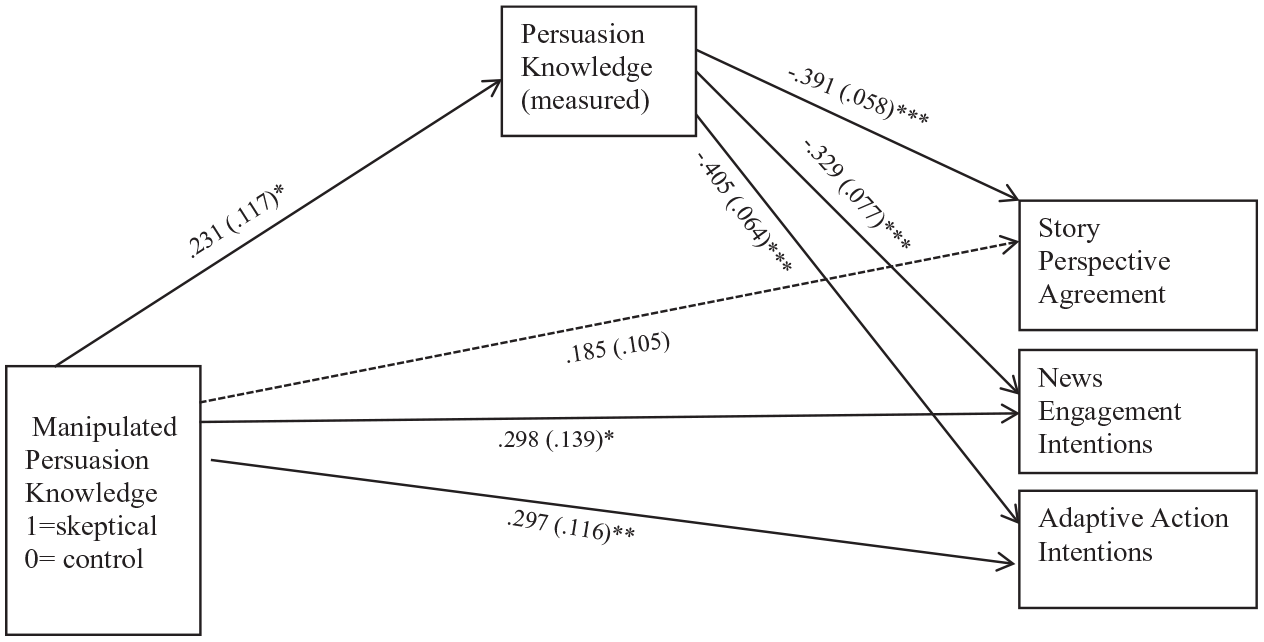
Mediation Model Predicting Causal Effects of Manipulated Persuasion Knowledge on Story Perspective Agreement, Adaptive Action Intentions, and News Engagement Intentions, Mediated by Measured Persuasion Knowledge for Those Seeing Adaptive Frames.
Discussion
This study is among the first—if not the first—in a communication journal to conduct a causal test of a mediator. Most research identifies mediators by measuring them and never proceeds to the next step to test causality (Chan et al., 2020). This study is a follow-up to a previous study that found evidence for the mediating role of perceived PK in response to adaptive framed stories about climate change (Coleman et al., 2024). However, that study only offered correlational evidence. The current study situationally induced PK activation (or not) to see if it influenced people’s attitudes and behavioral intentions using a design where both independent variable and mediator are manipulated in a single experiment. Through random assignment to levels of the mediator, this design established temporal precedence of activated PK to the outcome variables (perspective agreement, news engagement, adaptive action intentions) and reduced the plausibility of alternative explanations of the mediator to DV relationships.
This turned out partially as expected. The manipulated PK factor did have a direct effect on two DVs (news engagement, adaptive action intentions) but not on one (perspective agreement). Therefore, activated PK is a causal mediator for some outcomes, but not for all. This is not entirely unexpected as previous research shows that what the outcome variable is matters in PK research. A meta-analysis found that effects are different for cognitions than attitudes, with PK affecting primarily emotional and behavioral outcomes (Eisend & Tarrahi, 2022). In this study, the one DV that PK did not causally affect was the attitude measure of perspective agreement. Activated PK is less likely to move deeply ingrained ideological beliefs, especially considering how these are linked to one’s identity (Nisbet & Scheufele, 2009). The literature is filled with studies showing how hard it is to challenge underlying beliefs (Nisbet & Scheufele, 2009). However, the two DVs that did show manipulated PK was causal were both behavioral intention measures—news engagement and adaptive action intentions. The behaviors that these stories suggested, and questions measured, such as planting a tree or supporting officials and policies that encourage adaptive actions, are fairly easy to do and do not threaten one’s ideological viewpoint. Thus, these outcomes are predicted by the PKM, and activated PK is causal for them.
As manipulated PK did not cause the attitude measure to increase, activated PK is only a correlational mediator for this DV. This may be because perspective agreement affects perceived PK in the reverse of the temporal order than the hypothesized path—that is, agreeing with the perspective of the story may be responsible for lowering perceived PK, not that lower perceived PK causes one to agree with the story perspective. It is also plausible that some other intervening variable confounds the process.
We also found that, while there was a direct effect of manipulated PK on the other two DVs (news engagement, adaptive action intentions), the result was opposite to what we expected; manipulated PK had a positive direct effect on the two behavioral intentions. Most studies of perceived PK show that increasing levels of it lead to negative evaluations of the message and its sender (Eisend & Tarrahi, 2022); however, there is growing evidence that this is not always the case—in some circumstances, increasing perceived PK can lead to positive outcomes (Isaac & Grayson, 2017; Kirmani & Campbell, 2004). Research has shown favorable effects of activated PK on memory and learning, and transparent sources lead to more favorable evaluations (Eisend & Tarrahi, 2022). Increased PK activation can lead to greater credibility rather than skepticism depending on the tactic used (Isaac & Grayson, 2017). Three studies so far have shown that manipulated PK can have positive effects (Ahluwalia & Burnkrant, 2004; DeCarlo, 2005; Wei et al., 2008). Thus, our counterintuitive finding is predicted by theory and held up by evidence.
Our findings show a significant and positive direct effect, where priming these participants’ perceived PK about journalists’ bias led to more news engagement and more intentions to take adaptive action. It makes intuitive sense that if people are told journalists are biased, they would seek out more information—preferably from unbiased sources. How priming PK about journalists’ bias leads to greater intentions to take adaptive actions could be explained in several ways suggested by prior research. Those whose PK has been primed can discern not only the benefits for those attempting to persuade them but also the benefits for themselves (Eisend & Tarrahi, 2022). In this case, people with heightened PK recognize journalists are biased but that what the stories are saying is still in their best interest, so they will take these actions and support these policies and officials in line with the stories’ recommendations. In addition, even with higher activated PK, when sources are transparent, such as those in news stories, it can lead to more positive outcomes (Eisend & Tarrahi, 2022). We underestimated the complexity of PK in proposing the direction of our hypotheses, but we were correct about PK’s causal nature.
The indirect negative effect in this study is the one more often found in PK research, which we predicted. Priming PK about journalists’ bias increased perceptions of PK, which lead to decreased news engagement and adaptive action intentions. Greater awareness of PK suppresses or reduces the effect of the manipulated PK on these outcomes.
This puzzling pattern of a positive direct effect of the IV but a negative indirect effect of the mediator has been reported frequently in psychology and is called “inconsistent mediation.” Inconsistent mediation models are those where the mediated effect has a different sign compared to the direct effect (MacKinnon et al., 2000). Simply put, the IV influences the DV in two ways; positively through the direct path, and negatively through another mechanism—the mediator.
Our findings are in line with inconsistent mediation, where manipulating PK influences the DVs in two ways. In this case, the perception of PK is acting as a suppressor variable (MacKinnon et al., 2000), reducing the effect of manipulated PK on the DVs. When people have their PK manipulated, if they have high levels of awareness of the negative perceptions of perceived PK (the mediator), that lowers their evaluations. This contrasts with having their PK manipulated but not being as aware of it.
In cases where the mediator has a negative effect, but the direct effect is positive, the mediator acts as a suppressor variable, which is when the mediator reduces the effect of the IV on the DV (MacKinnon et al., 2000). One example is a study that showed a steroid-use-reduction program (IV) did indeed reduce intentions to use steroids—the direct effect was negative. However, the mediation path through reasons to use steroids had the opposite effect. The program increased the number of reasons to use steroids, which led to increased intentions to use them—the indirect effect was positive (Goldberg et al., 1996).
We emphasize that we used valid and reliable measures of perceived PK (Vashisht & Royne, 2016), and a manipulation of PK shown to induce skepticism (Isaac & Grayson, 2020), only adapting the language to reflect journalism rather than business. It is unlikely that our manipulation or measures were lacking. Furthermore, data show that the manipulation of PK did indeed result in significantly more perceptions of negative PK than the non-manipulated control participants. Thus, we add to the growing evidence that PK can result in both positive and negative outcomes and offer some contingencies for these differential effects.
Some may be skeptical of our PK prime, as were we; thus, we collected evidence via an open-ended comment section designed to detect hypothesis guessing at the end of the study. It said, “Please write down your thoughts about the purpose of this study.” We categorized the comments and found only three that said anything connecting bias—the information participants received at the beginning of the study—to the influence it had on their responses (.65%), which would indicate they grasped the purpose of the study. Prior research on PK—which tends to be in advertising; we could find none in journalism—is similar to what we have done, typically revealing the manipulation. According to Isaac and Grayson (2020), most studies follow a similar methodological paradigm where PK manipulations emphasize that something tends to be manipulative. For example, Sweldens and colleagues (2010) warned participants that the images contained no valuable information. Campbell and Kirmani (2000) told participants that some companies made charitable donations for ulterior motives such as tax deductions or to improve customer relations. Morales (2005) had participants read a prime that discussed tactics that retailers might use to increase profits. Wentzel and colleagues (2010) told participants a restaurant was buying more ads because of competition. Xie and Johnson (2015) had subjects read a prime that said, “advertisers often include information that cannot easily be understood in the hope of persuading a person to buy the product” (p. 443) then went on to explain that the use of probabilities—which was the manipulation in the study—was an example of this. None of these papers include a discussion of whether the priming of PK revealed the experiment’s purpose. One study (Wentzel et al., 2010) discussed limitations of the prime because it was artificial, not that it revealed the purpose of the study. The least sensitizing prime we found was in the work of Oza and colleagues (2010), who used three PK primes that were increasingly subtle: having participants read descriptions of common tactics used in business bargaining negotiations, describing the seller as an expert in selling, and telling participants that a bargaining opponent had the opportunity to communicate emotions, which is a known selling tactic. Future research should test more subtle ways to prime PK in the journalism domain. However, research into demand effects—bias from participants guessing the purpose of an experiment and responding in ways that confirm a hypothesis—shows that these are rarer than one would think. Mummolo and Peterson (2019) conducted five studies where participants were increasingly obviously told the intent of the researcher, and even financial incentives were provided for subjects to respond in line with researcher expectations. All five studies consistently failed to induce demand effects. They conclude that “Research participants exhibit a limited ability to adjust their behavior to align with researcher expectations” (p. 517).
Conclusion
The first theoretical contribution of this study is that activated PK is indeed the causal mechanism for two behavioral intention outcomes of adaptive frames. This study uses a more rigorous methodology to test if the mediating mechanism is, in fact, causal. In this case, it was, but not for all outcomes. This study also contributes to theory by establishing boundary conditions around the causal role of PK for behavioral intentions but not attitudes. While the findings from this study are mostly in line with what we predicted, it is still somewhat of a cautionary tale. The ever-growing list of mediators that are identified in current research must be tested for causality; otherwise, our knowledge about communication processes is incomplete and perhaps even wrong. It is possible that these measured mediators are not, in fact, the “causal” mechanisms of a myriad of processes.
This study has made major methodological strides by using a concurrent double-randomization design to show that researchers cannot automatically rule out alternative explanations for relationships between outcomes and a mediator when that mediator is measured. Furthermore, it is rare that only one variable is the mediator in any psychological process. For example, in addition to identifying perceived PK as a mediator, at least two studies have also identified perceived behavioral control as a measured mediator in climate-change processes (Coleman et al., 2024; Thier & Lin, 2022). This should be tested for causality.
The second theoretical contribution focused on replicating the effects of the previous study, specifically testing the effectiveness of the adaptive frames on three outcomes using different participants, and four different stimulus messages, thereby extending the generalizability of the concept. We did replicate the indirect effects on all three—the adaptive frame had significantly more agreement with the story perspectives, intentions to engage with the news, and intentions to take adaptive actions, mediated by perceived PK. The type of frame had a main effect on perceived PK, with the adaptive frames lowering it by nearly a third of a point, and that significantly affected the DVs. That this study replicates another is not a minor contribution. Concern over the shocking lack of replicability of experiments has been ongoing for decades and has not abated (Tackett et al., 2019). As Karl Popper said, replication is our only protection against findings due to “a mere isolated coincidence” (Popper, 1959, p. 45). Experiments are notorious for replicating at a significantly lower rate than non-experimental studies (Youyou et al., 2023). This phenomenon reduces trust in science, which is the very same phenomenon that we are fighting against with climate change messaging.
Our contribution to framing theory is a new type of frame that has the potential to change people’s intentions to engage with the news and take adaptive actions and the mechanism by which it works. This is accomplished by not cueing pre-existing beliefs about what causes climate change or using trigger words that make people think about their disputes with science. This new frame also uses the word “adapt” and its derivatives to convey control.
We also contribute to theory by extending the generalizability of the adaptive frames. We accomplished this by using four stories not used before. We now have seen positive effects of adaptive frames on six discrete climate change stories about different issues—four in this study and two in a previous one (Coleman et al., 2024). This shows that our results are not dependent on topic. Of course, there are a multitude of issues covered by climate change, but it is not practically feasible to randomly sample from all stories ever written to generalize climate stories to the population. We believe that any climate topic would react similarly when only the few words that adaptive framing calls for manipulating are changed. Thus, we have made good inroads into demonstrating the generalizability of adaptive frames to climate stories as a domain.
Finally, we have made a methodological contribution by conducting one of the first manipulated mediator designs in communication. While many articles using mediation have settled for correlational measurement-of-mediator designs, their assumptions are often based on theoretically well-established relationships. As such, many of these correlational findings may well be supported in more rigorous causal designs. However, not all methodologists are so sanguine about this outcome. For example, Kline (2015) called these studies “inadequate to establish mediation, so relatively little of the extant literature on mediation is actually worthwhile” (p. 210), while Saylors and Trafimow (2020) said that “much of the knowledge generated in top journals is likely false” (p. 1). There is only speculation as to why manipulation-of-mediator designs remain underused, despite numerous and repeated warnings for more than 30 years (Holland, 1988; James, 1980; Judd & Kenny, 1981; MacKinnon, 2008; MacKinnon et al., 2002; McDonald, 1997). Pirlott and MacKinnon (2016) suggest that these designs have not been widely used because they are more complicated. Chan and colleagues surmise they have not been used because researchers are simply following norms in the field, saying, “If mediation studies based on cross-sectional surveys and experiments that only manipulate the independent variable are perceived to be sufficient for publication in the field’s “top” journals, then they can reasonably assume that such research designs are sufficient. This reduces the incentive to conduct multiple studies or adopt more rigorous designs that require more time and resources” (Chan et al., 2020, p. 14). This study attempts to move the field forward in terms of more rigorous evidence that mediation is causal.
This study’s limitations include the use of a U.S. sample; therefore, we cannot know how adaptive frames might function in other countries where climate skepticism is less pronounced than it is in the United States. While the power analysis showed the study was adequately powered, and we did find several effects, it is possible that a larger sample size would detect even more effects.
Future research should also investigate other triggers. For example, sourcing. Science skeptics are known to distrust the Center for Disease Control and Environmental Protection Agency; perhaps occasionally replacing some of these sources with equally authoritative sources that do not trigger politicization would aid the cause. For example, the Texas A&M climate science lab could be consulted for quotes and information as it is a university beloved among conservatives and liberals alike in that state.
We suggest theoretical extensions for adaptive framing beyond climate change. The underlying principles of adaptive frames are to leave out words and phrases that cue politically charged ideology and to emphasize that problems can be adapted to with small, incremental changes. We see this as applicable in other cases of politicized topics, health issues being most obvious. For example, in the vaccine controversy, it would behoove scientists to identify language and ideas that are most triggering for people who do not accept the science behind vaccines. As the famous ad-man David Ogilvy said, “If you’re trying to persuade people to do something, or buy something, it seems to me you should use their language.” While there is no issue of cause in vaccines like there is in climate change, an idea with a similar triggering effect could be choice—freedom to choose to be vaccinated or not, mask or not, gather or not. The idea of adapting should remain prominent, with information about ways to reduce impacts.
As for the implications for journalists, this study adds one more tool to their climate change toolbox—one with the potential to reduce polarization and increase engagement with climate news among those who would otherwise avoid it. Reporting on climate change is a complicated endeavor, and various strategies are required for different types of stories. We acknowledge the concern that not including the cause of climate change risks public misunderstanding and downplaying the seriousness of human action. Future studies should examine whether adaptive framing aids or hinders public understanding of science. To address this concern, we recommend this adaptive framing approach specifically for stories that focus on adaptation—stories about adjusting to a warming world by planting trees and capturing rainwater for gardening or supporting policies that encourage controlled burns and building sea walls, for example. Not all stories should avoid talking about the man-made causes of climate change; in fact, we recommend more stories explain how human actions have led to global warming but in a more in-depth way than just dropping in the phrase “man-made” with little to no elaboration. The issue is about balance. We have even begun to observe that journalists are avoiding triggering words on their own; for example, a recent story on houses falling into the ocean never once used any of the trigger words identified in this study, while still talking about erosion, sea level rise, and ways to adapt (Dennis, 2024).
The adaptive approach described here is especially useful to journalists with conservative audiences. By avoiding a few words and phrases, this approach conveys respect for those audiences’ viewpoints. The climate-skeptical participants in this study felt that the adaptively framed stories more closely mirrored their own perspectives than the traditional stories, and none indicated in open-ended comments that they saw these stories as manipulative. Furthermore, this approach is easy for journalists to implement—it calls for simply replacing words such as “global warming” and “climate change” with “weather extremes” or similar phrases and to avoid saying “man-made” or “caused by humans.” When the focus of stories is already about adapting, including the word “adapt” and its derivatives should be inherent.
We conclude that this adaptive framing approach makes it more possible to realize the goal of bringing all people to the table—liberal and conservative alike—to learn about and discuss climate change, and to come to agreement on solutions.
Supplemental Material
sj-pdf-1-scx-10.1177_10755470241310822 – Supplemental material for But Is That Mediator Really the Cause? An Experiment Manipulating Persuasion Knowledge as a Mediator for How Adaptive Frames Create Positive Responses to Climate Change News
Supplemental material, sj-pdf-1-scx-10.1177_10755470241310822 for But Is That Mediator Really the Cause? An Experiment Manipulating Persuasion Knowledge as a Mediator for How Adaptive Frames Create Positive Responses to Climate Change News by Renita Coleman, Esther Thorson and Weiyue Chen in Science Communication
Footnotes
Declaration of Conflicting Interests
The author(s) declared no potential conflicts of interest with respect to the research, authorship, and/or publication of this article.
Funding
The author(s) received no financial support for the research, authorship, and/or publication of this article.

Supplemental Material
Supplemental material for this article is available online.
Notes
Author Biographies
References
Supplementary Material
Please find the following supplemental material available below.
For Open Access articles published under a Creative Commons License, all supplemental material carries the same license as the article it is associated with.
For non-Open Access articles published, all supplemental material carries a non-exclusive license, and permission requests for re-use of supplemental material or any part of supplemental material shall be sent directly to the copyright owner as specified in the copyright notice associated with the article.
