




Abstract
People relate to news in highly complex ways. Research on news audiences has identified how content reception, user practices, and spatiotemporal contexts influence relations to news. This study aims to see these dimensions as connected, emphasizing the significance of understanding how news content, practices, and people’s situatedness resonate in the context of everyday life and how this resonance reflects personal identity. Conceptually, the paper employs the concept of news experience as an analytical lens to understand the multilayered nature of how people relate to news. Empirically, six distinct forms of news experience are identified, all in which content, practices, and situatedness resonate differently: Reassurance, control, social connection, relaxation, diversion, and stress. Drawing on a Norwegian three-step data collection, including recurring interviews, news diaries, data donations, and video-ethnography from the same informants, the article methodologically contributes to a more profound understanding of the dynamics involved in various forms of news experience.
Keywords
Introduction
My boyfriend likes to solve crossword puzzles in A-magasinet [weekend print magazine in national Norwegian newspaper], and I enjoy reading it. I read news at other times too, it’s just that I don’t spend that much time on it. But then [during weekends] you often have more time to sit down with it, maybe relax and read a bit, for instance, if you’ve been out skiing in the mountains and then you come back [to the cabin] and sit down with the newspaper […]. I love long reads about stuff that… Well, it really doesn’t have to be happy stories either, but stories that go in-depth. And especially during the weekends. A few weekends back, I remember reading about human trafficking in A-magasinet, and I found that really interesting. – Therese (30)
Researchers have long sought to understand how people interact with news in everyday life. Scholarship has typically studied what content people consume; how time spent, medium, device and materiality, navigation, and embodiment matter for people’s user practices; or how the situatedness of temporal, spatial, and social aspects influence people’s relation to news. Drawing on these previously identified dimensions, this paper attempts to see them as connected by exploring how the three dimensions resonate in the context of everyday life. With such a conceptualization, we are better equipped to understand the factors involved in how people relate to and find value in news.
Following Costera Meijer’s understanding of the notion, the paper uses news experience as a sensitizing concept to “allow for a wider range of dimensions to be taken into account, not only the cognitive and informational but also the affective, ethical, material, sensory, and aesthetic” (2019: 395) As such, the analytical lens developed in this paper also encompasses how people’s relationship with news reflect aspects of personal identity expressed as aspirations, feelings, expectations, and associations.
The quote above illustrates how Therese’s experience with the newspaper cannot be solely explained by journalistic content or the newspaper itself. It was also the context, her expectations, and associations with the particular setting that gave her experience meaning; The situatedness of being in her cabin, having time off, enjoying a moment to herself; the sensory feeling of turning over the pages in front of the fireplace; the expectations of getting in-depth insights about other parts of the world. Moreover, the materiality of the newspaper invited a certain interaction with news, which also entailed an experience of togetherness as a ritual habit with her boyfriend, as he solved crossword puzzles while she read feature stories in the attached magazine. Therese later explained how she had grown up with newspapers lying around the house. Her aspirations of identifying as a person who reads print newspapers during the weekends thus appeared as an aspiration and part of her identity.
In her media diary, Therese further described how she, during a Saturday breakfast, read about a priest who was abused in his childhood, later became a drug addict, and now had turned his life around to help others. Despite the grave topic, Therese wrote that she enjoyed this piece because it said something about «the bigger picture», summing up how she still experienced this moment as «cozy». In that sense, reading the print newspaper during her weekend breakfast was not only meaningful in terms of the journalistic content, the practice of sitting down with it, or the situatedness surrounding it – it was the combination of these dimensions and how they reflected her aspirations and associations that made this weekly routine valuable to her.
Applying news experience as an analytical lens appears to be a fruitful way forward to holistically understand these ingrained dynamics. On this basis, the paper asks: How do content, practices, and situatedness resonate in different forms of news experience? Drawing on a three-step data collection, including recurring interviews, news diaries, data donations, and video-ethnography from the same informants (N = 14X2), I respond to this question by identifying six forms of news experience, all in which content, practices, and situatedness resonate differently: reassurance, control, social connection, relaxation, diversion, and stress.
Taking a step forward by integrating previously identified aspects of how people relate to news, the paper makes several contributions to the fields of journalism and audience studies. A conceptual contribution lies in the exploration of the resonance between content, practices, and situatedness in people’s news experience. This resonance is substantiated through an empirical contribution that identifies six forms of news experience across different media and platforms. Methodologically, I demonstrate how a data collection combining different data points from the same informants can yield a deeper understanding of the various dynamics involved in people’s news experience.
How people relate to news: content, practices, and situatedness
James Carey, in 1975, notably argued that there are two views of communication – both a transmission and a ritual view. Whereas the transmission view is centered around “sending” and “gaining information,” the ritual view is linked to “sharing,” “participation,” and “association” and directed “toward the maintenance of society in time; not the act of imparting information but the representation of shared beliefs […] that draws persons together in fellowship and commonality” (Carey, 2009 [1989], p. 15). Carey’s emphasis on also honoring the ritual view has later been reflected in multiple contributions within the field of audience studies to understand how people relate to news.
One branch of the literature revolves around the news itself, what information, genres, and topics people consume, and why. A central concept to bridge news with consumption, in this regard, is that of relevance. Schrøder (2019), for instance, identifies five factors that drive news relevance (and thus consumption): News story topic, brand, proximity, previous knowledge, and sociability. Also Bengtsson (2023), Martin (2008), and Heikkilä and Ahva (2015) underpin that news relevance is constructed by how audiences relate to news in social contexts. These contributions illustrate how meaning-making is embedded in aspects outside journalism itself, indicating that we must look beyond mere content to understand how people make sense of news in daily life.
Others have focused on the media and devices through which news is communicated and how these technologies invite different types of physical and sensory handling of news. Scholars have analyzed time spent on news and pointed to smartphones’ portability and small size to inherit brief and dispersed patterns of scrolling, checking, and snacking (Costera Meijer and Groot Kormelink, 2021; Searles and Feezell, 2023), often resulting in shorter news sessions (Molyneux, 2018). The physicality and size of a print newspaper, however, require people to sit down and turn the pages, often leading to more time-consuming sessions (Fortunati et al., 2015). As such, the materiality of the medium and device also appears to invite different sensory and embodied ways of interacting with news. Taking such aspects into account, then, means moving beyond mere transmission and informational aspects and including a ritual view of communication.
Zooming out, audience research has also underpinned the significance of temporal, spatial, and social aspects surrounding the medium to understand the role of news in people’s lives. While some studies operate with time and space in a concrete and locational sense grounded in people’s physical surroundings (on a personal level), others understand time and space on a societal level.
Concerning the former, news has historically been linked to specific spatiotemporal settings, such as listening to the radio in the car or watching the evening news from the sofa. As such, ritualization of space and time has traditionally been central to when and where people interact with news in daily life (cf. Peters, 2015; Carey, 2009 [1989]). Boczkowski et al. (2020) and Fortunati et al. (2015) more recently illustrated how people continue to read print newspapers for the ritual dynamics associated with its routinization and social practices. Fortunati et al. also highlight how time, in the sense of duration, is closely connected to the dimension of space, “which in many cases manifests itself as a limitation” (2015, 836). As news is increasingly immediate and accessible in digitized societies, scholarship has underlined how news consumption is becoming “de-ritualized” (Peters, 2015) in terms of time and space.
Scholarship has also dealt with time and space on a societal level to understand the role of news in people’s lives. Recently, a wave of studies has investigated how societal phenomena or events that manifest in people’s lives (such as elections, war, or the COVID-19 pandemic) influence how people interact (or avoid interacting) with news (e.g., Villi et al., 2022; Ytre-Arne and Moe, 2021). As such, spatial, temporal, and social aspects are central to grasping how people not just live with but through news.
Clearly, numerous aspects influence how people relate to news. These aspects are not treated in isolation in the mentioned body of literature. Still, it may be analytically fruitful to see them in relation by categorizing them into three dimensions: content (what information, topics, and genres people interact with), practices (how people interact with news; medium, device, materiality, duration, embodiment, physical handling and interaction), and situatedness (spatial, temporal, and social aspects of when, where, and why people interact with news, on a personal and societal level). These dimensions also reflect expressions of personal identity, including aspirations, feelings, expectations, and associations with news: Previous experiences with news – which economists often define as an “experience good” (Toff and Nielsen, 2022: 700) – contribute to constructing ritual associations to content, practices, and situatedness. In making assessments of what news and practices seem relevant to certain situations, then, people are often doing identity and cultural work (Martin, 2008).
Such complexities pose a challenge for capturing how people relate to news in daily life: Prominent aspects of one dimension can have ripple effects across the others, leading to variations in how news is experienced. This paper therefore aims to facilitate a sophisticated understanding of the dynamics involved in how people experience news by studying the resonance between content, practices, and situatedness in everyday life.
News experience as an analytical lens
Terminology pertaining to use is widespread in journalism research. Nevertheless, examining relations to news through the notion of use seems restrictive in the sense that it intuitively refers to consumption of particular content through particular types of technology (Ytre-Arne et al., under review). The concept of experience, however, has been applied as an analytical lens in audience-centric studies to capture additional dimensions of how people relate to media in everyday life (e.g., Costera Meijer, 2019; Gentikow, 2005). Following Costera Meijer’s understanding of the concept, news experience can encompass sensory, cognitive, and affective responses to media but also explain how we make sense of media on a deeper level – “to understand media practices in everyday life, and why we find them culturally and socially resonant” (Ytre-Arne et al., under review: 1). Whereas a focus on use has an implicit dependency on rationality, then, as found in uses and gratifications theory, experience avoids connotations of intentionality (Groot Kormelink, 2019). People are not always aware of why they favor certain genres, media, or practices and cannot always explain such motivations or actions of use, as they often are unconscious and intertwined with everyday life.
Moreover, Gentikow (2005) highlights how experience is subject to change, conflicting emotions, and evaluations and can be a process as well as an outcome. As such, applying the lens of experience exceeds binary understandings of what news people do or do not consume. Similar to how Carey (2009 [1989]) underpinned the significance of a ritual view of communication, Dewey emphasized how the concept of experience extends beyond simply doing or undergoing something: “To put one’s hand in the fire that consumes it is not necessarily to have an experience. The action and its consequences must be joined in perception. This relationship is what gives it [the experience] meaning” (Dewey, 2005: 46 [1934] as cited in Ytre-Arne et al., under review).
A main argument for approaching the relationship between media and audiences through experience has thus been to reveal other and more nuanced dynamics than more well-known concepts of use or consumption account for. The approach I suggest therefore opens the question of what constitutes news experience.
Building on these conceptual principles and the literature presented above, Figure 1 visualizes the sensitizing concept of news experience: By asking how the different dimensions of content, practices, and situatedness resonate; which dimensions are prominent; and how aspects of identity are confirmed and constructed from the various ways in which the three inner dimensions resonate, the news experience itself is unraveled. The three inner dimensions of the model deal with objective characteristics of news, practices, and spatiotemporal dimensions. The fourth layer of identity is subjective, as it expresses personal aspirations, feelings, expectations, and associations. By asking how the different dimensions of content, practices, and situatedness resonate; which dimensions are prominent; and how aspects of identity are confirmed and constructed from the various ways in which the three inner dimensions resonate, the news experience itself is unraveled.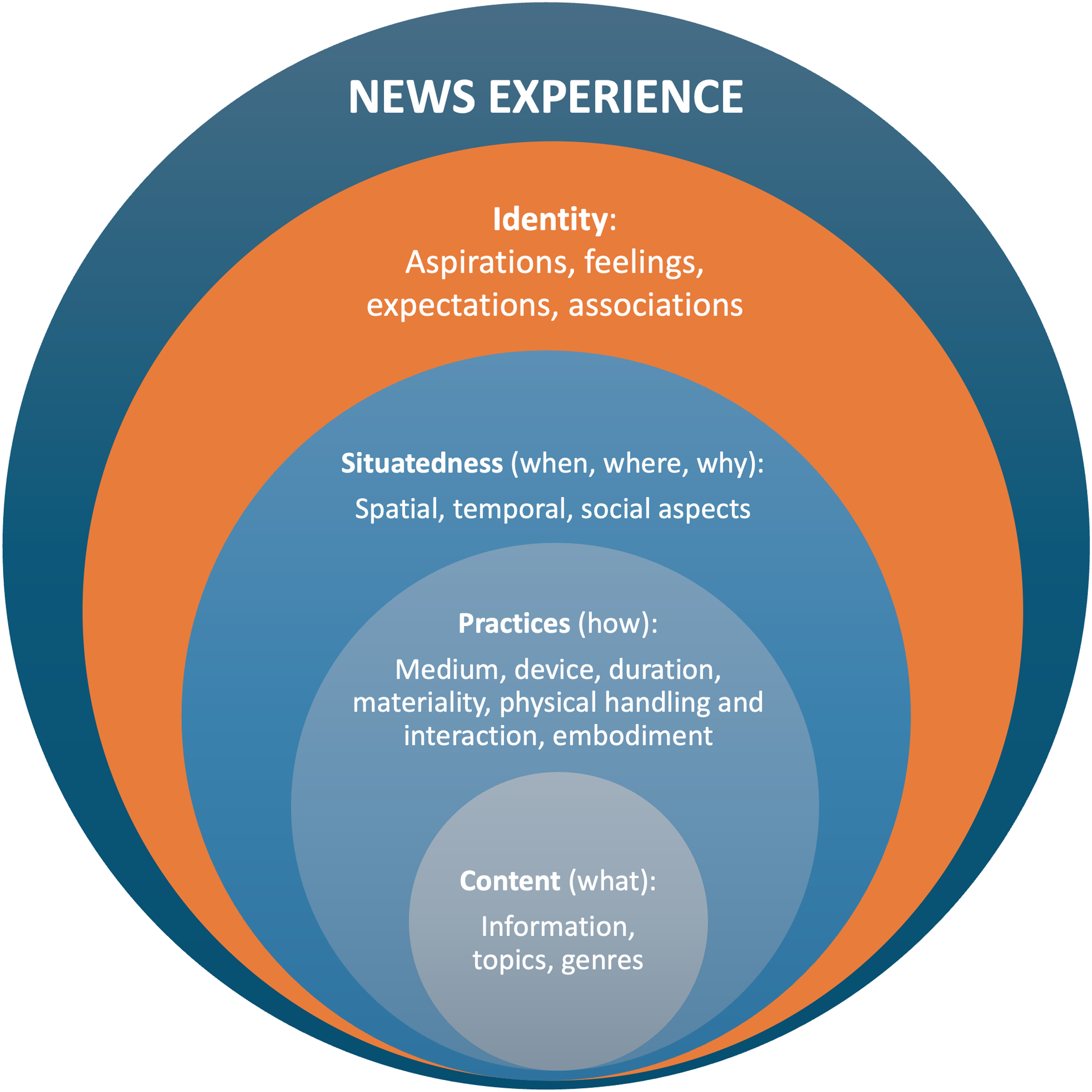
Whereas the three inner dimensions of the model deal with objective characteristics of news, practices, and spatiotemporal dimensions, the fourth layer of identity is subjective as it consists of personal aspirations, feelings, expectations, and associations. How content, practices, and situatedness resonate should therefore be seen in the light of identity, where cultural and social aspects may foster personal and normative aspirations and expectations to follow the news as a sense of belonging and inclusion (e.g., Schrøder, 2015). Such social characteristics of identity should thus be seen in relation to different cultures, where norms and ideals may vary.
Moving forward, I therefore hold that news experience provides an analytical lens better attuned to capture both transmission and ritual views of how people relate to news (cf. Carey, 2009 [1989]) and offers a more sophisticated understanding of how aspects of identity are reflected.
The literature presented above has explicated the three dimensions of content, practices, and situatedness (the three inner layers of Figure 1). The following analysis will use news experience as a sensitizing concept to further detail the shifting resonance between content, practices, and situatedness and how this resonance reflects aspects of identity (the fourth layer in Figure 1). The aim is to refine various forms of news experience. Such an analysis entails methodological implications, which I will now detail.
Methods: capturing news experience
Responding to the conceptual principles discussed above, the methodological approach should not only capture aspects of what news people read; which media or devices they use and how; or ritual aspects of when, where, and why people relate to news. Instead, we need to see these dimensions in relation. Examining news experience calls for an inquiry beyond the moment. The research question is: How do content, practices, and situatedness resonate in different forms of news experience? Capturing such intertwined experiences is hard, if not impossible, through single methods. To provide both transmission and ritual insights, the data material therefore included recurring interviews, news diaries, and video-ethnography, in addition to data donations of people’s news browsing history. The study was conducted in three stages, aiming to capture various aspects of their multilayered news experience.
Study design
First, 14 in-depth interviews were held to capture dimensions of people’s user practices and situatedness. Questions focused on when, where, and how informants interacted with news, their preferred media and devices, and how their practices related to meaningful moments. To provide a deeper understanding of the spatiotemporal surroundings in which their news experience took place, I opted for a location where their practices typically would unfold: their home. To get detailed insights into user practices, particularly the handling of their devices, informants were also filmed while sitting alone using their preferred news sources on their own devices (video-ethnography, cf. Groot Kormelink, 2019). Immediately afterward, the videos were watched and discussed with each informant.
Second, informants were asked to write news diaries to capture further insights into the dimensions of content and situatedness grounded in their everyday lives. Diaries have previously proved to provide informants with freedom of expression as they are based on everyday encounters with news, compared to interviews, which might increase recall bias (Bolger et al., 2003). Informants received links to a digital diary adaptable to smartphones (SuveyXact) every other day for two weeks. They were asked which – if any – news stories they remembered being exposed to, how those stories made an impression on them, and to describe spatiotemporal aspects of their news sessions. The diaries also allowed reflection on feelings and associations with the content and situatedness of their practices. During this step, some informants were also encouraged to donate their news browsing history to facilitate insights into the consumption, duration, and frequency of their digital news sessions. The aim was not to verify what they said but to add transmission insights. Constituting a pilot, the donation platform induced technical modifications, narrowing the successful donation sample to only three informants (see appendix for an explanation of the data donations). It must be emphasized that the data donations were exploratory and should be seen as supplementary to the study’s core methodology. Rather than being a null result, these limited but detailed donations provided additional information about the frequency and scope of their news sessions.
Third, a final round of in-depth interviews was held to clarify how the situatedness, user practices, and content described in the diaries (and donations) related to aspects of identity expressed as aspirations, feelings, expectations, and associations with news. Questions also revisited topics from the first interview round, opening for new reflections (cf. Gentikow, 2005).
Sample
As this study focused on understanding people’s news experience, informants were required to interact with news regularly. Previous research has shown that people typically form stable relationships with news in their 30s (Boczkowski et al., 2017). The sample therefore included six women and eight men aged 30-65. Because news experience can be quite intimate to share and capture, a certain “relationship of trust” (Madianou, 2010: p. 434) between the informants and the researcher was needed. Informants were therefore recruited through snowballing, starting through the researcher’s social circle.
A majority of the informants have higher education and were recruited from urban areas of the Western coast of Norway – a country with historically strong reading traditions and a comparatively high news interest and willingness to pay for news (Newman et al., 2024). As such, the sample – and its relatively modest size – is not demographically representative or generalizable. Similarly, it is important to emphasize that the empirical findings should be seen in relation to the Norwegian context and the informants’ identities. The aim is not to reveal a complete account of all forms of news experience. The aim is rather to provide “representativeness of concepts […] to build a theoretical explanation by specifying the phenomena in terms of conditions that gave rise to them, how they are expressed through action/interaction, [and] the consequences that result from them” (theoretical sampling, see Corbin and Strauss, 1990: p. 9). As such, comprehensive and broad data sets of each informant were necessary to find patterns and descriptions representative of the phenomenon. I therefore chose the most intelligible examples and quotes, which resulted in some informants being more prominent in the analysis.
Each interview lasted between 50 and 95 minutes, and most informants wrote in total several page-long entries in their diaries. As participation was quite intensive, I expected some informants to withdraw from the study, yet everyone completed all three steps. After the final interview, informants were compensated with €40 gift cards. The study was carried out during spring 2023. Informed consent was obtained from all informants, and the study was registered with the Norwegian Agency for Shared Services in Education and Research. Transcribed interviews and diary notes were analyzed thematically through an inductive approach. After labeling the data, similar labels were grouped into categories, and subcategories were further refined (Thomas, 2006). On this basis, I now turn to the analysis.
The resonance between content, practices, and situatedness: six forms of news experience
Delving into the multidimensionality of how people relate to news through the sensitizing concept of news experience, six distinct forms of news experience were identified in the material: Reassurance, control, social connection, relaxation, diversion, and stress. Within the various forms of news experience, the interplay between content (what news they interacted with), practices (how they interacted with news), and situatedness (when, where, and why they interacted with news) resonated differently. As the analysis now will demonstrate, it was the various compositions of these three dimensions that together defined the experience: The dimensions took turns playing more soloistic or accompanying parts but were all essential for the holistic experience. As underlined above, this does not constitute a complete account of news experience but an empirical substantiation of various kinds of resonance between content, practice, and situatedness in the context of everyday life. The findings should thus be seen in relation to the identities of the informants, set in a media welfare state with a majority of highly educated informants who actively and regularly sought out news. With the six identified forms of news experience providing structure in the following, the analysis additionally details how a lack of resonance between content, practices, and situatedness left informants with little awareness of their news experience.
Reassurance
A recurring form of news experience that emerged was that of reassurance. Here, situatedness and practices played prominent roles, while the content appeared less significant, as Sara (30) exemplifies: Before I get out of bed in the morning, I check the news to see if it says the same as the day before. And then perhaps around lunch, and then again in the afternoon or sometime after 6 pm until 21 or 22. […] Not that it’s a problem if I don’t take that round, but it sort of feels like you’re missing something, you know? Just a reminder that “everything is fine, I don’t have to worry”. […] I also think that when something that scary is going on [referring to the war in Ukraine], you sort of do it to feel safe – just making sure “okay, everything is fine”
Sara’s description of her habitual check-ups did not accentuate particular content or topics. Instead, she highlighted how she wanted to reassure herself that the state of the world had not changed too much since she last checked, where the practice itself was deeply existential. Her aspirations of monitoring the news sites could thus be seen as an expression of identity related to the case context: These repeated checking cycles have similarities to ideas about monitorial citizenship (Schudson, 1998) or a standby mode of public connection (Moe, 2020). In that sense, the news content appeared less significant: It was sooner the repeated checking-cycle and absence of relevant or extraordinary content that provided reassurance.
Moreover, the quote illustrates how the experience of reassurance was closely linked to situatedness. On a personal level, the repeated check-ups that emerged from the interviews and diaries were associated with specific times and places, such as checking the news in bed. Several informants also highlighted how their need for reassurance was driven by proximate and practical circumstances related to space and time, such as checking the news during breakfast or listening to the radio in the car to rule out traffic disruptions (cf. ritualization, Carey, 2009 [1989]; Peters, 2015). On a societal level, the need for reassurance could also result from geopolitical situations, as Sara’s quote illustrates. In these cases, however, the content seemed more relevant, as the absence of developments within certain topics provided reassurance.
Reassurance also appeared closely attached to how informants consumed and approached news (practices) regarding devices and navigation. The smartphone was the most relevant pathway to these repeated check-ups. Front pages of local and national news sites often provided the informants with a satisfactory overview, characterized by quick scrolling or skimming of the top headlines – leaving them reassured. Watching the evening news or glancing through an e-paper on their tablets could also fill this function for some informants in their 50s and 60s, although these practices were supplemented by regular checking cycles on their phones. As such, the experience of reassurance was characterized by quick, digital practices.
Control
Whereas content played a less significant part in the experience of reassurance, it took the lead when in need of control. Unlike reassurance, the need for control arose as a consequence of something happening, with the expectation of creating clarity about specific events – what Moe (2020, p. 212) discusses as a move from standing by (in the form of reassurance) to actively engaging with an issue when needed (control). As such, it was closely connected to societal situatedness and typically required more focused and time-consuming practices.
Gaining control of a topic was deeply meaningful for the informants, as it was associated with learning and exposure to new arguments and perspectives, ultimately contributing to a broader understanding of the world (cf. Costera Meijer, 2022; Bengtsson, 2023). Despite often gloomy topics, the experience of gaining control was still associated with the satisfaction of understanding a complex issue, which also can be seen as an expression of personal identity and social recognition – whom they aspired to be. This was particularly exemplified with topics like the COVID-19 pandemic or the war in Ukraine, primarily accentuated by male informants in the sample, like Benjamin (34): I feel a drive to understand things and understand the world around me. For that purpose, news is important. I take pride in understanding how it all connects. […] I have, for instance, spent much time in the last year to understand the historical and geopolitical dynamics behind the war in Ukraine. […] I often have these “deep dives” that last for several hours, where I try to understand a topic. For that [purpose], I feel the video format is best – to sit down and watch someone [on YouTube] who really knows what they are talking about in a way that enables them to explain the topic very well.
As the quote exemplifies, the urgency of content, societal situatedness, and user practices appeared closely intertwined. Regarding content, exposure to specific news stories through media triggered the wish to learn more. Moreover, the need for control and, consequently, more profound knowledge about specific content resonated closely with the potential implications these geopolitical events could have, not just for informants' own lives but also for others. As such, the experience of gaining control of the news could help informants situate themselves in the world (Bengtsson, 2023).
As Benjamin described how he could spend hours learning about the historical and societal backdrops of current events, the urge for control also required informants' personal situatedness (their spatiotemporal surroundings) to allow for such “deep dives”. Consequently, control resonated with practices that facilitated focus and learning. This could vary from watching YouTube to listening to podcasts while biking to work. For instance, Benjamin explained in his news diary how he one day came across an op-ed in a newspaper that led him to spend two hours going through verdicts from the European Court of Human Rights to provide him with “a more certain understanding of the issue”. Such time-consuming practices were common across different devices and platforms when in search of control. Contrasting reassurance, however, these deep dives seemed more occasional than habitual as they often followed extraordinary events and situations.
Social connection
News is also a significant social component of everyday life. For informants who regularly discussed current events with friends, family, or colleagues, news functioned as a social tool that enabled connection, inclusion, and recognition (Heikkilä and Avha, 2015; Schrøder, 2019; Bengtsson, 2023). Similarly, lacking attention to news was associated with exclusion and inadequacy, particularly within certain social settings or groups, and could influence aspirations and expectations to follow the news more closely:
Therese’s feeling of falling short illustrates the relevance of content awareness for the experience of social connection. Here, user practices appeared more instrumental – it did not necessarily matter how informants got to know the news or what formats or devices they relied on. The essential part was the habit of regularly following news to ensure awareness of important stories. This facilitated taking part in discussions, as a cultural characteristic of their social networks (cf. “news community” Toff et al., 2023, see also Heikkilä and Ahva, 2015).
Thus, the social contexts in which people encountered or discussed news (personal situatedness) appeared highly influential for the content they interacted with, as the experience of social (dis)connection was typically associated with specific places, situations, or people. Several informants expressed aspirations and expectations (Bengtsson, 2023; Martin, 2008) to stay on top of things or orient themselves towards topics typically discussed in their social networks, which can be seen as expressions of social identity. Whereas reassurance and control seemed driven by internal motivation, then, the experience of social connection appeared greatly influenced by external cultural structures (cf. Heikkilä and Ahva, 2015).
Relaxation
News could also be associated with relaxation, pleasure, and recreation, in which informants described rather fixed rituals. In these instances, descriptions were surprisingly consistent, considering the importance of situatedness and practices. As such, this form of news experience appeared as an idealized ritual in which particularly informants in their 50s and 60s aspired to identify as people who took the time to sit down with the news as a form of leisure. As we also saw from the example in the introduction, relaxation, ritual, and reward were recurring characteristics closely associated with the comfort of one’s physical situatedness: Occasionally, I still buy the newspaper when we're going to the cabin. Out there, it's very nice to have a print paper. Then it's complete silence and no commotion or noise. There, you find the peace and quiet to read. That's quality time – an early morning, the sun is out, and I'm sitting there, reading the newspaper with a cup of coffee, and everything is quiet and calm. – Magnus (57)
The example above illustrates how particularly the situatedness of being away from one’s busy everyday life, having time off (in the company of loved ones) invited a certain ritual – and perhaps somewhat romanticized – interaction with news: The content appeared less significant whilst routinization, sociability and spatiotemporal associations were central for the experience of relaxation (cf. Boczkowski et al., 2020; Fortunati et al., 2015).
While my findings support previous studies’ emphasis on practices, materiality, and personal situatedness, a surprising tendency was how even gloomy and hard news could fit into these relaxing rituals. As detailed in the introduction, Therese read a story in the print newspaper involving child abuse while still describing the setting as “cozy” due to the ritual associations of her weekend breakfasts. As such, relaxation was not just limited to entertainment or soft news.
Regarding the importance of format, age appeared to matter. Among the older informants, expressions of relaxation were particularly associated with weekend rituals and more time-consuming practices (e.g., physical formats, long reads, and the absence of screens). For some younger informants, however, relaxation could also be associated with scrolling through news sites on their phones if it took place at specific times and places (cf. Peters, 2015). Sitting down with the news (on their phones) was thus considered a treat or a moment of me-time, even in more mundane contexts, and could be a reward after household duties: I sort of just disconnect. That’s why I have written [in the diary] that I typically sit on the sofa when I read news. I come home, I make dinner, and then at night, when the children are in bed, I go through the news sites. There are, in fact, many times I fall asleep or nod off, too. It’s like ‘Now it’s time to relax’. The feeling that there’s nothing else to be done and that there is no one else around me – that I have some peace and quiet to myself. – Sara (30)
In that sense, the experience of news as relaxation appeared self-centered and reflected personal associations: Even connecting oneself to the world through spending time on (even hard) news could be experienced as pleasure and time off, where motivations seemed rooted in recreation rather than a moral duty. As such, the interplay between personal situatedness (in the ritual sense of being in a specific place at a particular time) and more focused, time-intensive practices appeared crucial in shaping this experience.
Diversion
Contrasting relaxation, where physical surroundings were central to the feeling of pleasure, the experience of diversion was characterized by a need to distance oneself from immediate surroundings through news.
Particularly younger informants expressed how they would pick up their phones in busy and crowded places (e.g., trains or busses) or during free moments and start skimming through news sites to pass the time. There was time for a quick break, but the often busy surroundings did not allow for deep dives or a feeling of peace and relaxation. Consequently, this form of news experience was often defined by their personal situatedness: On the light rail or train to work, where there is a lot of dead time to fill, then I read... or I skim through the big headlines. It could be anything from sports to finance, it could be... well, quite a lot, actually. – Mikael (30).
The quote exemplifies how personal situatedness was closely associated with distinct user practices: As the news experience of diversion often took place in public spaces, physical surroundings often determined which practices were considered appropriate (e.g., how watching videos on a crowded bus was considered inappropriate without headphones). As Mikael emphasized, this form of news experience was characterized by short and efficient practices like scanning and scrolling on their smartphones (Costera Meijer and Groot Kormelink, 2021), as it was easily accessible and often a good situational fit (Schrøder, 2015). Similar to what Ytre-Arne (2011) found in her study of women’s magazine readers, these practices required little concentration and continuity while simultaneously absorbing and shutting out noise and disturbances. In that sense, the news content itself appeared less central, as the purpose of the checkups was diverting from one’s personal situatedness rather than seeking information. Yet, how informants more or less automatically turned to news as a diversion in these situations simultaneously emphasizes how news was integrated as a natural part of their everyday lives as a cultural expression of identity.
Stress
On a less locational and more societal level, geopolitical circumstances could also impact what content people turned to. Although the informants regularly sought out news, with some being avid news users, many described how they also could experience news as a negative and stressful component of everyday life (cf. Toff and Nielsen, 2022). This form of news experience should be seen in context with the constant news stream and availability provided by digital platforms and devices.
Informants often talked about this negativity in relation to specific content caused by big societal events that received massive media attention. As such, the content itself was prominent for how informants experienced news as negative and stressful. Informants also highlighted how societal situatedness contributed to this experience, for instance, during the COVID-19 pandemic, when they had to deal with the consequences of these news-saturated events in their own lives. Like previous studies also found (Villi et al., 2022; Ytre-Arne and Moe, 2021), several informants expressed how saturated content influenced their practices and led them to occasionally limit or avoid news, particular platforms, or devices to shield themselves: I must admit that after the war [in Ukraine] started, I checked the news less frequently, and I avoided the TV because I thought it was scary. I think it was because of all the images and videos. The same thing with Facebook, the videos started playing as you scrolled. [….] When the war started, I had a phone with notifications, and the war was there all the time. How it went, how close it was… We also got these letters from school about iodine tablets that we had to sign. I was worried by how close and real it felt, so I can tell you I was really scared. I then deliberately turned off the notifications and snoozed the Facebook feed [news providers she followed]. That’s why I prefer using news sites because then, you click on what you want instead of everything suddenly being there right in front of you. That way, you’re at least a little prepared. – Sara (30)
The quote demonstrates how content and practices resonate within certain societal contexts. The saturated news coverage of the geopolitical situation in Ukraine resulted in a changed use of formats and devices, where Sara, to a greater extent, could control the visual impressions. On a personal level, the reality of scary headlines and videos she had previously only seen in the news now manifested itself in iodine tablets and letters from school. As such, the geopolitical situation was brought into her own family.
For others, it was the graphic aspects of news that could be perceived as problematic: Flashing headlines, continuous updates, and push notifications could make particularly digital user practices stressful. While particularly older informants emphasized how one should keep up with news as a moral duty (Hagen, 1992) linked to aspirations and expectations of “a good citizen” (Schudson, 1998), such practices could simultaneously create ambivalences, for instance, during weekends or after work. These stressful associations, then, could collide with ideals and aspirations of relaxation within particular spatiotemporal contexts.
Lack of resonance and re-ritualization
In addition to the six identified forms of news experience, informants could sometimes interact with news without being aware of their practices, the content they encountered, or their situatedness. These instances were mainly characterized by automated and ingrained habits. The data donations of news browsing histories demonstrated how some informants frequently sought out news on their smartphones at dispersed moments throughout the day, with as much as 35 daily sessions on their phones, yet without leaving any distinct impressions. Upon being confronted with their digital traces, informants expressed surprise by the frequency of their use, as it diverged from their own experience. Reflecting on their trace data during the follow-up interviews, informants expressed how these frequent news sessions felt excessive: No one needs such frequent updates […] It's really sick if that is my average. It may be because I have to fiddle with something. [...] It's a bit like you've just had dinner, and then you open the fridge to see if there are any more snacks – it's not something you really need. – Mikael (30) I noticed that I picked up my phone much more often than I was aware of [after the first interview]. I thought to myself, “How much time do I really spend on this”? – John (32)
These deeply automated habits did not resonate with particular spatiotemporal aspects or particular types of content. Yet, the practices were repeated regularly throughout the day, in which they seemed to be integrated and taken for granted as part of everyday life. As such, these automated habits appeared re-ritualized (cf. Peters, 2015), often resulting in less meaningful moments with news. Consequently, the lack of resonance between content, situatedness, and practices left informants with little awareness of their own news consumption as they struggled to remember what news they had read and how, when, or where they had encountered it. These insights underscore the significance of the interconnectedness of all three dimensions for a meaningful news experience.
Conclusion
Previous research has provided valuable insights into how content, user practices, and situatedness influence people’s interactions with news. This paper has placed these complex dimensions within the sensitizing concept of news experience – an analytical lens that allows for an exploration of the shifting resonance between the news content informants interacted with; the practices they engaged in; the situatedness of their news sessions; and how aspects of identity were reflected in the various ways these three dimensions resonated in everyday life.
This analytical framework has been empirically substantiated by identifying six forms of news experience: Reassurance, control, social connection, relaxation, diversion, and stress. Moreover, the study has demonstrated that the way people relate to news cannot always be understood as rational and intentional choices, as found in uses and gratifications theory, but also can stem from automated and unconscious factors, where the study design revealed how informants’ lived experience could differ from digital traces of apparent news consumption.
Alongside the empirical findings, the paper thus contributes with an analytical framework that can be applied to study various forms of news experience in future studies of news audiences by highlighting prominent dimensions critical to different forms of news experience: For research concerned with the ability to activate public connection, engagement and control over an issue, for example, content and societal situatedness appear as prominent dimensions to consider. As such, the study points to methodological implications for future research.
However, it is important to acknowledge that the six forms of news experience identified in this paper are not exhaustive and should be seen in relation to the social and cultural identities of the informants – a group who regularly sought out news, with a majority of highly educated people in a country with historically strong traditions of newspaper reading. While I hold that the various forms of experience presented here may be transferable to other cultures – at least in Western societies with similar journalistic, technological, and democratic conditions – it is plausible that other forms of news experiences could emerge from studies of different groups or cultures. Further studies are therefore needed to explore additional forms of news experience, for instance, among migrants, people with lower educational levels, and groups who, for different reasons, appear less invested in news.
Supplemental Material
Supplemental Material - Understanding news experience: The resonance between content, practices, and situatedness in everyday life
Supplemental Material for Understanding news experience: The resonance between content, practices, and situatedness in everyday life by Marianne Borchgrevink-Brækhus in Journalism
Footnotes
Acknowledgements
I wish to thank the anonymous reviewers for their valuable and constructive suggestions. I am also grateful to Tim Groot Kormelink and the NUSE unit of the imec-SMIT research group at Vrije Universiteit Brussels for helpful comments on early draft versions of the manuscript. I would also like to thank research assistant Snorre Alvsvåg for setting up and making the data donation infrastructure possible.
Declaration of conflicting interests
The author(s) declared no potential conflicts of interest with respect to the research, authorship, and/or publication of this article.
Funding
The author(s) disclosed receipt of the following financial support for the research, authorship, and/or publication of this article: This research was funded by SFI MediaFutures partners and the Research Council of Norway (grant number 309339).

Supplemental Material
Supplemental material for this article is available online.
Author biography
References
Supplementary Material
Please find the following supplemental material available below.
For Open Access articles published under a Creative Commons License, all supplemental material carries the same license as the article it is associated with.
For non-Open Access articles published, all supplemental material carries a non-exclusive license, and permission requests for re-use of supplemental material or any part of supplemental material shall be sent directly to the copyright owner as specified in the copyright notice associated with the article.
