



Abstract
Although it has been said for some decades that printed newspapers are dying, they are still in existence; however, Swedish newspapers have entered a new era. Throughout the country, the distribution of printed newspapers is slowly ceasing. In this article, we trace the process of the disappearance of printed news through ethnographic field work engaging with the perspectives of the newspaper industry, readers, and civil society. Conceptualizing the disappearance of printed news as an assemblage of imaginaries, materialities, and practices, we are interested in how this disappearance is accomplished, motivated, interpreted, and experienced. The article makes an argument for exploring disappearance in tandem with emergence to develop a deeper understanding of contemporary media culture and society.
Introduction
The true genesis is not at the beginning, but at the end (Bloch (1971), On Karl Marx, p. 44)
News distribution globally is taking new forms. Changes in news distribution starts in the peripheries, in small villages, and in rural settings marked by emigration and depopulation where disappearance (of people, services and communications) is a constant phenomenon. The newspaper arrives more rarely at first; then, it stops altogether. Readers will receive a letter from the editorial offices or maybe a discount on a reading tablet, and sometimes a meeting might be held in the local community center. “It is when a thing is beginning to disappear that the concept appears,” writes Baudrillard, and “thus the real vanishes into the concept” (2009, p. 42). Has the concept of the “newspaper” already subsumed its reality? Or is there still a reality of the printed newspaper to explore? A reality of disappearance?
This article sets out to document the disappearance of the printed newspaper from the perspectives of readers, journalists, typesetters, printmakers, photographers, and newspaper carriers as well as managers and union representatives from various parts of the industry. Through ethnographic fieldwork in several municipalities in Sweden as well as observations and interviews, we seek to explore the following question: what does the disappearance of the newspaper mean? What follows from exploring this question is our attempt to document the fast-paced change in news distribution that has been ongoing for at least the past decade. Beyond this descriptive aim, the article seeks to develop a theoretical argument for how we could – and why we should – explore the large-scale process of the digitalization of media and journalism through the lenses of distribution and disappearance.
Our article takes its cue from Bernard Berelson’s (1949) classic study “What missing the newspaper means.” Berelson’s article was researched during a 2-week distribution strike in New York. By asking this question again, and in a new situation in which the printed newspaper might disappear forever, this article aims to explore the role of disappearance in digital culture. Hence, the starting points for this article are that longing, missing things, and the experiences of disappearance are as important for our understanding of the digital as are emergence, development, and innovation and that it is necessary to understand the vanishing of the old to shed light on digital culture and contemporary media development.
In the following, we briefly discuss the background to the development of printed news in Sweden, our methodological approach and the collected material, and how we carried out our analysis of the disappearance of printed news.
The disappearance of printed newspapers
The digitalization of newspapers and termination of paper distribution are international phenomena, but these processes play out in different ways and tempos in different places (Cao and Li, 2013; Cummings and LeMaire, 2008; Romano, 2002; Rooke, 2013; Slaatta, 2015; Tandon, 2007; Wadbring and Bergström, 2017). In Sweden, printed newspapers have been steadily disappearing over the last three decades. Printed news peaked in around 1989 with around five million editions (in a population of 8.5 million) (Figure 1). In 2012, this number declined to around 3.5 million editions (in a population of 9.5 million) (Svenska Medietrender, 1995-2022). Printed newspapers not only disappeared from the market but also from statistics. As of 2010, many larger publishing houses chose not to reveal the circulation of their printed publications. The shrinking interest from subscribers was accelerated by increased subscription prices for national newspapers in rural areas and the reduction in distribution frequency for local newspapers (Departments Skriftserie, 2022: p. 14). The last few years, in particular, have seen a steep decline in the readership of printed editions. In the 8 years between 2015 and 2023, the share of the population that reported using a printed newspaper on a weekly basis dropped dramatically. The largest drop occurred between 2015 and 2017, and there has been a gradual decline since then. This development is especially palpable among the younger age groups but also significant among older audiences. Readership of Printed Newspapers on a Weekly Basis in Sweden in Different Age Groups. Source: Svenska Medietrender 1995–2022 [Swedish Media Trends 1995–2022], Report from the Swedish SOM-institute, Gothenburg University, pp. 4–6.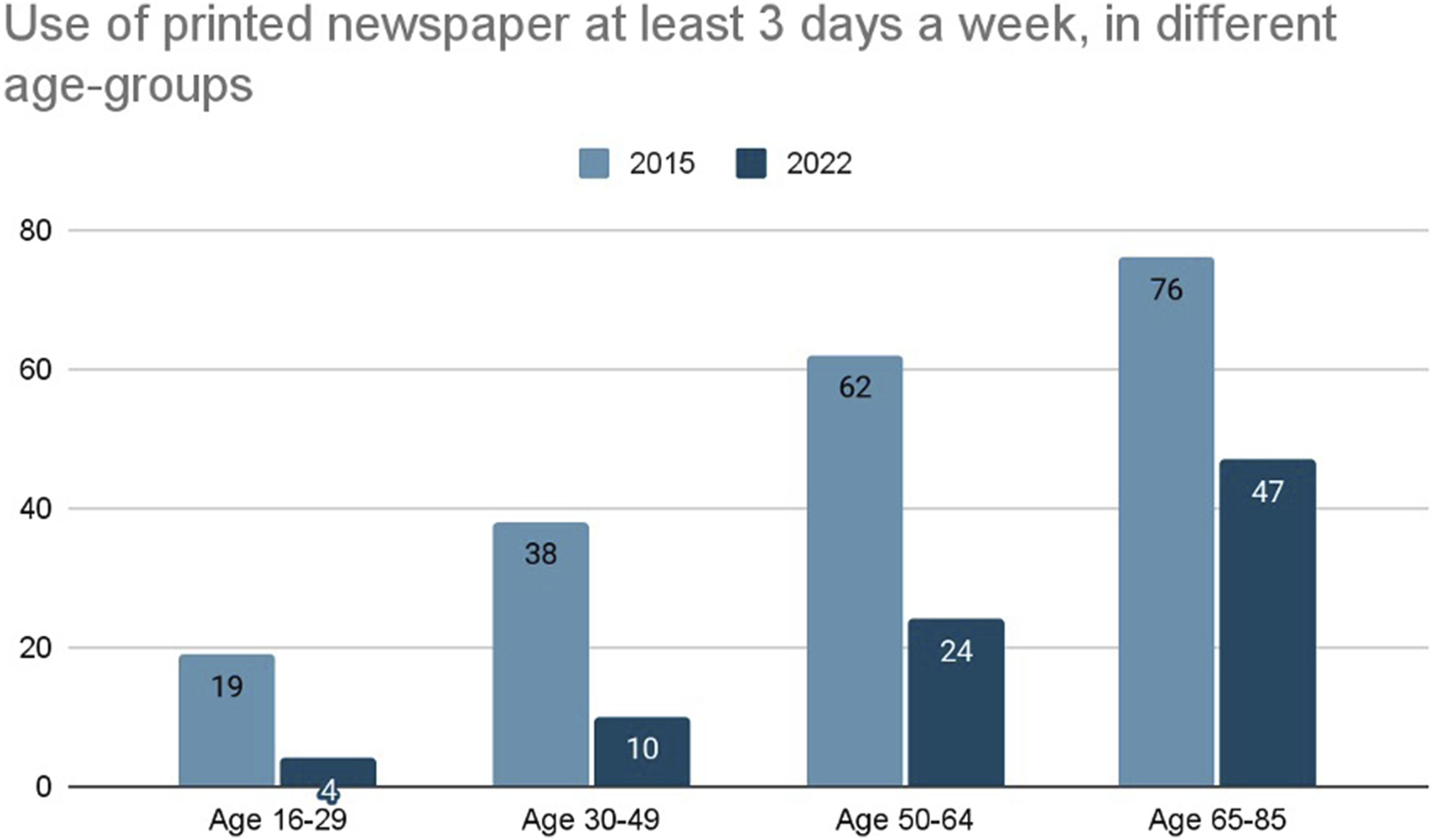
With the emergence of digital, connective technologies around the turn of the millennium, the newspaper industry experienced important shifts in news production (e.g., Birkner et al., 2024; Cohen, 2019; Conyers, 2024; Kristensen, 2023; Neuberger, 2024; Tenor, 2024) and news distribution (e.g., Blanchett et al., 2022; Meese and Hurcombe, 2021; Nechushtai, 2018). Structural transformations within the media industry and the contested relationship between journalism and big tech form one part of the background to the end of printed newspapers. Decreasing revenues and increasing competition, new forms of distribution and consumption, and new patterns of audience behavior are other crucial factors that point to the printed newspaper being an endangered species. This is not news: as early as 1975, commentators predicted that “printed journalism, in the long run, will disappear” (Wolseley, 1975: p. 199). While print distribution has been reducing for decades, however, recent years have seen a dramatic downturn (Franklin, 2008). Digitalization is only one of several explanations for the disappearance of print news. Recently, the increasing prices of paper and gasoline and increasing competition within the distribution market have accelerated the disappearance of the printed newspaper (DS, 2022: p. 14; Miller, nd). While local newspapers have moved from publishing editions every day to every second or third day and the national evening papers have terminated their Sunday editions, national morning papers are increasingly distributed by the postal services, which means households receive a paper only every second day. “We have,” reflects one of our interviewees from senior management, “gone from distributing the print edition to almost 80% of the population to about 20% during my career in the industry” (manager at a distribution company).
Imaginaries, materialities, and practices of disappearance
Do things disappear? Or, more specifically, do media technologies disappear? In one way, the answer seems obvious: of course they do. Every year the printed newspaper circulation declines by about 10 percent, and it is reasonable to assume that eventually no printed newspapers will be produced and distributed. The printed paper will be gone. Other media technologies, such as illuminated scrolls or eight-track cartridges, have already met this fate. They have disappeared or, at least, are no longer in regular use even though they might be retained and used on rare occasions. But do things really disappear? As noted by Ballatore and Natale (2016, p. 2387), the “idea that a medium would die often reveals a narrowly technical vision of media.” While specific technologies may fall out of use, the medium – in this case, the newspaper – remains, albeit in a new form as a digital newspaper distributed on reading tablets and mobile phones. Furthermore, things tend to (re)appear and disappear and reappear repeatedly in media history while transforming, evolving, and changing (Huhtamo, 1997). The idea of endings and vanishings might be an apocalyptic illusion that humans create for themselves to make sense of and try to order and manage the constant flow of change (Kermode, 2000). Hence, while the newspaper might not be disappearing, there are plenty of experiences of disappearance: the printed newspaper is surrounded by ideas, discourses, and emotions of an impending ending. Exploring the question of what it means to no longer have a printed newspaper thus allows us to learn something about how media change is perceived, represented, and made sense of. It further allows us to explore what it means that newspapers once imagined as the drivers of nation building (Anderson, 1983) and the modern public sphere (Habermas, 1962) are now primarily imagined in terms of death, disappearance, and crisis.
We are discussing the discontinuation of printed news distribution in terms of disappearance. As Andreas Reckwitz (2023, 2024) argues, disappearance is distinct from loss. While loss is connected to negative feelings about something that no longer exists, disappearance is not necessarily experienced as loss. Things might fall into oblivion and be forgotten without necessarily being mourned. The experiences that we encountered exploring the meaning of the discontinuation of printed news distribution were not always negative; often they were complex and ambiguous, and sometimes they were positive and enthusiastic.
The disappearance of the printed newspaper is entangled with and part of broader social transformations and becomes meaningful in relation to wider discourses of development, disappearance, and crisis. The discourse of disappearance, or this “sense of an ending” of the printed newspaper, has three distinct facets that, while connected in practice, are possible to separate analytically. There are experiences or imaginaries of disappearance, that is ideas, interpretations, understandings, and perceptions about the “death” of the printed newspaper and its meaning that are held by all those affected by and part of this transformation. Furthermore, there are materialities of disappearance, as the shift in news distribution connects to material resources, such as wood, water, pulp, paper, and fuel, as well as to material infrastructures, such as roads and broadband, and resources, such as labor power and capital. Lastly, there are practices of disappearance: behavior, routines, traditions, organizational procedures, and patterns of doing things become open for re-negotiation and change as the printed newspaper disappears. Following Alice Mattoni (2024), we understand the imaginaries, practices, and materialities of media as forming “socio-technical assemblages.” The disappearance of the printed newspaper as a process of media change is thus a matter of a transformation of this socio-technical assemblage. While newspapers might not be disappearing per se but rather transforming, the understanding of this transformation as a disappearance tells us a great deal about processes of media change.
A crucial point is that imaginaries, materialities, or practices are not unambiguous or univocal phenomena. On the contrary, they are marked by ambiguity, difference, and complexity. The materialities, practices, and imaginaries of disappearance are situated on the individual and collective levels. At the same time, they are experienced differently by different individuals and social groups depending on their social situatedness. For example, the chief executive officer (CEO) of a newspaper distribution company can influence the process of the disappearance of what we call the socio-technical assemblage of printed news in different ways than a subscriber in rural Sweden. While both might speak of the disappearance of printed news, the process means different things to them. Similarly, practices of disappearance might be developed individually or collectively. What not having a newspaper means is different – and has different implications – in relation to the position an individual or group has within the socio-technical assemblage of printed news distribution.
Tracing disappearance
In order to capture the complexities of what the disappearance of the printed newspaper means, we engaged in ethnographic fieldwork in the newspaper industry and among readers of print newspapers in Sweden. From 2022 to 2024, a wave of cancellations of printed news distribution took place in regions throughout Sweden. The cancellations mainly concerned local newspapers but also affected regional and national print distribution. The current research started in 2023 on the west coast and focused on changes in the distribution of local newspapers owned by the Stampen conglomerate. It continued in 2024 with areas in mid-Sweden (Gävleborg: pop. 286,000, and Dalarna: pop. 287,000) as well as the northern parts of the country (Västerbotten: pop. 279,000). The counties studied consist of mainly middle-sized and small-town communities that are scattered across a broad stretch of land, requiring newspaper distributors to manage long distances between subscribing households. In the studied counties, the national newspapers Dagens Nyheter and Svenska Dagbladet are distributed by the Swedish postal service, PostNord, which means they arrive not every day but every second or third day.
Overview of fieldwork.
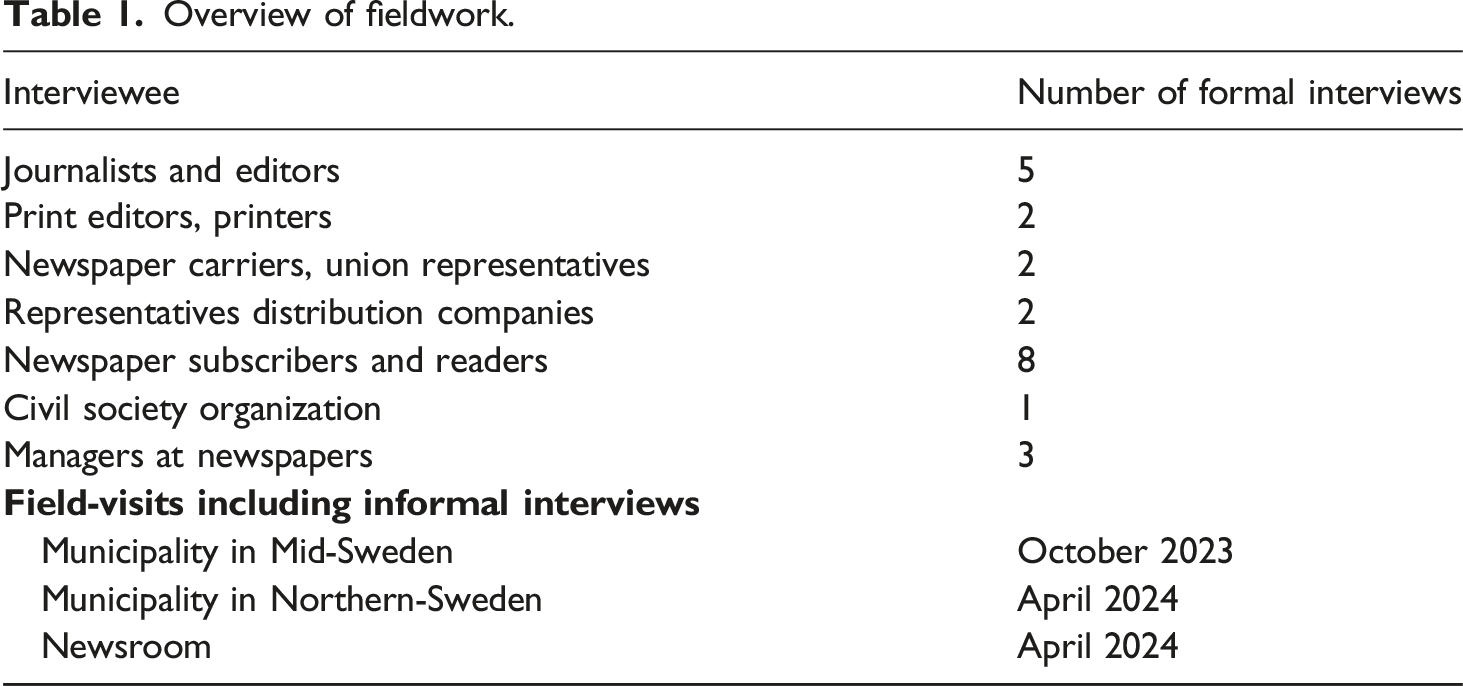
We conducted a thematic analysis of the collected materials – mainly transcriptions of the interview material and fieldnotes – coding for references relating to our theoretical framework, namely, imaginaries, materialities, and practices. Through analyzing the materials of this fieldwork with the help of the conceptual framework outlined above, we disentangle below the complex socio-technical arrangement of disappearing printed news considering the imaginaries, practices, and materialities of disappearance.
Imaginaries of disappearance
One trope is paramount in all the discussions that we have had during the past year: framing the disappearance of printed news as pointing toward death. The concept of death is everywhere in the material: talking to people about the disappearance of newspapers leads almost inevitably to discussions of death. Printed news has been diagnosed as a dying patient for decades, yet printed papers are still in existence. “The first year I worked in the industry,” one of our informants said, “we had a seminar forecasting the ‘death’ of the paper by the year 2020. And that has certainly not come true” (manager at a distribution company). One journalist that we spoke to joked that it is a surprise that printed news still exists. Whether or not printed news is dead already or just not yet, death is a major frame in the imaginaries of its disappearance. The imaginary of the end of print newspapers as a “death,” however, in itself contains different aspects and different forms of dying, which we call “death as business as usual,” “death as a new beginning,” and “death as a symbol.”
Death as business as usual
In a way, the discontinuation of printed news is what makes room for the new, that is, digital news distribution. More specifically, however, “the new” seems to be more of the same. “Death” is what is necessary to keep at least something of the journalistic news system “alive.” The managers dealing with decisions about where, when, and how to cancel the distribution of printed news repeatedly argue that they are – through these strategies – prolonging the life of printed news overall. They are aiming for cost reductions to preserve printed news in at least some areas and to reinvest the surplus gained from canceling print distribution in journalism. To cancel print distribution is a precondition for affording journalism at all in a situation in which the ad-based business model has broken down. Their argument is that only by cutting costs for distribution can local newsrooms survive. In that sense, distribution is pitched against journalism and content production, as the increasing price of newspaper distribution is threatening publishing houses. I have worked in the industry since 2007, and I have heard when people have talked about the time of the paper newspaper being over. I usually say that we have cried wolf for a very long time. But we are now in a position where the paper newspaper will disappear, and it will not disappear because of the lack of interest of the readers. (…) To be able to stand strong, we must accelerate digitalization. (Manager at a media house)
In this quote from one of the managers at a media house, two seemingly competing ideas of the death of the printed news are articulated. On the one hand, the death is natural and organic, and digitalization is an inevitable, unstoppable process that happens almost by itself or, at least, because of the invisible hand of the market. On the other, digitalization must be implemented, pushed for, and – as the informant says – “accelerated.” These two understandings of the disappearance of the printed newspaper are often combined by our informants. They connect to the idea that the death of printed news and the cancellation of print distribution are what are needed to salvage newspapers – or news – more broadly.
The editors and journalists to whom we talked also tended to underline similarity and continuity rather than stressing the differences between print and digital distribution. One journalist mentioned that digital distribution hampers “creativity,” but in general, the death of printed newspapers is, from the perspective of this group, not a very significant change: the content is the same, and the outline of the newspaper remains similar in the digital versions. From the perspective of production, to think “digital first” has long been the norm. The digital newspaper in a PDF format (“e-newspaper”) is basically the “same product” and is gaining in popularity as the printed newspaper is ever less used by audiences. The death of the printed newspaper, from this perspective, is thus not a real death at all: it is, in the words of Ben Ware, “the end as repetition” (2024, p. 11). The newspaper keeps on repeating itself, only with a new technological base. However, the end itself is also a repetition, being merely the latest of many disappearances, transformations, and changes. The industry is “volatile,” and change cannot be pushed back, as many of the informants stress. Things die; they disappear. That is the nature of the industry, of progress, and of the system at large. Thus, the death of the newspaper is merely a repetition of something we have experienced before: death is business as usual.
Death as a new beginning
Among the industry representatives, there is another dominant framing of “the death of the paper” (manager at a distribution company), namely, a “new beginning.” One could say that such an understanding of death, transience, and loss is constitutive of human reality: a cultural commonplace underlying much of humans’ unconscious understanding of time, change, and disappearance. To lose things, to have them disappear, is often – not least in the economic realm – seen as a precondition for progress: it is what frees human creativity and makes room for development. To put it more crudely, “destruction” is what generates and is generated by “creation” (Schumpeter, 2013).
The new beginning imagined in relation to the death of the newspaper concerns the role of physical distribution and the changing industrial structure of the media industries. In the words of a member of the senior management at one of the major Swedish newspaper distribution companies: We are on a journey of transition from newspapers to packages. Newspapers will disappear. We don’t know when. But that time will come. [But] we have a fantastic infrastructure with a distribution network covering the whole country. And there is a growing market in e-commerce. It grows 10% every year. There is something in this market that is very interesting. In this market, there are currently many distribution companies and suppliers that have a lot of resources from venture capitalists. But you can compare our newspapers with that venture capital; the newspapers are that capital for us. We have a window of opportunity here that is slowly but surely going away. (Manager at a distribution company)
The new beginning that is being imagined hence concerns new forms of delivery. From newspapers to packages, the newspaper “business” is the venture capital that can be used to gain market share within this new – and developing – area of the media industries. The death of the newspaper is hence an industrial restructuring. Not only does the traditional newspaper stand for the economic capital, as pointed out during the interviews, but the distribution companies in the newspaper industry have other forms of “capital” tied to them: newspapers are associated with “positive connotations”; they are about “democracy,” “freedom of speech,” and “social sustainability” (manager at a distribution company, manager at a media house, distribution manager of a local newspaper). The employees of newspaper distribution companies are permanently employed and have fixed salaries, and they are unionized and can undertake collective bargaining with the employers. The managers within the distribution companies see these forms of “capital” as assets when they are trying to secure market share within the new form of distribution economy being born. This position differentiates them from most new start-up companies in the blossoming e-commerce and delivery sector, which, in contrast, are organized through gig work and have a reputation for not contributing to social sustainability.
Death as a cipher
While such imaginaries – what we could call industrial, technological, or capitalist imaginaries of death – are abundant in the material, there are other ways of imagining the change brought about by the disappearance of printed news. The understanding of death as “business as usual” or “a new beginning” is mainly expressed among employees and especially (senior) management within the newspaper industry. Lower-level employees and readers tend to interpret the death of the printed news in other ways.
Printed newspapers are (still) distributed in more rural and sparsely populated areas, and for many of the people to whom we talked, the newspaper is the “last thing” that disappears: local services such as shops, gas stations, banks, and schools all vanished many years ago and have been moved to the larger cities. As regards communication, first the landline telephone was taken away, then analogue television, after which postal distribution was reduced, and now it is the turn of the newspaper. It is within this web of disappearances and what is often referred to as the “death of the countryside” that our informants interpret the process of print disappearance, a process that within the newspaper industries themselves is called the “quenching” of the newspaper. In the interviews, this relation to other deaths was often vaguely hinted at in silences and pauses. In one of the small villages in northern Sweden that we visited, we were welcomed into the home of an elderly couple. The husband was sleeping when we arrived, but his wife told us that “he had been in mourning” since the newspaper was canceled. When asked about the cancellation, she replied “of course… there have been a lot of things disappearing, the newspaper is just one…” and then paused before continuing, “yes, but that’s how it is.” So, that’s how it is: things disappear, and the death of the newspaper is only one of many deaths symbolizing the broader process that is the “death of the countryside.”
Another “death” that is part of the imaginaries surrounding the disappearance of the printed newspaper refers to the challenge to democracy (cf. Tomaz, 2024). The connection between the cancellation of printed newspapers and the organization of political life is mentioned throughout the interviews, whether with industry representatives, journalists and editors, or readers. Journalism, as distributed on paper and in printed form, is thus understood as part of the backbone of democratic life and a precondition for the forming of a public sphere as such. One of our informants, who has a leading role within the Swedish Journalists Union, states that: we [the union] think a special investigation should be initiated into distribution in rural areas or outside urban areas or, in general, just the possibility of distributing daily newspapers. (…) And this for democratic reasons, because there is still a percentage of the population that does not have the skills, the desire, or the possibility to consume news digitally. And consuming news and information is a democratic right and something that is important in society, important for democracy to work. (Representative from the Union for Journalists)
The imaginaries of the disappearance of the printed news as a form of “death” are thus connected to a wider understanding of social transformations and the threatened deaths of “the countryside,” “democracy,” and the social contract more widely. However, the disappearance of the printed newspaper is not only – or even mainly – a cipher or an imaginary. Rather, it is also a physical reality that affects practices and events in the material world, and the following sections address these aspects of the disappearance of printed news.
Materialities of disappearance
The most obvious shift described by our informants following the cancellation of print distribution is a change of habits and routines. The morning walk to the mailbox, the clipping of articles, and the sharing of printed copies between neighbors are phenomena that reappear repeatedly in the interviews and are closely related to the specific materiality of paper. In talking about her mother-in-law, one of our informants told us that: just this physical act of taking care of the newspaper is very important to her. Holding it, folding it neatly, putting the read copies in a specific place in her kitchen in a neat stack. She does this every day until the stack consists of seven newspaper editions. Then she knows one week has passed, and it is time to take the stack out to the recycling station. And she just didn’t understand: ‘What am I supposed to do now?’ (Fieldnotes October 2023).
This extract points to the importance of the materiality of the newspaper, the printed and physical copy: the paper. This importance was underlined by the many informants who talked about collecting, saving, and clipping newspapers. Our interviewees keep papers and paper clippings from special occasions, small memorabilia and material reminders of success and losses (obituaries in the papers are mentioned repeatedly in the interviews). The permanence of the material is of importance here, as readers perceive the paper as more sustainable – surviving for years – than digital media. Another important aspect is the material afterlife of newspapers, as an extract from one interview makes clear: Yes, this: what shall we use to light the fire? We light the fire in the tiled stove every single day throughout the winter. How should we do this without newspapers? And what should I put on the floor when I paint? You’ve always put newspaper and newsprint underneath when painting, haven’t you? And what do you put in wet shoes? Newspapers. And where do you put the muddy rubber boots when you come in from the garden? (Local newspaper reader 5)
Our informants share multiple side uses of newspapers and wonder how they will replace this material in the future: Newspapers are used for cleaning, soaking up water, lighting the fire, wrapping fragile pottery and glasses when moving, and insulation material. Already, some of our interviewees are becoming creative in their strategies to obtain papers: Yes, I mean there are people who still receive papers in larger villages. They take some papers with them for us, that’s easy. So if they are on their way, we can get their newspapers. And then we can read the obituaries, and those of the people who were really close, you can cut out and keep. (Local newspaper reader 7)
Newspapers are also rubbish, however; that is, they are something to be handled and then got rid of. For some of the interviewees, the disappearance of the printed newspaper is also a relief, since it eases the burden of handling the old newspapers, while some reflect that “it at least saves some trees” (Fieldnotes April 2024).
The importance of the materiality of newspapers in the reading experience has been well documented in previous research (Neijens and Voorveld, 2018; Rajanen et al., 2015; Von Krogh and Andersson, 2016). Almost all our informants agreed that reading a digital newspaper is not “the same experience” as reading a physical one. One interviewee – a journalist – reflected on the feeling of accomplishment when you have turned the last page of a newspaper. The digital news streams never seem to come to an end. The boundedness of the paper, sometimes seen as a disadvantage and constraint, becomes its defining characteristic. Furthermore, the quality of reading diminishes when news is consumed digitally: as one interviewee says, “I think I skim the headlines more and see if there is something I should read, and I think I actually read less of the content” (reader of local newspaper).
Practices of disappearance
The practices of disappearance are related to concrete forms of preparing for and coping with the disappearance of printed news. These include offers to make the transfer to digital subscriptions smooth; examples include subsidized tablets offered by publishing houses and arranging reader meetings with editors, journalists, and the distribution company. The practices of disappearance emerged in our material in three forms: first, as practices of giving information about the disappearance on the part of the newspapers and distributors; second, as forms of pragmatic mourning and coping; and lastly, as forms of resistance and protest.
Informing
Preparation is necessary when printed news distribution is to be cancelled, that is, identifying specific areas that will not receive printed papers anymore and informing subscribers. Identifying the specific areas follows statistical modeling to be as efficient as possible by eliminating those areas where the number of newspaper subscribers is already low and the costs of distribution per copy are high. This process is strictly evidence-based, as one interviewee responsible for the transition from print in a major Swedish newspaper company told us (Manager of a media house). Practices of disappearance that are concerned with informing and framing the disappearance include letters to subscribers and telephone calls to invite readers to transfer to digital subscriptions. In these cases, they do not only get access to the web version of the newspaper, but also the e-paper – a PDF version of the printed newspaper. In addition, distribution companies and local newspapers organize reader meetings where information is given about upcoming changes. Most of these meetings, according to the informants we spoke to, were not confrontational. The participants are rather pragmatic about the changes and show an understanding of them (editor-in-chief of a local newspaper).
These reader meetings are held in villages’ civic centers and libraries. During them, the industry representatives also try to gain a sense of why digital transition is impossible or difficult and, in some cases, to find individual solutions for the print distribution. However, many of those affected by the changes are not able to attend the meetings, which are held in central villages where most of the infrastructure remains in place. As one union representative from the transport sector joked, they organized meetings in places where people still receive their daily newspapers and not in the periphery where readers are cut off. In any case, the local newsroom editors and newspaper companies are investing time and resources in reader meetings and informing subscribers beforehand, and they present these practices as acts of care for their dedicated readerships.
Pragmatic mourning
The second kind of practices of disappearance is related to pragmatic approaches taken by readers that we call pragmatic mourning. One of the readers, for example, described her morning routine of walking her dog to the letter box to pick up the newspaper. She is still walking the same round, but now she returns without a newspaper in her hands, which still feels strange. Others similarly mourn the lost ritual of sitting and drinking coffee with their morning papers, sharing different parts with a partner and solving crosswords. The imaginary of death and loss discussed earlier extends to those who are most affected by the disappearance of printed news, namely, elderly people, as one respondent in a managerial position within a local newspaper company argued. The core group of readers subscribing to printed papers is aged 70 and above. This is a generation that will die off in the near future, but the newspaper industry cherishes them, as they have been loyal to the papers for decades. One interviewee told us the story of her grandfather, who received a free subscription from when he turned 90 until he died to honor him as one of the first subscribers to the newspaper (Fieldnotes April 2024).
Pragmatic mourning is a common reaction to the disappearance of printed news among not only readers but also those working in the newspaper industry. As one of the informants working in newspaper distribution told us: sometimes it feels a bit like those of us who work here and have worked for a long time... we understand these things better. How much the printed newspaper still means. But of course, this is also their [the corporate managers’] task. We must be profitable. That’s how it is. (Manager of distribution at a local newspaper)
The “very old” readers are considered to be those most affected by the loss of printed news, as they struggle more to adopt digital routines. Some of our informants argued that this cohort never became quite as digital as those just 10 to 15 years younger. However, rather than being the victims of the death of printed news, those readers in their 70s to whom we spoke displayed a sense of pragmatic mourning for printed news. They have experienced many technology-related changes throughout their lives, and this is yet another one (local newspaper reader 7).
Our informants are mourning printed news, but they try navigating tablets, pressing the right icons to reach the e-newspaper. While often not being connected to broadband and fast internet connection in the countryside. This pragmatic mourning is also a form of meaning-making or, rather, handling the loss in a specific way. Printed newspapers and their materiality allow for meaning-making in specific ways that go beyond the mere spreading of information. Meaning-making in this case can also be, for example, connecting with neighbors by sharing the paper or cutting out obituaries to be saved in a clippings folder. Following scholarship on mourning as a form of losing and re-making meaning, printed news that disappears forms a zone of loss and emptiness in the everyday lives of readers. The disappearance is a discontinuity and absence of practices that played a role in structuring the everyday and sense-making of the world. Now this sense-making is absent: printed news are marking an ab-sense (Neuman et al., 2006).
Resisting
Besides pragmatic ways of mourning the disappearance of printed papers, we saw practices of resistance and protest that, in some cases, led to what could be considered communities of disappearance. In these communities of disappearance, critical voices gather to mobilize against the dawning changes in newspaper distribution. They often emerge in connection with the first information letters and calls put out by the local newspapers. The most critical voices are not the readers aged 70+, who are considered particularly vulnerable in terms of making the shift to digital distribution. Rather, the critical voices tend to come from readers in their late 50s and 60s, a group of subscribers that is quite digital. This group of readers takes to social media to voice criticism and speak about the democratic implications of the disappearance of printed news. They formulate letters to the editor detailing the discriminatory aspects of canceling newspaper distribution. They join local radio stations to speak up against the loss. These readers who are prone to transfer to digital subscription are similarly affected by the disappearance of printed news, but they mainly speak out for readers who are older than themselves.
Other collective practices of disappearance are aimed at coping: we saw examples of civil society organizations that have taken over the distribution of printed newspapers in villages. One group developed and tested a specific model for self-organized newspaper distribution and developed a system in which a stack of papers would be delivered by the local public bus that passed through the village twice a day. The driver would unload the stack at the station, and a rotating team of volunteers would then deliver them to the approximately 35 households in the area. After a month this system was slightly adjusted so the individual households with a subscription now pick up their papers individually and deliver papers to those homes that, for different reasons, cannot make it to the station. At the local newspaper, we heard about similar, individual arrangements for other areas served by the newspaper.
Concluding remarks
Researching contemporary newspapers reveals that death seems always to be looming: “paper is where letters go to die” used to be the saying of Sakari Pitkänen, then editor-in-chief of the free newspaper Metro, which at one point was the largest printed paper in the world but has now disappeared (Holmkvist, 2023). Today it is the paper itself, or the printed newspaper, that is dying. Everything around printed newspapers seems to be pointing toward this unavoidable ending: the death of local newsrooms, the death of printed papers, the death of newspaper carriers, and the death of newspaper readers – the ultimate disappearance. As we have seen, however, things are much more complicated. Rather than being merely a matter of economic decisions about cost efficiency, the disappearance of printed news is a dynamic process or, as we have argued, an assemblage of imaginaries, materialities, and practices. The disappearance, as a process, is experienced and made sense of in multiple different ways depending on whether the person experiencing it is editor-in-chief, manager, reader, or newspaper carrier. Furthermore, disappearance is not only marked by loss. New practices and creative ways of coping with disappearance as well as communities of disappearance are emerging. These findings resonate with how Andreas Hepp (2019) conceptualized media as a process, namely, a constantly shifting landscape of different media formats and media types that are entangled with each other. According to Hepp, media as a process only stabilize temporarily while new elements are emerging and integrated.
Hence, the assemblage of disappearance is not stable, but dynamic. It is marked by impermanence and change. At some point, the local community will stop the self-organized distribution of newspapers, and the last persistent print readers will have converted to digital versions, stopped reading newspapers altogether, or died. In many ways, this assemblage of disappearance can be considered a form of reverse domestication or mundanization. Whereas Roger Silverstone (2005) and Robert Willim (2017) tried to capture how we integrate new technologies into our everyday lives with notions such as domestication and mundanization, in this paper, we have explored the reverse movement, namely, how the industry and readers are adjusting to disappearance. Hence, as Silverstone and Willim argue that the integration of new technologies is, at some point, so normalized that it falls into oblivion, the disappearance of these technologies will also be mundanized. Nevertheless, the assemblage of disappearance is an important aspect of digitalization as a large-scale infrastructural and ideological project that can only be understood if we consider the loss and disappearance that emerge in its context and aftermath. The imaginaries and practices of disappearance, as well as its material aspects, help to shape the future of the media and, more specifically, the press. The ways in which people come to terms with disappearance constitute an important aspect of the emergence of new practices and the social and cultural shaping of digital (news) technologies. Acknowledging this fact helps us reconfigure the idea of technological progress so that it also encompasses the integration of disappearance and loss. The imaginaries of disappearance that we have analyzed point to the fact that while the cancellation of print distribution has several explanations (new patterns of audience behavior, increasing paper prices, and a restructuring of the distribution industry), our informants tend to connect it largely to a single aspect: digitalization. Digital media are seen as both the drivers of this change and the solution to the crisis of news journalism. A “technosolutionist” paradigm (cf. Schaetz et al., 2024) is strong – at least among our informants from the industry – and moving to digital distribution is seen as a solution to “save” journalism from yet another disappearance: the increasing disappearance of revenues.
Our idea of zooming in on and documenting the disappearance of printed news requires a contemporary moment to be considered through the lens of a negative sociology (Kaun, 2021; Illouz, 2019), namely, foregrounding the undoing and disappearance of social relations, institutions, and practices side by side with analyses of their emergence. This move also speaks to the more general diagnosis argued by Andreas Reckwitz (2023) that late modernity is marked by experiences and narratives of loss, disappearance, and death rather than progress and a promising future. Media – in our case, printed news – are part of this disappearance.
Footnotes
Declaration of conflicting interests
The author(s) declared no potential conflicts of interest with respect to the research, authorship, and/or publication of this article.
Funding
The author(s) received no financial support for the research, authorship, and/or publication of this article.
