



Abstract
Individual experiences have gained more prominence as a reliable alternative source of knowledge in the last decades. This personalization of knowledge has far-reaching consequences for journalism. This article studies the rise of personal journalism, in which journalists play a central role in the stories they write, and analyses how this impacts the epistemological underpinning of journalism. Through a quantitative content analysis of tabloid and quality newspapers between 1999 and 2019, we show that personal journalism has increased. Subsequently, through a qualitative analysis we examine how journalists build on and adjust existing epistemic regimes to construct their ethos, the strategic self-image of the journalist in the text. We argue that ethos is central to the legitimization strategy of personal journalism and discern two ethos constructions: highlighting subjectivity and downplaying subjectivity. While the former builds on subjective epistemic regimes, in the latter subjective and traditional understandings of journalism intersect. These results urge journalism studies to rethink subjectivity beyond its status as undetermined counterparts to objectivity. Rather, they show the multifaceted manifestations of personalization and its intricate intertwining with objectivity.
Keywords
Introduction
The interest in personal experience and authentic self-expression in media, politics and culture has grown in recent years. Individual experiences have gained more prominence as relevant and reliable alternative sources of knowledge, an epistemological conception Van Zoonen (2012) has called “I-pistemology”. It captures the idea that “‘the truth is in there’; in the self, in personal experiences and feelings, in subjective judgement, in individual memory”. The personalization of knowledge has made the ‘I’ an authoritative position to speak from (Van Zoonen, 2012: 57). In this article we focus on the rise of personal journalism, in which journalists play a central role their stories, and analyse how this relates to the epistemological underpinnings of journalism.
Personal journalism is not a clearly delineated concept and encapsulates forms of journalism revolving around personal voice, personal stories and personal experiences of individuals, i.e., journalistic sources or journalists themselves (Coward, 2013; Macdonald, 2000). This encompasses journalistic content spanning from human interest stories, to confessional columns and opinion articles. We discern three different ways in which personal journalism has been defined in existing scholarship, while arguing that the third definition is most productive. First, it is used to refer to the ways in which journalistic processes, narrative and language are inherently subjective, and thus inherently personal. From this perspective, journalism is considered to always convey the personal voice of the journalist. Journalists always make choices in their subject matter and their subjective convictions guide the story, thus making objectivity as epistemic ideal impossible to obtain (Roberts and Giles, 2014). Although we agree with this perspective, we argue that this should always be part of how we understand journalism. Using the term personal journalism in this unspecific way results in the loss of its conceptual power.
Second, personal journalism is used for journalism that focuses on personal experiences of individuals other than journalists, i.e. ‘source subjectivity’ (Macdonald, 2000; Olsson, 2017; Steensen, 2017). This can take the form of human interest stories, or of citizen journalism in which non-professionals produce news. Although it is important to study how this type of journalism intersects with and relates to personal journalism, we propose to keep to the most commonly used terms for these, i.e., ‘human interest’ stories and ‘citizen journalism’.
Thirdly, personal journalism can refer to journalism that explicitly conveys journalists’ personal voices, or ‘byline subjectivity’ (Coward, 2013; Hågvar, 2017; Steensen, 2017). We reserve the term ‘personal journalism’ for this specific type of subjectivity in journalism. This allows us to carve out a category of journalism in which the personalization of journalism occurs on the level of the journalist, separating it from other forms of personalization in the journalistic field. Therefore, we define personal journalism as journalism that explicitly identifies the journalist in the text and foregrounds their subjectivity. This definition of personal journalism aims to group a wide array of journalisms that are normally researched separately, but that are all informed by doing journalism from a ‘personal lens’ (Harrington, 2005). It encompasses, but is not limited to, texts that have been classified as literary journalism, opinion journalism, or undercover journalism.
The appropriateness of using a first-person perspective is hotly debated in journalism (Jansen Van Galen, 2021; Nicchols, 2021). The underlying assumption of these debates is that journalists have increasingly become part of their own stories and that this is affecting, for better or worse, how journalism is practised. In this article we do not take a normative stance, but engage with these debates by doing a quantitative and qualitative content analysis of personal journalism in Dutch national newspapers in the first decades of the 21st century.
By gathering a wide range of different types of journalism that explicitly include the journalist’s perspective, this study moves beyond an a priori understanding of the truth claim personal journalism constitutes. Since journalism is a knowledge producing practice with specific epistemic norms, routines and forms that are legitimized as reliable, understanding how the personalization of knowledge impacts journalism is especially important (Ekström and Westlund, 2019). Their explicit presence in the story allows but also demands of journalists to legitimate their practices in ways that are not possible – or necessary – when they would not embrace their personal perspective e.g. journalism adhering to the objectivity regime (for a more elaborate discussion of this point, see: Smeenk et al., 2023). This can have far-reaching epistemological consequences for how journalists claim their epistemic authority and which practices are understood as valid routines of journalistic knowledge production.
We therefore ask: RQ1. How often does personal journalism appear in Dutch newspaper journalism at the start of the 21st century? RQ2. How do journalists in personal journalism position themselves in relation to existing journalistic epistemic regimes?
Ethos
We argue that understanding the legitimization strategies of journalists in personal journalism is best done through the concept of ethos (Smeenk et al., 2023). Ethos refers to the strategical self-image the speaker creates in the text to influence the audience (Amossy, 2001). Journalistic ethos is central to the performative power of personal journalism. Journalists try to construct their reliability in the text through the image they portray of themselves. They try to persuade the audience that they can trust their interpretation of reality, because they are a reliable journalist that acts according to journalistic norms (Broersma, 2010; Smeenk et al., 2023).
Researchers such as Amossy (2001) and Maingueneau (1999) have conceptualized ethos in contemporary discourse analysis, showing how writers construct a discursive image of themselves in a text. Writers do this in two ways: through what they say about themselves, i.e., the utterance, and through the way they say it, i.e., the enunciation. On the level of the utterance, journalists share information about themselves to create a trustworthy image, for example, a foreign correspondent mentioning “I have been here for over 20 years”. On the level of the enunciation, the journalist’s self-image is created indirectly by the form of the article, for example using and explaining words from a vernacular language.
Discursive ethos is constructed by journalists and attributed by audiences in relation to their social context (Amossy, 2001; Baumlin and Meyer, 2018; Korthals Altes, 2014). This happens based on existing, collectively constructed representations of, in this case ideal-typical existing images of a trustworthy journalist. The self-images that journalists convey in the text signal a certain manner of behaviour that connects – or not – to images of a trustworthy journalist that circulate in society (Maingueneau, 1999). Therefore, textual ethos “has an intrinsic social dimension” (Amossy, 2001: 9). In the text, authors consider – purposefully or subconsciously - these existing images and try to negotiate them (Levesque and Bédard, 2024). The relation between the textual and social dimension of ethos are reciprocal. As a result, analysing ethos gives us insight into the collective images of reliable journalism and how journalists position themselves in relation to them (Baumlin and Meyer, 2018).
In this article, we have limited our focus to the utterance level of discursive ethos. The utterance, i.e., the explicit presence of the journalist in the article, is unique to personal journalism. In other forms of journalism, and particularly in the objectivity regime, journalistic norms prescribe journalists to be – seemingly – absent in their stories. We are therefore particularly interested in how their presence in the story, the key characteristic of personal journalism, is employed by journalists to strategically position themselves. Moreover, given the time-intensive nature of manual qualitative analysis, this selective focus, typical for qualitative content analsysis, enables the analysis of a much larger sample that covers a broader scope, both historically and across different types of newspapers.
Epistemic regimes
Journalism’s authority is tightly bound to its claim to knowledge and consequently to its epistemological underpinnings (Carlson, 2017; Ekström and Westlund, 2019). To understand how the personalization of knowledge manifests itself in personal journalism, it is important to look at the epistemologies that are expressed through specific epistemic practices: patterns of action that journalists perform to produce and convey reliable knowledge (Ekström, 2002; Örnebring, 2017). The epistemic practices that journalists foreground in their articles are part of how they are constructing a trustworthy ethos. They create an image of themselves performing particular actions, such as interviewing people, to gain the trust of their audience.
It is important to note that the ethos that journalists project in their text does not necessarily line up with what actually happens in journalism practice (cf. Ryfe, 2006; Schudson, 2001). Ethos is a strategical narrative of professional identity that aims to persuade the audience of the journalist’s reliability (Amossy, 2001). In that sense it is a way for journalists to craft an image of their journalistic identity that legitimizes and naturalizes their authority. The epistemic practices that journalists use in their ethos construction do therefore quite possibly not include all epistemic actions they have performed to gain the knowledge presented in an article. Ethos is fundamental to convince the reader of the trustworthiness of journalists’ accounts of reality. It can, but does not have to, correspond to actual everyday practice.
The epistemological underpinnings of journalism are not stable or universal, but neither are they individual or arbitrary. They are a collectively negotiated set of interrelated norms, practices, and conventions, which together form epistemic regimes that govern how journalistic knowledge is produced and legitimated (Hackett and Zhao, 1998). These epistemic regimes shape the socially shared images of how a trustworthy journalist behaves: which practices are legitimate ways to produce journalistic knowledge, and which are not. It is these images that journalists have to build on, adjust, or challenge when constructing their ethos. Below, we outline four epistemic positions that are a central – but not undisputed – part of the socially shared images of what reliable journalism should look like and to which personal journalists need to relate their ethos construction to: objective journalism, literary journalism, interpretative journalism and confessional journalism. While there is overlap between them, in each regime different epistemic practices are emphasized.
The most dominant regime is the objectivity regime, which is closely intertwined with the professionalization of journalism (Broersma, 2019a; Schudson and Anderson, 2009). Objectivity aims to depersonalize journalistic practice and discourse by prescribing journalists to be neutral, factual, fair, non-biased and independent (Ward, 2015). Central to the objectivity regime are the practices of interviewing and witnessing (Broersma, 2015, 2019a; Ekström, 2006; Harbers, 2014). These practices function as a way of positioning journalism as a neutral witness of the news and watchdog of authority (Ekström, 2006). Adhering to them shows “that [the journalist] does not speak with its own voice but transmits others’ voices” (Ekström, 2006: 29). At the same time, the professional practices of interviewing and witnessing are also foundational to other epistemic regimes. Their connection with specific norms is therefore not self-evident, and they can also function outside of the objectivity regime. Witnessing, for example, has been understood as a crucial routine for subjective reports about events as well as for detached, fact-based articles (Muhlmann, 2008; Zelizer, 2007).
From the 1960s onwards, critique on the objectivity ideal intensified, first in the United States and from the 1970s in the Netherlands as well (Harbers et al., 2016). Critics not only doubted whether objectivity could sufficiently deal with the inherent partiality of human subjectivity, but also contended that the objectivity ideal itself produced bias (Schudson, 1978; Ward, 2015). As a response, several alternative epistemic regimes that position subjective, personal practices at the heart of journalism became more explicitly formulated in journalistic metadiscourse and more widely practiced. These epistemic regimes have been theorized in scholarship on a variety of topics, most notably on literary, interpretative and confessional journalism. We use the term ‘literary journalism’ here to encompass a range of journalistic forms that report subjectively in a literary style, including narrative journalism, feature journalism, reportages and New Journalism. Epistemic regimes associated with literary journalism and interpretive journalism have a long tradition in Western journalism, including in the Netherlands, but have gotten more marginalized as the objectivity regime gained dominance (Steensen, 2017; Wijfjes, 2004). Confessional journalism developed in the twentieth century in the Netherlands, and particularly gained traction as a concept from the 1990s (Harbers, 2014; Wijfjes, 2004).
In scholarship on literary journalism, ethnographic realism and cultural phenomenology were coined as concepts to describe two related conceptions of journalism that acknowledge journalists’ subjectivity to different degrees (Eason, 1984). In the first, reporters immerse themselves into communities and observe them. The underlying assumption is that, even though the community that is being observed might not share the same cultural values as the journalist, they can observe and understand the community and unproblematically present their observations as reality. The primary epistemic practice here is thus witnessing, but as a passive practice. They accept different cultural views on society, but they do not problematize the role of the reporter in accessing and understanding these different communities. In cultural phenomenology, journalists similarly immerse themselves into communities, but call specific attention to their inability to escape their own cultural frames in witnessing and interpreting reality. They understand witnessing as an active process in which reality is constructed and, in their texts, they reflect on their own role in this construction (Aare, 2016; Eason, 1984; Harbers and Broersma, 2014). Literary journalism is thus built on the core journalistic practice of witnessing, as well as the inherently subjective practice of reflecting.
Considering the role of value judgement or opinion in journalism, scholars further theorized interpretive journalism. Interpretive journalism is “characterized by a prominent journalistic voice; and by journalistic explanations, evaluations, contextualization or speculations going beyond verifiable facts or statements by sources” (Salgado and Strömbäck, 2012: 154). Instead of asking questions and reporting what is happening, in interpretive journalism, journalists analyse and explain what events mean, and provide their opinions (Barnhurst, 2003). An additional subjective epistemic practice emerges here: interpreting.
Finally, in scholarship on how journalists’ private lives have become part of journalism, confessional journalism has been conceptualized. Confessional journalism is understood as highly personal journalism that focuses on journalists’ private life and emotions, emphasizing their daily life or extraordinary personal experiences (Coward, 2013; Zelizer and Allan, 2010). The personal voice is the key ingredient of confessional journalism that blurs the lines between journalists’ private and professional roles. They are expected to turn to their own life to find knowledge and to show their entire person, especially the emotional, intimate and painful parts (Coward, 2013). In confessional journalism two epistemic practices come to the fore: feeling and confessing.
These four epistemic regimes – objective, literary, interpretative and confessional journalism – show that there is a range of core journalistic practices which are foundational to and strongly associated with objective journalism, but are not restricted to it and figure also in other epistemic regimes. Additionally, there is a range of epistemic practices in journalism that are inherently subjective, which have emerged in epistemic regimes beyond the objectivity regime. In this article, these theories function as starting point for our qualitative content analysis of the way that journalists embrace or avoid, build on, challenge or adjust these epistemic regimes in their ethos construction.
Methods
We have conducted a quantitative and a qualitative content analysis of personal journalism in four Dutch national newspapers between 1999 and 2019. The quantitative content analysis was designed to answer our first research question in order to understand the extent to which personal journalism is present in contemporary Dutch newspaper journalism. The qualitative content analysis aims to further analyse the epistemic practices that journalists signal in their ethos constructions. The combination of these methods provides insight into the extent to which personal journalism is increasingly part of journalism as well as how it relates to different epistemic regimes in journalism.
We focus our attention on newspapers in the first part of the 21st century because this is when the personal has become central to political and popular culture (Van Zoonen, 2012). In addition, the position of newspapers got increasingly precarious: readership has been declining and audiences increasingly got their information from digital sources. During this period, newspapers struggled with these challenges, yet remained central to the journalistic field (Broersma, 2019b). They have a central position in the negotiation between the norms of detached, neutral journalism in the strategic discourse on journalism and the increasing focus on personal experiences in everyday journalism practice. As such, focusing on newspapers elucidates how journalism developed in a period in which the Internet emerged, which thrives on personalization (Schachtner, 2020). By studying print journalism, we show how personal journalism has developed outside of the online realm.
At the same time, our focus on Dutch newspaper journalism is a way to clarify our larger theoretical argument on how the personalization of knowledge impacts journalistic epistemologies. We believe this argument can be extended to other cultural contexts. Nevertheless, Dutch journalism offers an interesting case, since historically it has an ambivalent relation towards objectivity and subjectivity. There has always been a tension in the Dutch journalistic field between strongly politically engaged and literary forms of journalism, and independent, objective journalism (Bardoel and Wijfjes, 2015). Since the post-war period the latter type has been dominant, but this tension has never fully been resolved (Harbers, 2014).
Sample
The Nexis Uni database was used to retrieve newspaper articles from three sample years: 1999, 2009 and 2019. 1 Four newspapers were selected. Algemeen Dagblad (AD) and Telegraaf are both considered popular newspapers. They are the most widely read newspapers in the Netherlands. NRC Handelsblad (NRC) and Volkskrant are considered quality newspapers. Both are known for their in-depth reporting and news analysis. Collectively, these newspapers by-and-large capture the variety of the Dutch press landscape.
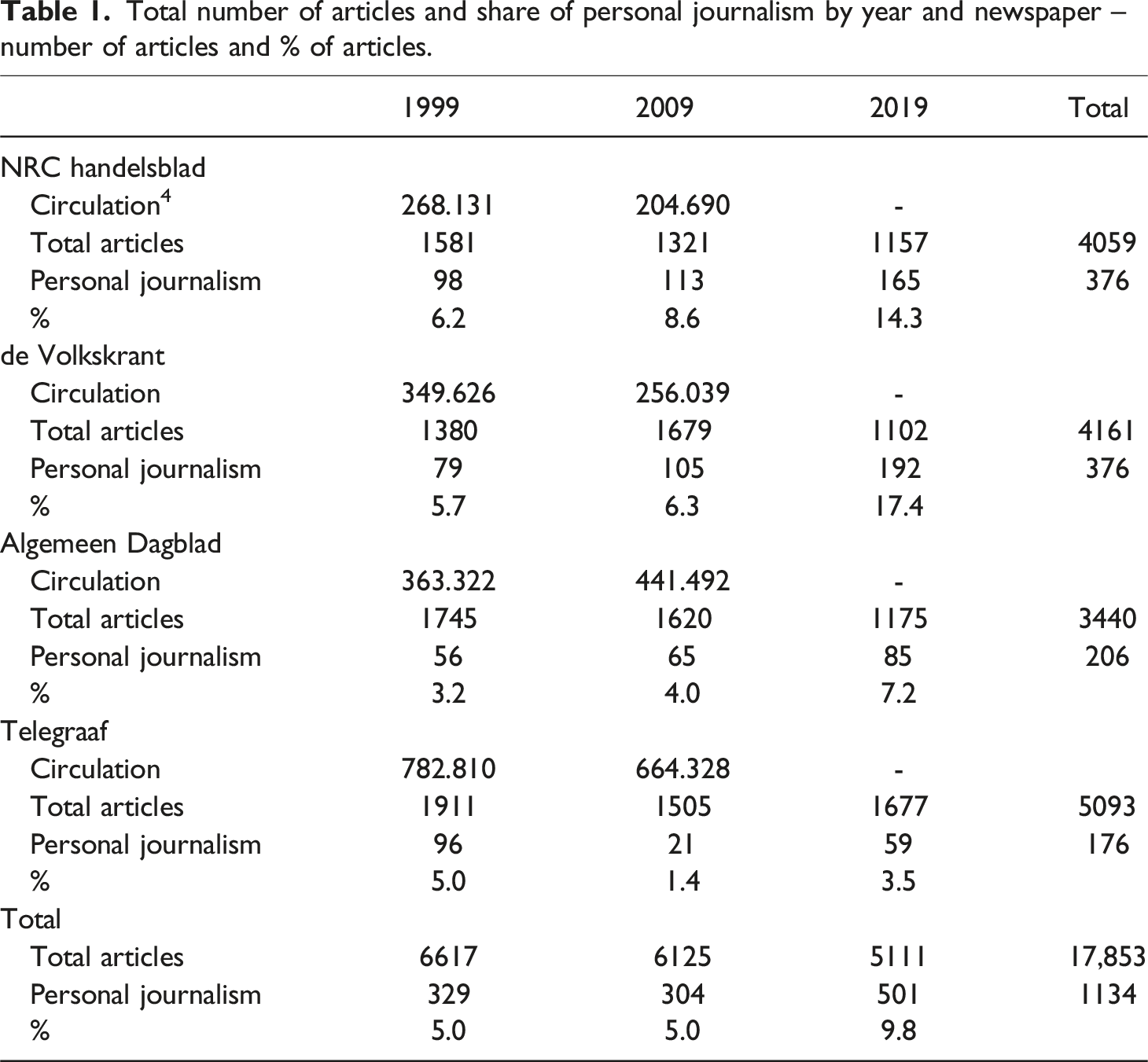
Total number of articles and share of personal journalism by year and newspaper – number of articles and % of articles.
Quantitative content analysis
We have done a quantitative content analysis of the entire dataset, developing a coding scheme and clear guidelines to systematically identify personal journalism. In line with our definition of personal journalism, our operationalization focuses on articles in which journalists explicitly refer to themselves. Consequently, all articles were included in which journalists refer to themselves by using a variation of ‘I’ or ‘we’. If only the latter was used, it needs to refer at least once to a group that the journalist was physically part of (e.g., audience of a musical) or that refers to a clearly delineated group which they are part of (e.g., family).
Accordingly, articles with any of the following characteristics were excluded, since they do not explicitly foreground journalists’ subjectivity: (1) all content that is not written by journalists (e.g., opinion articles); (2) articles in which ‘I’ or ‘we’ was only used as part of quotations, or in titles of books, movies et cetera; (3) articles in which ‘we’ was only used to refer to a general group (e.g., ‘humans’), since the identification of the journalist with that group is not personal. The 11.046 articles that contained no instances of ‘I’ or ‘we’ have been automatically excluded, leaving a dataset of 6.807 articles. This operationalization of personal journalism has been chosen to include as wide a sample as possible to be able to understand personal journalism in its diversity and not limit ourselves to, for example, only literary forms of journalism.
The coding for the category ‘personal journalism’ has been done by two coders. The coders have been aided in coding personal journalism articles by computer-assisted highlighting all first-person pronouns in the text. We have carried out an inter-coder reliability test on 300 articles to determine inter-coder reliability (ICR) for the selection of personal journalism articles from the data set. This led to a percentage agreement of 95%. 2
Qualitative content analysis
Through our quantitative analysis, we identified 1134 articles of personal journalism (Table 1). Subsequently, we have done a qualitative content analysis of these articles to understand how journalists legitimize personal journalism through their ethos construction in relation to existing theories on subjective epistemic regimes which we have discussed above (Hsieh and Shannon, 2005; Schreier, 2012). To do justice to ethos as a concept, rich interpretation of our data is needed (Korthals Altes, 2014). As an in-depth holistic textual analysis of such a large dataset is unfeasible, we have opted for a qualitative content analysis.
Qualitative content analysis provides a systematic approach that is aimed at carefully defining which part of the data is relevant for analysis, and subsequently interpretatively analysing these parts of the data including the latent content level (Schreier, 2012). Within the articles, we have focused on the ethos utterances by the journalist and the epistemic practices that they explicitly express within them. As a result, the amount of data is reduced, but it remains possible to interpret the meaning of the journalist’s ethos utterances in their context.
We developed a coding scheme and guidelines following a mixed approach, in which we started by establishing codes derived from the theory and we complemented those by data-driven code creation for the data that could not be categorized in the pre-defined categories (Schreier, 2012).
Coding categories for overtly subjective and core journalistic practices.
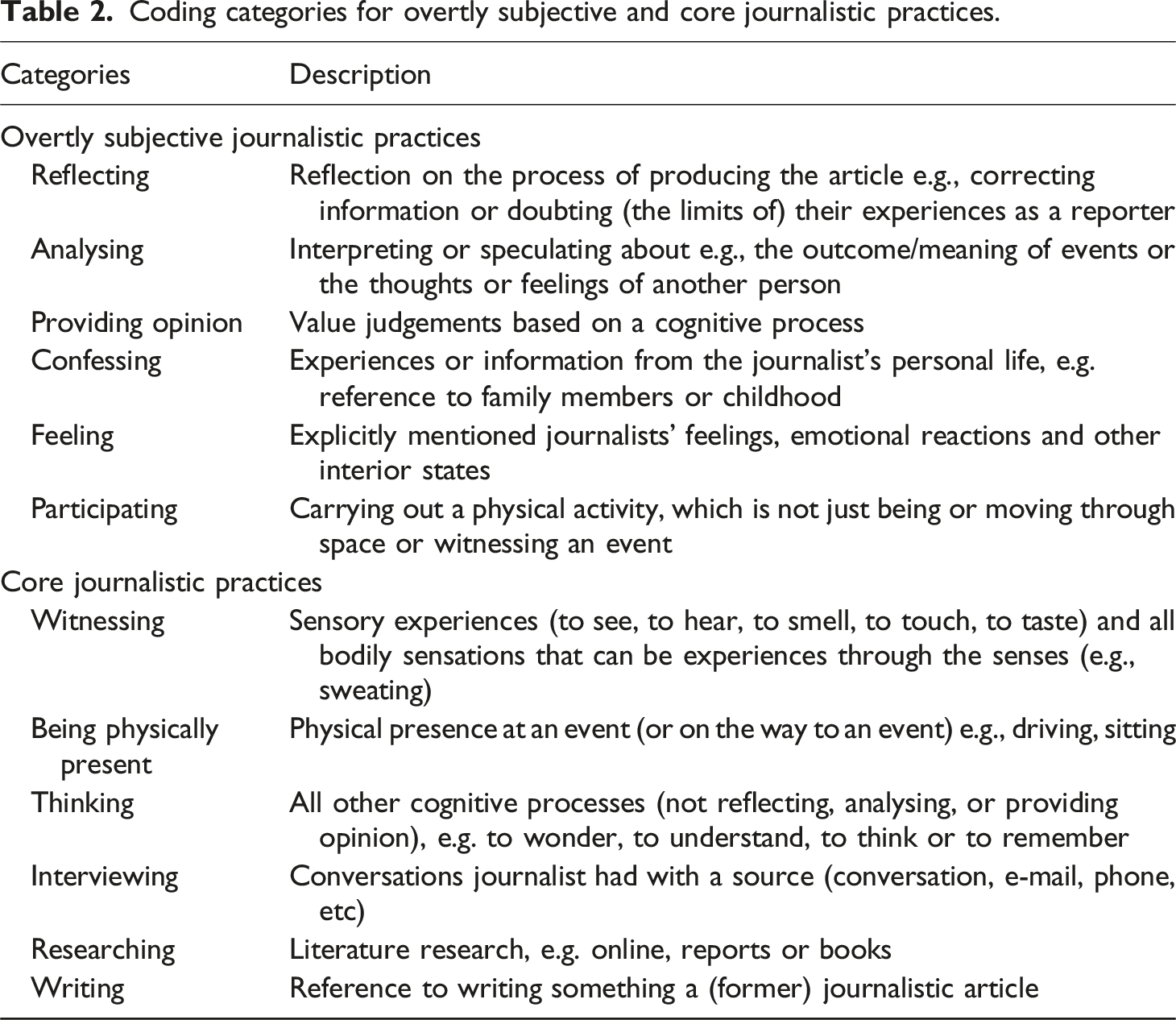
The specific coding guidelines were inductively developed to clarify the differences between the categories as much as possible. We would like to highlight that ‘thinking’ requires cognitive activity that is not captured by any other categories, and that ‘participating’ equally requires an action that is not captured by either physical presence or witnessing (Table 2). Since we are interested in the strategic discourse of journalists, their rhetorical framing has been decisive when there was doubt between different categories: if something was described as a feeling, it was classified as feeling, for example, even if it could also be understood as an opinion or a thought. In this case, the coding has been done by one coder, as the goal of our analysis was not to come to generalizable quantitative results, but rather to provide an interpretation of the ethos construction of journalists. Throughout the coding process, the coding categories and procedures have been closely discussed by all authors in order to assure their validity (Schreier, 2012). As a final step, based on the ways in which the different epistemic practices combined in the individual articles, we constructed and formulated two overarching legitimization strategies. Illustrative key citations from the articles have been selected to present the most salient ways in which these legitimization strategies are established in personal journalism.
The rise of personal journalism
The frequency with which personal journalism appears in Dutch newspapers at the start of the 21st century shows a clear increase over the years. To investigate the share of personal journalism, we have accounted for the number of articles as well as their length. The latter captures how much space personal journalism takes up in the newspaper, but might overstate the share of personal journalism if these articles are long and other articles are relatively short. The number of articles adds nuance by showing how many distinct items in the newspaper are personal journalism articles.
Share of personal journalism - % of articles and % of words.
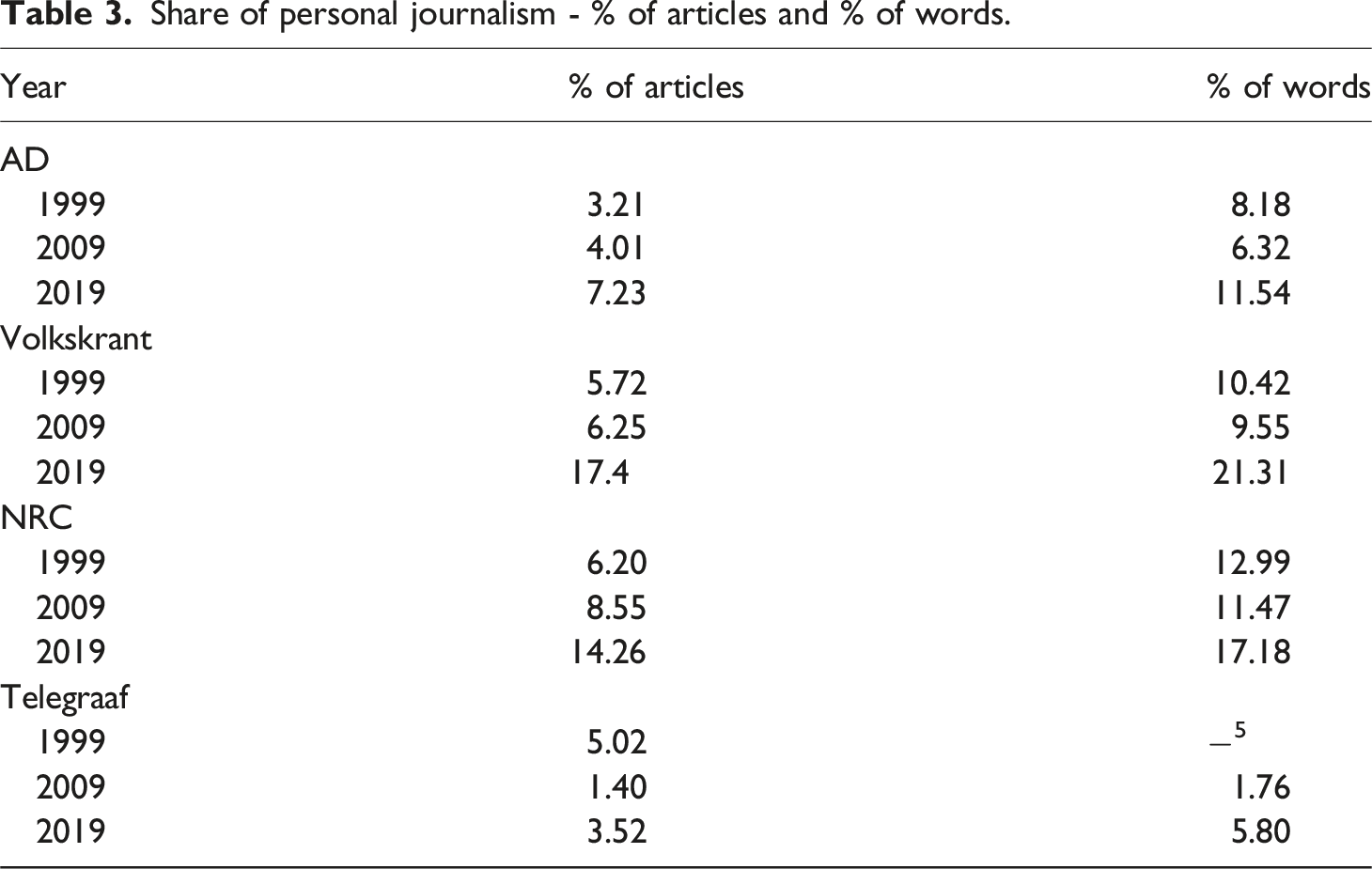
These findings show that the form of journalism has become increasingly personal between 1999 and 2019. This speaks to the importance of understanding these forms of journalism as alternatives for objective journalism. We need to develop theories and approaches that allow us to understand these forms of journalism beyond dichotomies between objectivity and subjectivity, quality newspapers and tabloid newspapers and their associations with good and bad journalism.
Epistemic practices
The ethos that journalists construct in personal journalism shows a wide variety of epistemic practices. Drawing on the relevant research on epistemic practices, we have divided these in two main categories i.e. ‘core’ and ‘inherently subjective’ journalistic practices (Table 2). Core epistemic practices reflect those that are closely associated with the objectivity regime, but are also present in many other forms of journalism. Inherently subjective epistemic practices clearly deviate from the foundational assumptions of the objectivity regime. By creating these two larger categories, we capture to which extent ethos construction in personal journalism reflects a continuation of dominant ideas of what journalism should be and to which extent it suggests a deviant shift towards subjectivity: what role do core practices have in their ethos construction and what role do inherently subjective practices have?
To understand how personal journalists build on these different practices to create a trustworthy ethos, we distinguish between two legitimization strategies: ethos constructions that highlight and that downplay the subjectivity of personal journalism.
Highlighting subjectivity
Ethos constructions that highlight subjectivity are underpinned by a subjective epistemic regime and only build upon subjective epistemic practices. They therefore align with the inherently subjective form of personal journalism in which the journalist is foregrounded in the text. As such, these ethos constructions depart clearly and strongly from the objectivity regime. Two examples illustrate how highlighting journalists’ subjectivity plays out in practice.
In an opinion article about the European elections of 1999, political commentator for de Volkskrant, Arnold Koper (1999), explores why he has developed a stronger inclination to vote for the liberal party. His discursive ethos construction is underpinned by interpretive journalism’s epistemic regime as he presents himself as a reliable source to guide his audience in interpreting the various party programs. In his utterances he emphasizes that he gives his opinion and interprets the party programs based on his profound knowledge as a political journalist. In quick succession he brings up a range of political issues and outlines the position of the liberal party in them, as well as his own position. “Why suddenly [my] appreciation for the liberals? Not because of the party program. Social-politically speaking it is much too poor for me. The migrant policies of [liberal spoke person on the issue] Kamp reek of narrow-mindedness. I am in favour of a real referendum […] [and] I appreciate the response of the real liberal party leadership […] to the referendum crisis” (Koper, 1999).
In this combination of analysing the party program and the actions of the liberal party as well as positioning himself in relation to them, he guides his readers to position themselves as well.
The same highlighting of the journalist’s subjectivity is visible in a rather different reportage by Haroon Ali (2019) about an exhibition about the pilgrimage to Mecca that he visited with his mother. The article builds on the regime of confessional journalism. The utterances of Ali are in line with it, as he shares personal stories related to the exhibition as well as his feelings while he visits it. He reflects on his own and his mother’s relation to the Islam and to the pilgrimage. They are both coming from a different angle, as she has converted after marrying Ali’s father, while he abandoned the faith he grew up with as it conflicted with his identity as a gay man (Ali, 2020). “While my parents separated fifteen years ago, my mother has always remained Muslim […] I, on the other hand, I am born as a Muslim and had an Islamic upbringing, but I broke away from my faith when I came out.” (Ali, 2019) In this way, Ali positions his personal experiences as the lens through which he views the exhibition.
Financial columnist Jan Maarten Slagter (2009) writes in one of his columns about the rise of the stock market index. He starts his narrative by relaying several anecdotes of holidays he has been on as big news events took place that he would otherwise have covered as a journalist, including the terrorist attacks in the London metro in 2005. Then, he states that: “this ‘talent’ apparently extends to financial markets. I got into the car at the end of the afternoon driving south. It was the day the Dutch stock market index started rising.” (Slagter, 2009). He continues by speculating about the legitimacy of this rise and the hope of investors that it represents. Covering a hard news beat, Slagter highlights his subjectivity by building on confessional journalism as he narrates his holidays and on interpretive journalism as he analysing the meaning tendencies of the stock market.
These ethos constructions, clearly highlighting journalists’ subjectivity, suggest that subjective epistemic regimes are familiar to journalists and readers, and are considered solid ground for producing trustworthy journalism. After all, the main aim of journalistic ethos is to convince readers of their trustworthiness. If journalists base this legitimization solely on a subjective epistemic regimes, they must assume that this regime is sufficiently familiar for their readers to not alienate them. The objectivity regime might remain to be dominant, but it is not all-encompassing: there are places, even in day-to-day newspaper journalism, in which subjective epistemic regimes are embraced.
Downplaying subjectivity
Nevertheless, ethos constructions in personal journalism do not necessarily highlight the journalist’s subjectivity. Below we discern two ways in which practices that are not necessarily solely associated to subjectivity are included in ethos constructions.
Downplaying subjective form
The first way in which journalists downplay the subjectivity of personal journalism, is by constructing their ethos by solely referring to core journalistic practices. In this ethos construction these practices are emphasized to win trust within a personalized form. Particularly, journalists do this by showing that they have first-hand experience with the situation they are describing, without sharing their subjective impressions about it. For example, in an in memoriam of Francis Fukuyama, a journalist adds that he has met him in real life, emphasizing that they met at a location that underlines the intimate access he had as they were both at the American state department at the same time: “I accidentally met him at one of those long, serene hallways of the state department in Washington” (Knapen, 2009). Similarly to ethos constructions that highlight subjectivity, he foregrounds his own presence but in this case does not mention any subjective practices that he carried out.
This ethos construction shares characteristics with the self-image of journalists that is established in the objectivity regime. In objective journalism, journalists aim to establish this self-image by being seemingly absent from their article and only implying indirectly that they have adhered to the norms of the objectivity regime through textual characteristics, such as direct quotes. In personal journalism, however, they explicitly construct a self-image in line with those norms, through utterances about themselves in the story. Yet, the form of these articles diverges from the convention of detachment and the associated idea that journalists should never write ‘I’. It could therefore be understood as a particular configuration of journalistic transparency, in which the underpinning norms of journalism with regard to objectivity have not changed but journalists actively share with their audience how they have acted to comply with those norms (Heim and Craft, 2020).
Downplaying subjective epistemic practices
The second way in which journalists downplay the subjectivity of personal journalism in their ethos construction is by complementing overtly subjective practices with core practices. Here, journalists are usually the principal character in the article. It includes personal stories in which core journalistic practices, such as witnessing and thinking, are just day-to-day methods of gaining information about the world. This is well illustrated by a column by Sylvia Witteman (2019), a regular in de Volkskrant, in which she recounts helping a little girl that has hurt her hand while Witteman is on her way to visit her mother. She describes how she makes her way over there, what she is seeing as well as how she helps the girl: “I dropped to my knees and gently grabbed the small, sticky hand” (Witteman, 2019). In this case, core journalistic practices are incorporated in an otherwise confessional ethos construction in a highly personal story.
It can also take shape as a journalistic story which has a argumentative or reflective, rather than a narrative form. In this case, journalists convey how they have gathered the knowledge presented in the article and their subjective response to it in their utterances. Japke-d. Bouma (2019), for example, writes in a column first about a survey she has read. Then she adds that she “chuckled a little about the conclusions” (Bouma, 2019). In the rest of the column, she further unpacks why the conclusions were amusing to her. Here, we see how the core journalistic practice of desk research is the starting point, on which she later expands with more subjective practices.
Overall, journalistic ethos constructions that downplay subjectivity suggest that the norms and everyday journalistic practices of objective journalism are adopted and expanded with additional practices in personal journalism. We therefore argue that in personal journalism journalistic epistemic regimes are negotiated through using the personal form and the utterances of the journalist: epistemic norms are negotiated by incorporating established practices to build the legitimacy of the form and the journalist, while at the same time constructing subjective epistemic practices as legitimate sources of journalistic knowledge.
Conclusion
Our quantitative content analysis shows that personal journalism has been increasingly present in Dutch national newspapers in the last three decades. Moreover, our qualitative content analysis suggest that the personalization of journalism demands a different legitimization strategy from journalists and provides different opportunities to convey this as it allows them to contribute to their ethos construction through explicit statements about themselves in their news stories (Smeenk et al., 2023). As we have shown, journalists follow two legitimization strategies in creating that image: they either construct an ethos highlighting their subjectivity for which they build upon subjective epistemic regimes, or a ethos downplaying their subjectivity, in which they combine the subjective form of personal journalism with explicit statements about themselves that are – at least partly – in line with the objectivity regime. So, while personal journalism as a form is rising in Dutch national newspapers, this rise does not necessarily result in a full-fledged personalization of the epistemic norms as expressed through journalists’ ethos.
Our findings show that understanding what personalization entails in journalism requires a detailed understanding of the different levels on which it manifests. The specific definition of personal journalism we use as well as our theoretical focus on ethos allows to make distinctions between the personalization of the form of journalism, the journalist’s image, and underlying epistemic regimes. Personalization can, but does not have to align on these different levels within the same article: journalism can be personalized at one level while aligning with objective journalism on others.
As such, ethos has proven a valuable concept to grasp the distinctions and the interaction between the textual features of journalism, the self-image that journalists create, and socially shared ideas about journalism. In other words, ethos brings forward the ways journalists reproduce and shape these socially shared ideas in their texts while highlighting how these processes play out on different levels.
The norms associated with personal journalism, as they are expressed in the journalists’ ethos, are anything but settled as these different legitimization strategies show. We argue that personal journalism is a space of negotiation in which the epistemic practices of journalism are not replaced, but recombined, reassembled or expanded. In this negotiation process established practices are incorporated into personal journalism, but so are subjective practices. While personal journalism is rising, its norms, practices and forms are carefully negotiated to strategically position it within the journalistic field, and can therefore be understood as a form of boundary work (Carlson and Lewis, 2015). It is trying to create space for less prestigious practices by combining them with already established, dominant practices. In this negotiation, configurations of journalistic norms emerge that build on subjective epistemic regime and bring them more towards the centre of journalism. As our analysis was not able to take into account genre or topic of personal journalism, further research is required to understand which beats or genres of journalism are driving these change in legitimization strategy.
A possible explanation for these strategies of journalists themselves and of editors, is that they want to retain cultural authority and audiences by continuing to construct a recognizable image of journalistic identity. In this way, this personal form of journalism aims to maintain its status as trustworthy journalism. Yet including subjective epistemic practices also enables expanding this image, and drawing in groups that might have grown sceptical of detached objective journalism as well as groups that are looking for a more entertaining, story-telling type of journalism.
As Wahl-Jorgensen (Wahl-Jorgensen, 2020) argues, journalism studies should look beyond the objectivity ideal in journalism that renders invisible the subjectivity which is central to journalism. Objectivity is commonly understood as reporting that is factual, fair, non-biased, independent, without interpretation, neutral and detached (Ward, 2015). Subjectivity is much less clearly defined and is often by default understood as the opposite of objectivity (Van Zoonen, 1998). This article has moved beyond this limiting understanding of subjectivity, and instead offers a bottom-up understanding of how subjectivity functions in day-to-day journalism. Our results underline that the way that subjectivity functions in journalism is complex and multifaceted and it should be understood as intricately intertwined with objectivity, instead of considering it as its unspecified counterpart.
Footnotes
Acknowledgements
The authors would like to thank Huub Wijfjes for his comments on earlier versions of this manuscript and Iris Baas for her help with coding the newspaper articles.
Declaration of conflicting interests
The author(s) declared no potential conflicts of interest with respect to the research, authorship, and/or publication of this article.
Funding
The author(s) received no financial support for the research, authorship and/or publication of this article.
