




Abstract
Trust in news media is a hot topic in media research, and although several attempts have been made to explore it, the concept has commonly been viewed as a matter of audiences’ reception of news products. In contrast, we conceptualize trust as an integral part of all stages of the news production process and focus on the journalists’ perspective. Based on semi-structured interviews with Austrian constructive journalists, we investigate which strategies they use to improve the perception of their trustworthiness among audiences and what they want to achieve by being trusted. Trust-building strategies are identified across various stages of news production, with a notable emphasis on traditional journalistic values like objectivity, particularly in the context of separating facts from opinions to enhance audiences’ trust. Objectivity is sought through reliance on scientific sources, which are considered objective in their own right. This approach contrasts with conventional notions of objectivity in journalistic and academic discourse on constructive journalism. The findings reveal a focus on fostering trust to promote a solution-oriented approach to public issues, facilitating a more vibrant and constructive public discourse.
Introduction
Trust in news media is a prominent subject of discussion within academic circles. Concerns about declining levels of news media trust are linked to evidence regarding, among other factors, politicians’ disinformation accusations against journalism, journalists’ misalignment with audiences’ expectations, and a shattered notion of truth, which contributed to a plethora of studies on the matter (Engelke et al., 2019). While numerous empirical studies were conducted, recent scholarly critics have pointed out theoretical deficiencies in the existing literature that need to be addressed, particularly given the complex relationship between audiences and journalists (e.g., Engelke et al., 2019; Moran and Nechushtai, 2023).
One notable criticism is the tendency to view trust solely from an attitudinal and static standpoint rather than as a dynamic process of trust-building and enactment (Blöbaum, 2021; Uth, 2024). Moreover, existing research on trust in news media predominantly focuses on the audiences’ perspective, overlooking the active role journalists play in fostering trust (Uth, 2024; Zahay et al., 2021).
This study aims to address these theoretical gaps by conducting semi-structured interviews with Austrian constructive journalists, exploring the strategies they employ to enhance audiences’ trust and their objectives in earning that trust. While attracting trust is important for all kinds of journalistic actors, constructive journalists are of particular interest due to the pivotal role trust plays in their future-oriented reporting (Gyldensted, 2015; Hermans and Drok, 2018). In this study, constructive journalists serve as a “paradigmatic case” (Aharoni et al., 2023) for examining the strategies and motivations behind their efforts to cultivate trust among audiences.
Toward a new consensual definition of news media trust
The importance of establishing clear and robust theoretical frameworks for understanding the concept of trust in news media research has been emphasized for a considerable period (Kohring and Matthes, 2007). However, the ongoing debate surrounding the definition of news media trust remains unresolved (e.g., Blöbaum, 2021; Engelke et al., 2019).
To gain a more nuanced understanding, some researchers have begun to qualitatively explore people’s interactions with news media and their folk theories about trust (e.g., Knudsen et al., 2022). While providing valuable insights, these studies do not contribute to the theoretical development of the news media trust concept, which is essential for promoting systematic research in this fragmented field (Engelke et al., 2019; Kohring and Matthes, 2007; Panievsky et al., 2024). This is due to the elusive nature of the trust concept, whose underlying mechanisms − like many mundane processes − often remain obscure in everyday life (Möllering, 2006; Münscher and Kühlmann, 2012).
Thus, it is imperative to critically examine the fundamental assumptions underpinning prevalent academic definitions of trust in news media to address deficiencies that have influenced previous empirical studies.
Beyond news media trust as an attitude: The trusting process
In the extensive research on trust in news media, scholars generally agree on defining trust as an attitude characterized by “the willingness of the audience to be vulnerable to news content based on the expectation that the media will perform in a satisfactory manner” (Fawzi et al., 2021; Hanitzsch et al., 2018: p. 5; Van Dalen, 2020). This definition has formed the foundation for numerous empirical studies aimed at assessing levels of trust in news media globally and identifying associated factors (Fawzi et al., 2021). However, some scholars have recently highlighted that this approach overlooks perspectives widely recognized in other research fields (Pytlik-Zillig and Kimbrough, 2016), particularly the behavioral and procedural aspects of trust (Blöbaum, 2021; Westphal and Blöbaum, 2016). As noted by Blöbaum (2021), there is a tendency to conceptualize and operationalize trust in news media as a static attitude held by individuals rather than a multi-step process (Möllering, 2006; Pytlik-Zillig and Kimbrough, 2016). Embracing a process-oriented viewpoint enables the examination of phenomena preceding and succeeding trust, often overlooked or conflated in news media trust research, such as perceptions of trustworthiness, trust, and enactment of trust (Engelke et al., 2019; Westphal and Blöbaum, 2016).
Drawing upon the convergence of various perspectives in trust research (e.g., Blöbaum, 2021; Dietz and Den Hartog, 2006; Möllering, 2006; Pytlik-Zillig and Kimbrough, 2016; Uth, 2024; Westphal and Blöbaum, 2016), we present three key steps in the trust process that can serve as a framework for more systematic and coherent empirical investigations into trust in news media. The specifics of each step necessitate context-sensitive empirical inquiry: 1) Perceived Trustworthiness (also referred to as “perceived credibility” or “ethos,” see Self, 2009): This step involves the potential trustor evaluating the trustworthiness of the potential trustee based on normative expectations. Such evaluation would influence, but not determine, trust decisions. These evaluations may be both cognitively and emotionally driven and are influenced by a plethora of factors, from individual characteristics of the potential trustee to organizational and institutional frameworks. The significance of these factors may evolve over time as the trustor-trustee relationship develops. Perception of trustworthiness is not only a potential trustor’s issue. It also stems from the ongoing communicative and discursive interactions between the potential trustor and the potential trustee, where the potential trustee can strategically take actions to shape how the potential trustor perceives its trustworthiness (Aharoni et al., 2023). 2) Decision to Trust: Building upon perceptions of trustworthiness, trust is a conditional state characterized by the trustor’s positive expectations. It involves temporarily setting aside vulnerability and uncertainty through a “trust decision” (Uth, 2024), akin to a “leap of faith” (Möllering, 2006). Trust entails living as if certain potential outcomes will not materialize, requiring a risky decision to expose vulnerability and uncertainty. Failure to take this leap results in a “lack of trust.” 3) Enactment of Trust: This step pertains to the actions undertaken by the trustor following the suspension of vulnerability and uncertainty. Such actions involve taking risks towards the trustee. Besides influencing perceptions of trustworthiness, in its communicative and discursive relationship with the trustor, the trustee can advocate for certain enactments of trust at the expense of others (see Zahay et al., 2021). The outcomes of trust-related actions, such as a trustor’s feelings of genuine or misplaced trust, impact perceptions of trustworthiness and future trust decisions.
The one-sided understanding of news media trust: Towards a more holistic approach
Despite the possibility for trustees to influence the trust process, the prevailing understanding of trust in news media focuses on the audiences’ reception of news products, with numerous studies dedicated to measuring trust, identifying predictors, and exploring consequences (Fawzi et al., 2021). Van Dalen (2020) highlights that researching trust in news media is usually considered important because of its role in fostering democracy, its contribution to “ontological security,” and its economic benefits for the information industry. What these lines of argument have in common is the understanding that trust is an issue related exclusively to how audiences receive news products (Aharoni et al., 2023; Moran and Nechustai, 2023).
This perspective overlooks the active and strategic role of journalists in shaping the trust process. As anticipated in the previous section, journalists can influence the trust process through deliberate efforts to influence the perception of their trustworthiness among audiences − and, therefore, audiences’ decision to trust − and advocating for specific enactments of trust (Aharoni et al., 2023; Zahay et al., 2021). The latter are two areas worthy of research; nevertheless, empirical studies are limited. The next sections are devoted to delving into these two underexplored strands of study.
Journalists’ strategies to improve the perception of their trustworthiness among audiences
Departing from the consideration that news media trust is the result of ongoing communicative and discursive interactions involving various actors, including journalists and audiences (Aharoni et al., 2023), a limited yet growing body of research is focusing on journalists’ orientations to elucidate their trust-building strategies, that is, how journalists try to improve the perception of their trustworthiness among audiences. For instance, Uth (2024) identifies three primary approaches adopted by German journalists: quality-oriented, publicity-oriented, and transparent. By focusing on news texts, Aharoni et al. (2023) discover three types of journalistic trust-building rhetoric in election coverage in Israel and the US: facticity, authority, and transparency.
To advance this research trajectory, it is imperative to assume a more comprehensive perspective of journalists’ work and explore how trust-building strategies intersect with journalists’ daily practices and are integrated into the news production process as a whole (Moran and Nechushtai, 2023). One notable example is the study by Robinson (2023), who reviewed data from trust initiatives and drew from interviews, focus groups, and surveys with US journalists to provide a list of trust-building strategies that encompass the whole newsmaking process, from the interaction with sources to online comments management (pp. 54-56).
Journalists’ preferred enactments of news media trust
In addition to efforts to enhance audiences’ perceptions of their trustworthiness, journalists may also advocate for specific enactments of trust − that is, how audiences should act on the information they trust. While scholarly research often does not explicitly focus on journalists’ preferred enactments of news media trust, the study by Zahay et al. (2021) provides insight: traditional journalists primarily aim to assist citizens in voting, while engagement-oriented journalists focus on facilitating citizens’ own deliberation. Given the limited theoretical development of this concept, we employ a “sensitizing concept” (Blumer, 1954), “paradigms of trust in news media,” to explore the preferred enactments of trust endorsed by journalists. Building on Bennett et al. (1985), we conceptualize it as a shared set of assumptions about how audiences should act on the trusted information provided by journalists. It is not only about the purpose of journalism but also about the purpose of trust in journalism. The distinction, though subtle, is crucial; news consumption and trust in the media do not always align (Fawzi et al., 2021). Like journalistic paradigms (Reese, 1990), paradigms of trust in news media are shaped, sustained, and interpreted within broader hegemonic contexts; thereby, multiple paradigms can coexist and intersect.
A “paradigmatic case” of analysis: Constructive journalists
Constructive journalism is a future-oriented type of journalism that has become increasingly popular in recent years, diverging from traditional notions of objective reporting. By focusing on the question “What now?” in addition to the traditional W questions (Gyldensted, 2015: pp. 175-181), it aims to challenge the formulaic, immediate, and event-driven reporting often found in mainstream journalism (McIntyre, 2019). Constructive journalism emphasizes social responsibility and advocates for a more inclusive and proactive approach that highlights positive values, emotions, and potential solutions (Bro, 2018; Van Antwerpen et al., 2023). It aims to provide affirming and inspiring, yet often overlooked, narratives (Gyldensted, 2015) to build trust and engage and empower audiences (McIntyre, 2019).
Constructive journalism is thus an interesting focus to shed light on journalists’ efforts to improve audiences’ perceptions of their trustworthiness and to promote certain enactments of trust for at least three reasons.
Firstly, it represents one of many journalistic approaches that require examination in relation to trust in news media. Different types of journalists employ distinct strategies and approaches regarding trust (Uth, 2024; Zahay et al., 2021). Given their specific focus on the social responsibility of journalism, constructive journalists are likely to offer interesting and original insights into their strategies for improving perceptions of their trustworthiness and the enactments of trust they promote. Secondly, attracting trust is important for all kinds of journalistic actors. Nevertheless, constructive journalists have a strong future orientation through which they try to engage audiences’ participation in society. Considering that (news media) trust is essential when it comes to assessing the uncertain future (Aharoni et al., 2023; Möllering, 2006), trust becomes especially salient for constructive journalists (Gyldensted, 2015; Hermans and Gyldensted, 2019). Thirdly, many constructive journalistic media, especially in Austria, that is, the case under analysis here, are largely funded by donations and therefore rely on the financial support of their audiences, making trust a relevant and central resource to finance itself in the long term (Hermans and Drok, 2018).
Although some studies have looked at trust in constructive journalism, these have focused on whether reading constructive articles correlates with trust in news media (see Van Antwerpen et al., 2023). Research has overlooked constructive journalists’ attempts to shape the trust process, that is, strategies to improve the perception of their trustworthiness among audiences and advocacy for certain enactments of trust. To fill this gap, in line with the steps of the trust process delineated above, we pose two research questions: RQ1: What strategies do constructive journalists pursue to improve the perception of their trustworthiness among audiences? RQ2: What enactment of trust do constructive journalists seek to foster among audiences?
Methodology
This study is based on in-depth interviews with 12 self-identified constructive journalists in Austria. The Austrian context provides an intriguing perspective for examining news media trust from the journalists’ viewpoint. Despite traditionally high levels of trust in news media, only 38% of Austrians currently express trust in news sources (Newman et al., 2023). This decline can partly be attributed to a significant scandal in 2016, where a political party unlawfully used funds from the Austrian Ministry of Finance. This involved faking opinion polls and bribing the highest-reach tabloids to disseminate these polls in order to influence public opinion. The incident led to a widespread erosion of trust in media and their financial practices (Balluff et al., 2023). Given this backdrop, we anticipated issues related to trust to be particularly prominent in the discourses of journalists.
The interviews took place face-to-face and remotely. They were carried out between June and July 2023 and lasted between 45 and 75 min. To identify potential interviewees, we followed a two-step process. Firstly, news organizations that explicitly identified themselves as practicing constructive journalism were selected, resulting in a list of 15 online newspapers 1 . All outlets focus on the Austrian context but do not have a specific (regional or thematic) focus; instead, they focus on constructive reporting generally. The size of the outlets ranges from three journalists to 15 journalists. Due to varying interpretations of constructive journalism (Bro, 2018), it was essential that the news outlets labeled themselves as constructive on their websites. Secondly, individual journalists associated with these constructive news outlets were identified as potential interviewees, yielding a list of 138 constructive journalists in Austria.
To reach data saturation, we concurrently sampled, collected data, and analyzed them (Hennink et al., 2017). An iterative sampling strategy (Hennink et al., 2017) was adopted to recruit participants; guided by the emerging findings and existing literature, gender, seniority (in constructive journalism), media outlet size, and age of participants were considered as relevant variables in the recruitment process. As a result, interviews were conducted with six men and six women, aged between 25 and 55, and working for nine different news organizations. In spite of the limited number of interviews conducted, “data saturation” was achieved; in other words, in line with the research questions, no novel strategy to enhance perceptions of trustworthiness or desired enactment of trust was found (Edward and Holland, 2013: p. 65). It is important to acknowledge the relatively small scale of the Austrian media landscape, particularly within the realm of constructive journalism. Despite the recent rise of news start-ups and peripheral journalistic actors, including constructive media outlets, the Austrian media landscape is characterized by few dominant media houses and remains relatively small (Maares and Hanusch, 2023).
The interview guideline explores the respondents’ comprehension of (constructive) journalism, the perceived role of audiences, and recalled journalistic practices. Due to the conceptual ambiguity surrounding the term “trust,” direct questions about trust were avoided. Instead, trust-related phenomena were addressed in a broader context without verbal coercion (Münscher and Kühlmann, 2012; Trotsuk, 2016). Questions addressing trust-related issues include: “How do you engage with the audience? How does this differ from non-constructive journalism approaches?” and “How can constructive information benefit individuals in their daily lives compared to other types of information?”. Nevertheless, interviewees spontaneously raised trust as a pertinent issue in today’s media landscape.
All interviews were transcribed, anonymized, and thematically analyzed using MAXQDA. Data analysis involved two phases. Initially, relevant excerpts were categorized into two deductive categories aligning with the research questions: strategies to enhance perceptions of trustworthiness and desired enactments of trust. It should be highlighted that interviewees often employed the term “trust,” as well as synonyms, indiscriminately to indicate what we defined as perceived trustworthiness, trust, and enactment of trust. The categorization of relevant excerpts was done following the meanings conveyed by the interviewees and not the specific terms employed. Subsequently, sub-categories were identified through an inductive approach to identify specific trust-building strategies and preferred enactments of trust.
Findings
Before addressing the research questions, it is necessary to outline why the interviewees consider news media trust a relevant issue, even if the word “trust” was never mentioned by the interviewer.
The interviewees consistently criticize the lack of trustworthiness of non-constructive journalists, which has led to a loss of trust in journalism as a whole, with repercussions that also affect the constructive journalists themselves. Discourses around such a crisis of news media trust form part of the common sense of the interviewees, on which many reflections on the future of journalism are based. Arguments about lack of trust in news media are sustained by references to reports, such as the Digital News Report (Newman et al., 2023): I think little reporting needs to be published instantly. Media should try out whether that might be profitable in the long term, because readers gain more trust. We see in Reuters Digital News Reports that people are reading less, consciously avoiding news, that this can also win over readers (M3).
Such arguments are also derived from personal experiences with news media: “The media is no longer the institution you can trust. Don’t know if it was ever like that, but you shouldn’t trust everything they say anymore” (M1).
Issues of trust were not referred to by the interviewees in order to distinguish themselves from and promote their legitimacy over other types of (journalistic) actors but rather to underline what they consider the only possible path for journalism to survive. As M2 says: “Forty percent of Austrians avoid news, and constructive journalism is a counter-reaction to this. A way to overcome the crisis in journalism that is urgently needed.”
These reflections on the current lack of trust in journalism characterize the respondents’ attitudes towards their work and audiences. In light of these critical considerations, the following sections address interviewees’ standpoints through the lens of the two research questions. Interviewees’ reported strategies to improve perceptions of their trustworthiness among the audiences are outlined first, to then delineate their desired enactments of trust.
Strategies to improve perceptions of trustworthiness
Regarding the first research question, that is, how constructive journalists try to improve the perceptions of their trustworthiness, it emerged that the interviewees aim to include several audience-oriented strategies in every stage of the newsmaking process, and beyond. These considerations are marked by a sensitivity to audiences’ needs. The interviewees claim to be aware of and driven by structural and individual factors that foster news consumption and trust, which they derive from close communication with audiences.
Strategies to improve perception of trustworthiness among audiences.
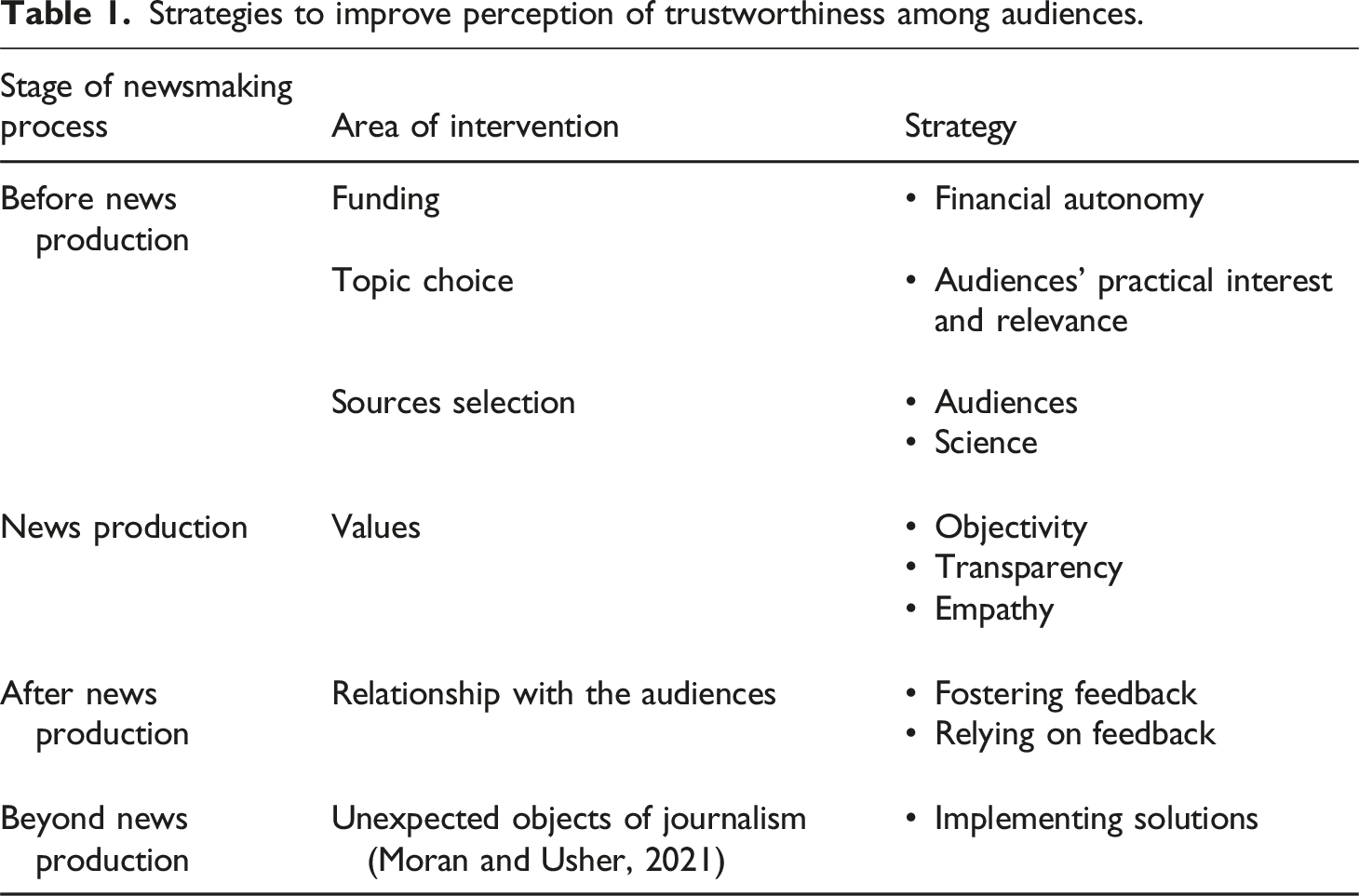
Before news production
Funding
One of the most important points for the respondents is (financial) autonomy, so for them, it is crucial that the media outlet they work for is not financially influenced by private companies or political parties. They aim to establish donation-based or community-based news outlets. The financial autonomy of the media is a particularly sensitive issue in Austria, in light of the fake opinion polls scandal described above. The journalists interviewed see this as a key reason to emphasize their independence from external funders in order to enhance audiences’ perceptions of their trustworthiness. As M4 remarks: “Advertisers can influence the editorial line or exert pressure, and that could upset people in the community. That’s why we have a fairly classic firewall, so the business side doesn’t affect the editorial side” (M4).
Topic choice
Regarding the choice of topics, interviewees highlight that reporting on issues that positively impact people’s everyday lives is the only way to bring audiences closer to journalism and regain their trust. As M2 argues: We believe that people avoid news because it’s a weariness of this negativity, and they crave the silver lining. For me, the key question is: Is it relevant for the fast-paced people? Is it something that can’t be found elsewhere? Is it something small that tells something big? And is it a topic where you can contribute to a solution or something constructive?
Interviewees’ perceptions of what is relevant for audiences are derived from personal contact with people and messages sent to the news outlet: “People just contact us and say, ‘This is important; can you take a look?’” (F2).
Beyond personal contact with people, interviewees state that they rely on academic debates to select topics to cover. Particularly, interviewees want to deal with topics that are central to the academic literature but seldom acknowledged by the press: “All these (scientific) findings are not translated in a way that is accessible and understandable for the general society. I believe there is a gap, that this translation service is needed” (F6).
Knowledge of the academic literature comes from research conducted independently in one’s field of expertise and from close contact maintained with scientists.
Sources selection
Regarding sources, interviewees unanimously emphasize a strong reliance on scientific experts: “We actually have almost no articles without scientific expertise in them” (F4).
Such a reliance on experts may be due to two intertwined reasons. First, science is thought to be able to provide the solutions needed. Second, and less explicitly, science is uncritically considered trustworthy. Critical reflections about what science is and who is an expert are rare. This excerpt is explanatory: I always send the text and ask: “What changes would you like to see?” And if a scientist tells me, “You didn’t understand that correctly,” then I have to take that to heart. But if a politician or someone with interests says, “I didn’t mean it that way,” then I have to think about whether I made the mistake or whether this person wants to be seen in a different light (M1).
Additionally, according to the interviewees, audiences consider science more trustworthy than journalism. For the interviewees, reporting scientists’ statements is seen as a good way to be considered trustworthy among audiences. We argue that referring to science is a way for constructive journalists to foster a “transfer of trust,” the phenomenon whereby a person develops trust in an entity because of the trust in a related entity (Belanche-Gracia et al., 2014); in this case, from science to journalism. However, critical reflections on the relationship between science and journalism also emerge in the interviews: “I have been asking myself: What makes expertise? What gives them expert status?” (M4).
News production
Values
According to the interviewees, in light of the information-saturated contemporary media environment, the best way to be considered trustworthy is by being objective, a trust-building strategy also prominent in Uth’s (2024) and Aharoni et al.’s (2023) findings. As F5 maintains: “(If they know it), I think that more people would actually read constructive journalism because it’s more objective. It’s more objective because it sheds more light and actually has future prospects. And I think that it appeals to more people.”
Two different, partly overlapping, meanings are attached to the objectivity value. Firstly, it is understood as the separation of facts from opinions: “Opinion is not journalism. (...) They should be separate, opinion and journalism” (F8). Secondly, it means showing all facets of an issue, and not just the negative ones, like other news media are thought to do. Behind this idea, there is the belief that reality is actually better than how the media portray it; the media are pushed to distort it because of a structure that privileges bad news: “Constructive journalism can give hope without lying and say what it is. Things are not that bad. We just have to change a few things, and then we won’t live in hell” (F4).
Consistent with the previous results outlined, the separation between facts and opinions is often dictated by science, which is mainly considered objective: “I would just say that what is the broad scientific consensus can be described as objective” (F2). It entails disregarding the constructed nature of the objectivity norm − in science as well as in journalism (Anderson and Schudson, 2020).
Another strategy recalled by interviewees to implement objectivity in reporting is not advocating for the proposed solutions, however valid they may seem: “We don’t promote solutions. We are not activists for solutions, we report on them, we classify them, and of course we want something to happen with them” (F4).
Besides objectivity, a second way to improve perceptions of trustworthiness concerns being transparent about information sources, again in line with Uth’s (2024) and Aharoni et al.’s (2023) findings: “I think it’s extremely important to people that they know where information comes from, that we communicate it clearly. And I think that many people appreciate it” (F5). Moreover, transparency serves to compensate for one’s own lack of objectivity. When interviewees recognize that objectivity is more an ideal to refer to than something practically feasible, they refer to transparency as a remedy to foster perceptions of trustworthiness: “I don’t think objective journalism is possible; it’s more important that you are aware of your own stance and that you are clear and transparent to your readers” (M3).
A third value that informs interviewees’ considerations about trust is often neglected by journalists and journalism scholars: empathy (Glück, 2020). Interviewees consistently argue that to lead audiences to trust and enact the proposed solutions, it is necessary to empathize with people’s emotional and cognitive needs, which concern how people may feel after reading an article: “I think constructive journalism is about the feeling after reading, when you’ve got information you can use. Instead of the media just throwing in negative facts and the reader is left alone with it, people notice this” (F3). It also entails adjusting the stylistic features of articles to make them easier to read: “The text must be understandable, and there cannot be too many numbers. This will get you out (from the current situation of news avoidance and lack of trust)!” (F7).
After news production
Relationship with readers
A major point stressed by all interviewees is that their job is not concluded once a news piece has been published, a point also stressed in many trust-building strategies identified by Robinson (2023, pp. 54-56). The publication of a news piece should instead mark the start of a close conversation with audiences, which influences future newsmaking processes. Interviewees do not conceptualize audiences as passive receivers of information, but as an integral part of an information exchange: journalists provide news to audiences, and audiences provide feedback and suggestions to journalists. This is thought to facilitate trust among audiences that are increasingly skeptical of institutions closed in their ivory towers: “That’s very important to me, that media should think how they can strengthen the exchange with readers, how they can offer more than just text and the possibility of commenting, that media also respond to comments” (M1).
Interviewees reported some initiatives taken up to enhance a closer relationship with audiences. Community management in particular is essential for constructive journalists to maintain a good relationship with their readership. One interviewee says: “I think that moderating comments, posting things on social media, and community management in general is important for journalism. This back office is what makes journalism possible in the first place” (F6).
Beyond news production
Unexpected objects of journalism
It is worth closing this section by highlighting that interviewees emphasize that fostering perceptions of trustworthiness extends beyond the newsmaking process. To be trusted, solutions need not only to be proposed but also implemented. Following Moran and Usher (2021), solutions implemented by journalists may be considered as “unexpected objects” of journalism, that is, objects “not typically considered to be part of the direct experience of producing or consuming news, but nonetheless have an affective dimension, creating the preconditions for a range of possible emotions” (p. 9).
It is interesting to note that advocating for a particular solution is regarded as detrimental to audiences’ perceptions of trustworthiness; rather, solutions should be practically implemented to show their efficacy. According to interviewees, it is a way to avoid being just another among the myriad of voices circulating online. Implementing solutions serves “to set the good example” (F2) and to persuade the audiences of the relevance of current issues: A solution is only interesting if people understand the problem is relevant. Simple language is used as a tool but there are also some constructive outlets whose constructiveness lies in the fact that they employ people with disabilities as journalists, and that is a very honorable goal. So, do we employ people with disabilities, or do we just write about them? (M4)
Desired enactments of trust: A necessary paradigm shift
The strategies outlined so far help the interviewed constructive journalists attract trust, enabling them to promote certain enactments over those typically pursued by mainstream journalists. To address RQ2, we use the sensitizing concept of the “news media trust paradigm” – a shared set of assumptions about how audiences should act over the trusted information provided by journalists – to first outline the two paradigms that, according to the interviewees, are now dominant and contributed to the current loss of trust in journalism. Then, we consider the necessary paradigmatic shift advocated by constructive journalists.
The profit-driven paradigm
When interviewees talk about the decline in trust in journalism, they do not attribute it to poor or deceptive performances of journalists and news media but rather to the standards they follow. In other words, they see problems of trust as deep-seated structural problems of journalism. According to the interviewees, due to the way journalism has traditionally been conceived, trust in news media is primarily viewed by journalists from an economic perspective, where “losing trust mainly means losing readerships and profits” (F5). In a critical vein, it is argued that: “The financing of media is contrary to their function, that you should not only inform but also show new perspectives” (M4). Moreover, regarding the current decline in trust in journalism, it is stated that: “It’s not the fault of the media that do daily journalism, but the fault of the system and the structures in which they are trapped” (F6).
This latter point is also related to the relationship between journalism, the current economic difficulties of the news industry, and politics. According to M4, as news media try to reach the broadest possible public to be economically profitable, it might prevent them from showing possible solutions to social problems because people of certain political factions may not like such solutions. It would lead those people to not trust and, therefore, not consume news from that news outlet, resulting in a considerable monetary loss following a decline in readership.
Thus, devoted to profit-driven considerations, journalists are considered to conceive issues of trust within an economic framework. Even when a more active and direct engagement with audiences is sought, this is pursued instrumentally, according to interviewees. One interviewee, for example, denounces a clickbaiting approach to constructive journalism, in which “media companies are now jumping on this trend of constructive journalism because you can bring the audience back and maintain interest” (F5).
Hence, according to interviewees, the enactment of trust pursued by journalists concerns pushing the audiences to consume news from the news outlet they work for, also in order to attract advertisement investments. The interviewees strongly emphasize that considering news media trust in economic terms is detrimental to journalism in the long run because it does not bring value to the audiences. Moreover, interviewees maintain that the audiences are increasingly skeptical about such a commercial attitude, which is why it is considered one of the main reasons for the current “crisis of trust” (F1).
The “competitive democracy” paradigm
A second dominant paradigm of news media trust regards the relationship between politics and journalism. The tendency of journalists to not advance possible solutions for fear of losing trust and readership from parts of the audiences has already been highlighted. Beyond economic considerations, the interviewees see such a tendency as having roots in journalists’ ideas of how journalism should help democracy flourish. These ideas relate to what Strömbäck (2005) defines as “the competitive model of democracy.” Accordingly, “it is the actions of the political elites that are of highest importance. The quality of democracy hinges more on the actions of the political elites than of people in general” (p. 335). In the same vein, our interviewees argue that journalists limit themselves to reporting the various positions different political actors take on current issues of public relevance. The pursued enactment of trust here concerns passively absorbing political news (M1). As a result, journalism usually “rewards not acting rather than acting; classic journalism often leads to a politician who takes an action, makes a suggestion, presents a solution, is brushed off” (M2). It ultimately leads to an “end-of-the-world and we-can’t-do-anything-more mood” (F6) among audiences that feel alienated from journalism, politics, and public life (F4). As one respondent explains, “Media believe that in this way they will be read, but the readers don’t know which medium to trust and what to do with it” (M3).
What these two paradigms have in common is the passive role of audiences in society, whose trust is sought to foster news consumption and earn money or to make the audiences passively absorb political news. In any case, as one respondent summarizes, “In the traditional way (of doing journalism), you are just a consumer” (M3).
The necessary paradigm shift: the “solution-oriented” paradigm
In contrast with both above-mentioned paradigms, constructive journalists argue that they want to be trusted to enhance a solution-oriented attitude about public issues, which serves as a common basis for a more vivid public deliberation. By making the audiences trust the information provided, constructive journalists aim to foster their active role in society rather than relegating them to a role of passive customers of information. It resonates with the principles of the participative model of democracy, which maintains that “democracy thrives when people engage in public life and different types of political action” (Strömbäck, 2005: p. 335). One respondent underlines this point, stating that it is fundamental that journalism “ensures that we as a society take the necessary steps that we have to take and that more people take part in the public discourse” (M2).
More specifically, for the interviewees, being trusted means equipping people with the tools to act on the information received in their daily lives; it means giving “people the opportunity to remain able to act” (F6). To provide this opportunity, it is necessary to present potential solutions to public issues but also offer feelings of hope and courage that motivate audiences to put those solutions into practice: “It is important that the reader gains self-determination through this information” (M1).
Discussion and conclusion
We began this article with both theoretical and empirical objectives. Despite the extensive literature on trust in news media, recent critiques have identified theoretical gaps that have impacted empirical research (e.g., Engelke et al., 2019; Moran and Nechushtai, 2023). By addressing two of these shortcomings, we aimed to advance research in underexplored areas. Firstly, building on Blöbuam’s work (2021), we emphasized the need to broaden the definition of trust beyond its common conceptualization as an attitude of will, as utilized in news media trust research (Fawzi et al., 2021; Hanitzsch et al., 2018; Van Dalen, 2020), to include a process-oriented understanding. Secondly, aligning with Moran and Nechustai (2023), we highlighted that trust is not solely a matter of audiences’ reception of news products; rather, issues regarding trust are intertwined throughout every stage of the news production process. By condensing those lines of argument, two research questions were posed, which concern: 1) the strategies journalists pursue to improve the perceptions of their trustworthiness among the audiences and 2) the enactments of trust journalists want to foster.
For the empirical analysis, we relied on in-depth interviews with 12 self-identified constructive journalists in Austria. The interviews revealed that constructive journalists are deeply concerned about a perceived trust crisis in journalism, attributing it to a perceived lack of trustworthiness among Austrian journalists. To address this crisis, interviewees reported devising various strategies to enhance audiences’ perceptions of their trustworthiness. Trust-building strategies are identified across various stages of news production and beyond, with a notable emphasis on traditional journalistic values such as objectivity, emphasizing the distinction between facts and opinions. This perspective diverges from the typical notion of objectivity advocated by journalists and scholars in constructive journalism. For instance, Van Antwerpen and Fielding (2023) argue for an “active objectivity” that prioritizes interpretations over neutrality and passivity towards facts, challenging the conventional “just-the-facts objectivity.” However, this adherence to traditional objectivity aligns with the Austrian journalistic culture, which values objective and factual reporting (Hanitzsch et al., 2019). It is possible that Austrian constructive journalists draw their concept of objectivity more from the national journalistic culture in which they are embedded than from the principles of constructive journalism. Further research on their professional socialization is needed. Another possible interpretation is that, as found by Garusi and Splendore (2023), the interviewees may view factual reporting as essential in response to the overwhelming amount of information available online, which has led to a perceived threat to the concept of truth. It would also explain why implementing solutions and practically showing their efficacy is preferred over advocating for them in news pieces.
Moreover, our interviewees seek to establish a “transfer of trust” (Belanche-Gracia et al., 2014) from science to journalism, with science perceived as possessing the objectivity necessary to restore public trust in journalism. However, given the current challenges to the notion of truth and the legitimacy of social institutions (Flew, 2021), relying on traditional forms of objectivity − often linked to the presumed objectivity of science − may not be the most effective approach to engaging with diverse audiences in today’s media environment. Research indicates that news media are more likely to be perceived as trustworthy when they report audiences’ everyday realities as faithfully as possible (e.g., Coleman et al., 2012; Robinson and Culver, 2019), a task that requires active and interpretive reporting approaches (Van Antwerpen and Fielding, 2023).
Regarding the second research question, the concern with (re)establishing trust in journalism led interviewees to advocate for a shift towards a “solution-oriented paradigm of news media trust.” This approach involves journalists earning trust in order to foster a solution-focused mindset among audiences, which can lead to more vibrant public discourse. In contrast, interviewees criticize the prevailing influence of “profit-driven” and “competitive democracy paradigms” of news media trust, attributing the current crisis of trust in journalism to them. According to the interviewed constructive journalists, the latter paradigms portray audiences as passive participants in society, merely consuming political ideas, which has resulted in audiences’ detachment from and disillusionment with journalism.
As with every study, this one is not without limitations. Specifically, it does not investigate the effectiveness of the trust-building strategies pursued by journalists and their advocated enactments of trust. Additionally, interviews allowed us to identify trust-building strategies recalled by constructive journalists and their advocacy for certain enactments of trust but not how the strategies are actually implemented. Finally, while some of our findings resonate with what emerged in different contexts − for example, interviewees’ reliance on the objectivity and transparency values to build trust was also found by Aharoni et al. (2023) in Israel and the US − they are rooted in the Austrian case, which makes their transferability to countries with different journalistic cultures and news media trust conditions problematic.
Despite the limitations, we are confident that the theoretical and empirical contributions of this article pave the way for news media trust research sensitive to its processual and multi-sided character.
Footnotes
Acknowledgements
The authors would like to thank the Faculty of Social Sciences at the University of Vienna for the financial support provided to cover the proofreading costs for this article.
Declaration of conflicting interests
The author(s) declared no potential conflicts of interest with respect to the research, authorship, and/or publication of this article.
Funding
The author(s) received no financial support for the research, authorship, and/or publication of this article.
