




Abstract
This article explores journalism cooperatives, a sub-field of journalism practice and a type of news organization that is becoming more popular as an organizational option in journalism internationally. While other non-traditional ways of funding and producing news – such as non-profit media or crowdfunding initiatives – receive growing attention from journalism researchers, cooperative enterprises remain largely neglected. This study develops an inventory of 29 such news outlets in Europe, North America, and South America. It presents a portrait of the cooperative field in journalism in terms of founding year, geographic location, linguistic tendencies, and cooperative sub-types. Second, based on an analysis of the official websites of seven of these cooperatives, the article describes the revenue sources, workforce, governance structures, and missions of such needs-rather than profit-driven news outlets. The study finds that their organizational traits oscillate between alternative media, non-profit media, and mainstream media attributes. However, in addition, journalism cooperatives possess a unique feature, namely internal democratic governance mechanisms, which have the potential to increase public trust in the news media. Moreover, for the seven cooperatives investigated here, this potential is enhanced further as they assign a key role to audiences as owners, managers, and funders of the organization (they are either reader-owned or co-owned by journalists and readers). I argue that the results of this exploratory study on journalism cooperatives, together with existing research on news non-profits, invite us to consider that the social economy might be a better default home for journalism than the capitalist marketplace.
Keywords
Introduction
According to Pickard (2020), the devastating impact of the recent pandemic on the news industry presents an opportunity to transform existing news production structures and to encourage non-commercial media systems. Some scholars and advocacy organizations call on governments to provide policies and funding to ‘ensure the sustainability of independent professional journalism’ (see, e.g., Forum on Information and Democracy, 2021: p. 15; McChesney and Nichols, 2010; Pickard, 2019). In contrast, cooperatives are an intervention situated at the organizational level, meaning news outlets that co-exist with but are different from both public media and investor-owned or private ventures, the two dominant journalism models of the 20th century now in crisis (Diamantopoulos, 2023). To delimit the boundaries of the present study, I focus exclusively on news organizations legally defined and run as cooperative enterprises. Excluded are thus initiatives that focus more broadly on collaboration and sharing in journalism (see Center for Cooperative Media, n. d), loosely organized publishing networks such as the Independent Media Center, and employee-owned news organizations. The latter resemble cooperatives in terms of ownership but are missing a key element of cooperatives, namely internal democratic governance (Schneider, 2020). Further, organizations such as Co-operative News, providing news about cooperatives around the world, and the Banyan project, a support structure for future news cooperatives, fall outside the purview of the present study.
Cooperative enterprises limit the influence of external investors and are instead owned and self-governed by their members (workers, consumers, or both) who collectively make decisions according to the strictly democratic principle of one member, one vote. Like mutual aid societies or non-profit organizations, cooperatives are part of the social economy, providing goods or services ‘while pursuing both economic and social aims, and fostering solidarity” (International Labour Organization, n. d). This article argues that examining journalism cooperatives and their successes as well as challenges can contribute crucial insights to long-standing debates in journalism studies that have acquired new urgency with the global Covid-19 pandemic. First, the study is relevant to the ongoing conversation about ways to address waning public trust in journalism’s ability to fulfill its traditional democratic mandate (Peters and Broersma, 2013, 2017). Second, it contributes to the search for sustainable journalism business models by focussing on an organizational option that by design prioritizes needs (of consumers, or workers) over profit.
Cooperative news enterprises have won important journalism awards. This includes the Outstanding Digital Journalist of the Year Award (Scottish Press Awards, The Ferret) the British Journalism Award for local journalism (The Bristol Cable), and multiple awards for New Internationalist (by the Independent Media Association, Amnesty International, and others). Yet, journalism researchers are just beginning to explore them, with recent studies on individual news cooperatives or the emergence of news cooperatives as crisis response in particular national contexts (Barranquero Carretero and Sánchez Moncada, 2018; Siapera and Papadoupoulou, 2016; Fefe, 2021; Solari, 2019). The goal of the present study is, by contrast, to start mapping the cooperative field in journalism internationally, by capturing its organizational change over time, geographic layout, linguistic tendencies, and cooperative sub-types. Secondly, I aim to document the organizational characteristics of journalism cooperatives as news organizations. Overall, this empirically oriented study aims to serve as a base that future research on journalism cooperatives can build on. The study is based exclusively on publicly available information online, primarily on the official websites of the journalism cooperatives, and only anglophone, francophone and hispanophone cooperatives were included, reflecting the author’s and research assistants’ language proficiencies. With these important qualifications in mind, the research questions the article seeks to answer are as follows: RQ 1: What journalism cooperatives can be found internationally, and what general tendencies are visible in this field of journalism practice? RQ 2: What are their organizational traits, such as funding sources, number and types of workers, governance structures, self-professed missions, and audience relationships? The article proceeds by situating journalism cooperatives in the literature on non-traditional funding models in journalism, alternative media, and cooperatives across economic sectors as well as existing studies on journalism cooperatives specifically. The methods section outlines the quantitative mapping of journalism cooperatives as well as the qualitative content analysis of their websites. This is followed by a presentation of research results. To conclude, I discuss the potential of cooperatives to help address the sustainability crisis as well as the public trust crisis of contemporary journalism in a post-pandemic world.
Literature review
In the field of journalism studies, publicly funded news media such as public broadcasting (Raboy, 2003) on the one hand, and commercial news media on the other (Almiron, 2011; Usher, 2017), have long exercised a ‘duopolistic hold over the journalistic imaginary’ (Diamantopoulos, 2023: p. 21). Nevertheless, several streams of research conceptualize and explore non-dominant news organizations and funding models. Starting with research on alternative media, the latter are news outlets that oppose mainstream media and contest their power or are perceived by others as doing so (Atton and Hamilton, 2008; Couldry and Curran, 2003). Most scholars agree that these are often small-scale organizations with limited resources – due to the absence of traditional funding, such as corporate advertising - and at least partial reliance on volunteer labour (Cohen, 2012; Harcup, 2016; Sandoval and Fuchs, 2010). They tend to serve local communities or other small audiences, may use non-hierarchical organizational structures, and practice an intentional lack of professionalism to include citizens of diverse backgrounds in news media production (Rodriguez, 2001). This reflects their counter-hegemonic journalistic missions aiming to expose as well as tackle structural inequalities that are part of the political-economic status quo (Downing, 2001; Sandoval and Fuchs, 2010). Sometimes grown out of progressive social movements, these news outlets amplify voices and topics absent from or negatively portrayed in mainstream media (activists, labour conflicts, protests, etc.) (Atton and Wickenden, 2005). At the same time, their intentional distance from the mainstream news ecosystem and the alternative organizational structures they endorse make them fragile and may hamper their long-term existence and viability (Skinner, 2010). Recently, scholars have suggested a comprehensive approach for judging the degree of ‘alternativeness’ of alternative media in comparison to mainstream media, ranging from media producers and media content (micro level) to the organizational structure (meso level) to the role of media for society (macro level) (Holt et al., 2019; Salamon, 2022). This complements the emerging scholarly consensus that continuity and fluidity exist between alternative and mainstream media, rather than stark opposition (Hackett and Gurleyen, 2015; Kenix, 2011).
In contrast to much research on alternative media, interest in non-profit media organizations and crowdfunding campaigns is primarily motivated by the desire to identify business models that can function within the existing, commercial system for news production, and help resolve that system’s crisis (Cagé, 2018; Carvajal et al., 2012). Harkening back to a perceived ‘golden age’ of robustly financed public interest reporting, non-profit media in the United States were founded mainly to fill the current gap in such reporting. Their main strategy to accomplish this mission is sharing with mainstream media outlets the news stories they produce, consequentially endorsing objective journalism produced by professional journalists (Konieczna, 2018). Sustaining audience financial support is key to success in both non-profit media and crowdfunding. For non-profit media, the challenge is to generate such audience contributions on a regular and ongoing basis (ibid.). By contrast, the very nature of crowdfunding campaigns is often temporary, as many journalistic projects are being pursued and funded in the short-term. Such campaigns require journalists to act as entrepreneurs, having to engage in time- and energy-consuming branding and engagement labour that pleases actual and potential funders (Hunter, 2015; Shaver, 2010). Philanthropic funding, especially grants from foundations, is a crucial funding source for many news non-profits. However, such funding tends to have an expiry date, and there are concerns regarding the impact of foundations’ potentially partisan agendas on journalistic independence (Konieczna, 2018). Despite enthusiastic audience support and award-worthy journalism emerging from some of these newer funding models, researchers agree that non-profit media and crowdfunding will likely not be primary or long-term solutions to the problems of commercial journalism (Konieczna, 2018; Requejo-Aleman and Lugo-Ocando, 2014).
Moving to the cooperative field in which the present study is situated, 3 million cooperatives exist internationally, employing 10% of all workers world-wide (International Cooperative Alliance, n.d). Cooperatives are ‘driven by values of solidarity, the primacy of people over capital, and democratic and participative governance’ (OECD, n. d). While no official statistics on journalism cooperatives could be found, a report from 2017 estimates a 27% increase internationally in the number of cooperative enterprises active in information and communication services in recent years (International Organisation of Industrial and Service Cooperative, n.d.). While cooperatives can be non-profit or for-profit enterprises, they are founded to meet a social need rather than to increase the wealth of their owners. Cooperatives do not provide a return on investment to external investors, as all profits are channelled back into the organization (Richards, 2012). The members (workers, consumers, or both) collectively own and control their cooperative according to the strictly democratic principle of one member, one vote (Ranis, 2016). Collective ownership and internal democratic governance are the defining characteristics of cooperative enterprises, compared to capitalist enterprises but also other third sector organizations (e.g., non-profits are not obligated to practice democratic governance). Furthermore, cooperatives tend to be resilient during economic downturns and employees show higher levels of job satisfaction than in other enterprises (Restakis, 2010; Sandoval, 2016). Since the financial crisis of 2008, interest in credit unions, housing, agricultural and other cooperatives as alternatives to capitalist enterprises has increased among sociologists and economists (Ranis, 2016; Webster et al., 2016), but less among media and communications scholars. Sandoval (2016) and Grohmann (2019) have examined cooperatives in the cultural and media sectors more broadly, observing tensions that arise in a business model that is non-capitalist but must compete for resources and consumers in a capitalist marketplace. Thus far, only a handful of studies have been published on journalism cooperatives specifically. This includes an individual case study (Solari, 2019) and examining news cooperatives in the national contexts of Greece and Spain (Barranquero Carretero and Sánchez Moncada, 2018; Siapera and Papadoupoulou, 2016; Fefe, 2021). These studies – mostly on one cooperative sub-type, namely worker cooperatives - suggest that journalism coops tend to be founded in response to economic or media crises, and to address the inadequacies of mainstream media reporting. Worker-members have moderate incomes, are deeply invested in the collective management of the cooperative and tend to have an organic rather than professionally detached connection to audiences. In turn, audiences seem more willing to pay for content, decreasing the need for advertising revenue. Finally, a recent article explores the theoretical affinities between co-operative studies and journalism studies, to ‘inform the news industry’s democratic reconstruction’ (Diamantopoulos, 2023: p. 1). The current study expands existing research by offering an initial systematic mapping of the cooperative field in journalism as well as a description of cooperatives’ organizational characteristics, applying a recently proposed comprehensive approach to analyzing alternative media (Holt et al., 2019) and putting reader-oriented rather than the more commonly studied worker cooperatives at the center (expanding work begun by Voinea, 2021).
Method
Emerging inventory of journalism cooperatives (currently active news organizations legally defined as cooperative enterprises, as of July 2023).
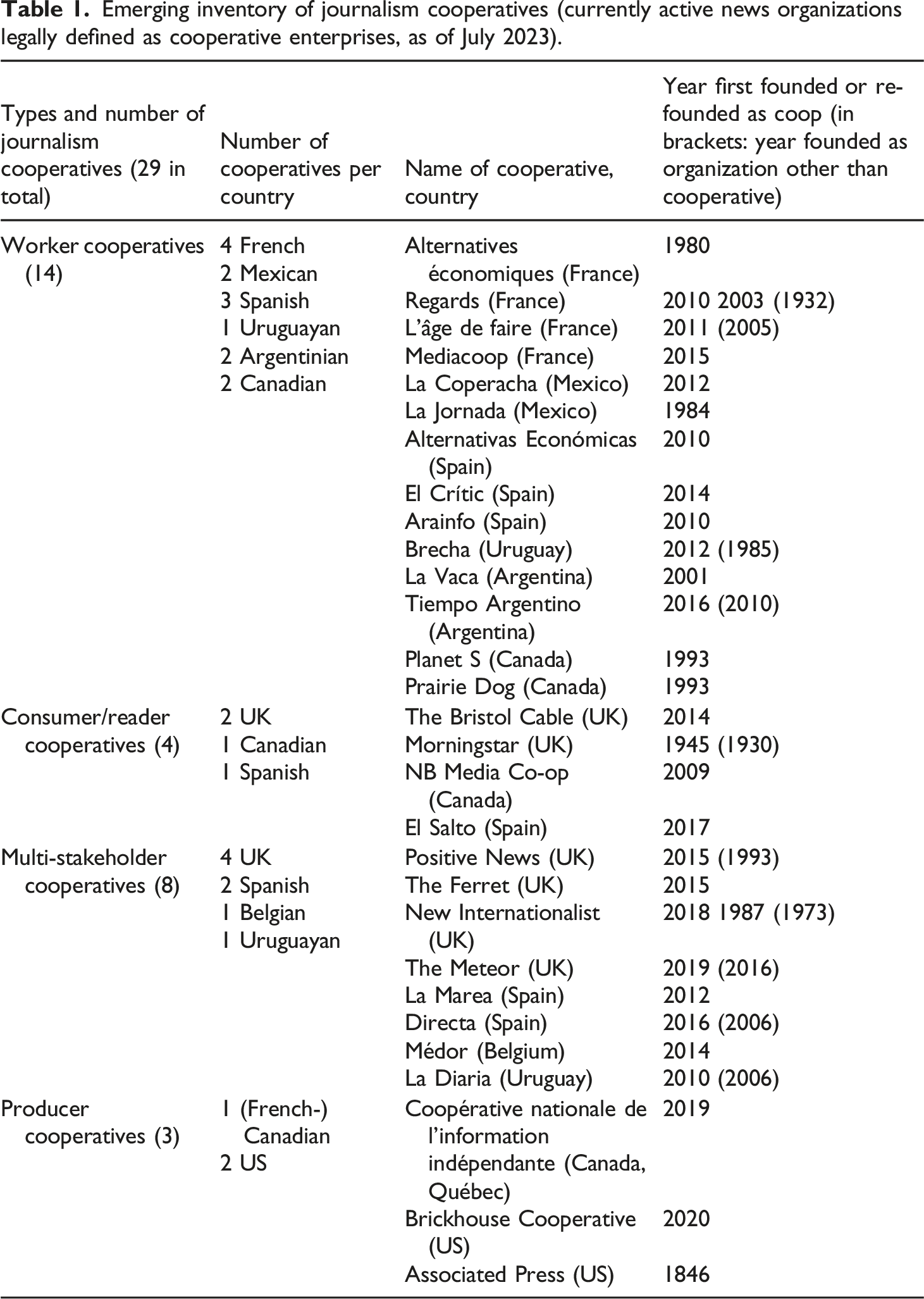
The emerging inventory maps journalism coops that publish online and in print or online only. Possibly due to the general search terms used, (‘journalism’ or ‘media’ ‘cooperatives’), no broadcasters or radio stations organized as cooperatives were found (such as, e.g., Vancouver Coop Radio). For the moment, excluding from the inventory audiovisual media seems reasonable, as these are traditionally guided by dedicated national regulatory agencies (such as the Radio-Television and Telecommunications Commission in Canada). Moreover, cooperative publications not having news reporting as their main purpose, such as the product review magazine Ethical Consumer were excluded. Further, the inventory includes only cooperatives with active websites, meaning those that publish news content online continuously and regularly. Overall, the inventory presented here is still emerging and is neither comprehensive nor representative. Reflecting an initial attempt at finding and characterising journalism cooperatives internationally, a geographic focus (countries, regions, cities, etc.) was not added to the search terms used.
Apart from this basic mapping of journalism cooperatives, the study relies on a qualitative approach, given that the goal was to develop a rich understanding of a largely unfamiliar social and media phenomenon (Denzin and Lincoln, 2018; Flyvbjerg, 2001; Leavy, 2020), namely the unique character of cooperatives as news organizations. More specifically, qualitative content analysis (Vaismoradi and Snelgrove, 2019) was used to examine the organizational characteristics of journalism cooperatives, based on public information on the organizations’ official websites. To enable a more detailed examination, I focus only on the seven anglophone cooperatives in the inventory, which are all either consumer or multi-stakeholder cooperatives.
Following Holt et al. (2019), I traced the ‘alternativeness’ of journalism cooperatives in relation to mainstream media, starting with the cooperatives’ self-professed missions in society (macro level), continuing with funding and organizational structure (meso level) and ending with media content producers (micro level). At the same time, the analysis was also informed by existing research on cooperatives across economic sectors and non-traditional business models in journalism, to see if and how journalism cooperatives’ traits might differ from or resemble these. The analysis proceeded by locating, reading, and rereading multiple times relevant sections of the cooperatives’ websites, such as the ‘about us’ or ‘support us’ pages. This allowed for an identification of more obvious themes in the cooperatives’ discourse – such as claims about the deficiencies of mainstream media – as well more latent sub-themes that could be grouped eventually under these umbrella themes (such as critiques of the negativity of traditional media or their exclusion of socialist perspectives, to continue the above example) (Vaismoradi and Snelgrove, 2019). A limitation is the fact that the analysis relies on information controlled by the cooperatives themselves (their official websites), constructing a particular organizational image. In other words, the findings below are based on public information selected by the organizations and may not reflect ‘objective’ organizational characteristics and practices.
Findings
Portrait of general tendencies
Given the initial search strategy and selection criteria mentioned above, 29 journalism cooperatives internationally could be identified (Table 1). In terms of drawing a geographic portrait of the journalism cooperatives in the inventory: 6 can be found in the United Kingdom, 6 in Spain, 4 in France, 1 in Belgium (17 in Western Europe), 2 in Uruguay and 2 in Argentina (4 in South America), 4 in Canada, 2 in the US and 2 in Mexico (8 in North America). Thus, the majority are in Western European countries, with the United Kingdom housing more coops than the other countries. At the same time, when drawing a linguistic portrait, a more balanced picture emerges among the three languages used in this research. While English is an official language in over 60 countries globally, and anglophone cooperatives form the largest group in the inventory (13), they are followed closely by hispanophone cooperatives (12). Only 6 cooperatives are francophone. When exploring the organizational history, the great majority of the organizations were founded as cooperatives (or converted to a cooperative from another type of enterprise) recently, indicating an increase in popularity of journalism cooperatives as an organizational option in news production: 21 of the 29 coops found were created within the last 14 years or so, namely since 2010. A minority of coops in the inventory are more seasoned organizations with several decades of ongoing existence and experience as news providers, with one founded in 1945 and one in the 1980s. 10 of 29 cooperatives were initially not founded as cooperatives but as another type of organization and were only later converted to a cooperative, thus having gone through a significant organizational change. Finally, the cooperative sub-type indicates the composition of the membership that democratically controls and owns the cooperative in each case. That is, workers in worker cooperatives (need met: employment), consumers in consumer cooperatives (need met: products provided), or, lastly, a combination of stakeholders such as both workers and consumers (needs met: employment, products produced). I found worker cooperatives (14) to be most common overall, with multi-stakeholder cooperatives (8) and reader cooperatives (4) less common. Crucially, however, among the most recently started journalism cooperatives, there is only one worker cooperative and one reader co-operative. In other words, almost all founders of news cooperatives who started their organizations in the past five to 10 years opted for the multi-stakeholder sub-type, a cooperative model that puts a combination of journalists and readers in charge. Apart from the long-standing Associated Press, only the recently founded Brickhouse cooperative (2020) in the United States and the Coopérative nationale de l’information indépendante (2019) in the Canadian province of Québec are producer cooperatives. Such cooperatives are of less immediate relevance to the present study, as they are not news organizations themselves but provide business and other non-journalistic services to member news organizations, which may themselves be cooperatives or other types of enterprises.
Organizational characteristics of journalism cooperatives
Organizational traits of seven journalism cooperatives (based on official websites, annual returns, as of July 2023).
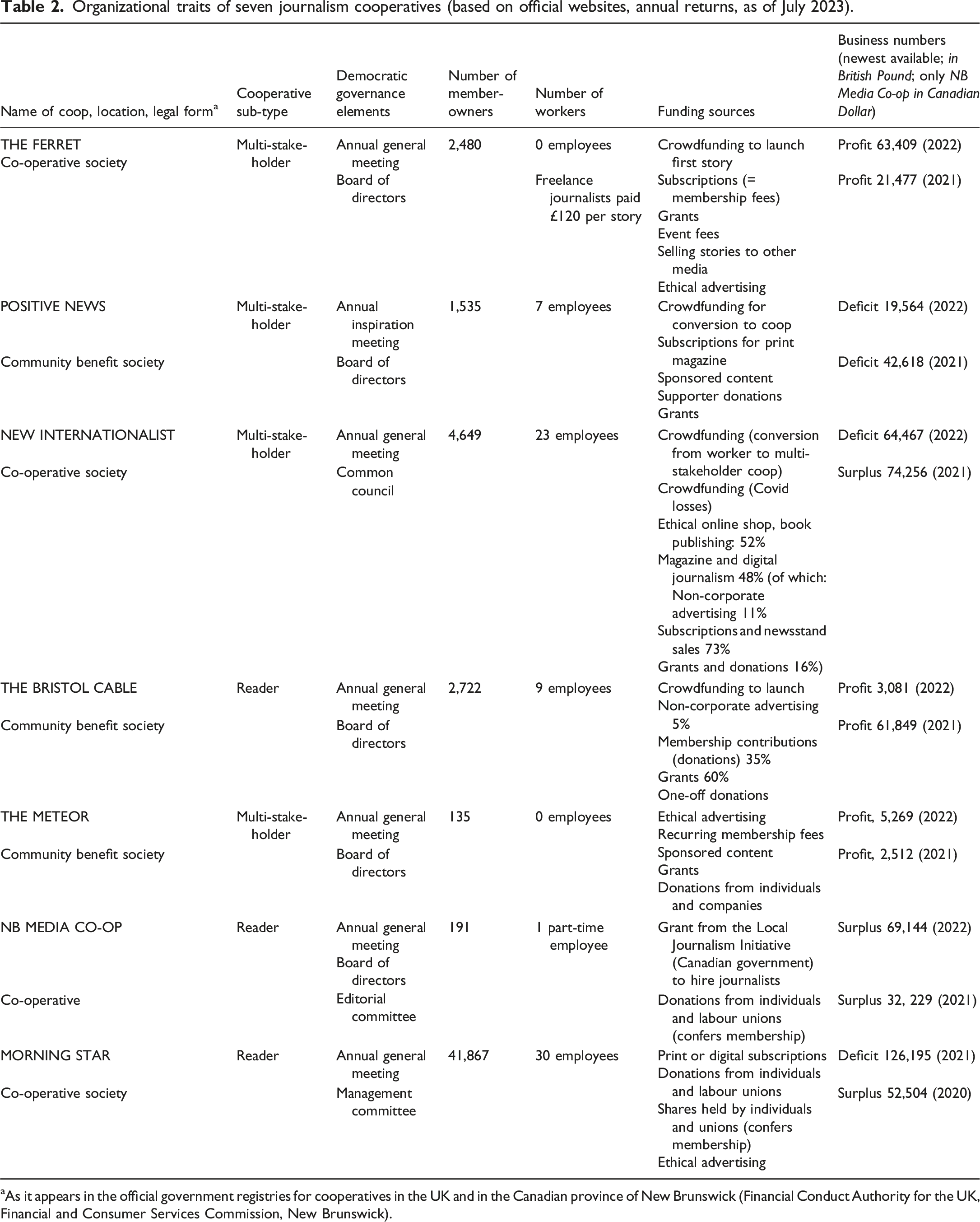
aAs it appears in the official government registries for cooperatives in the UK and in the Canadian province of New Brunswick (Financial Conduct Authority for the UK, Financial and Consumer Services Commission, New Brunswick).
Macro-level ‘alternativeness’: Responding to the failures of mainstream media, in various ways
When stating reasons for founding the organization, the seven cooperatives frame themselves as distinct from and corrective for various ‘failures’ (The Bristol Cable) of mainstream media. For some cooperatives, this term points to investor-driven or private media described pejoratively as ‘corporate’, ‘commercial’ or as ‘media moguls’ (New Internationalist, NB Media Co-op, Morning Star), implying that this media funding model perpetuates ‘elite interests’ and ‘filters out meaningful critique of corporate power and government’ (The Meteor). More neutrally and modestly, The Ferret aims to cover ‘issues that the mainstream media often misses.’ The critique of Positive News points instead to the prevalence of ‘doom and gloom’ in mainstream media reporting.
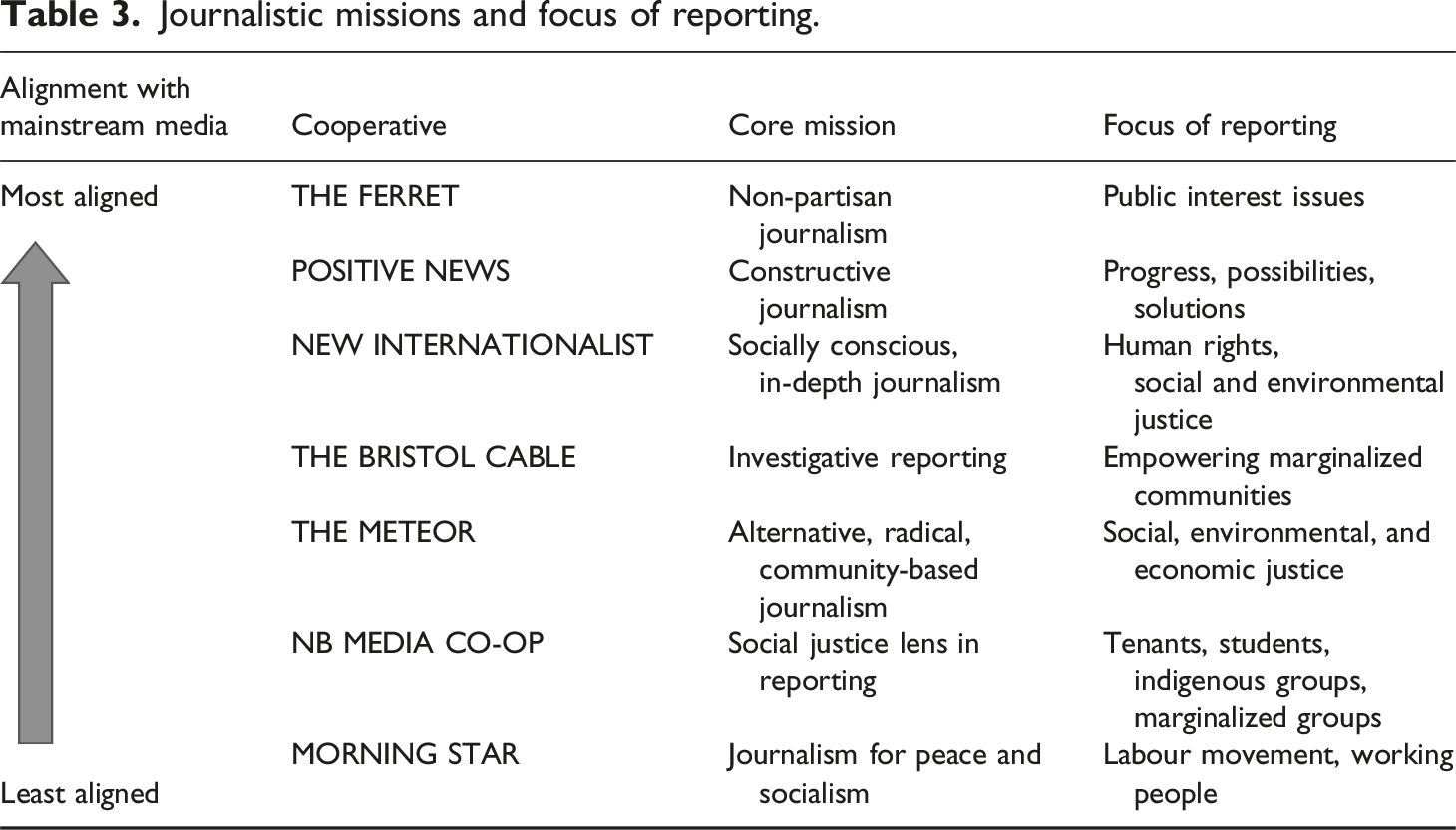
The journalistic missions of the seven cooperatives, consequentially, are designed to respond to the various ‘failures.’ For example, Positive News describes itself as a pioneer in ‘constructive journalism’, focused on ‘progress, possibility, and solutions.’ The Ferret aims to provide ‘investigative reporting, in the pursuit of public interest.’ It is the only cooperative explicitly embracing a ‘non-partisan’ stance as part of its mission. The other five cooperatives all pursue a combination of traditional journalistic values and goals (‘investigative reporting’; ‘challenging power structures’) with furthering certain political values, ideologies, or movements. This ranges from rather broad formulations such as the New Internationalist’s pursuit of ‘socially conscious journalism’ on ‘human rights’ to more clearly politically committed missions such as ‘empowering marginalized communities’ (The Bristol Cable) or promoting ‘environmental and economic justice in our city’ (The Meteor). The NB Media Co-op and the Morning Star are most specific and emphatic in their journalism support for specific marginalized groups and political movements, foregrounding the experiences ‘of workers, tenants, students, indigenous peoples’ (NB Media Co-op) or ‘working for peace and socialism’ by representing the perspective of ‘the labor movement and working people all over the world’ (Morning Star).
Meso-level ‘alternativeness’: Funding from the crowds, ethical advertising, and hope for sustainability
Crowdfunding is a popular choice when it comes to funding sources (The Bristol Cable, Positive News, The Ferret), whether to start a cooperative, convert an organization to a cooperative or periodically address funding crises. For example, the New Internationalist offset the financial impact of the Covid-19 pandemic through crowdfunding. Readers are also a key funding source when it comes to the ongoing operation of the news organizations examined here. Reader contributions can be one-time donations or ongoing, ranging from one to five pounds or Canadian dollars per month. Apart from individual reader contributions, the New Brunswick Media Co-op and the Morning Star also receive donations from labour unions, and the Meteor accepts donations from companies. Importantly, these individual and organizational contributions are not necessary to access the news content offered (except in the case of The Ferret). Rather, they support the cooperatives’ missions and/or confer membership and co-ownership (see section below on ‘organizational democracy').
Furthermore, except for the NB Media Co-op, all cooperatives rely on advertising or sponsored content. However, the ‘ethical’ or ‘non-corporate’ character of such funding is emphasized in each case, explaining that the funder’s activity must align with the cooperative’s values, with many ads coming from cooperative enterprises or from charities. Positive News journalists create articles that are paid for by ‘purpose-led organizations’, such as energy cooperatives or companies like Patagonia. The Ferret only allows ads from companies that do not cause environmental harm. Grant funding is another funding component, mentioned by all cooperatives except for the Morning Star. For example, this is the most significant funding source for the The Bristol Cable (60%). Grants come from organizations such as the European Journalism Centre, the Caledonian Trust, and Cooperatives UK.
The three older news organizations in the sample rely on paid print and/or digital subscriptions as a significant source of revenue. Most of their news content is available only to subscribers (New Internationalist, Morning Star) or their printed magazine is by subscription, but their online journalism is free (Positive News). Among the newer, digital-born journalism cooperatives, only The Ferret requires a subscription to access its reporting. The Ferret and the New Internationalist also have more diversified revenue streams than the other cooperatives in the sample, namely the sale of news content to other media, workshops fees (The Ferret), and an ethical online store (New Internationalist).
Overall, the foundational importance of readers as funders is underlined frequently and presented as part of the organizational identity of the seven cooperatives. For members of the public, becoming a ‘co-owner’, ‘reader-investor’ or ‘community shareholder’, is framed as a morally desirable act supporting journalistic independence in a funding model that avoids mainstream media funding sources, such as corporate advertisers. For example, The Bristol Cable emphasizes that its business model is ‘different’, avoiding ‘pop-ups, click-bait and selling your private data’. The support of readers is portrayed as crucial to the cooperatives’ financial survival - making up for the absence of those very same mainstream media revenue sources. ‘The rich don’t like us, and they don’t advertise with us, so we rely on you, our readers and friends, to help us continue to thumb our noses at the fat cats and tell truth to power.’ (Morning Star). Positive News counts ‘on our supporters, not advertisers or a wealthy proprietor’ and states that all ‘our profits are reinvested in our journalism and mission.’
Lastly, while the latest business numbers for each cooperative are provided in Table 2, this is not enough to assess the financial sustainability of the organizations. Most cooperatives mention ‘financial difficulties’ or operating on a ‘shoestring budget’ (New International, The Meteor, The Bristol Cable, Morning Star). Nevertheless, addressing their publics on their websites and the government in their annual filings, they are clearly optimistic regarding their financial and organizational future.
Meso-level ‘alternativeness’: Practicing organizational democracy, with and by readers
Audience members can become co-owners of the cooperatives examined here by buying one or more membership shares or by making a one-time or recurring donation to the publication (amounts range from 1 to about 50 pounds or Canadian dollars per year. The main benefit of becoming a member and owner is the possibility to participate in the organizational governance of the cooperative. For example, only reader-members (not journalist-members) can amend the Positive News Charter which governs the news values of the publication. Further, its board of directors, elected at the ‘annual inspiration meeting’ and composed of reader-members, ‘oversees the operation of the publication’. At the New Internationalist’s annual general meeting (AGM), reader-owners vote on stories the publication will then cover; its ‘common council’ composed of elected reader-owners is the ‘custodian’ of the publication and participates in ‘key decisions’ affecting it. The Meteor presents a financial report to its members at the AGM, and asks for input from reader-members, for example, on improving the organizations’ mission statement. The Ferret holds four general meetings every year, in addition to its AGM, to ‘ensure that members are given the opportunity to participate in the decision-making process of the co-operative’. Both journalists and readers are part of the board of directors; whereas the former take day to day editorial decisions, only the latter decide on audience complaints against The Ferret and hold the journalists accountable to editorial standards.
At The Bristol Cable, reader-members have developed an Ethical Advertising Charter, subsequently adopted at an AGM. Reader-owners are also consulted when it comes to funding sources (‘Should we accept grant funding from Google?’) as well as reporting priorities. The Morning Star holds four AGMs in various geographic regions across the UK to allow reader-shareholders from all regions to join this meeting. These elect fellow reader-members to the management committee holding journalists and editors to account and approve the accounts of the publication. At the AGM of NB Media Co-op, reader-members approve the budget and elect the board of directors as well as the editorial board. All seven cooperatives operate according to the principle of one vote per member, no matter the size of their financial contribution as a reader or amount of labour performed for the organization as a journalist.
The ownership and governance model for news production that the cooperatives follow is explicitly mentioned as a key element in the organizations’ self-presentation to the public, implying that public knowledge about cooperatives cannot be assumed. For example, The Meteor states that ‘We are a new and growing not-for-profit media co-operative, with democracy at its core’. The Ferret informs readers that its cooperative model ‘makes us unique in Scotland and means that when you subscribe to The Ferret you become more than just a passive supporter – people become part-owners of the project’. Becoming a paying member as well as participating in the organizations’ AGM’s and other elements of organizational governance is described as becoming part of a community working towards a common social or political goal, such as a transformation towards socialism: ‘You can’t buy a revolution, but you can support the only daily paper in Britain that’s fighting for one’ (Morning Star). The New Internationalist invites readers to join ‘a movement for independent media focussed on issues of environmental and social justice.’
Micro-level ‘alternativeness’: Workforce - few employed workers and variable transparency
First, the journalism cooperatives investigated here seem to sustain few permanent, full-time positions. For example, the NB Media Co-op has one part-time administrative worker paid from its own budget and opened a full-time journalist position financed by the Canadian government’s Local Journalism Initiative in 2023. Otherwise, it is run by a ‘dedicated group of volunteers.’ The Meteor and The Ferret do not have any employees, and it is unclear if and how much the team members listed on their websites might be paid. The Ferret does mention that freelance journalists can expect a fee of about £120 per news article. The rest of the seven cooperatives examined are small employers with 7 to 30 employees, which includes journalists as well as other staff members.
Second, information on the professional experience and backgrounds of the respective team members listed on the cooperatives’ websites is scarce. Where available, it can be located on a continuum between mainstream and alternative media. For example, while some of the team members of the NB Media Co-op have university degrees in journalism, their professional experiences tend to be in alternative media. Many also work for social justice projects or critically oriented scholarly projects. In contrast, several of The Ferret’s team members have worked for or are still working for legacy media such as the BBC or The Guardian as well as in the private sector outside journalism.
Thirdly, the news organizations examined here display varying degrees of task specialization, according to their websites. First, there is a tendency to combine roles among the people working for cooperatives without full-time employees (NB Media Co-op, The Meteor, and The Ferret). That is, team members combine, for example, writing news articles for the cooperative with doing tech support, fact checking, community engagement, or commissioning freelance work. In contrast, each of the editors at Positive News performs dedicated tasks (feature editor or production editor, e.g.) and each of the reporters at The Bristol Cable cover dedicated beats (labour, social issues, housing). The latter cooperative also has a clear division between journalistic and non-journalistic labour, with dedicated staff members responsible for tech issues, finance or community organizing. Similarly, the Morning Star has eight editorial desks corresponding to different beats, separated from non-journalistic desks such as advertising and circulation. Overall, the news organizations share little information regarding their workforces with the public. For example, while the New Internationalist has 23 employees according to its annual filing, no information could be found on the website about its team.
Discussion and conclusion
This article provides an emerging inventory of 29 currently active journalism cooperatives in Europe, North America, and South America. Most are in Western Europe, and anglophone as well as hispanophone cooperatives dominate the picture. Overall, this study finds that most of these news organizations are fairly young, having been founded in the last 14 years or so. Most common are worker cooperatives. But almost all journalism cooperatives most recently founded are multi-stakeholder cooperatives (the great majority) or reader cooperatives. One potential reason for this preference is that accessing reader financial contributions through reader ownership can expand the capital available to cooperative news organizations (Schneider, 2020). The seven anglophone cooperatives, examined more closely through a qualitative content analysis of their official websites, fall into these two reader-oriented cooperative sub-types.
Journalistic missions and focus of reporting.
Moving to the meso-level, I first consider the degree of ‘alternativeness’ of the journalism cooperatives’ funding. The three-part funding mix found to be typical for the seven cooperatives examined here, namely donations/membership fees from readers, grants, and ethical advertising (or no advertising) resembles alternative media and non-profit media funding (Skinner, 2010). However, this ‘alternativeness’ is tempered by subscriptions required to remove paywalls on some or most journalistic content (present in three of the seven cooperatives), a common mainstream media funding source. Also, small organizations with less than 200 reader-members like NB Media Co-op relying mostly on donations are more ‘alternative’ in their funding than cooperatives with multiple additional revenue streams, such as book
publishing or an online store (such as the New Internationalist with around 4600 reader-members). The financial challenges articulated by several cooperatives in the sample echo concerns regarding long-term financial sustainability in existing studies on alternative media, on non-profit media and on journalism cooperatives (Konieczna, 2018; Skinner, 2010; Downing, 2001; Voinea, 2021). Like many alternative media outlets, the cooperatives examined here are small-scale organizations, ranging from no or a handful of employees to a maximum of 30 employees at the oldest and most established cooperative (Morning Star). However, rather than their lack of financial viability in principle, these challenges reflect a structural dilemma faced by cooperatives and other non-capitalist enterprises across economic sectors: pursuing social goals while ultimately having to compete for resources and consumers with other enterprises in the dominant capitalist market economy (Grohmann, 2019; Sandoval, 2016).
Moving to the degree of ‘alternativeness’ of journalism cooperatives on the micro-level of media producers, at least some people working for journalism cooperatives seem to do so under potentially precarious conditions. In other words, the amount of volunteer and freelance labour implied by the absence of full-time employee positions in three of the seven cooperatives seems to point to working conditions typical for alternative media (Cohen, 2012). Information on professional backgrounds of journalists working in cooperatives mentioned is scarce. Where available it indicates a range of previous professional experiences, from work in mainstream media and the private sector (The Ferret) to work in alternative media and for activist projects (NB Media Co-op), with university degrees in journalism common. This points to a level of professionalization among workers in journalism cooperatives closer to if not equivalent to mainstream media, further underlined by a clear division of journalistic and other labour among staff members, at least among those cooperatives that can rely on the work of several full-time employee positions.
Finally, for the most important and unique characteristic of the seven journalism cooperatives, I return to the meta-level of organizational structure. Their internal democratic governance mechanisms make cooperatives different from mainstream media as well as from alternative and non-profit media (while the latter two might endorse forms of non-hierarchical governance, there is no legal requirement to do so). During annual assemblies and other governance events, all owner-members– readers only or readers together with journalists - can vote on the cooperatives’ budget and make strategic organizational decisions, following the principle of one member, one vote. Thus, audience relationships in cooperative journalism – at least for the reader-oriented cooperatives explored here - go beyond limited and instrumental forms of audience engagement (Koliska et al., 2023) but are also different from more serious forms such as the co-production of news or citizen reporting (ibid.; Rodriguez, 2001). Instead, readers co-own and co-manage the news organization. For example, readers elect democratically from their midst the board of directors, which holds journalists and editors accountable while respecting their editorial independence. If audience trust can be increased by producing journalism without a primarily commercial motivation, as found for news non-profits (Konieczna, 2018), such trust will likely grow further if the audience is able to directly shape strategic decision-making in news outlets. More broadly, this internal organizational democracy practiced in journalism cooperatives seems to align particularly well with journalism’s external democratic mandate (Christians, 2009), and cooperatives might thus be better suited to pursuing it than traditional, hierarchical news organizations.
To conclude, given evidence that the capitalist marketplace is not able produce quality journalism (McChesney and Nichols 2010; Pickard, 2019; Taylor Jackson, 2009), the emergence and growth of news non-profits over the past years, together with the increasing popularity of journalism cooperatives as demonstrated here, suggests that the social economy – with its twin focus on economic and social goals – might be more suitable as a dominant or default ‘home’ for the institution of journalism. This is one potential response to the call for non-commercial news systems in a post-pandemic world (Pickard, 2020). However, it requires a major shift in our definition of ‘success’ or ‘sustainability’ when evaluating journalism business models, from an overwhelming focus on ability to generate profit for corporate owners or shareholders to measuring social contribution (Siapera and Papadopoulou, 2016). Finally, moving beyond organizational information made publicly available by the cooperatives themselves, future research should pursue observations and interviews with journalists and other workers as well as reader-owners to expand our emerging understanding of journalism cooperatives.
Footnotes
Acknowledgements
I would like to thank Emilien Maubant, Florence Morin-Martel, and Nellie Surprenant for their excellent work as research assistants on this project. Many thanks also to the two anonymous reviewers who provided thoughtful and constructive comments.
Declaration of conflicting interests
The author(s) declared no potential conflicts of interest with respect to the research, authorship, and/or publication of this article.
Funding
The author(s) disclosed receipt of the following financial support for the research, authorship, and/or publication of this article: This work was supported by the Social Sciences and Humanities Research Council of Canada.
