



Abstract
This paper analyses reporting on the topic of Islam in Switzerland from 2018 until the end of 2020. A quantitative content analysis of 715 articles from 10 newspapers in German and French was conducted. Research into framing, agenda building, and attention theory serve as a theoretical basis. We show that “event-driven” and “institutionally driven” debates differ. They can be characterised on two dimensions: range of views (in terms of speakers, issues, issues in different language regions), and communication style (presentation of the position of Muslims and adopted journalistic role performance). In other words, this article shows that the arena is a key driving factor in the shape of a debate. This distinction of debate types provides a deeper understanding of Muslim actors as speakers, and of the role of market pressures in forms of infotainment journalism, and enriches theoretical understanding while providing empirical evidence. Islam as a topic is well suited for analysing public debates because the topic has been present in media coverage for many years, both in connection with political decision making processes (e.g. status of the religious community, integration of migrants, discussion about the ban on veiling) and in connection with current events in which contrasts between the Islamic and Western worlds are thematised (e.g. Islamic fundamentalism, religiously motivated acts of terrorism).
Keywords
Introduction
How Muslims or Islam are perceived, is largely determined by public communication. The perception is shaped by politicians, experts, representatives of churches and/or NGOs and, last but not least, representatives of the Muslim community. However, for the views of these actors to achieve broad resonance and reach the population, another central actor is vital: the mass media. In democratic societies, they create the public sphere and shape the agenda of public communication. The debate on Islam in the news media is of core interest in our study. Studies report predominantly negative portrayals of Islam (e.g. as a violent religion) in traditional media (e.g. Ahmed and Matthes, 2017). In those debates, a distinction between what is seen as “good” and “bad” Islam can be found. This dichotomy can be explained by processes of securitisation (Buzan et al., 1998), whereby “moderate Islam” is constructed by Western states as a referent object, while “radical Islam” is framed as a threat (Bosco, 2014). Systematic insights on media representations of Muslims can be considered relevant for both academic research and journalism practice, as media portrayals of Muslims can fundamentally influence how the non-Muslim majority population in Western societies judges Muslims as a group.
Feddersen (2015) reports a change in the way Muslims are portrayed in the public discourse between 2000 and 2009 based on the analyses of three institutional debates in Switzerland. Muslims were portrayed as people of foreign nationalities, for example, Turkish, Yugoslavian, or Tunisian nationals, until the beginning of the millennium, whereas they are mainly assigned to the Muslim minority in 2009. This suggests that Muslims may also assert their religious stance, and overall make more differentiated statements (e.g. explicitly distinguish Muslims from terrorism) than non-Muslim sources or journalists (Matthes et al., 2020). To date, there has been a lack of studies investigating how differentiated reporting is in the context of Islam news (von Sikorski et al., 2022).
Our research fills this gap, looking at Islam coverage in general and differentiating between institutionally driven and event-driven public debates. The former are staged in official settings; the latter respond to unexpected events. The research question of this paper is: Does the reporting about Islam differ between institutionally and event-driven debates? More precisely, the question is whether the debates differ in terms of diversity of perspectives and communication style within debates. This distinction of debate types provides a deeper understanding of Muslim actors as speakers, and of the role of market pressures in forms of infotainment journalism. With this distinction, our paper also makes a theoretical contribution, offers a generalizable explanation for systematic differences in media coverage (which also applies to other topics), and provides empirical evidence. Islam is a suitable topic of study in this context as it can raise trade-offs between financially- or socially-oriented decisions for media companies and journalists, contains variations in debate characteristics and types, and is highly relevant in terms of potential social consequences. To answer this question, we examined 715 individual news articles from 10 different newspapers (daily and Sunday quality, popular, and free newspapers of two language regions in Switzerland). This paper begins with the theoretical grounding, explains the empirical strategy, and then presents results and conclusions.
Institutionally and event-driven public debates
The arena is decisive in the shaping process of debates (Bernhard et al., 2019; Hänggli, 2019). In fact, when looking at how news content is built, it is useful to distinguish between ‘institutionally driven’ and ‘event-driven’ public debates (Lawrence, 2000). Institutionally driven public debates are institutionally staged, which means that they take place in official arenas such as parliamentary, electoral, corporatist, direct-democratic, or judicial and are initiated by political actors. Since the institutions set the agendas of news organisations, these debates can be anticipated, planned, and administratively managed. By contrast, event-driven public debates (Lawrence, 2000; Livingston and Bennett, 2003) are news that focus on unusual, unplanned or unexpected events like airplane crashes, earthquakes or terrorist attacks. These debates take place in the public arena, and since the institutions do not set news organisations’ agendas in these debates, they are less anticipated, planned and administratively managed. In these cases, political actors and institutions often respond to the news agenda rather than set it and are less likely to shape the stories than in institutionally driven debates. The Fukushima nuclear disaster is an example of such an external event that triggered many responses. Lawrence (2000: 9) notes that event-driven public debates are “more volatile and difficult for officials to control or to benefit from and are more open to challengers”. In a similar vein, Livingston and Bennett (2003) distinguish between managed and unmanaged news. Boorstin (1971) speaks of pseudo-events for institutionally driven events which lack spontaneity and come about “because someone has planned, planted, or incited it” (Boorstin, 1971: 11).
The event and its associated arena define key characteristics of a public debate such as diversity and communication style (Hänggli and van der Wurff, 2019). Diversity refers to the range of participating actors, range of views, and degree of justification. The debate can be diverse or dominated by particular actors. Scholars consider political diversity to be an important condition for well-informed decision-making and an expression of a healthy democracy (McQuail, 1992). Style of debate refers to how respectful, civilised and substantive a public debate is. A respectful and substantive style is policy-oriented (Hänggli and van der Wurff, 2019) and approaches the ideal of a deliberative model of democracy (Habermas, 1996). By contrast, a media-oriented debate style aims to capture and retain audience interest, and reflects the commercial logic in media. The style can be media-oriented or policy-oriented. Since institutionally driven debates take place in the parliamentary or direct-democratic arena, the institutional setting guarantees a diversity of perspectives in the arena and, as a result, also in the news media (Hänggli, 2020). By contrast, as Poole and Richardson (2006: 5) state, the range of perspectives is narrowed in external events such as crises. Therefore, institutionally driven debates are hypothesised to be more diverse than event-driven debates (h1). The institutional setting also ensures a rather substantive style of communication. By contrast, event-driven debates might be driven by the economic logic of the news media, with strategies such as personalisation, emotionalisation or conflict stylisation used to achieve the greatest possible reach (Ettinger, 2018: 8). Thus, institutionally driven debates are expected to be more policy-oriented than event-driven debates (h2). This distinction has so far been made theoretically. We cannot rely on empirical evidence.
Objectivity, principle of balance and role performance
The reason for systematic differences between different debates has to do with the extent of objectivity and principle of balance that is at work in these two debate types. According to Semetko (1996: 51), objectivity refers “to the use of news values as the primary criteria for story selection.” News factors (such as relevance, proximity, continuity, eliteness, negativity, personification, and conflict) and news values determine the strength of a story and ultimately whether or not the story is selected to be reported on (Galtung and Ruge, 1965). However, objectivity can conflict with the principle of balance. Semetko (1996) notes that to “‘balance’ the news is to diminish the role of news values as the primary basis for story selection.” For Entman “[b]alance aims for neutrality. It requires that reporters present the views of legitimate spokespersons of the conflicting sides in any significant dispute, and provide both sides with roughly equal attention” (Entman, 1989: 30). In Switzerland, it is stated in the Press Council’s guidelines on the Journalists’ Code 1 that journalists are obliged to seek the truth and are required to defend freedom of information. Guideline 2.2 calls for respect for pluralism of opinion: “Pluralism of opinion contributes to the defense of freedom of information.” In institutionally driven debates, the principle of balance is highly important since the positions of all relevant political actors in the debate should be covered. On the other hand, objectivity in the form of news values is more important in event-driven debates. Hopmann et al. (2011) note that balance is difficult to operationalise. They recommend defining it according to politically defined norms and journalistic norms. We follow their recommendation and rely on the established concept of role performance to examine differences in reporting between institutionally and event-driven debates.
Mellado and Van Dalen (2014) define different models of professional role performance 2 : disseminator-interventionist, watchdog, civic-based, and infotainment. The first concerns fact-orientation: Journalists are either neutral disseminators or intervene by having a voice in the story or acting as advocates. The second and third models are public-good oriented. The watchdog seeks to hold government, business, and other institutions accountable (to reveal facts hidden by authorities). Civic journalism aims to educate the ordinary citizen on complex and controversial issues, encourage the public to get involved in public debate, and encourage participation in social, political, and cultural activities. The final model is market-oriented. Infotainment journalism focuses on entertainment, scandals, sensationalism, emotions, and morbidity (Donsbach, 2008; Eide and Knight, 1999; Hanitzsch, 2007; Raemy et al., 2019). Depending on the debate, these models have greater or lesser opportunity to perform a specific role. Institutionally driven debates are shaped by political actors, who control each other by discussing the arguments of all sides. Journalists covering these debates are expected to report and to comment on them, that is to act as disseminator-interventionists. On the other hand, event-driven debates may be initiated by the media, when journalists bring new topics to the public, reveal hidden facts and thus act as watchdogs. Hence, we assume that journalists tend to adopt the role of watchdogs in event-driven debates rather than in institutionally driven debates (h3).
Next, we further investigate the dimension of diversity by looking at speakers, and the dimension of communication style by looking at the reported issues and position.
Speakers
Attention is scarce, not every actor gets access to the public debates, and media standing is a contested terrain. Power is needed to achieve media standing. Numerous studies have shown that media attention is biased toward the more powerful actors (e.g. Entman, 2007; Gans, 1979). The so-called indexing hypothesis predicts that “[m]ass media news professionals (…) tend to ‘index’ the range of voices and viewpoints (…) according to the range of views expressed in main-stream government debate about a given topic” (Bennett, 1988: 106). In addition to power, prominence and activity increases the likelihood of media standing (Hänggli, 2020).
Regarding speakers in Islam debates, Trucco (2021: 287), D’Haenens and Bink (2007), Poole (2002), and Ettinger (2018: 7) find generally a low presence of Muslims as speakers. In other words, discussions are held about Muslims, but predominantly not with them. Ettinger (2018) investigated three different Swiss debates: In the institutionally driven debate (concerning a vote on a veiling ban in the canton of Ticino), parties (23%) and voting committees (18.7%) were the main actors, followed by representatives of the executive branch (15.5%). Muslim actors accounted for 17.5% of all statements, while the media themselves are reticent with statements - especially after the vote (overall 11.1%). For event-driven debates, the pattern is different. State actors are less important, while journalists are sometimes the most important speakers. Ettinger (2018) reports the dominance of journalists as speakers (41%) in debates about the An’Nur mosque in Winterthur, whereas in another event-driven debate (the Therwil handshake affair) the reporting is mainly constructed as a confrontation between, on the one hand, the two youths and the Islamic Central Council Switzerland (IZSR) supporting them (33%), and on the other hand, the representatives of the executive branch, who would not allow any special rules (22.5%). Statements by experts (2.5%) are hardly found in this case, while the media are also rather underrepresented (16.7%). Ahmed and Matthes (2017) report that Muslims are portrayed more often in connection with event-driven debates, notable in the context of terrorist events.
Combining theoretical basis and these empirical findings, we expect the following: In institutionally driven debates, journalists are committed to the journalistic norm of balanced reporting, which in turn drives diversity of views. In event-driven debates, journalists cannot rely on the debate in an arena such as parliament. They feel less bound to the balanced reporting norm, and the debate is not prepared by institutional actors. Journalists and other non-institutional actors are thus perhaps more important speakers in event-driven debates. We assume that the standing of state and party actors is higher in institutionally driven debates than in event-driven debates (h4).
Issues
“In institutionally driven news, political institutions set the agendas of news organisations; in contrast, as event-driven news gathers momentum, officials and institutions often respond to the news agenda rather than set it” (Lawrence, 2000: 9). As far as Islam is concerned, media interest in the topic of Islam has generally increased after the terrorist attacks on 11 September 2001 (an external event). Ettinger (2018) notes for the period between 2009 and 2017 that two issues are predominant in the debate on Islam in editorial articles in Switzerland’s leading media: the visibility of religious symbols in public (leading also to institutionally driven debates), and, to an increasing extent, radicalism and fear of terrorism (event-driven debates). However, his analysis also shows an increasing media interest in Muslim organisations and individuals participating in the debate. Dolezal et al. (2010) note terrorism/fundamentalism, Islamic institutions, Islamic customs, and integration of Muslims as relevant issues. The emphasis on those issues varies across countries and time. Similarly, migration (and with this the integration of Muslim immigrants), terrorism, and wars within and between Muslim countries are those issues found to be most present in research on media representation of Muslims from 2000 to 2015 (Ahmed and Matthes, 2017). Poole (2002) mentions religion, education, and fundamentalism as subjects often discussed in connection with Islam. The debates on Islam in Switzerland are marked by the dominance of negative issues, portrayals or frames (Trucco, 2021: 287; Dahinden et al., 2011). This is also true for other Western European countries (e.g. Ibrahim, 2010; Poole, 2002; Poole and Richardson, 2006). We expect to find that the issues of the political agenda are more important in institutionally driven debates than in event-driven debates (h5). By contrast, news values trigger coverage of event-driven debates. An event needs to contain high news values on news factors such as proximity (geographical distance between place of event and region of distribution of the newspaper), personal influence (power of the main protagonist), sphere of relevance (range of concern), controversy (public dispute), and actual damage (physical consequence of an event) or it will not be covered (Kepplinger and Ehmig, 2006).
Positions of Muslim actors
Unexpected and extreme positions are generally more likely in event-driven debates than in institutionally driven debates, because they contain news value and reporting with such positions sells well. In the context of Islam, an extreme position could mean a fundamentalist position that prefers a strict observance to the teachings of the Qur’an and the Shari’a (Islamic Law). 3 Trucco (2021) classifies the position of Muslim actors as either fundamentalist, keeping with tradition (conservative), or critical to tradition (liberal). Speakers with fundamentalist positions show an ambiguity-intolerant, purist understanding of Islam. They see themselves as the only representatives of “true Islam” and, in their view, religious rules should serve as strict guidelines in everyday life. Fundamentalist positions differ from conservative positions by their intolerance of other points of view. Muslim actors who want to keep tradition (conservative position) stand for respecting certain “traditional” principles, are critical of reforms, but also take ambiguous positions. The critical to tradition position advocates an integrationist Islam that has a positive effect on society and does not exclude anyone. Faith is seen as a private matter, and a reform of Islam is sought for example with regard to LGBTIQ+ and women. Thus, the tradition-critical position itself can have an ambiguity-intolerant tendency, when it excludes those believers who do not share this view. In event-driven debates (i.e. in connection with a terrorist event), proximity of terror attacks and the number of deaths and injured increase the prevalence of undifferentiated statements, and Muslims are portrayed in unfavourable or stereotypic ways, as a threat to societies (Ahmed and Matthes, 2017). Thus, we hypothesise that fundamentalist positions of Muslim actors (both quoted or attributed) are more likely in event-driven debates than in institutionally driven debates (h6).
Salience of the topic and situation of Muslims in Switzerland
The reporting on Islam in Switzerland was most intense in 2009 due to an institutionally driven debate (not shown). During the investigated period (2018–2020), the topic was on the agenda but not in a heated or direct-democratic phase, which allows us to investigate an ordinary phase. It has somewhat receded into the background during this period in light of the emergence of the climate movement and, in particular, of the Covid-19 crisis. Nevertheless, it remains an important topic in the public discussion.
Muslims still constitute a small minority in Switzerland (as in other Western countries). The proportion of Muslim residents in the population has increased by 3% points in the last 35 years (from 2.2% in 1990 to 5.2% in 2017). Muslims in Switzerland do not form a homogeneous group either ethnically or culturally, having heritage in more than 100 countries. The Muslim population is more numerous in German-speaking than in French-speaking Switzerland, while even fewer Muslims live in Italian-speaking Switzerland. The majority of Muslims living in German-speaking and Italian-speaking Switzerland have heritage in the former Yugoslavia or Turkey. In the French-speaking part, Muslims mainly have origins in former Yugoslavia, North Africa or the Near and Middle East (for language reasons). 4 Only around a third of Muslims hold a Swiss passport (Stöckli, 2020).
Empirical strategy
Sample
The history of a country has a significant influence on the way Islam and Muslims are talked about (see for instance France, its colonial history and secularism). To control those differences and to systematically compare the two types of debate, we limit our study to one country, Switzerland. The sample for the study consists of articles published in 10 leading Swiss newspapers in the years 2018 to 2020. We selected the leading titles in terms of circulation for each newspaper type (daily and Sunday quality and popular papers, and daily freely-distributed papers), publishers with independent editorial offices, and language region (German- and French-speaking). We focused on domestic reporting and omitted foreign reporting, as we are interested in the portrayal of Islam in Switzerland. It can be assumed that the proportion of the Swiss media’s own contributions is higher in the domestic and local sections than in the foreign section, where there is a greater reliance on agencies and external correspondents. Also, potential speakers and journalists are the same across debates if we rely on domestic reporting, and therefore we can keep other factors more constant (in the logic of a most similar system design) and thus better compare debates within Switzerland. Furthermore, an extension to foreign reporting would have led to a multiplication of the research material.
The articles for the analysis were collected by means of the Swissdox online archive, where all the newspapers analysed are systematically archived. Articles were considered for the sample if they were published in the printed version of the newspaper between 1 January 2018 and 31 December 2020, if they were related to Switzerland (referring to events in Switzerland, and/or involving actors coming from or living in Switzerland), and if they contained at least one of the following words in German or French: Islam, Muslim, mosque, imam, burqa. The words “Islam” and “Muslim” proved to be the primary selection criteria, since they are mentioned in most articles of the sample. The additional keywords “mosque” and “imam” were chosen because they refer to a clearly Islamic context (place of worship, Muslim religious authorities), and the keyword “burqa” ensured that articles dealing with the burqa initiative were included in the sample. Texts listed by the Swissdox search engine in which Islam as a religion or the religious belief of the depicted actors was not a topic (e.g. “Islam” as a first name), were sorted out manually. In total, 799 articles were coded, of which 593 could be attributed to event-driven debates and 122 to institutionally driven debates. The remaining 84 articles on other issues (e.g. economic, scientific or cultural events) were not considered for the analysis, leaving a total of 715 analysed articles.
In each article, a maximum of six actors were coded. In total, we identified 1821 actors in the articles on event-driven debates and 370 actors in articles on institutionally driven debates (total of 2191 actors). Of these, 1295 were quoted in event-driven debates and 268 in institutionally driven debates (total of 1563).
Operationalisation of institutionally and event-driven debates
We categorized reporting occasions into institutionally driven events, such as elections, direct-democratic debates, and government decisions, where political actors predominate. Event-driven debates encompass scandals, controversies, external events, and individualized incidents. Court cases are classified based on their initiating events. We excluded economic, cultural, and scientific events and poll results unrelated to Islam debates. To analyze the hypotheses presented above, the debate type – event-driven or institutionally driven – serves as the independent variable. The following criteria will be used as dependent variables 5 :
For diversity, we rely on variety of perspectives (Hänggli and van der Wurff, 2019). The scale consists of no perspectives, only one perspective, one perspective dominating, and several perspectives equally represented. In this way, we look at whether diverse ideas are expressed. Diversity of speakers could also contribute to diversity of news media, but we leave it out here because we take speakers into consideration for H4.
For debate style (Hänggli and van der Wurff, 2019), coders had to evaluate the style of an article. The 5-point Likert scale goes from very policy-oriented (i.e. polite, respectful, and/or substantive) to media-oriented (i.e. offensive-aggressive, person-oriented, and attacking people with an opposing viewpoint).
For indicators of journalistic roles (Mellado and Van Dalen, 2014), the analysis uses four role conceptions: disseminator-interventionist, watchdog, infotainer, and civic journalist. Indicators for each role, such as opinion statements for interventionism and coverage of judicial processes for watchdog, are coded as dummy variables. Mean index variables are calculated for each role, weighted equally. For evaluating statistical significance of differences between roles, a t test for independent samples was used, with the mean values of the index variables compared between articles on institutionally driven and on event-driven debates.
Speakers are “units constructed from all utterances in a single article that can be attributed to a single source” (Ferree et al., 2002: 50), while having standing means “having a voice in the media” (Ferree et al., 2002: 86). Political actors (Wolfsfeld, 2015) can be defined as individuals who have at least some measure of power or who engage in activities that can influence decisions or media coverage, such as, for instance, representatives of state powers (executive and legislative authority, judiciary) and of political parties. Politicians are thus considered as state actors if an article refers to their actions and decisions as members of a parliament or an executive branch. If the text focuses on their political position respective to the position of their party, they are considered as representatives of political parties. Furthermore, we identify interest groups (non-Muslim and Muslim), Muslim religious authorities, other Muslim actors, experts, media, police, and other actors as remaining category. We analyse both the number of mentioned actors (individuals or organisations whose actions are reported, regardless of whether they are quoted or not) and the number of quoted actors (directly or indirectly quoted with a statement). For instance, the information “In order to perform his role properly, an imam must master the official language. That is what Imam XY says.” would thus be coded as mentioned and quoted. “An imam was hired as a chaplain” would be coded as mentioned.
The categorisation of issues is based on the analysis by Ettinger (2018) of the coverage of Islam in Swiss media between 2009 and 2017. He distinguished visible symbols related to Islam (such as veiling, headscarf, minaret), radicalism, discrimination against Muslims, practice of religion, successful integration, integration at risk, Muslim organisations, democratic rights, terrorism, everyday life of Muslims, and a residual category for other topics. Contrary to his analysis, we differentiate veiling from other symbols related to Islam because the burqa initiative was an important topic on the political agenda in the years we analysed (Arlt, 2021). Furthermore, we distinguish between terrorism by Muslims and terrorism against Muslims. In Swiss domestic coverage, terrorism as a news topic refers to reactions from Switzerland to terrorist attacks abroad, and stories of people related to Switzerland supporting terrorist activities. During the test coding, we also added particular categories for general criticism of Islam and for the situation of Muslims during the Covid-19 crisis in 2020.
The coding for fundamentalist position was adopted from Trucco (2021). The position of Muslim actors can either be fundamentalist, in keeping with tradition, or critical to tradition (see 2.4).
Reliability
To test the codebook, a sample of 30 articles (10 each from 2018, 2019, and 2020; minimum 2, maximum 4 articles per newspaper) was coded independently by two persons. Actor variables were only recorded for one actor per article (usually the one which was most prominently covered), so each variable was measured for 30 cases. The intercoder reliability was tested by calculating Krippendorff’s Alpha (Hayes and Krippendorff, 2007). Differences between the two coders could be found for the debate style (α = 0.917), the use of adjectives as an indicator for interventionist reporting (α = 0.933), the actor category (α = 0.884), the topics “religious symbols other than veiling” (α = 0.891) and “Muslim organisations” (α = 0.919), attributed positions of Muslim actors (α = 0.947), and cited positions of Muslim actors (α = 0.942). 6 All other variables, including the event type as the most important independent variable, were coded identically by both coders. The topics “terror against Muslims” and “Muslims and coronavirus,” as well as some indicators of particular journalistic roles (use of first person, conflicts during investigation, supporting citizens’ demands, informing about local impacts of political decisions on citizens, informing about possibilities regarding political participation, transferring citizens’ questions to authorities) could not be found in the test sample, which means that the corresponding dichotomous variables describe very rare situations, and calculations with them must be interpreted very carefully. Since no variable had an Alpha value below 0.8, the codebook was used without further changes. The overall satisfactory test results can be explained by the fact that most variables and items could be adopted from previous studies in which they had already been tested and optimised.
Results
Diversity and style of debates.
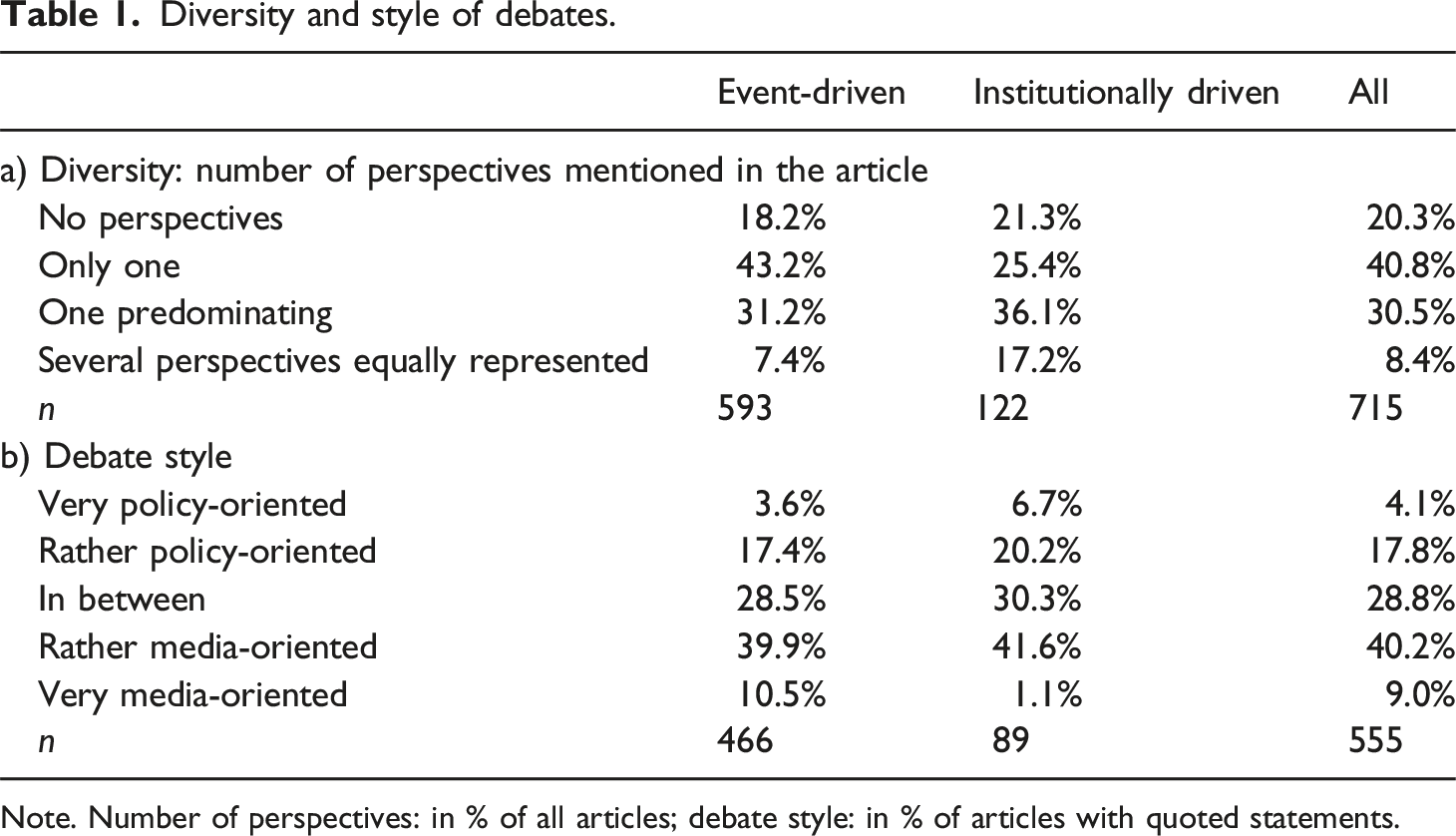
Note. Number of perspectives: in % of all articles; debate style: in % of articles with quoted statements.
To analyse the debate style (Table 1b), articles with no quoted statements were filtered out. The difference between articles on event-driven and institutionally driven debates is less obvious, but still significant (χ2 (4, N = 555) = 9.515, p = .049). It is notable that a very media-oriented debate style is almost exclusively found in event-driven debates. However, media-oriented statements in general are more frequent than policy-oriented statements in both debate types.
Journalistic role self-images.
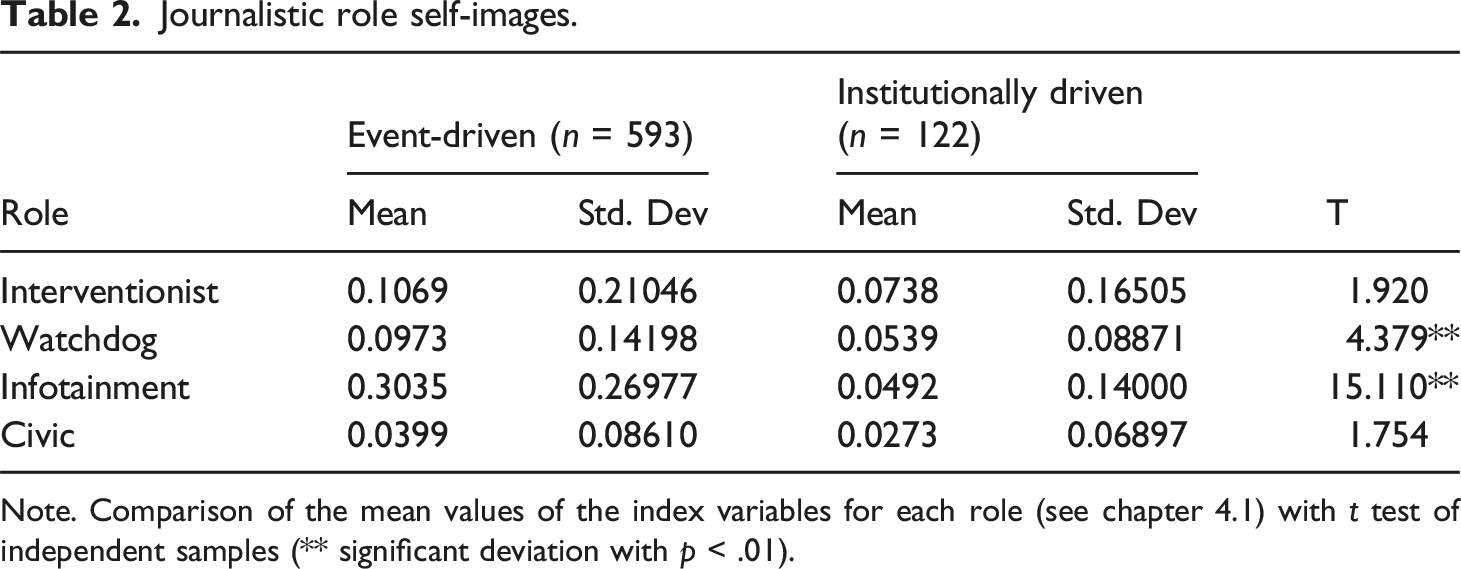
Note. Comparison of the mean values of the index variables for each role (see chapter 4.1) with t test of independent samples (** significant deviation with p < .01).
The proportion of investigative elements (watchdog role) in the reporting is relatively small. Nevertheless, a difference can be observed between the articles on institutionally driven and event-driven debates. Investigative elements, such as questioning statements by people and organisations of power, criticising their acts or referring to extensive investigations, can be found significantly more often in event-driven debates. Hypothesis 3 can be upheld.
The reporting on event-driven debates differs even more distinctly from institutionally driven debates with regard to infotainment elements: personalisation and sensationalism are significantly more frequent in articles on event-driven debates. There are no significant differences in the tendency of journalists to make their own comments and evaluations (interventionist role, more strongly represented in articles on event-driven-debates, p = .052) and in the emphasis on the citizens’ perspective (civic role, same tendency, p = .068).
Type of actor mentioned or quoted in the articles.
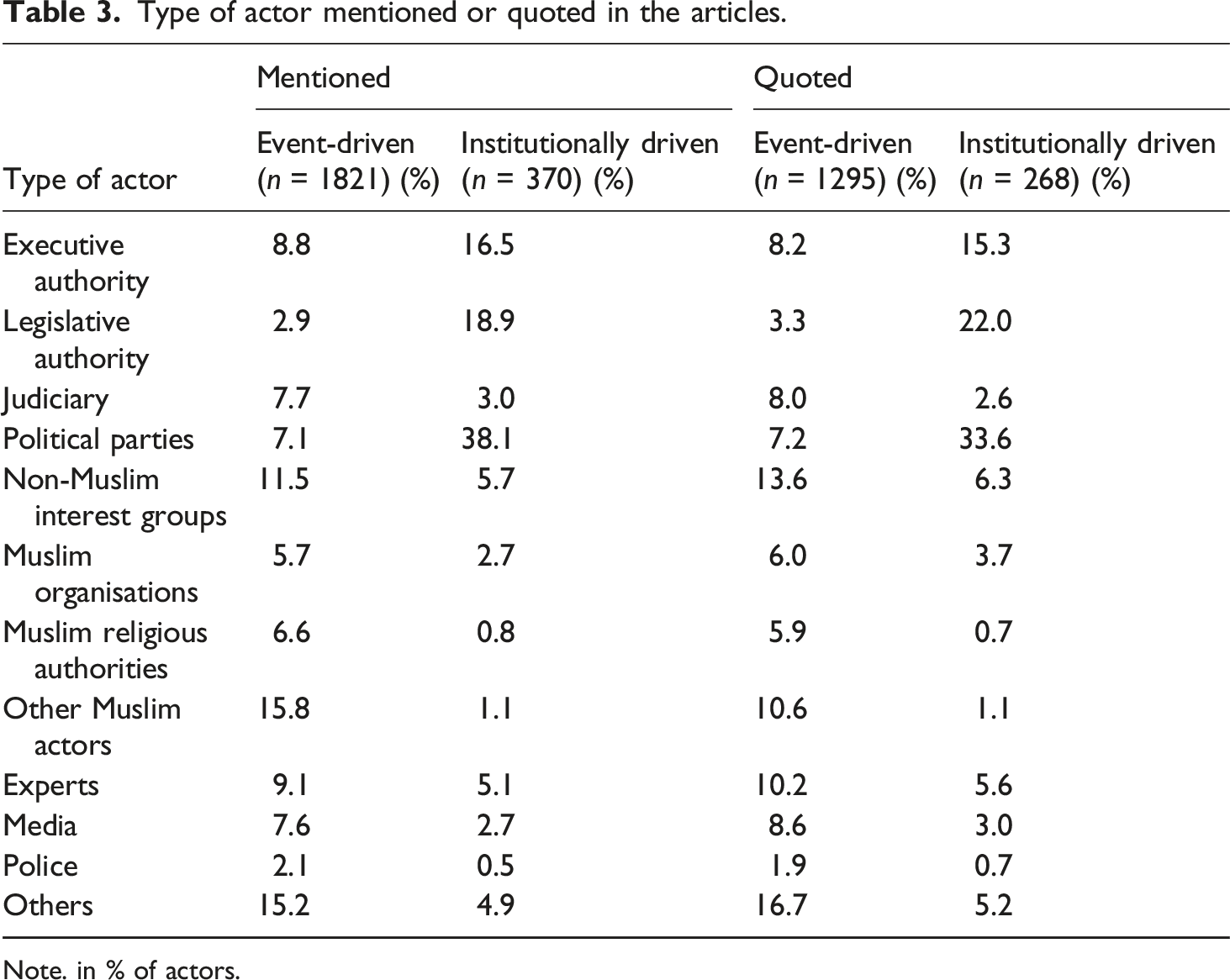
Note. in % of actors.
On the other hand, the very low proportion of Muslim actors and organisations in institutionally driven debates is striking. Muslims are more strongly represented in event-driven debates, most often as non-organised actors. In total, 28.1% of the actors mentioned in event-driven debates are identified as Muslim, compared to 4.6% in institutionally driven debates. The proportion of cited Muslim actors is only 22.5% in event-driven and 5.5% in institutional debates, which means that many debates are about Muslims, but do not include their voices. The majority of quoted and cited Muslim actors in institutionally driven debates are representatives of Muslim organisations, while Muslim religious authorities and other Muslim actors are more present in event-driven debates. The media, experts, and non-Muslim interest groups are also more frequently mentioned or cited in event-driven debates.
Share of issues.
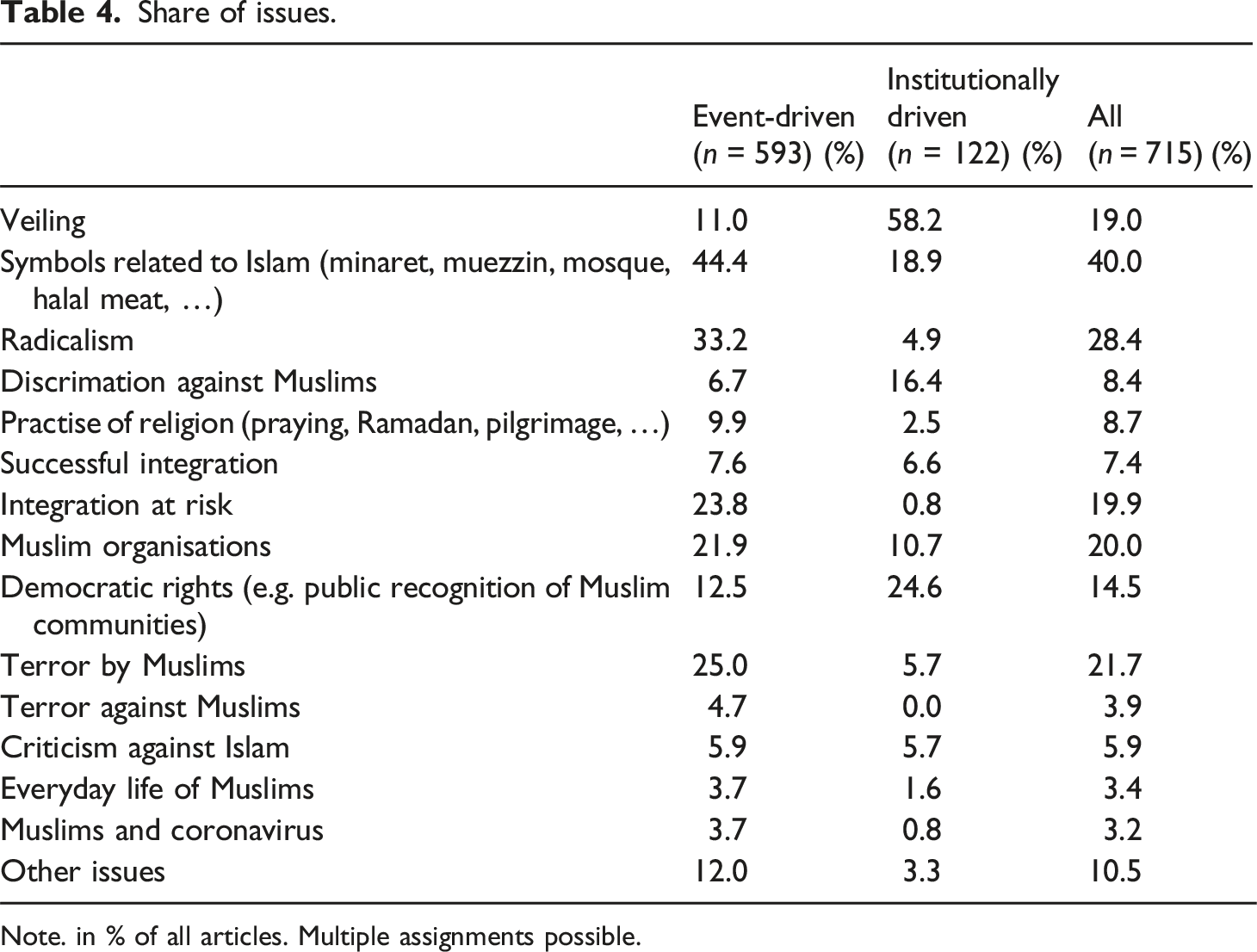
Note. in % of all articles. Multiple assignments possible.
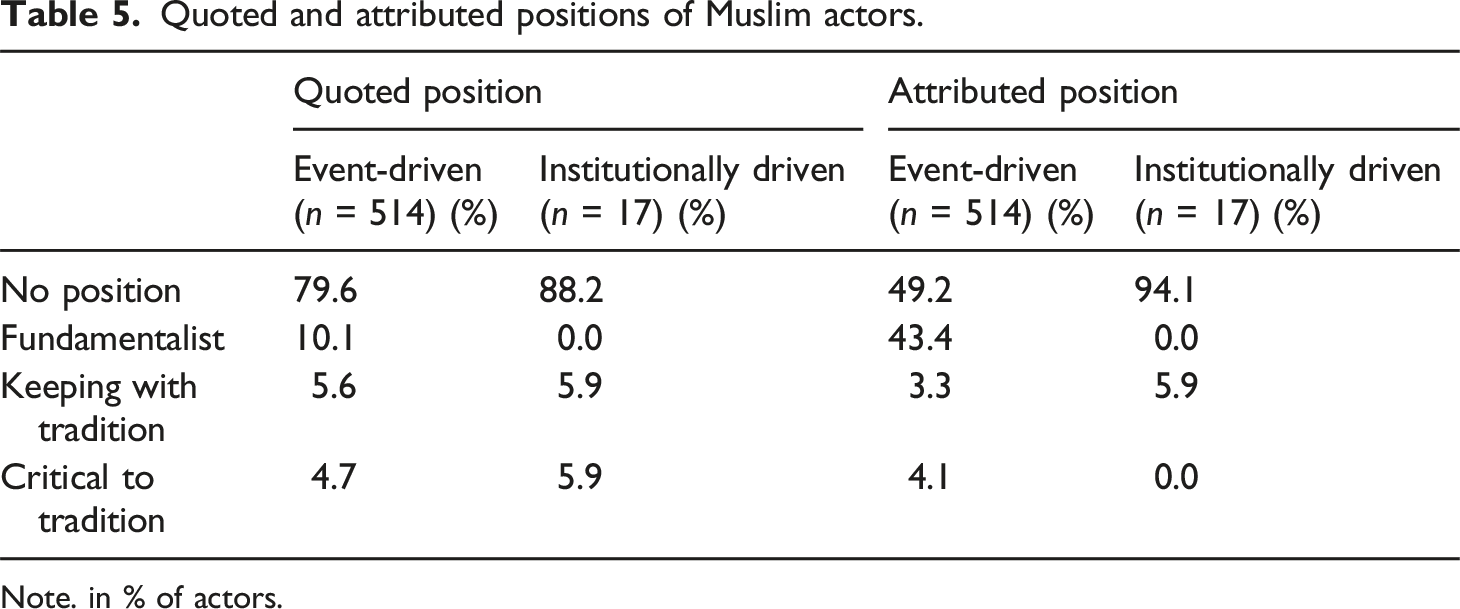
Quoted and attributed positions of Muslim actors.
Note. in % of actors.
In institutionally driven debates on Islam, Muslim actors are very poorly represented overall (n = 17). The religious position of Muslim actors is only cited in two cases: One of them is the president of the Union of Muslim Associations in the Canton of Vaud with a rather progressive position in an article discussing the recognition of Muslim communities as religious organisations by public law (Tages-Anzeiger, 27.1.2018). The other, with a moderate position, is a Syrian activist who fled to Europe, in an article about the Swiss Foreign Ministry’s aid to Syria (Le Temps, 28.2.2018). The only case of a position attributed to a Muslim appearing in an article on institutionally driven debates is related to the public funding of Muslim chaplains in Federal refugee centres: A female chaplain working at the refugee centre in Zurich is described as moderate, thus keeping with tradition (NZZ, 17.2.2018).
Conclusion
This paper shows that the reporting about Islam differs between institutionally and event-driven debates. We show that institutionally driven debates are more diverse and less sensationalist than event-driven debates. We find that the watchdog and infotainment roles of journalists can be found more in articles on event-driven debates. More precisely, the debates differ in terms of speakers, issues, or fundamentalist positions. Political actors are predominant in institutionally driven debates, while media and Muslim actors are more represented in event-driven debates. Overall, it is striking that we generally have few Muslim actors in the institutionally driven debates, so the debates tend to be about Muslims rather than including their voices. This is probably also due to the fact that the actors in these debates are mostly authorities, parliament and government, and additional viewpoints are apparently rarely sought from the media. Veiling is by far the most important topic in institutionally driven debates. Regarding communication style, we can conclude that issues are more in line with the parliamentary discussion in institutionally driven debates. Thus, institutionally driven debates are more substantive and more policy-oriented. Furthermore, a large proportion of described or quoted positions of Muslim actors is fundamentalist. In event-driven debates, this share increases further. Those debates are more media-oriented and more geared towards arousing and maintaining the interest of the audience.
We covered the debate on one topic in one country. This helped us to keep many factors constant (e.g. colonial history, its secularism) and to compare systematically following the logic of a most similar system design. Future studies could empirically check the generalisability to other countries and issues. Furthermore, it is also beyond the scope of this study to examine how the mechanisms change when we compare foreign and domestic news coverage on event-driven debates. We also did not analyse the framing of the debate. Finally, further studies are needed to examine the decision-making processes within media organisations and the consequences of the debate for society. How a society deals with people of different backgrounds is relevant for the integration and cohesion of a country.
Theoretically, our study implies that the debate type matters. In other words, the arena in which actors communicate is very important for the shape of a public debate (see also Bernhard et al., 2019). This fundamental insight should be taken into consideration generally in communication research.
As the mechanisms in public debates are different, we recommend discussing the demand for Muslim speakers depending on the type of debate. In institutionally driven debates, where the focus is on forming opinions, Muslims and their representatives should also contribute. The conditions in these debates are good for different and differentiated statements to be made. In event-driven debates, Muslim speakers with radical perspectives are often presented because that drives up news values. Those statements might then lead journalists or others to make or reproduce the distinction between good and bad Islam. In those event-driven debates, the recommendation is different: one should give attention to victims or those hurt or affected and their needs (including not publishing information they are not comfortable sharing publicly).
Our study also has practical implications. As mentioned, news values play a decisive role in the selection of event-driven debates. In the battle for circulation figures and ratings in the media industry, the opportunity structures are favourable for such reporting – for example, on Muslims who cultivate a radical perspective of interpretation, political actors who problematise the foreign, suggest the juxtaposition of the people and the elite, or break taboos. The high resonance for those actions is to be understood in the logic of news values. Measured against the pressure of the problem or its social or political significance, the resonance in event-driven debates would be too high. We should keep this in mind and communicate to the population that media coverage is not a mirror of reality. In our study, 83% of articles are event-driven and 17% institutionally driven. So, most of the time we are exposed to news value-driven stories about Islam.
In event-driven debates, less rather than more could be reported and journalists should take care to report in a less stereotypical but more differentiated way (e.g. by separating Muslims from (Islamist) terrorists). This can help to reduce Islamophobic attitudes. Muslim organisations can also ask for such reporting and contribute to it by promoting a differentiated perspective themselves, and demanding appropriate coverage.
We can evaluate the public discussion based on functions of news media (McQuail 2013: 37f): Formation and expression of public opinion, maintaining social order (reproduction of power), monitoring events and circumstances affecting society, stimulation of change and innovation, and integration and cohesion. The first (formation and expression of public opinion) is most important in our institutionally driven debates, whereas monitoring events is most important for our event-driven debates. Journalists and media companies should not abandon the function of integration and cohesion in favour of higher circulation figures in event-driven debates. In institutional debates, established (non-Muslim) actors also have a responsibility in shaping the debate. Here, they need to think about how provocative (populist actors) or silent (moderate actors) they want to be for strategic reasons. Muslim actors can bring in their perspective also via powerful established (possibly non-Muslim) actors.
Publicity is a basic feature of a democracy. It is therefore to be welcomed that institutionally and event-driven debates in connection with Islam also find their way into the public sphere and that the controversy is presented there. For the cohesion of a society, the advice is not to instrumentalise Islam-related conflicts, for all parties involved. Furthermore, conflicts that concern fundamental values and attitudes need time, concessions from both sides, the will for mutual understanding on the part of all those involved and sometimes also discussions away from the public sphere, or detached from news values.
Footnotes
Acknowledgements
We thank Jenny Bähler for coding assistance. We furthermore thank Hansjörg Schmid, Noemi Trucco, and the two anonymous reviewers for their constructive feedback and comments.
Authors Note
From Object to Subject: Social Science and Theological-Social Ethical Perspectives on Issues concerning Islam and Conflict,” Principal Investigator Hansjörg Schmid.
Author contributions
The design and idea for the paper stems from Regula Hänggli Fricker. Both authors were involved in all research steps.
Declaration of conflicting interests
The author(s) declared no potential conflicts of interest with respect to the research, authorship, and/or publication of this article.
Funding
The author(s) disclosed receipt of the following financial support for the research, authorship, and/or publication of this article: This study was a side product (without funding) of a Swiss National Science Foundation (SNSF) Project [Project No. 179090].
