




Abstract
Journalists use news factors to construct newsworthy stories. This study investigates whether different types of news outlets emphasize different news factors. Using a large-scale manual content analysis (n = 6489), we examine the presence of seven news factors in economic news across four different outlets types (i.e. popular, quality, regional, and financial newspapers). Results suggest that popular and regional newspapers particularly rely on the news factors of personification, negativity, and geographical proximity. Quality newspapers, instead, employ a rather general pattern of news factors, whereas the financial newspaper consistently relies on less news factors in its reporting. Findings urge scholars to move toward a more detailed understanding of how newsworthiness is constructed in different types of news outlets.
Keywords
Faced with limitations of time and space, journalists need to convince both their editors and the audience of the newsworthiness of the stories that they are working on (Bednarek and Caple, 2014; Eilders, 2006). This newsworthiness can be found either in the inherent characteristics of a real-world event or may be constructed by the journalist who can ascribe certain news factors to an event (Staab, 1990). The investigation of news factors and newsworthiness goes all the way back to Lippmann (1922), who first identified a set of attributes that would make a story worth reporting, and later Galtung and Ruge’s (1965) taxonomy of news factors in foreign news.
The importance of news factors for journalists and their particular application is of changing nature with certain news factors becoming more prominent over time (O’Neill and Harcup, 2009; Staab, 1990). Similarly, particular news factors may have more or less weight for certain outlet types than for others. Because different outlets (e.g. popular vs quality newspapers) have a different identity and target audience, there is more commercial value in constructing newsworthiness through emphasizing particular news factors than others (Allern, 2002). The existing research, however, did not yet empirically verify a differential use of news factors across news outlet types. This study addresses this gap in the literature by investigating how popular, quality, financial, and regional newspapers emphasize different news factors in (economic) news coverage.
News factors and newsworthiness
Research on news factors and newsworthiness can be approached from two perspectives, which Staab (1990) distinguishes as the causal model and the functional model. In the causal model, news factors are inherent characteristics of an event that determine whether and how extensively journalists will cover a particular story: The more news factors present in an event, the more newsworthy a story becomes (Buckalew, 1969), the higher the probability it will pass the gatekeeper (for an overview of this process, see Tumber, 1999, chapters 8–16). Hence, news factors are independent variables that cause certain journalistic decisions (i.e. dependent variables); in this causal model, journalists are considered passive actors.
Yet, many (subjective) dynamics influence the decision to cover a story apart from the presence of news factors (Caple and Bednarek, 2016; O’Neill and Harcup, 2009), ranging from practical considerations, journalistic instinct, to commercial motives. From this perspective, reported events are not just newsworthy on themselves but selected for a variety of reasons. News factors may exist external to the event (Caple and Bednarek, 2016) and be explicitly or implicitly ascribed to stories to make them newsworthy and legitimatize the decision to report a story (O’Neill and Harcup, 2009).
Complementing the causal model (Staab, 1990), in such a functional model news factors are the dependent variables that are the outcome rather than the cause of journalistic decisions (i.e. independent variable) to cover an event. Through the use of semiotic resources and using particular news factors that are valid characteristics of an event, journalists can establish newsworthiness to sell a story as ‘news’ to the audience (Bednarek and Caple, 2014: 139). Hence, newsworthiness is considered to be discursively constructed and a quality of the text rather than of the reported event itself (Caple and Bednarek, 2016).
To accurately analyze the process of news selection due to news factors (the causal model), news coverage should be compared to extra-media facts (i.e. reality). However, while content analysis – the method mostly applied in the study of news factors – is feasible to investigate the news stories that ‘have passed the gates’, the method is not apt to study events that were not selected for coverage (Rosengren, 1970). O’Neill and Harcup (2009) write that as a consequence, the ‘discussion of news values sometimes blurs distinctions between news selection and news treatment’ (p. 171) because scholars can only analyze the (characteristics of) news that was published.
Another reason to study news factors as characteristics of journalistic production (the functional model) rather than event properties is that most news factors are not objective qualities of an event but rather subjective aspects that are perceived in an event (Staab, 1990). For example, most news stories can be reported by including factors such as personification, controversy, or eliteness; yet, it very much depends on journalists which news factors will eventually be included. Often it is not a matter of selecting events with a certain set of news factors, but rather packaging stories with these news factors to construct newsworthiness (Caple and Bednarek, 2016). Therefore, we follow Staab’s (1990) functional model and analyze how journalists construct newsworthiness in different outlet types.
Taxonomies of news factors
Previous research identified numerous news factors guiding journalists’ decisions (Caple and Bednarek, 2013). Most notably, Galtung and Ruge (1965) developed a taxonomy of news factors that would determine the probability of a foreign event to become news. However, reliably applying Galtung and Ruge’s taxonomy of news factors turned out to be complicated (Harcup and O’Neill, 2001). Several of the news factors they identified are too open to subjective interpretation, which severely complicates reliable use in (quantitative) content analysis. Take, for example, the news factor threshold: ‘there is a threshold the event will have to pass before it will be recorded at all’ (Galtung and Ruge, 1965: 66). When is this threshold passed?
Clear standards for when a news factor would be present are frequently lacking, also in more recent studies. Similar to ‘threshold’, news factors such as ‘unexpectedness’, ‘unambiguity’, and ‘consonance’ are open to interpretation and difficult to apply empirically. In retrospect, scholars even concluded regarding their older work that ‘some categories were too broadly defined when subjected to empirical testing’ (Harcup and O’Neill, 2016: 9), causing them to leave out some of the earlier mentioned ambiguous news factors in later research.
In the 50 years after Galtung and Ruge (1965), many alternative taxonomies of news factors have been proposed. An extensive summary by Caple and Bednarek (2013) shows the wide variety in news factors, labels given to these, and operationalizations. The current investigation focuses on news factors that have repeatedly been validated in existing research done by German scholars (see literature study of Eilders, 2006). Given the similarity in media systems (Hallin and Mancini, 2004), these news factors are suitable for our investigation in the Netherlands.
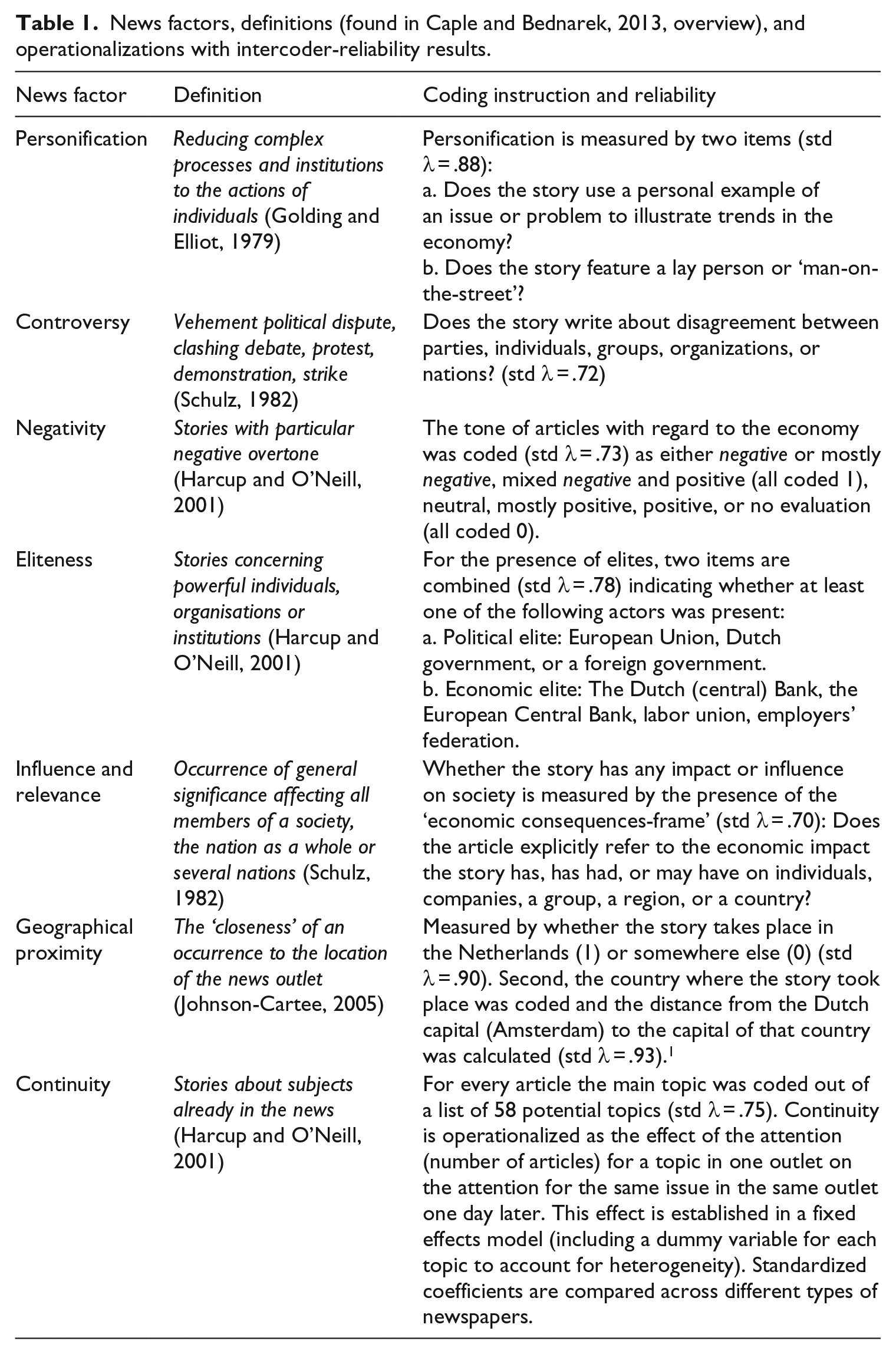
Eilders (2006) identified seven news factors repeatedly shown to be involved in journalistic considerations of what would entail newsworthiness: (1) personification (i.e. possibility of showing the ‘human face’ of an event; also with eye-witness reports), (2) damage or, more generally, negativity, (3) eliteness (i.e. presence of individuals or organizations with great societal power), (4) influence and relevance (i.e. having consequences for society), (5) controversy (i.e. conflict), (6) geographical proximity, and (7) continuity (i.e. having been in the news before). This set of news factors applies in a wide variety of countries (Masterton, 2005), and, therefore, suits our endeavor to investigate the use of news factors in the Dutch context and across outlet types. Table 1 (in section ‘Method’) provides conceptual definitions and operationalizations of these news factors.
News factors, definitions (found in Caple and Bednarek, 2013, overview), and operationalizations with intercoder-reliability results.
A tabloidization of news factors? Comparing news factors across outlet types
Often understood as a general phenomenon, one may wonder whether different news outlet types vary in their use of news factors. Reason to question this is the reference to so-called ‘tabloid news values’ that would increasingly be employed (Harcup and O’Neill, 2001: 276), or mentions of ‘a spill-over of tabloid news values from the popular to the quality press’ (Esser, 1999: 293).
As straightforward and convincing as these assumptions may seem, there is hardly any empirical evidence that different types of journalistic outlets emphasize different news factors. Although some evidence exists that different newspaper types vary on certain content characteristics (e.g. De Vreese et al., 2017; Kepplinger and Ehmig, 2006), a structural comparison of news factors still has to be conducted.
Theoretically, the concept of newsworthiness explains why outlet types may differ on which news factors they feature. Newsworthiness can be split into two components, which are news factors and news values (Kepplinger and Ehmig, 2006). News factors are the qualities of a news story (e.g. the presence of personification, controversy, or negativity), whereas news values are the journalistic assessment of how important these factors are. So the presence of a news factor on itself does not contribute to a newsworthy story, but only if a journalist sees value in it. In line with the functional model of Staab (1990), which specifies how journalists may use news factors to make stories (more) newsworthy, journalists of certain media outlets may attach more value to particular news factors than journalists of other outlet types (Kepplinger and Ehmig, 2006): Concretely, popular newspapers would attach more value to particular news factors than quality or financial newspapers (O’Neill and Harcup, 2009).
Not only being societal institutions but also commercial enterprises, news media will follow commercial considerations in the news factors they emphasize to let these reflect the orientation and interest of their audience (Allern, 2002). Hence, commercial pressures that differ between outlets may, for instance, influence the framing of the same event (McMenamin et al., 2013). The positioning of a newspaper (e.g. popular, quality) and its organizational conditions (e.g. target audience), therefore, are likely to translate into a particular construction of newsworthiness (Bednarek and Caple, 2014).
Based on the common distinctions made between newspaper types (i.e. quality vs. popular, national vs. regional, and general vs. specialist), theoretically a threefold (2 × 2 × 2) classification would result in eight different newspaper types. However, we identify only four types of newspapers in the Dutch context as some combinations are not present (e.g. the combination of local and specialist) and another newspaper type (i.e. the regional ones) is hard to classify as being either quality or popular. Hence, a distinction between popular, quality, and financial newspapers (all national) and regional newspapers allows for clearly identifiable types and provides a solid theoretical and all-encompassing empirical underpinning to spell out potential differences between types of news outlets.
Popular newspapers
News factors, arguably, can be split into commercial ones that appeal to a broad target audience and quality ones that are inherent characteristics of a story’s importance (Harcup and O’Neill, 2016). Popular newspapers are strongly event and market-driven (Strömbäck et al., 2012) and aim to reach an as large as possible audience; therefore, they may particularly concentrate on the commercial news values. Being confronted with more pressure in their daily work from (a) audience figures, (b) competition with other outlets, and (c) profit motives than journalists from other outlets (Skovsgaard, 2014), tabloid and popular newspaper journalists follow more closely what the audience is interested in than broadsheet journalists (Allern, 2002) and, consequently, make different journalistic decisions (Sparks and Tulloch, 2000).
To create a product that is of interest to a broad audience, popular press journalists are encouraged to personify the news (Allern, 2002): Personalized coverage makes news more interesting and comprehensible for audiences not very interested in the news (Bird, 1998), which typically are the people served by popular news media. More frequently than other outlet types, popular newspapers may therefore employ exemplars that give a human face to (otherwise) abstract issues (Lehman-Wilzig and Seletzky, 2010; Strömbäck et al., 2012), making personalization a typical tabloid news factor (Turner, 1999).
In their search for profit, popular newspapers arguably also focus more strongly on negativity than other outlet types. As a ‘burglar alarm’ (Zaller, 2003: 122), popular news media alert their inattentive audiences on issues that are going wrong ‘in excited and noisy tones’. Negativity has been demonstrated to trigger audience attention (Soroka, 2006), which is thus apt for (tabloid) journalists’ motive of profit-making and explains the relative absence of negativity in news of public broadcasters (Esser et al., 2017), which have a less strong incentive to follow commercial motives.
Popular newspapers would, therefore, focus relatively more on personification and negativity, which leads to the first hypothesis:
H1. News factors (a) personification and (b) negativity will be more prominent in popular newspapers than in other newspaper types.
Quality newspapers
Enhancing insights and knowledge of their audience is among the key goals of quality press journalists (Strömbäck et al., 2012). While popular newspapers would be characterized by a more personalized perspective, quality newspapers have been shown to feature controversy relatively prominently (Gonzalo et al., 2015; Vliegenthart et al., 2011). The reason probably being that journalists of quality newspapers stress the importance of objectivity (Skovsgaard, 2014): By portraying multiple (conflicting) perspectives on an issue, journalists demonstrate to adhere to this objectivity norm. Moreover and important for their purpose of enhancing insight, presentation of conflict provides journalists a way to interpret and analyze stories in-depth because it helps to juxtapose (policy) positions (Bartholomé et al., 2015).
Because quality newspapers tend to focus on issues from a political perspective (Reinemann et al., 2012), it is likely that quality outlets emphasize more strongly the potential impact a topic has on society: This is reflected in the news factor of ‘influence and relevance’. By highlighting the consequences an event may have, journalists of quality outlets take a pro-active stance and provide an analysis that goes deeper than just writing down the facts (De Vreese, 2005).
The news factor ‘eliteness’ refers to individuals, organizations (e.g. political parties), or national institutions (e.g. governments) that have a significant impact on society (Gans, 2004); other studies labeled it ‘prominence’ or ‘status’ (Caple and Bednarek, 2013). As quality outlets focus on developments that are politically relevant and related to policy-making, these newspapers will be particularly likely to include the involvement of such elites in their coverage (Reinemann et al., 2012). Altogether, we expect the following:
H2. News factors (a) controversy, (b) influence and relevance, and (c) eliteness will be more prominent in quality newspapers than in other newspaper types.
Regional newspapers
As regional newspapers have a local audience interested in regional news (Costera Meijer, 2013), one may expect journalists of such outlets to especially value the news factor ‘geographic proximity’ and, therefore, cover news more often from a domestic viewpoint (i.e. local stories) at the expense of international news (Mancini et al., 2007). Journalists working for news organizations serving a small geographic market tend to stress the news factor of proximity more (Buckalew, 1969) and focus on what happens in or is relevant to their area of distribution (Oliver and Meyer, 1999). Moreover, such a regional approach may lead newspapers to focus within international news on neighboring countries that could have a direct impact on the regional level.
Research demonstrates that audiences of regional news media are especially interested in coverage ‘from within’, which involves not only geographically close events but also presenting the perspective of local people (Costera Meijer, 2013). Accordingly, regional media have a special interest in the personal and emotional stories of the local population even when covering nationally relevant issues (D’Haenens and De Lange, 2001). Reporters of regional news, consequently, include relatively more ordinary people as sources in their articles (Reich, 2012) to make a story newsworthy for their specfic target audience. In line with the above, we expect the following:
H3. News factors (a) geographical proximity and (b) personification will be more prominent in regional newspapers than in other newspaper types.
Financial newspapers
Consumers of financial media want to be informed about news that can be used when making financial decisions (Davis, 2006). The interests of their target audience, thus, reach beyond national borders (Mancini et al., 2007). Hence, one may expect the news factor geographical proximity to be a less important news factor for financial newspapers. In contrast, market-based considerations may encourage financial press journalists to write about events from an international perspective (Allern, 2002).
The expectation that the news factor ‘geographic proximity’ would be less relevant for financial news media, actually, applies to almost all the (mainstream) news factors relevant to the other generalist newspapers (i.e. popular, quality and regional). Specialist news outlets operate with a distinct set of news factors (Manning, 2013). For example, whereas unambiguity would be an important journalistic criterion (Galtung and Ruge, 1965), financial outlets particularly focus on complex topics and do not shy away from issues such as regulations (Bach et al., 2013). While non-specialist outlets would consider such news ‘dull’ (Manning, 2013: 179), this kind of news is of particular interest to the target audience of financial outlets. With an audience that has strong interest in economic matters and high financial literacy, news factors that normally are employed by mainstream media to assure the newsworthiness of economic news stories are unnecessary and redundant (Doyle, 2006).
The same might be true for the news factor ‘continuity’: While newspapers, generally, adhere to a logic of ‘news being news, [partly] because it was news yesterday’ (Hollanders and Vliegenthart, 2008: 48), it will be less necessary for financial newspapers covering economic news to demonstrate how their news of the day relates to yesterday’s news. Arguably, it is a general journalistic routine to follow up on topics that have received attention in the previous edition, also because this justifies the selection of it in the first instance (Harcup and O’Neill, 2001). Yet, for specialized reporting as that of financial newspapers, journalists are probably less likely to routinely report on the same issues as the day before, as they may have already moved on to new issues and developments to demonstrate the urgency of their outlet’s coverage.
News factors, thus, are less important for specialist outlets, also because knowledgeable readers select stories less strongly according to news factors (Eilders, 2006): Economic news stories will be valuable to their audience anyway (Davis, 2006), and less effort is therefore demanded to constructed newsworthiness. Nevertheless, it remains important to inform about the potential impact news stories may have for readers’ investments, which implies that the news factor ‘influence and relevance’ probably still plays a strong role. Altogether, we expect the following:
H4. (a) Most news factors, (b) expect for influence and relevance, will be less prominent in financial newspapers than in other newspaper types.
Studying news factors in economic news
When studying the differential use of news factors, one could analyze all the news that is covered in newspapers or instead focus on a specific topic. When analyzing all the news that is published, it is plausible that the analysis picks up topic differences rather than differences in news factors as the two are closely interwoven. For example, political news that is prominent in quality newspapers will often carry the news factors ‘eliteness’ and ‘controversy’, whereas sports news prominent in popular newspapers may especially contain the factors of ‘geographical proximity’ and ‘negativity’. By analyzing news coverage in general, one thus runs the risk of comparing topics rather than the news factors being used by different outlet types (see, for example, Harcup and O’Neill, 2016: 9–10).
Focusing on a specific topic allows going beyond that topic dimension to provide deeper insights into the actual usage of news factors (Kroon and Schafraad, 2013). Economic news is a very general topic found throughout newspapers: It appears virtually in all sections, including front pages, domestic and foreign news sections, and even the culture pages (Gonzalo et al., 2015; Joris and d’Haenens, 2015). Therefore, it is specific (i.e. avoiding the confounding influence of topics) but simultaneously relatively general (Doyle, 2006). Economic news, thus, closely resembles characteristics of general news coverage and allows taking the newspaper as a whole into account, which arguably leads to findings that are generalizable beyond economic news.
Method
A content analysis has been carried out on nine Dutch newspapers. It included seven of the eight daily newspapers with the highest circulation in the Netherlands and the only financial newspaper (NOM, 2015). Together, they have a shared circulation that equals 65 percent of the full Dutch newspaper landscape. Two popular, tabloid-like, newspapers were analyzed (Algemeen Dagblad and Telegraaf), three quality newspapers (Volkskrant, NRC Handelsblad, and Trouw), three regional newspaper with the highest circulation owned by different publishing houses (Dagblad van het Noorden, Gelderlander, and Noordhollands Dagblad), and the only Dutch financial newspaper (Financieel Dagblad).
Popular newspapers have been identified as such, because they have shorter stories, large illustrations, and big headlines, which are obvious tabloid characteristics (Skovsgaard, 2014). Moreover, these newspapers identify themselves as being a ‘family newspaper’ (Algemeen Dagblad) for who ‘consumer demand is key’ (Telegraaf). Speaking to a broad audience – characteristic for popular media (Dahlgren, 1995) – they have the largest readership, in particular among ‘popular news consumers’ (Bos et al., 2016). The three quality newspapers, in contrast, do not refer to wide appeal but explicitly refer to ‘quality’ and mention ‘backgrounds, opinion and debate’ (Volkskrant) and ‘in-depth reporting’ (NRC and Trouw) in their outlet description.
Within the genre of popular newspapers, there are considerable differences internationally: German popular newspapers, for example, are much less tabloidized than the British tabloids (Esser, 1999). Similarly, the Dutch popular newspapers would probably be understood as ‘middle-market’ tabloid newspapers in the United Kingdom. The Dutch case, thereby, provides a conservative test as differences between popular and quality newspapers may be larger in countries with more distinct types of tabloid newspapers.
Sample selection
Units of analysis are individual newspaper articles retrieved from the LexisNexis database. All news articles (i.e. not a sample) about the economy in the period 1 February 2015 through 8 July 2015 were analyzed to get an as complete as possible picture of the news coverage. Therefore, a relatively general keyword search with economic terms for the headline and first paragraph was combined with a more specific keyword search for full articles. 2 This resulted in a sample of 15,315 newspaper articles.
To remove irrelevant articles, data were manually cleaned with a simple question whether the article in the headline or first paragraph explicitly referred to the economy, economic developments (e.g. employment, price changes, economic growth/shrinking, housing, consumer behavior, inflation, import/export), government spending, or the economic and financial situation of people or companies. Only the 6489 news articles (43.1% of the initial sample) that fulfilled this criterion were further analyzed (popular: n = 996; quality: n = 1004; regional: n = 667; financial: n = 859). 3
Measurement: Reliability and variables
While Bednarek and Caple (2014) applied critical discourse analysis on the word level to analyze the construction of newsworthiness by means of news factors, we do so with a quantitative content analysis on the article level. This content analysis has been conducted with the help of 22 coders. Before the actual content analysis took place, they had all thoroughly been trained by the principal investigators by means of two sessions, three homework assignments, and immediate online feedback once questions appeared.
Table 1 gives an overview of the measured news factors, their definitions, and intercoder reliability. For some news factors (i.e. personification and eliteness), two variables are summed, since both measure a certain aspect of this factor. Subsequently, the additive scale is recoded into a dummy variable that indicated whether at least one of the aspects of the particular news factor was present (score: 1; story carries the news factor) or none of these (score: 0; story does not carry the news factor).
Intercoder reliability has been assessed by 170 randomly selected articles from the full sample. Just as in the full sample, only about half of these articles followed the definition of economic news; hence, news factors have been coded by multiple (i.e. three or more) coders in the case of 89 articles. Following recent studies (e.g. De Vreese et al., 2017), the sophisticated measure Lotus (λ) has been used to assess intercoder reliability (Fretwurst, 2015). While Krippendorff’s alpha, Scott’s pi, and Cohen’s kappa are based on pairwise comparisons, Lotus compares individual coding decisions to the most coded value, and its standardized version (std λ) still corrects for chance. Hence, standardized Lotus works relatively well for datasets of large groups of coders and variables that are skewed or occur rarely, both of which are problematic issues for Krippendorff’s alpha. Standardized Lotus values of .67 indicate good reliability, while values above .60 are considered acceptable (Fretwurst, 2015).
Analysis
Because the dependent variable – presence or absence of a news factor – is dichotomous, logistic regression analysis (logit models) is the most suitable way to test how popular, quality, regional, and financial newspapers differ regarding their use of news factors. Newspaper types are, subsequently, compared using Wald tests of simple comparisons. Because logistic regression models provide coefficients that are difficult to interpret, we (visually) present the predicted probabilities in percentages for a news factor to be present in an article of a certain newspaper type. Confidence intervals provide insight into how precise the estimations are.
Different from the other news factors, the analysis for ‘continuity’ relies on a fixed effects model with a focus on the lagged dependent variable (see Table 1 for further details). All analyses include date of publication and day of the week (i.e. Monday and Tuesday) as covariates, to control for possible changes over time and sections of newspapers that are only published on certain days. Moreover, the natural logarithm of the articles’ length was included as a control variable, because longer articles simply have more space to contain multiple news factors (Kepplinger and Ehmig, 2006). This was necessary, because articles of quality and financial newspapers were considerably longer (p < .001), respectively, about 200 and 145 words, than those of popular and regional newspapers.
Results
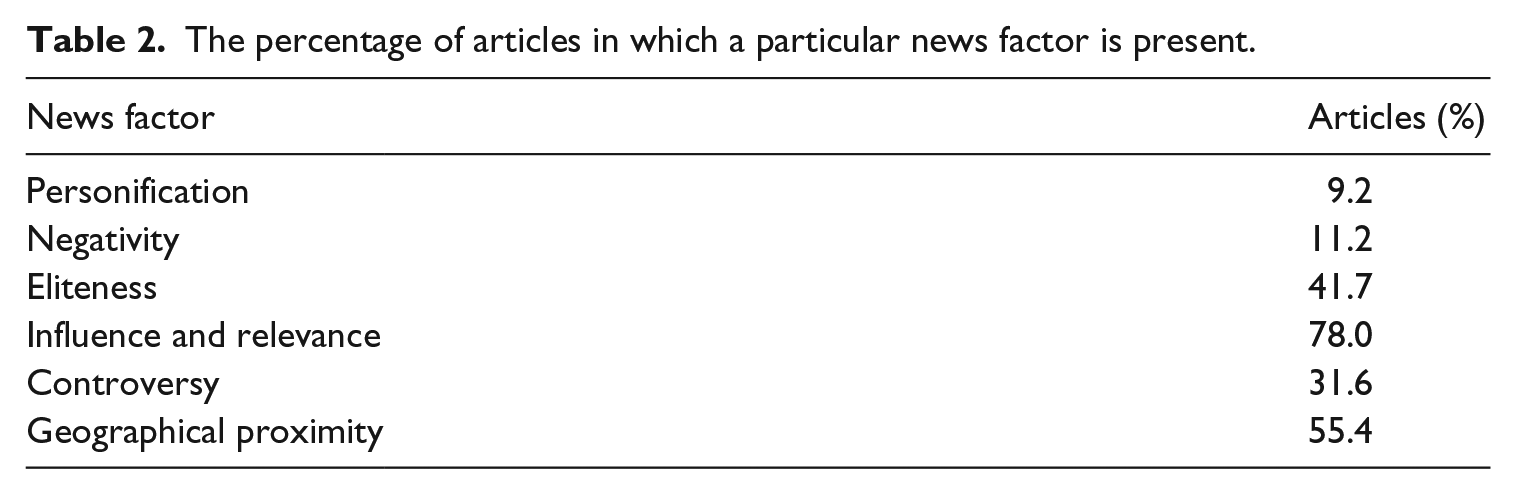
Table 2 provides the average percentage of newspaper articles in which a news factor was present. ‘Influence and relevance’ is the most prominent news factor, as it was present in 78.0 percent of the articles. Personification and negativity, in contrast, played a much less important role; being present, respectively, in only 9.2 percent and 11.2 percent of the articles. The latter might be explained by the period of investigation, which showed early signs of recovery after the economic crisis.
The percentage of articles in which a particular news factor is present.
News factors per newspaper type
Personification
The news factor personification was most prominent in articles from the popular (13.5%) and regional newspapers (12.4%) as displayed in Figure 1. This was about twice as often as in quality newspapers (7.7%, p < .001) and the financial newspaper (5.3%, p < .001). This provides support for Hypotheses 1a and 3b. The quality newspaper, on its turn, also focused 1.5 times more on personification than the financial newspaper (p = .003), confirming Hypothesis 4a.
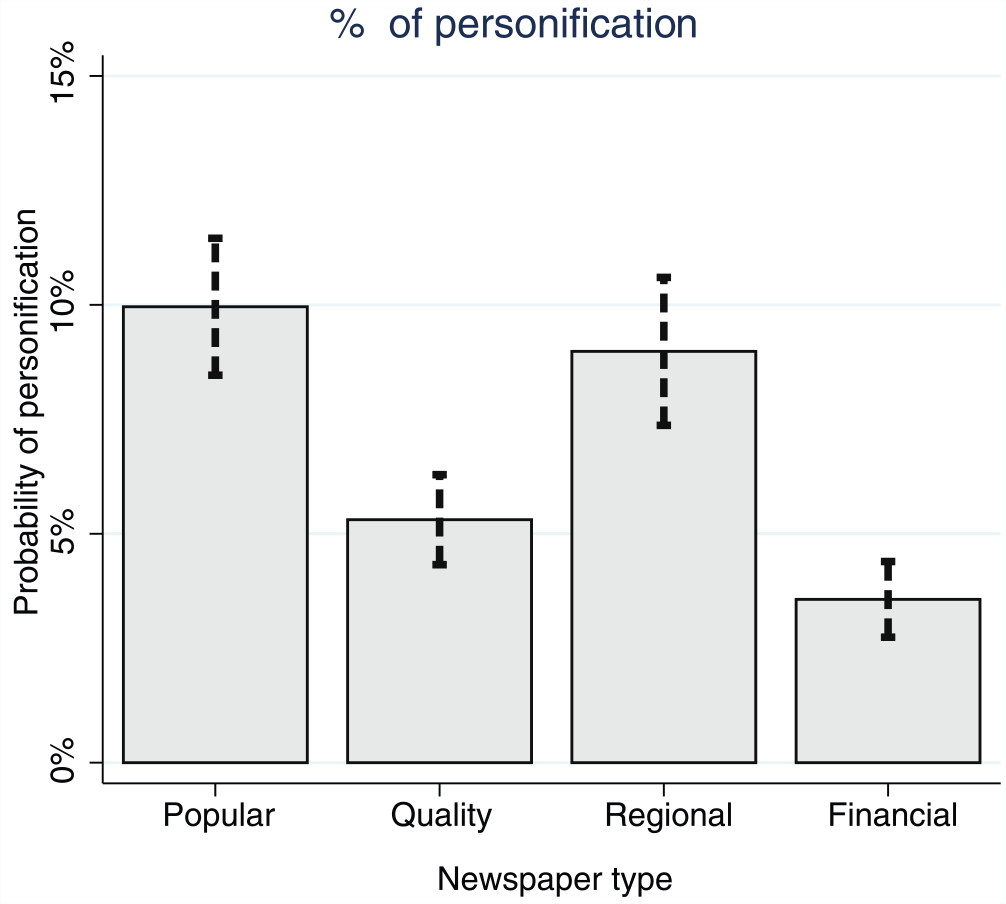
The predicted probability of the news factor ‘personification’ being present with 95% confidence interval (dotted lines).
Negativity
As hypothesized, negativity was most prominent in the popular newspapers (13.7%; see Figure 2). Confirming Hypothesis 1b, this is about 1.4 times as often as the presence of negativity in the quality (10.0%; p = .001) and financial newspapers (9.2%; p < .001). The latter two (i.e. quality and financial) did not differ significantly from one another (p = .426), weakening support for Hypothesis 4a. More than the quality and financial outlets (p < .002), the regional newspapers focused to a similar extent (12.7%; p = .435) on negativity as the popular newspapers.
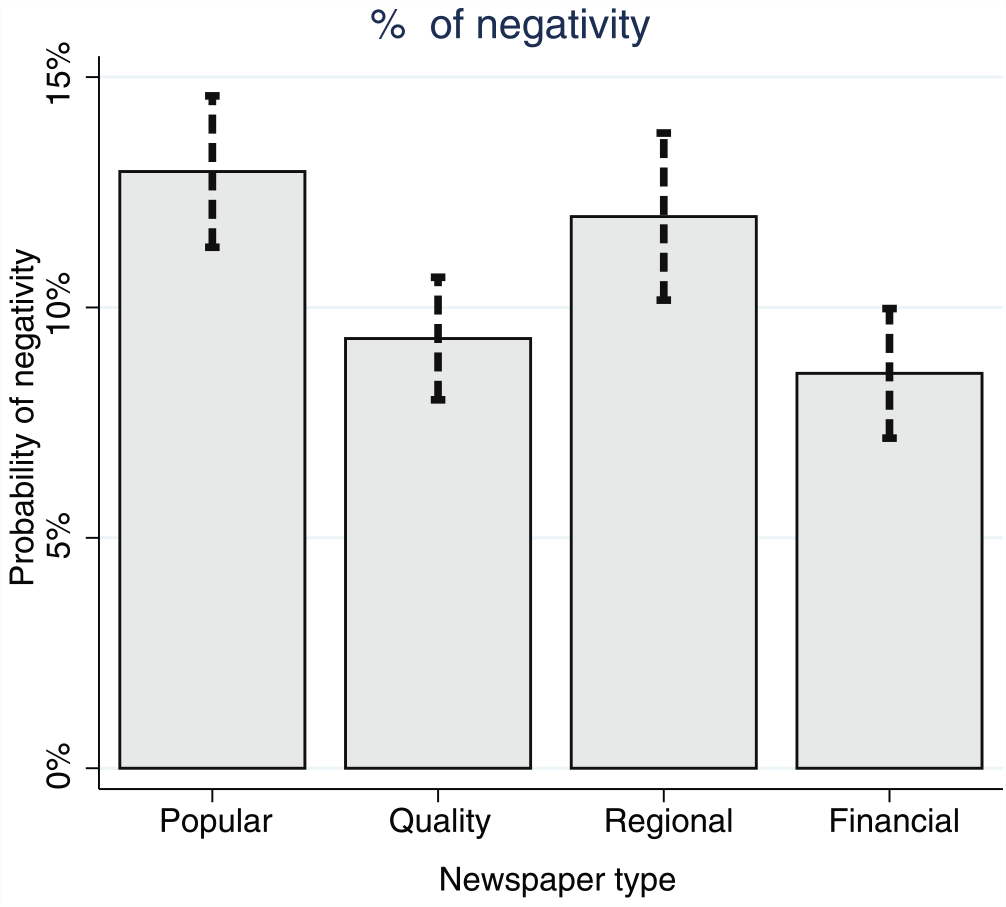
The predicted probability of the news factor ‘negativity’ being present with 95% confidence interval (dotted lines).
Eliteness
Although we find that elites are most prominent in the quality newspaper (44.2%), this was not significantly more than in articles of the popular newspapers (41.2%; p = .068). The regional newspapers (42.1%) did not differ from both either (p > .200). As Figure 3 shows, the financial newspaper contains the news factor ‘elites’ least frequently (39.6%), which is less than the quality outlets (p = .005), but not significantly less than the regional and popular newspapers (p > .150). Altogether, Hypotheses 2c and 4a are rejected.
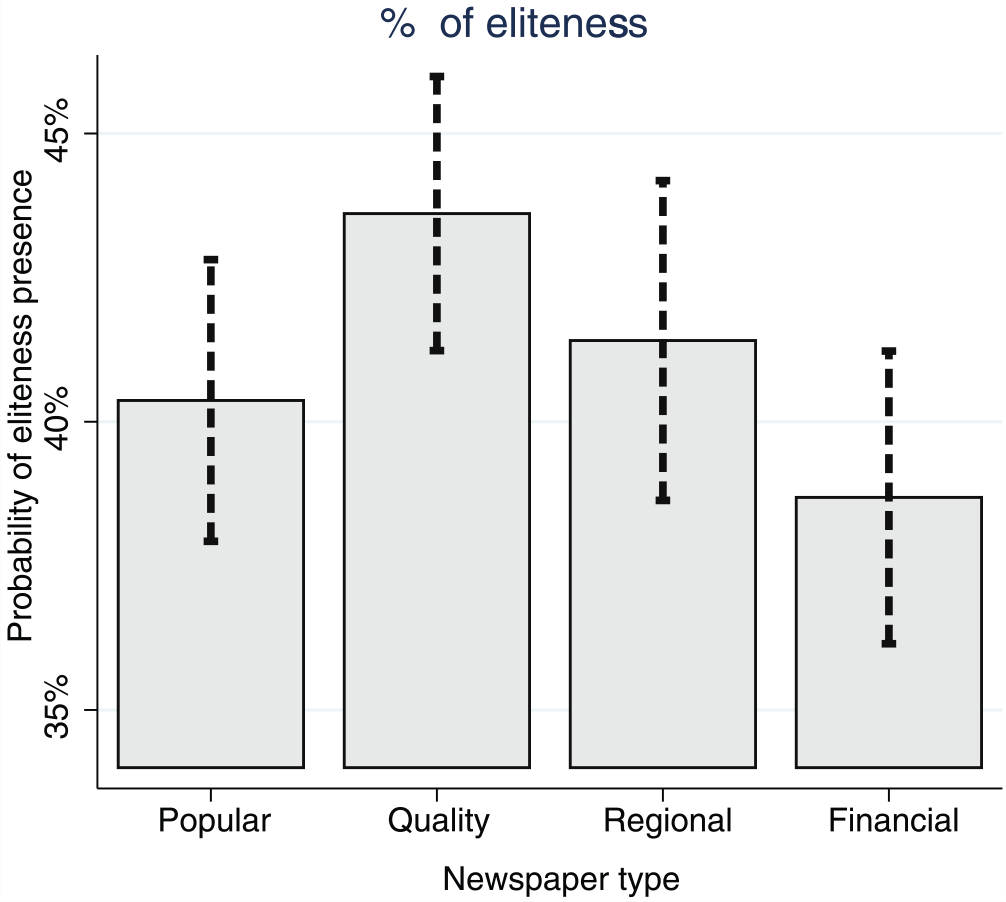
The predicted probability of the news factor ‘eliteness’ being present with 95% confidence interval (dotted lines).
Influence and relevance
Also with regard to the news factor ‘influence and relevance’, hardly any differences existed between outlets (see Figure 4), which results in a rejection of Hypotheses 2b and 4b. The popular (78.4%), quality (78.3%), regional (79.8%), and financial newspaper (76.0%) all contained a similar proportion of references to the influence and relevance aspects of news stories. Only the financial and regional outlets differed slightly (p = .013).
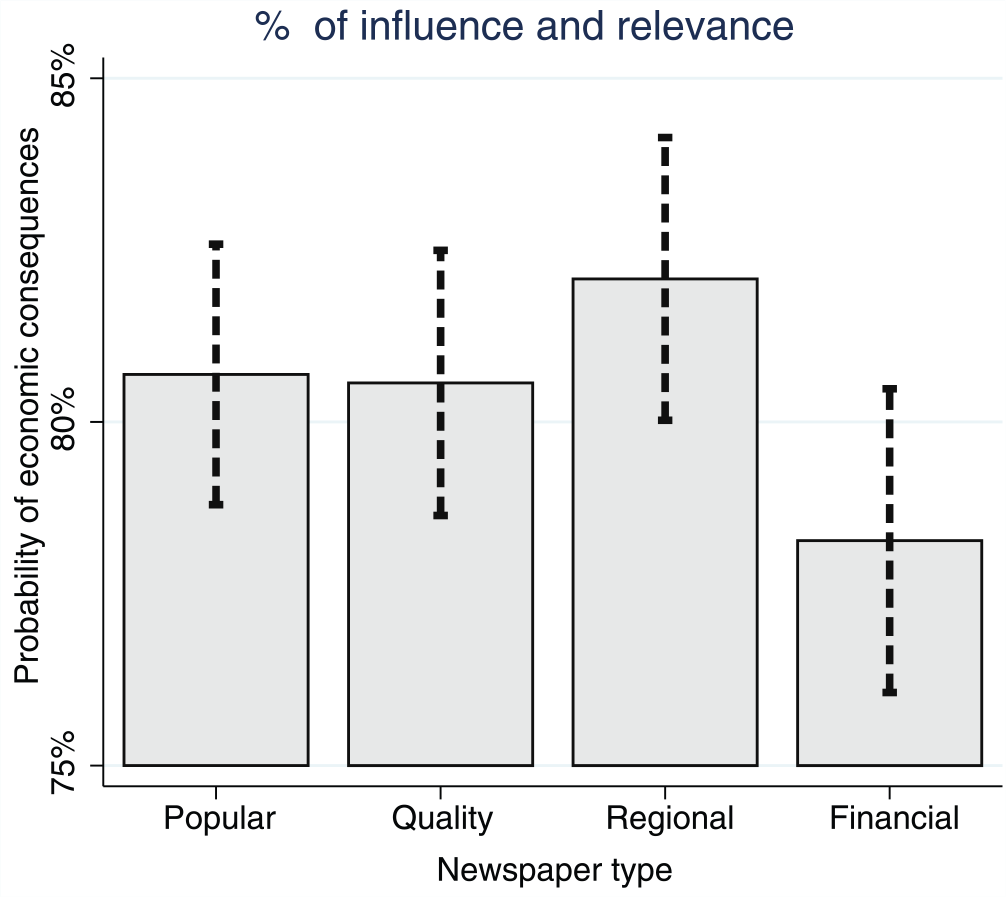
The predicted probability of the news factor ‘influence and relevance’ being present with 95 percent confidence interval (dotted lines).
Controversy
The news factor controversy was equally often present in the regional newspapers (35.1%), quality newspapers (34.8%), and popular newspapers (32.9%). The difference between these three outlet types was not significant (p > .200) as can be inferred from Figure 5. Hence, Hypothesis 2a was rejected, indicating that controversy seems to be a rather general news factor just as the news factors ‘eliteness’ and ‘influence and relevance’ before. Only the financial newspaper differed from all the other newspaper types by having less news stories containing conflict (24.5%, p < .001), providing additional support for Hypothesis 4a.
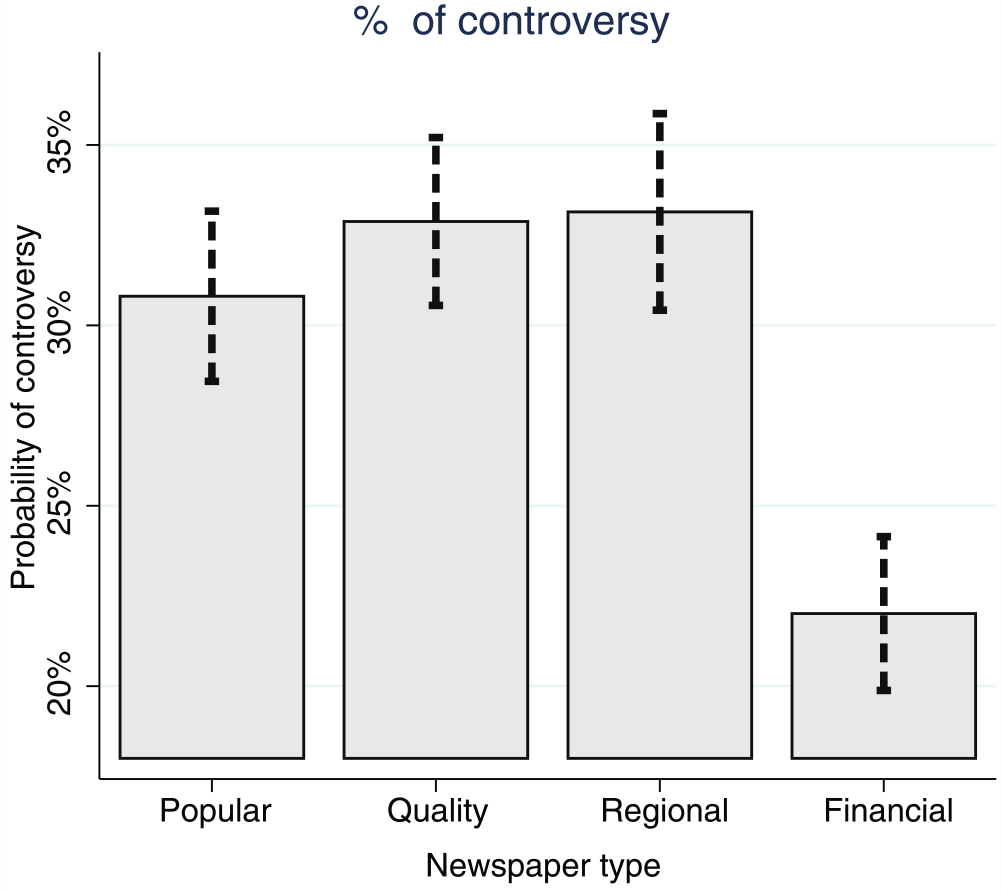
The predicted probability of the news factor ‘controversy’ being present with 95% confidence interval (dotted lines).
Geographical proximity
As Figure 6 shows, we find that regional newspapers (62.0%) and popular newspapers contain most news stories from the Dutch context (61.7%). Both these newspaper types focused significantly (respectively, 1.15 and 1.40 times) more often on domestic stories than the quality newspapers (53.8%; p < .001) and the financial newspaper (42.6%; p < .001). The specialized outlet, thus, contained a majority of foreign economic news. Hence, this confirms Hypotheses 3a and 4a, though noticing that the strong similarity between regional and popular newspapers was not expected.
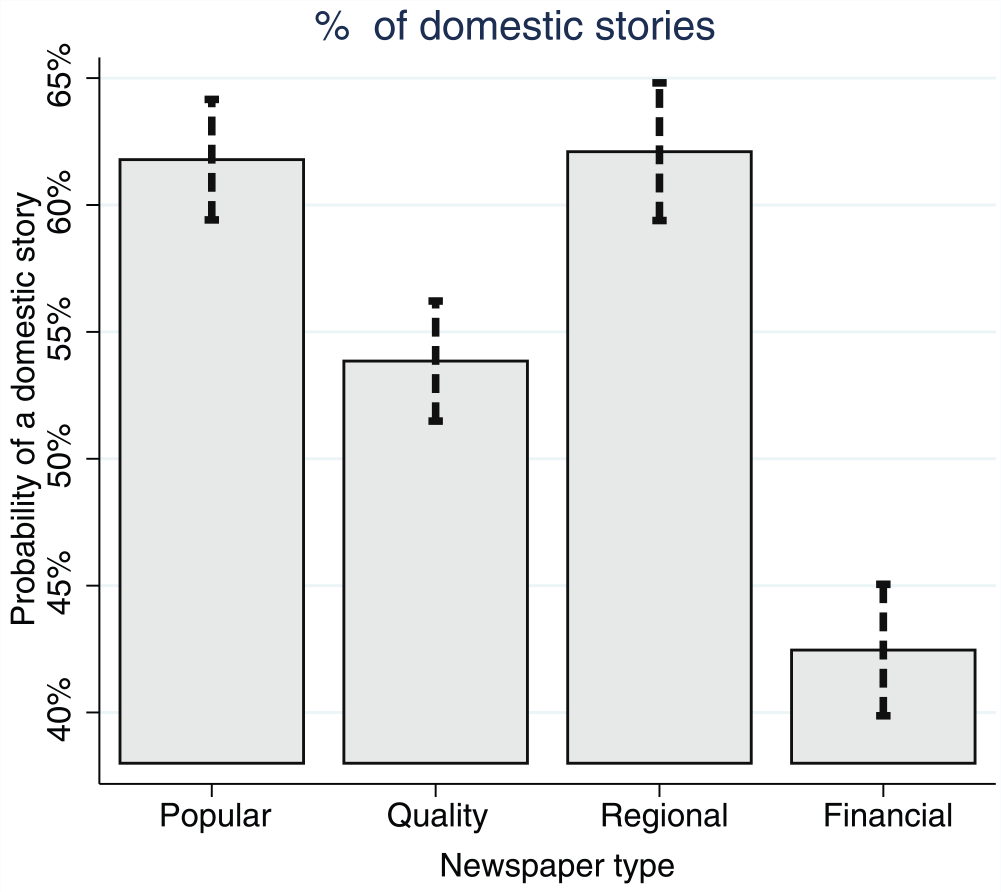
The predicted probability of the news factor ‘geographical proximity’ being present with 95% confidence interval (dotted lines)
The average distance to the location of foreign news stories is used as an alternative indicator for the news factor ‘geographic proximity’. The findings, though, are largely similar as Figure 7 also shows. Not only does the financial newspaper report less on domestic stories, when it reports on foreign news, it does so on events that take place most far away (average 2733 km; p < .001), which is in line with Hypothesis 4a. For regional newspapers, foreign news coverage tends to focus on stories taking place closest to the Netherlands (1475 km; p < .001), which confirms Hypothesis 3a. Popular (2131 km) and quality newspapers (2057 km) do not differ significantly from each other on this indicator of geographical proximity (p = .646).
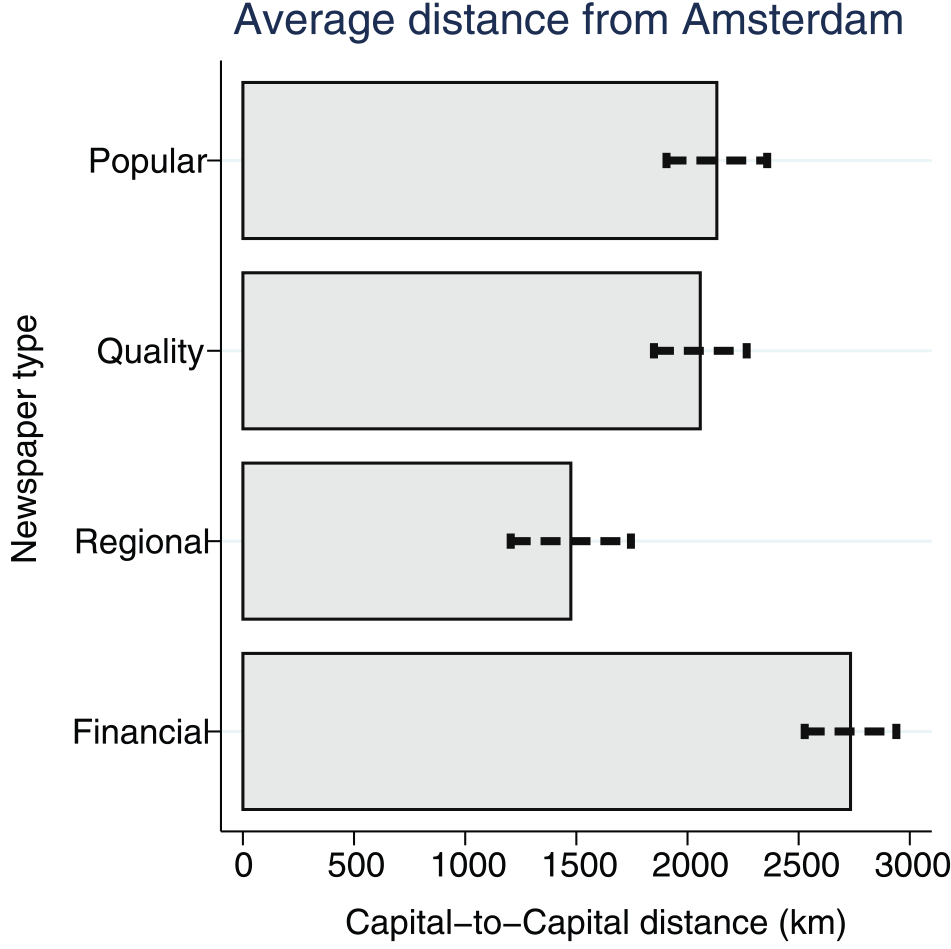
The average story’s distance from Amsterdam in kilometers with 95 percent confidence interval (dotted line).
Continuity
For continuity, we compare the coefficients of models that predict today’s issue attention (t1) by yesterday’s issue attention (t0) in the same outlet. Figure 8 presents the average of those coefficients across different types of newspapers. In all cases, the effects are positive, which indicates that issue attention in the past indeed predicts future attention for the same issue in the same newspaper.
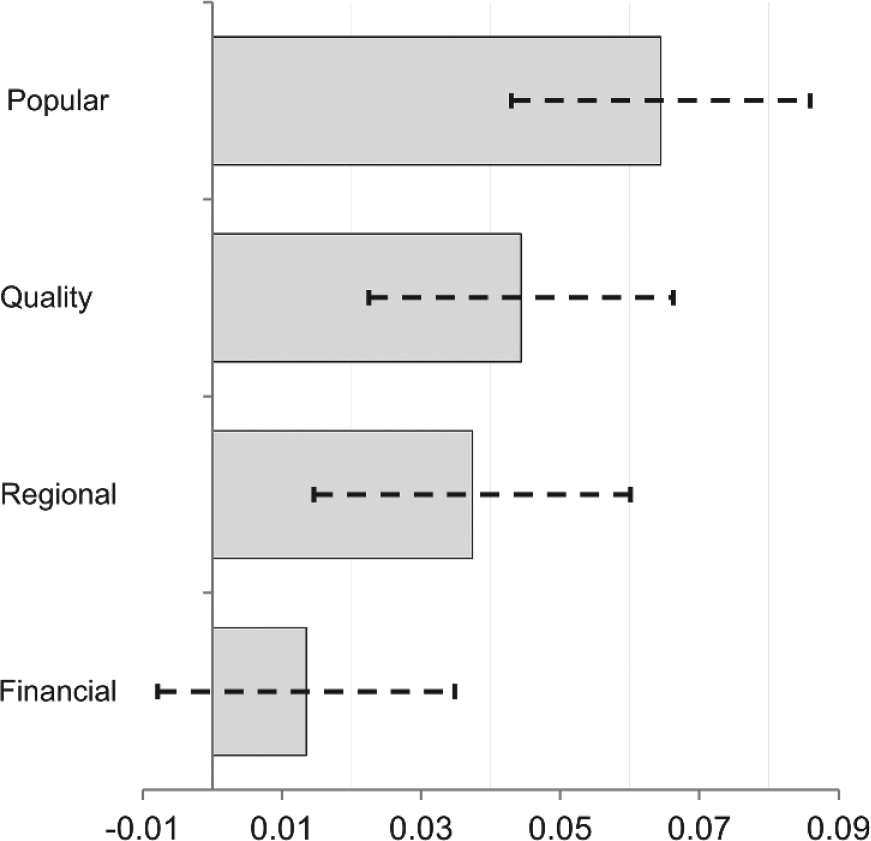
The average standardized effect of previous day’s topic coverage on next day’s coverage with 95% confidence interval (dotted line).
Continuity was indeed least strongly a predictor for the financial newspaper: The effect of continuity itself was not significant (p = .214) for this outlet, and at the same time was significantly weaker than the effect of continuity on coverage of the popular (p < .001) and the quality newspapers (p = .048). These results largely confirm Hypothesis 4a. The difference between the financial newspaper and regional newspapers was insignificant (p = .134), yet continuity had a significant effect for regional newspapers (p = .001), but not for the financial outlet.
Newsworthiness in general
An additive scale was created by summing the presence of all news factors listed above to investigate how newsworthy articles were overall. Continuity is not included, since it is not captured at the article level, which also explains its absence in Table 2. Altogether, this resulted in a scale ranging from a minimum of 0 (no news factors present) to 6 (all news factors present). On average, articles contained 2.28 news factors (standard deviation [SD] = 1.18) and only 5.5 percent of the articles contained no news factors.
Figure 9 shows how the overall newsworthiness of articles differs across outlets. The financial newspaper, clearly, had the fewest number of news factors per article (M = 1.97; standard error [SE] = 0.03, p < .001), which is in line with Hypothesis 4a. Regional newspapers, in contrast, contained most news factors (M = 2.44; SE = 0.03), which does not differ from the popular outlets (M = 2.41; SE = 0.03, p = .451). Both contained about 5 percent more news factors per article than quality newspapers (M = 2.31; SE = 0.04; p < .011).
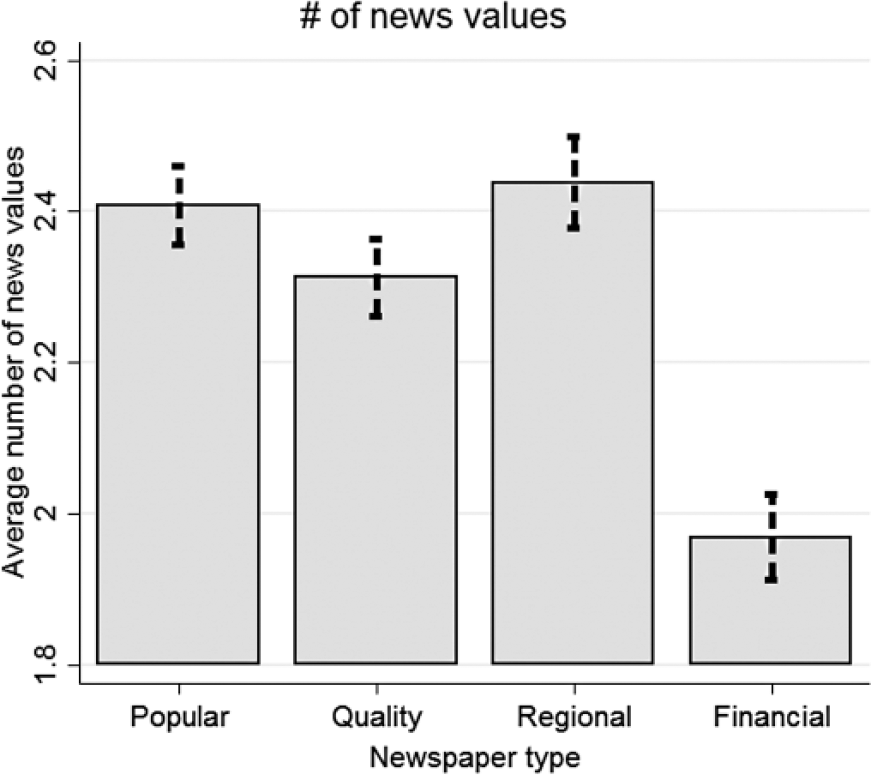
The average number of news factors with its 95% confidence interval (dotted line).
Discussion
Following Kepplinger and Ehmig’s (2006) two-component theory, this study demonstrates that different newspaper types attach different value to particular news factors. Relative to quality and financial outlets, popular newspapers especially emphasize personification, negativity, and geographical proximity. The first two are news factors that have been linked to the tabloid genre before (Lehman-Wilzig and Seletzky, 2010; Turner, 1999). Quality papers newspapers, in contrast, did not differ much from the other newspaper types on news factors that were expected to be most distinctive for them: Eliteness, influence, and relevance, nor controversy were found more frequently in articles of the quality newspapers, making these mainstream news factors.
Regional newspapers, in contrast, scored high on the same news factors as the popular newspapers. Whereas ‘a spill-over of tabloid news values from the popular to the quality press’ (Esser, 1999: 293) could thus not be detected, regional newspapers do focus on the so-called tabloid news factors: personification and negativity. As geographical proximity was found equally often in popular and regional newspapers, and potentially is of strong appeal to broad audiences, this news factor should be included in future considerations of what tabloid news factors would be.
The financial newspaper, as expected, relied the least on any of the news factors. Apparently, the financial outlet indeed operates with a distinct set of news factors (Manning, 2013). Economic news, by definition, is relevant for this specialist outlet, which makes the presence of news factors to construct stories as newsworthy less urgent (Doyle, 2006). This was even the case for the news factor of influence and relevance, perhaps because knowledgeable readers are able to infer the consequences themselves.
This study investigated how journalists employed news factors to construct newsworthy stories. It relied on a classification of news content characteristics that goes beyond more general news categorizations, such as ‘hard’ versus ‘soft’ news items (Otto et al., 2017; Reinemann et al., 2012). While some overlap exists between news factors and the distinction between hard news and soft news (i.e. some factors occur more often in one type of news, such as personification), news factors are more detailed characteristics of news content that most concretely contribute to insights into journalistic practices.
Previous research has also analyzed the role of news factors in decisions on journalistic selection. A content analysis, as conducted here, however does not suit this purpose (Bednarek and Caple, 2014; Eilders, 2006), because (a) news factors – except for proximity – are mostly subjective characteristics that rest on consensus (Staab, 1990), (b) sometimes are just elements of journalistic practice (i.e. news writing objectives, see Caple and Bednarek, 2013), and (c) a content analysis cannot uncover events that have not been selected to become news. Unless one investigates specific, comparable events with objectively documented properties (e.g. magnitude, damage, and proximity of earthquakes, see Koopmans and Vliegenthart, 2011), scholars should be in the newsroom observing and interviewing journalists while making their decision to cover an event (or not) when studying the role of news factors in the selection process.
Question for future research, hence, is what the consequences of particular news factors would be for subsequent journalistic decisions. One may expect that stories with more news factors will be published more prominently; for example, on the front page or in longer articles (Staab, 1990). Moreover, this study has been restricted to a study of news factors within one medium (i.e. printed newspapers) to assess differences across outlet types (i.e. popular vs quality vs regional vs specialist news media). Future research could extend this approach by investigating the differential use of news factors across medium types (i.e. newspaper, television, and Internet journalism). Research suggests that the news production process converges across medium types as journalistic content is increasingly produced with the different platforms in mind (Mitchelstein et al., 2015), which could lead to limited differences across platforms. For this study, though, printed newspapers offered an excellent case to assess how popular, quality, regional, and specialist journalistic outlets employ news factors differently in their construction of newsworthiness.
Footnotes
Acknowledgements
This paper has been awarded the ICA Journalism Studies Division Top Faculty Paper Award (1st place) in 2016. The authors thank two anonymous reviewers and Knut de Swert for their constructive feedback.
Funding
The author(s) disclosed receipt of the following financial support for the research, authorship, and/or publication of this article: This study has been made possible by a Vidi grant (project no. 016.145.369) from the Netherlands Organisation for Scientific Research (NWO).