




Abstract
Disruption and changes within the profession of journalism instigate boundary disputes. In this article, we analyse boundary work ‘in the making’, with the debate about membership rules within the Norwegian Union of Journalists as a case. The research question asked is: How do positioning and rhetoric in the membership debate evoke boundary struggles in journalism, and how do they reflect the internal professional hierarchy? Theoretically anchored in the sociology of professions, this study is based on qualitative text analysis of debate articles in the specialist magazines Journalisten and Medier24, as well as qualitative interviews. The findings suggest two main positions. On the one hand, a struggle to protect pure professional identity, values, and integrity. On the other, arguments regarding union power and impact and the contention that in today’s digital media landscape journalism in practice involves a wide range of competencies. The two positions suggest a tension between white-collar professionalism and blue-collar unionism. This study contributes to our understanding of the shifting boundaries of journalism, and how changes in external conditions also impact upon internal professional identity.
Introduction
The digital transformation of the journalistic field has re-energized discussion over what constitutes journalism in the modern age (Maares and Hanusch, 2020: 263). Journalistic identity becomes more complex as journalism as a concept, a communicative practice, a professional field, and a stable element in society, is in flux (Carlson and Lewis, 2020). Disruptions and changes propagate boundary work: the power to define reality and aims to demarcate journalists from non-journalists, creating distinctions between ‘us’ and ‘them’ (Carlson and Lewis, 2020). This raises pressing questions regarding what journalism is and who is defined as a journalist. It is also a rhetorical exercise utilized in all professions as a demarcation of territory (Carlson, 2015). Unions are the main actors in the self-structuring of journalists. Demers and LeCam (2006: 661) state that “journalists have built a professional group and defined a territory by constructing their own identity”. This identity is understood as the collective production of public discourses by the institutions of journalism, such as unions.
Journalism as a profession lacks firm borders (Carlson, 2015), and scholars describe it as a semi-profession (Ottosen, 2004). Due to this status, journalism has faced several processes of boundary work throughout its history, because social, political, economic, and technological developments have reshaped media environments and changed how journalism is carried out. Researchers have conducted a range of studies to explore and discuss boundary work from various angles, including the borders between journalism and public relations (PR) (Fredriksson and Johansson, 2014).
Unions serve as a safeguard for editorial principles, such as integrity and professional autonomy (Cohen and De Peuter, 2020). Through union organizing and membership, “news workers collectively structure and defend their norms, practices, and professional identity” (O’Donnell, 2022: 72). Unions also apply rhetorical strategies in their organizational, strategic communications (Salamon, 2022). For example, they shape and express professional norms, perceptions, identity, and boundaries. Scholars have therefore called for more research on the role of unions (Cohen and De Peuter, 2020; Coles, 2016). This article aims to contribute through an analysis of the discussion concerning membership rules in the Norwegian Union of Journalists. In 2020, a committee in the Norwegian Union of Journalists presented two proposals: a) change the union’s name to “The Media Association”, thereby removing the word journalist altogether, and b) extend the rules of membership to include those who work with content marketing. The proposal generated both protest and support among members, expressed through debate articles published in the specialized press Journalisten and Medier24.
In this article, we analyse this debate within the frames of boundary work, while asking the following research question: How do positioning and rhetoric in the membership debate evoke boundary struggles in journalism, and how do they reflect the internal professional hierarchy? The study will contribute to our understanding of the shifting boundaries of journalism and explain how changes in the external framework impact the way internal professional identity is negotiated, perceived, and understood. Furthermore, it will provide essential knowledge about union rhetoric, as well as how boundary disputes are conducted. An essential contribution lies in elaborating the tension between white-collar professionalism and blue-collar unionism. Norway has a democratic-corporatist media system with a high level of professionalism among journalists (Hallin and Mancini, 2009), and high union density. This makes it a relevant environment to explore in this regard.
Conceptual anchoring
Journalism as a profession is experiencing challenges and developments that impact on both professional work and the institution of journalism itself (Peters and Broersma, 2013). Journalism is characterized as a semi-profession because it lacks the formal criteria of a profession, such as licence protection and authorization demand (Ottosen, 2004). Abbott (1988: 8) understands professions as “exclusive occupational groups applying somewhat abstract knowledge to particular cases”. The level of exclusivity varies from profession to profession, and boundaries are a salient feature of the study of professions (Carlson and Lewis, 2020: 124). Although journalism lacks formal borders, it strives for internal cohesion and the right to reinforce its exclusivity through boundary work (Carlson, 2015). Journalism is a weak signifier rather than a clearly bounded universe of actors (Carlson and Lewis, 2020: 126), and it can be analysed as an area involving the discursive practice of boundary-negotiation rather than as a clear-cut profession (Riedl et al., 2021). Abbott (1988: 225) describes journalism as a permeable occupation that allows actors outside the profession’s boundaries to access some of its task areas.
Boundaries signify differences and create distinctions between ‘us’ and ‘them’. A related concept is jurisdiction, which Abbott (1988: 59) describes as a claim to legitimate control over a particular kind of work. “In claiming jurisdiction, a profession asks society to recognize its cognitive structure through exclusive rights”, he says. Threats to a profession are primarily the result of struggles over boundaries; about the rhetorical and material delimitations of insiders and outsiders, and what counts as ethical or acceptable practice versus what is deviant (Lewis, 2012: 837).
Gieryn (1983: 782) defines boundary work as “the attribution of selected characteristics to the institution of science for purposes that distinguish some intellectual activities as ‘non-science’”. According to him, professional boundaries are always contested and transformed by tension, and therefore he focuses on their construction and negotiation (see also Lewis, 2012). He defines three processes of boundary work: expansion; expulsion; and protection of autonomy. While Gieryn writes about science, Carlson applies the concept to journalism in several works (Carlson, 2015; Carlson and Lewis, 2020). According to Carlson and Lewis (2020: 127) expansion involves incorporating non-traditional journalists, whereby certain actors, actions, or norms and beliefs become accepted as journalism, and expand its borders. Expulsion entails expelling deviant forms and values; therefore, some actors, actions, or norms and beliefs are rejected as not being journalism. Protection of autonomy occurs when certain actors or actions, as well as particular norms, outside journalism, are considered a threat to it. Here, the aim is to prevent non-professionals influencing journalistic work and judgments (Mathisen, 2022).
The concept of boundary work relates to professional self-understanding because boundary disputes are primarily a discussion of identity markers (Tandoc and Jenkins, 2018: 4). Journalists’ professional identity is tied to shared knowledge, understandings, and experiences shaped through socialization. It is a product of the norms, practices, and statuses tied to a professional ideology (Evetts, 2013; Fredriksson and Johansson, 2014; Wiik, 2015). Labour and organisational changes challenge the traditional definitions of journalism (Deuze and Witschge, 2018). Journalism finds itself in an era of liquidity, in which constant change affects journalists’ professionalism, resulting in an increasingly negotiated identity as the profession faces new ways of working and new skills (Kantola, 2016).
Studies elaborate on boundary work in journalism, highlighting twilight zones (or blurred areas where journalism and other societal fields or work overlap, and where journalistic norms are contested (Maares and Hanusch, 2020: 264). Several studies have focused on the relationship between journalism and PR. Although some scholars have found that journalists have a rather hostile attitude towards PR professionals (Fredriksson and Johansson, 2014; Sallot and Johnson, 2006), others have underlined that the boundaries between journalism and PR are frequently overcome or negotiated. Studies have demonstrated that professionals often shift from journalism to PR, and that freelance journalists accept assignments in both fields (Fröhlich et al., 2013; Mathisen, 2018).
When boundaries are threatened, professional values, norms and principles are homogenized (Fredriksson and Johansson, 2014; Wiik, 2015), and the theoretical lenses of the sociology of professions serve as a constructive analytical tool. From this elaboration of boundary work, we move on to scrutinize the role of unions.
Literature review
Journalism unions play a vital role in constructing professionalism and identity. Unions constitute a vital hub in the professional community, even if major journalist unions are experiencing declining membership (Cohen and De Peuter, 2020; Neilson and Heylen, 2023; Salamon, 2023a, 2023b), and especially younger journalists are less likely to join (O’Donnell, 2022: 69). Scholars have elaborated on the role of journalists’ unions, several of them within the theoretical framework of critical political economy (Cohen, 2016, Cohen and de Peuter, 2020; Coles, 2016; Salomon, 2023a). Trade unions are powerful organizational institutions upholding both solidarity and professional standards, and quality media content (Salamon, 2023a: 186). Unionism and collective organisations have been a defining feature of journalism globally for over a century (O’Donnell, 2022: 66), and unionism and professionalism have played a stabilizing role in the configuration of journalism and its identity (Demers and Le Cam, 2006: 671).
Unions deal with questions regarding wages, working conditions, professional ethics and guarding journalistic autonomy (Elsaka, 2005; Harcup, 2002). Thus, unions serve a dual role, expressed through a tension between professionalism on the one side and industrial objectives on the other: a struggle over “whether unionism or professionalism would best advance the interests of journalists as an occupational group” (Elsaka, 2005: 84). Demers and LeCam (2006: 664) describe a discursive strategy of the journalist union in Quebec, where the union constructs its identity through a constant duality between professional and unionist conceptions of the journalistic occupation.
External sources of disruption impact upon unionism, and how journalists collectively structure and defend their norms, practices, and professional identity through union membership in the context of the digital transformation (O’Donnell, 2022: 72). Salamon (2023a) discusses a historical tension in unions, between class consciousness and professional identity on the one side, and an economic orientation and professional orientation on the other. He states: “These tensions are evident in analysis of journalists’ conflicting occupational ideologies and collective strategies” (187). This is also understood as a historical tension between white-collar and blue-collar unionism (Salamon, 2023b). Blue-collar unionism was embraced by working class printers, emphasizing issues like fair wages and collective interests, while white-collar unionism was adopted by middle-class journalists, who privileged mental labour over material gains and a dedication to the craft of journalism above collective interests (Salamon, 2023b: 5583). Also, Örnebring (2022) discusses how journalists historically have resisted to identify themselves as industrial workers, rather concentrating on social status, respectability, and identity issues.
Coles (2016: 469) examines the unions within the film and TV industry, researching how cultural workers participate in the construction and contestation of the creative economy at the policy level. She is concerned with unions as the collective voice and discusses how the unions become both objects and agents of the creative economy and the policy frameworks that shape it. “Unions face both structural advantages and impediments as policy actors, which shapes their ability to defend class interests as social movements”, she concludes.
Cohen and De Peuter (2020: xii) suggest that if journalism is to have a future, it must be organized. Contemporary unionization in journalism represents continuity through change rather than disruption and novelty. They study unionizing among journalists in Canada and the US and underline that “media workers’ commitment to unionization is often tied to wider issues and aspirations – sustainability, accessibility, equity and integrity, for example – and the call to raise labor standards across the digital media industry” (80).
Even if unions are researched in the scholarly literature, as shown in the literature review, still, researchers stress the need to build a body of research on unions (Coles, 2016). Researchers call for more emphasis on the language and communicative actions of unions (Salamon, 2023a; 2023b), as well clarifying the nature and boundaries of journalism “by giving greater attention to the collective organisation of journalists” (O’Donnell, 2022: 75). As unions represent essential definers of basic premises in journalism and boundary work constitutes just such a communicative action, a study of the boundary struggle within a union contributes to this body of knowledge.
The Norwegian context
When analysing the Norwegian Union of Journalists, it is important to understand the Nordic model of work-life, in which conflict between employers and workers is institutionalised through labour market organisations, and where unions and employer organisations see each other as legitimate adversaries (Hvid and Falkum, 2020). However, neo-liberal understandings and regulatory principles have affected the Nordic model, leading to more unpredictability and instability, although to a lesser extent than in other countries (Hvid and Falkum, 2020).
Union density in Norway is relatively high, around 50% of the workforce, and gradually decreasing. Union density remains high among journalists though, with about 90% of the journalists being organized. In 2021, the union surpassed 8000 members. Still, due to downsizing and cutbacks resulting from media crisis, the number of members decreased by 1500 between 2011 and 2019, a drop of 20% (Mathisen, 2022).
As the dominant professional organisation for Norwegian journalists, the Norwegian Union of Journalists (NJ) plays an important role in defining the boundaries of journalism. However, throughout its history, the union has faced several boundary struggles (Ottosen, 2004: 207). With the growth of the information and PR industry, urgent questions began to emerge at the beginning of the 1980s regarding the borderlines around journalism. The union’s 1983 National Assembly decided that the NJ should be “dominated” by journalists, with limited access for information workers and certain newsroom-adjacent groups.
Discussions continued about whether the content or the location of one’s work should determine qualification for NJ-membership. The 1997 National Assembly decided that the members must have a job in which they are able to make autonomous professional judgments and exercise discretion. For the first time in the union’s history, existing members were excluded in a process called “ethical cleansing” (Raaum, 1998). Ottosen (2004) argues that this exclusion of members working in communication must be analysed as a symbolic action, rather than a principled one, because it was done primarily to demarcate the “manipulative” function of information work, and to demonstrate that journalism was about free journalistic choices and decisions. Through these actions, NJ mounted a strong defence for the claim that journalism was fundamentally different from other types of information work.
In 2019, the NJ’s national board decided to set up a committee to investigate the advantages and disadvantages of changing the name of the organisation. This forms the focus of our research. The mandate was designated a so-called “B-case”, meaning that the committee’s work and documents were exempt from public disclosure, on the grounds that it could provoke other unions. Hege Fagerheim, who led the committee, described the creation in the following way: At the national assembly in 2019, I picked up that there was some dissatisfaction among members and union representatives, who worked with production (in the Norwegian Broadcasting Corporation, NRK) and did not feel very included. So then at the national assembly we adopted an action plan, and at a point that was about our organization and organizational development. It was said that we should take greater account of the changes that we have seen in the industry.
In June 2020, the committee delivered their report, which highlighted arguments for and against renaming the organisation. In the end, the committee suggested a name change to better reflect the diversity of professional groups and functions among its members, altering the statutes to ensure that groups that did not currently qualify for membership could become members. Such a debate over name change is not limited to the Norwegian case. It is a significant trend within the history of journalism and union convergence since the 19th century and being a core part of jurisdictional disputes (Salamon, 2023b). For example, the American Newspaper Guild changed its name to the Newspaper Guild, and thereafter to the News Guild. Salomon conceptualizes labour convergence as a set of trade union ideological values associated with the newsworkers’ organizing process, and states that this perspective have been underdeveloped in journalism studies (Salamon, 2023b: 5582).
In June 2021, the national board decided to facilitate a process to enable the 2023 national assembly to make a qualified decision on possible changes to the membership rules and the union’s name. They set up a second organisation committee, which Hege Fagerheim also headed. The mandate for the new committee was to collect, systematize, and assess, the different decisions and proposals, and to facilitate sufficient information flow and involvement throughout the entire organisation. The aim was to give the national board a clear recommendation in 2023. In June 2022, their proposals were sent for a formal hearing, where local union branches and individual members could respond. Here, the proposal to change the union’s name was rejected because of substantial resistance in the union. The proposal also omitted commercial groups, hence discarding the most radical and conflictual suggestions.
Data and methods
In their studies of boundary work, Lewis (2012) and Carlson (2015) called on scholars to examine the discourses used to re-articulate the professional logic of control. As a result, in this research we applied a qualitative research design, consisting of text analysis and interviews, in which the texts constitute the primary data. All texts were published in the specialized press journals Journalisten and Medier24, which we chose strategically because they represent essential arenas for the professional debate in the field of media and journalism. We conducted the sampling manually. The data includes 41 articles published between November 2020 and May 2022 (25 in Journalisten and 16 in Medier24) and consists of commentaries (26) and news stories/interviews (18) with various actors sharing their views and perceptions of the discussion.
In addition, we conducted qualitative interviews with two central actors in the debate: Hege Fagerheim, who was leader of the first committee – and is currently the deputy chair of the union – and committee member Christian Sørgjerd. With the interviews, we aimed to provide context and background information. The interviews were conducted face to face, with both researchers present, were recorded and thereafter transcribed.
We conducted qualitative argumentation analysis/rhetoric analysis to analyse the texts (Bergström and Boreus, 2000). Based on Stephen Toulmin’s model (1958, explained in Bergström and Boreus, 2000), we intended to elaborate on the claims used to construct the argument, including points that were raised in the debate. We set up a schema for each text, in which we identified the claims, arguments, and the premise the arguments relied on. In addition, we explored the words, concepts, and expressions used in the debate, to further scrutinize the rhetoric used. This analysis is inspired by Johnson and Kelling’s (2018) analysis of the discourse employed in texts as editorials, columns, and op-eds distinguishing institutional journalism from postings on Facebook. Also, Salomons (2022, 2023a, 2023b) analysis of union rhetoric and convergence has been an inspiration.
In addition, we identified the participants: all debaters who gave their full names, (eventual) position in the union, as well as their place of work. This information was easily available.
Of course, an analysis of 41 texts has its limitations. The debate outside the specialist journals, such as on social media and in physical meetings in the union branches at workplaces, is excluded from the study. On social media, the debate continued in the comment fields, especially in a closed Facebook-group for journalists in Norway. However, this debate is not available to the public, whereas Journalisten and Medier24 publish all their columns on accessible platforms without paywalls and thus constitute a front-stage debate. We found that the positioning and arguments brought to a public arena were of most significant interest, as they aim to convince colleagues and peers, and to position the profession in public debate.
Findings and analysis
In this section, we elaborate on and discuss our findings. First, we analyse which positions were taken. Second, we delve into the rhetoric and explore the words and expressions. Third, we focus on who is participating and which perspectives and parts of the union they represent.
Two main positions
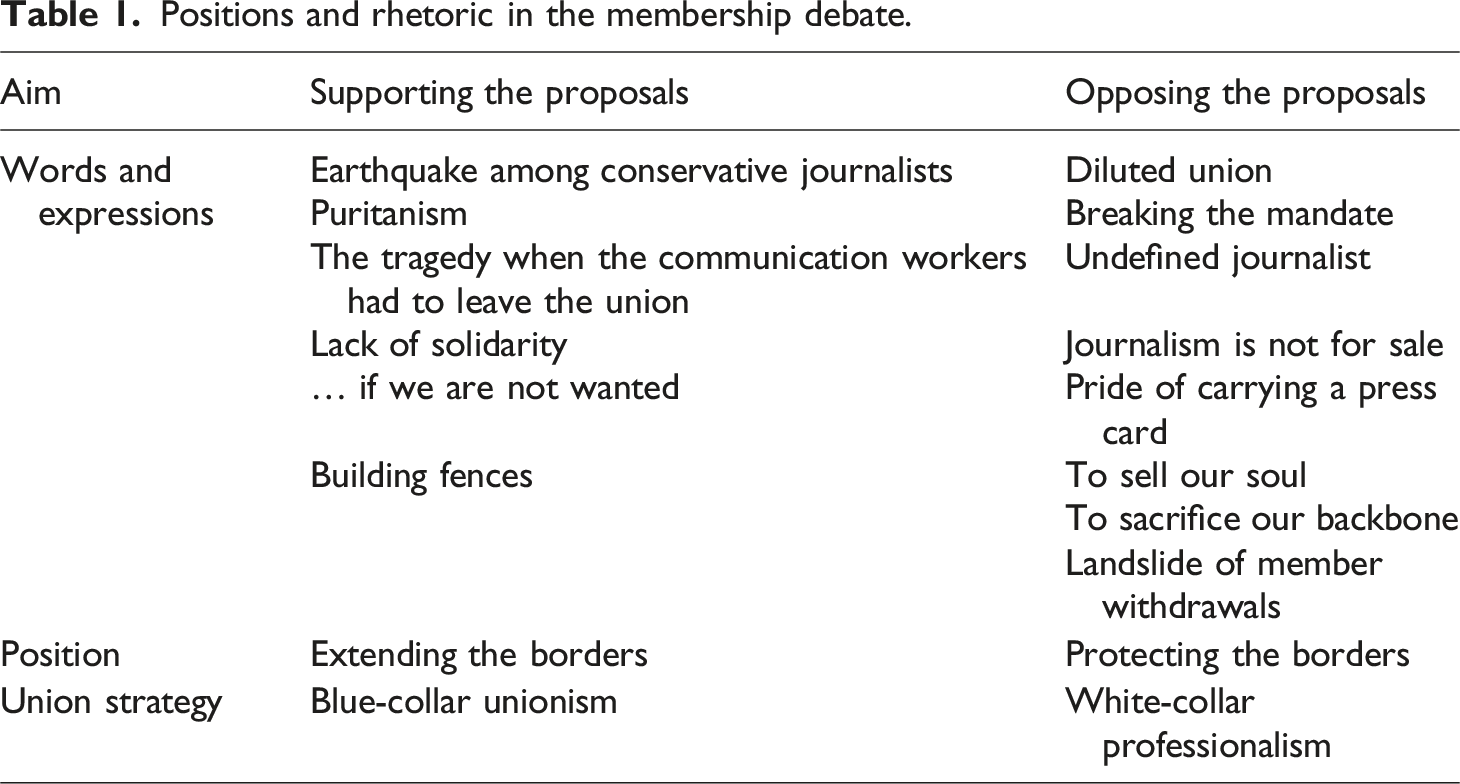
Positions and rhetoric in the membership debate.
Protecting the borders
On the one hand, there are a wide range of arguments for keeping the membership rules as they were rather than changing the union’s name. A fundamental premise in this argument is that free and independent journalism fundamentally differs from other forms of content. “Journalism is not for sale”, as one proponent argues: “An advertisement or paid content is possible to buy. Doubts should never be raised as to whether journalistic content is for sale.” (Article 3).
Journalistic integrity is held up as a significant value. One journalist writes: “I do not want to be a diluted journalist.” He also argued for the societal need for credible journalism: “In a present full of tensions and fake news, it becomes even more important to be a journalist with integrity.” (Article 6).
The participants on this side argued that we need to protect pure journalism, and they fear dilution will harm the profession and wider society. One journalist stated: The voice of The Norwegian Union of Journalists in public debate, as a defender of journalism and as a premise defender of the societal role of journalism, will be fundamentally weaker if we are going to be a union embracing those making paid content (Article 4).
The participants in this camp draw the borders of journalism around the professionals exercising free and independent professional discretion, and erect fences towards those working in the commercial fields producing paid content. “There has to be a clear distinction between journalism and commerce”, one stated. Another journalist asserted: “Journalism is the core that unites us. A media association for non-journalists is a pointless proposal” (article 14). Another warned against watering down the concept of editorial work, drawing the lines back to former struggles regarding membership: Both in 1988 and with the expansion in 1997, exercising editorial or newsroom work was a guiding principle. […] A journalist is a person doing editorial work. (Article 23)
He also argued that membership implies a commitment to professional ethics, guided by the Code of Ethics and Rights and Duties of the Editor.
Another had the same concern: According to the Code of Ethics, the individual editorial staff members shall protect independence, integrity, and credibility. I cannot in my wildest imagination see that this demand is fulfilled by those working with content marketing because that is not their task. Their job is about making commercials. (Article 6).
One union member of 40 years even started a petition to reject the proposal. In an interview with Journalisten, he warned that many members would leave the union if the proposals were implemented (Article 7).
Several of the opponents argued for the pride in being journalists. For example, one stated: “I remember the pride when I received my first press card, the proof that with words as a weapon I was fighting for the weak ones in society, being independent and critical towards power” (Article 8). “Journalist” is described as an “honorific title”.
When boundaries are threatened, professional values, norms and principles are homogenized (Fredriksson and Johansson, 2014; Wiik, 2015). Those who raise their voice against the proposals demarcate and protect the borders of journalism by arguing about the importance of professional values and ethics. Through these arguments, journalists “are concerned about the impact of sponsored content on their craft” (Cohen and De Peuter, 2020: 9).
Their aim is to prevent non-professionals influencing the understanding of journalism, and to argue that journalism and commercial content are substantially different. They frame journalism as something honourable, and a vocation of which to be proud, and they therefore fight against an expansion of the union, based on arguments similar to the former struggle when PR-professionals were excluded (Ottosen, 2004; Raaum, 1999). They claim that if the proposal of new rules is approved, many members will leave the union.
Unions serve a dual role, expressed through a struggle between unionism or professionalism (Demers and Le Cam, 2006; Elsaka, 2005; Harcup, 2002). Arguments for protecting the borders might also be seen as an expression of white collar professionalism (Salamon, 2023a: 187). The chosen strategy on this side is to protect professional identity and autonomy and prevent an expansion (Gieryn, 1983).
Expanding the borders
On the other side, participants argued for the need to expand the union. A vital premise in this argumentation was that journalistic practice has become more varied and complex, which the membership rules need to reflect. For example, they mentioned programmers and documentary directors creating editorial content. One described the scope of work especially within the broadcaster NRK: We are employees that absolutely are producing journalistic and relevant content. We relate to the editors, ethical guidelines and the Code of Ethics. We are writing, directing, filming, cutting drama series, sitcoms and other programmes. We are casting actors and are dubbing foreign animations […]. In our contracts, we can read that the most of us are hired as journalists. (Article 18).
As with the opponents, this participant also argued about identity. But here the lack of identity is the issue. He emphasized that many media workers perceive the NJ as a union only for those working in news, primarily in newspapers, and therefore do not feel at home nor welcomed in the union. He wrote: “Neither the name nor the first impression convinced me that this was the union for me” (article 18). Participants for this side of the debate claim that many newsroom professionals feel alienated: We also need the regular employed technologists, directors, producers, clippers, illustrators, animators, graphics, researchers, columnists, technicians, and developers that work with journalism (Article 17).
This quotation, and the previous one, concern the breadth and variety of journalism. A vital premise is that journalistic activity has become more complex, and that it is not only traditional news journalists who perform journalism or adhere to professional ethics. The proponents of expanding the boundaries argue that changes in media work require new membership criteria. One participant wrote: “The principle of free and independent journalism does not have to be given away even if the union is changed.”
It was also argued that a new name would better reflect the union’s actual membership: “The Media Association is the best proposal in a long time, since we can start to discuss how many there are who work with journalism but do not feel at home within the union,” (article 17). A new name reflecting the expansion is considered more inclusive for potential new members.
Another argument brought forth concerns about size, impact, and power: the larger the union is, the stronger its effect on negotiations with the employers is likely to be. Here, the participants argued that relaxed membership rules would lead to a substantial increase in members. One stated: “When you have the same employer and the same counterparty in negotiations, it becomes unnatural to build fences and state that some are not allowed to be part of it” (article 5). A second argued: “A larger union will secure us more power in negotiations,” and a third wrote: The fundamental task for a union is to secure good working conditions, wages and that the Working Environment Act is complied with. In addition, the Norwegian Union of Journalists has undertaken the mission of working for integrity and press ethics. This mission can still be fulfilled, even if new members are allowed entrance. It is permitted to bear two thoughts in mind at the same time” (Article 11).
Trade unions have long been powerful organizations for building worker resistance, solidarity, and improving working conditions (Salamon, 2022: 186). One this side, the arguments express an economic orientation, where journalists are blue-collar workers, and working conditions and pay are the most substantial tasks for the union (Harcup, 2002; Salomon, 2022). They argue for an expansion-strategy, because a larger union will be better at securing the best working conditions for the members, in line with blue-collar unionism.
However, not all the participants took a stance for or against the proposal. We also identified some articles questioning the process without taking a clear position. Here, principles regarding the way the proposal threatens internal union democracy were raised, such as whether it could be decided through a digital National Assembly or not (due to COVID-19-restrictions, the National Assembly in 2021 was organized on Zoom). Among others, the union’s leadership emphasized: “The debate about the future of The Norwegian union of journalists shall be wide, open and free.” (article 41). They stated that substantial changes require a wide and thorough process. “Calm down” urged one member, who stated that the process needed time to be carried out properly (article 20). He warned against making the final decision at a digital assembly and exhorted the national board to give it more time. One member argued that the process itself had been weak and characterized by a lack of transparency. The premise here is that the time could be ripe for such a union debate, but that the process obscured more than it revealed, and an unclear and weak process might engender distrust and uncertainty. This in-between position also indicated that the debate over name change was rhetorically and politically motivated.
Rhetoric in the two arguments
Through words and expressions especially in the columns, the rhetoric emerged as heated, hard, and confrontational. Some of the columns were answers or reactions to former ones, and the debate went back and forth. The words and descriptions used were quite loaded and characterized by pathos. For example, one of those opposing the proposal wrote: “Not only shall we sell our soul, obviously we shall also sacrifice our backbone” (article 8). They feared “a dilution of journalism.” One foretold a “society overwhelmed by floods of fake news.” (article 6). Another stated: “There is something unsolved and inconsistent in the committees’ work.” (article 9). One characterized the transformation of journalists into media workers as “a kneeling.”
On the other side, one participant wrote: “If the professionals I describe here are not wanted within the union, let us know so we can find other solutions.” (article 18) They went on to state: “It is quite sad if journalists fear that it will defile the profession if they share the union with others.” This illustrates how boundary work creates distinctions between us and them (Carlson and Lewis, 2020).
Regarding the proposal’s opponents, those supporting it described it as an “earthquake among conservative journalists” (article 17), and asked “Where is your solidarity, journalists?” (article 11). Another recalled “…the tragedy when the communication workers had to leave the union” (article 18), referring to the decision at the 1997 convention (Ottosen, 2004). It was clear that the wounds of the former boundary struggle still festered and constituted a vital background for this present one. Our study suggests a heated rhetorical struggle between the two opposing sides was designedto convince others in the debate and disparage one’s opponents. It also suggests the contested nature of union identity, as well as for journalist professional identity.
Who participates?
In the discussion above, we shed light on the arguments and positions brought forth in the publications. In addition, our aim was to elaborate on who raised their voices. We found that regular NJ members were the most active participants, either as writers of debate articles or main sources in news stories. The NJ leadership was also represented. Their role was often to calm the discussion, by stating that this would be a thorough process. They also frequently clarified what the suggested changes mean, typically right after a heated attack from someone against the proposed changes.
A prominent feature of the most critical voices was that they come from veterans or experienced journalists, several of whom hold former positions as union representatives at various levels, and they often bring this experience in as a premise or ethos in the argumentation. They mostly work in large, national media outlets, or as freelancers. On the other hand, the voices that were positive about the suggested changes were often on the fringes of the journalistic profession, such as photo freelancers and content producers in the national broadcaster NRK. Interestingly, we found freelancers in both camps. Medier24 and Journalisten referred to a meeting held by the freelance department of the union, where several participants feared that if the union opens itself to “every Tom, Dick and Harry”, union membership would lose its value and prestige, leading to a “landslide of member withdrawals”.
Members of the various committees working with the proposal were mainly absent in the debate articles but appeared in four news stories as main sources. When investigating who participated, it is also worth noting which voices are not present in the debate. One aspect here is geography. There are very few voices representing the full spectrum of local and regional media. The Norwegian media landscape includes about 200 local and regional newspapers, where a substantial number of Norwegian journalists work (Mathisen, 2022). In the socially stratified hierarchy of the profession, local journalists are described as belonging to a less prestigious part of the profession, whereas those working in the large, national newsrooms possess more professional prestige, as well as wielding symbolic capital to define the profession (Hovden, 2008). Mostly, the participants in this debate were located in the central parts of the country and worked in the large media companies.
Another aspect was union leadership. As stated above, the leadership was present, mostly related to the process. Christian Sørgjerd, member of the first committee and the one who fronted the suggestion to change the name, criticized the union leadership for being too passive in the debate. In the research interview, he said: It’s too harsh to call it an admission of failure, because it wasn’t, but it was like that… […] If you stand as a candidate for leadership in NJ without participating in the public debate on such important issues, you are in practice saying that this is not so important. And then you also send a signal to the entire organization that this is not that important. So, there is a kind of mild criticism on my part, of the NJ leadership. […] Why have you commissioned this committee to deliver a work when you don’t go out and argue either for or against the committee’s conclusions afterwards?
It is also worth asking why the proposal did not engage a larger part of the union. Even though the debate was heated and intense, only a few of the 8000 members participated. Of course, there might have been a large engagement expressed in social media debates and in the various local branches, which are outside the scope of this study. Regarding union democracy, the forums in local branches, and local and regional meetings, are important. Still, the open debate published in the specialized press constitutes a vital arena both to convince one’s peers and to position the profession in public discourse.
Concluding discussion
In this article, we have answered the research question, How do the positioning and rhetoric in the membership debate evoke boundary struggles within journalism, and how does this reflect the internal professional hierarchy? The boundary work determines which actors should be perceived as journalists, and what kind of practice should be regarded as journalism. Vital background information to bear in mind are the fundamental changes in the journalistic field caused by the digital transformation and the media crisis which have led to downsizing and shrinking numbers of union members. We explored how professional identity is negotiated, perceived, and understood in a rather agitated debate between two main positions, in a rhetorical exercise to demarcate the profession’s territory (Carlson, 2015).
The opponents struggled to maintain a clear boundary around journalism, demarcating the substantial difference between free, independent journalism on the one side and paid content on the other – the distinction between us and them (Carson and Lewis, 2020). This was a narrative that separated insiders from outsiders (Johnson and Kelling, 2018). The opponents held that the union also had to protect the credibility of journalism as a societal mission. Here, arguments related to professional values, norms, and identity were forcefully made, and the rhetoric also encompassed threats to leave the Norwegian Union of Journalists if the proposed changes were carried out. This resistance can also be seen as protection of professional, journalistic autonomy; a struggle to prevent non-professionals – in this case those working in the commercial fields – from influencing the profession’s work and judgments (Carlson, 2015; Gieryn, 1983).
On the other hand, the supporters argued about the union’s size, impact and strength, and emphasized the union is mainly responsible for wages and working conditions. The supporters attempted to expand the borders of journalism (Carlson, 2015; Gieryn, 1983), arguing that journalism has increased in complexity and become multifaceted, which the membership criteria and the union’s name must reflect. Here, technological developments resulting in new tasks and work forms are emphasized.
On both sides, we found a rather emotional rhetoric, including attacks on the counterparts of the other side. The debate became passionate, evoking emotions connected to professional identity.
Unlike in the former boundary struggle in the Norwegian Union of Journalists, expulsion of members was not an issue. Rather, this debate was a struggle for or against expansion. On one side, we found those patrolling and protecting the existing borders, fearing that an expansion would damage the union’s brand as well as the trust in, and credibility of, journalism. This serves as an example of how professional ethics are reinforced in the face of external threats (Wiik, 2015). On the other side, the participants strove for expansion, highlighting that professional work changes and developments require new forms of competence and skills (Deuze and Witschge, 2018).
Labor organizing is not just about improving working conditions for individuals, it is also a broader effort to build organizational infrastructure (Cohen and De Peuter, 2020: xii). Through union organizing and membership, news workers collectively structure and defend their norms, practices and professional identity (O’Donnell, 2022: 72). The two opposing positions in the debate suggest a tension among journalists between occupational ideologies and collective strategies (Salomon, 2022: 187), or between white-collar professionalism and blue-collar unionism. The boundary struggle also awoke a schism within the union over which strategy to choose: to be a large, empowered union viewing a wide range of media professionals as blue-collar workers, or to protect journalists’ professional identity, autonomy and ethics, keeping sponsored content outside the journalistic craft (Cohen and De Peuter, 2020). This debate over union name change is also significant within the wider context of union convergence (Salomon, 2023b). As boundary struggle is a demarcation of who gets to be defined as a journalist, the tension between the white-collar or blue-collar orientation is also a struggle of where to draw the boundaries of journalism.
The boundary struggle is a discursive negotiation of what makes a profession (Riedl et al., 2021), in which some specific positions emerge, and the union applies its communicative and rhetorical strategy (Salamon, 2022). Boundary work also invokes an internal professional hierarchy. A relevant discussion is whether this union debate reflects the socially stratified field of journalism (Hovden, 2008), between the pure and the more ‘deviant’ parts of the profession. Those who are fighting to keep the borders firm mostly represent the larger, national media, carrying out traditional journalistic work. Several members of this group are also former union representatives at various levels. Meanwhile, those supporting the proposed changes represent a larger variety of journalism, encompassing ‘new’ and more technical areas. Therefore, boundary work involves internal professional control or power over definition as well as border patrolling and demarcating territory to prevent intrusion by outsiders.
However, it must be underlined that this is a rather roughly drawn description of the participants, overlooking the many nuances in the debate. For example, freelancers are represented in both positions. Future research may also find it worthwhile to reflect on the many silent voices.
During our work with this project, the most radical proposals were abandoned, and the debate ceased. Still, this debate showed that journalism is a constantly shifting denotation (Carlson and Lewis, 2015: 3) and an interesting example of how the transformation of the journalistic field fuels an enduring boundary struggle. External forces and changes in the newsroom challenge how we think about journalism and journalistic work. Both sides are concerned with the same goal: the resilience of the profession and the union. However, they see different roads leading towards this goal: a narrow or a wide union, the understanding of journalists as white-collar professionals or blue-collar workers, and exclusivity or inclusion. Because the journalists’ union is a vital marker of professional self-perception, this kind of struggle is well suited to illuminate the complexity of journalistic identity, and show how disruptions and changes in media work challenge the understanding of journalism.
Footnotes
Declaration of conflicting interests
The author(s) declared no potential conflicts of interest with respect to the research, authorship, and/or publication of this article.
Funding
The author(s) received no financial support for the research, authorship, and/or publication of this article.
