



Abstract
Political podcasts have captured a global audience and emerged as an important innovation space in journalism. One of the most popular formats is the ‘extended interview podcast’. This study employs conversation analysis to examine how this format has been used to facilitate more personal and informal encounters between journalists and politicians who are usually associated with the accountability news interview. BBC Radio 4’s podcast ‘Political Thinking with Nick Robinson’ is used as a case study. The analysis shows that Political Thinking provides a discursive context for politicians to construct and perform their personal identities, in contrast to their traditionally more formalised political performance as institutional representatives. The looser structure of the podcast, relative to the tightly scheduled news interview, affords Robinson the discursive space for more reflexive handling of politicians’ personal narratives. Talk is mutually co-operative and conversational. Similarly to the celebrity talk show Political Thinking has an experiential focus, oriented towards the narrative exploration of personal experience as a device to contextualise politicians’ careers and value systems. This is complemented with more playful sequences in which Robinson collaborates with politicians to curate their non-political identities and reveal details of their personality that may help the audience to see them in a new light. Through this process, politicians become personal storytellers, whose thoughts, emotions and non-political identities are brought to the fore above issues of policy and current affairs. In turn, Robinson allows politicians to bridge the gap between their institutional identities as politicians and their personal reflections as individuals.
Introduction
Political podcasts have captured a global audience and are one of the fastest growing areas of media consumption (Newman and Gallo, 2020). In journalism, podcasting has emerged as an important innovation space, with the format well suited to experimentation in form, practice and style due to its freedom from the constraints of the broadcast schedule and established conventions (Lindgren, 2023; Miller et al., 2022). Within this space, a platform is emerging for different kinds of mediated encounters between public figures and journalists, often characterised by a more personal and informal approach (Smith and Higgins, 2020: 192).
One prominent British political journalist who has intervened in this space is former BBC political editor Nick Robinson, who, in 2017, launched Political Thinking with Nick Robinson (hereafter Political Thinking), a BBC Radio 4 podcast. Political Thinking is part of the popular personality led ‘extended interview’ genre, exemplified by podcasts such as The Joe Rogan Experience (2009-), Alastair Campbell and Rory Stewart’s Leading (2023-) and James O’Brian’s Full Disclosure (2019-). On the podcast, Robinson interviews politicians about their personal backgrounds and life experiences, and how these shape the way they think about and do politics. While these interviews are performed by Nick Robinson, a journalist best known for his news interviews, and the interviewees are political actors, and the talk topicalises the world of politics, these are not news interviews as would traditionally be convinced. This is because they are not tied to the here-and-now of current events which the journalist can hold the politician to account for. Such news talk does occasionally occur on the podcast, but it is rare. Instead, these interviews more closely resemble the norms of experiential interviews, focused on constructing accounts of personal experience (Montgomery, 2007: 155). In Robinson’s own words, Political Thinking allows politicians to “speak human” (Robinson, 2020a), listening to “what they’ve got to say beyond(…) the daily news interview” (Robinson, 2019c).
Adopting a broadcast talk lens, this article analyses Political Thinking to demonstrate how the experiential format is locally accomplished through an evolving set of discursive practices. This analysis is noteworthy for two primary aspects. First, the article expands the body of research concerned with interviews with politicians outside of a news context (Baym, 2013; Eriksson, 2010; Loeb, 2017) by exploring the ‘extended interview podcast’ as a new discursive context in which these encounters take place. Second, the article adds to the limited amount of scholarship that has applied a broadcast talk approach to the study of podcasts (Jarrett, 2009; Smith and Higgins, 2020). To this point, the literature concerned with analysing podcast texts has primarily deployed less granular methodological frameworks such as qualitative textual analysis (Miller et al., 2022) and close analytic listening (Lindgren, 2023; Spinelli and Dann, 2019), which while valuable, obfuscate the role interaction plays in the local creation of podcasts.
Overall, this article argues that Political Thinking provides a discursive context for politicians to construct and perform their personal identities, in contrast to their more formalised political performance. The looser structure of the podcast, relative to the tightly scheduled news interview, affords Robinson the discursive space for more reflexive handling of politicians’ personal narratives. Talk is mutually co-operative and conversational. Discussions focus on the exploration of serious political biography, aimed at revealing the origins of a politicians’ values, and more informal and playful sequences aimed a revealing unexpected hidden identity characteristics. Through these interviews, Robinson allows politicians to bridge the gap between their institutional identities as public representatives and their personal reflections as individuals.
Literature review
Like all discourse forms, media interviews are marked by generic evolution, with dominant, residual, and emergent approaches consistently redefining the form in the context of different programmes with unique editorial motivations (Montgomery, 2011: 42). The following explores a range of analyses of media interviews that are salient when contextualising Political Thinking and the ‘extended interview podcast’. It begins by outlining the norms of the accountability news interview as the dominant context in which politicians are interviewed. Subsequently, these norms are contrasted with the celebrity talk show interview as format oriented to exploring the “behind-the-scenes life” of guests (Eriksson, 2010: 529). Finally, politicians’ appearances on celebrity talk shows are explored as a discursive context which combines personal and political talk, utilising elements such as the narrativization of personal experience, comedy, and accountability (Baym, 2013; Eriksson, 2010; Loeb, 2017). Elements of each of these formats inform the discursive style of Political Thinking.
The accountability news interview
The dominant context in which politicians are interviewed is the accountability news interview, in which a political figure is asked to account “either for their own deeds or words or the actions/statements of the institution with which they are associated” (Montgomery, 2007: 148). This approach is seen in the UK on the likes of BBC Radio 4’s Today (1957-), BBC 1’s Sunday with Laura Kuenssberg (2022-), and Sky News’ Kay Burley (2019-). This format operates within strict topical restrains, with a narrow focus on policy, current affairs and recent events, oriented towards the interviewee’s institutional role as a politician rather than their personal identity (Clayman and Romaniuk, 2011). This approach is defined by adversarialism as the interviewer challenges the politician’s accounts of their actions and policy. In the 21st century, adversarialism is not only commonplace in political interviews, but somewhat of a journalistic requirement; indicative of an ongoing shift from deference to confrontation (Montgomery, 2007: 212).
The authority of the interviewer derives from their status as a representative of their journalistic institution and as a surrogate for the audience (Ekström, 2007: 967). In this role, interviewers deploy resources to achieve formal neutrality while remaining interactionally adversarial (Clayman and Heritage, 2002; Montgomery, 2007). When adopting critical or adversarial stances, it is common practice for the interviewer to reference third party sources in their quest to maintain personal neutrality as the mouthpiece of critical others (Clayman and Heritage, 2002). In this context, interviewers become guardians of democracy, speaking for the audience and ensuring politicians remain honest and working in the public interest.
Celebrity talk shows
The celebrity talk show interview adopts a different tenor to the accountability news interview and requires a distinct form of interactional management. Talk shows are more informal and playful in style (Eriksson, 2010; Loeb, 2015). Loeb (2015) identified two norms that distinguish celebrity talk shows from news interviews. The first is personalisation, which allows hosts to draw on their personal experience as a conversational resource. The second is congeniality, which is employed to foster a predominantly friendly interactional style and help guests promote themselves and their products in a positive light. Another distinguishing feature of genre in the narrativization of personal experience (Eriksson, 2010; Thornborrow, 2001). In this context ‘real life’ gets produced as a public narrative event for the audience (Thornborrow, 2001: 91).
Politicians on celebrity talk shows
The celebrity talk show has become an increasingly important site of self-presentation for politicians as a “commonplace and thoroughly routinized component of the contemporary campaign strategy” (Loeb, 2017: 146). These encounters blend norms of news and talk shows (Loeb, 2017). As with traditional celebrity talk show interviews, narrative exploration of politicians personal experience is a defining feature, often focused on the behind-the-scenes of their professional life or their lives out of politics (Eriksson, 2010: 534). Thus, politicians have to adjust the way they manage their discursive role and identity to adapt to this context (Eriksson, 2010).
Baym (2013) characterised the talk show political interview as an emergent form of accountability interview, rather than a separate entity. The less formal structure of the talk show political interview provides a wider range of conversational resources to the interviewer denied to their traditional journalistic counterpart (Baym, 2013; Ekström, 2011; Loeb, 2017). These resources facilitate new forms of accountability questioning, using mixed frame questions that mask serious criticism with light comedic talk. These devices can create scenarios that can be problematic to respond to by requiring politicians to display either their serious political identity or a fun/informal persona, each risking damage to their reputation in the eyes of the audience (Ekström, 2011: 143; Baym, 2013: 78). Such questions challenge the notion that talk show political interviews are a “more relaxed and feel good” alternative to the news interview (Clayman and Heritage, 2002: 341).
Methodology
Studying broadcast talk
Media interviews are a form of broadcast talk and a major component of programming on television, radio, and now, podcasts (Clayman and Heritage, 2002; Ekström, 2007). This form is central to how interviews are accomplished and how they are analytically understood. The discourse form of the media interview is designed to appear spontaneous, shaped through interaction in which the phenomenon of the media interview is locally created (Ekström and Patrona, 2011: 3). Media interviews are produced for a distant “overhearing” audience (Ekström and Patrona, 2011; Hutchby, 2006; Scannell, 1991). “All broadcast output is(…) self-conscious, self-reflexive performance produced for an audience” (Scannell, 1991: 11). Participants are not locked in private discourse but discourse that is designed to be inclusive of layperson audiences and attentive to their needs and desires (Scannell, 1991: 1). Interviewers and guests alternate between directly addressing the audience, interacting with co-present participants, and addressing both simultaneously. As such, talk is created both for the benefit of the co-present participants and the audience, providing media interviews with a dual character in which it is impossible to separate the local production context of interviews from their intended purpose of domestic consumption (Hutchby, 2006: 13).
Studies of media interviews within the broadcast talk tradition are built on the theoretical premise that talk is an object worthy of study in its own right, and not merely a screen that non-problematically projects other processes (Tolson, 2006: 5-6). Central to this premise is the notion that the formal and informal features of interviews are locally constructed and can only be understood in situ through studying utterances and sequences of talk (Ekström, 2007). To achieve this in the present study, conversation analysis is employed to examine the local interactional mechanisms that brought the content into being. Conversation analysis is characterised by the close examination of talk-in-interaction from an open-minded perspective which avoids preformulated conceptual or theoretical models, motivated by “finding the machinery, the rules, the structures that produce(…) orderliness” (Psathas, 1995: 2). Taken to its simplest level, conversation analysis seeks to understand how participants make sense of, and respond to, each other through the activities they employ during talk.
Turn design analysis
The analysis of talk sequences will focus on turn design, exploring how participants construct turns, and what actions turns are oriented to accomplish. As Drew (2013: 134) points out, turn design is an “immense and complex” topic of analysis. To bring order to this complexity, Drew (2013) recommends focusing analysis on, 1. where a turn fits into a sequence, 2. what a turn is doing in the interaction, and 3. to whom the turn is being directed. Crucially, attention is paid to how turns are understood by the participants within the interaction (Hutchby, 2006: 22). 1. Turns are designed to connect to previous turns. As such, turns must be analysed in sequence, with consideration of the orientations of prior turns, response turns and whether they succeed in the action they are trying to initiate within the encounter. 2. In every turn, the speaker is doing something, engaging in some kind of activity or action. Here, attention will be paid to how questions are designed to perform specific functions and how politicians manage their answers to handle the situations created by the journalist. 3. Finally, the recipient design of turns will be considered and how turns are directed at co-present participants and the overhearing audience.
The analysis will look to identify shared features across the sample, seeking to account for why these patterns of talk are occurring and what they are doing in the interactions.
Sample
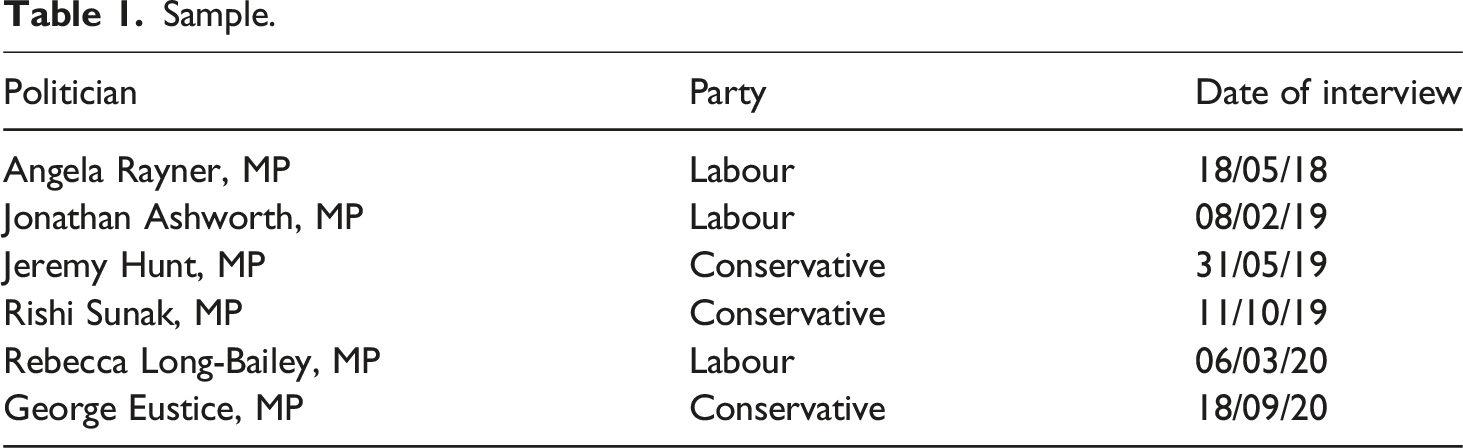
The sample consists of six interviews from Political Thinking between 2018-2020. The sample was strategically selected and aimed to equally balance the proportion of interviews with members of the Conservative and Labour Parties, the government and opposition in the UK. All the politicians were Ministers or members of the Cabinet or Shadow Cabinet at the time of the interviews.
Sample.
Process
Prior to any formal analysis, all interviews were listened to multiple times in order to gain “intimate acquaintance with the recording at the necessary level of detail” (Hutchby and Wooffitt, 2008: 71). The transcript was not treated as part of the data, but as a “convenient referential tool” that allowed the analyst to carry out the analysis with more ease and accuracy (Hutchby and Wooffitt, 2008: 70). Instead, analysis was performed upon the audio recordings of the interviews, with analytic notes labelled on the transcripts for reference. These notes were reviewed, and a series of examples written up to demonstrate the definitive interactional features of Political Thinking. All data extracts have been transcribed using Jeffersonian convention (Jefferson, 2004).
Analysis
The remainder of this article explores the ‘extended interview podcast’ as an emergent context in which politicians are interviewed outside of a news context, through the analysis of Political Thinking. The main argument is that similarly to the celebrity talk show Political Thinking has an experiential focus, oriented towards the narrative exploration of personal experience as a device to contextualise politicians’ careers and value systems (Extracts 1, 2, and 3). This exploration of serious biographical detail is complemented with more playful sequences in which Robinson collaborates with politicians to curate their non-political identities and reveal details of their personality that, while not politically salient, may help the audience to see them in a new light and humanise them (Extracts 4 and 5).
“What in that mix makes you political?” – Narrating political biography
A central trend of Robinson’s questioning is his attempt to link politicians’ personal biographies to their political careers. Across all the interviews, Robinson asked some variation of “where did your political values come from?”. Usually, these questions take the form of narrative elicitations. Thornborrow (2001) defined narrative-eliciting questions as questions that invite the interviewee to respond in the form of a story or anecdotes with the audience as the primary recipient. The narration of these stories is a collaborative process, with the politician performing as the main narrator of the story, and Robinson performing as the interactional manager, setting the topical agenda and frame, and guiding the audience through the narrative.
In Extract 1, Robinson uses a narrative-eliciting question, supported by a seeking-information question, to draw a parallel between Angela Rayner’s challenging upbringing and her political career.
Extract 1. The Angela Rayner one 18/05/18 (Robinson, 2018)
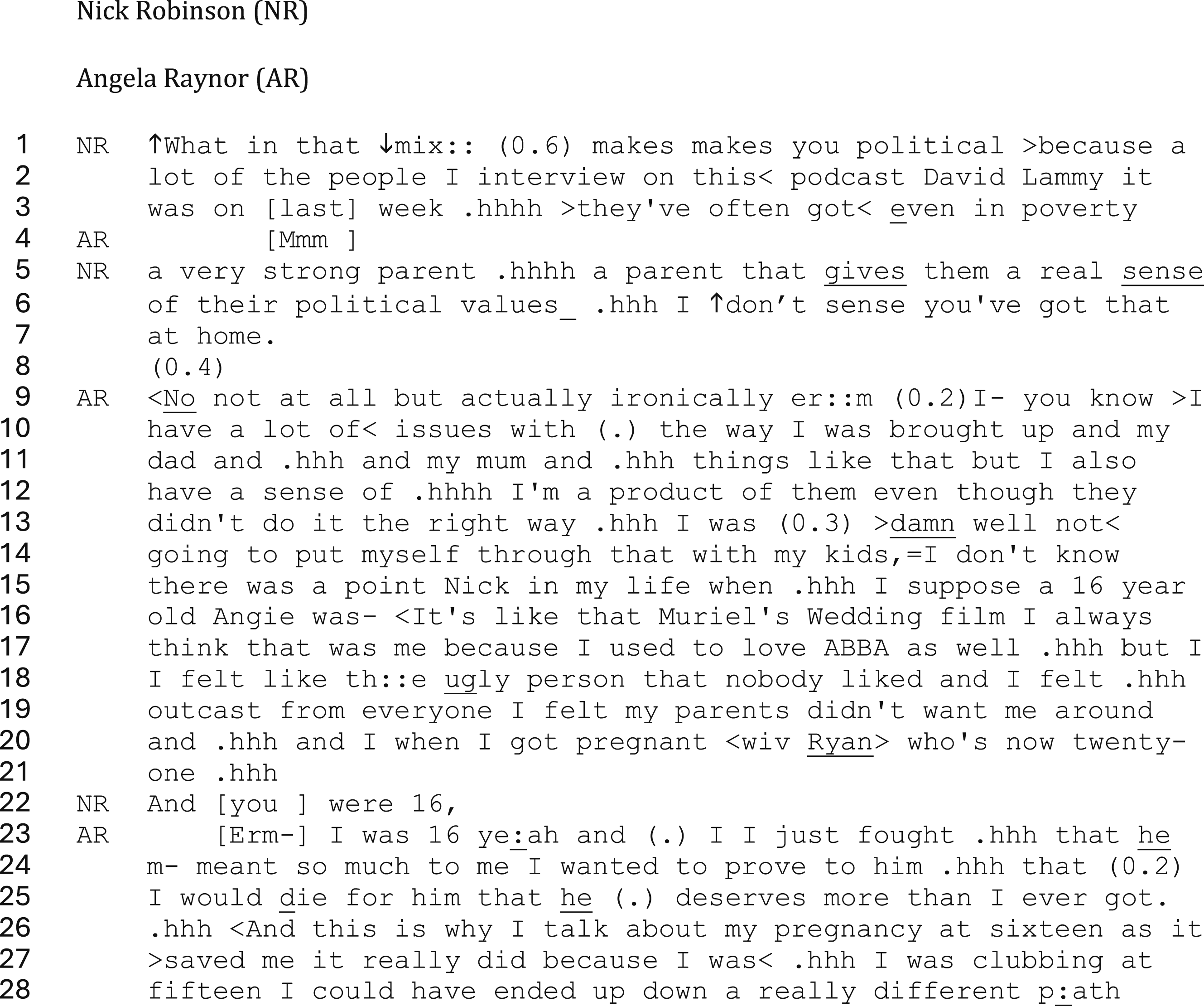
In line 1, “↑What in that ↓mix:: (0.6) makes makes you political”, Robinson sets the discursive frame for a narrative about the origins of Rayner’s politics. In lines 1-7, he further contextualises this frame, contrasting Rayner with past guests who even in poverty got a strong sense of political value from their parents. Beyond setting the stage for the upcoming narrative, this also produces the story of Rayner’s political origins as worth telling, because it is unique within the context of British politics and therefore especially interesting for the audience. Line 6-7 “I ↑don’t sense you’ve got that at home.” functions as a narrative elicitation device inviting Rayner to begin telling her story (Thornborrow, 2001: 90).
In Rayner’s response, she accepts Robinson’s frame and produces a narrative that coherently builds from the topics he has established (9-28). She begins by recounting her difficult relationship with her parent and how this shaped her (9-13). She then recounts her own experience of pregnancy and parenthood as the primary source of her political values (13-28), with Rayner wanting to give her son “more than I ever got.” (25).
Robinson cedes the conversational floor to allow Rayner to develop her narrative with minimal intervention. The only time Robison intervenes is in line 22, prompting Rayner to provide clarification as to her age when she got pregnant. Robinson does not wish to impede the story or redirect the topic. Instead, he is supporting the audience’s understanding of the story, recognising the fact Rayner was only 16 when she got pregnant is an important feature that may not have been clear to the audience in Rayner’s telling. In line 23, Rayner quickly confirms she was 16, before continuing with the narrative.
This sequence reveals the collaborative nature of storytelling on Political Thinking. While Rayner is the narrator of her own story, she is only able to do this because Robinson has made the story topically relevant and created the discursive space for her to tell it. The collaborative nature of this interaction closely resembles the celebrity talk show (Thornborrow, 2001) and strongly contrasts the highly conflictual news interview (Clayman and Heritage, 2002) that the participants are traditionally associated with.
“This isn’t some sort of gotcha” – managing the discursive boundaries of the interview
When addressing political issues, Robinson seeks to elicit personal reflections as opposed to policy details. To achieve this, he manages the boundaries of the interview using reflexive utterances where he performs his self-awareness of the norms of the political interview and the expectations of himself as a political interviewer closely associated with the 8:10am classical accountability interview slot on the Today program. Functionally, Robinson uses these utterances to distance himself from adversarial norms and to define the interactional context as one distinct from the news interview. Given the dual character of interview talk, these utterances concurrently communicate these characteristics to interviewees and the audience, managing their expectations (Hutchby, 2006: 13).
In Extract 2, Robinson uses a reflexive utterance to reassure Jonathan Ashworth that the question he has asked is not being used to set him up.
Extract 2. The Jonathan Ashworth one 08/02/19 ( Robinson, 2019b )
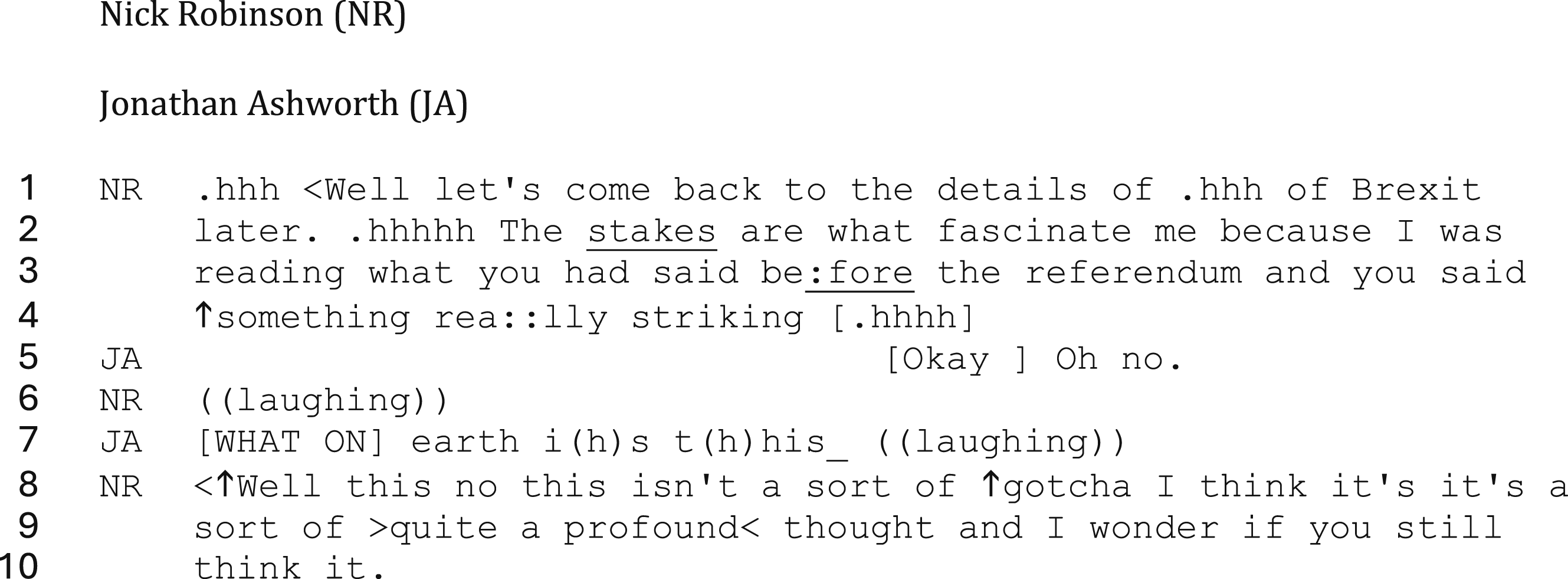
In lines 1-2, Robinson attempts to move the discussion away from policy details, before setting up the frame for his upcoming question, drawing on Ashworth’s previous opinion on the EU referendum (1-4). This frame draws a nervous laugh and comment from Ashworth as he adopts a defensive stance in line 5 and line 7, possibly anticipating an adversarial or gotcha question designed to catch him out.
Gotcha questions involve the interviewer setting a trap designed to make a politician contradict themselves or admit to something they otherwise would not want to. One common gotcha practice, and the one implied in Robinson’s question frame, is challenging a politician on the basis of their past position or actions (Emmertsen, 2007: 584). Principally the setup is: “did you say x? If so, why did you do y which contradicts x?” Such a setup amounts to what Bull and Waddle (2023: 92) describe as a communicative conflict, whereby all possible responses to a question have negative consequences for the public image of the interviewee. Communicative conflict questions have been shown to pressure interviewees towards equivocation (Bull and Waddle, 2023). This context provides a rationale for Ashworth’s defensive stance. At this point in the interaction, Ashworth does not know what previous statement Robinson is going to raise. Given the political volatility of Brexit and the common practice of gotcha questions his apprehension is understandable.
In line 8, Robinson actively distances himself from this kind of gotcha question with the aim of opening up the discussion when he says, “this isn't a sort of ↑gotcha”. In acknowledging the expected trajectory of the interview and subverting it, Robinson respecifies the expectation for his following question as one of congeniality rather than adversarial attack. There is a degree of knowingness and self-parody to this utterance that feeds into the playful style of the podcast and winks to Ashworth and the audience as if to say, this is not one of those relentless aggressive interviews that takes no prisoners and tries to catch politicians out. The non-antagonistic frame is reinforced in the subsequent utterance, “I think it's it's a sort of >quite a profound< thought” (8-9). Here, Robinson encourages Ashworth to feel able to respond candidly by praising his previous position. Such an assertion would be unlikely to occur in a news interview because it involves the journalist overtly taking a personal stance and contravening the principle of presentational neutrality. In providing a positive assessment of Ashworth’s opinion, Robinson aligns himself with Ashworth’s stance and provides a starting point of civility, that removes possible hostile trajectories.
Robinson further delimits possible hostile trajectories with the following utterance “I wonder if you still think it” (8-9), a stance that acknowledges the possibility Ashworth may have changed his mind without framing this possibility as a contradiction that could be used to score a political point. This departure from his expected role reinforces the genuine nature of Robinson’s reflexivity because it illustrates to Ashworth and the audience that this interview has a different character to the news interview. Robinson’s use of reflexivity points towards one of the apparent ground rules of discussions on Political Thinking - that Robinson will not ask typical adversarial questions on the mutual expectation politicians do not provide typical evasive politician answers.
“I often get quite staggered when people ask me questions about that” - Some topics are off limits regardless of questioning style
Despite Robinson’s attempts to adopt a supportive role in helping politicians to narrate their personal experiences, this does not mean these interviews are devoid of conflict. Situations occur where Robinson and a politician disagree as to whether a topic is appropriate for discussion, even when Robinson tries to frame the question in a congenial manner and attempts to close off hostile trajectories.
In Extract 3, Robinson’s actions are oriented towards encouraging Rebecca Long-Bailey to discuss the role religion plays in her everyday life, a topic which Long-Bailey believes is separate from her political orientation
Extract 3. The Rebecca Long- Bailey One 06/03/20 ( Robinson, 2020b )
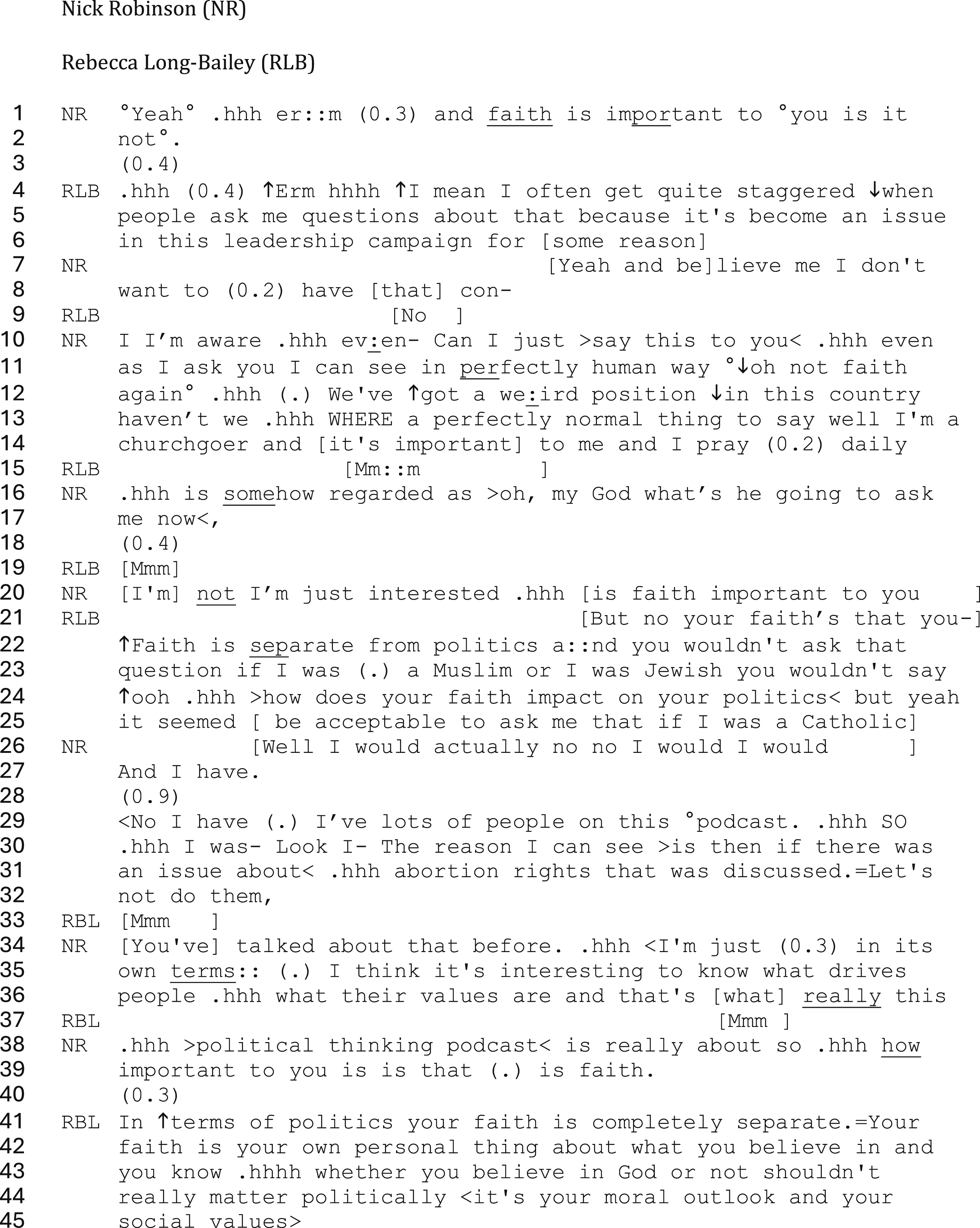
In lines 1-2, Robinson raises Long-Bailey’s faith as a topic of discussion. In lines 4-6, Long-Bailey attempts to invalidate faith as a topic of discussion with a strong dispreference orientation, claiming people who ask about faith are trying to make it an issue in the Labour leadership campaign when it is not. In lines 7-8, Robinson responds to this frustration by attempting to distance himself from the people trying to make faith an issue, saying “[Yeah and be]lieve me I don't want to (0.2) have [that] con-”[versation]. Here, Robinson suggests while he wants to talk about faith, he does not want to talk about it in the manner Long-Bailey finds problematic. Robinson then reinforces the validity of Long-Bailey’s position by commenting that he recognises her reaction as “
In lines 21-22, Long-Bailey again refuses to talk about her faith, insisting that faith and politics are separate, before recategorising the question as representative of anti-Catholic bias (22-26). This attack is severe because it implies Robinson has departed from the requirement of impartiality placed on BBC journalists. If Robinson conceded to such a criticism, he would not only invalidate the line of questioning, but also undermine his role as an impartial political journalist. In lines 26-27, Robinson immediately resists Long-Bailey’s categorisation of unfairness. In his repair against the accusation, Robinson states he has asked lots of people similar questions on the podcast (29). The implication is that Robinson is holding Long-Bailey to the same standard as other guests and that therefore the question is legitimate because she is not being treated differently to other guests based upon her religious beliefs. This creates an expectation she should answer. Robinson then takes the politically volatile issue of abortion off the table, further delimiting possible hostile trajectories and disassembling the potential assumption that Long-Bailey’s Catholicism necessarily implies an anti-abortion stance that could be politically damaging to Long-Bailey (30-32).
Finally, Robinson reflexively accounts the mission statement of the podcast, to explore motivations and values (35-38), legitimising the question as a justifiable feature of this interactional context that Long-Bailey has agreed to by participating in the podcast. He then restates the question (38-39), having outlined his motivation for asking. Despite this, in lines 41-45, Long-Bailey still refuses to answer, repeating her affirmation from lines 21-22 that her faith is separate from her politics.
Centrally, this sequence highlights a significant feature of the relationship between questioning style and answering patterns. Sometimes, regardless of how a question is framed, a politician will always refuse to answer because they are not objecting to the way the question is asked, but to the fact the question is asked in the first place. Therefore, however Robinson asked this question, it is likely Long-Bailey would have refused to answer because she believed it was beyond the boundaries of legitimate discussion.
“it’s just one of those stories I’m afraid” – Hidden identities and shared responsibility
More serious talk about politicians’ backgrounds is balanced out with informal talk, often focused on the elicitation of entertaining anecdotes and revealing unexpected hidden identities. These sequences aim to help the audience see the politician in a manner that contrasts their typically serious political performance. These interactions are good-natured, blending sociable chat and humour. Similarly to talk show interviews, they deploy a wide range of interactional resources to appear as casual conversation (Loeb, 2015: 33). Robinson helps politicians curate their non-political identities, rather than challenging them.
In Extract 4, Robinson seeks to elicit a confession from Jeremy Hunt that he bought a dance floor for his house. When Hunt contradicts Robinson, the aim of the exchange is destabilised, and then collaboratively reoriented to achieve the intent of the original turn, with Hunt providing the real truth of the matter and displaying his hidden identity as someone who likes to dance.
Extract 4. The Jeremy Hunt one 31/05/19 ( Robinson, 2019a )
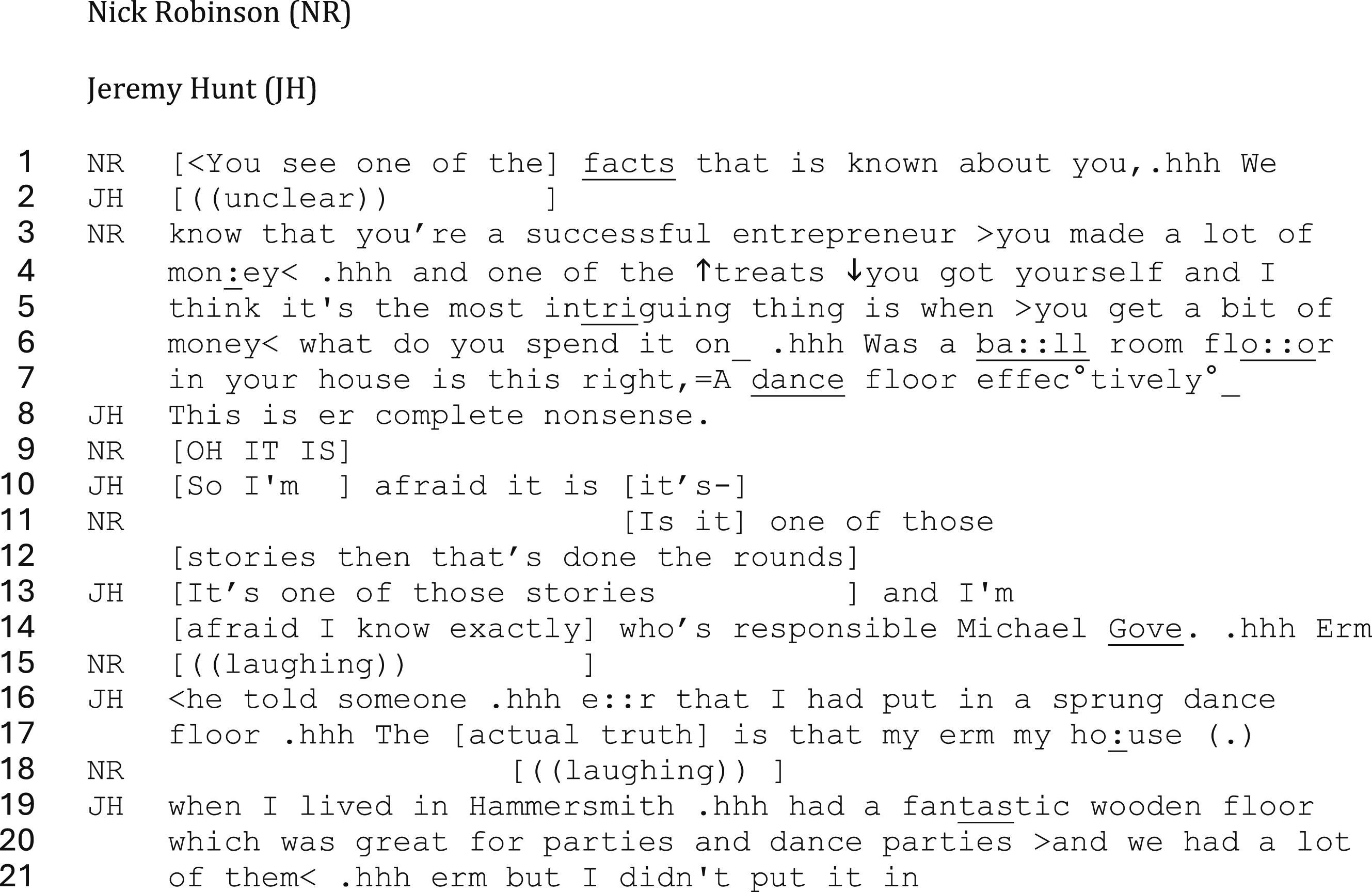
In lines 1-7, Robinson is seeking a confession from Hunt, presenting Hunt with the statement that he spent money on a ballroom floor and asking him for confirmation. The statement is intended to reveal the details of Hunt’s interest in dance, a personal characteristic that contrasts with his typically serious identity as a politician and entrepreneur. Implicit in Robinson’s request is a preferred response of yes. Yet, in line 8, Hunt dismisses the claim as “complete nonsense”, destabilising the trajectory of the interaction because it is no longer possible for Robinson to request further information about the dance floor as Hunt has debunked the claim. Robinson and Hunt collaboratively seek to reorient the discussion. The talk becomes more conversational (8-21), managed through short turns, with strong overlap and participants building on previous turns in a quick-fire manner. In line 9, Robinson asks for confirmation the claim is nonsense, in a manner that signal disappointment “OH IT IS”. In line 10, Hunt repeats Robinson’s “it is”, prefacing the statement with “I’m afraid”, an acknowledgement of this disappointment. These quick-fire turns stall the discussion as each participant waits for the other to redirect the conversation to its intended end. In lines 11-12, Robinson asks “[Is it] one of those [stories ]”, a phrase which Hunt adopts in line 13, before taking the initiative to elaborate on the origins of the rumour in line 14.
Here, it is important to emphasise the concept of shared responsibility in interview talk (Ekström, 2011: 149). While, the interviewer manages the interaction, the participants share responsibility for keeping the conversation going. In this instance, Hunt picks up on Robinson’s desire for him to reveal his hidden identity as a dancer. Though Hunt refutes the initial statement, he provides an alternative account about the true origins of the dance floor. In this alternative account, Hunt maintains Robinson’s initial characterisation of himself as a dancer who likes to party when he confirms he had a lot of dance parties (20-21), thus collaboratively accomplishing the identity construction Robinson initiated prior to the destabilisation.
Extract 5 provides another example of playfully co-constructing a hidden identity, this time through a talk game. Robinson uses a quiz device to allow Rishi Sunak to display his identity as a Star Wars fan.
Extract 5. The Rishi Sunak one 11/10/19 ( Robinson, 2019d )
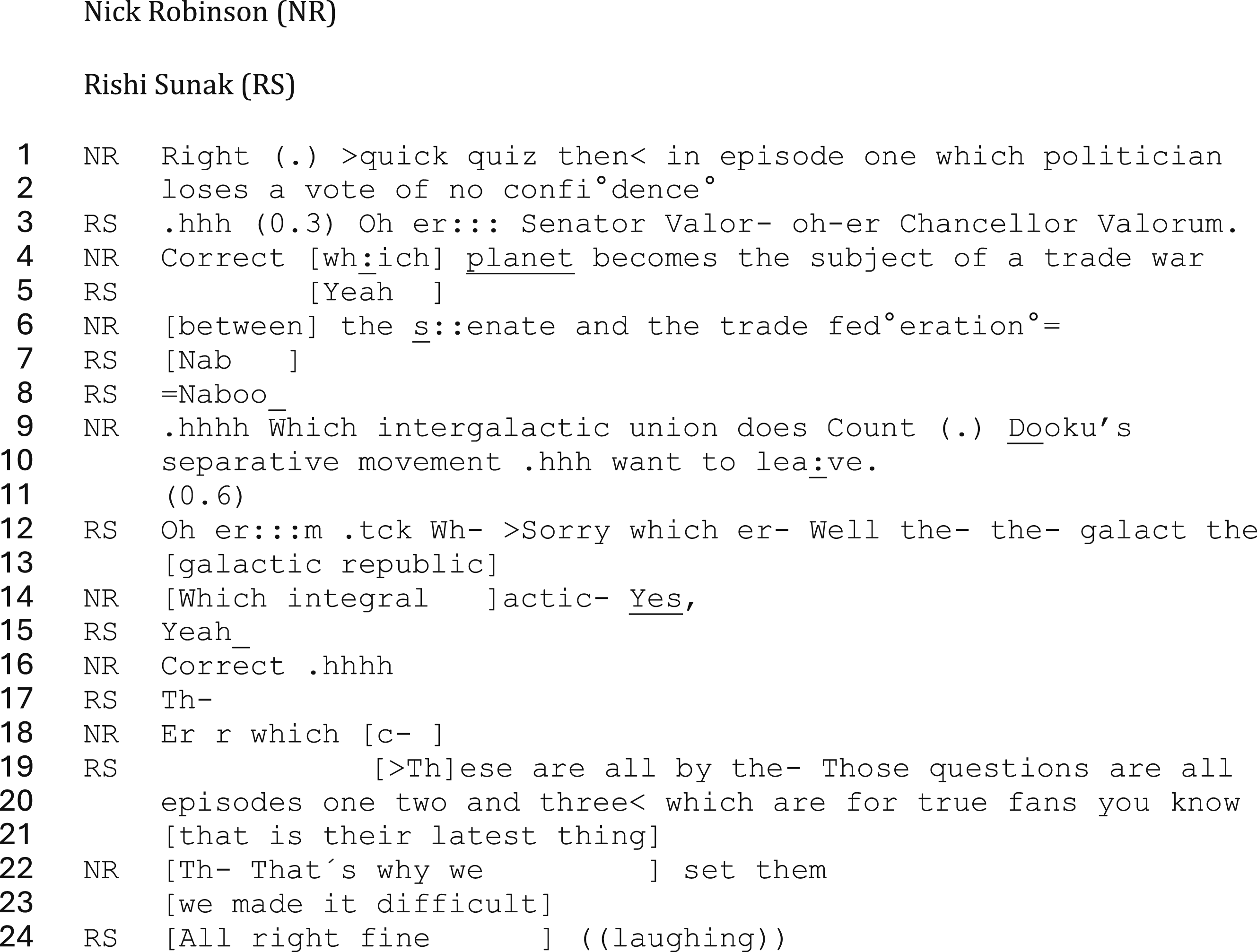
In line 1, Robinson introduces the quiz as a discursive device, before going on to quiz Sunak about his Star Wars knowledge (1-18). Clayman and Romaniuk (2011: 17) termed these kinds of questions pop quiz questions because they address a matter of established fact with only one correct answer. In principle, this is high stakes talk activity, because there is an implication that if Sunak cannot answer all of these questions, he is not a true fan, risking reputational damage to the personal identity he is trying to curate. This possibility is briefly observable in line 12 as Sunak struggles to find the answer galactic republic, before redeeming himself in line 13 just as Robinson begins to repeat the question in line 14. Yet, it can be assumed, based upon Robinson’s prior research that these questions have been designed for Sunak to answer correctly in line with the mutually co-operative style of the rest of the interviews. Assuming this is the case, the sequence can instead be seen to have mock stakes reminiscent of a game segment on a talk show, functioning as an entertainment device designed to reveal Sunak’s knowledgeability about Star Wars in a playful manner.
In lines 19-21, Sunak makes the implicit identity of being a true fan explicit by reflecting that because these questions are from the Prequel trilogy they are only for the true fans. Thus, Sunak is claiming because he has answered the questions correctly, he is a true fan. Here, Sunak goes beyond the frame of the questions to display further knowledgeability about Star Wars, the specific films the questions reference, that has not been explicitly solicited.
In lines 22-23, Robinson adopts a supportive role by stating that they set difficult questions on purpose. This accentuates Sunak’s claim to being a true fan by providing confirmation the questions were intended to be difficult, even if in actuality it can be assumed Robinson expected Sunak to answer them all correctly. The main point, as with Extract 4, is that the revealing of hidden identities is a collaborative project, with Robinson initiating the reveal of a hidden identity characteristic with the initial discursive device and adopting a supportive role in the remainder of the talk to aid the politician in displaying said identity characteristic.
Throughout this sequence there is also a slightly tongue and cheek politics device at play through references that are dually relevant to Star Wars and politics. Specifically, there are references to Brexit and criticisms that could be levelled at Sunak in relation to Brexit. “vote of no confi°dence°” (2) is hearable as a reference to the struggles of Sunak’s Conservative Party to pass the Brexit Bill and the subsequent vote of no confidence that was table against Theresa May’s government. “trade war” (4) is hearable a reference to disputes about the UK’s future trading relationship with the EU. And “Count (.) Dooku’s separative movement” (9-10), a strong antagonistic force within the Star Wars universe, is hearable as a parallel to the Brexit movement. Later in the interview (extract not included) Robinson uses these references to topicalise an expressly political question about whether Sunak stands by his support for Brexit. As such, while the quiz device enables Sunak to claim the identify of being a true Star Wars fan, this identity never supersedes his institutional identity as a politician. Nor does Robinson ever stray too far away from political fare. The audience never hear Sunak as speaking solely as a Star Wars fan, but rather a politician who is also a Star Wars fan, a feature which is supported by the question design. To adopt Sacks’ (1995: 630) words, being a politician is “parallel to being a celebrity in this society. Any time you’re recognized, you’re recognized as that celebrity. Whatever you’re doing, you’re seen as doing under that single formulation.” This is key because politicians’ non-political identities are not remarkable in and of themselves. They are only remarkable because they reveal relatable behind-the-scenes insight into the mundane life of a political figure, highlighting the humanity that lies behind the institutional identity.
Discussion
This study contributes towards scholarly understanding of interviews with politicians outside of a news context (Baym, 2013; Eriksson, 2010; Loeb, 2017) and the emergent ‘extended interview podcast’ format through the analysis of Political Thinking. While Political Thinking features the traditional actors of the news interview, it operates using a very different discursive framework that more closely resembles the celebrity talk show (Eriksson, 2010; Loeb, 2015, 2017; Thornborrow, 2001). Talk is mutually co-operative and oriented towards politicians’ personal identities as opposed to their institutional identities. Robinson mobilises a democratic culture which is interested in politicians as everyday people. This is based on the premise that understanding politicians’ backgrounds and values provides an important foundation to understand their political actions. Through this process, politicians become personal storytellers, whose thoughts, emotions and non-political identities are brought to the fore above issues of policy and current affairs. Playful talk sequences aimed at revealing unexpected non-political identities perform a humanising role. In enabling this evolution, Robinson creates a discursive context that bridges the gap between the distant public, political action, and political individuals, whose status as ‘ordinary individuals’ is often rendered invisible by their institutional status as ‘public representatives’. To some extent, this style is reminiscent of a previous era of celebrity talk shows dedicated to serious human interest journalism on programmes such as Parkinson (1971-2007) and Aspel & Company (1984-1993) that sought to emphasise guests’ authenticity by drawing links between their personal lives and professional personas (Van Leeuwen, 2001: 393).
It is also important to recognise that the genre and style of Political Thinking is an outcome of the affordances of the digital platform that is not constrained by the demands of the broadcast news schedules in the same way as the broadcast news interview. The time pressure is taken off and interviewees are given space to relax, rather than becoming frustrated by aggressive questioning designed to create a news moment. The interviews are more conversational and less tightly packaged than the institutionalised form of news interview and constitute a separate generic form. Further, because these interviews are not oriented to the here-and-now of news events they are well suited to the podcast form that is theoretically evergreen, as a form of broadcast talk which is collected and archived within platforms which are searchable and perpetually available (Spinelli and Dann, 2019: 8).
Robinson’s approach on Political Thinking does not represent a sea change in the way interviews with politicians are managed. Nor should it. Adversarial news interviews perform an important function. To adopt Montgomery’s (2011) terminology, Political Thinking represents an emergent approach, but one which complements, rather than replaces, the news interview. In a small way, Political Thinking contributes to the wider personalisation of UK politics and expands the diversity of political interview programmes available to citizens.
Directions for future research
Political Thinking is part of a rapidly expanding podcast political interview landscape where podcasters are innovating in style. For example, Leading (2023-) is dedicated to interviews with guests from inside and outside of politics in a more experiential mode. And, in January 2023, The News Agents (2022-) performed a half-hour accountability news interview with Labour leader Sir Keir Starmer. Each of these podcasts adopts a more informal and conversational style that takes advantage of their longer formats to allow politicians to speak with fewer interruptions. Yet, these podcasts are yet to receive serious academic attention from a broadcast talk perceptive. Further, there is scope to apply the broadcast talk tradition to podcasts more generally in order to better understanding the discursive practices that have underpinned the emergence of the medium.
Footnotes
Acknowledgements:
I would like to thank William Housley who supervised the MSc dissertation project this article is based on. I am also grateful to Sofia Brizio, Stephen Cushion, Patrik Dahl, Iñaki Garcia-Blanco, Charlotte Gehrke, Robin Smith, the Cardiff Ethnography Ethnomethodology Interaction and Talk (CEEIT) Group, and the Ross Priory Broadcast Talk Group. I appreciate the contributions of the editors of the special issue, Martin Montgomery, Michael Higgins, and Joanna Thornborrow, and their support throughout the process. Thank you to the ESRC who provided funding for my MSc and ongoing PhD project, enabling me to do this research. Finally, I would like to thank the two anonymous reviewers of this article for their helpful suggestions.
Declaration of conflicting interests
The author(s) declared no potential conflicts of interest with respect to the research, authorship, and/or publication of this article.
Funding
The author(s) disclosed receipt of the following financial support for the research, authorship, and/or publication of this article: This work was supported by the Economic and Social Research Council.
