




Abstract
This essay addresses two questions on the topic of podcast innovation. The first, ‘What is a podcast?’ is answered via a review of the literature, investigating podcasting history and its evolution. The definition of podcasting arising from this analysis – centring on episodic audio, convenient both to produce and experience – takes into account recent changes, providing an up-to-date description of the term, useful for further research on the topic. It is also required to answer our second question: ‘How do we design new ways to produce and listen to podcasts without denaturing the medium?’ By reflecting on the essential features of podcasting and the necessity for innovation in this interdisciplinary medium, a framework of six-tensions is proposed as a means of grounding and potentially boosting innovation. Answering these questions could prove valuable for the future of podcasting, hypothesising a basis for reflection and development in both academia and industry.
Introduction
In 2004, a Google search on ‘podcast’ gave 6000 search results; in 2005, 60 million (Berry, 2006); and in 2021, more than 1.9 billion. This is paralleled by an ever-growing amount of listeners and content created around the world (RAJAR, 2020). Whether the podcast medium is set for further growth, a plateau or decline, the future will bring opportunities for podcasting to evolve and respond to new trends and changing expectations, as well as to leverage the development of new state of the art audio technology and tools (Pike, 2019; Bahadoran et al., 2018; Forrester, 2013; Uhlich et al., 2017), which could alter the means and outcomes of podcast production and experience.
For a person selected at random in the US in 2020, the probability of them having listened to at least one podcast in their life was 0.55 (Beniamini, 2020). Although most of us will therefore be familiar with the foundational ideas behind podcasting, there is a grey area when it comes to drawing a definite line separating one piece of audio content from another. For instance, does an audiobook count as a podcast? It matches the Oxford Dictionary’s definition of a podcast: it is a digital audio file available for download on any portable device (Oxford English Dictionary, 2015, podcast entry). Yet, audiobooks are not counted as podcasts in most market research surrounding podcasting (RAJAR, 2020) and on most on-demand platforms.
This conceptual fuzziness becomes even more unclear when thinking of the future. The abundance of new technology will presumably modernise the podcast format (Berry, 2016), raising an important question around ensuring the integrity of its development: how do we design new ways to produce and listen to podcasts without denaturing the medium?
Of course, this question can only be answered once we establish a working, current definition of ‘podcast’, more detailed than the one provided by most dictionaries, so that its nature is understood before proposing a framework for next-generation podcasting innovation.
In order to begin this exploration into the definition and limitations of podcasting, we will at first assume those limits are real and fixed, and as objective as possible, even though they will necessarily be subject to discussion, as each person – be they listener, academic or creator – might have differing opinions on the topic, stemming from their individual relationship with the medium.
Looking at the past and present of podcasting should give us sufficient perspective to postulate what a podcast is, beyond simple technical requirements. As we go on to demonstrate, the ‘nature of podcasting’ will need to be able to withstand the many technological innovations that will change how podcasts are made and consumed, and hence should abstain from relying on specific, easily dated technology as a means to define it. For instance, the definition of podcast as a ‘a downloadable digital audio file distributed over the internet using RSS, designed to be played back on a computer or personal MP3 player’ as given by Markman (2012) is now dated. People no longer only use computers or MP3 players to listen to podcasts, and downloadability, although still of considerable importance within the podcasting community, could be questioned when looking at the statistics of downloaded versus streamed podcasts for the major podcast providers in the past year. For instance, on Apple Podcast, 13.7% of downloads to 86.3% of streams (Hallgren, 2019)
This investigation into the nature of podcasts will introduce us to the important concept of ‘tension’ in podcasting, where the medium is pulled between two competing concepts (e.g., ‘universality’ and ‘uniqueness’). These tensions have been highlighted following a reflection on what podcasting has been and became as well as informal conversations with industry professionals. The aim of establishing a theoretical framework from a review of literature is a conscious decision that we hope will encourage and support further research. We will hypothesize the different aspects of podcasting that are in tension with one another, and later, confirm them through an ontological and ‘conceptual, historical, and scholarly’’ analysis (boyd and Elison, 2007: 210). Figure 1 illustrates these tensions, showing the concept of podcasting at the centre of a series of tensions, pulling from either side. The six pairs are: 1. Personalisation and Automation 2. Independent and Mainstream Production 3. Unique and Universal Content 4. Current Audience and Possible Demographic 5. Immersion and Interactivity 6. Art and Technology The six-tensions framework for podcasting innovation, with the concept of podcasting at the centre of six pairs of concepts essential to the medium. The hypothesis presented is that the balance within the pairs must be kept throughout any innovation for the nature of podcasting to be preserved.
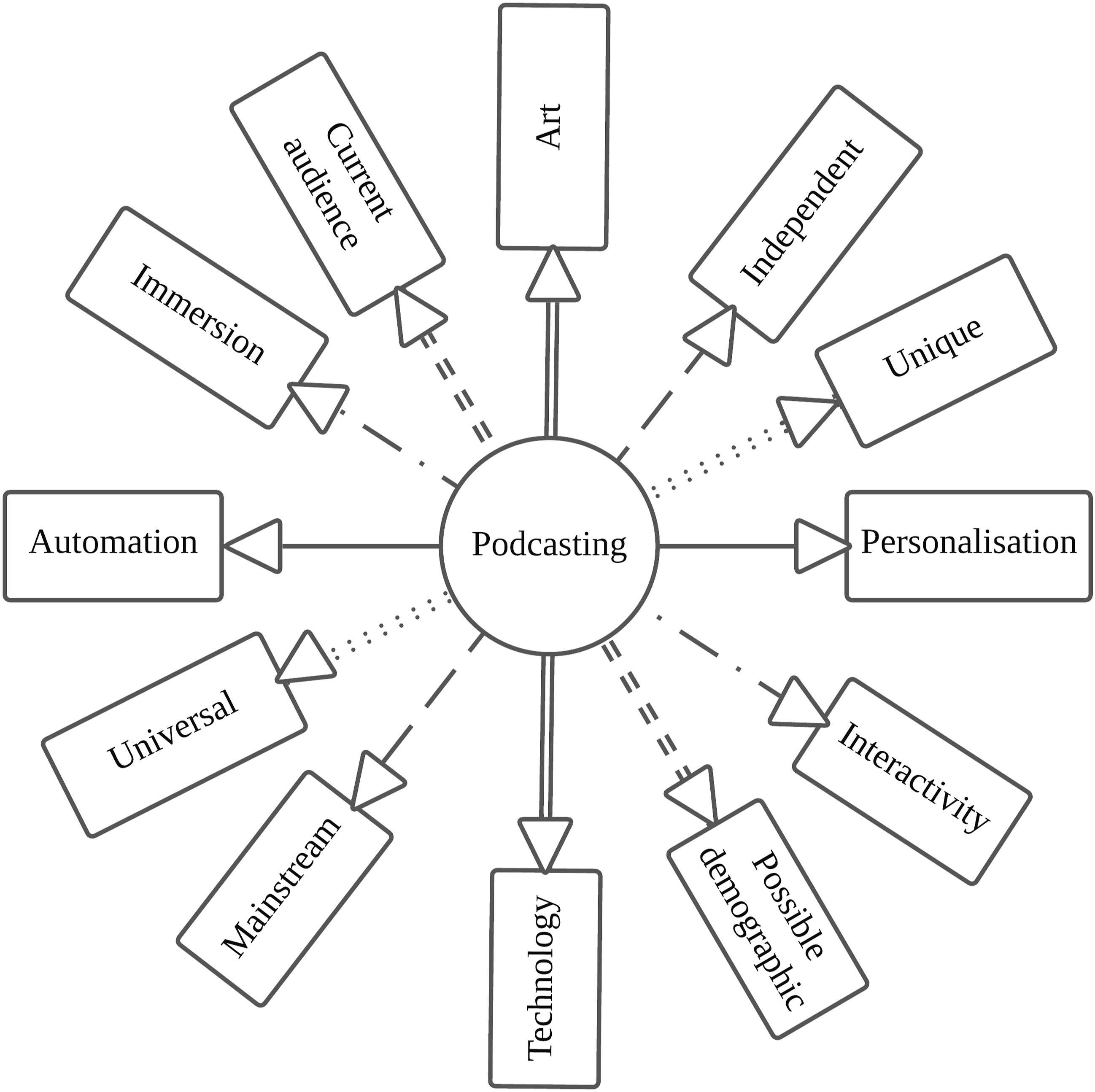
We will demonstrate that podcasting is, above all, a medium that has relied on these tensions to define itself. It will become apparent that thinking of these as a framework when designing new ways to produce or listen to podcasts is essential, as they are immutable attributes that the medium has entailed since its inception. Delving into these various trade-offs will bring to light the areas of the literature surrounding podcasts that would benefit from further research, lacking details and studies to provide a complete, evidence-led picture of what podcasting is today.
Method
This essay’s goal is to answer the following research questions:
What is a podcast?
How do we design new ways to produce and listen to podcasts without denaturing the medium? In order to validate our proposed framework for podcast innovation, we must first define what a podcast is (RQ1) by looking at the origin of the medium and its evolution, including how other media have influenced its form. We will therefore begin contextualising podcasting by looking back at its creation and development. We will be looking particularly at English language podcasts and their history. We will review the literature from the time and put it into perspective by analysing it through a contemporary lens, informed by the reality of what podcasts became and what current studies tell us about the content of podcasts and the people who listen to them. This will demonstrate that the tensions in Figure 1 have been evident throughout the history of podcasting and justify their inclusion in the framework. Following on from our historical analysis, we will provide a working definition of podcasting, representing what podcasts have been and are, which will inform our reflection on the metamorphosis podcasting is undergoing at present: what is changing, why it is necessary for the medium to evolve and how future innovations may or may not denature the nature of podcasting. This latter step will help answer our second research question, as well as showcasing the use of the six-tensions framework. Although the work presented here is theoretical, it adheres to Popper’s Theory of Falsification (Popper, 1992), where scientific hypotheses are provisional, confirmed over time by empirical validation, or eventually disproved through falsification. This review provides the necessary grounds of justification for this hypothesis, so that it can be tested in future through real-life applications and observations.
What is a podcast?
A brief history of podcasting: From the radio to the portable, on-demand format
The radio: A parent/sibling medium
The radio’s influence over podcasting will be explored first, as radio is widely acknowledged to be the conceptual predecessor of the podcast (Edmond, 2015; Madsen, 2009; Murray, 2009).
The radio was first an experiment to broadcast music and talks to a wide audience, but, although it was intended as a way to distribute audio content to the public without distinction, it quickly grew as a ‘uniquely personal medium’ (Encyclopedia Britannica, 2010). From being able to choose your programme, to the growth of talk-in (or phone-in) shows in the 1990s, radio listeners were motivated not only by the access to information and entertainment but also companionship (Perse and Butler, 2005). The ‘personal’ nature of radio only bolstered this last aspect, building a certain intimacy between the listener and their radio set. In the early 2000s, as people started getting used to ultimate musical sovereignty with the rise of the MP3 format and portable media players, the then-apogee of playlist making and track discovery, this expectation of personalisation drew people away from radio. A small but significant shift in practices can be observed in data from the time: in 2007, radio lost 3.1 percentage points of 15–24°years old UK listeners (OFCOM, 2007). This was the beginning of a trend of radio appealing to fewer young people every year. This showcases a change in media consumption choices and expectations of young people. Some turned to podcasting as an alternative to bring them ‘information’, ‘diversion’ and ‘companionship’, which were the main motives for listening to the radio at the time (Perse and Butler, 2005), efficiently replacing radio’s traditional roles, while maintaining the personalisation, freedom and convenience that they enjoyed from using a portable audio device (like an iPod) to access their media (Albarran et al., 2007).
We often think of the radio as an ancestor of podcasts, or as a product of ‘radio’s cultural renaissance’ (Edmond, 2015), but Bottomley questions this, and acknowledges the fuzziness of the term ‘podcasting’ (Bottomley, 2015). Indeed, while the auditory nature of both media as well as the temporal precedence of radio over podcast seem to confirm this filial relationship, we are inclined to characterise them here rather as siblings, because, beyond their intrinsically different vessels of transmission (FM and the internet, respectively), podcasts seem to have emerged from the circumscription of the radio in a changing media landscape, leading to 1) a sort of competition between them, where the audience of one is not necessarily the audience of the other (Albarran et al., 2007) and 2) a cooperation in the introduction of listeners to audio entertainment, where audiences of either can be shared by association (Berry, 2016). This ambivalent relationship was an important concern when podcasting was first developed, as many wondered how its growth would impact radio’s future.
What could have been ‘Audio-Blogging’…
The first podcasts and initial media coverage give us valuable insight as to what podcasting was intended to be. What could have been ‘audio-blogging’ (Hammersley, 2004), was first mentioned in 2004 in a Guardian article, after Adam Curry, now dubbed the ‘Podfather’ (Berry, 2006), and Dave Winer came up with the primitive form of what would become on-demand audio entertainment, using RSS feeds to automate the downloading of sound files from the web (Mclung and Johnson, 2010). This introduces us to the initial tension which led to the development of podcasting:
It took very little time for this new technology to gain popularity: in 2005, it was named ‘word of the year’ by the New American Dictionary (Durrani et al., 2015; Podcast, 2008). Although we have mentioned the appeal podcasts could have had over traditional radio for young people, the fast expansion of what started out as a niche for technology and audio aficionados cannot be explained by this alone, as we will explore below.
What are the features of podcasts?
Answering this question will allow us to notice which features have been consistent since podcasting’s inception, and therefore isolate the essential characteristics of podcasts to establish a current definition of the phenomenon.
The novel features of podcasting, as described by Spinelli and Dann (2019) in their book Podcasting: The Audio Media Revolution as 11 ‘major podcast features’, largely contributed to its rapid gain in popularity. In addition to the ability to have complete control over the type of programme one could listen to, the possibility to ‘time-shift’ and ‘placeshift’ (Mclung and Johnson, 2010) – that is, to play the content whenever and wherever, but also being able to fast forward, rewind, or listen to a programme again – made the medium incredibly convenient. Combining this convenience with the idea of free subscriptions, which according to Berry (2006) was a key concept of podcasting, makes for an enticing package, where one’s favourite shows would be easily accessible, with no cost or time limitation. It should be noted that until the introduction of Apple’s paying podcasts subscriptions in 2021, podcasts were mostly free. Despite offering an interesting monetisation and remuneration option for creators, it is still unclear how this decision will affect the podcasting community in the future (Apple Newsroom, 2021).
The recent podcasting landscape
The importance of ‘Seriality’
The episodical predisposition of podcast creators and the influence of this predisposition on the medium shows how podcasting technology affected its content, and vice versa. It demonstrates a form of podcasting Darwinism, where the prevalent and popular features are highlighted and enhanced, making them more important to the medium than other less fashionable aspects.
There is somewhat of a convention amongst scholars to highlight several key dates in the history of podcasting (cf. 2.): The first use of the RSS feed to distribute audio blogs, the release of the iPod (Cnet, 2011), the first podcast (Wallick, 2003), the first use of the word podcasting (Hammersley, 2004), and, flashforward a decade, the release of Serial, 1 a true crime podcast, which, during its first months, broke all previous downloading records for podcasts. These dates are all seen as turning points, but why is a singular podcast often deemed as important as the invention of the medium itself within podcasting history? To understand the impact of Serial, we need to become acquainted with the programme and its context.
Serial was a podcast show spun off of This American Life, 2 a popular radio show mixing documentary-style stories and audio experiments. Where This American Life had no preference of genre, Serial only focused on true crime and investigative journalism, where one case was developed over a season of episodes. It was first released in 2014, with new episodes posted each week for 12 weeks, distributed via RSS feeds through the podcast’s website. It quickly reached over 5 million iTunes downloads, a record at the time. In his paper, Berry (2015) argues that Serial ‘moved [podcasting] from a niche activity to a mainstream media platform’ (p.171), ‘raised the production quality bar’ (p.176) and ‘presented podcasting as a viable alternative for creators and storytellers’ (p.176); which are three major achievements to attribute to one programme.
Like Berry, many others have commented that Serial ushered in a new era for podcasting (Hancock and McMurtry, 2018; Mchugh, 2016; Sharon and John, 2019; Sherrill, 2020); one where ‘seriality’ became a prominent feature of podcasts. Arguably, this episodic structure is inherited from TV and radio shows’ (Figure 2) tendency to use Cliffhangers to retain listeners from one episode to the next. This led to a ‘renaissance’ (Mchugh, 2016) of fictional and non-fictional storytelling formats, inspiring creators to try to replicate Serial’s success, producing fiction or non-fiction crime thrillers featuring an investigative team leading interviews and discussions to solve mysteries. Such podcasts are still extremely popular today, with some of the most downloaded shows ever amongst this category (e.g., Limetown (2015),
3
Up and Vanished (2016),
4
S-Town (2017),
5
Atlanta Monster (2018),
6
Faerie (2020)
7
and Welcome to Your Fantasy (2021),
8
…). This demonstrates that podcasting features evolved to highlight certain initial aspects of the medium, like the importance of the episodic format (cf. What Could Have Been "Audio-blogging"). Conversely, although RSS feeds were part of the ‘building blocks’ of podcasting, they are no longer necessary to distribute podcasts, as streaming has gotten more and more popular and erased the need to download content directly. Timeline of podcasting, showing the usually recognised key dates in podcasting history.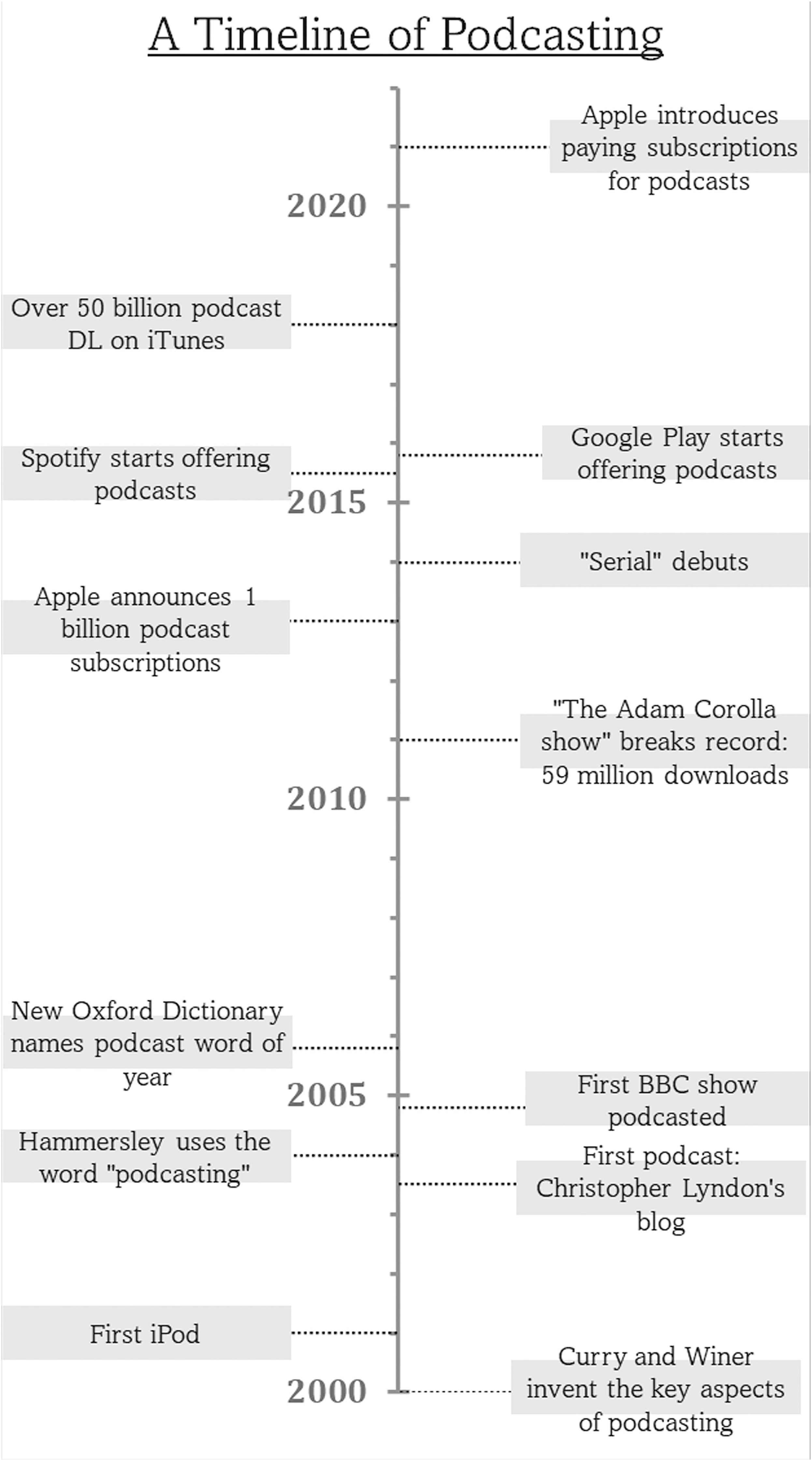
A ‘Programme-Led’ medium
In order to further chart the changes in the podcast format, the current podcast landscape needs to be compared to that of the 2000s. If the first podcasts were technology talks (The Conversations Network, 2013), weblogs (Wallick, 2003) and radio shows offering their programmes on replay (e.g. NPR in 2005), there is now a plethora of genres and subgenres in the ‘podverse’. In 2020, Spotify broke down its most popular genres as Society and Culture, Comedy, Lifestyle and Health, Arts and Entertainment, Education (Spotify Newsroom, 2020b), with less downloaded/streamed genres being Stories, Music, Games, Business and Technology, Sports and Recreation, News and Politics, Comedy, Kids and Family and True Crime still abounding with content.
This variety is part of the reason why podcasts are now so popular: they offer a
There has been an increase in the diversity of presentation formats also: • Interviews or Conversations (e.g. Table Manners with Jessie Ware, 2018)
9
; • Monologues (e.g. Have You Heard George’s Podcast?, 2018
10
); • Repurposed Media (e.g. The Skewer, 2019
11
); • Panel Discussions (e.g. The Infinite Monkey Cage, 2009
12
); • Fictional Storytelling (e.g. Limetown, 2016); • Non-fictional Storytelling (e.g. Lore, 2015
13
) …
These categories (Leonard, 2017) were agglomerated into three typologies by Berry (2020): ‘Conversations’, ‘Narratives’ and ‘Fictions’. At the beginning, most podcasts fell into the first category, but now, styles and genres are barely guidelines, with programmes mixing and matching presentation formats to make unique content. Wyld (2021) highlights the effectiveness of podcasting as a storytelling tool, and showcases how the ‘traditional’ podcasting genres can be bent to create new and engaging audio experiences.
3. The Independent/Mainstream Podcast Antithesis. Markman (2012) described the ‘typical podcasters’ as ‘older educated professional males’ (p.547). Making an inference from recent studies on the development of the medium (Beniamini, 2020; Edison Research, 2019; RAJAR, 2020), over the last decade, the accessibility of production and popularity of the medium seem to have opened the doors to a more diverse podcasting landscape. Podcast diversity has clearly contributed to the growth of the medium, and vice versa, has greatly benefited from these new audiences and creators bringing their varied backgrounds and experiences to podcasting. These new voices should be examined to establish a comprehensive anatomy of podcasting.
‘Who doesn’t have a podcast?’ has become somewhat of a sarcastic topos in the recent years. There is a proliferation of tools (free ones like Anchor, Spreaker and Podbean, or paying ones like Podomatic, Cast and many more) making it easy for anyone with a vague understanding of the technology to create a podcast. It was dubbed ‘amateur’ podcasting, but many of these independent productions have nothing ‘amateur’ about them (e.g. Nightvale Presents), even when compared to podcasts produced by major companies (e.g. Tracks, a BBC Radio 4 programme) (Markman, 2012).
This calls to mind what Berry (2006) termed the ‘podcast problem’ – that a medium originally intended as a means of independent distribution for audio media is heavily associated with one global corporation (Apple). Today, major providers like BBC Sounds, Spotify, Global Player or Castbox (RAJAR, 2020) are sharing the podcast industry with ‘attic’ producers able to publish their content on personal websites as well as on large platforms like Spotify, Google or Apple podcast.
The success of a podcast is now often measured in terms of how much it is consumed on these platforms. Independent podcaster’s work can be influenced by the algorithmic necessity to fit in with these corporation’s expectations of podcasts (Sullivan, 2018). Should a ‘democratisation’ (Hodgson, 2021) of podcasting be expected, where the decisions of platforms impact the creative process of podcasters? It is important to remember that although independent creators are able to get a revenue from podcasting, through advertising, subscriptions or other monetisation solutions, the industry is led by its bigger players – the companies at the top of this billion-dollar field (Grand View Research, 2021).
This tension between
A medium defined by its audience
A global format
Because podcast listening is not fixed to specific times, they are more accessible to different schedules but also locations. The ‘global’ nature of podcasting refers primarily to a lack of geographical boundaries but also to types of listening locations (e.g., train carriage or kitchen) and listening devices (Berry, 2006). This global nature, only reinforced by the variety of programmes offered, leads to more potential engagement, itself leading to a wider reach in audience. This global nature is also amplified by increased smartphone and tablet ownership, in that these are commonly owned devices affording access to podcasts. According to RAJAR (2019), 79% of podcast listening is done via smartphone. This can be explained by the surge of smartphone ownership in the past decades: over 80% of adults own a smartphone in the UK (OFCOM, 2020), making it simple and accessible to tune in to one’s favourite podcasts.
Smartphone use for podcast listening decreased slightly during the COVID-19 crisis of 2020, −9% in the first quarter of 2020 (RAJAR, 2020), but this is likely due to access to other home devices such as tablets and smart speakers that would have been available to listen to podcasts instead. As expected, statistics from 2020 were skewed and reflected the extra time spent indoors; hence, we will look at the previous report from Spring 2020 to draw conclusions. RAJAR (2019) reports that 48% of podcasts are listened to at home, 37% while travelling and 11% while working. These statistics underline the idea that convenience is not only a reason why podcasts are popular but also a factor for its growth, as it provides more convenient access to entertainment in certain time windows and locations compared to traditional forms of audio entertainment.
The evolution of podcast elitism
Back in 2009, most podcast listeners were tech-savvy, college graduates earning over $75,000 per year (Mclung and Johnson, 2010). This narrow demographic lent the medium an elitist aura (Sharon and John, 2019), very different from the utopian view of podcasts as a ‘global’ medium.
To confirm or disprove this impression, we should look at large studies gathering personal data like social class, income range, education and ethnic background from podcast consumers.
However, if these studies exist, the results do not appear to be publicly available. The diversity factors of published studies are rarely the same from one year to another on each report, preventing a temporal synthesis. Furthermore, there are scant overlaps between the variables looked at by different research groups, which makes analysis and discussion difficult. There is no shortage of data on podcast consumption and general information on the typical listener (cf. A Global Format) but the lack of more detailed studies prevents us from truly understanding the shifts and evolutions in podcast audience habits, preferences, and expectations.
We can still draw some useful conclusions from the data at hand. For instance, according to RAJAR (2020), podcasts are still more listened to by men (54% of the consumers), with 64% of monthly podcast listeners being in the 25–54 range. Compared to the 2009 statistics (Mclung and Johnson 2010), where 15–24 men listened to podcasts the most, this indicates that the demographic is slowly ageing, perhaps following these initial listeners through different life stages. In 2019, 53% of new podcast listeners were women, which is a substantial shift compared to the gender distribution in ‘veteran’ listeners, which had a 63:37 men:women ratio. These new female listeners are slowly tipping the scale, and we can project an even split in the men to women ratio of podcast listeners in the coming years (Edison Research, 2019).
Beyond gender, a trend has emerged in the last years that the growth in overall podcast listening has caused a gradual realignment of the distribution characteristics of podcast listeners with those of the population at large. This extends to distinctions of gender, age, ethnic background, education level and income range, and leads us to believe that ‘podcasting elitism’ is slowly being receding (Beniamini, 2020)
The expectations of the listeners
Using the profile of both
Why do people listen to podcasts? A thematic synthesis of the motives behind podcast listening according to four studies: (Chan Olmsted and Wang, 2020; Edison Research, 2019; Glebatis Perks et al., 2019; Mclung and Johnson, 2010).
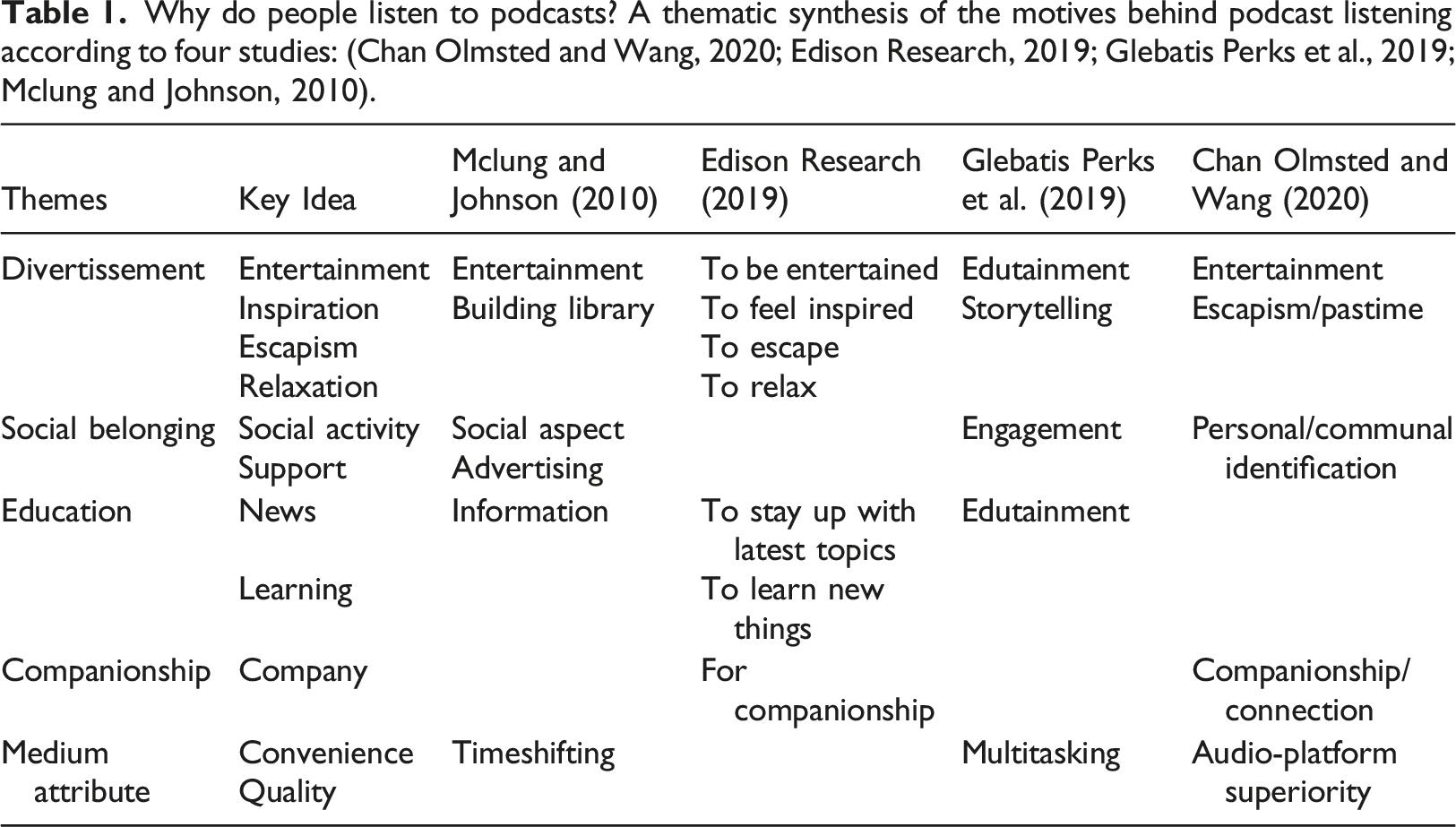
Entertainment is deemed the most important motive in each of the studies mentioned. However, expectations of entertainment vary depending on who is queried: a young person’s expectations differ from that of older generations. In the most prevalent age group for podcast listeners (1535 according to RAJAR spring 2020), there seems to be an expectation of personalisation (e.g., pre-made playlists, recommendations) and social connection (shareability, personal or global relevance, cultural phenomena).
As marketing is a key part of podcast production, specifically for those dependant of major podcast providers (BBC Sounds, Spotify, Global Player, Apple Music, iHeartRadio, etc.), the expectations of the listeners are always at the forefront of a producer’s mind, and content is not only created to maximise each podcast’s reach and increase its audience, but also increase its profitability. The relevance of each programme is therefore key in its publication, which encourages creators to consider innovation and ideas to maximise engagement.
Arriving at a definition of podcast
Before looking at ways to bring innovation to podcasting without denaturing the medium, we have to look back at the discoveries highlighted in this literature review, in order to answer the question: ‘What is a podcast?’
We have found that, through their evolution, podcasts have laid at the intersection of a set of four tensions, which will be essential when subsequently establishing our ‘six-tensions’ framework: Personalisation and Automation, Unique and Universal content, Independent and Mainstream production and Current Audience and Possible Demographics (see also Figure 1). We have explored how a subtle balance is achieved between each of these pairs, and how this equilibrium has defined the podcast since its inception.
Using these tensions in combination with a more technical or feature-centric definition, as seen in A Brief History of Podcasting: From the Radio to the Portable, On-Demand Format, we can deduce the following overall definition: A podcast is a piece of episodical, downloadable or streamable, primarily spoken audio content, distributed via the internet, playable anywhere, at any time, produced by anyone who so wishes.
Going back to the question ‘is an Audiobook a podcast?’, we would argue, using this definition, that it is: virtually anyone can record themselves reading a book and, hopefully with appropriate permissions granted, publish it in an episodic format, which ticks all the figurative boxes the definition offers.
But even though this definition was informed by the evolution of podcasting up until now, it overlooks the ability for the medium to change from now on. So far, podcasts have been shown to be incredibly versatile, evolving from something quite simple to a whole world of possibilities, even requiring academics to define its nature in order to pursue research around it. If the boundaries of podcasting appear to lie within the confines of these above-mentioned tensions, how far can we expect them to move, shift or change in the coming years? How will this affect our definition of podcasts? And how can these boundaries be pushed while preserving the nature of podcasting, to which they are integral?
For instance, some podcasts are now being marketed as ‘feature-length podcast’. (Ugwu, 2021). If this trend persists, should the episodic nature of podcasting to be questioned, as was its downloadability in The Importance of Seriality?
These questions can seem like an over-complication of the simple interrogation ‘what will podcasts become?’, but it is necessary to look at the past and present to inform the future of a medium, not only to be able to be able to forecast adequately what the media landscape might look like, but also to inform and lead creation and innovation within the field.
Expanding the boundaries of podcasting
A glimpse at how podcasting is already pushing its boundaries
Transcending the limitations of file formats
Podcasting is already undergoing a slow but steady metamorphosis, with file format being a telling example. When podcasts were first produced, MP3 offered acceptable quality, a file size reduction of approximately factor of 12, and space for metadata, which made it an automatic favourite to export and share podcasts. The MP3 format was chosen out of convenience, but as requirements evolved and creators began thinking of more creative uses of podcasts, its limitations became apparent.
The first signs of change were the adopting of other audio file formats like M4A or MP4, which use the AAC codec (BBC Sounds, 2021), or ogg (Spotify for Artists, 2021), which allow for tighter compression maintaining a similar bitrate as MP3, translating into higher quality and still relatively small file sizes. Even though this opens the door to better audio quality, the podcast delivered is still a fixed product: an immutable audio file over which the listener has very minimal control.
The metadata carried alongside the audio files have introduced a little more flexibility to the listener. For instance, by adding information on chapters, the user can skip from one chapter to another at the touch of a button, provided they are using a compatible player. Yet, the technology behind metadata has not evolved as drastically in the last 20 years, and currently caps the potential for personalisation inherent to the MP3/M4A/ogg formats in use for podcasting. The addition of transcripts, illustrative accompaniments, or new navigation methods rely on the podcast provider’s decisions, which restricts the potential for customisation of a programme by its producers.
Some podcast creators have therefore decided to publish their content independently of a traditional podcasting host like Podbean, Buzzsprout or Anchor, and rather chose to create standalone web pages (e.g. The Garden,2020 14 ) or apps (e.g This American Life), to gain complete freedom over the components in their programmes. However, this process only redefines the format on a per-podcast basis, with each programme or company creating a format that matches their need, without using a more universal podcast format. This lack of consensus on the format to use for more personalisable or responsive podcasts leaves a considerable gap in the industry, which stunts the growth of many innovative projects looking to the podcast format to host their new forms of content (Blind, 2013), but also highlights the need for innovation in this area.
Immersion as a goal
The podcast metamorphosis has also changed features expressed more subtly until now, but that have grown more notable and popular over the past few years. The evolution of these ‘hidden’ features is now taking a central place in leading podcasting innovation.
The audio properties of podcasts are amongst these features. For a while, podcast innovation was bound to the content, rather than exploiting the creative opportunities offered by the auditory nature of the medium. But, as seen on Table 1., the success of podcasting is not based on the content’s entertainment values or convenience alone, but also on its audio properties, which make it possible to immerse oneself in an acoustic environment. Witmer and Singer (1998) defined immersion as ‘a psychological state characterized by perceiving oneself to be enveloped by, included in, and interacting with an environment that provides a continuous stream of stimuli and experiences’ (p.227). Zhang et al. (2017) distinguishes two main types of immersion: a) Embodied, which for audio encompasses both quality (e.g., better headphones, file formats, sound systems) and spatialisation (e.g., stereo panning, ambisonics, binaural audio, 3D realism or illusion using virtual, augmented or extended reality) and b) Empathetic, where the substance or subject of the content is relatable, interactive or generally captivating.
From the above definition, immersivity is not only a function of form but also of content. Beyond making relatable and interesting programmes, another option creators are starting to consider is interactivity, shifting traditional podcasting to a more personal medium, with examples of interactive content (Responsive Radio, 2015, The Mermaid’s Tears,2017 15 , Solve,2019 16 , …) or personalised advertisement (Radio Works, 2018).
Interactivity as a tool
As we have seen in What Are the Features of Podcasts?, personalisation has always been part of the appeal for podcasts users, where their listening habits would reflect choices and preferences, as opposed to radio where channels would dictate content to its users. So do personalisation and immersion combine in this respect, and if so how?
Interactivity is already a feature of modern podcasts: the user has to make a series of choices before accessing their content, which differentiates it from the radio. Recommendation systems attempt to simplify this process, expressing the ‘
Lately, interaction with the podcasts’ content has been prioritised in productions, as it is seen to boost engagement, driving ratings and popularity. For instance, Spotify introduced a new ‘poll’ feature in 2020 (Spotify Newsroom, 2020a), which allows presenters to survey their audience at specific moments of their programme. This was preceded by a myriad of amateur ‘choose your own adventure’ podcasts, that offered nonlinear narratives to their listeners, and succeeded by the creation of new apps, like Stereo, 17 which is the ‘talk-in radio’ equivalent of the podcasting world, where users can send in voice snippets to podcasters during their live shows, or Entale, 18 Adori, 19 Hypercatcher, 20 or the Spotify tool Spotlight, which enable the user to experience additional data, like visuals, links and descriptions, without leaving their media player. More audio-based interaction has also been investigated, and BBC Taster has put out a range of audio experiences making use of various forms of interactivity to alter the audio of podcasts (e.g., Pick a Part, 2020, Monster, 2020).
If this trend continues, it is natural to ask how much interactivity crosses the line between ‘passive’ and ‘active’ entertainment, effectively turning a podcast into a game (Rowe, 1992). Interactivity of the right quality and quantity has the potential to make programmes more tailored to the listener. It reinforces the
Innovation for podcasting
The fundamental transformation of art and technology
In 2006, podcasts were seen by many as a ‘revolution’ (Berry, 2006); a medium grounded in innovation from the beginning, using computers to help deliver media and more broadly, art. In order to look at how we can innovate while respecting the medium’s essence, we have to look at why podcasts need innovation to exist in the first place, why the metamorphosis mentioned above has been occurring and is already pushing boundaries.
Creation (poiesis) and technology (technè) are often seen as opposite or heterogeneous, but Coeckelbergh (2018) (and countless others) argues rather that they are very much intertwined. Art’s essence is connected to human creativity, which changes constantly. Technology is also driven by perpetual reinvention. Podcasting is an example of this interconnection between
Podcasts, like art or technology, are intrinsically linked to innovation. As with any other artistic medium or technological endeavour, it is important to embrace innovative drift so the medium can flourish. Podcasting is not apart from ‘more traditional’ media in this respect. It is driven by the same need for reinvention as film, TV, and radio, and therefore should not be expected to remain the same forever, in the same way that these other media are given space to grow and change while still maintaining their appeal and audience.
The past, present and future of podcasting
If innovation is intrinsic to podcasts, how can the definition of ‘podcasts’ given earlier be valid, when the medium is expected to change?
Thomasson (2010) believes the ontology of art is determined by ‘human intentions and practices’ and that the boundaries of a work of art are defined by the ‘beliefs and practices of those who ground and reground the references of these general terms’ (p. 128). Looking at podcasting as media, and by extension, as a form of art (cf. The Fundamental Transformation of Art and Technology.), we can infer from Thomasson’s postulate that this analysis and exploration of what podcasts are is at least momentarily valid because it is grounded in the human experience of podcasts and based on factual evidence. We know what podcasts were, we see what podcasts are, and our imagination of what they will be only influences their future. The definition given here is crystallising as it is being written.
As an example of this cultural impact over podcasts’ definition and nature, let us consider France’s history with the word ‘podcast’. In 2010, ‘podcasteurs’ referred to comedians who talked directly to their camera and posted short comedy sketch videos on YouTube (Beuscart and Mellet, 2015). Everyone in France called their content ‘podcasts’, even though they had virtually nothing in common with what podcasts had been in the US or the UK so far. ‘Podcast’ took on a new meaning in France, associated with humour and a specific type of mostly visual entertainment. This meaning was replaced only when ‘actual podcasts’ grew in popularity in France, and these YouTubers’ notoriety eventually decreased. The notion of what podcasts were is completely different to what podcasts are now, and yet, podcasts were always called the same thing. We choose what a podcast is, and what a podcast will be. Our preferences, our colloquialisms and our culture give the word ‘podcasting’ its meaning.
For the time being, our definition is accurate. However, the hope is that further research and innovative endeavours, perhaps informed by the remarks made here, will transform what podcasts are, so that necessarily this definition will have to be revised in the future; that would mean the medium is evolving, which would be a positive outcome if the goal is for podcasts to maintain, or grow in, popularity.
How to go about Innovating for a chameleon medium?
Over the years, the podcasting landscape has changed drastically: from a few shows focused on technology in 2004 (Hammersley, 2004), to the current podverse, with over 48 million podcast episodes (Podcastinsights, 2021) of all types and genres, and from iPod and MP3 players to smartphones and smart speakers, there is no shortage of changes that have made podcasts more enjoyable and accessible in the last decade. Somehow, through all these modifications, podcasts could all fall under the same umbrella of audio-based, downloadable or streamable content, which is what motivated our definition of podcasts.
The versatility of podcasts is a double-edged sword for producers: it can help create a wide variety of content, but also quickly transform their podcasts into another type of media or entertainment entirely. We have seen this with the potential ‘gamification’ of podcasts, but this can also be applied to podcasts that rely on so much visual information they lose their audio focus and become predominantly visual. Still, these adaptive properties should not be tossed aside. Indeed, it is innovative drift that gave us podcasts in the first place. When Curry and Winer put together the system which would allow for podcasting to develop, they could not tell that it would draw characteristics from the world of TV (dramatisation convention), radio (talk-in, panel shows) or literature (audio books, transcripts).
This only corroborates the fact that the definition of ‘podcast’ is not fixed; on the contrary, we hope it will change. In other words, our definition is too contemporary to be considered the ‘nature’ of podcasts. So, can we find an alternative way to define the essence of podcasting which would encompass possible evolutions of the format, encouraging and not restraining innovation, without losing sight of the most important features of podcasting?
Grounding the endless possibilities of a new medium
Finding the balance to retain podcasting integrity
Limitations can help innovation in research and development environments (Rosso, 2014). It is crucial to set boundaries to scope our research, particularly in a field where the projects can have such a wide range, to narrow down possible goals and help frame creative endeavours.
The boundaries we have chosen to respect are, from previous reflections, the ones which allow for the most creative freedom, while still highlighting what we consider has been and will be essential to podcasting. We propose that the nature of podcasting is in fact its boundaries, and that its boundaries are this set of tensions, opposing forces striving for balance, representing a summation of equilibria that have characterised podcasting since its inception. The tensions are as given in Figure 1.
Developing podcasting with these at the forefront of our mind will allow us to conserve podcasting’s essence through its evolution, without constraining the medium to a strict checklist, or attempting to match the definition we have provided. Instead, they will act as guidelines, concepts to acknowledge while trying to bring new ideas to the world of podcasting. These boundaries should overrule our definition of podcasts when thinking of the ‘nature’ of podcasting. If nature is the immovable essence of an idea, these boundaries are more adapted to take on this role, rather than the more restrictive definition we have set out.
How might we use these guidelines to help channel innovative ideas in the field of podcasting? Simply, we verify that these ideas do not break the equilibrium in place. For each conceptual pair in tension (see Figure 1), there should be an approximately equal and opposite shift in both directions.
What comes next?
To contextualize this framework, we can look at some examples of innovation which are already on their way to modify the way we make and listen to podcasts.
Any method or interface which reduces the hindrance of interactivity to immersion, for instance, interactivity through personalisation rather than intrusive querying for choices (e.g. Instagramification
21
or other similar programmes which personalise the format, story or soundscape) would fall within the confines of our six-tensions framework. So would any other innovation facilitating interactivity without interrupting immersion, might it be a reimagination of the user/podcast interface using AI to recognise user behaviours (voice, sounds, motion) or the content itself, offering interactive narratives or variable podcasts. In both cases,
Francombe et al., 2017; Frank et al., 2015; Pike, 2019 and many others have been researching ways to make better use of the new audio systems and their variety, adapting the listening experience to a user’s device, or improving quality overall. Creators like Jeff Emtman and Martin Zaltz Austwick created the Neutrinowatch podcast,
22
a self-updating podcast relying on artificial intelligence, that generates new episodes daily. In these two cases,
Podcasts could also adapt to each user’s listening preferences, increasing accessibility by for instance allowing for the volume of less important elements to be turned down to maximise comprehension (Ward, 2020), which would concurrently increase
New technologies are proving a great source of inspiration to create next-generation podcasts, for example, object-based audio, voice or sound synthesis using AI, augmented reality, voice or text recognition, the use of metadata for adaptive audio (AW Churnside, 2015; AWP Churnside, 2015; Pike et al., 2016; Ward et al., 2020). These can all be considered with the six-tensions framework in mind, so as not to amalgamate podcasts with another already established medium.
So how will our definition of podcasts change in the coming years? How will these innovations shape the podcast format? If the boundaries we set are right, we should avoid the issue of podcasting becoming something entirely different, as hypothesised by Berry (2016). The tension system we set out will give innovation the leeway to contribute to podcasting metamorphosis while preserving the fundamental aspects of the medium, no matter what a podcast ends up being.
Discussion
How the boundaries of podcasting are defined and redefined by innovations, past and future is of wide and deep interest to the podcast industry, creators and listeners. In 2006, Matthews (2006) was already interested in the future of podcasting, and he theorised that the two areas where podcasts would have the biggest impact would be education and business. His predictions on the ‘capitalisation’ of podcasting proved right – still today, advertising has an important place in the podcasting industry.
Although universities and schools have used podcasts more and more in the past decade as a modern way to teach and interact with their students, the application of this theoretical enthusiasm for engaging with students through audio has proved somewhat underwhelming, with doubts being raised around the effects of using podcasts as a pedagogical tool on physical attendance and engagement with the teaching material (Drew, 2017). However, beyond the classroom, podcasts have indeed become a popular communication tool for academic research (Fox et al., 2021; Turner et al., 2020) and more generally to communicate knowledge (MacKenzie, 2019), which was not foreseen by Matthews. The shortcomings of podcasting he identifies mainly revolve around the lack of transcripts, which were unavailable or too expensive at the time. Today, this problem has been solved by widely accessible, if error-prone, AI-driven transcription methods.
Looking back at Matthews’ hypothesis on the future of podcasting reminds us that context should be weighed carefully when making such projections. In this case, the slight push-back from lecturers and teachers to move more of their materials to the podcast format, as well as the growth in interest in learning podcasts which exist outside of traditional educational structures, and the overall affordability of AI transcription, all had a big impact on the evolution of podcasting.
Berry (2016) questioned whether this evolution would end up causing the term ‘podcast’ to be replaced by another neologism. The imperfections in Matthews’ prognoses, combined with Berry’s interrogations, support our reasoning for building a framework for podcasting innovation, as opposed to trying to be more specific: the future of a medium cannot be predicted; it can merely be anticipated. The six-tensions framework anticipates the future needs of podcasting, while still allowing for the technological and sociological context to influence the evolution of the medium. It is likely that AI and other technological developments will provide other unexpected solutions and creative affordances for podcasting, and that, as a society, our expectation of podcasts will shift in ways we cannot yet imagine.
Conclusions
We have described how podcasting has changed dramatically since its inception, and the future of the medium and how to innovate for it should be considered as a key aspect for the medium’s overall advancement, as more changes are undoubtedly already in the making. This essay looks back at what podcasting was (What is a podcast?) and what it is now (Expanding the Boundaries of Podcasting and Table 1), to bring together a set of six-tensions (Figure 1) that have been consistent since the medium’s inception, and reflects on the implementation of this set of tensions as a frame of reflection to bolster innovation in the field. An analysis of the origins of podcasting and what it became brings to focus many changes that have occurred already (genre, format, mode of consumption, listener’s expectations and audience) but also highlights the areas of research that would benefit from further attention or transparency in data from major podcast providers, to give an unbiased picture of what podcasting looks like today. This reflection also allows us to propose a definition of what podcasts are currently: a piece of episodic, downloadable or streamable, primarily spoken audio content, distributed via the internet, playable anywhere, at any time, produced by anyone who so wishes.
This essay establishes 1) that innovation is fundamental to podcasting and 2) courses of action to podcast innovation that do not lose sight of the nature of the medium. Considering the podcasts that have been made to date, we attempt to pin-point what the nature of podcasting is by identifying and tracing the features that have been present consistently throughout the medium’s evolution. This process reveals a set of tensions (cf. Figure 1), which we name the six-tension framework, and which we hypothesize could be used as a framework for innovation that would allow the preservation of the nature of podcasting through the unavoidable changes already in motion (cf. A Glimpse at How Podcasting Is Already Pushing Its Boundaries).
Our definition of ‘podcast’ will be subject to change but provided it does so while respecting the set of tensions revealed in this paper, the essence of podcasting should be preserved throughout these changes. The framework’s boundaries will help focus innovation and ground new research and development of ideas and concepts for podcasting.
Limitations
The perspective expressed in this essay is the one of technologists, interested in how technical developments influence the definition of a medium or its audience. There is a parallel reflection stemming from a creative-editorial point of view, which focuses on content and tone rather than technology, which would be interesting to explore in order to challenge or confirm the thoughts presented here.
The data used to characterise what ‘podcast’ are limited. There has been relatively little research on the evolution of the medium, particularly when looking at the evolution of the typical podcast listeners and their habits. Even though more broadcasting companies and research groups are now looking into podcast listeners’ profiles and consumption habits, there are still gaps surrounding key analytical factors, like income, education, ethnicity and social class, and the influence of genre over its demographic. Having access to this data would be constructive for both research and business, helping build a more accurate listener profile, informing current trends and, consequently, what the trends of the future might be.
This essay discusses a very Western-centric view of the evolution of podcasts. Research such as that presented in the Reuters Digital News Report (2021) highlights the diversity and international nature of podcasting, with countries like South Korea and Spain being some of the most important markets worldwide. And, despite the US only being the fifth largest consumer of podcasts, and the UK ranking 13th on this same list (Newman et al., 2019), this paper focuses on the English-speaking podcasting industry and community because there is little worldwide data on podcasting that could warrant and justify such a global, cross-market, analysis.
The set of tensions presented is a framework to boost and constrain innovation in the field of podcasting. The presumption of innovation for the future of podcasting is necessary for this research. Although some medium can reach an equilibrium where innovation is not necessary to ensure prosperity, development of new ideas, tools, and projects orbiting these media can lead to significant technological and artistic developments which can be argued to be a goal in itself. The framework is theoretical in nature, but its use is justified by being based on a review of literature and survey data. The validity of the six-tensions framework can only be confirmed over time by looking at new podcasting projects and tools and their impact on these pairs of tensions.
Future work
The framework proposed will be useful to researchers in academia and industry, for producers, podcasting platforms, listeners and all other stakeholders in the field of podcasting. It will ground new ways to consume, interact with or make podcasts in relation to existing material, and bridge the gap between research and new media.
The definition provided will act as a basis for further reflection, as well as a ‘time-stamp’ of what podcasts are today for future researchers to look back on when thinking about the evolution of podcasting.
Knowing which technologies will change the face of podcasting is nearly impossible, but some of the current trends can give us hints of what podcasting could become. The use of AI, outside of its use for transcription, can be applied to the audio production process to create podcasts that would push the boundaries of podcasting while preserving the equilibria presented in this essay. This could translate into more adaptive content that would follow the users’ preferences, different forms of responsive audio, which would allow for more interaction between the user and the podcasts, sound generation, which would create tailored content for the listeners, or even new interfaces between the listener and the podcasts.
All of these possible modifications can be investigated under this framework, and their outcomes will certainly alter our current answer to the question: ‘What is a podcast?’
Footnotes
Acknowledgements
This research has been supported by the XR Stories project, part-funded by the UK Arts and Humanities Research Council Creative Industries Clusters Programme, grant reference AH/S002839/1, the University of York and the BBC. Thank you to Catherine Robinson for her involvement as industry supervisor on this project.
Declaration of conflicting interests
The author(s) declared no potential conflicts of interest with respect to the research, authorship, and/or publication of this article.
Funding
The author(s) disclosed receipt of the following financial support for the research, authorship, and/or publication of this article: This work was supported by the BBC as part of the BBC Audio Research Partnership and by XR Stories and Arts and Humanities Research Council (AH/S002839/1).
