




Abstract
Mainstream newsroom routines have faced significant shifts in the last decades. Regardless of its nature, these changes can be seen from a gender perspective and framed within neoliberalism, seen as a structural force affecting people’s lives and an ideology of governance that shapes subjectivities. In this paper, we aim to discuss how neoliberalism influenced the implications of the Covid-19 pandemic on newsrooms and journalists’ working conditions from a gender lens. For this purpose, thirty semi-structured in-depth interviews were conducted between October and December 2021 with Portuguese female and male junior and senior journalists of different levels of hierarchy working in mainstream media. Their perceptions of the pandemic impact on news production show the intersections of sexism and neoliberalism in the newsroom settings. Journalists accept as part of the job the long working hours and the personal cost of health protection material and essential equipment to work from home while normalising the work-home conflict as a private woman’s matter. These findings are discussed as reflecting how neoliberal logic has made the impacts of the pandemic heavier, especially for women.
Introduction
In the last decades, newsroom routines have faced profound shifts, sometimes imposed and, at other times, assumed likely free choice, transforming journalism practices and working conditions. Framed by neoliberalism, all these transformations tell a pessimistic story of how market-driven policies and logic have progressively colonised news media organisations. The multidimensional impact of many of these changes reverberated in the wake of the Covid-19 pandemic. This global public health crisis brought new challenges to the changing journalism culture, such as telework, risk perception, source contact, mental health, and digital collaborative production, especially during 2020 (Alonso, 2020; Hoak, 2021), under the same manifestations of neoliberal rationality. However, little attention has been paid to how journalism practised in media outlets embedded in capitalist values and shaped by the Covid-19 pandemic relates to gender hierarchies and privileges. This article examines this relationship based on empirical evidence.
Overall, to a greater or lesser extent, the explorations of neoliberalism in media research are informed by a political-economy approach (Phelan, 2018: 542). Neoliberalism is mainly seen as a political-economic force. Neoliberal ideas consider the market the best manager of the economic system instead of the State, minimally regulating private sectors, balancing public finances, and supporting private interests (Garcia and Martinho, 2020). Neoliberalism affects the dynamics of media ownership and regulation, triggering ‘privatisation, deregulation, liberalisation and globalisation’ (Pickard, 2007: 121). It is also said to be at the root cause of precarious work regimes, commodification mechanisms, and sensationalised and public relations-driven content produced to entertain consumers rather than inform the public (Fenton, 2011). Likewise, it is seen as global in scale, even if its impact has varied across national and regional contexts and been given variegated expression in different media practices and genres.
Despite the relevance of the political-economic perspective, neoliberalism has also been understood as an ideology of governance. It shapes agency and subjectivities and, thus, influences journalism routines and professional lives. As Wendy Brown (2006: 694) contends, neoliberalism “promulgates a political culture that figures citizens exhaustively as rational economic actors in every sphere of life”, transforming workers into entrepreneurs of themselves who find themselves, in Foucauldian terms (2008), as subjects of market rationality (Scharff, 2016). Thus, it is a cultural force that spans society and the individual and private domains. It is, therefore, not surprising that journalistic organisations justify some practices of self-disclaimer with the journalistic culture itself (Dawes, 2014: 702). The exploration of public relations source materials (Fenton, 2011) and the deprofessionalised working hours in which journalists must produce more with less mutually reinforce each other.
Other hegemonic forces have done their way in journalism. Feminist media scholars have seen the newsroom structured according to pre-existing power relations (Figaro, 2018; Gill, 2002; Ross, 2001; Ruoho and Torkkola, 2018; Steiner, 2017). In particular, empirical studies provide evidence that the newsroom has always been considered the cultural foundation of the journalistic group, which shares its routines, practices and ethics (Breed, 1955; Hanitzsch, 2007) and which has been structured around unequal power and inevitably gendered socialisations (Beam and Di Cicco, 2010; Reese and Shoemaker, 2016; Silveirinha and Simões, 2016). As a gendered place, it reproduces the prevailing structural inequalities visible from the outset in the representation of men and women in the news, a pattern that was maintained during the covid-19 pandemic (GMMP, 2021), despite the feminisation of professional healthcare in many European nations as happens in Portugal (GMMP Portugal, 2021). To better understand the flaws of the normative obligation of media organisations to keep society informed, what stills beg for a more profound comprehension is how neoliberalism and patriarchy intersect and affect professionals’ lives. This article interrogates the neoliberal and gendered impacts of the Covid-19 pandemic on the newsroom. The question that guided the research was: how neoliberalism and patriarchy shaped the impact of the pandemic on the lives of professional journalists?
In this research, we provide contributions to exemplify how the pandemic highlighted the structural gender inequalities in Portuguese society, specifically focusing on the journalistic field. It analyses thirty semi-structured in-depth interviews with Portuguese professionals between October and December 2021. The interviews were conducted remotely and face-to-face with female and male junior and senior journalists of different levels of hierarchy working in mainstream media. The results show the neoliberal way of thinking and acting has shaped inherent values in the journalist profession, exacerbating individual accountability and personal risk protection, job insecurity and gender inequalities during 2020’s public health crisis.
Journalists and the Covid-19 pandemic
During the first lockdown, which began in March 2020, the medical community and researchers knew little about the coronavirus, its disease, and its transmission. At that moment, the risk of infection and the measures taken by news media companies worried the journalistic class, which kept working to guarantee trustworthy information. Problems arising from the fear of being contaminated and the adaptations to remote work have exacerbated other issues related more specifically to the journalistic sector crisis of recent decades. The profession of journalist has been suffering impacts, such as insecurity in maintaining the job, the multiplication and overlapping of tasks and professional precariousness (Alonso, 2020; Bonixe, 2021; Jamil and Appiah-Adjei, 2020). In Portugal, the suspension of contracts, the reduction of working hours, and the retraction in the sales and advertising sectors during the Covid-19 crisis had accentuated long-established problems in journalists’ working conditions (Camponez et al., 2020).
The newsroom often neglects mental health (Kotisova, 2019; Mathews et al., 2021). Journalists pointed out evident tiredness and unpredictable loneliness in Hoak’s research (2021), which did not find a significant difference in the general stress level between television and newspaper journalists. However, those who work for television media declared that they suffered psychologically more during specific experiences covering stories in loco. Even with all the tension, Guðmundsson (2020) evidenced that journalists flexibly faced the conditions of teleworking.
Beyond private lives, the public health crisis also addressed new challenges to the journalistic routine. An example of the news response and the role of the journalist profession is the chaotic context of the disinformation phenomenon in liberal democracies. Despite not being a new process, “fake news” imposed the defence of facts, scientific evidence and fact-checking standards (Alonso, 2020; Jamil and Appiah-Adjei, 2020). In turn, technology has served as a facilitator of labour processes. Despite setbacks and obstacles, there were also occasions for maintaining social ties despite mandatory social distancing and teleworking (Guðmundsson, 2020; Hoak, 2021; Wenzel and Crittenden, 2021).
Risk perception and journalism profession
The category “journalist” itself reigns in the realms of experiences and subjectivity on account of professional identity. Covering great social impacts brings out the sense of their role as journalists, as is the case of public health crises. In the 2020 health crisis reporting context, journalists understood their role of saving lives plus the urgency and the “mission” of public service journalism (Lopes et al., 2021; Wenzel and Crittenden, 2021). In general, journalists tend to use the “depersonalisation” tactic to distance themselves from the traumas of the interviewees, creating a distance that allows a mechanism of emotional protection and safeguarding to guarantee that the work can be done without bursts of emotion or commotion. This strategy is part of the journalism ethos. It is linked to aspects of denial as if journalists had some protective shield that cushioned potential risks inherent to professional practices (Novak and Davidson, 2013). It ensures that covering uncontrollable events is part of the journalistic routine, and they will undeniably experience it again as many other times as necessary (Dworznik, 2006).
Moreover, personal experiences and sociocultural contexts and expectations intersect social markers. Therefore, gender differences are not of the order of differences but of dissonant power relations. Characteristics such as proactivity, courage, and bravery, considered masculine, are imposed in the cultural structure of journalistic newsrooms as qualities to be achieved and developed by all people equally without being considered individual and equitable factors. Since journalism is an institution built on concepts of the masculine as the norm, with its own culture and social roles, it is an important sphere of reproducing unbalanced gender representations (Lobo et al., 2017; Ruoho and Torkkola, 2018).
Regardless of the facets of patriarchy that structure power relations, women journalists must face inherent situations that could put them at a more significant disadvantage and more at risk than men. Thus, women may not fear catastrophes or conflicts in war zones. Instead, they have secondary fears associated with gender inequality and women subordination, namely harassment and sexual assaults (Harris et al., 2020). Thus, for female journalists, facing atypical health crisis coverage may go far beyond the assurance of health or the absence of disease.
Research design
This article interrogates the neoliberal and gendered impacts of the Covid-19 pandemic on the newsroom. We specifically aimed to know how neoliberalism and patriarchy shaped the impact of the pandemic on the lives of professional journalists. To answer this question, we analysed thirty semi-structured in-depth interviews with Portuguese professionals between October and December 2021. The first interviews were conducted a few days after the “liberation day”, as the socialist Prime Minister of Portugal, António Costa, called the period of return to normality after the country had reached the goal of vaccinating the population (Costa et al., 2021). By early October, 84% of Portugal’s residents had completed immunisation with the two shots of the Covid-19 vaccine. The complete vaccination for all age groups, including children from five to 11 years old, the need for the booster dose and the increase in cases due to the advance of the Omicron variant in Europe were part of the social dynamics and public health context during the interview period.
Participants selection
The interviewees’ selection was previously made based on two strategies: (1) documental analysis and (2) indications of professionals who work or have worked in the news media area. In addition, the “snowball” technique was employed, whereby people already interviewed indicated others to participate in the research. This method serves, above all, for analyses involving private matters (Vinuto, 2014). It is important to refer that none of the people interviewed was known to the researcher.
Interviewees profile
At the time of the interviews (OberCom, 2022), three publicly traded Groups (Impresa, Cofina, and Media Capital) were operating in the Portuguese media landscape, along with five major privately held Groups not listed on the stock market (Global Notícias, Público, Trust In News, Renascença, and Observador), as well as Groups in which the majority of capital belonged to the Portuguese State (RTP). The 30 interviewees were recruited from 18 media outlets within this spectrum of operators. The study included journalists from a public television channel (RTP1, of RTP) and private channels (SIC, of Impresa; TVI and CNN Portugal, of Media Capital); from a public radio station (Antena 1, of RTP) as well as private stations (TSF, of Global Notícias; Renascença, of Grupo Renascença; Rádio Observador, of Grupo Observador); from national newspapers (Público, of Público; Diário de Notícias and Jornal de Notícias, of Global Notícias; i and Sol, of Newsplex; Correio da Manhã, of Cofina; Expresso, of Impresa; Observador, of Observador); and information magazines (Visão, of Trust in News; Sábado, of Cofina). Participants identified themselves as news professionals working for print newspapers (n = 4), online newspapers (n = 7), radio (n = 7), magazines or weekly supplements (n = 7), and television (n = 5). Of these, eight were from the public service broadcast (radio and television). We do not list the number of journalists recruited from each outlet to protect the identity of the professionals, who were promised anonymity to encourage participation and avoid potential constraints in accounts.
Regarding their gender, the interviewees were 15 female and 15 male junior and senior journalists of mainstream media, with three women and four men interviewed holding leadership positions. We believe it was important to consider gender balance in general and in work hierarchies. Interviewees ranged in age from 25 to 57 and had more than 3 years of work experience in public service or private groups. The most senior journalist has worked for 34 years in the field. The majority have stable work contracts, but freelancer journalists were also interviewed.
Interviews procedure
The interviews were carried out remotely and face-to-face. Concerning privacy and confidentiality, the first author assured before starting the interviews that the interviewees’ data would be anonymised; therefore, the referenced names are fictional. All interviews were recorded with this commitment and the subsequent interviewee’s approval. The interview script was based on the theoretical and methodological model of the hierarchy of influences proposed by Shoemaker and Reese (2013). This model organises the different levels of influence of news production without subjecting them to stratified orderings and considers the newsmaking process complex and engendered in multifactorial dynamics.
This paper focuses on the individual and organisational levels and the interrelationship between both, showing that journalistic practice during the pandemic aligns with the neoliberal way of living and thinking. At the individual level, the purpose is to perceive personal attitudes, risk perception and the impact of changing attitudes and behaviours about healthcare. In addition, the organisational level explores the group’s collective issues that belong to a particular media outlet and, more homogeneously, to the journalistic class. This set of questions aims to understand how the lockdown and measures that prevent covid-19 spread were articulated in a professional area that has not ceased to work.
Data analysis
The next stage was dedicated to the verbatim transcription, also performed by the first author. To organise data, we used the support of MAXQDA software. This procedure allowed unpredictable sub-levels of analysis to emerge, including social, political, economic, and cultural contexts in which men and women are socialised differently. As gender issues are so intrinsic and normalised in everyday life and journalistic routines, topics that triggered discussions beyond those foreseen in the script appeared during the interviews. Even if not verbally expressed, they helped interpret the data. Following the method of critical thematic analysis (Lawless and Chen, 2019), which considers the repetition of approached issues and the emphasis employed during the interviews, the findings section is formulated considering the recurrence, repletion and forcefulness of the topics covered.
In this article, two key contributions are presented. First, how the neoliberal way of thinking and acting and the effects of the Covid-19 outbreak are related to gender in the journalism practice. Second, this study sheds light on how the pandemic crisis has emphasised entrenched gender disparities in Portuguese society, particularly in journalism, potentially causing a return to unequal working conditions and traditional gender-based employment patterns during the public health emergency.
Findings
From the critical thematic analysis, we found a symbiosis of neoliberal ideas and the patriarchal model of our society in the context of journalistic practices during the 2020 public health crisis. Two prominent themes emerged. The first concerns risk prevention, and the second concerns the working conditions. Both of these themes can be linked to the two levels of analysis that focused our attention on this research, the personal and the organisational levels and refer each to two critical themes, as we will explain below.
The two emerged themes allowed us to identify patterns considering how power and ideology were interplayed throughout journalists’ perceptions about their job during the Covid-19 pandemic. In the theme of (1) risk prevention, two critical themes emerged, including the threat of coronavirus contamination, which will be discussed in section (1.1) taking the risk on their own, and the journalist’s strategies to avoid burnout, which will be explored on the (1.2) coping with the pandemic. Further, the (2) working conditions theme unfolds into how the journalism practice resorted from home has generated (2.1) economic burden, and how working long hours affected parenting in different ways depending on expectations based on gender. Then, the fourth critical issue identified was (2.2) motherhood challenges.
Source: Own elaboration.
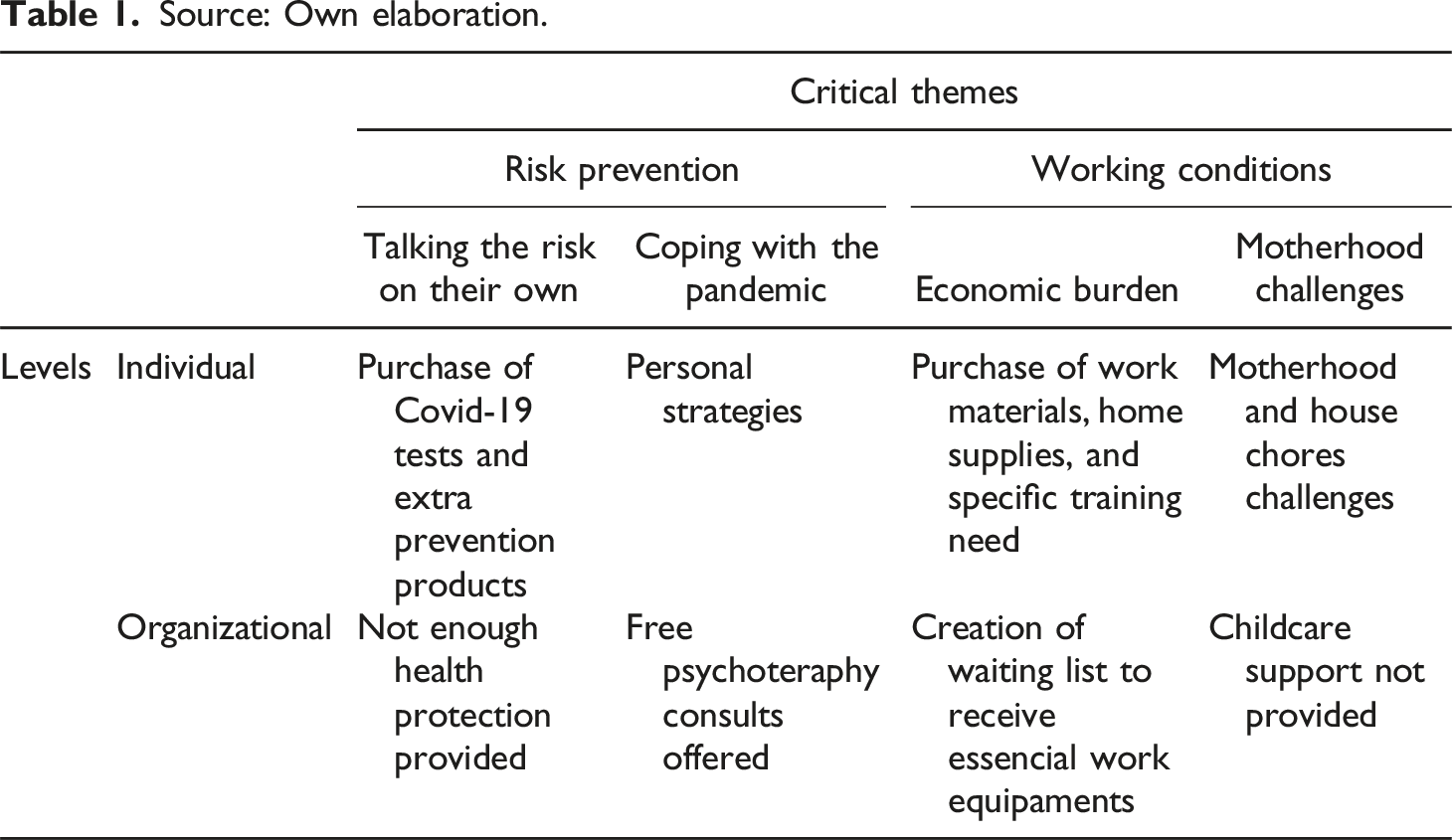
In the next section, we will discuss these findings and how they present a picture of how journalists’ personal and professional lives of journalists were shaped by neoliberalism and patriarchy during the pandemic.
Discussion
Taking the risk on their own
The Covid-19 pandemic has undoubtedly exposed how an epidemiological issue has become fraught with social, economic, and political components (Fuchs, 2020; Žižek, 2020). Therefore, it stands to reason that contamination hazards and the threats that derive from them interact with psychological, institutional, governmental, socioeconomic, and cultural processes in ways that can amplify or attenuate risk perceptions and, obviously, their subsequent responses (Lupton, 2023). The perception of risk should not exclude factors that directly influence emotions, both the so-called positive ones, such as hope, gratitude for not having been infected, serenity and empathy, and the so-called negative ones, such as fear, anxiety, and worry. Irrespective of one’s inclination to isolate parameters, it’s impossible to know which factor or factors may have a more significant influence than another.
During the first period of the Covid-19 pandemic and subsequent months, the journalist’s routine in public service and private sector news media context was somehow the same. Neoliberal rationality guarantees that each person is accountable to care of herself/himself. Discrepancies started appearing when Covid-19 tests became available. Freelance journalists were encumbered to an unequal extent to ensure compliance with health measures and to guarantee working conditions. According to the interviewees, this happened because of economic responsibility for all purchases of self-care materials. “All expenses for gel alcohol, masks, it was always on me, everything” (Benjamin, male, radio reporter, 33 years). Simultaneously with the resolutions issued by the Portuguese Ministry of Health, media companies also implemented their own decision-making processes, which included basic precautions against the spread of the coronavirus, such as mandatory mask usage, recommendations for using of alcohol gel, and guidelines for maintaining physical distance.
In general terms, alcohol gel was available at the entrances of the workplaces and in cars for outside locations. Regarding masks, the situation varies according to the period of the pandemic. Masks were provided at the beginning of the pandemic even if the number was insufficient by dint of disposable face masks, and its purchase over time was entrusted to journalists. As Cristiano, a 30 years-old male online journalist, told when a news site hired him: “The masks we use daily, I bring those from home”. In contrast, Benjamin, 33 years old, a male freelancer who works for print and online media, complained: “Nobody is really worried about freelancing, right? Right now, in communications, nobody cares.”
Specifically for radio and television journalists, media companies took it upon themselves to buy extendable poles to place the microphone. The aim was to ensure journalists would not be close to the interviewees and maintain the advisable distance of at least one and a half meters, which guaranteed health safety. Nevertheless, everything was not too easy. Carolina, a female 49 years-old television reporter, recalled that it was necessary to demand equipment to ensure distance and hygiene, “the issue of acrylics shields (to separate workstations) should not even have been requested. It should have been instituted immediately. Just like the spray cans for the microphones, we always had to ask for them”.
The make-up concern has become more evident for female journalists, which is a naturalised performance, especially in television culture. Carolina pointed out that “a man, even wearing a mask, it is very easy for him not to put anything on his face. A man, the most he can put on is powder to take the shine off. Now, a powder, any man with two fingers on his forehead could have his own powder”. As objects can transmit the virus and the eyes, noses, and mouths are its entrance doors, the risk during the make-up was more highlighted. To remedy this contingency, disposable materials, such as mascara sticks, started to be used in the private sector news media and in the state-owned media company. Costs matter for this convenience was not passed on to journalists. Added to other solutions measures, interviewed public service journalists considered the company “exemplary” in decision-making (Erika, female, tv reporter, 31 years). An example was the Covid-19 testing for all employees, initially available every week and further every 2 weeks intending to reach more people as they began to return to in-person work.
Even considering the private broadcast companies put available Covid-19 tests, the number of test kits, the regularity in testing and the availability of nurses in the public sector were higher. In this case, Covid-19 tests were available for those who both worked in coverage outside the newsroom and were more exposed and for those journalists who stayed exclusively in the newsroom. Journalists in the private sector recognised the company’s obligation to guarantee the safety of employees on individual terms and a public responsibility with the continuation of media work. On returning to in-person work and at a stage when full vaccination was assured at good rates at a national level, Ana hoped that in her company, a private online newspaper, monitoring of care and prevention would not remain restricted to the individual scope.
Coping with the pandemic
The wear and tear were not only felt on a physical extent but also in mental health. When it comes to psychological equilibrium, depending on how affected individuals are, the emotional influence on the response to health risks can drastically change behaviour (Mathur and Levy, 2013). Contrary to these reactions, by not identifying dangers clearly and precisely, some people may take risks that could have been avoided (Keller et al., 2002). Added to the emotional dimensions is the sphere of personal experiences, which interfere in accepting or denying certain public health practices and discourses. Adding even more complexity to the theoretical and practical approach to the subject, the perception of risk is changeable (Burns et al., 2012) and can vary in intensity depending on the time and conditions of the extra and intra public health crisis context. Journalistic routine during the pandemic put journalists close to the facts, operating as a stress and anxiety factor. As Ana reports, she had to anaesthetise feelings and work in automatic mode.
There had already been so many months of people dead, people sick, people ventilated, and people with horrific stories of families completely disfigured by the pandemic. It was almost as if my subconscious needed a cocoon to be in and to get away from the world, to put a brake on that. Otherwise, it would be impossible to manage so much emotion. (Ana, female, online journalist, 26 years).
During the first lockdown stage, an online newspaper offered free psychotherapy consults to employees. None of the interviewees said they had been monitored by a health professional linked to their workplace. Additionally, when asked if they would make an appointment if the news media made this service available, they considered the solution great, although an unusual/atypical initiative. A few would consider an appointment; however, they did not trust enough as long as fears and weaknesses would be exposed and could place the worker as unfit for the job and the coverage they carried out.
I never complained about this. Because of the stigma, you know? I was always afraid that they would think I was less capable or… and I didn’t want to share something so intimate with the doctor that I didn’t know. (Alexa, female, press reporter, 37 years).
Strategies to switch off were reported, such as doing physical exercises, reading books, and watching series. Martin (47 years old), who holds a managerial position in a radio station, gendered his moment of rest. For him, domestic chores are not obligations. That is to say, they are not his responsibility but rather moments of exception that he treats as a privileged condition. e: During this period, was there anything you did to unwind? I: (laughs) no, I don't know, do the laundry. (laughs)
Economic burden
In the transition from work to home, the leading work equipment, a computer, was provided to journalists from both the public and private media sectors. There were some inconveniences for some, who had to be part of a waiting list to receive essential equipment, or who did not receive laptops and had to use their own. These cases were more common in companies with more acute financial constraints. Other journalists did not have chairs or tables suitable for long work hours, such as dedicated spaces and ergonomic furniture, nor cable TV upgrades to follow the latest news events, as happens in the newsrooms. There were recurrent statements concerning the expense of extra materials that journalists had to undergo, such as buying screens, microphones, and ring lights in the case of television journalists. These demands were treated as “investments” for them. However, the biggest afflictions were the order of basic service prices. Journalists had to bear the economic burden of internet, telephone, water, gas, and electricity costs. At this point, freelance journalists felt more “privileged”. As Adkins (2016: 2) points out: “These are workers who paradigmatically fund these activities via indebtedness: they invest in themselves as assets in the hope of future returns”. Likewise, Kanai (2019: 11) posits the ideal entrepreneurial subject as one with affective orientations that may be deemed ‘positive’, such as ambition and optimism, converting negative experiences into feel-good outcomes. As Benjamin, a male journalist 33 years old, said, “regarding basic resources to anyone able to work autonomously from home, this was a period of adaptation that I never had to go through”.
Still, in the services and urgent needs field, the public health crisis has imposed unpredictability and the indispensability of specific knowledge. Maria, a female journalist from an online newspaper, summarises most interviewees’ perception: “training is done very much on the job, while we are working. Basically, we correct each other and help each other with some questions”. The media companies did not provide specific training, not even considering junior reporters or those in management positions. The idea that the journalist can communicate about everything and cover any subject was considered inherent to the profession. Women felt the need to seek more specific training, as webinars and courses directedly linked to the Covid-19 scope to cover the pandemic explaining the disease and contextualising the scientific advances. “The only thing I did on my own initiative and I didn’t finish was a course, which was precisely about covid-19. I was reading a lot of things, but training properly by the newspaper, there wasn’t” (Daisy, female, online journalist, 27 years). Female journalists felt unconfident, thinking they were not good enough. Furthermore, they had to seek information and training to address the pandemic in diverse contexts. Unsurprisingly, it created inconvenience regarding course fees and overtime that companies never funded nor reimbursed.
Motherhood challenges
Since women interviewed focused more on their individual-level experiences with parenting relationships than men, we focus on the perceptions of women journalists to address how being a mother shapes the professional journalist. It was frequently female journalists who were married/partnered with men who were also journalists. Also, most women interviewed were in charge of the care and attention of their children during confinement. One of the interviewees explored this dimension when she did not consider a structural issue in our society nor did she question the sexual division of labour, but rather explained that her husband’s work required much more commitment because he was the editor-in-chief of a news website and did not have the flexibility that she had on work hours. As Alexa confined, “he (husband) had to be permanently managing content. I could do my content in another way in their (children’s) naps, during the night. (female, press reporter, 37 years).
Combining the long working hours reported by interviewees with childcare duties, the adaptation and way of working of journalists with young children differed from those of school age. As told by Erika, a television reporter, she chose not to step away from work because she considered the role of journalism in conveying credible quality information as essential, especially during the first lockdown in March 2020. Solo mother of an 11-year-old son, Erika opted for remote work rather than staying exclusively in family care – a possible situation for parents with children under the age of 12 supported by the Portuguese State.
At the time, it was a bit to facilitate the logistics of writing because there was a lot of work (…) today, perhaps, I would not have done it because of the logistics between my child learning via Zoom and telework. It was not easy to organise everything during those weeks. (…) Encompassed by the school tasks, I often had to stop to solve problems on his (son’s) technological apparatus or document scanning that teacher asked for or even help with some assignments that were requested. (…) The general working day ended much later. (Erika, female, tv reporter, 31 years).
Despite the support network reported by some interviewees, being grandfather and grandmother most often mentioned as the figures who help in the upbringing of children, it was unanimous that the tasks of the mother-journalist “are demanding” (female, radio reporter, 37 years) and “sometimes suffocating” (female, press reporter, 37 years). For one interviewee, who is an employee of the public television and radio sector, childcare support should come from the State. She believes that, just like other professions that did not stop working during the general lockdown, journalists should have had support with childcare and education. In Portugal, some schools were kept open to receive the children of workers in essential services, such as doctors, nurses, firefighters, postal workers and those responsible for rubbish collection, for example. However, female journalists in the private sector media do not bring this issue up. They believed that the responsibility for balancing childcare and work duties lies with the family, not the State. As for men, those who were also fathers don’t seem to feel the same issues regarding to parenthood. In other words, for men this is not an issue recognised as problematic.
The flexibility of remote work was seen either positively or negatively. Teleworking created conditions for some mothers to spend more time with their daughters and sons, which was seen as positive due to the value of the quality time they spent together. I managed to be the mother I’d never been before (...) I didn’t know what it was to go to the park. (Alexa, female, press reporter, 37 y) The difficulty for him (a four-year-old son) was mainly that in the first lockdown, as I was available for him, we did lots of activities at home and plastic activities, etc., yet in the second lockdown I had much less time because I was working. So, I could only give him half of my attention. (Maria, female, online journalist, 40 y)
Since demands on Julia’s half-year-old daughter, such as taking her to the doctor or not having anyone to leave the child with, were recurrent, the mother-journalist had to shift her work routine. She said there was openness in talking to the boss, who is also a father, about her needs, and the requests were easily accepted. I really need to take time off or work at night (...) eventually I’ll telework because then I can stay with (child’s name) and I can work too. (Julia, female, press reporter, 37 y)
However, women journalists recognise that these situations are exceptions. “The issue of schedules in this journalism world, not all women find it easy. I have colleagues who don’t manage to have schedules as compatible with their children as I do” (Alexa, female, press reporter, 37 years). Working at the same time as being with children caused embarrassing moments for some of the interviewees. Maria’s four-year-old son is an example, “he wants to take part in all the interviews I do, he always wants to ask whom I am talking to, he wants to say ‘hello’”. As home also became the workplace for some of the people interviewed for the news stories, there was understanding and solidarity, especially from those who also had young children at home. Although this tolerance, for Alexa, this situation somehow bothered her, “there is a moment that it ends up being normal. But it is a strange normal. I have never got used to it”.
The interpretation of their own lives is not ambiguous. Although there was the perception that there was more time to dedicate to their children, the interviewees rebounded against the idea of giving up their work as journalists. On the contrary, the expectation was to return to their routine of in-person work so their children could return to school as soon as possible. What was pointed out regarding the negative side of flexibility also concerns time with the children. The price paid for Alexa (female, press reporter, 37 years) was that “I ended up wearing myself out because I ended up doing two very intense shifts”.
The neoliberal approach is very present in professional role perception. The journalist’s notion of the job is that the work must be delivered no matter how. Therefore, the alternative for some of the mother journalists interviewed was to work during their children’s naps, write texts at the end of the day or wake up earlier when everyone was still asleep. In contrast to female journalists, not all male journalists have shared their experiences as parents. Among those who have done so, they have often highlighted their involvement in educational tasks and emphasised the importance of gender equality within the domestic sphere, recognising that such attitudes are uncommon in conservative societies.
As shown by Brown (2006: 694), neoliberalism entails a “host of policies that figure and produce citizens as individual entrepreneurs and consumers”, and when professionals are worth when they are able enough to reach and maintain their own needs, do not need extra support, and keep themselves safe. The findings show that news organisations take responsibility to a certain extent when providing essential equipment against coronavirus, namely masks and alcohol gel, in the newsrooms. However, private sector employees have to bear the costs of testing against Covid, unlike the state-owned media company, where employees are provided with regular testing kits. Excessive and flexible working hours were reported, especially by journalists working for online platforms, who acknowledged an increased workload as the continuous flow of production required. Most of them had to purchase work materials: chairs, professional microphones, and laptops, as well as cover costs of external calls and upgrade internet services. Also, mental health is not seen in public policy terms as fundamental for a quality of life and is one of the burdens that the worker must maintain.
Journalist freelancers often distinguish themselves as flexible workers who are used to having a different routine from the journalists who work in the newsroom, seeing themselves as enterprising subjects. This characteristic is exposed by the resources they already have as cameras and equipment, and the easy ability to face homework during the lockdown. They performed and produced better than others because they already had the skills and abilities to adjust to whatever happened. As Foucault states, the “entrepreneur of himself” is “himself his own capital, being for himself his producer, being for himself the source of [his] earnings” (2008: 311). Moreover, entrepreneurial subjectivity is not only a consequence of the current neoliberal paradigm and economic order but also a prerequisite (Vallas and Christian, 2018).
Mental health cannot be neglected during the process of news coverage either. Journalists were exposed to a constating number of deaths and painful stories. As resilient professionals who often have to handle the stress they accumulate, journalists do not consider managing fatigue a support point the company should provide. The results show how each one perceives and deals with the news coverage routine is also gendered. This became evident in the case of the male boss, who perceived the house chores as rest time.
Differences between public service and private sector news media are significant. The owned-state media coped better in terms of safety and prevention of covid-19 than the private sector, which transferred health responsibility to an unequal extent, not considering discrepancies in salary conditions, parenting, chronic diseases, disabilities, ageing and treating all individuals as one single group.
Female television journalists faced a higher risk due to their daily make-up routine. Those who are mothers faced overlapping challenges. Motherhood was highlighted as demanding for mother journalists who kept their work duties even in a telework regime. Consequently, they had to combine long hours of work with childcare. Mother journalists felt overwhelmed and exhausted and expected to return quickly to in-person work in the newsroom. However, as others have pointed out (Lobo et al., 2017; O’Brien, 2014), in mainstream media, women commonly did not connect their professional practices to their gender subjectivity.
Gendered differences in experiences appear to be related to parenting, family care, and work-life balance. Women commonly take on a disproportionate share of caregiving responsibilities, such as childcare and eldercare, impacting their career opportunities and earning potential. Conversely, men may face societal pressures to prioritise their careers over their family responsibilities, leading to a different set of challenges. Not surprisingly, denial of the relevance of gender was articulated in the women’s fear of suffering reputational damage as a consequence of challenging the status quo. This is a crucial issue to gender studies because not seeing a holistic problem, considering individuals’ responsibilities and not a change in structural society bringing solutions becomes more difficult. As previous research shows, normalisation is critical (Ashraf and Brooten, 2017; North, 2009; Scharff, 2016).
Conclusion
Portuguese Journalists’ perceptions of their job during the Covid-19 pandemic show their acceptance of the new conditions due to the transfer from the workplace to home, crystallising that they must adapt to circumstances and not wait for the best scenario to deliver the work. Looking back on their experiences during the first 2 years of the covid-19 pandemic, journalists exposed their fears, feelings and desires about their private lives and work as news producers. No one was prepared for a health crisis on the scale of 2020, and everybody was affected in some way, whether they were infected or not, whether they knew someone who got sick or not, whether they died or survived. It was no different for the journalistic profession. Everyone in the news production machinery has had to adapt to their responsibilities and social roles.
There is a general perception that these personal efforts are part of the job, and the journalism practice implies these adaptations. Additionally, no critical thinking on neoliberal dynamics and gender issues was formulated consonantly with the social-economic-political context. Gender issues are externalised to matters of private life, such as the division of household chores and childcare, and are seen as a female problem. Gender continues to be placed outside newsrooms, which are generally considered neutral. By rejecting the structural role of gender, finding solutions that are also structural became heavier. This echoes neoliberal rationality. Individualism focuses on oneself, removing the possibility of solving problems with mutual support involving more people and even the State. Being strong and dealing with one’s problems is a basic premise of the ‘entrepreneurial of the self’. In the context of the covid-19 pandemic, taking the risk yourself has been normalised.
In this arena, material and subjective issues are articulated, implying that self-care was journalists’ exclusive responsibility during the first stage of the covid-19 pandemic. The neoliberal discourse, which is present throughout the empirical study to a greater or lesser extent, adopts the prerequisite of being safe and healthy as a condition for autonomy, empowerment, and self-responsibility, dismissing the power of the collective organised in unions or associations, and absenting the State’s responsibility to guarantee access to health measure protects. The prevalence of subjectivity in care stands out, a common feature in our world today. In journalistic practice, the fundamental difference lies in the supply and availability of these objects, transcending the dichotomy between public and private.
Footnotes
Acknowledgements
The authors thank the interviewees for participating in this study and the reviewers who provided invaluable feedback.
Declaration of conflicting interests
The author(s) declared no potential conflicts of interest with respect to the research, authorship, and/or publication of this article.
Funding
The author(s) disclosed receipt of the following financial support for the research, authorship, and/or publication of this article: This study was funded by the Fundação para a Ciência e Tecnologia, within the framework of the PhD research grant number 2020.04647.BD.
