




Abstract
This paper seeks to explore to what degree revisionism and journalism interact in a European context. By looking at countries with troubled pasts, such as Greece and Spain, which are well into the European Union and also the euro-public sphere, and Kosovo, which uses European Integration as a framework to deal with its conflicting past, we aim to answer the crucial questions of what historical revisionism in journalistic productions is; how it emerges and how it is addressed by journalistic productions in such discourses. We use data from 22 semi-structured in-depth interviews with selected journalists who cover ‘troubled past,’ identified by searching content on the media with the same keywords. These journalists represent a pool of professionals who research the past and forensically deconstruct events and documents to come to new conclusions or re-interpretations of the past through present journalistic productions. Our data suggest that journalists indeed have a narrative of the past in their minds and are eager to explore it further in seeking an ideal professional role of finding out the truth as a counter-revisionist measure. In doing so, journalists also face competing loyalty between their identity and professionalism, belonging, and political situation. Greece, Spain, and Kosovo have suffered very different past conflicts and have different ways of dealing with the past, but journalists in all three countries compete for the true narratives of war and the past. Writing the first draft of history, they argue that the latter is continuously under revision.
Keywords
Introduction
The terms ‘revisionism’ and ‘historical revisionism’ carry various normative, conceptual, political, and emotional associations, and we need to define these terms so that it becomes operational in our study. They are also controversial terms that carry various meanings and interpretations. The following example highlights how sensitive the issue can be:
In 2022, the Kosovo Government decided to reconstruct a house in the city of Mitrovica that formerly belonged to the prominent Albanian Deva family. Xhafer Deva served as Minister of Internal Affairs during the Nazi-German occupation of Albania and Kosovo during World War II (Haxhiaj, 2022). The restoration of the house of controversial figure in Kosovo´s history triggered national and international public reactions, including from the German Embassy in Kosovo (Bami, 2022a), EU officials, and others (Bami, 2022b). A group of journalists found credible information of Deva’s positive role during the World War II (Dauti, 2022) and another group had evidence of him being a Nazi collaborator (Malcolm, 2002). The Kosovar minister of culture said in 2022 that the restoration of monuments is not done for historical revisionism purposes (Bytyci, 2022). This sparked debates on history books and true account of Deva´s involvement with the Nazis among policymakers, academia, and the highest level in EU (Bami, 2022b). It is worth noting that Xhafer Deva was extracted to the United States after the World War II and lived until his death in 1976.
There is also a conceptual discussion on the matter of revisionism. In his book, Michal Kopecek claims that historical revisionism, far from being restricted to small groups of ‘negationists,’ has galvanized debates in the realm of recent history (Kopecek, 2008). He investigates the borderline between legitimate re-examining historical interpretations and attempts to rewrite history in a politically motivated way that downgrades or denies essential but contested ‘historical facts.’
Maruša Pušnik and Oto Luthar use the word ‘revisionism’ to describe situations ‘that illustrate the explicit political instrumentalization of the past” and in relation to World War II, “fallout in the historiographical framework of a more comprehensive political and ideological offensive (Pušnik and Luthar, 2020: p. 27) concluding that past is interpreted on the needs of the present. “The battles for the symbolic places of memory and prevailing interpretation of past events have moved into political and media discourses, which very often draw on the needs of the present in their attempt to interpret the past (p. 47).” In this context, journalists write the “first and second draft of history” (Nordberg, 2017) under this political instrumentalization of the past.
In framing the concept of revisionism and media production in Europe, the state-of-the-art report RePAST “Report on the state of the art in the field of memory, conflict and media: Troubled Pasts in Journalistic and Citizen-led Media”, (Siapera et al., 2018) reveals competing loyalties and potential clashes between the professional and national identities of journalists in Spain, Greece and Kosovo but also other European countries that have undergone conflicts. Fundamental journalistic norms, such as objectivity, traditionally perceived as western, come under even greater pressure in conflict reporting, as the trauma and violence journalists witness require an outlet. Reliance on official sources has been found to enable control of the information flow from states, while the broader institutional environment may impose direct orders on how and what to publish or broadcast. According to arguments made by Neiger et al. (2011), studies of journalists focus primarily on “non-commemorative and unintended influences of past phenomena” (Schudson, 1997: p.14) in the news, thus concluding that there is a “relative understudy of journalists as agents of collective memory” (Neiger and Zandberg, 2011: p. 14).
Revisionism invites reflection not only on the outcome of journalism (i.e., frames, narratives, representations and discourses) but also on the tools that produce it (i.e. ethics, objectivity and neutrality). At stake is the point of view from which media and journalists approach revisionism (i.e., ‘watchdog’ function, gatekeeping). Almeida and Robinson (2023) consider that journalism has had a long-standing difficulty to maintain a critical distance from political institutions and power. Another example is the notion of ‘false objectivity’, which refers to the misuse of objectivity with a view to privileging more dominant versions of reality against those supported by less affluent sources, including media sources (Almeida and Robinson, 2023; Attiah, 2021; Møller Hartley and Askanius, 2021). In effect, the views on journalism’s approach to revisionism will orbit around either a social constructionist approach (representation, legitimization and power) (Van Dijk, 1993) or the more classical approach of mediatization (Hjarvard, 2013); the idea that albeit its shortcomings, journalism is the primary repository of collective memory (Zelizer and Tenenboim-Weinblatt, 2014). It is also a framework that facilitates negotiation of different versions and the formation of consensus.
In recognizing that there is an ongoing theoretical discussion on the concept, this article has as an ambition to contribute to a systematic conceptualization of the relationship between historical revisionism and journalism. The empirical data upon which this analysis is based is 22 qualitative interviews with journalists from Spain, Greece, and Kosovo who report on topics of their countries’ troubled pasts. Journalistic reporting on troubled past is a demanding challenge due to the sometimes-ambivalent connotations of the notion of revisionism. The complex dynamics of journalism as a professional practice is a vocation with highly symbolic, political, cultural, and institutional dimensions. However, in the midst of these difficult aspects, there is a need to study the troubled relationship between journalism and revisionism. We aim, therefore, to formulate a conceptualization based on our data according to the following research question:
How is representation of historical revisionist narratives experienced by European journalists in the field, and how do they view their role in creating such discourses?
Acknowledging that media and journalism, like historiography, are a part– by definition– of the evolution of interpretations and revisions of history entails exploring how such agents participate in these discussions. Our focus is on more proactive aspects, such as the dilemmas regarding their representations and interpretation of troubled past and contested versions of history. Due to the multifaceted character of the matter, we focus on journalists’ perceptions of historical revisionism and their role in reproducing or overcoming it.
Theoretical framework: situating media research and revisionism
In the attempt to investigate the concepts of revisionism and media productions, it is necessary to consider the broader, generic context of journalism’s relation to history itself. A considerable amount of works stress the significance of journalism and its daily input on the writing of history (Boyce & O’Day, 2006; Naimark and Case, 2003; Palmer, 2003; Riggenbach, 2009). This assessment surpasses the common idea that the media and their content are valuable sources of information for historians. It also considers the evolution of normative western key concepts of journalistic practice, such as objectivity and balance (Löffelholz et al., 2008), both with regard to the gathering of information and the outcome of the journalistic discourse. Another aspect is found in studies focusing on the public debates on history, including the issue of revisionism (Ebbrecht, 2007; Hasian Jr and Carlson, 2000; Howe, 2000; Kopecek, 2008; Luthar, 2013; Valencia-García, 2020). They commonly regard the fact that the media and journalism have acted as the main facilitators and mediators of the exchange and circulation of ideas, perceptions, and knowledge. This ‘facilitation’ also includes the confrontation among different historical narratives and interpretations and their evolution through different periods.
The debates on objectivity and ethics put journalists into an almost impossible position regarding historical revisionism. From a critical standpoint, journalism is viewed as a field where antagonistic views meet. This is why Almeida and Robinson (2023) propose ‘activist journalism’ as a counterpart to objective journalism. Nonetheless, there are insights from the literature that suggest a way beyond the dipole. It all comes down to a different approach to the notion of objectivity. Gibran (2020) suggests that at best, objectivity will be flawed and at worst ideological. Thus, it should not be viewed as a static set of action imperatives but as a ‘virtue imperative’ (Gibran, 2020). From this standpoint, journalism will have a greater space to function as a facilitator and catalyst towards objectivity and not necessarily as the actor that sanctions it. Thus, such an approach allows to look for the awareness of journalists that they can deal with or eventually avoid the pitfalls related with revisionism.
Therefore, any attempt to conceptualize, in more prescriptive terms, journalism’s relation to revisionism should consider all these parameters. In this study, our attention does not limit itself to critical phenomena such as the media and journalism’s significant role in the formulation, evolution, and negotiation of a given society’s collective identity and memory (i.e., ethnocentrism, ideological, political, and cultural considerations). These are valuable standpoints that can highlight the media and journalists’ role in dominating a particular interpretation of history– particularly concerning traumatic pasts and revisionist approaches (Pušnik, 2019; Rossi, 2008). Our attention is primarily directed toward the procedural and typological characteristics of revisionism in journalistic productions based on approaches found in history. In many regards, Mallon’s notion of “cycles of revisionism” (Mallon, 1999) which she applies in the realm of cultural history, does seem to provide insights that could guide a similar approach to media and journalism.
Drawing from the debates and discussions regarding the paradigms of “new cultural history” based on post-structuralist and post-modern approaches, Mallon reflects upon revisionism as a process and not a static phenomenon. She argues that as a process, it may contain both an epistemological and a methodological component (debate on the instruments and the tools that validate knowledge) and a factual component (discussion on facts and dates and their implications). Independently of the complications that such debates can have on the progress of scientific research (i.e., multiplication of conflicting approaches), Mallon (1999) also advances the idea that scholars can use a cycle of revisionism to improve their epistemological and methodological equipment: “in a cycle of revisionism scholars have always begun to look for more finely honed instruments” (p. 337). The challenging aspect of connecting journalism to revisionism in this process is exploring the implications, the readjustments, and the recalibrations that each cycle brings to journalistic practices and production. In other words, the hypothesis from this standpoint is that independently of the specific position and a priori of journalists, a cycle of revisionism will inevitably modify their approach to history and through history on collective memory, identity, and trauma. From the standpoint of our approach, it is critical to determine to what extent one can refer to the accumulated expertise that particularly the more experienced journalists have acquired in dealing with revisionism from the perspective of their professional practice.
Focus: Journalism and historical revisionism
The statement “Journalists write the first draft of history” is often credited to the former Washington Post editor Philip L. Graham. In discussing journalism’s role in shaping history and memory, journalism scholars globally have increased their attention to this topic. In her work, Tanja Bosch (2019) places journalism as a key agent in collective memory. Zelizer and Tenenboim-Weinblatt (2014) have worked on the contradiction between journalism’s focus on the present and memory’s emphasis on the past. More specifically, research in news and media production of memory has looked at influencing factors.
Historically, studies emphasize various aspects of influence and forces shaping the news; individuals, routines, media organizations, economic factors, competition in the market, and society at large (Hansen et al., 1998). Reese and Shoemaker’s “Hierarchy-of-influences” model (Reese, 2019; Reese and Shoemaker, 2018) helps analyze the production of memory content in the media. In the production of media memories, journalists face unique challenges when the issues of competing loyalties are brought up. A recent study of the production of mediated Holocaust memory in Israel (Zandberg et al., 2012) explored the multi-layered interrelations of identities between news production and collective remembering based on interviews with senior reporters.
In our approach to framing revisionism– a term that carries strong normative assumptions, associations, and emotions– it is useful to go via the concept of memory studies and media production that concerns the extent to which journalists and other media producers reconstruct past events in ways that align with present events. These occasions are described as ‘reversed memory,’ a narrative that commemorates past events (the ‘there and then’) by narrating present events (the ‘here and now’) (Zandberg et al., 2012). Reversed memory “commemorates the difficult past through the achievements of the present, and thus not only eases the collective confrontation with painful traumas but rather avoids this encounter altogether” (Zandberg et al., 2012, 65–66). For Zandberg et al. (2012), journalists and other media producers are motivated to produce this kind of reporting as a means by which to understand and process the trauma of troubled pasts.
Methodology
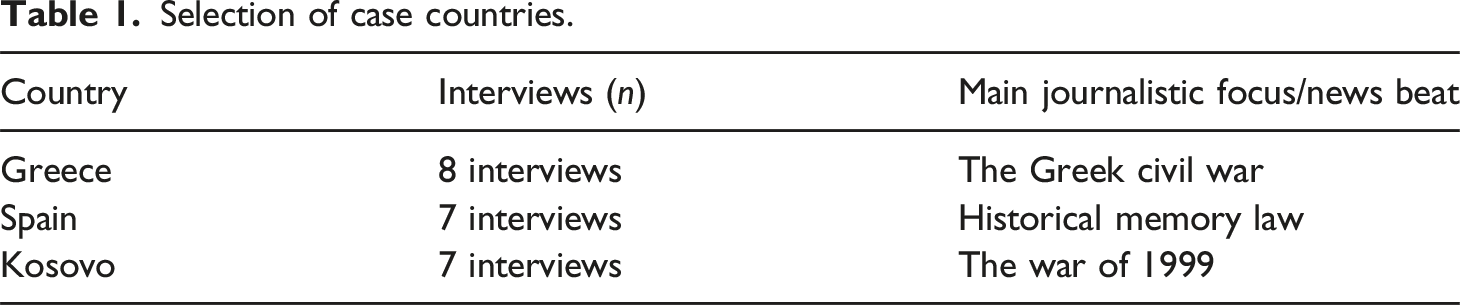
For each country, 7 to 8 journalistic media outlets were identified, fulfilling one of the following criteria: (i) mainstream media/agenda-setting media which influence a large number of people and are highly relevant in public opinion building; (ii) alternative, right-wing and/or left-wing media following an anti-establishment agenda. For each media outlet, at least one journalist was identified covering topics related to the country’s troubled past. 22 journalists were interviewed between 60 to 90 minutes with semi-structured in-depth interviews. Prior to interviews, they were informed about the purpose, conditions (duration, confidentiality), and the possibility of withdrawing.
The questions were based on news production research agenda with focus on routines, influences, and role perception in dealing with troubled pasts. The merging of news production and revisionism came as a result of a broader research framework of the project. EU funded RePAST project.
The rationale for selecting countries is based upon experiences that countries had with troubled past and revisionism. Greece is one of the countries with early membership in the EU and a rather disturbing troubled past with a Civil War, extending to student protests decades later. Spain with more recent democratization and EU membership, and somewhat obscured but peaceful transformation of power and dealing with the troubled past through legal regulation. Kosovo is practically a post-conflict country but with an extended conflict from the 1999 war and aspirations of EU membership.
Selection of case countries.
Interviews were conducted in 2019 and 2020. All interviewees were journalists covering stories on the subject of dealing with the troubled past and history. They were identified through a quantitative content analysis study for the RePAST project that looked upon narratives of the past in content published in media. The interviews were transcribed and translated into English. They were analyzed via the data analysis software MAXQDA which included manual coding of segments in the interviews related to the article’s main research questions. Among coded elements were also key controversial debates and polarized narratives regarding the past. More specifically, the data were further coded to understand news production and revisionism, denial, contested narratives, the emergence of revisionism, anti-revisionism, resolving revisionism, the role of the EU in positive or negative revisionism, and suppressed narratives in media content. Positive and negative revisionism were coded after the paper’s first preliminary findings were discussed.
Findings and discussion
The emergence of historical revisionist narratives
Before going into details about how historical revisionist narratives emerge in media content in Spain, Kosovo, and Greece, one should pay particular attention to the perception of revisionism by the journalists interviewed. Generally, journalists understand that ‘revisionism’ carries some political weight and is understood with negative connotations. When speaking about revisionism, journalists immediately describe stories about attempts to suppress narratives in Spain, negligence of research in Greece, and generally, the worst type of historical revisionism in Kosovo, which is the denial of a series of events of violence by the state authorities. One of the findings worth discussing here is that revisionism is not a well-defined term and has a different meaning in different contexts. The lack of formal study of the past dominates the reasons evoked for the emergence of historical revisionism.
Greece
While describing Greek sentiments towards Turkey, a journalist refers to events between 1821 and 1912–13 as defining periods on which narratives for Greek attitudes toward Turkey were initially based. Journalists are aware of being instrumentalized past (Pušnik, and Luthar, 2020). This view includes a critical assessment of public discussions: “In Greece, we do not study our past to the extent that we should (…). This does not enable us to be calm and have a more balanced view and understanding. This permits the domination of exaggerated views.” (Interview with Greek journalist, 2020)
Another journalist defines the process of debates on changes in history as a highly politicized process that will negatively impact society. In this case, revisionism is understood as a form of rewriting history books and changing the narrative on sensitive subjects that are still highly important in society confirming Kopecek (2008) claims of revisionism being of an interest to larger groups than small ‘negationists´. “I believe, as painlessly as possible, negotiating in high schools and colleges. As painless as possible because it will not only feed new tensions in schools. It will feed tensions into the teacher community, which will then be transferred to society. We will get a little out of the ministry of education curriculum from the schoolbook.” (Interview with Greek journalist, 2020)
Journalism in the historical newsbeat also suffers from a flood of subjective and personal publications. Such a trend can be attributed to an effort to provide a heroic narrative of the protagonists in conflict and war, and indeed, that was the case in Greece, where witnesses of the Greek Civil war, after the end of the war, went on to publicize their versions of the story. These publications confuse journalists in determining sides of the conflict, whether these publications are to be treated as primary evidence in stories. “The protagonists mainly wrote books. Almost everyone… Everyone wanted a chance to express their opinion, and everyone wrote accordingly. After 1974, everyone wanted to tell their legend, to deposit it. We were confused by this. Some books had value; they brought some primary evidence, and so on. But many were only means of testifying, of justifying the legend by different fighters. My library is full of such books.” (Interview with Greek journalist, 2020)
Furthermore, Greek journalists see such publications with a critical eye despite them being somewhat the official version of the story. Schudson calls this non commemorative and unintended influences of past phenomena (1997), and its productions serve instrumentalization of history. Journalists feel that the way forward is to provide expertise on the subject of history. As history is a sporadic task for a journalist, the involvement of experts in history to help journalists define and shape journalistic productions is the way forward.
Kosovo
The concept of conflict is fresh in Kosovar journalists' memories. Hence, the understanding of historical revisionism is related in principle to the war in 1999 and the crimes committed around that conflict. Kosovar journalists work proactively in historical newsbeat precisely because history is important to them confirming journalists’ role in dominating a particular interpretation of history (Pušnik, 2019; Rossi, 2008).
To define historical revisionism, journalists argue that the public is full of historical narratives, which necessarily produces disagreements on historical subjects. For Kosovar journalists, personal stories of Kosovar politicians are also not very credible, so they see the need to revise histories with a more comprehensive approach. One journalist claims that Kosovo’s politics is all about the war. “In Kosovo, the historical discourse is about what happened between us and Serbia and Yugoslavia. You can see that even today, politicians have to do with their contribution during the war.” (Interview with Kosovar journalist, 2019)
Similarly, other journalists understand that the generation that experienced the war themselves, including active participants in armed resistance, cannot write the allegedly true account of what happened. Although they are very critical of this approach of personalization, they reckon that there needs to be a timely distance so historians and journalists can cover facts and truth more accurately. A Kosovar journalist narrates his take on historical revisionism by claiming that contemporary narratives are, in fact, revisionist because they are personal and one-sided. This is added as news production value and significance of journalism and its daily input on the writing of history (Boyce & O’Day, 2006; Naimark and Case, 2003; Palmer, 2003; Riggenbach, 2009). “It is relative to say that the winner writes history. I have seen tendencies to change events that occurred just over two decades ago.” (Interview with Kosovar journalist, 2019)
Other versions of understanding revisionism in Kosovo include subjective approaches to reporting in such journalistic beats. As journalists write for their own ‘kind,’ they are more prone to cultural and social influence or biased reporting and produce content that does not support contradicting views or other versions of history. The same journalist explains that it is difficult to report on subjects that journalists have witnessed the events themselves. A degree of self-censorship is also applied in fear of being labeled under the nationalistic influence by readers should, for example, Kosovar Albanian journalists write about themselves in Kosovo making Kosovar journalism a key agent in collective memory (Bosch, 2019) in negotiating journalism’s focus on the present and memory’s emphasis on the past (Zelizer and Tenenboim-Weinblatt, 2014).
Other journalists highlight the impact of international media reporting. Using sexual violence as an example, one journalist points to how sexual violence was taboo until it was international news. According to this journalist, such reporting became important in local news reporting after a particular testimony of a victim of sexual violence in the United States Congress. “We talk a lot about the (war) martyrs and not so much about the victims of sexual violence. I wish this to be a more current topic, but I believe that because of our mentality and tradition, there is generally silence on the topic of sexual violence. This has changed, especially now that Vasfije spoke before the US Congress, where she said there were 20,000 raped women during the war and that there were extremely few who spoke out.” (Interview with Kosovar journalist, 2019)
Another journalist illustrates this by noting the media’s content covering events reported in Serbia that misinterpret history to political benefit. The interpretation of the past based on needs of present (Pušnik, and Luthar, 2020) to serve political conflict. For many years, he blindly believed in what the media was serving until he became a professional to report himself on historical revisionism. “While there is a tendency in our media to write how Serbs are changing history and always trying to portray losses as victory, it is difficult to see our society reflect differently since 1998.” (Interview with Kosovar journalist, 2019)
Kosovar journalists have an obscured way of understanding and reporting historical revisionism. This allows dichotomous role of journalists in society. On the one hand, they face challenges from outside, that is to say, denial of violent events in 1999 by political authorities in Serbia to this date. On the other hand, the internal struggle to report is real, as revisionism is also present in internal debates.
Spain
In many ways, Spanish journalists face different challenges regarding historical newsbeat. Revisionism is historically present throughout the Francoist times and to this date. Journalists say they proactively seek sources related to the Civil War or Francoism in their news reporting. Journalists base their understanding of revisionism upon media productions and the first sources they use such as series and documentaries.
Journalists follow documentaries and work based on research but take it with a dose of skepticism when comprehensively including all sides of the conflict making the ‘cycles of revisionism’ (Mallon, 1999). One journalist claims that only leftist journalists include all sides of the victims, while other media productions do so less. “During the Spanish Civil War, people of all kinds of ideologies were murdered in Spanish territory. Despite that, until now, the six documentaries broadcasted only included people ideologically that we could place on the left. But in our work, we will cover victims of all kinds.” (Interview with Spanish journalist, 2019)
Spanish journalists understand the competing nature of revisionism and the role they have in interpretation of history, particularly concerning traumatic pasts and revisionist approaches (Pušnik, 2019; Rossi, 2008). A blame game continues to this date in understanding historical revisionism and lack of public debate about the troubled past. A journalist explains this situation as follows: “During Franco’s regime, the official discourse was that “the Reds are evil and the Nationals, and the patriotic crusade, came to save Spain from the Reds.” Now, the discourse is just the opposite: ‘the Fascists were all bad, all the Civil Guards were all bad Fascists, and the Republicans were all perfect, holy, and in solidarity.” (Interview with Spanish journalist, 2019).
The same journalist continues a similar line of argument to explain how the Spanish public should move on and deal with the troubled past by focusing on factual truths. “And the only speech that, in my opinion, helped Spain to progress was the Transition Speech. In other words, we are going to heal the wounds, we are going to reconcile, we are going to do justice, we are going to look to the future, we are going to integrate into Europe, and we are going to close this black page in our history, and we are going to move forward together.” (Interview with Spanish journalist, 2020)
Spanish journalists follow revisionism very closely. They do not hesitate to take a firm position when suggesting ways ahead and how things should look in the future. One journalist explains that problems start with the idea of separation of victims attempts to rewrite history with legitimate re-examining historical interpretations (Kopecek, 2008). He reckons that there should be independent institutions dealing with issues of revisionism without saying revisionism. “What I do not understand very well is that we are always talking about the graves and Franco in the politics section. I think it should be in the culture or society section, even. That there should be neutral associations, and there should be a neutral law of historical memory that would allow all the families who have located the remains of their ancestors killed by one side or the other to be in a disposition to have the means for the burial.” (Interview with Spanish journalist, 2020)
For journalists in Spain, legal constraints or regulations must be in place to somehow put a framework for dealing with the past. Although they point to many problems with the Historical Memory Law, 1 for example, still, they recognize that this legal instrument at least has put dealing with the past from a popular narrative into a legal framework.
Overall, in all three countries, there are two main strands of arguments regarding how revisionist narratives come into being in journalistic productions. Journalists generally distinguish between (a) event-based and (b) proactive-based emergence of certain narratives containing some revisionist debate. The event-based narratives are followed by journalists who produce reports about commemorations, people, events, and generally-historical newsbeat as they happen, and the proactive way is that journalists already have an established frame and proactively seek sources to prove that frame to build a narrative on a person or event. To do this, they go back to research historical artifacts, research archives and collect information to bring events to light and rewrite history.
Journalists’ roles in historical revisionism
When we analyze the interviews with the journalists in Kosovo, Greece, and Spain, we find that in all three countries, journalists are aware of the historic altering of events and representation of the past. They have a perception of professional duty to address this by digging out the alleged truth and bringing new facts to life in journalism. For journalists, it is crucial to generate debate, ask questions and see the public decide about the re-interpretation of history. Journalists often know about positive and negative revisionism and willingly participate in the discussion to come as close to the supposed truth as possible by providing testimonies, data, and stories of the past in current media productions.
In the most recent conflict in our study, the Kosovar journalists interviewed, talk about practices active participation in the debate on revising history. Journalists frequently discuss cases and stories to cover these issues better than daily news. This practice indicates that a newsbeat on revisionism has been born out of necessity to cover the past. A journalist working for a Kosovar magazine explains; “We have planned for a few months to publish monthly stories about the war of 1999 (…). I think the strongest part of (our production) is that we see the past from the perspective of resolving the future, for which we have also won awards.” (Interview with Kosovar journalist, 2019)
Most of the content in media productions in Kosovo that follows history and how to deal with the past is centered around the human rights abuses of the war in 1999 but also the post-war crimes. In 2016, Kosovo Specialist Chambers and Specialist Prosecutor’s Office were created under EU pressure to address war crimes committed by the Kosovo Liberation Army. For Kosovar Albanian journalists, this is difficult to report, considering that they have to cover crimes of ‘their own.’ A journalist covering KLA explains: “In the media, many historians have family relations or friends with KLA commanders and try to defend them. Also, some historians have more to do with the peaceful movement of the 1990s and defend it in the media, which means that their ideological beliefs meet with unscrupulous scientific truth.” (Interview with Kosovar journalist, 2019)
The same journalist goes on to explore further the need for historical revisionism. He believes that: “Kosovo has a great need for historical scientists who research for the sake of history and do not intend to face daily politics. Achieving this is very difficult in a country overrun by pessimism and cynicism.” (Interview with Kosovar journalist, 2019).
It can be argued that Kosovar journalists practice historical revisionism without naming it so. For them, it seems essential to come as close to the alleged truths as possible by all means possible. When interviews were conducted, the most significant influence on the media productions was the Special Court accusations against the former KLA leadership. In Kosovo, journalists say they look forward to court-based truths on cases to set a narrative to counter revisionism.
In
“In Greece, we do not study our past to the extent we should. This [ignorance] does not relate only to the Civil War. Take the Greek–Turkish relations, for instance, and the issue of tension between the two countries in the recent period. For so long, the basic ideas on Turkey have been determined, but what took place in 1821 or the Balkan Wars of 1912–1913? This does not enable us to be calm and have a more balanced view and understanding. This permits the domination of exaggerated views.” (Interview with Greek journalist, 2020)
Much that is written now in Greece on the Civil War, has inflated the roles of many protagonists, and now history is being rewritten through courts, also. The need to revise history is seen as a necessary evil, but this should not be used to spark long-gone conflicts. As a journalist suggests: “We do not need to put oil into the fire. We are critical of the revision of history, which is done with ideological criteria.” (Interview with Greek journalist, 2020)
There is a different approach where journalists look forward to more research and academic data to counter revisionism. Slower journalism and featuring academic data in everyday journalistic productions is a practice to help reveal the supposed truth. Most advocate strongly for inclusion of scholars, academics, experts, and researchers in the public discussion and artistic creation of media products that deal with traumatic past. This seems to be the strongest indication of the Greek journalists’ awareness that a different mediation of the troubled past is needed. They are very critical of recent (during the 2010s) revisionist attempts coming from the far right and they still detect entrenched attitudes in journalistic productions from an ideological standpoint. This shows that ideological inclinations determined the journalists’ positioning vis-a-vis the revisionist cycles. Journalists with left and center-left affiliations express strong support for the revisionist cycle of the 1970s and 1980s and the tradition it created. On the contrary, journalists with center-right and correct affiliations favor the second revisionist cycle and its premises.
In Spain, The Historical Memory Law from 2007 has been the subject of discussion by most journalists, and most see it as a challenge to be implemented because of the lack of discussion for over 70 years. The news production cycle involves an inheriting conflict and constant revisiting of history following disinformation, myths, and often also resistance to the narratives that are well established.
Journalists in Spain work with top-level debate to create journalistic productions. The parliamentary debate seems to be very important, as the top-down approach. Journalists see themselves more as truth diggers who need to conduct research and look into the past for them to be able and present their work. “My days as an investigative journalist are dedicated to surfing the Internet, searching for information about the Civil War and Francoism, making contact with researchers who have done these things, asking them for an interview, writing emails explaining what we do, spreading it, asking people to collaborate by sharing their data with us, attending congresses which invite me to present the work we do.” (Interview with Spanish journalist, 2020)
A Spanish journalist sees himself as having a duty toward the victims of the Civil War. This role is self-perceived after investigations start, and while reporting, facing the scenarios and older people who explain their horrific experiences, the journalist feels compelled to enlighten the situation. As he puts it: “I was going through these processes which are the most shocking. These are the deepest at the human level as well. From a mass grave, and you talked to an older lady or an older man, and when I came back with a report, to thank him for what they had done, well, that meant so much to these people that it created a debt in me again. Because these people have lived through a tragedy, if I have the opportunity, the good fortune to be here for them, I want to provide a repair– I have to do more.” (Interview with Spanish journalist, 2020)
Journalists in Spain do not think their role ends with reporting on particular events or when their reports are filed for publication. Their work continues further to publish the whole story as a book or in other forms. The journalist who felt compelled to do more as a debt to the victims dedicated much more time to writing books and researching further to revise narratives about the reported events. “I started to think about what I had to do. I had to create something else. Two (books) came out and had an enormous appreciation. I have lived through moments of victims, of old ladies, of old men, who are in those books where the stories of their families are told, and they have it as a treasure, don’t they? And I think as a professional that, well, in my view, I’m doing the most important job of my life.” (Interview with Spanish journalist, 2020)
The importance of historical revisionism goes as far as being considered most important in the life of journalists because of the connection and empathy with the victims. At least, in the Spanish case, journalists express sympathy for the victims and are precepting their role as a journalist to help victims find closure.
Discussion: Typology of revisionism in journalism production
The interviews of journalists from Kosovo, Greece, and Spain reveal that revisionism is deeply rooted in journalistic content. In a broader context, it is observable that all three countries have experienced cycles of revisionism with different characteristics. In Kosovo, justice has been a major driving force; in Spain, legislation played a similar role; in Greece, academia and the political transition consolidated the first cycle. In all cases, the media and journalists were integral to the public debates and discussions. And within this framework, one can find different approaches: what we call positive revisionism, where facts, events, happenings, and other historical records are set straight through journalistic pieces, also negative revisionism, where influences of either junta–Francoism (Spain) or recent far-right revisionism (Greece) for example comes through content in articles. The latter is not in support of Francoism, but narratives from the past extend to today’s argumentation and writings.
Journalists in all three countries are self-aware that they write the first draft of history (Gans, 1979, 2004) and strategically decide on source selection to create a particular narrative that suits their idea of the coverage of specific events (Hoxha and Hanitzsch, 2018). It is also noteworthy that regardless of how confident or approving they are regarding their choices and approaches, they are also conscious of the limitations, the challenges, and in general, the difficulties that revisionism poses for them and their practices. These difficulties, in all probability, are the strongest indication that they reflect on revisionism in the context of specific periods and events and with the idea of a process unfolding in episodes. Particularly in the case of journalists with many years of experience, one can detect an approach that synthesized and filtered the relation of journalism to revisionism through many levels: practices and traits of professional journalism, political parties, political and economic context, legislation, justice, ideology, and relation to experts such as academics.
The three country cases studied allow us to combine the corresponding findings and propose a tentative outline of journalism’s normative or prescriptive relation to revisionism. In effect, the distinct traits of each country case are not selected or categorized; they are all included and added as constituent elements proposed by the journalists. Therefore, all these elements, taken as a whole, can help us establish a typology of several functions of journalism and journalists in relation to revisionism.
Conclusions
Revisionism is a demanding aspect of media production in the three countries. Journalists are aware that they rewrite history. However, the interviews reveal a distinction between the motivation and need for historical revisionism. In Spain, there is an ongoing debate about the need to revise history or remain silent about the past. In Greece, the primary motivation for revisionism has been a need for closure and reconciliation, while in Kosovo, the debate on revisionism is driven by the need for justice. Our findings enable a series of revealing remarks regarding the relationship between journalistic productions and revisionism.
Firstly, they confirm that journalistic production will emphasize different elements, courses of action, and dispositions in different national contexts and revisionist processes. This difference can be attributed mainly to the different revisionist cycles or processes in general and the differences in the other driving forces of revisionism in each case.
Secondly, a key remark, which in effect binds together the different country cases, relates to the fact that journalism seems to contribute to the element missing from the revisionist process. This missing element is the strongest indication that, indeed, journalists do adjust and modify their approach based on past experiences and present configurations. For instance, the prioritization of court justice in Kosovo, law debates in Spain, and scientific contributions in Greece can be viewed as such readjustments. Evidently, all these elements are part of the same broad framework. Most probably, they all have their place in most revisionist processes depending on the different contexts and conditions.
Thirdly, our findings indicate the acute awareness of journalists regarding the form and the content of public discussions on the traumatic past. More importantly, we were able to show that journalists do not exclude themselves from this interrogation. They struggle to find effective approaches to the pressing constraints of their professional routine. Contextual situations and conditions produce different attitudes of journalists and different engagement for journalists in the field. These conditions create possibilities for the perception of roles, as our findings suggest, as proactive attempts to change history, provide closure for victims, provide justice, and somehow be on the side of justice for historical revisionism.
Footnotes
Declaration of conflicting interests
The author(s) declared no potential conflicts of interest with respect to the research, authorship, and/or publication of this article.
Funding
The author(s) disclosed receipt of the following financial support for the research, authorship, and/or publication of this article: This work was supported by the H2020 Societal Challenges; Grant Agreement no 769252, project RePAST: Revisiting the Past-Anticipating the Future.
