




Abstract
This study provides an empirical and analytical look at how obituaries, as a relatively unexplored form of journalism, illuminate the long-term and conscious cultural work that journalists do. Through in-depth qualitative interviews with the elite political journalists who wrote and produced news obituaries for former US President George H. W. Bush, I offer a framework for understanding how journalists rewrite, and ‘recast’, drafts of history and Bush’s legacy. Results show how the obituary form, and the process involved in its creation, functions as a unique opportunity for political journalists – who have, perhaps for decades, covered a politician according to the norms of the profession – to now write about him in a way that they are keenly aware will become part of history. This research illustrates how the role of political or ‘hard-news’ journalism shifts when reporters write their final story about a president.
Keywords
In the late evening of 30 November 2018, the Bush family released a statement announcing the passing of former US President George H. W. Bush. Within hours, national and metropolitan news organizations had published obituaries for the 41st president, often going to great lengths to detail his life and legacy.
What appeared to audiences in this moment as a remarkably thorough biography of Bush for being formed in a matter of minutes or hours was a product of journalistic work years in the making. While breaking-news obituaries, or ‘dailies’, still exist, news organizations have also routinized the creation of comprehensive obituaries by maintaining a reservoir of ‘advance’ obits for prominent individuals in political and public life (Dunlap, 2015). Traditional depictions of obituaries by journalism scholars and historians as ‘the first stab at biography . . . a first, brisk judgment in the heat of news’ (Fergusson, 1999: 148) or as the ‘the first verdict of history’ (Starck, 2005: 268) allude to the deadline-driven nature of obituaries as ‘dailies’ but account less for the nature of the advance obituary of a former president, in which his role in history is rewritten by journalists many times over a period of years or even decades. Processes of re-contextualization in journalists’ construction of an individual’s legacy fundamentally connect the past and present in meaningful ways, and their narratives of history continue to evolve as facts take on new contexts at different moments in time.
This study provides an empirical and analytical look at how these obituaries, as a form of journalism, illuminate the long-term and conscious cultural work that journalists do. Through in-depth qualitative interviews with the elite political journalists from national and metropolitan news outlets who wrote and produced advance news obituaries for former President George H. W. Bush within 24 hours of the announcement of his death in late 2018, I examine how the role of political or ‘hard-news’ journalism shifts when reporters write their final story about a president.
The findings from this case study hold several empirical and theoretical implications. First, this study traces how elite journalists constructed, and reconstructed, the legacy of a US president long before his death through the news form of the advance obituary, which – despite its ubiquitous nature among legacy and digital native news organizations – remains relatively unexplored in the journalism studies literature. This research also illuminates how the obituary form, and the process involved in its creation, functions as a unique opportunity for political journalists – who have, perhaps for decades, covered a politician according to the norms of the profession – to now write about him in a way that they are keenly aware will become part of history. These results offer a framework for understanding how journalists rewrite, and ‘recast’, drafts of history through the obituary.
Obituaries as a form and conduit of public memory
In modern societies, the media sit at the core of experiences of death and collective mourning, and a series of mediatized rituals of bereavement mark the deaths of public figures in particular (Dayan and Katz, 1992). The news media have become ‘the main social platform in which public grief is constructed and delivered’ and determine what voices are ‘telling the society’s story and shaping its collective memory’ in the aftermath of a public figure’s death (Avital, 2019: 4). One of the most evident forms of this journalistic practice is that of the obituary.
A staple of US news outlets for more than 200 years, the obituary broadly serves a few distinct purposes, including as ‘a secularized rite de passage, to help the bereaved; yet it is also a verdict . . . about the worth of the dead person’s contribution’ (Fowler, 2011: 61; Hume, 2000; Starck, 2005). Unlike standard representations of death in the news media, modern journalistic practices surrounding obituaries emphasize ‘a life lived instead of a death died’ (Starck, 2005: 268). According to the Routledge Encyclopedia of Narrative History (Herman et al., 2010: 407), The obituary offers an appraisal of a life in the form of a . . . biography published in a newspaper, magazine or journal. It is important to note the appraisal factor, for it is this element which distinguishes an obituary from a standard news story about death. While the intent of the latter is to supply an account of a deceased person’s life, often with information also on the circumstances of death, the obituary provides an assessment of its subject’s character, achievements, and effect on society.
These practices are reinforced in the New York Times’ obituaries editor Bill McDonald’s (2018) description of the modern role of the obituary in journalism: ‘We seek only to report deaths and to sum up lives, illuminating why, in our judgment, those lives were significant’. This act of remembrance – and particularly the commemoration of, or assignment of significance to, the events that are chronicled – ‘has a resounding cultural voice’ (Kitch and Hume, 2012: 63; Schwartz, 1982).
Obituaries are, in essence, ‘modes of engaging with the past’ (Zelizer, 2008: 83). Albert et al. (2016: 455) suggest that obituaries exist as a ‘cultural blueprint’, simultaneously offering biographical information and a reflection of a society’s collective values. By linking memories of individual lives with American public memory, these news forms serve as important conduits and forms of collective memory (Bodnar, 1992; Kitch, 2000; Tenenboim-Weinblatt, 2013; Zelizer, 2008). Obituaries contribute to national myths or collective memories of contemporary heroes by symbolically ‘reflecting what, in death, was most valued about the lives of individual citizens’ (Hume, 2000: 19) – and this is particularly true for the select group of individuals who have held the nation’s highest political office.
In the wake of a former president’s death, the news media play a significant role in determining and communicating that individual’s legacy, or their place in history related to their political and institutional outcomes as well as their personal traits (Cronin and Genovese, 1998; Han and Heith, 2012). And yet, this ‘is not a neutral process’ (Romero, 2014: 125); the construction of presidential legacy is an iterative process, unfolding over a period of years or even decades, and the events and consequences of a presidency are reassessed over time as social and political contexts change (Han and Heith, 2012). Because obituaries simultaneously carry collective memory and are shaped by it in the context of the moments in which they are written, decisions about how this legacy is constructed fall on the journalists who eventually publish them (Taussig, 2017). In the obituary form, this predominantly occurs through inclusion and exclusion – not only who these stories are told about, but also how these stories are told (Hume, 2000). For instance, Fowler (2011) argues obituaries are uniquely constrained by norms of critical openness at the time of people’s deaths; the popular adage ‘don’t speak ill of the dead’ reflects what Eliasoph and Lichterman (2003) refer to as ‘speech norms’, elements of culture within groups or societies that determine what speech is appropriate in certain contexts.
How, then, do journalists eventually decide what is worthy of inclusion and exclusion in these narratives of a former president’s legacy? To answer this question, it is necessary to first explore the tensions between the temporal dimensions of everyday newswork that political journalists have adhered to in the years or decades of covering a prominent political figure before his death, and the unique conventions and norms of the advance obituary.
The temporal dimensions of newswork and the advance obituary
‘News is profoundly oriented to time’, write Tenenboim-Weinblatt and Neiger (2015: 1047). This orientation manifests itself in two ways: First, the production of ‘hard’ news has long been centered around temporality, and journalistic work in the digital age naturally involves notions of speed and efficiency (Klinenberg, 2005; Mitchelstein and Boczkowski, 2009; Zelizer, 2018). Second, journalists shape societies’ ‘understanding of the past, present, and future by constructing narratives organized by time’ (Neiger and Tenenboim-Weinblatt, 2016: 140), and this structure ‘imposes order and coherence on real-world experiences’ (Edy, 2006: 9). Because journalists make decisions to tell stories in particular ways – selecting and emphasizing pieces of an individual’s life over others through the process of ‘framing’ – ‘we selectively remember both the past and its significance’ (Edy, 2006: 24; Gitlin, 2003; Hume, 2000).
Particularly because of these two dimensions of temporality, the conventions involved in obituary writing notably differ from those of other forms of newswork. For instance, the narrative nature of the obituary form is uniquely dictated by elements of time: The ‘story’ of Bush’s life unfolds around the lifespan of its subject, and the ‘temporal borders’ (Klinenberg, 2005) that structure most day-to-day journalistic work evaporate almost entirely. Furthermore, journalistic accounts are built upon lasting stories and characters, and yet ‘judgments of what deserves to be chronicled change over time’ for the advance obituary as it is crafted and recrafted over periods of years or decades (Bird and Dardenne, 1997: 340).
Finally, journalists’ invocation of the objectivity norm in everyday newswork – while historically granting them the authority to make truth claims (Lewis, 2012) – shapes the temporal dimensions of the advance obituary in important ways, including preventing reporters from introducing perspectives into the news and making them hesitant to include contextual uses of the past in their work because ‘such work seems like ‘interpretation’’ (Edy, 1999: 80). For example, Zelizer (2008: 82) suggests when journalists attempt to intertwine the past and present, they do so while upholding the profession’s deference to ‘facts’ and ‘truth’.
Scholars have examined the content and purpose of obituaries as newswork and made convincing arguments for the role of the obituary as both a form and a conduit of public memory and values (Fowler, 2007; Gavriely-Nuri and Lachover, 2012; Kitch, 2008; Taussig, 2017). It is also clear that the form of the obituary itself, particularly that of the advance obituaries of prominent figures in public life, contradicts the everyday norms and practices of ‘hard-news’ journalism. However, we know little about how journalists themselves understand the nature of this work, or how they go about summing up the lives of these figures. This study analyzes how political journalists who wrote former President George H. W. Bush’s advance obituaries discuss the nature and purpose of their work and asks the following research questions: How do journalists draft the ‘history’ of a person who was previously just a news subject, and how do these narratives evolve over time?
Method
This research takes as a case study political journalists’ experiences writing former President George H. W. Bush’s obituaries, published within 24 hours of his death in late November and early December 2018. Bush’s death represents an ideal empirical site for two key reasons: First, the timeliness of his passing allowed for participants to more readily recall the norms and processes involved in the obituaries’ production, and his death at the age of 94 was not entirely shocking or tragic. Second, as the findings confirm, Bush’s social and political position as a former US president undeniably solidified his status as a figure ‘worthy’ of an advance news obituary.
In March 2019, I conducted interviews with 10 journalists working for elite (larger, well-known) national and metropolitan news organizations about their work writing obituaries for Bush (see Table 1). Participant selection began with a LexisNexis search for all official obituaries (published in the ‘obituaries’ or ‘politics’ section and demarcated from related news or op-ed pieces) published within 24 hours of Bush’s death. All of the journalists listed in the obituary bylines were then contacted through their professional email or social-media accounts with interview requests. Interviews were conducted on the record, though participants could declare any statement not for attribution (anonymously sourced), on background (not directly quoted), or off the record (not reported) at their discretion. Journalists were asked to discuss their career histories as well as their broader experience writing public figures’ obituaries, walk through the process of writing Bush’s obituary in detail, and comment on the nature of his obituary compared with ‘hard-news’ coverage. The phone interviews, which were all audio-recorded, lasted between 25 minutes and 1 hour.
Interview subjects.
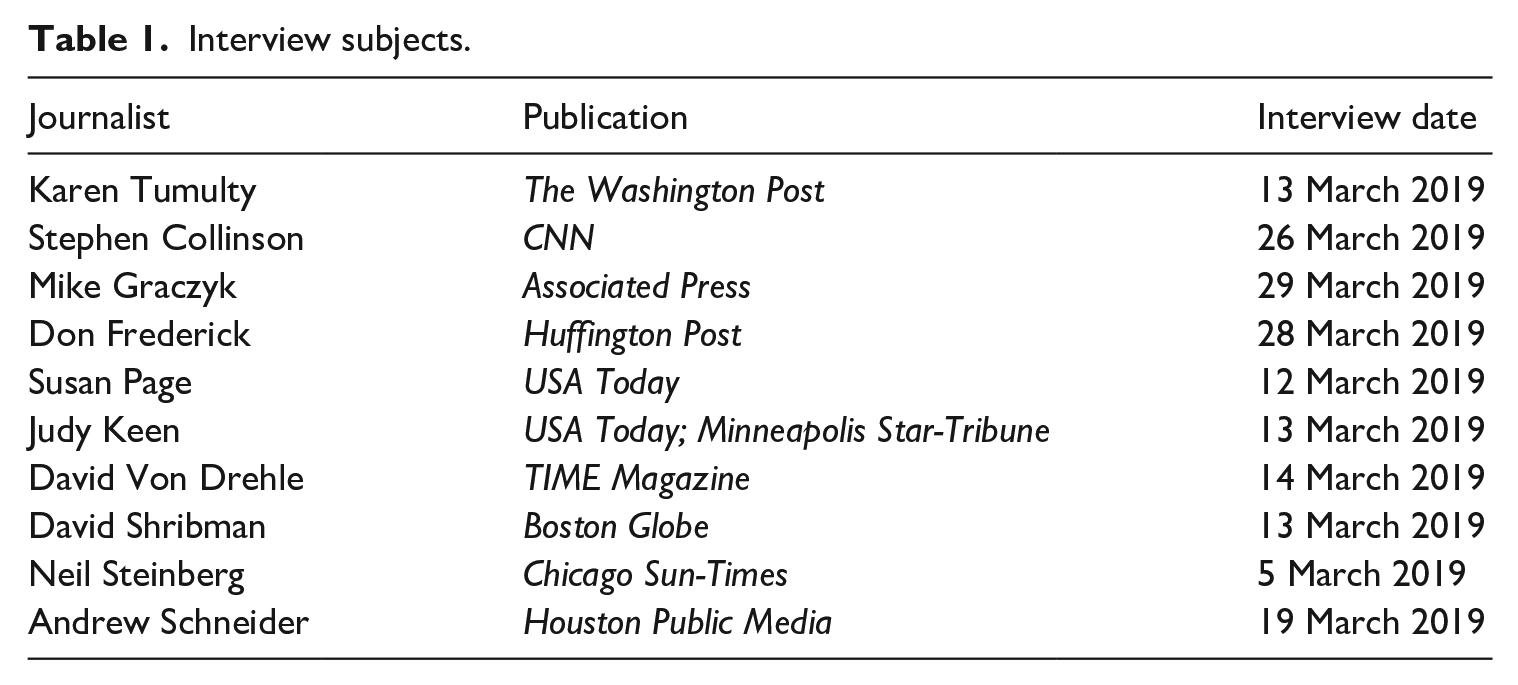
This sample of journalists offered marked case variation between national (The Washington Post, Associated Press, CNN, USA Today, Huffington Post) and metropolitan (Boston Globe, Chicago Sun-Times, Houston Public Media, Minneapolis Star-Tribune) news organizations as well as between legacy media (The Washington Post, Associated Press, USA Today, Boston Globe, Chicago Sun-Times, Minneapolis Star-Tribune) and digital native or multimedia (CNN, Huffington Post, Houston Public Media) outlets. The striking similarities in what these individuals described in terms of the nature and purpose of their work allowed me to achieve saturation across these interviews.
For data analysis, I applied Luker’s (2009) inductive approach merging grounded theory and extended case method to generate theory in the context of existing literature. I conducted semi-structured qualitative interviews discussing the obituary-writing process to allow findings to emerge inductively (Small, 2009). This was followed by ‘close readings’ (Brummett, 2018) of the transcripts to seek out similarities and differences in participants’ experiences and to identify emergent themes to index to and theorize around existing scholarship.
Some of these journalists are no longer employed by the organizations for which they published Bush’s obituary, but for consistency and clarity, I refer to each using their name and affiliation at the time of the obituary’s publication.
Results and discussion
The results of this study first illuminate how the obituary form and process both change the nature of newswork for political journalists who have long covered politics according to the norms of ‘hard’ news. They also illustrate the long-term, conscious cultural work that journalists do when they write, and recraft, the history of a former president.
How the obituary form and process change the nature of newswork
Participants often mentioned the overall resonance of the obituary as a news form, citing its readership as receiving millions of views and contributing to how people who knew about the 41st president – as well as those who did not – would think of his life and legacy long after he died. Stephen Collinson, who wrote Bush’s obituary for CNN, stated, ‘I think you do have a sort of obligation when you write something like this to kind of properly sum up somebody’s life, and it’s a president, right? So there is that kind of added pressure, I guess’ (Personal communication, 26 March 2019). Most strikingly, participants were keenly aware that their work was simultaneously defining Bush’s legacy and becoming part of that very history. David Von Drehle from TIME Magazine said, Ideally, the obituary gives you a full sense of a life and how it fits into the history of the country, understanding that that’s an endlessly moving target. I mean, people are still writing about the Founding Fathers and trying to figure out what we should think about. . . . So it’s a process that never ends. But the obituary is certainly a key moment in that process, where you try to take a deep breath and look at how this person fits into the history of the world. (Personal communication, 14 March 2019)
These journalists discussed a focus on ‘breadth’ and ‘perspective’ over ‘urgency’ or ‘facts’ when writing Bush’s obituary, and these descriptions denoted a clear shift in their understandings of what norms structure this form of newswork. The ultimate product of Bush’s obituary – unlike the political journalism participants were very much accustomed to – was evaluated not in terms of efficiency but in terms of thoroughness. As Karen Tumulty from the Washington Post aptly stated: I really am struck by how writing a person’s obituary – I thought it was this kind of grim thing that I was doing, and it wasn’t at all. It was really a lot of fun to sit there and do something you don’t really get to do that often in daily journalism, which is just kind of stand back and take a deep breath and try to get a real perspective on the meaning of someone’s life. (Personal communication, 13 March 2019)
While it was not a linear process – and, in fact, it was often cyclical in nature – the temporal dimensions involved in writing Bush’s obituary can be described through the following steps:
Assignment
While the private-figure obituary ‘beat’ as the first job for green reporters is a common trope among journalists, participants frequently contrasted the obituary of a US president as a ‘privilege’ or ‘honor’ only offered to tenured elite journalists. All participants had extensive experience covering White House politics, with many having covered one or both Bush administrations. Most had met George H. W. Bush at least briefly, while some had deep personal relationships with the former president or his family. As discussed later in this section, participants recalled these relationships offering them a ‘well-rounded’ perspective of Bush when writing his obit.
Like most journalistic work, Bush’s obituary was often assigned to a writer. Yet in this genre of newswork, the obit was assigned years, or even decades, before Bush’s death. While participants discussed being assigned Bush’s obit for a variety of reasons, most mentioned the first drafts were written in the midst of Bush’s presidency between January 1989 and January 1993. Notably, given that these were written at least 25 years before Bush’s actual death, many of the journalists who wrote the initial obituary drafts for Bush had left the organization, retired, or even died by the time this study’s participants became involved in the writing process.
The interview data suggested obituary assignments were often afterthoughts, or at least not priorities in the newsroom. This is quite practical: Few journalists are solely dedicated to an obituary beat, so compiling ‘advance’ obituaries often necessitates practitioners finding the spare time to research and continually update these stories alongside their various other responsibilities. For some news organizations, the writing of Bush’s obituary occurred as part of an organization-wide initiative to prepare more ‘advance’ obits. For others, editors assigned the obit to a writer who personally knew or covered Bush, or journalists took it upon themselves to write the obits of the public figures they knew well on a personal or professional level: As David Shribman, who wrote Bush’s obituary for the Boston Globe, simply said when asked why he began writing advance obits, ‘I knew the people who were going to die’.
Research
Journalists who wrote Bush’s obituary consistently privileged similar types of sources, though these did not conform to the standard norms of political journalism: Few participants discussed sourcing through political elites or even the family members of the to-be-deceased (who, in Bush’s case, were public figures in their own right). Rather, the temporal nature of the obituary’s biographical structure appeared to dictate its sourcing. Participants often discussed the importance of historical sources: conducting interviews with presidential historians, visiting Bush’s presidential library, and compiling background information for the story from authorized and unauthorized biographies of the former president.
Notably, these journalists frequently discussed relying on their own knowledge and experiences – either personally or professionally – with Bush and his family to guide their writing process. This entailed rereading their own notes or interviews as well as deferring to their personal knowledge of Bush’s life and presidency amassed over time. Don Frederick from the Huffington Post stated, ‘a lot of it I just knew myself’ (Personal communication, 28 March 2019), and Mike Graczyk from the Associated Press referred to it as building up ‘an institutional knowledge of the person’ (Personal communication, 13–29 March 2019). Stephen Collinson from CNN described it as ‘a culmination of a lot of experience and research that kind of went on for years, rather than necessarily sitting down and thinking, “OK, I’ve got to write an obit for the president. Where do I start?”’ (Personal communication, 26 March 2019)
Writing and contextualization
While participants often acknowledged drastic differences between the obituary form and that of other journalistic work, the obit still follows a fairly rigid structure – even if that structure differs from the classic inverted-pyramid style. The inverted pyramid provides the most newsworthy information up front in the ‘lead’, the important details in the middle, and extra material toward the bottom. The obituary, meanwhile, has what Chomsky (1969) refers to as a ‘deep structure’: While not always visible on the surface, it consistently follows a chronological narrative arc – in essence, taking the subject from the cradle to the grave. The narrative form of the obituary is not just a routine practice by choice; obituaries as a ‘life lived’ simply cannot be fit into the inverted-pyramid form. Don Frederick from the Huffington Post referred to the obit as ‘the opportunity to step back and take a sort of measured, broader, historic assessment . . . in a literary way, in a compelling narrative fashion. Because that’s what a great obit should be. They should have a literary quality as well as a news quality’ (Personal communication, 28 March 2019).
Interwoven throughout this arc is the ‘10,000-foot view’, moving outside the scope of the individual’s life and narrativizing their broader legacy in the contexts of both their lifetime and their death. As Stephen Collinson from CNN said, What’s interesting about it is you’re not just writing somebody’s life, which you are, so you have to give a good account. When you’re talking about a president, you’re also talking about something that’s much bigger – a presidency, a political career – and you’re also trying to capture the scope of someone’s public life in the context of what was going on at the time. And this one particularly was as much about the political era that George H. W. Bush was the last representative of as it was about him. (Personal communication, 26 March 2019)
Although elite journalists consistently crafted Bush’s obituary, drastic differences existed across these publications in terms of the number of hands that touched the obit writ large. At metropolitan news organizations such as the Chicago Sun-Times and the Boston Globe, journalists often discussed serving as the ‘lone craftsman’ throughout this stage of the process, whereas at CNN, Bush’s obit ‘probably was seen at least by around 10 people in the edit process’ – moving ‘up the editing chain’ through the White House editors, managing news editors, fact-checkers, lawyers, and copy editors (Personal communication, 25 March 2019). Multiple participants discussed the effects of contemporary changes in newsroom staffing and technology in oversight of, and newsroom time spent on, Bush’s obituary: According to Don Frederick at the Huffington Post, In the old days, say, at the Los Angeles Times, when newspaper staffing was different and all digital outlets did not exist, somebody like [Bush] would have gone through four or five editors. But that’s not the way it works now (Personal communication, 28 March 2019).
And in the digital age, obits need to be publishable online at the moment of death, eliminating the flexibility formerly offered by evening deadlines.
The ‘death watch’
Once the obituary draft was filed, it was often ‘shelved’, sometimes for years or decades. Edits to the Bush obit would occur sporadically – so much so that journalists would often forget about it until a health scare reminded them to update it. Participants frequently used language referring to editing the obit as a metaphorical process of renovation: ‘pulling it off the shelf’, ‘dusting it off’, and ‘freshening it up’. For Bush’s obituary, this often occurred a few times over a period of two decades. As Karen Tumulty from the Washington Post recalled, As the years went by, President Bush would have various health issues, and we would be once again on a death watch, and I would go back in and freshen it up. . . . We would always have to do this kind of drill when we thought he was in danger of passing away, where I would go through and reread it and make some changes and the editors would go over it again. (Personal communication, 13 March 2019, emphasis added)
In between these moments, participants described a process in which less-timely routines of obituary production often became an afterthought as the needs of daily news production took precedent. Susan Page from USA Today said, ‘In a perfect world, like, every five years we revisit it, but what actually happens is, a former president will get sick and we’ll think, “Oh my god, is the obit ready?”’
‘Recasting’ Bush’s legacy and the cultural work of the obituary
While the process described above depicts how journalists prepared drafts of Bush’s obit long before his death, changes over time – both in terms of political and cultural contexts and in terms of Bush’s post-presidency actions and reputation – inevitably led them to substantially or entirely rewrite the obituary, even if they had received a first draft from another writer. For instance, Don Frederick from the Huffington Post recalled pulling up the obituary draft the publication had ‘in the can’ on a Sunday after one of Bush’s health scares and, finding it to be ‘pretty perfunctory, pretty shallow . . . not only rewrote it but recrafted it, top to bottom’ (Personal communication, 28 March 2019).
Participants often recalled initially contextualizing Bush’s legacy as unsuccessful, based on his failure to win re-election in 1992 and his inability to connect with voters facing an economic recession. Over time, though, this interpretation of Bush’s legacy evolved; both Bush’s own post-presidency actions and changing political and cultural contexts allowed for his legacy to be considered in a different light. Journalists had to account for these contextual changes at multiple points throughout the obituary-writing process. Participants recalled ‘recasting’ Bush’s obit at various points after his and his son’s presidencies, during health scares, and when the former president ‘started jumping out of airplanes in his advanced years’ (Judy Keen, Personal communication, 13 March 2019).
These examples depict various moments in time in which journalists collectively analyzed the meaning of Bush’s life in the context of all that had transpired since his period of newsworthiness. At each of these moments – and even occasionally after publication, if ‘there’s overwhelming criticism of the way the story plays’ (Mike Graczyk, Personal communication, 29 March 2019) – writers and any members of the news team involved with the obituary have to take stock of the final product. As Susan Page from USA Today stated, ‘You don’t want to write an obit that’s going to look ridiculous in 10 years because things have shifted so much’ (Personal communication, 12 March 2019). One of the participants referred to this process as ‘recasting’, calling it a ‘famous word’ in their newsroom. The process of ‘recasting’ is addressed at multiple levels: First, journalists must determine how a subject’s legacy has changed with the passage of time. Second, they must interpret how contemporary political and cultural contexts fit into narratives about the individual’s legacy. Finally, journalists must evaluate how recent news about the public figure fits into that broader legacy.
Assessments of and views on public figures change over time: Participants frequently said history is kind to public, especially political, figures. These journalists acknowledged they frequently faced instances of what they called ‘telescoping’ in obituary writing – what appeared to be important at one moment seemed trivial with the perspective of time. For instance, David Shribman from the Boston Globe said Bush’s ‘whole profile in American life changed from basically a loser, repudiated president to a beloved senior statesman, and so that required substantial overhaul’ of the obituary’s narrative between earlier drafts and the final product (Personal communication, 13 March 2019).
The contemporary political and social contexts did appear to matter in how participants constructed narratives of Bush’s legacy, but it was rarely explicitly articulated. As Stephen Collinson from CNN stated, the obituary was ‘encapsulating [Bush] in this time as a throwback to an earlier era . . . and you have that implicit contrast with today’s politics. There were implicit comparisons made between Bush and the Trump era’ (Personal communication, 26 March 2019) – contrasts to a more civilized era of US politics or, in Bush’s own words, a ‘kinder, gentler America’. For instance, the subtitle of NBC’s Bush obituary led with, ‘He represented a moderate wing of the Republican establishment that in many ways has passed from the political scene’. According to Neil Steinberg from the Chicago Sun-Times, I think his death was experienced in the harsh light of Trump’s, whatever it is you want to describe what Trump is doing. You know, he represented the whole kinder, gentler thing. And I think that people’s deaths are news stories, and they have the weight or the lack of weight depending on the circumstances going on at that time. (Personal communication, 5 March 2019)
Some participants outright denied the importance of the contemporary context in obituary work – multiple journalists suggested it was more essential to news and editorial coverage of Bush’s death than to the obit itself – but continued to make direct comparisons between Bush’s accomplishments or character and that of the current or recent presidents. Even participants who acknowledged the importance of context did not feel their work explicitly referenced it: The context was meant to be implied for readers to interpret themselves. As Karen Tumulty from the Washington Post said, I don’t think I even mentioned Trump until about 180 inches into this thing. But I certainly wrote it very aware of the sort of political environment and the public environment that people were going to be reading it in. (Personal communication, 13 March 2019)
Furthermore, participants grappled with the tension between the newsworthiness of certain elements of a life story in accordance with traditional standards for political journalism, and the context and perspective they felt were necessary to effectively evaluate Bush’s legacy over the course of a lifetime. For instance, participants frequently mentioned struggling to assess where – or even whether – to situate allegations made by multiple women of inappropriate touching that arose in the final 2 years of Bush’s life, particularly in the political and social context of the burgeoning #MeToo movement. As David Shribman from the Boston Globe stated, You shouldn’t be lulled by the contemporaneousness of an issue into making it the central element of someone’s life. You have to look at the full arc of someone’s life. I think that that’s difficult to do, but I think essential. And of course, you have to remember that the readers didn’t know that you were working on this for 25 years and what they may remember was the most recent thing, so you have to make sure that’s in there and not buried. (Personal communication, 13 March 2019)
Although participants acknowledged obituaries, by their very nature, lean toward a focus on the good, journalistic norms of newsworthiness and fairness are constantly in tension with cultural ‘speech norms’ (Eliasoph and Lichterman, 2003) around speaking kindly of the dead when writing an obit. Andrew Schneider from Houston Public Media described these tensions as simply more present in obituaries than in ‘ordinary news coverage’: ‘You’re going to have sort of a glossing over because you have people who are reluctant to speak ill of the dead’ (Personal communication, 19 March 2019).
However, journalists are bound by their own ‘culture grammar’ (Colby, 1975) that dictates the rules of narrative construction of the obituary (Bird and Dardenne, 1997). Even when dealing with complicated moments in Bush’s past, participants discussed attempts to strike a balance between the best and worst of a person’s legacy as an ‘obligation’ and felt they wouldn’t be ‘doing the job’ if they ignored the negative or controversial aspects of an individual’s legacy. As Susan Page from USA Today said, You tend to want to be kind because they’re at the end of their life. You want to note the things they did that were good and the things about them were valuable, but you’re still a reporter. I mean, you’re still a journalist, and you have an obligation to mention the difficult as well as the easy, the negative as well as the positive. . . . There is an inclination to try to make to try to make an obituary reveal the fullness of a life, and of course, presidents by definition tend to have consequential lives. So there’s a lot to say that’s positive, but I don’t think you serve your own mission if you don’t also acknowledge the things that didn’t go well. (Personal communication, 12 March 2019)
One of the participants described these norms as ‘two types of fairness’: to the subject as well as to the reader, who deserves a fuller sense of perspective of Bush’s life (Personal communication, 13 March 2019). Mike Graczyk from the Associated Press referred to the ‘real hazard’ of making political or public figures, even those who ‘were not nice people’ in reality, ‘sound like saints’ in obituaries: ‘You don’t want to sanctify them or beatify them, but you want to tell a reader what they accomplished and how, perhaps, they’re remembered’ (Personal communication, 29 March 2019).
These tensions were especially apparent in journalists’ decision-making around including Bush’s aggressive 1988 campaign tactics in the obit, particularly the campaign’s use of racially charged political advertisements that ‘didn’t reflect particularly well on George H. W. Bush, nor does it really fit in with the narrative of George H. W. Bush as a gentleman . . . that somehow, he was above the negative politicking that we see so much of today’ (Andrew Schneider, Personal communication, 19 March 2019).
Andrew Schneider from Houston Public Media discussed navigating the conflicts between space constraints in the obituary form, his desire to focus on Bush’s links to Texas for a metropolitan audience, and what he perceived as valid criticism among commentators that Bush is being praised for XYZ, but don’t forget, he was also the person who was responsible for the Willie Horton ad, and here’s how this played into the kind of racial demonization that we’ve seen in politics going back time out of mind and how this laid the groundwork for what we’re seeing today in less coded messages of racism in politics. (Personal communication, 19 March 2019)
Houston Public Media’s final obit did not mention the Dukakis ads. Meanwhile, Don Frederick from Huffington Post described how an editor had taken out a couple grafs I had about the ’88 election and the nastiness of it, the use of some dog whistles in terms of Dukakis, and I really thought it was essential to have that in there, so I made my case and we restored that. (Personal communication, 28 March 2019)
Half of the Bush obituaries written by journalists interviewed in this study, including the Huffington Post’s, incorporated details about Bush’s controversial campaign practices products; the other half left it out of the story.
This example illustrates how the obituary form offers journalists a unique ability to decide what elements to include and exclude as they define, or redefine, and articulate the legacy of a former president. As David Von Drehle from TIME Magazine said, ‘Every story is a process of leaving stuff out’ (Personal communication, 14 March 2019). Participants often simultaneously discussed writing about Bush’s legacy based on their ‘perspective’ or ‘interpretation’ while referencing the importance of ‘truth’ in these narratives. Susan Page from USA Today said, ‘mostly I think you try to be both authoritative but honest, and when you’re unsure, I think you try to be transparent’ (Personal communication, 12 March 2019). Journalists also discussed a unique level of confidence in their personal knowledge of Bush’s political and public life to inherently know the key elements of his legacy. Given these journalists often knew or covered Bush and his family, participants felt this level of personal knowledge gave them an ‘advantage’ and seemed to afford them a certain level of authority to offer a more ‘well-rounded’ depiction of his life than the everyday reporter. As Judy Keen from USA Today and the Minneapolis Star-Tribune recalled, My editors at USA Today and my editor here knew that I knew him, not just had covered him, but knew him. I would have balked at writing something like that had I not known him, because you have to tell more than the bare biographical facts in order to do justice to a human being’s life and a leader’s life and the president’s life. It felt like a weighty responsibility . . . I felt that I was an appropriate vehicle to share his story because I actually knew him and had I not, I would have been very reluctant to do that. (Personal communication, 13 March 2019)
Narrowing the key elements of Bush’s life to discuss was described by participants as an intuitive or obvious process: As Stephen Collinson from CNN said, ‘I don’t think it’s difficult to decide, OK, this is clearly significant’ (Personal communication, 26 March 2019). According to Mike Graczyk from the Associated Press, I mean, you know what you’re looking for in a president. That’s the easy part. The hard part is that people write books about these people, and you’ve got to condense it down into maybe 1,500 words, and that for me was the hardest part, just deciding what do you want to use, and how much do you use, and how do you keep it in a form that’s interesting and short? (Personal communication, 29 March 2019)
As illustrated in this quote, participants described that the nature of the obituary form itself greatly influenced what they chose to – or even were able to – include and exclude in narratives of Bush’s life. Furthermore, these tensions are not all created equal across organizations: For instance, metropolitan journalists often discussed the need to find a local angle in the obituary in order to set it apart from national outlets’ obituaries. Returning to the example of Houston Public Media’s exclusion of the Dukakis campaign ads, Andrew Schneider described his struggle around what to exclude: ‘Really, what it just came back to is . . . well, what’s the Texas angle here?’ (Personal communication, 19 March 2019).
Conclusion
In examining how the role of political or ‘hard-news’ journalism shifts when reporters write their final story about a former president, this study depicts a unique moment in which political journalists reflected on – and recrafted, many times over – the life and legacy of an individual who was previously just a news subject. These journalists described the various tensions that exist between the norms and conventions of obituary and those of traditional, ‘hard-news’ journalism. Results reveal that in these moments, the nature of newswork can shift in important ways among even the most tenured reporters. Furthermore, their decisions on what to include and exclude in the story of Bush’s life and legacy – particularly when dealing with controversial pasts – were subject to a variety of forces related to the obituary’s unique form and process, including cultural norms around speaking ill of the dead, market forces, contextual changes in what was considered most newsworthy in an individual’s life, and the temporal dimensions of the advance obituary. This study offers one form of answering Zelizer’s (2018: 116) question: ‘What happens when time is itself . . . purposefully stretched out – more long-form than event-driven, driven as much by context as by time?’
This research has a few limitations, most notably that it focuses on the experiences of elite journalists through a case study of one former US president; as the findings illuminate, the treatment of a former president in advance obituaries may be quite unique, and is not necessarily logically generalizable to the broader genre of public figures. Future research could examine the obituary in transnational contexts as well as for diverse types of political and public figures. Furthermore, while this study reveals that changes in social contexts over time did, in fact, shift journalists’ interpretations and articulations of Bush’s legacy, additional research would benefit from an exploration of the cultural mechanisms behind how these changes in context can force groups to look at the same information in new ways.
Journalists in this study discussed how they made decisions about what to include and exclude in Bush’s obituary, but these results suggest we must account for how this process imbues journalists with the cultural authority to make truth claims about the legacy of a former US president – and, more broadly, has important implications for how we collectively remember the past. Central to most aspects of political life are the stories we tell (Polletta et al., 2011). As recent conversations within the journalism industry (e.g. the New York Times’ ‘Overlooked’ project) surrounding those historically ‘overlooked’ in the obituary – often women and people of color – have addressed, this also introduces tensions around who is deemed ‘worthy’ of an obituary and illustrates broader lessons obituaries can teach us about a society’s cultural values (Padnani and Bennett, 2018). What stories are told, who has the power to tell them, and what they keep in or leave out of them underpins the very nature of how we make political life meaningful.
Through this research, I also build upon our understanding of journalists’ role as agents and conduits of collective memory. This research offers a framework for understanding how journalists rewrite – and ‘recast’ – drafts of history, and depicts participants’ awareness of their own role in this history. As one participant eloquently stated, ‘In a way, this sendoff would become part of his history . . . He was part of history, and so therefore, my coverage of him was also part of that history’ (Judy Keen, Personal communication, 13 March 2019).
Footnotes
Acknowledgements
Author would like to thank the blind reviewers for their confidence and direction in the development of this paper, and Daniel Kreiss and Daniel Riffe for their guidance along the way. Author is also grateful to the political journalists who took the time to walk me through and reflect on their work crafting a president’s obituary.
Funding
The author(s) received no financial support for the research, authorship, and/or publication of this article.
