



Abstract
News coverage often uses stigmatizing language to label marginalized groups. Person-centered language has been discussed as a potential remedy, which this study tests for the first time. Using a between-subjects experiment with members of three marginalized groups (n = 339), we investigate whether news articles that use person-centered terms (e.g., “person with substance use disorder”) instead of stigmatizing terms (e.g., “drug abuser”) improve attitudes towards journalism. Findings show person-centered terms increased the perception that one’s group was humanized in the news article and marginally increased trust in news. This study highlights the importance of journalists’ careful consideration of the labels they apply to marginalized groups. Although trust-building efforts cannot be limited to the use of person-centered terms, this research shows that the linguistic change is a step in the right direction.
When covering stigmatized groups, past scholarship has demonstrated that journalism often perpetuates negative stereotypes (Holton et al., 2014; McGinty et al., 2016; Taylor, 2008). As journalism organizations develop efforts to advance more equitable news coverage (Crittenden and Haywood, 2020; Varma et al., 2023), it is important to consider the ways in which the news media can avoid reinforcing public stigma and damaging their relationship with marginalized audiences. This will likely be a long-term process that requires foundational changes in newsrooms. Yet one immediate practice that journalists could consider is using person-centered language instead of stigmatizing labels to describe groups in news articles. The purpose of this study is to examine how members of stigmatized groups perceive person-centered language and whether this language affects their impressions of the news itself.
In contrast to stigmatizing group labels that signal danger, dehumanization, and unacceptable abnormality (Smith, 2007), person-centered terms resist stereotyping or “othering” people based on a diagnosis, situation, or experience (Atayde et al., 2021; Bedell et al., 2018; Tran et al., 2018). Person-centered terminology starts with the label of “person” or “people,” and then adds distinguishing labels; for example, person-centered alternatives to more stigmatizing labels like “addict” and “the disabled” become “person with substance use disorder” and “people with disabilities.”
Limited empirical research has assessed the opinions of stigmatized groups on this matter. Studies that do explore the use of these terms provide support for the use of person-centered language (Ashford et al., 2019a; Noble et al., 2017; Pivovarova and Stein, 2019), but none examine how such terms may influence people’s relationships with the news media. To measure the impact of person-centered language in news, we collected 339 responses from members of three stigmatized groups: (1) people in recovery from substance use disorder, (2) people who have experienced homelessness, and (3) people with disabilities. Using an experiment, we exposed half of participants to a news article about their group that featured person-centered language (e.g., “people with disabilities,” “people experiencing homelessness,” and “people with substance use disorder”) and the other half to an article that used stigmatizing labels (e.g., “the disabled,” “the homeless,” and “drug abusers”). We examined how use of the different terms affected participants’ news trust, their views on whether their group was humanized in the article, their willingness to share their own story with a journalist, and their intentions to engage with the news. We also explored whether the effects of different kinds of labels were moderated by specific group membership.
Person-centered and stigmatizing terms
Coverage of disadvantaged and marginalized groups leaves much to be desired. Some have argued that disadvantaged populations have been all but ignored by the mainstream press (Cranberg, 1997). Even when these groups are represented, several studies suggest that news coverage often reinforces stereotypical or misleading portrayals by painting marginalized people as undesirable outsiders or over-representing criminality instead of accounting for structural issues in society (Gilens, 1996; Klin and Lemish, 2008; McGinty et al., 2016; Taylor, 2008; Widdowfield, 2001).
Against this backdrop, journalists have utilized strategies to engage underrepresented communities in the service of telling more holistic stories about their experiences (Brannock Cox and Poepsel, 2020; Crittenden and Haywood, 2020; Wenzel et al., 2018). Despite some success, trust and engagement initiatives can be expensive and can require considerable time investments (Lawrence et al., 2018), which may mean they are not immediately feasible for all news organizations. Some lower-cost solutions, however, such as using person-centered terms as we propose here, may affect what marginalized groups think of the news.
Scholarship has repeatedly shown that subtle changes to how people and places are referenced can affect public opinion. In an early study, Gilovich (1981) showed that describing an international conflict using terms that subtly brought to mind either World War II (e.g., “Blitzkrieg invasion”) or the Vietnam War (e.g., “Quickstrike invasion”) changed people’s beliefs about the conflict. Swapping the word “fetus” for “baby” when discussing abortion affects beliefs (Simon and Jerit, 2007), as does the use of the term “inner city” when discussing crime (Hurwitz and Peffley, 2005). The importance of language choices has also been recognized by the Associated Press Style Guide, which now recommends person-centered terms over the term “addict.” Proponents argued the change more accurately construes addiction “as a medical problem, not a moral one” (Szalavitz, 2017).
As this past work suggests, labels are rarely neutral, as they can highlight different characteristics with consequences for the people to whom they refer. The labels used when describing marginalized groups can evoke stereotypes and thereby increase stigma toward these groups (Ashford et al., 2019b; Link and Phelan, 2001). Such stigma may negatively impact health outcomes for groups that are being described (Frost, 2011) and affect public support for providing resources to these groups (Iyengar, 1990).
To combat stigma, some academics, policymakers, and other professionals have called for the use of person-centered language when describing groups (Atayde et al., 2021; Bedell et al., 2018; McGinty et al., 2019; Simpson, 2021; Tran et al., 2018). This language humanizes by emphasizing the person and indicating that their condition is secondary. Past research has demonstrated that both health professionals and members of the general public were more likely to have negative associations with the terms “addict” or “the mentally ill” than person-centered alternatives (Ashford et al., 2019b; Granello and Gibbs, 2016; Kelly and Westerhoff, 2010). Proponents argue that without person-centered language, labels in the media may emphasize “otherness,” unworthiness, or criminality and devalue the humanity of an individual by primarily identifying them in terms of an external condition (Bedell et al., 2018; Tran et al., 2018). Smith (2007) argues that a statement that uses non-person-centered labels, like “epileptics,” “denotes that the person is the disease and a member of a separate group from the rest of society” (p. 470). Currently, many news outlets do not consistently use person-centered terms. In a review of news coverage of the opioid epidemic, for example, McGinty et al. (2019) found that the use of stigmatizing labels, such as “addict,” was far more common in news coverage than the use of less stigmatizing terms, such as “person with substance use disorder.”
While person-centered language could be a boon for trust, person-centered language has also attracted critiques, largely from proponents of identity-first language (Dunn and Andrews, 2015). Identity-first language includes labels that begin with a group, condition, or diagnosis, rather than the word “person,” such as “autistic person.” The Deaf community, for example, strongly opposes the use of person-first language for their group, arguing that identity-first language communicates their shared culture and language (Padden and Humphries, 1988). The autism community is more divided on this issue, but some have argued against “person with autism,” based on the stance that it suggests that autism is a secondary descriptor instead of constituting their vantage point on the world. Advocates working to address homelessness have also questioned whether using person-centered language would translate into any real-world impact (Horvath, 2017).
Despite some pushback from people who endorse identity-first language, recent reporting guides encourage person-centered language in media, and argue that person-centered language is aligned with reader preferences. Based on findings from a reader poll, the Marshall Project published a guide in 2021 that recommended the use of person-centered terms (Solomon, 2021). The National Center on Disability and Journalism (2021) has also accounted for the unsettled matter about person-centered versus identity-centered language in their guide, stipulating: In the past, we have encouraged journalists and others to use person-first language (such as, ‘a person who has Down syndrome’ rather than ‘a Down syndrome person’) as a default. Even with the caveat that this does not apply to all, we have heard from many people with disabilities who take issue with that advice. For us, this really emphasizes the fact that no two people are the same — either with regard to disabilities or language preferences. And so we are no longer offering advice regarding a default.
The same guide encourages journalists to ask people for their self-descriptions. Yet given the lack of consensus about whether any individual’s preferences will be shared across more members of the same group (for example, see Callahan, 2018), this study offers an important empirical contribution for understanding the impact of adopting person-centered language in news coverage.
Gathering feedback directly from underrepresented communities is essential for evaluating the impact of person-centered language, yet little experimental research has explored different groups’ labeling preferences and the effects of labeling on attitudes toward the media. The few studies that do address this topic provide suggestive evidence in support of the use of person-centered language (Ashford et al., 2019a; Noble et al., 2017; Pivovarova and Stein, 2019). Surveying over 600 people with epilepsy, Noble et al. (2017) found that the vast majority preferred person-centered terms. Participants explained that they felt person-first language avoided defining them by their epilepsy alone and implied a sense of control over their condition. Ashford et al., 2019a asked people in recovery, their family members, and treatment professionals to rank terms related to substance use disorder from the most negative to the most positive; person-centered terms were preferred by all stakeholders. Pivovarova and Stein (2019) similarly found that while people who have used heroin may employ different terms to refer to themselves, they select person-centered labels when asked how they would like others to address them. Our study builds on this work by not only examining the term preferences of multiple stigmatized groups, but also experimentally testing how the use of such terms could influence media trust and relationships with journalists.
Reassessing word choice and labeling conventions may be necessary to develop relationships with media-skeptical communities. Critiques from marginalized groups about media portrayals include the lack of respectful, complex portraits of their lives, that stories are often overly negative, and that journalists seldom include voices from the community itself (Dixon and Williams, 2015; Heider, 2000; Wenzel and Crittenden, 2021). Importantly for this study, Wenzel et al. (2018) found that journalists’ choices of phrases can alienate underrepresented audiences. Marginalized groups have objected to these tropes vocally and have historically responded by creating their own news outlets to advance more accurate, humanizing representations of their experiences (Alamo-Pastrana and Hoynes, 2020; González and Torres, 2011). Alienated from mainstream media, members of marginalized groups regularly regard journalism with skepticism and fear and argue that they are being rendered unrecognizable (Varma et al., 2023). Person-centered language could help with these critiques, as the terms integrate people’s dignity by defining them not by one aspect of their life, but as a human being first (Tran et al., 2018).
A key premise of this study is that members of these groups are likely to distrust stigmatizing language in news coverage of their lives. Trust in news means believing journalists will provide reliable information without audiences needing to re-conduct investigations to confirm facts (Jakobsson and Stiernstedt, 2023). Trust evaluations also rely on the kinds of information journalists include and leave out, their perceived expertise, their perceived biases, and beliefs about the extent to which they understand and care about their audiences’ concerns (Kohring and Matthes, 2007; Lucassen and Schraagen, 2011; Strömbäck et al., 2020). Word choice may operate as an important cue to these dimensions of trust, especially given that people largely rely on heuristics, or quick mental shortcuts, when assessing trust in a news article (Metzger, 2007). The use of language that is not preferred by the community on which one is reporting would likely undermine perceptions of the journalists’ expertise and beliefs about how they incorporate the community’s interests into their work. In contrast, the use of preferred person-centered terms could signal experience hearing from members of the community and represent the active implementation of a reporting choice in line with community concerns, thereby encouraging news trust. In this view, media trust is performance-based; that is, journalists’ reporting choices can influence trust if they are deemed (un)satisfactory by an individual (Fawzi et al., 2021).
In sum, even though support for the practice of person-centered language is not unanimous, the feedback in favor of it from stakeholders in affected communities and a growing set of guides developed by journalists indicate that person-centered language may offer a bridge to trust in news. If person-centered terms are the preference of these audiences, they may feel more authentically heard and represented in news and more willing to talk with journalists who use language that is aligned with recognizing their humanity. Based on this literature, we propose the following:
Exposure to news articles that use person-centered terms will increase marginalized groups’ trust in (a) the news article and (b) the journalist who wrote the story relative to exposure to articles that use stigmatizing terms.
Members of marginalized groups will feel better represented by news articles that use person-centered terms than articles that use stigmatizing terms.
Whereas trust and perceived representation are individual attitudes toward the news, being part of a stigmatized group implies a group identity. Drawing from Tajfel and Turner’s (1982) idea that group membership is an important aspect of identity, Luhtanen and Crocker (1992) propose the concept “collective self-esteem.” Collective self-esteem represents how people feel about the groups to which they belong, such as groups based on race, ethnicity, or religion. One component of their scale refers to public self-esteem, or how positively or negatively one believes their group is viewed by society. With application to our study, the use of stigmatizing terms instead of person-centered terms may make people feel that the media positions their group as less valuable to society. They may feel that the media shows more respect for their group when it employs person-centered versus stigmatizing terms. Supporting this idea, Stamps (2020) suggests that negative media portrayals of marginalized groups can diminish their public self-esteem. Given that past research shows that some marginalized groups hold more negative associations with stigmatizing terms than person-centered terms (Ashford et al., 2019a), we propose the following hypothesis:
Exposure to news articles that use person-centered terms will increase perceptions of collective public self-esteem as conveyed in a news article relative to exposure to news articles that use stigmatizing terms.
Marginalized groups may also be more likely to engage (e.g., share, comment, etc.) with articles that use person-centered terms relative to those using stigmatizing terms. News that uses language deemed more acceptable by a community may inspire members to engage because the outlet seems more trustworthy and in sync with their needs. Indeed, some past research finds that those who trust news are more likely to comment on and share news online (Kalogeropoulos et al., 2017). Research also has found that people are more likely to engage with identity-consistent news (e.g., Knobloch-Westerwick and Hastall, 2006). Yet the result is not a foregone conclusion. Fletcher and Park (2017) find that those with lower levels of trust are more likely to share and comment on online news than those with moderate levels of trust. They speculate that the relationship may be because those with low trust “want to express their disapproval of news coverage” (p. 1295). In the present context, the use of stigmatizing terms may prompt people from marginalized groups to engage more in order to call attention to the use of non-preferred terms. Given these mixed prior findings, we pose a research question:
How will exposure to news articles that use person-centered terms affect marginalized groups’ news media engagement intentions relative to exposure to articles that use stigmatizing terms?
We also examine whether there is any evidence of an indirect relationship between exposure to news articles that use person-centered versus stigmatizing terms and marginalized groups’ engagement via collective public self-esteem and trust. 1 In particular, exposure to articles that use person-centered terms could enhance collective public self-esteem which may, in turn, increase trust, consistent with scholarship proposing that respect can lead to trust (e.g., Clarke, 2011). Enhanced trust could boost intentions to engage with the media (Curry and Stroud, 2021; Fischer et al., 2005), although investigation is warranted given that some do consume media that they do not trust (Tsfati and Cappella, 2003). We pose the following research question:
Is there an indirect relationship between exposure to news articles that use person-centered versus stigmatizing terms and marginalized groups’ engagement intentions via representation, collective public self-esteem, and trust?
For the purpose of robustness, we examine these relationships across three different stigmatized groups: people in recovery from substance use disorder, people with disabilities, and people who have experienced homelessness. Although we anticipate that all three groups will have similar reactions, we also explicitly investigate whether there is any variation:
Are the effects of person-centered versus stigmatizing terms moderated by the group to which one belongs?
Method
This study is a 3 (group: substance use disorder, homelessness, disability) × 2 (stigmatizing terms or person-centered terms) between-subjects experiment. Between December 2021 and June 2022, participants were recruited from CloudResearch, a platform that draws respondents from Amazon’s Mechanical Turk, and through outreach to organizations who serve those with substance use disorder, a disability, or issues with housing insecurity. In order to disguise the purpose of the study to gain participants who actually had these experiences, participants from CloudResearch were unaware of the criteria to participate in the study when they shared whether they had one of the three experiences. We inquired about the three experiences in a battery of nine other unique characteristics that were irrelevant to the study. People who said all 12 possible characteristics applied to them were not allowed to proceed with the survey. If a participant had more than one of our three experiences of interest, they were randomly assigned to view a news article that addressed one of those experiences.
Participants
The final sample included 339 U.S.-based participants. Of these, 324 were recruited from CloudResearch and 15 were recruited from organization outreach. The sample consisted of 90 people with a disability, 114 people who had experienced homelessness, and 135 people in recovery from substance use disorder. Around half (51.5%) of participants were male and 48.5% were female. Eighty percent of participants were White, 6.6% were Black, 5.7% were Hispanic, 3.0% were Asian and 4.8% identified as multiracial or another race. Roughly a third were between the ages of 18–34 (33.9%), 46.6% were age 35–50, 18.6% were age 51–69, and 0.9% were 70 or older. Nearly 60 percent of participants had not obtained a college degree (59.9%) and 40.1% had a bachelor’s degree or higher. We confirmed that within each stigmatized group, random assignment to condition was successful; there were no significant differences on age, gender, race, or education. Likewise, there were no demographic differences between the conditions overall.
We removed straightliners (e.g., participants who selected the same answer for a series of contradictory statements), junk responses (e.g., gibberish in the open-ended responses), and duplicate respondents. We also removed respondents from the analysis who spent less than a third of the median time or more than three times the median time on the survey or the article. 2 In total, we removed 118 responses to arrive at the final sample of 339.
Stimuli
The news articles used in the study were adapted from real news articles from The Philadelphia Inquirer, Fast Company, and WWMT-TV, a news channel in Michigan. The topics of articles were (1) how the end of a COVID-era plan for temporary housing in hotels affected people experiencing homelessness, (2) how the return to in-person offices affected people with disabilities, and (3) how yoga can be a source of community and therapy for people in recovery from substance use disorder. The articles were chosen because of their focus on issues facing the groups in the study and their prevalent use of group terms. Two of the original news articles largely used non-person-centered labels (e.g., addicts, the homeless) and the article about people with disabilities used a mix of person-centered and non-person-centered language (e.g., the disabled, disabled workers). The articles were edited for length and for the presence of either stigmatizing terms only or person-centered terms only. The only difference between the articles for each group was the terms used. Following guidance from advocates and past research, we used “drug abuser(s)” as the stigmatizing term and “[person/people] with substance use disorder” as our person-centered term in the article about substance use (Kelly and Westerhoff, 2010; McGinty et al., 2019; Tran et al., 2018). Although we were unaware of definitive research on specific guidance for person-centered terms related to homelessness, Tran et al. (2018) advise “placing individuals at the centre, and their characteristics or medical conditions second in the description” (p. 4). Drawing from this recommendation and from current AP Stylebook guidelines, we used “person/people without housing” as our person-centered term and “homeless person/the homeless” as the stigmatizing terms. There is significantly more debate about the best terms among people with disabilities, with some communities advocating for identity-first language over person-first language. Dunn and Andrews (2015) review these perspectives, noting that while the preferences of community members are diverse, survey research indicates that the majority of people with disabilities prefer person-centered terms, at least in the U.S. Given that this is our context in this study, we use “person/people with disabilities” and “disabled person/the disabled” as the stigmatizing terms.
Measures
Trust in the News Article
Based on the measure from Tsfati (2003), participants indicated whether they thought the article “is fair,” “is accurate,” “tells the whole story” and “cannot be trusted.” The last item was reverse coded so that higher values reflected higher trust in the article. Using an exploratory factor analysis with varimax rotation, all items loaded on the same factor, which explained 71.62% of the variance. We averaged the responses into a single measure (Cronbach’s alpha = 0.85, M = 5.46, SD = 1.05, Range = 1 to 7 with higher values indicating greater trust).
Trust in the Journalist
We asked participants to rate five statements related to their relationship with the journalist who wrote the article, including “I would trust this journalist to tell my story” and “I would feel comfortable sharing my personal experiences with this journalist.” Using an exploratory factor analysis with varimax rotation, all items loaded on the same factor, which explained 72.09% of the variance. We averaged the responses into a single measure (Cronbach’s alpha = 0.89, M = 5.15, SD = 1.22, Range = 1 to 7 with higher values indicating greater trust).
Representation
Participants rated their agreement with four statements, including whether the news article “Is concerned with my interests” and “Does a good job of showing what is going on with people like me.” Using an exploratory factor analysis with varimax rotation, all items loaded on the same factor, which explained 65.76% of the variance. We averaged the responses into a single measure (Cronbach’s alpha = 0.82, M = 5.46, SD = 1.03, Range = 1 to 7 with higher values indicating better representation).
Collective Public Self-Esteem
We adapted four items from the Collective Public Self-Esteem subscale from Luhtanen and Crocker (1992), including “In general, this news article presents people who have [a disability/experienced homelessness/experienced substance use disorder] as unworthy” and “In general, this news article respects people who have [a disability/experienced homelessness/experienced substance use disorder].” This approach has been used previously in the context of the news media (Stamps, 2020). An exploratory factor analysis with varimax rotation confirmed all items loaded on the same factor and explained 66.06% of the variance. We averaged the responses into a single measure (Cronbach’s alpha = 0.82, M = 5.85, SD = 0.92, Range = 1 to 7 with higher values indicating greater collective public self-esteem).
Engagement
Participants indicated their likelihood of participating in four activities related to news engagement, including “Read another article from this news organization” and “Share this article on social media.” Using an exploratory factor analysis with varimax rotation, all items loaded on the same factor, which explained 72.42% of the variance. We averaged the responses into a single measure (Cronbach’s alpha = 0.87, M = 4.54, SD = 1.49, Range = 1 to 7 with higher values indicating greater engagement).
These dependent variables are correlated (r = 0.30 to 0.74). Based on past work showing that even correlated variables can have different relationships with other variables (Wojcieszak, 2012), however, we proceed with our analysis.
Results
Preferred terms by group.
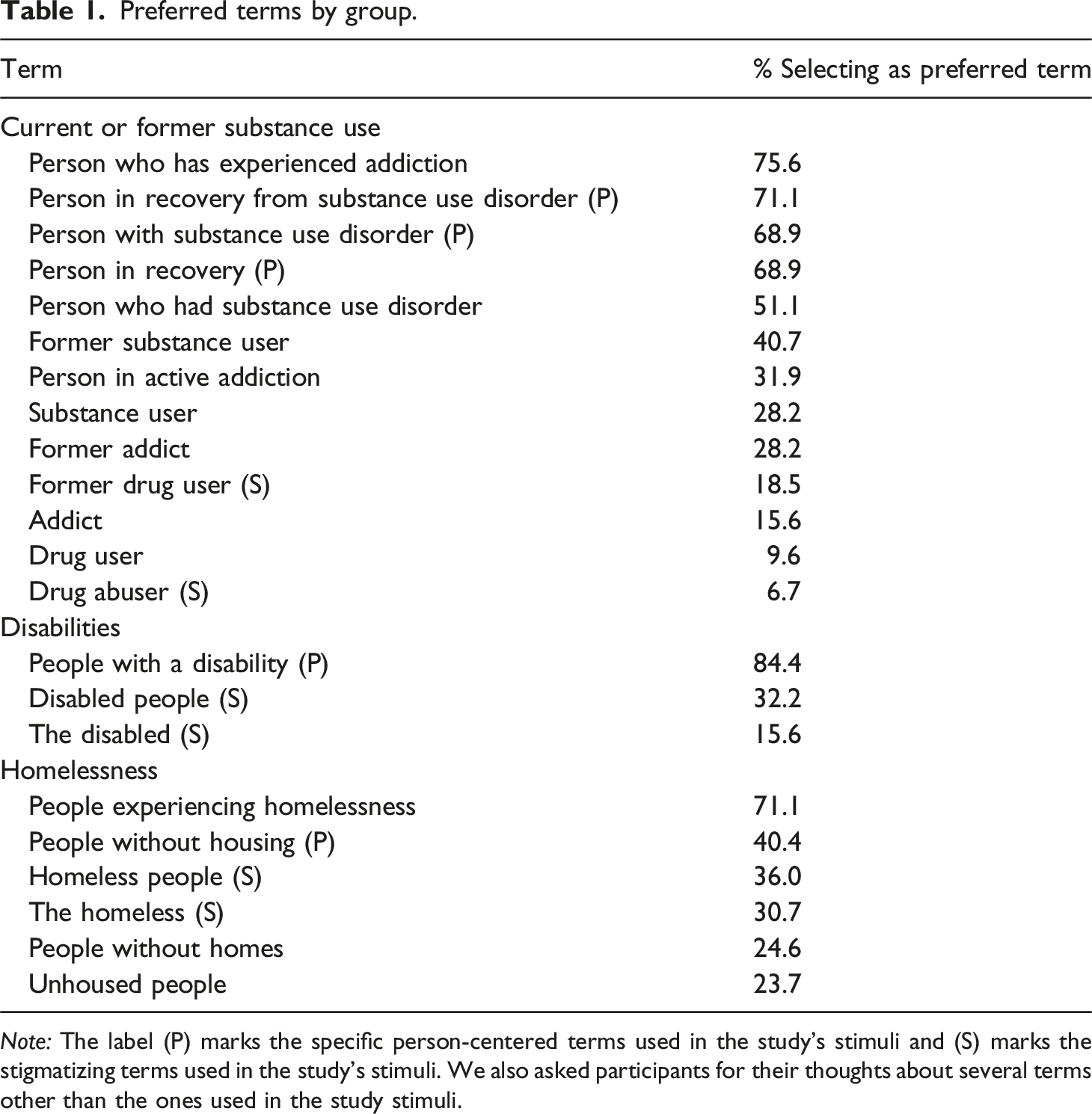
Note: The label (P) marks the specific person-centered terms used in the study’s stimuli and (S) marks the stigmatizing terms used in the study’s stimuli. We also asked participants for their thoughts about several terms other than the ones used in the study stimuli.
Trust, representation, engagement, and esteem by experimental condition Mean (SE).
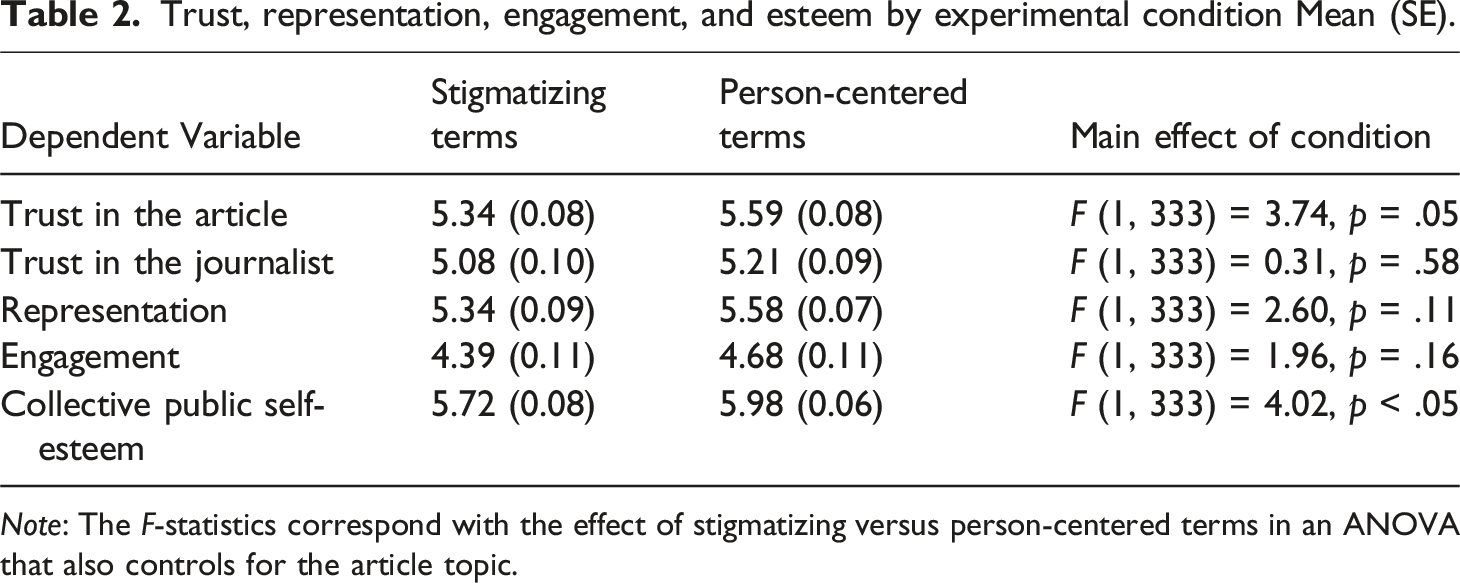
Note: The F-statistics correspond with the effect of stigmatizing versus person-centered terms in an ANOVA that also controls for the article topic.
For H1, we examined how the terms impacted news engagement and two kinds of trust: (1) trust in the news article and (2) trust in the journalist who wrote the article. The findings for H1a were only marginally significant, with participants trusting articles using person-centered terms more than articles using stigmatizing terms. The kinds of terms used in news articles did not impact trust in the journalist, leading us to reject H1b. H2 also was not supported, as we found no main effect of the experimental condition on participants’ thoughts about how well the news article represented their group. Turning to H3, participants demonstrated higher collective public self-esteem when they read articles that used person-centered terms compared to articles that used stigmatizing terms. The kinds of terms used in news articles did not impact intentions to engage, however, answering RQ1.
There is support for the indirect model proposed in RQ2. Using PROCESS Model 6, there was a significant, albeit small, indirect effect of the experimental condition on intentions to engage via esteem and generalized trust (0.06, 95% bootstrapped CI [0.01, 0.13]) and via esteem and journalist trust (0.11, 95% bootstrapped CI [0.02, 0.21]). The causal ordering, however, cannot be conclusively determined by this study and unspecified covariates may affect the relationship (Kline, 2015). 3
Representation by experimental condition and article topic mean (SE).
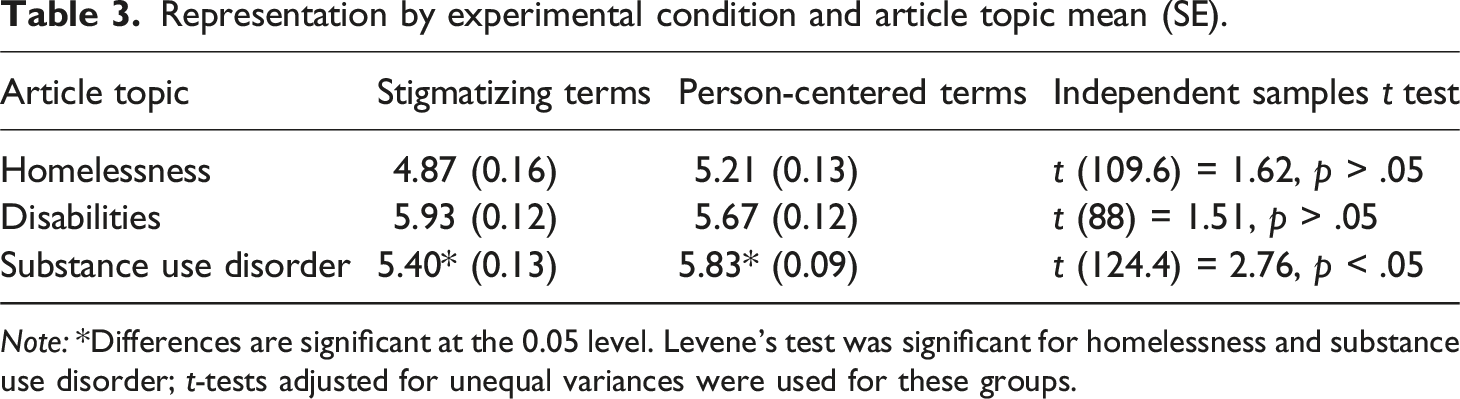
Note: *Differences are significant at the 0.05 level. Levene’s test was significant for homelessness and substance use disorder; t-tests adjusted for unequal variances were used for these groups.
We also note that the main effect of group membership was significant for four of the five dependent variables, with engagement being the exception. 4 In general, participants who had experienced homelessness had lower news trust, feelings of representation, and collective public self-esteem than the other two groups.
Discussion
Stigmatized groups have advocated for more holistic portrayals of their experiences in the news (Kwan, 2021; Perry, 2016; Simpson, 2021). While the use of person-centered terms will not fully realize that goal, this study shows that the practice is an important step in the right direction. Person-centered terms encouraged participants’ collective public self-esteem, or the feeling that their group was respectfully covered in news. This finding that the use of stigmatizing versus person-centered language matters confirms the power of small changes in language (Gilovich 1981; Hurwitz and Peffley, 2005; Simon and Jerit, 2007), and extends our understanding by showing that this matters to marginalized groups.
Although not universal across groups, person-centered language also influenced how well represented people in recovery from substance use disorder felt by the news article. Why this group and not the others felt better represented by person-centered language requires additional research. It’s possible that people in recovery from substance use disorder have particular personality traits, background characteristics, or experiences that lead them to be particularly affected by person-centered language. Alternatively, it is possible that some kinds of non-person-centered labels are more damaging than others. In particular, the extent of negativity found in the stigmatizing terms could explain why those in recovery from substance use disorder distinguished so strongly between person-centered and stigmatizing language. For people with disabilities and people without housing, the difference between person-centered language (e.g., people with disabilities, people without housing) and stigmatizing language (e.g., disabled person/the disabled, homeless person/the homeless) in our study was based on the order of the words. The actual words used were nearly identical. For people in recovery from substance use disorder, however, the person-centered language (“person with substance use disorder”) was not equivalent to the stigmatizing term (“drug abuser”). In this case, the stigmatizing term may carry more negative emotional connotations for people in recovery (e.g., Ashford et al., 2019a). In other words, the strength of the manipulation may have been more intense for people in recovery from substance use disorder compared to the other two groups.
When it came to trust, we found suggestive, marginally significant evidence that person-centered terms increased trust in the news article. Trust in the journalist did not differ across the experimental conditions, although the means trended in the predicted direction. A one-time experience of seeing person-centered language replace stigmatizing language may be insufficient for affecting trust, especially to the extent that there is longstanding damage from news media referring to people in dehumanizing terms. Valuable future work could investigate whether exposure to a body of articles establishing a track record of using person-centered language could encourage more trust. Given that the experiment involved only a change of a few words and that there are mixed results on the efficacy of other, more intensive trust-related interventions (Karlsson et al., 2014), even a marginally significant finding is worth further investigation.
Finally, we did not see any effect of the intervention on intentions to engage with the content. Like trust, this may require building a greater relationship with the newsroom and journalist over time to prompt different engagement decisions based on the use of person-centered language. It also is possible that other factors about the article, such as its topic, are more important for engagement decisions than the type of language used. We note that the indirect effect analysis suggests that trust and engagement intentions may be indirectly affected by the terms used via collective public self-esteem, however caution is warranted in interpreting these results given critiques of mediation analyses (Kline, 2015). Because we measured some of the mediators and the dependent variable concurrently, temporal order cannot be established. There also may be unmeasured confounders.
As with any study, this one has limitations worth noting. We analyzed the reactions of only three groups based on only three articles, each tailored to a particular group. Therefore, the three articles varied in their topic, style of writing, and the original versions’ use of stigmatizing and person-centered terms. Establishing that the relationships uncovered hold for additional groups, and using more diverse stimuli, is a task for future research. It is important to note that the overall study is able to detect small effect sizes with power .80; however, the sample size for each group only allows us to detect medium-sized differences for each group on its own and the sample size differs across the groups (disability n = 90, homelessness n = 114, substance use disorder n = 135). Future studies should explore additional ways of recruiting respondents in these infrequently surveyed populations to allow for more precise estimates. In context of the larger debate around person-centered language, the present experiment provides evidence in support of person-centered language over identity-first language. However, the finding should be understood as time-bound. Language preferences are dynamic, often very personal, and evolve over time. Understanding how reactions change over time will be an important next step. Furthermore, our experiment looked only at the effects of word choice on the perceptions of marginalized groups; future research should examine additional tactics. Varma (2020, 2023), for example, finds that solidarity journalism differs from dominant journalism in terms of framing, source prioritization, and the presence or absence of structural context in stories on issues of marginalization. These differences are not always detectable at the level of word choice, however (Varma, 2020). Furthermore, dehumanizing narratives in journalism may avoid dehumanizing words but still use problematic euphemisms or allusions, which is an area for future research as well.
The research underscores the importance of journalists’ careful consideration of the labels they apply to groups. On a practical note, copy editing norms may inhibit news organizations from experimenting with person-centered language. Person-centered language is almost always less concise than identity-first or stigmatizing language. Although column inches on a physical sheet of paper are no longer the constraining factor for most news organizations, character limits on some social media platforms may incentivize brevity, even when it results in problematic language. The ethos of any new journalism practice involves recognizing that longstanding norms in journalism have contributed to the current crisis in trust, which could justify reassessing and changing these norms in the service of further developing and, in some cases repairing, ties to social groups that have been stigmatized in the news. While trust-building efforts cannot be limited to linguistic intervention, this study has offered insight into one immediate change that news organizations can implement to improve how marginalized groups react to the coverage.
Supplemental Material
Supplemental Material - The impact of using person-centered language to reference stigmatized groups in news coverage
Supplemental Material for The impact of using person-centered language to reference stigmatized groups in news coverage by Caroline Murray, Anita Varma, and Natalie Jomini Stroud in Journalism.
Footnotes
Declaration of conflicting interests
The author(s) declared no potential conflicts of interest with respect to the research, authorship, and/or publication of this article.
Funding
The author(s) disclosed receipt of the following financial support for the research, authorship, and/or publication of this article: This work was supported by grant funding from Resolve Philadelphia and Democracy Fund.

Supplemental Material
Supplemental material for this article is available online.
Notes
Author biographies
References
Supplementary Material
Please find the following supplemental material available below.
For Open Access articles published under a Creative Commons License, all supplemental material carries the same license as the article it is associated with.
For non-Open Access articles published, all supplemental material carries a non-exclusive license, and permission requests for re-use of supplemental material or any part of supplemental material shall be sent directly to the copyright owner as specified in the copyright notice associated with the article.
