




Abstract
This article examines the role of trust in the age of mediatised politics. Authority, we suggest, can be successfully enacted despite the disrupted nature of the public sphere if both rational and moral trust are utilised to formulate validity claims. Drawing from Maarten A. Hajer's theorisation of authority in contemporary politics, we develop a model of how political actors and institutions as well as the media employ both rational and moral trust performances to generate authority. Analysing a Finnish case of controversial investigative journalism on defence intelligence, we show how the media in network governance need to critically evaluate the authority performances of political actors while at the same time enacting their own authority performances to retain their position within the governing network and to manufacture trust among networked publics. This volatile position can lead to situations where the media compete for authority with traditional political institutions.
Introduction
The contemporary analysis of politics and news media focuses on disruption, fragmentation, polarization and decline, showing how the proliferation of disrupted communication processes poses various challenges to democratic processes. As Bennett and Pfetsch (2018: 248) argue, ‘for growing number of issues, authoritative political information either fails to reach many citizens or is drowned out by alternative sources of uncertain credibility’. There are various declinist and disruptive processes taking place simultaneously, including the fragmentation of the political party system (Best, 2013), the decline of power in political institutions (Crouch, 2004), the diminishing legitimacy and efficiency of political parties (Ignazi, 2014), and the decline of trust in elites (Kaina, 2008). These processes are taking place at the same time as there are increasing difficulties to establish authoritative governance in the age of mediatised politics (Hajer, 2009), hybrid media (Chadwick, 2017) and networked, affective publics (Papacharissi, 2015). Some of these declinist trends have been part of the political sphere for decades, but the sense that politics is increasingly broken in the contemporary era is prevalent across established democracies.
When an increasing amount of analytical focus is directed towards making sense of disruption and fragmentation, processes that generate consensus, trust, and authority remain understudied. In this article, we argue that a more nuanced understanding of the role of trust in the age of mediatised politics and disrupted public spheres is needed in order to explain situations where consensus and authority are successfully manufactured. The concept of trust is often employed in studies that examine the weakening legitimacy of established institutions and the changing media systems. For example, Bennett and Livingston (2018: 127) write that the ‘breakdown of trust in democratic institutions of press and politics […] is not ephemeral but grounded in the hollowing of parties and diminished electoral representation’. Instead of approaching trust through indexes that examine the level of citizens’ trust towards institutions, we treat it as a key element in authority performances. Our research approach is grounded in the theorisation of Hajer (2009) who employs the term ‘politics of multiplicities’ to analyse the fragmented nature of contemporary politics that is thoroughly mediatised.
The concept of mediatisation (Esser and Strömbäck, 2014; Mazzoleni and Schulz, 1999) highlights how ‘media logic’ to various degrees permeates not only political communication but also political processes (Altheide and Snow, 1979; Strömbäck, 2008). For Hajer (2009: 36, 38), mediatisation is both a disruptive force challenging authoritative governance and a communicative logic increasingly internalised by policy-makers. Approaching authority ‘not in terms of systems of persons, but in terms of the strings of enactments that create and sustain authority’ (Hajer, 2009: 179), Hajer distinguishes between the more established (1) classical-modernist way of governing where institutional positions, parliamentary rituals, and bureaucratic routines build up authority and (2) network governance that is rooted in interaction. In the classical-modernist genre of governance, authority is typically generated by following institutional norms and practices. In network governance, there are stagings of deliberation that generate authority and create a stronger relationship between policy-makers and publics.
In the classical-modernist genre, the role of media is fairly stable and ritualised, representing a channel through which trust towards political institutions can be maintained. In network governance, however, the role of media becomes much more complex and ambivalent as the media assumes an institutional position in the governing network (see Hajer 2009: 37). As Hjarvard (2008: 113) argues, ‘media have become integrated into the operations of other social institutions, while they also have acquired the status of social institutions in their own right’ (see also e.g. Allern and Blach-Ørsten, 2011). In network governance, we suggest, the media does not only report on and analyse authority performances of political actors but also themselves enact authority performances, which include manufacturing trust This means that the media needs to engage in various trust performances in order to maintain trust within the governing network as well as among the wider public that expects the journalistic media to act as a watchdog, critically overseeing the conduct of authorities. This position is volatile as ‘the media seem to be simultaneously becoming more central for other institutions and running into problems of their own sustainability and credibility as society's central attention brokers’ (Kunelius and Reunanen, 2016: 372–373). Although Hajer's approach underlines the centrality of media in network governance, it discusses the media as an arena and logic influencing governance but not as an agent with its own authority struggles.
Trust and authority
Trust is central to democracy but in a paradoxical way. Institutions of democracy were built on distrust but require trust to function effectively (Warren, 2018). In the classical-modernist genre of governing, institutional trust provides a channel through which the paradox can be managed and controlled. Warren (2018) describes that in institutional trust the truster ‘will typically know nothing about the trustee except that the trustee holds an office within an institution. Individuals must infer the trustworthiness of individuals from features of institutions’. In network governance, the role of social trust (Putnam, 2000) becomes more prominent with its emphasis on interpersonal relationships. The media is a key actor in extending social trust in mass societies (Newton, 2017), but it is also increasingly a trustee that is constantly evaluated by the governing network and the general public both in rational and in moral terms.
Rational trust refers to the traditional way of perceiving trust as a rational choice calculation that is based on a strategic assessment of the other's trustworthiness. It can be called strategic trust or ‘knowledge-based trust’ (Yamigishi and Yamigishi, 1994; see also Putnam, 1993) because it approaches trust as a strategic risk evaluation based on knowledge and rational reasoning. A rational understanding of trust assumes that knowledge about the other party's actions and intentions determines the level of trust performing institutional rituals and committing to shared norms of policy-making and information sharing are ways to generate rational trust in the classical-modernist genre of governing. Moralistic trust refers to the belief that ‘others share our fundamental moral values’ (Uslaner, 2002: 18–19) and highlights the integrity and character of the counterpart. The emotive element to trust is a more inarticulate ‘horizon of expectation’ (Michel, 2012: 879) that influences perception and action (see also Lahno 2001).
To Uslaner (2002), the concept of moralistic trust captures ethical and communal elements that a rational understanding of trust completely overlooks, explaining how generalised trust is possible. We employ the concepts of rational and moral trust to study how trust is performed to generate authority in the age of mediatised politics. Habermas (1996) distinguishes between sincerity, rightness, and truth, which can be seen as instances of authority performances related to trust, value commitments, and knowledge (Reunanen and Kunelius, 2019: 2). Rational and moral dimensions to trust entail aspects of all the three validity claims with rational trust relying on knowledge and moral trust relying on value commitments. Following Hajer's typology on ways of performing authority, we develop a model of how rational and moral trust performances are employed to generate authority in the two governing genres (see Table 1).
Generating authority through trust performances. Modified from Hajer (2009: 180).
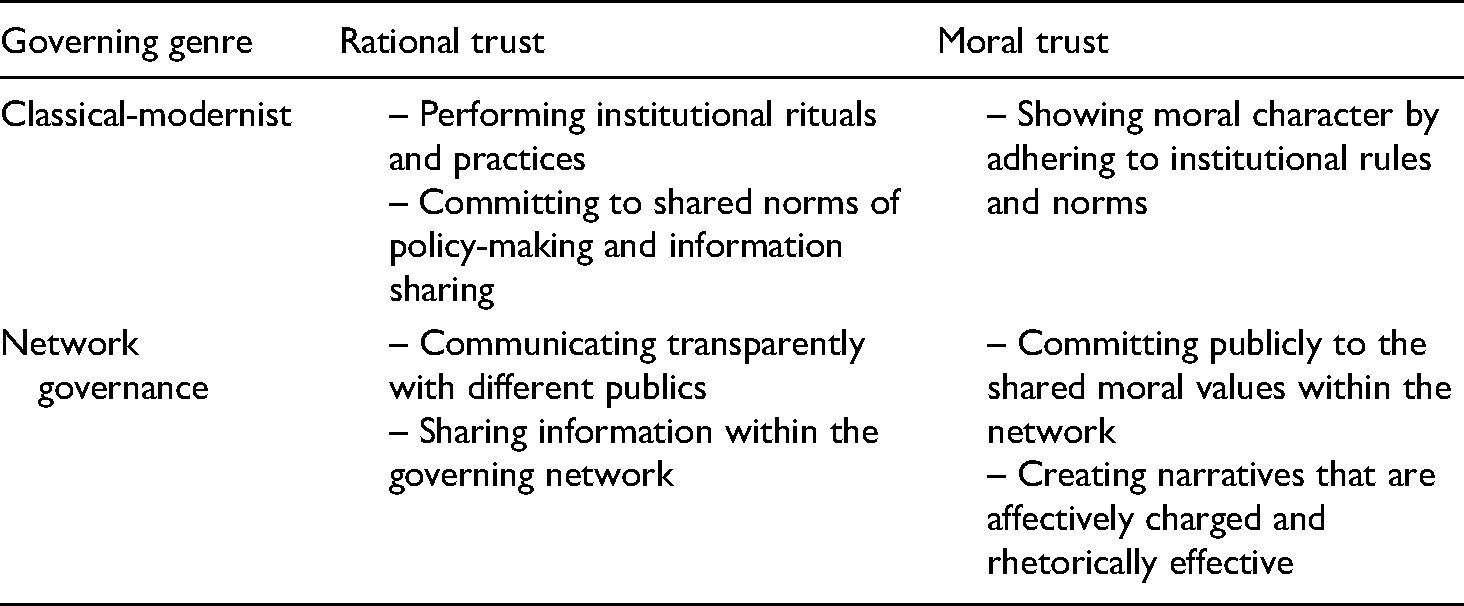
Although providing a heuristic approach to analyse the manufacturing of authority in policy processes, we argue that this frame also allows a more nuanced understanding of the complex role of news media in network society and its specific authority problems. Previous research has made visible how distrust in media is linked to wider anti-institutional and declinist tendencies (Bennett and Livingston, 2018; Osburg and Heinecke, 2019) as well as how trust is a central ingredient in policy networks and in relationships between politicians and journalists (Reunanen et al., 2010). The focus on trust and authority enables a reframing of the debate to focus not on the degree of public trust but on the media's agency in enacting rational and moral trust performances.
In what follows, we examine this empirically through a case of investigative journalism on the Finnish Defence Intelligence Agency and the ensuing intense public controversy. We study the case as a manifestation of tensions in authority and trust in the age of mediatised politics, showing that (1) authoritative governance by state institutions is possible despite the forces of disruption, polarisation, and fragmentation, (2) the role of media is particularly ambivalent and precarious in network governance, and (3) trust performances are central in manufacturing authority. As such, the article advances knowledge both empirically and theoretically. Empirically it provides ‘a better sense of why authoritative governance is so difficult to achieve nowadays, which “repertoires” work, and why’ (Hajer, 2009: 47). It contributes to the existing theoretical debate in respect of why the role of trust becomes more complex in authority performances and how the media seeks to establish and retain its credibility in network governance.
Data and methodology
Adopting Polkinghorne’s (1995) paradigmatic method to study narratives, we approach the public debate on the publishing act from a narrative perspective. In recent decades, there has been a growing understanding of how strongly a narrative format dominates the way in which we perceive social reality (Bruner, 1991). The reason why we conceptualise the public debate as a collection of narratives rather than as discourses (cf. Kortesoja et al., 2019), frames, or speech acts is that a narrative approach allows us to focus on valued endpoints that are rendered meaningful by arranging relevant events into a coherent order with the use of causal linkages (Gergen, 1999: 37–38). The intensity and affective nature of the debate is intelligible only when placed in a wider narrative context that explains causal linkages between historical traumas, national self-image, and security interests as well as the valued end point of remaining nationally united when national security seems to be threatened. We employ two types of paradigmatic search (Polkinghorne, 1995: 13). Firstly, we locate manifestations of rational and moral trust in the data set to examine how different concepts of trust were used to perform authority. Secondly, we trace how they were connected to the two governing genres, the classical-modernist and network governance.
Our empirical data consist of two datasets. Firstly, a selection of the journalistic coverage of the information leak during 16–18 December 2017 (N = 137). Secondly, a Twitter dataset (N = 4308 tweets, N = 2844 unique users, 16–21 December 2017) was acquired through Twitter's public data interface. Previous research has examined the public reception of the Helsingin Sanomat (HS) news story, identifying different ideological horizons and discursive dimensions in a rich set of social media data (Kortesoja et al., 2019). We instead focus on different notions of trust, qualitatively analysing both the journalistic media data and the Twitter data to identify the narrative trajectories and key turning points. The data provide a rich picture of the case by highlighting the dynamics of hybrid media logic but also showing how as a media event the case exemplifies the logic of hybrid media and what Papacharissi and de Oliveira (2012) term ‘networked publics’. We treat the case as a moment of dislocation, which is an instance where ‘political or institutional authority becomes unhinged, even if it is only for a moment’ (Hajer, 2009: 5). What was particular about this moment of dislocation was that ‘a moral outcry, a moment of broadly shared emotionality, or a feeling that trust was breached’ (Hajer, 2009: 5) was not directed towards political leaders or traditional political institutions but the media, forcing the media to engage in its own trust performances to handle the situation. We illustrate the performative nature of the authority acts enacted in the public sphere by dividing the data into six settings with their own specific trust performances (see Hajer, 2009: 78–89).
Performing trust and mistrust in the Finnish intelligence legislation case
Setting 1: The media performing independence from the governing network
After the 9/11 attacks in the United States in 2001, there have been various counter-terrorism policy processes in EU member states as well as on the EU level (see e.g. den Boer 2003). They have caused controversies and opposition across European states as the policy processes have involved legislative changes to grant military and civil intelligence agencies more access to private data. Surveillance revelations have resulted in conflicts between journalists and state officials, highlighting clashes between national security policies and journalistic ideals of transparency and accountability (Bell and Taylor, 2017; Eide and Kunelius, 2018). In Finland, the policy process began in the mid-2010 and was justified with the need to bring the level of surveillance to the European standards. The terrorist attack in the Finnish city of Turku in 2017 intensified the calls for reforming the intelligence legislation, which involved constitutional changes.
A month before the parliament was meant to start processing the bill, Finland's leading daily newspaper HS published an investigative report with the headline ‘The Most Secret Place in Finland’ (Halminen and Pietiläinen, 2017). Its layout featured photos of classified documents signalling an information leak concerning the operations of the Finnish Defence Intelligence Agency and its signals surveillance research centre in Tikkakoski, Central Finland. The report described the location and number of employees of the research centre, as well as its task to monitor the Russian Armed Forces by capturing, classifying and analysing electromagnetic radiation. The report was framed as investigative journalism exposing information to which the public had been previously denied public access but which the readers needed to know given the intelligence law reform which would give the research centre new tasks and authorization (Kortesoja et al., 2019). The article promised that ‘for the first time, the classified documents obtained by HS will explain what happens at Tikkakoski’ (Halminen and Pietiläinen, 2017). The newspaper emphasised that Members of Parliament will have to take decisions without having adequate knowledge about secret surveillance practices in Finland. In the article, it was told that it was part of a longer series on military and civilian intelligence, which would continue the following days (Figure 1).
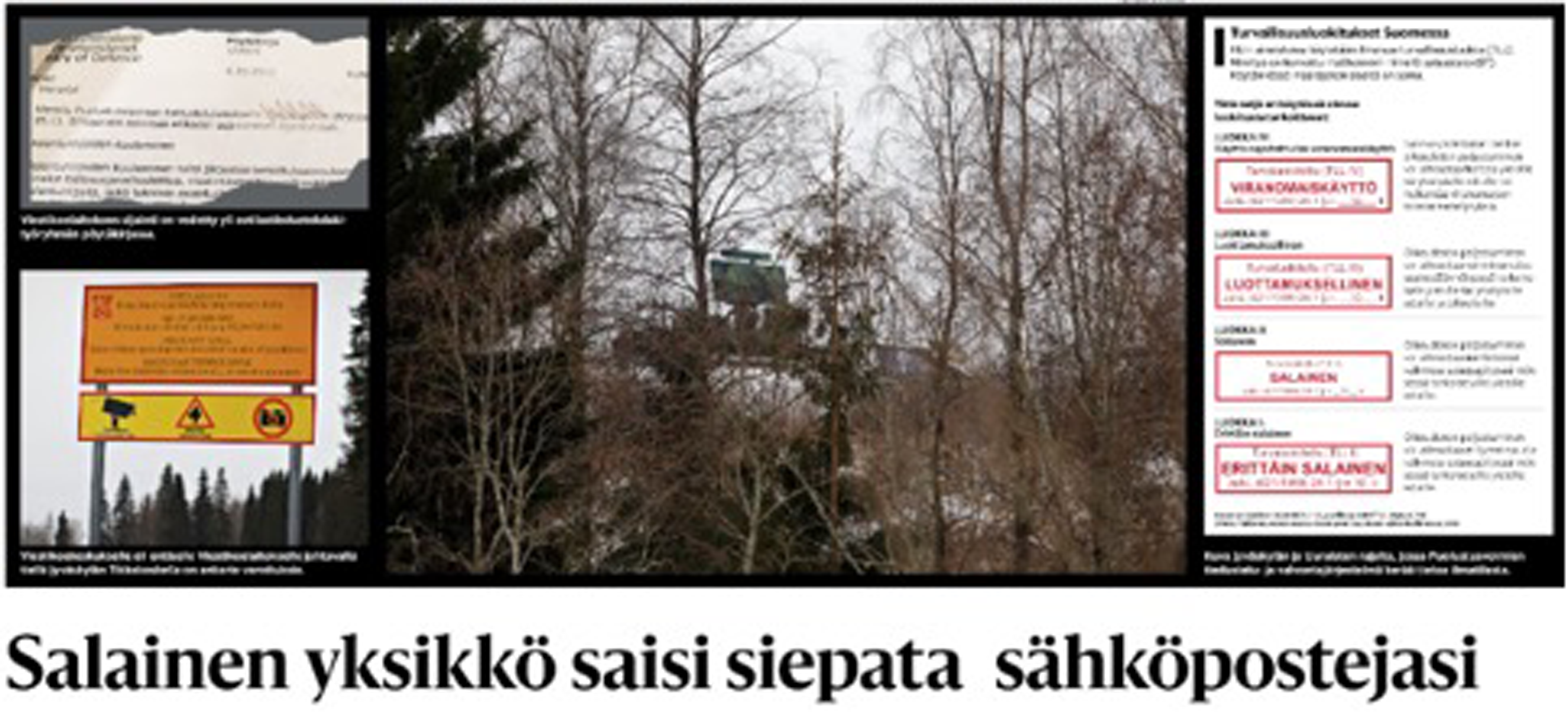
‘A secret unit would be allowed to intercept your emails’, the Helsingin Sanomat (HS) article stated in its headline alongside images of the secret signals surveillance centre and red ‘confidential’ stamps in classified documents.
The publishing act was the newspaper's attempt to perform the traditional watchdog role that is intertwined with rational trust in providing the public more information about the conduct of state governance. The maintenance of rational trust requires an adequate amount of information, which includes knowledge about governance processes that are not public. HS framed the publishing of the article as an act of defiance towards the state, represented by the Defence Forces, that has repeatedly declined to share any information about Tikkakoski. The publishing act can be seen as the newspaper's authority performance that was legitimized with the claim that the public have the right to know the basic details that are relevant to the ongoing legislative process. It was essentially a performance of independence from state institutions, manifesting a professional and critical journalistic identity that has been developing in Finland since the 1980s. This is a particularly challenging balancing act for HS given its historically, politically, and culturally central role in Finland (Lounasmeri, 2013). Not only is HS the only national daily newspaper in Finland and the largest in the Nordic countries with over 400,000 subscribers but also a power centre in the eyes of political, social and cultural elites, and the general public. Since 1889 HS and its predecessor Päivälehti have acted as an institution voicing national interest and as ‘an instrument of Finnish nation-building and an arena for public discussion, promoting unity and the creation of consensus’ (Lounasmeri, 2013: 385). A proponent of a liberalist ethos and legality, HS has acted as a pillar of the classical-modernist governing and a key broker of public trust in network governance. The publication of the article on surveillance was an authority performance that breached with both the models of governance.
Setting 2: Presidential ritual of authority
Only a few hours after HS published the article, the President of Republic Sauli Niinistö issued a press release (Niinistö, 2017) announcing a criminal investigation against the newspaper. The press release was widely distributed on social media as was its claim that revealing classified information ‘is critical to our security and may cause serious damage’. A political figure enjoying exceptionally high popularity among Finns and, at the time, a candidate running for his second term in office, Niinistö's press release entailed an intense securitisation of the publication and directed the public attention not to the leak but to the actions of HS. Following President Niinistö's press release, both the press and broadcast media started covering the case as #hsgate, concentrating on reporting the criminal complaint. Characteristically for hybrid media, the event unfolded concurrently on Twitter and in journalistic news media, with their different logics. Journalistic coverage focused on describing the news story and reporting comments by army officials, leading politicians and experts on security politics. Whereas for Finnish News Agency, Minister of Defence (representing The Finns Party) declined to comment the article beyond a general statement on how ‘leaking confidential information is always a serious matter’ as ‘intelligence cooperation is based on exchange and information is confidential’ (STT, 2017), on Twitter he published a statement framed as an ‘aphorism’: ‘It is a short distance from the misuse of freedom of speech to unpatriotism’. Although the chairs of the parliamentary Defence Committee expressed concern in journalistic media over the potential damage to the reputation of Finland as a partner in international intelligence exchange, prominent representatives of the Defence Forces used strong language condemning the publication of classified information both on social media and in comments to news media.
‘Trust is broken at once’, tweeted a Lieutenant Colonel at The National Defence University. A navy officer in Defence Command Finland used the hashtag #treason (#maanpetos) referring to HS as did the Secretary General of the Finnish Cadet and Officer Corps Association. Brigadier General and Officer of the Finnish Defence Forces tweeted having terminated his decades-long HS subscription due to the article. The narrative of unpatriotism was echoed by a Member of Parliament representing the Centre Party who tweeted: ‘Leaking classified material to the press is totally irresponsible and criminal. It is also unpatriotic to publish it. If a crisis erupted, could we trust one of the most prominent media houses or would it be more important also then just to have headlines?’ Similar rhetoric was employed by Chairman of Patria, a government-owned provider of defence, security, and aviation technology, who tweeted: ‘It was an unpatriotic and shameful article on the surveillance research centre. You are not acting for the benefit of Finland and her people’. Both in journalistic and social media two distinct notions of trust coexisted and intertwined: on the one hand, the rational, knowledge-based and disaffected narrative on consequences for Finland's reputation as a trusted partner in international intelligence cooperation; on the other hand, the affectively charged narrative on unpatriotism as a violation of a moral code. ‘Can Finland be trusted’ summarised Iltalehti (Ainola, 2017) the rational notion on trust: ‘In London, Washington, Berlin, Paris and Stockholm the question at this moment is, what else had leaked and to what extent can they trust Finland to keep confidential information secret’. The moral notion of trust was manifested in the language of treason and in debates on the newspaper's ‘will to defend the country’. In an interview, Chief of Defence Intelligence compared the publication of classified information with a Finnish soldier in the Second World War revealing the Finnish strategy to the Soviet enemy troops.
The President performed traditional authority that was in line with the classical-modernist way of governing, issuing an official press release and employing legal language to condemn the publishing act. This classical-modernist gesture was mobilized for collective storytelling in social media, which strongly resonated with the framing that the president manufactured with the press release. Previous research has shown that the clear majority of commentators on social media and the newspaper's online comments section criticised the newspaper for publishing classified information. Arguments that defended its publishing were marginalised and delegitimised with a ‘loose alliance’ emerging between various ideological and discursive positions (Kortesoja et al., 2019). This value alignment resembles the logic of a ‘resonance machine’ (Connelly, 2005) that fuses together distinctive, even opposing ideological positions. Although the President's press release operated strictly within the rational notion of trust and moved the issue to the legal sphere, the moral notion of trust provided affective language to publicly question whether HS was still committed to the values and ideals of the network. Importantly, the Defence Forces succeeded in directing the public interest away from its potential mistakes. As the public debate focused on HS, there was little or no interest in investigating or speculating about the leak. In the context of national security, the Defence Forces exerted authority over the event as the public debate followed its logic. The publishing act generated an unprecedented reaction from the highest state authorities and the wider public as well as legal processes including several Supreme Court verdicts and pending charges against journalists.
Setting 3: Journalistic double tongue
HS responded to the President's press release and the social media debate by underlining the primacy of the watchdog role. In the words of a Managing Editor, ‘[t]he most important task of the media is to monitor and control the activities of the authorities’. (Mäkinen, 2017). The initial HS response addressed the accusations of breaching rational trust by mobilising universalist language of press freedom. In a similar vein, the Editor-in-Chief's first comments attempted to maintain authority by underlining how commonplace it is for the media to handle information that public authorities classify as secret (Niemi, 2017a). This routine language of press freedom and calling forth the ideals of journalistic independence proved however to be ineffective as a defense strategy as the strong public criticism continued. The day after the Editor-in-Chief of HS published an ‘Open Letter to the Readers’ (Niemi, 2017b), which reads as a complex performative gesture aimed to restore not only rational but also moral trust and to balance between the demands of network governance and maintaining an independent watchdog role. With this letter, HS addressed the readers by appealing both to rational grounds – ‘We should have motivated the article better’ – and to moral trust: ‘The will to defend the country is the strength of Finnish society and an exceptional feature in international terms. It is an important part of our experience in unity, and we want to respect that also in the future’. Attempting to convince the readers as a ‘responsible publisher’ and explaining the rational motivations for discussing intelligence operations in public, the letter acknowledged a failure in journalistic skills: the grounds for publishing existed but the article was not written well enough as the wider context of intelligence law was not properly explained. Simultaneously, the Editor-in-Chief addressed the accusations for breaching moral trust, making a pledge to the nation: ‘During its 128 years, Helsingin Sanomat has been a builder of Finnish society. I want this newspaper to continue on this path’.
The open letter reads as a trust performance directed both to the general public and the network partners. Although the open letter explicitly addressed the readers of the newspaper, it manifested an attempt to balance between network loyalty and journalistic independence. With this trust performance, HS strategically reshaped its initial watchdog narrative to motivate the publication with a double tongue (see also Hajer, 2009: 82), both invoking the democratic duty of the press and assuring the readers and the network governance partners of its core values. The importance of moral trust in network governance had already become visible in a spectacular late-night Twitter exchange where Chief of Defence Intelligence tweeted directly to the Editor-in-Chief of HS, quoting The Unknown Soldier (1954) that tells a story of Finnish soldiers during the Continuation War (1941–1944) between Finland and the Soviet Union. ‘Now it is not the time to get caught in crossfire’, he tweeted and stated that ‘cooperation is the only option for rebuilding trust’. In his tweet, he invoked a legendary Finnish sniper during the Second World War, and the Editor-in-Chief of HS responded with a personal family anecdote, telling how his grandfather's brother fell during the Second World War: ‘This summer I went to this place called a “killing hill” to hold a moment of silence in the memory of him and others’. The Chief of Defence Intelligence replied, ‘Respect’. In the shadow of these public trust performances, HS paused its announced follow-up articles for two days, releasing two more stories on the topic on the following Tuesday and Wednesday. With all the focus on the first article, the criminal complaint and the trust performances, the readers of HS were left to wonder whether something was left unpublished.
Setting 4: Calling out of the media
Other media outlets first assumed the role of silent onlookers of the public debate, concentrating primarily on reporting the criminal complaint against HS. Late Sunday evening, however, the storytelling took a new turn as the Helsinki police conducted without a court order a home search of the journalist behind the story, confiscating her hard drives. The tone was solemn and serious in the public service morning TV programme as two eminent Editors-in-Chief, clothed in black, expressed their concern for the ‘exceptional’ police act that ‘we are not used to seeing in Finland’ (YLE, 2017a). The qualifier ‘exceptional’ emerged as a keyword, referring both to HS publishing classified information and to the police raid. The home search intensified the debate on the notion of press freedom, calling forth comparisons with violations against free press in Poland and Hungary. The police raid also prompted journalists to discuss the right of citizens to be informed about intelligence and to compare the openness of intelligence authorities in different countries. The home search validated momentarily the ethos and rhetoric of HS to demand increased transparency and democratic accountability in intelligence politics. Previously, few journalists – alongside some politicians and a former chair of Council for Mass Media in Finland – had framed the debate as a question of press freedom. Other journalists had criticised the newspaper for sensationalism, ‘red stamp porn’, or publishing classified information for the sake of the gesture, without showing serious misconduct. Although the coverage of both the ‘HS gate’ and the home search foregrounded commentary by the police, the publicity now also featured experts on constitution, information law and press freedom.
Also after the home search, several Editors-in-Chief were remarkably cautious in their comments, emphasising that press freedom must not threaten intelligence cooperation and agonising over the difficult balance. ‘Trust is the most important thing in both intelligence and media’ wrote the Editor-in-Chief of MTV News (Ylä-Anttila, 2017). When the Editor-in-Chief of Kauppalehti expressed his concern about the home search on the YLE morning TV programme, he simultaneously emphasised that the Editor-in-Chief of HS is certainly a patriotic person who is willing to defend the country. Employing the language of press freedom and underscoring the importance of free press, he – at the time the Chair of the Association of Editors – also felt the need to emphasise grounds for moral trust. The HS article made visible the precarious role of the media as a partner in network governance. Challenging the opacity of national intelligence and the refusal of Defence Forces to increase transparency, the authority performance of HS resulted in a serious clash with the classical-modernist governance. In the context of national security, a ‘staging of deliberation’ (Hajer, 2009) was not for the media to decide (Figure 2).
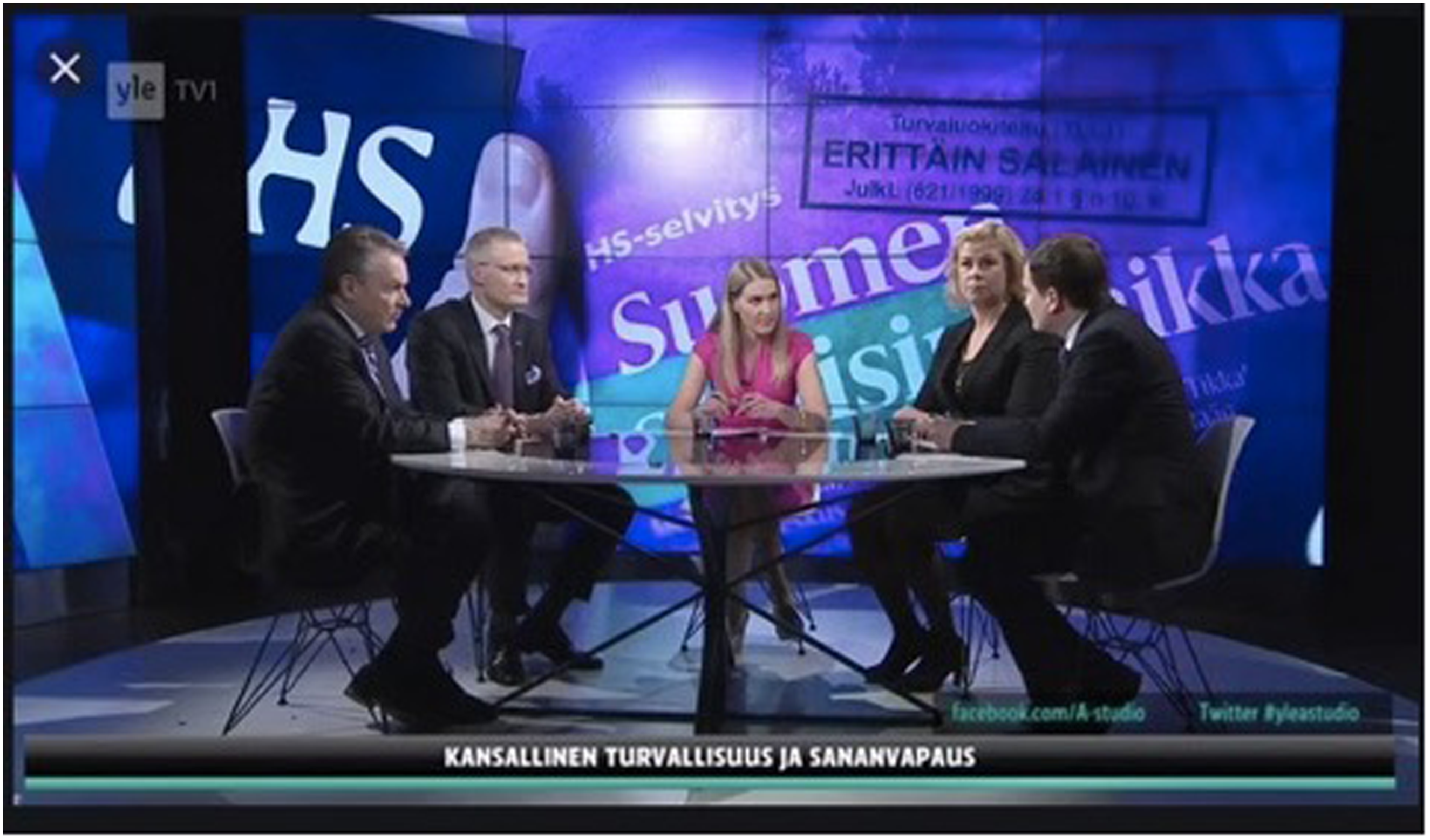
National security and freedom of speech (Yle A-Studio).
Setting 5: Closing the circle of trust
On Monday, amidst a heated debate on the meanings and consequences of the police raid, President Niinistö made a second authoritative move declaring that the leak ‘will not destroy trust in us’ (Lakka, 2017). Downplaying the severity of the information leak, the case became framed primarily as a drama of moral trust. This was evident in a YLE high-profile actualities show (Yle, 2017b) where the Editor-in-Chief of HS was interrogated in front of TV audiences not only by a journalist but also by other guests: an MP and Chair of Parliamentary Defence Committee, a Doctor of Military Science and a Professor of Practice in Cyber Security as well as a Professor in Communication Law. The group performed a circle of trust in a roundtable discussion in which the Editor-in-Chief was assumed after an interrogation and at times a heated discussion. In the programme, both the Doctor of Military Science and the MP assumed the role of interrogators, addressing Editor-in-Chief directly, questioning the publication of classified information and challenging the newspaper's competence in assessing harm to national security as well as in handling classified documents. In this discussion, the Editor-in-Chief continued to underline the importance of press freedom and the watchdog role of the media but also appealed to fresh comments by President Niinistö to support his position.
The roundtable turned to a televised trust performance as the discussion revealed both familiarity and patronising tone: the MP turned to the Editor-in-Chief with ‘I would like to ask you as a friend’ and the Doctor of Military Science addressing him with his first name and congratulating him for ‘coming here to engage in a dialogue’. In this discussion, the MP and the Doctor of Military Science assumed the role of network gatekeepers, concluding the discussion in asserting the importance of trust and shared values: ‘It would be the most unfortunate if the key social institutions would end up in a conflict. That is not the case here’. Stressing also the principles of freedom of expression, the televised trust performance concluded in a call for the importance of ‘being in the same Finland boat, in a correct balance’ and of ‘uniting rather than breaking up’. Although the police investigation was only beginning and the legal process loomed far in the future horizon, the televised trust performance read as an attempt at closure, a tightening of ‘connections between particular members of groups within a broader network’ and formation of trust as ‘an equilibrium […] that ultimately permits the cultivation and sustenance of social capital’ (Papacharissi, 2015: 92). In a prime-time TV studio, the parties enacted a ‘staging of deliberation’, performing a circle of trust and reinforcing the consensus culture (Lounasmeri, 2013; Reunanen et al., 2010) as interconnections between political and media elites. Simultaneously, they were united in confirming and manifesting the authority of network governance as well as soliciting trust from the home audiences (Figure 3).
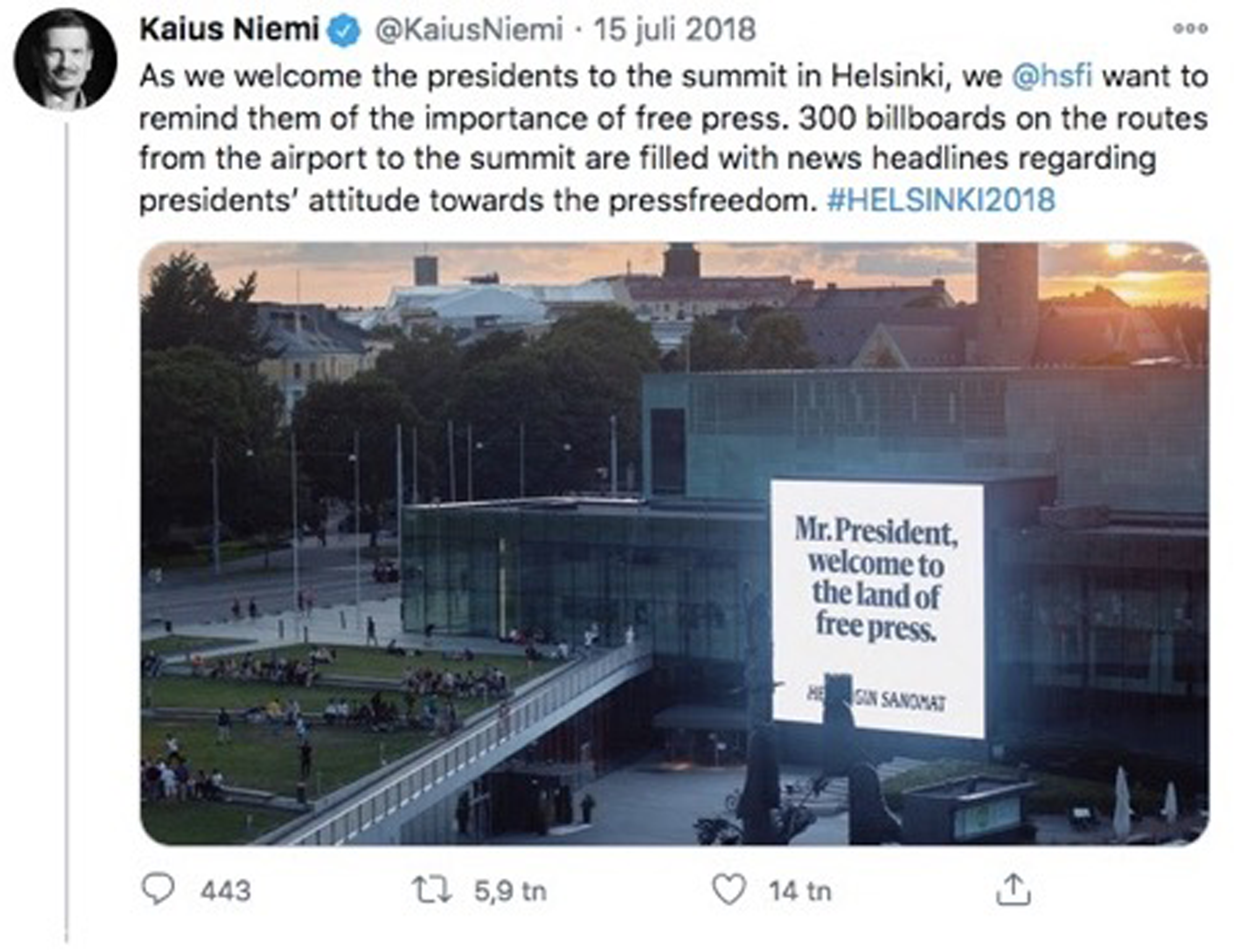
Mr President, welcome to the land of free press.
Setting 6: Media reclaiming authority
Six months later, HS made a forceful attempt to reclaim authority. When Presidents Donald Trump and Vladimir Putin visited Helsinki in July 2018, the newspaper launched a campaign on press freedom, decorating the presidents’ routes from the airport to the summit with 300 billboards with the tagline ‘Mr President, welcome to the land of free press’. The campaign received considerable domestic and international attention, winning a number of media and marketing prizes, but it also served as branding of HS (TWBA, 2018). Although the campaign at the time made no references to the controversy around HS publishing classified information, the Editor-in-Chief of HS invoked it when introducing a film about the campaign at the 50th anniversary seminar of The Council for Mass Media in Finland (Niemi, 2018). In the context of the campaign, the public controversy around the HS article was reframed and the police home search narrativised as one of many global threats against press freedom.
In this narrative, the journalist's attempt to destroy the hard drives by hammering to protect her sources before the home search was not a subject of ridicule as in the public debate following the publishing act but comparable to the Guardian editors destroying computers used to store top-secret documents leaked by the NSA whistleblower Edward Snowden (Kortesoja et al., 2019; Niemi, 2018). In this context, the emphasis on journalistic independence caused no trust issues but instead the ‘land of free press’ was acclaimed also in Finland. The campaign was widely embraced in social media, occasioning a celebration of a national ‘we’ in line with nation branding that foregrounds the press freedom narrative. In this moment, rational and moral trust were restored: the imaginary ‘we’ trusted HS as a national institution, not only sharing but embodying ‘our’ values and boldly addressing Trump and Putin as one Mr President. If the focus in the public debate surrounding HS in December 2017 was not primarily on the leaked information itself but on the defiance and independence shown by HS when using classified documents in its reporting and thus breaking a moral bond, the ‘land of free press’ was an authority performance with which HS restored its position in network governance.
Negotiating trust and mistrust in the public sphere
When trust is analysed in relation to politics and media, the focus is often on measuring citizens’ attitudes towards institutions or categorising types of trust and trusting relationships. In this article, we have taken a different approach and studied trust as a key element in authority performances. Drawing from Hajer (2009), we developed a model that recognises trust has both rational and moral dimensions with their specific functions in different governing genres. At the same time, it acknowledges that the media is an institution in its own right and with its own authority struggles alongside political institutions. The authority paradox in politics, then, does not only concern political authorities but also the media. In our model, rational trust is connected to institutional rituals and transparency, while moral trust is about commitment to shared moral values and affective legacies.
The specific case of an influential newspaper negotiating trust and mistrust in the Finnish context allows us to draw more general conclusions about authority performances in the age of mediatised politics. Firstly, authority can be successfully enacted despite the disrupted nature of the public sphere if both rational and moral notions of trust are utilised to formulate validity claims. Secondly, the media need to critically evaluate the authority performances of political actors while at the same time enacting their own authority performances to retain their position within the governing network as well as to maintain credibility among networked publics. The central question underlying the case was not only rational concerns over national security but also whether ‘we’ can trust the newspaper as a national institution that shares our fundamental moral values and works towards ‘our’ valued endpoint (Gergen, 1999).
The valued end point in the authoritative performances was the protection of national interests, causally linking the emotionally charged events in Finnish war history to the image of a national ‘we’ that shares a moral trust bond. The authority performance of the newspaper initially tried to only invoke rational trust by distancing itself from the affectively charged national ‘we’, foregrounding the watchdog role and independence from the state. This proved unsuccessful, which prompted the newspaper to also mobilise moral trust in its public performance. Our model highlights the volatile position of the media in mediatised politics, characterised as simultaneously powerful and yet potentially forcefully distrusted among different publics. This paradox has the potential to intensify the process of disruption that characterises contemporary political communication. It necessitates trust performances and can lead not only to situations where the media compete for authority with traditional political institutions but also to value alignment and consensus that counter trends of fragmentation.
