




Abstract
News reportage is one of the major means of scientific communication to the public, but science information can be misrepresented in news. In this study, we used a corpus-assisted discourse analysis approach to examine the use of COVID-19 vaccine metaphors across news, translated news and scientific articles and how metaphorical frames may have differed based on genre and translation. Results reveal that there are shared (HUMAN, RACE and WAR) and unique (BUILDING, PASSPORT and TOOL) source domains between news articles (original and translated) and scientific reports. Interestingly, the study reveals that translation plays a role in the discursive construction of news values, such as Proximity and Negativity, which engenders frame shifts in news production for different target readers. The study concludes by advocating the use of a BUILDING metaphor to map COVID-19 vaccine/vaccination for the benefits of health communication. It has further revealed the complicated nature of scientific communication through (translated) news and calls attention to the political intention of news translation.
Introduction
The metaphorical framing of COVID-19 has received considerable scholarly attention in the news context (Taylor and Kidgell, 2021). However, metaphorical framing of COVID-19 vaccines has been much less investigated than pandemic metaphors, despite the impact of metaphor use on vaccination intentions (Scherer et al., 2015). Abdel-Raheem and Alkhammash’s (2021) work is an exception, which explores Saudi women’s vaccine hesitancy in response to pro- or anti-vaccination frames in written news reportage and multimodal cartoons. Their results show that written news has a greater impact on vaccine hesitancy than cartoons, with the former also being the focus of the current research. Nonetheless, journalistic scholars barely pay attention to metaphorical frames in COVID-19 news, though COVID-19 news itself is of their interest (Santos-Gonçalves and Napp, 2022).
Aligned with prior research, this study holds that metaphor is ‘too pervasive and useful a tool for communication and thinking to be avoided or censored because it can do harm as well as good’ (Semino, 2021: 56). It attempts to identify appropriate metaphorical framing for covid vaccination through a corpus-assisted comparative study of news and scientific articles. It also analyzes how news translation might alter metaphorical frames for readers of different socio-political backgrounds. In fact, variation in metaphor use by genre and translation in news remains overlooked in academia, partly because translation in news production and its dissemination receive little attention in journalistic research (see Valdeón, 2017). This comparative study of (translated) news and scientific reports is chosen for three reasons: first, news reportage is one of the major means of scientific communication to the public 1 (Rode et al., 2021); second, news and science are often placed in a controversial and interactive relation (Tsfati et al., 2011), where coronavirus disease science, including vaccine information, can be misrepresented in news (Hart et al., 2020); and third, metaphor frames in both science and news are important carriers of meaning (Zhang, 2021). In so doing, the study aims to explore the dialectic relations between science, news and news translation in an era in urgent need of effective communication.
The three research questions to be addressed in this study are:
What are the metaphorical frames used for COVID-19 vaccines in news, translated news and scientific articles?
Do translation and genre variation cause shifts in metaphorical frames of COVID-19 vaccine?
According to Semino’s (2021) three criteria for evaluating metaphor effectiveness, which of the available metaphors is considered the most suitable for mitigating potential counterproductive framing effects and, simultaneously, enhancing health communication during the pandemic era?
COVID-19 pandemic and vaccine hesitancy
The infectious disease COVID-19 has caused over six hundred million confirmed cases and over six million deaths globally as of November,2022. 2 To cope with this dreadful pandemic, multiple vaccines have been developed, including the Pfizer/BioNtech Comirnaty vaccine, the AstraZeneca/Covishield vaccine, the Janssen/Ad26.COV 2.S vaccine, the US Moderna COVID-19 vaccine, the Sinopharm COVID-19 vaccine and the Sinovac-CoronaVac vaccine. 3 In spite of the relatively rich provision of vaccine options, low vaccine acceptance rates are reported in Europe, North America and African countries, inter alia (Sallam, 2021). Aside from economic reasons, psychological explanations such as mistrust of vaccine reportage are also documented in a cross-nation comparative study (Machingaidze and Wiysonge, 2021), although empirical evidence to support this claim is still lacking. As of November, 2022, about 68.5% of the world’s population has received at least one dose of a COVID-19 vaccine. Around 69% of the population in the United States have been fully vaccinated, demonstrating a slightly higher acceptance rate than the world average but only two-thirds of that in countries such as the United Arab Emirates, China, Singapore and Spain. 4 Anti-vaccine campaigns have been taking place on social media, more dominantly on Facebook. 5 The disparately distributed rates of vaccine acceptance observed in these regions contradict the aspirations of scientists and health professionals who strongly advocate for individuals to seek protection through COVID-19 vaccination.
As illustrated in Introduction, science depends on news reportage to communicate knowledge to the general public, but is also likely to be adversely affected by fake news and misinformation. The current study focuses on how news and the translated news diverge from scientific reports in metaphor use to frame covid vaccines, thereby exploring the vaccine hesitancy from the perspective of news narratives, which, to the best of our knowledge, has not been discussed before.
Metaphor and framing
Frame is about selection and salience, that is, to choose to highlight some aspects but hide others (Entman, 1993). This is also what metaphors do (Semino et al., 2018) as the cross domain-mapping principle of the Conceptual Metaphor Theory (CMT) (Lakoff and Johnson, 2003[1980]) accentuates some shared aspects of two objects and de-emphasizes others. Hence, metaphor scholars also use the term ‘metaphorical framing’ to refer to this framing function of metaphors and the product of such a framing practice is mentioned as ‘metaphorical frames’. Metaphorical framing of certain events in speeches, news, and social media posts can be studied to tease out the contour of people’s (un)changed understanding of the world, including COVID-19 (e.g., Liu and Li, 2022, 2023; Semino, 2021). While journalists explore metaphors (e.g., Gravengaard, 2012) to understand newswork, they rarely connect metaphors with framing or study metaphorical frames in COVID-19 news.
Previous research suggests translation alters metaphorical frames in news, possibly indicating newspapers’ ideological manipulation (Liu and Tay, 2023). Different translation strategies can result in readers encountering entirely different metaphors. This differs from Valdeón’s (2017) view of translation as gatekeeping where journalists determine which news articles to translate. The modification of metaphors in translated reports reveals potential manipulation by newspapers in each news article.
Another surprising fact for journalists is that scientific articles are also full of metaphorical language, as metaphors play an importantly epistemic role in science (Kompa, 2022). For instance, physicists may use the terms ‘waves’ and ‘particles’ to describe phenomena, despite there being no actual liquid or solid entities involved. Therefore, in scientific articles on Covid vaccines, there are also a significant number of metaphors used to explain the production and working mechanisms of the vaccines. Comparing metaphors in scientific articles to those used in source news articles and their translations may reveal how journalists and scientists prioritize different aspects of vaccines.
Methodology
Corpora
In this study, three corpora are used to investigate whether genre (news versus science) and readership (English versus Chinese) impact the use of metaphorical frames for COVID-19 vaccines. The data has been taken from the New York Times English corpus (NYT_En), the New York Times Chinese corpus (NYT_Ch) and the COVID-19 corpus (COVID-19).
The NYT_En corpus and the NYT_Ch corpus are created based on news articles reporting the COVID-19 vaccines starting from January 1st, 2020 to September 30th, 2021 on the New York Times’s English (https://www.nytimes.com/) and Chinese (https://cn.nytimes.com)
6
official websites. This time range is selected because January 2020 marks the isolation and sharing of the first novel coronavirus strain
7
whereas in September 2021, close to half of the world population have received at least one dose of a COVID-19 vaccine.
8
The data for this study was selected using a three-step procedure: first, using the data scraping software Octoparse Version 8.5.8
9
to retrieve all English and Chinese news articles published within the designated time range from the two official websites; second, examining the news headlines of the retrieved articles and retaining only those that contain the English word ‘vaccine/vaccination/vaccinate’ or the Chinese phrase ‘疫苗yìmiáo’ (literally, vaccine);
10
and third, only keeping articles that have the English source text (ST) and the Chinese target text (TT). In total, the NYT_En corpus consists of 59,205 word tokens from 45 English original news articles and the NYT_Ch corpus is composed of 54,318 word tokens from 45 Chinese translated news articles. Figure 1 below provides a visual representation of the temporal distribution of news articles.
11
Notably, the reporting on Covid vaccines did not emerge until May 2020, with a significant increase in coverage observed primarily in December 2020 and June 2021, comprising seven and six articles, respectively. Visualization of the number of vaccine reports in the New York Times over time.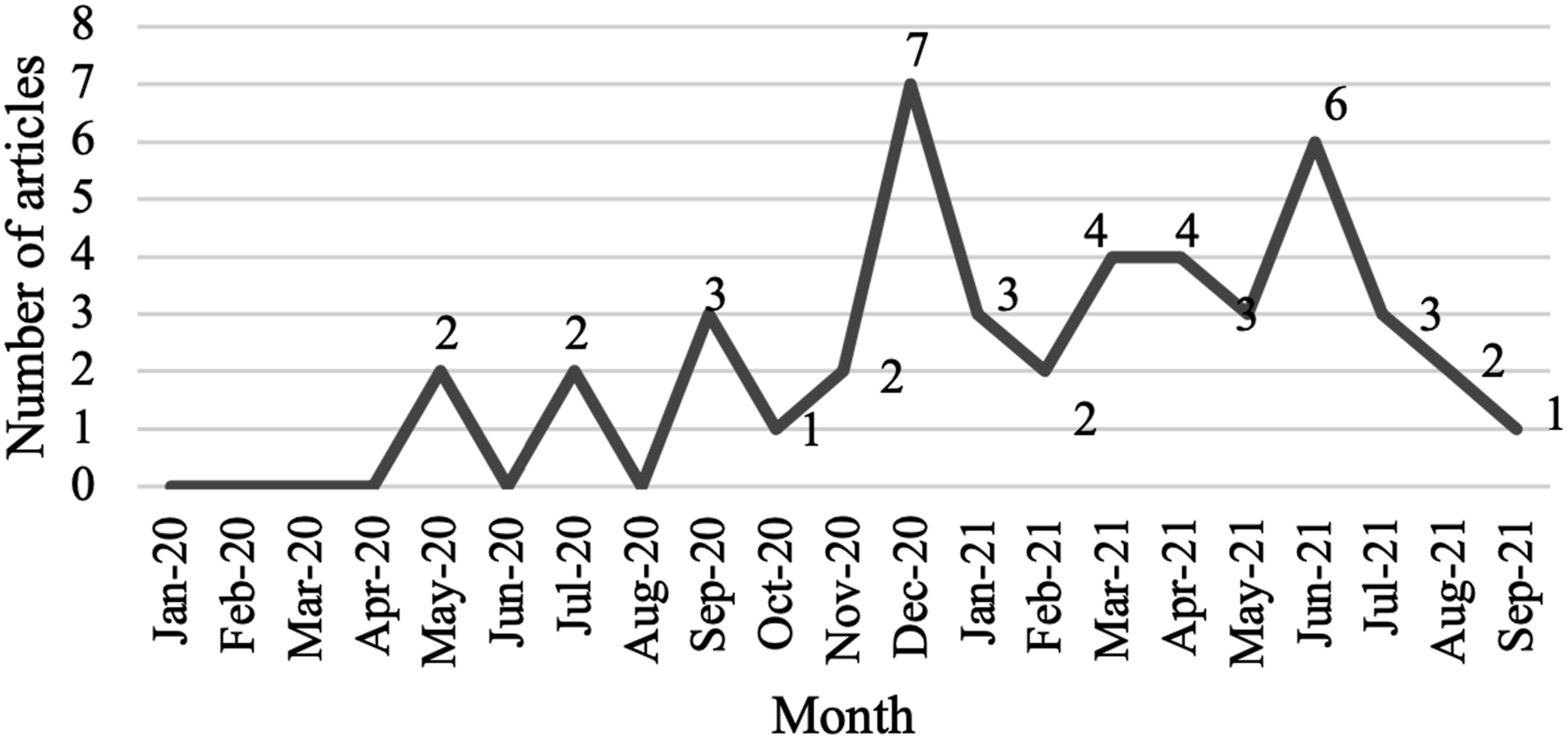
The COVID-19 corpus, available as an open access resource on Sketch Engine (https://ske.li/covid_19), encompasses over 370,000 scientific research articles addressing coronavirus and related subjects. 12 These research articles primarily originate from the COVID-19 Open Research Dataset (CORD-19), which incorporates data obtained from PubMed’s PMC open access corpus, WHO’s listing of COVID-19 research articles, as well as bioRxiv and medRxiv preprints using the search terms ‘COVID-19’ and ‘coronavirus research’. Notably, the COVID-19 corpus features extensive metadata encompassing essential information such as authorship, DOI, journal details, publication dates, and article titles. The same time range is selected when retrieving data from this corpus. As of September 30th, 2021, the corpus has a size of over 200 million word tokens. Searching ‘vacci*’ 13 in the corpus on Sketch Engine returns 327,888 concordance lines. The COVID-19 corpus represents a collection of scientific genre on COVID-19, since the sources are from medical and research corpora (see above). The NYT may also introduce scientific information to the general public, but its reports are of a generalized nature and composed by news journalists. This distinction underlies our categorization of news and science genres. Noteworthily, the scope of the current study is limited to metaphor use in framing covid vaccines, rather than medical issues that require more expertise.
Process of analysis
Description of the concordance lines used for the current analysis (window size: 150 characters).
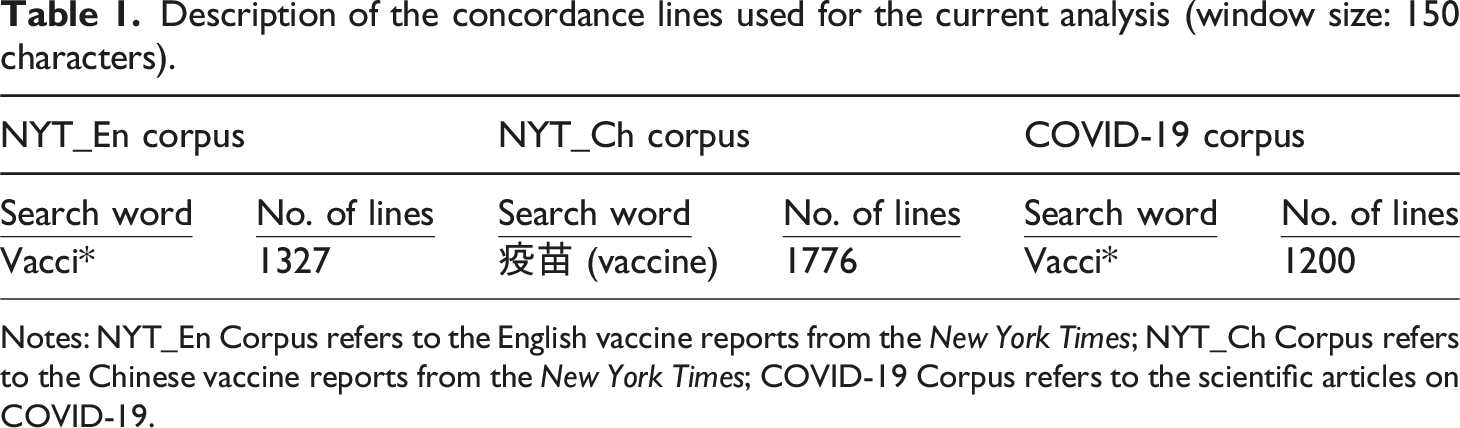
Notes: NYT_En Corpus refers to the English vaccine reports from the New York Times; NYT_Ch Corpus refers to the Chinese vaccine reports from the New York Times; COVID-19 Corpus refers to the scientific articles on COVID-19.
Concordance lines were imported into Microsoft Excel Spreadsheet from AntConc and Sketch Engine. The authors highlighted concordance lines that might involve metaphors using the conditional formatting function in Excel, making them ready for the subsequent manual coding. Fuoli et al.’s (2021) metaphor coding method that combines the Pragglejaz Group’s (2007) metaphor identification procedure (MIP) and Cameron’s (2003) vehicle identification procedure was borrowed to code these concordance lines for the vehicle and topic of metaphors, and Ahrens and Jiang’s (2020) Source Domain Verification Procedure (SDVP) was used to verify source domain and target domain of metaphors. The MIP 15 is a widely used approach in metaphor research that compares the basic meaning of a linguistic unit with its contextual meaning to assess its metaphoricity. The Pragglejaz Group’s work (2007) outlines a step-by-step guide for implementing the MIP. Cameron (2003) expanded on the MIP with a vehicle identification procedure that analyzes metaphors in phrases, sentences, paragraphs, or longer text strings and identifies the vehicles and topics of the metaphor.
The SDVP systematically determines the source domain of a metaphor, using corpus-based resources such as the Suggested Upper Merged Ontology (SUMO, https://www.ontologyportal.org), WordNet (wordnetweb.princeton.edu/perl/webwn), Handian Dictionary (https://www.zdic.net), and the Word Sketch function in Sketch Engine (https://www.sketchengine.eu) (see Ahrens and Jiang, 2020: 47, Figure 1 for a step-by-step guide). Simultaneously identifying vehicles using the vehicle identification procedure and source domains using SDVP allows for analyzing metaphors at different levels, with vehicles providing context and domains offering a more schematic understanding.
Example 1,
16
below, gives a brief illustration of the coding principle of metaphors in the English source text (ST) and the Chinese target text (TT) from the NYT corpora.
17
(1) ST: Think of vaccine antibodies like a TT: 可以 把 疫苗 抗体 想象 成 一道
In example 1, ‘sea wall/海堤’ is the unit of analysis, where: the vehicle is ‘seawall’; the source domain is also ‘SEAWALL’; 18 and the topic or target domain is ‘VACCINE’. Thus, the conceptual metaphor is ‘VACCINE IS SEAWALL’.
For coding reliability, the first author devised and refined a stepwise manual, with a second coder randomly coding 10% of data. The inter-coder reliability is ‘substantial’ (Cohen’s kappa = .745, Landis and Koch, 1977). Deviations were discussed and codes finalized jointly.
The following Results section summarizes the main patterns of metaphor identified in this research. The standard Key Word In Context (KWIC) concordance view is used to demonstrate patterns of co-occurrence, and sentence examples from the concordances are given in cases in need of more context.
Results
Overview
The main patterns of source domains for vaccine metaphors identified in this research are summarized in Figure 2, where the frequency percentage is calculated by Relative frequency of metaphors of vacci* in corpora of news, translated news and science.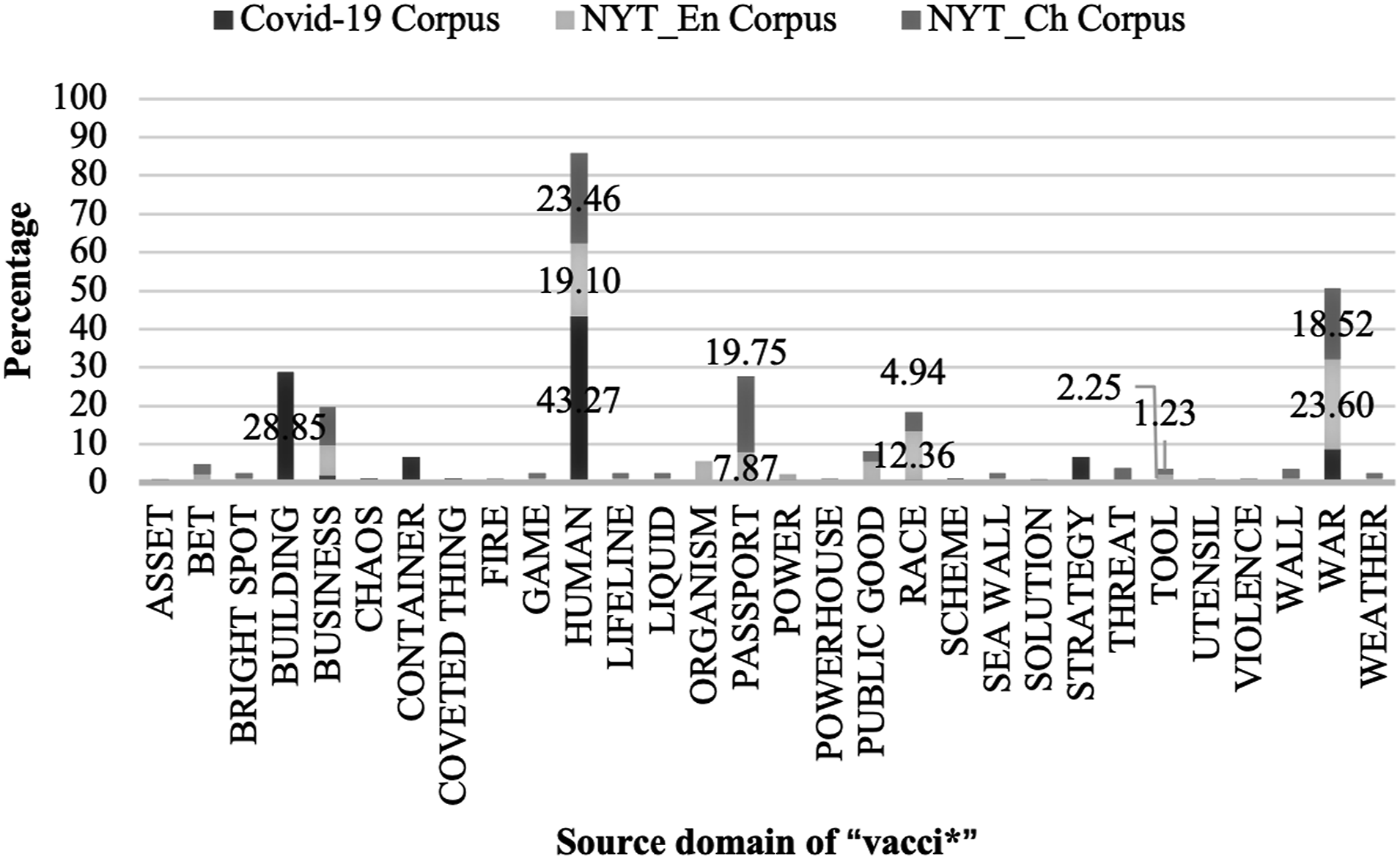
Shared HUMAN, RACE and WAR domains between science and news
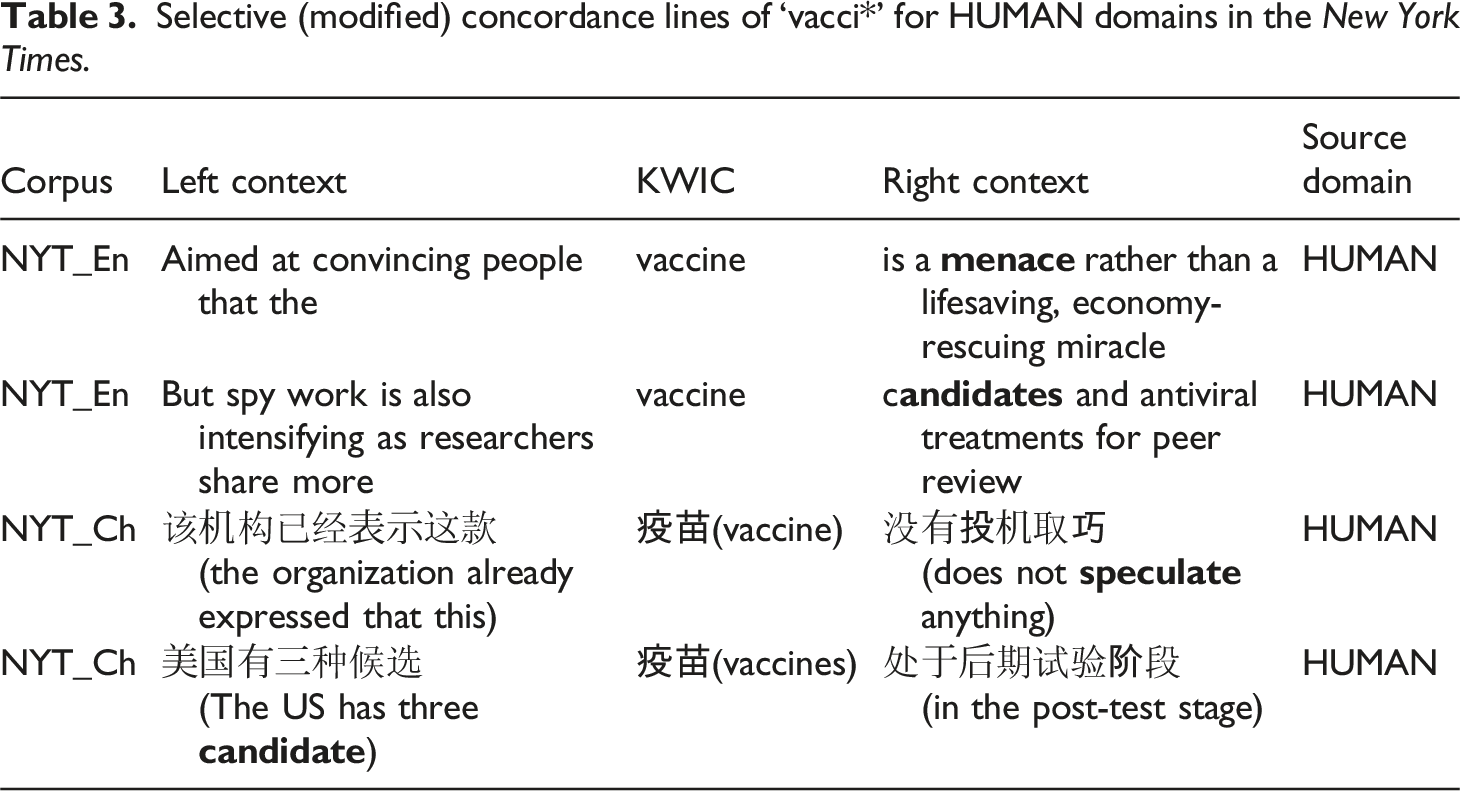
The COVID-19 corpus, the NYT_En corpus and the NYT_Ch corpus use similar and different vehicle terms and lexicalization for HUMAN, RACE and WAR domains, as summarized in Table 2. Overall, the two news corpora use more diverse varieties of vehicle terms and lexis than the science corpus for these source domains. News, translated news and science genres all recognize the urgency of vaccine development with the ‘race’ frame, as illustrated in examples 2 and 3, although such an emphasis is more highlighted in the NYT_En corpus (12.36%) and the NYT_Ch corpus (4.94%) than in the scientific corpus (0.96%). While the science corpus regards the coronavirus as what researchers are racing against (in example 2), the two news corpora render it into a political competition where China is racing against other countries (in example 3). (2) … researchers are (3) ST: The political stakes in the TT: 对 执政的 中国共产党 来说, duì zhízhènɡde zhōngguógòngchǎndǎng láishuō for ruling Chinese Communist Party AUX 疫苗 Vehicle terms and lexis for HUMAN, RACE and WAR domains across corpora.
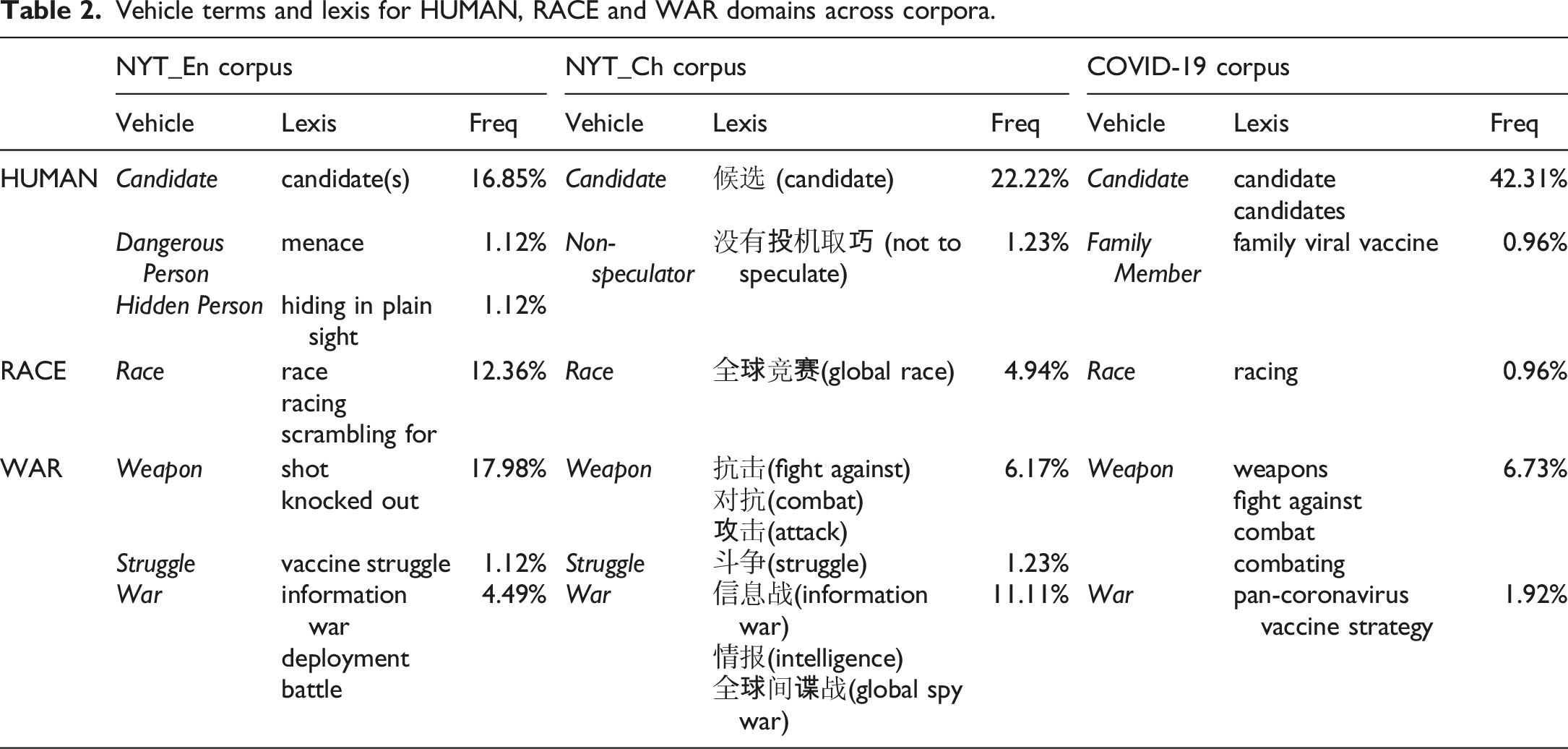
Similar patterns are observed for the WAR domain, where the significance of vaccines is exhibited with war-related frames, such as weapon. Nonetheless, while the science corpus directly mentions vaccines as ‘weapons’ against the pandemic enemy (in example 4), the two news corpora also highlight wars triggered by the vaccine, such as a global spy war (in example 5), and even weaponize the vaccine itself (in example 6). (4) In addition to the prevention and control of the epidemic, vaccines and drugs are the two major (5) ST: Race for Coronavirus Vaccine TT: 新冠 疫苗 与 全球 (6) ST: …accused a pair of Chinese hackers [on Tuesday] of TT: 两名 中国 黑客 代表 该国 情报部门, liǎngmíng zhōngguó hēikè dàibiǎo gāiguó qíngbàobùmén two Chinese hacker represent China Intelligence Department 瞄准 疫苗 开发 发起
Selective (modified) concordance lines of ‘vacci*’ for HUMAN domains in the New York Times.
Unique building, passport and tool domains between science and news
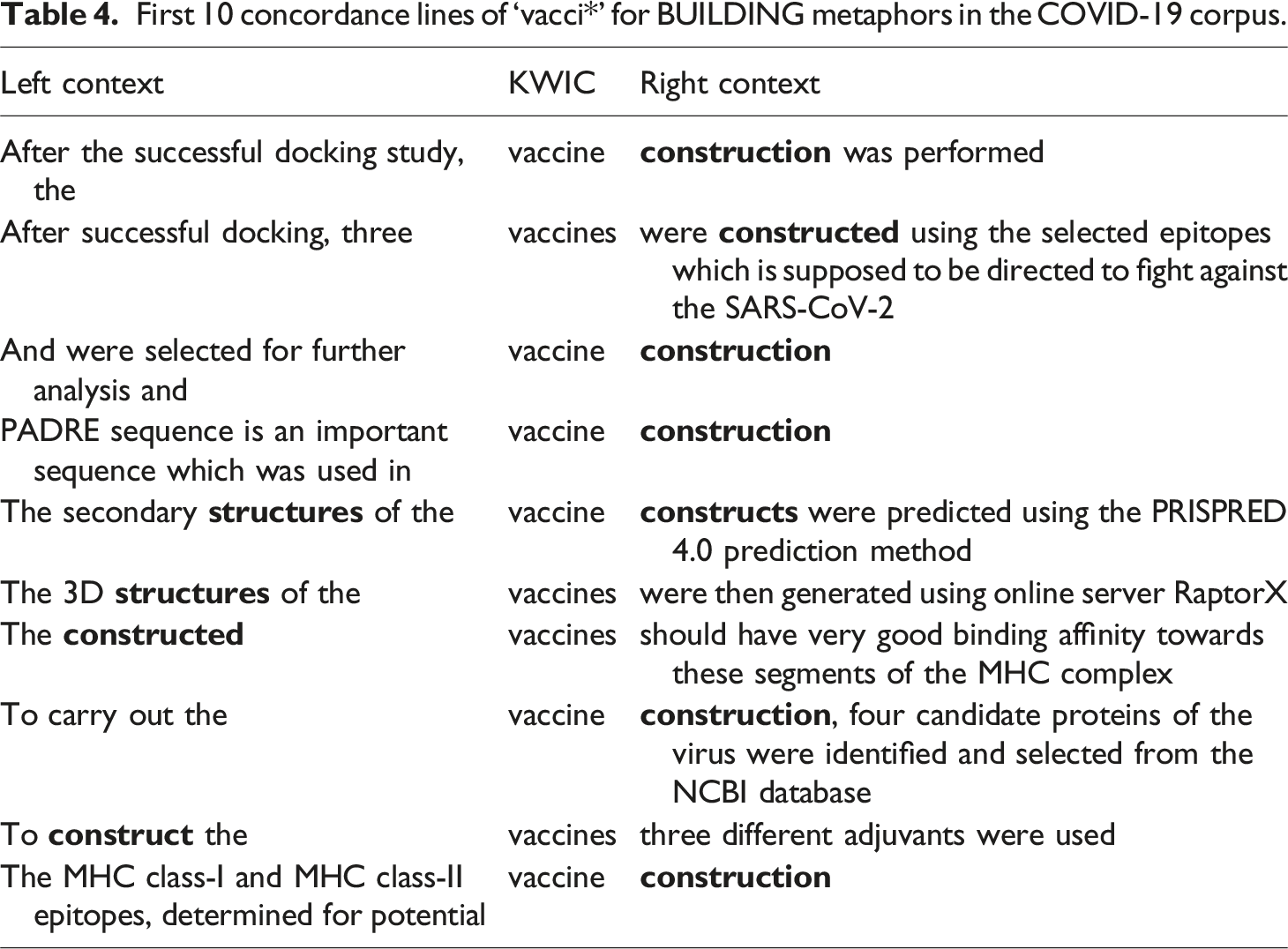
First 10 concordance lines of ‘vacci*’ for BUILDING metaphors in the COVID-19 corpus.
Selective concordance lines of ‘vacci*’ for TOOL and PASSPORT metaphors in the New York Times.
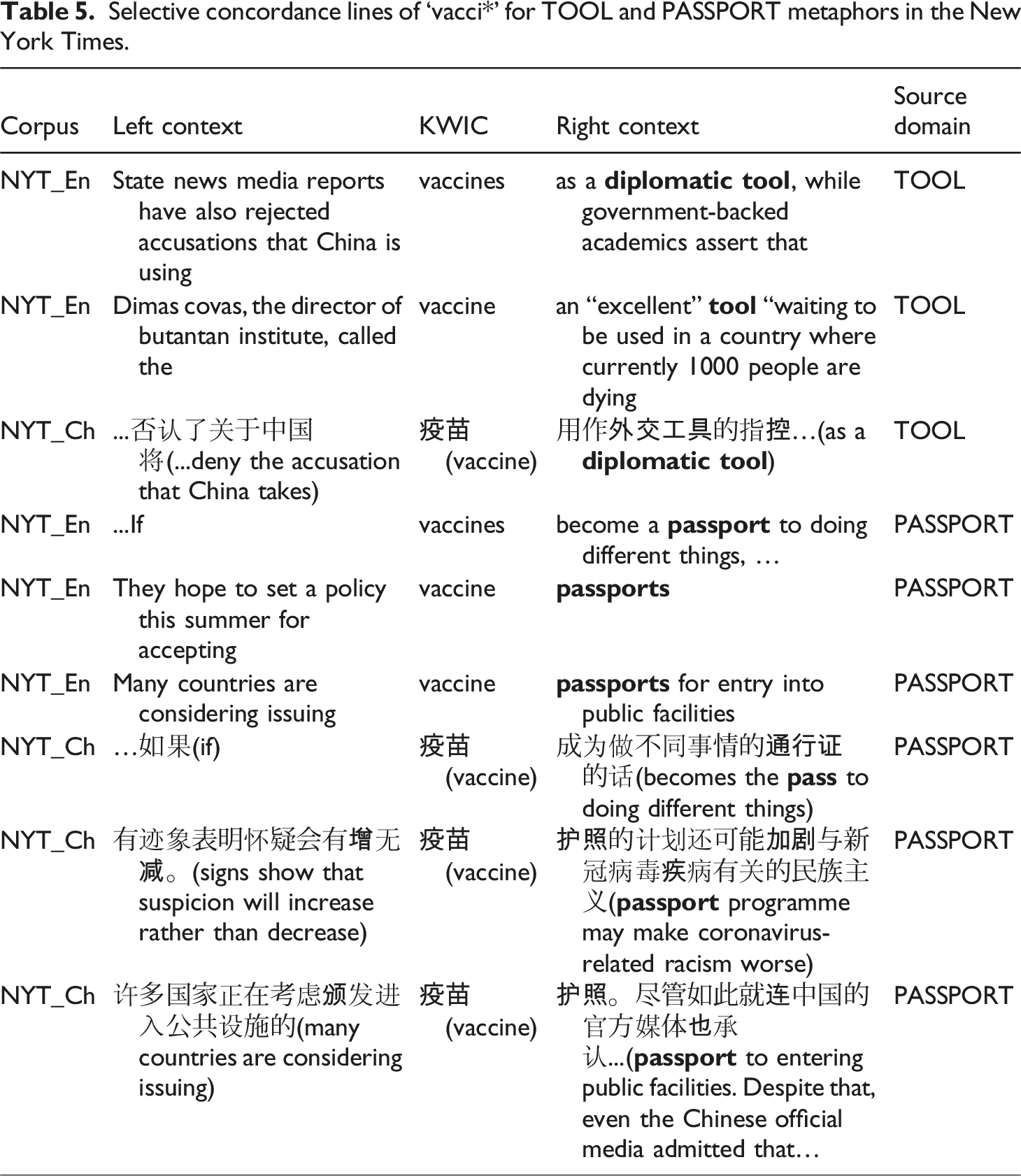
The distinct usage of BUILDING metaphors in scientific writing and PASSPORT and TOOL metaphors in news reporting serves to emphasize two intriguing aspects: the potential political underpinnings behind news coverage and the comparatively objective nature of scientific writings. This contrast between metaphors in these domains raises intriguing questions about the nature of objectivity in communication. The exclusive prevalence of BUILDING metaphors in scientific writing may reflect a concerted effort to maintain objectivity, ensuring that research outcomes are conveyed in a relatively unbiased manner. In contrast, the prevalence of PASSPORT and TOOL metaphors in news reporting highlights the news media’s inclination to cover politically charged subjects that are likely to spark diverse opinions (e.g., the issuance of ‘vaccine passports’), as well as the challenge of absolute objectivity in journalism, where language can inadvertently introduce subjective interpretations.
In conclusion, the selective use of metaphors in these distinct domains sheds light on the complexities of communication and information dissemination. It prompts further exploration into the underlying motives and influences behind linguistic choices, urging us to critically evaluate the impact of language on shaping our understanding of the world and the news we create and consume.
Translation shifts of metaphorical frames in news
The preceding analyses mainly showed variations in metaphor use between genres (news and science). However, this section will investigate in detail the frame shifts observed from English source texts to Chinese target texts in the news corpora.
Dominant changes in the two news corpora include a decrease in the use of the WAR domain by 5.08% and an increase in the use of the PASSPORT domain by 11.89% from the English STs to the Chinese TTs (see Figure 2 in Results section). Nonetheless, there is no significant variation in the types of vehicle terms for the WAR domain in the two news corpora. Instead, more diverse war-related lexis is used in the Chinese TTs, as can be seen from Table 2 in Results section. Based on a manual comparison of the ST and TT of each concordance line, the study finds that the reason for a decrease in the use of the WAR domain in the TTs lies in an extensive use of the lexis ‘shot’ in the STs, which does not have a counterpart in the Chinese language. Example seven illustrates how the dead metaphor
21
‘shot’, used in the STs to depict vaccine application process as a bullet fired from the needle to the virus, is paraphrased as ‘injection’ in the TTs. This is because in Chinese, there is no shot-like dead metaphor used to describe the injection of a vaccine. Meanwhile, the PASSPORT domain is more frequently seen in TTs because ‘护照(passport)’ occurs repeatedly in the Chinese news reports, while the STs usually use pronouns to refer to this entity, as can be seen in example 8. (7) ST: The Pfizer and BioNTech vaccine is delivered as a TT: 与 其他 典型的 疫苗 一样, 辉瑞 和 BioNTech yǔ qítā diǎnxíngde yìmiáo yíyànɡ huīruì hé BioNTech AUX other typical vaccine same Pfizer and BioNTech 的 疫苗 是 在 手臂 上 (8) ST: Governments typically talk about TT: 政府 谈到 疫苗
More radical changes are observed in news headlines where metaphors are omitted, replaced and added in the translation process mainly for two reasons: first, to catch the Chinese target readers’ attention by highlighting the parties played in the vaccine conflict such as China and the US, as in examples 9 and 10; and second, to make criticisms on China more implicit for the Chinese target readers, as in examples 11 and 12 (see further below).
In example 9, the English metaphor ‘VACCINE IS INFORMATION WAR’ is omitted in its TT, whereas Americans refusing vaccination is highlighted for the Chinese readers. Similarly, in example 10, China and the US as race competitors in this ‘VACCINE R&D RACE’ are added to the TT, thereby whetting the Chinese readers’ appetite. (9) ST: Get Ready for a Vaccine TT: 如果 有 了 新冠 疫苗 但 美国人 拒绝 接种 怎么办 rúguǒ yǒu le xīnguàn yìmiáo dàn měiguórén jùjué jiēzhǒng zěnmebàn if have AUX covid vaccine but Americans refuse inoculate what to do (10) ST: Future Vaccines Depend on Test Subjects in Short Supply: Monkeys TT: 新冠 疫苗 研发 背后 的 中 美 ‘战略 猴子 储备’
In example 11, the TT uses the lexis ‘僵局stalemate’ to emphasize the idea of vaccine storage being treated as a competition. However, in the ST, this competitive aspect is diminished, as the focus shifts to highlighting China as an obstruction (standing in its way). In example 12, the TT entirely omits the ‘vaccine as a bullet’ concept. This metaphor, implying Chinese individuals seeking the ‘shot’ without knowledge of the vaccine’s effectiveness, could create an unfavorable impression. By introducing the ‘competition’ metaphor in example 11 and omitting the ‘shot’ metaphor in example 12, criticism towards China is subtly toned down, possibly to cater to the sensibilities of Chinese readers of The New York Times. (11) ST: Taiwan Wants German Vaccines. China May Be Standing in Its Way TT: 台湾 疫苗 (12) ST: Vaccine Unproven? No Problem in China, Where People Scramble for TT: 新冠 疫苗 效果 未知 急于 接种 的 xīnguān yìmiáo xiàoguǒ wèizhī jíyú jiēzhǒng de corona vaccine effect unknown eager (to) get vaccinated AUX 中国 人 并不 担心 zhōngguó rén bìngbù dānxīn Chinese people not at all worry
These shifts in the translation of metaphors hint at the fact that translation does play a role in media communication to different groups of people. These shifts are derived not only from the innate linguistic differences between two different language systems but also from the value judgments placed by the news outlet on different entities in different contexts. 22
Discussion
The advocacy of building metaphor
Here, we discuss the appropriateness of the metaphorical frames analyzed in Results section to address the third research question. We adhere to Semino’s (2021) three criteria for evaluating metaphor effectiveness in health communication: Overall, effective metaphors tend to involve (a) complex and abstract target domains that are not linked to preexisting strongly held beliefs and evaluations; (b) source domains that are widely accessible, well-delineated and image-rich, (c) precise and clearly applicable mappings from source to target domains, which make a metaphor ‘apt’. (Semino, 2021: 54)
We argue that metaphors used in news such as PASSPORT, TOOL and RACE, are not appropriate for health communication because they, like WAR metaphors, have ‘potentially counterproductive framing effects’ (Semino, 2021: 52). When a vaccine becomes a political resource, its credibility will be questioned. Instead, we propose to frame the covid vaccine as BUILDING, which meets the three criteria stated above. First, the BUILDING metaphor represents a physical object in the human world, having less of a political orientation. Second, BUILDING is widely accessible, well-delineated and image-rich due to its ubiquity (i.e., everywhere in the modern world), and varieties of types (e.g., European and American styles), shapes (e.g., square-like Siheyuan in North China and oval Colosseum in Rome), manufacturing materials (e.g., concrete or metal) and construction techniques (e.g., 3D Volumetric Construction or Hybrid Concrete Building Technique). This richness of implicature enables it to correspond to different types of covid vaccines that are developed through inactivated virus technology (e.g., Sinovac) or mRNA technology (e.g., Pfizer-BioNTech), etc. Third, with the first two criteria met, it facilitates the applicable mappings from the source BUILDING to the target covid vaccine/vaccination.
Specifically, the job that BUILDING metaphors can do includes but is not limited to the following: • convey the myriads of covid vaccines currently available to people based on different construction methods (e.g., inactivated virus technology-based Sinovac and mRNA technology-based Pfizer-BioNTech); • portray covid vaccines as a shelter for people from the pandemic, albeit in different quality levels, rather than a political tool or a prize for a political race; • highlight the availability of various vaccine construction materials and the importance of updated/seasonal vaccines for renovating the protective shelter; • explain vaccination as a process of selecting a vaccine construction to one’s liking, adding no value judgments to one’s choice; • and indicate future updates of covid vaccines (e.g., vaccine construction method and style may change when new technologies are available).
It is noted that metaphors such as SEAWALL, WALL, and POWERHOUSE used in the corpora are less politically biased and may encourage the vaccine uptake by conveying the positive aspects of vaccines. However, when assessed against the second criterion, which emphasizes the widely accessible and image-rich features, they are found to be less suitable compared to BUILDING metaphors. Furthermore, TOOL metaphors, while capable of conveying some positive messages, can also be easily associated with political ideologies, such as being viewed as a ‘diplomatic tool’. Consequently, they may not fully meet the first criterion, which emphasizes the need for neutrality and avoidance of political connotations. Moreover, they are less image-rich than BUILDING metaphors, thereby less likely to comprehensively encompass every facet of a vaccine, including its material, technology, function, and working mechanism.
Although we propose the use of descriptive BUILDING metaphors because they are beneficial for health communication, we also acknowledge that news outlets may prioritize news values over the effective transfer of scientific information. Therefore, this suggestion only serves as a reminder for news professionals and readers that an alternative frame exists which can facilitate better communication without excessively emphasizing entrenched political beliefs. However, it is ultimately up to news professionals to select what to report when news values and public health priorities come into conflict. The current study reveals that the NYT journalists and translators have chosen news values over public health priorities. The following section will further explain how the NYT utilizes different metaphors in the STs and TTs of the news reports to prioritize various news values.
Translation in the discursive construction of news values
The analysis results above have shown that translation can cause shifts to the metaphorical frames used in the news. Although such shifts occur mostly because of the innate linguistic differences between English and Chinese languages, omitting, adding or substituting the ST metaphorical frames in the TTs are also motivated by a variety of news values. Simply put, we conclude that translation becomes a way to construct news values in discourse.
In Discursive News Value Analysis (DNVA), news values are ‘how newsworthiness is communicated and negotiated through discourse’, thereby focusing not on ‘how an event is selected as news’, but on ‘how it is constructed as news’ (Bednarek and Caple, 2017: 43). There are 11 types of news values in total in DNVA (55), among which, Proximity (i.e., the event is discursively constructed as geopolitically or culturally near) and Negativity (i.e., the event is discursively constructed as negative) are the main motivations for the News York Times to make substantial changes to the news headlines when translating the original English news reports into Chinese, as illustrated in examples 9–12. The Chinese readers are more attracted to China-related reports out of a sense of geopolitical proximity, and thus the NYT tends to highlight the involvement of China in the translated Chinese news headlines, which may engender frame shifts such as from dependence on a limited supply to an R&D race in example 10.
Moreover, it is assumed that news values are in flux where negativity can be uplifted and downplayed for different target readers via translation. Negativity towards China in the English STs may be downplayed in the Chinese TTs, (see examples 11–12). Likewise, negativity towards the pandemic misinformation may be shifted to the negativity towards the US in the Chinese TTs (see example 9), thereby catering to the target readers’ geopolitical stance.
Conclusions
The study conducts a corpus-assisted discourse analysis of covid vaccine metaphor patterns in news, translated news and scientific reports. It investigates whether and how genre and translation impact the use of metaphorical frames for covid vaccines. While the three corpora share the HUMAN, RACE and WAR domains, they differ in their use of vehicle terms and lexicalization. Overall, news involves more value judgments in the metaphorical frames, for example, the PASSPORT and TOOL metaphor, whereas scientific reports use more descriptive frames, for example, the BUILDING metaphor. Translation plays a role in frame shifts in news, motivated by the discursive construction of news values for readers with different socio-political backgrounds. More importantly, translation can uplift and downplay these news values, which may not be acknowledged by news professionals and readers. Moreover, the study suggests using the BUILDING metaphor to frame COVID vaccines/vaccination for better health communication.
The contributions of the current study are manifold. It is the first investigation to compares news, translated news and scientific reports in the COVID-19 pandemic and explore their relations in health communication. It calls attention to newspapers’ translation practice that is often invisible in media reportage. More importantly, it assumes that translation plays a significant role in the discursive construction of news values, especially placing those news values in flux through an uplifting and downplaying practice. Methodologically, the study provides more evidence for the integration of traditional cross-domain mapping in CMT and the vehicle-topic pairing in authentic discourse, which may shine new light on future research.
Nonetheless, the study is also limited in several ways. Although the New York Times is an influential newspaper in the United States and even in the broader English-speaking world, it cannot represent the news industry. Future work can triangulate the results using reports from other newspapers. Moreover, the corpus method is unable to exhaust all vaccine-related metaphors, and the occurrences of lexicalization in concordance lines does not represent the whole picture of the three corpora. Another limitation of this study is the lack of information regarding the translators of the news articles, although it is assumed that all articles underwent editorial screening before publication. Further research could investigate the specific workflow and procedures involved in news translation. Hence, in modest terms, the study only scratches the surface and paves way for more comparisons of scientific and (translated) news communication of covid vaccines in the future.
Footnotes
Acknowledgements
We would like to express our gratitude to the three anonymous reviewers for providing their constructive feedback. Additionally, we extend our thanks to Jolie Li, our research assistant, who has assisted in recoding a randomly selected 10% of the data.
Declaration of conflicting interests
The author(s) declared no potential conflicts of interest with respect to the research, authorship, and/or publication of this article.
Funding
The author(s) received no financial support for the research, authorship, and/or publication of this article.
Correction (January 2024):
There have been changes in the bold font for some of the Chinese characters in the text since the original publication of the article.
