



Abstract
While the domestication literature indicates how national media link foreign events to a country’s domestic affairs, it has thus far only examined modes of domestication - the ways through which these links are created. In this article, we introduce a different dimension of the phenomenon: degrees of domestication. This includes the extents to which a foreign event gets connected with the domestic. By making a topic-modeling analysis of French and Dutch newspaper articles about 9/11, the 2004 tsunami in Southeast Asia, the Arab Spring and Donald Trump’s political rise, we provide an explorative case study of this dimension. We inductively arrive at a scale ranging from no to extreme domestication of the event, classified according to four degrees of domestication: (1) an entirely foreign affair; (2) a foreign political affair involving domestic actors; (3) a domestic political affair; (4) or a personal disruption. French newspapers score higher on the second degree, the Dutch ones on the third and fourth. A deepening of this pattern shows how these differences stem from two distinctive cultural repertoires that journalists and other media participants employ when relating to foreign events: a French one, which sees them as an opportunity to dominate the international political stage, and a Dutch one, which considers them a reason for reflecting on domestic or personal matters. These clear differences indicate the concept’s importance for the literature and for investigating it within other national media contexts.
Keywords
Introduction
An effect of globalization is that people can respond intensely to events that occur far beyond the borders of their own nation-state. The international reactions to 9/11 serve as an illustrative example. One day after the attacks, Le Monde famously headlined an article “We are all Americans” on its front page. German Chancellor Gerhard Schröder called the event “a declaration of war against the entire civilized world.” In Rio de Janeiro, billboards depicted the city’s famous Christ the Redeemer statue hugging the Manhattan skyline.
In one sense, these intense international responses to 9/11 were about sending messages of solidarity to Americans, New Yorkers and the direct victims of the attacks. At the same time these responses – the French and German examples, especially – were also directed to the senders themselves. After 9/11, everyone was an American. War was declared against the entire “civilized world.” In other words, the event’s significance traveled far beyond American soil.
Thus, the impact of events can cross borders to differing extents. In this article, we explore this phenomenon using the concept we call “degrees of domestication.” The term “domestication” is itself generally employed to analyze the varying modes through which national media report on foreign events to “sell” them to their domestic audiences. Examples include emphasizing similarities with domestic events or forging an emotional bond with disaster victims (Alasuutari et al., 2013; Gurevitch et al., 1991; Ha, 2022; Joye, 2015; Olausson, 2014; Williamson Sinalo, 2022). We propose that the term can also be used to capture the degrees to which national media relate these events to affairs that happen within their country’s borders.
We are particularly interested in the question of whether these degrees differ cross-nationally, as modes of domestication do (Alasuutari et al., 2013; Ha, 2022). This is of significance because, if it were the case, then media participants – journalists but also other actors such as politicians and scientists who regularly provide commentary or publish op-eds – have to work with varying national understandings of considering foreign events as “ours” or “theirs” (Liebes, 1992; Nossek, 2004). This would clearly impact the claims that they can make (e.g., is it a norm to cite foreign events in debates on domestic affairs?). And given that media framings often have wider societal effects (Bröer and Duyvendak, 2009; Snow et al., 2007), it would also influence how citizens relate to foreign events and the policy responses that ensue.
In this article, we perform an explorative case study (Gerring, 2004: 349–350) of the concept of degrees of domestication. To do so, we employ the computational method topic modeling to investigate the domestication of four events in French and Dutch national newspapers: 9/11; the 2004 tsunami in Southeast Asia; the Arab Spring; and Donald Trump’s political rise. Our main objective is to analyze whether and, if so, how domestication degrees for these events differ within these two national media contexts. To this end, we make a quantitative coding of the topic modeling results to measure whether the degrees vary and a qualitative one to investigate how they do or do not.
Modes and degrees of domestication: Toward a multidimensional understanding of foreign event responses
Modes of domestication
Literature abounds showing that the same event can have vastly different meanings within varying national media (or other) contexts in terms, for instance, of policy responses (Dekker, 2023; Hoffman and Durlak, 2018), prognostic and diagnostic framing (Snow et al., 2007; Van Dooremalen and Uitermark, 2021) and issue attachment (De Vreese, 2001; Van Dooremalen, 2021). This literature is part of a broader field of research indicating that even though globalization is a social fact, cross-national differences in politics and culture still exist. For instance, Lamont and her co-authors (Lamont, 1992; Lamont and Thévenot, 2000) introduced the concept of “cultural repertoires” – the toolkits for meaning-making processes that are dominantly present in the context of a given country – to explain cross-national variations in how actors draw “symbolic boundaries” between good and bad, who belongs and who does not or, for that matter, linking the foreign to the domestic.
Within the field of media studies, a term was developed to capture national media’s linking of foreign events to the domestic: domestication. The term was introduced by Gurevitch et al. (1991) to claim that media often give a specific national touch to foreign news items to make them attractive and accessible to their domestic audiences.
Many scholars have followed their lead. Here we discuss those who are most significant for the purposes of our study. Alasuutari et al. (2013) analyzed domestication modes of the Arab Spring in British, Finnish and Pakistani newspapers. They envision national media as a battleground: a constellation of national public spheres across which all sorts of media participants fight to promote their worldviews (Alasuutari et al., 2013: 693). Within this process, they use modes of domestication to make their case.
Joye (2015) deployed the concept of domestication in a highly specific way. He used Boltanski’s (1999) work on “distant suffering” to analyze how media can make their audiences care about events that happen far beyond the borders of their own nation-state. Based on an investigation of international disaster coverage by two Belgian television stations in 2011, he distinguished four such modes: (1) creating an emotional bond with the victims; (2) considering the repercussions “at home”; (3) compelling the audience to donate money; (4) and making the unknown locations of the disasters more familiar. Even though distant suffering is principally about the creation of empathy with victims of foreign disasters, Joye (2015) concludes that this process can also result in, for instance, a focus on domestic suffering or the creation of a positive national self-image.
The work of Olausson (2014) is also worth mentioning, because she problematizes the distinction between “foreign” and “domestic.” According to her, rarely does any clear difference between these two categories exist within the reporting on a global phenomenon such as climate change. She distinguishes three scenarios: the domestic is explicitly disconnected from the foreign (“introverted domestication”); the two are explicitly connected (“extroverted domestication”); or the domestic disappears in a global mode of reporting (“counter-domestication”). Olausson (2014) therefore suggests that it is better to capture modes through which the foreign and the domestic get related to each other.
Degrees of domestication
All of these scholars deal with what we could call “modes of domestication,” or the various ways in which a bridge between the foreign event and the domestic is created. The concept of degrees of domestication – the extent to which foreign events get related to affairs happening within the borders of the nation-state – is, to the best of our knowledge, not explicitly theorized within media research. However, the literature contains various implicit references to this phenomenon.
One example can be found in the work of Berglez (2008). He makes a plea against the media’s tendency to domesticate events, suggesting that because several of the world’s key contemporary problems – such as climate change and terrorism – are so globalized, media should start doing more “global journalism”: showing the interconnectedness of or similarities among events that happen in different locations on the planet. Such journalism could also indulge news consumers with cross-cultural engagement in relation to distant, unknown locations (cf. Scammell and Bielsa, 2022). Berglez contrasts this “global” outlook on events with a “foreign” outlook (paying attention to their foreign aspects) to a “domestic” one (focusing on their domestic features).
Whether a global outlook in recent decades is indeed gathering more prominence is up for debate. For instance, Tanikawa (2019) concludes that two newspapers expected to engage in such global news reporting – The New York Times and The Guardian – have in fact been doing this less so since the 1980s. However, Wang and Downey (2023) find support for the rise of the global outlook. They show that in reporting on climate change in six countries from the Global North and the Global South, an “emergent cosmopolitan discourse” is taking shape.
Similarly, Dai and Hyun (2010) analyze the extents to which American, Chinese and South Korean news agencies used global or domestic “packages” to frame the North Korean nuclear test. Like Olausson (2014), they emphasize how the global and the domestic within this framing are often interconnected. They also highlight how the different positions that these three countries have in the “world power system” bring out cross-national variations in event perspectives. For instance, the American news agency connected the nuclear test to the War on Terror, while the South Korean one made many references to the Cold War.
The idea that a relationship exists between a nation’s power position and the degree to which foreign phenomena are domesticated is also present in a different academic field: cultural sociology. Various scholars in this field have used Wallerstein’s (2004) ideas regarding the economic world-system, to hypothesize that there is also such a thing as the cultural world-system. They state that it is easier for citizens of countries that are central within this system to sell or promote their cultural products (e.g., movies, music, books) around the world than for those from more peripheral countries (Heilbron, 1999; Janssen et al., 2008; Kuipers, 2015). Consequently, degrees of foreign cultural product domestication differ between nations, with a central country such as the US being much more an exporter than an importer.
Among these cultural sociologists, Kuipers (2015) most explicitly employs the concept of domestication. Using screen translations of movies and television programs as a case study, she demonstrates that in France, a culturally central country, the product is given a strong national touch: it gets dubbed. By contrast, in the Netherlands, a more peripheral country, screen translations are kept in the original language with subtitles. This implies high levels of foreign product domestication in central countries because they want to add their “own” powerful culture to it versus low levels in peripheral countries – or, as Kuipers (2015), calls it, high levels of “foreignization.”
We argue that it is relevant to move from implicitly to explicitly conceptualizing degrees of domestication as a separate dimension within research on the media framing of foreign events. This leads to our research question: do these degrees also differ cross-nationally, just as this field has demonstrated for other types of event meanings (Alasuutari et al., 2013; Dai and Hyun, 2010; De Vreese, 2001; Dekker, 2023; Hoffman and Durlak, 2018; Snow et al., 2007)? This is an important question because such differences would influence media participants’ opportunities to gain voice: when journalists, politicians or scientists refer to foreign events in debates over domestic issues, their points will be considered more legitimate across media landscapes where it is a common practice to see them as “ours” instead of “theirs” (Liebes, 1992; Nossek, 2004).
Cases, methods, data, scripting, and coding
Cases
Comparing the media contexts of France and the Netherlands makes for a fair test of our research question. Given that the two countries are geographically close and are culturally rather similar, we would not expect to find large cross-national variations in domestication degrees as a result. However, they also have some significant differences in geopolitical status that could cause distinct variation. France has a more central position in the political, cultural and economic world-system than the Netherlands: it possesses more political power (e.g., holding a permanent seat on the United Nations Security Council), is culturally more central (Janssen et al., 2008; Kuipers, 2015) and has a bigger economy. We might suppose, therefore, that French media would be less inclined to domesticate foreign events because they consider their country too powerful to relate foreign news to its domestic affairs.
Yet, there are also reasons to expect a reverse outcome. According to Hallin and Mancini’s classic typology (2004), France has a polarized pluralist media system, while the Netherlands has a democratic corporatist one, although it recently began evolving into a liberal system (Hallin and Mancini, 2017). Polarized pluralist systems have the highest levels of state intervention accompanied by the lowest levels of professionalization (Hallin and Mancini, 2004). Both features could incentivize French journalists to domesticate events to larger extents than their Dutch counterparts: the intervening French state might encourage them to pay attention mainly to internal affairs, while their low level of professionalization could result in a focus on local stories that are easy to “sell” instead of providing a “global outlook” (Berglez, 2008).
It is not the aim of our article to directly test these expectations. We state them to justify why it is worthwhile to explore the concept of degrees of domestication for these two national media contexts. To make this exploration, we delve into four event cases: • The terrorist attacks on the Twin Towers and the Pentagon on 11 September 2001 (9/11); • The tsunami in Southeast Asia in December 2004; • The Arab Spring, which started in 2011 and resulted in several revolutionary regime changes; • The political rise and election of Donald Trump as president of the United States in 2016.
These are all events that occurred during the first two decades of the 21st century and attracted significant media attention in both countries (see end of next section). But they happened on different continents (Asia, Africa and North America) and constitute distinct types of occurrences: 9/11 was a terrorist attack, the tsunami a natural disaster, the Arab Spring a revolution and the rise of Trump a remarkable electoral result. Analyzing events with such a diversity of characteristics can reveal whether any degrees of domestication we encounter are caused by specific event characteristics – for example, perhaps Dutch media participants are especially interested in domesticating events when they happen in the US, as it is a culturally proximate country – or if they represent more general early 21st-century event domestication patterns in the two country contexts.
Methods and data
To perform our study, we used the automated content analysis technique topic modeling, more specifically Latent Dirichlet allocation (LDA). Topic modeling is a research method that indicates which issues – topics – are prominent within large text corpora (Blei 2012; Grimmer and Stewart, 2013; Maier et al., 2018). A topic consists of a list of words that often show up together within a given corpus. For this study, we aim to research to what extent these topics – which we derive from French and Dutch newspaper articles on the four foreign event cases – concern foreign or domestic affairs. Topic modeling has not been used for studying this specific question, yet various studies have indeed brought back a large collection of topics that were derived from newspapers to a few core categories (Marshall, 2013; Van Dooremalen and Uitermark, 2021) or frames (Di Maggio et al., 2013; Jacobi et al., 2016).
By making national newspapers a central focus of our analysis, we follow scholars who have studied “modes of domestication” (Alasuutari et al., 2013; Olausson, 2014). Like Alasuutari et al. (2013: 693), we consider national newspapers part of the public arena in which journalists, politicians, scientists and other actors come together to promote their worldviews – for instance, by domesticating or foreignizing an event.
The newspapers we selected are all that are available for the two countries in the Nexis Uni database. For France, these are Le Monde, Le Figaro, La Croix and L’Humanité. For the Netherlands, these are De Volkskrant, NRC Handelsblad, Trouw, De Telegraaf and Algemeen Dagblad. This corpus covers all Dutch national newspapers targeting a general audience (instead of focusing on specific groups, such as financial newspapers) and thus report on the diverse range of events we investigate. From the French ones, Liberation is the only general audience newspaper that is not available in Nexis Uni. However, we do not think that this will significantly affect our results, as we have included two other French newspapers with a similar profile (leftist and highbrow): Le Monde and L’Humanité.
We examine the degrees of domestication over a period of a year after the occurrence or start of each of the four events. 1 Even though responses to the same event can change over time (Wagner-Pacifici, 2017), focusing on a time span of the first year following the occasion provides an indication of the primary and consequently highly significant period of meaning-making. In the case of 9/11, this includes the period of September 2001 to September 2002; for the tsunami, this is December 2004 to December 2005; and for the Arab Spring, it is January 2011 to January 2012. For Trump’s political rise, the relevant period runs from the point he gained popularity in the political opinion polls to his inaugural speech, which is January 2016 to January 2017. We used the following search terms (each translated into French or Dutch): “September 11”; “tsunami” + “Asia”; “Arab Spring”; and “Trump.” For 9/11, this produced a corpus of 12,084 French articles and 7592 Dutch ones; for the tsunami, the numbers were 2244 and 2487; for the Arab Spring, 874 and 777; and for Trump’s rise, 3925 and 5467.
Analysis: Topic modeling
Our topic modeling analysis consisted of various steps. The topics were created in R, where we used the package Quanteda (Benoit et al., 2018). As a first step, we used a script to clean the texts. We deleted punctuation, stop words and commonly used newspaper phrases that would give no indication of foreignization or domestication (e.g., “author” or “section”), and then we tokenized them. From there, we created eight sub-corpora (one for each of the four events in both countries) and explored how many topics were needed for each to achieve optimal topic coherence. We experimented with ranges from 5 to 100 topics. The optimal topic coherence turned out to be either 10 or 20 for all cases (10 for 9/11 in France and the Arab Spring in both countries and 20 for all other cases). This is a standard result for topic modeling from newspaper articles (Marshall, 2013; Van Dooremalen and Uitermark, 2021).
In LDA the sizes of the texts that belong to a certain topic differ (e.g., topic A might represent 4% of the data, whereas topic B represents 10%). Therefore, we created a measurement in R to account for the variation: for each topic, we calculated a percentage indicating how much it contributed to the sub-corpus to which it belonged.
These topics then had to be coded. To make this process reliable, the task was taken up by two coders: the article’s first author and a social science researcher knowledgeable about both France and the Netherlands. The coding consisted of two steps. As we are the first scholars to explore the phenomenon of degrees of domestication in detail, the literature offered no expressions or codes to search for. The first step of the analysis therefore entailed performing an inductive qualitative investigation of the topics. For each topic, the coders independently studied its 15 most prominent terms and searched without any pre-defined codes for common ways in which foreign and domestic affairs were being addressed. When a topic was unclear to them, they used a tool – the topic-document matrix – to indicate the texts most closely related to the topic and read the 20 most representative ones.
This analysis revealed that it is best to conceptualize foreignization versus domestication on an ordinal scale, including various degrees, ranging from radical foreignization to extreme domestication (cf. Dai and Hyun, 2010; Olausson, 2014; Scammell and Bielsa, 2022). In our case study, we encountered the following degrees: (1) The event as an entirely foreign affair, which treats the occurrence solely in relation to affairs happening outside the nation-state (or as Kuipers (2015) calls it, “total foreignization”); (2) The event as a foreign political affair involving domestic actors, which connects it to affairs happening outside the nation-state, but with involvement of actors from the nation-state (e.g., national politicians trying to solve a foreign crisis);
2
(3) The event as a domestic political affair, which relates it to political affairs happening within the nation-state; (4) The event as a personal disruptive affair, where the occurrence turns into a disruption of media participants’ personal lives.
Our second step of analysis was to measure the saliency of these four degrees. For both coders, this entailed following the same procedure taken during the inductive coding phase: reading the 15 most prominent terms for each topic and, if that offered insufficient clarity, investigating the 20 most representative articles belonging to it. In most instances, the coders agreed on the degree to which a topic belonged: they reached a Krippendorf alpha of 0.82 (Krippendorf, 2013: 277 – 287). This is a good intercoder reliability score, which indicates that we are dealing with four clearly distinguishable degrees of domestication. All topics on which the two coders did not agree or that both considered too vague were not included in the final analysis (11 topics out of a total of 130). This article’s Appendix provides examples of topics from our analysis along with their respective coding and short topic descriptions.
Results: Consistent cross-national differences in degrees of domestication
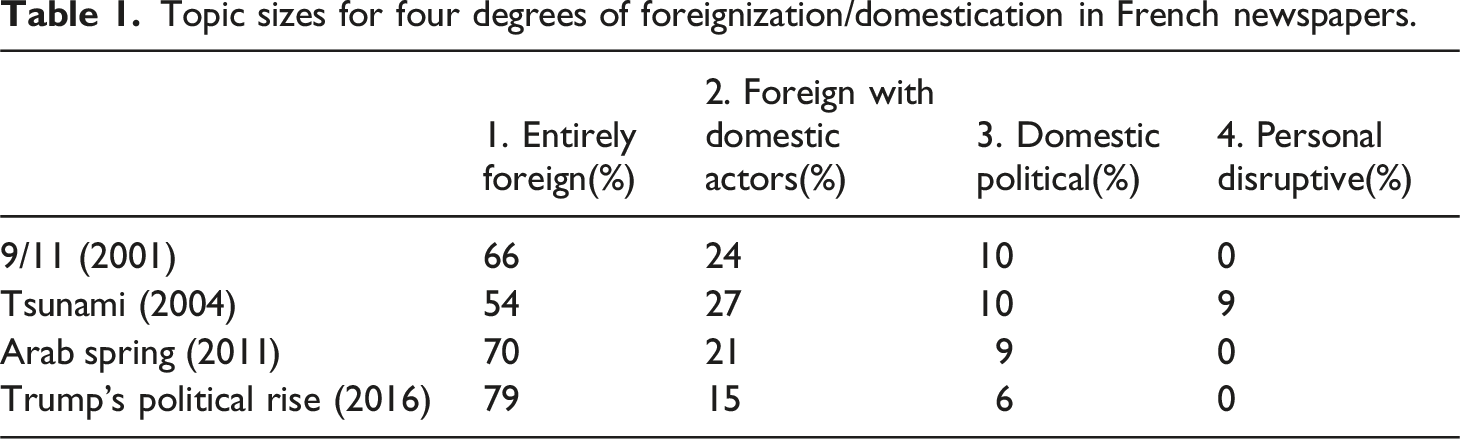
Topic sizes for four degrees of foreignization/domestication in French newspapers.
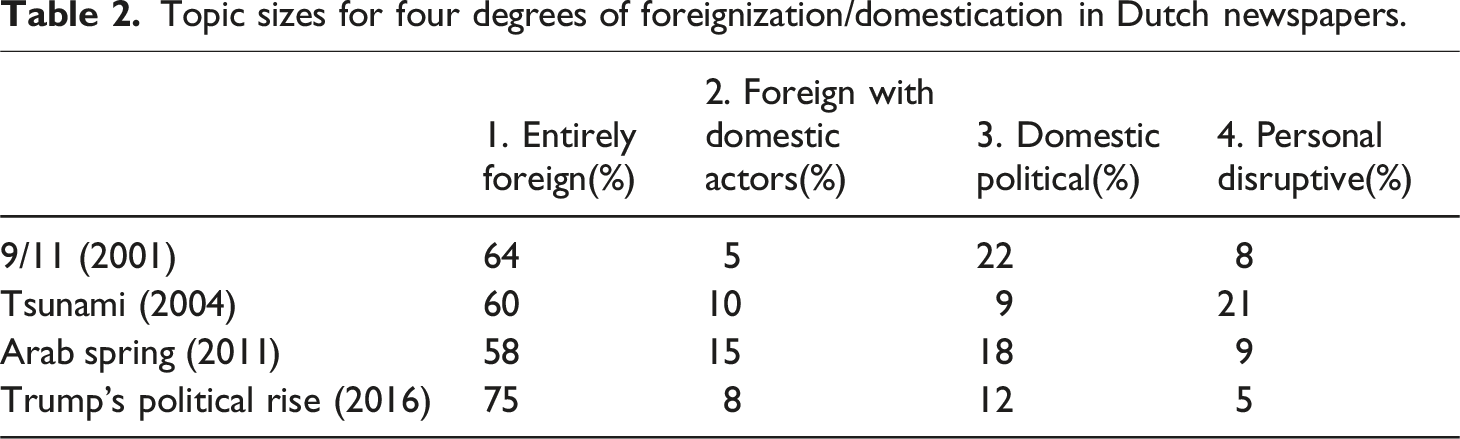
Topic sizes for four degrees of foreignization/domestication in Dutch newspapers.
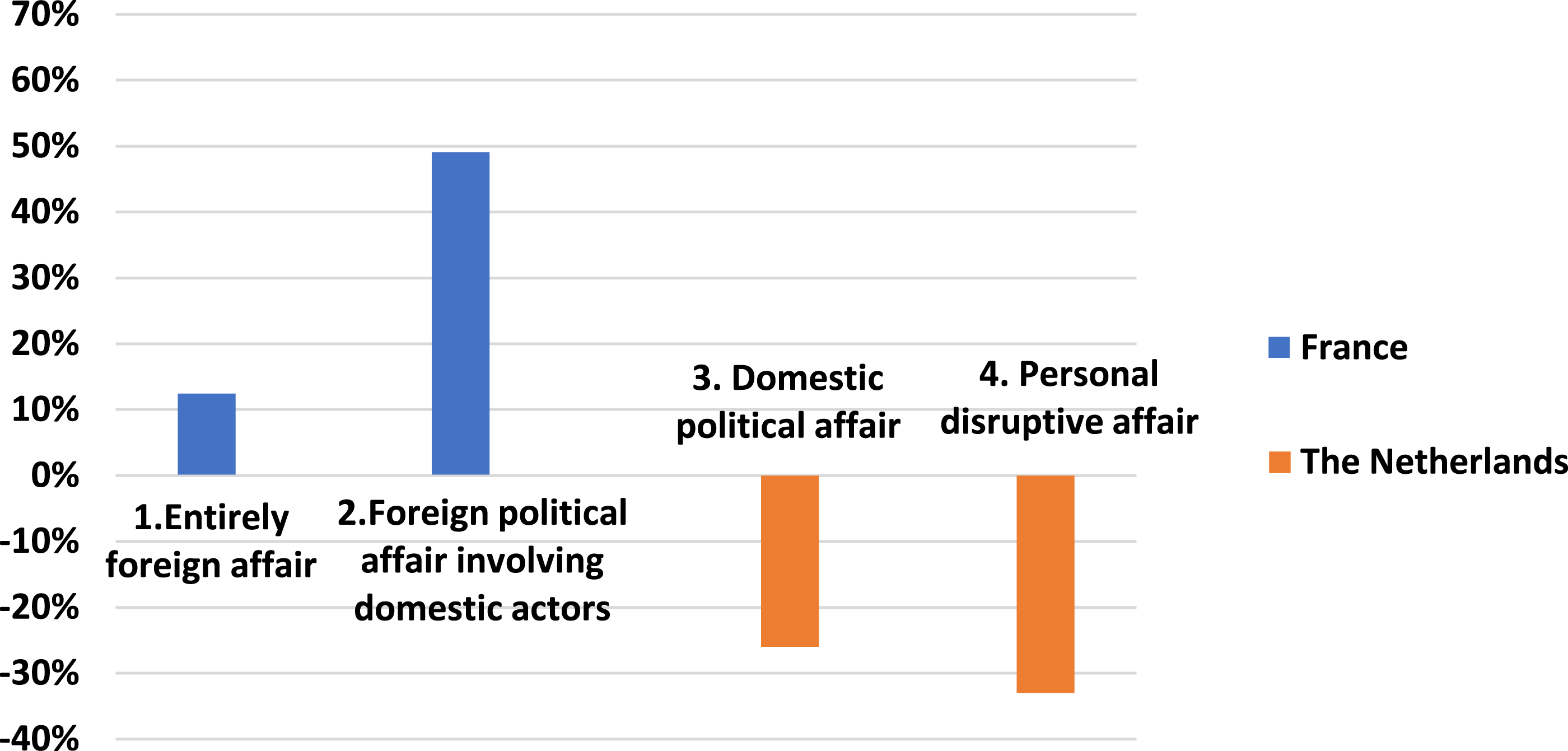
Overall differences regarding four degrees of foreignization/domestication in French and Dutch national newspapers.
The event as an entirely foreign affair
The degree of the event as an entirely foreign affair accounted for the largest portion of newspaper content in both France and the Netherlands (Tables 1 and 2): for each event, at least 54% of the content occurred in this category. Topics coded within this degree often bore great similarity in the two countries. For instance, in the case of 9/11, a topic about the Afghanistan War was present in the data from both countries and even included many similar terms such as “Taliban,” “Bin,” “Laden,” and “war” (the French version of this topic is shown in the Appendix). 3
Moreover, French and Dutch newspaper articles about the Twin Tower attacks often focused on the same specific subject. On September 24, 2001, Le Figaro published an article entitled “The Taliban are Organizing Themselves to Face an Increasingly Probable American Attack” (Bouilhet, 2001). As this headline suggests, the article reflects on preparations that Taliban troops are making to contend with the American invasion of Afghanistan. On October 8, 2001, De Volkskrant published an article that also dealt with this subject, called “Taliban May Be Able to Resist an American Attack” (Kester, 2001). And as a final example of cross-national parity: in the case of the tsunami, both the French and the Dutch data include a topic on the ways in which Thailand and Sri Lanka have been hit by the disaster, which contain the same terms, namely “disaster,” “victims” and “missing.”
The event as a foreign political affair involving domestic actors
For the degree of the event as a foreign political affair involving domestic actors, the percentages are higher in the French press for all four events. The differences range from 6% (the Arab Spring) to 19% (9/11).
Close examination of the empirical material pertaining to 9/11 illustrates the wider cross-national differences. During the first months after the Twin Tower attacks, several French newspaper articles reporting on international policy responses to the event depict France playing a central role in them. President Jacques Chirac was the first international politician to visit with the US president and the UN Secretary-General after 9/11. A reflection in Le Figaro (September 18, 2001) about this visit implies that France is – together with the United Kingdom and Germany – “naturally” a very central partner within the international post-event context: On Wednesday, the president of the republic will visit New York at the invitation of Secretary-General of the United Nations Kofi Annan. Jacques Chirac wants to involve the UN in the fight against international terrorism… The Europeans asked Jacques Chirac to inform them about the talks. He promised to telephone Tony Blair from Washington, as well as Gerhard Schröder, whom he will meet in Berlin on Wednesday (Rousselin, 2001).
Dutch media’s general interpretation of their country’s international involvement during the first post-9/11 weeks is much more modest. This observation can be culled from newspaper reports about the Netherlands’ participation in EU meetings, which often employ the idea that a “small member state” like the Netherlands should be modest and careful in its actions. This is apparent in the following excerpt from Trouw, reflecting on a call for Dutch Minister of Foreign Affairs Jozias van Aartsen to take political action during an EU meeting: If left up to VVD members Weisglas and Wilders, Van Aartsen will put a clear message on the table: Iran’s support for terrorism should be stopped. This is not a comfortable assignment for a minister from the small Netherlands at a time when the EU is seeking a cautious approach toward Iran (Trouw, 2001).
Ten years later, during the Arab Spring, similar processes occurred. In March 2011, there were preparations for a military intervention in Libya, and the French elite held a strong belief that their country should play a major role in this campaign. A group of intellectuals with various political sympathies (Bernard-Henri Lévy, Daniel Cohn-Bendit and André Glucksmann, inter alia) published an op-ed calling for intervention in Le Monde (March 17, 2011) under the roaring headline “Yes, We Must Intervene in Libya, and Quickly!” The following excerpt summarizes the group’s exhortation: We therefore urge the French government to do everything possible with its partners to ensure that the United Nations respects its commitment to the “responsibility to protect” and that Europe takes responsibility and proves that its wish to see the Libyan colonel leave is not wishful-thinking.… It is not up to the Russian and Chinese governments to force us to allow Libya’s democracy to be massacred. It is now, immediately, that we must act (Bruckner et al., 2011).
The point of this excerpt is not that all French media participants applauded the intervention –at a later stage, it was criticized too – but rather, that it is normal for the French political elite to claim a major role in the international political arena. This comes in sharp contrast to Dutch public discourses about the Libya intervention. The Netherlands made a small military contribution to it, yet ambivalence prevailed even around that initiative. Dutch war historian David Barnouw, for instance, reflected on the position of the Netherlands in an interview with Algemeen Dagblad (March 24, 2011): Since we once had colonies, we cherish the idea that the Netherlands is a medium-sized country. This is nonsense, of course; it is tiny. But we absolutely do not want to be as insignificant as Denmark. We want to play with the big boys (Oomen, 2011).
The event as a domestic political affair
The third domestication degree concerns depicting the event as a domestic political affair. This degree was more present in the Dutch press than in the French one in response to three of the four events. We find illuminating patterns behind this higher score in the case of the Arab Spring. In the Netherlands, these uprisings are strongly linked to debates about the role of Islam in Dutch society. While they were happening, commentators used the unfolding events in North Africa to prove that their discursive position in the debate was the right one. Journalist Rob Vreeken, for instance, interpreted the demonstrations as a sign that commentators being highly critical of Islam’s democratic potential were wrong (De Volkskrant, March 5, 2011): As far as the sunrays of the Arab Spring are reaching the Netherlands, they are eclipsing the notorious Islam haters. Their one-dimensional worldview has been disjointed. The clash of civilizations, the global dichotomy of us (Western civilization) and them (the Islamic world), all of it has been swept aside in one historical arm swing by the rebellious civilians on Arab liberation squares. More than anything, they prove that they long for democracy, for the rule of law, for freedom, “just like you in Europe” (Vreeken, 2011).
However, a few months later, criminologist Chris Rutenfrans claimed that the Arab Spring actually validated the thesis of a clash between Enlightenment ideals and Islam (De Volkskrant, May 7, 2011): Since the attacks of September 11, 2001, the populism of Fortuyn and Wilders has derived its arguments against Islam from the principles of the Enlightenment. Soon the thought arises that this Enlightenment originates in Western culture and that it would be extremely difficult for Islam to master that Enlightenment. See the tragedy of the Arab Spring, the “hunger for democracy” that does not lead to democracy, but to an exodus to Western Europe (Rutenfrans, 2011).
By contrast, hardly any domestication process concerning Islam took place in France during the Arab Spring. Even National Front leader Marine Le Pen – from whom we might most expect statements to this effect – does not relate the uprisings to debates about the position of Muslims in French society. 4
The event as a personal disruptive affair
Our last domestication degree pictures the event as a personal disruptive affair. This degree refers to a process by which an event, even though it happens at a distant location, is experienced so intensely by media participants that their own psychological state of well-being is affected.
This degree was present for all four events in the Netherlands, while in France it only occurred around the 2004 tsunami. During this event's aftermath, newspapers in both countries gave much attention to the victims of the natural disaster. However, in the Netherlands, much more articles additionally mentioned the responses of Dutch celebrities - individuals not directly involved in the disaster. They not only considered the tsunami something terrible for people living in Indonesia or Thailand, but claimed it caused disruption in their own lives.
For example, producer Theu Boermans reflected on this in an interview published on January 28, 2005 in De Telegraaf. Boermans was working on a performance of Gilgamesh, an old epic which includes a flood and premiered the day after the tsunami: This cannot be true, I thought. But natural disasters have always had a place in world literature, so you cannot preclude these kinds of coincidences (De Telegraaf, 2005).
The interviewer added that the event had inspired Boermans, writing: “Moreover, such a link between plays and reality once again proves to Boermans of the need to make theater.” Thus, although the tsunami happened far away, the producer considered it of great relevance to himself and his work.
This kind of emotional involvement was also clearly present in the Netherlands during the year that Trump ran for and became president. In many newspaper interviews, Dutch celebrities stated that this event psychologically affected them, claiming it was an important occasion in their own lives. For instance, while acting in a theater adaptation of The Kindly Ones, a novel about the Holocaust, Hans Kesting related his role to contemporary events, concluding (De Telegraaf, March 12, 2016): I think that Wilders and Trump are a horror. That they get the chance to continue to spread their poison. How they continue to peek in that wound without offering alternatives. History has shown that extreme systems such as National Socialism were not created from one day to the next. For years, there had been a focus on gut feelings (De Telegraaf, 2016).
These examples demonstrate that for many (famous) Dutch citizens the boundaries (Lamont and Thévenot, 2000) between things happening abroad and in the Netherlands blurred. They could, for instance, become enraged by Trump and call out Dutch right-wing populist Wilders and Trump in a single breath; it made little difference to them that one was an American politician and the other Dutch. The last quote also shows why this domestication degree – even though it is so personal – has relevance for the study of national media contexts: celebrities can use a personal event experience to say something about wider political affairs.
This is a specific form of “distant suffering,” experiencing psychic pain because of events in a faraway location (Boltanski, 1999; Joye, 2015). When this type of emotional involvement occurred in the French press, it was usually when American celebrities were interviewed. Examples of French celebrities who expressed personal disruption because of Trump’s political rise were rare enough not to warrant a separate topic in our analysis.
Two national cultural repertoires of foreignization/domestication
A French touch on the international political stage (foreignization)
Taking together the excerpts from the previous sections along with Tables 1 and 2 and Graph 1, we can describe the existence of two distinct national “cultural repertoires” (Lamont, 1992; Lamont and Thévenot, 2000) that provide French and Dutch media participants with varying perspectives for responding to foreign events. On the one hand, there is a French repertoire of foreignization, which encourages media participants to not turn such events into matters of importance for the country’s domestic politics. However, this does not imply no involvement of French public figures around foreign events. The scores for the event as a foreign political affair involving domestic actors indicate a clear French event interest. Yet, this is one that mainly happens on the international political stage: the aim is to give a French touch to events within the domain of foreign affairs (the “Francization” of world politics) instead of relating them to domestic debates.
Dutch domestic concerns (domestication)
The Dutch cultural repertoire is different. Politicians from the Netherlands played a much smaller role within the international political arena for the four events than their French counterparts – and the Dutch press endorsed this role, implying that the country should take a modest position within this realm. The Dutch cultural repertoire of relating to foreign events is much more focused on bringing these occurrences close to home. The excerpts from the last section show that foreign events are not only significant for Dutch media participants because the people who are directly involved suffer (after the tsunami) or make progress (during the Arab Spring). They are also important because they are relatable to domestic political issues or even their personal lifeworlds. Everything that happens in the world seems to qualify as a reason for reflecting on the situation in Dutch society.
The existence of these distinctive cultural repertoires provides media participants in France and the Netherlands with varying opportunities and constraints when referring to foreign events (Alasuutari et al., 2013: 693). French ones are inclined to employ them to promote their country within the field of international politics, whereas citing them in debates over domestic issues would be less legitimate. Conversely, Dutch media participants are met with irony when they want to adopt such a repertoire of foreignization (what is a citizen of a small country going to do on the world stage?), yet it is completely accepted for them to engage in domestication.
Conclusions
The aim of this article was to introduce the degrees of foreign event domestication as a germane research topic. This is a different phenomenon from the frequently investigated modes of domestication: the various ways through which national media aim to make foreign events attractive and comprehensible to their audiences (Alasuutari et al., 2013; Gurevitch et al., 1991; Ha, 2022; Joye, 2015; Olausson, 2014; Williamson Sinalo, 2022). We sought to find out whether these institutions do also differ cross-nationally in the extents to which they relate foreign events to their country’s domestic affairs.
For the cases of France and the Netherlands, this indeed turned out to be true. We found that each of the four events we analyzed – 9/11, the tsunami in Southeast Asia, the Arab Spring, and the rise of Trump – was domesticated to a larger extent in Dutch newspapers. To be more precise, instead of making a dichotomous distinction between foreignization versus domestication, we inductively came up with a scale, consisting of four degrees of domestication (cf. Dai and Hyun, 2010; Olausson, 2014; Scammell and Bielsa, 2022), seeing that Dutch newspapers scored higher on both of the most domesticating degrees. These clear cross-national differences turned out to be the result of two distinctive cultural repertoires (Lamont, 1992; Lamont and Thévenot, 2000) of what is defined as “ours” and “theirs” (Liebes, 1992; Nossek, 2004): a French one that considers foreign events as opportunities to present the country’s Grandeur on the international stage versus a Dutch one that experiences them as stimuli for reflecting on its domestic affairs. These repertoires affect how media participants and likely also ordinary citizens and policymakers (Bröer and Duyvendak, 2009; Snow et al., 2007) in these two contexts relate to foreign events.
Our research constitutes but a first explorative case study (Gerring, 2004) of the phenomenon of degrees of event domestication. It is up for future research to investigate to what extent these degrees also differ among other national media contexts. However, given that we discovered such clear variations between our two contexts of research, we hypothesize that significant differences will be present in other cases too. Future research could also delve into whether the four different degrees we found to be prominent in these two countries are more widely present. For instance, is considering the event a personal disruptive affair something that celebrities beyond the Netherlands do too on a regular basis?
Additionally, are there specific event characteristics that stimulate the creation of high extents of domestication? We did not find any clear patterns in our analysis, but this might stem from the fact that we studied four very different types of events. Comparing similar types of events (e.g., solely terrorist attacks or natural disasters) could possibly show that differences in their characteristics result in varying degrees of domestication (e.g., higher degrees when events happen in more geographically or culturally proximate locations (Knoester and Van Dooremalen, 2023)). On the other hand, selecting four event cases that were all very newsworthy (see Methods and Data) might have given an overestimation of how common domestication is. That is, events that media participants consider newsworthy are probably also ones that they will easily consider “ours” (Liebes, 1992; Nossek, 2004).
Our analysis also did not allow us to fully explain the origins of the two cultural repertoires that are behind the varying domestication patterns. However, we have indications that world-system theory (cf. Heilbron, 1999; Wallerstein, 2004; Janssen et al., 2008; Kuipers, 2015) could serve as an explanation, because both cultural repertoires seem to be linked to different positions in the world-system: the powerful French who aim for foreignizing events versus the modest, less powerful Dutch who want to domesticate them. This presents a hypothesis that could be tested in future research: the more peripheral a country’s position within the (political, cultural or economic) world-system, the higher its degrees of domestication will be.
Footnotes
Acknowledgements
We thank Erin Goodman, Ioana Sendroiu and Cécile van de Velde for giving us the opportunity to present the article’s main arguments in the Weatherhead Scholars Forum (Harvard University). We also thank Justus Uitermark for his comments on various draft versions.
Declaration of conflicting interests
The author(s) declared no potential conflicts of interest with respect to the research, authorship, and/or publication of this article.
Funding
The author(s) received no financial support for the research, authorship, and/or publication of this article.

Notes
Appendix
Four topics and their degrees of foreignization/domestication.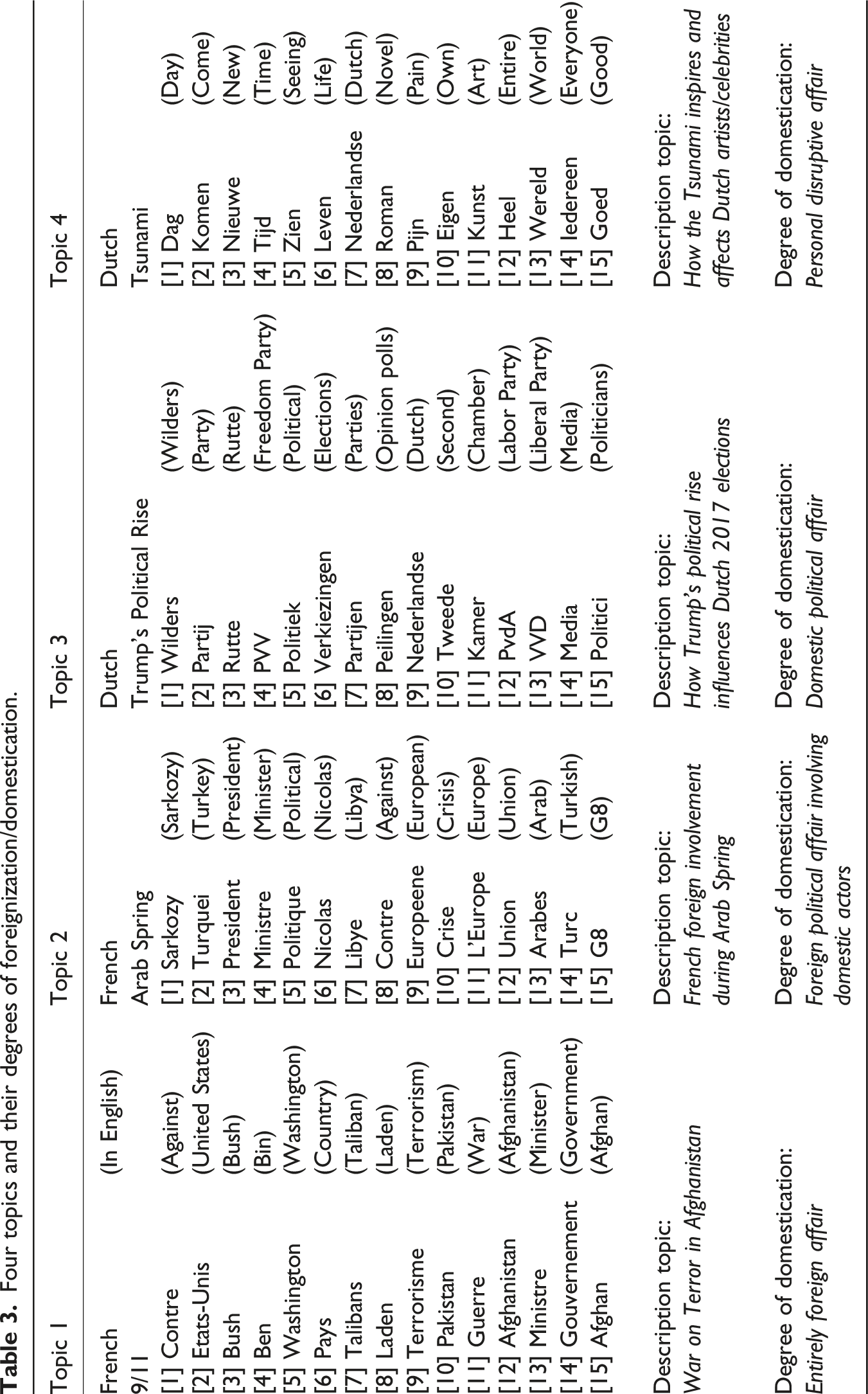
Topic 1
Topic 2
Topic 3
Topic 4
French
(In English)
French
Dutch
Dutch
9/11
Arab Spring
Trump’s Political Rise
Tsunami
[1] Contre
(Against)
[1] Sarkozy
(Sarkozy)
[1] Wilders
(Wilders)
[1] Dag
(Day)
[2] Etats-Unis
(United States)
[2] Turquei
(Turkey)
[2] Partij
(Party)
[2] Komen
(Come)
[3] Bush
(Bush)
[3] President
(President)
[3] Rutte
(Rutte)
[3] Nieuwe
(New)
[4] Ben
(Bin)
[4] Ministre
(Minister)
[4] PVV
(Freedom Party)
[4] Tijd
(Time)
[5] Washington
(Washington)
[5] Politique
(Political)
[5] Politiek
(Political)
[5] Zien
(Seeing)
[6] Pays
(Country)
[6] Nicolas
(Nicolas)
[6] Verkiezingen
(Elections)
[6] Leven
(Life)
[7] Talibans
(Taliban)
[7] Libye
(Libya)
[7] Partijen
(Parties)
[7] Nederlandse
(Dutch)
[8] Laden
(Laden)
[8] Contre
(Against)
[8] Peilingen
(Opinion polls)
[8] Roman
(Novel)
[9] Terrorisme
(Terrorism)
[9] Europeene
(European)
[9] Nederlandse
(Dutch)
[9] Pijn
(Pain)
[10] Pakistan
(Pakistan)
[10] Crise
(Crisis)
[10] Tweede
(Second)
[10] Eigen
(Own)
[11] Guerre
(War)
[11] L’Europe
(Europe)
[11] Kamer
(Chamber)
[11] Kunst
(Art)
[12] Afghanistan
(Afghanistan)
[12] Union
(Union)
[12] PvdA
(Labor Party)
[12] Heel
(Entire)
[13] Ministre
(Minister)
[13] Arabes
(Arab)
[13] VVD
(Liberal Party)
[13] Wereld
(World)
[14] Gouvernement
(Government)
[14] Turc
(Turkish)
[14] Media
(Media)
[14] Iedereen
(Everyone)
[15] Afghan
(Afghan)
[15] G8
(G8)
[15] Politici
(Politicians)
[15] Goed
(Good)
Description topic:
Description topic:
Description topic:
Description topic:
War on Terror in Afghanistan
French foreign involvement during Arab Spring
How Trump’s political rise influences Dutch 2017 elections
How the Tsunami inspires and affects Dutch artists/celebrities
Degree of domestication:
Degree of domestication:
Degree of domestication:
Degree of domestication:
Entirely foreign affair
Foreign political affair involving domestic actors
Domestic political affair
Personal disruptive affair