



Abstract
In the present study, we investigate gender bias against politicians in a large set of news articles (n = 1,139,571) published in major media outlets in the United States between 2010 and 2020 by tracing changes in reporting about 1,095 US politicians. Using topic modeling with latent Dirichlet allocation (LDA), we identify main policy-related topics in media reports. We find gender differences in the coverage of certain policy issues, with major imbalances explained by societal factors. Specifically, we show that women in high-level political positions receive less media coverage than their male counterparts and women in less powerful positions on economic and national security issues. However, women and men in less influential positions do not differ in the amount and type of reporting they garner. Since women are still underrepresented in leadership positions, the US media may inadvertently reflect and reinforce existing gender biases in society by devoting more attention to high-profile politicians, who are overwhelmingly male. Although our longitudinal analysis shows positive changes, the gender gap in reporting continues to exist.
Introduction
Media outlets are powerful players in modern US politics, and the amount and type of attention they pay to politicians are crucial for candidates’ efforts to secure elective office. Having the power to influence the political agenda and people’s opinions, mass media are not always objective in their coverage of political actors. For instance, female politicians tend to receive less substantive coverage (i.e., on their policy stances) than male candidates (e.g., Kahn, 1994). When women do receive policy issue coverage, it tends to reflect existing gender stereotypes, emphasizing the ability of female politicians to better handle “women’s issues”, such as gender equity and education (Major and Coleman, 2008). Although these policy issues are undoubtedly significant and are advantageous for female candidates in certain election years (Fridkin and Kenney, 2009), issues linked to male politicians, such as the economy, are perceived as more important for politics (Kittilson and Fridkin, 2008). Thus, the association of female politicians with stereotypical issues in the media can have a significant effect on women’s political careers contributing to the problem of underrepresentation of women in elected bodies.
Although previous research suggests gender bias in reporting about female and male politicians, most studies are based on the analyses of news content published more than two decades ago (e.g., Devitt, 2002; Smith, 1997). Gender stereotypes are constantly evolving, along with the changes in women’s and men’s occupational and family roles (Eagly et al., 2019). The last decade has been characterized by important shifts in US society, namely the record number of women participating in US politics (Blazina and DeSilver, 2021), women empowerment movements (e.g., the #MeToo movement), and increased political polarization (Wilson et al., 2020). Recent research shows that gender stereotypes about women in general have changed over the past few decades, moving away from the traditional understanding of practices and traits associated with women (Eagly et al., 2019). Anecdotal evidence suggests the media coverage of women in politics is undergoing similar changes (Zulli, 2019). However, it is not yet well understood whether the news coverage of female politicians has been transformed as well. Our study provides new evidence for gender differences in the amount and type of policy issue coverage based on a timely dataset of more than one million news reports published over the last decade by major US media outlets. We investigate how prominent female and male politicians are in various policy-related topics that were identified using a computational approach, that is, topic modeling with latent Dirichlet allocation (LDA). Finally, as general media visibility research shows that the amount of news coverage between female and male politicians can vary greatly depending on their position of power and party affiliation (e.g., Shor et al., 2015), our longitudinal analysis involves a large number of Democratic and Republican politicians holding various levels of public office to address the following research question (RQ): To what extent have politicians’ gender and factors such as their position of power and party affiliation influenced issue coverage over the past 11 years?
Literature Review
The media continuously structure and expand political debates, keeping individuals informed about various issues. By doing so, the media can influence public opinion is through agenda-setting, that is, the ability of the media to influence what issues the public considers to be important (McCombs and Shaw, 1993). Through their selection and framing of news stories, the media can highlight certain issues over others, thereby shaping the public's perception of what issues are most pressing. In this process, politicians involved in the issues prioritized by the media may receive greater coverage and thus become more visible to the public. Research shows that mere exposure improves a candidate’s electoral success (Geiß and Schäfer, 2017), as media attention increases voters’ awareness of the politician and therefore improves the latter’s chances of being viewed as a viable candidate for public office (Aaldering et al., 2018). Additionally, appearing more frequently in the news related to certain policy issues, as opposed to more trivial coverage, can help politicians to inform citizens about their political positions and draw attention of other legislators to certain policy issues and potentially obtain their support in passing a bill (Amsalem et al., 2020). Scholars show that female politicians tend to receive less substantive coverage than their male counterparts across various types of elections, including senatorial (Kahn, 1994), gubernatorial (Devitt, 2002), and presidential (Heldman et al., 2005) races. For instance, male politicians are likely to receive twice as much content related to actual policy issues as female candidates do (Falk, 2008).
Past research shows that news outlets tend to emphasize men's ability to better handle policy issues that require assertiveness and toughness (hard, or masculine, policy issues such as the economy and defense), while women are presented in the media as more competent in handling issues that require compassion and caring (soft, or feminine, issues such as poverty, education, and, and healthcare; Hayek and Russmann, 2022; Huddy and Terkildsen, 1993), even though female candidates tend to campaign on a broad set of policy issues (Greene and O’Brien, 2016). This also pertains to situations where candidates have gender-incongruent issue backgrounds (Major and Coleman, 2008). The association of male candidates with hard policy issues tends to increase from primary to general elections (Banwart et al., 2003). In some countries, male politicians tend to dominate the coverage of both soft and hard issues (e.g., in Austria, as shown by Hayek and Russmann, 2022). Generally, US media coverage centers around hard issues, as shown by some scholars (Hayes and Lawless, 2015; Kittilson and Fridkin, 2008; Meeks, 2013).
Despite the differences in issue reporting shown by the above-cited studies, some researchers suggest that gender differences in the coverage of politicians are or have become less distinct. Specifically, in US, women and men in presidential primaries (Heldman et al., 2005), elections to the US House of Representatives (Hayes and Lawless, 2015), and mayoral races (Atkeson and Krebs, 2008) are equally likely to be featured in stories about hard and soft issues. D’Heer et al. (2021) show that the amount of coverage on soft issues differs between Belgian politicians regardless of their gender. Some evidence shows that female politicians have become more strongly associated with masculinity over time. For instance, an analysis of Hillary Clinton’s media coverage in The New York Times find that her association with hard policy issues has increased between 1993 and 2016 (Zulli, 2019). Regarding specific policy competencies, US female candidates tend to be mentioned as frequently as men in the context of policy issues traditionally linked to men, such as crime, government finances, and ethics (Smith, 1997), as well as foreign policy (Bystrom et al., 2001). Other studies indicate that soft issues are more widespread in the media than hard issues (Jalalzai, 2006) and that female candidates are featured in more articles about both types of policy competencies than men (Meeks, 2012).
The above-reviewed studies on issue coverage typically rely on gender to explain inequalities in media coverage, overlooking the effects of structural characteristics of modern US politics, including an overwhelming number of men in key political positions (Blazina and DeSilver, 2021). In fact, previous studies that examine the influence of political position on media visibility are typically conducted in Western Europe. They conclude that position of power may be one of the most influential predictors of politicians’ presence in the news (Vos, 2014). Indeed, elite politicians tend to have higher name recognition and better, more habitual access to the media. Earlier studies show that highly prominent Belgian female officeholders (e.g., cabinet members) are especially under-covered and are less visible in the news than men in elite positions (Vos, 2013) and regular female politicians (Hooghe et al., 2015). Analyzing the coverage of US politicians, Shor et al. (2015) suggest that women in politics face a “glass ceiling”, or what the authors call a “paper ceiling”, where certain institutional or ideological factors prevent an individual, typically a woman, from rising to a top position. The authors find that female politicians, who rarely appear in the media, have increased their presence over time and were as likely to be mentioned in news stories as men by 2008; however, more prominent female politicians, those who are mentioned more frequently, continue to receive less coverage than male leaders due to the fact that men dominate top political positions. (Shor et al., 2015). In terms of the content of issue coverage, female leaders are more strongly associated with policy issues traditionally associated with men than female politicians in less influential positions, as shown in an analysis of European elections by Greene and Lühiste (2018). However, having a female party leader may also result in the media addressing more issues stereotypically associated with female politicians (Greene and Lühiste, 2018).
Another defining characteristic of US politics is the lack of diversity among Republican politicians. Despite a record number of women who serve in the 117th US Congress, Republican women are largely underrepresented in all levels of political office (Blazina and DeSilver, 2021) and may as well be under-covered in news. In addition, as in the United States, where parties are perceived as owning certain policy issues, with Democratic issue ownership (e.g., civil rights, social welfare) associated with femininity and Republican issue ownership (e.g., crime, defense) associated with masculinity (Petrocik, 1996), both party and gender stereotypes may pose challenges for female Republicans. For example, Republican women have a harder time appealing to Republican voters than they do to Democratic voters (Brians, 2005). Previous literature on issue coverage typically focuses on prominent Republican female politicians. For instance, Sarah Palin, a Republican vice-presidential candidate in the 2008 US presidential election, received less issue coverage than Hillary Clinton, a Democratic presidential candidate, and less reporting on hard issues than Democratic male opponents (Meeks, 2013). Likewise, Elizabeth Dole, a candidate for Republican nomination for president in 2000 US election, garnered less issue coverage than her male opponents (Heldman et al., 2005).
Present Study
The above-reviewed research on gender differences in issue coverage has arrived at contradicting conclusions. A number of studies show that coverage of female politicians qualitatively and quantitatively differs from that of male candidates (e.g., Kahn, 1994). In other papers, it is argued that coverage is relatively balanced (e.g., Hayes and Lawless, 2015), if not in favor of female politicians (Meeks, 2012). Most of these studies base their conclusions about gender-differentiated coverage on news reports published more than 20 years ago (e.g., Smith, 1997). However, gender stereotypes are continuously evolving, paralleling the transformations in women's and men's roles both in their professional and family spheres (Eagly et al., 2019). The past decade has witnessed significant societal shifts in the United States, including a notable increase in women's engagement in politics (Blazina and DeSilver, 2021) and the rise of women’s empowerment movements such as the #MeToo movement. Recent studies indicate that the prevailing gender stereotypes about women have undergone substantial changes over the past few decades, departing from the conventional understanding of practices and traits associated with women (Eagly et al., 2019). Specifically, research in social psychology shows an increasing association of women with stereotypical masculine characteristics (Donnelly and Twenge, 2017; Eagly et al., 2019). In addition, there is some evidence, albeit outside the United States, that a growing proportion of voters perceive men and women as equally competent to deal with various political issues (Lefkofridi et al., 2018). In terms of media coverage, anecdotal evidence suggests that issue coverage of some prominent US female politicians has become less gendered over time (Zulli, 2019). However, to our knowledge, there are currently no studies that provide a large-scale analysis of gender differences in policy issue coverage over the past decade. In light of this, our study takes an exploratory approach, aiming to understand the evolution of gender bias in issue coverage using the most recent and comprehensive dataset available to us. Our goal in this paper is to map the research field of gender stereotyping dynamics in media coverage, thereby creating a foundation for future confirmatory research to delve further into this matter.
Most studies categorize policy issues into soft and hard, or feminine and masculine (Hayek and Russmann, 2022; Huddy and Terkildsen, 1993). Yet this classification may appear outdated given the evolution of voters' expectations of female politicians' policy competencies (Lefkofridi et al., 2018) and the evidence that female candidates emphasize both soft and hard policy issues in their campaigning (Greene and O'Brien, 2016) and legislative proposals (Atkinson and Windett, 2019). As using this categorization in such an exploratory study may bias the interpretation of our findings, we avoid using the existing classification and adopt a gender-neutral approach to exploring policy issues.
Previous research on gender differences in issue coverage typically uses descriptive statistics or bivariate analysis (e.g., Devitt, 2002) potentially overlooking the effects of other factors. However, studies examining variables influencing general media visibility of politicians show that women’s position of power influences significantly their media visibility (e.g., Greene and Lühiste, 2018). The fact that previous research often concentrates on a handful of prominent candidates (e.g., Heldman et al., 2005) may only contribute to this issue making the findings of these studies inapplicable to the majority of politicians. Likewise, as the number of female politicians in US politics remains low, earlier studies often underrepresent women, especially women in elite positions and female Republicans, in their samples. We include a large number of Democratic and Republican female and male politicians in various positions of power and use a robust analytical approach involving complex inferential statistics to examine gender differences in political issue coverage, which we believe is a significant contribution to the research field. Therefore, we aim to address the following research question (RQ): To what extent have politicians’ gender and factors such as their position of power and party affiliation influenced issue coverage over the past 11 years?
Methods
Data Collection
We created a sample of politicians (n = 1,095) that included their names, unique identifiers, gender, party affiliation, and political positions occupied between 2010 and 2020. Politicians who did not identify with the Republican or the Democratic Party and those who were mentioned less than three times in a news report were excluded, resulting in the final sample of 1,070 politicians, 214 of whom were women. More details on the sample specifically and our study in general can be found in the Supplementary Online Appendix 1 . Detailed information about the members of the 111th to the 116th US Congress was retrieved with the help of ProPublica Congress Application Programming Interface (API). 2 We also collected details about politicians who served as members of the US Cabinet from 2010 to 2020 by means of web scraping of the respective Wikipedia pages. 3
Subsequently, we used LexisNexis APIs to extract the entire corpus of digital copies of news articles published in the major US newspapers, magazines, and online outlets (n = 19). 4 Only the articles that mentioned the examined politicians were retained. Initially, we collected texts published between January 2009 and December 2020 and used the data to extract topics with a topic modeling algorithm (n = 1,139,571). The data for 2009 were then discarded due to the limited number of outlets and news articles. Duplicated texts, articles on non-political topics (e.g., sports), and news reports containing less than three mentions of the selected politicians were also excluded. This resulted in the final corpus of 525,718 news reports.
Data Pre-Processing
We converted each word in the full texts of the collected news articles to lower case and removed punctuations, numbers, special characters, stop words, and one-letter words. Words were lemmatized in accordance with their part of speech. Subsequently, in the collected news reports, each mention of every politician from our sample was replaced with the person’s unique identifier (e.g., Joe Biden, candidate Biden – joe_r_biden; detailed information can be found in the Supplementary Online Appendix A).
Topic Extraction
Policy-related topics in the news corpus were identified using topic modeling with LDA (Blei et al. 2003), a computational content analysis technique that automatically discovers abstract topics in the collection of texts and classifies the documents into these topics (Maier et al., 2018). Following the workflow of recent studies (Wilkerson et al., 2017), we argue that topics derived from a corpus of political articles generally reflect policy issues.
A series of LDA models were trained on the full texts of the news reports. The number of topics (k) ranged from 10 to 200 in 10 increments. We employed the LDA implementation provided by the genism module (Řehůřek and Sojka, 2010). A model with 90 topics was selected, as it demonstrated the highest topic coherence based on several coherence metrics (see Figure 2A of the Appendix).
Next, among all topics discussed in each article, we selected the one with the highest probability to represent the article. As recommended by Maier et al. (2018), words with the highest probabilities in each topic were reviewed, and the topics were assigned preliminary labels. To ensure the semantic validity of the topics, we selected 10 random articles for each of the 90 topics for manual validation. Prior to this, a subset of the articles was manually coded by one of the authors by assigning topic labels in order to calculate intra-rater reliability and ensure high self-consistency (Krippendorff's α = 0.91). Highly similar topics were then clustered together, resulting in 13 meta-topics. Here, we analyzed 12 meta-topics; the analysis of the largest catch-all cluster (politics other) was included in the Supplementary Online Appendix. For complete information on training and validation, see the Supplementary Online Appendix (pp. 6–7).
Analysis Plan
We employed linear mixed-effect models due to this method’s ability to account for the within-subject relations among the repeated measurements of the politicians’ associations with policy-related topics in each year. Since the number of articles varied broadly across the politicians, with many being more prevalently featured in certain years (e.g., due to their prominence) but not even mentioned in publications in other years, we attempted to control these differences by introducing a random effect for individual politicians. This method allowed us to keep a low number of parameters in the regression models, while tracing each individual’s variation from the grand mean. Therefore, in further reporting on the results obtained from the linear mixed-effect models, we refer to the variations in media coverage among individual politicians. For this type of analysis, all politicians with at least three mentions in a single article were included.
In addition, to investigate the probability of a female politician being the main actor in an article we used a series of logistic regressions on the proportion of articles about female politicians in each topic over the analyzed period. For this type of analysis, only the main actor of an article (i.e., the politician with the most mentions in an article) was considered. In this scenario, the same threshold of a minimum of three mentions has been applied. Notably, for this type of dependent variable (i.e., article’s most mentioned politician), we also conduct a supplementary analysis using the above described linear mixed-effect models. The results of the main and supplementary analyses with two different types of dependent variables showed a similar pattern (see pp. 8–22 in the Supplementary Online Appendix).
Furthermore, since a small number of ultra-prominent politicians received disproportionately more coverage than the remaining politicians in our sample, we conducted a sensitivity analysis by excluding these outliers (i.e., Barack Obama, Joe Biden, Hillary Clinton, and Donald Trump) from the sample. We find that the main conclusions of this paper are generally stable in the absence of these outliers (see the full analysis in Supplementary Online Appendix C).
Measures
Each article’s publication year as a continuous variable (2010 through 2020) and each politician’s gender (female, male), party (Democratic, Republican), and position of power in each year were used as fixed effects. Regarding position, the politicians were assigned to one of the following three categories based on their occupational status in each year of the reviewed period: no position (the politician was inactive in politics or did not hold any public office), medium-level position (the politician was a member of the US House of Representatives), and high-level position (the politician was a member of the US Senate or Cabinet or a presidential or a vice-presidential candidate). The positions occupied by the politicians in state and local governments were not considered. Since the model presented in this paper included several interaction terms with the above-mentioned variables, we provided the screening for multicollinearity in the Supplementary Online Appendix C.
The dependent variables (DVs) were represented by the number of articles, in which the analyzed politicians were discussed per topic in each year. Prior to our analysis, the DVs, grouped by topic and year, were logarithmically transformed to reduce skewness and minimize the influence of outliers. The transformation helped us to compress the differences between the original values, bringing them to the same order of magnitude. To facilitate interpretation, we report our regression coefficients in percentage units.
Results
Figure 1 provides a statistical analysis of the general time trends showing the evolution of political coverage on various issues over the period analyzed, taking into account the gender of the politicians. As the number of men in our sample is much higher than the number of women, the regression lines in the plot are based on the average number of news reports per politician. On average, media attention to male politicians across all topics has increased steadily over the past 11 years. For female politicians, although to a much lesser extent, a similar upward pattern is seen in the areas of civil rights, congress and legislation, economy, and national security. By the end of the last century, the only areas where women in politics had received more coverage than their male counterparts were in the areas of education and elections. For other topics, the amount of coverage has either shown negligible positive change (crime, law and law enforcement, healthcare, immigration, and nonpolitical) or has remained stagnant over time (environment and foreign affairs and defense). General time trends showing the evolution of political coverage on various issues over the analyzed period for female and male politicians.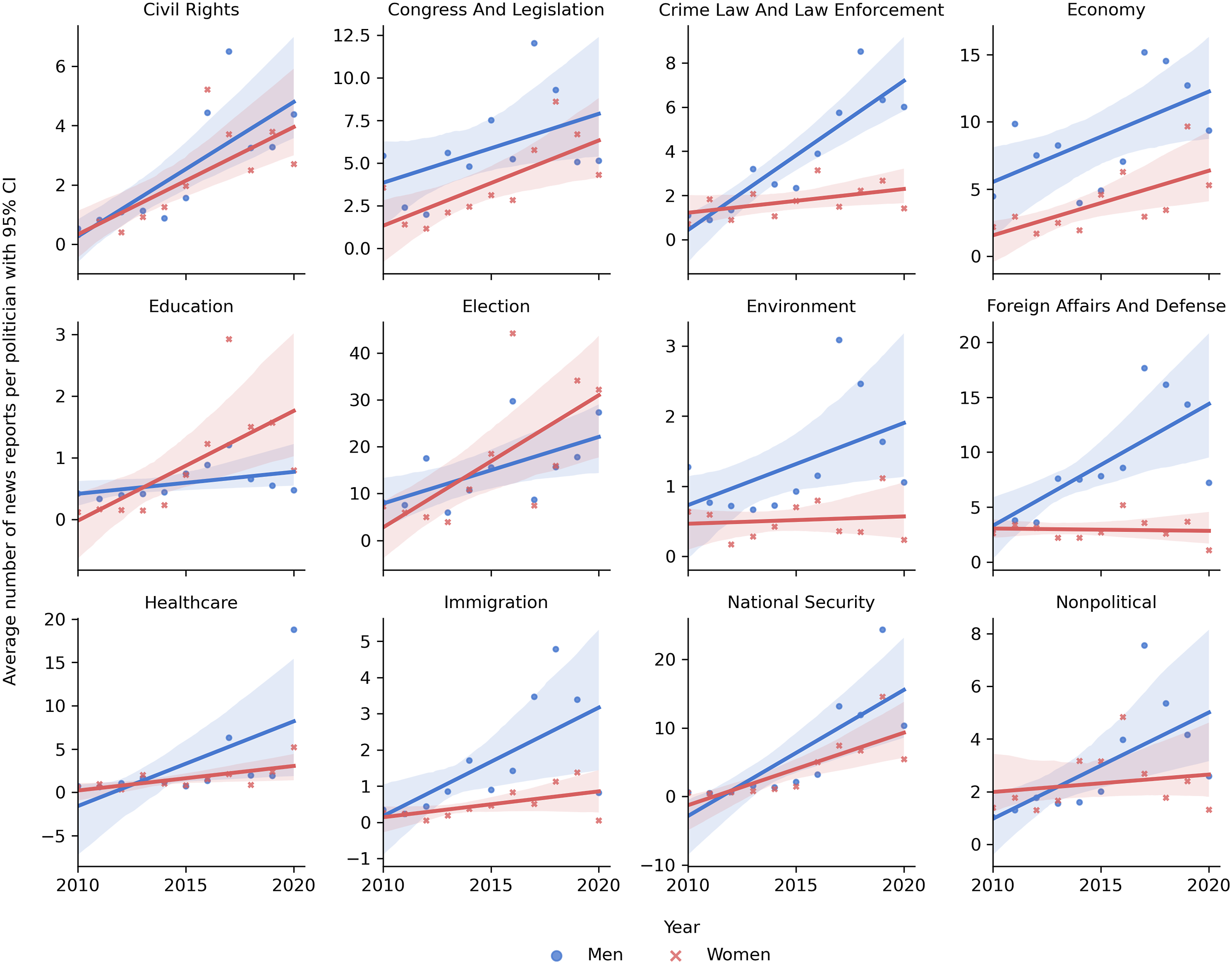
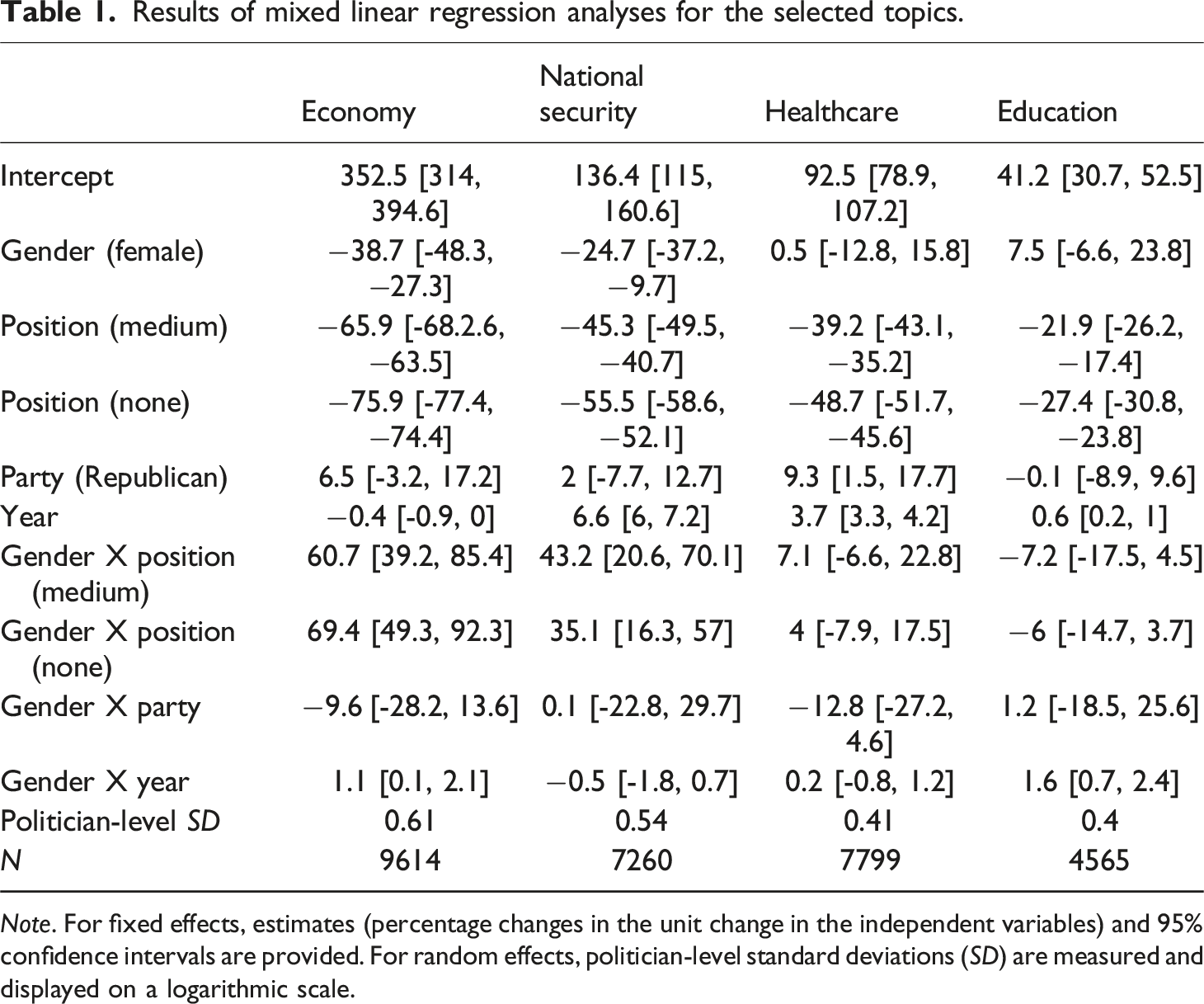
To provide detailed insights into issue coverage, we examined the influence of politicians’ characteristics on the amount of coverage they receive in various topics. Due to a relatively large number of topics and the fact that our findings are rather similar across all topics, we opted to describe the analysis of selected topics in this paper and provide the analysis for the remaining topics in the Appendix (see Supplementary Online Appendix B, pp. 8–26). The topics reviewed here include the economy, national security, healthcare, and education, as these issues have consistently ranked among the top policy priorities of US citizens over the past decade (Bialik, 2019). We found no significant main effect of gender on the amount of coverage for the selected and remaining topics. Therefore, only the final model that included the effects of all predictors was reviewed in this paper (see complete information on each model in the Supplementary Online Appendix).
Results of mixed linear regression analyses for the selected topics.
Note. For fixed effects, estimates (percentage changes in the unit change in the independent variables) and 95% confidence intervals are provided. For random effects, politician-level standard deviations (SD) are measured and displayed on a logarithmic scale.
Examining the interaction between gender and year of publication revealed that the growth rate of articles for a female politician increased significantly over time compared to a male counterpart in news stories about the economy and education. The interaction between gender and position showed that a female politician with no position or a medium-level position tended to receive significantly more coverage than a female politician with a high position on the topics of the economy and national security. For these topics, position of power modified the effect of gender, suggesting that a female leader received significantly less coverage than her male counterpart. Party affiliation and the remaining interaction terms were not statistically significant in the examined topics.
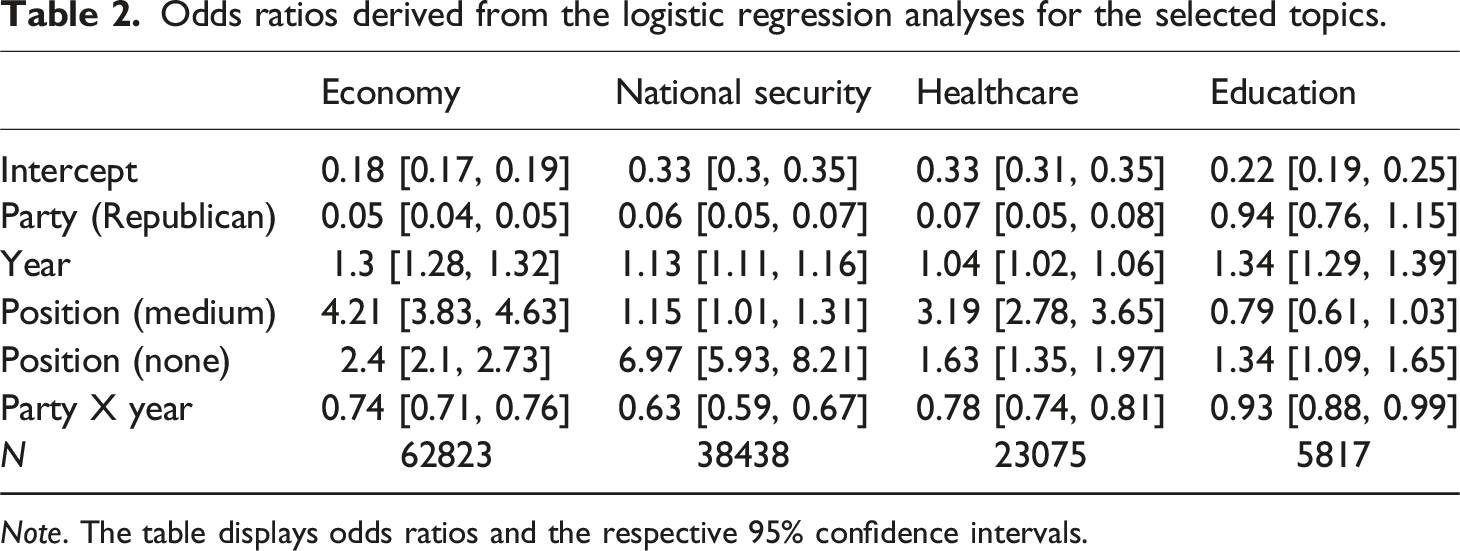
Odds ratios derived from the logistic regression analyses for the selected topics.
Note. The table displays odds ratios and the respective 95% confidence intervals.
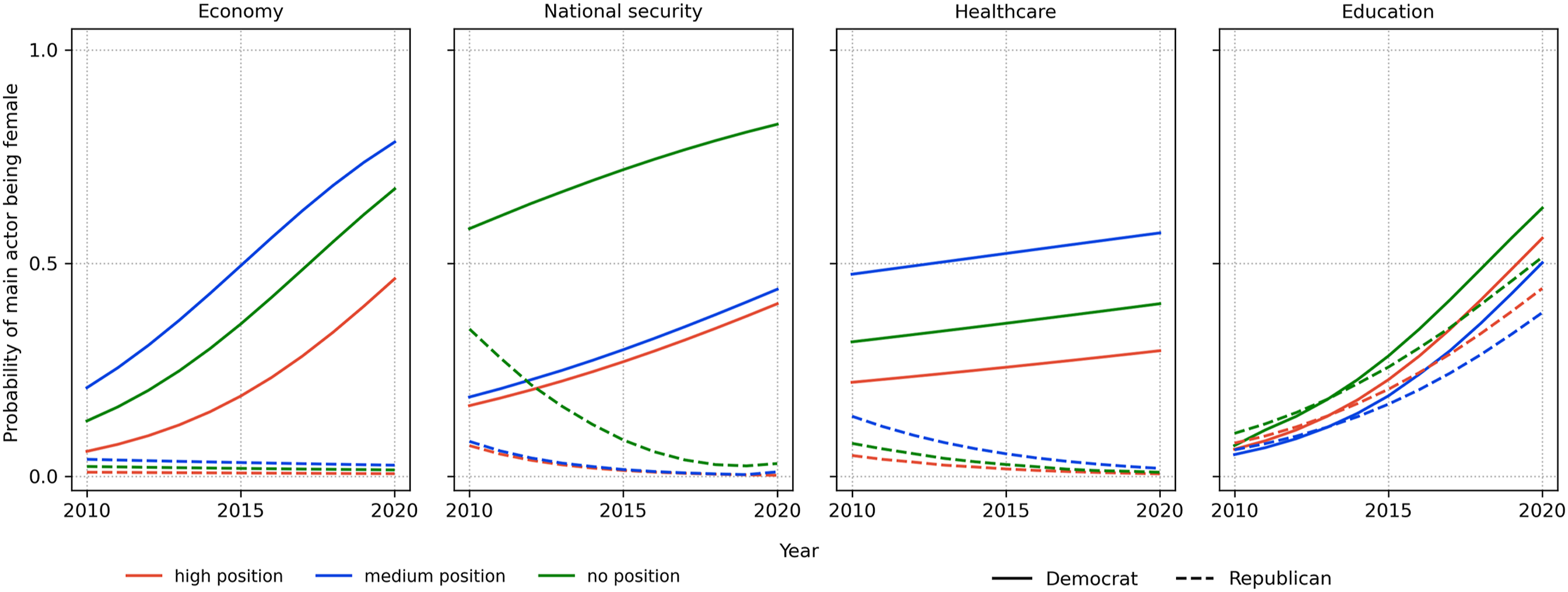
Logistic regression analyses showing the probability of a female politician being the main actor of an article on a particular topic, given her party affiliation and the position she holds.
Discussion
Our results reflect the current issue of underrepresentation of women in leadership positions: the media tend to focus on a relatively small number of prominent politicians the majority of whom are men. Our detailed study of policy-related topics reveals that the inequalities are large in the topics national security and economy, in which male politicians in powerful positions are more likely to be mentioned than female leaders. One reason that male leaders are often featured in articles on national security is the association between national security and masculinity (Holman et al., 2016). Voters' beliefs that women are more liberal than men (Koch, 2000) and lack the leadership traits, such as decisiveness and aggressiveness, that are seen as critical to dealing with national security issues (Lawless, 2004) may be reflected in media coverage of this issue. However, we suggest that a more likely explanation for our results is that the increasing number of domestic right-wing extremism (e.g., violence at the Unite the right Rally in Charlottesville; Neiwert, 2017) and international security threats (e.g., Russia interference in the 2016 presidential election; US Select Committee on Intelligence, 2019) in the past few years may have led to the heightened media attention to Donald Trump and his top officials. And since national security and defense agencies are almost exclusively led by men, the coverage of national security issues of the past decade was dominated by male leaders. We also find that men in high-level positions garner more coverage about the economy than their female counterparts, another policy issue linked to masculinity (Huddy and Terkildsen, 1993). Although some previous studies that focus on limited time periods and/or politicians find that the pattern of perceived male superiority in economic policy has declined over time, one explanation for our findings may be that voters overall still view men as more apt than women to deal with the economy (Lefkofridi et al., 2018). Additionally, as studies on budgetary policy preferences of officeholders suggest that male politicians tend to attach more importance to the economy and taxes (e.g., McEvoy, 2016), men may be more vocal advocates of economic reforms and thus, receive more attention from the media on this topic. Our findings are in line with some of the studies on politicians’ media visibility, showing that men in elite positions are more visible than their female counterparts (e.g., Vos, 2013). Some research on issue coverage confirms that male politicians receive more coverage on issues traditionally linked to men (e.g., Banwart et al., 2003; Hayek and Russmann, 2022; Kahn, 1994; Major and Coleman, 2008); however, these studies attribute differences in news coverage solely to gender and rarely consider the impact of other factors on news coverage.
Earlier studies find that political women get more coverage related to so-called soft policy issues (e.g., education; Hayek and Russmann, 2022; Kahn, 1994; Kittilson and Fridkin 2008; Major and Coleman, 2008); however, our main analysis shows that when it comes to healthcare and education, the media do not favor women over men, regardless of the position they hold. This is consistent with some of the previous studies on issue coverage (e.g., Atkeson and Krebs, 2008). With respect to healthcare, voter research suggests that citizens perceive women as more competent at handling healthcare issues (Fridkin and Kenney, 2009) and that, unlike national security threats, health epidemics may be advantageous to women in their pursuit of elective office (Holman et al., 2016). During one of the largest health crises of the past decade, COVID-19 pandemic, some media outlets have reported that female leaders are better at managing the COVID-19 health crisis than men (Johnson and Williams, 2020). However, research finds no effect of gender on the ability to handle the pandemic (Aldrich and Lotito, 2020). This fact may have also been reflected in the coverage of politicians in our dataset. Likewise, in education, topic traditionally linked to women, we observe no gender differences in the number of news reports. In our sample, the attention of the national media outlets to this issue is rather limited. Although we find that the topic has been garnering significantly more coverage in the recent years, potentially due to the discussions about COVID-19-related school closures and school mask and vaccine mandates, most educational policy is decided at the state and local levels, and thus examining the coverage of state and local politicians in local newspapers may lead to different results (e.g., Major and Coleman, 2008). Interestingly, our supplementary sensitivity analysis showed that in the absence of ultra-prominent politicians such as Barack Obama, Joe Biden, Donald Trump, and Hillary Clinton, women in high positions were mentioned significantly more often in articles about education than were men in similar positions. This may be explained by the active participation of high-level female politicians in education policy, such as Betsy DeVos, former Secretary of Education, and Senators Elizabeth Warren and Patty Murray, advocates for education issues and longtime members of the US Senate Committee on Health, Education, Labor, and Pensions.
Over time, the media attention to women have increased, as women do seem to have a significantly higher articles’ growth rate than men, but only in topics economy and education. Although this is a positive trend for women in politics, it is important to keep the baseline number of articles that female and male politicians receive in mind. An average female political actor tends to garner less coverage than a male counterpart, and even a small increase in the number of articles featuring the former may result in a significant change in her relative growth rate, i.e., the increase in percent compared to the previous year.
Similar to Shor et al. (2015), we find no difference in the coverage of regular female and male politicians. We also observe that while men in elite positions are more likely to be featured in news stories than men in less powerful positions, the opposite is true for female politicians. This confirms previous findings in the literature that women in high positions receive less coverage than ordinary politicians (e.g., Hooghe et al., 2015), possibly because women are underrepresented in top government positions (Shor et al., 2015). The increasing number of women running for political office over the last decade may have resulted in less prominent female and male politicians receiving similar levels of media attention.
We also find that our results reflect the inequalities within the Republican party. In line with previous literature (e.g., Meeks, 2013), we demonstrate that the trends for Republican and Democratic female politicians are strikingly different, with Republican women being considerably less likely to be featured as articles’ main actors. The situation has only worsened over time. One reason is that there are only a handful of female Republicans who have held public office in the past decade: even in our relatively large sample of US politicians, female Republicans make up only about 26% of all women in the sample. Even though a record number of women serve in 117th US Congress, women account for only 14% of House Republicans and 16% of Senate Republicans (Blazina and DeSilver, 2021). As the trend is identical across all topics, except education, the underrepresentation of Republican women may be the prime cause of the differences across party lines. In recent years, Republicans have often made education one of the central issues of their campaigns (e.g., ban on school mask mandates, parental rights, call for ending the federal student loan program; Barrasso et al., 2016). The relatively active involvement of a number of female Republicans, such as Betsy DeVos and Virginia Foxx (former chair of the House Education and the Workforce Committee), in shaping U.S. education policy may have led to increased media interest in certain female Republicans.
Limitations and Directions for Future Research
We provide an in-depth analysis of quantitative and qualitative differences in the coverage of political women and men, but our analysis does not allow us to examine how politicians are discussed in news reports. For instance, by focusing on female politicians, journalists may question women’s political viability and their chances of winning elections. Earlier research also shows that the media may trivialize women’s ability to handle certain issues (e.g., Kahn, 1994) and present their traits and talents in a negative light (e.g., Zulli, 2019). Therefore, future studies can inspect how the media discuss politicians’ viability in specific policy-related topics by, for instance, examining how often women and men are quoted directly versus being paraphrased in articles on certain topics. Additionally, incorporating sentiment analysis of news reports may help to explain how the media assess women’s competencies in various policy issues. Another limitation of this study is that our analysis focuses on news stories produced by newspapers, magazines, and online outlets. However, other media types, such as television and radio, may exhibit different patterns of gender bias (e.g., Hooghe et al., 2015). In addition to that, over the past decade, social media platforms, such Twitter and Facebook, have emerged as an integral part of political communication. Previous research finds gender inequalities in user discussions of political actors suggesting that female politicians are more strongly associated with femininity, family, and motherhood than their male counterparts (e.g., Field and Tsvektov, 2020). Thus, future studies can compare political media coverage of female and male politicians on various media platforms, including social media. Furthermore, policy issues that politicians are more active on may have affect the amount of media coverage with respect to these issues. Scholars can extend our research by examining the issues that political candidates highlight in their campaign messages to examine whether the media covers them with respect to the issues they advocate for. In addition, although the LDA used in this study is a stable and efficient method for exploring policy issues, future research may benefit from using deep learning models based on an encoder/decoder architecture to identify relevant topics in large datasets. Finally, due to inconsistencies on the part of the data provider, it was not possible to keep the number of media outlets constant over the entire period studied.
Conclusion
Tracking changes in political reporting over the past decade, we find gendered coverage of certain policy issues. Specifically, we find that women in high-level political positions receive less media coverage than (1) their male counterparts and (2) women in less powerful positions on economic and national security issues. Women and men in less powerful positions, however, do not differ in the amount and type of reporting they garner. There are also see striking differences between Democrats and Republicans, with the latter getting the least coverage. Over time, the situation for women has improved; however, media attention to female politicians is largely topic-dependent.
The fact that women in leadership positions were less likely to be featured in topics traditionally associated with men (Huddy and Terkildsen, 1993) may suggest gender stereotyping in political media coverage. However, as this effect is limited to politicians in higher positions, we argue that journalists may not be biased against female politicians per se, but rather reflect the gender inequalities that exist in society. Specifically, as the number of female politicians has increased over the last decade, their coverage has become comparable to that of men. However, women in elite positions and female Republicans are still largely underrepresented in the US government and underreported in the media. Media organizations should consciously implement measures to combat gender stereotypes in political coverage, for example by introducing training courses for journalists to raise awareness of such issues (Kalra and Boukes, 2021). The ability to identify and reduce gender bias is particularly important now, as media reports are used by various technology companies to train their algorithms; biased datasets can result in algorithms that reinforce and perpetuate gender stereotypes.
Supplemental Material
supplemental Material - Still facing the ‘paper ceiling’? Exploring gender differences in political news coverage of the last decade
Supplemental Material for Still facing the ‘paper ceiling’? Exploring gender differences in political news coverage of the last decade by Aliya Andrich, Emese Domahidi in Journalism.
Footnotes
Declaration of conflicting interests
The author(s) declared no potential conflicts of interest with respect to the research, authorship, and/or publication of this article.
Funding
The author(s) received no financial support for the research, authorship, and/or publication of this article.

Supplemental Material
Supplemental material for this article is available online.
Notes
Author biographies
References
Supplementary Material
Please find the following supplemental material available below.
For Open Access articles published under a Creative Commons License, all supplemental material carries the same license as the article it is associated with.
For non-Open Access articles published, all supplemental material carries a non-exclusive license, and permission requests for re-use of supplemental material or any part of supplemental material shall be sent directly to the copyright owner as specified in the copyright notice associated with the article.
