




Abstract
Much of the mediatization literature argues that the increased occurrence of expressions of media logic in political news coverage is driven by supranational factors including marketization, and postulates that contextual factors such as the national democratic model can explain the marked variations between countries. However, the relationship between such structural conditions and the occurrence of media-content elements in news coverage remains underexplored. In response, we compare the incidences of seven content expressions of media logic across a classic majoritarian democracy (UK) and a classic consensual democracy (the Netherlands). Innovatively, we additionally incorporate the dynamic political constellation of the two national governments. Our logistical regression analysis of 1463 newspaper articles shows that, as expected, these content expressions of media logic occur more often under majoritarian than under consensual styles of government. Our results further reveal that the political constellation of national governments offers a more refined explanation for how coverage behaves than the less dynamic variable of adopted democratic model.
Introduction
Within the mediatization literature, the occurrence of media-content elements associated with media logic in political news coverage is predicted to continue to increase as an effect of the professionalization and marketization of the media industry (Vliegenthart et al., 2011). In such situations, coverage is ‘constructed’ in a way that fits the format of the medium concerned and adopts storytelling techniques in which the media focus on ‘what they assume the public […] is interested in’ (Brants and Van Praag, 2017: 5). Empirical studies have, however, found much greater variation than expected in the occurrence of such content elements of media logic (hereafter: CEMLs) over time and across countries (Humprecht and Udris, 2019). Scholars have postulated that the patterns observed can be explained by contextual factors such as the local democratic model that could mitigate transnational pressures (Udris and Lucht, 2014; Umbricht and Esser, 2016). However, the relationship between such structural conditions and the occurrence of CEMLs in political news coverage remains underexplored (Dimitrova and Kostadinova, 2013).
In response, we analyse how one such contextual factor, that is majoritarianism versus consensualism, relates to the use of seven CEMLs in political news coverage. Differences in their occurrence can be observed in the distinct political–institutional models as well as under changes in contingent power within a national government. The current article contributes to the literature in four ways.
First, we study the occurrence of CEMLs in political coverage under different political models and analyse their incidence in relation to political-system characteristics. We incorporate empirical manifestations of diverging models of democracy that have emerged from different normative assumptions about the ‘proper’ approach to democratic rule, the core distinction being Lijphart’s (2012) ideal–typical division between consensualism and majoritarianism. Scholars have theorized that CEMLs in general more often occur in majoritarian democracies than in consensual democracies because of the differences in decision-making practices, political culture, journalistic style and media-market regulation (Udris and Lucht, 2014; Vliegenthart et al., 2011). However, diachronic and cross-national studies on the matter are rare (Humprecht and Udris, 2019). Consequently, ‘it is still unclear to what degree the assumptions of increasing mediatization apply to Western democracies under different structural conditions’ (Magin, 2015: 416). In response, we have conducted a longitudinal comparative study of the occurrence of CEMLs in the UK and in the Netherlands as examples of majoritarian and consensual democracy respectively (Lijphart, 2012). In so doing, we respond to the calls by Höglinger (2008) and by Dimitrova and Kostadinova (2013) to take an ‘institutional turn’ in political-coverage research by incorporating political–institutional factors in media logic research through innovatively analysing differences across democratic systems as well as the effects of within-country variations.
Second, we analyse how the incidence of CEMLs relates to the political constellations of the national government since changes in such contingent power affect a country’s democratic inclusiveness, which in turn can be expected to influence news content (Dimitrova and Kostadinova, 2013). Such within-country variations, and their effects on coverage, are often overlooked (Dimitrova and Kostadinova, 2013).
Third, our study analyses the coverage of a ritualized political event that has not changed significantly between 2000 and 2020 in either the UK or the Netherlands, namely the opening of the parliamentary year and the related debates. To date, most media research has focused more on election campaigns, which makes it difficult to disentangle changes in coverage from transformations in the political events covered as the dynamics of election campaigns have changed significantly over time (Mancini and Swanson, 1996). In contrast, our focus on a largely unchanging political event allows us to more reliably study longitudinal media trends (Soontjens, 2019).
Fourth, scholars often see developments in the occurrence of a variety of media-content elements as indicators of a single, broader phenomenon, often labelled ‘mediatization’ or ‘media logic.’ This conclusion tends to come from empirical studies that focus on just one or two such elements, with multidimensional studies such as Magin and Geiß (2019) and Takens et al. (2013) being notable exceptions. However, to markedly increase understanding of the phenomenon, it is crucial that we analyse the occurrence of multiple expressions diachronically, and under equivalent conditions, so that one can meaningfully compare across countries and between different periods (de Vreese et al., 2017; Magin, 2015). For this reason, we focus on seven content elements that are widely seen as expressions of media logic.
Our research question is: ‘To what extent can democratic systems and the composition of the national government explain the variance in the occurrence of seven CEMLs in the coverage of the opening of the parliamentary years in the UK and in the Netherlands between 2000 and 2020?’
Below, we first elaborate on the concept of mediatization and media logic and also explain our selection of seven content elements. Next, we examine how CEMLs are expected to behave under distinct democratic models and alternative power constellations. Finally, after elaborating on the methodology and presenting our results, we discuss the theoretical implications and methodological limitations of the current study.
Theoretical framework
In studies on the relationship between media and politics, the umbrella term ‘mediatization’ is often used to describe an increase in the influence of the media on democratic processes as well as in other societal domains. Strömbäck and Esser (2014: 6) define the mediatization of politics as ‘a long-term process through which the importance of the media … on political processes, institutions, organizations and actors have increased.’
In our study, we approach mediatization from an institutional perspective, viewing ‘political logic’ and ‘media logic’ as key concepts (Strömbäck and Esser, 2014). Although we provide a brief overview of both below, the primary emphasis in our research is on ‘media logic,’ particularly news-media logic.
According to Strömbäck and Esser (2014: 14), politics ‘is about collective and authoritative decision-making, as well as the implementation of political decisions.’ Furthermore, political logic is the ‘need to form, take decisions on and implement policies, and the need to be successful in different processes of winning support in elections or the battle for publicity, public opinion, and in negotiations and bargaining’ (ibid.: 15–16). The concept of media logic is described by Strömbäck (2011: 373) as ‘the institutional, technological, and sociological characteristics of the news media, including their format characteristics, production and dissemination routines, norms and needs.’
According to Strömbäck and Esser (2014), media logic has three aspects: professionalism, commercialism, and media technology. The first, professionalism, is the shared understanding among journalists that journalism should be differentiated from other social institutions, particularly politics. Professionalism presupposes a ‘growing autonomy from outside influences and outside control over one’s work’ (Strömbäck and Esser, 2014: 17). Furthermore, it should mean that journalists have their own set of professional norms and values that guide them in the process of editing and selecting news. Finally, ‘professionalism is the claim to serve the public interest’ (Strömbäck and Esser, 2014: 18).
Second, ‘commercialism’ reflects that media organizations are driven by market considerations such as increasing audience numbers and reducing costs. This encourages journalists to make economically efficient choices. As a result, these organizations often replace in-depth coverage of substantial issues with simpler, more entertaining, content to attract the widest possible audience (Schmuck et al., 2016).
Third, ‘media technology’ refers to how communication technologies shape the content produced.
Scholars often perceive political and media logics as competing rationales and predict that, over time, the media logic will gain ground over the political logic (Strömbäck and Esser, 2014). Mediatization is thereby perceived as an evolving process and, since mediatization is ‘too complex a concept to be studied in its entirety’ (Magin, 2015: 417), many empirical studies on the topic focus on media-logic-infused coverage (Magin, 2015; Magin and Geiß, 2019). Esser and Matthes (2013) argue that empirical research into mediatization should use context-sensitive longitudinal designs on the basis that the main drivers of media logic differ across countries. Cushion et al. (2016) argue that the political and media logics are not mutually exclusive and suggest that it is impossible to disentangle the precise logic behind editorial decisions in large-N content analyses. For this reason, we focus on how the behaviour of media logic relates to political institutions and temporary within-country variations in the inclusiveness of the national government without fully separating media and political logics.
We concur with Esser and Matthes (2013) that empirical research into mediatization should use longitudinal and context-sensitive designs, and therefore our study compares the UK and the Netherlands between 2000 and 2020. Cushion et al. (2016) attempted to separate media logic from political logic by using a qualitative research method, interviewing news directors and senior editors to interpret the editorial intent behind coverage. An alternative approach, taken by Magin and Geiß (2019), was to focus on the drivers of media logic, such as autonomy from politics and economic pressures. Unfortunately, we could not obtain valid, reliable and comparable data for the period and countries involved in these earlier studies to follow their approaches. Consequently, the operationalization of these drivers is beyond the scope of this paper.
Our study ultimately focuses on media-logic-infused coverage, and more specifically those expressions that shape the content of coverage. We consider the selected CEMLs to be hybrid forms of a professionally oriented and commercially driven media logic (Esser, 2013). Media technology falls outside the scope of our paper since we are only investigating newspapers and, as such, the technology dimension remains reasonably constant. The added value of our study lies in revealing how these media patterns occur under different democratic systems and how they function in political news coverage under different political constellations of national government. In the next section, we elaborate on our selection of CEMLs.
Selecting CEMLs
In the literature, a range of content elements of news coverage are considered to be part of the media logic including, but not limited to, strategy, game, conflict, human-interest framing, interpretive journalism, individualization, privatization, hard versus soft news, sensationalism, emotionalization, negativity, and cooperation (de Vreese et al., 2017; Koehler and Jost, 2019; Takens et al., 2013; Van Aelst et al., 2011).
This study focuses on seven of these CEMLs: strategy, game, conflict, individualization, privatization, negativity, and cooperation. Some studies amalgamate one or more such CEMLs into overarching concepts, such as Schmuck et al.’s (2016) ‘strategic game frame,’ combining the strategy and game frames, Van Aelst et al.’s (2011) combination of ‘individualization’ and ‘privatization’ as ‘personalization,’ or Takens et al.’s (2013) ‘contest frame’ that integrates strategy, game, conflict, and cooperation. However, we are not alone in seeing our seven selected CEMLs as distinct and separate, and as potentially behaving differently in different circumstances (Lecheler and De Vreese, 2019; Strömbäck and Van Aelst, 2010). For this reason, we initially keep our seven CEMLs separate, and only later explore their relatedness with a Categorical Principal Components Analysis (CATPCA).
In selecting CEMLs, we chose elements that are exemplary of a professionally oriented and commercially driven media logic (Takens et al., 2013). Below, we explore how our CEMLs relate to professionalism and commercialism.
First, our CEMLs assist journalists in reinforcing their professional identity and establishing their autonomy from outside influences on their work. The argument for the strategy, game, conflict and cooperation CEMLs is that ‘by focusing on strategic aspects of the political game, political reporters maintain an apparent stance of both independence and objectivity’ (Aalberg et al., 2012: 164). In journalism, professionalism is also perceived as journalists following their own sets of norms and values regarding news selection. Each of our CEMLs align with critical news values, and thus with journalists’ shared understanding of what constitutes news (Strömbäck and Esser, 2014; Takens et al., 2013).
Second, our CEMLs relate to commercialism in that they, in principle, demand fewer resources and are easier to produce than in-depth investigations. That is, it is more cost-effective to use these elements in news reporting (Aalberg et al., 2012). However, it is worth noting that in-depth investigations can also include these CEMLs. Next, all our seven CEMLs are linked to ‘news values pursued by the mass media in their competition for a mass audience’ (Kriesi, 2012: 826; Aalberg et al., 2012). As such, they are perceived as attractive to the public and as increasing the ability of journalists to reach the widest possible audience.
From the above discussion, we see that our CEMLs show a slight tendency towards commercialism, which could possibly mean that commercial interests have a larger impact than professionalism on the occurrence of our CEMLs in news coverage. Below, we explain our understanding of the seven CEMLs.
First, ‘strategy’ focuses on the political strategies and tactics that politicians use to win an election or gain a political advantage (Aalberg et al., 2012; Schmuck et al., 2016). In such coverage, it is explicitly stated, or at least implied, that, rather than pursuing solutions that address societal challenges, politicians are mainly interested in winning votes.
Second, the content element ‘game,’ which is also known as the ‘horse-race frame,’ is a storyline that focuses on candidates and parties who are said to be winning or losing elections (Aalberg et al., 2012; Schmuck et al., 2016). The associated coverage frequently uses sports or war metaphors and often refers to election results or opinion polls.
Third, when applying the ‘conflict’ content element, a news report stresses the presence of two or more opposing sides that are in conflict or disagreement (Schuck et al., 2013; Takens et al., 2013). Accordingly, the emphasis in the coverage is on personal attacks or disagreements between two or more actors.
Fourth, ‘individualization’ refers to a shift in media attention towards individual politicians at the expense of political parties or other collectives (Rahat and Sheafer, 2007).
Fifth, ‘privatization’ refers to an emphasis in the coverage on non-political aspects of politicians’ private lives, their characters and their looks (Otto et al., 2019; Rahat and Sheafer, 2007).
Sixth, ‘negativity’ refers to the overall tone of coverage, in which newspaper articles convey a pessimistic image of politics, political records or political opinions, or have negative expectations about the future developments of a particular political situation (Lengauer et al., 2012).
Seventh, ‘cooperation’ refers to coverage that emphasizes cooperation between actors from opposing sides. Takens et al. (2013: 281) argue that, in multiparty systems, ‘cooperation creates an exciting story.’ Here, the strongly proportional system in the Netherlands results in a multiparty system that requires several parties to cooperate to govern and shape policy. This creates complex relations in the political realm. In such contexts, journalists can emphasize their professional identity and independence from political actors by showing that they can rise above and interpret such relationships. This complexity of relationships may express itself in failing or faltering cooperation, that is it may lead to the sidelining or distancing of participants, creating news value of a breaking relationship. Notably, cooperation is the only one of our content elements that connects to core features of consensualism rather than of majoritarianism. We would therefore expect cooperation to act in the opposite direction to the other six CEMLs.
Questions, hypotheses and control variables
Media logic factor structure
Including seven CEMLs and exploring their underlying factor structure can reveal whether and how content elements are interrelated. Sub-question one follows from the above:
Are the different elements of media logic empirically related and, if so, how?
Cross-country variation between divergent democratic models
Various authors writing on aspects of political communication assert that characteristics of the political system affect the frequencies at which certain media logics appear in political coverage because some democratic models produce more adversarial politics than others, which is easier to present in commercially attractive storylines than consensual politics (Strömbäck and Van Aelst, 2010; Udris and Lucht, 2014; Vliegenthart et al., 2011). In our conceptualization of this contextual factor, we draw on the seminal work of Lijphart (2012) who distinguishes two ideal types of democracy, namely majoritarian and consensual democracy, which we elaborate on below.
In a modern mass society, direct democracy is widely viewed as impractical as both the scale and division of labour have grown enormously. Modern democracies are thus primarily representative democracies in which politicians act on behalf of their constituents (Lijphart, 2012). The majoritarian, or ‘Westminster,’ version of representative democracy is founded on a winner-takes-all electoral system that promotes adversarial politics and highly competitive relationships between two major political parties (or blocks thereof). Elections winners have all the governing power, and the losers remain in opposition until the pendulum swings the other way. This model of democracy tends to concentrate and centralize political power. In contrast, the ideal-typical consensual democracy is geared towards the spreading and sharing of political power. It is founded on an electoral system that facilitates the proportional representation of minorities in parliament, which subsequently need to associate, compromise and collaborate in multi-party coalitions (Lijphart, 2012). Further, since opposition parties, even the smaller ones, may at some point be needed for future coalition-building, political relations in consensual democracies tend not to be strongly adversarial.
When theorizing on the relationships between our CEMLs and these two models of democracy, we assert that, in principle, six of them have a greater affinity with majoritarian than with consensual democracy. Compared to the latter, the highly competitive, first-past-the-post, electoral environment of majoritarian democracies provides more fertile soil for writing about strategy in media coverage. In addition, majoritarian democracies, after competitive horse-race elections, typically create clear winners and losers, which relates more directly with the content element game than do consensual democracies where election results are often multi-interpretable (Lijphart, 2012). Further, as majoritarian democracies induce adversarial politics, coverage can be expected to put more emphasis on conflict and, given that adversarial politics often involve ‘mudslinging,’ a more negative tone.
The first-past-the-post system in the UK, which encourages the dominance of two parties, and a pivotal position for the British Prime Minister, unlike the Dutch Prime Minister who has to operate in a multiparty system that always results in multiparty coalitions, explains why personalization can be expected to be more common in the UK than in the Netherlands. Majoritarianism is expected to provide politicians in the UK with a better forum from which to gain prominence than the consensualism that prevails in the Netherlands (McAllister, 2011; Vliegenthart et al., 2011).
Cooperation, on the other hand, can be expected to receive more attention in consensual democracies by providing grounds for storylines representing the political process as a collaborative venture (Takens et al., 2013). Thus, in contrast to the other six forms of CEML, cooperation is expected to be more prominent in consensual democracies than in majoritarian democracies.
In line with the above, Vliegenthart et al. (2011) found that differences in political coverage reflect differences in political systems. Their findings include that British news coverage is more negative in tone, personalized, and conflict-oriented than its Dutch counterpart. However, several other studies contradict some of the above expectations. Boumans et al. (2013) found that the overall attention paid to politicians, rather than to parties, is increasing more in the Netherlands than in the UK. Similarly, Strömbäck and Van Aelst (2010) found unexpected differences in coverage between Belgium and Sweden. Overall, many scholars, including Umbricht and Esser (2016), conclude that structural-political factors cannot explain all the variations observed in the data and that situational factors must therefore be important. Further, several studies have concluded that satisfactory explanations for the patterns observed do not yet exist, and argue that additional diachronic and cross-national studies are required to provide convincing explanations for the democratic system’s influences on coverage (Humprecht and Udris, 2019; Magin, 2015). This proposed research agenda has inspired the present study into the incidence of CEMLs in political coverage in the UK and the Netherlands. Notwithstanding attempts in both countries to reform their democratic models, the two countries remain widely viewed as models of majoritarian and consensual democracies respectively (Vatter et al., 2013). From the above arguments, we derive our first hypothesis:
Except for cooperation, the CEMLs addressed in this study occur more frequently in the UK than in the Netherlands.
Within-country variation in the inclusiveness of national government
In addition to addressing the structural cross-country differences between democratic models, we innovatively incorporate temporal within-country changes in how their respective models are expressed. This decision is grounded in the observation that changes in the political constellation of the legislative and executive branches of a government, resulting from impermanent electoral movements and party behaviour, can strengthen or loosen majoritarian and consensual tendencies (Vatter et al., 2013). For instance, the 2010-2015 UK coalition government between the Conservatives and the Liberal Democrats exceptionally inserted a consensual democracy element into a predominantly majoritarian model. Accordingly, the frequency of occurrence of CEMLs in political coverage may vary, leading to our second hypothesis:
Except for cooperation, there is a positive relationship between the emphasis on majoritarianism, as opposed to consensualism, and the occurrence of CEMLs. To operationalize the majoritarianism versus consensualism distinction in the political constellation of the legislative and executive branches of government, we again take a Lijphartian approach. In his operationalization, Lijphart distinguishes an executives–parties dimension and a federal–unitary dimension. As the former covers the organization of the national political domain, which is at the core of our analysis, we focus on this dimension. To capture majoritarianism versus consensualism, we use a previously applied variable ‘level of inclusiveness in the democratic process’ (hereafter: inclusiveness), which has been considered as the most comprehensive and parsimonious variable for distinguishing majoritarian from consensual politics (Ganghof, 2010). Here, we follow Ganghof’s (2010: 680) operationalization that is rooted in the conviction that, in a representative democracy, ‘votes, seats and cabinet portfolios’ are the most critical resources for furthering one’s interests. Accordingly, Ganghof identifies three core components of inclusiveness: 1) inclusiveness of the electoral process, 2) inclusiveness of cabinets and 3) inclusiveness of legislative coalitions. Since the inclusiveness of the electoral model did not change significantly between 2000 and 2020 in either the UK or the Netherlands (Otjes et al., 2018; Vatter et al., 2013), we can safely ignore the first component. In contrast, over the same period, the inclusiveness of cabinets and the legislative constellations in both countries saw frequent changes, which could have affected political news coverage. In operationalizing these aspects of inclusiveness, we use Laakso and Taagepera’s (1979) well-established measure of the ‘effective number of parties’ (ENP) in the respective bodies. ENP is defined as 1/Σs
i
2, where s
i
refers to party i’s share of the seats. For our full measure of inclusiveness, we combined the ENP(P) of parliament and of the cabinet, ENP(C), for each year. The inclusiveness scores are included in Appendix A.
Time effect
Previous comparative studies of mediatization have often used countries and the passage of time as proxies for structural differences between countries and for structural change over time. While some studies find an increase in the presence of the content elements that we associate with media logic (Umbricht and Esser, 2016), others find stable levels (Udris and Lucht, 2014), while others identify declines during specific periods (Kriesi, 2012). Concurring with Magin and Geiß (2019: 544), who argue ‘that time and space are not necessarily the best or primary explanations of changes in news coverage,’ we include a dynamic majoritarianism-versus-consensualism variable, calculated as above, as a measure of the inclusiveness of the national government to explicitly test how political structures affect coverage. However, one should not a priori dismiss time as a plausible explanation, and therefore we opt for an open sub-question, rather than a directional hypothesis, in assessing the development of the selected CEMLs over time since our aim is not to support the view that there is an increase, but to observe how the CEMLs actually develop over time.
How has the occurrence of the seven CEMLs developed between 2000 and 2020?
Control variables: article length, newspaper type and election cycle
We included article length, newspaper type and election cycle as control variables in our models since we expect these to impact our dependent variables. In terms of article length, as longer articles take up more space, we would expect that there to be more incidences of CEMLs in longer articles (Soontjens, 2019).
Further, we included newspaper type as a control variable to distinguish between broadsheet and popular papers (Strömbäck and Van Aelst, 2010). Previous studies have argued that CEMLs are more likely to occur in popular papers than in broadsheets since the commercially attractive nature of these elements is more appealing to readers of the former, and they will tend to adjust their content towards what maximizes their audience (Strömbäck and Van Aelst, 2010). However, while some empirical studies do indeed find a higher CEML presence in popular papers (Strömbäck and Van Aelst, 2010), others do not (Schmuck et al., 2016). Given this lack of consensus, we included newspaper type as a control variable in our models.
In addition, we included election cycle as a control variable because the expectation in the literature is that the media logic will be more prevalent in the coverage during campaign periods than in other periods (Schuck et al., 2013). This expectation originates from the reasoning that, during election times, political parties have more financial power and interest in spreading and ‘spinning’ their message (De Swert and Van Aelst, 2009), and that this triggers journalistic conventions to use content elements associated with media logic to appear neutral and objective.
Methods
We conducted a quantitative content analysis of UK and Dutch newspaper articles for the period from 2000 to 2020. The period covered in each year starts with the opening of the parliamentary year, known as the ‘State Opening of Parliament’ in the UK that features the ‘(then) Queen’s Speech’, and ‘Prinsjesdag’ in the Netherlands, that also includes a speech by the monarch (‘Troonrede’). The periods reviewed end when all the major political debates in connection with the event have finished, which is usually within a week. To keep the coding task manageable, we only collected data for alternate years starting in 2000. No Queen’s Speeches were delivered in 2018 and 2020 in the UK because of a leadership change but two were delivered in 2019, and we separately cover both 2019 events.
To reduce the possible impact of differences in the political ideologies of newspapers on our results, we selected two right-leaning newspapers from both countries: The Times (broadsheet) and The Sun (popular) for the UK, and NRC Handelsblad (broadsheet) and De Telegraaf (popular) for the Netherlands.
In our data collection, we used Factiva for the UK newspapers and Nexis Uni for the Dutch ones. The unit of analysis was the individual news article. The search terms were: ‘queen’s speech OR speech from the throne OR throne speech OR state opening’ for the UK, and ‘miljoennennota OR prinsjesdag OR troonrede OR begroting OR ridderzaal OR parlementair jaar OR tweedaagse debat OR kabinetsplannen OR beschouwingen’ for the Netherlands. Our initial searches produced 1591 hits. After manually removing duplicates and articles that fell outside the scope of our study (e.g., articles about the budgets of local governments or football clubs), 1463 articles remained (911 NL and 552 UK). Since our aim was to analyse the simultaneous occurrence of multiple CEMLs, we, like Strömbäck and Van Aelst (2010), adopted a present/absent approach. That is, each of our elements was individually coded as either present or absent. The alternative dominant-frame approach (Aalberg et al., 2012) would have not identified the occurrence of multiple elements in a single article. The codebook used is summarized in Appendix B. To improve the intercoder reliability, we pre-tested our codebook with three authors each coding one hundred articles separately. We then discussed any disagreements and reworked the codebook. Subsequently, all articles were coded by any two of the three coders. We then calculated the inter-rater agreement index Kappa (Brennan and Prediger, 1981) on 180 articles, a number above the 10% minimum prescribed in the literature. We report on all variables above the 0.67 threshold (see Appendix B).
Results
Media logic components.
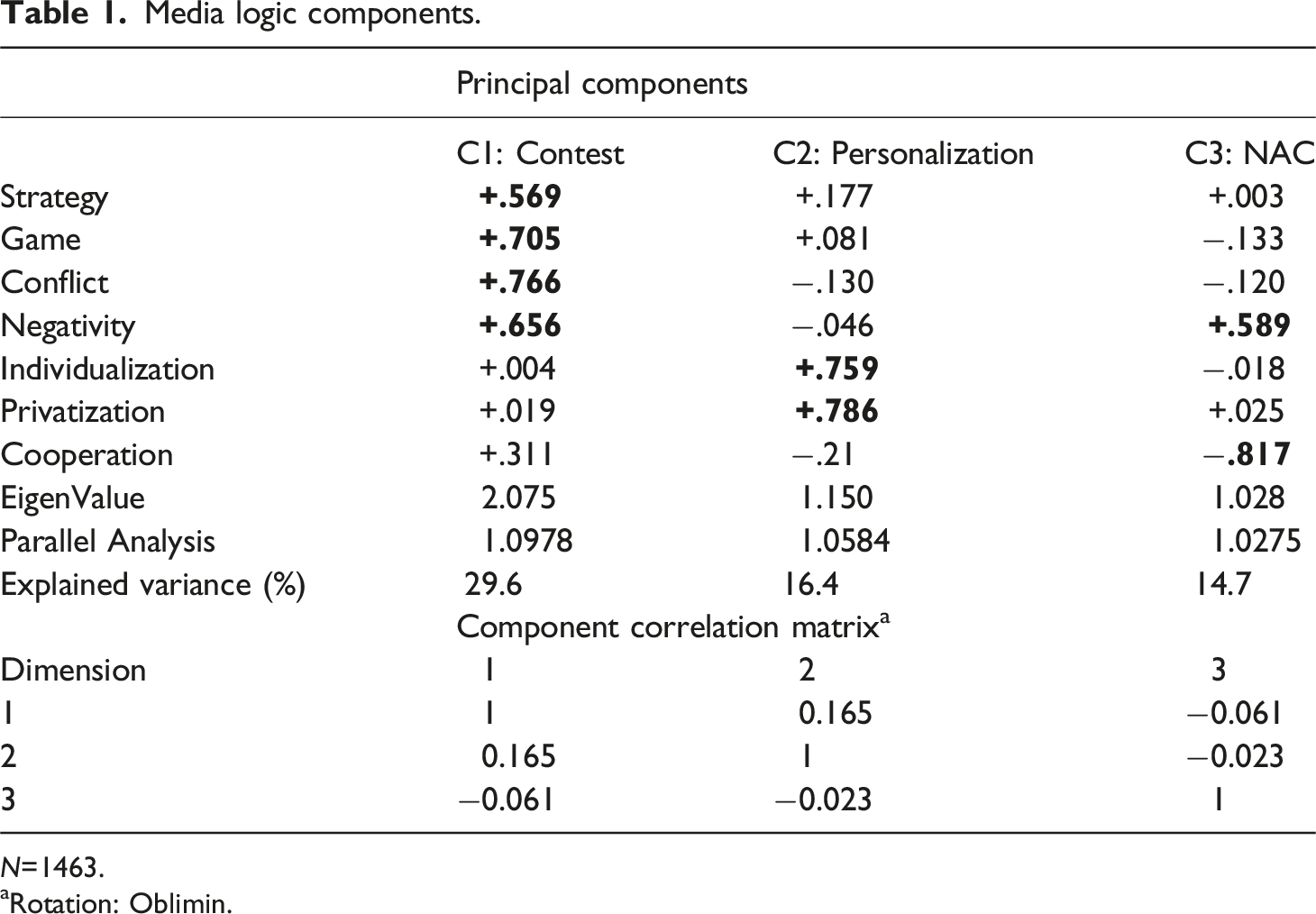
N=1463.
aRotation: Oblimin.
The first component (C1) comprises four CEMLs: strategy, game, conflict and negativity. Since this component strongly resembles Takens et al.’s (2013) contest frame, we labelled it the ‘contest component.’ The second component (C2) comprises individualization and privatization, which we labelled ‘personalization’ since it is consistent with this well-established concept (Van Aelst et al., 2011). The third component (C3) comprises negativity and cooperation, with cooperation having a negative loading on the component. We labelled this component ‘negativity in the absence of cooperation’ (NAC). The correlation matrix shows weak relationships (<0.3) between the three components.
Results of the logistic regression models predicting the occurrence of media logic in coverage.
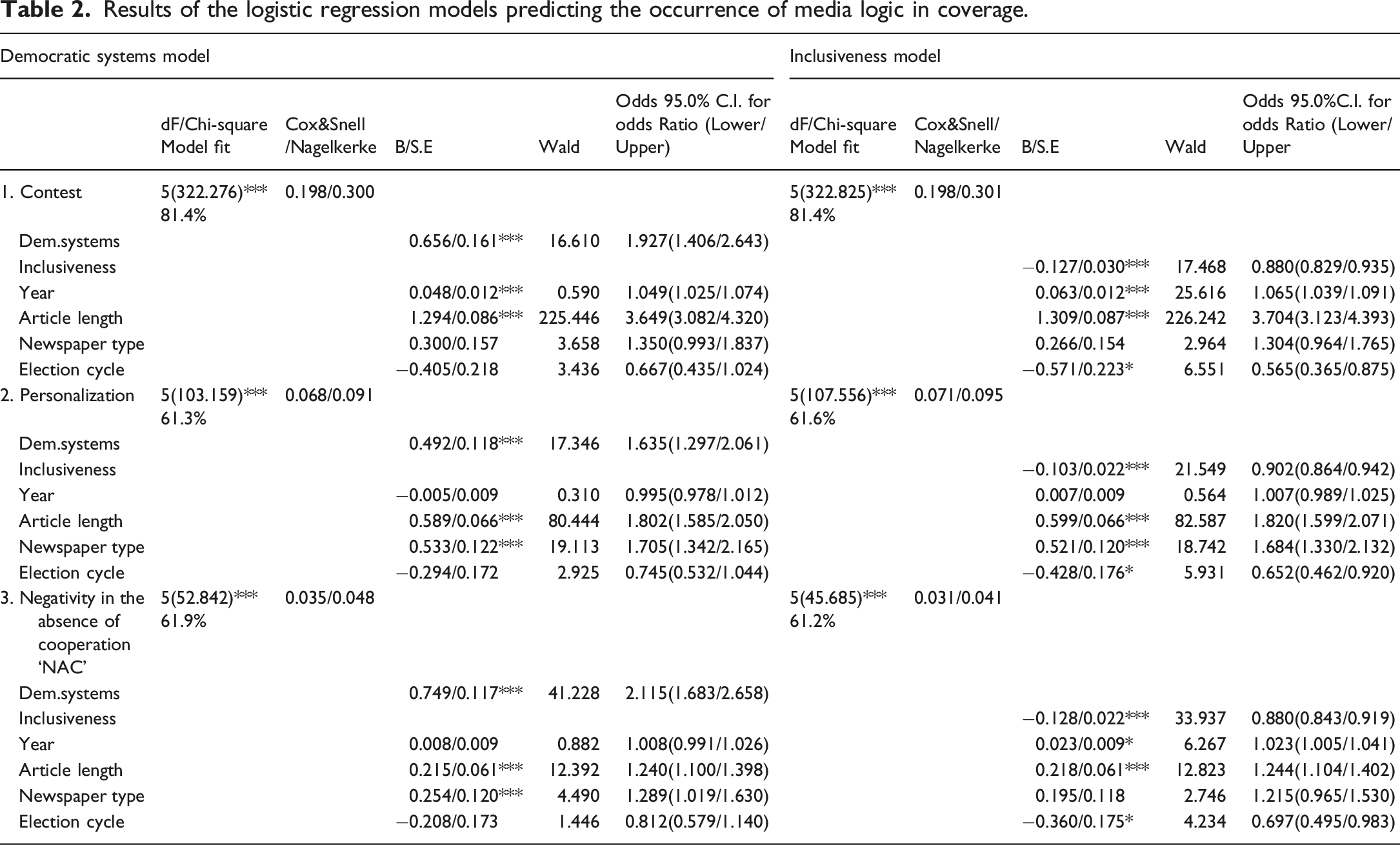
Prior to this analysis, we tested for multicollinearity and found a bivariate correlation of −0.88 between democratic systems and inclusiveness, which indicates multicollinearity is present, and we therefore opted for two separate models.
Our first model, labelled the democratic system model (DSM), included the democratic system as an independent variable. The second model, the inclusiveness model (IM), instead used the inclusiveness variable. We also added a year variable to both models.
In addition, we included article length as a control variable in both models. We found that all our CEML components are likelier to occur in longer articles. We also included the newspaper type as a control variable but did not find this significant in either model. However, personalization had a positive and significant b-coefficient in both models, indicating that this component is more commonly found in popular papers. Further, the NAC component had a positive and significant b-coefficient in the DSM, indicating this component is only significant in that model.
In addition, we included election cycle as a control variable. Although we did not find any significant influence of this control variable on any DSM component, it had a significant effect on all the IM components. That is, the IM produced negative and significant b-coefficients for the contest, personalization and NAC components, indicating that these three components are less likely to occur in a campaigning period.
Both models were statistically significant for all the variables (N=1.463, p<.001), indicating that the models were able to distinguish between articles with and without each of the CEMLs.
Democratic systems model
The DSM shows positive and significant b-coefficients for contest, personalization and NAC, indicating that these elements are more likely to occur in the UK than in the Netherlands. This finding supports H1 given that we consider NAC to be the opposite of cooperation. The DSM predicted odds ratios of 1.635 for personalization and 2.115 for NAC. This indicates that, after controlling for all the other factors in the model, personalization is 1.635 times more likely to occur in UK coverage and NAC 2.115 times more likely than in the Netherlands.
Inclusiveness model
To assess whether the more refined majoritarianism-versus-consensus variable, that is the inclusiveness of the national government, better predicts the incidence of the CEMLs, this measure replaces the democratic-systems variable, used in the DSM, in the IM. The IM subsequently shows negative and significant b-coefficients for contest, personalization and NAC, indicating that when inclusiveness increases, these components are less frequent in the coverage. This finding aligns with H2, which posits that a majoritarian context provides more fertile ground for CEMLs than a consensual context. In terms of odds ratio, inclusiveness as a predictor variable scored 0.880 for both contest and NAC, and 0.902 for personalization. These odds ratios indicates that, after controlling for all other factors in the model, the contest and NAC components are 0.880 times less likely to occur when inclusiveness increases by 1, and personalization 0.902 times less likely to occur.
Model comparison
When comparing the DSM and the IM, we see that the former is better at predicting the occurrence of NAC whereas, for personalization, the IM provides a better fit. Both models provide a similar fit for the contest component. From this, we conclude that whether the democratic or the IM best predicts the incidence of CEMLs in news coverage depends on how the media logic is expressed.
Effect of time
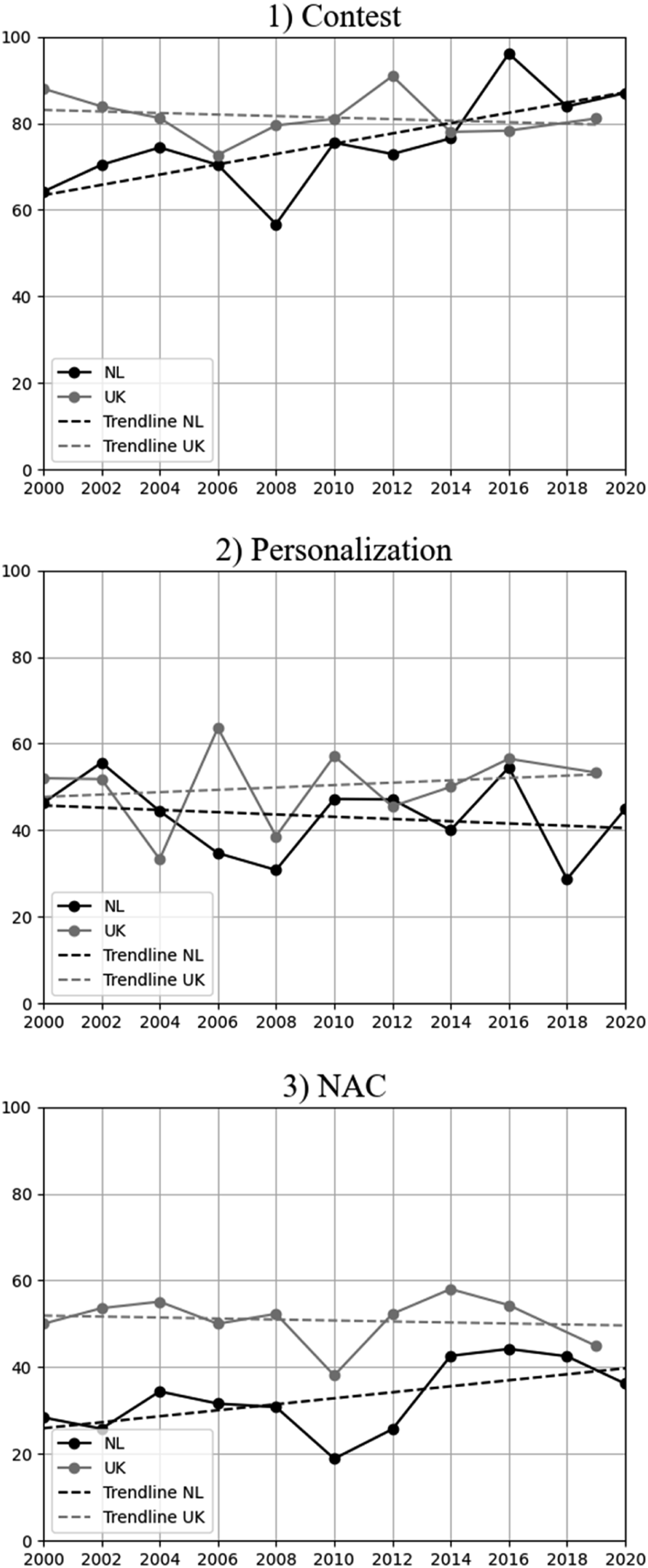
To show how the occurrence of CEMLs has developed over time, we visually interpreted the incidence of components from year to year (see Figure 1). Overall, the graphs indicate roughly linear relationships, which allows us to exclude other patterns. Over the full 2000–2020 period, we see, in the Netherlands, an increase in the occurrence of the contest and NAC components, and a decrease in personalization. In contrast, in the UK, we observe decreases in contest and NAC and an increase in personalization over time. Nevertheless, one should be cautious about making strong claims of linearity since there are significant fluctuations. Coverage (%) of media logic components between 2000 and 2020.
1
When we analyse the effect of the year of publication, we find that the DSM produces a significant positive b-coefficient for contest but no time effects for personalization and NAC. The odds ratio for contest is 1.049, indicating that, as we move from 2000 to 2020, contest is 1.049 times more likely to occur with every 2-year period that passes.
When we similarly analyse the year of publication in the IM, the model shows positive and significant b-coefficients for contest and NAC. Contest has an odds ratio of 1.065 and NAC 1.023, indicating that, as we move from 2000 to 2020, contest is 1.065 times, and NAC 1.023 times likelier to occur with every 2-year period that passes. The year variable did not have a significant influence on personalization.
Conclusions and discussion
This study has evaluated the proposition that the democratic systems and the political constellation of national governments have influenced the frequency of CEMLs in political news coverage in both majoritarian and consensual democracies between 2000 and 2020. The underlying factor structure of our model with seven CEMLs shows a three-component solution (thereby answering SQ1). The contest component comprises the strategy, game, conflict and negativity CEMLs and strongly resembles Takens et al.’s (2013) contest frame. The personalization component includes the individualization and privatization CEMLs, and is consistent with the well-established concept of personalization (Van Aelst et al., 2011). Finally, the NAC component includes negativity and the absence of cooperation. Further, the components do not correlate with each other, suggesting that they represent clearly distinct patterns of coverage and should be treated as such.
Supporting H1, on the relationship between media logic and democratic systems, we find that all three components are more likely to occur in the UK than in the Netherlands. In addition, and in line with H2, we find a positive correlation between electoral expressions of majoritarianism in the political constellation of the national parliaments and national executives and the presence of all three components.
Answering SQ2, both the DSM and IM models show a significant increase over time in use of the contest component, and in the latter of the NAC component. However, the results found no significant increase in the use of the personalization component in either model.
Controlling for article length showed that, not surprisingly, all three components are more likely to occur in longer articles. On controlling for newspaper type (between broadsheets and popular publications), we found no significant effect for contest in either model; for personalization we identified significant effects in both models, and for NAC only in the IM. That is, the latter two components are more common in popular newspapers than in broadsheets.
On controlling for election cycle, our analysis indicated that this control variable had no significant effect on any component in either democratic system. When controlling for inclusiveness, we saw that this had a significant effect on all three components, suggesting that the contest, personalization and NAC components are less likely to occur during a campaign period than at other times. A plausible explanation is that covering the opening of the parliamentary year is less important in terms of political campaigning as policymaking typically takes place after elections.
Our results have theoretical and societal implications. First, we find that, notwithstanding global and transnational influences on the media industry, differences between countries contribute to explaining differences in coverage (see also Humprecht and Udris, 2019). Second, our results indicate that, for the personalization component, the more dynamic majoritarianism-versus-consensus variable, that is the inclusiveness of the national government, provides a better explanation for how political news is presented than the cruder democratic-systems variable. However, for the NAC component, the democratic-systems variable is a better predictor. Third, the differences in the prominence of the tested CEMLs reflect key features of democratic systems, with there being a greater presence under majoritarianism, both as regards cross-country variation in democratic models and within-country variation in the inclusiveness of the national government. Fourth, our paper illuminates how the democratic system impacts the occurrence of CEMLs in newspaper coverage. For example, the increased use of the contest CEMLs could inflate tensions between political actors, which might lead to legislative gridlock (Jones, 2001). The extent to which CEMLs might impact political behaviour and systems warrants future research.
Our study naturally has limitations. First, our data selection focussed on a ritualized political event. We did so believing that covering a highly ritualized event that includes a range of policy topics would allow us to study media patterns in Western democracies beyond the specific event covered, and would have the advantage of reducing the influence of particular topics on the occurrence of CEMLs (Damstra et al., 2021). However, studying a specific event could reduce the generalizability of our findings. Second, for pragmatic reasons, we only collected data for every other year during the 2000–2020 period while including every year would have increased the robustness of our findings. Third, to reduce the possible impact of differences in the political ideologies of newspapers on our results, we included only right-leaning newspapers. This has the downside that this selection limits the possibility to generalize to other types of newspapers. Fourth, while our study, by including seven CEMLs, is more ambitious than most studies that have analysed news content, which often focus on only one or two elements as de Vreese et al. (2017) observe, our selection is not exhaustive since many more CEMLs can be identified (see Lecheler and De Vreese, 2019). Given the sheer number, it would be almost impossible to include all of them, and we believe that our selection is sufficient to compare coverage across and within divergent democratic systems. Fifth, disentangling editorial intent in any large-scale content analysis is difficult (Cushion et al. 2016) and goes beyond the scope of this study. Indeed, the precise logic behind the selected content elements, and the answer to the question of whether they have political and/or media origins, is often unclear. Research that operationalizes the drivers of media logic could be better able to disentangle the two logics. Sixth, our inclusiveness measure adopts a well-established operationalization that is typically used in large-scale comparative research. However, on reflection, Ganghof’s ENP measure lacks some contextual sensitivity, particularly when it comes to national cabinets. Although the measure correctly identifies the minority governments that were established in 2010 in the Netherlands and in 2017 in the UK as both being fairly exclusive, in the Dutch case the governing coalition still cooperated closely with many opposition parties. Hence, in practice, the then national executive was considerably more inclusive than the ENP score suggests. A more refined approach could consider such contextual factors but would require a more subjective interpretation of ambiguous political processes, for which reason we refrained from such an exercise.
Overall, our main finding is that cross-country differences in terms of majoritarian versus consensual democratic models can contribute to predicting the incidence of CEMLs. What we add to the literature in this respect is that, in future research, there is good reason to also incorporate the inclusiveness of the national government. The justification for this is that this measure better accounts for subtle variations in the majoritarian versus consensual decision-making practices within countries and, thereby, provides a better explanation for the occurrence of most of our seven elements in political news coverage than the cruder structural characteristics of democratic systems. Such a complementary approach could improve our understanding of how political news changes as a consequence of marketization.
Footnotes
Declaration of conflicting interests
The author(s) declared no potential conflicts of interest with respect to the research, authorship, and/or publication of this article.
Funding
The author(s) received no financial support for the research, authorship, and/or publication of this article.
