




Abstract
Digital journalism and its research have evolved significantly over the last twenty-five years. When the first online media were installed on an experimental basis in the mid-1990s, neither media companies nor scientific observers expected them to transform the way journalism operates. However, very soon after these humble beginnings, a seemingly infectious euphoria spread among journalism scholars who hoped to rejuvenate journalism and democracy with the help of user participation and a resulting “dialogue with the audience.” Still, many of these promises remained unfulfilled, and this led to considerable disenchantment of academics with online media and user participation during the second decade of the 2000s. Indeed, current journalism scholars exhibit a preoccupation with fears of disinformation and forms of “dark” participation. This essay analyzes the process of co-evolution in digital journalism and academia from the personal perspective of a European scholar. Four broad empirical phases are discussed: (1) niche, (2) euphoria, (3) disillusionment, and (4) doom and gloom. Using this typology, a fifth phase will be suggested to extend the current state of the field.
Keywords
“Time’s arrow is the loss of fidelity in compression. A sketch, not a photograph. A memory is a re-creation, precious because it is both more and less than the original.”
(Liu, 2016: p. 195)
Introduction: Lived stories of (online) media development
When I grew up in a small South German city in the 1970s and 1980s, media and information sources were as limited as they were predictable. There were newspapers and public service television channels for “indisputable” facts and political opinions, the movie theatre for entertainment and socializing, and the radio for new music. Radio songs often ended up on badly pieced-together mix tapes; vinyl records were extremely desirable, but equally expensive. Then, there was the landline telephone for reaching your friends to chat or organize in-person meetings. Using the phone came with the risk of parents picking it up or someone overhearing personal conversations—especially since most households had just one or two telephones, with the main apparatus conveniently placed in the living room. For top-secret talks, one had to resort to the dreaded public phone booth—a sordid place that smelled of cigarette smoke and housed the remains of a half-rotten phone book hanging from a bent mounting. Initially, this little media universe was analogue, but video and computer games soon expanded the media portfolio in the late 1970s and early 1980s—at least for the nerds among us.
Customary use of computer technology was not yet a given when I started studying at a large university in the early 1990s. I remember students discussing with their lecturers whether handwritten essays were still acceptable. Professors were using overhead projectors, and some had assistants whose sole job was to manually move forward the transparency foil with scribbled notes and diagrams during the lecture. My first contact with the world of computer networks was via a fellow student who had an acoustic coupler that he used to dial up computers overseas—a slow and excessively costly procedure prone to failure. Progress was quick, though. During my study time, my friends and I started to build DIY computer networks in our dormitory by feeding thick cables through holes we drilled into the walls. Soon after, the first modems arrived in our student homes.
It was not until I started to work as an academic in the late 1990s and early 2000s that online journalism became a relevant topic in society—and in communication research. Initially, it was not taken very seriously, even within certain realms of journalism research. Many of my established colleagues believed that the Internet hype would eventually disappear, and people would continue to subscribe to print newspapers, as had “always” been the case (a sentiment shared by many publishers at that time). Of course, as the current state of journalism demonstrates, these predictions would prove to be way off the mark.
This personal trip down memory lane may feel like traveling back to the ancient times of media development—but in fact, we are only talking about a few decades of media evolution. Indeed, the past experiences described here are likely still shared by significant parts of the academic community and society. This form of “experienced media history” poses some problems, though. When reflecting on one’s personal memories, often the perception of time is compressed or stretched. Things may not have happened when we think they did, and sometimes not in conjunction with other developments that we perceive as synchronous. We try to make sense of this by attributing causal connections in hindsight (Hawkins and Hastie, 1990), as we assume causality and time to be related (Faro et al., 2005). Thus, events happening in short sequence are likely to be perceived as part of a causal chain. Indeed, this fuzziness in remembering and telling stories about ourselves is well researched (e.g., Barclay, 1993; Fivush, 2008). As Daniel Kahneman notes in relation to a concept by Nassim Taleb: “Flawed stories of the past shape our views of the world and our expectations for the future. Narrative fallacies arise inevitably from our continuous attempt to make sense of the world” (Kahneman, 2011: p. 189).
This phenomenon is not only true of our personal stories as individuals. Academics, even whole disciplinary fields, tend toward such narrative “fallacies” by searching for causality when there is none, or by extrapolating a future in a simple and linear fashion from a limited set of observations. Indeed, this is not unheard of in our own discipline (Quandt, 2018). This raises the question: is the stated intent of this special issue and its introductory article—namely, making sense of the past twenty-five years of digital journalism (research)—a fool’s errand? Not necessarily, depending on one’s goals and expectations. Despite their obvious shortcomings for some purposes, experienced history and personal perceptions are not without value. Rather, they lead to different insights than external, “objective,” and cold descriptions of events. What may seem like a fallacy (when understood in terms of an impartial and fair “representation” of a past) may be alternatively seen as an attempt to structure and theorize one’s own past in a process of meaningful construction (Bateson, 2001). Further, it may be argued that the very idea of a “faithful” representation of the past is misleading in that context, as it implies a naive realism that is not adequate for understanding the past—not just as a series of events, but also and foremost as human experience.
In this sense, the current article follows such an alternative concept of lived history: it presents one possible construction of the past, told from the perspective of a European scholar who recounts a story of experienced history over several chapters. This essay tries to find narrative coherence in a stream of events happening over the course of two and a half decades, in full awareness that the coherence may just be a very personal one. 1
Twenty-five years of online journalism (research) in Europe and beyond: General observations
Digital journalism and its research have come a long way in the last twenty-five years. A core piece of this article is the differentiation of this bumpy and complex development into different phases from a European perspective (s. Figure 1). However, there are some cross-national or even global similarities—some of them may be so seemingly mundane that they are never spoken of, and some have been forgotten over the course of development. Therefore, it is relevant to remember how this all started. The introductory trip down memory lane is not just a stylistic device—it is meant to give context to the historic situation. 2 The reference point for both journalism and its academic observers at that time was a stable system of media that seemed to be a given, one that made journalism quite profitable in many places. Accordingly, “online” outlets were first deemed to be experiments with a limited user base in a primarily academic, “techno-geek” milieu. What seems to be ubiquitous and a necessity today was not relevant for large audiences back then, and many journalists regarded the online outlets as technological field tests rather than professional journalism. In many ways, online journalism started from scratch and had to find its niche, often against the existing structures and routines in the media system.
Despite this obvious commonality, there are stark differences between countries and cultural and language zones. While in many places, the first experimental online news outlets emerged from the mid-1990s, there was no joint zero-point—not in terms of a common start date; not in terms of the socio-political and technological environments; and not in terms of a similar subsequent speed and trajectory of the ventures’ progress. The differing speeds of development can be linked to numerous factors. These include the economic situations and structures of the tech sector, levels of technology acceptance, regulative situations, media system structures, political support or intervention, and cultural aspects (such as a risk-taking attitude). The USA, for example, is often perceived as being ahead of Europe in terms of online development due to the many underlying technologies being developed in its thriving tech sector—but this perception represents only part of the truth and carries a certain “winners bias.”
As a matter of fact, European countries have tended to favor state-supported (or state-controlled) and centralized data retrieval and information systems in development since the late 1960s and early 1970s (Gillies and Caillau, 2000; Briggs and Burke, 2002). Back then, national videotex systems like Prestel in the UK, Btx in Germany, and the very widespread Minitel in France already offered some functions of today’s Internet (e.g., information retrieval, forms of two-way communication, and news), but the organizational ideas and many technological aspects were strongly based on the notion of state monopolies (i.e., national post and telephone systems). One could argue that these systems were more developed as a usable infrastructure than the sometimes gimmicky and academic experiments that led to the Internet. Most of these systems were not successful in the long run, however, due to a price structure that made them unattractive to most users. This is why these systems did not feature in my personal introduction; they never ended up in the hands of an average person. The most successful videotex system, Minitel, was an exception, though: It gained millions of users in France because it was heavily subsidized—the end device was handed out for free to users to replace their phone books. Even this pervasiveness of Minitel devices, however, only contributed to the very slow adoption of the Internet in the country (Brousseau, 2003). Ultimately, the head-start into the online world turned out to be a disadvantage.
By the second half of the 1980s, the idea of national videotex systems was failing in most countries. In parallel, networking across national borders became a more viable option with the Internet. Here, the affiliation to language zones turned out to be a crucial factor. Media from the large English language zone had a natural advantage over media from smaller or even national language zones, as it offered access to many more users and therefore a potentially much larger market. In short, not all “online journalisms” were created equal, and they also did not co-evolve in perfect sync (s. also Singer et al., 2011).
The (potential) emergence of a new field with such broad variability and promising opportunities for innovation in journalism also made this a very exciting research area for upcoming scholars around the turn of the millennium. Moreover, the diverse implementations and varying speeds of online journalism across European countries made this field even more appealing—it quite naturally called for explorative, comparative approaches. It may be no coincidence that the early development of online journalism was paralleled by the formation of an international research community driven by a joint fascination and a strong interest in comparing findings. It may also be no coincidence that European scholars played a significant role here. Indeed, many of these researchers became central actors in the development of journalism studies, which in the subsequent years would thrive in terms of output, the broadening of topics (Schatto-Eckrodt and Quandt, 2023) and institutionalization (Hanitzsch et al., 2005). This does not imply a full “reset” of journalism research, as there were strong academic traditions and some skepticism regarding the future relevance of online communication in some countries (s. also Niche below). In the end, however, the success of both online communication and its research was inevitable.
The flow of time: A (re)construction of the four phases of development
As discussed, the development of digital journalism and its associated research has been far from uniform or linear. The flow of time can be broken down into four phases, potentially followed by a fifth: (1) niche, (2) euphoria, (3) disillusionment, (4) doom and gloom, and (5) normalization (s. Figure 1). These phases are roughly tied to key socio-political events and technological developments that enabled and influenced the emergence of digital journalism—and later reverberated in digital journalism research. Twenty-five years of digital journalism research—factors of influence and key events.
7
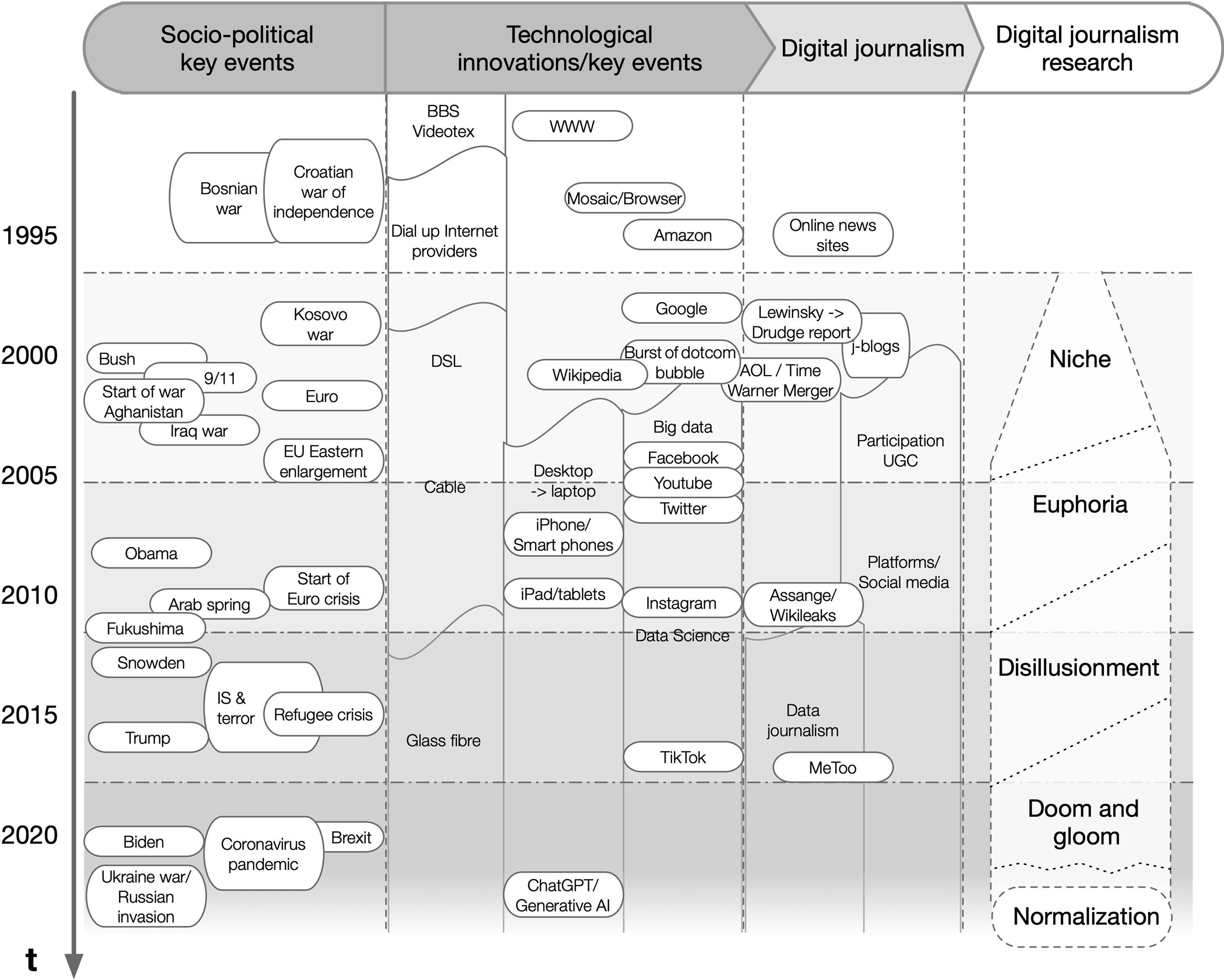
Niche
The start of the online revolution can be fittingly described with a famous quote: “Big things have small beginnings.” 3 Indeed, the beginnings of digital journalism were rather miniscule. To fully understand this, one has to remember the reality of the news system in the early 1990s. Back then, scholars still commonly referred to audiences as “recipients”, portraying them as endpoints of a one-way street of information. News was still being primarily produced in institutionalized, “traditional” media houses. As outlined in my personal story, computers were just gradually gaining traction as work tools in the form of PCs, but computer networks and “online access” for the average user were still in their nascent stages.
The Word Wide Web went public in 1991, the first mainstream compatible browser Mosaic was introduced in 1993, and its main developer Marc Andreesen released the highly popular Netscape Navigator a year later. “Popular,” however, referred to a small group of users—in the mid-1990s, less than one percent of the world population had Internet access, with the overwhelming majority in the United States. 4 The first online news sites started on an experimental basis in 1994, such as Time magazine or the German Spiegel (Rada, 1999)—but again, largely without an audience. As media houses could not invest in substantial newsroom staff for next to no users, initial online news relied heavily on “shovelware”—content that was copied from the parent medium, often without edits. Accordingly, news and information flows relied on the established media. In Europe, these were preoccupied with the conflicts and wars that followed the disintegration of Yugoslavia.
Early research on “computer-mediated communication”—or other unwieldy terms for describing the new field—tried to grasp what was happening in this strange, new, “interactive” world, often coming from an old media logic with no ready-made concepts of description or understanding. I remember vividly how researchers at conferences would excitedly discuss the difference between “interaction” and “interactive” (for a few snippets of this, s. Jensen, 1998; Kiousis, 2002). Back then, “search engine research” was an extremely hot topic (Introna and Nissenbaum, 2000). While this may sound a bit like “researching Google” as a platform, it is important to remember that Google was founded by two PhD students in 1998, and many of today's central players in the online world did not even exist at that time. Consequently, the early approaches were trying to untangle new and confusing phenomena on foundational, technological, and communicative levels, but they were drawing from familiar ideas of established media ecosystems. Unsurprisingly, this was paralleled by the suspicion that this latest fad might disappear after a few years or that these bold assumptions of the “hyperactive media user of the future” (Schönbach, 2001) were somewhat over the top.
One of the first key events to hint at the power of online news happened in 1998 with the “Drudge Report.” This was essentially a gossip and news aggregation site, but it triggered a monumental scandal when it revealed that Newsweek was deliberately not publishing a story on US president Bill Clinton’s sexual relationship with an intern, who was later identified as Monica Lewinsky. The scandal contributed heavily to an impeachment trial against Clinton, and this became the object of global news for months. While Drudge was not the originator of the story, the event still underlined that online news—of some form—could have an impact due to its speed and directness. Coinciding with this, “j-blogs” became increasingly popular around the turn of the millennium (Singer, 2005). These were weblogs run by (mostly mainstream) journalists as a news and comment outlet. The j-blogs often exhibited a more explicitly opinionated tone than the journalists’ “home” media. Academics described j-blogs as a “cross between a column, a news story, and a journal” (Robinson, 2006), or more pointedly, as “black market journalism” (Wall, 2004).
The fantasies regarding the opportunities of the online world were not only inspired by the Lewinsky case but also by the immense growth of the dotcom market in the late 1990s. This era saw huge gains in user numbers and investments, especially among promising dotcom companies in the US. Anything that looked remotely like a viable idea for an online business was supposed to be “the next big thing.” In researching the socio‐political foundations of the “network revolution,” I spoke with various experts in Silicon Valley. One of the interviewees, a professor at Stanford’s Computer Science Department, remembered these times as follows: “We had more than once a person (…) going office to office asking everybody, ‘I have money. Do you have a good idea for a startup?’ Somebody who wanted to invest. (...) He wouldn’t know whether it’s a secretary you were talking to or a graduate student or a professor. He would ask everybody. They were just desperate to find something to invest in.”
Excitement, overconfidence, greed, herd mentality, stupidity—there was a little bit of everything mixed into the economic irrationality of these times. One should not forget that most of these companies were far from profitable, and most online users had expected services on the Internet to be free (including news). Further, development in the US was still ahead of that in other countries. Whole parts of Europe lagged behind (Roser et al., 2005), and other parts of the world were largely “nonline.” Simply put, the market was growing, but it was still small by today’s standards. At the height of this exaggerated bubble, online company AOL announced plans to merge with Time Warner to form the biggest media company in the world. The deal closed a year later.
The inevitable burst of the speculative dotcom bubble in 2000 led to a dampening of expectations in the business and financial world, but not so much in academia and journalism studies. Here, the “impact of technology on journalism” (Pavlik, 2000) was deemed to be profound and irreversibly transformative. Indeed, the very same year, John Hartley (2000) published a (then quite divisive) conceptual piece in the very first issue of Journalism. It outlined a “communicative democracy in a redactional society” with the help of the Internet. And a new generation of researchers hoped that “online” would be a fountain of youth for journalism—a profession they perceived as being in a state of institutionalized crystallization, with a lack of connection to its audiences. They hoped for the inclusion of citizens in the news-making process and for revolutionary new forms of storytelling (Bowman and Willis, 2003; Deuze, 2003; Pavlik, 2000). In aiming for no less than to “save journalism” (Quandt 2018), euphoric scholars smelled the seductive scent of an academic revolution.
Euphoria
What would become a decade of academic excitement started with a global shock: the terror attacks on the 11th of September, 2001, and the USA’s subsequent military intervention in Afghanistan. Many view 9/11 as a changing of eras. It exposed vulnerabilities but also strengths of Western communication systems and journalistic crisis response. Indeed, there was chaos and confusion during the attacks and the days that followed. However, many media also reported directly from the scene in real time; 9/11 may well be one of the most broadly documented news events of all time. The initial chaos also extended to the online world, where many sites crashed due to the masses of information-seeking users trying to access them at the same time. Some media houses managed to react accordingly by reducing their picture-heavy, bandwidth demanding sites to simple data-saving text versions (Quandt, 2005). In the aftermath of 9/11, many news providers strengthened their online capacities to meet the increased interest in online journalism. As cruel as it may sound, the tragic events of 9/11 contributed to the success of online journalism. News sites showed the potential of online journalism for “in time” news production, and they opened the door to the digital world for many users who had previously relied on traditional media.
For the US, the initial years of the decade after 9/11 were politically dominated by the aftermath of the terror attacks and the subsequent wars in Afghanistan and Iraq (from 2003). The EU was busy with its new currency in many member states (i.e., the Euro) and with the Eastern enlargement in 2004 and 2007. In parallel with these large-scale political developments, technology was leaping forward. Online connections were becoming faster and more affordable, bringing them into reach for many societal groups and applications. Stationary desktop computers were being replaced by portable laptop computers, making mobile use a much more viable option for the average end-user. This was amplified by the introduction and success of the iPhone in 2007 and, subsequently, similar smartphones from other companies, which gradually turned into a new class of devices that were essentially networked computers in one’s pocket. 5 The success of these devices was also made possible by the quick succession of improved wireless standards and mobile infrastructure (West and Mace, 2010).
This combination of factors—the expansive socio-political situation in Europe, technological advances such as better and faster access to the online world, and the massive growth of user numbers—all contributed to the prospering of online journalism. It started to look “sexy” to both academics and media businesses, despite rarely being profitable. In particular, the idea of a participative, social Internet (popularized by Tim O’Reilly and the term Web 2.0) sparked the imaginations of scholars and managers. The former group hoped for a more democratic society supported by highly involved citizens turned spare-time journalists; the latter hoped for free “user-generated content” provided by a willing lay workforce. At this time, the concept of participation was still largely limited by the horizon of the existing system: it was conceived as an extension or transformation of journalism (e.g., user-generated content, debates in forums, and journalistic blogs). Indeed, most of the major “platforms” that play a central role in today’s information flows did not yet exist at the beginning of the millennium; many began to rise in the second half of its first decade.
The burgeoning academic euphoria regarding the future of online journalism can be seen reflected in incredibly hopeful titles of books and articles from that period. In line with Hartley’s earlier work, Gillmor (2004) proclaimed a “grassroots journalism by the people, for the people” in We the Media. Deuze, Bruns, and Neuberger (2007) suggested “Preparing for an age of participatory news”, and Rosen (2006) famously declared readers, listeners, and viewers to be “the people formerly known as the audience”. 6 Concepts from that period also mirror the notion of a paradigmatic change in the news production process. Bruns (2008) coined the term “produsage” to denote the amalgamation of production and usage. Personally, I worked with an international group of researchers on a conceptualization and comparative exploration of “participatory journalism” (Domingo et al., 2008).
While this enthusiasm may seem naive and borne out of normative—maybe even utopian—ideas of the future, proof exists that the options of online and mobile communication had a notable impact on information systems, politics, and democratization. The Arab Spring (from 2010 to 2012), for example, is perceived as driven by the opening up of information systems. Autocratic regimes could no longer control the flow of information, and networked protesters were able to use mobile and social media to coordinate their actions (Howard et al., 2011; Tudoroiu, 2014).
In the second half of the “euphoric” phase, journalism researchers broadened their focus beyond the online activities of journalistic actors and the inclusion of user-generated content and participation. They started to delve into new social media platforms and online services that emerged in the mid-2000s, such as Facebook, YouTube, and Twitter. The idea of “ambient journalism” (Hermida, 2010), which emphasizes both the pervasiveness of news from a multitude of sources and the active engagement of citizens with such content, led to the realization that the gatekeeping power of journalism was fading (Singer et al., 2011)—and that the whole news and information system was undergoing a substantial transformation process with an unclear outcome. Ironically, the broad success of ideas enthusiastically embraced in the euphoric phase led to significant socio-political problems later on and contributed to some of the disillusionment that followed. The radically democratic idea that “everyone is a journalist, and journalism is everywhere” (Hartley, 2008: p. 45), espoused in the early phase of digital journalism research, not only troubled the profession with differentiation issues (i.e., ... then who really is?). It also became increasingly evident that not everyone wants to be a journalist. More often than not, people outside the profession who do so or claim to be one may not always be motivated by the best interests for democracy.
Disillusionment
Europe’s start into the second decade of the 21st century was bad, at least economically. The Euro crisis (from late 2009) brought many countries to the brink of financial collapse. However, this was not the only issue the continent faced. The nuclear disaster in Japan’s Fukushima created a stir in Europe, leading to a change in energy politics in several countries—especially Germany. Further, developments in Northern Africa and the Middle East following the acclaimed Arab Spring resulted in disenchantment, the outbreak of civil wars, and the destabilization of the region. This contributed to the rise of Islamist extremist groups. In particular, the territorial gains of the Islamic State (ISIL) in Syria and Iraq from 2014 (and the international counter-reaction of a military coalition led by the USA) were paralleled by numerous terror attacks in Europe, especially between 2014 and 2016. Further, the refugee crisis in 2015, with more than a million people (mostly from Syria) requesting asylum in Europe, led to massive political tension. In short, these were times of growing fears within societies, both politically and economically, and these fears were amplified by key events relevant to digital journalism.
In 2010, a political affair demonstrated the growing power of online information sites. Wikileaks, which specialized in leaking secret information to journalists and the public via their website, released US diplomatic cables and army reports that they got hold of from whistleblower Chelsea (then Bradley) Manning, an American army analyst. This set off a massive worldwide scandal about misconduct and the potential war crimes of the American military. However, this also led to Manning’s conviction based on the Espionage Act and the persecution of Wikileaks founder Julian Assange (as the leaks were interpreted as treason and espionage by the USA). In many academic circles, and especially so in Europe, Manning’s conviction was perceived as disappointing and the persecution of Assange as relentless. It was argued that whistleblowing should be protected in democratic countries because it serves the public.
The second big leak in the 2010s was arguably even more significant from a European perspective. Whistleblower Edward Snowden, an American computer intelligence consultant who worked for the National Security Agency (NSA), revealed massive global surveillance programs involving Western governments and telecommunication companies. Snowden’s documents revealed that the US and other governments were secretly accessing, collecting, and analyzing data from both their own citizens and those of foreign nations. This large-scale harvesting of data from—also European—users massively undermined trust in the US, involved governments, tech companies, and in online communication in general. It seemed that over the course of a few years, the promises of an open, participative democracy with the help of digital media had turned into a nightmarish vision of total surveillance. Further, it did not help that Snowden fled the USA, finally ending up in Russia, and was accused of espionage and treason. Again, critics argued that whistleblowers needed protection against state prosecution (Olesen, 2019). In the EU, journalists, politicians, and the public supported this notion, despite Snowden having applied for asylum in European countries to no avail. The European Parliament itself approved a “Whistleblower Directive” that entered into force in 2019 (Directive (EU) 2019/1937).
These grand-scale developments led to notable disillusionment in the democratic hopes that had dominated the second “euphoric” phase of digital journalism research. The general darkening of the socio-political atmosphere and the unredeemed promises of a participatory web cooled down the positive excitement for anything “online.” Congruent with these large-scale trends, the specific dreams for an inclusive, participatory journalism that was in dialogue with society were also vanishing quickly. Critical voices already noted early in the second decade of the 2000s that not every technological option was actually used by (or made sense for) journalism (Steensen, 2011). Many journalistic media deliberately limited the existing participatory options to very small pockets while largely retaining tight control over the production process (Singer et al., 2011). This created an obvious gap between normative expectations and a disappointing empirical reality. If there was a debate, then it was among users who had been sent to the walled gardens of discussion forums where they could only play among themselves. Many journalists seemingly did not have the time to interact with users, and some even had bad experiences with individual users that led to a defensive attitude. The limited integration of participatory options primarily happened within the logic of the journalistic system—either as a way to get “free” user-generated content (e.g., eye-witness accounts) or as a tool for strengthening user (a.k.a., audience) loyalty. Thus, digital journalism research came from “grand narratives of democracy” just to end up with “small expectations of participation” (Peters and Witschge, 2014).
Doom and gloom
Frustrations with the state of online communication vis-à-vis scholarly expectations were already very apparent by the mid-2010s. In the second half of the decade, these degraded into full “doom and gloom.” In a 180-degree turn, many academic works announced fear and failures instead of hopes, outlined vulnerabilities and dangers instead of options, and warned about the undermining of democracy instead of its strengthening by participation (Quandt, 2018). Compared to the hopeful titles of articles just ten years before (s. Euphoria above), the contrast is razor-sharp. Researchers now focused on “toxic talk” (Anderson et al., 2018) or partisan “incivility” (Muddiman and Stroud 2017). They identified a “cyberspace war” (Aro, 2016) and the need to “control the conversation” (Santana, 2016).
There are several reasons for this change, some of which resulted from the previous phase of disillusionment. The Snowden revelations contributed to fatalism among society and academia alike: online was everywhere, but surveillance was as well. This exacerbated the dwindling trust not only in governments, but potentially also the “other” on the Internet. However, the notion of surveillance being a seemingly irreversible side effect of online communication predates the Snowden case. According to Zuboff (2019), surveillance is a systemic issue driven by unleashed capitalism that monetizes personal behavioral and communicative data. Simply put, harvesting data was already accepted as a foundational principle of online companies. One may argue that Snowden’s leaks were probably shocking, but still in line with the assumption that personal data was used by third parties.
A highly relevant key event that contributed to the U-turn of research was the 2016 US election campaign and the subsequent presidency of Donald Trump. The online election campaign was perceived early on as controversial, or even “dirty,” in terms of mutual accusations and even disgust of the candidates (Persily, 2017). Further, the use of bots in the campaign fueled fears of the democratic public being increasingly manipulated by one-sided or even false information (Bessi and Ferrara, 2016; Howard et al., 2018). Growing polarization in the country during Trump’s presidency—advanced by partisan media and online influencers (among them, the president himself)—caused massive worries in Europe.
Indeed, in many European countries, there were apparent signs of populism rising in the politically heated situation following the refugee crisis. Right-wing online media and online influencers contributed to this, somewhat echoing developments in the USA (albeit in different socio-political contexts). In a highly cited conceptual piece, Holt, Figenschou and Frischlich employed the term “alternative media” as an umbrella concept for such outlets that “position themselves as correctives of the mainstream news media” in the sense of a “counter-hegemonic alternativeness” (Holt et al., 2019: p. 860). Further, researchers identified attempts to manipulate and destabilize online publics in democratic countries from the outside. As a well-known example, the rather ironically named “Internet Research Agency” in St Petersburg (Bastos and Farkas, 2019) operated a multitude of fake accounts on Western social media and discussion forums to destabilize the respective publics and countries. The list of further events that contributed to the “doom and gloom” perspective on European news and information systems is long. There were obvious and well-documented mis- and disinformation attempts during Brexit, the Coronavirus pandemic, and, lately, the Ukraine war, often carried out or supported by “alternative” online outlets that claimed to be the “only ones that tell the truth.”
Personally, I labeled such “negative, selfish, or even deeply sinister contributions” (Quandt, 2018: p. 40) to the news-making process as “dark participation”, that is the “bleak flip side to the (…) utopian ideas” (ibid: p. 36) of the first phases of digital journalism research. However, this concept was developed in the context of a piece that was meant as a warning to not repeat the fallacies of the earlier phases by just looking at “dark” forms of particiation. I argue that replacing naive optimism with lithic pessimism does not solve societal issues, but contributes to the problems it aims to describe. And therefore, this socio-historic tour-de-force through the last twenty-five years of research should not end with such a depressive “end of all” phase. As de Vreese notes, we need to move “beyond the darkness” as “it seems important to balance our fascination with ‘darkness’ with questions about positive engagements with media” (de Vreese 2021: p. 215-216). De Vreese further asks a crucial question: “in the midst of worries about and research into trolling, incivility, conspiracy, mis- and disinformation, automated pollution of the information environment, populism, and democratic backsliding, is there also space for optimism and a positive research agenda?” (ibid.: p. 216).
From the past to the future: Toward a new phase of digital journalism research
The above overview was a wild race through twenty-five years of academic development, outlining the fascinations, insights, mood swings, and fallacies of a specific research field. Naturally, such an overview has to leave out more than it can include—this is a very compressed story in four short chapters. Notably, the article focused on a European perspective. It should have become apparent, though, that the USA is still very influential in this discussion, not only because of its dominant position in the discipline (Schatto-Eckrodt and Quandt, 2023) but also because of its relevance in socio-political and technological contexts. American and European perspectives do not fully match, however, as scholars explicitly or implicitly refer to very different journalistic systems and socio-political environments. This focus on the relation between the USA and Europe makes a glaring limitation of the article (and the field) all more obvious: most other parts of the planet are missing from the discussion. This is reflective of the dominance of American and European positions in journalism research in general (ibid.)—something that is deplorable but has been empirically true for the last twenty-five years.
There are further limitations here, many of which stem from the inherent constraints of a short article that cannot provide the intricacies of twenty-five years’ development. One limitation does not solely rest on the brevity of the article or the author but rather pertains to the prevailing state of the field at the time of writing: Pointedly said, it seems to be somewhat stuck in lamentation about the depressive realities of the online world and the broken promise of digital journalism as democracy’s savior. As noted above, the overview should not end on such a negative note, especially considering the optimistic start of it all. Perhaps, one needs to regain some of this optimism (minus the unbridled naivety that came with it), as de Vreese (2021) proposed in his call for a new research agenda.
It goes without saying that I cannot develop such a positive research agenda in the few remaining lines of this overview article. However, my historical analysis already reveals many positive aspects that should not be forgotten and could contribute to a forward-looking perspective. Today’s options to inform ourselves from a multitude of sources are light years away from the meagre news situation in the 1970s and 1980s, as outlined in the introduction. Also, the options for “produsage” are still there—their neglect by news media in the past does not necessarily mean they could not be used in a productive way in the future. In that sense, the ingredients for a better, democratic journalism still exist.
What the academic field would need, though, is a step towards a fifth phase of development: a “normalization” of research that both considers the positive and negative aspects without over-pronouncing one over the other on the basis of normative convictions. To do this, we need to broaden our focus and deepen our analyses. Recent research, for example, showed that the much-feared effects of online echo chambers and algorithmically created filter bubbles on the public were overstated (s. Bruns 2019). This indicates that we as academics may have created at least some of the current murkiness ourselves.
While a recalibration of research is crucial, we do not need to throw all the previous work overboard (again). Some of the earlier academic work had qualities that are absolutely worth rediscovering. Indeed, if future research would restore some of the early enthusiasm for democratic journalism instead of the depressive “doom and gloom” that seems to be so pervasive at present, then this alone will have made this trip down memory lane worth it.
Footnotes
Acknowledgements
I would like to thank Johanna Klapproth, Cora Ihle, and Anna Davydova for their support in searching through and validating the literature.
Declaration of conflicting interests
The author(s) declared no potential conflicts of interest with respect to the research, authorship, and/or publication of this article.
Funding
The author(s) received no financial support for the research, authorship, and/or publication of this article.
