




Abstract
Media trust has been studied particularly from the audience perspective so far, while journalists’ trust has been neglected. Therefore, based on representative survey data of journalists and recipients in Germany, we investigated media trust levels of both groups, and we examined political factors driving their trust. Our findings suggest that journalists indicate higher trust levels than recipients and their levels of political trust and political satisfaction increase it. In comparison, social and political trust, along with perceived political influences on journalistic work, are decisive for the level of media trust among recipients.
In recent years, the often-assumed erosion of trust in media has been hotly debated around the world and stimulated extensive research on trust. Communication scholars in particular have examined trust among audiences, for instance recipients’ trust in various media objects (Daniller et al., 2017; Williams, 2012) or correlates of media trust at the individual and societal level (Fawzi et al., 2021).
However, a different picture emerges when it comes to the journalists’ perspective on trust: Some studies have investigated journalists’ political trust (Hanitzsch and Berganza, 2014). Even fewer have focused on journalists’ perceptions of the audience’s trust and how their perceptions affect their work as media professionals (Kalsnes and Krumsvik, 2019; Tsfati, 2004). Journalists’ media trust, however, has remained largely unaddressed, and, if anything, has been addressed as a mere by-product of larger studies whose focus usually falls to other aspects than trust, as showcased in the Worlds of Journalism Study (WJS). 1
Given that journalists and their media coverage are the targets of criticism in the context of the debate over the “lying press” and “fake news,” this lack of research is somewhat surprising. Yet, studying journalists’ media trust holds considerable potential for journalism studies in two ways. Firstly, journalists’ levels of trust in the media outlet they are working for and in the media in general are sources of influence stemming from the individual level. Thus, journalists’ perceptions of media trust as well as their social and political trust levels can have some influence on news production (Tsfati, 2004). Therefore, it is relevant to look at trust levels to determine the extent to which journalists have trust in their own profession and in the media outlet they work for, as well as to what extent their trust differs from the audience against the backdrop of the “fake news” and “lying press” debates.
Secondly, journalists are disseminators of information and a central part of the news production process. As such, they experience first-hand what sources say, they know what kind of influences they are exposed to and how the coverage comes into being (Brants et al., 2010). Thus, investigating journalists as particular group compared to the audience refines our understanding of the driving factors of media trust. While recipients usually do not get insights into the journalistic work behind the scenes, journalists are not only exposed to news media coverage but deeply embedded into the production process and actively shaping news. Consequently, the importance of certain sources feeding their media trust may differ from those the audience relies on. In addition, studies show that journalists’ political trust is to some degree predicted by professional factors (Steindl, 2021), and that journalists and recipients differ in their perceptions (e.g., regarding perceived influences on journalistic work; BR, 2016). Therefore, it seems obvious to expect differences in the factors driving the media trust levels of recipients and journalists. However, we know relatively little about the correlates of the journalists’ trust in media and whether it is driven by different factors from those that drive audience trust. By examining their differences in media trust, we thus can learn about the fundamental factors shaping media trust as well as which factors are specific for audiences and for journalists. This is particularly relevant for the latter, as the journalists’ trust might be influential on their work and therefore hold implications for news production.
Against this background, this study aims to compare the levels of media trust among journalists and recipients (RQ1) and investigates the relative importance of driving factors associated with them (RQ2). Here, we draw on social and political characteristics that existing media trust research has identified as possible antecedents of media trust (Fawzi et al., 2021). Some of these factors, such as social trust, are likely to similarly affect both groups. Yet, those factors, which may be related to the highly different access to background knowledge on and significantly altering involvement into the news production process among journalists and recipients may vary, such as perceived influences on journalistic work. Therefore, we compare the respective relevance of social trust, political attitudes, satisfaction with political performance, political trust as well as perceived political and economic influences for predicting the media trust level of journalists and audiences.
In doing so, we used representative survey data of journalists in Germany and Germany’s general population. The German media system shares key commonalities that can be of relevance for studying trust with several Western democracies. For instance, rather high professionalization of journalism and strong public broadcasting move the German media system closest to Austria, Switzerland, and Great Britain (Brüggemann et al., 2014). Trust levels in the news media in Germany are moderate to high and have proven to be relatively stable over time in international comparison (Hölig et al., 2021). Thus, we consider Germany a robust case to study driving factors of media trust among journalists and the audience in democracies.
The results inform future conceptualization of factors influencing generalized media trust and hint at potentially problematic deviations in media trust between journalists who shape the news, and the audience exposed to their coverage.
Media trust among journalists and recipients
Despite the number of studies on media trust, a universal definition of trust remains elusive. Even so, scholars typically characterize trust according to three facets. First, trust is an active decision; it embodies the willingness to be vulnerable to a trustee, which is based on past experiences and positive expectations (Gambetta, 2000; Mayer et al., 1995). In the case of media trust, such experiences and expectations are associated with journalistic quality and the established normative media functions (Prochazka and Schweiger, 2019). However, because those expectations are not always met, disappointment can occur, which illustrates trust’s inextricable association with uncertainty and risk. After all, whether it was right to trust (e.g., a news story or journalist) can be determined only in retrospect – if at all. Second, and for that reason, trust is characterized by its orientation toward the future (Sztompka, 1999). Third and last, trust reduces social complexity because individuals cannot verify all information provided and/or because information may be incomplete (Luhmann, 2017). Considering those facets, we have defined media trust as a willingness to be vulnerable to media objects, based on the expectation that they will perform (a) satisfactorily for the individual and/or (b) according to the dominant norms and values in society (Fawzi et al., 2021). Moreover, individuals can trust in different media objects, such as media brands, media types (e.g., newspapers, broadcasting) or the news media as a public institution, referring to the traditional or mainstream journalistic media (Prochazka and Schweiger, 2019).
In Germany, levels of trust among media audiences are relatively high. Half of the population trusts the news most of the time, whereas every fifth person reports having no such trust (Hölig et al., 2021). Regarding media trust in particular, 22% express high levels of trust, whereas 31% report that they do not trust media whatsoever (Blöbaum, 2021; Obermaier, 2020). If one asks more specifically about media objects, for example, about those that recipients use themselves, then the media trust values are higher (Daniller et al., 2017; Knudsen et al., 2022). Generalized trust in news media thus represents a restrictive estimator of trust in media objects and, moreover, is comparatively strongly associated with political trust (Tsfati and Ariely, 2014). We therefore focus on generalized media trust among recipients – and journalists.
But can the same be assumed for journalists? There are several reasons why we should not make such an assumption but instead pay closer attention to the perspectives of journalists themselves. For one, the audience has its (not always accurate) ideas about how news come into being (Nielsen, 2016), and it is most often exposed to the finished journalistic product only, which is why the audience is especially vulnerable to the media content produced by journalists (Hanitzsch et al., 2018). Journalists, however, are in a situation that is very different from that of the general population, who does neither have firsthand contacts (e.g., with politicians to verify information) nor the same in-depth insights into journalistic work (e.g., regarding influences on the journalists’ work). One could therefore assume that journalists and recipients differ in their media trust and that it is the journalists that may show greater media trust levels than recipients. However, as journalists’ trust (perceptions) can affect news production (Tsfati, 2004), higher trust levels might make them less responsive to recipients’ criticism of media coverage and the wish to fulfill the expectations recipients have for journalistic work (e.g., demands for transparency and disclosure of sources). Those dynamics could affect trust among the population negatively or decrease it even more in segments that have turned away from mainstream media. Journalists, however, have a more qualified assessment of what is going on behind the scenes due to their professional experiences (e.g., influences on journalistic work); they know how the selection of topics, sources, and story angles work, and what restricts their professional autonomy. In addition, they have immediate insights and relationships into their field of reporting. For instance, in the case of political journalists, they are regularly in contact with political elites and therefore gain direct insights into politics (Brants et al., 2010).
Because of their knowledge und first-hand experiences, one could assume that journalists do not need to trust the media as their knowledge and experiences take away risk and uncertainty (Kohring and Matthes, 2007). While we acknowledge that this might be true for media outlets the individual journalist works for, the same might not be the case for their generalized media trust. For instance, media pluralism in Germany is comparatively rather high, including a broad variety of media outlets with different ideas of journalistic quality (Holznagel and Kalbhenn, 2021). This means that there are media outlets that have professional standards that might deviate from the dominant normative expectations on news production (e.g., alternative media; Schweiger, 2017). Thus, journalists might base their generalized media trust on the degree to which they perceive their own media outlet to be the norm. Journalists could base a particularly differentiated assessment into their generalized media trust as they can be assumed to be most critical media users as they also use the media professionally. Thus, our first research question reads as follows: RQ1a: To what extent does journalists’ trust in their own media outlet and their generalized media trust differ?
Another reason for paying close attention to journalists’ perspective on media trust stems from research suggesting differences between journalists and recipients. For example, different mechanisms are evident when it comes to (factors that explain) political trust (Mishler and Rose, 2001), and journalists and recipients perceive journalistic norms as having varying significance (Tsfati et al., 2006), which also holds for the varying perceptions of (political) influences on journalistic work (Obermaier et al., 2021). Besides that, research has suggested that journalists’ trust should not be neglected when it comes to news production. For instance, studies have shown that the perception of the audience’s trust in the media is correlated with the journalists’ adherence to journalistic norms (Tsfati, 2004). Other studies have indicated that journalists’ social and political trust might have some impact on their news coverage; whereby such perceived influences on reporting may in turn be related to media trust on the part of recipients (Steindl, 2021).
In that sense, it can be assumed that journalists and recipients also differ in their levels of media trust; recipients lack the same insights into journalistic work, lack the same firsthand experiences, and are usually confronted with finished media products only. However, the question remains how strongly journalists and their audiences vary in their trust in news media. Therefore, we ask: RQ1b: To what extent do journalists and recipients in Germany differ in their levels of media trust?
Explaining media trust
To explain possible differences in media trust between journalists and recipients, scholars can draw on an extensive corpus of studies examining social, political and media-related factors of media trust in considerable depth (Fawzi et al., 2021). However, in this article, we focus on political factors, as studies show that differences between journalists and recipients emerge particularly in this regard (Fawzi and Mothes, 2020; Obermaier et al., 2021). Moreover, at the theoretical level, the most prominent explanations for media trust have originated from research on political trust. First and foremost, culturalist theories assume that institutional trust is shaped by interpersonal trust and results from norms and socialization. Accordingly, citizens learn that others can be trusted within civic networks and generalize these experiences to institutions; also, the more citizens perceive their norms and values learned during socialization are in line with the predominant institutional values, the higher their trust is in the respective institutions (Mishler and Rose, 2001; Putnam, 1993). Accordingly, generalized social trust and political attitudes of citizens, but also of journalists, could be related to their media trust.
Institutional theories, by contrast, suggest that the perceived or actual performance of institutions matters for the decision whether to trust or not. Accordingly, the more citizens perceive past institutional performance to be in line with their normative expectations, the more trust they have in institutions (Easton, 1975; Mishler and Rose, 2001). The performance evaluation of political institutions, for example, can also be decisive for trust in other institutions that implement political decisions or report on them (Tsfati and Ariely, 2014). Accordingly, perceptions of aspects of performance of political and media institutions could predict trust in media by recipients and journalists.
Thus, we argue that trust in news media can be predicted by social, political, and institutional performance-related characteristics. In what follows, with reference to the literature, we explore what those associations might be for recipients and journalists.
Social trust and political attitudes
According to culturalist explanations of political trust (Mishler and Rose, 2001), generalized social trust is a positive predictor of media trust, for the former aligns with the general notion that trusting others has positive consequences for oneself (Jakobs et al., 2021). Even so, a weak positive correlation between generalized social trust and media trust among recipients is documented (Pjesivac, 2017; Yamamoto et al., 2016). Because generalized social trust is an individual trait shaped by the experience that trusting others can have positive consequences in various contexts and thus is not primarily associated with the professional work of journalists, we expected social trust to be positively associated with both journalists’ and recipients’ generalized media trust: H1a: Generalized social trust is positively associated with recipients’ generalized media trust. H1b: Generalized social trust is positively associated with journalists’ generalized media trust. RQ2: How does social trust’s relative predictive strength differ between journalists and recipients?
Culturalist theories also assume that the more citizens perceive congruency between their attitudes and values and those represented by institutions, the more they may trust institutions to adequately take their interests into account in collectively binding decisions independent of their perceived performance (Mishler and Rose, 2001). Accordingly, recipients place more trust in media in general if they believe that media outlets share their political attitudes and thus adequately represent their views in their journalistic content (Stroud and Lee, 2013; Tsfati and Cohen, 2005). Correspondingly, research firmly has shown that recipients’ conservative political orientations and extreme political attitudes are negatively associated with generalized media trust (Hanitzsch et al., 2018; Lee, 2010; Yamamoto et al., 2016). By contrast, recipients with highly liberal political attitudes display higher levels of media trust (Livio and Cohen, 2018).
It seems plausible that the same mechanism works in the same direction for journalists. On a political spectrum spanning from left to right, most journalists in Germany place themselves in the middle or somewhat to the left (Dietrich-Gsenger and Seethaler, 2019). Therefore, the political attitudes of journalists may well be a driving force for high trust in news media: H2a: Left-wing political attitudes are positively associated with recipients’ generalized media trust. H2b: Left-wing political attitudes are positively associated with journalists’ generalized media trust. RQ3: How does political attitudes’ relative predictive strength differ between journalists and recipients?
Political trust and satisfaction with political performance
In numerous studies, political trust, especially in representative institutions, and satisfaction with past political performance, including with the current economic situation and/or the functioning of democracy, has been shown to strongly and positively predict recipients’ generalized media trust (Ariely, 2015; Hanitzsch et al., 2018; Lee, 2010). One explanation for that robust association is that recipients globally evaluate politics and media as being social elites and therefore trust either both of them or neither (Fawzi, 2019). Beyond that, recipients might assume that the appropriate performance of news media as a social institution contributes to the functioning of democracy in general, which is why they credit news media with political performance. Thus, in their eyes, their satisfaction with political performance could also be due to the adequate performance of news media, which in turn fosters a high level of media trust (Tsfati and Ariely, 2014).
However, journalists themselves are part of news media as a social institution and thus viewed together with political and business actors as members of the social elite (Hanitzsch et al., 2018). Therefore, they are likely to draw more granular distinctions between their satisfaction with past political performance and/or their trust in specific political institutions and their media trust. For that reason, the association between political performance ratings and political trust may be somewhat lower for journalists than for recipients. Furthermore, in contrast to recipients, journalists are often personally in touch with politicians; thus, their perceptions of political performance and their perception of which political institutions adequately fulfill their normative functions in democratic societies can be shaped by their personal experiences with the political sector. Therefore, it can be argued that when it comes to satisfaction with political performance and political trust, journalists’ higher level of sophistication and proximity to political elites could lead to different associations between both factors and generalized media trust compared with recipients. H3a: Satisfaction with political performance is positively associated with recipients’ generalized media trust. H3b: Political trust is positively associated with recipients’ generalized media trust. RQ4a: How are satisfaction with political performance and political trust associated with journalists’ generalized media trust? RQ4b: How does political trust’s and satisfaction with political performance’s relative predictive strength differ between journalists and recipients?
Perceived political influences
Studies have demonstrated that whereas journalists in Germany, for example, perceive comparatively little political and economic influences on their work (Hanitzsch et al., 2019b), large swathes of recipients assume that journalistic work is characterized by political and economic restrictions (e.g., influence of politicians and censorship; Obermaier et al., 2021; Prochazka and Schweiger, 2016). If recipients perceive such strong political influences on journalistic work, then isolated indications suggest that the perception may be associated with lower levels of generalized media trust because journalistic autonomy is viewed as an important part of adequate media performance (Donsbach et al., 2009; Ladd, 2012).
Although perceived political and economic influences may well lower trust in news media among journalists as well, the question is more complex in that particular segment of the population. After all, journalists and their reporting are the objects of influence in that context; unlike recipients, they can draw on their and their colleagues’ personal experiences and can distinguish the attempts of politicians and businesspeople (e.g., advertising clients) to influence their work from actual influences on their journalistic content (Baugut et al., 2017). Indeed, research has shown that though journalists report confronting various political and economic attempts to influence their work, they can also ignore or combat those attempts (Lauerer, 2021). Thus, our final hypotheses and RQ were as follows: H4a: Perceived political influences on journalistic work are negatively associated with recipients’ generalized media trust. H4b: Perceived economic influences on journalistic work are negatively associated with recipients’ generalized media trust. RQ5a: How are perceived political and economic influences on journalistic work associated with journalists’ generalized media trust? RQ5b: How does perceived political and economic influences’ relative predictive strength differ between journalists and recipients?
Methods
To address our hypotheses and RQs, we used data from two representative surveys. For journalists, we used German data from the second wave of the WJS. In the WJS, journalists are broadly defined as professionals in the news industry who have editorial responsibility to some degree and earn at least half of their income in journalism (Lauerer and Hanitzsch, 2019). The sample consisted of 775 interviews, which were conducted online and via telephone between 2014 and 2015 (combined response rate: 35%). In the final sample, journalists were 46 years old on average (SD = 10.50), and approximately 40% of them were women.
For recipients, we used data from a quota-based online survey of the German population conducted in September 2019. Quotas were based on age, gender, and education, and participants received an incentive to take the survey. Ultimately, 1114 recipients completed the questionnaire. During the data cleansing, all participants who completed the questionnaire in less than one-third of the average time of the sample were excluded, which resulted in a final sample of 1000 participants. On average, they were 50 years old (SD = 15), and 51% were men.
The two surveys lend themselves to comparison since the measures were built on highly similar approaches to trust, which led up to comparable measures (Hanitzsch et al., 2019a; Obermaier et al., 2021). The time lag of 4 years since the journalists’ survey is a potential constraint; yet, it is still the latest data representative for German journalism. Further, we focus on arguably time insensitive factors explaining trust, and the levels of trust have proven rather stable over time as compared with 2008, journalists’ media trust in Germany has not changed considerably (Steindl, 2019). Similarly, the level of trust among recipients signals continuity in Germany. While the Reuters Digital News Report indicates a decline of media trust (Hölig et al., 2021), other surveys paint a different picture: In 2015, 28% of the German population trusted the media when it comes to important things, in 2016, this applied to 41%, in 2019 to 43% (Jakobs et al., 2021). In fact, this period from 2016 to 2019 can be considered a rather stable phase to study trust in media, compared to the last years, when the COVID-19 pandemic has affected trust levels (Adam et al., 2022).
Measures
Media trust. In the survey of recipients, respondents were asked to indicate how much they trust “the media” on a 5-point scale (1 = no trust, 5 = very high trust; M = 2.81, SD = 1.08). The WJS asked journalists how much they trust “news media” also on a 5-point scale (1 = no trust at all, 5 = complete trust; M = 3.57, SD = 0.70). In addition, German journalists were also asked to indicate how much trust they have in the “media outlet they are mainly working at” (M = 4.06, SD = 0.74).
Political attitudes. In both surveys, respondents assessed their political leaning by positioning themselves on a 11-point left–right scale (recipients: 1 = left, 11 = right, M = 5.88, SD = 2.04; journalists: 0 = left, 10 = right, M = 4.47, SD = 2.03).
Social trust. The recipients’ survey measured social trust with one item (i.e., “Most people”) on a 5-point scale (1 = no trust, 5 = very high trust, recoded as 1 + 2 = 0, >3 = 1; M = 0.76, SD = 0.43). The WJS’s data are based on a dichotomous scale (European Social Survey, 2019; 1 = most people can be trusted, 2 = one cannot be too careful, recoded as 2 = 0; M = 0.64, SD = 0.48).
Political trust. Respondents in the general survey were asked to indicate their trust in “the government,” “the Bundestag” (i.e., German parliament), and “political parties” on a 5-point scale (1 = no trust, 5 = very high trust, α = 0.93, M = 2.47, SD = 1.08). Journalists’ political trust was based on the same three institutions and measured on a 5-point scale as well (1 = no trust at all, 5 = complete trust, α = 0.81, M = 2.96, SD = 0.70).
Political satisfaction. Both surveys measured satisfaction with “political performance,” “the current economic situation,” and “the functioning of democracy” on a 5-point scale (1 = not at all satisfied, 5 = completely satisfied; population: α = 0.85, M = 2.67, SD = 1.05; journalists: α = 0.69, M = 3.31, SD = 0.66).
Perceived political influence. Recipients and journalists were also asked to assess how strongly they perceive the influence of “politicians” (recipients: M = 3.61, SD = 1.08; journalists: M = 1.41, SD = 0.70), “business people” (recipients: M = 3.51, SD = 1.03; journalists: M = 1.78, SD = 0.94), and “censorship” (recipients: M = 3.09, SD = 1.28; journalists: M = 1.38, SD = 0.76) on journalistic work using a 5-point scale (1 = not influential, 5 = extremely influential).
Results
Differing media trust levels among journalists and recipients
The first research question deals with media trust levels of journalists and recipients in the German context. First, we investigate the trust journalists place in the media outlet they mainly work for and the levels of their generalized trust in the news media (RQ1a). Findings reveal that journalists indeed have higher trust levels in their own media outlet than in the news media in general. More specifically, about 82% of the interviewed journalists indicate a high level of trust or complete trust in the media outlet they mainly work for, whereas only 3% have no or little trust and about 15% indicate to partly trust their own media outlet. For generalized trust, however, 59% of the interviewees indicate to have high or complete trust in the news media (see Figure 1). Media trust levels among journalists and recipients.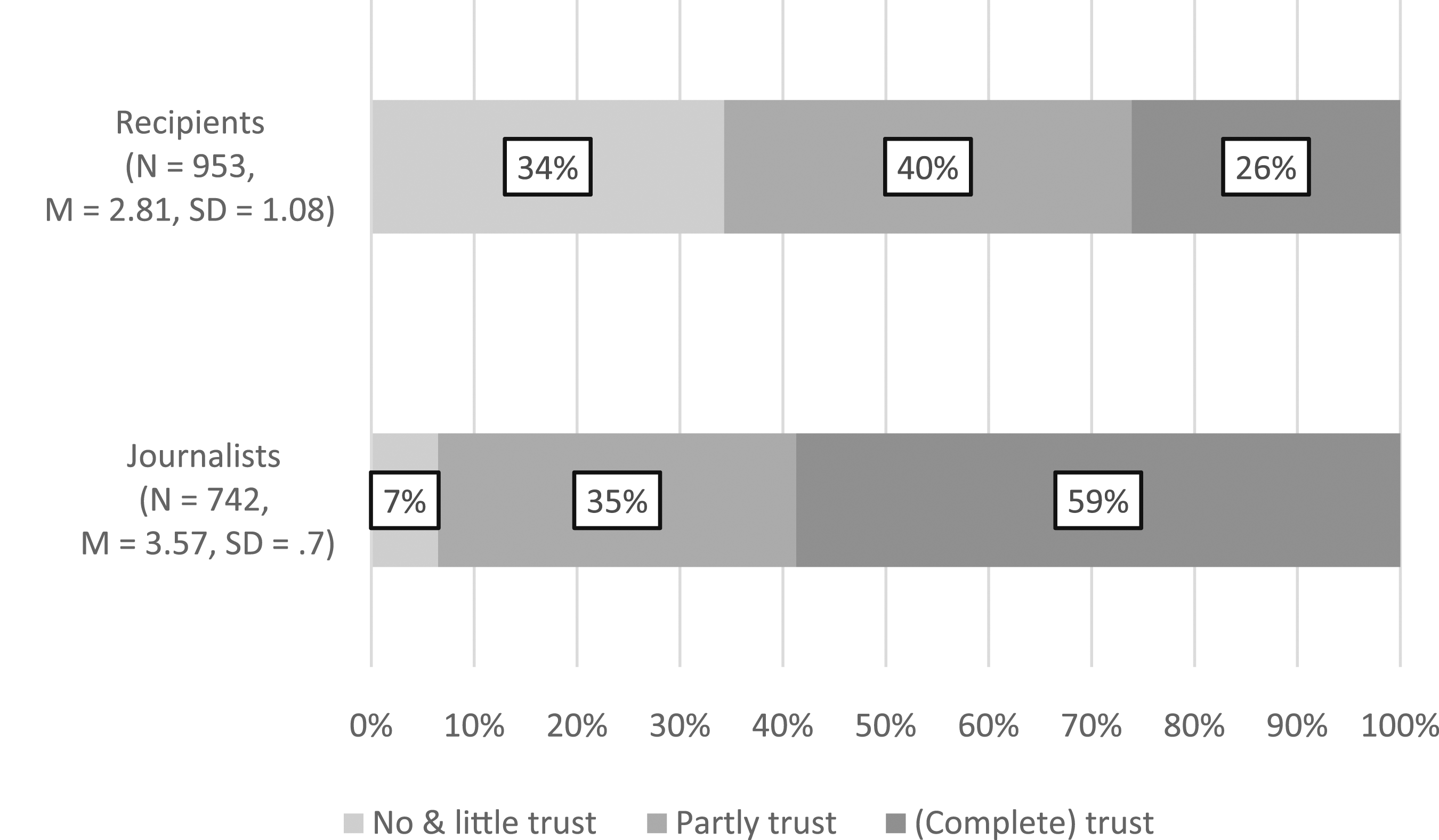
In addition, we are also interested in the extent to which the generalized media trust levels among journalists and recipients differ (RQ1b). The findings are in line with what can be assumed given our definition of media trust. As shown in Figure 1, more than half of the journalists interviewed indicated having complete or a high deal of trust in news media. Recipients, by contrast, indicated lower levels of media trust; only a quarter of those interviewed indicated (completely) trusting news media. The distrusting part of the audience (34%) is also much larger than the group of journalists who do not trust the media (7%). A comparison of the mean values confirmed that journalists and recipients differ significantly from each other, t = 16.639, p < 0.001 (d = 0.815). 2
Factors predicting media trust among journalists compared with recipients
This section seeks to explain the levels of generalized media trust among recipients and journalists in order to compare the predictors of media trust between the groups in terms of their nature and predictive power.
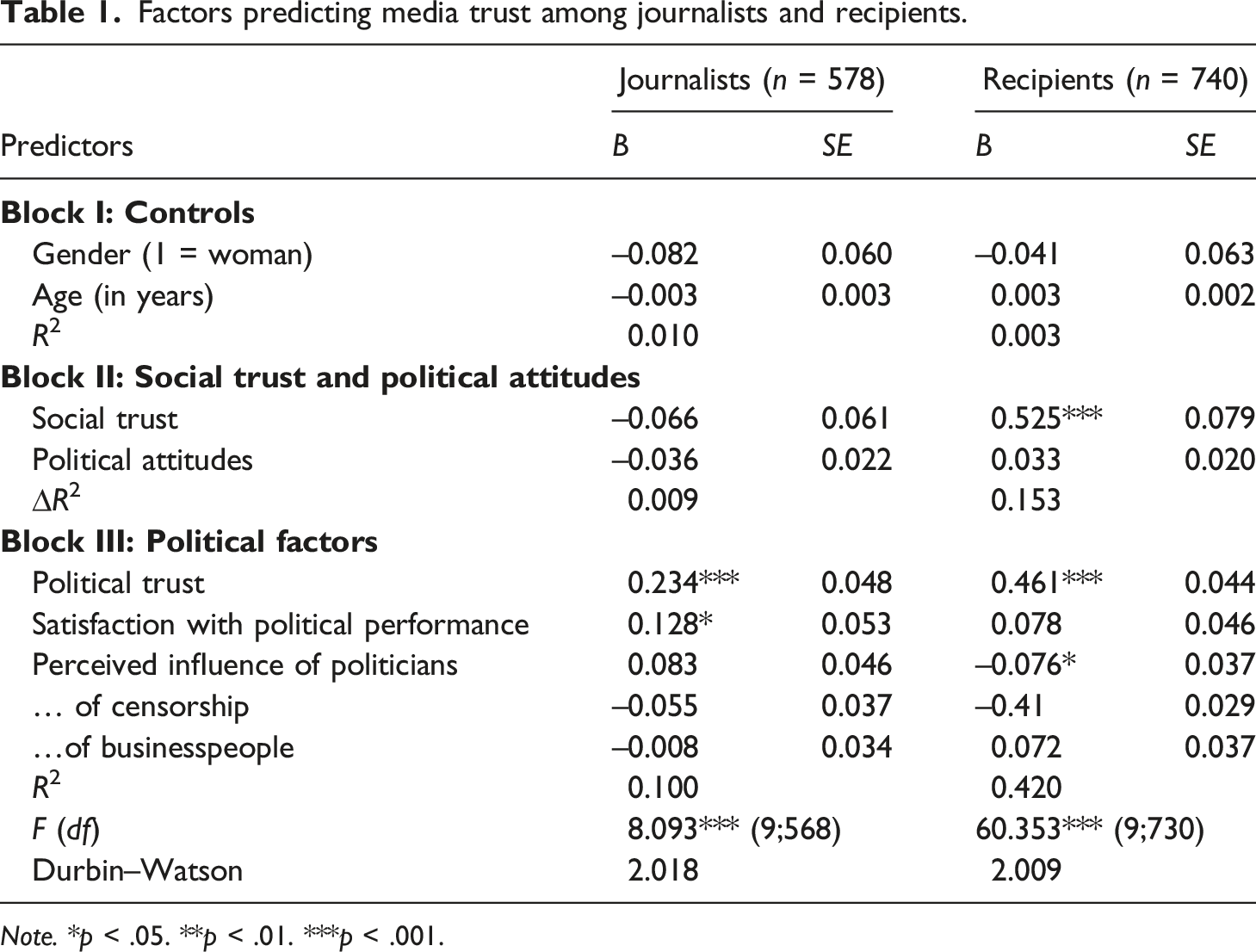
Factors predicting media trust among journalists and recipients.
Note. *p < .05. **p < .01. ***p < .001.
Overall, our results suggest that different mechanisms drive journalists’ and recipients’ trust in news media. In general, whereas the model explains approximately 10% of the variance in news media trust among journalists, the same variables explained approximately 42% among recipients.
Regarding social trust and political attitudes in particular, we assumed positive relations between trust in news media and social trust (H1) as well as left-wing political attitudes (H2). As predicted, generalized social trust among recipients was positively associated with their trust in news media, while no relation emerged between their political attitudes and level of media trust, which supported H1a but justified the rejection of H2a. For the journalists, however, neither social trust (H1b) nor left-wing political attitudes (H2b) are related to their level of trust in news media, meaning that those sociopolitical characteristics are more decisive for recipients’ trust in media than in journalists themselves (RQ2 and RQ3).
Regarding political factors, H3 presumed positive associations between satisfaction with political performance and political trust among recipients. However, whereas their satisfaction with past political performance was not related to generalized media trust, their political trust especially predicted higher scores for recipients’ trust in media. Based on these findings, H3b was supported but H3a was rejected. In addition, we assumed that perceived political and economic influences on journalistic work might relate to lower levels of trust in news media as reported by recipients (H4). Indeed, the data showed that the more recipients agreed that politicians influence journalistic work, the lower their levels of trust in news media, which supported H4a. Even so, recipients’ media trust tended to be unrelated to perceived economic influences on journalistic work, which justified the rejection of H4b.
The findings were somewhat different for journalists, for whom the data indicate that their political trust and satisfaction with political performance are paramount. Journalists with high political trust, as well as ones who are more satisfied with political performance, showed higher levels of trust in news media (RQ4a). However, perceived influences on their work stemming from political factors (e.g., perceived influence from politicians, censorship, and economic factors such as businesspeople) did not show any association with their generalized news media trust (RQ5a). Comparing the predictive strength of those political factors of trust in news media between journalists and recipients, we clearly observed that the association between political trust and media trust in particular was significantly stronger for recipients than for journalists (RQ4b). Perceived political influence on journalistic work also proved to be a factor for recipients’ level of trust but was not decisive for journalists’ media trust (RQ5b).
Discussion
Our study was an initial examination of levels of media trust among journalists versus recipients in Germany. Therein, our goal was to investigate political factors and perceptions driving news media trust among journalists compared with recipients and to identify the relative influence of these factors. Despite indications that the level of media trust between the groups differs, such that lower levels of recipients’ trust can be associated with the fact that journalists and their products are the targets of criticism in debates over the “lying press” and “fake news,” that dynamic has been neglected in journalism research.
To be specific, our results suggest that journalists’ media trust levels are rather high, especially compared with those of recipients. That finding is unsurprising given that journalists are part of the journalistic sphere and thus have insights (e.g., into journalistic routines and practices) and different experiences (e.g., with politicians) from those of recipients. In addition, data from the WJS suggests that news media is one of the most trusted institutions among journalists in nearly every country compared with political institutions (e.g., national parliaments), politicians, trade unions, and religious leaders. 3 The sole exceptions are Greece and South Korea, where only approximately 6%–7% of journalists reported that they trust news media completely or have a great deal of trust in it; by comparison, journalists in Sierra Leone and Kenya (each 74%), as well as Bangladesh (65%), Malawi (61%), and Germany (58%), are among the frontrunners when it comes to trusting their own profession (cf. Steindl, 2019).
Regarding recipients’ levels of media trust, however, we found that one-fourth expressed high levels of media trust. That finding aligns with past results showing that nearly half of the German population trusts the news most of the time (Hölig et al., 2021), while approximately a fourth expresses high levels of generalized media trust (Obermaier, 2020).
Those clearly differing levels of trust between journalists and recipients can be problematic. If journalists show higher levels of media trust than recipients, then it is conceivable that they are less responsive to recipients’ normative expectations of their journalistic work and less likely to make their work transparent in that regard. Those dynamics could nevertheless underpin levels of trust among the population or even decrease them in segments that have turned away from news media.
In our study, beyond replicating those differences in the level of media trust among German journalists and recipients, the results revealed that, in line with culturalist theories suggesting social trust shapes institutional trust (e.g., trust in media) as a result of processes of socialization (Mishler and Rose, 2001), recipients’ generalized trust in society positively predicted their trust in news media. Thus, while the presumed association seemed to hold true for recipients, social trust did not show any correlation with the news media trust of German journalists. That difference could indicate that recipients are more likely than journalists to take their positive experiences with other people as an indication that they can trust them. That result makes immediate sense because journalists, as part of the social elite, have direct access to firsthand information about the journalistic performance of their employers and colleagues and can base their trust in their own profession on that information.
At the same time, for journalists, political trust and satisfaction with the political performance were positively associated with trust in their own profession. That result complements institutional theories suggesting that satisfaction with political performance positively predicts news media trust (Mishler and Rose, 2001).
For recipients, by contrast, political trust, at a level approximately similar to social trust, was positively related with their trust in media. Even so, the correlation between political trust and media trust was stronger for recipients than for journalists. Again, that difference may be due to the fact that journalists have direct experience with political actors and insights into the performance of political institutions and may therefore have a more differentiated view of the performance of media and political institutions. As such, they have firsthand experience with the performance of both and do not have to mutually infer trust in the respective institutions. Because recipients lack those direct experiences and instead have indirect experiences with political performance in journalistic reporting, it is plausible that the two forms of institutional trust are far more intertwined for recipients.
Moreover, while research has suggested that journalists and recipients perceive influences on journalistic work differently, especially concerning political influences (Obermaier et al., 2021), journalists’ levels of media trust in our study were independent of their level of perceived political and economic influences on journalistic work. However, in line with the literature (Donsbach et al., 2009), perceived influences from politicians on journalistic work negatively predicted recipients’ media trust. That finding may be related to the fact that journalists themselves are the target of influence attempts by political and economic actors. They can ultimately assess the extent to which such influence is reflected in their own reporting, and are likely to have an image about the work of colleagues in that regard. Recipients, on the contrary, draw their assumptions of political influence partly from their own political views, their satisfaction with social situations and/or public discourse, and statements critical of media therein. They thus cannot match their ideas of what political influence on journalistic work seems to be with insights into everyday journalistic work, which makes the negative correlation between perceived political influences on journalistic work and their media trust plausible. However, it should be noted that influences on journalistic work imply restrictions upon journalistic autonomy and that data on that relationship could be distorted by socially desirable responses.
Limitations and directions for future research
Overall, our study provided initial insight into the news media trust of German journalists compared with that of recipients. Our analysis revealed that journalists’ and recipients’ trust in media is determined by different social, political, and institutional performance-related characteristics and that journalists tend to have higher levels of trust than recipients. Thus, future research should examine the possible consequences of news media trust on news production, but not only concerning the selection of information and sources used for reporting. Also, its influence on content is important. For instance, on the way in which stories are portrayed, because research has suggested that social and political trust may somewhat impact political news reporting (Steindl, 2021) and that audience trust, as perceived by journalists, correlates with adherence to journalistic norms (Tsfati, 2004).
Our results are subject to limitations. First, we cannot fully rule out the possibility that the 4 years’ time lag between the survey of journalists (i.e., 2014-2015) and recipients (i.e., 2019), might have influenced the results. During these 4 years, “fake news” allegations and debates about political influence on election coverage, which may be linked to media trust, have increasingly gained attention in public discourse. While some studies nevertheless point to stability during this time period (Jakobs et al., 2021), others indicate more short-term fluctuation in media trust among the German audience (Hölig et al., 2021). As journalists’ trust can be assessed as rather stable, the descriptive trust differences between journalists and recipients might diverge from year to year due to variations among the audience. The specific values of this trust difference should also be interpreted cautiously as the two studies are based on different survey modes which might have affected the results. WJS data are based on CATI and online interviews, while the audience was surveyed online only which is known to increase the level of reporting of sensitive information (Kreuter et al., 2008). Journalists’ media trust assessments might be prone to social desirability as they address their own profession which could have led to the values turning out higher. Still, as the trust differences were rather large, we are confident that journalists do have higher trust in their own profession than the audience and maybe more importantly, there are much fewer distrusting journalists than distrusting recipients.
Moreover, the second focus of this study, explanatory factors of trust in news media, should not be affected by the time difference. There is robust evidence that variables such as social or political trust predict audience media trust (Hanitzsch et al., 2018; Obermaier, 2020) which we can again confirm in the present study.
Furthermore, because we relied on secondary data, our dependent variable was based on a single-item measurement. That single-item measure of generalized media trust is often used in the literature because, unlike a reflexive measure, it allows the separation of media performance ratings from media trust in analysis (Obermaier, 2020; Prochazka, 2020). However, it should be kept in mind that recipients may consider journalistic quality media when asked about trust in “the media” (Daniller et al., 2017). Future studies should thus additionally include external data on political performance in order to, for example, validate the perceptions of both groups and differentiate various forms of trust in news media (e.g., trust in types of news media).
Third, because our study ranks among the first to compare media trust and its explanatory variables for journalists and recipients, we focused on explaining generalized media trust with more general individual and political factors. Moreover, we only used measures that applied to both groups of actors. On the part of journalists, however, we see the need to consider additional factors in future research, especially professional factors (e.g., role conception and work experience). We also compared the entirety of journalists to recipients in Germany. However, levels of trust in news media and its predictors could vary for different segments of journalists and recipients. For that reason, future studies should include additional social, political, and performance-related predictors and attempt to explain trust in various media genres and/or outlets as well.
Last, follow-up studies should examine the levels and predictors of media trust for different groups of journalists—for example, for journalists working for public service media compared with private media, or journalists covering politics compared with culture or sports—as well as for recipients and different segments of the population (e.g., those with high and low levels of trust in news media or different political attitudes).
Footnotes
Declaration of conflicting interests
The author(s) declared no potential conflicts of interest with respect to the research, authorship, and/or publication of this article.
Funding
The author(s) received no financial support for the research, authorship, and/or publication of this article.
