




Abstract
This paper investigates the epistemic injustice in conflict reporting, where foreign parachute reporters collaborate with local producers and ‘fixers.’ Drawing from existing research on ‘fixers’ and other media professionals covering conflict zones and the philosophy of emotion and knowledge, I address the following questions: What is the role of local and foreign media professionals’ affective proximity and professional distance in the social epistemology of conflict news production and the epistemic hierarchy among the collaborators? What implications is this particular social epistemology believed to have for conflict reporting accuracy and ethics? Based on 36 semi-structured to in-depth interviews with foreign and local media professionals covering Ukraine, Israel, and Palestine and further online and offline contact with the Ukrainian ecosystem of foreign/conflict news production, I argue that the collaboration between foreign and local media professionals is sometimes marked by identity-prejudicial credibility deficit granted to local media professionals because of their affective proximity to the events they cover. This epistemic injustice mirrors other power vectors and the dominant journalistic professional ideology that values disinvolvement, distance, and detachment. In practice, the (local) media professionals’ affective proximity to their contexts is often appreciated as embodied knowledge beneficial to the nuance, accuracy, and ethics of journalistic practices and outcomes.
Keywords
Introduction
There is a widespread assumption – documented by previous research – that when you are a local media professional covering a conflict, war, or occupation in your own country, you tend to be biased and/or activist. Your affective proximity to the events and community you cover (Al-Ghazzi, 2023) is supposed to, at best, blind your critical eye or, worse, make you push for your ideological agenda (e.g., Bishara, 2006). Your work can be trusted less than the work of foreign observers who manage to keep their professional distance (e.g., Arjomand, 2022; Bishara, 2006; Budivska and Orlova, 2017; Palmer and Fontan, 2007).
This finding comes to the fore in the production of war coverage by international or transnational teams consisting of reporters who are foreign to the context where the war takes place and local media professionals in the role of fixers, producers, consultants, or news assistants. Lately, there has been increased attention paid to the logistical and editorial aspects of the collaboration among these various actors of foreign reporting (e.g., Murrell, 2015; Palmer, 2019) and the dangers and risks that especially the locals face as a result of their work (Baloch and Andresen, 2020; Creech, 2018; Palmer, 2018; Pedelty, 1995; Pendry, 2015). The complexity of these ecosystems of foreign/conflict news production has also become more visible and transparent to the general public due to the evacuations of media fixers from Afghanistan in 2021 (Free Press Unlimited, 2021) and within the context of the Russian invasion of Ukraine since February 2022, especially of the death of Oleksandra Kuvshinova working for Fox News (BBC, 2022). However, the discussion on ‘fixers’ and ‘local producers’ still has many blind spots (Jukes, 2019). Especially some of the more subtle and complex – though not less unjust – hierarchies in the social epistemology of conflict news production (Kotišová and Deuze, 2022) remain to be explored and criticized – which is the aim of this paper.
I investigate a particular aspect of this social epistemology: the epistemic injustice that pervades newsmaking in conflict zones. Using current research on foreign and local conflict reporters’ professionalism and emotionality (e.g., Al-Ghazzi, 2023; Budivska and Orlova, 2017; Stupart, 2021) and an eclectic conceptual apparatus borrowing from the philosophy of emotion and social epistemology (Godler et al., 2020; Fricker, 2007; Scarantino and De Sousa, 2021), I am bringing attention to ‘human practices through which knowledge is gained, or indeed lost’ (Fricker, 2007: vii). Specifically, I address the two following research questions: What is the role of local and foreign media professionals’ affective proximity and professional distance in the social epistemology of conflict news production and the epistemic hierarchy among the collaborators? What implications is this particular social epistemology believed to have for conflict reporting accuracy and ethics?
Based on 36 semi-structured to in-depth interviews with foreign and local media professionals covering Ukraine, Israel, and Palestine 1 and further online and offline informal contact with/observation of the ecosystems, I explore whether and how the collaboration between foreign and local media professionals is marked by epistemic injustice (Fricker, 2007). I also attempt to challenge the epistemic injustice by dismantling the (local) media professionals’ emotional closeness to their contexts and illustrating that this closeness is often valued as embodied knowledge beneficial to the nuance, accuracy, and ethics of journalistic practices and outcomes.
Professionalism and activism in Ukraine and Palestine; affective proximity
(Meta)journalistic discourse has been shaped by the powerful juxtaposition of professionalism, entailing objectivity understood as neutrality and detachment (e.g., Deuze, 2005; Kotišová, 2019; Ward, 2010), and its various opposites, namely subjectivity, emotionality (e.g., Van Zoonen, 1998) and activism (Budivska and Orlova, 2017). Professional, objective journalists are traditionally supposed to be emotionally detached, neutral, and disinvolved. Including emotion in journalistic practice or being openly involved – except for specific journalistic beats or styles (e.g., Harbers and Broersma, 2014; Harries and Wahl-Jorgensen, 2007) – is considered a kind of disruption or failure (Blaagaard, 2013; Pantti, 2010; Stupart, 2021; Wahl-Jorgensen, 2019).
The discursive opposition points to the privileged position of critical-monitorial journalistic roles such as monitor, detective, or watchdog that lie ‘at the heart of the normative core of journalists’ professional imagination in most Western countries’ (Hanitzsch and Vos, 2018: 154; see also Hanitzsch, 2019). However, journalism worldwide has also had advocative-radical, developmental-educative, collaborative-facilitative (etc.) shades where journalists see themselves as – for instance – advocates, adversaries, missionaries, change agents, mouthpieces, collaborators, and mobilizers (Arafat, 2021; Hanitzsch and Vos, 2018).
In post-Euromaidan Ukraine, the Western professional model focused on detachment and political adversarialism does not always fit the contextual circumstances. Halyna Budivska and Dariya Orlova (2017: 147) show how journalists participated in the events starting in 2013 and 2014 both as journalists and citizens/protesters, thus wearing two or more different hats, and explain that this ‘interventionism among journalists evolves in response to acute challenges.’ At the same time, they found different responses to the related ethical dilemmas: while some journalists ‘accepted activism as a sort of necessity stemming from the peculiar Ukrainian context’ (ibid.: 149), others were confused about the solution. A third group rejected activism as a component of journalists’ identity. Importantly, Budivska and Orlova (2017: 150) write that the ‘third approach was mostly advocated by journalists who either worked or used to work for international media in Ukraine,’ as they were ‘familiar with the explicitly articulated journalistic standards of the foreign, predominantly Western, media, and this influenced their rejecting the interventionist approach.’ This finding contradicts the above-outlined epistemic suspicion; yet, even these media professionals understood the activism of their colleagues aiming at the survival of Ukraine as a state.
Before 2006, Amahl Bishara (2006) identified a similar diversity among Palestinian media professionals, corresponding to some extent with different journalistic practices, political consciousness, and generation. Photojournalists tended to be more aware of the activist value of their work; writing reporters tended to be more ‘cynical.’ By comparison, Nibal Thawabteh (2010) claims that Palestinian journalists are often openly involved in defending the Palestinian cause (or linked to various interest, religious, and political groups). Thus, Palestinian ‘journalism is a message rather than a mere profession’ (Thawabteh, 2010: 87), which complicates some professional decisions and related ethical questions. ‘The Palestinian journalist, prior to being an Al-Jazeera or BBC reporter or a writer for an international agency, is a human,’ which makes it ‘difficult to achieve objectivity. However, it is our aim to do so,’ Nibal Thawabteh (2010) writes, and powerfully shows the difference in understanding objectivity and the overall difference in journalism practice and theory. Nevertheless, in Arab contexts, the conceptions and uses of journalism have been dramatically changing (Al-Ghazzi, 2014). The gradual decrease in Palestinian media freedom indicated by non-governmental and international organizations (Reporters Without Borders, 2022; UN Watch, 2022) suggests that the pressure to report in conformity with Hamas’ and Palestinian Authority’s views is increasing. Not doing so can have serious safety repercussions.
Activism and emotional involvement are tightly intertwined: activism is constituted by affective proximity to a political cause (Al-Ghazzi, 2023). Omar Al-Ghazzi defines affective proximity as the imagined space (or the lack thereof) between journalists and the events which they are representing (and in which they are participating at the same time). The high affective proximity among media professionals covering traumatic events in their community means that they are not – and cannot be – as strict in dividing their professional and personal lives (e.g., Backholm and Idås, 2015; Kotisova, 2020; Rosen, 2011) and it also adds another layer to the emotional toll of first-hand witnessing of violence.
By contrast, previous studies have illustrated that ‘foreign’ crisis and conflict reporters often attempt to keep a professional distance from the events they cover. Their emotionally disengaged posture has been called ‘cool-detached,’ ‘autopilot,’ ‘right distance,’ or ‘cynicism’ (Backholm, 2017; Jukes, 2017; Kotišová, 2017). The process of journalists’ self-distantiation from the traumatic events they cover, during which they suppress or postpone any ‘genuine’ emotions, and develop a viable, professionally beneficial emotional posture, can be seen both as emotional labor (Hopper and Huxford, 2015; Wahl-Jorgensen, 2018) and a coping mechanism (Buchanan and Keats, 2011).
Epistemic injustice, or the fear of bias
How is the local – and foreign – media professionals’ (un)involvement and (un)emotionality relevant to the social epistemology 2 of conflict reporting (Godler et al., 2020), in particular epistemic injustice (Fricker, 2007)?
Al-Ghazzi (Al-Ghazzi, 2023: 281-282) claims that the question of affective proximity should be discussed in relation to the unequal structural power relations within the global news industry because ‘It shows how the labor and input of locals is side-lined when dismissed as emotional and biased, and when journalism is narrowly conceived as an intellectual endeavour based on the professional norms and values of objectivity, neutrality and distance.’
Al-Ghazzi’s claim that understanding affective proximity is vital for grasping local media professionals’ roles and positionality is echoed in the concept of fixer’s paradox, recently aptly coined by Noah Amir Arjomand (2022): the fact that local media professionals’ embeddedness is both their greatest asset and greatest liability. They convince sources to talk, arrange logistics and security, explain contexts, translate meaning, and their foreign colleagues could not operate effectively without them. But their local embeddedness also means that they are perceived as activists, not professional, and not objective enough to be trusted or to claim higher-status journalism labels.
The fear that local collaborators of reporters covering conflicts hinder quality reporting is widespread among media practitioners. Jerry Palmer and Victoria Fontan (2007) noticed that some American and French editors, commentators, journalists, and also professional organizations expressed concerns that the reliance on fixers significantly reduces the quality of information from Iraq, leading to biased reporting on the post-invasion situation: ‘Journalists were aware that fixers might bring their own agendas to bear on the interactions that they made possible for the journalist, thus effectively transforming the journalist into a propagandist on their behalf,’
Palmer and Fontan (2007: 15) write. ‘However, those who mentioned it did so primarily as a theoretical possibility rather than a real threat,’ they continue (ibid, 2007). If we look at journalism studies, where scholars have seen second-hand witnessing and social knowledge generation as necessary but epistemologically problematic, the theoretical nature of this fear makes sense. Yigal Godler et al. (2020: 218) show how prominent journalism scholars’ (e.g., Gans, 2004; Schudson, 1989; Tuchman, 1972) conclusions ‘remained in line with orthodox individualistic epistemology in that only individually ascertained information counted as factual knowledge.’
More recent Arjomand’s research suggests that this concern lives on. His interviewee, a fixer, was considered a ‘rat’ by her foreign client, ‘betraying journalism for a secret allegiance to a local political faction’ (Arjomand, 2022: 2). The client’s political categorization of the fixer was wrong; yet, he did not trust her to be objective. The same fear appears in the data presented below in this study.
This geographically, nationally, or ethnically predefined mistrust and suspicion can be best conceptualized as epistemic injustice. Miranda Fricker (2007: 1) defines epistemic injustice as ‘a wrong done to someone specifically in their capacity as a knower.’ What Palmer and Fontan, Arjomand and others seem to observe in conflict news production is testimonial injustice, occurring ‘when prejudice causes a hearer to give a deflated level of credibility to a speaker’s word’ (ibid, 2007). Fricker gives an example of the police not believing you because you are black. Similarly, the economy of credibility disadvantages local media professionals (in conflict-ridden contexts). As I show in the analytical section, applying the epistemic mistrust to the whole group of local media professionals is experienced as a form of prejudice by some Ukrainian local producers and fixers who – being seen and consistently reproduced as Western journalists’ ‘others’ (see Shome and Hegde, 2002) – thus suffer from what Fricker (2007) calls identity-prejudicial credibility deficit (deflated credibility owing to identity prejudice). The fear seems to encircle mostly journalists/fixers based in ‘non-Western’ or ‘Globally Southern’ contexts 3 , ‘transitional’ or ‘developing’ countries.
The credibility deficit usually corresponds to excess credibility attributed to someone in a position of privilege (Longair, 2017: 52). Thus, local media professionals’ foreign colleagues/clients linked to big media houses dispose of identity power (Fricker, 2007) that depends upon a shared imaginative construction of the foreign conflict staff reporters as the mythical, heroic, disengaged, nonchalant elite of journalism (e.g., Pedelty, 1995; Peters, 2011). This identity power grants them credibility. However, existing research illustrates that in practice, it can be the foreign reporters who have their ‘agenda,’ ‘preconceived notions,’ or ‘narrow views’ (Bishara, 2006; Palmer, 2018). They can ask their local collaborators to find controversies or relatively marginal phenomena fitting into the stereotypical image of the country in question (Paterson et al., 2011). ‘Show me’ or ‘find me’ a particular situation/person is a typical reporter’s request documented by several authors (Chaloupka, 2016; Paterson et al., 2011). What emerges from such a biased reporting model is ‘fast food journalism’: ‘stories prepared quickly but with artificial ingredients which just appear appealing’ (Hoxha and Andresen, 2019: 1742). Therefore, neither the credibility excess nor the credibility deficit seems grounded in the practice of conflict reporting.
The research questions directly follow from the above-outlined debates:
What is the role of local and foreign media professionals’ affective proximity and professional distance in the social epistemology of conflict news production and the epistemic hierarchy among the collaborators?
What implications is this particular social epistemology believed to have for conflict reporting accuracy and ethics?
Method
This paper is based on a year-long (roughly May 2021 to July 2022) formal and informal, online and offline, at times very intense as well as temporarily silenced contact with and existence within the communities of media professionals covering Ukraine (mainly the Russo-Ukrainian War), Israel and Palestine. The two contexts were selected because they represented two types of conflict (occupation, colonialism, if you wish; see also Footnote 1).
List of Interviewees
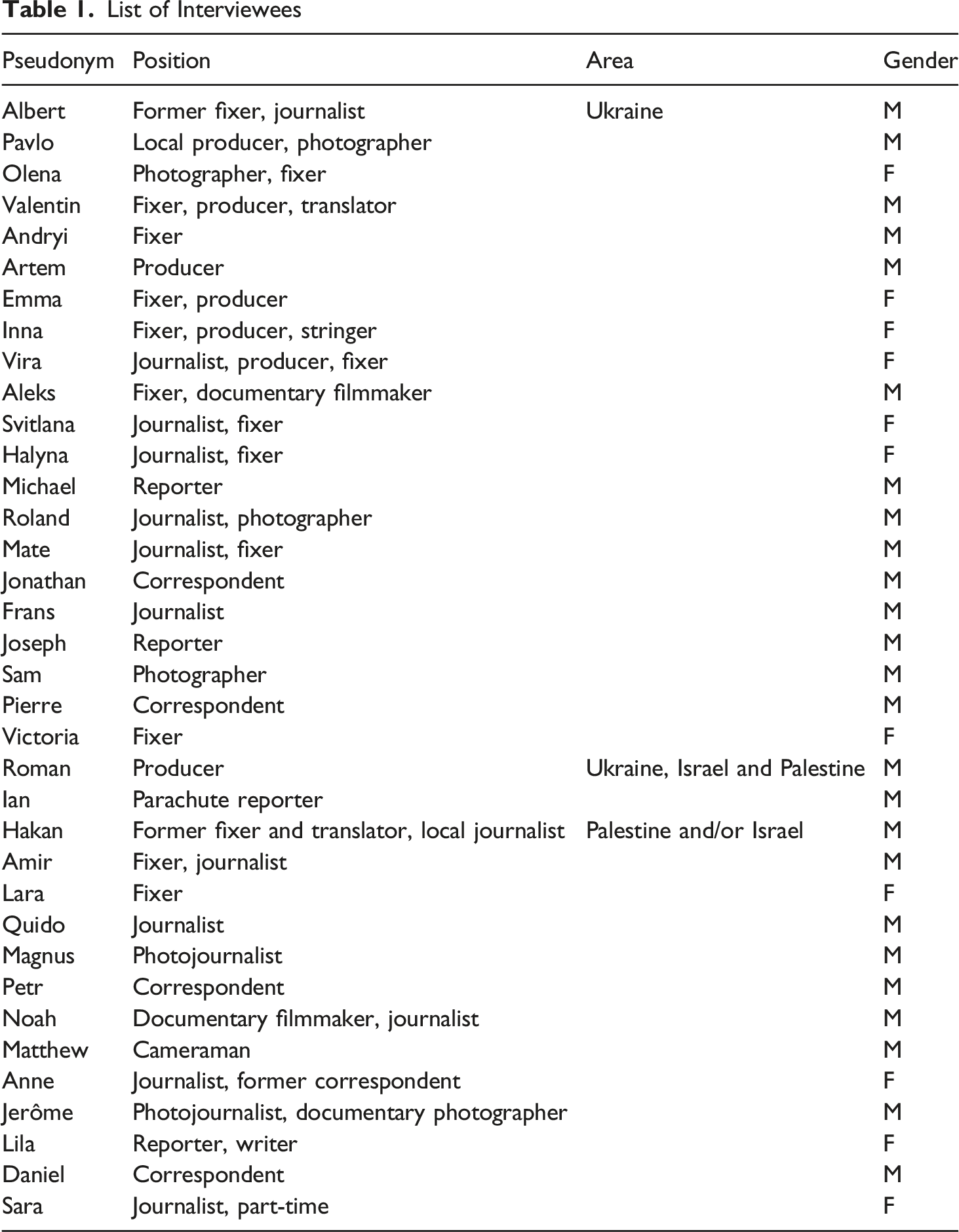
After an informed consent procedure, the interviews were recorded, transcribed, and pseudonymized. I analyzed them using thematic analysis (Braun and Clarke, 2006) and Atlas.ti. The thematic analysis combined data-driven and concept-driven coding; this paper draws from excerpts of text that were assigned one or more of the following codes: • concept-driven codes: coping mechanisms; detachment; emotional engagement; emotional labor; objectivity; • data-driven codes: clichés, bias, conformism; dissociation; emotional gap; fixers’ agenda/interventions; self-reflexivity; superior values; trauma; Western lack of knowledge.
Second, this paper builds on a less systematic knowledge I gained through continuous online and offline contact with the contexts, especially the Ukrainian media sphere and conflict reporting community. In August and September 2021, I visited Kyiv and Lviv (where I attended the Lviv Media Forum) and spent 3 weeks among parts of the regional media sphere. Since the full-scale Russian invasion of Ukraine, the general need for people with contacts in Ukraine and any knowledge of any Ukraine-related topic intensified, strengthened my links to my Ukraine-related contacts and Ukrainian academics, and temporarily turned me into an active participant in the public debate about reporting on Ukraine. A large part of this quasi-ethnographic period was formed by online ethnography, including routine listening to relevant debates, friending and liking, observing, following, catching up, exploring, interacting, and archiving (see Arafat, 2021). I archived only highly relevant and public online materials, such as selected op-eds, debates, and stories. In this paper, I occasionally use them to support the analysis. The rest of the materials encountered within the ‘field’ (private chats and conversations, posts in private and secret Facebook groups, etc.) co‐shape and refine my knowledge but are not quoted in this paper as data. This contact with the field results in an asymmetric understanding of journalistic practices and collaborations within the Russo-Ukrainian War and the Israeli occupation of Palestinian territories, which is one of the shortcomings of this paper.
Another limit of this paper is the occasional reproduction of the dichotomic language of ‘local’ and ‘foreign,’ ‘proximity’ and ‘distance,’ ‘fixer’ and ‘reporter’ (cf. Shome and Hegde, 2002). These divisions are too schematic – very few people are pure locals and only work as fixers (Plaut and Klein, 2019), and the foreigners are foreign to a varied extent. For the lack of more accurate language, I still use these invalid divisions as analytical categories while deconstructing them wherever possible and relevant. For example, I use the more general and neutral term ‘media professionals’ and distinguish between different self-definitions and labels such as the much debated ‘fixer’ (Sardarian, 2022, cf. Dovzhyk, 2022) and ‘producer.’
The affective proximity in the credibility economy
In what follows, I will first describe the perceived differences between local and foreign media professionals’ emotional experiences of the contexts they covered and the related credibility economy. In the second analytical sub-section, I will explain the local media professionals’ emotional labor while pointing to three different components of emotions and their rationality. Finally, I will develop the notion of emotions as embodied knowledge and thus challenge the assumptions behind epistemic injustice.
The starting point of the analysis is an ‘emotional gap’ between local and foreign media professionals: a whole cleavage between people who come from outside with very little degree of compassion and us, who were, you know, inside the story (Albert, recalling his work after the Euromaidan protests).
While I deal with this gap and the actual emotions in detail elsewhere (Kotišová, 2023), it is important to say here that many media professionals I talked to perceived a similar difference between local or locally based media professionals’ – fixers,’ producers,’ photographers,’ and also permanent correspondents’ and stringers’ – intellectual and/or emotional engagement in their context and foreign, especially parachute reporters’ detachment. The local media professionals’ affective proximity to the violence in their own community (Al-Ghazzi, 2023), their fellow citizens’ and sometimes their own families’ suffering made it difficult to impossible to be unemotional, uninvolved, neutral, or objective ‘inside’ (Valentin; see Budivska and Orlova, 2017). On the contrary, parachute reporters invested relatively less emotional energy. To successfully perform their job, they deliberately or unwittingly suspend or suppress their emotional reactions to otherwise emotionally disturbing experiences (cf. Jukes, 2017; Kotišová, 2017).
Some foreign reporters believed that the locals’ higher levels of affective proximity and their very identities as local persons brought bias and were afraid of emotionally driven ideological pressure. ‘[Fixers] are soldiers in the information war,’ Joseph, a European reporter, told me. Vice versa, several fixers/producers felt less trusted because they were ‘too emotional’ (Artem) or ‘Ukrainians’ (Olena, Victoria).
This is a classic example of the identity-prejudicial credibility deficit (Fricker, 2007): not trusting a person based on their group identity (Ukrainians, Palestinians; fixers) assumingly tied to unruly emotions, without distinguishing their other identity markers and knowing more about the position and approach of the person. By comparison, the detached perspective, which still forms a cornerstone of professional journalistic ideology (Deuze, 2005), together with the belonging to a powerful media company, granted foreign parachuters excess credibility, at least in their own – i.e., ‘the bosses’’ (Pierre) – eyes. As a Ukrainian producer Alik Sardarian (2022) wrote, ‘Some Western journalists seem to have a sense of entitlement based on the idea that they do better work than their Ukrainian counterparts.’
This form of epistemic injustice was frustrating for Olena. While she knew fixers and producers who were ‘a bit too patriotic for how maybe journalists should be, which kind of prevented them from seeing a story in a full picture,’ she was different. During the encounters with Ukrainian media professionals, I found out that there was a ‘huge discussion in Ukraine whether Ukrainian journalists can remain unbiased in a situation of war’ (Svitlana) and diverse views on, and occasional mutual criticism of, the extent to which one should be ‘patriotic,’ perceive their work as a ‘mission,’ and – most importantly – what these terms mean, which is essential for the understanding of the (missing) ground of the credibility deficit/epistemic injustice.
In the next section, I will show why conflating the affective proximity with the lack of credibility is prejudicial: I will challenge the epistemic injustice by analyzing the different components of emotions and local media professionals’ emotional labor.
The rationalities of emotions
I was literally told by the [Western media company, a journalist], he told me: Artem, you are too emotionally involved. I told him: You will go back, right? I stay in this country. … So now, you are twisting the whole story in such a way that does not correspond to the truth. What am I supposed to do? I don’t have several months to spend with you and to teach you the truth … We are becoming emotional, maybe we start shouting at each other, … The people want ... The truth, it requires more time. It requires involvement, you know. (Artem)
The credibility economy described in the previous section points to the messy mix of the different components of emotion – or even different traditions of studying emotions in the philosophy of emotion (Scarantino and De Sousa, 2021) and the difficulty of making sense of this complexity. Especially since the mid-twentieth century, the age-old philosophical dualism of emotionality and rationality (see Damasio, 1994; Stupart, 2021) has been gradually made more complicated and eventually replaced by several different streams of thinking about emotions. The current philosophical thinking suggests that emotions entail not only phenomenological inner states/affections but also cognitive evaluations (they either are or are caused by cognitive evaluations) and behavioral desires (Scarantino and De Sousa, 2021). These components of emotions have porous boundaries yet are not necessarily consistent.
Similarly, current neuroscience, psychology, and cognitive science stress the importance of emotional experiences for reasoning and conceptual knowledge (e.g., Damasio, 1994; Ignatow, 2007). Emotions can be understood as rational in two ways. First, they have cognitive rationality: the ability to represent the world as it is, to point to events in the world. Second, they have strategic rationality: the ability to motivate and lead to actions that promote one’s interests (Scarantino and De Sousa, 2021). In the quote above, Artem was agitated by his colleague’s disregard for the truth (cognitive rationality). Although he did not have time to explain the whole context as he wished to and almost resigned, his agitation eventually motivated him to argue about the truth (strategic rationality).
Most of the local media professionals I met performed – and were required to perform – strict emotional labor, self-analyzing and compartmentalizing these different emotional parts and trying to bring order into the complex of affect, opinions, and behavior: Obviously, everyone’s human, and they’re gonna have opinions and emotions, but to the extent that people can sort of like compartmentalize… (Sam)
Sam added that ‘It has not ever been a major problem’ in Ukraine, i.e., his collaborators were successful emotional laborers.
The compartmentalization starts with the cognitive dimension of emotions, or cognitive evaluation of outer reality: I always really strived from the very beginning, when I started learning about journalism, ... to try to, like, self-analyze, and think, like, is this opinion that I have really biased or is this based on some facts? (Olena) Everyone knows that if [local fixers and producers] want to maintain credibility, there are facts they need to stick to. (Sara) [N]aming Russia as an aggressor, it’s not about being biased, it’s a fact that is out there, as in, you know, international law. (Svitlana)
Human rights, international treaties, humanitarian law, historical facts, and verified outer reality – and others’ (dis)respect for these values and principles – motivated both local and foreign media professionals’ emotions. For example, when a Ukrainian producer saw a foreign reporter ignoring that the Russian annexation of Crimea was illegal and is not internationally recognized, they could get angry. In this way, the emotion pointed to the knower’s confidence in certain aspects of outer reality. Richard Stupart (2021) recently described a similar potential of journalists’ emotions to point to (ethical) norms/values.
Moreover, these values and principles also guide the process of the compartmentalization of the three components of emotions: affect, opinion, and behavior. Locals such as Olena, Svitlana, and foreign correspondents such as Pierre or Frans relied on verified facts, international treaties, and human rights to tell the affective emotional dimension (carrying the danger of bias) from the rest of the emotional components.
In turn, the research participants’ emotions also had strategic rationality: they motivated particular behavior. First, being triggered by (not) sticking to a value or a fact, the emotion (typically an unpleasant one) motivated the local research participants to insist on the value/fact and – as some saw it – help their foreign colleagues discover a world beyond clichés and lead them from ignorance: I mean, we were also considering it as our duty. … to help this journalist do this story that really reflects the reality. … And lead it out of the clichs of people who know nothing about this country. (Albert) You can’t tell somebody: I think, or I believe. No. You can tell: Wikipedia says this, this, and this. [smiles] … Or the person we interviewed told us this and this. And when you are building this communication in this way, then you are more susceptible to influencing somebody’s narrative. (Pavlo)
In her recent op-ed for CNN, the Ukrainian researcher and fixer Sasha Dovzhyk (2022) lists fact-checking among fixers’ tasks. Albert said that this help needs to be done ‘cleverly,’ thus pointing to the need to think through the communication with the foreigners carefully; Pavlo was even more explicit about the need for a communication strategy. The emotion thus did motivate a certain form of ‘activism.’ However, this activism resided in the mission to tell the world what happens in a contextualized, historically, and legally informed way (see Budivska and Orlova, 2017; Hanitzsch and Vos, 2018).
But the strategic rationality was also instrumental. Since the collaboration between foreign and local media professionals often starts with the word of mouth and recommendations (Murrell, 2019; Plaut and Klein, 2019), anyone who wants to stay in business – build a sustainable professional image – must also stick to the compartmentalization of affect, cognition, and behavior in practice. My interviewees’ confessions that they cannot be detached – inside – were usually followed by their assurance that they can be ‘neutral outside … with the journalists’ (Valentin), when they work: I’m a journalist, working as a journalist, and I’m trying as hard as possible to be professional. Even though I am a Palestinian, I live here, I suffer myself. (Amir) You need a fixer that does something against his ideology. (Noah)
Pavlo pointed out that this emotional labor is a universal human experience: in any profession and personal life, one sometimes needs to talk to ‘simply disgusting’ people. ‘The problem in the warzone [is that] those people have guns,’ he concluded. Local media professionals who could not perform this emotional labor were not only in physical danger because they worked with armed sources but also gained a bad reputation among foreign reporters, which was detrimental to their careers.
Thus, in practice, those Ukrainian media professionals I encountered would often criticize not only Russia but also the Ukrainian army and officials, and Palestinian media professionals would criticize not only Israel but also Hamas and the Palestinian Authority. Svitlana explains: This is the most patriotic position. We want to live, you know, in a democratic country with the rule of law. This is why we will be telling these stories. I mean, being a professional journalist is the most patriotic position that you can ever find.
She defined ‘patriotic journalism’ (see also Budivska and Orlova, 2017) – a term that very much puzzled me while I was at the Lviv Media Forum conference and outraged my Western colleagues to whom I mentioned it – through the watchdog function. In the same vein, a month after the full-scale Russian invasion of Ukraine on 24 February 2022, a group of Ukrainian media professionals initiated an open letter to Ukrainian President Volodymyr Zelensky, the Armed Forces, and other public offices, criticizing the anomia and urging ‘to end the harassment of journalists who are Ukraine’s greatest allies in this war’ (IMI, 2022) yet who were pushed by the authorities not to publish shelling locations.
Ukrainians live in a country with an oligarchized media system yet with a substantial deal of free media and freedom of speech. However, for the Palestinian media professionals, criticizing Hamas and, to some extent, the Palestinian Authority was severely dangerous, and some of my Palestinian interviewees paid more or less dearly for their criticism (in anonymized ways; see UN Watch, 2022).
In the next section, I will develop the perceived benefits of media professionals’ emotional engagement.
Objectivity, accuracy, and ethics as a collaborative enterprise
Contrarily to the credibility deficit (Fricker, 2007) granted to the local media practitioners, their emotional engagement seemed to lead them to be more sensitive to facts and insist on facts and values they saw as essential. In his seminal work Descartes’ Error, the neuroscientist Antonio Damasio (1994: xiii) develops and illustrates a thesis that ‘certain aspects of the process of emotion and feeling are indispensable for rationality’ and that humans’ capacity for reason depends on emotions and bodily processes. Therefore, the widespread journalistic self-delusion that a journalist’s bodily experience and feelings are excluded from their purely rational purview – or even that emotion is a form of intruder or failure (Stupart, 2021) – is arbitrary and artificial and lags behind the available social-scientific state of the art where ‘sensory and perceptual experience are now understood to be fundamental components of knowledge’ (Ignatow, 2007: 125).
Indeed: local, localized, and foreign media professionals believed that some aspects of emotional engagement provide detailed embodied knowledge of the situation, which results in frequent, yet largely unwitting outsourcing of empathy (Kotišová, 2023): That’s how stories are made – with emotions. And accurate context, I think. (Mate) I understand these people. And because I understand these people, I can tell the story much better than foreigners coming to this place. (Vira)
Vice versa, some local media professionals appreciated the foreigners’ distance and detached perspectives, which helped them recognize their own blind spots: Of course, we need such people with a much more dry approach even to tragic events. … Our foreign colleagues helped us in a way to understand that we try to be blind, to close our eyes on some issues. … And somehow, we need to find this true angle. (Albert)
By some, ‘objectivity’ was thus seen as collaborative. Or, ‘good journalism’ is believed to require both objectivity and subjectivity (Van Zoonen, 1998) that become intertwined in the process of collaboration based on mutual trust and intellectual humility. The social epistemology consisting of the collaboration of actors with diverse levels of affective proximity (Al-Ghazzi, 2023) was thus seen as beneficial to the accuracy of conflict reporting.
While this sounds very hopeful, the emotional detachment that often went hand in hand with lack of knowledge seemed to have also negative repercussions on the accuracy and ethics of reporting: stereotypical thinking, sensationalism, working with predefined narratives, simplification, ignorance of nuances, and naivety in the field. Some of the local media professionals, such as Lara, were frustrated that they needed to act ‘like a teacher,’ especially to the ‘the new journalists’ coming to Israel and Palestine with insufficient knowledge of the context (but she was also optimistic that ‘with the time, they’ll learn’). Some of my local communication partners told me about cases of their foreign collaborators seeking controversies, stereotypes or extremes, thus asking to exploit and distort the local context (see also Hoxha and Andresen, 2019; Paterson et al., 2011). A typical task of this kind was to find a crying female survivor, neo-Nazis in Ukraine, and aggressive teenagers in Palestine.
This behavior impacted journalistic ethics. Valentin estimated that about 20 percent of foreign reporters coming to Ukraine ‘don’t really care about morality;’ in Palestine, journalists coming ‘from different cultures … ask in an inappropriate way’ (Amir). A repeated story involved the foreign reporters starting to film, taking pictures, talking in the third person about a survivor while she was present, or pointing to her. In Ukraine, the problem with sensationalist, insensitive reporting might have intensified since February 2022. As Sardarian (2022) writes: ‘Russia’s war against Ukraine has attracted everyone – journalists from major international media, freelance writers and photographers, documentary filmmakers of all kinds. Most of these people are united by one factor: they can do almost nothing on their own.’
By comparison, the local media professionals’ empathy and compassion often make them care about their sources’ emotional well-being (see Freelance Solidarity Project, 2022). Dovzhyk (2022) writes: ‘Shielding our fellow citizens from what sometimes feels like insensitivity of the international news machine has been another responsibility many fixers have assumed on the job. ... I was aware that the reporters’ questions could re-traumatize the survivors.’
Therefore, locals’ empathy, stemming from the higher levels of affective proximity, is believed to bring a stronger sense of journalism ethics.
Conclusion and discussion
All this makes the prejudice that local newsworkers in occupied or conflict zones push for their own opinions and ideology because they have strong emotions more complicated – and thus invalid.
Addressing the role of local and foreign media professionals’ affective proximity and professional distance in the social epistemology of conflict news production and the epistemic hierarchy among the collaborators (
Therefore, the described model of epistemic injustice and mistrust is perceived as a wrong that happens, rather than being a universal mode of collaboration: many local producers and fixers enjoy the trust of their foreign clients, and many parachute reporters have extensive knowledge of the countries they cover and understand the value of locals’ knowledge and engagement. Even the dualism of local–foreign is simplified (see the methodological section). Still, the epistemic injustice, the emotional gap, and the related (lack of) empathy form a specific pattern that is sometimes enacted, fully or partly. At the same time, the feared emotionally motivated ideological influence of the local media professionals did not find much ground in the data. While I heard a few stories about the fear itself and also a few stories about the attempted ‘activism’ (more funny than serious, e.g., Quido’s Palestinian fixer insisting that there was no alcohol at an event they covered, while Quido saw visibly drunk people), most of the reporters were confident about their ability to recognize such an unwitting pressure or deliberate ‘game’: I think I have an eye for that, I mean, I can smell when something is fishy, when they have their feelings, and I can understand … I’m not scared of being taken into the woods by these feelings. (Mate) You understand very quickly when your fixer is not professional or too emotional, or too involved, emotionally. We know it immediately. (Frans)
Most of the local media professionals I talked to seemed to self-reflexively question the cognitive and behavioral dimensions of their (almost inevitably) emotional postures (Scarantino and De Sousa, 2021). Throughout their emotional labor process, they used the cognitive rationality of their emotion to increase the accuracy of the joint reporting and its strategic rationality to enhance the sustainability of their careers.
The data also illustrate that this social epistemology (
These findings not only add to existing research on the value of media professionals’ emotions and affective proximity in their knowledge-building practices (Al-Ghazzi, 2023; Stupart, 2021) but also shed new light on hierarchies in conflict reporting and journalism in general (Creech, 2018; Kotišová and Deuze, 2022; Shome and Hegde, 2002). The dominant journalistic professional ideology that values disinvolvement, distance, and detachment and insists on the individual and purely intellectual epistemology of journalism (Godler et al., 2020; Deuze, 2005; Tuchman, 1972; Ward, 2010), side-lines, fears or dismisses the (emotional) input of locals in conflict-ridden regions (Al-Ghazzi, 2023). People with identities co-defined by certain geographical origins, nationalities, ethnicities but also religious backgrounds, gender, and/or organizational identities (or lack thereof) seem more prone to credibility deficit or excess than others. This paper illustrates that the epistemic injustice can stem from (a) being a local, (b) having a certain nationality and ethnicity (Ukrainian, Palestinian), as well as from (c) being emotional, and, additionally, from (d) being a fixer who is not employed by a major media company like her client. The injustice also reflects the broader invalid separation of rationality and emotionality and the bad epistemological reputation of the latter that this article challenges. Victoria, a Ukrainian fixer, further explained the epistemic hierarchy using feminist optics:
[The epistemic injustice] reminds me of the negation of women’s experience. … Women are emotional, and our knowledge and our labor are emotional labor, and therefore it’s not valid, or it’s somehow a lesser commitment to the truth and objectivity than sort of a male, objective, rational perspective.
Apart from the male-female epistemic hierarchy, media and journalism scholars have linked the rational-emotional dualism to the hierarchy of white and non-white knowers (Kulbaga and Spencer, 2022) or knowers in Global North and South (Mutsvairo et al., 2021). These kinds of knowledge-related hierarchies have been observed in journalism and its studies.
This paper shows that, contrary to the hierarchic structure of credibility, local media professionals’ emotional engagement can be vital for accuracy, nuance, and ethics. Yet, the epistemic value of emotions in conflict reporting and other journalistic beats remains to be studied further.
Footnotes
Declaration of conflicting interests
The author(s) declared no potential conflicts of interest with respect to the research, authorship, and/or publication of this article.
Funding
The author(s) disclosed receipt of the following financial support for the research, authorship, and/or publication of this article: This project has received funding from the European Union’s Horizon 2020 research and innovation programme under the Marie Skłodowska-Curie grant agreement No 887406.
