




Abstract
In contemporary working life, journalists are often faced with the pressures of an increasingly precarious field where employment is less stable and more contractual than in previous years. Consequently, learning as a skill has grown in importance as journalists enter and leave the job market. Previous research has often portrayed professional journalists as unwilling to learn due to the persistence of the institution of journalism. Consequently, this study examines learning in professional journalism through interviews with 30 Finnish journalists. We adopt the institutional logics perspective to examine which institutional logics manifest in journalists' descriptions of learning and how. We identify a labor market logic that highlights how the need to learn continuously to satisfy employer needs is felt as pervasive. Additionally, our analysis suggests that journalists negotiate the technology logic’s push for learning digital skills with journalism’s professional logic. The analysis also highlights a negotiation of market and professional logics in the journalists' experiences of intensification in relation to learning. Intensification, specifically, may have consequences for journalists' skill levels and occupational well-being.
Introduction
While labor in journalism has historically been precarious due to its nature as a creative field (Örnebring, 2018), the intensifying of neoliberalism as well as the pandemic era and subsequent layoffs have added to the field’s precarity (e.g., Quandt and Wahl-Jorgensen, 2021). Recent studies have shown that rather than having careers, journalists now have contracts (Deuze and Witschge, 2018) and that the ‘culture of job insecurity’ has become a norm in newsrooms (Ekdale et al., 2015). Journalists, faced with uncertain employment and a tumultuous labor market, are increasingly pushed to develop their skills to keep their jobs while their newsroom leaders are faced with trying to produce more journalism with less resources (Cohen, 2015; Min and Fink, 2021). In this environment, learning as a skill in and of itself has become increasingly important for the individual journalist.
This study examines learning in the journalistic profession and argues that it is shaped by multiple institutional logics prevalent in the field of journalism. We consider the phenomenon of learning through the lens of institutional theory with a specific focus on institutional logics. The institutional logics perspective (Thornton et al., 2012) has gained popularity among journalism scholars in recent years: It has been utilized to examine, for example, the institutionalization of fact-checking sites (Lowrey, 2017), the adoption of newsbots (Bélair-Gagnon et al. 2020), and the emergence of product manager roles in news organizations (McMullen Cheng and Bélair-Gagnon, 2022). In this study, we ask which institutional logics can be identified in professional journalists’ descriptions of learning and how those logics manifest in their descriptions. Contrary to previous neo-institutional approaches that emphasize the relative stability of the institution of journalism (see e.g., Lowrey, 2011; Laaksonen et al., 2022), the institutional logics perspective highlights agency and accounts for change and diversity in the organizational field (Thornton et al., 2012). It is therefore a suitable framework for examining learning.
In previous research, skill requirements (i.e., the object of learning) for professional journalists have been the topic of much debate (see, e.g., Royal et al., 2020; Bro et al., 2016; Nygren, 2014). Recent studies have examined which skills journalists themselves value and found that “traditional skills,” such as writing and interviewing, are still respected, but that the demand for “digital” and “technology skills,” is increasing (e.g., Min and Fink, 2021; Royal and Kiesow, 2021). Recent research also indicates that the constantly changing skill requirements strain journalists: Rantanen et al. (2021) found that intensified job demands and the fast-paced rhythm of work in the media sector are associated with cognitive stress symptoms at work, such as difficulties in concentration, decision making, and memory. Overall, the intensification of work in general (Kubicek et al., 2015) and journalists’ inability to produce quality work as its result have been found to reduce job satisfaction among workers in news media (Reinardy, 2014; Beam, 2006).
Learning as a process has received less attention from journalism scholars. Schunk (2014: 3) defines learning as “an enduring change in behavior, or in the capacity to behave in a given fashion, which results from practice or other forms of experience.” Apart from some studies that examine the process of learning in the newsroom (e.g., Stoker, 2020; Porcu, 2020; Laaksonen et al., 2022), surprisingly little is known about professional journalists’ learning amidst their daily work. This gap is partly explained by researchers’ focus on innovation as it is generally considered to be the source of competitive advantage for organizations as opposed to learning (e.g., Porcu, 2020). Considered through the lens of institutional theory, journalism studies’ relative lack of attention to learning becomes more pronounced. The theory posits that journalists are socialized into the profession and that they often learn how to do journalism through repetition of their colleagues’ actions (Ryfe, 2006). This raises the question of what happens next: after socialization, what does the process of on-the-job learning look like for professional journalists and what shapes it?
We build on previous research on newsroom learning and expand knowledge specifically on how journalists employed by news organizations and in different career phases embrace learning rather than focusing on students of journalism or early-career journalists (e.g., Stoker, 2020; Jaakkola, 2018). Furthermore, our utilization of institutional theory enables us to highlight an experience that unifies journalists across organizations: the need to learn continuously is felt as pervasive – no matter the individual skill. The utilization of institutional logics as a theoretical lens allows us to tease out the influences shaping learning in professional journalism: We conceptualize the journalists’ perceived need to learn continuously as a labor market logic, i.e., journalists experience a need to learn continuously in order to remain employable. Additionally, we identify how a technology logic may push journalists to learn digital skills and how that push is negotiated against a professional logic, as well as analyze how the interplay of market and professional logics manifests in descriptions of intensification of work among our interviewees in relation to learning. Our findings contribute to research on institutional logics in journalism through the identification of the labor market logic which has only been hinted at in previous work (see e.g., McMullen Cheng and Bélair-Gagnon, 2022), and build new knowledge on learning in professional journalism through the analysis of market and professional logics illustrating the role of intensification in relation to journalists’ skill levels and occupational well-being.
Literature review
Institutional logics and journalism
Institutional theory argues that meso-level variables such as ideas, beliefs, values, norms, rules, and practices mediate the relationship between macrostructures such as the economy, law, politics, or journalism, and the micro-actions of individuals and organizations (Ryfe, 2019). In journalism research, there is a general consensus that journalism constitutes an institution even if it being a profession has long been debated (Hanitzsch and Vos, 2017). Most agree that journalism is a social institution in that it enables and constrains individuals' choices, extends over space, and endures over time, and presides over a societal and/or political sector (Cook, 1998). This section outlines the institutional logics perspective and the following section dives into research on learning connecting it to institutional theory.
Institutions guide practical action through institutional logics. Institutional logics are “socially constructed, historical patterns of cultural symbols and material practices, assumptions, values, and beliefs by which individuals produce and reproduce their material subsistence, organize time and space, and provide meaning to their daily activity” (Thornton and Ocasio, 1999: 804). Unlike neo-institutional approaches, the institutional logics perspective highlights agency and change (Thornton et al., 2012): Logics provide individuals with sense-making frameworks for daily activity as they guide individual action, but the logics may also be shaped by actors in return (Ocasio et al., 2017). As a social institution, journalism has a set of rules that are learned and understood as cultural consensus as to “how we do journalism” (Hanitzsch and Vos, 2017). The day-to-day work of a journalist is guided by assumptions and expectations about legitimate modes of practice (Ryfe, 2006) and decisions at work are often navigated with uncritically accepted norms, rules, and procedures (Cook, 1998). Consequently, journalistic work is marked by routines that can be hard to break and can act as brakes in learning and innovation processes (Paulussen, 2016).
Each institutional domain has a central logic that guides its organizing principles and provides actors with vocabulary of motive and identity (Thornton et al., 2012). Journalism can be conceptualized as a multi-domain constellation where logics arising from news organizations’ democratic-capitalist operating environment are multiple and often contradictory (Lischka, 2020). A classic example of conflicting logics is the clash between a professional logic, which is about journalism’s role as the fourth estate and its watchdog function over societal domains such as politics and the economy, and the market logic, which arises from media organizations’ need to treat news as a product to be sold for profit (Lischka, 2020). Thus, media organizations represent what Brés et al. (2018: 376) term “hybrid organizations,” i.e., they face logics that are incompatible or even oppositional. Professional and market logics have been traditionally compartmentalized in media organizations via the separation of editorial and business sides. Research has, however, shown that the two logics can become fused in, for example, audience-oriented journalism (Lischka, 2020).
Recent studies have highlighted the growing role of the technology logic for journalism (e.g., Russell, 2019; Lischka, 2020; Kosterich, 2019). Based on an analysis of the Riptide oral history of digital disruption in journalism, Russell (2019) argues that Silicon Valley can be identified as an emerging institution with power over the institution of journalism. As an institution, Silicon Valley is defined by the shared belief that technological solutions are possible for societal problems, that entrepreneurs are better at innovation than industry incumbents, and that information should flow freely. Later work by Lischka (2020) builds on this characterization by suggesting a technology logic in journalism: At its core, the same belief in digital technologies’ capacity to solve societal problems and thus, serve society. In newsrooms, this technology logic has been shown to be negotiated against a professional logic (Kosterich, 2019; Lischka, 2020; see also Laaksonen et al., 2022). Kosterich (2019) shows how journalism’s professional logic and the technology logic become fused in “news nerds,” a generation of media professionals who are driven by journalism’s democratic agenda and believe problems can be solved through technological applications. Wu et al. (2019), on the other hand, highlight how journalists also tend to resist technology adoption in fear of being replaced by automation. This leads to a situation where, according to Lischka (2020), professional logics are in constant change triggered by technology logics.
In relation to innovation and learning, competing logics may cause challenges: Studying the adoption of newsbots, Bélair-Gagnon et al., (2020) found that newsworkers had to balance their own logics of experimentation, audience orientation, and efficiency with the logic of professional journalism. The authors argue that competing logics are not a defeating proposition for innovation but require careful coordination. The logics reviewed above are not the only logics guiding action in journalism as, for example, managerial logics have also been identified as influential (e.g., Raviola and Dubini, 2016). However, for our analysis, professional, market, and technology logics proved to be the most salient.
Learning in professional journalism
In the past two decades, journalism research has seen multiple accounts of how journalists coming to the digital age have been required a change of pace and skill set. Essentially, multimedia production, taking place around the clock, has forced the journalistic workforce to learn new ways of doing journalism (e.g., Örnebring and Mellado, 2018). These encompass a plethora of skills and competencies varying, for example, from learning to use new technologies (Cornia et al., 2016), dealing with online harassment (Bossio and Holton, 2021) to career skills, such as personal branding (Hedman, 2020). Many of these changes and the subsequent need to learn are consequences of the transformation of news organizations’ economic, technological, and social environments as the field has gone through a gradual, yet dramatic, strategic shift. Simultaneously, working life in general has experienced an acceleration of pace, and the resulting intensification of job-related skill demands has been linked to, for example, burnout and lessening job satisfaction (Kubicek et al., 2015).
The changing skill demands have been well-documented in academic research on, for example, newsroom convergence and multiskilling (Bro et al., 2016; Nygren, 2014; Cottle and Ashton, 1999) as well as in studies on ideal skills for both professional journalists (Chew and Tandoc, 2022; Royal et al., 2020; Min and Fink, 2021) and students of journalism (Valencia-Forrester, 2020; Jaakkola, 2018; Mensing and Ryfe, 2013). Some studies have looked at the effects of newsroom culture on learning and innovation (Porcu, 2020; Porcu et al. 2022; Koivula et al., 2022) and, relatedly, still others have examined the effects of mid-career training (Smith et al., 2022; Salzmann et al., 2021). These studies exemplify the amorphous nature of learning in journalism as an object of study: Learning has been examined from multiple viewpoints but studies that focus on the process of learning or its larger institutional context are rare.
In one such study, Stoker (2020) investigated how early career journalists learn ethics and found that her study participants mainly learned ethical conduct from their community of practice and through exposure to formal and informal learning opportunities. Stoker (2020: 185) shows that journalists drew on their community of practices’ “historic and collective wisdom in making sense of ethical approaches to journalistic work.” In other words, early career journalists were socialized into the field of journalism (cf. Ryfe, 2016). Moreover, the effect of a journalist’s social environment on learning has been noted in other works too: Porcu (2020: 1559) suggests that legacy media newsrooms would benefit from an “innovative learning culture” (ILC) which propels newsroom members to “work and learn together” and ultimately gives the organization a competitive advantage over its competitors. Learning is considered as a key process leading up to innovation and seen normatively as a tool to improve a media organization’s economic stance. The ILC framework, however, has also been argued to lack a holistic view into institutional factors shaping learning in news organizations (Koivula et al., 2022).
Learning in journalism can take place both formally through degree programs and training as well as informally in the newsroom. Studies examining mid-career training often find journalists a hard audience: Researching mobile journalism training in German newsrooms, Salzmann et al. (2021) found that turning print journalists into multitasking, fast-thinking, and fast-acting smartphone video reporters was an ambitious goal that conflicted with the reporters’ professional identities and established skill sets. Similarly, Smith et al. (2022) examined the effects of a science training course for political reporters and found that while the journalists wrote with more certainty in their published pieces after the training, there was only a modest increase in the use of scientific material, such as peer-reviewed studies. These findings are in line with the long tradition of research depicting journalists as unwilling to change (e.g., Tameling and Broersma, 2013; Ekdale et al., 2015).
Finally, Örnebring (2019) notes that the majority of research that addresses skills has been conducted from the perspective of the journalism educator. These studies tend to ask if students of journalism have the skills they need to be employed as journalists (see e.g., Jaakkola, 2018). However, in the light of the increased precarity in journalism, addressing the same question becomes salient in relation to professional journalists. As McMullen Cheng and Bélair-Gagnon (2022) illustrate, journalism professionals especially in R&D roles experience a “logic of precarity” through multiple changes in tenureship in relatively short periods of time, i.e., they enter and leave the labor market quite steadily. In this context, the ability to learn new skills manifests as a way to increase employability and manage the precarity of the field.
In sum, we see that due to precarity journalists are increasingly expected to take care of their employability by learning new skills. Constantly changing skill requirements, however, have been found to induce stress for media workers (Rantanen et al., 2021). Against this backdrop, on-the-job learning can become an arduous task. Institutional theory, on the other hand, highlights socialization into the journalistic profession, but fails to ask what happens after. Institutional logics, accounting for change within fields (Thornton et al., 2012), help in shedding light on how learning among professional journalists may be shaped by the institution of journalism as well as other institutions. It is noteworthy that institutional logics can also be contradictory, and result in rivalries, collaborations, or hybrid logics (cf. Belair-Gagnon et al., 2020). This “institutional complexity” (Oostervink et al., 2016) may complicate learning. Hence, we ask: In professional journalists’ descriptions of learning, which institutional logics can be identified and how do the logics manifest?
Data and method
Research context and data collection
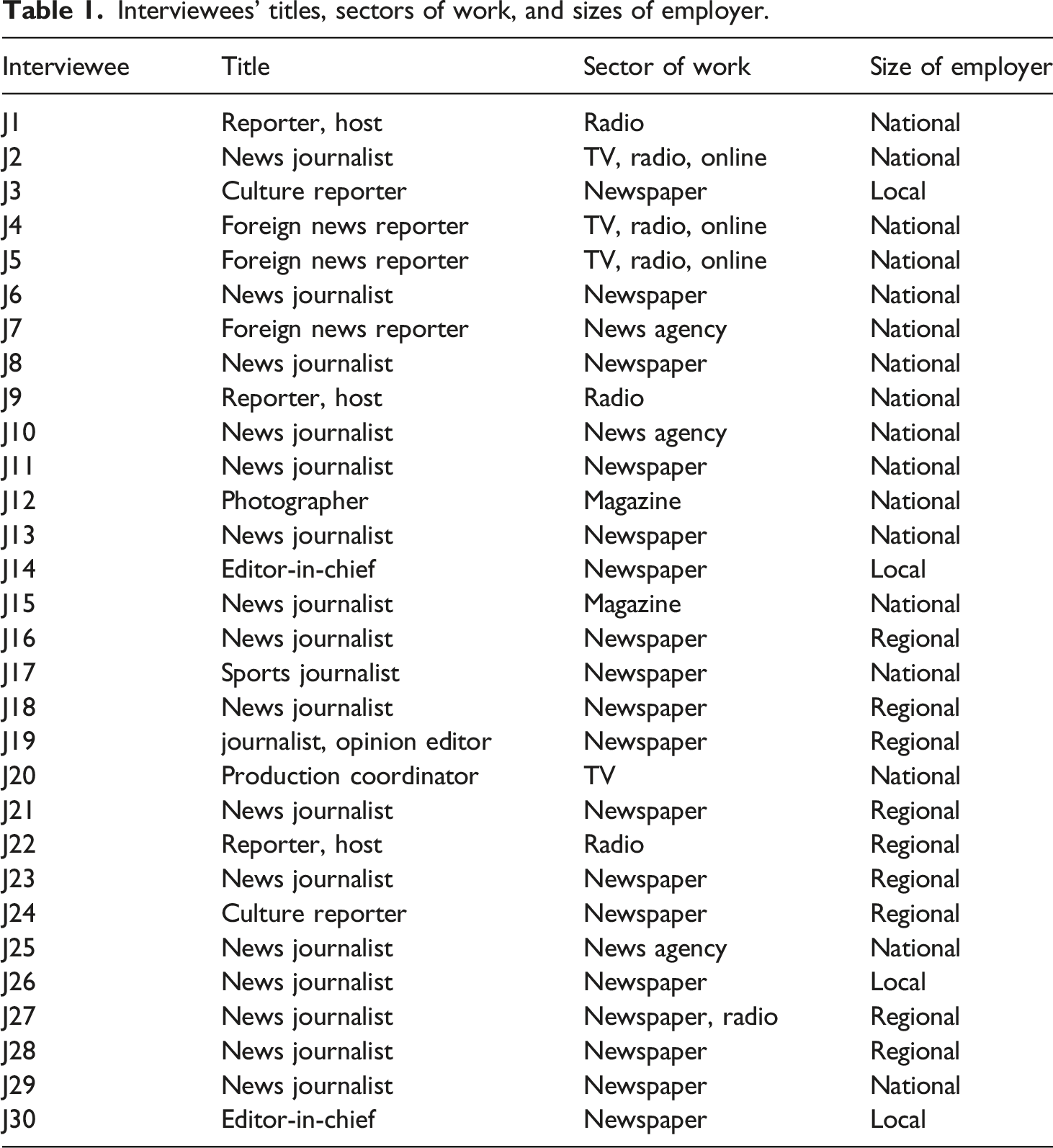
We collected data from March to June 2020. We interviewed 30 Finnish journalists who had taken part in a quantitative survey research about media workers’ occupational well-being in September 2019 and indicated that they were willing to be interviewed further. Due to the COVID-19 pandemic, interviews were conducted on the phone and through videoconferencing systems such as Zoom. The average length of an interview was 58 min with the longest taking 119 min and the shortest 38 min. Participants were informed of their rights in accordance with the European data protection regulations and they were promised anonymity in the reporting of data. Thus, all interviewees are given ordinal numbers in the Findings section.
Our interview guide covered four themes in addition to background information about the interviewee: (1) work and changes in the media field, (2) digitalization in media work, (3) well-being at work, and (4) future of media work. Interviews were carried out by first and second authors as well as a research assistant, recorded, and professionally transcribed. We opted for a semi-structured approach to allow our interviewees to describe and explain the themes they felt were important (Kvale, 2007). Interview questions covered, for example, the interviewee's working history as a journalist, changes in skill requirements, and technologies used in daily work.
Interviewees’ titles, sectors of work, and sizes of employer.
Data analysis
All interview transcripts were imported into the analysis software Atlas.ti and read through several times by the first author and subsequently discussed among all authors. We examined our data with an iterative approach, letting the data speak for itself but also considering it through previous research (Tracy, 2019). An iterative approach moves abductively between inductive data analysis and deductive considerations of existing theory (Huffman et al., 2019).
In practice, in the first phase of the analysis process, the interview transcripts were read through twice: the first reading focused on determining what was present in the data, i.e., which themes and topics our interviewees were discussing. The topic of skills and learning had emerged as early as the data collection phase and the first, preliminary reading of data determined that the theme could be explored further. During subsequent readings, the first author coded the data in relation to the theme of learning and by looking for, for example, descriptions of learning experiences and mentions of skills. This resulted in 28 descriptive codes, such as “learning new things”, “handling all outlets”, and “visuality, visual thinking.”
A close reading and thematic coding of these descriptive categories allowed us to identify larger analytical themes, which led to three categories: the labor market logic, the negotiation of professional and technology logics, and the negotiation of professional and market logics. From these, the labor market logic was identified more inductively based on our participants’ descriptions, whereas the negotiation of technology and professional logics as well as the negotiation of professional and market logics were identified based on previous research arguing for the centrality of these logics.
Findings
Our research question asked which institutional logics can be identified in journalists’ descriptions of learning and how the logics manifest in those descriptions. The analysis led to three analytical categories representing the logics: the labor market logic, the negotiation of professional and technology logics, and the negotiation of professional and market logics. The section below starts by outlining the labor market logic which, to our knowledge, has not been conceptualized explicitly in journalism research previously. We then turn to how our participants negotiated the skill demands arising from the technology logic with the professional logic and close the section with an analysis of the interplay of market and professional logics, which, through the intensification of work, enable and constrain learning.
The labor market logic
Everyone has to re-educate themselves. Especially middle-aged journalists like me. (J2)
The quote above, coming from a news reporter working for a national news outlet, embodies our key finding well: the need to learn continuously is felt and seen as pervasive among our interviewees. Being able to learn was seen as an important skill in and of itself for a journalist to have. As one of our participants, a newspaper reporter (J28), put it: “If I’m not actively developing myself, I’ll fall behind very soon.” This learning ability was extended to, for example, learning new ways of working, such as mastering new technologies, learning about story topics, or just plain speed – learning how to get one’s job done faster. This need to continuously learn was motivated by journalists’ perceptions about employability: They saw learning as a skill that would keep them employed both currently and in the future. Hence, the journalists’ perceived need to learn continuously can be conceptualized as a labor market logic that pushes individual journalists to learn 1) to meet the needs of their current employer and 2) to be successful in the labor market in the future.
In discussions related to the precarity of the journalistic field, our interviewees saw learning new skills as a strategy for securing employment. A magazine journalist stated that “I’m 48 and halfway through my career. I have 20 years left until retirement, so I think learning these digital skills is the most important thing for me” (J15). Our interviewees were keenly aware of the relationship between their willingness to learn and their future chances of employment. This finding is further highlighted when considered through the distribution of working experience among our interviewees: No matter how long they had been in the field, journalists recognized the need to learn – variance was found in their willingness to do so. Journalists with less than 10 years of working experience tended to view the continuous need to learn as normal while journalists with more than 30 years of working experience were quite reserved about mastering new skills. Journalists falling in between these groups, i.e., those with more than 10 but less than 30 years of experience had more ambivalent attitudes toward learning. The following excerpts illustrate these varying attitudes: Just to keep your job, like I’ve done so many different things and never said no to any task. – – In the future, I think it’s so important that you’re able to embrace [new] things. (J6, seven years of experience) For someone my age, learning these [technical] things is somewhat hard already. Retirement is so close that I really have no ambition other than surviving these last couple of years. (J10, 32 years of experience)
These findings can be explained by the times the journalists entered the field: Newer entrants arrived at a field disrupted by technologies and disintegrating business models, whereas journalists with 10–30 years of experience had entered the profession at a relatively stable moment only to find their skills insufficient later. For those nearing retirement, learning had no specific purpose anymore as their careers were ending. Importantly, however, all recognized the need to learn continuously.
The labor market logic could also be identified in our participants’ talk of the daily requirements and practices of their work. They saw that learning was an essential skill in producing good journalism as news organizations have moved from the beat reporting system toward employing more general assignment reporters due to shrinking budgets. This shift requires journalists to be able to take in sizable amounts of information in a short period of time (i.e., to learn about story topics) and present that information to audiences as if they are experts in it. Journalists approached the change from beat to general assignment reporting in different ways. Where one journalist delighted in getting to learn about a new topic each day, others saw the decline of expertise as a threat to the quality of journalism as the following quotes illustrate: I get to take in new interesting topics, new interesting themes every day and I learn so much from that, which is so valuable to me because I love learning new things. – – If I’m bored at work, I’ll read Wikipedia. (J7) It's a shame that expertise is disappearing. Now you should just know everything about everything, which easily leads to a situation where nobody knows nothing. (J10)
Our participants also discussed how general assignment reporting tasks are going to keep increasing, indicating that related skills will be necessary when entering the job market in the future. A reporter (J6) said, “People who can embrace new things fast and play expert in them, we need that kind of people.” In other words, journalists were aware of how they should meet employer demands through learning in order to succeed in both their current organization and in the labor market in the future.
Negotiating technology and professional logics
The analysis indicates that our participants used professional logics to combat the effect of the technology logic in relation to learning. The technology logic could be seen to push journalists to learn digital skills, such as cross-platform production, which did not always align with what the journalists thought journalism should be about, i.e., the profession’s watchdog role. Journalists negotiated this tension with three methods: (1) they evaluated the need to learn through its usefulness to filling the watchdog role, (2) they assessed learning in relation to the quality of journalism, and (3) they questioned the need to learn as a chase after “shiny new things” (Posetti, 2018). Taken together, these methods can be seen to mirror the professional logic of journalism. Consequently, the role of the technology logic for learning in journalism gets downplayed by the journalists with the use of a more dominant professional logic.
The technology logic manifested in this study as the main driver of skill requirements. From the viewpoint of institutional theory, skill requirements can be seen as traits for an imagined ideal journalist that sets the bar for institutionally legitimate behavior (cf. Lowrey, 2017). Our participants’ descriptions of how skill requirements have changed or which skills they will need in the future reflect how journalists are trying to come to terms with the increasing digitalization of their profession: While traditional skills, like writing and general knowledge, were still present in their descriptions, most devoted time to talking about the importance of digital skills. In the interviews, journalists talked of skills such as understanding data and audience analytics, being able to produce journalistic content to social media platforms, and being able to use different types of software. The following quote, coming from a radio reporter, illustrates how a seasoned journalist is struggling to adjust to the demands of producing journalism to digital platforms, i.e., how the technology-related skill demands are met with journalism’s professional logic: For radio reporters, there’s now pictures, video, editing, and all that… - - And it requires a whole different thinking process. If I go out in the field, I’m focusing on radio even though I know I should also get stuff for social media and pictures, video and so on. (J1)
Journalists tended to assess the usefulness of learning in relation to producing quality journalism on one hand, and on fulfilling journalism’s watchdog role as the guardian of democracy on the other. These aspects were also at times intertwined as producing good journalism entailed fulfilling journalism’s role as the fourth estate for many of our participants. In the interviews, journalists described their (un)willingness to learn through their assessment of whether learning gave them the ability to do better journalism or whether it took time from them to do good journalism. The following quotes illustrate both of these attitudes toward learning. It is also noteworthy that both interviewees discuss digital skills in relation to doing quality work: When I’ve mastered these digital things, I really want the chance to do good digital content like producing quality [content] for the web. Or to be able to do something new, like podcasts. (J15) I really don’t have the energy to learn all the nitty-gritty [technical] stuff. Like what I said about being on-call [for the website], there are so many little things you need to remember, like I’m not interested in that. I just want to do the job. (J11)
In relation to the watchdog role, a key tenet in our participants’ descriptions was the highlighting of the relative stability of “what journalism is” in relation to the rapidly changing technological environment. In other words, the professional logic provided the institutionally legitimate baseline for approaching the phenomenon of digitalization and the associated skill requirements. For example, a reporter (J4) talked about understanding algorithmic decision-making at length but then finished off with a note highlighting journalism’s meaning for society: “I don’t think journalism’s basic nature is going to change. We tell people important and meaningful stories and contextualize them."
Finally, technology and professional logics were negotiated by questioning the need to learn altogether. This took place only rarely, but when it did, learning was often equated with journalism’s chase for “shiny new things” (Posetti, 2018). Specifically, those participants that expressed critical views wondered what the consequences of continuous learning and adoption of new technologies are for the journalistic work process and journalism’s societal role. A culture reporter (J3) described how many digital tools were made to simplify her work but then asked “what’s the overall benefit of them? I can’t see it.” Similarly, a magazine reporter (J15) was worried how learning digital skills might affect the journalistic production process: “But all that learning, I wonder if it takes up room from something slower but important, like editing.” Again, the technology logic was met with a dominant professional logic.
Negotiating market and professional logics
Our analysis suggests that the market logic may function both as an enabler and constraint for learning among professional journalists. This was visible in our participants’ descriptions of intensification of work which can be understood as an individual’s need to work faster, multitask more, and invest more and more effort in their everyday work (Kubicek et al., 2015). Essentially, the market logic has pushed individual journalists to be able to learn about story topics more widely than before as it has driven newsrooms to size down and emphasize general assignment reporting. On the other hand, it has also induced time pressures on journalists as less journalists are taking on the same or even a bigger workload while other resources have not increased. These pressures are often met with a professional logic that can be seen to motivate journalists to produce quality journalism to serve society. Consequently, the market and professional logics present journalists with conflicting demands in relation to learning: the market logic highlights the need to learn on a wider scale and faster than before while the professional logic emphasizes the journalists’ need to simultaneously produce quality journalism that serves society. The experience of intensification can be identified as journalists describe these pressures in their daily work.
In the interviews, our participants described how intensification in journalism is not merely about winning the race for news but rather about a more comprehensive intensification of all work. This manifested in their talk about, for example, learning about story topics, which many felt there was not enough time to do. A radio reporter specializing in food journalism (J9) said, “you have to know everything in a very short amount of time. You don’t have enough time to familiarize yourself with these topics in the same way [as before].” Similarly, a foreign news reporter (J5) reflected on the rapid pace of change in her newsroom, where technological change and the requirement to learn new software felt demanding: Sometimes it feels like we have these pretty intense periods of like, there's something new all the time, and you don't have the time to take it all in. Like I was on a pretty long sick leave and when I came back it felt like all the software had changed. Usually, I think new is good but sometimes it just feels like 'oh no, something new, again.' (J5)
Furthermore, the phenomenon of intensification arising from the interplay of the market and professional logics was visible in how journalists talked about their ability to make use of new skills in daily work. Essentially, journalists described how, due to time pressures, they rarely had the chance to solidify new skills through repetition. A journalist (J3) explained how their employer provided training for the use of a new content management system but how the things taught in that training never went to use as there was no time to make use of the skills in daily work. Similarly, a magazine journalist detailed how the time pressure she experienced daily influenced her ability to hone her skills: We've had video training, for example, -- but the problem is that afterward, we don't have the time or resources to do anything. You spend a day or a half in training, but you never have the time to use those skills in your work and they're forgotten and wasted. (J15)
In this sense, the market logic may also constrain learning: as it pushes journalists to perform their work efficiently, it may decrease journalists’ chances to make use of new skills in the long-term. This could have ramifications for journalists’ skill-levels in the future as well as consequences for occupational well-being as the intensification of job demands has been shown to lead to burnout and decreasing job satisfaction (Kubicek et al., 2015; Rantanen et al., 2021).
Discussion
This study examined learning in professional journalism through the analytical lens of institutional logics (Thornton et al., 2012). Drawing from institutional theory and previous research on learning in journalism, we identified the labor market logic, the negotiation of technology and professional logics, and the negotiation of market and professional logics as influential for learning among professional journalists. The findings contribute to research on both institutional logics in journalism as well as learning in the journalistic profession. Firstly, the conceptualization of the labor market logic sheds light on why journalists experience the need to learn as pervasive regardless of their position in the field: Journalists’ perceived need to learn continuously stemmed from their experience of precarity and learning functioned as a mechanism to control their employability in their current organization and when entering the job market. Previous research in journalism studies by McMullen Cheng and Bélair-Gagnon (2022) has identified a potential “logic of precarity” among news product personnel and operationalized it as relatively frequent changes in tenureship. Our analysis indicates that the logic of precarity may be more aptly conceptualized as a labor market logic that can push journalists to embrace learning to meet current and future employer needs. Furthermore, the labor market logic offers an instrument for examining precarity in journalism and future studies should continue to conceptualize it in more detail through, for example, ideal type typologies as proposed by Thornton et al. (2012).
Secondly, the negotiation between technology and market logics identified in the analysis aligns with previous research in highlighting how the technology logic, while introducing new skill requirements to the field of journalism, is often met with a dominant professional logic (cf. Russell, 2019; Lischka, 2020). Journalists in this study assessed skill demands based on their usefulness in relation to journalism’s watchdog role and their personal ability to produce quality journalism while at times questioning the need to learn in the first place. These tactics can be interpreted as journalists’ attempt to reduce institutional complexity (Oostervink et al., 2016) arising from the competing logics. Notably, our analysis did not indicate that the technology logic would have been adopted without critique on the individual level as the journalists did not speak of technologies as serving society without also implicating the professional logic (cf. Wu et al., 2019). This finding also speaks to previous research in the neo-institutional tradition that has directed attention to media organizations’ increased dependence on platform companies (e.g., Laaksonen et al., 2022). While on the macro-level media organizations seem to be showing isomorphic tendencies in their adaptation to the platform economy, analysis of the individual level shows that variance and even opposition to the institution of digital technology can still be found.
Thirdly, the analysis of market and professional logics highlights the journalists’ experience of intensification of work (Kubicek et al., 2015). In relation to learning, the two logics posed journalists with conflicting demands when the market logic pushes journalists to embrace learning on a wider scope than previously but also to do it faster, while the professional logic demands journalists’ also produce journalism that serves societal needs. As these pressures are in conflict with each other, being constantly forced to negotiate the competing logics might have consequences for journalists’ occupational well-being: Being unable to produce the best work one can may lead to decreasing job satisfaction (Reinardy, 2014; Beam, 2006). Moreover, the presence of the experience of intensification also subjects journalists to an increased risk of burnout (cf. Kubicek et al., 2015; Rantanen et al., 2021).
Contrary to previous research on learning and innovation, this study found variance in attitudes toward learning: Our participants were not completely unwilling to change as many newsroom studies suggest journalists are (cf. Tameling and Broersma, 2013; Ekdale et al., 2015). This is due to the study’s adoption of the institutional logics perspective which allows the highlighting of diversity of experiences within a field. Furthermore, the study’s focus on learning instead of innovation merits a notion: while journalism innovation research often concludes that news organizations are incapable and/or unwilling to produce innovations and thus secure their future (see Koivula et al., 2022), less attention has been devoted to the mechanism through which this comes to be. Learning allows for the building of routines which make new learning more difficult to achieve (Edmondson and Moingeon, 1996). Rather than seeing learning normatively as a mechanism to gain skills and develop innovations, it should be viewed as a “faulty mechanism” (Edmondson and Moingeon, 1996: 19) where routines represent an inventory of past learning. This applies specifically to news organizations that, in the process of producing news, constantly have to “routinize the unexpected” (Tuchman, 1973) in order to be efficient and maintain editorial independence (Tandoc and Duffy, 2019). Hence, examining learning instead of innovation reveals a more nuanced picture of why change might be difficult in newsrooms.
Finally, this study is not without limitations. To establish a causal link between institutional logics and learning on the individual level, a different methodology should be applied. Furthermore, the study’s connection to a research project examining digitalization in media work may highlight the role of technology more than what a dataset collected with a different focus would. However, it is noteworthy that news organizations’ need for learning is largely motivated by the organizations’ challenges in going digital (Küng, 2020). Hence, it could be fruitful to examine whether journalism’s professional logic has changed over time to accommodate the demands of the technology logic.
Footnotes
Acknowledgements
The authors wish to thank Jussi Salmela for his help in data collection as well as the two anonymous reviewers for their valuable feedback during the review process.
Conflict of interest
The author(s) declared no potential conflicts of interest with respect to the research, authorship, and/or publication of this article.
Funding
The author(s) disclosed receipt of the following financial support for the research, authorship, and/or publication of this article: This work was supported by the Helsingin Sanomat Foundation.
