



Abstract
Trust in journalism is highly relevant for society. Within the past years, especially during the COVID19-pandemic, trust in journalism became a recurring subject of public debate in Germany: Journalism is often vilified as ‘lying press’ and the legitimacy of traditional media is increasingly questioned. While in Germany, unlike other countries, we do not see a crisis in media trust, there nonetheless is a certain share of the population being skeptical towards traditional journalism. News outlets therefore need to ask themselves how to win back these sections of their audience and strengthen trust in their work. So far, research on media trust has largely focused on the audience – the journalistic perspective has hardly been examined. By conducting 29 interviews with German journalists, this paper aims to analyze which strategies news outlets pursue to cultivate trust in their work. Three main approaches to trust-building can be identified: The quality oriented, the audience engagers and the transparent. The results enable us to get a clearer overview on how news outlets try to regain and build their audience’s trust – which presents starting points for both journalism practice and research.
Introduction
Journalism is a cornerstone of democratic societies – without it, informed societies would hardly be thinkable. Especially in times of crises, such as the coronavirus pandemic, the importance of trustworthy information sources becomes apparent. Journalism performs a variety of important tasks within democratic societies: It gathers, verifies and presents up-to-date information on rapidly evolving events worldwide, offers orientation and acts as watchdog for those in power (Hanitzsch, 2017). Journalism thus is oftentimes considered essential for political deliberation and participation, it provides common ground and supplies citizens with highly valuable services (Deuze, 2005). However, the reliance on journalism is always accompanied by a certain risk: As journalism usually reports about events outside of one’s experience – for example, by providing information about COVID19-developments worldwide – individuals have no possibility to exercise control such as checking on the information provided (Tsfati and Cohen, 2005). Thus, trust is a central prerequisite within the journalism-audience-relationship: Recipients need to trust journalism to provide them with information on relevant events in appropriate quality – and the media depend on their audiences’ trust in order to upkeep their societal task and legitimacy (Prochazka, 2020). Trust in journalism furthermore is closely connected to trust in other systems – such as political institutions (Fawzi et al., 2021). A certain level of media trust can thus be regarded as democratically necessary – too high trust, especially ‘blind trust’, however has to be seen with caution: “Even more so: in democratic societies, (constructive) media criticism is necessary. A critical and cautious public that monitors news media’s performance and holds them accountable is an important corrective for journalism” (Prochazka and Obermaier, 2022: 452).
Pre-COVID19, media trust in Germany was on a downward trend, the Reuters Digital News Report reported media trust falling from 60% in 2015 to 45% in 2020 (Newman et al., 2020). In the 2021 survey, the first to be conducted in COVID-times, media trust climbed to 53%, underscoring the importance of the media in times of crisis (Newman et al., 2021). It is uncertain whether this increase is sustainable: In 2022, 50% of the German respondents state they can trust most news most of the time, indicating a slight drop in media trust after the “Corona bump” (Newman et al., 2022: 15). Nevertheless, Germany has internationally always enjoyed rather high levels of media trust (50% compared to 42% worldwide). Other studies in Germany second this high level of media trust, but also show a small, but strong core of people with very low media trust (16% in 2020, 28% pre-pandemic; Jakobs et al., 2021). News outlets thus have to ask themselves how to maintain and build trust – and how to win back skeptical parts of society. While there has been a large body of research published on media trust in the past decade (see Fawzi et al., 2021), mostly focusing on the audience’s perspective on trust in the media (e.g. Obermaier, 2020; Prochazka, 2020), the journalistic perspective on the topic has hardly been examined (exceptions: e.g. Muck, 2018; Toff et al., 2020). Studies that take the journalistic perspective on the relationship to its audience, for example by analyzing expectations (e.g. Loosen et al., 2020) or audience inclusion (e.g. Green-Barber and McKinley, 2019), oftentimes do not or only superficially include the concept of trust – despite its relevance for the joint relationship. Thus, we only know little about how journalism tries to build long-term trust relationships with its audience(s). By interviewing 29 German journalists, this study aims to fill this gap by analyzing how editorial offices perceive the trust relationship with their audience and which strategies they pursue to cultivate trust in their work. 1
Trust in journalism
Trust can be seen as a social concept that evolves in a relationship between two entities: the trustor, in this case the recipient, and the trustee, journalism. One of the most widespread definitions of trust is that of Mayer et al. (1995), who define trust as “the willingness of a party to be vulnerable to the actions of another party based on the expectation that the other will perform a particular action important to the trustor, irrespective of the ability to monitor or control that other party.” (p. 712, original highlighting). By communicating information on relevant and current events, journalism performs an action important to its recipients – trust presents a mechanism that allows the trustor to make use of this service (Blöbaum, 2021). When recipients enter a trust relationship with journalism in order to use these services, they make themselves dependent and vulnerable towards journalism (Grosser, 2016). They do this without being able to monitor or control what happens behind the scenes – the recipients’ trust therefore always entails a certain risk: “When people act upon this information in their daily lives (when voting, buying or selling stocks, planning trips etc.) they risk taking the wrong decision, and this risk is the most central element in the definition of trust” (Strömbäck et al., 2020: 149). Seeing that the positive expectations and assumed benefits overweigh the possible risks, recipients are however willing to accept this risk to benefit from the advantages of the journalistic system (Blöbaum, 2016).
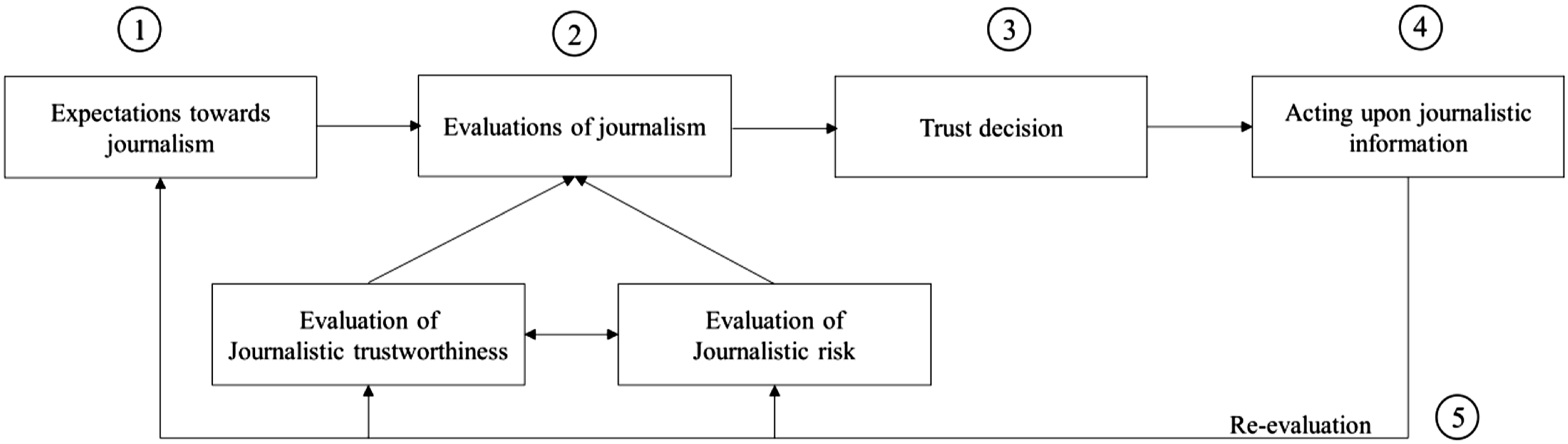
In this paper, we define trust as a process consisting of five steps (see also Fischer, 2016; Uth, 2021; for a similar process: Blöbaum, 2016). Figure 1 illustrates this process. 1. Expectations towards journalism: As specified in the definition of Mayer et al. (1995), trust is based on the trustee’s positive expectations towards the trustor. As trust is situational (Blöbaum, 2021), these expectations are focused on the specific task the trustor expects the trustee to execute (Hardin, 2002). Recipients expect that journalism fulfills its systemic function by correctly informing them with all information necessary for their everyday conversations, decisions and actions (Blöbaum, 2016; Grosser, 2016). 2. Evaluations of journalism: Based on this first step, recipients will evaluate how likely it is that their expectations towards journalism will be fulfilled (Fischer, 2016; Grosser, 2016). Two evaluations take place: On the one hand, the trustor will make judgements concerning journalism’s trustworthiness (i.e. via indicators of quality, journalistic reputation, expertise or credibility (thus a sub-factor of journalistic trustworthiness, Fawzi et al., 2021)); on the other hand, the trustor will assess potential risks of trusting journalism – more specifically, how likely it is that the conveyed information could be incorrect, incomplete or distorted and its use therefore would entail negative consequences (Grosser, 2016; Karlsson, 2020; Uth et al., 2021). Trustworthiness, as well as risk, thus constitute key building blocks of trust (Mayer et al., 1995). 3. Trust decision: Based on these evaluations, recipients will come to a decision on whether to enter a trust relationship with journalism and to make themselves “vulnerable to the journalistic system’s selection and communication of current information.” (Grosser, 2016: 1040) If the perceived trustworthiness of journalism overweighs the perceived risks, a positive trust decision manifests – which builds the base for a trust relationship between journalism and audience (Blöbaum, 2016). 4. Trusting action – acting upon journalistic information: The last, but crucial step of a holistic process of trust needs to encompass actual action (Dietz and Den Hartog, 2006; Fischer, 2016). Would information solely be consumed, but not used in any further way (such as a basis of future attitudes, decisions or actions), no need for trust would be given (Blöbaum, 2016; Fischer, 2016). In the realm of journalism, the trusting action includes a variety of processes, as mediated information can be processed and used in various ways and intensities – such as solidifying knowledge, attitude-formation, follow-up-communication or decision-making (Grosser, 2016; Strömbäck et al., 2020). Consequently, trust in journalism can be accompanied by various degrees of risk – from lower levels when information is stored, but not actively used, up to more extensive forms of risk, for example when media information is used in conversations or for voting or purchasing decisions (Prochazka and Schweiger, 2019). 5. Re-evaluation: The outcome of this action will be used for a re-evaluation of journalism, its trustworthiness and its risks (Mayer et al., 1995). While a positive result (trust was not disappointed) consolidates the trust relationship, a negative outcome (trust is broken) will weaken journalism’s perceived trustworthiness and might lead recipients to restrain from future trust relationships – aversion and cynicism are possible consequences (Mayer et al., 1995; Prochazka, 2020). Process of trust formation.
Trust-building strategies in journalism
The relationship between journalism and its audience has gained relevance within the last decade – both in journalism practice and research. Within the past years, studies discussed possible trust-building strategies within journalism (e.g. Toff et al., 2020; Zahay et al., 2021). Looking at existing literature as well as the aforementioned process of trust in journalism (Figure 1), we can differentiate three main starting points to strengthening trust in journalism.
Ensuring journalistic trustworthiness, minimizing risk
The most evident way to build trust is to strengthen one’s trustworthiness: the higher the perceived trustworthiness of journalism, the higher the probability that recipients will enter a trust relationship and act upon journalistic information (see Figure 1; Grosser, 2016).
By now, several studies have analyzed which factors influence media trust. Based on a review of empirical studies to date, Fawzi et al. (2021) differ between three groups of factors: social, political and media characteristics. To analyze how journalism can build trust in its work, the latter are essential: Several studies show that perceived media performance is highly influential when it comes to trust (Obermaier, 2020; Prochazka, 2020). 2 As the aforementioned process demonstrates, trust is foremost based on positive expectations the trustor has towards the trustee (Barber, 1983; Fischer, 2016). Trust in journalism is therefore highly dependent on the specific expectations citizens have towards the role and performance of journalism within society – and how these role and performance expectations are perceived as enacted (Grosser, 2016; Prochazka, 2020). Using qualitative interviews, Prochazka (2020) analyzed recipients’ expectations towards trustworthy journalism: Besides competence and integrity, mainly expectations towards the journalistic reporting prove to be key when it comes to trustworthiness, such as correctness, separating facts and opinions, balance, completeness, diversity of topics and opinions and serosity – classic quality criteria within journalism (Prochazka, 2020). Quantitative studies second this, showing a connection between the perceived quality of journalism and its trustworthiness (Obermaier, 2020; Prochazka, 2020). If journalism wants to actively strengthen trust, working on its performance and quality should therefore be a main factor.
However, trustworthiness is not objective but perceived – journalism should therefore not only work on its trustworthiness, but provide recipients with sufficient information on how to assess the trustworthiness of its actors and products (Uth et al., 2021).
Communicating journalistic trustworthiness and risk
As shown, perceived trustworthiness and risk are the main components recipients (unconsciously) consider when deciding whether or not to trust journalistic information. In order to build trust, it is therefore recommendable for news outlets to clearly communicate their (high) trustworthiness – and the correspondingly low risk that recipients have to account for when trusting them (Karlsson, 2020). Transparency, defined as “the increasing ways in which people both inside and external to journalism are given a chance to monitor, check, criticize and even intervene in the journalistic process” (Deuze, 2005: 455), has often been proclaimed as ‘savior’ when it comes to regaining trust in journalism (Kovach and Rosenstiel, 2001). If outlets give further information about their products (product transparency, e.g. naming and hyperlinking sources) and open up about the processes behind the scenes (process transparency, e.g. info-boxes, explanation articles, newsroom-tours; see Meier and Reimer, 2011), recipients can come to more informed decisions on whether to trust certain journalistic information. Approached in a strategic way that allows recipients to gain their own, unbiased impression of what happens behind the scenes, transparency has the potential to (re)gain citizens who do not yet trust journalism or have lost trust: “Transparency could thus appeal to low-trust members of the public who, all other things being equal, do not trust journalism and the news media under regular conditions, but may eventually, find journalism more trustworthy through acts of transparency.” (Karlsson, 2020: 3) Especially direct, non-mediated forms of transparency (happening in face-to-face-contact between journalists and the public, compared to indirect forms, mediated through journalistic products), such as live events or guided newsroom-tours seem promising here. As surveys show, recipients value transparency both in general as well as when it comes to building trust (Uth et al., 2021; Wintterlin et al., 2020). Experimental studies however do not come to an unanimous conclusion on whether transparency actually has trust-building effects (see the overview of Curry and Stroud, 2021).
Engaging the audience
Besides the aforementioned strategies, there is one more way news outlets could build trust in their work: by engaging their audiences. Zahay et al. (2021) differ two normative frameworks of trust-building: the traditionally as well as the engagement oriented. While the first mainly focuses on traditional standards of journalism, such as quality and transparency, the latter focuses on engaging the audience in order to build trust (Zahay et al., 2021). This focus on the relationship with the audience is also captured in the concept of “engaged journalism”, which is accompanied by the explicit goal of building long-term, sustainable trust (Green-Barber and McKinley, 2019). Kovach and Rosenstiel (2001) stress that “Journalism’s first loyalty is to citizens.” (p. 51) The audience therefore should present a crucial part of journalist’s everyday work (Muck, 2018). By actively including the audience into journalistic processes and taking them seriously, news outlets can produce journalism that better meets their audience’s expectations – which should in turn increase their satisfaction, loyalty and trust (Grosser, 2016; Prochazka, 2020). Closeness and a bond to the outlet are oftentimes named as catalysts of trust (Beham, 2020). Engaging the audience – both in form of being available and listening to them as well as by actively including them into their work – can therefore be considered a third possible way for news outlets to enhance trustworthiness. In journalism studies, several forms of engagement are discussed to have positive effects on trust in journalism – such as the participation of audiences in the journalistic process, for example by selecting topics (Karlsson, 2020) or the establishment of audience councils or ombudspersons (Beham, 2020).
As shown, there are many potential ways in which journalism could build trust in its work – nevertheless, we so far have only little knowledge on how news outlets actually try to do so. Considering the democratic relevance of media trust, it becomes central to shift focus to the journalistic perspective to gain a comprehensive picture of how journalism deals with its audience’s trust. This paper sets out to fill this gap. Its central research question is: Which strategies and measures do news outlets pursue in order to cultivate trust in their work?
Methodological approach
To answer this question, the author conducted 29 in-depth interviews with journalists throughout Germany, with an average length of 50 min. We used non-probabilistic convenience sampling, following the concept of theoretical sampling (Glaser and Strauss, 1967), selecting interviewees by their relevance in answering the research question instead of quotation to best shed light on how news outlets build trust. As work on the trust relationship with the audience largely revolves around strategic decisions predominantly taking place at the management level, we focused mainly on (deputy) editors-in-chief, as they promise the best insights on strategic planning within the newsroom. We recruited via personal contacts, pro-actively e-mailing suitable outlets, as well as via snowball sampling, asking interviewees for colleagues they can recommend. The final sample consisted of 26 (deputy) editors-in-chief, one journalist, two ombudsmen and one interviewee being both a journalist and readers’ advocate, mainly working for local and regional print/online news outlets. 3 Sampling was stopped when we reached theoretical saturation (Glaser and Strauss, 1967), meaning further interviews did not spark substantial new insights, proving the comprehensiveness and representativity of our sample. Except for two interviews happening face-to-face, all interviews were conducted via telephone. Data collection took place from August 2019 to February 2020
The interview guideline consisted of three overarching blocks. The first third of the interview aimed to allow an easy start to the interview as well as an overview of the trust situation in the newsrooms (perception and relevance of trust, characteristics defining trustworthy journalism). The second block aimed to identify the strategies the outlets established to build and strengthen trust in their work. Here, we used both very general, open-ended questions to obtain as unbiased answers as possible and to capture the variety of used strategies, as well as questions explicitly focusing on the trust-building strategies derived from theory (quality, transparency, engagement), for example how the outlets let their audiences participate, open up their products, make their processes transparent or how they present the actors working behind the scenes. This simultaneous combination of theoretical guidance and openness can be seen as main advantage (Gläser and Laudel, 2009) of qualitative interviews: While we have some knowledge on possible trust-building-strategies, there might be others we are not aware of – which we might miss out using a less explorative approach. The third block focused on evaluation as well as an outlook to capture a holistic view and first-hand-experiences concerning the trust-building activities. The full interview guideline can be found in the Supplementary Materials. The interviews were transcribed, adjusted for readability and translated before being analyzed using the method of qualitative content analysis following Mayring (2015). For the analysis, we applied a first version of a category system consisting of overarching categories based on an extensive literature review to the material and subsequently inductively refined it, adding sub-categories and themes emerging from the data (Gläser and Laudel, 2009; Mayring, 2015). Based on this inductive-deductive category system, transcripts were systematically coded and analyzed by the author using MAXQDA.
Trust-building strategies within German news outlets
All respondents agree that in order to properly do their job, both in terms of their societal mandate as well as financial legitimacy, they are in need of the public’s trust. Consequently, almost all interviewees are convinced they actively need to work on the trust relationship with their audience. This perception is unaffected by whether the outlet in question perceives a loss of trust in their work – respondents stress that it is important to not let trust vanish in the first place and instead actively counter-act any possible decrease of trust. Several respondents describe that they see media trust as situation-bound and thus put up for debate anew with each individual article – cultivating this trust therefore has to be a fundamental part of their day-to-day operations.
So which strategies and measures do news outlets pursue in order to cultivate trust in their work? Based on which strategies respondents classify as most important for the trust relationship with their audience, 4 we distinguish three main approaches to building trust within the outlets surveyed: the quality oriented, the audience engagers (audience) and transparent. While all outlets address all three types of trust-building to some extent and pursue a wide range of measures, varying focal points can be identified.
The quality oriented
The first – and most common – approach of trust-building within the surveyed newsrooms can be described as the ‘quality oriented’. All interviewees point to the important role of quality when it comes to trust and most interviewed journalists stress it should be in the center of their work and trust relationship to the audience. The reason for this is the professional role perceptions the journalists convey: They see journalism as a service for democracy, its main function being providing citizens with relevant, up-to-date information. It is the professional performance of this function on which, in their opinion, trust is based. For them, trust therefore is inevitably connected with the quality of their work and high quality will – almost automatically – result in high trust: “If a reader has the feeling that an article is well researched, well prepared and written in fluent and error-free German, then you already have achieved a lot as a journalist. Then there is no other way than for the reader, with permanent use, to gain trust in the medium he has in front of him and in the people behind it.” (Editor-in-chief, regional newspaper) Particularly in recent years, however, this connection between quality and trust caused problems: Many respondents observed a loss of journalistic quality – partly due to cost-cutting measures and the increasing speed of news cycles. For them, this loss of quality is one of the main reasons underlying the current debate about media trust with which they see themselves confronted. Accordingly, the journalists perceive it as essential to establish institutionalized routines of quality management to win back and strengthen their audience’s trust. They implemented a wide variety of policies and initiatives to ensure the quality of their work – both concerning the journalistic processes as well as preventive and corrective measures (see Ruβ-Mohl, 1997 for this distinction). Examples are the training and education of their employees (e.g. traineeships as entry requirement, workshops on comprehensible writing), a specialization along tasks and topics, institutionalizing editorial guidelines setting norms and rules for the journalistic processes, a two-source and four-eye principle for correctness, and critical self-reflection both within the newsroom as well as together with their audience, for example in form of a daily product critique or feedback councils with recipients in which journalistic quality and the success of the aforementioned quality management initiatives are being evaluated. The respondents are convinced that this variety of initiatives located on all steps of the journalistic process is both necessary and successful when it comes to guaranteeing high-quality journalistic reporting in the long term – and, due to its direct influence, also trustworthiness.
The audience engagers
A second type of trust-building emerging from the interviews are the ‘audience engagers’. These outlets prioritize the relationship with their audience over other trust-relevant factors such as quality or transparency. While the newsrooms of this type do stress that quality is inherently important when it comes to trust, they perceive a close relationship and bond with their audience as even more important to ensure profound and sustainable trust relationships. Outlets of this type oftentimes have a long tradition in their area and praise their close relationship with their audience. In this context, audience engagement is defined as twofold: on the one hand, it includes a close bond between journalists and audience, on the other hand it encompasses the active involvement of recipients in journalistic processes. For the participants, this strong orientation towards the recipients is a necessity following a period of neglect in the past years, which led journalism to loose proximity to its audience. Several respondents self-critically claim that journalism has not been sufficiently concerned with their recipients, some interviewees even state a severe alienation between journalism and parts of its audience. In line with current studies (e.g. Jackob et al., 2019), the respondents report that they encounter a significant proportion of people who perceive journalism as part of the political and economic elite and no longer feel represented within the journalistic coverage. As the interviewees point out, this is detrimentally opposite to how they define their role as journalists, especially in local and regional contexts: “We write and broadcast for the audience, for our readers, listeners, viewers or users […]. And if we would not engage with them now, that would be completely absurd.” (Journalist, nationwide newspaper) The interviewees are thus convinced that they would be well advised to better consider and involve their audience at all stages of their work – which, so their assumption, will lead to a regain of trust. News outlets should constantly be available and in close contact with their audience, treat them at eye-level, listen to their concerns and actively involve them in their work: “The reader must have the feeling that they are being taken seriously. We have to be at eye level with the reader.“ (Editor in chief, regional newspaper) To do so, the outlets surveyed offer various ways to get in touch with them, both mediated and in person. In a few of the outlets, new journalistic roles evolved that aim to represent the audience and serve as a dedicated contact for recipients – such as an ombudsperson. Besides these aspects of accessibility and tangibility, the outlets also established a variety of opportunities for their audience to actively participate in journalistic processes, for example by putting topics on the media agenda and discussing content the newsroom published. However, this will to let the audience participate is mostly limited to stages post- and pre-production. When it comes to the actual core of journalistic work, that is researching, checking and presenting information, respondents only seldomly allow for citizen journalism – a finding in line with previous studies (e.g. Loosen et al., 2020). While respondents appreciate involving the audience when it comes to suggesting topics or giving input for articles, they do not want to share or sort out authorship – as this presents dangers for quality and objectivity: “That would also be, I think, a very questionable issue. After all, independence is our most important asset” (Journalist, nationwide newspaper). Audience engagement within the surveyed newsrooms thus is focused on proximity rather than co-creation – which, for the interviewees, will be decisive for journalism’s future.
The transparent
All respondents stress that being close to their audience and delivering high-quality journalistic content is key for successfully establishing trust. Nevertheless, several interviewees see this alone as insufficient and perceive another aspect as more relevant when it comes to their audience’s trust: transparency. As recipients do not have insights on what happens behind the scenes of news production – thus entering a risk when relying on journalistic information – giving them additional information can enhance their trust. For recipients to be able to trust the processes happening within the editorial offices and the information that results from them, it is crucial they are given the chance to understand these processes: “In order to trust someone, I either have to love them very much, or I have to understand what they do. In our case, it’s probably the latter. To have trust, I should know the processes.” (Deputy editor-in-chief, regional newspaper) The respondents thus perceive transparency as a prerequisite for trust – this trust-building type can therefore be classified as the ‘transparent’. The outlets of this type are convinced that the emerging skepticism towards journalism can effectively be countered by proving existing allegations and prejudices as incorrect through transparency. For them, it is important that recipients can form their own and independent picture of the journalistic team and their work – they therefore prioritize formats of transparency that put the recipients in the position of an ‘active observer’. Outlets should not simply claim trustworthiness, rather, the audience should be able to experience and discover their trustworthiness by themselves: “…one wants to show that […] there is no secrecy being practiced. This opacity is fuel for all these people who no longer have any trust in the media.” (Ombudsperson, regional newspaper) Transparency thus is especially popular among such news outlets that feel a certain degree of skepticism towards their work and journalism in general. Many of the participating outlets actively run transparency campaigns that aim to show what distinguishes them from alternative, less trustworthy offers (such as social or alternative media). They try to convey the work power and professionalism they invest in supplying their audience with the best coverage possible – they are convinced this will inevitably lead to higher trust. The interviewed journalists thus see transparency with its immediate, hands-on-approach “among the best means” (Editor-in-chief, regional newspaper) for reducing skepticism and building trust.
Discussion
Which strategies do news outlets pursue in order to cultivate trust in their work? As shown, trust-building an important goal and task in the outlets interviewed. Looking at the main focus of their trust-building strategies, three ideal types of journalistic trust-building can be distinguished: the quality oriented, the audience engagers and the transparent. These ideal types reflect the three trust-building ways derived from our theoretical perspectives on trust. While all of the interviewed newsrooms engage in measures of every trust-building type, they set different priorities which factors are most important when it comes to the trust-relationship with their audience. The majority of the outlets primarily focus on quality management and can thus by classified as quality oriented – generally, every interviewee stressed the key role journalistic quality has regarding trust. Nevertheless, several of the outlets perceive a close bond to their audience (audience engagers) or transparency (the transparent) as even more important to build sustainable trust. This prioritization partly depends on the perception of their audience: As our theoretical underpinnings on media trust suggest, quality as the most dominant strategy in our sample is seen as overall important – independent of one’s specific audience. However, outlets stressing the close relationship with their audience and their long tradition in their neighborhood primarily fall into the audience engager type. Outlets propagating a paradigm change to a new, more open culture within journalism on the other hand primarily are of the transparent type. Our results thus reinforce our theoretical assumption that trust and trust-building have to be understood as multifaceted concepts: besides the performance of journalism, also other aspects such as the proximity to the own audience as well as an active collaboration with the recipients in form of transparency are of relevance.
Taking a closer look at the priorities the different trust-building types set, diverging journalistic role conceptions (see Zahay et al., 2021; more general Hanitzsch, 2017) become apparent: While the quality oriented type can be classified along rather traditional journalistic tenets, the other two types – audience engagers and transparent – show, in comparison, a more ‘modern’ and innovative understanding of their own role. Our findings therefore are in line with the traditional and the engagement oriented types of trust-building differentiated by Zahay et al. (2021).
The quality oriented place high value on traditional quality standards of journalism, such as objectivity, correctness, impartiality, neutrality, and relevance. They see their societal function as impartial transmitters of information; therefore, this is where their priorities regarding trust-building are: Trust is built when journalists enact their role as detached observers, reporting things in an objective manner, ‘as they are’ (see also Loosen et al., 2020). Their work should therefore primarily focus on supplying their audiences with the highest quality possible – other aspects such as transparency or engaging audiences take a comparatively lower priority. This type of trust-building is thus based on a normative understanding of journalism, derived from its ideal-typical function in democratic societies. Several studies show a clear connection between journalistic quality and trust: the higher recipients perceive the quality of news content, the higher their stated media trust (Obermaier, 2020; Prochazka, 2020). Low quality, on the other hand, is stated as trigger and catalyst of distrust (Mede et al., 2020; Prochazka, 2020). Moreover, journalistic quality turns out to be a particularly strong explanatory factor: Analyses including factors at different levels, such as sociodemographics, political attitudes and evaluations of media performance show that the latter in particular contribute to a high degree to the explanation of variance and show strong effects (Obermaier, 2020; Prochazka, 2020). We can therefore assume that quality management should efficiently build trust. However, we do not know whether recipients actually are aware of quality management efforts happening behind the scenes – this is where transparency becomes a necessary addition (Meier and Reimer, 2011).
In contrast to the quality oriented, the other two trust-building types found point towards different underlying role conceptions – they signal a more audience-oriented approach to and understanding of journalism.
The audience engagers place stronger emphasis on a dialogical relationship with their audience, especially when compared to the quality-oriented which mostly remain in a more traditional top-to-bottom style of communication. While audience engagement has been cultivated in the US for a long time (Green-Barber and McKinley, 2019), German journalism has only recently begun to open up to their audiences and is often still reticent about audience engagement (Loosen et al., 2020). This also shows in the interviewee’s reluctance to give up control over editorial processes – instead, their audience engagement-initiatives are mostly focused on the stages pre- and post-processing. Despite this limitation, it is reasonable to assume that the approach taken by the outlets is nevertheless promising: Studies show that proximity to the editorial team as well as approachability are valued by the audience and perceived as trust-building, the same applies to participation in suggesting topics and discussing content (Beham, 2020; Uth et al., 2021). Additionally, studies on other fields of trust, for example medicine or police, have found personal contact to be a strong amplifier of perceived trustworthiness (e.g. Boda and Medve-Bálint, 2017). The audience engager-type can thus be seen as underlined by different values: Newsrooms of this type stress the understanding of journalism as a service to the public (Kovach and Rosenstiel, 2001) – it should therefore be oriented towards its audiences and their needs. Empirical evidence shows that this shift is valued by the audience: It counter-acts one of the main reasons recipients state for media distrust, not feeling represented and heard (Jackob et al., 2019), and fulfills a key expectation audiences have towards news they trust: to be taken seriously and to be represented (Prochazka, 2020).
The transparent type also argues for a paradigm change when it comes to journalistic values. Several years ago, Hellmueller et al. (2013) observed a shift from objectivity towards transparency as main norm within the journalistic field – this shift is what differentiates the transparent from the other trust-building-types found in the interviews. In contrast to a normative focus on quality and thus the front-stage, these outlets focus on the processes and actors behind the scenes – and thus the back-stage. Instead of solely concentrating on strengthening their trustworthiness, interviewees stress the relevance of communicating these efforts to counter-act skepticism by openness and accountability – even if this might be accompanied by a loss of journalistic authority. Concerning transparency, studies find mixed evidence on whether it actually influences trust (Curry and Stroud, 2021). However, there are some transparency formats that, based on empirical evidence, can be considered beneficial, such as the explanation of the processes behind news production (Masullo et al., 2022), as well as source transparency (Beham, 2020; Wintterlin et al., 2020), which are both done by many of the editorial offices surveyed. For other formats, effects are unclear (Curry and Stroud, 2021). We can thus not conclude whether and to what extent the normative shift towards transparency as guiding norm actually builds trustworthiness – however, this shift towards greater transparency reflects the public’s current role expectations of journalism (Loosen et al., 2020) as well as what they deem as important when it comes to journalistic trustworthiness (Beham, 2020).
As Hanitzsch (2017) puts it, “journalistic roles are indicative of a certain journalism culture” (p. 2); they are “where the struggle over the preservation or transformation of journalism’s identity takes place.” (p. 3) Our study, showing which strategies news outlets pursue in order to cultivate trust in their work, indicates a possible shift in Germany’s journalistic culture: While in the past, German journalism was highly based on classical tenets focusing on a traditional understanding of journalism as objective transmitter of information, we can observe growing attention regarding audience engagement and transparency. While the interviews show that journalistic quality still is the main priority in the outlets, we observe a certain realization that journalistic quality on itself seems insufficient to build trust and should be complemented by a focus on the relationship to the audience as well as by insights on the back-stage of news production. In the future, news outlets should therefore not only implement measures aimed at journalistic quality, but continue to actively work on the relationship with their audience (see also Zahay et al., 2021).
It remains to be seen to which extent the strategies pursued by the outlets actually build trust. It seems plausible that trust-building effects will depend on the specific audience: Studies show that characteristics of the trustor – mainly political attitudes and ideological preferences – influence trust in journalism (e.g. Fawzi et al., 2021; Markov and Min, 2022). Furthermore, attitudes towards certain journalistic standards such as balance or transparency affect the perception thereof (Karlsson, 2020). Trust-building strategies thus need to be individually adapted and tested for one’s specific audience (Uth et al., 2021). Future research should conduct so called “relationship studies” (Loosen et al., 2020), simultaneously looking at journalism and its audience in form of case studies. Besides, it will be of interest how these results on trust-building from Germany are valid internationally. Generally, the overarching types of trust-building can be transferred to many geographical contexts and media systems – quality, audience engagement and transparency are topics of interest within journalism worldwide (e.g. Zahay et al., 2021). However, there are certain differences between media systems that influence how trust-building should be approached. Regarding the US as example, partisan media present unique challenges – as political attitudes, hostile media effects and motivated reasoning influence trust judgments (Fawzi et al., 2021). Additionally, it is of interest how our results, considering data collection happened pre-pandemic, might be influenced by the developments of the COVID19-pandemic. Especially in times of crisis and rapid developments, transparency might gain importance for trust-building: If outlets give insights on which sources their reporting is based on and which facts they could not verify yet (product transparency), this might boost their trustworthiness (Wintterlin et al., 2020). The same holds for certain aspects of quality, especially balance: One main criticism during the COVID19-pandemic focused on a lack of balance and representation – a thorough quality management controlling these aspects thus gains in relevance.
Limitations and future research perspectives
This study is not without limitations: First, it is based in Germany, a country with rather high media trust. Efforts concerning trust-building might differ in intensity and innovation in countries where media trust is lower. While our results are transferable to many other media systems and represent trends that can be observed in many other countries, a comparison with countries with significantly different trust situations and media systems would be insightful. Further, the sample was based on self-selection – we thus might miss out on outlets that are less-invested when it comes to the audience’s trust. Additionally, our sample only consists of print/online news outlets – however, we are positive the results found are transferable to all media genres. Last but not least, this study is based on self-disclosure given by the interviewees. Thus, the distinction between what Tandoc et al. (2013) call role conceptions and role enactment remains unclear. While this study only captures role conceptions, what journalists they think they (should) do, it is unclear whether this actually overlaps with their enacted role, what they actually do. To limit these effects, we inquired how the overarching strategies are implemented in everyday work – for example by asking about quality controls or checklists. Ideally, however, this would require content analysis. While this study gives insights on how news outlets try to build trust and which ideal role-types of trust-building can be distinguished, one main research interest emerges: the audience’s perspective on these results stemming from the journalistic field. Future studies should qualitatively investigate how recipients perceive the trust-building strategies identified as well as experimentally analyze whether they actually contribute to trust. As trust is fundamentally relational, both sides of the trust relationship should be taken into account for a complete picture.
Conclusion
The COVID-19 pandemic has stressed the high relevance of journalism as trustworthy information intermediary. In order to upkeep their legitimacy within society, trust-building becomes an important task within newsrooms – this study analyzed which strategies and measures outlets pursue to cultivate trust in their work. Three types of trust-building emerged in our interview study: the quality-oriented, the audience engager and the transparent. This leaves us with implications for journalism practice. Based on our results, outlets should evaluate their own trust-building-management. We suggest a three-step-process: (1) analysis of the status quo regarding trust-building, (2) identification of unused potentials and implementation of measures realizing these potentials and (3) evaluation in cooperation with the audience. Outlets should specify their social mission, how they define the relationship to their audience and which professional roles they want to enact. In order to form sustainable trust relationships, they should pursue a combination of quality management, transparency and audience engagement – tailored to their specific audience(s). Especially in digital times, allowing access to a diversity of information offers, news outlets should not solely emphasize quality, but focus on transparency as a distinguishing feature and intensify the relationship to their audience to consolidate their position as relevant social institution.
Supplemental Material
Supplemental Material - The quality oriented, the audience engagers, the transparent: Types of editorial trust-building in German news outlets
Supplemental Material for The quality oriented, the audience engagers, the transparent: Types of editorial trust-building in German news outlets by Bernadette Uth in Journalism
Supplemental Material
Supplemental Material - The quality oriented the audience engagers, the transparent: Types of editorial trust-building in German news outlets
Supplemental Material for The quality oriented the audience engagers, the transparent: Types of editorial trust-building in German news outlets by Bernadette Uth in Journalism
Footnotes
Acknowledgements
We thank all interviewees for their participation in the study. All authors have agreed to the submission in this current form. The article is currently not being considered for publication by any other print or electronic journal.
Declaration of conflicting interests
The author(s) declared no potential conflicts of interest with respect to the research, authorship, and/or publication of this article.
Funding
The author(s) disclosed receipt of the following financial support for the research, authorship, and/or publication of this article: This work was supported by the Research Training Group 1712/2 “Trust and Communication in a Digitized World” of the German Research Fund (DFG).

Supplemental Material
Supplemental material for this article is available online.
Notes
Author Biography
References
Supplementary Material
Please find the following supplemental material available below.
For Open Access articles published under a Creative Commons License, all supplemental material carries the same license as the article it is associated with.
For non-Open Access articles published, all supplemental material carries a non-exclusive license, and permission requests for re-use of supplemental material or any part of supplemental material shall be sent directly to the copyright owner as specified in the copyright notice associated with the article.
