




Abstract
This article explores how political parties and individual politicians in Sweden communicate strategically in an online environment where the close relationship between news and journalistic institutions no longer can be taken for granted. We define the adoption and adaption of journalistic conventions in political communication as a particular communication style, conceptualized as “parasitic news”. The article presents an analytical framework that explicates the role of parasitic news across five dimensions: ideological transparency/position, alternativeness, news genres, individual vs. collective media practices, and social media affordances. An analysis of three news projects, representing right-wing populist, liberal/conservative, and left-wing/green ideological positions, reveals that parasitic news is a flexible communication style that blurs the boundaries of politics and media in online spaces. Moreover, parasitic news challenges the relevance of established terms such as alternative, hyper-partisan, and fake news, pointing to the need of a renewed conceptual vocabulary in journalism, media and political communication research.
Keywords
Introduction
Over the last decade, rapid transformations in the media landscape have caused a breakdown of boundaries between producers and consumers of news, between professional journalists and amateurs, and between journalism and such phenomena as alternative media, disinformation, and propaganda presented in ‘journalistic’ or ‘fake news’ formats (Holt et al., 2019; Tandoc et al., 2018). The intimate relationship between news and journalistic institutions can no longer be taken for granted, as people inform themselves through a diversity of content formats on a daily basis (Deuze and Witschge, 2018). The digital transformation towards more open and public forms of interaction has simultaneously changed the modes and structures of political communication (Kreiss and McGregor, 2018). Social media have grown immensely over the last decade, and political actors have incorporated various new media practices into their everyday communication. Today, the mediatization of politics not only encompasses legacy media’s ability to influence the behaviors and modes of communication of political actors and institutions (Strömbäck, 2011), but as a result of recent developments, including the hybrid media logics advanced by social media, it has also blurred the boundaries between media and politics on a more fundamental level (Chadwick, 2017).
While much research on politics and social media has focused on politicians’ use of for example Twitter, Facebook and Instagram as part of a renewed political communication repertoire, little attention has been given to the adoption and adaptation of journalistic practices and conventions among politicians. In order to explore this rather uncharted phenomenon, this article presents a study of how political parties and individual politicians in Sweden operate across platforms in digital spaces. We assess how political actors become ‘parasitic’ newsmakers, blurring the lines between politics and news media. Our aim is twofold: First, to introduce the concept of parasitic news as a particular political communications style and its wider theoretical implications, and second, to develop a multidimensional analytic model that can be used to analyze parasitic news projects, irrespectively of their political orientation. To demonstrate this model analytically, we assess three cases of parasitic news representing right-wing/populist, liberal/conservative, and center/left positions in the ideological landscape of Swedish politics. The article seeks to answer the following questions: 1) How do political actors utilize the parasitic style of political communication, 2) in what ways do they blur the boundary between journalism and political communication, and 3) to what extent do they seek to exploit the credibility and legitimacy of news media and journalism?
Defining parasitic news
Over the past decade, studies on journalism, media and politics have undergone a ‘hybrid turn’ as scholars have shown increased interest in objects and phenomena that do not fit into long-used analytical categories (Witschge et al., 2019). On its most fundamental level, hybridity can be defined as blending and cross-fertilizating of cultural logics and institutional practices that previously have been distinct and separate (Baym, 2005). One of the most influential contributions to the study of systemic hybridity is Chadwick’s (2017) notion of the ‘hybrid media system’. In contrast to traditional media systems, hybrid media systems are built upon interactions among older and newer media logics where logics are defined as ‘technologies, genres, norms, behaviors, and organizational forms in the reflexively connected fields of politics and media’ (Chadwick, 2017: p. 4). The hybridity of contemporary media systems implies that earlier, and relatively stable epistemological categories such as fake and real news, the professional and the amateur, producers and consumers, news and popular genres, are becoming increasingly complex and indistinct (cf. Witschge et al., 2019). The fact that politicians draw on journalistic conventions in their communication is a powerful example of textual hybridity. For Baym (2017), textual hybridity includes questions of genre, form and voice. He points to how previously distinctive program formats such as entertainment and television news have become increasingly hybridized, as the media industry seeks to find new ways to engage audiences in politics and public affairs. Similarly, hybrid media logics enable political actors to position themselves as alternatives to professional journalism through adoption and adaption of journalistic styles and formats.
To conceptualize the increased hybridity of media and politics, we define parasitic news as a particular political communication style that relies on established journalistic formats and genres, and that seeks to utilize the wider social and institutional legitimacy of professional journalism in order to produce and distribute information for political purposes. While the metaphoric concept of something/someone being ‘parasitic’ on something/someone might sound harsh, we draw inspiration from Barthes’ (1977) understanding of the relation between text and image in newspapers. Barthes (1977: 25) argued that the text, in such a context, ‘constitutes a parasitic message designed to connote the image, to ‘quicken’ it with one or more second-order signifiers’. Contrary to Barthes however, we do not see the relationship between textual/oral and visual aspects of communication as unidirectional, but as mutually reinforcing process associated with multimodality (Kress, 2010). By designing a political message as news – in visual as well as textual and generic terms – political actors can exploit the institutional legitimacy of news journalism, ‘parasitizing’ on professional journalistic norms such as objectivity, autonomy, immediacy, ethics, or public service, depending on the type of news genre deployed (Deuze, 2005). In other words, similar to other hybrid phenomena such as branded content or native advertising (Ferrer Conill, 2016; Iversen and Knudsen, 2019), parasitic news deploys a wider set of methods and techniques inspired by the communicative repertoire of news journalism. The parasitic communication style can be used by both individual politicians and parties, and encompasses such diverse media formats as online news, television news, podcasts, and social media activities.
Since the diminishing of the party press in the 1970s, the Swedish media system underwent a strong process of change towards what Hallin and Mancini (2004) defined as the ‘Democratic corporatist media model' characterized by a high professionalization of journalism, a high circulation of newspapers, but at the same time a low level of parallelism between political elites and news media companies. This has furthermore led to a distinctive separation between news and views in newspapers and a high level of trust in journalism among Swedish media consumers (Andersson, 2021). However, recent decades have showed an increase in new subjective and interpretative forms of journalism, along-side more traditional opinion genres such as editorials and op-eds (Strömbäck, 2014). Opinionated content has become a vital source of income for media companies, since subjective forms of journalism have greater potential to be circulated widely in social media (Wadbring and Ödmark, 2014).
The more central role of opinions within legacy media institutions as a consequence of digitalization is essential to understand the development also of parasitic news. However, it would be too easy to define parasitic news as just a revival of the party press within new formats. It should instead (as the subsequent analysis shows) be understood as a hybrid element in an online communication ecology characterized by fragmented and blurred boundaries between news and views.
Dissolving boundaries
The discursive boundaries of news and journalism have never been completely static, but have changed in tandem with innovations in media technology, socio-political transformations, and commercialization processes on the media market. However, the boundaries of journalism, e.g. what counts as news, and who counts as a journalist, have been subject to a renewed discursive contestation in the digital era (Egelhofer and Lecheler, 2019; Tandoc et al., 2018). Carlson (2018: 1) describes boundary work as ‘the process through which definitions of social phenomena come to be accepted or rejected.’ Journalism’s boundaries are one the one hand constructed and maintained ‘from the inside out’ (Deuze and Witschge, 2018: 167), through what Carlson (2018) conceptualizes as processes of expansion, expulsion and protection of autonomy within journalism institutions. These include, for example, the acceptance or rejection of certain participants and practices that challenge journalism’s professionalism, such as citizen journalism or new information practices associated with social media communication. Boundary struggles are also visible in changing distinctions between genres and formats of media institutions such as the hybridization of soft and hard news (Widholm and Appelgren, 2022), the rise of the talk show format within journalism, and the growing relevance of subjective, interpretive and hyperpartisan journalism, challenging the discursive centrality of the objectivity norm in the news industry (Rae, 2021; Salgado, 2019).
The boundaries of journalism can also be drawn in a way that encompasses more than just professional journalism. This means shifting the focus to how a broad array of actors provide information in seemingly journalistic formats, and how that primarily challenge citizens’ rather than journalists’ definitions of news and journalism. An influential example is the development of alternative media. Early studies of alternative media had a strong focus on communication practices connected to social movements, stressing their importance for giving marginalized groups and movements voices in state- and/or market dominated media systems (Atton, 2002). This research stressed the participatory character of alternative media, including organic intellectual work and democratic communication practices. More recent, and less normative studies, suggest instead that alternative media need to be understood more as a continuum, comprising media initiatives with varying agendas and with different degrees of journalistic professionalism (Holt et al., 2019). What most forms of alternative media have in common, however, is that they position their content in opposition to what they perceive as the dominant ‘mainstream’ values of legacy media, although these values may differ over time and in different contexts (Holt et al., 2019). Another common denominator is that alternative media often claim to be detached from political elites, representing ‘the people’s’ interest (Ekman, 2019). What we call parasitic news can include typical features of alternative media such as an anti-media, anti-elite and anti-establishment rhetoric if that suits the political goals and values of the communicating actor. However, the parasitic format is open for actors across the entire political spectrum, it does not presuppose a critical stance towards a specific type of media or political ideology, and it is not produced autonomously from political parties (which is a normative trait of alternative media).
A related example of dissolved journalistic boundaries is the development of fake news. Egelhofer and Lecheler (2019) define ‘fake news’ in terms of two dimensions: As disinformation, expressed through pseudo-journalistic genres of communication, primarily in online environments, and as a political instrumentalization of the term, seen for example in the way US president Trump called out journalism institutions as ‘fake’ to undermine their credibility (Carlson et al., 2021). As a pseudo-journalistic genre of communication, fake news exhibits similarities but also fundamental differences to what we call parasitic news. Fake news refers to media content that mimics news, has a low level of facticity, and is produced with the intention to mislead readers to believe that it is ‘real’ journalism. There might be political reasons behind the production of such content, but there are also examples of fake news sites driven by purely economic motives (Tandoc et al., 2018). In the US context, (Mourão and Robertson, 2019) have shown that some fake news sites draw on conventions associated with alternative media, and that accurate and fraudulent stories can be mixed, creating increased ambiguity about journalistic boundaries online.
In terms of the second dimension of fake news, both legitimate media criticism and fake news labelling are particularly vital elements of contemporary populist discourses (Schmuck and Hameleers, 2020), since such criticism strengthens conceptions of a clash between ‘the people’ and a corrupt media elite. Media criticism is moreover a powerful discursive resource that primarily right-wing politicians in Sweden use to increase their visibility and attention in social media (Widholm and Mårtenson, 2018). To sum up, parasitic news can include typical features of fake news, not least as it is a pseudo-journalistic form of communication. In terms of strategic goals, however, parasitic news does not necessarily seek to disinform or mislead, although our coming analysis show that such examples do exist as well.
Method
In order to assess variations of how political actors deploy the specific style of political communication we call parasitic news, the analysis includes three Swedish cases connected to different political parties represented in the national parliament: The news site Samhällsnytt (News from Society) connected to The Sweden Democrats (far-right/populist), the news site Nyheter i Västerbotten (News from West Bothnia) produced by the Moderate Party (liberal-conservative), and the online television news talk show 2022/tjugotjugotvå, produced by two MP:s (European Parliament) of The Green Party (center-left). The cases were selected based on four criteria, 1) they represent various political parties, 2) they utilize various forms of journalistic styles and genres, 3) they were all active during the studied period, and 4) they illustrate conceptual limitations of terms such as alternative media and fake news in different ways. The data was sampled during a month period in September 2021. The cases are presented in more detail in the analysis section. Because the phenomenon has scarcely been studied, our approach is qualitative, explorative and descriptive in character. It seeks to comparatively assess the cases along five analytical dimensions explained below: (1) Ideological transparency, (2) alternativeness and the relation to legacy media institutions, (3) news practices and genres, (4) individual and/or collective media practices, (5) affordances of digital platforms. The qualitative approach assesses textual and visual features, genres, design and distribution/circulation strategies. We assess the broader generic and structural features of the content, as well as production and distribution strategies, providing an overview of how parasitic news are constructed in the three cases. The various data included in the assessment are presented in relation to the five dimensions below.
First, we examine the ideological positions of the cases, assessing how and to what extent the political position of the producer comes to the fore in the content published, including the self-presentation visible on the platforms. In relation to this we also assess the political transparency of the cases. Here we distinguish between actors that: (a) openly admit their political affiliation or motives, (b) seek to hide vital information about political leaning/affiliation, or (c) completely obscure any political affiliation, and present themselves as independent news makers (cf. Rae, 2021).
Second, we assess their relationship with journalistic institutions, distinguishing between different types of alternativeness in the media initiatives: those that seek confrontation with legacy media, positioning themselves as ‘correctives’ (Holt et al., 2019); those providing implicit critique of legacy media by offering news from a ‘different’ perspective; and those that mainly position themselves in relation to various other ‘alternative’ and/or ‘parasitic’ news initiatives online, rather than to legacy media institutions. Here, the various forms of ‘alternativeness’ are analyzed by assessing the self-presentation of the media initiatives, including presentation strategies published on the platforms as well as making assessments of how legacy media are framed in the news published by the cases. It also includes comments from interviews published in legacy media.
Thirdly, we assess how news practices and genres are adopted by the political actors, analyzing how textual and visual forms, styles, modes of address, etc. are utilized and hybridized in the material (Rulyova and Westley, 2017). Here we scrutinize if and to which extent journalistic conventions are adopted in the content, for example, if the content in the cases display (superficial) balance, impartiality, source verification and other features of journalistic professionalism and ‘objectivity’.
Fourthly, we look into whether the productions rely on individual or collective news/media practices. Here we distinguish between the adoption of conventional news room practices (collective/collaborative team work), or more personalized and intimate forms of news/media production centered on the performativity of individual politicians (Metz, et al., 2020). Here we map out various genres, forms and styles of presentation visible in the news material.
Fifthly, we analyze how the cases take advantage of, and are shaped by, the specific affordances of digital platforms. Here we look into practices of online diffusion as well as how form and content are designed in relation to platform functionalities and infrastructure, taking into account, user-generated content, user interaction, connectivity, spreadability, etc. (Cohen, 2019). Here we map out the platforms used for distribution of content, the various strategies deployed on these platforms, and how the producers seek to generate user interaction through distinctive forms of communication. The five selected dimensions enable us to provide both a general overview of three cases of parasitic news, and more specified examples of how the parasitic style come to the fore in the cases, including how the boundaries between news journalism and political communication are blurred and/or contested.
Far-right ‘alternative news’ by the Sweden Democrats
The site Samhällsnytt is an online multimedia platform, and is part of the alternative media ecology characterized by a far-right/populist agenda in Sweden (Sandberg and Ihlebæk, 2019). There are at least a handful of similar sites with explicit or implicit ties to political parties on the far/populist-right in Sweden. Thus, it serves as an exemplifying case (Bryman, 2016) for these kinds of media initiatives. In terms of transparency, the site is not officially linked to the far-right/populist party The Sweden Democrats, but it is owned by an organization controlled by party officials, and its administrative executive is Kent Ekeroth, a former high-ranking politician and member of parliament (MP) for the party. As an MP he also funded the predecessor of Samhällsnytt, and he serves as one of the key financiers (Freje Simonsson, 2020). After the 2018 national election he was removed from parliament by the party leadership, due to various public scandals, and he has pursued his political career as an ‘executive’, ‘news presenter’ and ‘reporter’ for the site. The site claims to be independent, but in the presentation of the staff, the affiliation of the former MP is mentioned, it also states that he was the administrative manager of the site when serving as a member of parliament for the Sweden Democrats. In an interview for Swedish Public Service Radio he provided the following statement on his new role: Yes, it’s mainly the same thing. My opinions have not changed just because I work for Samhällsnytt now and not The Sweden Democrats. It’s the same. And there are a lot of similarities, that is also why alternative media was created. Alternative media helped the Sweden Democrats into parliament back then, and it is still helping them.’ (Freje Simonsson, 2020).
Samhällsnytt describes themselves as a corrective to legacy media, highlighting legacy media’s neglect of reporting on critical social issues. The site states that its goal is to ‘be the news publisher that the socially engaged media consumer of the future wants and rightly demands.’ (Samhällsnytt, 2021). News items includes references to legacy media as ‘politically correct media’ and ‘fake news’ (Schmuck and Hameleers, 2020), these references are used as framing strategies for certain type of content (see below).
Samhällsnytt mainly relies on two production practices. First, in order to keep up with the vast flow of online news, it republishes and recontextualizes news produced by mainstream media outlets (Ekman, 2019). In particular, online news stories relating to immigrants/immigration, including news on crime, social and public unrest and economic costs, are repacked and reframed on the site. This reframing is often done through editorial amendments applying (online) media logics – by including spectacular or scandalous headlines, using certain naming strategies, omitting explanatory factors, and including speculative content. Thus, through selective extraction and/or reformulation of the original news story, the site transforms apparently neutral news coverage into partisan news with an anti-immigrant and far-right framing. In particular, the framing relies on certain strategies such as culturalizing/racializing the behavior and actions of individuals, or pointing to religious or ethnic backgrounds as explanatory factors of events and actions (Ekman, 2019).
Another recurrent strategy is the use of taboo-breaking content, such as naming and shaming of criminals, or lashing out at political representatives. Both the content and form of the reframed news are ostensibly professional, since they build on the professional logics of the original sources. However, the often scandalous and repeatedly standardized framing also makes the content less professional in style (it seldom lives up to professional journalistic standards), resulting in superficially professional, but simultaneously highly confrontational partisan news.
Secondly, they utilize user-generated content (UGC), such as videos and photos recorded on mobile devices in order to publish content that generates viewers/readers, adopting to the socio-technical affordances of SNS (Cohen, 2019). Several news stories contain video footage of violence or social unrest involving alleged immigrants, while the textual framing includes explicit victimization of native members of society. These videos are often circulating on social media platforms, and are used by the site as ‘evidence’ of failed immigration policies and the alleged silence of mainstream news. In the framing of user-generated content, legacy media are accused of concealing the truth from the public. The hybrid genre-mixing of visual UGC and editorial framing also contribute to user traffic to the site. By utilizing platform logics of Twitter (13.6k followers), Facebook (39k followers) and You Tube (28k followers), they make content generated by everyday users an important feature in order to attract attention. On several You Tube clips; the former MP performs in his new role as ‘news anchor’ commenting on current affairs and events, thus leaning on individual practices centered on the former MP.
Scandalization and sensationalism are key features in the circulation of the site’s content on social media platforms. It relies on user activity in far-right networks in order to disseminate the content and reach readers across various platforms and user networks (cf. Ekman, 2019). Videos are especially important for circulation and attention, and they often contain controversial, taboo-breaking or even shocking content, elements that increase their potential ‘spreadability’ online (Titley, 2019). For example, Samhällsnytt regularly publishes videos such as ‘Watch a knife fight in the middle of a housing community – “Jalla Ahmed”', ‘Gang member spits at police – “Whore, I will kill you”' and 'Criminal mocks the police' (Samhällsnytt, 2021). In these clips, user-generated video content include demeaning and threatening behavior of immigrants, including towards the police (the two latter clips). These videos create strong reactions and increase the spreadability on platforms such as Twitter and Facebook, and they are also published on Samhällsnytt’s YouTube channel. The third clip has more than 586 000 views. Mainstream news outlets’ reluctance to publish content of this kind (for ethical or other reasons) provides ammunition for Samhällsnytt’s confrontation with legacy media, who tag all their posts on Twitter with the text ‘the best independent news site in Sweden, Samhällsnytt reveals what the old media conceals.’. Users also deliver raw material for stories by publishing ‘witnessing’ content circulating among anti-immigrant actors, such as footage of violence perpetrated on ‘natives’ by ‘immigrants’. The content from everyday users provides the site with a type of authenticity and legitimacy. It claims to reveal the ‘truth’ about immigration and other social issues, which is ‘concealed’ by legacy media and at the same time they seek to undermine the credibility of professional journalism (Koliska and Assmann, 2019) by pointing to ‘institutional censorship’ or ‘political partisanship’.
Nyheter i Västerbotten: Party propaganda in disguise?
Nyheter i Västerbotten (News from West Bothnia) is an online news site operated by a regional division of the right-wing (liberal-conservative) Moderate Party, the second largest party in Sweden. The Moderate Party has since the introduction of Nyheter i Västerbotten launched similar initiatives, such as 08Nytt, a ‘news' site published by the party in the capital of Stockholm, thus it serves as an exemplifying case (Bryman, 2016) for the Moderate Party’s utilization of parasitic news across various regions. At first sight, the website looks like an ordinary regional/local online news site, and it was not until the site received harsh criticism that it stated that it was run by the regional division of the Moderate Party in West Bothnia (Palm, 2016). The official publisher is a member of parliament for the party, but despite the public criticism, the information on ownership and political affiliation is not easy to spot. It appears only in a small font at the bottom of each page (which is only reached after lengthy scrolling to the end) and states; ‘Nyheter i Västerbotten is an online newspaper owned and produced by the Moderate Party in West Bothnia. The official publisher is Edward Riedl.’ (Nyheter i Västerbotten, 2021). A small party logo is displayed at the bottom of each page, just above the disclaimer. The choice of declaring the political affiliation in a small font at the bottom suggests a strategy of hiding the partisanship of the site from readers, also because the site does not include a conventional ‘about us’ feature, present in most online news sites, thus making the political affiliation less transparent. It also operates a Facebook page (4k followers) featuring all the updates on the site. The site does not have a Twitter account, but the news are frequently embedded as links by Twitter accounts of party officials.
The site was launched as ‘an alternative to established media, such as the regional branch of public service news’, and as a way of circumventing the traditional politician-media relationship. The logo and head font of the site is similar to the ones used by legacy media outlets. The news published on the site is ordered chronological, with new articles being displayed at the top, and the site is generally updated each weekday. It includes two columns on the right hand side, with links to the ‘most read articles’ and to ‘the latest news’. All articles feature an image, a headline, and the first paragraph of the story. The headline and image each contain a link leading to the full story. The entries are marked ‘news’, and there is a separate section of the site entitled ‘opinion’, which generates a superficial appearance of professional news production (i.e. by separating ‘news’ from ‘views’) (Salgado, 2019). The articles mainly promote the activities of the Moderate Party in the region and could be described as reframed press releases. They are written in the format and style of news articles, including a ‘journalist’s’ byline (usually a staff member of the Moderate Party). So, by producing what could be understood as traditional information subsidies for local and regional journalists (press releases, etc.) but in the form of online news items, the site functions as a public space for news from and about the party, often including photos of politicians, and a seemingly neutral framing of information. The layout is rather simple and the site uses a standardized template common in open source content management systems.
The site mimics the predominant style and format of the vast flow of online news, and the articles rely on strategies such as evoking uncertainty about source validation, deploying reframed content, etc., and more contemporary opinion-shaping activities, such as strategic targeting, sensationalistic content, etc., prevailing in the digital sphere. On the other hand, the site keeps a very low key profile on other platforms, mainly relying on the party base (local politicians, the aforementioned MP, etc.) for disseminating and circulating practices.
2022: Communicating in the style of live television news
In January 2020, the Swedish Green Party started a weekly online news talk show, ‘2022’, led by their two representatives in the European Parliament, Alice Bah Kuhnke and Pär Holmgren. The two parliamentarians have substantial experience from the television industry. In the late 1990s, Bah Kuhnke hosted a talk show on Sweden’s largest television channel, TV4, and she also led the channel’s party-leader interviews prior to the national parliamentary election in 2002. When Bah Kuhnke several years later was recruited by the Green Party, she was appointed minister of cultural affairs in the coalition government with the Social Democrats. At that time, she was also by far the most influential politician on Instagram (Ekman and Widholm, 2017). Pär Holmgren was for 10 years a well-known meteorologist and weather presenter on Sweden’s largest daily public service news program, Rapport. Both parliamentarians can therefore capitalize on their strong media capital. In addition, they have all the experience needed to produce a professional television program. 2022 is an example of what Bryman (2016), defines as a specific (or extraordinary) case.
2022 was launched as a way of counteracting right-wing alternative media online and especially the dominance of the Sweden Democrats in the online ecology of Swedish politics. Before the Covid-19 crisis swept over Europe in the spring of 2020, the program was aired live from the European Parliament on both Facebook (8k followers on Bah’s page) and YouTube (less than 1k followers). Shorter clips of the show were also distributed via Instagram (37k followers) and Twitter (95k followers) on the Green Party’s official accounts. Since the show rests on the public knowness of the two MP:s, and because of the distributing strategies, the tie to the Green Party is obviously transparent. To date, around 100 episodes with varying characteristics have been produced. The clips produced before the pandemic typically begin with a vignette, after which the two parliamentarians greet the viewers from behind a news desk, using well-known aesthetic conventions of television news. The very first welcoming address was as follows: ‘The time is 20:22, and this is “2022”, the program that from now on and every week will be your direct channel to the closed rooms of the European Parliament, and your juicy fly on the wall’ (tjugotjugotva, 2021, Episode 1, January 30 2020). The two MP:s are positioned as news anchors, hold script cards in their hands, and look and speak directly into the camera. Behind them, viewers can see spaces of a busy European Parliament, with people rushing to meetings or mingling, which accentuates a sense of liveness and constant movement. The show’s parasitizing on journalistic conventions takes different forms, where the distinction between the participants’ roles as politicians and media professionals are blurred. The programs follow the typical logic of traditional news broadcasts, consisting of short news segments, interviews, and even a final weather segment, ‘the world’s worst weather’, where Holmgren demonstrates the current consequences of global climate change on an interactive world map, similar to a conventional televised weather forecast. Even if the two presenters are politicians, they also act out, or perform, in their previous roles as television professionals, characterized by strong personalization (Metz et al., 2020). The Green Party’s third representative in the European parliament, Jakop Dalunde, regularly appear on the show, however more often in specific news segments than in the role as news anchor.
2022 does not always emphasize the policies or work of the Green Party. Instead the program takes a much broader approach, wanting to give seemingly impartial ‘insights’ into how European politics works, with a particular focus on the environment, but also human rights, LGBTQ issues and racism. This is often done through formal and occasionally critical interviews, where invited guests explain their stance on current political issues. Examples of guests appearing on the show are Nigel Farage (leader of the Brexit party in the UK), Hans Dahlgren, the Swedish minister for EU affairs (Social democrat), and Maria Corazza Bildt (former member of the European parliament for the Moderate Party). Moreover, the show features interview segments with artists and cultural celebrities, accentuating a ‘softer’ approach to politics, and a strategic use of ‘celebrity connectivity’ that has proved to be common also in the party’s daily communication, particularly on Instagram (Ekman and Widholm, 2017).
As a consequence of the Covid-19 crisis, the program partly changed character. The parliament could no longer serve as the main location, and the program was converted into a more personal form of communication with the journalistic conventions being toned down. 2022 mainly rely on the ‘knowness’ of the two politicians for distribution strategies on various party affiliated accounts.
Discussion
The use of digital platforms by politicians has opened up new avenues for political communication, amplifying politicians’ agency at the expense of legacy news media. The specific style that we have called ‘parasitic news’ can be seen as a specific trajectory of this development, where the practices of strategic political communication are blended with journalistic formats, genres and performative roles. Similar to alternative media, fake news, native advertising, and other overt and covert political strategies visible online, parasitic news comprises a set of communication styles that imitate journalism in terms of content and form, exploiting established conventions and news genres to make the information appear accurate and truthful (Tandoc et al., 2018). However, as previously noted, the goal of parasitic news is not necessarily to mislead viewers. Instead, it represents a popularization of political communication and an adaptation to the affordances of social media and the practices deployed by news media in the struggle for attention and spreadability online (Chadwick, 2017). In this regard, parasitic news also mirrors the increased professionalization of political communication, where new formats and distribution practices are reshaped in relation to digital platforms.
In terms of relationships with legacy media, attaining an adversarial position has long been a strategy of media initiatives from right-wing populist political actors (Holt, 2018), as is evident here in the Sweden Democrats’ news site (see Figure 1). The label ‘fake news’ is sometimes used explicitly in the content, targeting both legacy media and political actors (Schmuck and Hameleers, 2020). It is clear that the parasitic style can be used by politicians to undermine the credibility of traditional journalism and thereby push ‘alternative’ frames into public discourse (Egelhofer and Lecheler, 2019), while utilizing similar forms and styles as legacy media. While active confrontation with ‘mainstream media’ is at the core of the far-right Samhällsnytt, it is less visible in the other two cases. The production of ‘alternativeness’ can be seen as a flexible strategy that relies on specific aspects of digital media logics, as can be seen in the use of taboo-breaking styles and content (Titley, 2019) and in the vast social media impact of content critique, for example regarding immigration, gender equality and climate change policies. Analytic model assessing five dimensions of parasitic news.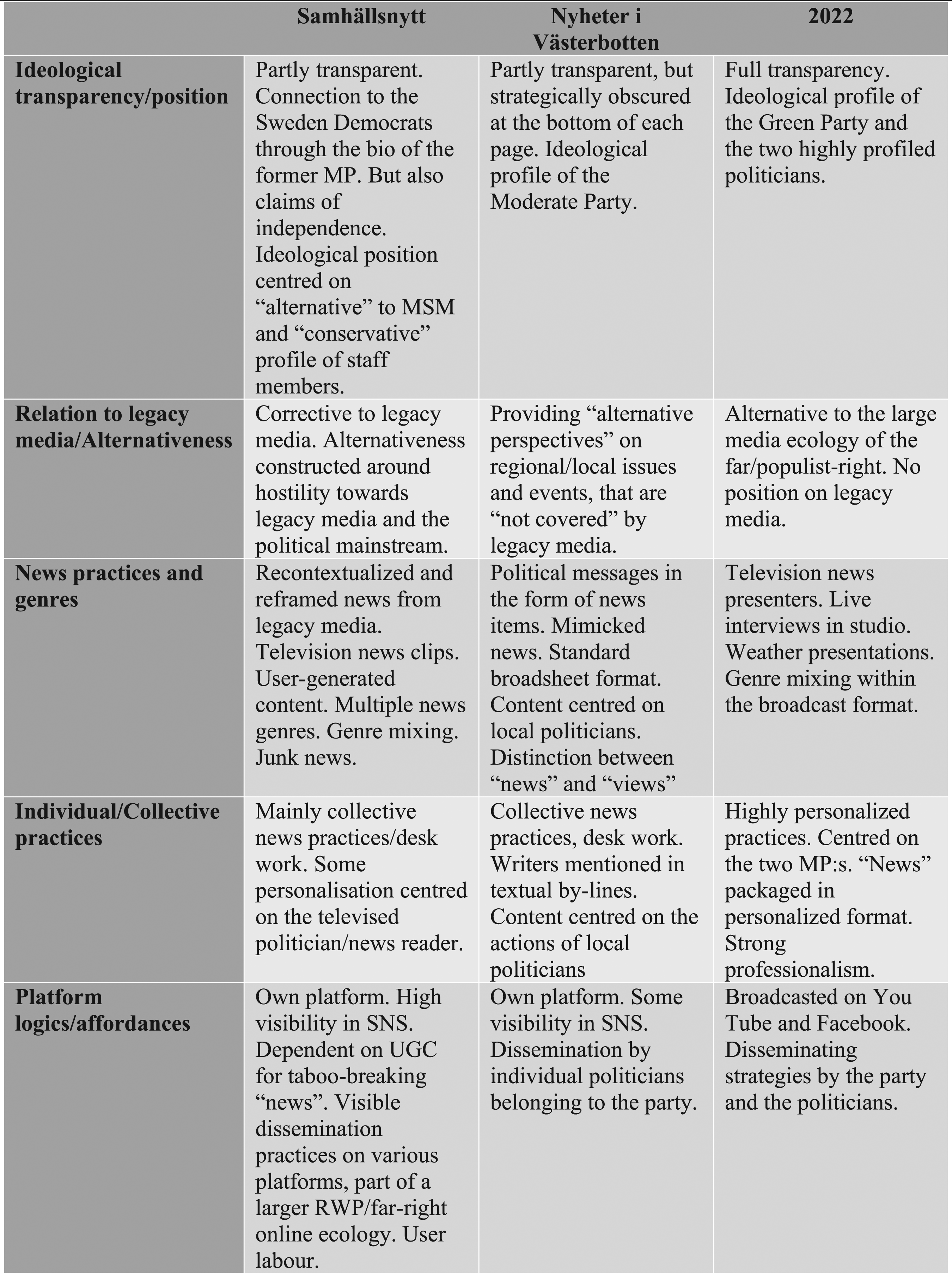
Another way of creating alternativeness is through a more implicit media critique, where the emphasis is on promoting issues and policies that go unnoticed by legacy media, thereby circumventing journalistic gatekeeping and presenting political policies and actors as news such as in the case of Nyheter i Västerbotten. Moreover, alternativeness can be constructed purely politically, such as in the case of 2022, challenging right-wing actors in the alternative media realm, and simultaneously seeking to increase their visibility by adopting journalistic conventions on commercial social media platforms. All forms of alternatives identified in our cases, irrespective of their ideological position, reflect ongoing struggles over status, legitimacy and accuracy in the digital public sphere. However, some parasitic news practices can utilize strategic obscuring of political affiliation in order to capitalize on the institutional legitimacy of news media. This was evident in the collective news practices where political transparency was low or absent.
In terms of news genres, the use of hybridity and mixing is a clear trait of parasitic news. The sites connected to the Sweden Democrats and the Moderate Party rely on various conventional news genres, such as hard news, desk reporting, commentary and feature reports, in order to produce and disseminate ostensibly professional news content. Samhällsnytt mixes conventional news with UGC such as videos and images, some times with taboo-breaking content. Capitalizing on a style of tabloid and junk news that is relatively lacking in Sweden, Samhällsnytt finds a ‘journalistic’ niche that has proven to be appealing in the digital sphere. The television show produced by the Green Party rely on an unambiguous personalization of form and content (Metz, et al., 2020), where political discourses are woven into everyday conversations, including in-depth interviews on social issues, lifestyles and culture. In 2022 journalistic genres such as hard news and current affairs programs are blended with entertainment and individual performativity, creating an atmosphere of intimacy between politicians, guests and audiences. This is often done through humoristic and sometimes hearty styles that go beyond conventional forms of political communication. The news site Nyheter i Västerbotten, mimic news by reconstructing political statements and opinions in conventional online news formats. However, these news items are also centered on the performances of local politicians belonging to the conservative Moderate Party. Worth noting here is that official party positions can be transgressed and individual politicians can break (or differ) with them more broadly, which highlights the enhanced role of political personalization on social media platforms (Metz et al., 2020), this is particularly visible in the television show of the Green Party.
The hybridization of politics and media also means that social media platforms are becoming increasingly vital for both the production and distribution of content, as can be seen in the live-broadcasting on Facebook and YouTube, and in the way various social media feeds (on Twitter, Facebook and Instagram) are deployed for dissemination, but also for collecting raw material (for example UGC) for news. SNS are also used strategically in order to attract attention to content published on their own sites and platforms. The functionalities of social networking sites impact the way parasitic news is shaped. Provocative and taboo-breaking content is foregrounded (particularly in the far-right case), and strong personalization of politics is visible (mainly in The Green Party initiative but also to some extent in all cases), and this type of content is easily disseminated online through user labor.
Since parasitic news is partly a novel phenomenon, the level of ‘symbolic’ journalistic professionalism still depends on individuals, rather than adopting routinized and collective journalistic practices. The superficial professionalism of the Green Party’s television show 2022 is connoted (Barthes, 1977) through references to the hosts’ previous journalistic experiences from the television industry. Likewise, the news sites connected to the Sweden Democrats and the Moderate Party ‘mimick’ (Farkas and Neumayer, 2020) the styles and formats of news journalism in legacy media, creating a superficial veneer of professionalism. In sharp contrast to traditional journalists, however, contributors are allowed to operate across seemingly subjective and objective boundaries. By attaining a hybrid role, the staff at Samhällsnytt can publish editorials and analysis one day, and another day act as program hosts in web television programs or report directly from the field during newsworthy events. Hence, while parasitic news projects draw upon established journalistic genres, they also change the rules of the game by allowing actors to alternate between subjective and objective roles in ways that would have been unthinkable in a Swedish legacy media company. Furthermore, in terms of boundary work, particularly the cases of Samhällsnytt and Nyheter i Västerbotten, challenge the boundaries of journalism in that they claim to be trustworthy alternatives, providing news that legacy media shy away from, or by presenting the same news from different perspectives. On the other hand, they claim autonomy from political parties (Samhällsnytt) or try to obscure the party affiliation (Nyheter I Västerbotten). In this respect they differ from the now defunct party press system, where newspapers tended to have a more open and visible connection to the political parties (Nord, 2012). It should be noted though, that the Green party stand out in our sample, since 2022 explicitly sought to be an alternative to right-wing alternative media rather than legacy media.
Irrespectively of party positions, the phenomenon we have studied also constitutes a challenge to the idea that news is something that journalists produce. However, the fact that politicians and party workers act out or perform in journalistic roles does not necessarily make the content ‘journalistic'. An important implication from the analysis, at least in our view, is therefore that scholars should pay more attention to news and journalism as potentially separate objects of study. In the contemporary digital media ecology, news can be published by practically any individual or organization. Whether it is journalism should not be defined solely by the goals and terminology of the communicating actor, but through a sensibility to journalistic professional norms and ethics. The concept of hybridity is essential in such examinations.
We conclude that parasitic news has similarities to what is often referred to as alternative media and/or fake news. However, since parasitic news is produced by actors working within or in close proximity to the Swedish political establishment, it cannot claim to be ‘detached’ or ‘autonomous’ in the same way that alternative media producers usually do. Nevertheless, the five analytical dimensions used in assessing the three cases, reveal that parasitic news challenges the boundaries of journalism in new distinctive ways. Future studies should therefore scrutinize the digital spreadability of parasitic news across social media platforms, and moreover analyze how citizens perceive its credibility. There is also a need for comparative studies of how it manifests itself in countries and media systems beyond Sweden.
Footnotes
Declaration of conflicting interests
The author(s) declared no potential conflicts of interest with respect to the research, authorship, and/or publication of this article.
Funding
The author(s) disclosed receipt of the following financial support for the research, authorship, and/or publication of this article: This work was supported by Riksbankens Jubileumsfond, grant P21-0158.
