



Abstract
Data journalism in Western-centric research has been lauded for its investigative qualities, capable of bringing to light previously concealed information and enabling the press to play its watchdog function. That said, journalism outside the liberal West may operate within vastly different contexts, shaped by different historical experiences, political cultures, and philosophical traditions, thereby creating a different brand of data journalism. This paper examines data journalism practice in Asia specifically, a region known to be home to collaborative press systems that adhere to a set of “Asian values” pertaining to collectivism, social harmony, norm conformity and deference to authority. By examining 210 data stories produced by news outlets in six Asian countries, this study finds that Asian values are displayed in a vast majority of data stories produced in the region, most of which are news stories pertaining to the home country of these news outlets. Continued reliance on government sources for information and a lack of stories that reveal previously hidden information or scrutinize a powerful entity also suggest no strong push to leverage on the investigative qualities of data journalism to produce more “watchdog” journalism; focus is instead placed on the “civic” role of informing the public.
Keywords
Introduction
Data journalism is a form of reporting increasingly practiced by news outlets around the world. Here, newsworkers extract useful information from data, write articles based on the information and embed visualizations in the articles to enhance audience understanding of issues and events (Veglis and Bratsas, 2017a). With the development of new methods and technologies related to data science, and more government agencies, private businesses, and organizations collecting data, data journalists have been able to uncover patterns and insights from more complex datasets (Borges-Rey, 2016).
Data journalism’s role in enhancing democracy has been widely discussed by scholars –investigation into data allows previously concealed information to surface and critical conclusions to be drawn (Parasie and Dagiral, 2012; Uskali and Kuutti, 2015; Zamith, 2019). This then allows the press to act as a watchdog against the powerful in society and better inform the public (Parasie and Dagiral, 2012; Felle, 2016). However, as scholars like Hanitzsch et al. (2019) and Mellado et al. (2017) have noted, journalistic traditions discussed in Western-centric literature may not be applicable worldwide; different journalistic realities can therefore lead to data journalism being practiced in different ways (Appelgren et al., 2019).
This study takes a closer look at data journalism practice in Asia, often deemed as opposite to or different from how it is practiced in the West (Massey and Chang, 2002). This is largely due to the adherence of the press to “Asian values”, according to scholars like Park and Shin (2006), Shen and Tsui (2018), and Wong (2004); these include social harmony, norm conformity, deference to authority, and the primacy of collectivism over individualism. This has created press systems in countries like China, Singapore, Malaysia and Thailand that have a collaborative relationship with the government, rather than play a watchdog function (Hanitzsch et al., 2019). It makes it worthwhile then, to discover if data journalism, given its strong association to investigation and advocacy in the West, displays characteristics that make it distinctly “Asian” in Asia, by examining the presence of such Asian values in its stories. This study conducts a content analysis on 210 data stories produced by seven news outlets based in six Asian countries to discover if such Asian values are present. Study findings can significantly enhance understanding of data journalism practice outside the liberal West, and help journalism scholars and educators in Asia navigate the field.
Data journalism: dominant definitions
Data journalism has been defined as a process that involves “analyzing, filtering and visualizing data in a form that links to a narrative and is useful to the public” (Knight, 2015, p. 58). This is done through the “large-scale manipulation of data using computing software to enable new ways to access, organize and present information” (Flew et al., 2012, p. 157).
Data journalism studies have largely been situated within the West, in countries such as the US, UK, Canada, Sweden, and Belgium (Appelgren and Nygren, 2014; Borges-Rey, 2016; Young et al., 2018; Zamith, 2019). Scholars from these countries argue that data journalism has inherently democratic properties, and highlight its ability to hold the political elite accountable. Its investigative nature for instance, is useful for uncovering previously unknown information, or to prove or falsify a claim through the analysis of data (Parasie and Dagiral, 2012). It may also involve newsworkers being critical of datasets and verifying information by utilizing multiple sources of data, rather than just one, often governmental, source (Uskali and Kuutti, 2015). Such characteristics have led scholars to associate data journalism with the “watchdog” role, defined as the act of “question(ing) the validity or veracity of what those individuals or groups in power say or do, implying an attitude of doubt or skepticism” (Mellado, 2015, p. 604).
That said, journalism realities in Asia suggest that the practice and contents of data journalism might be different in the region, given a different set of political, economic, social, and cultural contexts. While scholars have noted challenges regarding data journalism practice there, such as the lack of data availability, inability to access data, lack of access to journalistic technologies, and low data literacy in newsrooms (Du, 2019; Mutsvairo, 2019; Wu, 2021, 2022a), there has not been an investigation yet on how the notion of “Asian values” may have manifested itself in actual data stories produced. This presents a significant gap in understanding, given the extent to which these values shape journalism realities in the Asian context.
An Asian version of data journalism? Why the question of Asian values matters
While it must be acknowledged that “Asia” is made up of a group of disparate countries each with its own political, economic, and social contexts, journalism in Asia has been influenced to a significant extent by the notion of “Asian values” (Xu, 1998; Massey and Chang, 2002; Glassman, 2016; Sen, 2017; Hanitzsch et al., 2019). Driven by the post-colonial project of nation-building, many Asian politicians and scholars expressed the need to protect these Asian values in order to challenge the economic and cultural dominance of the West (Birch, 1993). They claimed that Asian society was “patterned on morally prescribed norms and obligations” which encouraged “filial piety, unisonal relations and humanism” (Mehra, 1989, p. ix), rather than “Western liberal individualism” which emphasized individual rights and freedoms (Chua, 1994, p. 27–28). These Asian values towards the achievement of social harmony and stability were promoted in the media and education systems of countries like China, Singapore, and Malaysia in the 1990s (Hoon, 2004), and began to influence journalistic sensibilities (Wu, 2022a).
The relevance of Asian values, however, has been critiqued by scholars who note the already significant influence of “Western” values in Asian societies and the diversity of Asian cultures. For instance, Welzel (2011) notes in his study of data from the World Values Survey, conducted on 120 countries, that “the same forces that nurture emancipative values and liberal notions of democracy in the ‘West’ do exactly the same in the ‘East’” (p. 30), and Amartya Sen (2003) notes that Asian countries like China, Japan, South Korea and India have historical traditions of democratic structures such as popular assembly and political pluralism.
Asia is a diverse region as well, politically, economically and socially. (Dollah and Tandoc, 2022, p. 1214), for instance, point out that this concept “cannot really be considered pan-Asian” due to the existence of diverse social and media systems in Asia. Countries such as South Korea, China, and Singapore are rooted in Confucianism (Shin, 2012), while other countries such as Malaysia and Indonesia are influenced by an Islamic worldview (Muchtar et al., 2017). Politically, countries such as India are set firmly within a long tradition of democratic processes (Sen, 2003), while countries in Southeast Asia have been helmed historically by authoritarian governments (Sen, 2017). In terms of the media, Hong Kong’s press freedom is constitutionally protected but has been increasingly influenced by the Chinese central government (Wu, 2022b); South Korea’s existing laws give the government “a framework to undermine unwelcome news coverage” despite increasing democratization of the press (Rohrhofer, 2014, p. 170); Singapore’s media is dominated by two news organizations with “close ties to the government” (Wu, 2018, p. 1296); Malaysia’s journalists have to navigate “harsh laws” that may prevent them from releasing information to the public (Blatt, 2021); Indonesia’s media is an oligopoly that seems to privilege profit motives over public development goals (Sukmayadi, 2019); and India’s journalists are exposed to “every kind of attack”, including police violence and reprisals from corrupt local politicians, even as the country is the largest democracy in the world (Reporters Without Borders, 2021).
That said, numerous scholars like Chang and Chu (2002), Park and Shin (2006), Glassman (2016) and Sen (2017) have acknowledged that the Asian values discourse has shaped Asian societies in significant ways; it has continued to be used and promoted by leaders in the region to “consolidate their positions… in the global arena” and “protect and promote authoritarianism” (Sen, 2017, p. 54). Even in India, which has a strong culture of democracy, Asian values have been seen to be used by Prime Minister Narendra Modi’s government as “an excuse to assault civil and political rights”, as described by Roy (2014).
In journalism, this Asian values discourse has led to the creation of a brand of journalism that is collaborative in nature (Wong, 2004), evident in countries like China, Singapore, Indonesia, and India, among others (Hanitzsch et al., 2019, p. 182). Journalists work based on the premise of having respect for authority, upholding communalism, practicing self-restraint and exercising freedom with responsibility (Massey and Chang, 2002; Hanitzsch et al., 2019). Within this context, journalism is conceived as a tool to help authorities foster national unity and economic growth. Asian values advocate that journalists should reject “the notion of an uninhibited and robust press” that makes “attacks on government and public officials”, and should prioritize the protection of social harmony above all else (Mehra, 1989, p. 4).
That said, critical scholars like George (2012) and Hoon (2004) have discussed dangers associated with this rhetoric, potentially used by the political elite as a means to “serve their political legitimacy” and limit press freedom (George, 2012, p. 119). Countries like China, Singapore and Indonesia, for instance, are low in press freedom, occupying the 175th, 139th and 117th positions respectively, out of 180 countries (Reporters Without Borders, 2022). (Richstad, 2000, p. 275) points out that a serious consequence of “limiting criticism of governments and institutions” is the development of a culture of “self-censorship” among journalists. Hanitzsch et al., (2019, p. 190) suggests that such Asian press systems reinforce a “political culture unconducive to journalistic autonomy”. This marks a point of concern for data journalism practice in the region, given the strong ability of this type of journalism to uncover truths and wrongdoing.
Indeed, news content in Asia has been seen to be influenced by such Asian values in existing literature. Massey and Chang’s (2002) content analysis of Asian news stories revealed that such values were found in all the 10 online newspapers in Asia they analyzed, displaying features of “supportiveness” and “harmony”, particularly in stories directly related to the journalists’ home countries, such as Japan, Malaysia, Pakistan and India. In Hanitzsch et al.’s (2019) work on journalist perceptions of their roles in society, it was found that Southeast Asian journalists perceived themselves as playing a collaborative role with the state and that their purpose was aligned with the Asian values of social harmony, stability, and the promotion of national development (p.190). Such findings suggest the potential internalization and normalization of Asian values in news production.
The question then remains on whether this carries through to data journalism and the actual data stories produced in the region. Are data stories produced in Asia less watchdog and investigative, and more consensual and conformist? Some studies already suggest that this may be the case. Du (2019), for instance, revealed that compared to Western publications like The Guardian or ProPublica, Chinese data journalists are more inclined to “avoid politically sensitive topics” and “focus more on economic news as well as big social events and avoid involving government agencies” (p. 121). Similar concerns have surfaced in other data journalism studies in Asia – in Sri Lanka, data stories are described as uncritical and simply reprints of data from “press releases disseminated by government authorities” (Aneez, 2013, p. 60) and in South Korea, they are seen to “apply the traditional journalistic rule of relying on official sources”, with a low level of interactivity and a reliance on static infographics (Lim, 2019, p. 109). There has yet to be a study, however, that systematically examines the presence of Asian values in data stories produced across Asia, to discover if there is indeed a unique brand of Asian data journalism, and to discuss the implications of this going forward.
Methodology
Guiding this research are two research questions
To what extent do data stories produced in Asia display Asian values?
What are the characteristics of data stories that tend to display Asian values? (i.e. their topic, country of interest, cultural proximity, visualizations, interactivity, valence, objectivity, sources of data and data interpretation, investigative elements, and journalistic roles) RQ1 will uncover how commonly Asian values are embedded in data stories produced in Asia, while RQ2 will reveal if certain types of stories are more prone to having these values embedded. For instance, there might be reason to believe, based on existing literature, that stories set in the home country of a news outlet is more likely to abide by Asian values given the collaborative nature of the press with the government (Hanitzsch et al., 2019). Here, the variables that would make up “Asian values” were adapted from the works of Massey and Chang (2002), Kim et al. (2005), Park and Shin (2006), and Shen and Tsui (2018). Five such values were identified by Kim et al. (2005) in their study of 390 Asian American respondents, which have been widely used by scholars studying Asian values – these five values are “collectivism”, “conformity to norms”, “emotional self-control”, “family recognition through achievement” and “humility”. Shen and Tsui (2018) used a similar model in their study of the relationship between Asian values and freedom of expression but included “deference to authority”. Park and Shin (2006) focused on four values in their investigation into the effects of Asian values on democracy, namely “social harmony”, “social hierarchy”, “group primacy”, and “anti-pluralism”. Similar values had been used by Massey and Chang (2002) in their content analysis of Asian news content, where they coded for “supportiveness” and “social harmony”. After noting overlaps in these scholars’ definitions of Asian values, the list was narrowed down to seven values: 1) emotional self-control, i.e. reference to the absence of emotionally-driven words and/or the implication that it is more important to behave appropriately than to act on what one is feeling, 2) humility, i.e. the idealization or demonstration of being humble, 3) norm conformity, i.e. the encouragement of social uniformity and discouragement of the expression of social difference, 4) collective welfare, i.e. an emphasis on collectivism, especially at the expense of personal interest, 5) respect for authority, i.e. obedience towards authority where “authority” can refer to political authorities, older family members or anyone in a higher position, 6) supportiveness, i.e. an emphasis towards political, economic, or social stability, cohesion, or strength, and 7), social harmony, i.e. demonstration of an aversion to conflict to maintain collective harmony. Coding for these seven variables would reveal if there is indeed an Asian brand to data journalism and what it might look like. Once there was clarity on what would make up “Asian values”, decisions were made on the news outlets to be chosen. Existing research suggested a lack of evidence that press systems in West and Central Asia abided by the concept of Asian values (Massey and Chang, 2002) and hence, the search spanned just the regions of East, Southeast and South Asia, which scholars like Yung (2012), Glassman (2016), and Sen (2017) have cited extensively. Within these parts of Asia, a check was then done on the websites of each country’s national newspaper and broadcaster to determine if they had data sections. Seven news organizations in six Asian countries were found to have a data section. They were South China Morning Post (SCMP) from Hong Kong (China); Korean Broadcasting System (KBS) from South Korea, Channel News Asia (CNA) and The Straits Times from Singapore, The Star from Malaysia, The Jakarta Post from Indonesia, and The Hindu from India. Because each of the news outlets had a different number of data stories in their corpuses – The Hindu for instance had the most data stories, at 930 stories, while The Straits Times had the least stories, at 36 – a decision was made to select 30 of their most recent data stories for analysis, with data collection ending in June 2021 when this study began; this resulted in a total of 210 stories. Selecting the latest data stories of each news outlet would ensure representation of each news organization in the sample, and showcase the latest iteration of how data journalism looks like in each locale. All the news outlets selected had their data stories in English. A codebook was developed to enable the coding of these 210 data stories. Besides including the seven Asian values as noted earlier, other variables were drawn from journalism scholars like Knight (2015), Young et al. (2018), and Zamith (2019), such as those pertaining to story assets, like topics and country of interest; presentational elements, like types of visualizations and interactive elements; and data-related traits like sources of raw data and sources of data interpretation. These variables would reveal characteristics of data stories that display Asian values. Other characteristics of interest included the location of the story event, since stories closer to home might display more Asian values (Massey and Chang, 2002); the presence of investigative elements, as measured by the presence of multiple sources, the revealing of concealed information, and acting in the public interest (Abdenour and Riffe, 2019), since stories displaying Asian values might tend to be less investigative in nature; the valence of the story as positive, negative, or neutral (De Vreese and Boomgaarden, 2003), since stories displaying Asian values might speak better of authority; and the presence of objectivity and transparency (Tandoc and Oh, 2017; Bradshaw et al., 2019), to see if stories with Asian values are also less objective and transparent. The codebook also accounted for the journalistic role most on display in the data stories examined, given that Hanitzsch et al. (2019) have suggested that the Asian values model of journalism directly impacts the role that journalism plays in those societies. Drawing from Mellado (2015), six roles were included in the coding sheet, namely 1) the “watchdog” role, i.e. the monitoring of the powerful in society, 2) the “loyal-facilitator” role, i.e. the supporting of the interests of the powerful, 3) the “service” role, i.e. the providing of information on everyday goods and services, 4) the “civic” role, i.e. the encouraging of citizens to participate in social, political and cultural life, 5) the “infotainment” role, i.e. the entertainment of the audience, and 6) the “interventionist” role, i.e. the inclusion of the journalist’s voice in the news. Coding was conducted by two coders; to check for intercoder reality, 10% of the stories were randomly selected and coded – it was found that there was 85.7%–100% agreement across all the variables.
Study findings
Presence of Asian values
RQ1 asked about the extent to which data stories produced in Asia display Asian values. The analysis of the 210 data stories revealed that Asian values were commonly found in Asian data stories, with 81.9% or 172 data stories displaying at least one of the seven Asian values. Slightly more stories displayed one to three Asian values, at 46.7% or 98 stories, than those that displayed four to six Asian values, at 35.3%. None of the stories displayed all seven Asian values.
The most commonly displayed Asian value was “collective welfare”, which was coded as present when stories emphasized or advocated for collective well-being as opposed to the well-being of a specific group or individual; 71.9% of the stories in the entire corpus, or 123 stories, displayed this value. “Social harmony”, which was coded as present when there was an absence of conflict, was the second most common Asian value found in data stories, at 69.6%, followed by “supportiveness”, which was coded for when stories were uncritical of authorities or other powerful individuals, at 63.7%, followed by “norm conformity”, which referred to the social conformity of individuals or groups in the story, at 62.6%. Only 28.5% displayed any of the other three Asian values, namely “emotional self-control”, “humility”, and “respect for authority”, at 60 stories each.
Characteristics of data stories with Asian values
Given that there was a large number of stories displaying at least one Asian value, a decision was made when answering RQ2, on the characteristics of data stories that display Asian values, to focus on those stories that displayed the Asian values strongly, i.e. they displayed four or more of the seven Asian values. A total of 74 stories in the corpus met this criterion.
Topic, country, and cultural proximity
Slightly more than half of the data stories that displayed Asian values strongly, at 52.5% or 39 stories, were about “health, science, technology” – this investigation took place notably during the COVID-19 pandemic – followed by “government, politics, courts, laws”, at 41%, and “economy and business” as well as “lifestyle, entertainment, culture”, at 10.8% each.
Cultural proximity was also coded for, and results showed that data stories that displayed Asian values strongly were often focused on news from the news outlet’s home territory (e.g. Hong Kong for SCMP). 93.2% or 69 stories that strongly displayed Asian values were reporting on local news. The most commonly covered country among data stories that featured Asian values strongly was Singapore, at 23.0% or 17 stories, followed by Malaysia at 21.6%, and South Korea at 18.9%.
Visualizations and interactivity
An analysis of visualizations and interactivity in stories that displayed Asian values strongly revealed that such stories were not visually complex. Results showed that these stories did not contain a large number of visualizations, with 64.9% of them or 48 stories containing less than five visualizations each. Conversely, more than half of the stories that displayed Asian values weakly contained more than five visualizations, at 55.6% or 75 stories. This suggests that a large number of visualizations is less common for data stories that display Asian values strongly.
Across stories that presented Asian values strongly, there was a range of 11 types of visualizations, indicating that newsworkers used a variety of methods to present data in these stories. The most common type of visualization was images that do not show data, such as photographs of people and places, at 71.6% or 53 stories, followed by infographics at 48.6%, and table/list at 35.1%.
As for the level of interactivity, based on the framework established by Veglis and Bratsas (2017b), half of the stories that displayed Asian values strongly, or 37 stories, were interactive. 59.5% of these featured the “transmissional” level of interactivity, with simple interactivity that conveys additional information about elements, followed by 29.7% with the “conversational” level of interactivity, where interactivity accepts input data that permits the user to substantially alter the visualization, and only 10.8% featuring the “consultational” level of interactivity, where users are offered multiple views of the same data. Findings showed similar results for stories that displayed Asian values weakly, where 49.3% or 68 stories were interactive, with a majority of these, at 51.5%, featuring the “transmissional” level of interactivity.
Valence and objectivity
Data stories that displayed Asian values strongly were mostly neutral and somewhat objective. In terms of valence, which relates to the tone of the story, 47.3% or 35 stories were neutral; this was a higher percentage than stories of negative valence, at 27%, and stories of positive valence, at 25.7%. This suggests that data stories displaying Asian values strongly most commonly adopted a neutral tone.
The journalistic norm of objectivity was also fulfilled by a majority of data stories that displayed Asian values strongly, with 67.5% or 50 stories featuring at least one variable of objectivity; this variable was most commonly “absence of the author’s own judgement or interpretation”, found in 52.7% of the stories, or 39 stories. However, none of the stories fulfilled all three variables of objectivity, which were absence of the author’s judgement/interpretation, presence of opposing sides, and presence of justification/evidence for all sides.
Investigative elements: multiple sources, concealed information and public interest
Coding for three investigative elements – presence of multiple sources, revealing of concealed information, and relevance to the public interest – revealed that stories that displayed Asian values strongly were generally not investigative in nature. While more than half of such stories, at 55.4% or 41 stories, contained at least one investigative element, only 4.1% or 3 stories had all three investigative qualities. This is in contrast to stories that displayed Asian values weakly, where 73.5% or 100 stories contained at least one investigative element and 17.6% or 24 stories contained all three.
A breakdown of the three investigative elements revealed that while about half of the stories that presented Asian values strongly used multiple sources, at 48.6% or 34 stories, indicating the inclusion of information from different parties as a fairly significant practice, the release of previously concealed information was rarer, at just 16.2% or 12 stories. This is low in comparison to data stories that display Asian values weakly, where 50.0% or 68 stories in that corpus revealed previously concealed information. Similarly, stories relevant to the public’s interest, which according to Abdenour and Riffe (2019), “should reveal information about a powerful entity in the interest of the general population” (p. 2388), were rarely found among stories that featured Asian values strongly, at 28.3% or 21 stories. Conversely, this public interest variable was present in more than half of the stories that displayed Asian values weakly, at 51.4% or 70 stories.
Data source and interpretation
An analysis of the source of raw data revealed that government organizations tended to provide data for stories that expressed Asian values strongly. They were the most common distinguishable source of data in those stories, at 63.5% or 47 stories, followed by business/private organizations at 27% and the news organization itself, which stood at a much lower 6.8%.
As for data interpretation, a majority of stories that displayed Asian values strongly showed that the news organization had interpreted the data itself, at 66.2% or 49 stories, followed by academics/educators at 13.5%, and government organizations, at 6.7%; this suggests that even though newsrooms tended to turn to the government for data, they were relatively comfortable with interpreting the data themselves based on their understanding of the story.
Journalistic roles
An analysis of journalistic roles revealed that data stories that displayed Asian values strongly performed roles that catered to both public interests and elite interests. The most common role performed by these stories was the “civic” role, where stories “encourage the audience to participate in social, political, and cultural life, informing them on broad political topics” (Mellado et al., 2017, p. 949), at 81.1% or 60 stories. This was followed by the “loyal-facilitator” role, where the media cooperates with “those in power by acting as loyal spokespersons” (Mellado et al., 2017, p. 949), at 66.2%. This is significant when compared to stories that displayed Asian values weakly – only 35.3% or 48 stories performed the “loyal-facilitator” role. The third most common role performed by data stories that displayed Asian values strongly was the “service” role, which “views the public as a client, providing information and advice on goods and services that are useful for their everyday lives” (Mellado et al., 2017, p. 949), at 60.8%.
Beyond the top three most common roles, another notable observation was how rarely data stories featuring Asian values strongly performed the “watchdog” role. This role, which “monitors actors and institutions by denouncing their wrongdoings and holding them accountable” (Mellado et al., 2017, p. 949) was found only in 31.1% or 23 stories.
Discussion and conclusion
Study findings.
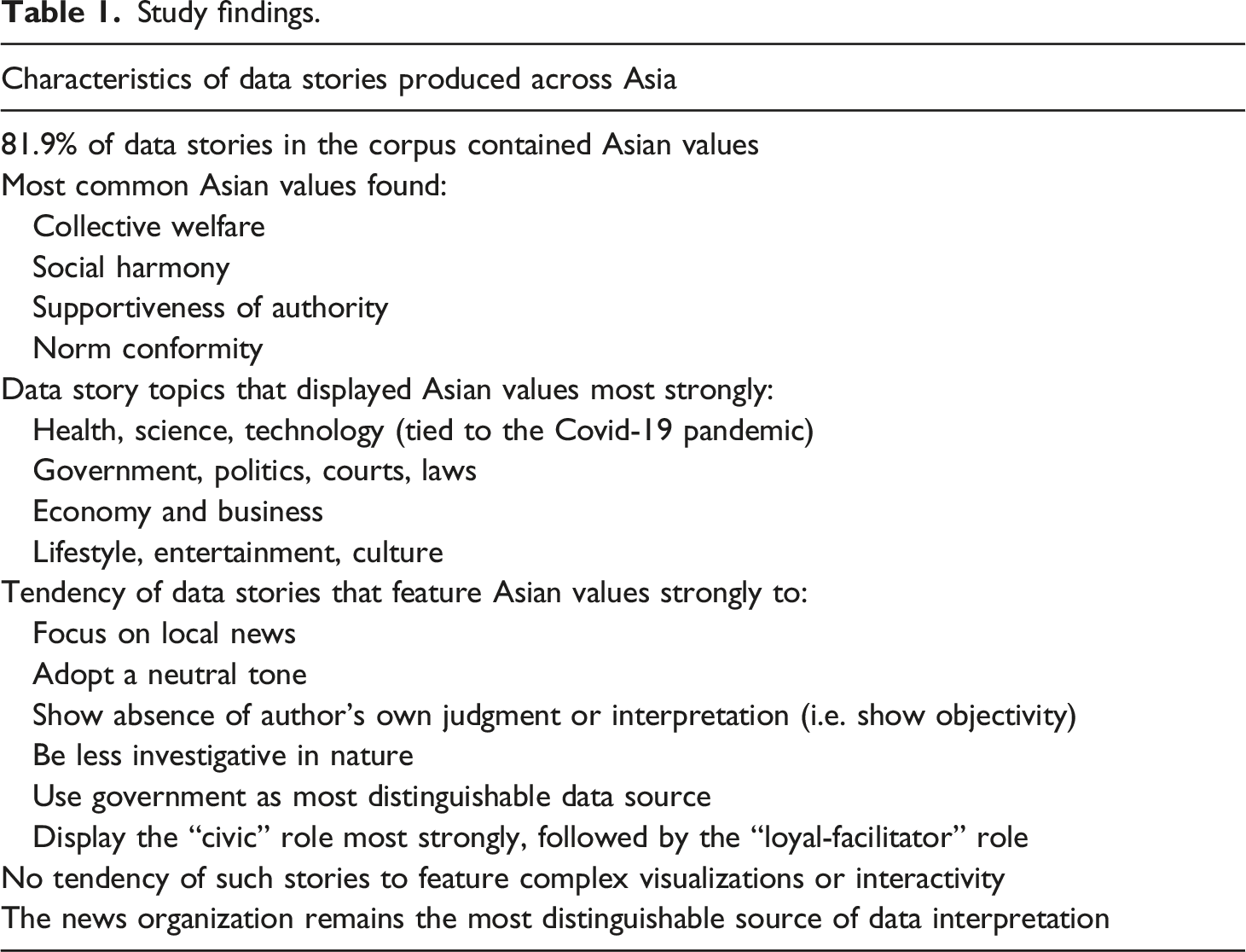
For RQ1 on the extent to which these data stories displayed Asian values, results indicated that Asian values were found in a high 81.9% of the 210 data stories analyzed, with close to half displaying one to three Asian values. A further breakdown of this statistic by news outlet could be telling, and may be explained by the political and social contexts within which these news organizations operate. The lowest percentage of stories containing Asian values belonged to The Jakarta Post’s data stories, at 66.7%, while the highest belonged to Singapore’s The Straits Times, at 90%. This could be explained by Indonesia’s press system being made up primarily of privately owned profit-making entities (Sukmayadi, 2019), compared to Singapore’s media, where one of its two major media organizations is owned by the investment arm of the Singapore government (Wu, 2022a), and the other has its media business as a not-for-profit public company (Tham, 2021) with close ties to the government (Wu, 2022a).
The news outlet with the most data stories that displayed more than three Asian values was Malaysia’s The Star; 53.3% of them contained four to six Asian values. This could potentially be due to the government’s close watch on the Malaysian press which prompts newsworkers there to produce stories that are more supportive of the elite and the status quo than those that are critical in nature (Blatt, 2021). Conversely, the news outlet with the least data stories that displayed more than three Asian values was Hong Kong’s SCMP, at 13.3%. This could be due to freedom of the press being constitutionally protected in Hong Kong and newsworkers there looking up to the liberal press model (Wu, 2022b), despite a situation complicated by concerns that the Chinese central government might be using indirect approaches such as investment in and ownership of media outlets to slowly shift the Hong Kong media to adopt stances closer to that of China (Wu, 2022b).
These findings indicate the strong impact that state influence has on the shaping of journalistic sensibilities and news products. They also indicate that “Asia” cannot be conceived as a singular entity – even within the region, the complex interplay between historical experiences, political systems and philosophical traditions create differing circumstances that influence the nature of the press.
The most common Asian values found in the corpus were “collective welfare” which emphasized collective well-being, at 71.9%, followed by “social harmony”, “supportiveness” of authorities and powerful individuals, and “norm conformity”. Compared to the least common Asian values of “emotional self-control”, “humility”, and “respect for authority”, the four top Asian values seem to relate more to the harmonizing of wider society, and hence has the effect of maintaining the status quo and not rocking the boat; the least common Asian values seem to be linked more to the behaviour of individuals, which may cross more into the private realm and hence potentially cause more discomfort if reiterated too often.
For RQ2 that relates to the types of data stories that display such values, results showed that the topic that displayed Asian values most strongly was “health, science, technology”, followed by “government, politics, courts, laws”, “economy and business”, and “lifestyle, entertainment, culture”. The strong presence of Asian values in “health, science, technology” stories could be due to the COVID-19 pandemic, a health crisis that had to be managed from the top-down. Stories therefore urged the public to conform to the measures put in place by the government to protect the collective well-being of the population, hence displaying Asian values such as “collective welfare”, “norm conformity”, and “supportiveness”. With regards to cultural proximity, this study showed that most stories that strongly displayed Asian values tended to focus on local news, at a high 93.2%. This relates to the desire to manage stability, order and growth locally, within the news outlet’s country of origin, through the nature of the news output.
When it comes to visualizations and interactivity, results showed that data stories that displayed Asian values strongly were not visually complex. 64.9% of these stories had less than five visualizations each, and the most common type of visualization in 71.6% of these stories was actually images that did not show data, such as photographs of people and places. In terms of interactivity, half the stories that displayed Asian values strongly were interactive, with a majority of these featuring simple interactivity that carries additional information about elements in the visualization. These results suggest that stories with Asian values do not have particular tendencies towards using visualizations or interactivity to bring their points across.
As for the valence and objectivity of data stories that displayed Asian values strongly, most of these stories adopted a neutral tone compared to a positive or negative tone, and 67.5% featured at least one variable of objectivity, most commonly “absence of the author’s own judgment or interpretation”. This suggests that such stories continue to reflect tendencies of data stories to appear unbiased and free from personal judgment (Borges-Rey, 2016).
When it comes to investigative elements, i.e. the presence of multiple sources, revealing of concealed information, and relevance to the public interest, stories that displayed Asian values strongly were less investigative in nature than those stories that displayed Asian values weakly. The latter had 20% more stories containing at least one investigative element compared to the former. The nature of the investigative element was also different in these two groups – stories that displayed Asian values weakly were more likely to reveal previously concealed information or reveal information about a powerful entity in the name of public interest; stories that displayed Asian values strongly were more likely to just include multiple sources in the story. This suggests that a strong of display Asian values may impede data journalism’s inclination towards investigation.
Stories that displayed Asian values strongly also had government organizations as the most common distinguishable data source in the story. This indicates the strong inclination of newsrooms to turn towards government as an authoritative “official” data source. That said, once the data is obtained, news organizations do not shy away from offering interpretations of the data themselves; 66.2% of the stories featured newsroom interpretations.
Finally, in terms of journalistic roles, stories that displayed Asian values strongly did not prioritize the “loyal-facilitator” role, as literature on collaborative press systems in Asia might suggest. Interestingly, the most common role played by these stories, at 81.1%, was the “civic” role, which meant informing the audience on broad political topics to encourage participation in social, political, and cultural life (Mellado et al., 2017); this is compared to just 66.2% that played the “loyal-facilitator” role, where the media becomes spokepersons for those in power. Hence, data journalism in Asia still reflects a key public service function of data journalism as it is practiced in the liberal West. That said, the “watchdog” role was played in less than one-third of the stories displaying Asian values strongly. This contrasts with the use of data journalism in the West to perform the “watchdog” role given its investigative qualities (Parasie and Dagiral, 2012).
So, is there an Asian form of data journalism? “Asian values” such as “collective welfare”, “social harmony”, “supportiveness” of those in power, and “norm conformity” seem to be displayed in a vast majority of data stories produced in the Asian region based on this analysis, moving away from the Western-centric conception of data journalism that is tied to investigation, activism, and holding power to account (Mutsvairo, 2019; Uskali and Kuutti, 2015; Young et al., 2018). Most of these stories are about news in the home country of the news outlet, suggesting the desire to exert control and/or manage the stability and proper functioning of their own societies locally.
This reveals, crucially, that data journalism is simply a form of reporting found under the larger umbrella of “journalism” as a whole in Asia – journalistic sensibilities in Asia have been shaped over time to be more collaborative in the region, influencing journalistic norms, standards, and practices in Asian newsrooms, and this remains unchanged whether or not news reports contain data. There does not seem to be a particularly strong push to leverage on the investigative and democratic qualities of data journalism to produce stories that are more adversarial or monitorial in nature. This is evidenced from this study by the continued reliance on government sources for data, the lack of stories that reveal previously concealed information or scrutinize a powerful entity in the name of public interest, and the lack of stories that play the “watchdog” function to monitor and question those in power. Contextual factors pertaining to the lack of access to available data in some of the countries in this study contribute to such journalistic sensibilities – for instance, freedom of information laws do not exist in China, Singapore, and Malaysia (Du, 2019), unlike in South Korea, Indonesia and India. This means that when data beyond those pre-framed by the government is not available, the types of data stories produced may naturally become more limited, diluted, or toe the official line (Wu, 2021). This makes the version of data journalism practiced in Asia stand apart from that which is practiced in the liberal West.
The shift towards producing more data stories, therefore, has not corresponded with a significant shift towards using data journalism to monitor the powerful in society and hold them to account. This in turn allows narratives to continue to be shaped from top down. This situation is made more acute by the nature of data itself. Because it is often seen as objective and neutral (Borges-Rey, 2016), the influence of the political and economic elite on the data stories becomes invisible – narratives become seen as “objective truths rather than subjective interpretations of reality”, making them all the more powerful (Wu, 2021, p. 14). The danger arises when the elite are no longer working in the best interests of the people, and such journalism is used as a tool for this group to amass more political and economic power, while maintaining a front of promoting unity and growth.
That said, data journalism in Asia does perform the “civic” role to inform the public and encourage political, social and cultural participation, aligning with how it is practiced in the West (Parasie and Dagiral, 2012; Felle, 2016). This is, in fact, consistent with how journalism as a whole is practiced in the Asian region – collaborative press systems do play the functions of informing and educating the public (Tan, 1990). Notably, how journalism is practiced is likely to differ in different parts of Asia – this region is not a singular entity; Indonesia’s The Jakarta Post had 66.7% of its data stories display Asian values, while Singapore’s The Straits Times had 90%, for instance. This study suggests that the way data journalism is practiced in different Asian countries aligns with how journalism in general is practiced in these countries as well. The shift towards producing more data stories has not indicated clear attempts to push existing boundaries.
This study contains limitations that must be noted, however. This paper considers Asia as a region and “Asian values” as a broad theoretical concept for the purpose of analysis; it should be noted that this region is made up of disparate countries with circumstances that may impact the nature of their data stories in nuanced ways. More detailed analysis pertaining to specific countries and their forms and functions of data journalism could be conducted in future studies. Additionally, the choice of national newspaper and/or broadcaster might limit the results obtained for each country, given that lesser known or less established news organizations in those countries might also be producing data stories. Finally, while the research method of content analysis can enable an in-depth look into the textual output of an organization, it may be enhanced with other research methods such as interviews or surveys to further explain context.
Footnotes
Acknowledgements
The author would like to thank the two research assistants in this project Sofia Tan Contreras and Beverly Anne Devakishen for their contributions.
Declaration of conflicting interests
The author(s) declared no potential conflicts of interest with respect to the research, authorship, and/or publication of this article.
Funding
The author(s) disclosed receipt of the following financial support for the research, authorship, and/or publication of this article: The work was funded by the Ministry of Education Academic Research Fund Tier 1 in Singapore (FY2019-FRC3-011).
