



Abstract
Sustainable Finance (SF) has been identified as one of the biggest trends in the financial industry in the past years. By channeling capital into sustainable investments, it is hoped that finance can accelerate the transition towards a greener and more sustainable future. However, given that the discussion about SF lacks consistency and a common understanding of SF, the role of financial journalists in reporting about this trend and in enacting their role as watchdogs becomes of paramount interest. To do so, 33 semi-structured interviews with journalists who have covered SF in six countries (AT, BE, CH, DE, NL, UK) were conducted to find out about journalistic role perceptions and daily journalistic practices (such as sources, style of writing and role of the audience). Findings show that journalists mainly enact the role of a chronicler, informant and educator when writing about SF, but fail to fulfil an active watchdog role. Furthermore, the coverage of SF is predominately event-driven, directed at a financial elite, and has become highly professionalized at financial news outlets. Given the urgency of the climate crisis, journalists reported that they found themselves in a moral dilemma between enacting their professional role as a journalist on the one hand and providing a platform for unsubstantiated claims about SF (greenwashing) made by the industry, on the other hand.
Keywords
In the aftermath of the Global Financial Crisis 2007–2008 (GFC), financial journalists were strongly criticized for having failed to warn the public of frauds and imbalances within the financial system (Fahy et al., 2010; Knowles et al., 2017; Manning, 2012; Starkman, 2014; Tambini, 2010). Whereas the global financial industry is currently proclaiming it has become more sustainable as a result of public pressure and mounting climate risks ever since the GFC (GSI Alliance, 2019), less is known about how financial journalism has reacted to this shift towards ‘Sustainable Finance’ (SF). In fact, research on financial journalism has been found to be generally scarce and lacking in-depth analysis and critical scrutiny (cf. Lee, 2014). However, in the past few years, there has been an increase of research endeavours examining sustainable and climate journalism (Schäfer and Painter, 2020) and how topics such as sustainability, climate change or corporate social responsibility have been covered internationally by journalists (e.g. Painter et al., 2020). Despite intriguing findings that point towards an escalation of international media coverage on some sustainability issues around the globe (particularly climate change: Schäfer and Schlichting, 2014), the way journalists cover SF and the pressing need to move our economic system towards a greener future has mainly been overlooked in journalism research.
Recent proclamations made by the industry, national governments (UK, New Zealand, etc.), international communities and organizations (e.g. UN Climate Action Summit 2019) have talked to the need to increase investments in green projects and industries, thereby securing a future that meets targets for net-zero carbon emissions. In this context, the role of financial journalism in covering these topics becomes of paramount interest. After all, one of the key normative roles of journalists is to act as watchdogs (Norris, 2014), and therefore to check whether the claims made by the financial industry and governments about sustainable finance are truthful, and to uncover whether the financial sector is truly following the path towards a greener, resource efficient and more stable economy. Thus, the purpose of this paper is to study how financial journalists in Europe perceive their role in covering SF and what journalistic practices they employ when reporting about the topic.
Literature review
Sustainable finance, greenwashing and the role of the financial press
While there is no overall agreement on the definition of Sustainable Finance (SF) in the financial and policy sector, SF can generally be understood as ‘any form of financial service integrating environmental, social and governance (ESG) criteria into the business or investment decisions for the lasting benefit of both clients and society at large’ (Swiss Sustainable Finance, 2019). This rather short and vague definition undoubtedly leaves room for interpretation and has thereby also contributed to widespread criticism regarding its definition (Paetzold and Busch, 2014), measurement and taxonomy (Caldecott, 2019) as well as its applicability in the financial industry and beyond (Rust, 2019). Given this broad definition, the role of the news media to make sense of SF gains increasing relevance. Furthermore, fueled by global movements such as Fridays for Future and media-intensive ‘sustainability’ events (e.g. COP25; UN Climate Action Summit), the topic of sustainability has moved to the top of the media and public agenda (Guertin, 2019). Hence, there is a pressing need to make governments, politicians, decision-makers and the broader public aware of the opportunities and risks of SF.
SF is widely portrayed as a leverage and solution to achieve the SDGs by 2030 (United Nations, 2020). Although not being specifically referred to in the definition of the 17 Sustainable Development Goals by the United Nations, it is argued that only by re-channeling financial capitals into projects, industries and purposes that serve the environment, humanity and biodiversity, can climate change be adequately addressed. Particularly large financial institutions with a strong business in investment and capital markets have positioned themselves at the centre of this debate (e.g. op-eds in the Financial Times) and, indeed, the offer of sustainable funds, ETFs and other ESG (environment, social, governance) investment vehicles has increased notably in the past years (Smith, 2020).
While it is true that sustainable assets amounted to $30 trillion all over the world by the end of 2018 (GSI Alliance, 2019) and experienced an additional push through the recent financial crisis due to Covid-19 (e.g. Tew, 2020), less is known about the real impact of these investments. Research has shown that the ESG criteria commonly used to identify sustainable investments in the financial industry are understood and interpreted very differently, with different outcomes (Berg et al., 2020), and with limited levels of trustworthiness perceived among investors (Paetzold et al., 2015). More recently, Olatubosun and Nyazenga (2019) pointed out that responsible investment practices are used as a symbolic marketing tool in Zimbabwe. Furthermore, an analysis by the non-profit think tank, 2 Degrees Investing Initiative, found that 85% of funds with a green theme in Europe make ‘unsubstantiated and misleading impact-related claims that violate existing market regulations’ (Dupre and Roa, 2020: 4). It thus comes as no surprise that some of these ‘ethical’ or ‘responsible’ investment strategies have also been accused of ‘greenwashing’ (Hellsten and Mallin, 2006).
Given that financial journalists have been criticized for their lack of media accountability in the aftermaths of the GFC (Tambini, 2010; Usher, 2012), it becomes of paramount interest to study how journalists deal with such ‘green claims’ made by the industry. For example, Usher (2017), based on her ethnography of business journalists at The New York Times, concludes that ‘(t)here is little questioning of the underlying soundness of the market itself’ (p. 376). Other scholars have criticized financial journalists for their primary focus on wealthy investors and the market, rather than following the interests of the broader public (McChesney, 2004; Starkman, 2014). However, Tambini (2010) argues that financial journalists should be considered as part of the corporate governance framework, ‘providing the balanced and skeptical news and comment that deflates bubbles and helps avoid market irrationality’ (p. 172). Thus, facing a new market trend such as SF where definitions, measurements and analysis of products and approaches are ambiguous and opaque, the financial press plays a crucial role in scrutinizing such practices on the financial markets and informing the public, regulators and decision-makers about potential fraud, greenwashing or bubble formations.
Role perceptions and the watchdog role of financial journalists
In the past, the role of financial journalists has been defined rather narrowly in the wake of the neo-liberal financial economic theory (Fahy et al., 2010). Since the 1980s, financial journalists have commonly been seen as ‘conveyor belts’ (Fahy et al., 2010: 7) of financial information and data that inform investors. Similarly, research investigating the mutual relationships between the news media and financial markets has identified the function of financial journalists as conduits and reflectors of market events (Strauß, 2019). Self-reporting by journalists in Ireland regarding their role during the GFC imply that they considered themselves as regular informants, explainers of complex events and watchdogs that hold those in businesses and organizations accountable.
However, not only has research that has investigated the role of financial journalists during the GFC shown that journalists failed to enact this watchdog role (e.g. Knowles et al. 2017; Manning, 2012; Starkman, 2014; Tambini, 2010), a recent triangulation study surveying and interviewing financial journalists in the U.S. also suggests that there is a discrepancy between the watchdog role that journalists envision for themselves, and how they enact their role in their daily practices (Strauß, 2019). In this regard, Frig et al. (2018) argue that a general distinction should be made between watchdog and business press; that is, business journalism that works in the interest of corporations by spreading business ideas such as corporate responsibility and business journalism that controls, supervises and monitors businesses as a societal function. While financial journalists in Denmark and the US have more recently been identified to comply more or less with their watchdog and educator role (Kalogeropoulos et al., 2015), no research has investigated how financial journalists perceive their role with regard to the coverage of sustainability topics such as SF.
While there is limited research on the role perceptions and watchdog role of financial journalists beyond the periods of financial crises, Usher (2012) demands a clearer definition of normative expectations for watchdog journalism in business and financial journalism in general. More specifically, she argues that financial or business journalists should take on a more active watchdog role, a form of direction- and solution-oriented journalism that provides citizens with enough information and solutions; thus, a clear guidance for taking action. This watchdog role description might be particularly relevant with regards to the topic of SF where the market, policy makers and the public are in need of more clarifications, orientation and solutions. Moreover, this active watchdog role gains additional relevance when considering that the coverage of SF is a mixture of environmental and financial reporting. Thus, given the unique combination of covering a sustainability topic as a financial journalist and the urgent need to take action with regard to climate change, the first research question reads: How do financial journalists perceive their role when reporting about SF?
Financial news and journalistic practices
Although research about financial journalism has picked up after the GFC, ranging from content analysis of coverage during global financial crises (Knowles et al., 2017), investigations of role perceptions (Kalogeropoulos et al., 2015; Usher, 2012), critical analyses of the interrelationships between financial journalism and the financial markets (Davis, 2005; Strauß, 2019) and news values theory (Boukes and Vliegenthart, 2017), the topic of sustainability has not reached the attention of financial journalism research. Financial journalism has generally been relegated to playing a marginal role in journalism practice (Arrese, 2017), and in communication research in particular (Lee, 2014). However, with the increasing financialization of our society (Epstein, 2005), the growing relevance of finance to fight global warming (United Nations, 2020), and the general lack of financial literacy among citizens (Lusardi, 2008), financial journalism takes on a crucial societal, economic and environmental role in educating the public as well as economic and political decision makers about SF. Particularly with regard to the growing interest in SF among market participants, NGOs and politicians, there is a pressing need to investigate the way financial journalists report about SF and what journalistic practices they employ in doing so.
In general, financial journalism has been ascribed high levels of professionalism, given that they cover events and topics that require a critical expertise (Parsons, 1989). However, Fahy et al. (2010) have criticized the proximity of financial journalists to financial sources in Ireland during the Celtic Tiger economy and its collapse. Furthermore, Frig et al. (2018) identified an underrepresentation of social issues in business infomediaries in Finland, and Doyle (2006) has expressed concerns that financial journalists sometimes depend on certain sources to get access to economic data, which in turn might influence their reporting. Similarly, Davis (2003) has used the critical elite theory framework to work out the closed circle of financial journalists, their sources, and elite audience respectively. Despite this proximity to sources, the dependence on information and data access from financial market sources (e.g. strategic PR: Tambini, 2010), financial journalists have repeatedly pointed out their commitment to journalistic standards such as fairness, accurateness and objectivity (Fahy et al., 2010; Strauß, 2019).
However, financial journalists have also received criticism with regard to their lack of technical knowledge (Schiffrin, 2011) and their weaknesses in understanding the complex financial world (e.g. Pardue, 2004). In addition, financial journalists have been found to be strongly influenced by public relations efforts (Doyle, 2006; Tambini, 2010) and to be largely reactive and focused on day-to-day reporting rather than investigative journalism that questions the status quo (Usher, 2017). Considering that SF has recently gained more attention in the daily financial news reporting and that SF presents a topic that combines an environmental topic with a financial perspective, the question arises whether the previous findings about financial journalists and economic news still hold. To gain more insights into the journalistic practices in reporting about SF, the second research questions reads: How do journalists describe their journalistic process when covering SF stories?
Method
Case selection and data collection
To study the role perceptions and journalistic practices of journalists covering SF, a qualitative interview study was conducted. Given that the aim was to get an initial idea of how journalists cover SF in the European sphere, six representative countries were chosen that have so far played an active role in the discussion about SF: Austria, Belgium, Germany, Netherlands, Switzerland, United Kingdom (see Appendix B for more information about the selection). The major mainstream news outlets and financial newspapers of these six countries were researched online for articles about SF that were published in the previous 2 years (2018–2019). After skimming through the relevant articles, a pool of 114 journalists was identified. Where publicly available, all 114 journalists were contacted first via their professional email address in late October 2019; in other cases, the LinkedIn or Twitter profiles of the respective journalists were used to reach out to them. For those journalists for whom there was an email address available, a reminder was sent 2 weeks after the first email invitation.
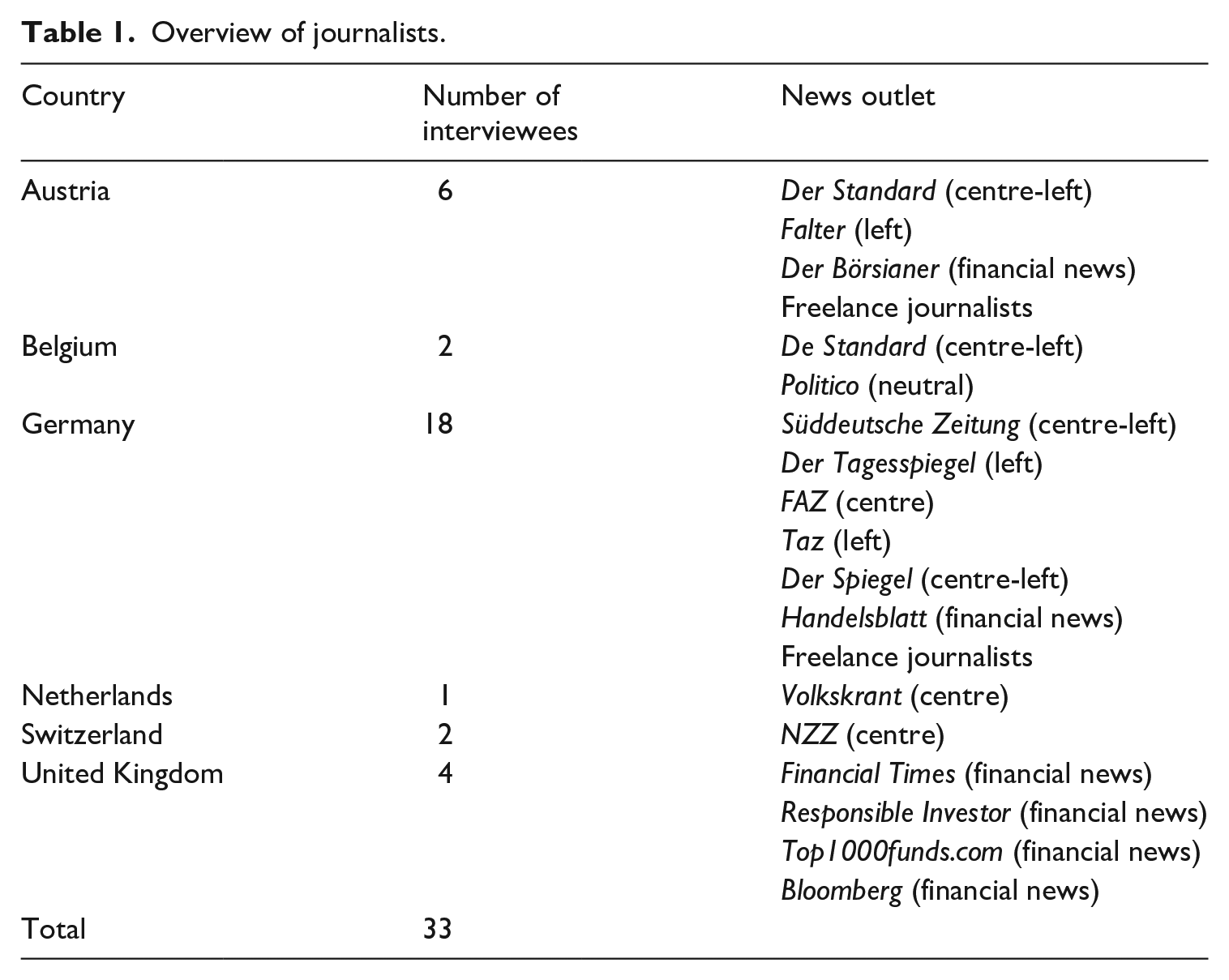
In total, 33 (financial) journalists agreed to participate in the study. In order to control for organizational and individual differences, the interviewee sample consists of journalists who work for financial newspapers, legacy and mainstream news media (ranging from politically left leaning to centre) as well as newspaper magazines and trade magazines in the respective countries (see Table 1 for an overview). What is more, the journalists differ in terms of gender (12 female/21 male) and years of experience. A few (three) journalists had just recently started working as a journalist, and others (the majority) had between 10 and 30 years of experience, partly particularly in the field of finance and environment.
Overview of journalists.
Before the interviews took place, all interviewees received a consent form and an information sheet that covered all relevant information about the procedure of the study, ethical considerations as well data protection regulations. After the informed consent forms were signed by the respective journalists and sent back to the researcher, the interviews were conducted per telephone based on a semi-structured interview guide (see Appendix B). The interviews took place between November and December 2019 and lasted between 25 and 60 minutes. After all interviews were completed, the audios were anonymized and sent to a UK-based and German-based transcription service.
Analysis
The analysis of the interviews followed the coding procedure set out by Strauss and Corbin (2015). In the first stage, the transcribed interviews were read with an open mindset. To both English and German interviews, English codes were assigned to statements that were deemed relevant to the research questions posed above. In particular, attention was paid to statements by journalists that referred to role perceptions as well as all information related to the process of writing articles about SF. In the second stage, all codes were transferred into an excel-file that helped to get an overview of the various codes per interviewee. In doing so, the codes were categorized into emerging topics (e.g. experience, sources for SF, watchdog role). This overview made it possible to identify similarities and differences across and within countries, media outlets and journalists. In the third step, the codes were further synthesized from which overarching themes emerged that provided answers to the two guiding research questions. Those were: (1) themes that referred to the journalistic process of covering SF (market-driven and event-based reporting; the use of balanced, neutral and trusted sources; audience reactions by the elite, experts and a few critics; the monetization and professionalization of reporting) and (2) the themes that are related to journalistic role conceptions (chronicler, informant, educator; moral dilemma).
Results
Market-driven and event-based reporting
When asked about the journalistic process involved in reporting about SF, many mainstream financial journalists indicated that the journalistic steps are very similar to the coverage of other topics. However, most journalists explained that to get a story about SF into the news, it needs to fit into the news cycle, be connected to a recent occasion (e.g. a decision by the European Commission) or fit into the larger context of financial news reporting. A journalist from an Austrian mainstream newspaper asserted in this regard that ‘It always needs a reference to a recent event – and it also needs to fit a little bit into the policy of the newspaper. It’s not like you can put it on the agenda every day’. In addition, journalists reported that the story needs to be considered newsworthy by the editors. Although none of the journalists reported to have had a story about SF rejected by their editors, they also indicated that the story is more likely to get published if it shows an overall trend on the market, a conflict, a twist or something surprising and unknown to the audience. A financial journalist for a mainstream newspaper in Germany stated, ‘We thoroughly think about what we have reported about in the past, and what would be a new twist now. We discuss these things together in our editorial finance team’.
Interestingly, most of the journalists reported to come up with their own suggestions for articles about SF. In general, there are two routes how an article about SF can make it into the news, as reported by a Swiss financial journalist, ‘Either an article is ordered from the editorial office . . . or I have an idea about a recent event – for example, about what is happening here in Brussels and where I think we should report about’. This increased interest among the editorial offices for SF has been reported to have occurred rather recently. Amanda White from top1000funds.com recalled an anecdote from about 5 years ago when her editor came and said, ‘Look, you’re running too many of these stories on ESG, you need to tone it down a little bit’. However, she did not stop writing about it, and today the focus on SF turned out to be a good business case for the news outlet, similar to the experience of various other specialized news providers such as the Financial Times.
Many journalists reported that they got their inspirations for stories from events and conferences that deal with SF or related topics on the market. They particularly highlighted the valuable exchanges and conversations they have with industry actors, financial experts and investors that provide them with insights on market trends. As a Belgium-based journalist indicated, ‘it’s talking about the key people involved’. What is more, some of the journalists pointed out that they regularly meet with asset managers and institutional investors, listening to their pitches and their newest products or activities. While some considered these talks as useful resources to get a new idea for a story, some also regretted the sales pitches of these presentations. Jakob Blume from Handelsblatt disclosed in this regard, ‘In my daily work I talk with many fund managers who present their investment strategies, bonds and all other asset classes to me. And by now, almost all of them have prepared some slides or handouts that deal with sustainability’. Most remarkable in this regard is the stream of press releases and advertising emails that journalists said they received about SF on a daily basis. Peter Köhler, an experienced journalist at Handelsblatt in Germany reflected what had been articulated by many journalists, ‘. . .and there is no day where there are no press releases about sustainable finance or events about the topic’.
Style of reporting: Balanced, neutral and trusted sources
Although financial sources inevitably represent the core of journalists’ reporting about SF, all journalists indicated that they seek to present a balanced picture that gives voice to diverse non-financial sources. In particular, financial journalists ranked insights from scientists and independent research institutes highly, and also applauded NGOs for their engagement in presenting a counter-voice to strong financial lobbyism. Anna Hirtenstein, who formerly worked for Bloomberg while covering SF, explained, “I would typically try to write a balanced story where I would mention that this is something happening across the industry. . .not just speak to the company or whoever is publicizing the initiatives, but also to get an NGO or some kind of expert, to get a sense of whether they think that this is greenwash or if it’s legitimate.”
However, some journalists also pointed out that even non-financial sources have their agenda and that a critical reflection about hidden interests and fact-checking is always necessary, regardless of the source. When asked about what sources they trust most about SF, most of the journalists mentioned academic research and independent research institutions. However, journalists also ascribed trust to some of their financial sources, given the long-term relationships, their level of experience in SF, the senior position they hold, as well as successful collaborations in covering SF over a long period of time. A journalist from a financial magazine in Austria recalled, ‘There are a couple of people I can call in Austria whom I trust. I am quite familiar with the topic by now, and I know when somebody talks nonsense’.
When asked about their reporting style, most journalists reiterated the basic principles of journalistic reporting, such as fact-based, transparent and fair reporting, the separation of news and opinion, and as mentioned above, the inclusion of various sources and voices to secure balanced and inclusive reporting. However, whereas all journalists indicated that they take a critical stance towards sources and specifically ‘green claims’ made by the industry, journalists from trade magazines and specialized financial news (e.g. Responsible Investor, top1000funds.com) additionally saw their role as providing a platform for different voices from the market. In general, investigative reporting on SF was either not mentioned; or if it was mentioned, it was to say that it did not take place. One major reason for the absence of investigate work in this area, according to journalists, are the limited resources available for this work. Bernhard Pötter who writes for the left-leaning German newspaper taz, recalls, ‘The fight about scarce resources at a news outlet is fought on a daily basis’.
Audience-reactions: Elite, experts and few critical voices
The differences in reporting are also reflected in the audience reactions to SF news, as reported by the journalists. It has been highlighted by many mainstream financial journalists that it is a great challenge to present SF in a way that is also appealing to the ‘regular’ news reader. If the story does not contain a private finance angle, a broader perspective on politics or the overall market economy, it is difficult to catch readers’ attention, according to some journalists. When being asked about the feedback they receive to stories about SF, most of the mainstream journalists reported that they received positive but only few letters. In contrast, journalists from specialized financial newspapers recalled that they receive overwhelmingly positive reactions on a regular basis. Most of the readers were said to praise the detailed articles, the well-researched information and the up-to-date insights. As Susanne Bergius, a freelance journalist who writes for the Handelsblatt newsletter Business Briefing Sustainable Investments, says, ‘I am receiving so much positive feedback from my readers like never before. . .This is great, and very motivating. There are reactions to every issue. . .and almost no criticism’. Yet given the specialized reporting in these trade magazines or financial news outlets, journalists also pointed out that the readership is generally a small community, mainly consisting of the financial, political and corporate elite. While this group of audience seems to hold high stakes in SF, the journalists of these specialized news outlets also indicated that the elite and highly professionalized audience forces them to uphold high quality in their reporting. As Andrew Edgecliffe-Johnson, US Business Editor from the Financial Times stated, ‘We can be sure that whatever we’re writing about, some of our audience will be experts in it. That does hold us to a very high standard’. Hence, it becomes apparent that not only the sources, and origins of story ideas can be situated within the financial circles, the closed elite network is also reflected in the audience that regularly consumes and comments on the coverage about SF.
Monetization and professionalization of reporting
Closely related to the differences in audience reactions are the financing models of specialized financial newspapers vis-à-vis mainstream news. In light of decreasing subscription numbers for print issues and online news, all journalists interviewed agreed that sponsorships and advertisements currently play a pivotal role in financing news outlets. A common way to secure income flows with regard to SF is sponsored content or journalistic features on the topic that are accompanied with advertisements. However, all journalists strongly affirmed that there is a strict line between the sponsorship and marketing departments on the one hand, and the editorial offices and the journalistic content for such features on the other. A journalist from a specialized UK trade magazine assured in this regard, ‘We have a very strong Chinese wall in this office. There’s no relationship at all between the covers that we do and the companies (who advertise)’. To complement the financial resources from sponsors, some of the specialized newspapers (e.g. FT, Responsible Investor, top1000funds.com), but also increasingly mainstream news (e.g. FAZ and SZ in Spring 2020), were reported to offer conferences, summits and roundtables to discuss sustainable and green investments with experts.
Although the specialized financial news and mainstream news differ regarding their audience orientation and financial business models, the level of professionalization in reporting about SF seems to be pronounced across all news outlets. Journalists from financial newspapers and trade magazines, for example, stated that SF has become an integral part of their daily reporting. Other journalists said that given the increased interest for SF on the market, the topic has become a side-product of all kinds of financial or business news – be it news about energy, automobile, real estate or construction. Bernhard Pötter from taz who has reported about climate for about 20 years explained, ‘In our editorial office, the economic and environmental editors are working together. . . it’s normal to observe the things more holistically. And thus, all of us are dealing with economic or ecological aspects to some extent’.
In fact, some of the journalists reporting for financial newspapers have developed an expertise on SF and have been assigned the expert role in their respective newspaper. Susanne Bergius, a freelance journalist from Germany, for instance, said she had reported about SF for more than 20 years. Similarly, a female journalist from the leftist newspaper Tagesspiegel in Germany said that the newspaper has appointed a dedicated, professional journalist to report on SF in order to be taken more seriously vis-à-vis the financial markets. In fact, both financial newspapers Handelsblatt (cf. Business Briefing Sustainable Investments) in Germany and the Financial Times (cf. Moral Money) in the UK provide specialized newsletters that cover SF on a regular basis.
Role conceptions: Chronicler, informant and educator
When asking journalists about the role they would ascribe themselves when writing about SF (without using prompts), the most common answer was that of a chronicler. Many journalists, regardless of the country or news outlet, reported that their job is to reflect a market trend. They saw it as their duty to provide an ‘overview’, ‘the full debate on a subject’, ‘putting the pieces of a puzzle together’ or to ‘illustrate and map a trend’ such as SF. As one journalist from a mainstream newspaper in Germany explained it, ‘It is one of the most relevant trends (SF) that we have witnessed in the financial industry this year, and last year. . ..and we’re reporting about what’s happening and what we deem important’. Some of these journalists also pointed to the demand of their audience in this regard. While journalists from specialized (financial) news outlets, such as the Financial Times, Bloomberg, Handelsblatt, top1000funds.de, Politico or Responsible Investor, indicated that they have a specialized and critical audience, composed of experts in the field (e.g. energy industries, asset managers, academics), senior professionals (e.g. executive board) as well as decision- and policy-makers; journalists from mainstream, daily newspapers such as SZ, De Standaard, Der Tagesspiegel, taz or Der Spiegel said that in contrast, they rely on a broader, lay audience that consumes daily financial news stories. Having these different audience groups in mind, the role perceptions among these two groups of journalists also differed.
Some financial journalists from specialized financial newspapers considered themselves to have an instrumental function in enabling decision-makers and senior professionals to get informed, find a network and take decisions with regard to SF. Amanda White from top1000funds.com said, ‘(M)y writing is a lot more about highlighting best practice rather than being critical. Then, promoting collaboration, so that if these large institutional investors actually work together, they could definitely be more impactful’. Such a statement reflects that rather than enacting a watchdog role, journalists from specialized financial news see their role in keeping market participants up-to-date and providing a platform where they can mingle, discuss and find solutions and opportunities related to SF. Only one early career journalist at a mainstream newspaper in Germany said that she saw her role in keeping those in power accountable, and ‘rapping them on their knuckles’ for wrongdoing and fraud.
Journalists from mainstream news outlets, on the other hand, saw their role in helping their readers to come to their own decisions, to raise awareness for SF and to incentivize people to start thinking about their finances by providing ideas and orientation. A financial journalist from a German-speaking mainstream news outlet indicated, ‘My goals are to explain to the reader a little bit what the topic is about, to show what supporters and critics are saying, and to present it in a way so that the reader can make up their own mind’. Most of the journalists, but particularly in Germany and Austria, identified a strong need to educate the broader public about financial topics in general. With reference to the mainstream audience, they saw their role in explaining a complex topic such as SF in easy terms. As a Belgian journalist explained, ‘I try with the image of my Mum or whoever you want – a non-expert should still be able to get a sense of what I’m writing about’.
As part of this informant and transmitter role, journalists repeatedly pointed out that their job is to filter out relevant information from marketing or PR, to focus on the ‘most impactful activity in this area’, the ‘most substantial and meaningful news’ and to provide ‘worthwhile information’ to their readers. Some indicated that they are always looking for a ‘new twist’ or a ‘new perspective’. Others said they try to keep their ‘eyes and ears open’ while looking for new developments, trends and answers to the ‘next big questions’. A journalist from a trade magazine in the UK reported in this regard, ‘We’re very lucky to be able to be so focused on this that we kind of have quite a good sense of when something’s brewing either as a kind of incident but actually, mainly as a trend or the next big question the market needs to ask itself’.
Moral dilemma: Professional distance versus need for advocacy
In line with the ambiguity of the term SF itself, some of the journalists raised concerns about the challenge to report about SF in the financial news. Jakob Blume from Handelsblatt, even said, ‘To me, the whole sustainability topic is not a topic where you can win. I perceive this as an absolute horror topic as a journalist, because everyone wants to sell you something’. Journalists are overwhelmed with press releases, emails and advertisements about sustainable products from financial market actors. This poses a moral dilemma for the journalists: On the one hand, the increased interest and movements on the market signal to the journalists that there is a trend that needs to be reported about; on the other hand, the journalists need to be careful not to provide a ‘greenwashing’ platform for the financial market by merely reporting about the most recent financial products, initiatives, alliances and promises without critical reflection. A journalist from a UK-based specialized financial news outlet stated in this regard, “Sometimes we get information where somebody has launched a fund or has done something which on paper is actually correct, but we know that in the context of the bigger institution or whatever, it’s meaningless nonsense and it’s PR. There’s some discomfort around giving it a platform.”
In fact, many journalists saw their main job as cutting through the wilderness of PR and marketing material and making it clear to the reader what could potentially, or truthfully, be regarded as ‘green’ and ‘sustainable’. One journalist referred in this regard to ‘50 shades of green’, thereby also pointing out how difficult it has become as a journalist to draw the line between greenwashing and sincere activities regarding SF.
At the same time, some of the journalists found themselves in a delicate situation in which they have to balance their professionalization as a journalist on the one hand, and their responsibility as a member of the global society to fight climate change on the other hand. Some journalists saw the current climate crisis as a reason to become more alarming in their reporting and to encourage readers to become more active, particularly with regards to SF. However, in line with their professional values of objectivity, none of the journalists ascribed themselves an advocacy role. On the contrary, as one of the journalists from a mainstream newspaper in Germany indicated, this would be a violation of their code of conduct. Still, some of the journalists also expressed their doubts whether this is still the right way to approach the topic, given the looming climate crisis and the urgent need to act. As one journalist from a specialized financial news outlet in the UK said, ‘I swing between celebrating it and wanting to drown myself, to be honest’.
Without compromising their professional role but fulfiling their duty as a responsible citizen (and partly parent of children), many pointed to the future and their commitment as a financial journalist to keep an eye on greenwashing in the market and to unravel frauds and deceptions in relation to SF, following their watchdog role function. Some of the journalists indicated that they plan to write more in-depth articles on SF, to look at overall trends in different industries and countries, to get more insights on the measurement of impacts of SF and to consider SF activities in a broader context (e.g. future of capitalism). Many journalists were optimistic that SF will remain a trend and will even gain more traction in the upcoming years, facing an inevitable need to transition to a low-carbon or carbon-neutral economy.
Discussion
In the past few years, Sustainable Finance has become a buzzword in the financial sector, being portrayed as a powerful leverage to fight climate change (GSI Alliance, 2019). However, in some instances, the investment strategies and pervasive advertisement of seemingly ‘new and green’ investment products in the industry have been criticized by activists, scholars and policy makers for ‘greenwashing’ (Dupre and Roa, 2020; Hellsten and Mallin, 2006; Olatubosun and Nyazenga, 2019). Given the crucial role that financial news and journalists play in providing a forum for discussion, information and critique about this trend, this study sought to understand how journalists from six countries in Europe (AT, BE, CH, DE, NL, UK) describe their daily journalistic practices and how they perceive their journalistic role when covering SF.
The interviews with 33 journalists showed that the coverage about SF is mainly driven by recent events (e.g. messaging by ECB or EU) and is difficult to be placed in mainstream news if not in accordance with the news cycle. Furthermore, news about SF only receives limited audience attention in mainstream news. In contrast, a strong audience-orientation was recorded by journalists who work for specialized financial news outlets. Here, journalists not only felt they are held accountable by their elite and expert audience, but also reported that they received predominantly positive feedback, and only occasionally some critical comments. In line with this, the journalists were found to be overly reliable on financial sources from the market when reporting about SF (e.g. asset managers, banks, investors) and that these financial information networks make up the majority of their readership. This close interaction between the financial press and the financial elite is a cause for concern, alike to the criticism that has been expressed in previous research regarding the proximity of financial sources to journalists and business news (Doyle, 2006; Frig et al., 2018; Strauß, 2019; Tambini, 2010). Not only could these restricted feedback loops point to a reversed watchdog role where the industry and financial market actors hold financial journalists accountable, it could also bring about an industry-friendly style of reporting about a recent market trend that urgently needs more scrutiny at this early stage.
The interviews, indeed, revealed that the prevailing role perception among journalists covering SF is that of a chronicler. In this vein, many journalists reported that they saw their main job in reflecting a market trend and to show and explain new developments in the area of SF. Related to this, they considered their role in informing their readers about main concepts related to SF and providing them with useful information so they can make their own informed decisions. This orientation towards supporting decision-making was particularly mentioned with regard to the powerful elite. Hence, these descriptions refer to the role perception as watchdog with a focus on the transmission view as outlined by Usher (2012) and to some extent to the results-based view when influencing decision-makers in the field of SF. However, some journalists also saw themselves as educators, informing the broader public about financial topics such as SF. Indeed, the role perceptions of a chronicler, educator and market reflector are broadly confirming previous research in financial journalism (Strauß, 2019).
Sadly, but in line with previous studies on the failing enactment of the watchdog role by financial journalists during the GFC (e.g. Fahy et al. 2010; Manning, 2012; Starkman, 2014), almost none of the journalists indicated that they pursued an explicit and active watchdog role. Only with regard to the stream of press releases related to SF, did the journalists assert that they took a critical stance to uncover ‘greenwashing’. Related to this, it also became apparent that journalists find themselves in a moral dilemma, where they do not want to provide a platform for some of the questionable activities that are promoted as ‘green’ by the industry on the one hand, and their obligation in reporting on market trends in an objective and neutral manner on the other. Although all of the journalists rejected the role of an advocate, most of them did see the need to make their readers aware of how money and finance is related to global warming and how readers can become active.
When referring back to Usher’s (2012) normative watchdog role description for financial journalists, it could thus be summarized that the journalists in this study only seem to fulfil the active watchdog role to a limited extent. By merely practicing a form of journalism that filters out relevant and truthful information from PR and financial sources so that readers can make up their own minds and act accordingly, journalists miss the opportunity to provide clear solutions and a guidance for taking action. However, the active watchdog role, according to Usher (2012), might not be sufficient or adequate for journalists covering SF at this point of time. First, because it requires journalists to offer directions and solutions for a topic that remains contested in the financial, political and public sphere (e.g. Dupre and Roa, 2020; EU High-Level Expert Group on Sustainable Finance (EU HLEG), 2018). Second, providing clear-cut answers and guidance on how to put SF in practice might overstep journalists’ obedience to journalistic values such as neutrality, objectivity and balanced reporting. And, third, the definition by Usher (2012) does not encompass a watchdog role that would hold to account those that make claims about SF (e.g. through investigative reporting). Yet, one possibility to fulfil the active watchdog role in SF reporting could be to write about solutions and necessary actions to be taken in articles that are clearly identified as opinions, such as comments or opinion columns.
When looking into the future, there is hope that this active watchdog role as well as more investigate reporting might become more integrated into journalistic reporting about SF. Many journalists in this study contemplated the need to employ a more critical lens on industry practices related to SF in the upcoming years, and to check whether the announcements being currently made (e.g. divestment, carbon-neutrality) will actually play out in the future. However, while these are – similar to the financial industry – merely pledges at this stage, follow-up research needs to keep an eye on whether financial journalists will maintain their promises. Declining resources at media outlets that has affected financial journalism in the past (Knowles et al., 2017) and a focus on day-to-day journalism (Usher, 2017) suggest a pessimistic picture. At the same time, the findings from this study imply that the news outlets have managed to monetize the trend of SF (e.g. events, ads) without compromising the level of professionalization in their reporting. However, to allow journalists to live up to their active watchdog role in warning the public from potential market frauds and imbalances related to SF in the future (cf. Fahy et al., 2010; Tambini, 2010), news organizations need to free up additional time and resources for more investigate and critical financial journalism.
While the findings from this study are slightly biased through an over-representation of journalists covering SF in Germany or German-speaking countries, the findings are still crucial in guiding future research in the area of sustainability and financial journalism. Particularly in relation with the global economic recession as a result of Covid-19 and recent discussions about green recovery packages, the findings of this study gain additional relevance in unveiling the strong interdependence of financial journalism and the financial markets, and the missing active watchdog role function of journalists covering SF. Thus, future research should follow-up on this study by not only investigating the closed financial networks with regard to the coverage of green financial recovery packages during the Covid-19 crisis, but also by studying (e.g. content analysis) whether the strong interrelation between financial journalist and their financial information sources is reflected in the actual reporting about SF. Eventually, it remains to be seen whether journalists will stay true to their promised watchdog role function in future reporting about SF.
Footnotes
Appendix A
Appendix B
Acknowledgements
The author would also like to thank all journalists who have participated in this research.
Funding
The author disclosed receipt of the following financial support for the research, authorship and/or publication of this article: This project has received funding from the European Union’s Horizon 2020 research and innovation programme under the Marie Skłodowska-Curie grant agreement no. 834638.
