




Abstract
This article analyses the use of time and space in ‘identity journalism’ in Poland and Czechia. ‘Identity journalism’ is an emic term that valorises the construction of identities as journalism’s prerogative and enacts this by supplying news that amplifies views around which conservative communities coalesce. This article focuses on how identity journalism’s discourse on migration manufactures racist subjectivities. Theoretically, it employs the notion of a ‘chronotope’: a discursive construct that fuses time and space and, in so doing, produces subjectivities. By bringing together spatialities implied in the concept of ‘domopolitics’ with the ‘racialised temporalities’ of critical race theory, the article conceptualises three distinct chronotopes of migration: the ‘homeland’, the ‘extended home’, and the ‘(racialised) outside’. Empirically, it studies how these chronotopes figure in a corpus extracted from two online identity-journalistic media: the Polish wPolityce.pl (110 articles) and the Czech ParlamentniListy.cz (189 articles). The results of a Foucauldian discourse analysis reveal, firstly, that by defining the ‘homeland’ as a spatially fixed entity that persists through time, identity journalism reinforces racist subjectivities by limiting the community of ‘us’ mainly to those who share the same past and, therefore, ethno-racial characteristics. Secondly, by projecting the spatially fixed but demographically diverse ‘extended home’ into the dystopian future, identity journalism buttresses the racist presumption of incompatibility between ‘us’ and ‘them’. Finally, by casting the ‘(racialised) outside’ as spatially mobile but temporally affixed to the uncivilised past, it feeds into the view of racialised migrants as barbaric and threatening.
Introduction
This article analyses how right-wing identity-journalistic discourse on migration in Poland and Czechia uses time and space to construct racist subjectivities for its audience. As such, it plugs into two strands of journalism research. Firstly, it adds to the copious literature on journalistic uses of time (e.g., Barnhurst and Nightingale, 2018; Bell, 1995; Neiger, 2007; Neiger and Tenenboim-Weinblatt, 2016; Zelizer, 2008) and on the less studied constructions of space (Gutsche, 2019; Hallin, 1986; Usher, 2019) by analysing the two together. To this end, we borrow from literary studies the concept of a ‘chronotope’ (time-space): a discursive construct that fuses time and space, thereby ushering in the sphere of meaning (Bakhtin, 1981). While studies of media content occasionally apply ‘chronotopes’ (Applegarth, 2020; Brottman, 2005; Hutchings and Burchell, 2018), such investigations tend to privilege the temporal over the spatial dimension. To counterbalance this focus, we begin by spatially delineating the key chronotopes of migration – the ‘homeland’, ‘extended home’, and ‘outside’ – which we then unwrap from their different temporal layers.
Secondly, the article contributes to the growing body of research on journalism that transcends the traditional boundaries of the field (Deuze and Witschge, 2018; Eldridge, 2018) and news that transgresses the definition of ‘a commodity produced and packaged within organised journalistic institutions’ that stakes a claim to truth (Bengtsson and Johansson, 2021: 2875). It focuses on ‘identity journalism’: an invention of right-wing journalists in Central and Eastern Europe (CEE), particularly Poland, which explicitly recognises and celebrates journalism’s role in manufacturing subjectivities, constructing identities, and building and strengthening communities (Karnowski, 2013). For ‘identity journalists’, news is less about providing well-researched and factual information than about amplifying ideas and views that integrate and mobilise conservative communities while reinforcing their sense of belonging (Klimkiewicz, 2021: 63). As the ‘migration critical’ attitude, with its associated racist imaginary (Polynczuk-Alenius, 2021), is a viewpoint around which conservative, right-wing communities tend to coalesce nowadays, the discourse on migration emerged as a natural focus for our study.
Given our interest in identity journalism, we begin with Poland as the context where this notion first emerged. Because of our focus on migration discourse, we pair Poland with Czechia: countries that share a trajectory wherein formerly multi-ethnic states were re-engineered as homogenous in the 20th century. Currently, both are changing status from emigration to immigration societies, revealing a deposit of racist sentiment in the process (see Polynczuk-Alenius, 2021). Against this background, we empirically investigate a corpus of articles collected from the paradigmatic, self-proclaimed ‘identity medium’ that is the Polish portal wPolityce.pl (Klimkiewicz, 2021) and from its Czech equivalent: a comparably popular, politically oriented online outlet, ParlamentniListy.cz (PL).
Tying together time, space, and subjectivity, this article furthers the understanding of journalism as an exercise of power (Barnhurst, 2016; Gutsche, 2019). By analysing the uses of time and space as ways of propagating certain dispositions towards the events and people being reported on among audiences (Orgad, 2012; Silverstone, 2007), it shows the two-pronged operations of journalism’s power. Specifically, we posit that journalistic representations have consequences for the people represented while simultaneously imparting certain subjectivities onto their audiences. Although our analysis pertains to a specific geopolitical context wherein journalism’s power is fleshed out and openly embraced, we believe that similar mechanisms have also been at work elsewhere (Gutsche, 2014; Lule, 1997).
In what follows, we first introduce the concept of a ‘chronotope’ and theorise three relevant time-spaces by mapping the spatialities implicated in the notion of ‘domopolitics’ (Walters, 2004) and pairing them with temporalities borrowed from critical race theory and postcolonial readings of CEE history. Secondly, we unpack Foucauldian discourse analysis (FDA) as our methodological approach and introduce our empirical material. Thirdly, we present the main results of the analysis. Finally, we discuss some of identity journalism’s implications for the traditional journalistic ethos.
Time, space, and the journalistic shaping of subjectivities
In this theory section, we present a brief overview of the available literature on journalistic uses of time and space. Subsequently, we introduce the Bakhtin's (1981) notion of a ‘chronotope’, borrowed from literary studies, and discuss how chronotopes work in journalism. Finally, we theorise three time-spaces that form the backbone of our analysis – ‘home’, ‘extended home’, and ‘outside’.
The commonplace understanding of journalism as reporting on recent events entwines it with the ‘realist’ now, rendering the present its main temporality (Barnhurst and Nightingale, 2018: 10). Journalism studies research, however, has consistently shown that both the past and future inform journalistic treatment of the present (Zelizer, 2008) and that reporting casually conflates different temporalities, typically in pursuit of the journalistic values of newsworthiness and novelty (Bell, 1995; Neiger, 2007). However, journalism’s ‘time travels’ serve more than news values and commercial ends. They help journalists make sense of events, albeit often in formulaic and predictable ways that reach to the past for analogies and explanations (Zelizer, 2008), and enable them to influence the future by setting the public agenda (Neiger and Tenenboim-Weinblatt, 2016: 155). Different temporalities can perform functions that are cultural, by prompting questions about who ‘we’ are as a community, and political, by mounting threats, consolidating trust in institutions, justifying governments’ actions, and creating solidarity (Neiger, 2007: 319). Similarly, the less studied journalistic constructions of space are acts of power, positioning groups vis-à-vis each other, imparting ideological meanings, and maintaining the powers that be (Barnhurst, 2016; Gutsche, 2019; Hallin, 1986; Lule, 1997; Usher, 2019).
This article investigates how identity journalism harnesses different temporalities and spatialities to manufacture racist subjectivities and consolidate conservative communities around them. Theoretically, we weave together time, space, and subjectivity by borrowing Bakhtin’s (1981) concept of a ‘chronotope’ (time-space). A chronotope indicates the fusing of time and space: ‘[t]ime, as it were, thickens, takes on flesh, becomes artistically visible; likewise, space becomes charged and responsive to the movements of time, plot, and history’ (Bakhtin, 1981: 84). Crucially, chronotopes frame the options for action available to the characters in the narrative (Jack, 2006: 53; see Brottman, 2005).
As systems of knowledge that interweave time, space, and characters, journalistic chronotopes also shape audience responses to the events represented and their protagonists. They direct attention, frame and constrain perceptions, and construct relationships of temporal and/or spatial proximity, or distance, which render those events and people (ir)relevant, (dis)similar, and (in)consequential (Applegarth, 2020: 160). As such, chronotopes produce and transform subjectivities (Manderson, 2017: 167).
Theorising chronotopes in CEE
To analyse how chronotopes deployed in identity journalism manufacture racist subjectivities in Poland and Czechia, we posit three time-spaces relevant to the discourse on migration: ‘homeland’, ‘extended home’, and ‘outside’. We theorise the spatial dimension of these chronotopes based on the notion of ‘domopolitics’ – ‘the government of the state...as a home’ (Walters, 2004: 241, italics in original). Domopolitics conflates a geographical state territory with a home, imagined as a ‘warm’ community, to justify security measures undertaken to manage and regulate migration (Titley, 2012: 820). Simultaneously, domopolitics envisions the ‘outside’ as frightening, chaotic, turbulent, and always ready to seep in through porous state borders.
Domopolitics, therefore, splits the world into two spatial constructs – ‘home’ and ‘outside’ – populated by two peoples: ‘us’ (nation, citizens) and ‘them’ (illegal and unwanted migrants, bogus refugees) respectively (Walters, 2004: 241). ‘Home’ must be protected from the ‘outside’ by sealing, securing, and, above all, managing borders. Yet despite its professed inwardness, domopolitics is necessarily expansive, taking a keen interest in regulating the ‘outside’ to keep it at bay (Walters, 2004: 242). Introducing a third spatiality, ‘extended home’, may complicate the ‘home’ – ‘outside’ dyad. The Schengen Area of free international movement within the EU actualises this potentiality by removing the ‘internal’ borders between (some) member states and replacing them with the ‘external frontier’, reinforced to protect the combined EU territory (Walters, 2004: 252). As such, the ‘extended home’ may be viewed as a liminal space, combining elements of both the safe, familiar home, and the foreign, dangerous outside (Gutsche, 2014).
As both ‘home’ and ‘outside’ are at least implicitly racialised in European domopolitics – the former as white and the latter as non-white – we draw on critical race theory to conceptualise each chronotope’s temporal aspect. The existence of disparate ‘racialised temporalities’ means that people racialised as non-white often find themselves temporally disjointed and affixed to the past (Ngo, 2019: 239), whereby the mythical primitive pasts inscribed on their bodies demarcate the parameters of their lived experiences in the present (Al-Saji, 2013: 6). Those pasts were invented to explain away racism and colonialism by pairing the myth of terra nullius – a vacant space available for exploitation – with the fantasy of ‘tempus nullius – uninhabited time, time not utilised or made use of’ (Ngo, 2019: 246). Hence, European colonialists’ entitlement to the non-European lands hinged on their (mis)construing those places as time-spaces devoid of history and, therefore, inhabited by non-humans, insofar as humanity meant existence through time (Mills, 2014).
People racialised as white, meanwhile, are not temporally restricted. Instead, they can freely move between temporalities, often orienting themselves towards the present or the future (Ngo, 2019: 247). This unconstricted and often forward-looking orientation is only possible through the tethering of non-white people and spaces to premodern pasts as a deictic background against which a ‘white’ present and future can emerge (Al-Saji, 2013: 6). Tying this back to domopolitics, the primitive pasts (e.g., poverty, premodern culture, and uncivilised customs) that migrants arriving from the ‘outside’ are presumed to drag in threaten the present and future of the ‘home’.
On this foundation, we conceptualise three time-spaces that pin down the discourse on migration in Poland and Czechia. Firstly, the ‘homeland’ spatially corresponds to the territory of each country and is temporally located in the deictic present as the primary frame of reference for lived experiences. Secondly, the ‘extended home’ spatially covers the EU, wherein national borders are blurred or formally removed. Temporally, the EU (and, especially, its Western member states) is cast in the future, following postcolonial readings of CEE history, whereby the post-socialist states are viewed as coerced into an impossible process of catching up with their Western European partners (Kuus, 2004). Thirdly, the ‘outside’, the point of origin of undesirable mobilities, is bounded to spaces racialised as non-white and temporally tethered to the uncivilised past.
Methods and materials
To unearth the chronotopes identity journalism uses and dissect how they produce racist subjectivities, we deployed Foucauldian discourse analysis (FDA). Foucauldian methods are applicable to cultural critiques of news coverage because they show that knowledge conveyed by journalism is not neutral but enmeshed in relations and strategies of power (Andrejevic, 2008). While FDA is interpretivist and non-prescriptive (Graham, 2005), below we outline our procedure by grounding it in Michel Foucault’s thought.
Explicitly concerned with politics (Foucault, 1972), FDA is a ‘top-down’ approach in that it investigates how pre-selected political, ideological, or historical issues play out in discourse (Sam, 2019). Building on the definition of discourse as a language used by a particular community at a particular spatiotemporal juncture Olsson (2010: 65), we began by identifying ‘identity journalism’, and specifically its discourse on migration, as the object, i.e., topic, of our analysis (Liao and Markula, 2009). Subsequently, we assembled a corpus of statements representative of this discourse in two steps. Firstly, we selected two conservative, digital-born media outlets that enact the principles of identity journalism: the Polish wPolityce.pl and the Czech ParlamentniListy.cz (PL).
Established in 2010, wPolityce.pl is the most influential right-wing, and the seventh most influential overall, online news portal in Poland (Wirtualne Media, 2022). It is intensely partisan, nominally independent from but closely aligned with the current government, led by the conservative-nationalist Law and Justice (PiS) party. As such, the portal advances the ruling party’s positions, including Russophobia (Miklóssy and Pierzynska, 2019) and selective Euroscepticism (not challenging Poland’s membership in the EU, while opposing certain EU institutions and further integration; Fomina, 2016), rather than reflecting dominant public opinion or the general mainstream media attitude. Content-wise, wPolityce.pl is peppered with ‘junk news’, despite being curated by professional journalists (Marchal et al., 2019). What scholars describe as ideologically extreme, misleading, and factually incorrect information, the founder and former editor-in-chief of wPolityce.pl views as an enactment of a self-imposed ethos: ‘Newsrooms are...the watchtowers of communities. In [our] case, of the Catholic, Christian or conservative [community]...Resilient newsrooms are centres for interpretation, power, thought, defence of the community, and counteracting the opponents’ reactions’ (Karnowski, 2013). Thus, wPolityce.pl is a prime example of an ‘identity medium’, whose rise is a key symptom of structural polarisation in the Polish news environment (Klimkiewicz, 2021).
Established in 2008, ParlamentniListy.cz is a prominent Czech right-wing news site. Despite frequent citations as a major source of disinformation in the Czech media system (Janda and Víchová, 2016), it is the most popular independent alternative media outlet (Stetka et al., 2021). A 2019 survey (CVVM, 2019) found that 18% of respondents read PL at least occasionally. Still, it does not represent the mainstream of either Czech society or the Czech media landscape. PL has an editorial staff but also provides a place where politicians can post information directly, or, alternatively, where their posts from other platforms (including social media) appear on their ‘profiles’. On the editorial side, many of the articles are interviews with sympathetic individuals, sometimes experts or public figures and sometimes ordinary people espousing a certain viewpoint, who provide opinions and interpretations of current events that help develop and strengthen PL’s community, free from the constraints of fact-based reporting. While PL has published pieces representing a broad range of viewpoints, their content usually leans towards social conservatism and right-wing nationalism, and, going against the mainstream of Czech public opinion, they often provide space for pro-Russian, pro-Chinese, and pro-Trump interviewees (Stetka et al., 2021).
Secondly, we gathered all the articles from these outlets published during the randomly selected period from October 2019 to May 2020 via a keyword search using the embedded search boxes and the terms ‘migration’, ‘immigration’, or ‘emigration’ in the respective languages. During that period, there were no extraordinary events that directly impacted the public discussion on migration, such as terrorist attacks or major migrant inflows into Europe, thus offering an insight into a ‘mundane’ identity-journalistic discourse on migration. Contrary to our expectations, even the onset of the COVID-19 pandemic, which reconfigured global mobilities, did not appear as such an event in our material. The original corpus amounted to 129 articles from wPolityce.pl and 299 from PL. An initial reading revealed that some items did not cover the topic of im-/e‐/migration, despite featuring those keywords. Such articles were excluded, yielding a final sample of 110 wPolityce.pl articles and 189 PL articles.
Having assembled the material representative of the object of our study, we first divided the articles into three categories, depending on which chronotope was their main focus. We then performed a twofold analysis that reflected Foucault’s (1978: 98) definition of discourse as an endless interplay between ‘schemas of knowledge’ and ‘forms of subjugation’. Crucially, the focal points of our investigation did not ‘emerge’ from the empirical material, but rather from our theoretical standpoint (Graham, 2005).
In the first step, we interrogated the knowledge, or meanings, that the identity-journalistic discourse on migration constructed by focusing on how the three chronotopes became recognisable through spatial and temporal references (see Graham, 2005; Liao and Markula, 2009). Next, we examined this discourse’s operations of power by focusing on the racist subjectivities it produced through ‘dividing practices’, whereby the subject is divided from others (Foucault, 1982: 778). This twofold procedure resonates with the notion of a chronotope, which imparts knowledge configured in spatiotemporal terms and exerts power by forming subjectivities, thereby weaving our theoretical and methodological frameworks together.
Analysis of chronotopes in identity journalism’s discourse on migration
We begin this section by noting the quantitative distribution of the chronotopes before moving on to the qualitative analysis, divided into three sections, each addressing one chronotope from a comparative perspective between wPolityce.pl and PL. In the wPolityce.pl sample, 48 articles are primarily concerned with the ‘extended home’; the ‘homeland’ comes in at 42 pieces, while only 20 items primarily focus on the ‘outside’. Meanwhile, the PL data presents a different picture, with the ‘homeland’ as the overarching theme in only 17 articles. While 54 articles deal with the ‘extended home’, the ‘outside’ is the topic of as many as 82 articles. Although the two outlets focus their discourses differently, they construct analogous time-spaces of migration, similarly geared towards manufacturing racist subjectivities and, consequently, consolidating conservative communities.
Homeland: managing the present
The first chronotope, the ‘homeland’, is much more central to wPolityce.pl than to PL. Spatially, wPolityce.pl’s Polish ‘homeland’ coincides with its state borders, which must be secured and defended. Specifically, Poland’s borders with Russia, Belarus, and Ukraine constitute an EU ‘external frontier’ that the country is obliged to safeguard by ‘building a “fortress Europe” to protect the borders from a mass immigration of Third World peoples’ (2 November 2019). According to a German expert proudly cited in another article, Poland performs this task flawlessly (22 October 2019).
More than a fixed space, however, the Polish homeland is imagined in ethno-racial terms as a community for and of Polish people, defined as white (racial marker) and Christian (ethnic marker). For example, wPolityce.pl quotes an interview with a far-right politician: ‘[w]e want Poland to remain Poland and for Poles to constitute – as we have it today – over 90% of the population in our country’ (28 November 2019). Minister of Justice Zbigniew Ziobro also articulates the mission to protect the Polish nation-state’s ethno-racial cohesion: ‘Of course we are tolerant and open, but the state’s most important task is to ensure real safety’ (9 October 2019). Thus, he insinuates that the homeland’s ‘tolerance’ and ‘openness’ may render it vulnerable to encroachments by the dangerous, unscrupulous outside (Walters, 2004). This ‘conjectured future’, based on ideology more than an extrapolation of facts, both presents immigration as a threat and pre-emptively justifies the actions undertaken to contain it (see Neiger, 2007).
Crucially, representing Poland as an ethno-racial community renders the homeland mobile and portable. Thus, for wPolityce.pl, Polish emigrants and their descendants – configured as genetic and cultural carriers of the homeland – are more legitimate members of ‘us’ than non-Polish migrants who live in Poland and contribute to Polish society in tangible ways. Indeed, ‘Polonia’ (i.e., the Polish diaspora) carries out a symbolic mission of projecting Polishness outwards, for which it deserves interest and care: ‘If we fail to lure Poles back to the country, let us take care that they become our true ambassadors abroad. It is Polonia that fights for Poland’s good name in the world’ (3 February 2020).
Partially mobile, the Polish homeland chronotope is primarily defined temporally. WPolityce.pl can equate Poland with an ethno-racial community precisely because it views this community as persisting through time, bound together by historical continuity, intergenerational ties, and obligations, still unshattered by mass immigration (3 May 2020). This endurance guarantees temporal unboundedness (see Ngo, 2019): it allows the ethno-racial community of ‘us’ to recognise its past while freeing itself from it, to anchor itself firmly in the present, and, ultimately, to dream up a future for itself.
In the past, Poland was a country of reluctant but necessary emigration, a home that emigres left due to a turbulent history shot through with heroism, victimhood, and historical injustice. Although wPolityce.pl – similarly to the outcome-oriented journalistic use of time (Bell, 1995: 312) – does not explicitly ponder historical processes, it makes their results plain: economic deprivation and few opportunities prior to PiS’s ascent to power in 2015. That is why ‘many times [emigrants] did not have any other choice’ (23 March 2020) but to sadly leave the country. Likewise, wPolityce.pl asserts that physical detachment from the homeland tends to strengthen emotional attachment to it: ‘Emigration often makes Poles even more patriotic...They love Poland and long for it’ (14 October 2019). Poles’ seeming inseverable bond with their homeland compels wPolityce.pl to believe that Polish emigrants will return home when the opportunities and standard of living match those in their ‘Western’ host countries.
For wPolityce.pl, poverty and unemployment are things of the past. Now, the Polish economy blooms and unemployment decreases (26 February 2020, 4 March 2020), the welfare state strengthens (26 February 2020, 23 March 2020), the standard of living improves (4 November 2019), and new opportunities continuously appear (26 February 2020). These changes transform Poland into an immigration country, increasingly attractive to foreigners (12 December 2019). As discussed above, this growing attractiveness is paired with efficient protection from (unwanted) arrivals. These two intertwined aspects of the present success – attraction and protection – form the temporal core of the homeland chronotope: they both overshadow discussions of the grim past and anticipate the future. Aligning with typical journalistic uses of time, wPolityce.pl imagines a future heavily informed by the past (Neiger and Tenenboim-Weinblatt, 2016: 154; Zelizer, 2008).
Doubling back to its idealised ethno-racially homogenous past, Poland is poised to become a country of return migration. Luring Polish emigrants back has been the key priority of the PiS-led government’s haphazard migration policy as evident in a speech by Prime Minister Mateusz Morawiecki: ‘...in the coming years...every government should take upon itself the same task we have taken: to attract Polish emigrants back to Poland’ (8 October 2019). Although mainly reserved for the future, this process of return is already in motion. While the re-entry began with Brexit (4 November 2019), the COVID-19 pandemic has further accelerated it (23 March 2020). On one hand, this obsession with return migration reveals the homeland’s temporal unboundedness: its freedom to move between idealised past, successful present, and utopian future. On the other, it betrays the backward-lookingness of wPolityce.pl’s identity journalism that postulates the return of a mythical ethnopluralist world order where everybody lived in their countries of birth (see Zelizer, 2008).
Meanwhile, PL treats the Czech homeland as a spatial construct: a fixed territory within Czech borders. This territory remains protected despite the incompetence of the EU, on whom Czechia depends for its border security. For example, crimes committed by Muslim migrants frequently appear in PL’s articles, but they most often happen outside Czech borders. In describing a rare case where a Muslim migrant assaulted a Czech man in 2013, one article classifies the attacker as a ‘Turkish immigrant...on the run’ and later as an ‘Austrian Turk’ (17 October 2019); the fault for his presence and crime in Czechia lies with Austria. Even if the porous ‘external Schengen borders’ (30 January 2020) fail, however, Czechia is still secured by, for example, the right-wing Freedom and Direct Democracy party, which ‘protects our country against immigration and Islamisation and tries to help victims of immigrants’ (17 October 2019). The Schengen borders being at fault contributes to Czechia’s representation as a fixed, bounded, and immobile spatial construct, unlike wPolityce.pl’s Poland. However, even as the EU subsumes and dominates the Czech space, it remains protected from within.
This spatial grounding of the homeland enables PL to view some migrants who are already present in the country as ‘acceptable’, non-threatening and, thus, implicitly differentiated from the racialised ‘them’. In one interview with PL, a Jewish, Israeli-born Czech citizen and security expert calls Czechia ‘one of the safest countries in the world’ and uses Germany as a foil, referring to the German police as unprepared for a recent far-right extremist terrorist attack aimed at a synagogue (16 October 2019). He differentiates ‘us’ (Jews) from the unnamed, racialised ‘them’: ‘We’re friends, not some cocooned enemy’ (16 October 2019). Another ‘good immigrant’ is a Czech citizen of Greek descent, whose parents arrived in Czechoslovakia as ‘real refugees, for whom it was a matter of life and death’ (6 March 2020). She contrasts her parents with the refugees currently waiting at the Turkish border, who are ‘a proper army of young, well-nourished men capable of anything’ (6 March 2020).
This reveals the temporal divides between refugees then and now. Refugees previously allowed into the country and living there now are offered the temporal unboundedness of ethnic Czechs and incorporated into the nation’s possible futures, ‘immensely grateful’ for what the country has given them (6 March 2020). Conversely, the refugees of journalism’s ‘imminent’ future (Bell, 1995: 322), still outside Czechia, are coming for different reasons, threatening to tear the nation apart. Thus, in a more nuanced way than in wPolityce.pl, where temporal orientation manufactures racist subjectivities by promoting the vision of ‘us’ as a strictly ethno-racial community, PL’s spatial construction of the homeland advances racist subjectivities by constructing a more inclusive ‘us’ just to contrast it more sharply with an invariably different ‘them’.
Although the homeland’s temporal aspect is less emphasised, the (white) Czech homeland is clearly temporally unbounded (see Ngo, 2019); the past cyclically informs, but does not limit, the present and potential futures (Neiger and Tenenboim-Weinblatt, 2016). In constructing Czechia as a country that is currently safe even while disaster looms, PL falls back on echoes of the Czech 20th century past, using past events as analogies for negative elements of the present (see Applegarth, 2020; Zelizer, 2008). Czechia’s present repeats a cycle of past events that PL casts as representations of hope (26 January 2020), disillusionment (2 January 2020), and betrayal (4 October 2019); currently, all of these are at play. Rather than limiting Czechia to the past, however, these pasts offer lessons on what to avoid in the future, which Czechia squandered by submitting to the EU’s ‘new kind of dictatorship’ (11 November 2019). The future, then, appears mostly through implication and in two distinct streams: either democracy and freedom will continue to exist (4 October 2019, 26 January 2020), or the EU’s unenviable present will become the Czech future.
Extended home: the EU at a temporal crossroads
The second chronotope in wPolityce.pl and PL’s discourses on migration, the ‘extended home’, covers the pre-Brexit EU. Both outlets represent it as a spatially fixed area constantly under threat. In wPolityce.pl, the EU is a space where ‘citizens’ (i.e., ‘native’, white Europeans) can rightfully move unrestrictedly without being labelled as migrants. A quote by the Bulgarian Minister of Foreign Affairs highlights this point: ‘Besides, our people [Eastern Europeans] are not migrants. The free movement of people exists in the EU…’ (2 November 2019).
Although the EU as an ‘extended home’ is formally borderless and spatially uniform, wPolityce.pl paints it as split over migration (6 December 2019) into two geopolitically defined camps: ‘Western’ Europe, whose liberal approach already causes security threats and social erosion, and the CEE flank, whose firmer stance protects it from problems generated by the influx of undesirable migrants. Like Poland itself, its ‘immigration critical’ partners – including Czechia – respond to migration by, on one hand, prioritising their national security and values (30 September 2019, 6 March 2020) and, on the other, by ‘[s]upporting the rights of people to remain in their fatherland and to return there’ (30 November 2019; emphasis added). For this uncompromisingly domopolitical approach (Walters, 2004), EU institutions continuously harass them (31 October 2019, 2 April 2020).
WPolityce.pl connects the hardened stance on migration in CEE to the situation in Western Europe, a harbinger of a dystopian future that CEE is determined to stave off. The incompetence of ‘liberal governments’ has catapulted Western Europe from its past as a promised land of prosperity and liberty to the brink of future extinction. In an interview translated by wPolityce.pl, Viktor Orbán articulates this temporal bifurcation, calling shifting demographic and social structures in ‘Western countries’ a ‘question of pure mathematics’; in his view, ‘a large, growing Muslim community and a decreasing Christian community’ will soon cause society to ‘look different in the West and East’ (8 February 2020).
Similar sentiments reverberate in PL. According to one interview, ‘the West is lost...in a few generations it will have an Islamic majority...that will be the end of democracy and the western, open-minded lifestyle’ (2 January 2020). Another refers to support for immigration as part of a ‘multicultural ideology’, which he claims has already led to the ‘indisputable fact’ of the ‘original population’s disappearance’ because ‘you can’t bend the math’ (18 December 2019).
In anticipation of this demographic shift, wPolityce.pl prophesises, Muslim communities in ‘Western’ Europe have already launched a project of clawing back city neighbourhoods to build ‘a state within a state’ and ‘a parallel society that in the future will likely want to reach for power...attempt to impose its own law, rules of conduct or hierarchy’ (10 October 2019; see also 7 February 2020). State institutions have given up control over those areas, brimming with violence and ‘increasingly often treated as extraterritorial enclaves’ (21 April 2020). The COVID-19 pandemic only exacerbated the situation, transforming migrant-dominated districts into not only security threats and breeding grounds for terrorists (19 February 2020), but also health hazards (16 March 2020). As such, they are emplaced harbingers of the future, which will become inevitable if ‘Western’ Europe continues on a course of civilisational downfall headed towards the return of the primitive past brought about by non-white migrants.
Correspondingly, PL notes that ‘the large majority of “new Europeans” has no interest in working or adapting to the locals...they want to start their own ghettos and force the original inhabitants to accept their manners’ (27 October 2019), making Europe more violent, primitive, uncontrolled, and unclean (10 April 2020). In places with more Muslim migrants, ‘violence reigns in the city streets’, state authorities are beginning to have schools and healthcare systems comply with Sharia law (27 October 2019), and immigrant terrorists carry out alleged knife attacks (18 April 2020). The EU’s present is contrasted with that of Czechia, which could become like Paris or Birmingham soon if people do not vote correctly in the next elections (27 October 2019); once again, the EU’s present, or foreseeable future, is Czechia’s distant, projected future (see Neiger and Teneboim-Weinblatt, 2016).
While wPolityce.pl and PL speak with one racist voice about the incompatibility of ‘us’ and ‘them’, the dangers of multiculturalism, and the impossibility of integration as contouring the future of the ‘extended home’, they differ in their assessment of this dystopian future’s inevitability. For wPolityce.pl, it is not yet set in stone, and that it might be averted is a hallmark of the extended home’s temporal unboundedness. For a long time, ‘Western’ European states have been unable to effectively address their ‘sickness’ (21 February 2020), held hostage to ‘botched multicultural politics, directly grown out of leftist ideologies’ (10 October 2020). Now, though, they attempt to save their future by reclaiming control of their migration policies (8 October 2019, 6 February 2020, 19 February 2020). For example, Germany experiments – in the context of the COVID-19 pandemic – with new approaches to migration management, whereby ‘strict control [is exercised] over the inflows of migrants, separating them from the rest of the population, testing whether they pose an epidemiological hazard, and then, after having them perform the contracted jobs, sending them home’ (6 April 2020). Thus, for wPolityce.pl, the dystopian scenario remains within the journalistic realm of envisioning the ‘conjectured future’ (Neiger and Tenenboim-Weinblatt, 2016: 156).
PL, in contrast, presents the EU’s future as path-dependent (e.g., Greener, 2005), with past immigration policy choices already having determined the future. Accordingly, one interviewee claims that the situation would be unavoidable even if the EU closed its borders now and did not admit any more Muslim immigrants (7 March 2020). Here, ‘they’ have already achieved their assumed goal of overtaking Europe’s white population, so PL’s analysis of the present bleeds into predicting and anticipating the future (Neiger and Tenenboim-Weinblatt, 2016: 156).
The outside: spaces tethered to the past, migrants lurching towards the future
While the ‘outside’ formally spans countries beyond Europe, wPolityce.pl and PL distinguish between the various corners of the world and the forms of mobility that they assume to originate from those places. The outlets draw a distinction between desirable – or, at least, acceptable – migrants and bogus refugees, viewed as potential terrorists and scroungers (wPolityce.pl, 9 October 2019). For wPolityce.pl, desirable migrants originate from Ukraine, Central Asia, and the Philippines (30 October 2019), while PL praises people from ‘post-Soviet countries like … Uzbekistan, Georgia, and Armenia’ who ‘definitely have something to bring us’ (28 February 2020). PL also replicates a spurious differentiation that appeared after the 2015 ‘refugee crisis’ between ‘true refugees’ (usually those who arrived in the past), ‘economic migrants’ who come ‘because they don’t like Africa’ (18 April 2020), and the ‘organised Islamic migration’ or ‘invasion’ at the Turkish border (6 March 2020) (see Holmes and Castaneda, 2016).
Consequently, undesirable migrants primarily originate from two regions, both racialised as non-white: the Middle East and Africa. Representations of those regions are steeped in racist stereotypes, unexamined beliefs, and oversimplifications that, while resulting from journalists’ lack of knowledge, convert them into primitive, backward time-spaces (Barnhurst, 2016; Lule, 1997). In wPolityce.pl, there is virtually no news about the situation in the Middle East beyond vague claims that attribute the past and looming migration crises to ‘destabilisation and war’ (13 February 2020). PL’s coverage of the Middle East, while more extensive, is similarly reductionist, naturalising ‘Afghanistan, northern Iraq, or similar [places]’ as ‘spaces of fighting’ (18 April 2020) (see Gutsche, 2014).
WPolityce.pl’s sole article about Africa views it temporally as tethered to the past: ‘Practically all African countries have a difficult history...It is not without reason that the Black Continent is perceived as a region with enormous but still dormant potential...All the global economic powerhouses want to participate in awakening the African lion’ (29 November 2019). Despite ostensibly having left its ‘difficult history’ behind, without external help Africa cannot emancipate itself from its past to reach for the future (for the same argument about ‘backward regions’ generally, see 6 October 2019). This pertains to economic and infrastructural underdevelopment, in addition to the condition of human rights, democratic institutions, and the media.
Accordingly, for wPolityce.pl, the idea of helping ‘over there’ seems to be the guiding principle of Polish migration policy (6 October 2019, 1 November 2019, 29 November 2019, 13 February 2020). The notion of helping on the ground aims at preventing further migration (or, superficially more empathetically, stopping ‘brain drain’) and encouraging those who left to return to their native countries (29 November 2019, 13 March 2020). After all, according to wPolityce.pl’s retrograde ethnopluralism, everybody should live in their country of birth. Similarly, PL argues that if Europeans taught Africans how to make a living themselves, they would never ‘go to the supermarket across the Mediterranean Sea’ (25 February 2020).
While temporally bounded, the racialised outside is spatially mobile, embodied in and inextricable from its peoples: ‘them’. For example, wPolityce.pl argues that ‘[m]ost immigrants cannot or do not want to assimilate’ (29 November 2019), while PL views the inhabitants of the Middle East, characterised above as ‘spaces of fighting’, as naturally inclined to create a ‘military organisation’ amongst themselves wherever they go (18 April 2020). Crucially, in attaching itself to its peoples, the racialised outside also moves with ‘them’ through time as ‘they' move in space.
Once arrivals from the racialised outside find themselves at the edges of Europe, they are transported into the present, and their presence becomes acute when they allegedly besiege the Greek-Turkish border (PL: 5 March 2020, 6 March 2020, 13 March 2020; wPolityce.pl: 6 March 2020, 13 March 2020). Even in the early days of the COVID-19 pandemic, both outlets considered this inflated ‘crisis’, cast as nearly a warzone at the EU’s external frontier, as a more pressing threat than the coronavirus. For PL, the situation at the Greek-Turkish border served as an illustration of the conflict between the societally ‘more advanced’ EU (concerned with human rights and distracted by such lesser issues as climate change and the pandemic; 5 January 2020, 5 March 2020) and the more primitive space outside Europe, considered powerful because of its untamed, violent nature.
For wPolityce.pl, the outside not only skulks at Europe’s edges, but it has also already crept into the extended home via ‘no-go’ zones (10 October 2020), French ‘banlieues’ (3 May 2020) and ‘Sharia zones’ in Sweden (25 November 2019). Those invaded spaces move temporally from the European present into the racialised migrants’ past. The racialised past, then, becomes a scenario for the ‘Western’ European conjectured future.
The lack of agency over its temporal trajectory differentiates the racialised outside from the homeland and the extended home. If the racialised outsiders stay home, they remain in the mythical past written for and affixed to them (Al-Saji, 2013; Mills, 2014; Ngo, 2019). Thus, for identity journalism, the invasion of the extended home emerges as the only way the racialised outside can unshackle itself from the past and claim for itself an overdetermined future, envisioned as the revenge of ‘reverse colonisation’ that would reset ‘historical chronometers at zero’ (Mills, 2014: 30). This prospect once again throws into relief the backward-lookingness of identity journalism, which remains stuck in circular time (Barnhurst and Nightingale, 2018) and is, therefore, incapable of imagining a future that would be more than a repetition of the past in reverse (see Zelizer, 2008).
Conclusions
Summary of findings.
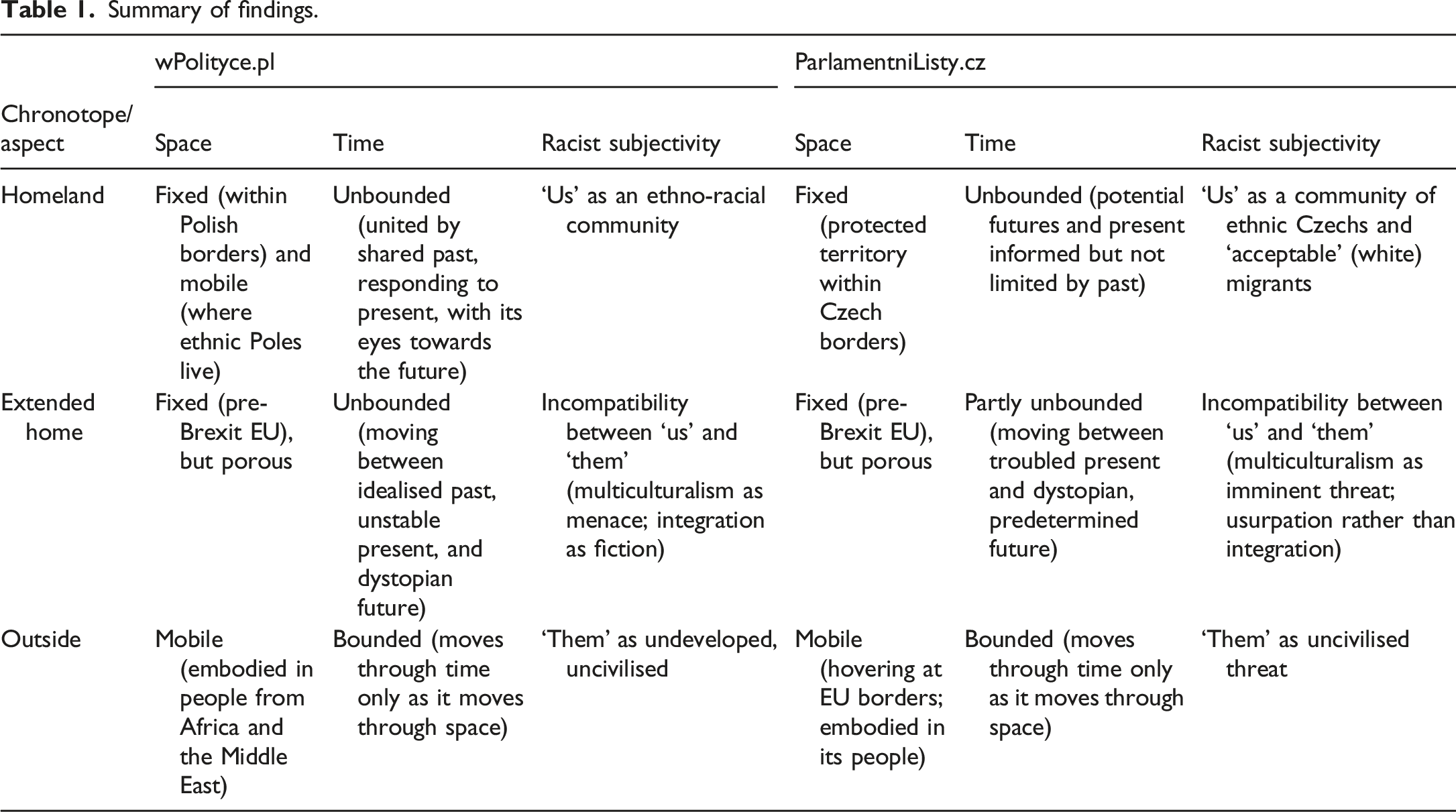
In empirically analysing chronotopes (i.e., time-space configurations), this article adds to the existing literature on journalistic uses of time and space (e.g., Barnhurst and Nightingale, 2018; Bell, 1995; Hallin, 1986; Neiger, 2007; Neiger and Tenenboim-Weinblatt, 2016; Usher, 2019; Zelizer, 2008) by interrogating the two in tandem. It contributes to the analyses of journalism as a domain of power (Barnhurst, 2016; Gutsche, 2014, 2019) by showcasing how chronotopes are an exercise of journalism’s power in a double sense. They simultaneously frame options for action available to protagonists in the events reported on (Jack, 2006) and propagate racist subjectivities among audiences (Applegarth, 2020).
More generally, we posit that news on migration is harnessed to the project of identity journalism, which valorises views and voices that consolidate conservative communities around ‘migration critical’ stances over well-researched and factual information (Klimkiewicz, 2021). In its crude instrumentalisation of migration, not only is identity journalism at odds with the dominant turn to interpretative journalism (Barnhurst and Nightingale, 2018) but it also upends the whole ‘Western’ journalistic ethos premised on the ideals of factuality, neutrality, and balance (Neiger, 2007). The ideological disinhibition and lax approach to truth connect identity journalism in CEE to more transnational outlets such as Breitbart, with its ‘penchant for “fake news”’ and ‘trafficking in alt-right nativist and hate-filled narratives’ (Eldridge, 2018: xii). By taking seriously the emic idea(l) of identity journalism that unashamedly embraces fictitiousness and subjectivity, we can begin to critically appraise, rather than deny, a troubling trajectory whereby journalism, whose media-as-fictions once contributed to the imagining of national communities (Anderson, 1983; Gutsche, 2014; Hallin, 1986), and which – in its global guise – once offered hope for the creation of a global community (Lule, 1997), has repurposed its imaginative power to divide, splinter, and fragment communities instead of bringing them together.
Footnotes
Acknowledgements
Earlier versions of this manuscript were presented at the 2020 Post-socialist and Comparative Memory Studies Conference and the 2021 NordMedia Conference. We are grateful for all the comments received on both occasions. We also want to thank Dominika Baczynska Kimberley for assisting with data collection.
Declaration of Conflicting Interests
The author(s) declared no potential conflicts of interest with respect to the research, authorship, and/or publication of this article.
Funding
The author(s) received no financial support for the research, authorship, and/or publication of this article.
Author biographies
 is a doctoral researcher in political science at the University of Helsinki. Her PhD thesis focuses on populist contestations of the past on social media, through the case study of the Czech Republic. She is also interested in technocratic populism, visual analytic methods, and spatio-temporal entanglements present in collective memory.