



Abstract
Local journalism has received increasing attention and recognition from scholars as well as in public and political debate. However, challenges and downsizing in media businesses raise concerns about blind spots, with possible impacts on diversity, local democracy and civic engagement. This article discusses the concept of blind spots and diversity, investigating trends and patterns in local and regional journalism based on a content analysis of 24 local and regional media sources in Norway.
Introduction
Scholarly interest in the local media and local journalism has increased, underlining their societal role (Gulyas and Baines, 2020; Gumera et al., 2018; Hess and Waller, 2017; Mathisen and Morlandstø, 2018; Nielsen, 2015a; Waschkovà Císařová, 2017). Remaining remarkably stable despite the media crisis, revenue loss and circulation decrease, the local media in Norway has been described as the backbone of the media structure (Høst, 2005) and considered important for local identity and belonging, as well as for local democracy and public debate. However, like most media businesses worldwide, Norwegian local journalism has experienced changes, challenges and crises, as downsizing and geographical withdrawals have driven local legacy media sources in a more hyperlocal direction. With media ecology as a theoretical starting point (Anderson, 2016; Napoli et al., 2015), these trends raise concerns about blind spots, with possible impacts on diversity, local democracy and civic engagement (Høst, 2016). This concern is even reflected in political debate because media diversity is regarded as fundamental to a healthy democracy (Barnett and Townend, 2015).
Even in the Norwegian public debate, the local media has received increased attention in times when tensions between the centre and periphery are significant conflict lines in discussions. One example is the increasing peripheral protest against the centralization of police, hospitals and universities – a protest rooted in the fear of fundamental consequences for local communities and regions. The increased public attention reflects engagement and recognition of the role and value of local journalism as a mediator of this controversy. However, local journalism is also criticized for being an uncritical lapdog, described as superficial and deferential and one that skirts controversy (Nielsen, 2015a: 1).
In this article, our aim is to elaborate on trends and patterns in local and regional journalism in light of concepts, such as diversity and blind spots, in the Norwegian context. Diversity refers here to the existence of variation in content, while blind spots refer to topics with little or no media attention. The research question is twofold: First, what qualities – in terms of topic and tone - do Norwegian local and regional media content express? Second, how does the local media contribute to diversity or, conversely, blind spots in the Norwegian media ecology? The empirical ground is a content analysis of 24 local and regional media sources in Norway, including print, digital and broadcasts.
The article is organized as follows: First, a literature review elaborates on the local media and the Norwegian context followed by theoretical framework and concepts. Then, we explain the data and methods before presenting the findings. Finally, we discuss blind spots and diversity in relation to democracy and media ecology and in the end; concluding remarks.
The context of local media
The decentralized media landscape is a vital characteristic of Norway and consisted of 223 editions in 2018, of which most were local and regional, as well as published in a range of communities all over the country (Høst, 2019: 6). The media structure in Norway is described as an umbrella, underlining the prevalence of newspapers at four geographical levels of coverage: national newspapers, regional newspapers, local dailies and local weeklies (Høst, 2005). The umbrella model describes how information segments media markets according to geography (Sjøvaag and Kvalheim, 2019: 303; Sjøvaag and Owren, 2021). In addition, the national broadcaster NRK consisted of 48 local or district offices throughout the country in 2018, all of this making local media sources the backbone of the media structure (Høst, 2005). Even if we have experienced a decline in the use of the local media in the last couple of years (Statistisk sentralbyrå, 2021), Norway, alongside other Nordic countries, stands out with its diverse press structure, which has universal appeal and a relatively high level of newspaper consumption. Additionally, the level of trust in the news media and political institutions is high in all of the Nordic countries (Skogerbø et al., 2021: 17), and the willingness to pay for news is significantly higher in Norway than many other countries, even the Nordic ones (Newman et al., 2021). The local press remains of key importance in the Nordic newspaper ecology, especially in Norway and Finland (Syvertsen et al., 2014: 55–56). Hallin and Mancini (2009: 150) described both the Nordic and Central European media systems as democratic corporatist models with several similar characteristics linked to political, social and economic structures. They underscore the high circulation of the local press as a characteristic feature of this model, advancing strong local patriotism as a possible reason. This applies even when considering the Nordic media system as much more fragmented and changeable, not least because of the development of social media and different kinds of hyperlocal media outlets (Lindén et al., 2021). Media policy aims to strengthen diversity, with press subsidies as a remedy. In the latest Norwegian media policy white paper, the government even increased the subsidies of the local press due to its value for diversity and local democracy (Kulturdepartementet, 2019).
Waschková Císařová (2017: 19) connected the increased attention of local journalism the last couple of years to a general adoration of the local area and culture: “Nowadays, the local is empowered in contrast to the uniformity and homogenization of globalization, or as universal and exportable culture.” Hess and Waller (2017: 2) stated that local journalism is “increasingly recognized for its diversity and its resilience.” The increased scholarly interest also embraces the role of local journalism in the digital media landscape (Hess and Waller, 2017; Nielsen, 2015a; Olsen, 2019). The societal role of local journalism has been described as twofold and partly contradictory – between local patriotism on one hand and the critical fourth-estate concept on the other (Mathisen, 2013; Nielsen, 2015a). Expectations of community building (Costera Meijer, 2010) might collide with the watchdog idea, as studies have found a scarce amount of critical reporting in the local media (Leckner et al., 2017; Mathisen, 2013; Svith et al., 2017). Further, the dilemma of proximity is challenging the professional role of local journalists, especially related to carrying out critical and investigative journalism in small societies (Mathisen, 2013).
Despite the growth in scholarly interest, few studies have examined the content in a range of local media outlets, and even fewer have elaborated on the differences and similarities between different kinds of local media sources within the decentralized umbrella model of the Norwegian media landscape (with some exceptions, e.g., Sjøvaag and Kvalheim 2019). In this article, we seek to fill in this research gap and contribute to the understanding of how the decentralized media landscape supports the aim of diversity and potential blind spots.
Theoretical framework: media ecology
Theoretically, this study is grounded in an ecological perspective of the news media (Anderson, 2016), which might contribute to an understanding of how different parts of the diverse media landscape relate to each other. The ecological perspective underlines the meaning of the media system as such. The media system is perceived as an ecological system that values the relations between different types of media, as well as how the media system contributes to the societal need for information (Scolari, 2012). It also underlines the news media as a part of the democratic infrastructure (Peters and Broersma, 2017). Anderson (2016: 412) defined news ecosystems as …the entire ensemble of individuals, organizations and technologies within a particular geographic community or around a particular issue, engaged in journalistic production and in journalistic consumption.
Nielsen (2015b: 51) described the local media as a keystone media source, underlining its role as “primary providers of a specific and important kind of information and enable other media’s coverage and thus have ‘ecological’ consequences that reach well beyond their own audience.” For example, news is distributed by local or regional media and is later picked up by national media sources and spread to a broader audience (Anderson, 2016). Nielsen (2015a: 27) argued that the ecological perspective helps both journalists and researchers see individual actors as parts of a wider environment, as well as understand how media structure, production and circulation take place in a specific context.
Ecologies are interdependent and relational, and shifts at one level can be potentially far-reaching (Peters and Broersma, 2017). When a new form of media enters the scene, it changes the landscape for those already there: An example is how social media has transformed journalistic work. In the contemporary journalism ecosystem, social media plays a vital role in facilitating interconnectedness and the sharing of journalistic content (Napoli et al., 2015: 16). In addition, the internet and the use of algorithms have challenged the business models of local media, which have more or less lost their advertising market to Facebook and Google (Sjøvaag and Owren, 2021).
Underlining the democratic value of journalism, the ecological perspective makes a well-suited frame through which to discuss the role that the local media plays in the larger public debate, not only limited to the single and specific communities. Further, we find it suitable to address concepts such as diversity and blind spots. Even if the ecological metaphor is rooted in biology, and one might question whether terms of natural science are suitable to describe societal phenomena such as democracy and public, we still find the media ecology a useful perspective to analyse how the parts of the diverse and decentralized Norwegian media landscape relate to each other.
Diversity and blind spots
As stated earlier, securing diversity has been a vital aim for Norwegian media policy, independent of which side of politics the government represents (Syvertsen et al. 2014). The idea of diversity encompasses owners, channels, the content, the number of editions, freedom of speech and the geographical dimension. This aim is grounded in an understanding that journalism is vital for democracy, public debate and citizenship. Regarding content, media diversity implies many varieties of user preferences, identities and ideologies (Sjøvaag and Kvalheim, 2019: 296).
Opposing this, a lack of diversity is described as blind spots and could be seen as geographical, thematic and social. Høst (2016) described blind spots as both geographical – when specific areas lack journalistic coverage – and thematical – when the news agenda is lacking in specific issues. Social blind spots describe which parts of society, perspectives or interests are not brought into the mediated agenda. All these types of blind spots have implications for democracy, citizenship and public sphere.
There are few real geographical blind spots in Norwegian local journalism (Høst, 2016, 2019). Consequently, thematic blind spots are more essential to elaborate on. Sjøvaag and Kvalheim (2019) defined thematic blind spots as “the topics that are not considered relevant, important, interesting, accessible or timely enough to be routinely prioritized on the broadly mediated agenda” (p. 292). On the contrary, these are the topics about which the public receives sporadic and marginal information, possibly leaving systematic gaps in public knowledge. They found the social and energy sectors to be topics of vital interest in the national budget; however, the news media pays them scarce attention (p. 302).
Following this, thematic blind spots are closely linked to the agenda-setting function of journalism. What topics the news media sets on the agenda also define what is perceived to be important in public debate (McCombs and Shaw, 1972). An agenda is a set of issues communicated in a hierarchy of importance, and the agenda-setting process impacts how public opinion is shaped (Dearing and Rogers, 1996). The news agenda is shaped through journalistic choices and priorities concerning what editorial teams perceive as important and less important (Allern, 2001: 120). The agenda-setting power even implies the power to omit specific issues and perspectives.
In scholarly research, several concepts are comparable to blind spots. Nord and Nygren (2002: 32) introduced the concept of media shadow, which occurs when the reporting from a specific area is single-sided, scarce, sporadic or lacking in detail. The concept of a news desert is another connected to geography and describes a lack of local news in a specific area (Napoli et al., 2015) or a community without local news outlets (Abernathy, 2018; Howells, 2015). In this article, we will use the concept of blind spots, focusing in on thematic blind spots, not geographical or social ones.
Data and methods
This article is based upon a quantitative content analysis of 24 local and regional media outlets in Norway, containing 6.574 articles published in print, online and broadcast media sources. Our aim is to elaborate on trends and patterns in the content that local media offers its citizens, using the following research questions: What qualities – in terms of topic and tone - do Norwegian local and regional media content express? How does the local media contribute to diversity or, conversely, blind spots in the Norwegian media ecology?
The selection of the newsroom in the study mirrors variations in media types in the Norwegian media landscape that are based on Høst’s (2005) umbrella model. Even though the media landscape in Norway is in flux and the divisions between the geographical levels have become blurred, we selected newspapers from the three stages beneath the national level of newspapers: regional, local dailies and local weeklies. A distinct trend in the newspaper landscape in recent years has reduced print frequency in parallel with an increased prioritization of internet content (Høst, 2019). Nevertheless, we chose four regional media companies, six typical local daily newspapers and twelve local weeklies, published 1–4 days a week. In addition, we selected two of the Norwegian Broadcasting Company’s (NRK’s) regional offices, as they are central actors in the production of local news.
We used stratified sampling to ensure the best possible representativeness of the different parts of the Norwegian media ecology. A proportional number of local and regional media sources of various types from each geographical region (strata) was randomly selected, and content from six publishing days in 2017 (a constructed week) was coded and analysed. 1 For the newspapers not published every day, we chose the closest publishing day. The study comprises all editorial articles in print and on the web for the newspapers and, in addition to online articles for NRK’s regional offices, news bulletins and newscasts on radio and TV for the chosen week. The study was conducted in 2017/2018 before the COVID-19 pandemic and thus represent a “normal year” of news reporting.
In the coding, 28 variables were used, all related to topic, source, genre, platform, picture, conflict and critique. 2 The coding sheet was developed and modified through a pre-study conveying code testing of a range of articles, were we also leaned on former, content analysis of news content (Allern, 2001; Mathisen, 2013), in order to compare our findings and to explore changes and development over time. A team of six cooperating scholars carried out the coding. 3 Working in a research team was a great advantage, not least regarding the qualitative interpretation of some variables. To secure the coding practice and interpretation of the variables, we carried out seminars regularly. We also developed an inter-coder reliability test of 10% of the total material. The reliability score is from 81 to 96% for the variables, which is satisfactory in relation to general reliability requirements (Krippendorff, 2004).
According to time and resources, we decided to reduce the number of collected days for the regional newspapers (the biggest ones), which weakened the data material to some degree. Due to the small number of articles from regional newspapers, we are unable to make definitive conclusions for the regional media regarding a comparison to the other media types, even if we identify trends confirmed by previous studies. Further, the number of analysed articles from NRK’s regional offices is low, primarily because newscasts formatted in radio and TV are scarce. The news bulletins on the radio last only a few minutes each, and the news programs on TV last for 15 min. The radio and TV cases constitute only 3% of the total data material, even though the NRK data represent a constructed week. Despite these discussed limitations, our data reflect all of the local and regional levels of the media landscape in Norway and constitute a rather large content analysis.
Findings
In this article, we focus our discussion on two aspects of the content. First, we elaborate on which topics the newsrooms prioritize; thereafter, we analyse the content in relation to critical reporting.
We coded and divided the topics according to 19 categories emerging mainly from the material itself (a few are theoretically defined). The “other” category covers articles on topics that fall outside the defined categories. However, a single news story covers several issues and topics at the same time, so the categories might not always be mutually exclusive. This exemplifies how quantitative coding demands interpretation and discretion from the coder. For example, a news article about a bus company might touch upon transport as well as trade and industry, and an article about a school closing might be both about politics and education. Still, in the coding, the most prominent topic is highlighted through the title, picture, introduction and angle of the unit registered.
With regards to Figure 1, three aspects are worth noticing: First, a few topics dominate the media coverage; second, many topics are represented on the agenda; and, third, some topics are missing or very scarcely covered, which we here describe as blind spots. Topics in 24 local and regional media outlets (percent).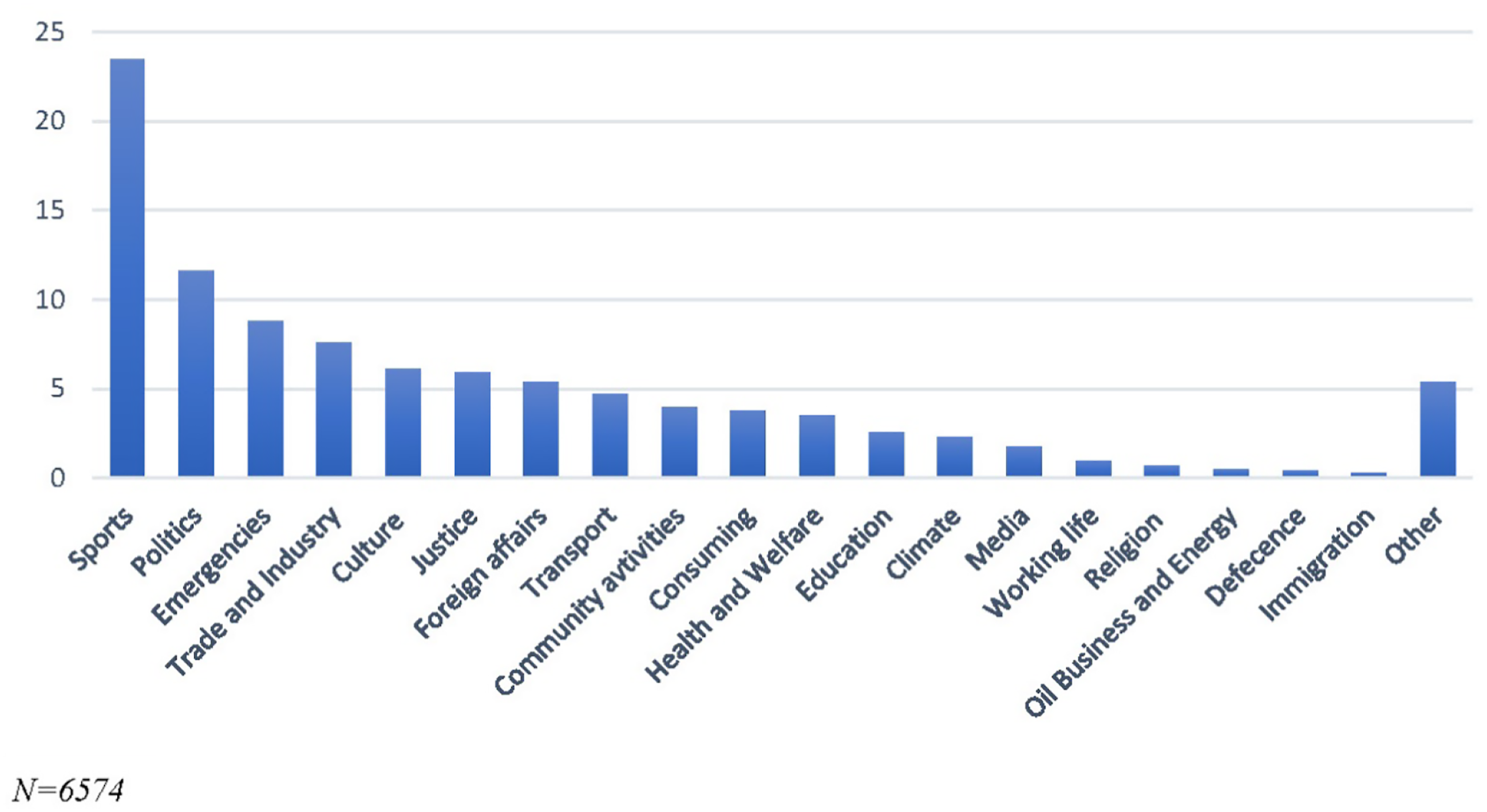
First, in Figure 1, one category stands out remarkably higher than the others: sports. Twenty-four percent of the journalistic content in local and regional media sources is about sports, which includes news stories about professional football clubs and professional players as well as children’s sporting activities. This large amount of sports content is supported by former studies (Allern, 2001; Sjøvaag and Kvalheim, 2019). Taking the democratic and societal roles of journalism into account, such a large amount of sports coverage is questionable. As a topic, sports are hardly of vital societal value or fulfil the criteria for the critical information needed in society (Napoli et al., 2015) or provide a community–information role (Svith et al., 2017). It is reasonable to question whether the large amount of sports coverage suppresses other vital societal topics. However, sports are undoubtedly a popular category among the audience and might also reflect grassroots activities and volunteer work, as well as contribute to the local sense of belonging and engagement. Thus, the large amount of sports content constitutes a vital part of the patriotic mission of local media, promoting community cohesiveness and engagement at a grassroots level. However, sports coverage also concerns commercial considerations, generating loyalty between the media company and the audience (Sjøvaag and Kvalheim, 2019). Following this, commercial considerations and local patriotism might go hand in hand. Nevertheless, when resources are allocated around sports, other topics are left in a blind spot.
The second largest category is politics. We find that 12% of the content is about politics, which corresponds with the findings by Svith et al. (2017). The coverage of local politics seems to be at a rather stable level, as local newsrooms prioritize both local and regional political issues. Journalism has always been related to the political sphere, and an essential understanding of its societal role involves holding political power to account. Shaker (2009: 810) found that news consumption and political knowledge interrelate, stating that “media which contain political information should be seen as a vital part of democracy.” Thus, the local media’s prioritization of politics encourages civic engagement.
Second, in terms of the scope of the topics covered, they vary from so-called “hard news” related to politics, trade and industry and transport to “soft news” about culture and community activities. The local media covers both sports and community events – the kind of content that supports identity and belonging – and thus contributes to the patriotic aspect of the societal mission. It also covers politics, trade and industry, transport, health, welfare and all topics that citizens need to know about in order to manoeuvre as informed citizens in a local democracy. In other words, the local press presents many topics on the mediated agenda, thus providing citizens access to a diverse range of societal aspects. The agenda entails a long trail of journalistic coverage that in sum can be said to facilitate diversity (Sjøvaag and Kvalheim, 2019).
Third, despite the scope of the topics covered, the figure reveals that some topics are very scarcely covered or almost ignored by local media. This applies to climate, media, working life, religion, oil business and energy, immigration and defence, with the latter three constituting only 0.5% each of the content. Being so scarcely set on the agenda, these topics might be characterized as being thematic blind spots. The local news media highlights some topics while overlooking others, and previous studies have confirmed these trends (Dahlstrøm, 2013; Kvalheim and Sjøvaag, 2016). This gives reason to question whether the news agenda really represents diversity.
Concerning media ecology, it is also interesting to look at how the coverage varies between various types of media. In Figure 2, we show how the topics are covered in the different media sources under study. Most common topics in various levels of media companies (percent).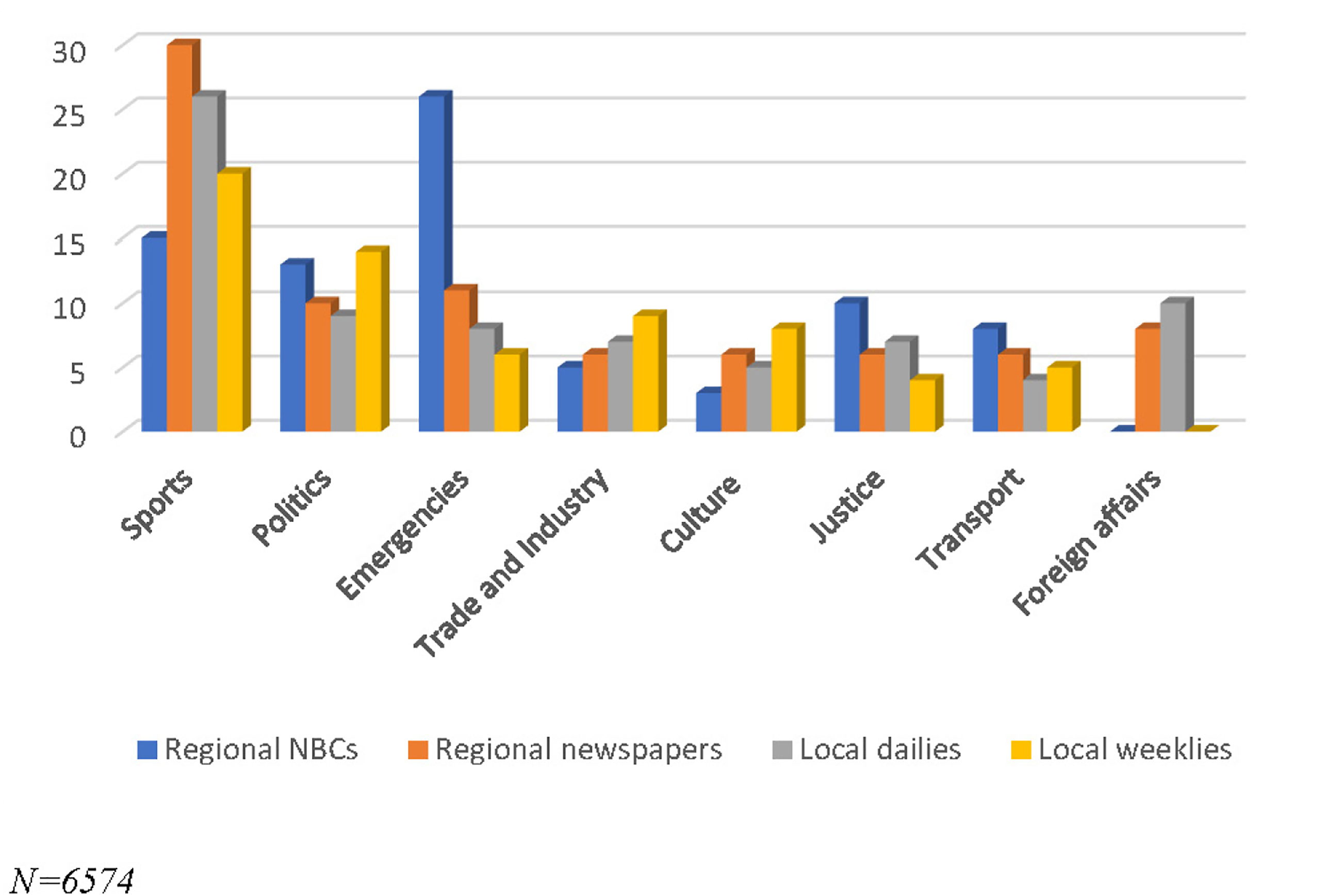
First, we notice that sports, which local and regional media sources cover the most, are a much more dominant topic for newspapers than for regional broadcasters. Regional newspapers have the highest number of sports articles, but it is also worth mentioning that sports often constitute agency news and that regional newspapers have the most extensive exchange agreements with news agencies. The smallest newspapers have a significantly closer proximity to the communities they cover, both to various local institutions (e.g., sport clubs) and to citizens (readers), which might explain why they prioritize local “heroes” and clubs.
Second, according to politics, Figure 2 reveals that the smaller local newspapers published between 1 and 4 days a week have the largest amount of political content (14%). This indicates that small newspapers closest to readers appear to be in a vibrant arena for the local political public. They inform citizens about political processes and issues and enable them to take part in discussions and decisions. The same is the case with the categories of trade and industry, and culture, which local newspapers also cover the most. These types of activity are close to the citizens as well, both relative to their working life and their spare time.
Broadcasters mostly cover emergencies. Almost all of these stories are short news briefs, indicating the responsibility of regional public service broadcasters to inform residents about accidents and closed roads in a fairly large area. The broadcast media also covers justice and transport more often than newspapers.
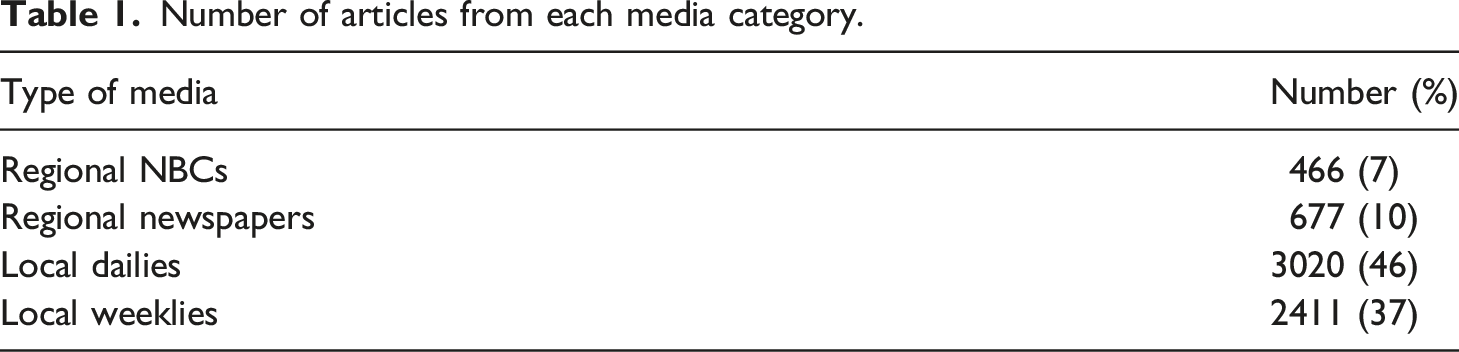
Number of articles from each media category.
Critical reporting?
Critical journalism and topics in 24 local and regional media outlets (percent).
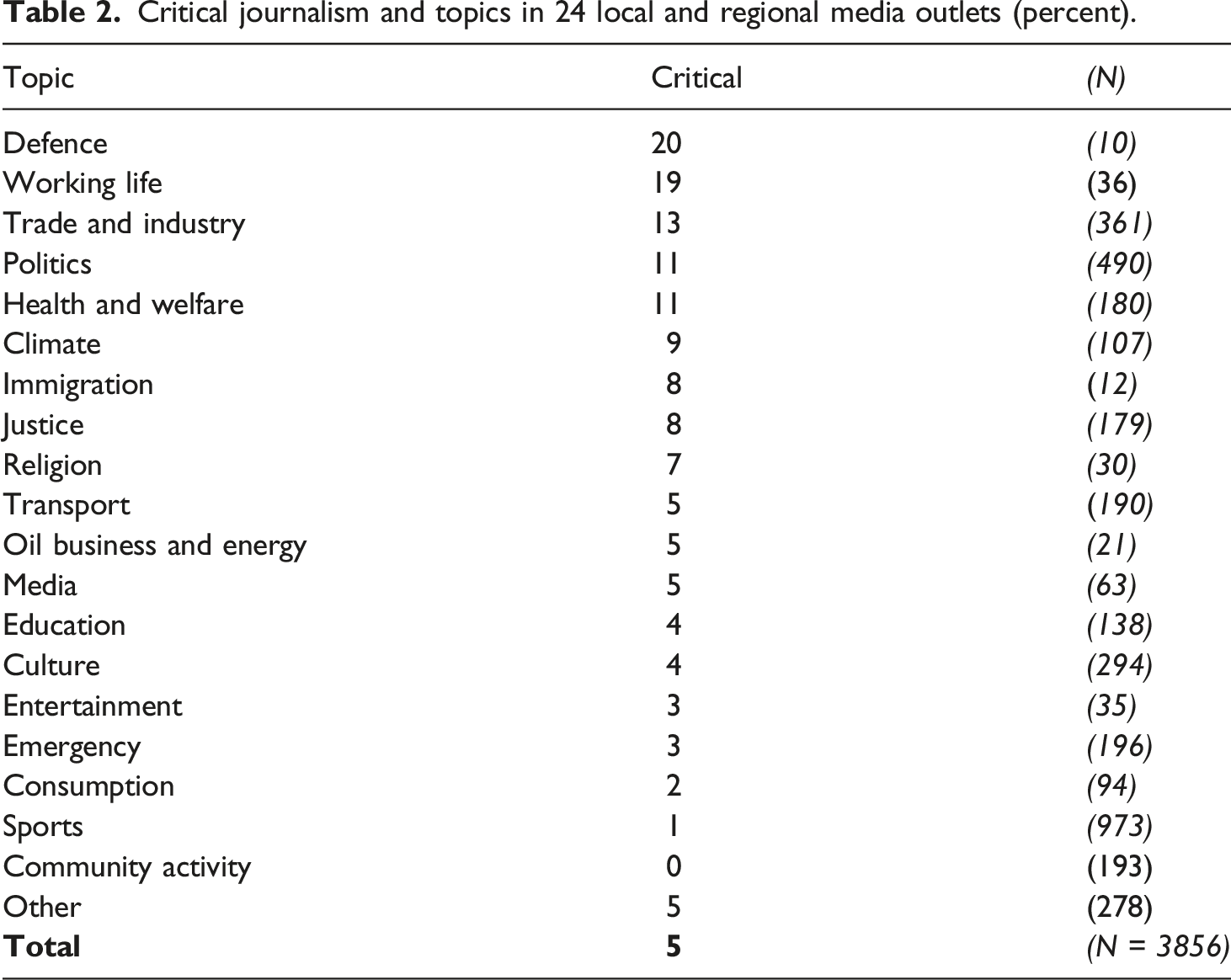
Table 2 reveals two main aspects worthy of further discussion. First, in total, only 5% of the content is identified as critical reporting. This might be characterized as rather low, which previous studies have confirmed (Allern, 2001; Mathisen, 2013). Media organizations are often criticized for a lack of critical reporting on complex issues that concern a majority of citizens (Sjøvaag and Kvalheim, 2019: 293). This critique is mainly directed at the local media, where local journalism is described as a lapdog more than a watchdog (Nielsen, 2015a: 10). Nielsen explained the lapdog metaphor by describing the local news media as “deeply influenced by local community structures, including local political fault lines” (Nielsen, 2015a: 10). Our findings suggest that local patriotism trumps the critical watchdog.
However, second (and vital to the discussion of blind spots and diversity), the table 2 reveals large disparities between the categories of topics. The range of critical reporting varies from nothing when community activities are on the agenda to 20% of the stories about defence and 19% concerning working life. Several of the topics we discussed earlier as being blind spots, such as the oil business and energy, immigration and religion, are here framed in a critical view when finally reaching the mediated agenda. Conversely, only 1% of the large number of sports stories are characterized as critical journalism, leaving sports journalism dominated by positive cheerleading stories about “local heroes.” This might also be in line with expectations from the local audience, as several previous studies have shown that news audiences want local news organizations to be “good neighbors” and patriots more than critical watchdogs (see Poindexter et al., 1996; Costera Mejer, 2010).
Also worth mentioning is politics, which constitutes the second largest category of content: 11% of the content about politics is critical or investigative. Of course, it could be questioned whether this constitutes a rather low amount of critical reporting about local politics, as the political field represents essential parts of societal power and authority. A vital aspect of the fourth-estate role of news media is holding power to account, not least political power, in which the democratic role of journalism is traditionally concerned with enlightening citizens. The same goes for trade and industry, which constitute commercial and financial power; 13% of the items are stories viewed through a critical lens. There has even been a large increase compared with a former study of Norwegian local news about trade and industry, where the amount of critical reporting was found to be 7% (Mathisen, 2013). In other words, local critical reporting about trade and industry has doubled since 2013.
These variations prove that topics that are often left in a blind spot more often become the subjects of critical reporting when these topics meet the mediated agenda. They also prove that when first performing a critical role, the local media most often does so in topics that meet the criteria for critical information needed in society (Napoli et al., 2015) or to fulfil community information needs (Svith et al., 2017). Regarding the societal role of journalism, critical reporting about politics, business, health care and transport is more essential than shining a critical light on children’s sports activities or community events. These variations also prove that essential nuances easily vanish in a discussion of the scope of local critical reporting. Separating critical reporting according to topic reveals more diverse and multiple patterns and provides valuable insight into how local and regional media sources carry out their societal roles.
Further, when separating between the smallest local weeklies, local dailies, regional newspapers and regional broadcasters, we find differences underlining the concept that size matters. Even if the number of analysed articles is small, we find a tendency among regional newspapers and broadcasters to prioritize critical reporting more than the smallest local newspapers (8% in regional newspapers, 7% in regional broadcast, 5% in local dailies and 4% in local weeklies). An obvious explanation might be based in resources and size – larger newsrooms have better frameworks for critical reporting. Further, in small communities, local journalists depend on community power, and ties might be closer and tighter as described by the dilemma of proximity (Mathisen, 2013). Proximity is twofold: On one hand, it might enable journalists to access sources and arenas with ease, as well as provide insight into problems, issues and events. On the other hand, the ties and interactions may be too close and intertwined, thus influencing the critical distance required.
Discussion
Our study documents that, even though the local media covers a large number of topics, some topics dominate and some are scarcely covered; thus, they are left in a blind spot. Furthermore, we find that the priority of topics varies between different types of local media. The digital media environment enables newsrooms to gather detailed knowledge about what kind of news will initiate the most sales and clicks, entailing the apprehension that news about local politics will be less prioritized and that superficial stories will be more successful (Olsen, 2018). However, our findings indicate that this is not the case. Politics is the second most common topic covered in the local media. It is also interesting that the smallest newspapers, closest to the inhabitants, are paying the most attention to political issues. This means that wherever citizens live in Norway, they receive information about political processes and political decisions in their communities, underlining that small, local media sources do play a vital role in the local public debate.
Our findings also relate to media policy. In the Norwegian context, several of the smallest local media outlets depend upon media support. Press subsidies are also subsidies of democracy, as the media structure would be less diverse without support. Media diversity depends upon a variety of media sources at different levels and scopes. Various levels of media within the media ecology relate to each other and feed of each other. Even if one might question local patriotism and lapdog tendencies, one cannot underestimate how a rich and varied media structure secures a diversity of topics on the mediated agenda, contributes to public debate and constitutes a vital part of the democratic infrastructure.
Simultaneously, several topics are scarcely covered and thus are left in a blind spot. Topics such as climate change, oil business and industry, working life, immigration and religion are all essential in public debate and democracy. They are connected with aspects such as power, distribution of resources and fundamental social and democratic values, but news stories within these categories are less likely to receive attention on the local and regional mediated agenda. A vital concern is how these blind spots impact public debate, civic knowledge and engagement, diversity and democracy within each local community and in the mediated debate as such. Within the frames of media ecology, these trends also suggest that when perceptions of climate change, the oil business and other thematic blind spots are rarely covered by the local media, and none are likely to be brought onto the national mediated agenda – at least not from the periphery, rural or regional points of view. Still, the thematic blind spots engender a long trail of journalistic coverage that, in sum, facilitates news diversity (cf. Sjøvaag and Kvalheim, 2019).
Another vital discussion is why the blind spots of local media develop this way. One explanation might be the institutional frame of local journalism with geography as the overall supervisory component, where the geographic area of reporting defines the agenda more than the topics do (Mathisen, 2013). For example, fisheries are more likely to be thoroughly covered in newspapers located near the coast than newspapers located inland.
Another explanation might be related to journalistic competence and knowledge. As being an all-rounder is a typical feature of the professional role of local journalists, they rarely possess specialized knowledge in specific fields, such as energy, the oil industry or defence. Still, holding specialized knowledge in a specific field is mandatory to fully understand, interpret and convey what is happening within that field, as well as to ask independent and critical questions. Journalists may avoid working on topics they feel insecure about, fearing that a lack of knowledge will cause them to make mistakes or be fooled by powerful sources aiming to control the agenda (Mathisen, 2013).
However, several of the blind spot topics represent connections between the local and the global, such as climate change and immigration. A vital challenge for local journalism is to connect global structures and processes to local life, showing how development and decisions made from a global perspective also have a large impact on local communities and workplaces. More thorough coverage of such topics in local media also involves a connection between the local and the global and could contribute to a vital strengthening and improvement of local journalism and its democratic role. This may be the most vital opportunity to further develop local journalism, sustaining its societal and democratic roles.
Regarding the structural framework, a third explanation comes from a several-year media crisis and the resulting downsizing. From 2011 to 2019, the number of Norwegian journalists reduced by 20%, and this downsizing also affected the local media (Bjerke et al., 2019). The need for cost adjustment to withstand the loss of advertising is crucial for many media companies (Sjøvaag and Owren, 2021), and with fewer journalists and resources, complicated issues demanding knowledge and insight might be dropped from the news agenda. Thus, characteristics of the professional roles of local journalists, as well as the structural framework of journalistic practice, might contribute to how the agenda-setting process is carried out and which blind spots occur.
One vital finding of our study is the large variation in critical reporting between topics, which nuances the perception of deferential local journalism. We found the most critical reporting within the topics that meet the critical information needs of society, whereas the large local focus on community activity and sports contributes to a low amount of critical journalism. Still, we cannot overlook that, in total, the amount of critical reporting is scarce. Journalism scholars have discussed several explanations for this lack of critique, including the proximity to society and sources that make it difficult for local journalists to ask critical questions (Mathisen, 2013). Local journalists have become part of the community structures they report from. They meet the expectations of community building (Costera Meijer, 2010; Pointdexter et al., 1996) and are supposed to fulfil a patriotic mission, which might collide with the ideal of critical reporting. The balance between local patriotism and critical watchdog might be challenging in small communities. However, the patriotic part of the mission is also of vital democratic value because it contributes to belonging and identity (Poindexter et al., 1996; Mathisen, 2013). Still, when the scrutinizing of local authorities is scarce and local patriotism dominates the agenda, it is vital to discuss the consequences: How does it affect the role and legitimacy of the local media in public debate?
Concluding remarks
In this article, we elaborated on the research questions pertaining to what qualities – in terms of topic and tone – do Norwegian local and regional media content express, as well as how does the local media contributes to diversity or, conversely, blind spots in the Norwegian media ecology? We find contributions to both. Regarding content, we conclude that local and regional media cover a wide range of topics, and we show that diversity in the types of media ensures diversity in the coverage of topics because the news judgments and prioritizations vary to some degree in the different parts of the media ecology. However, some topics are highly prioritized, whereas others are rewarded with rather scarce coverage.
Furthermore, we found that the amount of critical reporting is low. The local media seems to be more eager to fulfil a patriotic mission than a critical one, acting more as a cheerleader than a critical watchdog. However, a vital nuance in our study is that critical reporting is highest in the topics fulfilling community information needs, such as politics, trade and industry. Even if vital topics are scarcely covered, they are often treated by the critical watchdog when first put on the agenda.
The value of local media is versatile and diverse: conveying information, balancing the tension between patriotism and critical watchdog. A vital strength is related to proximity, contributing to both access and trust, which also constitutes important prerequisites for viewing reality from a diversity of perspectives. Critical reporting is of course at the core of journalism, but if we merely judge the value of local media sources without taking their diverse contributions into account, we miss out on important nuances. The local media contributes to a sense of local belonging and identity, which constitutes a vital part of its role.
From the theoretical perspective of media ecology, we can see how media structure, production and circulation take place in a specific, situated context (Anderson, 2016; Nielsen 2015b). Nielsen (2015b) stated that local media sources are keystones with ecological consequences as primary providers of a specific kind of information, also enabling coverage by other media sources. A diverse media structure in itself seems to be essential for a diversity of topics brought up on the mediated agenda, and knowledge of how the different parts of the media landscape prioritize their news agendas and relate to each other is of substantial value. Without different levels of local and regional news media outlets, the public sphere would become poorer. Local and regional media sources facilitate local and regional public debates. They view and interpret a range of aspects of local life, fulfilling their mission as both the glue in the community and critical watchdogs, while also serving as the primary providers of the political information that the audience needs in order to act as citizens in their communities.
As in all other forms of journalism, local journalism possesses both strengths and weaknesses. Still, it constitutes a collective good in society, playing an essential role for democracy and citizenship. Our study also raises a range of new questions. What are the implications of thematic blind spots? Perhaps most essential of all, how does the audience use and relate to the local media? Last but not least, where will changes, challenges and rapid alterations take local journalism in the future? What are the implications for local belonging and identity when journalism transfers to platforms where geographical borders and anchoring become less important? Local journalism is increasingly recognized for its diversity and resilience, with a value becoming more interesting and obvious, as Hess and Waller (2017) stated. Therefore, we also need new knowledge as local media sources are steadily developing.
Footnotes
Declaration of conflicting interests
The author(s) declared no potential conflicts of interest with respect to the research, authorship, and/or publication of this article.
Funding
The author(s) disclosed receipt of the following financial support for the research, authorship, and/or publication of this article: This study is supported by The Fritt Ord Fundation.
