



Abstract
This paper investigates the origin stories of local journalism entrepreneurs in the UK, based on 57 in-depth interviews and a survey of 116 practitioners, carried out in 2020–2021. In doing so, it focuses on the motivations and identities of editors of what are variably known as community journalism outlets and hyperlocals. These outlets represent a growing sector which has filled the gap left behind by the closure and consolidation of local and regional newspapers. Many have been established over the past decade, frequently by journalists previously working for traditional media organisations. Drawing on insights from the field of social enterprise, the article shows that, like other social entrepreneurs, community journalists are driven by a range of motivations: Their decisions to start up new outlets are frequently informed by economic conditions, including gaps in the local news market. But more importantly, they also tend to be strongly influenced by normative ideals, including the desire to improve their communities through news provision. The distinctive articulation of these normative ideals demonstrates that local journalism entrepreneurs embody distinctive professional identities associated with conceptions of what constitutes “good” local journalism. These are tied to the provision of news which authentically captures the experience of the local community. Editors’ origin stories reveal an emphasis on authority grounded in knowledge of, and a passionate attachment to, the local community.
This paper examines the origin stories of local journalism entrepreneurs in the UK, based on in-depth interviews and a survey of practitioners carried out in 2020–2021. The growth of local journalism startups should be understood in the context of a broader crisis in journalism across many Western countries. As a result of digital transformations, there has been a rapid erosion of income. In the UK, where this study is based, newspaper print circulations have halved and advertising revenue has fallen by 75% since 2005 (Mayhew, 2020). As a result, more than 300 UK local newspapers closed down between 2005 and 2015 alone (Turvill, 2015). Newspaper chains tend to concentrate their remaining journalistic workforce in urban centers. Local newspapers that have stayed in business tend to retain just a skeleton staff. This crisis of local news provision has given rise to concerns about the impact on citizen participation in politics (Hayes and Lawless, 2018). Research has found that the collapse of local newspapers is correlated with a decline in electoral participation (Shaker, 2014) and accountability in local politics (Darr et al., 2018).
In the UK, steps have been taken to strengthen local public interest reporting. Since 2017, the BBC has supported the Local Democracy Reporter scheme, which places 165 reporters in communities around the UK to cover local politics, with content being made available to local news providers, including community news organisations (BBC, no date). The high-profile 2019 Cairncross Review (Cairncross, 2019) recognized the importance of local journalism and recommended more direct funding for the sector. These initiatives, however, have not addressed the fundamental issue of the sustainability of local journalism.
The rise of local journalism startups
In the face of the difficult outlook, the crisis in local journalism has opened a space for the rapid expansion of small-scale local journalism startups – sometimes referred to as hyperlocal or community news outlets. These have been particularly well established in Europe and the United States (e.g., Ferrucci and Alaimo, 2020; Harte et al., 2018; Harte and Matthews, 2021). Such news organizations have been seen a vital to fostering new, locally based forms of participation, addressing the democratic deficit caused by widespread local newspaper closures (Williams et al., 2015).
Although three of the outlets studied for this article have operated for more than 20 years, the vast majority has been established since 2010, in part due to the opportunities afforded by technological transformations, and in part due to shifts in the journalistic labor market. Many local, regional and national print journalists lost their jobs due to newspaper consolidation and closures and sought new employment opportunities. The launch of blogging platforms such as WordPress made it easy and inexpensive to set up a slick news Web site, reducing entry barriers (Chadha, 2016). These technological transformations were instrumental in broadening access to a new generation of local journalistic entrepreneurs. A “snapshot” survey of the hyperlocal landscape in 2014, for example, showed that there were more than 400 active publishers (Harte, 2014). 1 Most of these outlets are small in terms of geographic and population reach, focusing on areas ranging from small towns to neighborhoods in major metropolitan areas. Collectively, however, they reach significant proportions of the population – recent data indicates that such small-scale local news providers in the UK reach 14.9 million people online, or more than one in five of the total population (Burrell, 2020).
Like other start-ups, their financing is frequently uncertain, and their existence under continuous threat (Deuze and Witschge, 2020). As (Van Kerkhoven and Bakker, 2014), p. 297) pointed out, such news organizations are characterized by “a high degree of entry and exit and they require a heavy reliance on volunteer work and individual entrepreneurship.” In their study of Dutch hyperlocal sites, they found that securing financial sustainability is the major challenge to these outlets. In the majority of cases, they are run by a single person, who is responsible for both editorial and journalistic decision-making (see also Harte et al., 2018).
Local Journalism Startups and Social Entrepreneurship: Combining Social and Financial Goals
Local journalism startups have much in common with the broader practice of social entrepreneurship, which is informed by both economic and social considerations. Social entrepreneurs “use business knowledge and entrepreneurial principles to solve critical dilemma facing a society regarding economic, social and environmental problems” (Germak and Singh, 2010).
Social entrepreneurs typically focus on “creating social value” (Boluk and Mottiar, 2014: p. 53) and empowering and improving communities (Ghalwash et al., 2017), rather than primarily on turning a profit. Research on their motivations has demonstrated that they tend to be shaped by multiple goals, including “lifestyle motives, receiving acknowledgement and generating profit” (Boluk and Mottiar, 2014: p. 53, see also Williams and Nadia, 2011, p. 125). Social entrepreneurs tend to be driven by altruism and passion but are also inspired by past volunteering experiences and a desire to “create and innovate” (Braga et al., 2014: p. 11).
The “social economy” to which local journalism entrepreneurs belong is characterised by lower wages and precarity but high job satisfaction and work-life balance (Bell and Haugh, 2008; Amin, 2009). As such, social entrepreneurs are part of a broader “passion economy” in which individuals make material sacrifices to pursue more precarious, but creatively rewarding careers (Davidson, 2020). While social entrepreneurs make individual choices based on what are often deeply held normative principles, they are nonetheless embedded within broader economic circumstances which shape the conditions for creative work.
The motivations of journalistic entrepreneurs
There is a growing body of scholarship on journalistic entrepreneurialism. Such research often looks at entrepreneurial practices which seek to extend the boundaries of journalism (Deuze and Witschge, 2020). These initiatives may be backed by venture capital and driven by an interest in technological innovation (e.g., Carlson and Usher, 2016; Usher, 2017; Deuze and Witschge, 2020). For example, Usher (2017), in focusing on venture capital-backed startups, studied news aggregators, content providers, social media content curators, and hosting platforms. (Hepp, 2016), p. 920) coined the term “pioneer communities” to describe emergence of “experimental groupings related to new forms of media-technology-related change and collectivity for technological as well as ideological innovation” (see also Hepp and Loosen, 2021).
Given the focus on technological innovation which has frequently driven research on entrepreneurial journalists, their motivations and origin stories differ somewhat from that of the local news entrepreneurs studied here. As Deuze and Witschge (2020, p. 48) have shown, the motivations of entrepreneurs are diverse, and encompass technological, economic, cultural, and social goals (see also Usher, 2017). As such, research on entrepreneurial journalism has demonstrated that, like other social enterprises, journalistic startups are never solely profit-driven, but rather informed by a broad range of motivations, with a prominent place for the allegiance to core professional values of news provision.
Harte et al. (2018) examined motivations of hyperlocal journalists as part of a larger project, using data collected in 2014 and 2015. They found significant differences in the motivations of practitioners from professional backgrounds in journalism and those coming into the sector from outside the profession: While those from a journalistic background were frequently motivated to address gaps in news coverage, those from non-journalistic backgrounds were more often driven by normative goals, including redressing negative coverage of a particular area, and telling the stories of community members. Ultimately, they suggested that hyperlocal journalists draw heavily on a “civic values” discourse in explaining their motivations. This contrasts with broader studies of the profession, which suggest that journalists are frequently motivated to enter journalism by personal interests, including a love of writing and enjoyment of the exciting and fulfilling work, even if some are also driven by the intrinsic and social value of the work (e.g., Coleman et al., 2018).
Here, my interest is in what such origin stories reveal about the identities of these local journalism entrepreneurs. Origin stories can shed light on the lived experience and identities of professionals (e.g., Jeong et al., 2020). By examining the origin stories of local journalism startup editors, we can access their motivations and self-understandings, and therefore get at how they see their practice as distinctive. While there has been extensive research on role conceptions in journalism (e.g., Hanitzsch, 2011; Mellado, 2015; Weaver and Wilhoit, 1996), this tradition of research has tended to draw on large-scale, cross-national surveys with limited representation of local journalists. This means that the role conceptions identified in this work do not map neatly onto local journalism. The small body of research focused on the roles and values of local and community journalists has found that while they share some values with conventional journalists, they also tend to be driven by a distinctive set of community-focused values (Harte et al., 2018), making them “a different breed altogether” (Hanusch, 2015).
Here, I suggest that the origin stories of local journalism entrepreneurs reveal not only their motivations, but also a distinctive identity and understanding of journalistic authority (Carlson, 2017). Local journalism entrepreneurs gain their authority through a combination of professional skills and grounded knowledge and networks, premised on a long-standing and affective attachment to the community. The role thus requires specialist knowledge in the same way as other forms of professional specialization (e.g., Matthews, 2014). This suggests the need to take seriously placed-based professional expertise and its relationship to local attachment.
Methodology
The article is based on in-depth interviews with 57 editors of local journalism startups, carried out over between June and September 2020, and an online survey of 116 editors, carried out in March and April 2021. The data presented here is part of a larger project, funded by grants from the British Academy and the Economic and Social Research Council, focused on investigating the experiences and working practices of local journalism entrepreneurs.
In-depth interviews
The 57 interviewees were recruited from the membership of the Independent Community News Network (ICNN), the main organization representing the interests of the independent community news sector in the UK They account for a significant proportion of the 123 members of ICNN. Interviewees were offered a £40 incentive for their participation.
In-depth interviews cannot be seen as a straightforward source of “factual” data about the experiences of subjects. Rather, they must be viewed as discourses which reveal much about how interviewees wish to present themselves in relation to prevailing norms and the cultural contexts in which they operate. It is therefore important to note that the high level of participation in the study can be attributed in part to the financial incentive, but also to the self-understanding of this practitioner group as champions of the fledgling sector of independent community news, shaped by their commitment to the communities they inhabit (see Wahl-Jorgensen, forthcoming). As such, the interview data should be read through the lens of their commitment to and advocacy for the type of journalism they practice.
The interviews explored the following areas: (1) the interviewees’ professional backgrounds, (2) their route into the sector, (3) their financial conditions, (4) their news coverage, and (5) their experiences during the coronavirus pandemic. Interviews lasted between 59 min and 1 h 20 min. Due to the restrictions imposed by the coronavirus pandemic, all interviews were carried out over Zoom, Skype or phone. Interviewees were given the option of being identified or remain anonymous either for the interview as a whole, or particular parts. The vast majority of respondents (50 out of 57) was happy to be identified. In cases where respondents wished to remain anonymous, they have been given pseudonyms and any details which may reveal their identity have been removed. Interviews were transcribed with the assistance of otter.ai transcription software and were then analyzed for attention to recurring themes, with a focus on identifying the interpretative repertoires that these journalists draw on as a means of explaining their work and making sense of their experience (Wetherell and Potter, 1988: p. 168).
Interviewees represented all nations and regions of the UK, with one interviewee based in Ireland. 2 Of the 57 interviewees, 44 were the sole individuals producing content for their outlets.
Online survey
The online survey was carried out in March and April 2021. It built on measures first developed for a survey of hyperlocal publishers carried out in 2013–2014 (Williams et al., 2014). These measures were focused on (a) assessing the democratic role of hyperlocal journalism, and (2) examining how successful and sustainable the sites are. Given an interest in a broader range of questions around the working practices of local journalism entrepreneurs, a further set of measures related to these areas were developed and piloted. The survey also included optional open-text boxes to allow for qualitative responses.
The survey targeted a broader range of publishers than the interviews: The sample included all the contacts for publications listed on the map of community news outlets hosted by the Centre for Community Journalism, an organization providing advocacy and support for hyperlocal, community and local publishers, and also manages ICNN. Contact details were found for 217 editors (some putting out more than one publication). They were invited to participate via e-mail and offered a £10 shopping voucher as compensation. Out of those invited, a total of 116 editors completed the survey, resulting in a response rate of 53%. Given this high response rate, and the targeted nature of the sample population, it suggests that the data could be seen as broadly representative of the experience of local journalism entrepreneurs in the UK (see also Baruch and Holtom, 2008). 3
While the interview data reflects a broader range of issues around the practice of local journalism entrepreneurs than the survey data, the findings presented below draw on both data sources where possible to provide triangulation.
Findings
The data suggests that most of the practitioners were motivated to join the sector because of their disappointment with working conditions in mainstream news organisations, combined with the benefits of starting up a new outlet. These benefits included improving local news provision and community cohesion, and enhancing personal autonomy. Origin stories revealed that practitioners were driven by a passionate attachment to their local community, combined with a willingness to endure material and personal sacrifices.
Many of the practitioners from came from backgrounds in professional journalism, with the survey data showing that over 60% had prior experience working in journalism, while 19% had done a university-level undergraduate or postgraduate degree in journalism or media. However, they were frustrated with the lack of viable jobs and/or increasingly difficult working conditions in the mainstream news industry. The data thus suggests that while local journalism entrepreneurs have been shaped by conventional professional norms, they also embody a distinctive role conception which is tied to their attachment to the community.
Improving local news provision
The origin story told by Francesca Evans, editor of Lyme Online, is typical of the experience across the sector. First, it reflects the journey from stable employment in traditional newspapers to the precarious existence of the journalistic entrepreneur, in the context of the decline in the local newspaper industry: Evans started the title with a colleague with whom she had previously worked in a local newspaper group. The group once owned 13 titles in the area but had closed all of them by 2018. Second, it reflects the fact that the identity of most of the practitioners was strongly linked to local news, and that improving local news provision was essential to their motivations: When it [the local newspaper chain] closed, a lot of people in Lyme Regis went online to express how much they were how disappointed they were that they weren't gonna have their local newspaper anymore […] We decided there was still kind of need for it in this town so we've set up this operation which is much smaller than the previous in reality, it's just three of us and it just covers the one specific area […] so it's much lower cost.
Evans’ story highlights the combination of civic motivations associated with improving news provision, and economic considerations around cost and market gaps. As previous research has shown, local news entrepreneurs are often informed by a desire to improve civic life in their communities (see also Harte et al., 2016; Harte et al., 2018). Yet what this meant varied across respondents, informed by their values and life histories. Here, it is important to note that respondents were usually driven by multiple motivations, though all tended to cluster around provision of local news. This is also reflected in our survey, where editors were asked about their motivations for starting their publications, allowing for multiple responses. The most prominent of these was bringing about change in the community, (50%), followed by identifying a gap in the market (45.7%), an interest in the community and local news (44%) and wanting to be “my own boss” (18.1%). This shows that motivations were not purely civic, economic or personal, but rather based on an interplay between these, as is characteristic of the broader field of social enterprise (e.g., Williams and Nadia, 2011).
Most important roles in the community (n = 116, multiple answers allowed).
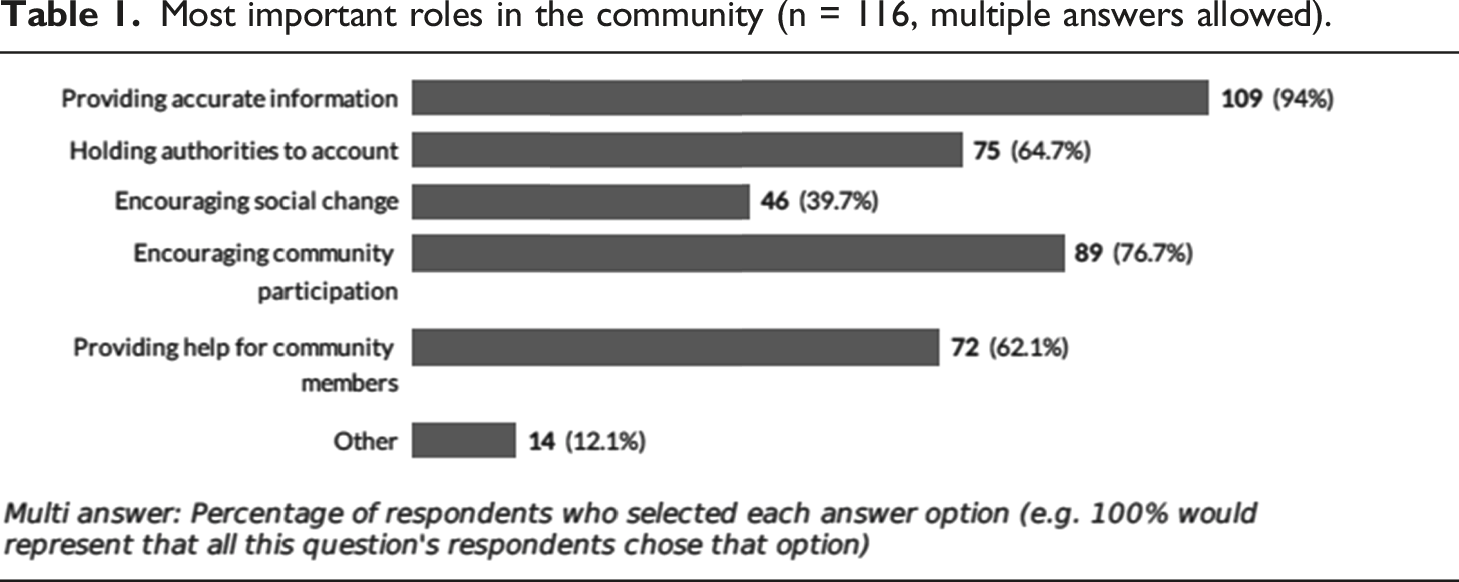
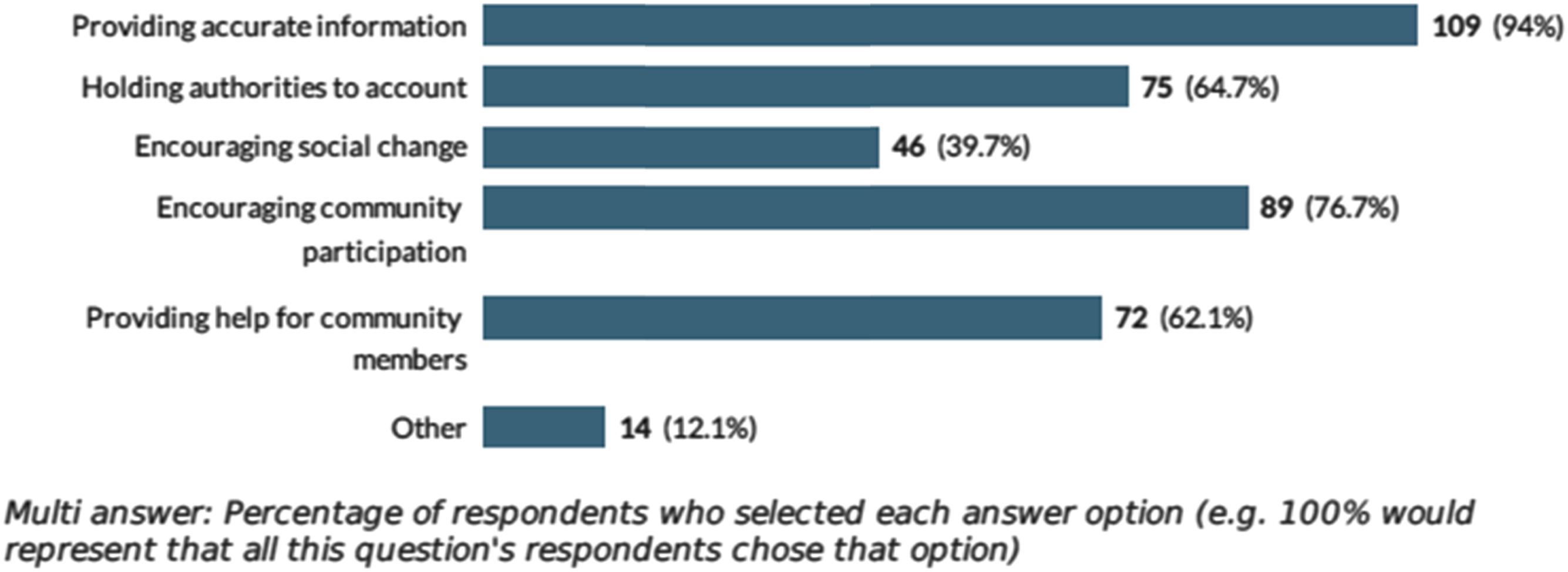
The range of understandings of what it means to improve the community frequently included political projects. For example, Owen Donovan, who hosts the Oggy Bloggy Ogwr, Bridgend Council and Senedd Home blogs, was driven by the aim of achieving political change by boosting public debate and holding politicians to account. He described the sites as “a way to start debates on current affairs in Wales, as well as include stories about the local council which the local print media either took too long to cover or didn't cover at all.” For Donovan, his blog filled a gap in public debate around Welsh politics which he saw as a way of redressing a democratic deficit.
The principle of upholding government accountability at the local level was a prominent motivation for several of the journalists, in line with broadly shared concerns around the decline of scrutiny resulting from the collapse of local newspapers. Several outlets originated in investigative journalism projects focused on holding local councils to account. Steve Downes, of Inside Croydon, came into local journalism from a long and well-established career in national print and broadcast journalism. He described his career journey as follows: I really started in journalism when I was in sixth form at school, at the end of the 1970s. With a few friends we put together a fanzine, which I suppose in the post punk era, was the equivalent of doing an easy access Web site. And I have been working professionally as a journalist from 1983. I had people from the chief executive’s office, town hall, contacting me. I had politicians contacting me. Because it wasn’t really any other outlet, dealing with news in this sort of way.
Downes’ focus on holding the local council was not unique. Julian Calvert of Lochside Press produces his site as a project alongside his full-time job as a university journalism lecturer, following on from a long career in journalism. For Calvert, the impulse to hold the local borough council accountable was explicitly tied to a project of protecting local services, which were increasingly undermined by funding cuts: Nearly 20 years ago, the local library is closed, [it’s now] run by volunteers. The Council tried to close both of the local primary schools in 2010. And then in 2012, the local ferry service became transferred to another organization which really was spectacularly incompetent. And there were a lot of fears the village pier would be lost. So it was kind of twofold. One, I needed to learn how to do this. And two, I thought there was some local causes which needed to be highlighted and services which needed to be protected more.
Other respondents described how they had been drawn into local journalism through the pursuit of civic projects or campaigns. For example, while Columba O’Hare of Newry.ie had run a local blog since 2004, he started his site as a more professional endeavor following on from a successful campaign to establish the first local park in the town of Newry (population 30,000). The campaign originated in a blog post, penned by O’Hare, and subsequently taken up by community activists. Through his campaign for the local park, O’Hare experienced how community-oriented campaigning could “make a difference” (see also Harte et al., 2018). This advocacy led him to formalizing his blog, turning it into a community social enterprise in 2017.
The desire to bring about positive change in a community was grounded in a personal investment in the community and its success. This represents a distinctive subject position which differs from that embodied by mainstream journalists. While journalistic professionalism has historically been predicated on objectivity and providing “news from nowhere” (Epstein, 1973), local news startups are fueled by an affective commitment to a specific locality, and is often driven by a desire to improve it. Nonetheless, among the editors, this passion for the local sits alongside an adherence to conventional journalistic norms.
Improving representation of the local area
For some entrepreneurs, their origin stories reflected a desire to improve the representation of the local area, often in the face of what they saw as problematic and stereotypical coverage in mainstream local, regional and national media. Mark McGinley puts out the Peckham Peculiar, along with two other publications covering diverse London suburbs, in partnership with his wife: The whole key thing was talking about an area that got a lot of bad press in the mainstream media, a lot of clichés in the mainstream media, some really bad ones, some comic ones. So, if you think of Peckham’s negative stuff, you know, knife crime, whatever, but […] you know, that happens all throughout the country. Obviously, London has a lot of that kind of thing, but also has many, many, many great things. And that's what we're all about, it is sort of saying, these things do happen, but there's a hell of a lot more good stuff going on.
Lynne Thomas, edits Inksplott, a site that covers a deprived neighborhood in Cardiff, as a hobby alongside her fulltime job as engagement officer at Cardiff University. In setting up the site, she was driven by a desire to capture positive news about the community: [Splott] has a wonderful community, and it has loads of proactive people, brilliant activities, loads of clubs, societies you can join and there's loads going on. But nobody was talking about it, and Splott gets a bit of a bum rap, unnecessarily. It has, you know, an industrial history. It has a history of poverty […] a big part of Splott was knocked down because it was classed as being dilapidated and slum-like. And, we still have the remnants of that bad reputation clinging to us, and it's totally unjustified. […] The merits it has going for it are huge, and I just thought I'd like to get involved [setting up Inksplott] and use it as a platform to promote positivity.
Such origin stories appeared frequently in the interviews, with other editors mentioning their desire to provide “balanced coverage” in the eye of “sensationalized” mainstream media stories (Carole Bond, Your Local Voice). These concerns are not distinctive to UK local journalism. Instead, they echo broader debates around the representation of local areas, particularly in marginalized communities (Wenzel and Crittenden, 2021). They highlight another distinctive way in which local journalism entrepreneurs claim epistemic authority: Based on their knowledge of the community, they can provide more nuanced and “balanced” coverage which does justice to the distinctiveness of the place. Successful local journalism is grounded in local knowledge, frequently garnered from embodied and long-term experience of living in a neighborhood, town or city as a private individual prior to covering it as a journalist.
For some of the editors, this investment in representation extended to projects of building community participation and giving voice to local citizens, reflecting the breadth of its residents. John Baron, editor of the West Leeds Dispatch, came into his role after a long career working in national and regional journalism. His last mainstream media job prior to starting the Dispatch in 2015 was a 2-year project for the Guardian as their community engagement reporter. His work for The Guardian, as well as a longstanding commitment to community empowerment, alerted him to a need for “giving local communities a voice. “ Along with a colleague, he set up the outlet as a community-led social enterprise. The Dispatch now draws on the work of 40 community reporters, “writing stuff about their own communities, and creating content about their own communities.” For Baron, the involvement of the community is both essential to the foundational ethos of the Dispatch and to its reputation. Such an approach parts ways with understandings of journalists as possessing privileged knowledge and skills, and instead embraces a model of co-production. This model, in turn, implies that authentic knowledge cannot come about solely from the elevated position of the journalism professional, but relies on community involvement and empowerment.
Such an idea is not unique to the West Leeds Dispatch but shared across several outlets. While central to the origin stories of such outlets, an emphasis on community empowerment, involvement and voice also carries over into editorial decision-making policies in the longer term, including in the context of the Covid-19 pandemic. Sarah Cheverton, the editor of Star and Crescent, described her motivation as bringing about social change and representing marginalized voices in the community. During the first wave of the pandemic, she reflected with pride on her commissioning of pandemic diaries from two community members, both of whom were shielding throughout the first wave. The diaries reflected dramatically different perspectives and experiences. While one, Maddie Wallace, was a left-wing single mother with serious health conditions, the other, Ian Morris, was a right-wing, visually impaired and diabetic elderly man. I thought, well, this is just pure gold. I've got people at the opposite ends of political spectrums who are going to be detailing their experiences every day. How do I go shopping safely? How does a blind man socially distance when his guide dog is accustomed to bounding up to everybody? […] How does, Maddy negotiate, you know, three children, all of them are now stuck at home. How does she explain why they can't go out? All of these things […] from experiences of going to the supermarket and fears about the virus, mental health, practical difficulties, daily frustrations of ‘oh I'm so bored,’ all of these are in the diaries.
Editors motivated by giving voice to community members thus prioritized the authenticity and grittiness of lived experience, suggesting an epistemic hierarchy which privileges “ordinary people” over professional journalists. While such priorities have been identified in research on other journalistic practices, including user-generated content, citizen journalism and disaster reporting (e.g., Chouliaraki and Blaagaard, 2013), it takes a distinctive form here. Harte, Howells and Williams (2018) identify two key discursive repertoires that hyperlocal practitioners deploy to legitimate their practice; those of authenticity – defined as providing an authentic representation of a place, and reciprocity – “lasting forms of exchange that deepen collective trust, social capital and overall connectedness” (Lewis et al., 2014, p. 230). We can see both of these repertoires at play in these origin stories which focus on redressing negative representation and giving voice to the community. In relation to authenticity, the editors emphasize their personal relationship to the spaces of the local, and the authentic knowledge that derives from it. Secondly, many are informed by a community empowerment agenda. This means that they proactively seek out local voices – both as sources and contributors – to better reflect the lived experience of the community and counter negative representations. In relation to reciprocity, editors highlight how their long-standing commitment to life in the local area means that they have a deep connection to the community and the social capital that derives from the long-term cultivation of trust.
Filling a gap in the market
In some cases, origin stories revealed that motivations for starting a local news outlet could be based on considerations which were both normative and economic, reflecting a common theme in research on social entrepreneurs, as discussed above. Entrepreneurs were frequently driven by the desire to provide information in “news deserts” (Abernathy, 2018) or to fill a gap in a news market (see also Harte et al., 2018). For example, Graham Breeze, the editor of My Welshpool and My Newtown started the publications after being at professional “loose ends” following the financial collapse of 2008, and noticing a “black hole for local news” in sparsely-populated mid-Wales. Similarly, Jon Dunham, of the Hastings Independent, had moved back to his hometown of Hastings from London in 2010, after a career in publishing. Though he had initially been inclined to leave the media industry altogether, he saw a “gap in the market” given the high advertising rates and poor local coverage of the existing local newspaper, owned by a major chain.
Market-driven motivations should also be understood in the light of the challenges of securing financial viability in the growing sector. In our survey, which included less well-established outlets, just over two in five (41%) reported an income over £1,000 a month. However, this compares to just under a quarter (24.1%) reporting this level of income in the 2013–2014 survey (Williams et al., 2014). This suggests that the sector is increasingly professionalized, but that financial viability is still some way off. Just over one in four (25.9%) currently have an income more than £2,000 a month. At the same time, 30.4% of respondents work full-time - 40 or more hours - on their publications each week. 4
Some of the journalists are able to draw on pensions or family wealth, with 37.9% of survey respondents indicating that at least some of their income derives from such sources. Nonetheless, for many of those seeking to make a living from their outlets, commercial considerations were important, as shown in the interview data. For example, Joe Willis, who founded Richmondshire Today since 2016, came into his role as a local news entrepreneur after 15 years in local and regional journalism in the North of England. I recognized that the local user landscape was changing quickly and, due to the internet, it was both in positive and negative ways. But I saw an opportunity to basically cover the area of the country I live in, which is North Yorkshire, in the Yorkshire Dales, where I was brought up. I recognized it as an opportunity to produce a good local news service. It was no-brainer – I could make my living doing that. And that is basically what, since being a journalist, I have really wanted to do really.
For Willis, the foundation of Richmondshire Today was based on the recognition of a gap in the local news market, but also represented an opportunity to realise a life-long ambition to cover his local community. In his case, like many others, commercial considerations therefore coincided, rather than conflicted, with normative ones.
Richard Coulter, founder of the Filton Voice near Bristol, in Southwest England, had worked in regional journalism for his entire career, but had been feeling for some time that the regional press had “lost connection with the communities.” Due to a lack of staffing, they failed to cover local communities in detail: “So it felt like there was a bit of a gap in the market” and a “democratic gap” as “people were not being given proper news service om the issues that affect their local lives”: I had seen a lot of free publications posted through the letterbox full of adverts. So, they were commercially quite viable, but they didn't have much in the way of good content. So, I thought, I wonder whether we could combine the two [to] offer a proper news service for small communities. And without us, I don't think a lot of these issues would get covered. […] We might do stories about potholes in the road and when the bins are being collected, all these kind of things. It's quite mundane unless you live in that area, in which case is quite important.
Coulter’s story highlights a distinctive facet of professional identities of local journalism entrepreneurs: They tend to prioritize different news values than mainstream media. While the local journalists recognise the perceived mundanity of news about potholes, dog fouling and parish council meetings, they also appreciate the importance of such stories for their communities. Indeed, research on local online news audiences shows that proximity is the most important news value (Schaudt and Carpenter, 2009). Editors’ belief in the value of such news is therefore matched by audience preferences, and hints at a distinctive orientation of local news practice (see also Harcup and O’Neill, 2017).
Gaining autonomy
Most of the entrepreneurs were not solely driven by journalistic and civic motivations but also by personal goals. The importance of autonomy as a motivation for entrepreneurial journalists is well established in the literature (e.g., Heft and Dogruel, 2019). This orientation is not distinctive to entrepreneurs, but characteristic of the journalism profession as a whole (e.g., Willnat, Weaver and Choi, 2013). However, it tends to be emphasized by journalistic entrepreneurs, with 18.1% selecting “I wanted to be my own boss” as a motivation for starting their outlets. Richard Drew, editor of Frome Valley Voice, who combined his editorial work with a role as sports commentator, observed that “it's still something that I can control and something that, although it's not gonna leave me puffing cigars on the Caribbean beach, it helps pay the bills as well.” Michael Casey, of Your Thurrock and Harlow, “just fancied doing something on my own. A bit like somebody being in a band who fancies a solo album.” And Graham Smith, founder of Cornwall Reports, explained that “I more or less ran out of people who were prepared to employ me on any basis. And the only way that I could continue to work was by starting my own publication.”
The celebration of gains in autonomy appears frequently in origin stories, justifying the material sacrifices entrepreneurs have made with reference to gains in autonomy (Duffy and Wissinger, 2019; AUTHOR, YYYY). For several of the journalists, the freedom of producing their own outlet represented a solution to what they described as a growing encroachment on professional autonomy which came as a by-product of the economic crisis in journalism. With the consolidation of newspaper titles, several editors had seen their roles changed and their conditions worsened. For Kathy Bailes, editor of the Thanet News in the east of England, the decision to start her own news site was the result of worsening work conditions at the local paper, the Isle of Thanet Gazette, where she had worked for 15 years. Towards the end of that period, the paper underwent a major reorganization, which dramatically changed her role. Several local titles were consolidated into one regional site – Kent Live - and editors of these titles were either made redundant or offered curatorial roles as “content editors.” That new role took her away from covering local news, and she therefore decided to leave the organization and start out her own news site, which launched in 2017: I didn't feel like we were doing stories that kind of really mattered to people living in the community. I know; I live there. And I didn't like it so I thought I would do it myself. […] And that's what I'm pleased about, is that I don't have to do those things that I feel are morally wrong. […] Because I don't have to answer to someone else. I make that decision.
As a result of starting the site, her income halved, and her workload tripled. Bailes now works 12 h days, 7 days a week. Like many other local journalism entrepreneurs, she is the sole employee of the news site and responsible for all aspects of its running. But for her, the sacrifice was justified by the gains in autonomy. She explains this professional autonomy – not having to “answer to some else” – as a moral good: It allows her to retain her professional integrity and avoid doing things that are “morally wrong.”
Conclusion
This paper has demonstrated that an examination of the origin stories of journalistic entrepreneurs can provide nuanced insights into their motivations and experiences.
These accounts show us that the decision to become a local news entrepreneur tends to be driven both by structural conditions, normative considerations and individual circumstances and aspirations. As such, they are characteristic of the broader field of social enterprise, characterised by a commitment to social change aligned to personal goals. This, in turn, suggests that the field of journalism studies, in understanding innovation in the profession and its practice, can benefit from further engagement with debates on social enterprise.
The research presented here shows that the professional identities of local journalism entrepreneurs are distinctive, deriving from their affective attachment to the local communities in which they are situated. In brief, many of the local journalism entrepreneurs left mainstream news organisations due to the economic crisis in the industry. The crisis created the conditions for the emergence of local journalism startups. The entrepreneurs studied here took advantage of these opportunities, informed by a desire to improve news provision in local communities. What this meant varied across interviewees, ranging from holding local authorities accountable to more authentically representing the community and the lived experience of its citizens.
The analysis of origin stories highlights the fact that the decision to start up a local news outlet is frequently tied to a long-standing affective commitment to a local community, and that this commitment is both essential to practitioners’ professional identities and operates as a source of journalistic authority. At the same time, such commitment to the local community, and the hard labor to produce its news is not always matched with a sustainable income. While the research showed that such local entrepreneurial outlets may be increasingly professionalized, they have not, in most cases, achieved financial sustainability. As such, the research ultimately highlights the pitfalls of the “passion economy,” characterized by the immense sacrifices of creative workers: While their entrepreneurial activities enable them to do fulfilling work, in many cases such work does not earn a living wage. As journalism is increasingly characterized by precarious labor (e.g., Örnebring, 2018; Chadha and Steiner, 2022), this points to the need to further investigate such experiences of precarity amongst entrepreneurial journalists. Finally, the paper demonstrates the usefulness of analyzing origin stories, suggesting that future research into broader practices of entrepreneurial journalism can benefit from such an approach.
Footnotes
Acknowledgments
The author would like to acknowledge the contribution of Dr Julia Boelle and Dr Inaki Garcia-Blanco, who contributed to carrying out the in-depth interviews for this paper.
Declaration of conflicting interests
The author(s) declared no potential conflicts of interest with respect to the research, authorship, and/or publication of this article.
Funding
The author disclosed receipt of the following financial support for the research, authorship, and/or publication of this article: This work was supported by the British Academy (COV19\201302).
