




Abstract
This study analyzes citizen representations in a corpus of 300 Dutch newspaper narratives published between 1860 and 2009. Results show that citizen perspectives are more frequently represented than authority perspectives, although the perspectives of authorities have become somewhat more frequent over time. In-depth analyses of the citizen perspectives show that citizens may fulfil multiple roles in the crime narratives, leading up to a functional typology of citizens as (1) story characters experiencing the news events, (2) news sources providing inside information about the events, and (3) vox pops expressing opinions and evaluations of the events. The variety of citizen perspectives included in crime news narratives and the multitude of roles they fulfill may help audience members to become informed as well as engaged and to explore their personal emotions, which may ultimately reinforce moral, cultural and societal values.
Introduction
The role of citizens in journalism has traditionally been a marginal one. Preferences for elite sources – such as politicians, business people, governments and the police – in print journalism have been consistently documented over the years (e.g. Fishman, 1980) and have recently been confirmed for television news (Cushion, 2018; Kleemans et al., 2017). These preferences result in news coverage that is dominated by the voices of people in possession of power and authority, who have easier access to the media and have more authority to attract media attention than non-elite sources. Although the rise of the internet has impacted the way journalists gather information, including more use of non-elite (online) sources (Van Leuven et al., 2018), elite sources remain the ‘primary definers’ (Hall et al., 1978) of newspaper coverage, whose symbolic societal power (Cottle, 2000) privileges their viewpoints over other in the journalistic representation of reality. One of the consequences of the preference for elite sources is a cycle in which existing power relationships get reinforced and citizen sources remain silenced, creating biased, univocal journalistic representations of reality which then further reinforce the power dynamics of society (e.g. Carlson, 2009).
The inclusion of ordinary citizens appears to be issue-dependent (e.g. Beckers and Van Aelst, 2019). De Keyser and Raeymaeckers (2012) note that contributions from citizens are often unavoidable in the coverage of unexpected events of which they were the only observers present at the scene of action. Criminal acts belong to this category of unexpected events and, indeed, news stories about such acts typically include representations of ordinary citizens sharing their first-hand and on-site experiences (Van Krieken et al., 2015b).
Next to eyewitnesses, news stories often also include the voices of persons related to the victim of a crime. It has become common that relatives and friends of victims give press conferences, thereby increasing the news media attention for the crime (Greer, 2017). The expression of suffering and pain by these ‘indirect’ victims appeals to the emotions of the public (Greer, 2017). Furthermore, previous research has shown that the representation of citizens – and eyewitnesses in particular – in crime news stories can evoke a mediated witness experience: an experience in which audience members virtually observe criminal news events from up close and align their emotions with the emotions of those affected by the events (Peelo, 2006; Van Krieken et al., 2015a). Although such an experience may be entertaining, it also invites audience members to take part in social debates about crime and help shape broader societal narratives about what is morally right and wrong (Peelo, 2006). The expression of emotions appears to play a pivotal role in this respect, for it creates a ground for involvement, empathy, and identification (Wahl-Jorgensen, 2013).
Yet, eyewitnesses and indirect victims are not the only citizens whose perspectives can be included in crime news narratives. A study on early Dutch news stories showed that journalists in the second half of the nineteenth century and the beginning of the twentieth century frequently reconstructed criminal acts from the perceptual perspectives of suspects and victims (Van Krieken and Sanders, 2016a). Similarly, contemporary crime news narratives have been shown to include speech and thought reports of the suspect as well as the suspect’s relatives as a way to ‘provide more insight into the perceptions, conceptions, and motivations of other sources than the journalist’ (Sanders, 2010: 243).
The above studies signal plurality in the people that get selected as citizen sources in crime news narratives (eyewitness, victim, suspect, relatives) as well as the ways in which their perspectives can be represented (through their perceptions and emotions, speech, or thoughts). These findings point towards the possibility that citizens may fulfill a variety of roles in these stories, specifically considering the close relation between the linguistic form and communicative function and effects of journalistic discourse. Greer (2003), for example, argues that the language used in sex crime narratives leads to the homogenization of sex offenders, creating stereotypical images in the minds of society members. Thus far, however, research on citizens in the news has primarily been concerned with the question of whether or not, and in which cases, citizens are included in news coverage rather than with questions about their linguistic representations and roles (e.g. Hopmann and Shehata, 2011). The present study therefore explores the representation of citizens in news stories in relation to the roles they fulfill by systematically examining whose perspectives are represented in crime news narratives and if and how these perspectives have changed over time, with the aim to arrive at a typology of roles that citizens fulfill in these stories. In doing so, this study contributes to the research on citizens in the news by generating deeper insights into the roles of citizens in newspaper coverage and in particular in news narratives, ultimately advancing our understanding of how these stories contribute to journalism’s societal function.
Citizen perspectives in news narratives
A well-known role of citizens in the news is that of vox pops: random passers-by that are quoted for illustrative or exemplifying purposes (Kleemans et al., 2017; Lewis et al., 2005). Vox pop sources are typically approached by journalists with the question to express their opinion about, for example, political or social issues. Because they are ordinary citizens, their opinions may resonate more strongly with the audience compared to elite opinions and hence provide a ground for audience identification (Hopmann and Shehata, 2011).
However, the functional role of citizens in news coverage varies across news genres and topics. Inclusion of citizen perspectives for vox pop purposes is dominant in the news report genre, reducing ordinary people to ‘symbol people’ (Kunelius and Renvall, 2010), but news narratives typically put citizens at the center of attention. News narratives can be distinguished from non-narrative forms of journalism (such as news reports) by their use of storytelling techniques such as point-of-view writing, dialogues, and detailed scene reconstructions (Johnston and Graham, 2012) rather than the classical inverted pyramid structure. Contrary to non-narrative news reports, the genre of narrative journalism ‘resembles literary fiction in terms of its style and structure, with the difference that its content is factual’ (Van Krieken, 2019: 1). Application of these techniques results in personalized accounts of news events and situations whose communicative function is not only to provide the audience with newsworthy information, but also to engage the audience members personally and to elicit their compassion and empathy for the people portrayed in the narratives (see Oliver et al., 2012).
In news narratives, citizens may thus be included not for the opinions they express, but for their involvement in news events and their personal experiences thereof. These experiences can be rendered in various modes of perspective. Common perspective modes are direct and indirect speech and thought reports, with direct reports demonstrating and indirect reports paraphrasing a person’s utterances (Sanders, 2010). Implicit viewpoints constitute a different mode of perspective through which a person’s sensory perceptions, mental states and emotions are exposed (Sanders, 2010). Implicit viewpoint markers include verbs of perception (to see, to observe), verbs of cognition (to know, to realize), verbs of emotion (to fear, to be disappointed), and modal verbs (can, must). These implicit viewpoints hint at the inner life of a news actor without making this inner life explicit through quotations.
In the specific context of criminal events, the perspectives of citizens in a range of identity roles may be available for inclusion in news narratives, including eyewitnesses as well as suspects, victims, and their relatives. Wardle (2003), for example, showed that news stories about terrorism attacks often include the voices of victims and their families. She describes such representations as ‘attempts to explore some of the emotional dimensions of crime and punishment in society’ (Wardle 2003: 245). Furthermore, a case study on Dutch newspaper narratives of a woman consecutively killing four newborn babies showed how journalists may not only embed the inner voices of various news actors – in this particular narrative, of the woman and her mother – but may also intertwine these voices with their own voice (Sanders, 2010). Accidental eyewitnesses of crime constitute yet another group of citizens whose viewpoints are regularly represented in news stories and whose experiences provide highly personalized accounts of the newsworthy events (Van Krieken et al., 2015b, 2016).
Crime news narratives may, thus, include a variety of citizens from whose viewpoints the acts are related. Such citizen representations seem to be subject to historical developments. Wardle (2006) examined similarities and differences between the newspaper coverage of murder cases in the 1930s, 1960s, and 1990s and signaled a shift from perpetrator-centered stories in the early decades to personal stories about loss in the 1990s. The move towards personal loss stories, mostly revolving around grieving relatives, reflected a change towards a more emotional form of crime news coverage (Wardle, 2006). These changes can be interpreted as strategies journalists apply to meet audience’s changed expectations; additionally, or alternatively, they could signal a journalistic answer to collective fear by explicit avoidance of moral indifference (Wardle, 2006; see Lupton and Tulloch, 1999).
The present study builds on the above studies and examines citizen representations in Dutch crime narratives. In the Netherlands, the genre of narrative journalism has become increasingly popular over the past decades (Van Krieken and Sanders, 2017). Newspaper narratives typically include a multitude of perspectives, including elite and non-elite voices (Van Krieken et al., 2015b). In their analysis of Dutch television news, Pantti and Husslage (2009) found an increase in the inclusion of the voices of ordinary people. These voices function ‘as a means of eliciting interest, facilitating understanding and creating meaningful connections between everyday life and public issues’ (Pantti and Husslage, 2009: 19). Citizen voices are thus becoming more frequent in Dutch television news as a way to engage the audience and increase their understanding of society. The present study elaborates on this finding by examining citizen perspectives in the specific context of Dutch newspaper narratives and over a larger period of time.
Research questions
Summarizing the above, previous studies indicate, first, that the perspectives of citizens are not uncommon in (Dutch) crime news narratives; second, that inclusion of these citizen perspectives may fulfill specific communicative functions; and, third, that historical developments in the representation of citizen perspectives might reflect changes in the way journalism defines its societal function. The present study connects and builds on these indications and systematically analyzes the representation of citizens in crime news narratives from a historical perspective with the aim of gaining a better understanding of their roles in these narratives. The following set of research questions was formulated:
RQ1 In what proportion are citizen perspectives represented in crime news narratives relative to authority perspectives?
RQ2 How did the representations and modes of citizen perspectives in crime news narratives develop over time?
RQ3 What functional roles do citizens perform in crime news narratives?
Method
A corpus analysis was conducted of 300 news narratives about domestic and international murder cases, all published in Dutch newspapers between 1860 and 2009 (20 narratives per decade). 1 The online databases Delpher (for the period between 1860 and 1989) and LexisNexis (for the period between 1990 and 2009) were used to construct the corpus. 2 The Delpher database contains over 1.7 million digitalized Dutch newspapers from the seventeenth century onwards. The LexisNexis database
The articles were taken from 17 different newspapers which together formed a representative reflection of the pluriform Dutch newspaper climate; included were national and local newspapers, broadsheet and tabloid newspapers, and both newspapers with a conservative political orientation and newspapers with a progressive political orientation. The newspapers were searched for articles including the word murder (Dutch: ‘moord’) or vermoord (Dutch: murdered). Then, a purposive sampling technique (Neuendorf, 2002: 88) was used to select only newspaper articles that could be classified as murder narratives, that is,: if they (1) described a murder, murder attempt, or discovery of a corpse and (2) provided chronological details about the events (which could not have been witnessed in person by the journalist), thus implying a narrative reconstruction of the events. For each decade between 1860 and 2009, the first 20 articles that met these two criteria were included in the corpus.
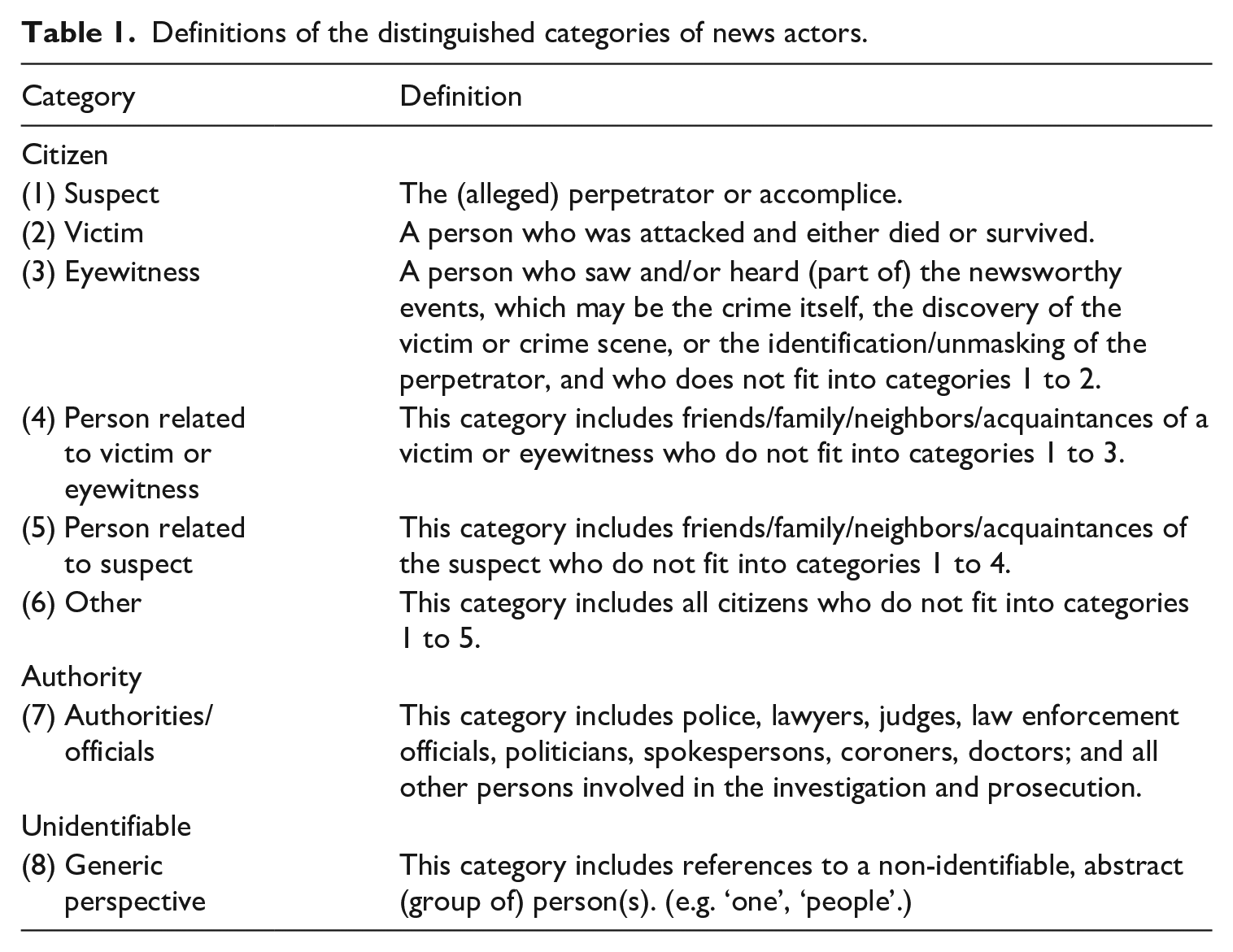
Each sentence of the corpus narratives was analyzed on two variables. First, the sentences were analyzed on the source of the information provided in the sentence, that is, from whose perspective the information was presented. For sentences that did not embed a news actor’s perspective, the perspective was coded as the journalist’s. For sentences in which a news actor’s perspective was embedded, it was determined whose perspective was embedded. This could be the perspective of a citizen, the perspective of an authority or official, or the perspective of a generic, unspecified (group of) person(s). The category of citizens was further divided into the following subcategories based on the identity of the citizens: suspects, victims, eyewitnesses, and persons related to victim, eyewitness or suspect. Thus, the following categories were distinguished: (1) suspect/accomplice; (2) victim; (3) eyewitness; (4) person related to a victim or eyewitness; (5) person related to the suspect; (6) other citizen; (7) authorities/officials; and (8) generic perspective. Definitions of each category are provided in Table 1; note that categories 1–6 constitute the overarching category of citizen perspective. 3 A single sentence could be coded as representing the perspectives of multiple news actors, for example if the sentence was composed of a main clause and one or more subordinate clauses that each represented a different perspective.
Definitions of the distinguished categories of news actors.
The first coder coded the entire corpus on this variable. The second coder coded 10% of the corpus (30 randomly selected narratives; 831 sentences in total). The intercoder reliability was good (Cohen’s κ = 0.70; qualification by Fleiss, 1981).
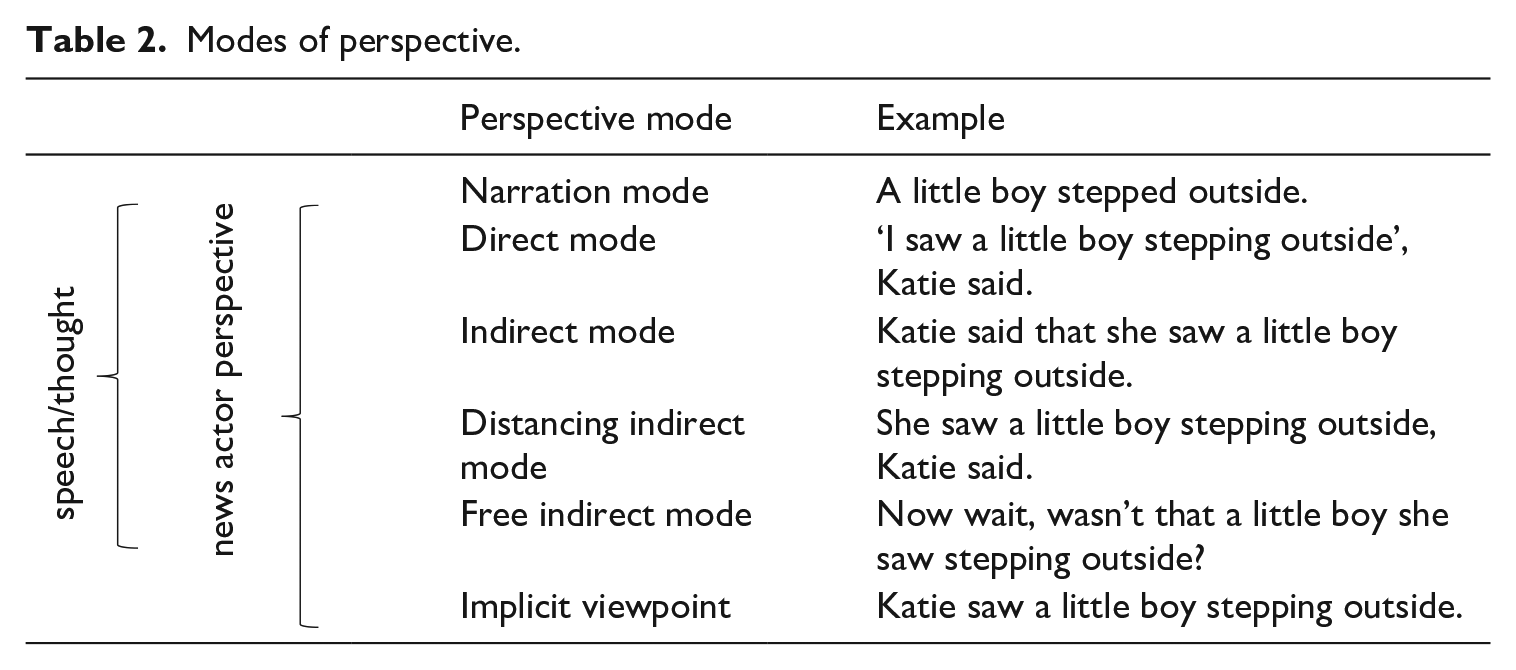
Second, all sentences were analyzed on the mode of perspective. 4 Sentences representing the perspective of the journalist were coded as narration mode. For sentences representing the embedded perspective of a news actor, a distinction was made between speech and thought reports in the direct, indirect, distancing indirect, or free indirect mode. Alternatively, references to a news actor’s perceptions, emotions or consciousness were categorized as implicit viewpoints (Sanders, 2010). Table 2 provides examples of each category.
Modes of perspective.
Results
Perspectives of journalist, citizens and authorities
The results showed that 61.9% (n = 5436) of all sentences were reported in the narration mode, meaning that the journalist (narrator) was responsible for the information. The remaining sentences (38.1%; n = 3349) were reported from the perspective of a news actor. Figure 1 shows the distribution of the perspective of journalist versus news actor over time.
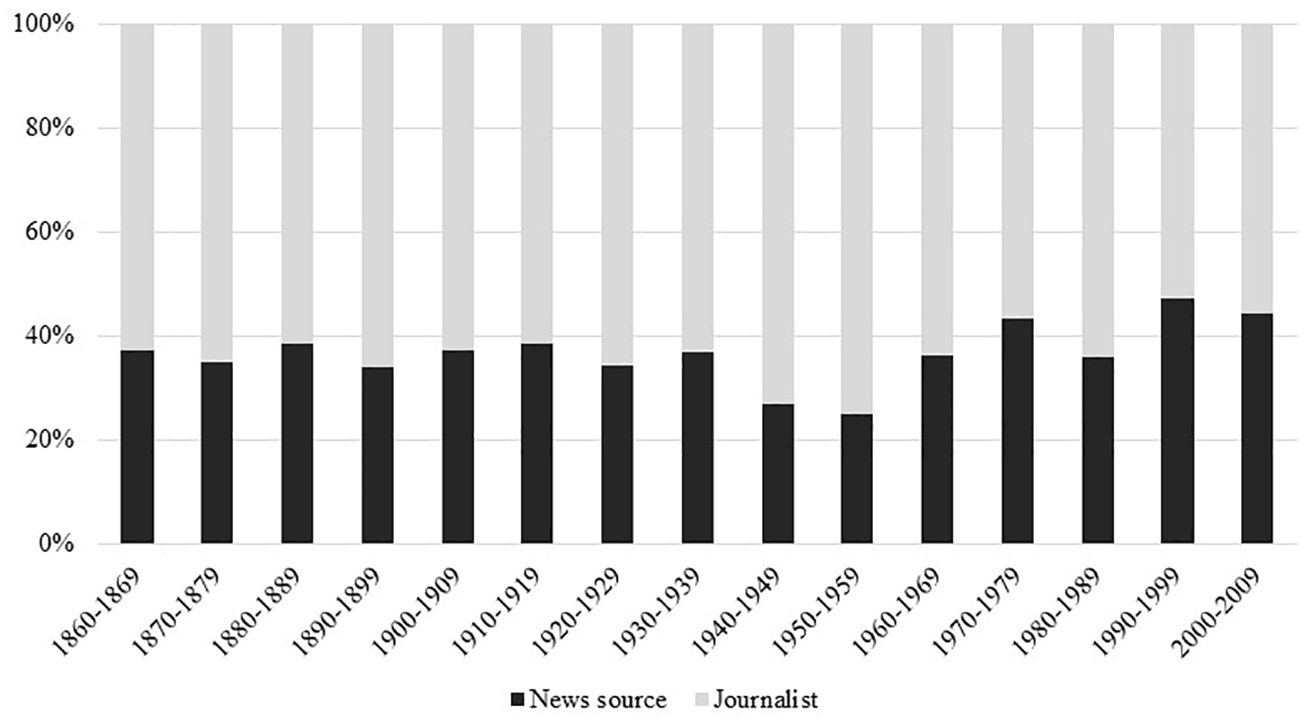
Ratio of sentences representing the perspective of a news actor versus the journalist’s perspective from 1860 to 2009 (total N = 8785).
Figure 1 shows that the journalist’s perspective was dominant in all periods: most sentences provided information from the point of view of the journalist whereas a minority of the sentences provided information from the embedded perspective of a news actor. However, the proportion of sentences representing a news actor’s perspective appears to have increased somewhat over time, in particular in the decades from 1960 onwards. A binary logistic regression analysis was performed to assess whether time predicted whether a given sentence was reported from the perspective of a news actor or the perspective of the journalist (χ2 (1) = 31.88, p < 0.001; R2 = .004 (Cox and Snell). Although the effect size of the regression was small, time was found to be a significant predictor of perspective (B = .028, Wald χ2 (1) = 31.71, p < 0.001; Exp. B = 1.03). This means that news actor perspectives became relatively more frequent over time. Specifically, the odds that a sentence reported a news actor’s perspective (instead of the journalist’s perspective) increased with a factor of 1.03 per decade.
To further analyze the sentences representing news actors’ perspectives, a distinction was made between authorities on the one hand and citizens on the other (collapsing the categories of suspect, victim, eyewitness, person related to suspect, victim, or eyewitness, and other citizens). The vast majority of these sentences represented a citizen perspective (76.2%) whereas only 18.4% represented the perspective of an authority. The remaining sentences were categorized as representing a generic perspective (2.0%) or multiple perspectives (3.4%).
Table 3 shows the distribution of perspective modes for citizens and authorities. Implicit perspectives were most frequent (45.9%), followed by speech and thought reports in the direct mode (33.4%), indirect mode (17.2%), distancing indirect mode (1.7%), and free indirect mode (1.7%).
Modes representing the perspectives of citizens and authorities.
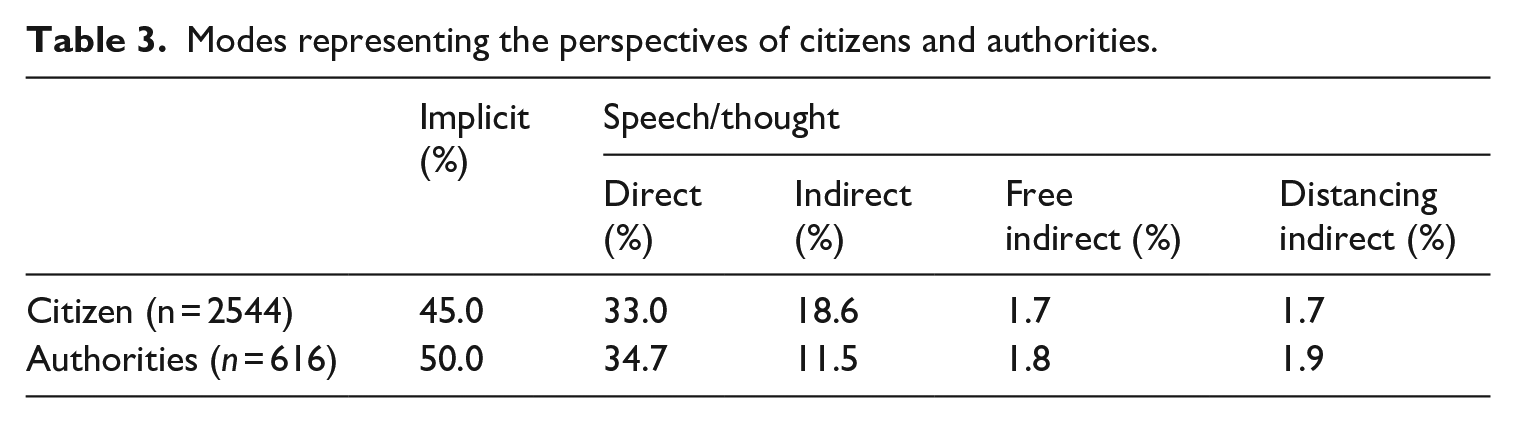
Table 3 shows that the distribution of modes of perspective is fairly consistent across citizens and authorities. Both citizens and authorities are thus presented not only as speaking and thinking persons, but also as perceiving, reasoning, and emotional persons through the use of implicit viewpoint markers. Although murder coverage is by definition about humans, this finding might serve as an indication that the way in which these humans are included in news narratives maximizes the human-interest potential by emphasizing individual experiences.
Figure 2 shows the distribution of perspectives over time. As can be seen in this table, citizen perspectives dominated over authority perspectives in each of the periods. However, in the later periods, and in particular between 1950 and 1999, the proportion of sentences representing authority perspectives increased. A binary logistic regression analysis was performed to statistically determine whether time predicted whether a given sentence was reported from the perspective of an authority versus a citizen perspective (χ2 (1) = 182.41, p < 0.001; R2 = .056 (Cox and Snell). Although the effect size of the regression analysis was small, time was found to be a significant predictor of perspective (B = 1.42, Wald χ2 (1) = 1002.19, p < 0.001; Exp. B = 0.242). This means that the odds that a sentence represented an authority perspective (instead of a citizen perspective) increased with a factor of 0.24 per decade. Thus, while citizen perspectives dominated over authority perspectives throughout the years, their relative occurrences have been shifting somewhat over time, decreasing the initially rather large gap between the representation of citizens versus authorities.
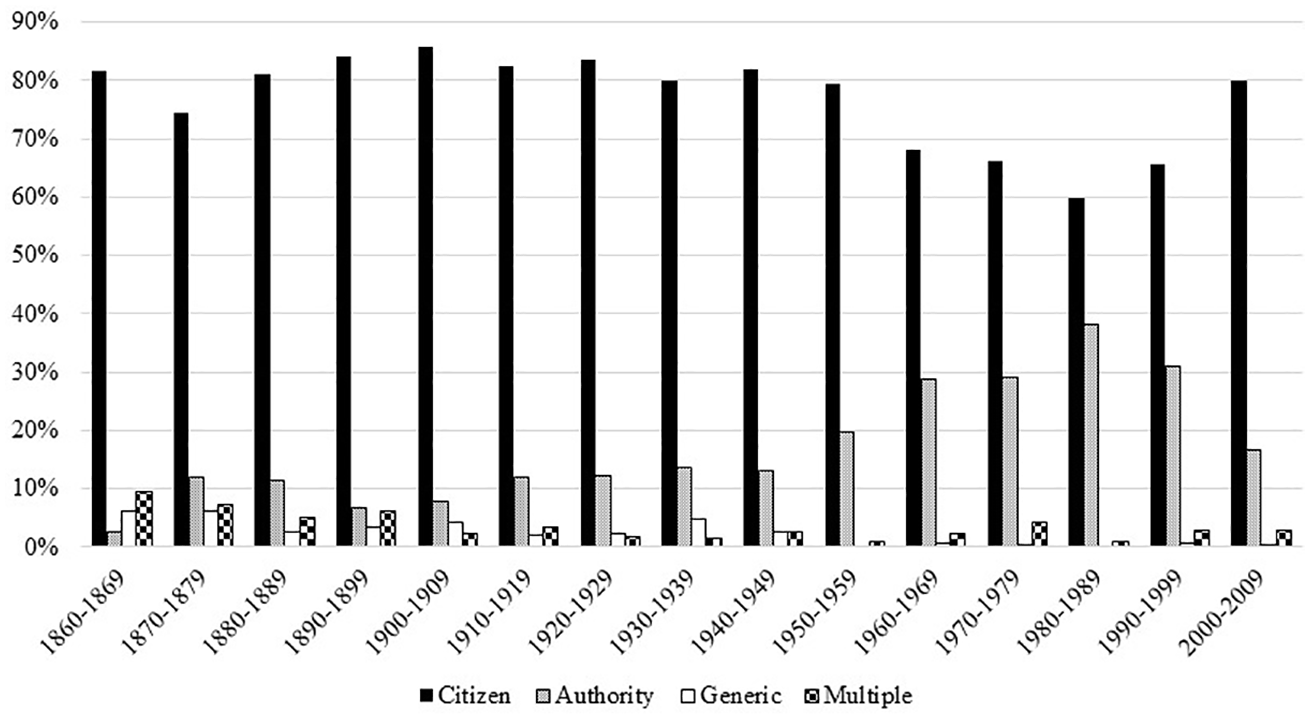
Distribution of news actor perspectives over time (percentages add up to 100 for each decade).
Citizens as story characters and news sources
Figure 2 shows that representations of authority perspectives were particularly infrequent in the early periods. It was in this period not uncommon for news narratives to reconstruct criminal acts in a detailed manner with references to citizen perspectives only. Excerpt 1 below provides an example of a news narrative that only represents the perspective of the suspect, whereas Excerpt 2 provides an example of a narrative that represents both the suspect’s perspective and the victim’s perspective: Excerpt 1 Four students were sitting at a table in a coffee house; one of them, the son of a councilor of Bern, suddenly said to his friends: “Behold, the first to enter the room I will beat the brain with a chair.” A few minutes later a young merchant comes into the room, and the student drove the brutality so far so as to actually follow the words by the action. He struck the young man with the chair, so that he, wounded to the head, fell down unconsciously. (De Tijd: godsdienstig-staatkundig dagblad, April 26, 1866) Excerpt 2 “I am now without occupation,” he said, “and I have nothing left. I am totally ruined, and there is nothing left for me but to try to get into the galleys.” Father Cardoni heard these words, raised his head out of curiosity and looked at the man who spoke. He immediately approached the father. “Yes, I want to go to the galleys,” he repeated. “Here, old man, this is for you,” and as he spoke those words, he stabbed the father in the lower body, and took the flight. (De Tijd: godsdienstig-staatkundig dagblad, August 8, 1879)
In both excerpts, the suspect is represented as a speaking actor whose words are rendered verbatim in the direct mode. Note that these quotations do not portray the actors as sources providing journalist and reader with information about what happened, but as characters performing a role in the story. Interestingly, in both narratives the suspect is described from an outside perspective, thus inviting the audience to ‘watch’ and ‘hear’ this actor from a distance rather than experience the events from his internal perspective. The way these suspects are portrayed thus offers little room for empathy or identification, keeping readers at a distance.
Excerpt 2 furthermore shows a contrast between the suspect’s perspective, which is represented through direct quotations, and the victim’s perspective, which is depicted by means of implicit viewpoints: he heard words and he looked at the speaker. Thus, the victim is portrayed as the perceiving character whose inner experiences are made available to the reader, who is invited to take over the victim’s perspective and witness the situation from his point of view. The reader is, by extension, invited to take the moral side of the victim (cf. Chouliaraki, 2010).
Upon further breaking down the citizen perspectives, it became clear that the perspective of the suspect was the dominant citizen perspective throughout the historical periods. This breakdown is shown in Figure 3.
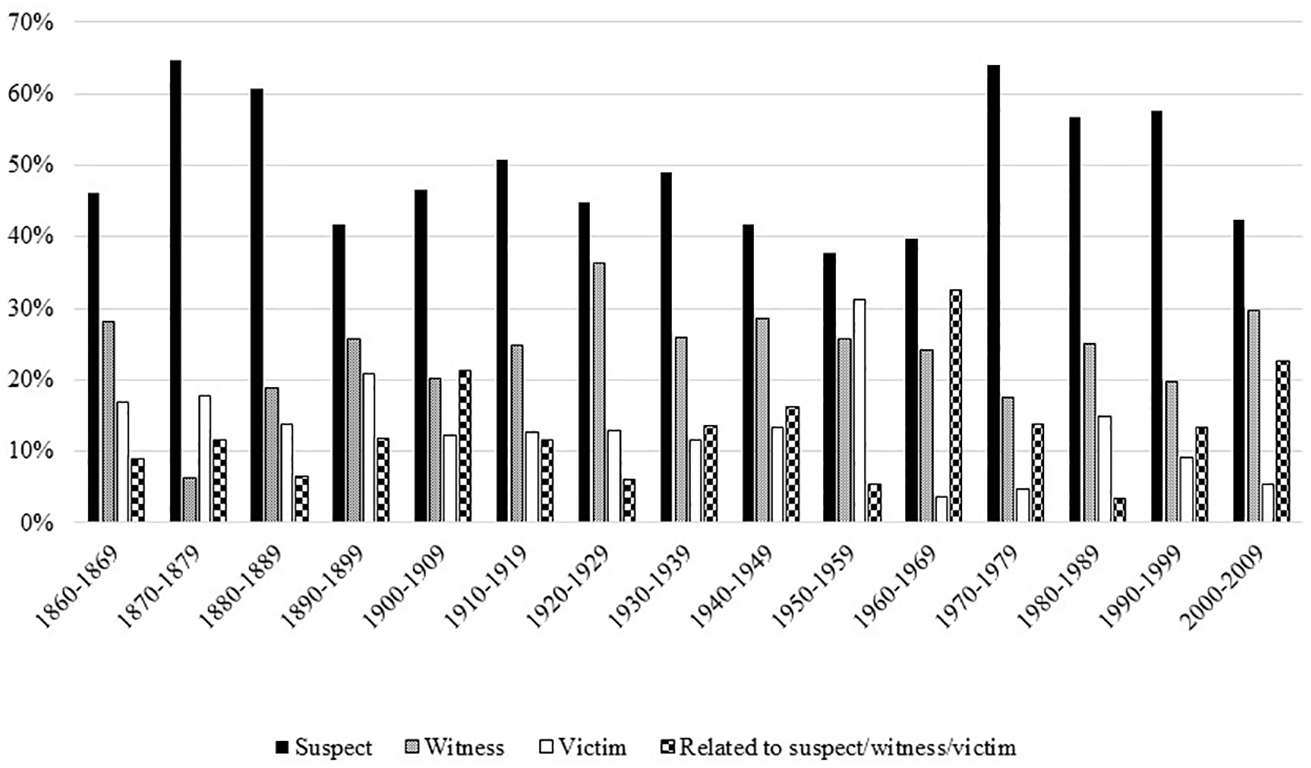
Relative percentages of sentences representing the various citizen perspectives over time (percentages add up to 100 for each decade).
Representations of the suspect’s perspective include speech reports from public hearings, court trials, and official police interviews. The following excerpts provide examples from various periods.
Excerpt 3 “I have murdered, without knowing, what I was doing. Now my wife is dead and I regret it.” The murderer had told his horrifying story while weeping and sobbing. Then he lit a cigarette. (De Tijd: godsdienstig-staatkundig dagbad, January 8, 1910) Excerpt 4 In court she declared that she loved her husband so much that she could not bear the thought that he was deceiving her. (De Telegraaf, November 1, 1921) Excerpt 5 The public prosecutor considered it murder in cold blood. Frans himself insisted: “I did not want to kill her, really not.” (De Telegraaf, February 1, 1986)
These examples show how suspects are given a voice to express their emotions, explain their behavior, and emphasize their intentions. Their voices are rendered in the direct mode (Excerpts 3 and 5) or in the indirect mode (Excerpt 4). In Excerpt 3, the suspect’s emotions (he is ‘weeping’ and ‘sobbing’) are contrasted with his behavior (he lights a cigarette). The banality of this act undermines the seriousness of his portrayed emotions and frames the suspect as a stereotypical cold-hearted, manipulative person (cf. Greer, 2003).
Note that there is a functional difference between these representations and the quotations in Excerpts 1 and 2: in Excerpts 1 and 2, the quotations serve to dramatize the news narrative by reconstructing words that have been uttered at the time the newsworthy events took place, and that have been reconstructed by the journalist who could not have heard them in person, whereas in Excerpts 3 to 5, the quotations serve an additional function of increasing authority and demonstrating factuality by presenting words that have been uttered during subsequent public court hearings at which the journalist presumably was present (Van Krieken et al., 2016; Van Krieken and Sanders 2016b). These differences signal two different roles citizens may fulfil in news narratives, which can be characterized as narrative character (Excerpts 1–2) versus news source (Excerpts 3–5).
Citizens may fulfill both roles within a single narrative. Excerpt 6 provides an example. This excerpt is part of a news narrative about the murder of a man named Theo Poppe, who died after his wife’s lover Bernhard drove into him with his car. The wife, Joke, had repeatedly urged Bernhard to kill her husband. She had promised him a new Opel car in return.
Excerpt 6 “It has happened.” That is how Bernhard, the driver of the murder car, reports it to Joke on that Sunday evening. She doesn’t need more words to understand that poor Poppe, her despised husband, has now finally been gotten rid of [lit: been sent out of the lane]. [. . .] Bernhard, the carpenter, confesses defenselessly. “That Opel Kadett? Oh no, I just did it to get rid of the nagging,” he says. (De Telegraaf, September 16, 1972)
The first part of this excerpt depicts a scene representing the perspectives of Bernhard and Joke at a point in time directly following the crime: Bernhard’s words to Joke after he murdered Theo Poppe, rendered in the direct mode, and Joke’s subsequent reasoning, signaled by the implicit viewpoints need and understand, as well as her emotional stance, signaled by the evaluative expressions despised and finally. Note that Bernhard’s words can only have been heard by Joke, which means that the journalist must have reconstructed the quotation so as to turn Bernhard into a narrative character and dramatize the story. The second part depicts a scene located at a different time and place: a court hearing about 6 months later. Here, Bernhard’s perspective is again represented by means of a direct quotation. But in contrast with the first quotation, the words rendered in this quotation have been uttered at a public occasion and have thus been reported and replicated verbatim rather than reconstructed by the journalist. Hence, in this instance Bernhard (also) fulfills the role of news source explaining his acts. By including this quotation, the journalist emphasizes the truthfulness of the narrative portrayal of events (Van Krieken et al., 2016; Van Krieken and Sanders 2016b).
As Figure 3 furthermore shows, the perspectives of citizens related to people directly involved in the news events were relatively frequently represented in the most recent period compared to early periods, accounting for over 22% of all representations of citizen perspectives. Excerpt 7, taken from a narrative about a young man who shot five persons at his school, exemplifies how narratives may include the perspective of the suspect’s relatives. The narrative focuses on his parents, who provide their account of what had happened and why.
Excerpt 7 Ali’s dad ran to the bedroom: the gun he keeps in his bedroom, under his pillow, was gone. He had bought a gun three years ago, he now says, to protect himself when going to his company late at night. “Sometimes I was a bit scared.” He immediately drove back to the school. He saw Ali underway, his son was running down the street. In the hall and the computer room Ali had shot four students and a teacher. Ali’s dad: “I said: Ali, now you have to go to the police.” They drove to the police station in Veghel. (NRC Handelsblad, December 8, 1999)
By including the voice of the suspect’s father, who can be considered to be an ‘indirect victim’ of the crime (Greer, 2017), this narrative responds to society’s need to understand what kind of person would commit such a crime and why. In the narrative, the father and mother explain the events on behalf of their son, who – a day after the attack – is unable to speak for himself. The narrative shifts back and forth between the narrative reconstruction of the fatal event and the comments and explanations provided by the suspect’s father a day later. The father’s roles of source and character are much intertwined, as exemplified by the embedded quotation (Ali’s dad: ‘I said’,) which shows how the father, as a news source, positions himself in the story as a narrative character performing a morally appropriate deed. Stories with such representations may help the audience to make sense of seemingly unexplainable acts as well as to humanize suspects and their relatives.
Other narratives include representations of grieving relatives and friends of the victim(s) expressing their emotions, e.g.: Excerpt 9 “She was so weak and tender,” said one of them [the victim’s friends]. “What kind of coward has dared to attack her?” (De Telegraaf, February 17, 1968)
The citizen source in Excerpt 9 expresses confusion, thereby giving a voice to an emotion that may also be experienced by members of the audience and potentially stimulating public sympathy and support (cf. Greer, 2017).
Citizens as vox pops
Next to the roles of narrative character and news source, citizens can be included in crime news narratives to fulfill the role of vox pop. Excerpt 10 provides an example. This excerpt is part of a narrative about a school shooting in Germany that is partly a reconstruction of the shooting and partly a reportage of its aftermath. The reportage part includes quotes from bystanders who had gathered at the school a couple of hours after the shooting: Excerpt 10 Students are standing defeated at the scene of disaster. They hold each other and encourage each other. “It can happen to anyone,” says Angelo Clarizia, who lives nearby. He pulls his baseball cap deeply over his tearful eyes. His girlfriend makes a case for shooting games on the computer. “I play them too at home, but do I look like a murderer?” She rather thinks that Tim Kretschmer, the perpetrator, received no attention and love. (De Telegraaf, March 12, 2009)
The persons quoted in this excerpt are not directly related to the crime itself and any persons involved in the event, but do express their reaction to it and speculate about the suspect’s motives.
In addition, vox pops may be included in crime stories to express their opinion about the punishment of a suspect. The following excerpt is part of a narrative about a man who had kept his daughter captivated for 24 years. He had abused her numerous times during this period, which resulted in the woman giving birth to seven children. One of the babies had been killed by the man. Prior to a detailed reconstruction of these events, the narrative sketches an image of the town in which the man had kept his daughter captivated. An inhabitant is asked for her opinion: Excerpt 11 Like everyone else she is shocked by the barbarity of what has been going on practically under their noses. When she is asked about an appropriate punishment, she shrugs. “A good punishment does not exist. This suffering can never be undone.” She walks on, shaking her head. (De Telegraaf, March 15, 2009)
In this excerpt, too, the vox pop is included in a part of the text that is not part of the narrative reconstruction of the newsworthy events. Instead, she is part of a reportage in which the journalist is implicitly presented as both an interviewer asking her a question and an observer registering her physical movement.
Conclusion and discussion
The first two research questions of this study concerned the representation of citizen perspectives in crime news narratives and possible historical developments in this representation. A first conclusion is that citizen perspectives have been dominating over authority perspectives since the 1860s. This conclusion contrasts with previous research showing preferences for elite sources such as politicians and police officials (e.g. Cushion, 2018; Fishman, 1980), but can be explained by the suggestion that the inclusion of citizen perspectives is issue-dependent and likely to occur in news coverage about sudden, unexpected events like criminal acts (De Keyser and Raeymaeckers, 2012). The current study makes a relevant contribution to the finding that citizens are becoming increasingly visible in Dutch television news (Pantti and Husslage, 2009) by showing that citizen perspectives have always been included – and have in fact been dominant – in Dutch newspaper stories about crimes. This signifies the relevance of studying the inclusion of citizens across different media and over time in order to arrive at a full picture of whether, how, and under which circumstances citizens are given a voice in journalism.
A second conclusion is that Dutch news narratives include a range of citizen perspectives in different identity roles. Notably, the suspect’s perspective was found to be the dominant citizen perspective throughout time, possibly because reasons of accessibility or because a narrative reporting style lends itself well for journalists to take on the perspective of the primary actor, in this case the person who caused the traumatic event. Representations of this perspective may help readers to understand the motivations behind violent acts as they are invited to witness not only the acts, but also the emotions and considerations of suspects (Sanders, 2010). At the same time, the dominance of suspect perspectives may raise ethical concerns about the potential humanization of criminal offenders. Narrative texts in particular, in which offenders’ own words are presented, have the ability to reduce stigmatization, punitive attitudes and moral disengagement (Harper et al., 2018). Reader-oriented studies are necessary to test the range of potential effects that the representation of suspect perspectives in news narratives may have in order to empirically assess the ethical risks of crime news reporting styles.
Yet, the results also revealed an increased focus on the perspective of relatives of suspects as well as victims, which resonates with Wardle’s (2006) study which showed a move towards personal stories of loss in the coverage of child murder and Greer’s (2017) observations about the presence of indirect victims in the media coverage of crimes. The inclusion of relatives of suspects and victims can be argued to add a moral dimension to crime news narratives in the sense that readers are invited to explore a variety of complex emotions evoked by unsettling attacks. As Kyriakidou (2015) argues, witnessing and exploring such emotions through the news media implies a kind of participation on behalf of the audience that stretches beyond the mere act of ‘noticing’ and may manifest in an exploration of one’s own emotions and reflections on attributions of responsibility and blame. Ultimately, such participation might reinforce cultural and societal values in terms of what is wrong and wat is right.
The third and final research question concerned the roles played by citizens in crime news narratives. Based on the study’s results, and specifically the qualitative analysis, a functional typology can be identified which is visualized in Figure 4.
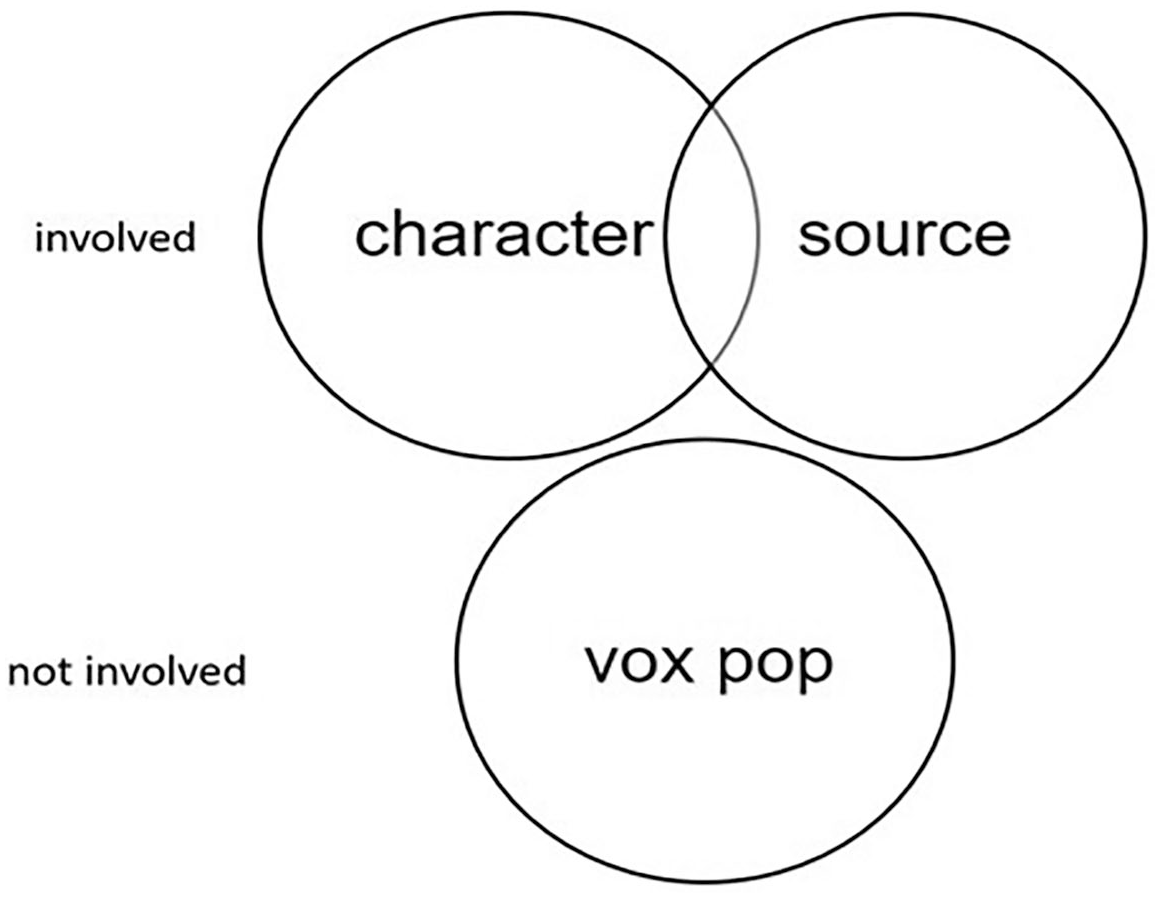
Role typology of citizens in crime news narratives.
Figure 4 shows that citizens may fulfil the role of story character, news source, or vox pop. These roles differ on the dimension of involvement: whereas characters and news sources are citizens who have been personally involved in the news events or maintain a personal relationship with people involved, vox pops are unrelated to the events and actors. A citizen fulfilling the role of news source thus typically provides information based on personal insider experiences, whereas a vox pop provides evaluations and opinions from an outsider perspective. This difference points towards a difference in communicative functions fulfilled by news sources versus vox pops. The inclusion of citizens as news sources primarily serves a communicative function to inform the audience about what happened while emphasizing the truthfulness of the narrative. The inclusion of vox pops, on the other hand, contextualizes the news events and shifts the events from a matter of personal to public interest. The communicative function of the vox pop role is thus to provide a ground for identification to readers who are also unrelated to the events but, like the vox pop, do face the challenge of making sense of them.
The distinction between citizens as news sources and citizens as story characters adds nuance to a previous classification of citizens in television news which distinguishes vox pops from citizens affected by the news events (Kleemans et al., 2017). The current study shows that citizens affected by the news events may indeed ‘contribute personalized, sometimes emotional, statements’ (Kleemans et al., 2017: 471), but also that they do so in functionally different roles: either as a news source or as a story character. The inclusion of citizens as story characters may be characteristic of print news, which would explain the difference between Kleemans et al.’s (2017) classification based on television news and the classification developed in the current study, and may also be genre-dependent. Whereas the roles of news sources and vox pops may be found across journalistic genres, the role of character is likely characteristic of news narratives. The notion of character has indeed been associated with the genre of narrative journalism and is often considered one of the aspects that distinguishes narrative forms of journalism from non-narrative forms (e.g. Vanoost, 2013). Representing the perspectives of citizens as story characters, that is, reconstructing what they were saying, thinking, perceiving and feeling at the time the news events took place, fulfills a dramatizing function. As such, the main communicative function of the character role is to engage the audience members, one of the central goals of narrative journalism (Van Krieken, 2019; Van Krieken and Sanders, 2019).
Results of this study furthermore showed that a single citizen may fulfill both the role of narrative character and the role of news source within a single news narrative (represented by the partly overlapping circles in Figure 4). A combination of vox pop and character or vox pop and source is not possible, however, for a citizen cannot be simultaneously involved and not involved in a given news event. Yet, a single narrative may feature both characters and sources on the one hand and vox pops on the other by including a choir of diverse citizen voices. Examples of such stories were found to be hybrid articles that combine the genres of narrative and reportage. This hybrid form might appeal to readers’ thirst for stories that not only tell what happened – which they often already know due to the contemporary 24/7 news cycle – but also explore the event’s aftermath and its impact on citizens they can relate to.
A limitation of this study is its focus on the specific genre of crime news narratives. The characteristics of crime news, such as its proneness to sensationalism and stereotyping (Greeg, 2003) and its potential impact on people involved and society as a whole, are not necessarily shared by other types of news, such as economic, political or sports news. The results of ths study may therefore not be generalizable to news coverage in general. The functional and communicative roles that citizens fulfil in journalistic accounts of events unrelated to crime are therefore subject to further investigations. Similarly, citizen representations may vary across countries and cultures (Tiffen et al., 2014) and the results of this study may therefore be limited to Dutch crime narratives. Nevertheless, although crime news as a specific genre might not be representative, it is apt with regard to moral discussions and the functional roles adopted.
Another limitation is the study’s focus on print news. The rise of the Internet and technological advancements have created room for citizens to be more substantially included in the news. The result of this process has been referred to as the ‘pluralization’ of primary definers (Splendore, 2020). In the context of online news coverage of natural disasters, citizen voices may gaine authority and expert status by expressing their emotional and experiential proximity to the events, thereby manifesting themselves as a new moralising force in journalism (Chouliaraki, 2010). A similar process may apply to online crime reporting. Future research is necessary to examine this possibility and to clarify how the roles of citizens in online crime news stories relate to the roles identified in this paper.
Despite these limitations, the present study is a relevant addition to previous studies on news sources by (1) examining crime news narratives over a large period of time, thus creating a broad view on potential developments in the inclusion of citizen sources; (2) examining how citizen perspectives are included by distinguishing between various modes of perspective, thus providing more insight into the communicative roles of citizens in crime news narratives; and (3) revealing, based on quantitative data (combined with qualitative analyses) rather than case studies, both the prominence of citizen perspectives in Dutch crime news narratives as well as their multifunctional role. This last finding indicates that citizens are a rich source for journalist in crafting crime narratives that invite the audience to explore the moral, social and emotional dimensions of crime from different angles. The linguistic analysis of how citizen perspectives are represented advances our understanding of how these perspectives add to the aesthetics of journalistic storytelling by asking audience members to feel and experience the moral importance of a news story (Kunelius and Renvall, 2010), as the analysis showed that references to citizens’ emotions, perceptions and mental states constitute the most common mode of viewpoint representation. Together, the results of this study underscore the relevance of studying both the occurrence and the form of citizen perspectives in news stories to advance our understanding of their function and potential impact. The typology developed in this article can be of benefit to future studies in this domain.
Footnotes
Acknowledgements
I thank José Sanders for her assistance in coding the narratives and for her valuable comments on a previous version of this paper.
Funding
The author disclosed receipt of the following financial support for the research, authorship, and/or publication of this article: This work was supported by the Netherlands Organization for Scientific Research (NWO) under Grant 275-89-038.
