




Abstract
We examined how Muslims are depicted in connection with Islamist terrorism and to what extent journalists use undifferentiated coverage – that actively links Muslims to terrorism – and differentiated coverage that actively differentiates Muslims from terrorism. Drawing from research in journalism studies and from terror management theory, we examined media-specific and event-specific predictors using a quantitative content analysis (12 quality/tabloid newspapers from three countries, N = 1071 articles). Results reveal that undifferentiated coverage occurs in almost every other article. Differentiation occurs much less. Tabloids use undifferentiated and differentiated coverage in fact-oriented and opinion-oriented articles. Quality news only do so in opinion-oriented articles. Proximity of a terror event resulted in more undifferentiated and less differentiated coverage. Results have important implications for journalism practice, terrorism research and intergroup relations.
Introduction
In recent years, the increasing number of Islamist terrorist attacks in Western societies has led to intensive terrorism news coverage (Ahmed and Matthes, 2017; Nesser, 2018). The news media frequently reports about terrorist attacks, for example, the attacks in Barcelona, Berlin, Brussels, Orlando or Paris, which have been realised by Islamist terrorists who self-identified as Muslims (Neumann et al., 2018). In this regard, current research shows that the news media frequently associates Muslims and Islam with negative concepts such as aggression and violence (Nacos and Torres-Reyna, 2007; see Bowe and Makki, 2016). Effect studies revealed that repeatedly pairing Islam and Muslims as a group with specific negative attributes such as violence or even terrorism (e.g., see second-level agenda setting, McCombs et al., 1997) significantly and negatively affects news consumers’ attitudes towards the particular outgroup (Muslims) in general (Saleem et al., 2017; Schmuck et al., 2018; von Sikorski et al., 2017, 2018).
Thus, linking Muslims and Islam to terrorism may promote Islamophobia and can severely damage intergroup relations between non-Muslims and Muslims living in Western societies (Neumann et al., 2018). However, previous effects studies have also shown that actively distinguishing Islamist terrorists from Muslims in general may reduce Islamophobic attitudes in non-Muslim news consumers inhibiting negative generalisations towards Muslims as a group (von Sikorski et al., 2017, 2018). In this regard, we argue that the concept of news differentiation is of crucial importance to the study of terrorism news coverage. More precisely, journalists may decide to actively differentiate Muslims from Islamist terrorists (e.g., by stating that Muslims are not terrorists and have to be separated from terrorists who claim to be acting in the name of Islam) or may report in an undifferentiated way actively linking Muslims to terrorism (e.g., by stating that there is a clear link between Muslims and terrorism because Islamist terrorists regularly identify as Muslim; Hodges, 2015).
However, so far, we lack systematic and comprehensive studies examining how journalists relate Muslims as a group to Islamist terrorists in the context of terrorism news coverage. That is, to what extent do journalists use undifferentiated and differentiated news coverage in the context of terrorism news? Systematic insights on media representations of Muslims in the context of terrorism news can be considered relevant for both academic research and journalism practice, as media portrayals of Muslims can fundamentally influence how the non-Muslim majority population in Western societies judges Muslims as a group.
Therefore, in the present study, we aimed at closing this research gap and examined how the news media depicted Muslims in connection with Islamist terrorism in three European countries (Austria/Germany/Switzerland) between 2015 and 2017. We examined 12 different quality and tabloid newspapers (two quality, two tabloid newspapers per country) and more than 1000 individual news articles with three specific aims. First, we were interested in how frequently the news media reports in an undifferentiated and differentiated manner when depicting Muslims in the context of Islamist terrorism and if there are country-specific differences. Second, we examined media-specific predictors. That is, we theorised that news in tabloid newspapers (vs quality newspapers) as well as opinion-oriented articles (compared with fact-oriented articles) will more frequently contain undifferentiated news coverage and less frequently contain differentiated terrorism news coverage. Third, drawing from terror management theory (TMT, Greenberg et al., 1986), we deduced different event-specific predictors that – based on TMT – allowed us to make specific theoretical predictions on how particular event-specific cues (e.g., proximity of an attack) affect undifferentiated and differentiated news coverage.
News differentiation: Muslims and Islamist terrorists
Although the news media frequently reports about terroristic acts and researchers have dealt intensively with the topic of terrorism, the literature still lacks a unified definition of terrorism (Moghaddam and Marsella, 2004). However, three superordinate key criteria have been proposed to define terrorism: (1) the use of violence, (2) the intention to generate fear and (3) the aim to influence citizens’ political beliefs or social positions (Moghaddam and Marsella, 2004; Nesser, 2018). According to Nesser (2018), Islamist terrorism (the focus of the present study) is the most prominent type of international terrorism. Islamism can generally be described as a set of ideologies and its proponents usually perceive specific political, legal and social aspects of other cultures and religions as incompatible with Islam (Eikmeier, 2007; see Nesser, 2018). Importantly, Islamism refers ‘to a whole constellation of political movements and actors world-wide, only a tiny highly radical subset of which engage in acts of violence’ (Piazza, 2009: 64). Based on this literature (Eikmeier, 2007; Nesser, 2018; Piazza, 2009), radical Islamist terrorists can clearly be separated from Muslims in general. Yet, the circumstance that radical Islamist terrorists frequently claim to commit terroristic actions in the name of Islam has led to controversial public discussions about the alleged connection of Islam to terrorism. For example, U.S. President Donald Trump – despite widespread public criticism – repeatedly described Islamist terrorists as “radical Islamic terrorists” thus linking Islam to terrorism (Holley, 2017).
In general, previous research shows that media portrayals of Muslims in Western media are deficient (e.g., Ahmed and Matthes, 2017). That is, Muslims are frequently portrayed in unfavourable and stereotypic ways, for instance, as intruders, as a threat to national cultures and as individuals who have a hard time integrating in Western non-Muslim-majority societies (Ahmed and Matthes, 2017). Several case studies and examinations mostly using qualitative approaches showed that, especially, after the 9/11 terrorist attacks the news media increasingly portrayed Muslims as terrorists. For example, Powell (2011) used a qualitative approach and examined prevalent news frames in the coverage of 11 attacks in the U.S. Findings revealed that the central theme in news stories was the collaboration of ‘Muslims/Arabs/Islam in organised terrorist cells against a “Christian America”’ (p. 90). Dixon and William’s (2015) quantitative data showed that Muslims were highly overrepresented as terrorists in crime news stories aired on U.S. nightly network news programs.
In summary, we see an increase of research focusing on how the news media frame particular terrorist events and it is also more likely for Muslim perpetrators (compared to non-Muslim perpetrators) to be portrayed as terrorists. However, we lack systematic and quantitative studies (going beyond case studies) that specifically examine how Muslims as a group are depicted in the context of Islamist terrorism news. That is, are Muslims linked to Islamist terrorism in undifferentiated ways and/or are Muslims actively differentiated from Islamist terrorists? Also, what are the predictors of undifferentiated and differentiated news coverage?
Undifferentiated and differentiated terrorism news coverage
Previous research has started to explore how journalists depict Muslims as a group in the context of terrorism news (Gerhards and Schäfer, 2014; Sides and Gross, 2013; Woods, 2011). Gerhards and Schäfer’s (2014) case study of the 2005 terrorist attack in London revealed that the pan-Arab station Al Jazeera explicitly differentiated Islamist terrorists from Muslims in general stressing that ‘many Muslims have condemned the attacks’ (p. 14). In contrast, CNN refrained to do so and described the Islamist terrorists as ‘British-based radical Muslims’ classifying ‘the perpetrators not only in terms of their nationality but also in terms of their religion’ (p. 14).
In an attempt to systematise those previous findings (Gerhards and Schäfer, 2014; see also Sides and Gross, 2013; Woods, 2011), we suggest applying a new theoretical approach to the analysis of terror news coverage, which we refer to as news differentiation (Matthes et al., 2020; von Sikorski et al., 2017, 2018). More specifically, undifferentiated news coverage can be defined as a form of generalisation, which ‘refers to the extension of the characteristics or activities of a specific and specifiable group of people to a much more general and open-ended’ segment of the population (Teo, 2000: 16). Thus, undifferentiated terrorism news coverage actively and explicitly links Muslims to terrorism. For example, a news article may contain statements like: ‘Muslim terrorists are part of the mosque community in Paris’; ‘there is a clear link between terrorism and Islam’ or ‘Islam is a breeding ground for radical Muslim terrorists’.
In contrast, differentiated news coverage is characterised by an explicit and active distinction between the activities and characteristics of individuals and more general and open-ended subsets of a population (Teo, 2000). Therefore, differentiated terrorism news coverage actively and explicitly distinguishes Muslims from terrorism. For example, a news article may contain statements like: ‘Muslims have nothing to do with Islamist terrorists’, ‘violence and terrorism are incompatible with Islam’ or ‘Muslims must not come under general suspicion, Muslims are not terrorists’.
News differentiation can therefore be understood as a multidimensional construct. Theoretically, news articles can (a) consist of both undifferentiated and differentiated coverage, (b) undifferentiated but not differentiated coverage, (c) differentiated but not undifferentiated coverage or (d) may neither consist of undifferentiated nor differentiated coverage. Thus far, researchers have not analysed terrorism news coverage using such a systematic theoretical approach. Therefore, we lack prior results on the role of undifferentiated and differentiated news coverage in the context of Islamist terrorism news. Also, there is no indication on how regularly journalists use undifferentiated and differentiated forms of news coverage. Thus, we formulated the following research question:
RQ1: How frequently do journalists report about Islamist terrorism in an undifferentiated and a differentiated manner?
Media-specific predictors
As a first step, we theorised that media-specific predictors forecast undifferentiated and differentiated news coverage. We assumed that the specific type of newspaper (tabloid vs quality newspaper) plays an important role in this context. Previous research shows that broadsheet or upmarket newspapers (i.e., quality newspapers) differ in their news reporting compared with mass-market newspapers (i.e., tabloid newspapers; Albæk et al., 2014). Different comparative studies revealed that tabloid newspapers generally carry more soft news topics and frame issues in a different manner (e.g., less complex) compared with quality newspapers. In contrast, quality newspapers rather focus on hard news (de Vreese et al., 2017). First, these differences in reporting styles have been explained with the fact that tabloids are predominantly sold or disseminated directly (e.g., newsstand) and are less regularly sold via subscription like quality newspapers (especially in Germany-speaking countries). Tabloids directly compete for potential readers’ attention in public spaces (e.g., newsstand) and thus regularly consist of pointed or sensationalist headlines and/or topics (Esser, 1999). Second, tabloids and quality newspapers usually produce news for different target audiences. That is, readers of quality newspapers generally prefer detached and rather complex political news and reporting styles, while readers of tabloid newspapers are generally less politically interested and prefer softer issues, and more personalised and emotional presentation styles (de Vreese et al., 2017). Typically, information in tabloid newspapers can be quickly read and processed in an easily digestible manner (Esser, 1999). Especially, undifferentiated forms of news coverage or generalisations fit the media logic of tabloid newspapers in reducing complexity and help to create sensationalist headlines, for example, labelling terrorists as ‘radical Muslim terrorists’ (e.g., Gerhards and Schäfer, 2014), or even more unequivocal ‘Muslim killers’ (Ford, 2015).
Furthermore, we assumed that journalists working for quality newspapers (compared with tabloid journalists) will put more effort in precisely distinguishing between Islamist terrorists and Muslims in general, which can be regarded an active process. In order to shed light on specific facts in detail, the level of complexity of a particular news article increases, for example, when actively differentiating subgroups such as terrorists who self-identify as Muslim from individuals who are Muslim and live peacefully in Western societies (Nesser, 2018). Also, quality newspapers usually follow the general self-conception of reporting in a detached, neutral and differentiated manner more closely than tabloid newspapers. Based on this, we articulated our first hypothesis:
H1: Tabloid newspapers (a) more frequently use undifferentiated forms of news coverage and (b) less frequently use differentiated forms of news coverage.
Furthermore, we assumed that article type (fact-oriented versus opinion-oriented) is of crucial importance. We expected that the level of undifferentiated and undifferentiated coverage systematically varies between fact-oriented news articles (i.e., straight news articles; descriptive and source-driven news) and opinion-oriented articles, for example, commentaries, editorials, feature stories in which a journalist gives explanations, contextualising information or speculations and goes beyond a fact-oriented form of reporting that is rather strictly based on verifiable facts and/or statements by sources (de Vreese et al., 2017). Also, we expected that journalists will rather focus on facts and avoid undifferentiated and differentiated news coverage in straight news stories. That is, a journalist’s statement, for example, ‘Muslims are not terrorists, the majority population has to stand up and stand by Muslims’ can rather be understood as contextualising and evaluative information and inappropriate content for a classical straight news story. In contrast, we assumed that both undifferentiated and differentiated forms of news coverage will be more frequently used in opinion-oriented articles, where journalists – by definition – are expected to take a stand and present contextualising and evaluative information (de Vreese et al., 2017). For example, it is the central goal of an editorial to convey an editor’s own opinion on a topic. Also, interviews with experts (e.g., a terrorism expert) or an op-ed (opposite the editorial page) may contain speculation, personal views and opinions regarding a particular issue at stake. Thus, these types of coverage are usually not neutrally written and objective (Schudson, 2001) and should therefore consist of undifferentiated and differentiated news coverage to higher extent, as we formulated in our second hypothesis:
H2: Fact-oriented articles less frequently contain (a) undifferentiated news coverage and (b) less frequently contain differentiated news coverage compared with opinion-oriented articles.
Also, we assumed that type of newspaper (quality versus tabloid) and article type (fact-oriented versus opinion-oriented) will interact. We theorised that the higher amount of differentiated reporting in quality newspapers (compared with tabloid newspapers) will be stronger because of more differentiating statements in opinion-oriented articles compared with fact-oriented articles. Similarly, we assumed that the lower amount of undifferentiated reporting in quality newspapers (compared with tabloid newspapers) will be stronger because of more undifferentiated statements in opinion-oriented articles compared with fact-oriented articles. Stated differently, we expected that quality news (compared with tabloids) will keep to stricter established journalistic norms and separate more clearly between fact-oriented and opinion-oriented formats (Schudson, 2001; see de Vreese et al., 2017) when reporting in an undifferentiated and differentiated manner. More formally, hypothesis 3 reads as follows:
H3: The lower amount of undifferentiated reporting in quality newspapers compared with tabloid newspapers is more strongly pronounced in fact-oriented articles.
H4: The higher amount of differentiated reporting in quality newspapers compared with tabloid newspapers is more strongly pronounced in opinion-oriented articles.
Event-specific predictors
Drawing from terror management theory (TMT; Greenberg et al., 1986), we further theorised that particular event-specific characteristics predict undifferentiated and differentiated coverage. In general, TMT is based on the premise that people are aware of their own mortality and that someday they will die. This awareness challenges individuals to deal with the terror that accompanies this kind of knowledge. The theory tries to explain a kind of defensive human thinking and behaviour that results from our fear of death (Greenberg et al., 1986). ‘To avoid becoming paralysed by this terror, people immerse themselves in cultural systems and worldviews that offer them literal immortality (e.g., the promise of an afterlife after one’s death) or symbolic immortality (e.g., being remembered by others after one’s death). Faith in one’s cultural worldview thus functions as a buffer against death-related anxiety’ (Das et al., 2009: 453). Thus, fear of death leads individuals to accept certain worldviews that protect their self-esteem and makes them believe they play an important role in a meaningful world. Survival instincts and the goal of strengthening cultural meaning in the face of death can lead to prejudice, or the belief that one’s own group with whom we identify is superior to other groups (Greenberg et al., 1986). In short, TMT predicts that mortality salience, for example, triggered by terroristic threats (Das et al., 2009) initiates increased worldview defence and self-esteem striving. Consequently, engaging in defences allows individuals to let go of death-related thoughts and to ‘manage terror’ (Landau et al., 2004). Meta-analytical findings based on more than 250 experimental studies generally support the predictions made by the mortality salience hypothesis of TMT (Burke et al., 2010). More specifically, it has been shown that mortality salience increases liking of one’s own religious group and disliking of outgroup members (Greenberg et al., 1990). Das et al. (2009) applied TMT to the context of Islamist terrorism and showed that exposure to news about the murder of the Dutch filmmaker Theo van Gogh – in line with TMT – increased news recipients’ mortality salience and, in turn, increased outgroup prejudice. Importantly, terrorism news-induced mortality salience may increase negative prejudice against any outgroup and its members; even those not directly mentioned in a news article or directly linked to a terrorist attack (Das et al., 2009).
We assumed that not only news recipients but also journalists will be affected by terrorism news-induced mortality salience. Journalists who encounter information about terroristic actions that contain particular event-specific cues − for example, proximity of an attack, number of people that died in an attack − may experience increased mortality salience and adapt their style of reporting. Thus, when journalists report about Islamist terrorism they may experience fear of death (e.g., ‘Me or my friends/family could have been affected by the attack’) and will consequently perceive outgroup members (Muslims) in more negative, stereotypical and prejudiced ways (Das et al., 2009). That is, although Muslims as a group have nothing to do with a specific terrorist attack carried out by Islamist terrorists, journalists experiencing mortality salience should develop negative stereotypes and prejudices against Muslims as an outgroup as a worldview defence (Greenberg et al., 1986). When both Islamist terrorists and Muslim outgroup members are perceived in negative ways, we theorised, undifferentiated reporting becomes more likely and the likelihood that a journalist actively differentiates Muslims from Islamist terrorists will decrease (see Nossek and Berkowitz, 2006).
Also, mortality salience may be triggered by certain event-specific cues that a journalist encounters. First, according to TMT, proximity plays an essential role and can be regarded a key predictor of more undifferentiated and less differentiated news coverage. Das et al. (2009) showed that Dutch individuals only showed outgroup prejudices when exposed to terroristic acts that occurred nearby (i.e., the Netherlands). No outgroup prejudices were detected after being exposed to distant terroristic acts. Thus, we assumed that proximity predicts both, more undifferentiated and less differentiated news coverage.
H5: Nearby versus distant acts of terrorism (a) predict more undifferentiated news coverage and (b) less differentiated news coverage.
Second, based on TMT, we theorised that information that explicitly refers to victims of a terrorist attack (deaths or injuries) will remind individuals of their own mortality and will consequently increase mortality salience (Das et al., 2009). Thus, outgroup prejudice and stereotypes should then be activated in order to defend one’s own worldview, making undifferentiated and less differentiated news coverage more likely. Thus, the following two hypotheses read as follows:
H6: Articles stating information on deaths more frequently contain (a) undifferentiated news coverage and (b) less frequently contain differentiated news coverage compared with articles not stating death-related information.
H7: Articles stating information on injuries more frequently contain (a) undifferentiated news coverage and (b) less frequently contain differentiated news coverage compared with articles not stating injury-related information.
Third, drawing from TMT, we theorised that concrete information on a threatening terrorist organisation should increase mortality salience affecting undifferentiated and differentiated coverage compared with news coverage not mentioning a specific terror organisation. Public opinion polls from various countries revealed that citizens around the world regard the so-called Islamic State (IS) 1 as the leading threat to national security of their respective country (Poushter and Manevich, 2017). Due to the vast number of atrocities − for example, public beheadings − committed by IS proponents, we assumed that explicit information on the IS without naming other terrorist organisations predicts both, more undifferentiated and less differentiated news coverage. Thus, H7 reads as follows:
H8: Articles containing information solely on the IS as a terror organisation more frequently contain (a) undifferentiated and (b) less frequently contain differentiated coverage compared with articles naming other, multiple or no terror organisation(s).
Fourth, previous research revealed that the mere presence of a weapon (e.g., naming a weapon in a text) automatically affects psychological reactions, for example, increases aggression-related thoughts (e.g., Anderson et al., 1998). Also, research informed by TMT shows that reminding people of the 9/11 attacks in which terrorists used airplanes as weapons increased individuals’ mortality salience (Landau et al., 2004). Thus, we assumed the following:
H9: Articles stating information on a particular weapon more frequently contain (a) undifferentiated news coverage and (b) less frequently contain differentiated news coverage compared with articles not stating information on a particular weapon.
In the present study, we investigated news coverage in three Western European countries: Austria, Germany and Switzerland. The three countries share a number of similarities and we selected them for the following reasons: First, all three countries have similar political and media systems and form part of the democratic corporatist model (Hallin and Mancini, 2004). Second, the countries are culturally similar and the same language (German) is spoken in all three countries. Third, all three countries have a comparable proportion of Muslims (between 6.1% and 6.9%; see Pew Research Center, 2017) and have recently been affected by planned and/or realised Islamist terrorist attacks that were intensively covered by the news media. Thus, Austria, Germany and Switzerland can be regarded as highly similar cases and we expected comparable results in all three countries. In line with Strömbäck and Van Aelst (2010), we theorised that if our hypotheses can be supported for all three countries, this would make a stronger case than if we are only able to find support for the hypotheses in one country.
Method
We conducted a quantitative content analysis examining how the news media depicted Muslims in connection with Islamist terrorism news coverage (also see Matthes et al., 2020). We selected January 2015 as start date, as the Charlie Hebdo shooting, a major Islamist terrorist attack in Paris, France (January 2015), marked the beginning of a new wave of major Islamist terrorist attacks in Europe (see Nesser, 2018). As end date, we selected November 2017, which is when the Syrian army announced its victory over the so-called IS, which has been the most important Islamist terrorist organisation committing attacks in Europe during the selected time period.
Sample
Our sample consisted of N = 1071 news articles published in twelve different news outlets (Table 1). We selected the two largest quality newspapers and the two largest tabloid newspapers in each country 2 (Table 1). When selecting the newspapers, we made sure that we took both conservative and liberal orientations into account. First, we collected all news articles published in those outlets between January, 1st 2015 and November, 9th 2017. We exclusively selected news articles that contained the terms terror and Muslim, as we were interested in how Muslims are represented in the context of Islamist terrorism news coverage. For instance, we thus did not consider articles about terrorism and depictions of other religious groups, nor articles about the group of Muslims that did not involve the topic of terrorism. We created a list of German keywords to ensure that all articles dealing with terrorism and Muslims were captured in the relevant time frame. We used the same keywords for all newspapers and downloaded all articles from the same database (i.e., (COUNTRY) press agency) 3 . Second, we drew a random selection of 100 news articles for each newspaper. If less than 100 news articles were available, all news articles were selected for those newspapers. Third, an independent intensively trained coder scrutinised all selected news articles and determined whether the news articles’ main topic was either about Muslims or about terrorism. This procedure was employed in order to avoid selecting news articles that mentioned terrorism or Muslims only peripherally. Specifically, an article was selected, when (a) more than 50% of the article dealt with the topics Muslims or terrorism, or (b) the article’s title dealt with the topics Muslims or terrorism, or (c) the first paragraph dealt with the topics Muslims or terrorism. Before selecting the articles, several test rounds and a formal researcher-coder-reliability test (N = 15) was conducted to ensure the reliability of the article selection (Krippendorff’s alpha = 0.77). Ultimately, the procedure yielded a sample of 1071 items (Articles: Austria = 308, Germany = 378 and Switzerland = 385).
Percentage of news articles containing news differentiation per country.
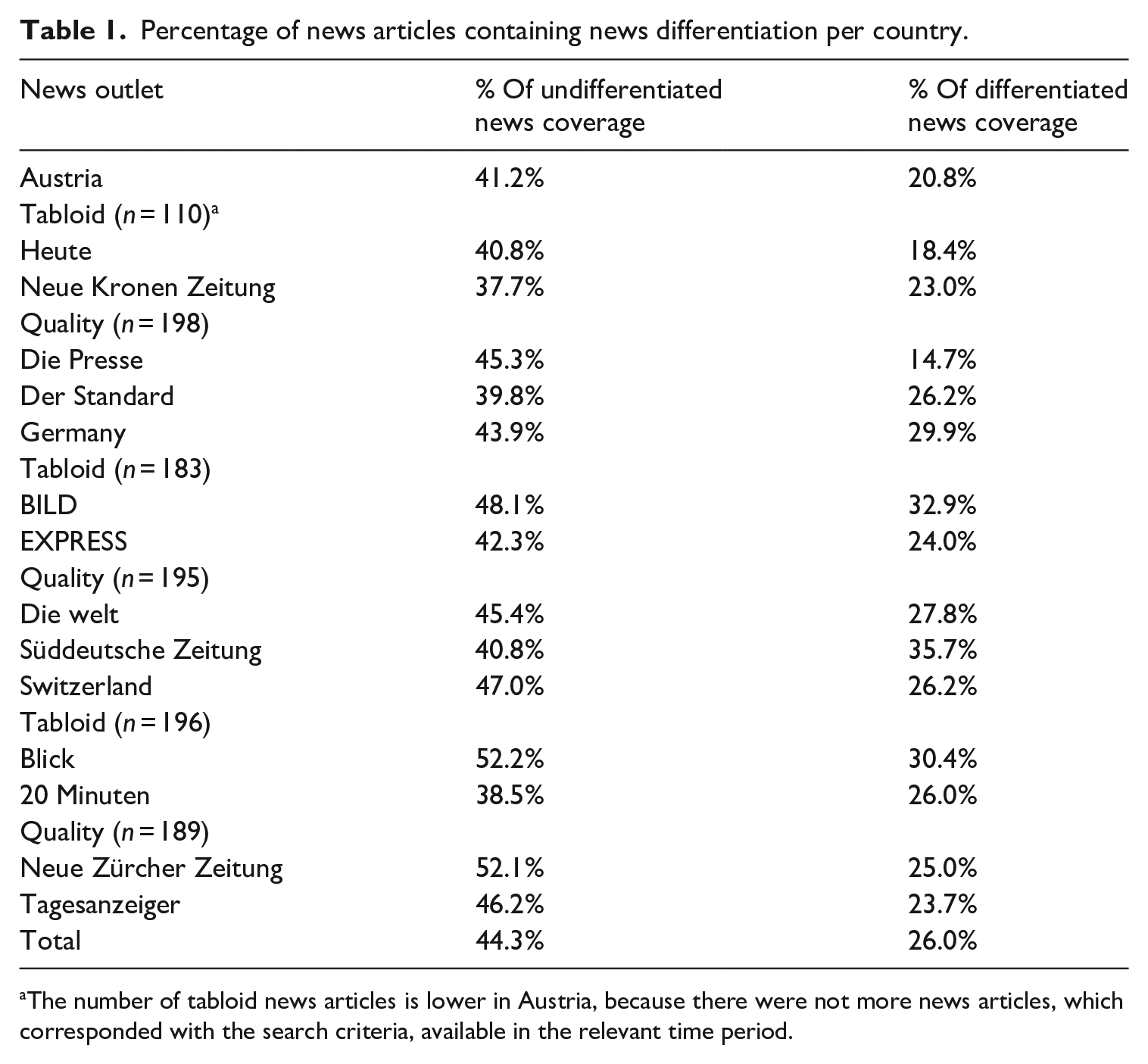
The number of tabloid news articles is lower in Austria, because there were not more news articles, which corresponded with the search criteria, available in the relevant time period.
Coding procedure
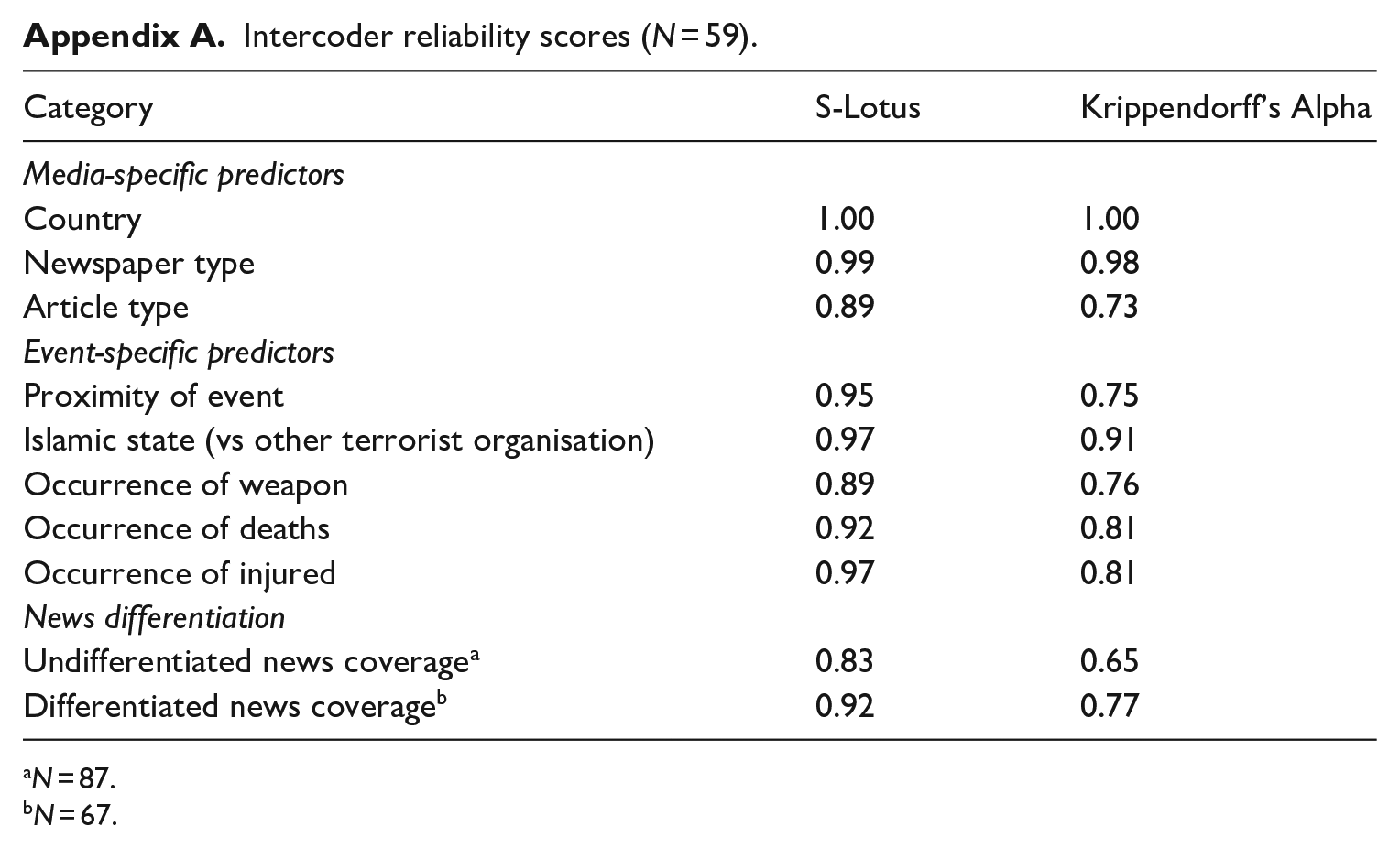
The unit of analysis was the textual content of a news article. We did not code pictures or picture captions. Three independent human coders (German native speakers) performed data collection. After intensively training the coders, we conducted several rounds of intercoder reliability tests for each variable and the coders analysed randomly selected news items of all news outlets and countries. After each round of testing, we discussed inconsistencies with the coders and reran tests with different subsamples. The total sample for the intercoder reliability tests consisted of 59 news articles or 5.5% of the total sample, which can be regarded appropriate according to best practices in content analysis (Lacy et al., 2015), taking the number of coders and the total sample size into consideration. The coders ultimately achieved acceptable levels of reliability for each variable. We computed Krippendorff’s alpha for each variable, which ranged between 0.65 and 1.0 (see Appendix A). Some variables are rare categories and hence, standard reliability coefficients are not fully informative. We therefore computed an alternative, chance-corrected reliability coefficient that doesn’t penalise non-agreement for rare categories, standardised lotus (Fretwurst, 2015). When there are only two coders, the Lotus is equivalent to Scott’s Pi.
Dependent variable
News differentiation comprises two dimensions: undifferentiated and differentiated coverage (von Sikorski et al., 2017). Both were operationalised as undifferentiated and differentiated statements made by the author of the article him- or herself or by external actors (e.g., an expert, a spokesperson, an eyewitness, etc.). 4
Undifferentiated news coverage
A news article was coded as undifferentiated, when it mentioned a quote or action, which made an explicit connection between terrorism and Muslims or Islam, for example, ‘the Muslim terrorist’; ‘the IS terrorist is a follower of Islam’; ‘the terrorist is a Muslim scholar/preacher’; ‘s/he committed the act in the name of Islam’; ‘there is a clear link between terrorism and Islam’, etc. describe terrorists as part of mosque communities; state that terrorists in the Muslim community are radicalising themselves; describe Islam as ‘a breeding ground for terrorism’. We considered the dimension of undifferentiated news coverage as present when at least one undifferentiated statement appeared in the news article (see Appendix B).
Differentiated news coverage
A news article was coded as differentiated, when it mentioned a quote or action, which expressed that Muslims and terrorists must be clearly distinguished, for example, ‘violence and terrorism are incompatible with Islam’, ‘Islamist terrorists have nothing to do with Islam as a religion’, ‘terrorist acts are un-Islamic’, ‘Muslims must not come under general suspicion’, ‘Muslims distance themselves from terrorism’, etc. We considered the dimension as present when at least one differentiated statement appeared in the news article.
Media-specific predictors
First, we coded the country and the news outlet that published the article. Second, we coded the article type using five different categories: news article, background article/feature, commentary/analysis, interview and other (e.g., a reader’s commentary). We considered straight news articles as fact-oriented articles and background articles/features, commentaries/analyses, interviews and other (e.g., reader’s commentary) as opinion-oriented articles.
Event-specific predictors
We coded event-specific predictors for specific realised or planned attacks that were mentioned in the article. 5 We defined terrorist attacks as an attack with a stabbing weapon, firearm, explosive, vehicle, or any other act that (a) constitutes an act of violence, (b) is intended to create fear and (c) has a political objective (Moghaddam and Marsella, 2004). We considered an event-specific category as present when it appeared for at least one terrorist event mentioned in the text. We first coded the proximity of the event by determining where the terrorist event took place using five categories. 6 To distinguish between close and distant events, we created a dummy variable with two categories: the first category subsumed attacks conducted on national territory or territory of other German-speaking countries; the second category subsumed all other territories and no territory mentioned. Second, we coded whether a terror organisation was mentioned in the news article using six categories. 7 To assess the occurrence of the IS as the sole terror organisation, we created a dummy variable with two categories: the first category subsumed articles that mentioned the IS as the only terror organisation, the second category subsumed articles that mentioned one of the other organisations, multiple organisations or no organisation at all. Third, we assessed the occurrence of a terror weapon using seven categories. 8 We created a binary dummy variable with all weapons grouped into one category and no weapon in the other category. Fourth, to assess the occurrence of deaths, we coded whether the article mentioned deaths as a result of a terrorist attack. Finally, we coded the occurrence of injured when the article mentioned individuals injured as a result of a terrorist attack.
Data analysis
We ran logistic regression analyses with either undifferentiated news coverage or differentiated news coverage as dependent variable and dummy coded all predictors prior to entering them into the analyses. To account for interaction effects between newspaper type and article type, we ran stepwise logistic regression analyses with main effects in Model 1 and two-way interactions in Model 2.
Results
Answering RQ1 – how frequently do journalists use undifferentiated and differentiated coverage? –, our findings revealed that 474 out of 1071 news articles (44.3%) contained at least one undifferentiated statement and 278 out of 1071 news articles (26.0%) contained at least one differentiated statement (Table 1).
Next, we ran logistic regression analyses with undifferentiated statements (Table 2, Model 1) and differentiated statements (Table 2, Model 3) as dependent variables. First, we found no significant difference between the use of undifferentiated statements in German compared to Austrian news articles (b = 0.01, SE = 0.16, p = 0.970, Table 2), Swiss compared to Austrian news articles (b = 0.24, SE = 0.16, p = 0.124., Table 2), or German compared to Swiss news articles (b = −0.23, SE = 15, p = 0.117, not shown in Table 2). With regard to differentiated statements, we found significantly more differentiated statements in German compared to Austrian newspapers (b = 0.49, SE = 0.19, p = 0.001, Table 2), but not in Swiss compared to Austrian newspapers (b = 0.27, SE = 0.19, p = 0.144, Table 2), or German compared to Swiss newspapers (b = 0.22, SE = 0.17, p = 0.197, not shown in Table 2).
Logistic regression analysis: Predictors of undifferentiated and differentiated news coverage.
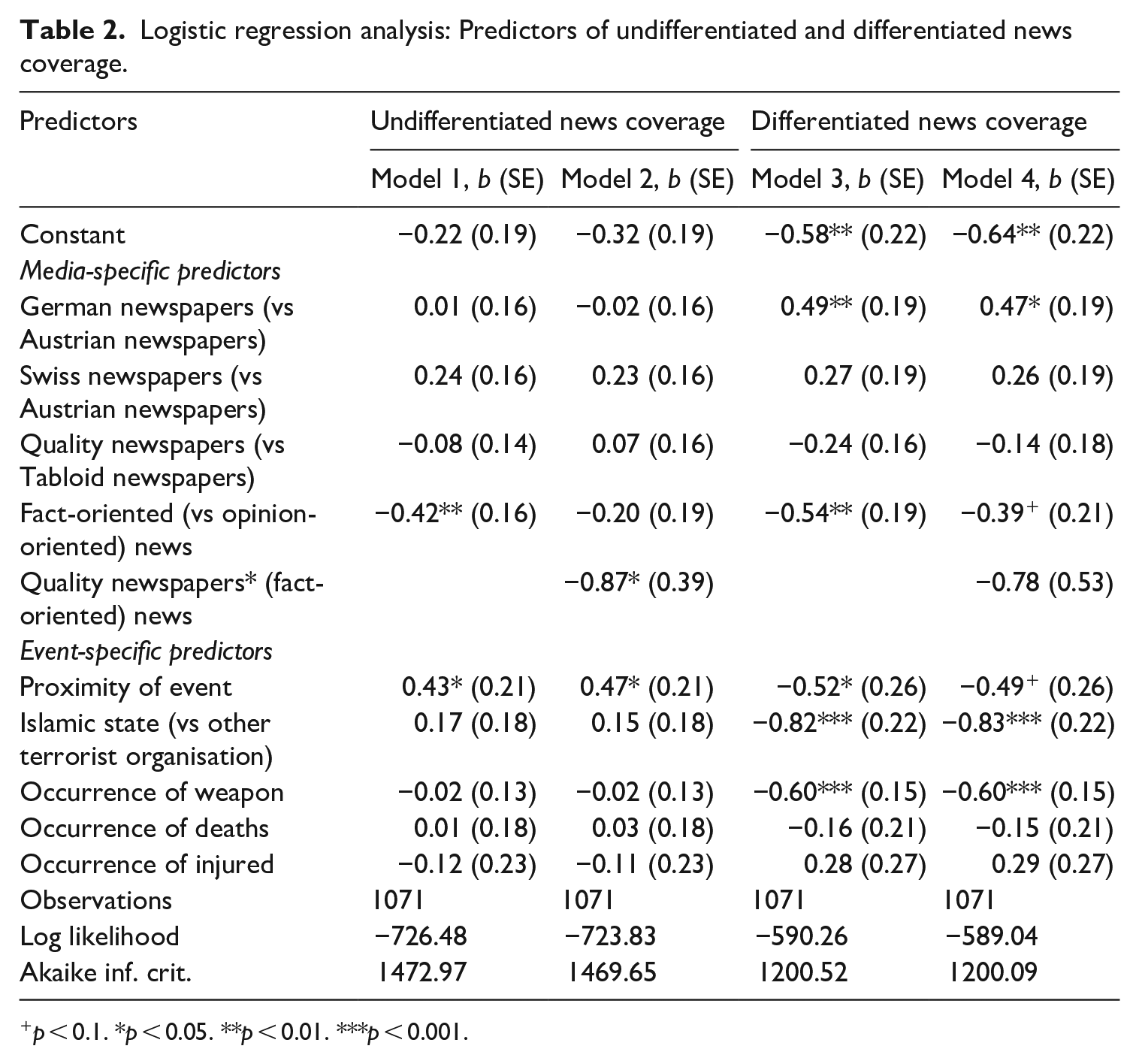
p < 0.1. *p < 0.05. **p < 0.01. ***p < 0.001.
Compared to news in tabloid newspapers, quality newspapers did not contain less undifferentiated statements (b = −0.08, SE = 0.14, p = 0.560) or more differentiated (b = −0.24, SE = 0.16, p = 0.132) statements. Therefore, H1a and H1b were not supported (see Table 3). However, as expected, we found support for the assumption that fact-oriented news articles less frequently contain undifferentiated (b = −0.42, SE = 0.31, p = 0.009) and differentiated statements (b = −0.54, SE = 0.19, p = 0.004) than opinion-oriented articles. Hence, H2a and H2b were fully supported. Furthermore, we found a significant interaction effect between type of newspaper (tabloid vs quality) and type of article (fact-oriented vs opinion-oriented) on undifferentiated news statements (b = −0.87, SE = 0.39, p = 0.026; Table 2, Model 2). Specifically, we found that undifferentiated statements were less prevalent in fact-oriented articles compared to opinion-oriented news articles in quality newspapers, while no such difference was found for tabloid newspapers (Figure 1). In contrast, we found no significant interaction effect between newspaper type and article type on differentiated statements (b = −0.78, SE = 0.53, p = 0.142; see Table 2, Model 4). Differentiated statements were more likely to appear in opinion-oriented news compared to fact-oriented news in both quality and tabloid newspapers (Figure 2). This supports H3, while we had to reject H4.
Supported (bold) and unsupported hypotheses.
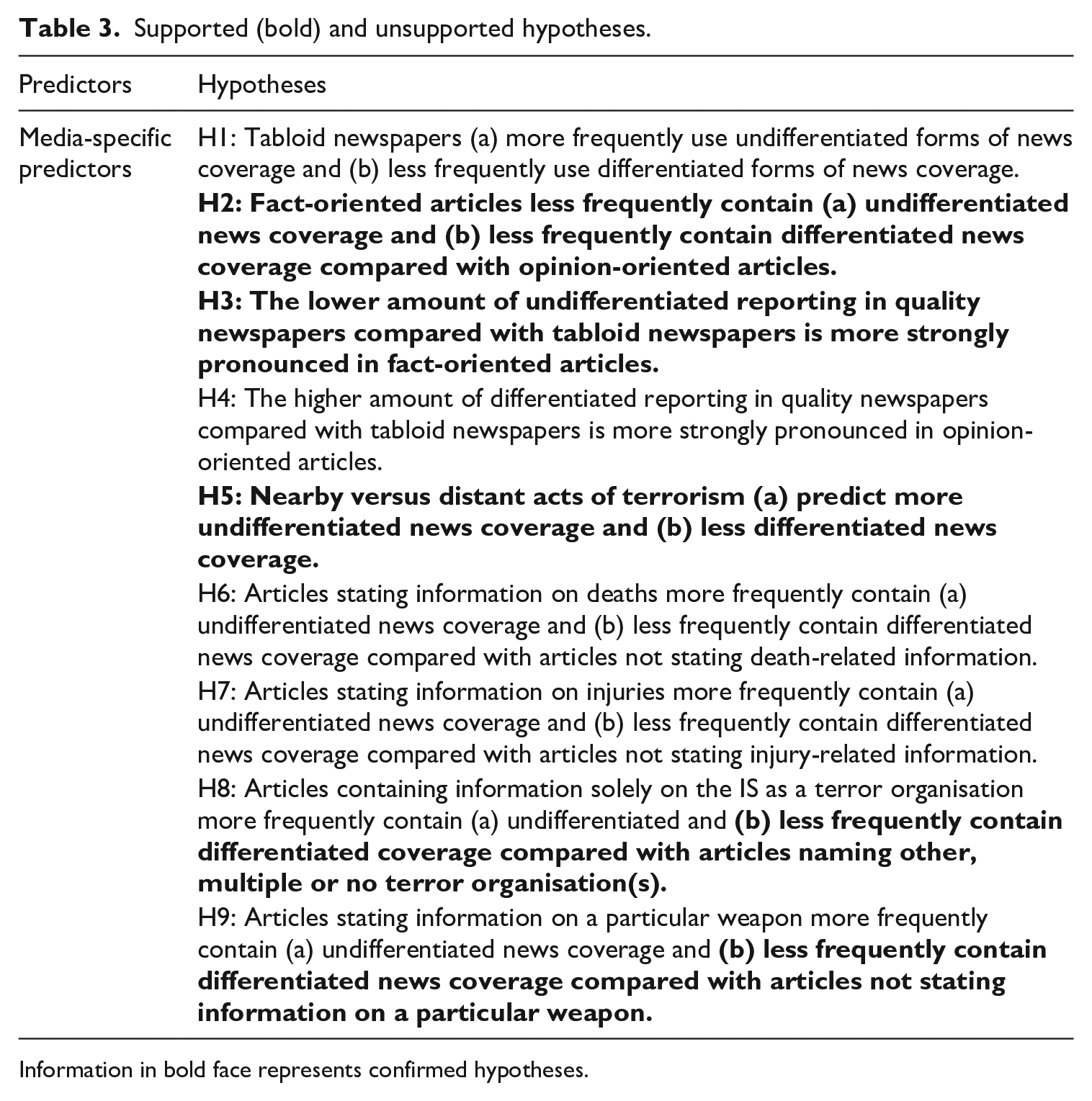
Information in bold face represents confirmed hypotheses.
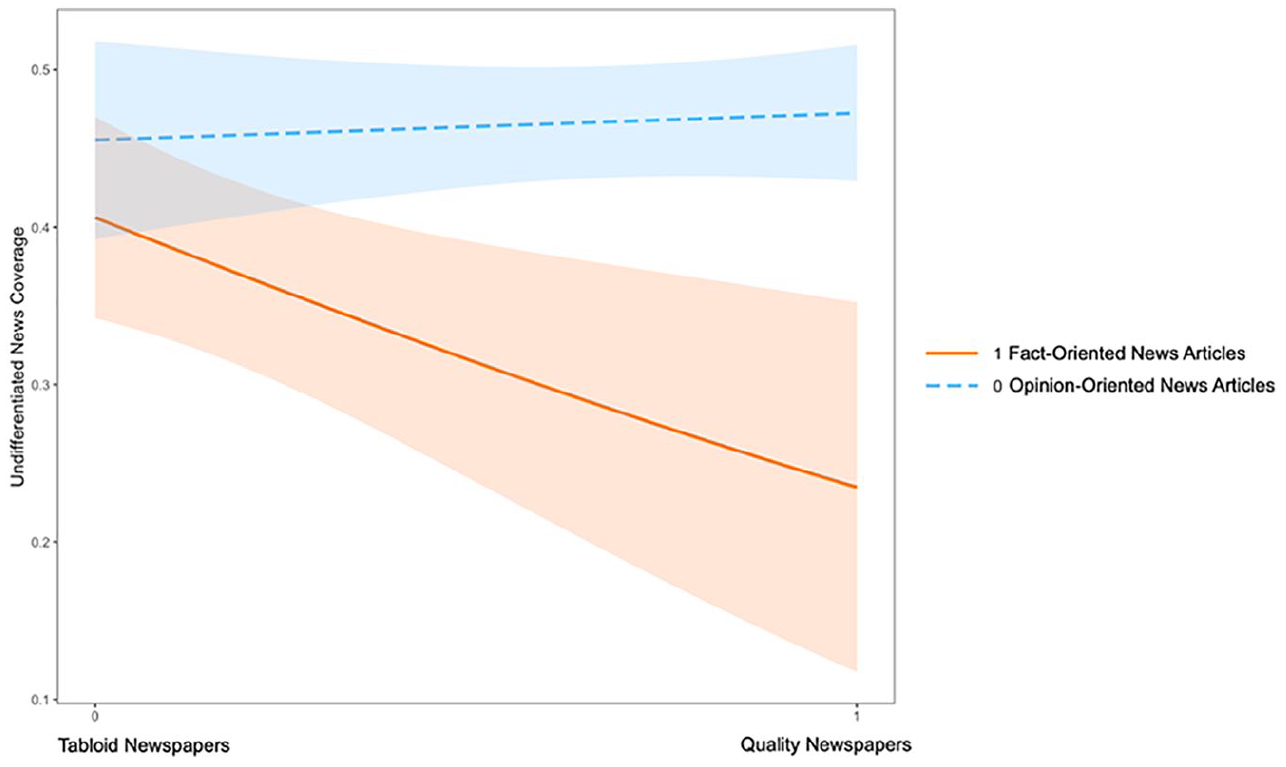
Two-way interaction effect between newspaper type and news article type on undifferentiated news coverage. All covariates are set to their mean values.
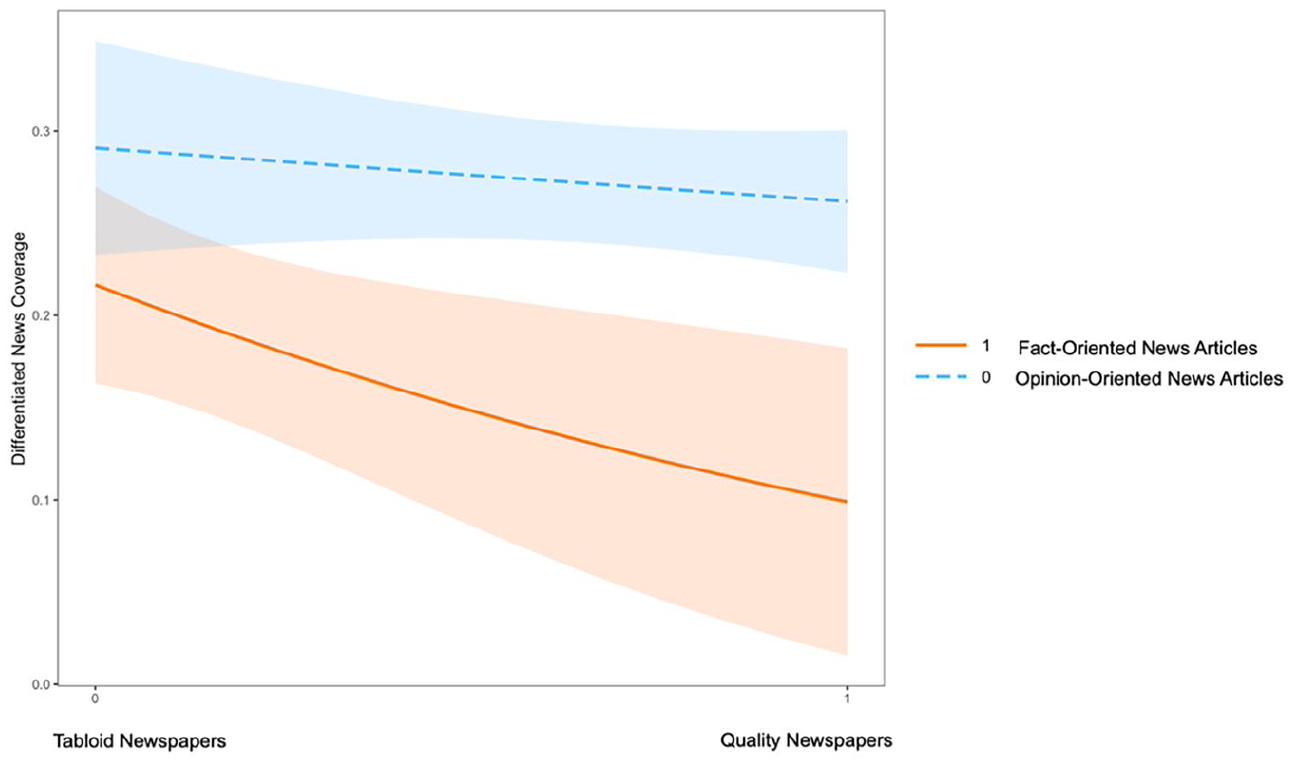
Two-way interaction effect between newspaper type and news article type on differentiated news coverage. All covariates are set to their mean values.
Regarding event-specific predictors, undifferentiated news statements were significantly more prevalent when the event was nearby rather than distant (b = 0.43, SE = 0.21, p = 0.042). Similarly, differentiated news statements were significantly less likely when the event was nearby rather than distant (b = −0.52, SE = 0.26, p = 0.043). Thus, H5 was fully supported. With H6, we assumed that the occurrence of deaths predicts undifferentiated and differentiated news coverage. However, deaths predicted neither undifferentiated (b = 0.01, SE = 0.18, p = 0.951) nor differentiated statements (b = −0.16, SE = 0.21, p = 0.458). Thus, we had to reject H6a and H6b. Finally, we also found no significant effect of the occurrence of injured as a response to terrorist attacks on undifferentiated (b = −0.12, SE = 0.23, p = 0.601) or differentiated statements (b = 0.28, SE = 0.27, p = 0.306). Thus, H7a and H7b were rejected. Furthermore, news articles mentioning the IS as terror organisation were not significantly more likely to contain undifferentiated statements (b = 0.17, SE = 0.18, p = 0.343) but significantly less likely to contain differentiated statements (b = −0.82, SE = 0.22, p < 0.001). Thus, H8a was not supported. However, H8b was supported. Moreover, the occurrence of weapons was not a significant predictor for more undifferentiated statements (b = −0.02, SE = 0.13, p = 0.875). However, differentiated statements were less likely to occur in articles which mentioned weapons (b = −0.60, SE = 0.15, p < 0.001). Thus, H9a was not supported, but H9b was supported (see Table 3).
Discussion
The aim of the present study was to examine how the news media depict Muslims in the context of Islamist terrorism. Precisely, we were interested in how frequently journalists link Muslims to Islamist terrorism covering terroristic acts in undifferentiated ways and how frequently Muslims are actively differentiated from Islamist terrorists. We theorised that undifferentiated and differentiated coverage is predicted by both media-specific and event-specific predictors.
First, our results show that journalists frequently use differentiated news coverage (26%) and thus actively distinguish between Muslims and Islamist terrorists. However, more importantly, undifferentiated coverage that actively links Muslims to terrorism is much more common (almost twice as often) than differentiated coverage; almost every other article contained at least one undifferentiated statement linking Muslims to terrorism. This finding extends previous results on negative media depictions of Muslims (e.g., Dixon and Williams, 2015). Below, we will further elaborate on this finding and discuss implications for intergroup relations. One explanation for the higher frequency of undifferentiated news coverage, one may argue, is the circumstance that generalisations and the mixing of categories such as ‘Muslim’ and ‘terrorist’ can linguistically be realised with less effort compared to a more effortful process of distinguishing categories. Linguistically speaking, it is easier to describe a person as a ‘Muslim terrorist’ than to actively differentiate and to correctly refer to a terrorist as ‘Islamist terrorist’ and then differentiate this terrorist from Muslims in general. Furthermore, we expected no country-specific differences regarding undifferentiated and differentiated news coverage. The data largely supports this assumption as we only found one relevant difference for differentiated reporting. That is, German newspapers overall used more differentiated news coverage compared with Austrian-based newspapers. It has been argued that Germany, compared with Austria is traditionally more liberal in general (Langewiesche, 2011). This cultural difference may have affected terror news coverage. Precisely, the idea of the ‘freedom of the individual’ that may be more pronounced in Germany may strengthen reporting styles that clearly differentiate between individuals and groups.
Media-specific predictors
Interestingly, the overall degree of undifferentiated and differentiated coverage did not differ between tabloid and quality newspapers. This is an unexpected finding. One explanation could be that Muslims are among the target audience of tabloid newspapers in all three countries and that Muslims as part of a minority group may react very sensitively to depictions of their own group (Neumann et al., 2018). Journalists working for tabloid newspapers may therefore avoid undifferentiated news coverage and use differentiated coverage regularly in order to not offend Muslim readers. Results further show that fact-oriented news articles less frequently contain undifferentiated and differentiated statements than opinion-oriented news articles. This is in line with established journalistic guidelines of providing contextualising and evaluative information that go beyond fact-oriented forms of reporting in opinion-oriented articles only and not in straight news articles (de Vreese et al., 2017). Yet, tabloids more frequently use undifferentiated coverage in fact-oriented news compared with quality newspapers. Put differently, when news consumers expose themselves to fact-oriented news in tabloids, they are more likely to encounter undifferentiated information compared with fact-oriented news in quality newspapers. Thus, journalists working for quality newspapers draw a clear line between fact-oriented and opinion-oriented articles, while journalists for tabloids do not. Thus, readers of (allegedly) fact-oriented articles in tabloid papers are exposed to undifferentiated terrorism coverage, while quality news recipients are not.
Event-specific predictors
Drawing from TMT, and extending previous findings (Das et al., 2009), the results show that proximity affected undifferentiated and differentiated terrorism coverage. Proximity may have affected journalists’ own death-related thoughts and may have activated negative outgroup stereotypes towards Muslims, thus making undifferentiated coverage more and differentiated coverage less likely. This finding is of particular importance because it shows that news coverage increasingly links Muslims to terrorism in times when one’s own country or the narrower cultural space is hit by terrorist attacks. Such forms of reporting can help to (further) divide Muslims and non-Muslims in Western societies and indirectly play into the hands of terrorist organisations, such as the IS, whose goal is to counter Muslims and non-Muslims in Western societies (Nesser, 2018). Furthermore, we did neither find a relevant influence of deaths, nor injuries on undifferentiated and differentiated reporting. One explanation may be that the identity of the victims may play an important role in this regard. For example, the Islamist terrorists involved in the Charlie Hebdo shooting killed both non-Muslim and Muslim individuals and the news media explicitly mentioned the victim’s identity (and Muslim religion) in these reports (Graham-Harrison, 2015). The act of an Islamist terrorist killing or injuring Muslims itself serves as a differentiating cue and may explain why the superordinate category (deaths/injuries) did not result in relevant effects. Thus, cases in which terrorists explicitly kill and/or injure non-Muslims in a targeted way may affect undifferentiated and differentiated coverage in different ways compared with cases where victims are Muslims and/or both Muslims and non-Muslims. Future research should specifically examine this assumption.
Furthermore, mentioning the IS as terror organisation decreased the amount of differentiated news coverage (no effect for undifferentiated reporting). That is, when a terrorist attack is solely connected to the IS (compared to other/multiple terror organisations) this may especially activate worldview defences in journalists in order to ‘manage terror’ and results in less differentiated forms of reporting. However, this cue may not have been strong enough to also make undifferentiated reporting more likely. Also, articles mentioning a weapon/weapons also decreased differentiated (but not undifferentiated) coverage, as weapon cues can automatically affect psychological reactions making one’s own mortality more salient (Landau et al., 2004). Yet, respective cues may not have been strong enough to affect undifferentiated reporting.
Implications
In general, the implications of our findings are manifold. First, journalists in Austria, Germany and Switzerland regularly use differentiated news coverage (26%) that explicitly differentiates Islamist terrorism or terrorists from Muslims. This is an important finding showing that journalists (and news organisations) in these three countries tend to have similar routines when reporting about terrorism and seem to view the importance of news differentiation in a relatively similar manner (although cultural differences between Austria and Germany may affect the degree of news differentiation as mentioned above). Yet, the fact that almost half of all articles examined contained undifferentiated news coverage speaks for itself and shows that news consumers in Austria, Germany and Switzerland (we found no country-specific differences) are regularly exposed to high doses of stereotype-activating information. Exposure to mediated associations that repeatedly pair Muslims with extremely negative concepts such as terrorism increases negative attitudes towards Muslims and Islamophobia (Matthes et al., 2019; Saleem et al., 2017; Schmuck et al., 2018; von Sikorski et al., 2017, 2018). Importantly, this form of coverage is even more pronounced when terroristic actions happen nearby (compared to distant events) and may thus further contribute to dividing Muslims and non-Muslims in times of terror. Although this goes beyond the scope of our paper, it can nevertheless be argued, that repeated exposure to this form of media coverage can have serious consequences for intergroup relations and has the potential to negatively influence the coexistence of Muslims and non-Muslims in Western societies, as previous effects studies indicate (Saleem et al., 2017; see als Baugut and Neumann, 2020). Apart from that, exposure to undifferentiated coverage can negatively affect Muslim citizens living in countries such as Austria, Germany or Switzerland, whose attitudes towards the non-Muslim-majority population in Western societies may then be affected in negative ways.
Limitations
This study has some noteworthy limitations. First, we examined newspaper articles only. Future research should extend this line of research examining, for example, television news. Also, we examined tabloid and quality newspapers in Austria, Germany and Switzerland. That said, we cannot say anything about the role of undifferentiated and differentiated news coverage in other (non-European) countries. Based on TMT, we theorised that certain terroristic information may increase mortality salience in news journalists, which affects their style of reporting. Although, previous research has shown that effects of mortality salience robustly affect perceptional and behavioural processes in individuals (Burke et al., 2010) and key findings of our study support the theory as well, we, of course, cannot say for sure that journalists experienced mortality salience. We simply did not measure it. Future research should explore this assumption and, for example, test in experimental settings if increased mortality salience among journalists indeed predicts undifferentiated and differentiated news coverage.
Conclusion
Journalists frequently use differentiated and undifferentiated forms of news reporting when depicting Muslims in the context of terrorism. Yet, undifferentiated news coverage is much more common; almost every other article in our sample contained at least one undifferentiated statement linking Muslims to terrorism. Based on our findings and previous results stemming from effect studies, we call journalists to explicitly distinguish Muslims from Islamist terrorists because undifferentiated media coverage can promote Islamophobia and negatively affect intergroup relations between Muslims and non-Muslims living in Western societies.
Footnotes
Appendix
Intercoder reliability scores (N = 59).
| Category | S-Lotus | Krippendorff’s Alpha |
|---|---|---|
| Media-specific predictors | ||
| Country | 1.00 | 1.00 |
| Newspaper type | 0.99 | 0.98 |
| Article type | 0.89 | 0.73 |
| Event-specific predictors | ||
| Proximity of event | 0.95 | 0.75 |
| Islamic state (vs other terrorist organisation) | 0.97 | 0.91 |
| Occurrence of weapon | 0.89 | 0.76 |
| Occurrence of deaths | 0.92 | 0.81 |
| Occurrence of injured | 0.97 | 0.81 |
| News differentiation | ||
| Undifferentiated news coverage a | 0.83 | 0.65 |
| Differentiated news coverage b | 0.92 | 0.77 |
N = 87.
N = 67.
Funding
The author(s) received no financial support for the research, authorship, and/or publication of this article.
