



Abstract
Media framing helps to shape our understanding of the meaning of news events, often problematically. This study examines how this process interacts with the phenomenon of familicide-suicide, where a person kills one or more family members before taking their own life. A social constructionist analysis of the print media coverage of three high-profile cases in Ireland highlights framing and discursive patterns, contributing to an explanatory framework that is misleading and lacking in an evidence base. As well as a tendency towards broad and poorly supported claims-making, several primary causal frames are prevalent: mental health; financial debt; fall from grace; and ‘out of the blue’, whilst a domestic violence frame is notable in its absence. Coverage is found to be episodic in character, linked to dramatisation and more simplistic explanatory frames, rather than evidence-based analysis of potential causal factors for these incidents. Findings raise important questions for journalistic practice, regarding processes of selection and salience of sources contributing to overall coverage that is partial and biased, rather than an ‘objective’ representation of the social world.
Introduction
Journalism’s core responsibility is that it guides, informs, educates and engages. However, various tensions have been highlighted among these different, often competing, aims, especially when reporting complex events. The phenomenon of murder-suicide, whereby an individual takes the life of one or more people before taking their own life, is especially challenging to report on because a gap exists between what can be comprehensively established and the demands of an often traumatised community for an explanation, leading to pressure on journalists to impose a coherent narrative on something that, initially at least, can appear inexplicable. Negative informational outcomes have been linked to this tendency in other types of reportage, for example narratives of convenience being applied to violent incidents involving domestic abuse that misrepresent or distort their causes (Bullock and Cubert, 2002). Coverage of recent cases of familicide-suicide in Ireland generated debate (primarily social media driven) about perceived shortcomings in reporting, e.g. the omission of victims from the narrative (see, e.g. Dunne, 2016; O’Brien and Culloty, 2020) and overly sympathetic coverage of the perpetrators (Quinn et al., 2019).
This study examines explanatory frames applied to such media stories and the reasons for such explanations. Through comparative framing analysis of reporting on three recent familicide-suicides − including the subcategories of femicide-suicide and fratricide-suicide − in Ireland, we establish differences and commonalities between how each case was represented in the media, and consider the implications of this representation. A critical element of this latter aspect, and a central part of the theoretical lens, is social constructionism, which situates journalism as a primary means by which public perception of reality is constructed. In the next section, we tease out the relationship between social constructionism and journalism. We then describe some key characteristics of the three cases, before outlining important aspects of the inter-relationship between journalism, crime, and newsworthiness, and the framing of certain types of news events.
Social constructionism and media framing
Numerous studies have highlighted how the media can shape public understanding of societal phenomena, for example sexual violence against children (Kitzinger, 2004), environmental problems (Stamm et al., 2000) and health policy (Walsh–Childers, 1994). A social constructionist perspective positions different types of societal activity and interactions at the centre of how reality is perceived and understood. We conceptualise journalism as a social practice, with journalists as critical social actors who influence how news stories are represented (Van Gorp, 2010). Other ideological influences, organisational cultures and professional values are also important in this ‘construction’ (Hall et al., 1978). Considered from a social constructionist perspective, the news as it is reported in the media is less a reflection of the reality and significance of a situation than a contested space where the inclusion or omission of certain social actors in a story, as well as influences of journalists themselves, conscious or otherwise, are crucial.
Journalists’ use of sources and how sources contribute to claims-making in news output are vital considerations when viewing journalism through a social constructionist lens. Journalism represents and brings social problems to our attention via claims made by select, ‘expert’ sources (Broersma and Graham, 2012), which characterise an issue and demonstrate how ‘professionals and the public respond’ (Limbrik, 2013: 26). The means by which claims are selected, as well as their positioning as ‘primary’ or ‘secondary’ claims-makers 1 (Best and Harris, 2013) contribute to perceived newsworthiness. Thus, in multiple ways, the media reconstruct and reinterpret claims for the wider audience, influencing societal perceptions of sensitive topics. An imbalance of types of claims-makers combined with routinisation of news processes has been linked to negative tendencies in news output, for example perpetrators receiving more coverage than victims in crime stories (Schildkraut 2016), or intimate partner homicides being stripped of relevant social context (Simons and Morgan, 2018) and a generally weak interrogation of causation (Niblock and Bindel, 2017).
Police and criminal justice personnel, who predominate as primary claims-makers in crime news output, have also been linked to a failure to challenge the overarching patriarchal system within which this violence occurs (Richards et al., 2014). The use of these sources, as well as community sources and religious leaders, can construct case narratives that insinuate the violence was isolated, whilst obfuscating a context of coercive control (Niblock, 2018). It has also been linked to a tendency to focus on the stoicism of the victims and mystery of the event (Cullen et al., 2019). Van Dijk (2015) found that ‘us’ versus ‘them’ media discourses enable certain social classes to ‘belong’ more than others. Quinn and Vaughan (2019) further show how these tendencies can lead to depersonalisation of tragic events involving minority ‘lower social class’ groups, contributing to the perpetuation of unequal power relationships within society.
Whilst social constructionism helps illustrate why journalism interacts with complex phenomena like familicide-suicide in certain ways, comparative framing analysis indicates a key means by which social constructionism is instantiated in practice. Framing suggests a particular conceptualisation of an issue, via the selection and highlighting of key aspects (Entman, 1993). Media framing analysis considers how such conceptualisations apply to news output specifically by ‘constructing and processing news discourse’ (Pan and Kosicki, 1993: 57). Frames can manifest in numerous ways, for example in the breadth and depth of coverage, its placement, and linkages to specific causes. Word choice, selection, and salience of information also impact on the development of a frame, as do organisational factors, external conditions, and use of journalistic sources. Episodic and thematic presentation of stories also accentuate frames. The former represents incidents as isolated (Post et al., 2009), whilst thematic presentations of news embed events within their larger social context. Episodic framing has been found to have a context-stripping effect in coverage of homicides, exacerbated by the sourcing bias discussed earlier (Cullen et al., 2019).
Categorisation, incidence and media coverage of familicide-suicide
Murders followed by suicides (also referred to as ‘homicide-suicides’) are defined as incidents in which a person kills one or more individuals and then dies of suicide (Marzuk et al., 1992). The term familicide-suicide describes different types of intrafamilial homicide, including the killing of a spouse and one or more children (Wilson et al., 1995), and the murder, by a parent or step-parent, of a current or ex-partner and/or one or more of the couple’s children and/or children from a previous relationship (Sabri et al., 2016), together with the suicide of the perpetrator. Familicide-suicide is relatively unusual both internationally 2 and in Ireland, where the National Suicide Research Foundation (NSRF) recorded 28 cases between 2004 and 2021 (NSRF, 2021, personal communication). 3 Recent studies (see, e.g. Standish, 2020) have warned that suicide and familicide-suicide rates may increase as domestic violence is exacerbated by lockdowns and other restrictions during the Covid-19 pandemic. In Ireland, the number of calls to the domestic violence support service, Women’s Aid, rose by 43% in 2020 compared with 2019 (Women’s Aid, 2020). This study focuses on media coverage of familicide-suicide, and the subcategories of femicide-suicide and fratricide-suicide. Femicide-suicide involves the killing of a woman by a male intimate partner (Dawson and Gartner, 1998), whilst fratricide-suicide involves the killing of one or more siblings by another sibling (Bourget et al., 2017), in both cases followed by the suicide of the perpetrator. Liem and Reichelmann (2014) identify two main types of perpetrator of familicide-suicide. One is motivated by anger or revenge and is more likely to have a history of coercive control and physical violence; the other is motivated by despondency and humiliation, and is unlikely to have a history of prior physical violence. Gendered, controlling and proprietary attitudes towards women, children and family, as well as shame about financial debt, are regularly cited as causal factors (Liem and Koenraadt, 2008). Femicide-suicide is a strongly gendered phenomenon (Enander, 2010), is usually carried out by men and involves killing a female victim (Karlsson et al., 2021; Liem and Koenraadt, 2008; Wilson et al., 1995). Fratricide, the murder of one’s brother or sister, accounts for approximately 2% of all intrafamilial homicides (Bourget et al., 2017). Despite the interest in multiple-family killings ‘throughout history and across cultures’, few studies explore fratricide-suicide (Liem and Reichelmann, 2014: p. 44). Media reporting patterns suggest power struggles between siblings, disputes about money, property, or status within the family unit, alongside mental health issues, could contribute to such violence (Walsh, and Krienert, 2009). A lack of education and strict tribal culture, particularly in rural areas and among some ethnicities, have also been highlighted as contributory factors (Hashim et al., 2017).
Media representations often suggest reasons for familicide-suicide, including mental health, a loss of status in society or financial debt (Easteal et al., 2015). Such representations can deflect criticism from the perpetrator and obscure the issue of violence against women and children (Monckton–Smith, 2012), especially given that domestic abuse and coercive control are not clinical conditions, but rather patterns of behaviour (Monckton–Smith, 2010). Coverage may also perpetuate pre-existing patriarchal and social stereotypes, such as that perpetrators are good family men (Little, 2021), and the event is therefore ‘inexplicable’ (Dobash et al., 2009). Indeed, Chesney–Lind and Chagnon (2017) found that media representations of domestic violence may promote patriarchal and racist ideologies that inhibit a more ‘sophisticated understanding of domestic violence among the public’. For example child-abuse has been constructed as a Māori issue in coverage in New Zealand (Maydell, 2018), and honour killings are associated with South-Asian/Muslim ethnicities in Canadian news media (Shier and Shor, 2016). Over-emphasis on offenders is another hallmark of media coverage of familicide-suicide (Sutherland et al., 2016). Perpetrators tend to be portrayed, not as men who committed the most extreme form of domestic violence, but as individuals who ‘just snapped’ (Niblock, 2018: 2455). Sourcing strategies, furthermore, favour male elite voices, who often fail to characterise the incident as domestic violence (Bullock and Cubert, 2002; Sutherland et al., 2016).
The rarity of familicide-suicide cases adds to their perceived newsworthiness (Jamieson et al., 2003), leading to the relatively large amount of coverage individual cases receive. Newsworthiness comprises a collection of criteria with which events are deemed by the media to be worth presenting to the public as news, and are assigned by journalists and editors using typifications that reflect existing social structures and cultural understandings (Gilliam and Iyengar, 2000). Factors that influence perceived newsworthiness of familicide-suicide cases include society’s fascination with extreme violence and personal tragedy, deaths of ‘vulnerable’ or ‘innocent’ victims, and apportioning blame to institutional failings (Flynn et al., 2015). A focus of this study is the intersection between newsworthiness and other journalism-related values, and the character and volume of news output. Jamieson et al. (2003) found that coverage of suicides tended towards ‘problem definition', ‘causal explanation’ or ‘solution’ orientations, whilst skewed attention on familicide-suicide has also been linked to negatively framed portrayals of mental illness (Paterson et al., 2004), whilst obscuring the role of gender and power in family domestic violence (Buiten and Coe, 2021). Exploring the extent to which preconceptions and stereotypes are evident in media frames in the coverage of three specific cases can lead to a better understanding of how and why news shapes public perception around complex, multi-faceted news events.
Methodology
The research questions this study explores are 1. What frames are used in newspaper reporting of familicide in Ireland, and what specific factors contribute to this framing? 2. How do patterns of newspaper coverage of familicide contribute to its social construction?
We took a comparative case-study approach and conducted a framing and sourcing analysis of print media coverage of three familicide-suicide cases. Cases were purposefully selected via two main criteria: firstly, they are recent and information-rich in terms of diversity of content and breadth of coverage; and secondly, they represent a range of typifications of familicide-suicide. Nevertheless, the cases have differences too, and these differences enabled us to identify patterns, divergences, and commonalities across coverage. For example we were interested in how socio-economic and cultural backgrounds were represented, and whether language use or other factors differed in the case of fratricide-suicide.
The cases selected for analysis are 1. The Hawe case: Clodagh Hawe and her three children were murdered by her husband and the children’s father, Alan Hawe in Ballyjamesduff, Co. Cavan on 29 August 2016. Alan Hawe then took his own life. 2. The Greaney case. Valerie Greaney was murdered by her husband Michael Greaney. Michelle Greaney survived Michael Greaney’s attempt to murder her, before taking his own life. 3. The O’Driscoll case: Jonathan O Driscoll murdered his two brothers near their home in Charleville, Co. Cork on 4 September 2014, before taking his own life.
Summary of case coverage.
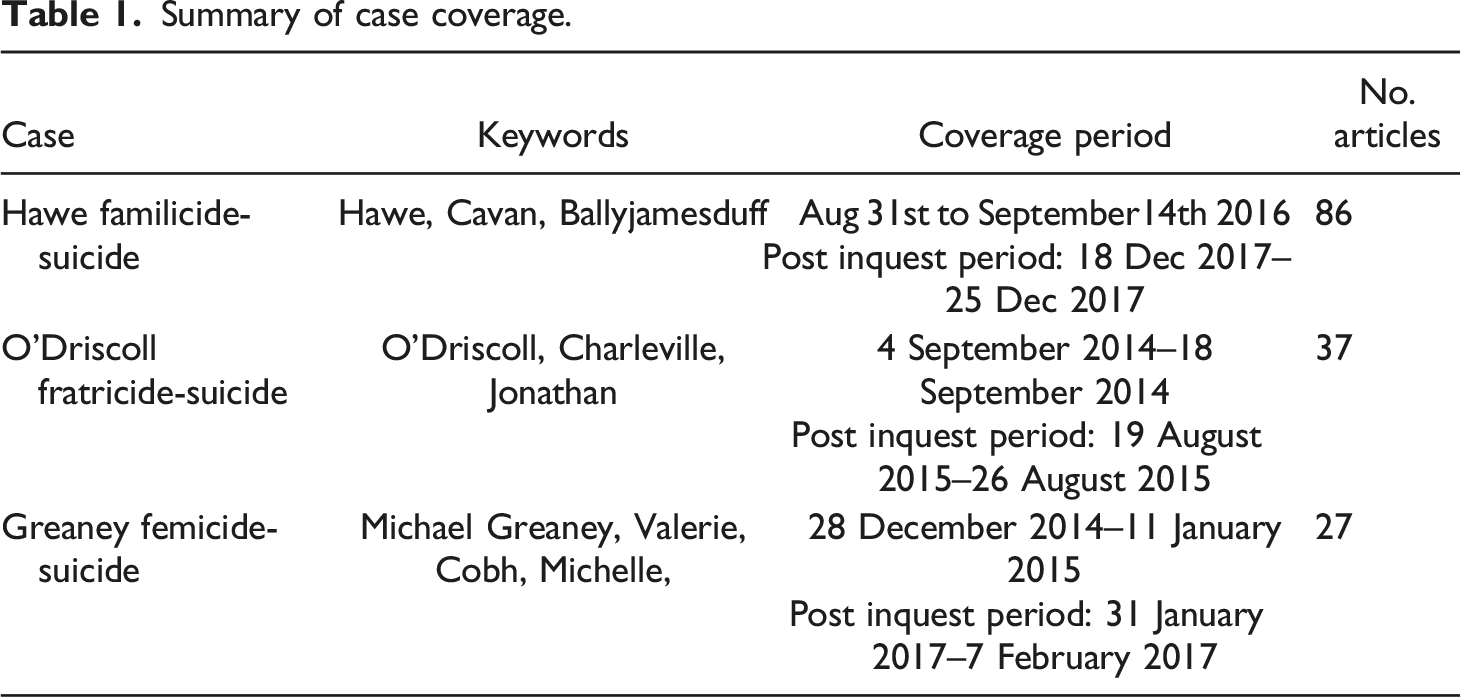
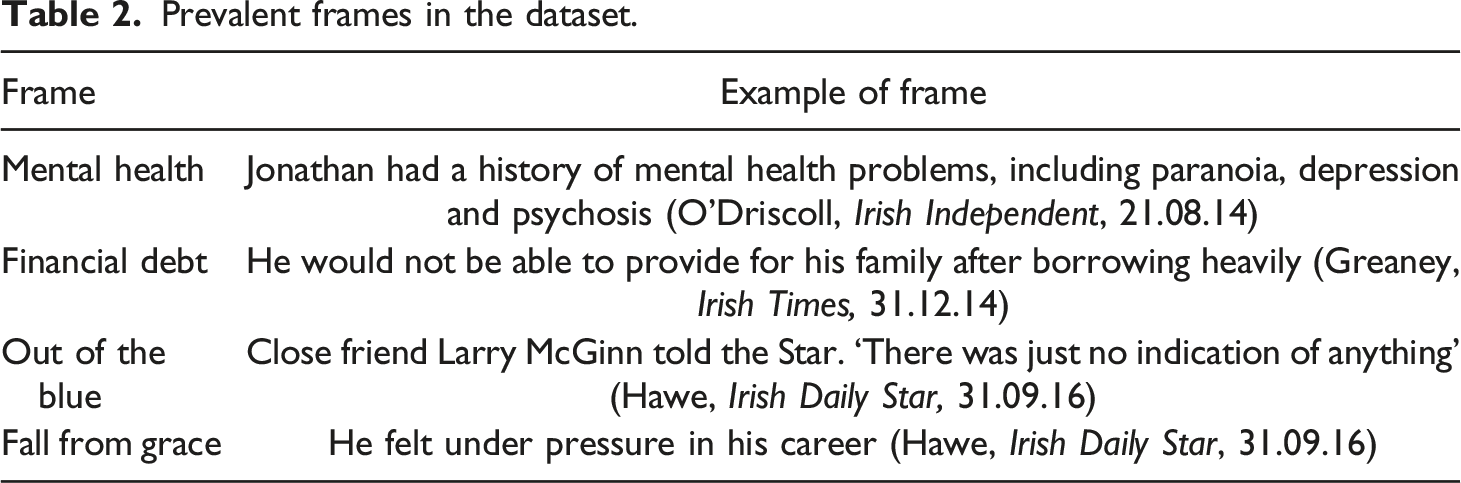
We analysed the 150 newspaper articles representing the three cases using NVivo, a qualitative data analysis application. Analysis involved three phases. Phase 1: We noted initial observations whilst familiarising ourselves with the corpus. Frames were identified in accordance with Entman (1993) and Post et al.’s (2009) definitions. Identified frames were coded individually within each article. We distinguished between implicit and explicit frames. Explicit frames stated directly that the perpetrator had a previous or current mental health problem or financial debt was directly featured in the story. Implicit frames included speculative quotes to make wider points about the incident, as illustrated in this quote: ‘That person must be in a terrible state for something like this to happen…so there’s a sense that this person deserves sympathy’ (Hawe, Irish Independent, 03.09.16). Where multiple references in some texts noted a factor (e.g. mental health) in the familicide-suicide, each instance of that implicit or explicit reference was coded. Phase 2: We then used an inductive and deductive approach to identify recurring frames. Whilst multiple frames were evident, following our research questions, we limited analysis to frames that were common to at least two cases and prevalent across the dataset. Analysis encompassed news articles’ general ascriptions of causality, as well as rhetorical and technical framing devices, for example word choices, stock phrases, or forms of judgement. Table 2 indicates prevalent frames with excerpts from coverage as illustrative examples of the frame in context. Phase 3: We identified and categorised sources within the stories. Here, we considered the ordering of sources in the story (see Table 3). A ‘lead’ source was a central figure in the story, who featured in the first three paragraphs and whose commentary was referenced in the headline. ‘Other’ sources provided supplementary information to the main thrust of narrative and were quoted for the first time after more than three paragraphs. We considered contextual detail to build a more complete picture of how these incidents were interpreted and constructed, such as story leads, page numbers and positioning of stories as indicators of perceived newsworthiness. Referential strategies of social actors within the text (representation of the perpetrator or victim, e.g. Traveller
5
, loving father and psychopath) were also noted where relevant. Prevalent frames in the dataset. Sourcing analysis.
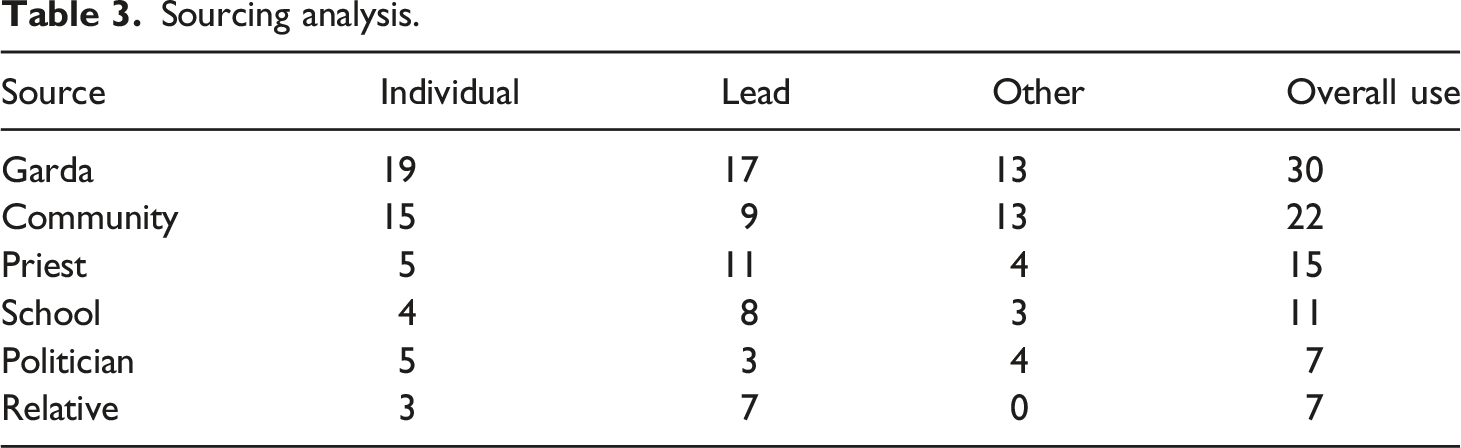
Individual sources represent the number of times an individual representative was named: for example 19 named Gardaí (Irish police) are quoted across coverage of the three cases. The remaining 11 references are to unnamed Garda or security sources. Community sources refer to members of a local sports club, neighbours, community leaders and family acquaintances.
What frames are used in newspaper reporting of familicide in Ireland, and what specific factors contribute to this framing?
Our analysis revealed that in the three cases examined, reportage relied on a small number of frames to construct the narrative, primarily by explaining the cause, in episodic coverage that characterised familicide-suicides as isolated incidents.
Causal frames of convenience contribute to misleading explanatory framework
The media primarily used causal frames that served to explain or excuse the act of familicide-suicide by the perpetrator, which we term a ‘causal frame of convenience’, or a means of ‘tidying up’ and simplifying an event which proves resistant to conventional explanatory frameworks. This tendency is exemplified in this excerpt relating to the Hawe case: “In most cases, you can pinpoint some kind of strife or mental health issue,” said one Garda source. “And when there is something in the background, people at least feel they know what happened; there is some kind of explanation.” (Irish Times, 31.08.2016)
In total, 74% of stories implicitly or explicitly cited a reason or precipitating factor as a motivation for the familicide-suicide. Of this figure, the perpetrator’s mental health was salient in 36% of stories, followed by the event occurring out of the blue in 24% of cases. Financial debt was mentioned in 9% of stories, and a possible fall from grace was found in 5% of stories. These frames tended to emphasise what, and not who, was responsible for the familicide-suicide. This apparent depersonalisation reduces perpetrator accountability by failing to acknowledge that human action was at the core of the event. It also implicitly obfuscates the wider issue of extreme domestic violence.
Figure 1 illustrates the dominant causal frames in coverage of the cases. Episodic presentation contributes to an ‘out of the blue’ explanatory framework.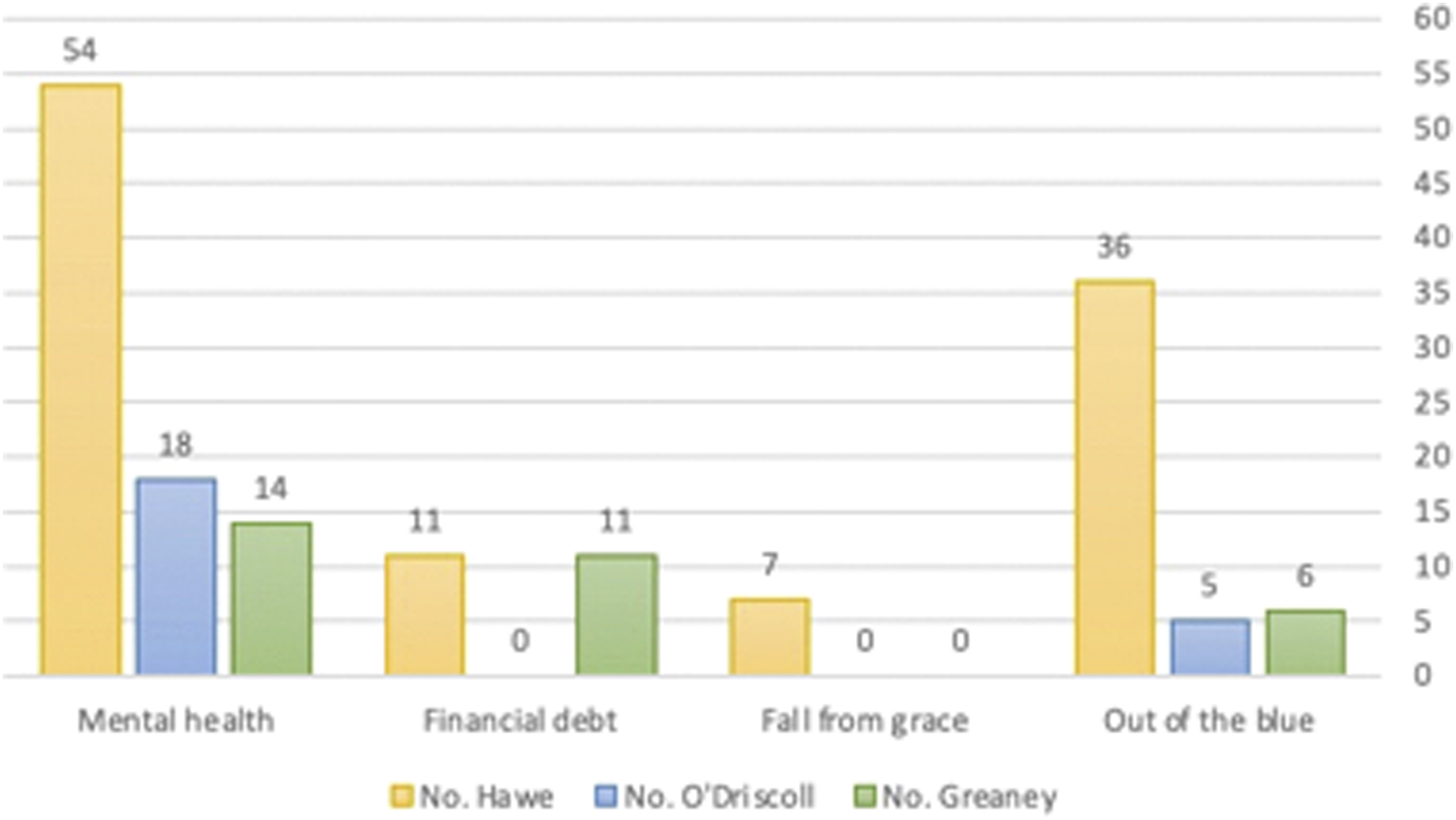
We established earlier how episodically oriented framing represents incidents as isolated, whilst more thematically oriented narratives embed events within their larger social context. Earlier studies of media framing of familicide-suicide and femicide-suicide note a tendency to oversimplify the causes or present them as unexplainable (Richards et al., 2014). Coverage in all three cases shows a reticence to discuss broader social contexts, instead preferring to treat familicide-suicides as random episodes. In support of this contention, 87% of articles we examined were ‘news’ stories as opposed to feature, opinion or editorial, all of which allow for deeper discussion.
One article used sensationalist language to describe the fratricide-suicide of twin boys with a focus on why the event occurred, positioning the violence as an anomaly in society. “Mystery remains over what drove the killer, 21, to butcher ‘little angels” (O’Driscoll, The Irish Daily Star, 06.09.14).
The few features, editorials and opinion pieces published focused on the need for further investigation into the causes of familicide-suicide, whilst not actually offering any explanation, for example this Irish Times headline and subheading (03.09.16): ‘Irish society will learn little from murder-suicide and “Deaths of Hawe family will not be studied in any substantive way.”’
This tendency towards episodic framing echoes patterns observed in other types of crime coverage where, in combination with certain types of causal reasoning, critical contextual and societal issues are obscured (Easteal et al., 2019; Gillespie et al., 2013) leading to an implication that familicide-suicides are inherently beyond rational explanation. Our analysis shows how an unexpected and extreme act by a perceived loving father or brother is constructed in the media as ‘a bolt from the blue’ (Irish Times, 21.08.16) In the Hawe case, 15% of reports were coded as ‘out of the blue’, the highest instance of this frame across the three cases. Fine Gael councillor Paddy Smith said: “It is a complete shock, out of the dark, people are just unable to grasp or comprehend what has happened.”. (Hawe, Irish Daily Mirror 29.08.16)
Dobash et al. (2009) argue that familicide-suicides are often portrayed as ‘out of the blue’ because they do not cohere with the stereotypical image of ‘good family men’. In the Greaney and Hawe cases, the image portrayed was of successful family men, whilst news reports depicted Jonathan O’Driscoll, albeit ‘troubled’, as a loving brother. Perpetrators were portrayed as having little or no agency and, therefore, limited blame. If the perpetrator could not control his actions, or the act was ‘out of the blue', who was responsible? The underlying suggestion is that familicide-suicide or femicide-suicide is synchronously ‘not a societal problem, not a gendered problem but a misfortune that occurs to problematic individuals’ (Easteal et al., 2019: 458). The accumulation of such framing devices may contribute to a tolerance for the perpetuation of male violence in society.
How do patterns of newspaper coverage of familicide contribute to its social construction?
Via the interpretative mode of analysis described in the methodology section, we identified patterns in the case coverage that we believe contribute to a social construction of familicide-suicide containing problematic conceptualisations of mental health, and pre-existing patriarchal, social and class stereotypes.
Mental health language usage exemplifies simplification of complex phenomena
Buiten and Coe (2021) have argued that an emphasis on mental health frames in media coverage of familicides suppresses important dimensions and intersections, of gender and power, for example in media discourse and in the public consciousness. Mental health was a dominant causal explanation in the three cases (36% of the corpus overall), for example: ‘A security source told the Irish Mirror: “The father had a serious mental health issue”'. Greaney corpus, Irish Daily Mirror, 29.12.14. Whilst in some of the dataset, this was a valid avenue of discussion (e.g. perpetrators Greaney and O’Driscoll had documented histories of mental health problems), in other areas, speculation around mental health was advanced without any substantiation. Analysis of the Hawe case reportage shows that ‘mental health’ was coded more frequently than in the Greaney and O’Driscoll cases, without any evidence. An excerpt from the Irish Independent exemplifies this frame: ‘One thing that many of the perpetrators have in common is a history of depression or mental illness' (Hawe, Headline, Irish Independent 30.08.2016).
The dominance of this frame is revealing both in terms of journalism’s reliance on simplistic causal frames for complex social phenomena, but also because of the implicit suggestion that mental illness is inherently dangerous. Violence is linked to mental illness by repeated references to perpetrators’ previously good nature and suggestions that mental illness overpowered them. Hawe, for example was a father, husband, son, community and family man. He was ‘a valuable member of the community’, a ‘real gentleman’ and ‘the most normal person you could ever meet’ (Irish Times, 06.09.16). Stories noted that Greaney had served communion at mass 3 days before the femicide-suicide, whilst O’Driscoll was described as a ‘loving brother’ (Irish Daily Mirror, 05.09.14).
Meanwhile, the repeated use of pejorative language, such as ‘crazed teacher’ (Hawe, Irish Daily Star, 21.12.17), and ‘tormented dad’ (Greaney, Irish Daily Star 01.02.17) alluded to mental illness. The illness and the act are intertwined in the narrative either implicitly or explicitly. In the Greaney case, the act of murdering his wife and attacking his daughter was not one of extreme violence but of ‘chronic depression’ (Greaney, Irish Daily Star, 01.02.17). In the Hawe case, a security source was quoted: ‘The father had a serious mental health issue. It’s not a case at all that he lost his temper and lashed out violently’ (Hawe, Irish Daily Mirror, 29.12.2014). This frame advances the perception that mental illness was the only plausible reason for all of the familicide-suicides, and implies that only people with a mental illness could carry out such a crime. Data from a larger study of homicide-suicide have shown that 38% of offenders had no history of mental illness (Flynn et al., 2009, cited in Flynn et al., 2015). Indeed, individuals with a serious mental illness are much more likely to be victims than perpetrators of violence (Stuart, 2003: 123). Our findings confirm a pattern highlighted in Quinn et al.’s (2019) intermedia agenda setting study, whereby traditional media frame familicide-suicide cases as caused by mental health. Quinn et al. show how such framing can be challenged: social media critique of this pattern of framing in the Hawe case led to a change of tone in later coverage. In print media, however, we identified a reticence to challenge the patriarchal system within which violence occurs. Potentially controlling and proprietary attitudes towards women and children are unacknowledged. In the Greaney case, the gendered nature of the act is unrepresented, and the wider context of domestic violence is unreferenced. The event is minimised by associating it with debt and/or a personal loss of control (Richards et al., 2014).
Patriarchal framing exemplified by ‘financial issues’ or ‘loss of status’
Framing familicide-suicide as an act of altruism, saving the family from a fate of financial ruin or economic hardship, are factors strongly supported by literature (Wilson et al., 1995; Kennedy–Kollar and Charles, 2010). A male perpetrator might act out of a deluded sense of love and loyalty to his loved ones, e.g. not wanting his family to suffer financial hardship after his death, so killing them in order to reinforce a sense of masculinity and patriarchal control (Yardley et al., 2014; Wood and Voight, 2007). Several excerpts from our dataset indicate how this frame was also prominent in the Greaney case of femicide-suicide. ‘He didn’t want the family to suffer pain’ (Greaney, Irish Daily Mirror, 1.02.2017). Reports also linked a previous arrest for a violent incident with the financial pressure Greaney was under at the time. ‘[Greaney]…was under considerable financial pressure at the time of a violent incident in May 2013’ (Greaney, Irish Independent, 31.12.14). In the Hawe case, patriarchal status is implicitly linked to financial status via his reputation in a work setting. Hawe’s suicide note is reported: ‘Hawe addressed his anxieties over his performance as a teacher… At one point, he refers to how people had looked at him over the summer’ (Hawe, Irish Times, 20.12.17). An implicit patriarchal orientation also speaks to the prominence of the ‘fall from grace’ frame. The conceptualisation of this frame is influenced by Surette’s (2007) description of familicide-suicides which cite an anticipated fall from grace. The media used this frame in seven (5%) of all articles in the Hawe case. By focussing on success and failure, familicide-suicide becomes explicable, considered through gendered ideological constructs about the feelings of male shame and powerlessness when the perpetrator cannot provide for or retain a proprietary role within his family.
Routine sourcing strategies may compound this problem. Like O’Brien and Culloty (2020), we found that source selection contributed to patriarchal social constructions. Sources tended to be elite and predominantly male voices of the Gardaí, priests, politicians and local school principals. The least-used source was a relative of the victims or the perpetrator. The main source used in the first days after the Hawe familicide-suicide was the Gardaí, who immediately adopted a crime frame: ‘we are not looking for anybody else…the answers lie within that house’ (Irish Independent, 30 August 2016). Like news coverage of domestic violence (see Gillespie et al., 2013), media reports of femicide-suicides relied on police sources instead of domestic violence experts. They simultaneously failed to characterise the event as domestic violence. In a more explicit instance of patriarchal social construction, we found that five Catholic priests were sources in 15 stories across all three cases in the days after the familicide-suicides, even though they could add little by way of fact or context. Indeed, like many media constructions, they presented familicide-suicides as emotional, inexplicable, isolated incidents. Priests are key community sources because they are often accessible and willing to speak for the community when others are unwilling or unable to do so. This selection becomes problematic when religious sources are reproduced in reportage as verifiable and factual, as opposed to the clearly subjective views of bystanders who add ‘human interest’ to the story. Also, prioritising these sources may leave limited space for alternative, more informed, sources who could offer greater context. Cullen et al. (2019) argue that church sources are indeed highly partial because their Christian or ‘non-judgement’ framing may obfuscate the facts of the case.
News angles are frequently determined by the opinions held regarding the character and motive of the perpetrator, either by strangers or individuals with a vested interest in preserving the offender’s reputation. The risk is that the narrative is over-simplified by virtue of gender. Yardley at al. (2014: 120) note a tendency in writing about violence against women to describe the offenders as having some sort of ‘triggering incident’ that made them behave out of character. In terms of journalism practice, this finding highlights a selection bias in the story construction and raises an important concern around journalistic objectivity (Beckett, 1997). Our findings show that the reality of familicide-suicide is distorted through a selection bias of information presentation. The potential for domineering and abusive behaviour by perpetrators towards their families, culminating in murder, is downplayed in favour of a narrative in which good fathers, brothers, husbands, and family men, ‘just snapped'. In this light, the act is framed as a tragic but understandable outcome. Our analysis suggests a cumulative news narrative which reinforces such patriarchal constructions on a conceptual level, rather than challenging or rejecting the core premises on which they are based.
Class and perpetrator description reveals racialised attitudes. We found a disparity in descriptions of Alan Hawe and Michael Greaney compared to Jonathan O’Driscoll. All three men murdered family members: Alan Hawe murdered his wife and three children (familicide-suicide); Michael Greaney, his wife (femicide-suicide); and Jonathan O’Driscoll, his twin brothers (fratricide-suicide). However, where articles described Greaney and Hawe as quiet, gentle community men, one tabloid newspaper described Jonathan O’Driscoll as ‘troubled’, ‘isolated’ and ‘depressed’ (O’Driscoll, Irish Daily Mirror, 21.08.2014). Cultural references to O’Driscoll being from the Travelling community, having left school at an early age, and being adopted, were mooted as possible reasons for the fratricide-suicide, as well as having a mental illness. Hawe and Greaney were presented as men whose characteristics were in conflict with such violent acts, whereas the murder of the O’Driscoll twins was characterised in one newspaper as the action of a man who was envious of his siblings, because he was adopted and they were not. Troubled killer changed his name and tried to find birth parents before he killed twin siblings (Headline, O’Driscoll, Irish Independent, 08.09.2014) He was on medication for mental health issues and had become obsessed with finding his birth mother and was also troubled over an upcoming court case. (O’Driscoll, Irish Independent 07.09.14)
Reportage of the O’Driscoll case was linked with stereotypical notions of the Traveller culture, for example that they are uneducated and on the fringes of society. There is no explicit or implicit framing of a fall from grace or financial debt in the O’Driscoll case, although these frames are evident in coverage in the other two cases. The coverage constructed O’Driscoll as the racialised ‘other’. Koca–Helvaci (2016) found recurrent discourses surrounding the Traveller community in Ireland which reinforce the image of a ‘problematic’ minority group with ‘deviant’ lifestyle choices (as cited in Quinn et al., 2019: 334). Emphasis on the ethnicity of O’Driscoll aligns with what McLaughlin and Jensen (1995) describe as the means by which the isolation of a minority community is achieved via its position in cultural discourse being determined largely by outside forces. Previous research on fratricide-suicide cases found that reporting depersonalises events involving minority groups (Walsh and Krienert, 2009; Hashim et al., 2017). A greater level of coverage of the Hawe and Greaney cases generally suggests higher news value placed on ‘us’; incidents of familicide are worthy of more coverage when they occur to ‘us’ rather than the ‘other'. Given the small number of cases in our dataset, this assertion requires further study. Sokoloff and Dupont (2005) have also suggested that class, and the intersections between class, gender, sexuality and other factors, are underexplored in research about domestic violence.
Despite strong evidence of causal framing in this study, as well as the nature of the episodic coverage, a small number of articles discussed the wider context of familicide-suicide. One newspaper article in the Irish Times (12 May 2015) stated that people with a mental illness are not more likely to commit a violent crime. An article in the Irish Independent (23 December 2017) observed that mental health issues may be the default cause cited in reports about tragedies, and the article cautioned against this type of reporting.
Conclusions and research recommendations
Our study shows that, in the reporting of three high-profile cases of familicide-suicide in Ireland, framing resulted in the perpetuation of myths and reinforced cultural stereotypes, whilst neglecting alternative sources or angles or broader context. Inclusion and exclusion of content served to shape perpetrator representation by positing palatable reasons for the familicide-suicide, whilst concomitantly rejecting domestic violence as a central issue, through its omission from the narrative. Reporting in the three cases reinforced stereotypes and judgements about perceived news value by foregrounding possible reasons and mitigating factors. The media presented the aggressors as having financial debt, mental health problems, or as feeling hopeless. The perpetrators’ use of violence was a less visible element of reports, which focused instead on their life crises. O’Brien and Culloty’s (2020) study of one familicide-suicide case indicates similar problematic representations in both print and broadcast media. Our study builds on this work, by broadening the lens for examination. Our findings confirm their assertion that broadcast and print media follow similar patterns with respect to non-expert sourcing. Further, we found that sourcing strategies prioritise patriarchal social constructions in all reporting of familicide-suicide (not only femicide-suicide). Our findings also build on the work of Cullen et al. (2019), who highlighted the need for journalists to move away from representations of domestic violence as isolated events without connection to broader social problems. The patterns we identified in this study suggest a ‘doubling down’ effect whereby causal effects are insinuated, but only those of ‘convenience’ which have the effect of essentially closing the story off, without shedding light or demanding further examination. Reporting across these cases simplified complex events using just four causal frames and a generally episodic presentation. Foregrounding reasons for such extreme behaviour implicitly reduces perpetrator culpability and agency. Frames suggesting more open-ended, controversial or disturbing questions were downplayed. Our examination of the fratricide-suicide case suggests biases in reporting linked to class and ethnicity. Our findings from the O’Driscoll case data also suggest a pattern of ‘othering’ of marginalised groups, consistent with the findings of other studies. The implications of our findings for journalism education and practice are challenging. Journalists have an essential role in helping readers to process difficult content, which demands accountability and fairness. At the same time, because news media are commercial entitles, journalists are often required to frame events using narratives that are understandable and familiar to specific audiences. However, journalists retain much agency in deciding how a story is written, and they can be guided on the effect of ill-thought-out or unintended framing, via more attention on cause and effect, alternative viewpoints, and sourcing practices. Recommendations for future research: Cullen et al. (2019: 775) found that sourcing biases compromise accurate reporting of domestic violence. Our study sought to build on this finding by examining how conventions such as selection and salience of information affect the reporting of familicide-suicide. Considering recent questions about how murder-suicide is reported in Ireland, this area needs to be studied further. There is a lack of data about journalists’ experiences of their practice and processes when reporting extreme and private events, we believe interviews with journalists and editors about their processes, environments, motivations, and constraints is a necessary next phase of this study.
We identified a broad tendency in mainstream media to avoid representing familicide-suicide as an extreme manifestation of domestic violence, or to characterise it as a wider societal issue. It is important to explore this tendency further in other cases and in reportage from other countries.
Footnotes
Declaration of conflicting interests
The author(s) declared no potential conflicts of interest with respect to the research, authorship and/or publication of this article.
Funding
The author(s) received no financial support for the research, authorship and/or publication of this article.
